Conceptual background
In the past decade, social capital has emerged as a major concept in economics, political science, sociology, business, and health sciences. It can be simplistically defined as the advantage created by a person's location in a structure of relationships and is supposed to explain how some people gain more success in a particular setting through their superior connections to other people. Social capital is also often defined as an entity that is useful in minimizing costs of misunderstanding and transactions between people when forging bridges and enhancing bonds, when initiating joint undertakings, and when trying to regularize reciprocities. There are in fact a variety of inter-related definitions of this term, and in many popular essays, social capital is sometimes taken to be ‘something of a cure-all’ (Portes, Reference Portes1998) for all the problems afflicting communities and societies today. Social capital is such a broad concept that it is often used to mean whatever the researcher wants (Bacon et al., Reference Bacon2003).
As compared to its definition, the conceptual root of ‘social capital’ is relatively clear. As early as the nineteenth century, the concept has been implicitly used by theorists who emphasized the relation between pluralistic associational life and democracy, including James Madison (2003) and Alexis de Tocqueville (2007), and many authors in the dominant, pluralist tradition in American political science. Modern usage of the term dates back to Jane Jacobs in the 1960s, who used it with a reference to value of networks, and to Pierre Bourdieu in the early 1970s. James Coleman (Reference Coleman1988) then adopts Glenn Loury's 1977 definition in developing and popularizing the concept, and in the late 1990s, the concept has become largely pervasive, with the World Bank devoting a research program to it and its use in Robert Putnam's works.
One large problem with the term ‘social capital’ is its widely differing definitions. Bourdieu is considered to have coined the contemporary usage of the term (Everingham, Reference Everingham2001). Pierre Bourdieu distinguishes between three forms of capital: economic capital, cultural capital and social capital. He defines social capital as ‘the aggregate of the actual or potential resources which are linked to possession of a durable network of more or less institutionalized relationships of mutual acquaintance and recognition’. (Bourdieu, Reference Bourdieu, Kreckel and Nice1983) He places the source of social capital, not just in social structure but in social connections. His treatment of the concept is considered to be instrumental, focusing on the advantages to possessors of social capital and the ‘deliberate construction of sociability for the purpose of creating this resource’ (Portes, Reference Portes1998).
Meanwhile, Coleman has defined social capital functionally as ‘a variety of entities with two elements in common: they all consist of some aspect of social structure, and they facilitate certain actions of actors. . .within the structure’ (Portes, Reference Portes1998) – that is, social capital is anything that facilitates individual or collective action. A functional definition of social capital does, however, make it impossible to separate what it is from what it does. Indeed, Portes states that Coleman included under the term the mechanisms that generated it, the consequences of possessing it, and the ‘appropriable social organization that provided the context for both sources and effects to materialize’ (Portes, Reference Portes1998). The mechanisms that generated social capital were: networks of relationships, reciprocity, trust, and social norms. In Coleman's (Reference Coleman1988) conception, social capital is a neutral resource that facilitates any manner of action, but whether society is better off as a result depends entirely on the individual uses to which it is put (Foley and Edwards, Reference Foley and Edwards1997).
Despite such efforts by Bourdieu and Coleman to define the concept, the most pervasive definition of social capital should be attributed to Robert Putnam. In his eyes, social capital ‘refers to the collective value of all “social networks” and the inclinations that arise from these networks to do things for each other’. According to Putnam and his many followers, social capital is a key component to building and maintaining democracy. Putnam also claims that social capital is declining in the United States, basing his evidence on lower levels of trust in government and lower levels of civic participation.
Although Putnam was at first careful to argue that social capital was a neutral term, stating ‘whether or not [the] shared are praiseworthy is, of course, entirely another matter’ (Foley and Edwards, Reference Foley and Edwards1997), his work on American society is claimed to have added moral and ethical value to the concept. He sees social capital as a producer of ‘civic engagement’ and also a broad societal measure of communal health (Alessandrini, Reference Alessandrini2002). In essence, Putnam argues that democracy is much more deeply rooted where there is a tradition of civic engagement – for example, the tradition of republican rule in Florence, the tradition of civic associations in mid-nineteenth century America, etc. He also transforms social capital from a resource possessed by individuals to an attribute of collectives, focusing on norms and trust as producers of social capital to the exclusion of networks.
Putnam speaks of two main components of the concept: bonding social capital and bridging social capital, the creation of which Putnam credits to Ross Gital and Avis Vidal. ‘Bonding’ refers to the value assigned to social networks between homogeneous groups of people and ‘bridging’ refers to that of social networks between socially heterogeneous groups. Bridging social capital is argued to have a host of other benefits for societies, governments, individuals, and communities.
There have been many other attempts to define or conceptualize social capital, though their levels of popularity are highly various. For example, Francis Fukuyama has described social capital as the existence of a certain, specific set of informal values or norms shared among members of a group that permit cooperation among them. Fukuyama argues that where there is a tradition of social capital, prosperity is created in a civilized form. Fukuyama models on high and low trust societies, whereby civilized and not-so-civilized business transactions occur. His argument is that without civilized trust permeating society, sustained prosperity is more difficult to create. His anthropological evidence that he uses to support his argument is marshaled on Chinese, Korean, Indian, Japanese, French, German, American, and other social relations.
Meanwhile, Nan Lin's concept of social capital, ‘investment in social relations with expected returns in the marketplace’, seems to subsume the concepts of some others such as Bourdieu, Coleman, Flap, Putnam, and Eriksson (Lin, Reference Lin2002) but remains problematic in that altruistic actions by fellow societal members cannot be fully counted as results of return expectations. Patrick Hunout (Reference Hunout2000) has suggested that social capital is a set of attitudes and mental dispositions that favor cooperation within society, and that as such, it equals the spirit of community. Nahapiet and Ghoshal (Reference Nahapiet and Ghoshal1998), in their examination of the role of social capital in the creation of intellectual capital, suggest that social capital should be considered in terms of three clusters: structural, relational, and cognitive. Carlos García Timón asserts that the structural dimensions of social capital relate to an individual ability to make weak and strong ties to others within a system; the differences between weak and strong ties are explained by Granovetter (Reference Granovetter1973). The relational dimension focuses on the character of the connection between individuals. This is best characterized through trust of others and their cooperation and the identification an individual has within a network. Hazleton and Kennan (Reference Hazelton and Kennan2000) has then added a third angle, that of communication; communication is needed to access and use social capital through exchanging information, identifying problems and solutions, and managing conflict. According to Boisot (Reference Boisot1995) and Boland and Tensaki (Reference Boland and Tensaki1995), meaningful communication requires at least some sharing context between the parties to such exchange.
Carl L. Bankston and Min Zhou (Reference Zhou and Bankston1998) observe that social capital does not consist of resources held by individuals or groups, but of processes of social interaction leading to constructive outcomes. However, social capital has also been defined as the resources available to one through the networks that they hold. In this aspect, investigations by Ichiro Kawachi and Bruce Kennedy (Reference Kawachi and Kennedy2002) are significant, as they presented psychosocial explanations for the relationship between income equality and health, finding that at levels of states, provinces, cities, and neighborhoods, low social capital has been a predictor of poor health, poor self-reported health, and high mortality rates.
The measurement issue
There is no widely held consensus on how to define social capital, but it is also true that there is no widely held consensus on how to measure social capital. One reason is obviously the fact that one cannot measure what is not well-defined. Another reason is that each definition allows for a number of possible approaches, and, in total, the world is now faced with a variety of methods for measurement, regardless of the fact that one can most often intuitively sense the level and/or amount of social capital present in a given relationship despite its type or scale.
In measuring political social capital, it has been common to take the sum of society's membership of its groups. According to this theory, groups with higher membership (such as political parties) supposedly contribute more to the amount of capital than groups with lower membership, although many groups with low membership (such as communities) still add up to be significant. Another approach is to measure the level of cohesion of a group, but, again, there is no true quantitative way of determining the level of cohesiveness. In the words of some, ‘It is entirely subjective.’
However, such ‘subjectivity’ to individual psychology should not always be seen from a negative viewpoint. The very definitions of social capital point to the collective manifestation of individual networking within given groups and societies. Earlier mentioned concepts, such as bonding and bridging social capital, weak and strong ties, processes of social interaction, the ‘three dimensions’ (trust, cooperation, and communication), set of attitudes and mental dispositions that favor cooperation within society, informal values or norms shared among members of a group that permit cooperation, and the ‘three clusters’ (structural, relational, and cognitive), precisely imply this notion.
This paper is a psychometric attempt to measure social capital. It uses the AsiaBarometer survey data of 2004, 2005, and 2006, which focus on lifestyles and beliefs of ordinary individuals residing in the 29 survey societies; specifically, it uses questions and answers pertaining to social capital.
This paper is significant in two aspects. First, using simple statistical procedures, it extracts various dimensions of social capital without first knowing what dimensions to extract. In other words, it does not try to measure social capital using some kind of pre-defined concept, such as those aforementioned. Rather, it succeeds in manifesting key factors of social capital – altruism, utilitarianism, communitarianism, and concordance with prevailing regime – by mechanically processing collective responses by individual respondents towards survey questions oriented with social capital. Though the paper does not aim to establish its methodology as a widely held consensus on how to measure social capital, it does aim to give credence and recognition to psychometric approaches as effectives means to measure social capital, which by its very definition, calls for ‘objective’ approaches using collective data to measure ‘subjective’ notions of individual actions within networks.
Second, this paper is the first systematic empirical analysis of social capital in all the subregions of Asia, i.e. East, Southeast, South, and Central. It builds on earlier works by Inoguchi and Hotta, including the 2006 paper on social capital in Central and South Asia, and gives empirical credence to important concepts on Asian political culture.
Scope of analysis
This paper covers 29 Asian societies, which had been surveyed under the AsiaBarometer 2004, 2005, and/or 2006 Surveys:
• AsiaBarometer 2004 – Thailand, Laos, Cambodia, Myanmar, Brunei, Indonesia, Malaysia, and the Philippines
• AsiaBarometer 2005 – All the 7 South Asian and 7 Central Asian countries – Kazakhstan, India, Pakistan, Afghanistan, Sri Lanka, Bangladesh, Maldives, Bhutan, Mongolia, Nepal, Tajikistan, Turkmenistan, Kyrgyzstan, and Uzbekistan
• AsiaBarometer 2006 – Japan, Korea, China, Taiwan, Hong Kong, Singapore, and Vietnam (7 societies with histories of strong ‘Chinese’ influence)
Questions were chosen according to three main criteria. First, the questions were based on Inoguchi and Hotta's (Reference Inoguchi and Hotta2006) paper on the social capital in Central and South Asia (2006). Second, the questions had to be common to all of the three datasets: AsiaBarometer 2004, 2005, and 2006. Third, the ‘government-permit’ question was excluded from the list due to (a) lack of responses from several survey societies and (b) poor orientation with the other questions (given results of the Principal Component Analysis).
As such, the following questions had been chosen for analysis in this paper:
Q11: ‘Generally, do you think people can be trusted or do you think that you can't be too careful in dealing with people (that it pays to be wary of people)?’ Respondents had to choose between ‘Most people can be trusted (+1)’, ‘Can't be too careful in dealing with people (0)’, and ‘Don't know (MV).’
Q12: ‘Do you think that people generally try to be helpful or do you think that they mostly look out for themselves?’ Respondents had to choose between ‘People generally try to be helpful (+1)’, ‘People mostly look out for themselves (0)’, and ‘Don't know (MV).’
Q13: ‘If you saw somebody on the street looking lost, would you stop to help?’ Respondents had to choose between ‘I would always stop to help (+1)’, ‘I would help if nobody else did (+0.5)’, ‘It is highly likely that I wouldn't stop to help (0)’, and ‘Don't know (MV).’
Q14: ‘If you had no descendants, would you think it desirable to adopt somebody in order to continue the family line, even if there were no blood relationship? Or do you think this would be unnecessary?’ Respondents had to choose between ‘Would adopt in order to continue the family line (+1)’, ‘Would not adopt in order to continue the family line. I think it would be pointless (0)’, ‘It would depend on the circumstances (+0.5)’, and ‘Don't know (MV)’.
Q15: ‘Suppose that you are the president of a company. In the company's employment examination, a relative of yours got the second highest grade, scoring only marginally less than the candidate with the highest grade. In such case, which person would you employ?’ Respondents had to choose between ‘The person with the highest grade (0)’, ‘Your relative (+1)’, and ‘Don't know (MV)’.
Q16–3: ‘If the main breadwinner of your household should die or become unable to work due to illness, how would your household maintain the household budget? Select up to two of the following measures.’ Respondents had to choose from a list of answers including ‘Would get support from relatives (+1)’, all other answers (0), and ‘Don't know (MV)’.
Q16–4: ‘If the main breadwinner of your household should die or become unable to work due to illness, how would your household maintain the household budget? Select up to two of the following measures.’ Respondents had to choose from a list of answers including ‘Would get support from neighbors and the community (+1)’, all other answers (0), and ‘Don't know (MV)’.
Q16–6: ‘If the main breadwinner of your household should die or become unable to work due to illness, how would your household maintain the household budget? Select up to two of the following measures.’ Respondents had to choose from a list of answers including ‘Would get social welfare payments (+1)’, all other answers (0), and ‘Don't know (MV)’.
Q16–7: ‘If the main breadwinner of your household should die or become unable to work due to illness, how would your household maintain the household budget? Select up to two of the following measures.’ Respondents had to choose from a list of answers including ‘Retirement allowance (+1)’, all other answers (0), and ‘Don't know (MV)’.
Q16–8: ‘If the main breadwinner of your household should die or become unable to work due to illness, how would your household maintain the household budget? Select up to two of the following measures.’ Respondents had to choose from a list of answers including ‘Have an insurance policy to cover such a situation (+1)’, all other answers (0), and ‘Don't know (MV)’.
Q22: ‘Do you think that on the whole men and women are treated equally in your country? Please indicate which of the following is closest to your opinion.’ Respondents had to choose between ‘Men are treated much more favorably than women (0)’, ‘Men are treated somewhat more favorably than women (0)’, ‘Men and women are treated equally (+1)’, ‘Women are treated much more favorably than men (+1)’, ‘Women are treated somewhat more favorably than men (+1)’, and ‘Don't know (MV)’.
Questions 11, 12, and 13 are useful indicators of how much trust prevails in interpersonal relations. They deal with civic trust and touch on the concept of altruism, as well as communitarianism (Inglehart and Welzel, Reference Inglehart and Welzel2005). A gap exists between the objectivity of Questions 11 and 12 and the subjectivity of Question 13. Question 13 entails action on the part of the respondent to strengthen his/her connection with society and to reaffirm his/her position in the social network.
Meanwhile, Questions 14–16 measure the broadness of trust. In fact, these are the questions that try to draw a line between Putnam's two main conceptual components of bonding social capital and bridging social capital. We are interested in measuring the various degrees of trust, from self-trust to blood-based trust, to trust in neighbors, and finally to trust in social institutions and the general public. Question 14 involves the continuation of the family line despite the lack of a blood-based connection with the successor. It is not a question of how much the respondent values a blood-based succession of a family line, but rather a question of how much the respondent values the concept of a family line, a form of social infrastructure. In that sense, Question 14 is similar to Question 13 in that the respondent is locating himself within the structure of society. On the other hand, Question 15 is a question on blood-based trust, that is cronyism/nepotism versus utilitarianism/meritocracy, and whether one should employ a relative of good capacity or a non-relative of the highest proven capacity.
The various response categories to Question 16 are designed to measure the degree of anonymous communitarian scheme of trust when the bread earner is disabled or dies. Questions 16–3 and 16–4 are similar to Question 15 in that they deal with narrow trust; they ask whether one would employ so-called family and community-based connections, namely those of relatives and neighbors, in a time of financial emergency. Question 16–6 deals more with issues of broader trust. Here, the question measures how much one trusts a social institution, and how much one relies on his/her position as a member of a society. In this sense, it is an extension of Questions 13 and 14. Questions 16–7 and 16–8, reliance on retirement allowance and insurance policy, should be distinguished from Question 16–6 even though they refer to the social system. The major difference is that income from retirement allowances and insurance policies are self-earned (or self-deserved) and are results of careful planning, whereas social welfare payments are more or less financial public support and not results of long-term planning. Thus, Questions 16–7 and 16–8 relate to (1) self-trust (despite their social aspects) and (2) fairness in respect to not using family and community connections or burdening society.
Question 22 portrays trust in terms of gender. It asks about the emancipative aspect of trust, that is the approach that focuses on self-expression values and liberty aspirations (Inglehart and Welzel, Reference Inglehart and Welzel2005). The response categories, ‘Men are treated much/somewhat more favorably than women’, measure the degree of discrimination and the oppressive nature of trust in terms of gender. Moreover, this question measures the utilitarian aspect of social capital. It is expected that more utilitarian respondents would have less bias on nonutilitarian parameters, such as gender or blood. In that sense, the question is closely connected with Q15, which contrasts utilitarianism and cronyism.
Four dimensions of social capital
First, principal component analysis (PCA) was conducted using all of the survey questions. Both the KMO measure (0.517) and Bartlett's Test (p<0.001) were adequate for the analysis, and four components with eigenvalues larger than 1.000 were extracted after Varimax rotation.
Note that Categorical PCA and Hayashi's Quantification Method III may also be used in lieu of PCA. In fact, these two stochastic methods may produce even more accurate results, but this paper has used ordinary PCA given its facility in both employment and repeatability.
The four extracted components were altruism, utilitarianism, communitarianism (reliance on relatives/community), and concordance with prevailing regime (trust in social system). The altruism factor positively reflected Q11, Q12, and Q13; the utilitarianism factor was in line with Q13, Q14, Q15, and Q22; the communitarianism factor (or the negative reflection of self-preparedness and individual responsibility) corresponded positively with Q16–3, Q16–4, and Q15, and negatively with Q16–7 and Q16–8; the regime factor positively mirrored Q16–6 and Q22, while negatively mirroring Q16–3, Q16–4, Q16–7, and Q16–8.
As stated earlier, the psychometric implication of the above PCA is significant. Whereas, ‘dimensions’ and ‘clusters’ asserted by many social scientists originate from theoretical backgrounds, i.e. the three clusters of Nahapiet and Ghoshal, the three dimensions of Timón, Hazleton, and Kennan (though these three dimensions were not presented together), etc., we have succeeded in mechanically extracting the key components of social capital by simply collecting a large number of individual, subjective responses to a variety of social-capital survey questions and objectively processing them with PCA. In other words, we did not look for the answers; rather, the answers unraveled themselves.
There is also theoretical significance. The four components – altruism, utilitarianism, communitarianism (reliance on relatives/community), and concordance with prevailing regime (trust in social system) – clearly fit into the aforementioned variety of definitions and concepts bestowed upon the term ‘social capital’. The very broadness of the term itself (Portes, Reference Portes1998; Bacon et al., Reference Bacon2003) can be seen as a reflection of the interaction between the four components. Lin's concept of expected returns in marketplace (Reference Lin2002) focuses on the utilitarian component; those of Hunout, Hazleton, Kennan, Boisot, Boland, and Tensaki largely focus on the communitarianist component; that of Timón looks more into the components of altruism and concordance with prevailing regime. Meanwhile, Putnam and Fukuyama cover all of the four components in some form or the other. It is also possible to associate the four extracted dimensions to utility, fairness, and institution, which is another often-discussed triplet set of theoretical dimensions, but since the argument is almost identical to that of the 2006 Inoguchi and Hotta paper (Reference Inoguchi and Hotta2006), we would not touch upon this matter in this paper.
Societal traits and groups of societies
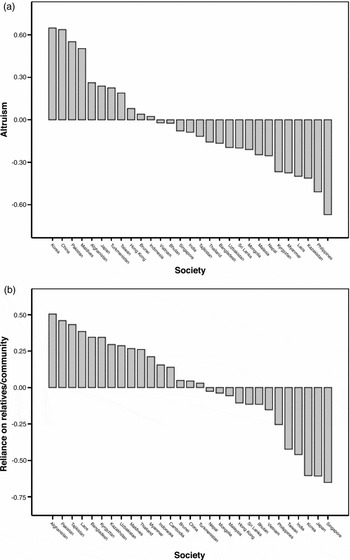
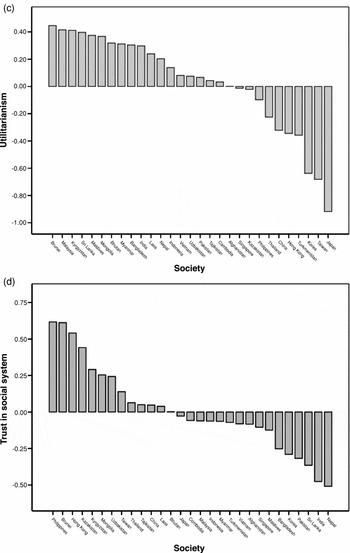
The second step of analysis was the aggregation of the four factors by society. In this paper, we averaged the Bartlett scores of all respondents within each society, that is, each respondent, who responded to all of the chosen questions, was assigned four Bartlett scores, each corresponding to one of the four dimensions of PCA; we then took societal averages of each score category. Thus, each one of the 29 societies ended up with four scores, one for each dimensional component.
In short, the aggregation process allows us to quantifiably compare the 29 societies by one of the four dimensional components – altruism, utilitarianism, communitarianism (reliance on relatives/community), and concordance with prevailing regime (trust in social system).
From the figures, it is easy to see some form of geographical and cultural traits. Groups of neighboring societies and of societies that share some major aspects of culture seem to manifest similar contours of social capital, which is in other words, similar orientations (or balances) of the four dimensional components of social capital. Fukuyama (Reference Fukuyama1995) sees social capital in terms of existence of a certain, specific set of informal values or norms shared among members of a group that permit cooperation among them, and, in this respect, it is not strange to expect societies with similar cultural heritage to form state groups that have distinct social capital traits.
Instead of trying to group the societies by inspection, we then chose to employ hierarchical cluster analysis (HCA) to the 29 societies, using the four score categories. For our purpose, we used the Ward Method and squared Euclidean distance. The shape of the resulting dendrogram helped us to group the 29 societies into roughly seven clusters:
1 Japan, Taiwan, Korea
2 Pakistan, Afghanistan, Maldives
3 China, Turkmenistan
4 Singapore, India, Sri Lanka, Nepal
5 Brunei, Malaysia, Indonesia, Vietnam, Bhutan, Mongolia
6 Hong Kong, Philippines
7 The rest (Thailand, Kazakhstan, Uzbekistan, Tajikistan, Cambodia, Bangladesh, Kyrgyzstan, Laos, Myanmar)
There are a number of interesting points in this grouping. For example, the fact that Japan, Taiwan, and Korea make up one group is no surprise, given many similarities shared by the three societies. Not only are they geographically positioned as the furthest of the Far East, they share in common the history of intensely adopting the Zhu-zi school of Confucianism (up until the modern period) and of being part of the same empire in the early twentieth century. The group ranks high in terms of altruism but low in terms of both communitarianism and utilitarianism, and there is possibly a strong influence of the Confucian (and also militaristic) aspect of self-management and virtue. In this school of thought, respectable adults should not be in the situation of having to beg for communal help, because people with good self-management ought to be able to overcome almost any form of disasters; moreover, it is believed that virtuous people do not have to ask for help, since they would be helped by other people of good virtue (communal or not) before they ask for help. Of course, the level of altruism in this group is relatively high, as altruism directly reflects the level of individual virtue; in contrast, the service-for service, money-for-money notion of utilitarianism is greatly looked down upon in such culture.
(a) 29 societies ranked by the altruism component (b) 29 societies ranked by the communitarianism (reliance on relatives/community) component.

(c) 29 societies ranked by the utilitarianism component (d) 29 societies ranked by the trust in social system (concordance with prevailing regime) component.

The Pakistan, Afghanistan, and the Maldives group seems to be geographically, ethnically, and religiously constructed; this group ranks high in both altruism and communitarianism but low in the level of concordance with prevailing regime. The altruist and communitarianist aspects could possibly be stemming from the teachings of Islam. Included in the Five Pillars (most important duties) is the Zakat, which is the Islamic concept of mandatory tithing and alms to specified categories within each Muslim's community; there is also the Sadaqah, the non-mandatory version of Zakat. Meanwhile, the low level of concordance with prevailing regime may be reflecting the relative position of Islam over government regimes, as well as the low level of democracy and political stability in the region.
The Singapore, India, Sri Lanka, and Nepal group strongly reflects the colonial British influence (it is worth mentioning that Bangladesh came close to entering this group). This formerly British group ranks low on communitarianism and concordance with prevailing regime. However, despite the Anglosaxon influence, Hong Kong and the Philippines differs from the previous British group, in that their group ranks high in terms of concordance with prevailing regime, despite a similarly low level of communitarianism. The low level of communitarianism among these two groups may be partially explained by Protestant work ethics, Western individualism, self-achievement, and emphasis on retirement and insurance systems (both of which one needs to prepare in advance). The major difference in their levels of trust in social systems should be attributed to greater gender equality in Hong Kong and the Philippines as compared to societies in the formerly British group.
China and Turkmenistan are interesting in that the people strongly emphasize altruistic values, but differ from the Japan group in that they are not too low in terms of communitarianism. The other two groups are noteworthy for ranking low in terms of altruistic values. The Brunei group, consisting of the eastern Southeast Asian countries plus Mongolia and Bhutan, is more oriented towards utilitarianism, while the Thailand group, consisting of the western Southeast Asian countries and four Central Asian ‘stan’ countries, is more oriented towards reliance upon the community.
Future enhancements
We believe that this paper serves as one answer to the problem of measuring social capital. The psychometric approach employed in this paper is simple, but yet, considering the largely psychological aspect of social capital, this approach should serve as one general model of measuring social capital, at least for the next decade. Of course, PCA and HCA could give way to other statistical methods, such as categorical PCA, Hayashi's Quantification Method III, discriminant analysis, and logistic regression analysis, and survey questions may change. Nonetheless, the concept of applying statistical tools to large-scale social survey data should remain more or less unchanged.
From this aspect, this paper will not directly lead to further innovations in psychometric or survey techniques. However, instead, this paper leaves ample room for other enhancements. First, there is room for contextual analysis of the above societal groups, which consist of societies that share similar social capital contours, and even the most minimal requirement for a good understanding of the groups would be thorough examinations from economic, historical, political, ethnical, and religious aspects. Little is known about Asian societies, especially when viewed in terms of subregions and cultural groups. Second, there are infinite possibilities in terms of the scope of analysis. This paper has focused on the 29 societies surveyed in AsiaBarometer, but similar psychometric approach can be applied to other regions of the world. Moreover, we need not limit ourselves to the country-state level. There are a number of smaller groups, of which individuals are members, left for us to analyze. Take for example, cities, villages, community religious groups, political parties, etc. Possibilities are infinite. Finally, we should also mention that this paper has not gone beyond the scope of measuring social capital. As seen in researches by Putnam, Fukuyama, and Kawachi, the study of social capital is most interesting when it is compared and contrasted with some other quantifiable (or claimed-to-be-quantifiable) factors, such as health, democracy, prosperity, crime, development, and environment. Again, there are infinite possibilities.
As such, we have good reason to believe that this paper is significant, with its psychometric implication and with its timing and scale as the first systematic empirical analysis of social capital in all the subregions of Asia, but significant to the extent that it is only the beginning to the end that does not exist.