


Introduction
Aggression arises from individuals competing for access to limited resources such as food, shelter, territories, and potential mates. In nature, disputes are often resolved without escalated fighting, and target individuals can avoid receiving aggression by respecting territorial boundaries or dominance signals and moving away from the aggressor. However, the limited space available in captivity can stimulate aggressive behaviour and individuals cannot escape, making it easier for dominant individuals to deliver attacks to subordinate individuals (Mandrekar & Oldfield Reference Mandrekar and Oldfield2008). Such increased aggression in captivity may lead to severe wounding and even death of individuals that are the target of aggression (Van Loo et al. Reference Van Loo, Kruitwagen, Koolhaas, Van De Weerd, Van Zutphen and Baumans2002; Alcazar et al. Reference Alcazar, Becker, Hilliard, Kent and Fernald2016; Theil et al. Reference Theil, Ahloy-Dallaire, Weber, Gaskill, Pritchett-Corning, Felt and Garner2020). In addition, chronic low-intensity aggression and the constant threat of attack can trigger physiological and behavioural stress responses, suggesting that aggression may contribute to prolonged stress and negative affective states. Therefore, strategies to reduce the aggression and minimise its negative consequences are vital for both animal welfare and high quality scientific research in laboratory animals (Honess & Marin Reference Honess and Marin2006; Weber et al. Reference Weber, Zidar, Ewaldsson, Askevik, Udén, Svensk and Törnqvist2023; Soper & Dijkstra Reference Soper and Dijkstra2026).
Physical enrichment (PE) is a form of environmental enrichment referring to tangible objects and materials added to housing for captive animals (Olsson & Dahlborn Reference Olsson and Dahlborn2002; Young Reference Young2013; Jones et al. Reference Jones, Webster and Salvanes2021). PE, also referred to as structural enrichment, includes shelters, substrates, platform, tubing, climbing structures, and other tangible, habitat-modifying objects (Mellen & MacPhee Reference Mellen and MacPhee2001; Williams et al. Reference Williams, Readman and Owen2009). PE is distinguished from other enrichment types, such as social, sensory, and cognitive enrichment by its emphasis on the physical properties of the enrichment rather than social aspects or sensory stimulation per se. Animals provided with PE often experience benefits, as indicated by greater neurological development, behavioural plasticity, and disease resistance than animals without enrichment (Nilsson et al. Reference Nilsson, Perfilieva, Johansson, Orwar and Eriksson1999; Olsson & Sherwin Reference Olsson and Sherwin2006; Salvanes et al. Reference Salvanes, Moberg, Ebbesson, Nilsen, Jensen and Braithwaite2013). Accordingly, enrichment is now widely regarded as an essential component of captive housing environments (Benefiel et al. Reference Benefiel, Dong and Greenough2005; Young Reference Young2013).
Although PE is generally thought to enhance the welfare of captive animals, the provision of PE can also stimulate competitive interactions and increase the severity of aggression in many animal species, since enrichment can be perceived as a valuable, limited resource (Kaliste et al. Reference Kaliste, Mering and Huuskonen2006; Wilkes et al. Reference Wilkes, Owen, Readman, Sloman and Wilson2012; Giles et al. Reference Giles, Whitaker, Moy and Fletcher2018) (Figure 1[a]). In zebrafish (Danio rerio), three studies found less aggression in enriched environments (Basquill & Grant Reference Basquill and Grant1998; Carfagnini et al. Reference Carfagnini, Rodd, Jeffers and Bruce2009; Keck et al. Reference Keck, Edgerton, Hajizadeh, Swift, Dupont, Lawrence and Boyd2015), but three others reported more aggression in enriched environments (Bhat et al. Reference Bhat, Greulich and Martins2015; Suriyampola et al. Reference Suriyampola, Sykes, Khemka, Shelton, Bhat and Martins2017; Woodward et al. Reference Woodward, Winder and Watt2019). The role of enrichment in aggression has been particularly well-studied in laboratory mice (Mus musculus) (Olsson & Dahlborn Reference Olsson and Dahlborn2002; Van Loo et al. Reference Van Loo, Van Zutphen and Baumans2003; Theil et al. Reference Theil, Ahloy-Dallaire, Weber, Gaskill, Pritchett-Corning, Felt and Garner2020; Weber et al. Reference Weber, Zidar, Ewaldsson, Askevik, Udén, Svensk and Törnqvist2023). For example, nesting materials can reduce aggression in group-housed male mice but shelters, running wheels and cage dividers can increase aggressive behaviour and harm well-being (Van Loo et al. Reference Van Loo, Kruitwagen, Koolhaas, Van De Weerd, Van Zutphen and Baumans2002; Howerton et al. Reference Howerton, Garner and Mench2008; McQuaid et al. Reference McQuaid, Audet and Anisman2012). These contradictory effects of PE raise the question of whether enrichments should be added, and if so, in what manner they should be implemented.
In this perspective, we will outline a framework for studying the effect of PE on behaviour and animal welfare. We will describe how resource defence theory can clarify variation in territorial disposition and the intensity of aggressive behaviour based on the quality, density and distribution of defendable resources (Maher & Lott Reference Maher and Lott2000). As welfare outcomes depend not only on the presence of aggression but also on how aggression is distributed among performers and recipients within the group, we further argue that detailed quantification of social interactions is essential. We then describe specific mechanisms through which PE may mitigate negative welfare outcomes, such as increasing opportunities for conflict avoidance, and redirecting attention toward alternative activities. Distinguishing among these mechanisms provides a roadmap for designing targeted experiments that isolate how specific enrichment properties (e.g. distribution, size, dimension, materials, and placement) mediate aggression, behaviour, and welfare. Although our perspective is primarily informed by laboratory animal research, we propose that our framework is broadly applicable to captive animals, including those housed in zoo and farm settings.
The effect of PE on territorial behaviour and dominance hierarchy organisation: A conceptual framework
Many group-living animal species form linear dominance hierarchies, defined as relatively stable, transitive rank-order relationships (Drews Reference Drews1993). High social rank or social dominance is often associated with territoriality (Gesquiere et al. Reference Gesquiere, Learn, Simao, Onyango, Alberts and Altmann2011; Dijkstra & Border Reference Dijkstra and Border2018; Strauss et al. Reference Strauss, Curley, Shizuka and Hobson2022). Territoriality involves the active exclusion of competitors from a fixed space or discrete resource (Maher & Lott Reference Maher and Lott1995). Dominance, by contrast, is a relative measure referring to asymmetries in competitive ability that confer priority access to resources without necessarily involving defence of a fixed area (Drews Reference Drews1993). These two concepts often overlap, as social dominant individuals often maintain territory. However, in some species (e.g. non-human primates, chickens, sows, cattle), social dominance is not necessarily linked to permanently defended territories (Beisner et al. Reference Beisner, Jackson, Cameron and McCowan2011; Maffezzini et al. Reference Maffezzini, Turner, Roehe and D’Eath2026). In these situations, aggression is used to establish and maintain dominance relationships, and high-ranked individuals may show transient aggression to gain access to feeders, resting places, or toys (Foris et al. Reference Foris, Thompson, von Keyserlingk, Melzer and Weary2019). Territoriality and social dominance are maintained or defined by different mechanisms: territorial aggression is primarily shaped by resource attributes as outlined below, whereas dominance hierarchies rely on individual recognition, threat signals, punishment, and self-reinforcing asymmetries rather than spatial defence per se (Tibbetts et al. Reference Tibbetts, Pardo-Sanchez and Weise2022). In captive groups, PE may influence both territoriality and dominance relationships by providing monopolisable or value-increasing assets that reinforce or destabilise social rank relationships. We will begin by discussing the economic defensibility of resources, focusing on how enrichment attributes may promote territoriality. We then examine how territorial and non-territorial aggression shape dominance hierarchies, with implications for understanding PE-mediated effects on aggression and welfare outcomes.
The emergence of territoriality: Resource defence theory
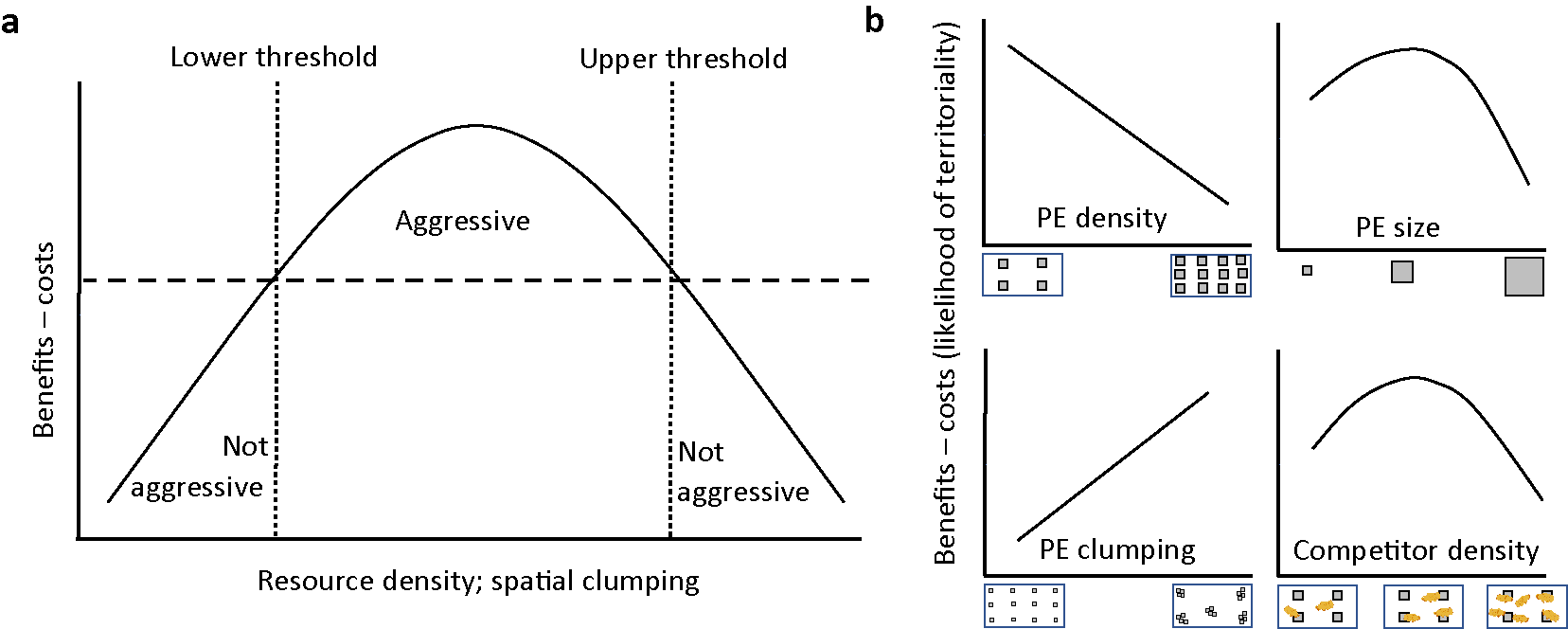
Resource defence theory predicts that defending a resource is favoured only when the benefits outweigh the costs of defending it against competitors. These costs include injury, predation, time lost from exploiting resources, and energetic expenditure (Gill & Wolf Reference Gill and Wolf1975; Calsbeek & Sinervo Reference Calsbeek and Sinervo2002). The benefits of territorial defence, in turn, depend on the value of the resource to the individual relative to resource quality and the degree to which it is limited (Elwood et al. Reference Elwood, Wood, Gallagher and Dick1998; Dijkstra et al. Reference Dijkstra, van der Zee and Groothuis2008). This cost-benefit framework provides clear predictions about how resource attributes, such as quality, density and patchiness, shape (a) the emergence of territorial behaviour, (b) the intensity of territorial aggression, and (c) how space or resources are partitioned among individuals (Figure 2). Although food is the most commonly studied resource, other resource types, including shelter, mating sites, and nest sites are equally subject to economic defence (Maher & Lott Reference Maher and Lott2000). Resource defence theory therefore applies readily to enrichment items such as rocky outcrops, PVC pipes, or artificial caves (Calsbeek & Sinervo Reference Calsbeek and Sinervo2002; Akre et al. Reference Akre, Bakken, Hovland, Palme and Mason2011; Dijkstra et al. 2024b).
At any given density of competitors, aggression is expected to follow an inverted-U relationship with resource density (Grant Reference Grant1993) (Figure 2). When PE is absent or sparse, no discrete high-value resource exists, and territorial defence is not favoured (Grant Reference Grant1993). Similarly, when PE density is very high, resources are readily available and difficult to monopolise, reducing the net benefit of defence (Brown Reference Brown1964; Carpenter & Macmillen Reference Carpenter and Macmillen1976). In contrast, at intermediate PE density, the benefits of defence exceeds its costs, and an individual may assume a territorial disposition and aggressively exclude competitors (Carpenter & Macmillen Reference Carpenter and Macmillen1976; Wyman & Hotaling Reference Wyman and Hotaling1988). A similar relationship is predicted to occur between resource distribution (i.e. clumping) and territoriality (Grant Reference Grant1993; Maher & Lott Reference Maher and Lott2000) (Figure 2). When resources are uniformly distributed or minimally clumped, no discrete high-value resources exist and defence is not favoured. Intermediate clumping creates discrete high-value patches, favouring territorial defence. However, when clumping becomes extreme, resources grow too large to be effectively monopolised, decreasing the net benefit of territoriality. This may occur because larger patches attract disproportionately more intruders (Grant Reference Grant1993), and because large patches become increasingly difficult to patrol, making the effective exclusion of competitors prohibitive.
Welfare-focused studies have largely overlooked insights from resource defence theory (but see Näslund & Johnsson Reference Näslund and Johnsson2016), which could in part explain the confusion that exists relative to the effect of enrichment on aggression and welfare (Van Loo et al. Reference Van Loo, Van Zutphen and Baumans2003; Oldfield Reference Oldfield2011; Ruberto et al. Reference Ruberto, Swaney and Reddon2024). In a study in laboratory mice, various PE items (including a plastic house, running wheel, and wood-shaving for bedding) were either dispersed or clustered, and as predicted by resource defence theory, aggression was higher (and welfare outcomes lower based on glucocorticoid levels) in the clustered enrichment treatment where the increased resource value and defendability promoted territorial defence (Akre et al. Reference Akre, Bakken, Hovland, Palme and Mason2011). More broadly, the apparently contradictory effects of PE on aggression reported across studies (Olsson & Dahlborn Reference Olsson and Dahlborn2002; Van Loo et al. Reference Van Loo, Van Zutphen and Baumans2003) may reflect unmeasured variation in PE density, distribution, and quality.
Although resource defence theory traditionally frames aggression as a response to discrete, defendable resources, animals in confinement may also exhibit aggression and engage in fights for social dominance even in the absence of such resources (e.g. a barren enclosure). While such aggression may arise from behavioural restriction or pathological behavioural states resulting from insufficient enrichment (Honess & Marin Reference Honess and Marin2006), it is important to recognise that space itself can function as a defendable resource (Herberholz et al. Reference Herberholz, McCurdy and Edwards2007; Oldfield et al. Reference Oldfield, Thal, Das, Zarlinga, Lukas and Wark2023). In captive environments, space is more limited and therefore more easily monopolised than in the wild (though additions of PE may further increase aggression).
Applying resource defence theory to PE design, territoriality, shape of the dominance hierarchy, and welfare outcomes
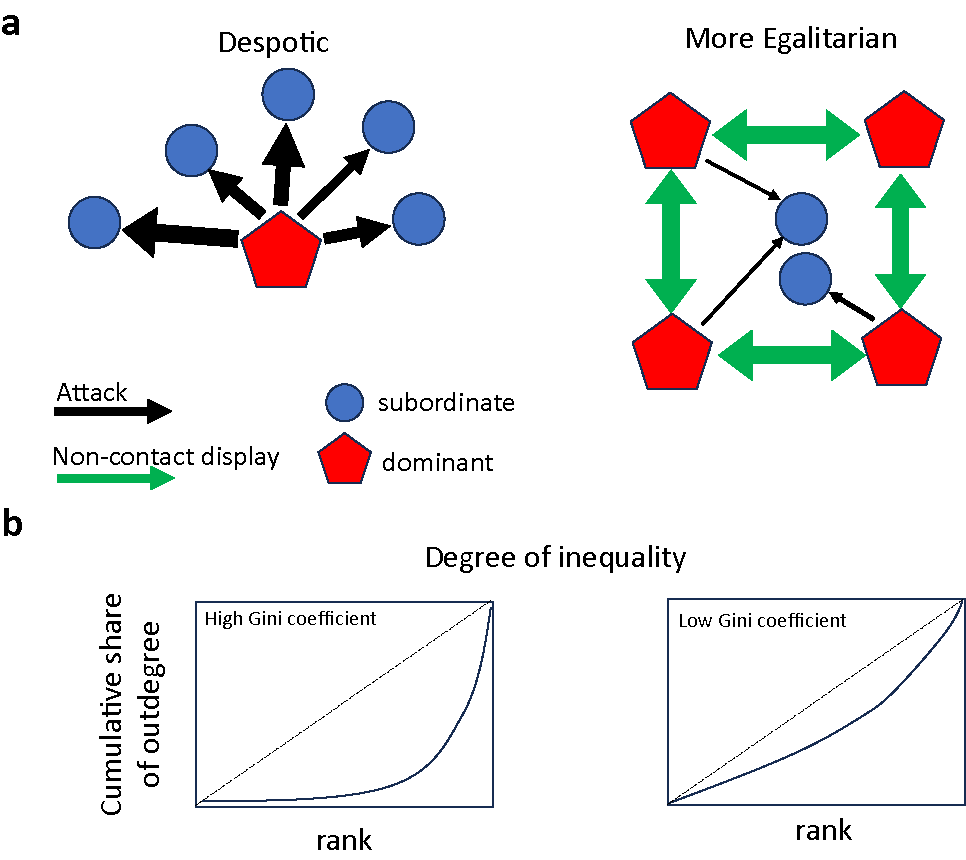
Although resource defence theory addresses how ecological conditions favour territorial defence, its predictions may also help explain how the design of PE influences the dominance hierarchy, with important implications for animal welfare. For example, when a single, large structure may be effectively monopolised, the hierarchy becomes despotic with aggression chronically directed to lower-ranking group members, resulting in poor welfare outcomes. In contrast, when enrichment structures are distributed across multiple defendable patches, the cost of monopolisation by a single individual may become prohibitive. This allows several high-ranking individuals to coexist, producing a more egalitarian social configuration, which is associated with more even distribution of aggression across group members, reduced risk of chronic victimisation, and possibly improved welfare outcomes (Figure 3).
Quantifying dominance relationships and hierarchy
While resource defence theory predicts when and where territorial aggression is expected to emerge, understanding the welfare consequences of PE requires a more detailed characterisation of how aggression is organised within the group (Howerton et al. Reference Howerton, Garner and Mench2008). For example, is the burden of aggression shared equally, or are there chronic targets? Are aggressive interactions escalated or mild? Addressing these questions requires characterising aggression in terms of (1) the frequency and intensity of aggression, (2) the distribution of aggression performed and received, (3) linearity and stability of rank relationships, and (4) the group-level organisation of aggression networks. Several examples of key measures of hierarchy configuration and aggression are summarised in Table 1 and will be discussed below.
Summary of representative metrics for characterising dominance hierarchy and distribution of aggression; this list is not exhaustive

Table 1. Long description
Table showing different measures of prominence, equality, and social organization.
1 Because Gini coefficients are rank-independent, they are well suited to quantifying inequality in groups with non-linear or stratified dominance hierarchies (e.g. distinct dominant and subordinate classes). However, in most situations both measures are useful since they provide distinct information about hierarchy configuration and the distribution of aggression.
Aggression can vary both in frequency and intensity, and both dimensions matter in terms of welfare outcomes. High-intensity, escalated fighting increases injury risk and compromises welfare relative to low-intensity attacks or non-contact display behaviours (Dijkstra & Border Reference Dijkstra and Border2018; Tibbetts et al. Reference Tibbetts, Pardo-Sanchez and Weise2022). Quantifying the rate of aggression performed or received allows identification of particularly aggressive individuals or vulnerable targets who bear a disproportionate burden of aggression (Kawakatsu et al. Reference Kawakatsu, Chodrow, Eikmeier and Larremore2021). Network measures, such as centrality (Table 1), extend this by capturing not just how much aggression an individual performs or receives, but how broadly it is distributed across group members (e.g. it quantifies whether a dominant targets many individuals or concentrates aggression on just a few chronic victims).
In the previous section we discussed how PE attributes can organise the dominance hierarchy, promoting more despotic or egalitarian societies depending on the distribution and patchiness of defendable resources. Despotism is defined by some as groups with a single alpha male (Sasaki et al. Reference Sasaki, Penick, Shaffer, Haight, Pratt and Liebig2016) but here we treat ‘despotism’ and ‘egalitarian’ like a gradient or continuum of power distribution across group members reflected in the steepness of the dominance hierarchy (Kaburu & Newton-Fisher Reference Kaburu and Newton-Fisher2015). Steep, despotic hierarchies are characterised by large differences in winning ability and access to resources between adjacent ranks, whereas shallower, more egalitarian hierarchies involve smaller dominance differentials and more equitable access to resources (De Vries et al. Reference De Vries, Stevens and Vervaecke2006; Kaburu & Newton-Fisher Reference Kaburu and Newton-Fisher2015). The degree of despotism can be quantified using hierarchy steepness, defined as the gradient of dominance differentials (De Vries et al. Reference De Vries, Stevens and Vervaecke2006), as well as inequality indices such as the Gini coefficient (Wittebolle et al. Reference Wittebolle, Marzorati, Clement, Balloi, Daffonchio, Heylen, De Vos, Verstraete and Boon2009; McDonald & Shizuka Reference McDonald and Shizuka2012; Table 1). These measures of despotism or dominance inequality are widely used in the behavioural ecology literature (Kaburu & Newton-Fisher Reference Kaburu and Newton-Fisher2015; Dijkstra et al. Reference Dijkstra, Piefke and Bonnell2022; Huang et al. Reference Huang, Arlet, Balasubramaniam, Beisner, Bliss-Moreau, Brent, Duboscq, García-Nisa, Kaburu, Kendal, Konečná, Marty, McCowan, Micheletta, Ostner, Schülke, Schino and Majolo2024). Although group-level hierarchy properties, such as dominance linearity, are sometimes considered in welfare research (Spratt et al. Reference Spratt, Spratt, Bauman and Chandler2019; Oldfield et al. Reference Oldfield, Thal, Das, Zarlinga, Lukas and Wark2023), direct quantitative measures of despotism remain under-utilised and could be more broadly applied in enrichment and animal welfare studies.
More egalitarian dominance hierarchies are often associated with improved welfare, although the extent of these benefits depends on the intensity of aggressive interactions and the predictability of social relationships. The behavioural style with which dominance is expressed can vary markedly between species and context. For example, in many cichlid species, dominant individuals direct high-intensity aggression to subordinate males and females (Huffman et al. Reference Huffman, Mitchell, O’Connell and Hofmann2012). In contrast, in some non-human primates, hierarchies may be steep, yet dominant individuals show considerable tolerance to subordinates and escalated aggression is relatively rare (Kaburu & Newton-Fisher Reference Kaburu and Newton-Fisher2015). Further, more linear hierarchies, in which rank relationships are consistent and transitive (A > B, B > C, A > C) are generally associated with hierarchy stability. This increased predictability may reduce stress and the need for escalated fighting (McDonald & Shizuka Reference McDonald and Shizuka2012; Williamson et al. Reference Williamson, Lee and Curley2016b). By contrast, reduced linearity and higher levels of reciprocal aggression (A > B, B > A) can indicate that rank relationships are unresolved and conflicts are escalating. However, reciprocity does not always reflect instability, and it could simply be the result of a flatter hierarchy in which subordinates may retaliate and occasionally challenge dominants. In some cichlid species, reciprocal interactions may primarily consist of symmetrical non-contact display behaviours used to negotiate territorial boundaries, and may therefore be associated with reduced escalated aggression directed to subordinates despite high overall aggression rates (Maguire et al. Reference Maguire, DeAngelis, Dijkstra, Jordan and Hofmann2021). Temporal stability in the dominance hierarchy can also be quantified using Pearson r correlation between successive dominance matrices (Piefke et al. Reference Piefke, Bonnell, DeOliveira, Border and Dijkstra2021) (Table 1). More stable hierarchies, as noted above, are typically characterised by predictable social interactions and may be linked to reduced chronic stress and improved welfare (Williamson et al. Reference Williamson, Lee and Curley2016b).
The social organisation of groups relative to the degree of fragmentation or density of social connections can influence social dynamics and the distribution of aggression (Rose & Croft Reference Rose and Croft2015; Kleinhappel et al. Reference Kleinhappel, John, Pike, Wilkinson and Burman2016). Interestingly, physical characteristics of the environment are known to shape social network organisation (Jordan et al. Reference Jordan, Maguire, Hofmann and Kohda2016; He et al. Reference Maldonado-Chaparro and Farine2019). Networks characterised by small, tightly bound dominance pockets may concentrate aggression on a few isolated targets, whereas more integrated, denser networks may disperse aggression across multiple individuals, reducing the likelihood that a few individuals become chronic targets. For example, in pigs, larger or more overlapping subgroups (defined as cliques participation rate; Table 1) have been associated with less detrimental chronic aggression, suggesting that network integration may buffer aggression-related welfare costs (Foister et al. Reference Foister, Doeschl-Wilson, Roehe, Arnott, Boyle and Turner2018).
Methodological considerations
The quantitative dimensions described above can be measured using focal observations or social network approaches (Beisner et al. Reference Beisner, Jackson, Cameron and McCowan2011; Makagon et al. Reference Makagon, McCowan and Mench2012). Focal observations involve tracking one individual at the time and recording its behaviour using an ethogram. Aggressive behaviours can be categorised according to the category of the target (e.g. sex, social status) or by recording the individual identity of the target or partner. The latter approach, in which all dyadic interactions are quantified, enables the calculation of steepness measures as well as social network measures, such as centrality and reciprocity. Emerging technologies can further enhance behavioural quantification. For example, proximity loggers and motion-tracking-combined artificial intelligence tools can provide information on social relationships, space use, and hierarchical organisation (Lauer et al. Reference Lauer, Zhou, Ye, Menegas, Schneider, Nath, Rahman, Di Santo, Soberanes, Feng, Murthy, Lauder, Dulac, Mathis and Mathis2022; Yamakawa et al. Reference Yamakawa, Ezaki, Watarai, Kutsukake, Miura and Okuyama2025).
Although the focus here is on dominance interactions, similar quantitative approaches can be applied to submissive behaviours, affiliative relationships, and feeding patterns. In some cases, simple focal observations without exhaustive dyadic data collections (especially difficult in large groups) may be sufficient to characterise dominance inequality or identify bullies or individuals at risk of chronic aggression. Regardless of the method used, it is important to integrate quantitative hierarchy measures with welfare indicators such as injury rate or physiological stress. Interpreting these patterns within a resource defence framework can provide valuable insight into how social and PE properties shape behaviour and welfare in captive animals.
Mechanisms that may reduce harmful aggression
What is harmful aggression?
Aggressive interactions and signaling are not always ‘harmful’ and may in fact benefit individuals by communicating intention and maintaining social roles. Aggressive behaviour comprises physical attacks or threat displays that function to establish or reinforce social dominance and defend resources (Tibbetts et al. Reference Tibbetts, Pardo-Sanchez and Weise2022). Agonistic interactions, which include aggressive and submissive behaviour, organise dominance hierarchies and stabilise social relationships. For example, in captive groups of pig-tailed macaques (Macaca nemestrina) higher ranked individuals police the group and manage conflicts, thereby improving welfare outcomes such as infant survival and social learning (Flack et al. Reference Flack, de Waal and Krakauer2005, Reference Flack, Girvan, de Waal and Krakauer2006). As fighting is costly (Theil et al. Reference Theil, Ahloy-Dallaire, Weber, Gaskill, Pritchett-Corning, Felt and Garner2020), many species rely on ritualised behaviours or other signals to indicate social status and resolve conflicts without escalation. In rodent and fish species, visual signals, olfactory cues, and acoustic displays play central roles in mediating dominance relationships, highlighting that social hierarchies are not only maintained solely by overt or physical aggression (Van Loo et al. Reference Van Loo, Kruitwagen, Van Zutphen, Koolhaas and Baumans2000; Barata et al. Reference Barata, Hubbard, Almeida, Miranda and Canário2007; Ebbesen & Froemke Reference Ebbesen and Froemke2021; Grijseels et al. Reference Grijseels, Lemazina, López-Jury and Barker2024).
Furthermore, animals may effectively cope with competitive challenges they encounter. Animals may find shelter, signal submission to dominant individuals, find social support, or adapt physiologically to overcome potential negative consequences of subordination. For example, in pigs, dominant individuals visited feeders more frequently than subordinate individuals, yet subordinates adjusted their behaviour to obtain sufficient food and achieved growth rates comparable to dominants (Agha et al. Reference Agha, Fàbrega, Quintanilla and Sánchez2020). Thus, welfare is often compromised not necessarily by the presence of aggression itself, but by an individual’s inability to cope with the associated stressors (Van der Harst & Spruijt Reference Van der Harst and Spruijt2007; Mellor Reference Mellor2016; Arndt et al. Reference Arndt, Goerlich and van der Staay2022). Consequently, opportunities should be provided to support animals’ behavioural and physiological coping strategies, mitigating the potential negative consequences of competitive interactions.
When contests escalate, repeated low-intensity aggression occurs, or if social relationships become unpredictable (i.e. the hierarchy becomes unstable and more stressful) welfare risks increase, particularly for subordinate individuals who are the typical targets of territorial aggression. Animal welfare is a multidimensional concept, encompassing physical, mental, and affective states (Mellor Reference Mellor2016). Aggression can compromise welfare in all these dimensions. Aside from physical injuries or chronic stress, competitive interactions may limit access of lower-ranked individuals to food or water. Aggressive interactions may also force individuals away from the group, preventing them from enjoying the benefits of affiliative relationships and social buffering (Silk Reference Silk2007; MacLeod et al. Reference MacLeod, English, Ruuskanen and Taborsky2023). While social dominance may also entail costs, such as high energetic and cognitive demands (Höjesjö et al. Reference Höjesjö, Johnsson and Bohlin2004; Sapolsky Reference Sapolsky2005; Garratt et al. Reference Garratt, Mcardle, Stockley, Vasilaki, Beynon, Jackson and Hurst2012; Fialkowski et al. Reference Fialkowski, Aufdemberge, Wright and Dijkstra2021), our primary concern in this perspective is the welfare of individuals exposed to aggression.
Mechanisms through which physical enrichment can shape aggression and conflict management
Here, we define how PE influences aggression and welfare through multiple interacting mechanisms. These mechanisms are summarised in Table 2 and visualised in Figures 1(b) and (c).
Mechanisms by which physical enrichment (PE) may improve welfare of subordinate individuals subjected to aggression performed by dominant animals

Table 2. Long description
Table showing different mechanisms regulating the amount of aggression directed to subordinate individuals, including territory properties, attention, and opportunties for social buffering
Physical enrichment (PE) is used to enhance welfare by (a) providing a more stimulating environment and shelter. However, PE may also be aggressively defended, which may negatively affect welfare. Visual of the effect of PE (b) on behaviour and welfare as a function of enrichment attributes. Mechanisms (c) by which PE may improve/shape welfare of subordinate individuals subjected to aggression from territorial or higher-ranked individuals (see Table 2 for description of each mechanism).

Figure 1 Long description
Three panels. (a) Cages show nesting material and shelter as enrichment. Diagram: enrichment increases aggression and welfare outcome; aggression decreases welfare outcome. (b) Flowchart: enrichment attributes (size, density, patchiness/placement) drive resource value, attention motivation, and visual barrier, which promote or suppress aggression performed, leading to aggression received, then coping. Social context (density, neighbors) modulates all three. Aggression received also harms welfare indicators (injuries/mortality, body condition/growth, physiological stress). (c) Five mechanisms shielding subordinates from dominants via enrichment: resource value/attention motivation; more territory owners; territory identification; hiding behind a visual barrier; escape route during attack. Legend: cave=enrichment; pentagon=dominant; circle=subordinate; solid arrow=line of sight; dotted arrow=attention.
Inverted-U relationship between density or distribution of resources (or physical enrichment [PE] objects) (a) and aggression as predicted by resource defence theory. Aggression is predicted to be advantageous when resources are at densities lying between lower and upper thresholds, resulting in territorial behaviour. Similarly, aggression is predicted to be advantageous when clumping/patchiness lies between lower and upper thresholds. Adapted from Grant (Reference Grant1993). Potential predictions (b) derived from resource defense theory relative to PE density, PE clumping, PE size, and competitor density. For example, larger PE objects may enhance resource value but also make it harder to detect intruders and successfully exclude them. Panels in (b) do not show the entire range of physical enrichment attributes, so the relationships shown are segments of the inverted-U in (a).

Figure 2 Long description
Two panels. (a) Line graph, “Benefits − costs” (y-axis) vs. “Resource density; spatial clumping” (x-axis), showing an inverted-U curve. Below a lower threshold and above an upper threshold, benefits−costs falls below a dashed horizontal line and behavior is “Not aggressive.” Between the two thresholds, the curve rises above the line, peaking at “Aggressive,” showing aggression is advantageous only at intermediate resource density/clumping. (b) Four small line graphs, all y-axis “Benefits − costs (likelihood of territoriality)”: “PE density” shows a downward line (small→large icon grids); “PE size” shows an inverted-U (small→large squares); “PE clumping” shows an upward line (scattered→clustered dot icons); “Competitor density” shows an inverted-U (few→many competitor icons). Together these predict how territoriality likelihood changes with enrichment density, size, clumping, and number of competitors.
A simple illustration (a) of how increasing the number of territorial individuals may lead to a less despotic and more egalitarian social configuration. Arrows indicate aggressive behaviours directed to specific group members. Territorial individuals (red) engage in more non-escalated display behaviour with other territorial group members, thereby significantly reducing the frequency of harmful attacks to subordinate individuals (blue). More inequality or higher level of despotism is (b) linked to higher Gini coefficients. Shown are hypothetical Lorenz curves illustrating the distribution of outdegree (number of attacks performed) from lowly to highly ranked individuals.

Figure 3 Long description
Two panels. (a) Diagrams contrast a “Despotic” structure, where one dominant attacks multiple subordinates, with a “More Egalitarian” structure, where several dominants exchange non-contact displays with each other and direct fewer attacks to subordinates. (b) Two Lorenz curve graphs of cumulative share of outdegree by rank: a “High Gini coefficient” curve bowed sharply (unequal, despotic), and a “Low Gini coefficient” curve near the diagonal (more equal chase distribution).
First, building on the resource defence framework discussed above, PE design influences both the value of the resource and the cost and benefits of territorial defence. For example, smaller or less complex enrichments may be valued less by dominant individuals and elicit less aggression, whereas structures that are too large or complex to defend effectively may increase defence costs and reduce territorial aggression (Figure 2[b]).
Secondly, more complex PE may support the coexistence of a higher density of territorial individuals because of greater availability of defendable objects and/or increased delineation of territorial boundaries, resulting in a dominance hierarchy that is less despotic. This increase in number of territorial or highly ranked individuals may result in reduced escalated fighting and increased welfare because territorial males are engaged in more aggressive displays with territorial neighbours, reducing the time available to direct harmful aggression to subordinates. We note that the effect of PE complexity or density depends on both competitor density (group size) as well as space since these factors determine how limited (and valuable) resources are as well as the cost and benefits of defence. There are also species- and context-specific patterns; for example, in laboratory mice, captive groups are often linearly organised with typically a single clear alpha male (Williamson et al. 2016a), though multiple territorial individuals may coexist in larger enclosures (Crowcroft Reference Crowcroft1955).
Thirdly, PE items may reduce the frequency or intensity of aggression or provide opportunities for potential targets of aggression to avoid conflict. This can happen in two different ways: (1) PE may limit visual contact which reduces opportunities for dominant individuals to direct aggression to target individuals (Clayton Reference Clayton1987; Imre et al. Reference Imre, Grant and Keeley2002; Tallent et al. Reference Tallent, Law and Lifshitz2024). Visual exposure to competitors is also known to incite aggression and even raise androgen levels (which may promote aggressive behaviour), and blocking visual contact may cause neurophysiological changes that reduce aggression in dominant individuals. (2) PE can provide shelters where animal can retreat, be out of line-of-sight to avoid conflict (Kaliste et al. Reference Kaliste, Mering and Huuskonen2006; Carfagnini et al. Reference Carfagnini, Rodd, Jeffers and Bruce2009), escape from aggressors (Froberg-Fejko & Lecker Reference Froberg-Fejko and Lecker2013), or engage in affiliate interactions (which may improve social buffering and increased stress coping).
Fourthly, PE may help identify territories and their owners, which enables other animals to respect territorial boundaries, reduces the risk of attack, and stabilises the dominance hierarchy. Group members learn to recognise the owner of a clearly identifiable resource (defendable physical structure such as a rocks or PVC pipe) (Kallenberg Reference Kallenberg1958; Blanchet et al. Reference Blanchet, Dodson and Brosse2006). In addition, PE enhancements, such as plants, dividers, or substrate, can be used as visual landmark that delineate territorial boundaries (Breau & Grant Reference Breau and Grant2002; Van Staaden & Smith Reference Van Staaden and Smith2011).
Fifthly, although more complex enrichments may heighten aggression in dominant individuals by increasing resource value, they can also redirect attention toward exploration or interaction with the PE itself, or with additional PE in the environment (Galhardo et al. Reference Galhardo, Correia and Oliveira2008). In laboratory mice, dominant males may aggressively monopolise shelters, but the provision of nesting material has been shown to reduce harmful aggression by shifting attention and motivation toward alternative rewarding activities such as nest building (Van Loo et al. Reference Van Loo, Kruitwagen, Koolhaas, Van De Weerd, Van Zutphen and Baumans2002). Enrichment studies in non-human primates similarly indicate that providing foraging devices, or objects that promote cooperative behaviours, can redirect attention away from aggression (Richardson Reference Richardson2024). These findings support the idea that diversion of attention toward alternative motivational activities is an important mechanism linking enrichment to welfare outcomes.
Sixthly, research in laboratory rodents indicates that enrichment influences affective states, as indicated by changes in exploratory tendencies, sensation seeking, and social learning (Peña et al. Reference Peña, Nestler and Bagot2019; Malone et al. Reference Malone, Shaykin, Stairs and Bardo2022). Enrichment can also influence physiological states, such as the activity of the hypothalamic-pituitary adrenal axis (Belz et al. Reference Belz, Kennell, Czambel, Rubin and Rhodes2003) or redox homeostasis (Dijkstra et al. Reference Dijkstra, Buzinski, Beyett, Hager and Maes2025). Since these physiological and neurocognitive states shape social interactions, enrichment can indirectly influence dominance hierarchy formation and alter the balance between aggression, conflict avoidance, and tolerance within groups (Lehmann & Herkenham Reference Lehmann and Herkenham2011). A related process is social buffering, in which the presence or proximity of a familiar conspecific reduces stress reactivity and increases the ability to cope with challenges (DeVries et al. Reference DeVries, Glasper and Detillion2003; Denommé & Mason Reference Denommé and Mason2022). PE design may facilitate affiliative contact or safe proximity, e.g. by providing shared spaces where individuals can seek companionship. By reducing stress, promoting positive affective states, and enhancing opportunities for social buffering, PE may lower the likelihood of escalation and improve coping with social challenges.
Importantly, the mechanisms outlined here are not mutually exclusive and may act simultaneously within the same enrichment context. In laboratory mice, partial dividers reduced aggression and improved welfare (Tallent et al. Reference Tallent, Law and Lifshitz2024). Partial dividers likely facilitated delineation of space, reduced visual contact between competitors, and increased opportunities for subordinates to avoid conflict. Given the complex interaction between PE, territorial aggression, and conflict avoidance (Figure 1[b]), more research is needed to understand how enrichment modulates the severity of aggression and opportunities for individuals to avoid or cope with conflict. These insights can then be used to develop PE strategies that allow animals to express their natural social behaviours but also mitigate potential negative welfare effects in individuals that are the target of territorial aggression.
Recommendations for future studies on enrichment, aggression, and welfare
Several frameworks have been proposed to guide the study of environmental enrichment effects on animal welfare, often highlighting different dimensions such as physical enrichment properties, ecological relevance, the timing of providing enrichment, and the social environment (Jones et al. Reference Jones, Webster and Salvanes2021). While these approaches are useful, here we discuss aspects of PE that more fundamentally pertain to resource defence and opportunities for conflict avoidance. We call for more carefully controlled experimental approaches aimed at clarifying specific effects of PE on behaviour and welfare. This requires careful manipulation of specific PE attributes.
Building on the mechanism outlined earlier (Table 2) we propose three interconnected PE design strategies that may help reduce the harmful consequences of aggression in captive settings:
-
(1) Reduce opportunities for monopolisation and increase the cost of territorial defence, for example by distributing PE items across multiple equivalent locations or by using large enrichments that are less economically defendable. Such configurations may promote more egalitarian social systems, reduce the emergence of highly despotic hierarchies, and enhance hierarchy stability.
-
(2) Create visual barriers and shelter that reduce exposure to aggression from higher ranked individuals and facilitate social buffering. Such features may also increase the cost of territorial defence by limiting the ability to detect and exclude intruders.
-
(3) Redirect attention and motivation away from aggressive interactions toward other alternative, positively motivated behaviours, such as exploration or manipulation of enrichment materials.
PE attributes that may influence behaviour and welfare
The following enrichment attributes need to be explored, which we organise based on primary drivers of PE affecting territoriality, social organisation, and conflict avoidance (density, patchiness, placement), modifiers (size or dimension, materials used), and context (space, social environment).
Primary drivers
-
(1) Density of PE may influence resource value, particularly when a single defendable zone contains multiple enrichment items, as well as opportunities for hiding. The behavioural consequences of PE density depend on group density, as the number of individuals competing per enrichment item determines whether PE becomes limiting and defensible (Grant et al. Reference Grant, Gaboury and Levitt2000).
-
(2) Patchiness of PE. Increased patchiness, where objects are more clustered or compact, may raise resource value and alter defendability of localised patches (Calsbeek & Sinervo Reference Calsbeek and Sinervo2002). Increased patchiness or complexity may also redirect attention away from territorial defence (e.g. through increased PE inspection) and create opportunities for hiding.
-
(3) Placement of PE. The placement of defendable objects may influence how they are valued and defended, and can greatly shape social organisation (He et al. Reference Maldonado-Chaparro and Farine2019). For example, PE placed in the corner of an enclosure may be easier to defend than centrally located objects, potentially increasing resource value and promoting territorial behaviour. Strategic placement of enrichment may help define territorial boundaries, allowing lower-ranked individuals to avoid unnecessary intrusions, and facilitating stable spatial relationships between territorial neighbours. When defendable objects are placed in proximity, interactions between neighbouring or high-ranking individuals may increase or decrease (Carazo et al. Reference Carazo, Font and Desfilis2008; Dijkstra et al. Reference Dijkstra, Buzinski, Beyett, Hager and Maes2025) altering patterns of welfare-compromising aggression to subordinate individuals. Other factors worth exploring include the orientation or angle of PE and its proximity to feeding locations. Placement of PE may also influence opportunities for hiding and avoiding conflict.
Modifiers
The structural complexity of PE can modify how it affects behaviour and welfare. PE complexity is often defined as habitat complexity with variable arrangements of the same or different objects throughout an enclosure creating a more physically enriched environment. However, here, we refer to complexity of a single defendable enrichment object or structure, where complexity is determined by the number of physical features, such as parts or textures, hidden or layered elements (e.g. crevices, internal spaces), or potential for change (e.g. flexible). A more complex PE may increase its value as a resource but could also reduce attack rate, as the territory owner may become distracted by the enrichment item (e.g. inspecting the enrichment). Additionally, it may be harder to detect intruders and to reliably exclude them from very complex or large enrichments, increasing the cost of defence and potentially lowering aggression. Separately, visual barriers created by complex structures can provide hiding spots for lower-ranked individuals, offering opportunities for conflict avoidance and social buffering. Overall, PE complexity is influenced by many factors, and some are listed below:
-
(1) Size or dimensions of PEs. Larger structures may have higher perceived value and can intensify territorial aggression, but if one is too large it can be hard to monitor and defend. Structure dimension (size and shape) can also influence the perceived value of the resource (Dijkstra et al. Reference Dijkstra, van der Zee and Groothuis2008; Jones et al. Reference Jones, Gardella and Webster2024), tendency for inspection by the owner, affect visual contact between group members, and create or enhance visual barriers that subordinates can use to avoid conflict.
-
(2) Design of the PE. The internal layout, number of entrances or openings, and the overall geometry of a structure can influence its resource value, defendability, opportunities to avoid aggression, and patterns of use. For example, shelters with a single entrance may be easier for dominant individuals to monopolise (Van De Weerd et al. Reference Van De Weerd, Van Loo, Van Zutphen, Koolhaas and Baumans1998a), whereas structures with multiple openings can offer escape routes for targets of aggression (Kaliste et al. Reference Kaliste, Mering and Huuskonen2006; Froberg-Fejko & Lecker Reference Froberg-Fejko and Lecker2013). Variation in structural design can therefore modulate the organisation of the dominance hierarchy, the likelihood of escalated aggression, and opportunities for conflict avoidance.
-
(3) Materials used for PE. Sensory properties, such as colour and texture, can affect how competitors value or perceive defendable objects (Van De Weerd et al. Reference Van De Weerd, Van Loo, Van Zutphen, Koolhaas and Baumans1998a,b; Wells Reference Wells2009; De Oliveira et al. Reference De Oliveira, De Sousa, Kuhnen and Sanches2019). Studies in non-human primates indicate these properties influence how animals interact with enrichment items (Richardson Reference Richardson2024). Further, colour of defendable object relative to background colour can influence resource value, with higher visual contrast being linked to elevated resource value and defence (Chatfield & Briffa Reference Chatfield and Briffa2025). However, the impact of enrichment material properties on aggression-related welfare outcomes remains largely unexplored.
-
(4) Combination of PE items. Enrichment strategies often involve multiple types of enrichment. The interaction between multiple PE objects may influence aggression and conflict avoidance (Veness et al. Reference Veness, Galichet, Murphy, O’Mahony, Isogai and Amaniti2025). For example, defendable objects, such as shelters, may raise aggression but additional enrichments such as plants may create visual barriers or create a more engaging environment, reducing rates of aggression. Providing multiple enrichment items may also provide opportunities for exploratory behaviour, redirecting attention away from aggression.
Context in which PE and behaviour are studied
When evaluating how PE attributes affect behaviour and animal welfare, it is essential to consider the spatial, social, and temporal context as each plays an important role in shaping hierarchy steepness, stability, and mechanisms for conflict mitigation:
-
(1) Space and spatial arrangement are known to influence behaviour and opportunities for social buffering and avoiding conflict (Oldfield & Murphy Reference Oldfield and Murphy2024). The interaction between space and PE has been considered in fish, where larger or more structurally complex environments reduce territorial aggression (Oldfield Reference Oldfield2011). In laboratory mice, burrowing systems or multi-chambered cages provide subordinates with escape routes and physical separation, reducing direct encounters and minimising aggression (Giles et al. Reference Giles, Whitaker, Moy and Fletcher2018). Thus, both the amount of space and the spatial configuration of enclosures determine how physical enrichment impacts territorial behaviour, partitioning of space, and conflict avoidance.
-
(2) The social context can modulate how PE affects behaviour and welfare. Familiarity can be important. Introducing a new animal to an established group may lead to lethal aggression in primates (Bayne Reference Bayne2005) and cichlid fish, and such behaviour has the potential to interact with PE. Genetic background and prior social experience can affect behaviour: Aggressive tendencies can vary between animals from different populations, genetic background, life histories, and age classes (Kelley et al. Reference Kelley, Magurran and Macías García2006). Competitor density determines how limited PE items are, thereby influencing both the number of territorial individuals and how aggression is distributed among group members. Crucially, increasing the density of animals may distribute aggression among more individuals, improving well-being (Sen Sarma et al. Reference Sen Sarma, Frymus, Axling, Thörnqvist, Roman and Winberg2023). For instance, in male mice housed in pairs, the subordinate male is the only individual receiving aggression, whereas in groups of three mice the aggression can be distributed between two subordinates (Van Loo et al. Reference Van Loo, Van Zutphen and Baumans2003). Similarly, adding heterospecifics can reduce harmful aggression and stabilise dominance hierarchies in fish (Nortvedt & Holm Reference Nortvedt and Holm1991; Dijkstra et al. Reference Dijkstra, Hemelrijk, Seehausen and Groothuis2009, Reference Dijkstra, Lindström, Metcalfe, Hemelrijk, Brendel, Seehausen and Groothuis2010). These social factors may also interact with social buffering, because group composition and group density influence the availability of affiliative partners that can reduce stress. Thus, both social composition and density can modulate the effect of specific PE attributes on behaviour, conflict avoidance, social buffering, and welfare.
-
(3) The time course of PE experiments can strongly influence welfare outcomes. Although overt fighting typically decreases once dominance hierarchies stabilise, animals in captivity are often maintained for extended periods, during which injuries and mortality may emerge weeks after initial group formation as allostatic load accumulates (Arndt et al. Reference Arndt, Goerlich and van der Staay2022). Over time, changes in the relative body size or condition of group members can trigger rank reversals, leading to group instability, which is associated with escalated fighting and rank uncertainty (Milewski et al. Reference Milewski, Lee, Champagne and Curley2022). Such instability tends to produce particularly poor welfare outcomes for individuals experiencing social descent (Bouvier et al. Reference Bouvier, Brouillard, Molet, Claverie, Cabungcal, Cresto, Doligez, Rivat, Do, Bernard, Benoliel and Becker2017; Lim et al. Reference Lim, Soga and Parhar2023). Longitudinal designs that track social stability and behavioural effects of enrichment over time will be especially valuable for linking PE design to long-term welfare objectives (Hobson et al. Reference Hobson, Avery and Wright2013; Williamson et al. Reference Williamson, Lee and Curley2016b; Piefke et al. Reference Piefke, Bonnell, DeOliveira, Border and Dijkstra2021).
Enrichment itself can also be altered over time. While periodic alteration or rotation of enrichment items may sustain exploratory motivation and perhaps promote welfare (Bohn et al. Reference Bohn, Bierbaum, Kästner, von Kortzfleisch, Kaiser, Sachser and Richter2023), they may also alter resource value and cause instability in the dominance hierarchy (Border et al. Reference Border, Piefke, Funnell, Fialkowski, Sawecki and Dijkstra2021). Understanding how novelty interacts with existing dominance hierarchy structure will therefore be critical for designing enrichment strategies that promote stable long-term welfare outcomes.
Having outlined how PE attributes and environmental context can shape behaviour and welfare, it is important to consider the specific goal of a PE and welfare study, as this determines whether substantially altering the dominance hierarchy is desirable or not. When PE is intended to promote more egalitarian social situations, the mechanisms outlined above, with special focus on patchiness and density of PE, will help guide the design of effective PE strategies that, for instance, increase the number of highly ranked individuals within captive groups. By contrast, when the goal is to isolate how specific PE attributes alter visual barriers and attention or motivation for defence, changes in social rank may complicate interpretation. (For example, aggression between a dominant and subordinate individual is fundamentally different compared to aggressive interactions between two dominant individuals). In these contexts, it may be more informative to design experiments in which dominance relationships are partially controlled or standardised across treatments. For example, dominance relationships can be experimentally assigned (or at least biased) by creating groups with predictable asymmetries among group members, such as differences in body size, age, or prior experience, since individuals that are larger or more experienced are more likely to assume dominant roles (Dijkstra et al. Reference Dijkstra, Fialkowski, Bush, Wong, Moore and Harvey2024a; Zheng et al. Reference Zheng, Chen, Zhong, Li, Yuan, Zhang, Zhou, Zhu, Sun and Sun2025). Such approaches are often most feasible in relatively small groups or isolated settings, where dominance relationships are more predictable, such as the resident-intruder paradigm in which a resident controls the home enclosure and intruders invariably experience social defeat (Chuang et al. Reference Chuang, Cui, Mason, Mahgoub, Bookout, Yu, Perello, Elmquist, Repa, Zigman and Lutter2010; Lim et al. Reference Lim, Soga and Parhar2023).
Animal welfare implications
Our primary aim is to present a framework for experimentally assessing how PE affects behaviour and welfare. We encourage animal facility managers and researchers to adopt a systematic, hypothesis-driven approach to enrichment design rather than relying on ad hoc implementations. However, recognising that rigorous testing is not always feasible in applied settings, the conceptual framework developed here also allows us to outline practical recommendations that may help improve animal welfare.
Managers seeking to minimise aggression, particularly when working with territorially plastic species or life stages, may draw on resource defence theory to design enclosures that discourage animals from assuming a territorial disposition. This may be achieved by providing a relatively high density of PE that is evenly distributed rather than spatially clumped, and by offering enrichments that are sufficiently large and/or abundant to reduce their defendability while also increasing visual barriers. Incorporating manipulable or exploratory enrichments (e.g. substrates, toys, or nesting materials) may redirect dominant individuals’ attention away from territorial monitoring and reduce motivation and time available for aggressive interactions. In species that inevitably establish territories in captivity, welfare may be improved by providing sufficient PE to allow multiple individuals to form territories. This can promote a more balanced or egalitarian social organisation, diffuse aggression across individuals, and reduce the intensity of aggression experienced by subordinates. When PE is introduced to provide shelter, reduce visual contact, or serve as a territorial boundary, its material properties, geometric design, size, abundance, and spatial arrangement should be carefully tailored to the species’ ecology. This is important to promote conflict avoidance – by providing opportunities for refuge and ensuring enrichments have escape routes so that individuals targeted by aggression are not trapped – and to facilitate social buffering without inadvertently increasing resource value and thereby intensifying aggression.
These preliminary recommendations should be implemented alongside careful monitoring of aggression patterns, injury rates, and other welfare indicators, and adjusted based on species- or strain-specific responses, as enrichment effects can vary considerably across taxa and contexts. Importantly, eliminating aggression may not be a realistic objective. In many species, territoriality or competition for social dominance are normal aspects of social organisation and essential for successful breeding. Similarly, dominant-subordinate relationships are integral to certain experimental paradigms, such as resident-intruder models of social defeat. In these studies, enrichment that facilitates stable cohabitation could interfere with the induction of social defeat, thereby undermining investigations of the effect of social status on behaviour and physiology. Rather than eliminating aggression entirely, the emphasis in such settings should be on managing its severity and exposure in order to prevent harm. For example, supplemental PE strategies can provide shelter or redirect attention, helping to reduce the risk of injury without disrupting the social hierarchy (Burka et al. Reference Burka, Oldfield, Kelty and Dijkstra2026). Finally, we recognise that enrichment strategies are not solely developed based on the need to minimise the negative consequences of aggression: more complex PE may increase surface area for pathogens, increasing the risk of disease (Olsson & Dahlborn Reference Olsson and Dahlborn2002; Stevens et al. Reference Stevens, Reed and Hawkins2021). In addition, potential welfare-promoting enrichment strategies may interfere with other goals such as ensuring the animals can be observed (research or zoo setting) or can be easily monitored or captured (farm setting) (Young Reference Young2013; Ratuski & Weary Reference Ratuski and Weary2022).
Conclusion
In this perspective, we described how insights from resource defence theory, combined with detailed behavioural analysis, provide useful tools for clarifying how PE influences behaviour and welfare. We outlined distinct but interrelated mechanisms through which enrichment design shapes aggression, behavioural priorities, opportunities for conflict avoidance, and coping with social challenges. Examining these mechanisms will allow for more hypothesis-driven research and targeted enrichment strategies. We call for more controlled experiments to isolate effects of specific PE attributes (Soper & Dijkstra Reference Soper and Dijkstra2026). Aggression in captive settings is a major welfare concern, particularly in territorial species, but also in species that form linear dominance hierarchies without defending discrete territories (‘pecking order’ in chicken) or species that are thought to be not extremely territorial (e.g. zebrafish: Basquill & Grant Reference Basquill and Grant1998; Kelley et al. Reference Kelley, Magurran and Macías García2006). We hope our perspective will stimulate debate and encourage more focused studies on the effects of enrichment on aggression and welfare of captive animals (Oldfield & Bonano Reference Oldfield and Bonano2024; Tallent et al. Reference Tallent, Law and Lifshitz2024).
Acknowledgements
We thank members of the Dijkstra lab and two anonymous reviewers for providing helpful comments on earlier drafts of the manuscript. We are grateful to Nick Jones and Mike Webster for their constructive and insightful comments on an earlier version of this manuscript, which substantially improved the discussion of affective state and social buffering. The manuscript also benefitted from discussions with Julien Rossignol, Svante Winberg, Pavla Hubená, and Bernd Riedstra. This research was supported by a grant from Central Michigan University’s Neuroscience Program to PDD, a grant from the American Association for Laboratory Animal Science to PDD and JDK, a grant from the National Institute of General Medical Sciences to PDD (NIGMS, R15GM150286 and R35GM161778), and a grant from the National Science Foundation to PDD (2444902).
Competing interest
None.



 Open access

