Introduction
Historically, fire regulates plant communities in Fescue Prairie (Bailey and Anderson, Reference Bailey and Anderson1978; Anderson and Bailey, Reference Anderson and Bailey1980). Seedling recruitment of many species in Fescue Prairie can be promoted by fire (Romo and Gross, Reference Romo and Gross2011). In fire-prone habitats, many propagules, seeds in particular, have evolved strategies to benefit from various factors associated with fire (Van Staden et al., Reference Van Staden, Brown, Jäger and Johnson2000). Heat, the most important physical fire cue, can fracture the hard seed coat (Brits et al., Reference Brits, Calitz, Brown and Manning1993) or stimulate the embryo (Van de Venter and Esterhuizen, Reference Van De Venter and Esterhuizen1988; Musil and de Witt, Reference Musil and de Witt1991). Seed germination may also be affected by different chemical fire cues, including ethylene and ammonia (Van de Venter and Esterhuizen, Reference Van De Venter and Esterhuizen1988), nitrogen oxides (Keeley and Fotheringham, Reference Keeley and Fotheringham1997), ash (Henig-Sever et al., Reference Henig-Sever, Eshel and Ne'eman1996), and smoke (De Lange and Boucher, Reference De Lange and Boucher1990; Brown, Reference Brown1993). Among these chemical fire cues, smoke is the most striking one, stimulating seeds with varying size, shape, and life form (Dixon et al., Reference Dixon, Roche and Pate1995; Van Staden et al., Reference Van Staden, Brown, Jäger and Johnson2000).
The major active compound in plant-derived smoke is 3-methyl-2H-furo [2,3-c]-pyran-2-one (Flematti et al., Reference Flematti, Ghisalberti, Dixon and Trengove2004; Van Staden et al., Reference Van Staden, Jager, Light and Burger2004), known as karrikinolide (KAR1) (Commander et al., Reference Commander, Merritt, Rokich and Dixon2009). The promoting effects of KAR1 on seed germination have been reported for various species (Merritt et al., Reference Merritt, Kristiansen, Flematti, Turner, Ghisalberti, Trengove and Dixon2006; Daws et al., Reference Daws, Davies, Pritchard, Brown and Van Staden2007; Kulkarni et al., Reference Kulkarni, Sparg and Van Staden2007; Stevens et al., Reference Stevens, Merritt, Flematti, Ghisalberti and Dixon2007). KAR1 can be active in stimulating seed germination at very low concentrations, it can widen the environmental conditions under which seeds can germinate (Jain et al., Reference Jain, Kulkarni and Van Staden2006) and plays a positive role in enhancing seedling growth of weeds (Daws et al., Reference Daws, Davies, Pritchard, Brown and Van Staden2007) and medical plants (Kulkarni et al., Reference Kulkarni, Sparg and Van Staden2007). Fescue Prairie is well known for its adaptation to burning, indicating that seeds of species in it may be adapted to the smoke cue.
Five KAR1 analogues (KAR2 to KAR6), also known as karrikins, were discovered and confirmed by chemical synthesis from smoke solutions (Flematti et al., Reference Flematti, Ghisalberti, Dixon and Trengove2009). Although KAR1 is the most important stimulant for most species, germination can be greatly affected by other analogues. For example, KAR2 is the most active stimulant for germination of Arabidopsis (Arabidopsis thaliana) (Nelson et al., Reference Nelson, Riseborough, Flematti, Stevens, Ghisalberti, Dixon and Smith2009). Cyanohydrin glyceronitrile is another important active compound in plant-derived smoke (Flematti et al., Reference Flematti, Merritt, Piggott, Trengove, Smith, Dixon and Ghisalberti2011). Germination of Tersonia cyathiflora responded positively to cyanohydrin glyceronitrile but not to karrikins (Downes et al., Reference Downes, Lamont, Light and Van Staden2010).
Several studies have shown that smoke produced from different plant materials has similar effects on germination response (Baxter et al., Reference Baxter, Granger and Van Staden1995; Jager et al., Reference Jager, Light and Van Staden1996; Catav et al., Reference Catav, Bekar, Ates, Ergan, Oymak, Ulker and Tavsanoglu2012). However, over 5000 compounds may exist in smoke (Smith et al., Reference Smith, Perfetti, Garg and Hansch2003) and the stimulating effects of smoke on seed germination vary among species. So it is quite possible that some active compounds that can stimulate seed germination in certain species are unidentified. Our previous study has shown that smoke derived from alfalfa (Medicago sativa, Fabaceae) affected germination differently compared with that produced from prairie hay (Festuca hallii, Poaceae) and wheat straw (Triticum aestivum, Poaceae), indicating that different smokes may contain different active compounds (Ren and Bai, Reference Ren and Bai2016c).
The objectives of this study were to: (1) determine whether different active compounds exist in smoke originating from alfalfa, prairie hay and wheat straw; and (2) determine how active compounds in smoke derived from different plant materials and KAR1 interact with temperature and light to affect seed germination and seedling growth of species in Fescue Prairie.
Materials and methods
Smoke and plant materials
Smoke solutions were produced by burning alfalfa, prairie hay and wheat straw according to Ren and Bai (Reference Ren and Bai2016c). Smoke made from herbaceous Fabaceae has never been tested before and alfalfa is the most popular legume forage species; testing smoke made from Prairie hay may highlight the importance of fire for the germination of species in situ; smoke made from wheat straw has been studied before (Abu et al., Reference Abu, Romo, Bai and Coulman2016) and was used to compare the other two smoke types in our study. Seeds from eighteen different cultivars of lettuce were purchased from Early's Home and Garden Center in Saskatoon, SK. Cleaned seeds were kept in sealed plastic bags and stored at –20°C prior to germination experiments. A completely randomized design with five replicates was used for germination tests. Thirty seeds of each cultivar of lettuce were placed in 10-cm diameter Petri dishes lined with two layers of Whatman number 1 filter paper and moistened with 5 ml of distilled water under safe green light, and subsequently incubated at 25°C under 12 h light–12 h dark, or 24 h darkness. Petri dishes were placed in transparent zip-lock bags for those incubated in 12 h light–12 h dark. Zip-lock bags wrapped with two layers of aluminum foil were used to accommodate Petri dishes for seeds incubated in 24 h dark. Germination was recorded after 1 day of incubation (Jager et al., Reference Jager, Light and Van Staden1996). The cultivar (L. sativa L. cv. Salad Bowl), which showed the greatest difference between light and dark germination, was selected as the test cultivar to compare among smoke types.
Salad Bowl lettuce bioassay
For each bioassay test, a completely randomized design with five replicates was used. Thirty seeds of Salad Bowl lettuce were placed in 10-cm Petri dishes lined with two layers of Whatman number 1 filter paper and moistened with 5 ml of test solutions under a green safe light in darkness. Distilled water was used as the control for each experiment, and various dilutions of each separated fraction were used to ensure the optimum concentration range for activity. Petri dishes were sealed in plastic bags wrapped with two layers of aluminum foil and incubated in darkness at 25°C. Germination was recorded after 1 day of incubation.
Fractionation of smoke solutions
The procedures for separating the active compounds involved in smoke solutions produced from alfalfa, prairie hay and wheat straw were based on modifications by Flematti et al. (Reference Flematti, Ghisalberti, Dixon, Trengove, Colegate and Molyneux2008). The total of 2 litres of each stock smoke solution produced from alfalfa, prairie hay and wheat straw were filtered (32 cm, Whatman number 1 filter papers) and separated. Each litre of smoke solution was exhaustively extracted with ethyl acetate (3 × 200 ml). Aqueous NaOH (1% w/v) (5 × 100 ml) was then used to fractionate the combined organic extract solution into acid (NaOH-soluble) and neutral fractions. The resulting neutral fraction solution was dried with Na2SO4, filtered, and evaporated in vacuum to remove water and to give the neutral fractions (452 mg for alfalfa, 422 mg for prairie hay, and 428 mg for wheat).
Concentrated neutral fractions were subjected to column chromatography using a 2.5 × 30 cm column packed with 50 g silica gel 60 (Merck, 0.040–0.063 mm) and eluted with a hexane: ethyl acetate gradient [hexane proportion: 100, 90, 80, 70, 60, 50, 40, 30, 20, 10 and 0% (v/v); 150 ml aliquots of each mixture]. The active fraction was evaporated in vacuum and then subjected to reverse-phase (RP) C18 column (Waters Sep-Pak 12 cc Vac Cartridge), eluted with a water: methanol gradient [methanol proportion: 0, 10, 15, 20, 25 and 100% (v/v); 50 ml aliquots of each mixture]. The active fraction was evaporated to 1.5 ml in vacuum.
Part of the active fraction (20 µl) from alfalfa, prairie hay or wheat straw smoke solution was analysed with a C18-RP HPLC column (Chromolith Performance RP-18e 100-4.6), eluted with an acetonitrile:water gradient specified as 7%–14%–95%–7%–7% acetonitrile/water over 0–14–15–16–20 min for further fractionation. The elution rate was 2 ml/min. UV absorbance was measured at 330 nm. Fractions were collected between 3 and 12.5 min (3–5.7, 5.7–6.6, 6.6–9, 9–10, 10–11 and 11–12.5 min) based on the elution pattern. A sample of 20 µl of pure KAR1 (0.1 mg/ ml) (Toronto Research Chemicals Inc.) was eluted with the same acetonitrile based method as standard. More active fractions were obtained by applying 80 µl of the fraction obtained after (RP) C18 column chromatography to the C18-RP HPLC each time, using the same methodology described above for fractionation of 10 times. In total, 18 ml (2 ml/min, 0.9 min for each run, and 10 runs) of active fractions from the smoke solutions produced from alfalfa, prairie hay and wheat straw were obtained.
Selection of plant species from Fescue Prairie
Four Asteraceae species from Kernen Prairie in which total seedling densities were significantly increased after burning (Ren and Bai, Reference Ren and Bai2016a) were chosen for this study, including fringed sage (Artemisia frigida), white sagebrush (Artemisia ludoviciana), Canada thistle (Cirsium arvense), and Canadian horseweed (Conyza canadensis). After one month after-ripening at room temperature and ambient relative humidity, cleaned seeds were kept in sealed plastic bags and stored at –20°C until they were used for germination and seedling growth experiments.
Priming effects of active fractions on germination and seedling growth
Each active fraction (18 ml) obtained from smoke solutions produced from alfalfa, prairie hay or wheat straw was diluted in 1.07 litres of distilled water, to be equivalent to the concentration of the active compounds in each 2 litres of 1/1 v/v stock smoke solution (2 litres times 0.8 divided by 1.5, because for each type of smoke solution, in total 1.5 ml of fraction was obtained after reverse phase chromatography and 0.8 ml of this was subjected to the HPLC for further separation). In addition, to determine the effects of KAR1 on seed germination, a concentration of 10–6 M of KAR1 was dissolved in distilled water to be used as the 1/1 v/v KAR1 solution. Each of the four different solutions (1/1 v/v), including active fractions obtained from alfalfa, prairie hay, wheat straw and KAR1 solution was made into three serial dilutions, including 1/1000 v/v, 1/100 v/v and 1/10 v/v. Seeds primed in distilled water were used as the control. Each fraction (18 ml) contained 10% acetonitrile. To determine and eliminate the effects of acetonitrile on seed germination, 1.8 ml acetonitrile was dissolved in 1.07 litres distilled water and was regarded as 1/1 v/v acetonitrile solution. Various concentrated acetonitrile solutions (1/1000 v/v, 1/100 v/v, 1/10 v/v and 1/1 v/v) had no effect on germination or seedling growth of any tested species (data not shown).
Fifty seeds of each species were counted and placed in a 50 ml centrifuge tube stored vertically in perforated paper boxes. Seeds were submerged after adding 10 ml of distilled water, 1/1000 v/v, 1/100 v/v, 1/10 v/v or 1/1 v/v of each aqueous fractions, or KAR1 solutions. Each centrifuge tube was sealed with a cap and kept in darkness for 24 h at 20°C. Seeds were then transferred to 10-cm Petri dishes lined with two layers of Whatman number 1 filter paper and dried for 1 week at 20°C in darkness. Seeds and filter paper in each Petri dish were then moistened with 5 ml of distilled water and incubated at 10/0°C or 25/15°C regimes under 12 h light–12 h dark or 24 h darkness. These two temperature conditions mimic average spring (April) and summer (July) daily temperatures in Keren Prairie (Environment Canada, 2012). Petri dishes were placed in transparent zip-lock bags for those incubated in 12 h light–12 h dark. Zip-lock bags wrapped with two layers of aluminum foil were used to accommodate studied Petri dishes for seeds incubated in 24 h darkness.
Germination of A. frigida, A. ludoviciana, C. arvense and C. canadensis were counted weekly for 7 weeks. Seeds with a radicle ≥1 mm were considered germinated. Distilled water was added to keep the filter paper moist. Seed germination in the 24 h darkness treatment was checked under a green safe light (Drewes et al., Reference Drewes, Smith and Staden1995). Germinated seeds were counted weekly, and were transferred to a new Petri dish and seedlings were allowed to grow for 7 days under 12 h light–12 h dark at the same temperature for seed germination. Lengths of radicle and hypocotyl were measured after 7 days. Hence the seedling could be between 7 and 13 days old when measured.
A randomized complete block design was used for each species with five priming treatments (1/1000 v/v, 1/100 v/v, 1/10 v/v, 1/1 v/v and distilled water) for each of the four different types (alfalfa, prairie hay, wheat straw and KAR1), and four replicates within each of the four germination conditions, which included 12 h light–12 h dark at 10/0°C, 24 h darkness at 10/0°C, 12 h light–12 h dark at 25/15°C and 24 h darkness at 25/15°C. The experiment was repeated once.
Data analysis
A t-test was used to compare germination differences among lettuce cultivars under light and dark conditions at 25°C. One-way analysis of variance (ANOVA) was used to determine the effects of various fractions or smoke types on germination of Salad Bowl lettuce seeds after each separation. Treatment means were separated using Tukey's test at P ≤ 0.05.
For the effects of separated fractions and KAR1 on seed germination and seedling growth, data of total germination percentage, length of radicle, hypocotyl and total root were analysed with a randomized complete block design with two runs (four replicates for each run) using the mixed model procedure in SAS version 9.3 software (SAS Institute Inc., USA). For each species in each treatment, priming effects for each of the studied smoke types were used as independent variables. Replicates, blocks and runs were treated as random effects.
All germination data were arcsine square root transformed before analysis using t-test or ANOVA. Seedling length data that did not meet normality assumptions were log-transformed before analysing. The Shapiro–Wilk test was used to test data normality before and after transformation. All the data were normal distributed after transformation. Treatment means were separated using Tukey's test at P ≤ 0.05.
Results
Screening L. sativa cultivars based on response to light
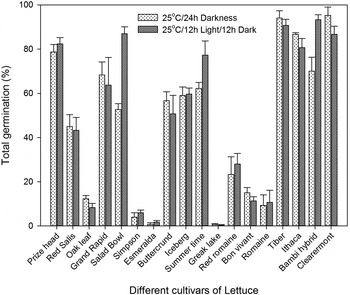
Seed germination of 18 different cultivars of L. sativa was tested in 12 h light–12 h dark and 24 h darkness at constant 25°C (Fig. 1). Germination of Salad Bowl lettuce showed the greatest difference in germination between light and dark (P < 0.01).
Total germination of various cultivars of Lactuca sativa seeds incubating at 25°C in 24 h darkness or in 12 h light–12 h dark for 1 day. Bars represent means ± SE of five replicates with 30 seeds each.

Effects of different smoke solutions on seed germination of Salad Bowl lettuce
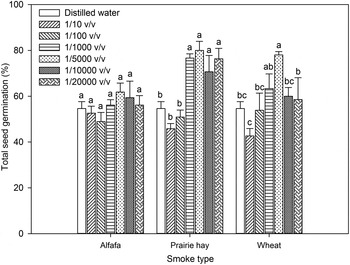
The stimulant effects of smoke solutions on germination of Salad Bowl lettuce varied with different smoke types and different dilutions (Fig. 2). Germination of Salad Bowl lettuce after treating with 1/5000 v/v smoke dilutions produced from prairie hay and wheat straw increased from 55 to 80% (P < 0.01) and 78% (P = 0.01), respectively. Different dilutions of smoke made from alfalfa had no effect on germination of Salad Bowl lettuce compared with the control (P = 0.44).
Total germination of Salad Bowl lettuce (Lactuca sativa) seeds after treating with serial dilutions of smoke solutions made from alfalfa, prairie hay or wheat straw, and incubated at 25°C in 24 h darkness for 1 day. Means with different letters indicate total germination of treated seeds were significantly different (P ≤ 0.05) within smoke types. Bars represent means ± SE of five replicates with 30 seeds each.

Tracing the active compounds involved in plant-derived smoke using Salad Bowl bioassay
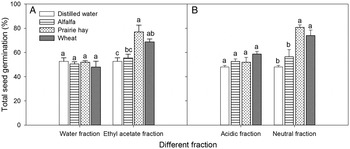
Ethyl acetate separated a stock smoke solution made from alfalfa, prairie hay or wheat straw into water (inorganic) and ethyl acetate (organic) fractions (Fig. 3A). The two fractions were both tested with the Salad Bowl lettuce bioassay at a series of dilutions to ensure the right concentration range for activity (data not shown). Priming with ethyl acetate fractions from prairie hay and wheat straw significantly increased seed germination of Salad Bowl lettuce from 53 to 77% and 69%, respectively (P < 0.01). Ethyl acetate fraction from the alfalfa solution had no effects on seed germination of Salad Bowl lettuce. None of the three water fractions from different smoke types had effects on seed germination of Salad Bowl lettuce compared with the control (P = 0.70).
Total germination of Salad Bowl lettuce (Lactuca sativa) seeds after treatment with (A) water or ethyl acetate fraction and (B) neutral or acidic fraction derived from smoke solutions produced from alfalfa, prairie hay or wheat straw, and incubated at 25°C in 24 h darkness for 1 day. Means with different letters indicate total germination of treated seeds were significantly different (P ≤ 0.05) within fractions. Bars represent means ± SE of five replicates with 30 seeds each.

NaOH was used to fractionate organic extract into acid and neutral fractions (Fig. 3B). The two fractions were both tested with the Salad Bowl lettuce bioassay at a series of dilutions to ensure the right concentration range for activity (data not shown). NaOH fractions from prairie hay and wheat straw solutions significantly increased seed germination compared with the control (P < 0.01). However, NaOH fraction from alfalfa had no effects on seed germination relative to the control. None of the three acid fractions from different smoke types had effects on seed germination of Salad Bowl lettuce compared with the control (P = 0.10).
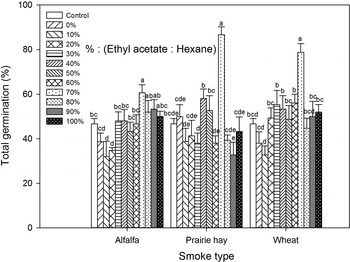
The concentrated neutral fraction was separated by chromatography, eluted with ethyl acetate: hexane gradient (ethyl acetate proportion: 0, 10, 20, 30, 40, 50, 60, 70, 80, 90 and 100%). Different fractions were tested with the Salad Bowl lettuce bioassay at a series of dilutions to ensure the right concentration range for activity (data not shown). The fraction with germination stimulating activity eluted in 70:30 ethyl acetate:hexane fraction occurred in all three smoke types (Fig. 4).
Total germination of Salad Bowl lettuce (Lactuca sativa) seeds after treatment with fractions derived from normal phase chromatography of the neutral fraction from alfalfa, prairie hay, wheat straw or distilled water and incubated at 25°C in 24 h darkness for 1 day. Means with different letters indicate total germination of treated seeds were significantly different (P ≤ 0.05) within smoke types. Bars represent means ± SE of five replicates with 30 seeds each.

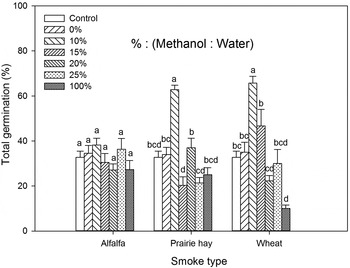
The 70:30 ethyl acetate:hexane fraction was separated by reverse-phase chromatography, eluted with methanol:water gradient (methanol proportion: 0, 10, 15, 20, 25 and 100%). Different fractions were then tested with the Salad Bowl lettuce bioassay at a series of dilutions to ensure the right concentration range for activity. Fractions with germination-stimulating activity were eluted in 10:90 methanol:water and obtained from prairie hay and wheat straw (Fig. 5). None of the fractions from alfalfa had effects on seed germination of Salad Bowl lettuce compared with the control (P = 0.31).
Total germination of Salad Bowl lettuce (Lactuca sativa) seeds after treatment with fractions derived from the reverse phase chromatography of the 70:30 ethyl acetate:hexane fraction from alfalfa, prairie hay or wheat straw or distilled water and incubated at 25°C in 24 h darkness for 1 day. Means with different letters indicate total germination of treated seeds were significantly different (P ≤ 0.05) within smoke types. Bars represent means ± SE of five replicates with 30 seeds each.

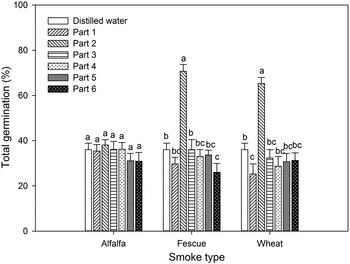
The 10:90 methanol:water fraction was separated using HPLC. Six parts were collected between 3 and 12.5 min (3–5.7, 5.7–6.6, 6.6–9, 9–10, 10–11 and 11–12.5 min) based on the elution pattern and were regarded as parts 1 to 6, respectively. Different parts were tested with the Salad Bowl lettuce bioassay at a series of dilutions to ensure the right concentration range for activity (data not shown). Treating seeds with the second part from prairie hay and wheat straw significantly increased seed germination from 36 to 71% and 65%, respectively (P < 0.01) (Fig. 6). None of the six parts from alfalfa had effects on seed germination of Salad Bowl lettuce compared with the control (P = 0.61).
Total germination of Salad Bowl lettuce (Lactuca sativa) seeds after treatment with fractions derived from the HPLC separation of the 10:90 methanol:water fraction from alfalfa, prairie hay, wheat straw or distilled water and incubated at 25°C in 24 h darkness for 1 day. Means with different letters indicate total germination of treated seeds were significantly different (P ≤ 0.05) within smoke types. Bars represent means ± SE of five replicates with 30 seeds each.

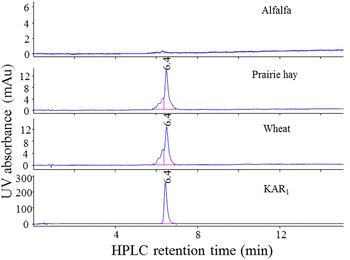
KAR1 co-eluted with the active compound in the fractions obtained from smoke produced from prairie hay and wheat straw, but not in that made from alfalfa (Fig. 7).
Chromatograms of the active fraction of smoke produced from alfalfa, prairie hay, and wheat, together with KAR1 standard.

Effects of active fractions and KAR1 on seed germination and seedling growth of selected species
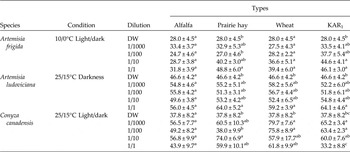
Total seed germination of A. frigida was affected by the priming effect of the active fraction from prairie hay solution (P < 0.01) and KAR1 (P < 0.01) in 12 h light–12 h dark at 10/0°C (Table 1). Priming with 1/1 v/v active fraction from prairie hay significantly increased seed germination from 28 to 49%. Priming seeds with 1/10 v/v and 1/1 v/v KAR1 solutions increased seed germination from 28 to 45% and 46%, respectively. Priming in various dilutions of fractions from wheat straw (P = 0.09) and alfalfa (P = 0.33) had no effect on germination of A. frigida compared with the control. Seed radicle, hypocotyl and total seedling lengths of A. frigida were not affected by priming effects of any studied solutions in any studied germination conditions (data not shown).
Total germination (%) of Artemisia frigida, A. ludoviciana and Conyza canadensis seeds after priming in serial dilutions of separated fractions and incubating at 10/0°C or 25/15°C in 24 h darkness or in 12 h light–12 h dark

Only the conditions in which germination was significantly affected are presented. Means with different superscript letters indicates that total germination of primed seeds were significantly different (P ≤ 0.05) among dilutions within fractions. DW, distilled water. Values represent means ± SE.
Total seed germination of A. ludoviciana was affected by priming effects of active fractions from prairie hay (P = 0.04) and wheat straw (P= 0.04) and KAR1 solutions (P = 0.02) in 24 h darkness at 25/15°C (Table 1). Priming with 1/1 v/v fractions from prairie hay and wheat straw increased seed germination from 47 to 64% and 59%, respectively. Seed germination increased from 47 to 64% after priming with 1/1 v/v KAR1 solution. Priming in various dilutions of fractions from alfalfa (P = 0.25) had no effect on germination of A. ludoviciana compared with the control. Seed radicle, hypocotyl and total seedling lengths for A. ludoviciana were not affected by any priming effect of any studied solutions in any studied germination conditions (data not shown).
Total seed germination of C. canadensis was affected by priming effects of active fractions from prairie hay (P = 0.02), wheat straw (P = 0.03) and KAR1 solution (P = 0.02) in 12 h light–12 h dark at 25/15°C (Table 1). Priming with the 1/10 v/v fraction from prairie hay increased seed germination from 38 to 74%. Priming with 1/1000 v/v fraction of wheat increased seed germination from 38 to 80%. Seed germination increased from 38 to 65% and 63% after priming with 1/1000 v/v and 1/100 v/v of KAR1 solution, respectively. Priming in various dilutions of fractions from alfalfa (P = 0.43) had no effect on germination of C. canadensis compared with the control. Seed radicle, hypocotyl and total seedling lengths for C. canadensis were not affected by any priming effect of any studied solutions in any studied germination conditions (data not shown).
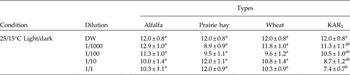
Total seed germination, hypocotyl and total seedling lengths of C. arvense were not affected by any priming effect of any studied solutions in any studied germination conditions (data not shown). Radicle length for C. arvense was affected by priming effect of KAR1 solution in 12 h light–12 h dark at 25/15°C (Table 2). Priming with 1/1 v/v KAR1 solution (P < 0.01) significantly reduced radicle length from 12.0 to 7.4 mm. Priming in various dilutions of fractions from alfalfa (P = 0.28), prairie hay (P = 0.06) and wheat straw (P = 0.46) had no effect on radicle length of C. arvense compared with the control.
Radicle length (mm) measured after 7–13 days of germination for Cirsium arvense seeds after priming in serial dilutions of separated fractions and incubating at 25/15°C in 12 h light–12 h dark

Means with different superscript letters indicate that radicle lengths of primed seeds were significantly different (P ≤ 0.05) among dilutions within fractions. DW, distilled water. Values represent means ± SE.
Discussion
KAR1 is not universally present in smoke solutions
A previous study has shown that active compounds in smoke solutions can substitute for light effects and stimulate germination of lettuce seeds in darkness (Drewes et al., Reference Drewes, Smith and Staden1995). In our study, Salad Bowl lettuce was used as a rapid bioassay for the detection of germination-promoting compounds in smoke solutions because it germinated consistently better in light compared with darkness. Previous studies have used Grand Rapid lettuce for the bioassay (Flematti et al., Reference Flematti, Ghisalberti, Dixon and Trengove2004; Van Staden et al., Reference Van Staden, Jager, Light and Burger2004). However, in our study, germination of Grand Rapid lettuce seeds did not differ between light and darkness. This may be due to the fact that seeds from different sources may have different germination characteristics. Drewes et al. (Reference Drewes, Smith and Staden1995) reported germination of Grand Rapid lettuce seeds from Stokes Seeds Inc. was much higher in 24 h darkness at a constant 25°C relative to that of the seeds collected from five other sources.
In our study, priming in low-concentration smoke solutions made from prairie hay and wheat straw increased germination of Salad Bowl lettuce seeds in the darkness (Fig. 2), agreeing with previous studies that germination of light-sensitive lettuce seeds (L. sativa) can be increased by smoke solutions (Drewes et al., Reference Drewes, Smith and Staden1995; Jager et al., Reference Jager, Light and Van Staden1996; Gardner et al., Reference Gardner, Dalling and Light2001; Van Staden et al., Reference Van Staden, Jager, Light and Burger2004). However, priming in various dilutions of smoke solution made from alfalfa did not affect seed germination of Salad Bowl lettuce. Lack of KAR1 explained the neutral responses of germination of Salad Bowl lettuce seeds to the smoke made from alfalfa. KAR1 was found in the smoke solutions made from prairie hay and wheat straw, but not in that made from alfalfa (Fig. 7). This is the first report that KAR1 is absent in smoke solutions.
Our results directly show that smoke originating from different plant materials contains different compounds. Many previous studies reported similar germination responses for smoke produced from different plant materials (Dixon et al., Reference Dixon, Roche and Pate1995; Perez-Fernandez and Rodriguez-Echevarria, Reference Perez-Fernandez and Rodriguez-Echeverria2003; Thomas et al., Reference Thomas, Morris, Auld and Haigh2010). However, the number of plant species tested so far is limited. To our knowledge, smoke solutions made from herbaceous Fabaceae have never been tested. Species in the family of Fabaceae have unique metabolic approaches in fixing N2, which may create contrasting chemical compositions compared with species from other families. However, Jager et al. (Reference Jager, Light and Van Staden1996) reported that smoke produced from leaves of Acacia mearnsii, a leguminous tree native to Australia, had similar germination responses compared to smoke made from four other species, including Themeda triandra. KAR1 was also found in the smoke produced from T. triandra (Flematti et al., Reference Flematti, Ghisalberti, Dixon and Trengove2004; Van Staden et al., Reference Van Staden, Jager, Light and Burger2004). Further studies are needed to test whether the absence of KAR1 in the plant-derived smoke is a taxonomic trait.
Interestingly, priming in 70:30 ethyl acetate:hexane fraction from alfalfa after normal phase chromatography increased germination of Salad Bowl lettuce compared with the control (Fig. 5). Lack of the stimulating effects of different fractions on the germination of Salad Bowl lettuce ahead of normal phase chromatography separation may be due to existing inhibitors. Lack of response to different fractions on Salad Bowl lettuce germination after normal phase chromatography separation indicated possible synergistic effects of more than one compound that were later separated into different fractions, accounting for increased germination.
KAR1 favours seed germination of native species from Fescue Prairie
Seedling emergence of A. frigida, A. ludoviciana, C. arvense and C. canadensis in the field was positively affected by burning (Ren and Bai, Reference Ren and Bai2016a). In this study, KAR1 increased seed germination of A. frigida, A. ludoviciana and C. canadensis, highlighting the importance of smoke in affecting seed regeneration of these three species. Priming in high-concentration KAR1 solutions and active fractions from prairie hay increased germination of A. frigida compared with distilled water at 10/0°C in 12 h light–12 h dark. Germination of A. frigida occurred in a wide temperature range, with 20/10°C as the optimal temperature (Wilson, Reference Wilson1982). Increased germination of A. frigida at a suboptimal temperature observed in this study was consistent with Jain et al. (Reference Jain, Kulkarni and Van Staden2006), who reported that KAR1 can improve seed germination of Solanum esculentum when using suboptimal temperatures. Our results indicated that KAR1, the active compound in prairie hay, could play a critical role in enhancing the establishment of A. frigida after early spring burning when ambient temperatures are still low.
Priming in concentrated KAR1 solutions and active fractions made from prairie hay and wheat straw increased germination of A. ludoviciana compared with distilled water at 25/15°C in 24 h darkness. This finding agrees with a previous study which found that KAR1 stimulated seed germination of light-sensitive seeds, including Angianthus tomentosus, Gnephosis tenuissima, Myriocephalus guerinae, Podolepis canescens and Rhodanthe citrina in suboptimal light or darkness (Merritt et al., Reference Merritt, Kristiansen, Flematti, Turner, Ghisalberti, Trengove and Dixon2006). KAR1 may substitute for light effects and affect the conversion of Pr to Pfr in the phytochrome response (Drewes et al., Reference Drewes, Smith and Staden1995). In addition, KAR1 can alter the metabolism and perception of gibberellins (GAs) and abscicic acid (ABA) in seeds (Nelson et al., Reference Nelson, Riseborough, Flematti, Stevens, Ghisalberti, Dixon and Smith2009). Exposure to smoke solutions increased endogenous GA levels and decreased endogenous ABA levels for two positively photoblastic species, Lactuca sativa and Nicotiana attenuate (Gardner et al., Reference Gardner, Dalling and Light2001; Schwachtje and Baldwin Reference Schwachtje and Baldwin2004). Increased germination of A. ludoviciana in darkness by KAR1 partly explained the increased coverage of this species after burning in Fescue Prairie and tallgrass prairie (Bailey and Anderson, Reference Bailey and Anderson1978; Anderson and Bailey, Reference Anderson and Bailey1980; Collins, Reference Collins1987).
Although the active fractions produced from prairie hay and wheat straw both had KAR1, priming in the concentrated active fraction from prairie hay but not wheat straw increased germination of A. frigida compared with distilled water at 10/0°C in 12 h light–12 h dark. Not only qualitative but also quantitative variation exists in smoke solutions produced by different material, which, in turn, may affect seed germination differently. Priming in low, but not highly concentrated active fractions made from prairie hay and wheat straw and KAR1 solutions stimulated seed germination of Conyza canadensis in 12 h light–12 h dark at 25/15°C. Different seeds have different sensitivity to KAR1 solutions. For example, germination of L. sativa and Stylidium affine can be increased after treating with KAR1 solutions concentrated at 10–9 M and 10–7 M, respectively (Flematti et al., Reference Flematti, Ghisalberti, Dixon and Trengove2004).
Although burning increased seedling emergence of C. arverse (Ren and Bai, Reference Ren and Bai2016a), smoke (Ren and Bai, Reference Ren and Bai2016c) and KAR1 had no positive effect on seed germination of this species. In addition, ash did not increase seedling density of this species emerging from soil seed bank (Ren and Bai, Reference Ren and Bai2016b), indicating that heat might be the crucial factor promoting seed germination of species. Priming in 1/1 v/v KAR1 reduced radicle length of C. arvense compared with distilled water in 12 h light–12 h dark at 25/15°C. Although most previous studies have shown a positive or neutral effect of KAR1 on the seedling growth of different species (Daws et al., Reference Daws, Davies, Pritchard, Brown and Van Staden2007; Kulkarni et al., Reference Kulkarni, Sparg and Van Staden2007; Stevens et al., Reference Stevens, Merritt, Flematti, Ghisalberti and Dixon2007), radicle length of Eragrostis curvula was reduced by KAR1 at constant 30 and 35°C conditions, but not at constant 15, 20 and 25°C conditions (Ghebrehiwot et al., Reference Ghebrehiwot, Kulkarni and Kirkman2009), indicating that effects of KAR1 on seedling length are temperature and species dependent.
It is not surprising that separated fractions from alfalfa had no effect on seed germination and seedling growth of all tested species, since this fraction did not contain any detectable compound (Fig. 7). However, smoke produced from alfalfa increased germination of C. canadensis significantly more than that made from prairie hay and wheat straw (Ren and Bai, Reference Ren and Bai2016c), indicating that unique active compound(s) may be involved in it, which deserves further study.
KAR1 increased seed germination of all three native species and decreased seedling growth of the only non-native species under the germination conditions we applied. Previous studies have shown that fire could be used to restore native species and control non-native species in various grasslands (DiTomaso et al., Reference DiTomaso, Kyser and Hastings1999; Prober et al., Reference Prober, Thiele, Lunt and Koen2005; MacDonald et al., Reference MacDonald, Scull and Abella2007). Burning increased species density and richness of native seedlings emerging from the soil seed bank in Fescue Prairie (Aran et al., Reference Aran, Garcia-Duro, Reyes and Casal2013; Ren and Bai, Reference Ren and Bai2016b). Results from our study indicate that KAR1 could be the key effect of burning in restoring native species in Fescue Prairie. They also show that the potential of KAR1 in regulating seed regeneration in Fescue Prairie is time sensitive, because the influence on seed germination and seedling growth varied across temperature and light conditions, which varies seasonally.
It should be noted that although KAR1 seemed to be the dominant active compound in the separated fractions from prairie hay and wheat straw in our study, other unidentified compounds were still involved in germination. Our methods were targeted to gross identification of the main smoke fractions. To more thoroughly understand the effects of smoke on Fescue Prairie seed regeneration, the germination responses of different species to smoke solutions and other founded active components including other karrikins (Flematti et al., Reference Flematti, Ghisalberti, Dixon and Trengove2009) and glyceronitrile (Flematti et al., Reference Flematti, Merritt, Piggott, Trengove, Smith, Dixon and Ghisalberti2011) should be tested.
Acknowledgements
Special thanks are due to staff in Dr Martin Reaney's laboratory (Department of Plant Sciences, University of Saskachewan), especially P. Burnett and P. Jadhav, for their help with chemical analysis.
Financial support
We would like to acknowledge the financial support of the China Scholarship Council and University of Saskatchewan.
Conflicts of interest
None.