Group A β-hemolytic Streptococcus (GAS) is an uncommon but serious cause of post-operative wound infections and invasive disease. Outbreaks of GAS disease may occur when (1) a virulent clone circulates in the general population; (2) the clone becomes prevalent among asymptomatic carriers (particularly children) and persons with pharyngitis; and (3) persons at high risk of invasive disease are exposed to carriers.Reference Cockerill, MacDonald and Thompson 1 Many reports of healthcare-associated cases and clusters have been associated with specific populations and medical procedures. However, there are no previous reports of outbreaks of GAS infections associated with dermal substitutes or podiatry clinics.
Dermagraft (Organogenesis, Canton, MA) is a bioengineered “skin substitute” with fibroblasts in a polyglactin matrix. It is used in the treatment of full-thickness diabetic foot ulcers >6 weeks duration, which extend through the dermis but without tendon, muscle, joint capsule, or bone exposure. Dermagraft is provided frozen at –70°C, thawed, trimmed to size for the debrided wound, and covered with a multilayer dressing.
We report an outbreak of serious GAS infections associated with the application of Dermagraft to open ulcers in a hospital-based podiatry clinic over a 10-month period.
METHODS
Description of Outbreak
In November 2011, the microbiology laboratory at the VA Western New York Healthcare System at Buffalo (VAWNYHS) identified 3 inpatients with blood cultures positive for GAS over a 4-day period. Of these patients, 2 recently had placement of Dermagraft to wounds in the VAWNYHS podiatry clinic. An epidemiologic investigation was initiated and hospital microbiology records were searched for all nonpharyngeal GAS culture isolates between July 2011 and November 2011. Given the possible association of GAS infections with application of Dermagraft, all use was immediately discontinued.
Based on this review, the initial case definition was “a VAWNYHS patient with a positive GAS wound or blood culture occurring between July 1, 2011 and November 15, 2011.” A total of 8 patients met this case definition. Additional case detection, with assistance from the New York State Department of Health (NYSDOH), identified 4 more cases at 4 outside hospitals, 1 of them in June 2011. Expanded microbiology record review from January 2011 identified 2 more patients with positive wound cultures, 1 in February 2011, and 1 in late November 2011. All of these patients had Dermagraft applied in the podiatry clinic at VAWNYHS.
Therefore, the revised case definition was “a VAWNYHS patient who received Dermagraft treatment with a subsequent positive GAS wound or blood culture between January 1, 2011, and November 30, 2011.” Surveillance for possible cases following termination of the outbreak was continued through 2015.
Assessment of Infection Control Practices
During the first week of the investigation, the hospital infection control team reviewed podiatry clinic hand hygiene practices, Dermagraft thawing and application (including possible partition of a single sheet for use on >1 patient), use of personal protective equipment (PPE), ie, gowns, gloves and masks, and cleaning practices. Clinic layout, patient flow, patient scheduling, and freezer maintenance were also reviewed. Dermagraft had been in use for approximately 2 years prior to this outbreak.
Podiatry clinic staff (4 podiatrists, 1 nurse, 1 technician, and 2 nursing assistants) involved with these cases were requested to have pharyngeal and rectal cultures to screen for GAS carriage. Cultures were also requested from 2 company representatives who were present for Dermagraft applications, as well as vascular surgery team members who sometimes had contact with these patients. The 6 females also were asked to have vaginal cultures.
GAS Isolate Characterization
GAS isolates from VAWNYHS and outside hospital patients were analyzed at VAWNYHS by pulsed field gel electrophoresis (PFGE) using the PulseNet protocol for Salmonella 2 with modification of the switch times to 5–50 seconds during the run. These isolates were also sent to the NYSDOH laboratory for PFGE and emm gene typing. All available VAWNYHS GAS isolates from 2006 onward also were subjected to PFGE analysis and analyzed using Bionumerics Software (Applied Maths, Austin, Texas).
Case-Cohort Study
A total of 14 cases meeting the revised case definition were identified among 13 patients, with 1 patient having 2 temporally separated infections. A total of 84 unique patients were treated with Dermagraft during the outbreak period. According to the literature reports, the average incubation period for serious GAS infections is likely 3–5 days.Reference Ogden and Amstey 3 Because some patients had multiple Dermagraft applications during the outbreak period, we used the date of the Dermagraft application occurring within 5 days prior to the recovery of GAS from case patients as the probable transmission day.
We used 2 comparator cohorts. The first cohort included patients attending podiatry clinic on a probable transmission day who had Dermagraft applied to an open ulcer but did not develop GAS infection (CD group). The second cohort included patients seen in the clinic on a probable transmission day with (1) no Dermagraft application, (2) open ulcers documented in the electronic medical record (EMR), and (3) no GAS infection (CU group). Patients were excluded if they were treated with other biologic dressings.
We targeted a ratio of case:CD:CU of up to 1:2:2. If sufficient comparators could not be obtained from the identified transmission day, due to clinic volume or no Dermagraft use, they were obtained from other probable transmission days.
Patient characteristics and possible infection risk factors were extracted from the VA Computerized Patient Record System (CPRS). Baseline creatinine was the value obtained prior to the probable transmission day to eliminate the effects of severe infection in the case group. This study was approved by the VAWNYHS Institutional Review Board.
Statistical Analysis
We compared categorical data using χ2, Fisher’s exact, or Wilcoxon tests. Continuous variables were analyzed using t test or ANOVA. Statistical analysis was performed using JMP9 (SAS Institute, Cary, NC). We considered a 2-sided P≤.05 to be statistically significant.
RESULTS
Descriptive Epidemiology
In 13 patients, 14 episodes of GAS infection met the revised case definition. The epidemic curve is shown in Figure 1. All patients with positive blood and/or wound cultures had clinical evidence of infection, including 1 or more occurrence of severe sepsis, fever, or leukocytosis, or local evidence of wound infection. Additionally, 1 patient with Dermagraft application was admitted with lower extremity cellulitis but had no positive cultures and was excluded. A total of 8 patients had positive blood cultures, and 2 of these 8 also had positive wound cultures. A total of 6 patients had positive wound cultures only. Of the 14 total cases, 13 patients were hospitalized, and 4 patients (all bacteremic) died, yielding a case fatality rate of 29% for the total group and 50% for bacteremic patients. Of the 4 deaths, 2 occurred at outside hospitals.
Outbreak Epidemic Curve. Days are numbered from the index case and shaded with regard to site of isolation or hospital location. The upper graph is an enlargement of the lower timeline. Letters indicate specific patients.

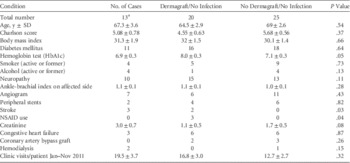
Demographic characteristics of the cases generally reflected the VAWNYHS patient population and are shown in Table 1. All were male, average age in years was 67.3±3.6 (range, 36–85 yearas). Of the 13 patients, 12 were diabetic and 1 had presumed alcoholic neuropathy. Patients had received an average of 9.7±9.7 Dermagraft applications (range, 1–30 applications; median, 5), though it is not known how many different wounds per patient may have been treated.
Univariate Comparison of Demographic and Clinical Characteristics of Cases and Controls

NOTE. SD, standard deviation; NSAID, nonsteroidal anti-inflammatory drug.
a Patient A accounted for 2 cases but is only entered once for demographic characteristics.
Dermagraft was applied by 4 podiatrists during the outbreak period; however, podiatrist A was the listed provider in 61% of Dermagraft applications and frequently assisted with other cases. He was involved in 11 of 14 cases and had treated all 4 fatal cases on the probable transmission day. Podiatrist A was no more likely to see cases than comparators (P=.24; data not shown).
No GAS was isolated from any staff member, including repeated cultures from podiatrist A, or company representatives. Vascular surgery team members did not submit specimens, but there is no evidence that they treated patients in podiatry clinic on probable transmission days. No environmental cultures were collected.
A total of 8 separate Dermagraft lot numbers were associated with the outbreak, and each lot was used multiple times during the outbreak period. The manufacturer provided initial quality control culture reports for the lots used on cases and retained samples from each lot were also cultured. All cultures were negative. No case or CD patients received treatment with any other biological dermal substitute product.
GAS Strain Characterization
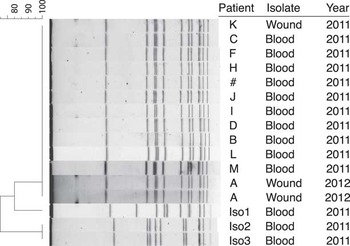
Genetic typing by the NYSDOH showed that all strains were emm type 28. Initial analysis of strains by PFGE showed a single PFGE type for these cases (Figure 2). PFGE at the NYSDOH confirmed the local findings and noted that the outbreak clone had not previously been seen in New York state. This unique clone was also recovered from the blood of a postoperative patient, who was 1 of the 3 initial bacteremic patients. (labeled # in Figure 2). This patient developed necrotizing fasciitis following coronary artery bypass graft surgery but had not been in the podiatry clinic. The patient was seen by the vascular surgery service, which also saw some of the hospitalized GAS cases, but no direct linkage was found. This patient did not meet the case definition and was not included in the analysis despite having infection with the outbreak clone.
Pulsed Field Gel Electrophoresis of GAS isolates. The individual strains are labeled with the patient designation, source of culture, and year of isolation. # represents the clonal strain without association to the podiatry clinic (see text). Iso1-3 are the other blood isolates of GAS recovered during 2011.

This clonal outbreak occurred against a background of other strains of community or healthcare-associated GAS disease. For 2011, 3 distinct PFGE patterns occurred among invasive GAS isolates at VAWNYHS (Figure 2). The NYSDOH reported a stable incidence of invasive GAS infections in the 7-county western New York epidemiologic region, ranging from 42 to 51 cases per year from 2007 to 2011 (NYSDOH, unpublished data.)
Continued Monitoring for GAS Disease
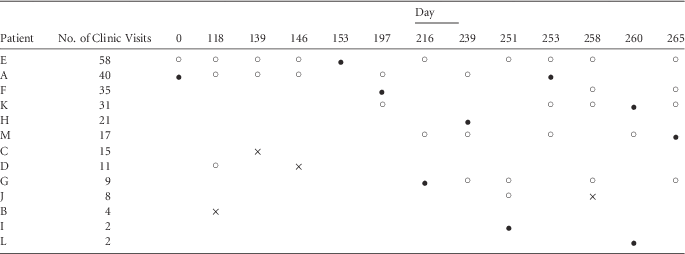
After discontinuation of Dermagraft use, no new cases were identified after the last case in November. However, continued surveillance of all GAS isolates revealed the re-appearance of the outbreak clone strain in patient A in both February and March 2012. This raised the possibility that persistent carriage of the organism by patients may have been associated with the outbreak. To determine whether the outbreak could be associated with inter-patient transmission in clinic on transmission days, we analyzed the cases with respect to the probable transmission day and ranked the patients by frequency of visits. This revealed that either patient A or E was in clinic on all but 1 probable transmission day (Table 2).
Possible Inter-Patient Transmission on Probable Transmission DaysFootnote a

NOTE. ● indicates the possible transmission days for that patient and development of GAS disease; ○ indicates a clinic visit without development of GAS disease; × indicates possible transmission days with death of patient from GAS disease.
a Patients are identified by their code letter and sorted by number of clinic visits. The days indicate the possible transmission dates referenced from the index case. Patients A and E have the greatest number of visits to podiatry clinic and are present on all transmission days except 260.
Because transmission and resultant carriage could have occurred with any clinic contact, we also analyzed the possibility of spread of the organism on nontransmission days. The possibility of spread from patients A and E was seen for all patients, as shown in Figure 3.
Possible transmission of GAS during 2011 analyzed by all clinic visits. Panel A displays the clinic day referenced from the index case. A thick black line around the table entry indicates the first clinic visit occurring with patient A or E and provides a possible link for all cases with either patient A or E. Panel B is a graphic representation of possible spread of GAS from either patient A or E. For example the arrow connecting just Patient E to the oval containing patients M and G represents the possible spread on day number 216.

Case Cohort Study
The demographics and clinical characteristics of cases and comparator cohorts were evaluated in univariate analyses (Table 1). A history of stroke was more common in cases than in the CD or CU groups. Hemoglobin A1c levels were higher and NSAID use was more common in the CD group compared to cases. Serum creatinine prior to transmission date trended higher in the case patients than in either comparator group. There was no difference in the length of time between the probable transmission day and determination of baseline creatinine in cases and comparators.
Average monthly clinic visits increased by 35% from 986 in the January–April 2011 period to 1,331 in the May–November period. Clinic visits per patient were high in all groups, but no significant differences were seen (Table 1). Significantly more patients were seen in the podiatry clinic on probable transmission days compared with nontransmission days (67.3±6.1 vs 52.3±1.3, P=.01).
Control Measures and Interventions
Dermagraft applications were discontinued as soon as the possibility of an outbreak was recognized. Inspection and review of clinic procedures and infection control practices with clinic staff was undertaken and the following improvements were necessary:
-
1. Clinic rooms were small and access to sinks often was impeded by placement of the procedure chair and/or equipment. Room configuration was changed to correct this, and the number of alcohol foam dispensers was increased.
-
2. Rooms were fully cleaned at the end of each day, but there were no written procedures related to specific surface cleaning before/after the use of Dermagraft. This was changed to include disinfectant wipe down of examination tables and other hard surfaces after each case.
-
3. The Dermagraft package insert called for use of sterile scissors but not PPE for application. Future application of any biologic dermal substitute at VAWNYHS would require use of sterile technique and PPE, including gowns, gloves, and masks.
-
4. Dermagraft sheets may have been partitioned to decrease cost and the number of applications often exceeded the manufacturer’s recommendation of 8 per wound. However, procedure notes almost always were brief and infrequently specified the location, number or extent of the wound(s). Future use of dermal substitute products at VAWNYHS would require strict adherence to manufacturer recommendations regarding number of applications.
-
5. Multiple staff members may have been involved with individual Dermagraft applications, and clinic/procedure notes did not specify who participated. Company representatives were present to assist with thawing and removal of the product from packaging. Future application of biologic dermal substitutes would be done with only necessary staff members (ie, a podiatrist and an assistant) present in the clinic room.
-
6. Detailed CPRS description of applications and the individuals present also would be required.
Dermagraft use resumed in May 2012, and there have been no further cases of GAS infection related to its use.
DISCUSSION
Streptococcus pyogenes is one of the most important bacterial pathogens in humans.Reference Bisno and Stevens 4 Approximately 10,000–15,000 cases of invasive GAS disease occur annually in the United States, associated with a 10%–13% mortality rate. 5 Virulence factors of the GAS strain, its prevalence in the community, together with the immunologic state of infected hosts, are important factors in the spread of the organism.Reference DiPersio, File, Stevens, Gardner, Petropoulos and Dinsa 6
This is the first description of an outbreak of GAS infection in an outpatient podiatry clinic or associated with a biologic dermal substitute. The epidemiology strongly indicated an association with the application of Dermagraft. Review of the podiatry clinic policies and practices regarding Dermagraft application revealed many opportunities for improvement in infection control practices.
Initial recognition of the outbreak was slowed by the staggered and varied presentation of the cases. The index case appeared to be a case of uncomplicated GAS cellulitis, with no additional cases noted for almost 4 months. Unfortunately, that isolate was unavailable for analysis, so we were unable to determine whether it was the clonal strain. This long gap between the index case and subsequent cases is a common finding in other reports from long-term care.Reference Auerbach, Schwartz and Williams 7 – 10 As shown in the epidemic curve (Figure 1), the initial and third bacteremias occurred at outside facilities and were not known to our infection control personnel, which delayed the recognition of the outbreak. The bactermias seen locally on days 139 and 197 were seen on a background of occasional GAS bactermias at our facility and appeared to initially have no epidemiologic linkage and were not associated with surgery or long-term care. It was not until the higher density of cases near the end of the outbreak that a common epidemiologic link was suggested.
The Centers for Disease Control and Prevention recommend that the occurrence of ≥2 cases of infection with the same GAS type within a 6-month period indicates that a healthcare worker (HCW) might be the source. 11 Although we did multiple surveillance cultures on podiatry clinic staff, we did not identify a carrier. It is possible that 1 or more staff may have been colonized during the outbreak but not at the time of culture or may have been a non-colonized transmitter.
Genetic typing by NYSDOH revealed that all of our strains were emm28, and PFGE revealed that strains associated with the infections in the podiatry clinic were clonal. GAS emm type 28 has been associated with severe disease and has been reported as the second most common invasive type.Reference O'Brien, Beall and Barrett 12 It also is a common type in postpartum GAS infections,Reference Chuang, Van Beneden, Beall and Schuchat 13 , Reference Ben Zakour, Venturini, Beatson and Walker 14 and clonal spread has been reported in France.Reference Mihaila-Amrouche, Bouvet and Loubinoux 15 GAS emm28 isolates carrying the sdn gene may be more invasive.Reference Green, Beres and Graviss 16
Dermagraft has been shown to increase cure rates in the treatment of diabetic foot ulcers.Reference Marston 17 The material is derived from allogeneic neonatal foreskin fibroblasts, cultured on a biodegradable scaffold. Dermagraft has also been shown to induce a variety of epithelial growth factors, including fibroblast growth factor, insulin-like growth factor, platelet-derived growth factor, transforming growth factor (TGF), and vascular endothelial growth factor.Reference Marston 17 These growth factors likely contribute to the more rapid regeneration of dermis but may paradoxically increase the risk of serious GAS disease because it binds initially to integrins expressed on the surface of cells as a prelude to invasion.Reference Wang, Li, Southern and Cleary 18 TGF-β1 has also been shown to increase GAS invasion of epithelial cells via increased expression of fibronectin and α5 integrin on host epithelial cells.Reference Wang, Li, Southern and Cleary 18
While active infection is a contraindication to application of the material, wound colonization or subsequent introduction of the organism during application is possible. Additionally, the wound is bandaged and dressings are changed on a weekly basis, which impedes timely detection of erythema and swelling. Because patients often have neuropathy, early warning signs of infection may not be apparent. All of these factors may create a “perfect storm” when GAS is present in the ulcer.
High patient volume may have contributed to the spread of the organism, and we hypothesize that patient-to-patient transmission, perhaps by healthcare workers, played an integral role in the outbreak. Most reports describe multifactorial transmission,Reference Deutscher, Schillie and Gould 8 – 10 , Reference Smith, Li, Tolomeo, Tyrrell, Jamieson and Fisman 19 – Reference Lee, Ferguson and Jernigan 39 and there has been a report of a wound care team being involved in GAS transmission.Reference Felkner, Pascoe, Shupe-Ricksecker and Goodman 40 While we only have data for the presence of long-term carriage of GAS by patient A, the association of patients A and E with subsequent cases supports the hypothesis that these 2 patients may have been reservoirs in the propagation of the outbreak.
Serious GAS infections traditionally have been associated with postoperative and postpartum patients, 23 but the range of locales has expanded to include nursing homes,Reference Auerbach, Schwartz and Williams 7 , Reference Milne, Lamagni and Efstratiou 9 , 10 , Reference Dooling, Crist and Nguyen 37 an ambulatory surgery center,Reference Beaudoin, Torso and Richards 38 and with this report, a podiatry clinic. No previous reports have linked GAS infections with dermal substitutes though a prior case of GAS infection due to a tendon allograft has been reported.Reference Lee, Ferguson and Jernigan 39 This outbreak was caused by a locally unique PFGE type organism, with unique epidemiologic features, but whole-genome sequencing may provide superior discrimination in other situations.Reference Salipante, SenGupta, Cummings, Land, Hoogestraat and Cookson 41
In summary, we have described an outbreak of GAS infection associated with application of a biologic dermal substitute in a podiatry clinic. The combination of a virulent organism, susceptible patients, and inconsistent infection control technique likely allowed this outbreak to occur.
ACKNOWLEDGMENTS
The opinions expressed herein do not necessarily reflect those of the Veterans Administration or the U.S. Government.
Financial support. This material is the result of work supported with resources and use of facilities at the VAWNYHS.
Potential conflicts of interest. All authors report no conflicts of interest relevant to this article.