People’s psychological relationships to their jobs have been conceptualized as a continuum between the negative experience of burnout and the positive experience of engagement (Maslach & Leiter, Reference Maslach and Leiter2008). Schaufeli and Bakker (Reference Schaufeli and Bakker2004) agree with the assertion that work engagement is the positive antithesis of burnout, but defines and operationalizes engagement in its own right. In other words, although burnout and work engagement are negatively related, Schaufeli, Salanova, González–Romá, and Bakker (Reference Schaufeli, Salanova, González–Romá and Bakker2002) proposed that burnout and work engagement should be conceived as two opposite concepts that should be measured independently with different instruments.
In the last 50 years, many studies have shown that work environment has a significant influence on employee engagement and burnout. For instance, job demands such as workload, time pressure, and difficult physical environments, have been found to have a positive relationship with burnout (e.g., Demerouti, Le Blanc, Bakker, Schaufeli, & Hox, Reference Demerouti, Le Blanc, Bakker, Schaufeli and Hox2009; Jourdain & Chênevert, Reference Jourdain and Chênevert2010) and a negative link with work engagement (e.g., Hakanen, Schaufeli, & Ahola, Reference Hakanen, Schaufeli and Ahola2008; Zacher & Winter, Reference Zacher and Winter2011). By contrast, job resources generally have a positive impact on well–being. Indeed, resources such as job control, participation in decision making, and task variety, have been observed to have a positive influence on work engagement (e.g., Korunka, Kubicek, Schaufeli, & Hoonakker, Reference Korunka, Kubicek, Schaufeli and Hoonakker2009; Kühnel, Sonnentag, & Bledow, Reference Kühnel, Sonnentag and Bledow2012) and a negative effect on burnout (e.g., Bakker, Demerouti, & Schaufeli, Reference Bakker, Demerouti, De Boer and Schaufeli2003; Schaufeli & Bakker, Reference Schaufeli and Bakker2004).
The present research aimed at modeling, in two samples of French workers, the contributions of different factors in the explanation of work engagement and burnout, separately. Specifically, Study 1 was conducted to identify the determinants of work engagement. We first proposed that organizational resources (i.e., interpersonal and informational justice) would have a positive influence on work engagement. In contrast, job demands (i.e., changes in tasks and ambiguities about work) would negatively relate to work engagement. In addition, we tested a model in which changes in tasks, ambiguities about work, and organizational resources would have a significant impact on work engagement through the satisfaction of psychological needs for autonomy, competence, and relatedness (Deci & Ryan, Reference Deci and Ryan2000). In Study 2, we examined the effects of job demands and organizational resources on burnout and also tested the mediating role of need thwarting (Bartholomew, Ntoumanis, Ryan, & Thøgersen–Ntoumani, Reference Bartholomew, Ntoumanis, Ryan and Thøgersen–Ntoumani2011) in these relationships. The present research is based on different, yet complementary, frameworks: Job Demands–Resources (JD–R) model (Demerouti, Bakker, Nachreiner, & Schaufeli, Reference Demerouti, Bakker, Nachreiner and Schaufeli2001), organizational justice theories (Greenberg, Reference Greenberg1990), and self–determination theory (Deci & Ryan, Reference Deci and Ryan1985).
Conceptual Framework and Hypotheses
The JD–R Model
The JD–R model (Bakker & Demerouti, Reference Bakker and Demerouti2007; Xanthopoulou, Bakker, Demerouti, & Schaufeli, Reference Xanthopoulou, Bakker, Demerouti and Schaufeli2007) attempts to explain both the well–being and ill–health of employees in terms of psychosocial work characteristics (Balducci, Schaufeli, & Fraccaroli, Reference Balducci, Schaufeli and Fraccaroli2011). According to the JD–R model, a health impairment process is activated by excessive job demands (e.g., changes in tasks, ambiguities about work) that lead to physical and psychological health problems. Job demands refer to those aspects of a job that require sustained physical and/or psychological effort and are therefore associated with certain physiological and/or psychological costs. The central premise of the health impairment process is that individuals use compensatory strategies under the influence of excessive job demands that may lead to a draining of energy (see Bakker & Demerouti, Reference Bakker and Demerouti2007; Hockey, Reference Hockey, Baddely and Weiskrantz1993). As a result, job demands are positively related to strain, including fatigue, burnout, and health problems (e.g., Korunka, Kubicek, Schaufeli, & Hoonakker, Reference Korunka, Kubicek, Schaufeli and Hoonakker2009; Lee, Lovell, & Brotheridge, Reference Lee, Lovell and Brotheridge2010), and negatively associated with work engagement (e.g., Bakker, Hakanen, Demerouti, & Xanthopoulou, Reference Bakker, Hakanen, Demerouti and Xanthopoulou2007; Nahrgang, Morgeson, & Hofmann, Reference Nahrgang, Morgeson and Hofmann2011).
The JD–R model also includes organizational resources that may help to enhance work engagement and reduce burnout. Organizational resources contribute toward achieving work–related goals, reducing the costs associated with job demands, and stimulating personal development. High levels of organizational resources protect employees from burnout (e.g., Alarcon, Reference Alarcon2011; Bakker, Demerouti, & Euwema, Reference Bakker, Demerouti and Euwema2005) and are beneficial for work engagement (e.g., Crawford, LePine, & Rich, Reference Crawford, LePine and Rich2010; Schaufeli, Bakker, & van Rhenen, Reference Schaufeli, Bakker and van Rhenen2009) because having access to larger pools of resources allows employees to satisfy their needs for autonomy, competence, and relatedness, and increases their willingness to dedicate efforts and abilities to the work task (Bakker & Demerouti, Reference Bakker and Demerouti2007).
Few prior studies on the JD–R model have considered organizational justice as an organizational resource but organizational justice, and more specifically interactional justice, has been a particular consistent organizational resource across different working environments (Boudrias et al., Reference Boudrias, Brunet, Morin, Savoie, Plunier and Cacciatore2010; Campbell, Perry, Maertz, Allen, & Griffeth, Reference Campbell, Perry, Maertz, Allen and Griffeth2013). Based on these findings, we hypothesized that interactional justice would be positively and negatively related to work engagement and burnout, respectively. Indeed, recent research (e.g., Heaphy & Dutton, Reference Heaphy and Dutton2008; Quinn & Dutton, Reference Quinn and Dutton2005) suggests that positive relationships at work are energizing, both physically and emotionally, because high–quality relationships at work create immediate and enduring consequences for an individual’s cardiovascular, immune, and neuroendocrine systems. In other words, they generate and sustain energetic resources, equipping people to work more efficiently. Accordingly, Shraga and Shirom (Reference Shraga and Shirom2009) found that warm interactions with others including one’s supervisor were associated with more engagement at work. In addition, based on ego depletion theory (Baumeister, Bratslavsky, Muraven, & Tice, Reference Baumeister, Bratslavsky, Muraven and Tice1998), Johnson, Lanaj, and Barnes (Reference Johnson, Lanaj and Barnes2014) have shown that exhibiting interactional justice behaviors (e.g., showing respect, treating with dignity) create positive work interactions, which replenish resources (see also Bono, Glomb, Shen, Kim, & Koch, Reference Bono, Glomb, Shen, Kim and Koch2013; Lilius, Reference Lilius2012). This is notably because interpersonally fair treatment is associated with positive social interactions, positive emotions, social acceptance and support (e.g., Bies, Reference Bies, Greenberg and Cropanzano2001).
In the present research, organizational resources represent one multidimensional construct which subsumes two forms of interactional justice (see below), as first–order factors. In addition, two job demands were assessed: changes in tasks (i.e., task changes that could affect employees’ work; e.g., Bakker, Demerouti et al., Reference Bakker, Demerouti, De Boer and Schaufeli2003; Bakker, Demerouti, de Boer, & Schaufeli, Reference Bakker, Demerouti, De Boer and Schaufeli2003) and ambiguities about work (i.e., a lack of congruent expectations between and within job roles or confusing ideas about the role and responsibilities assigned; e.g., Kahn, Wolfe, Quinn, Snoek, & Rosenthal, Reference Kahn, Wolfe, Quinn, Snoek and Rosenthal1964; Kalbers & Cenker, Reference Kalbers and Cenker2008). We selected these two demands because Lequeurre, Gillet, Ragot, and Fouquereau (2013, Study 3) have recently shown in a sample of French workers that changes in tasks and ambiguities about work were significantly related to both positive and negative outcomes. Few investigations studied propositions of the JDR model within samples of French workers but these results suggested that changes in tasks and ambiguities about work may play a particularly important role in predicting work engagement and burnout in the present research.
Organizational Justice
The term organizational justice is used to describe people’s perception of fairness in organizations (Greenberg, Reference Greenberg1990). Robust relationships with work outcomes as organizational citizenship behavior, organizational commitment, turnover intentions, and job performance have been established in organizational justice research (e.g., Li & Bagger, Reference Li and Bagger2012; Poon, Reference Poon2012). Organizational justice is also negatively related to burnout (e.g., Cheng, Huang, Li, & Hsu, Reference Cheng, Huang, Li and Hsu2011; Moliner, Martínez–Tur, Peiró, & Ramos, Reference Moliner, Martínez–Tur, Peiró and Ramos2005). At least three types of organizational justice have been discussed in the literature: distributive, procedural, and interactional justice. Interactional injustice is concerned with the fairness in one’s interactions with and information received from his/her supervisor (Bies & Moag, Reference Bies and Moag1986; Greenberg, Reference Greenberg1990). Interactional justice is further theorized to consist of two distinct forms: interpersonal justice and informational justice (Greenberg, Reference Greenberg1990). Informational justice captures the fairness of explanations provided by supervisors, while interpersonal justice reflects the extent to which supervisors treat followers with dignity and respect. In this study, our focus is on employees’ perceptions of interactional justice for four reasons.
First, distributive justice and procedural justice have been already linked to work engagement in past studies (e.g., Biswas, Varma, & Ramaswami, Reference Biswas, Varma and Ramaswami2013; He, Zhu, & Zheng, Reference He, Zhu and Zheng2014). On the other hand, although interactional justice is strongly related to ill– and well–being (e.g., Kausto, Elo, Lipponen, & Elovainio, Reference Kausto, Elo, Lipponen and Elovainio2005; Moliner, Martínez–Tur, Peiró, Ramos, & Cropanzano, Reference Moliner, Martínez–Tur, Peiró and Ramos2005), no research to the best of our knowledge has examined the links between this form of justice and work engagement. This is one of the purposes of the present research. Second, perceived interactional justice has more significant effects on key outcome variables than perceived distributive and procedural justice (Cropanzano, Prehar, & Chen, Reference Cropanzano, Prehar and Chen2002). Third, ego depletion theory states that rule–driven behaviors consume self–regulatory resources (Muraven, Reference Muraven and Ryan2012), which suggests that procedural justice behaviors may deplete actors’ self–regulatory resources. In other words, although fairness is universally heralded as something good, acting procedurally fair may come at a cost for workers, in the form of depleted resources. Thus, based on recent findings (e.g., Johnson et al., Reference Johnson, Lanaj and Barnes2014; Wiesenfeld, Swann, Brockner, & Bartel, Reference Wiesenfeld, Swann, Brockner and Bartel2007), it is not possible to consider procedural justice as an organizational resource. Finally, research exploring the effects of subordinates’ perceptions of how fairly they are treated, is important because supervisors play a central role in employees’ work life and can significantly influence their subordinates’ attitudes and behavior (Kozlowski & Doherty, Reference Kozlowski and Doherty1989).
Given that job demands (e.g., changes in tasks, ambiguities about work) and organizational resources (e.g., interactional justice) relate to employee work engagement, then what are the processes mediating such effects? Despite growing evidence, few studies on the JD–R model have examined the psychological mechanisms that could explain how job demands and organizational resources contribute to work engagement. Because the satisfaction of the psychological needs for autonomy, competence, and relatedness, as defined in self–determination theory (Deci & Ryan, Reference Deci and Ryan1985, Reference Deci and Ryan2000), has been, respectively, identified as important predictors of individuals’ optimal functioning in various life domains (e.g., Baard, Deci, & Ryan, Reference Baard, Deci and Ryan2004; Gillet, Fouquereau, Forest, Brunault, & Colombat, Reference Gillet, Fouquereau, Forest, Brunault and Colombat2012), we propose that satisfaction of these psychological needs may be at play in these relationships.
Need Satisfaction
In their self–determination theory, Deci and Ryan (2000, p. 229) defined the needs for autonomy, competence and relatedness as the “innate psychological nutriments that are essential for on–going psychological growth, integrity and well–being”. The need for autonomy reflects the need for individuals to feel volitional and responsible for their own behavior (de Charms, Reference de Charms1968). The need for competence is defined as the extent to which individuals interact effectively with their environment (White, Reference White1959). Finally, the need for relatedness concerns the degree to which individuals feel connected and accepted by others (Baumeister & Leary Reference Baumeister and Leary1995). In accordance with Deci and Ryan’s (Reference Deci and Ryan2000) theorizing, recent research has shown that satisfaction of these needs was positively associated with well–being, work engagement, and performance (e.g., Trépanier, Fernet, & Austin, Reference Trépanier, Fernet and Austin2013; van den Broeck, Vansteenkiste, De Witte, Soenens, & Lens, Reference van den Broeck, Vansteenkiste, De Witte, Soenens and Lens2010).
Lian, Ferris, and Brown (Reference Lian, Ferris and Brown2012) have recently shown that interactional justice was positively linked to need satisfaction. In addition, the multiple needs model of organizational justice (Cropanzano, Byrne, Bobocel, & Rupp, Reference Cropanzano, Byrne, Bobocel and Rupp2001) posits that employees may react positively when perceiving a corporate justice because the action fulfills their psychological needs. Indeed, it is possible that the perception of high levels of interactional justice could strengthen employees’ feeling of belonging to the organization (i.e., facilitate the satisfaction of the need for relatedness). Moreover, Gagné and Forest (Reference Gagné and Forest2008) postulated that high levels of organizational justice (e.g., being interactionally fairly treated by his/her own supervisor) could allow employees to satisfy their need for autonomy and competence. Few studies have confirmed that need satisfaction represents a mechanism through which organizational justice has positive effects on individual and organizational outcomes (e.g., Boudrias et al., Reference Boudrias, Desrumaux, Gaudreau, Nelson, Brunet and Savoie2011; Gillet, Colombat, Michinov, Pronost, & Fouquereau, Reference Gillet, Colombat, Michinov, Pronost and Fouquereau2013). However, more research is needed to examine the mediating role of need satisfaction in the relationships of organizational resources (e.g., interactional justice) to work engagement. This constitutes one of the purposes of the present research.
-
Hypothesis 1: Need satisfaction mediates the positive relationship between organizational resources (i.e., interactional justice) and work engagement.
Studies based on the JD–R model have shown that job demands have direct effects on physical and psychological health (e.g., Pekkarinen et al., Reference Pekkarinen, Elovainio, Sinervo, Heponiemi, Aalto, Noro and Finne–Soveri2013; Tims, Bakker, & Derks, Reference Tims, Bakker and Derks2013). Still, job demands could also influence psychological health at work through indirect ways. For instance, van den Broeck, Vansteenkiste, De Witte, and Lens (Reference van den Broeck, Vansteenkiste, De Witte and Lens2008) have examined how job demands could have an impact on work engagement at work through the satisfaction of psychological needs for autonomy, competence, and relatedness. Structural equation modeling in a sample of employees showed that job demands negatively predicted need satisfaction that in turn, was positively associated with work engagement. Few studies have examined whether satisfaction of the three psychological needs, as defined within self–determination theory (Deci & Ryan, Reference Deci and Ryan2000), serves as a mediator in the relationships between job demands (e.g., changes in tasks, ambiguities about work) and work engagement. Therefore, further examination of these variables is needed to better understand the different pathways that link job demands to work engagement.
-
Hypothesis 2: Need satisfaction mediates the negative relationships of changes in tasks and ambiguities about work to work engagement.
Few studies have also examined the mediating role of organizational justice in the relationship between job demands and need satisfaction (e.g., Boudrias et al., Reference Boudrias, Desrumaux, Gaudreau, Nelson, Brunet and Savoie2011). Indeed, job demands may have a negative impact on need satisfaction because “the reduction of energy triggered by job demands could result in individuals having less mental resources to perceive social–organizational resources, if available” (Boudrias et al., Reference Boudrias, Desrumaux, Gaudreau, Nelson, Brunet and Savoie2011, p. 377). Job demands may have a negative influence on workers’ perceptions of interactional justice because job demands such as ambiguities about work increase conflicts between workers and their supervisor, are negatively associated with supervisor support, and more generally lead to a decline in social climate at work (e.g., Eys & Carron, Reference Eys and Carron2001). In addition, changes in tasks and ambiguities about work could influence interactional justice because they both reflect organizational structure (Lequeurre et al., Reference Lequeurre, Gillet, Ragot and Fouquereau2013). In other words, in job environments where tasks change often and tasks are ambiguous, it should be harder to maintain good relationships with supervisors. As a consequence, workers’ perceptions of interactional justice are lower. Recent research has confirmed that job demands were negatively related to individuals’ perceptions of organizational justice. For instance, Pekkarinen et al. (Reference Pekkarinen, Elovainio, Sinervo, Heponiemi, Aalto, Noro and Finne–Soveri2013) have shown that job demands (i.e., physical workload and mental workload) were negatively associated with organizational resources such as social support and distributive justice. Koponen et al. (Reference Koponen, Laamanen, Simonsen–Rehn, Sundell, Brommels and Suominen2010) have also demonstrated that job demands have a negative influence on interactional justice. Based on these findings, we expect that workers reporting higher job demands would perceive less organizational resources. As mentioned above, organizational resources should positively relate to need satisfaction (see Hypothesis 1), while the opposite pattern of relationships should be observed for job demands (see Hypothesis 2). In with this reasoning, we formulated the following hypotheses.
-
Hypothesis 3: Organizational resources partially mediate the effects of changes in tasks and ambiguities about work on need satisfaction.
The Present Research
Very few studies (e.g., van den Broeck et al., Reference van den Broeck, Vansteenkiste, De Witte and Lens2008) have considered need satisfaction, as defined within self–determination theory (Deci & Ryan, Reference Deci and Ryan2000), as a potential mechanism through which job demands and organizational resources have significant effects on work engagement. In addition, although organizational justice has indirect effects on various outcomes (e.g. via cognitive and affective trust; see Hon & Lu Reference Hon and Lu2010), no previous research to the best of our knowledge has documented the links between organizational justice, need satisfaction, and work engagement. Given that psychological need satisfaction is related to well–being (see Deci & Ryan, Reference Deci and Ryan2000), it is anticipated to act as a mediating variable between organizational factors (i.e., job demands and organizational resources) and workers’ engagement. Accordingly, we tested, in Study 1, a model in which two job demands (i.e., changes in tasks and ambiguities about work) have direct and indirect effects on need satisfaction (via organizational resources), that in turn leads to work engagement.
In past research (e.g., Reinboth, Duda, & Ntoumanis, Reference Reinboth, Duda and Ntoumanis2004) linking need satisfaction and various maladaptive outcomes (e.g., burnout), low need satisfaction scores were inadvertently considered evidence of both a lack of need satisfaction and need thwarting, without distinguishing between the two constructs. Findings from recent research (e.g., Bartholomew et al., Reference Bartholomew, Ntoumanis, Ryan and Thøgersen–Ntoumani2011) provided support for the utility of measuring need thwarting alongside need satisfaction. Indeed, low need satisfaction is not the same as having one’s psychological needs actively frustrated. Specifically, “need thwarting does not simply reflect the perception that need satisfaction is low, but moreover the perception that need satisfactions are being obstructed or actively frustrated within a given context” (Bartholomew et al., Reference Bartholomew, Ntoumanis, Ryan and Thøgersen–Ntoumani2011, p. 78). Assuming that need satisfaction and need thwarting are separate concepts allows us to explore different consequences of each of these constructs. In the present research, we assume that need satisfaction is the key mechanism that links dimensions of the social environment to indices of well–being and optimum development (i.e., work engagement; Study 1), while need thwarting is a central process linking social factors to compromised functioning (i.e., burnout; Study 2).
In sum, we conducted two studies to separately examine the relationships of job demands and organizational resources to work engagement (Study 1) and burnout (Study 2), as mediated by psychological need satisfaction (Study 1) and thwarting (Study 2). Such research is extremely useful as it advances understanding of the processes that may be at play in the relationships of organizational factors to well– and ill–being. The models tested in the present research are unique and adds to the literature on the JD–R model (Demerouti et al., Reference Demerouti, Bakker, Nachreiner and Schaufeli2001), organizational justice theories (Greenberg, Reference Greenberg1990), and self–determination theory (Deci & Ryan, Reference Deci and Ryan1985).
STUDY 1
Study 1 investigated the relationships between job demands (i.e., changes in tasks and ambiguities about work), organizational resources (i.e., interactional justice), satisfaction of the needs for autonomy, competence, and relatedness, and work engagement. First, need satisfaction should completely mediate the relationships of organizational resources to work engagement (Hypothesis 1). Second, need satisfaction should completely mediate the relationships of changes in tasks and ambiguities about work to work engagement (Hypothesis 2). Finally, organizational resources should partially mediate the relationships of changes in tasks and ambiguities about work to need satisfaction (Hypothesis 3).
Method
Participants and Procedure
A cross–sectional survey and a convenience sampling approach were used in the present study. Undergraduate students were recruited for collecting the data related to this project. They distributed a paper–based questionnaire to a convenient sample of 461 workers (190 men and 271 women). Respondents were employed in the public or the private sector, and worked in various companies located in France. They came from a variety of industries including banking and finance, telecommunications, manufacturing, healthcare, energy, and technology. Informed consent was processed according to all ethical standards. In each organization, participants received a questionnaire packet, a cover letter explaining the study, and a consent form stressing the fact that their participation was confidential and voluntary. They were also informed that there were no right or wrong answers and were assured that their managers would not see their responses. After signing an informed consent form, participants were asked to complete a questionnaire including basic demographic questions, as well as the scales depicted below. They completed the questionnaires and gave them directly back to the undergraduate student. Participation was voluntary and no incentive was offered to take part in the study. Each participant took 15–20 minutes to complete the questionnaire. Thus, there was no ethical issue in the process of data collection and analysis.
Participants’ age ranged from 18 to 69 years (M = 34.69, SD = 10.48). Participants were employed in the public and private sector, and worked in various French companies in the Centre region of France. Respondents came from a variety of industries including financial, telecommunications, manufacturing, healthcare, energy, and technology. Organizational tenure ranged from 0.08 to 37 years (M = 8.18, SD = 7.68). Twenty–four participants (5.2%) worked in a company with less than ten employees, 61 in a company from 11 to 49 employees (13.2%), 136 in a company from 50 to 249 employees (29.5%), 58 in a company from 250 to 499 employees (12.6%), and 182 in a company with more than 500 employees (39.5%).
Measures
All questionnaires used in this study were developed in English, except the scales used to assess job demands and need satisfaction, and have been widely used around the world because of their consistent reliability and validity across regions and cultures. They were prepared for use in France using appropriate translation–back–translation procedures. Bilingual translators performed each initial translation. After this step was completed, the questionnaire was given to another bilingual translator, who then back–translated all questions into English in order to control for the quality of the translation (Brislin, Reference Brislin, Triandis and Berry1980). Any discrepancy was solved through a brief discussion among the translators.
Job demands
Changes in tasks (3 items, α = .80; e.g., “Do you find it difficult to adapt to changes in your tasks?”) and ambiguities about work (3 items, α = .73; e.g., “Is it clear to you exactly what your tasks are?”, reversed item) were measured with two subscales from the Questionnaire sur les Ressources et Contraintes Professionnelles (QRCP; Lequeurre et al., Reference Lequeurre, Gillet, Ragot and Fouquereau2013). Responses were anchored on a 7–point Likert ranging from 1 (never) to 7 (always). The QEAW was successfully used to measure various job demands in prior studies (see Lequeurre et al., Reference Lequeurre, Gillet, Ragot and Fouquereau2013).
Organizational resources
We used the justice scale developed by Colquitt (Reference Colquitt2001) to measure workers’ perceptions of interpersonal justice (3 items; e.g., “Has your superior treated you in a polite manner?”) and informational justice (3 items; e.g., “Has your superior communicated details in a timely manner?”). Items were completed on a 7–point Likert scale ranging from 1 (strongly disagree) to 7 (strongly agree). Past investigations confirmed the factor structure of this scale and revealed adequate levels of internal consistency and satisfactory construct validity (e.g., Guptaa & Singh, Reference Gupta and Singh2013; Noblet, Maharee–Lawler, & Rodwell, Reference Noblet, Maharee–Lawler and Rodwell2012). Following the guidelines proposed by Johnson, Rosen, and Chang (Reference Johnson, Rosen and Chang2011), we specified empirical criteria for the inclusion of indicators of organizational resources (α = .90). Given that organizational resources are a superordinate construct, the two indicators (i.e., interpersonal and informational justice) should display high loadings on it. As suggested by Johnson et al. (Reference Johnson, Rosen and Chang2011), this can be tested using confirmatory factor analysis (CFA) by specifying a higher–order organizational resources factor that subsumes the two first–order factors. Results revealed an adequate fit of the model to the data (e.g., GFI = .97, NFI = .98, IFI = .98, CFI = .98) and the two indicators had loadings exceeding .70 (i.e., .77 for informational justice and .84 for interpersonal justice). The two forms of interactional justice also had high internal consistency (i.e., α = .94 for interpersonal justice and α = .88 for informational justice). These results provide supportive evidence for our higher–order construct of organizational resources. This view is also consistent with the numerous studies where organizational resources were found to define a single higher–order construct (e.g., Boudrias et al., Reference Boudrias, Desrumaux, Gaudreau, Nelson, Brunet and Savoie2011).
Need satisfaction
Satisfaction of the needs for autonomy (3 items; e.g., “I can express my opinion about the planning of the tasks to do”), competence (3 items; e.g., “Often, I feel that I am very efficient at work”), and relatedness (3 items; e.g., “I have a lot of sympathy for the persons with whom I interact at work”) was assessed with the Basic Psychological Needs in Sport Scale (Gillet, Rosnet, & Vallerand, Reference Gillet, Rosnet and Vallerand2008). The scale was modified in the present study to assess need satisfaction in the work domain. Specifically, we replaced “in my sport activity” by “in my work”. All responses were indicated on a 7–point Likert scale ranging from 1 (strongly disagree) to 7 (strongly agree). Recently, Gillet et al. (Reference Gillet, Fouquereau, Forest, Brunault and Colombat2012) have provided strong evidence for the factorial structure, construct validity, and internal consistency of this scale in the work context (see also Gillet et al., Reference Gillet, Colombat, Michinov, Pronost and Fouquereau2013). As suggested by Johnson et al. (Reference Johnson, Rosen and Chang2011), we conducted a CFA in which a higher–order need satisfaction factor subsumes the three first–order factors (i.e., autonomy, competence, and relatedness). Results revealed an adequate fit of the model to the data (e.g., GFI = .96, NFI = .96, IFI = .97, CFI = .97) and the three indicators had loadings exceeding .50 (i.e., .53 for autonomy, .77 for competence, and .72 for relatedness). Autonomy (α = .88), competence (α = .82), and relatedness (α = .85) need satisfaction also had high internal consistency. These results provide supportive evidence for our higher–order construct of psychological need satisfaction (α = .85). This view is also consistent with the numerous investigations where psychological need satisfaction was found to define a single higher–order construct (e.g., Smith, Ntoumanis, & Duda, Reference Smith, Ntoumanis and Duda2007).
Work engagement
Vigor (α = .83; e.g., “At my work, I feel bursting with energy”) was measured using three items of the Utrecht Work Engagement Scale (UWES–9; Schaufeli, Bakker, & Salanova, Reference Schaufeli, Bakker and Salanova2006). Response was given on a 7–point Likert scale ranging from 0 (never) to 6 (always). Past studies also used exploratory and confirmatory factor analyses with employees from diverse occupations and organizations, and provided evidence for the factorial structure and the high internal reliability of the UWES–9 (e.g., Seppälä et al., Reference Seppälä, Mauno, Feldt, Hakanen, Kinnunen, Tolvanen and Schaufeli2009).
Results
Confirmatory Factor Analysis
We first examined the dimensionality of our variables using CFA via AMOS. A covariance matrix was used as input and models were estimated using the maximum likelihood method. Because the χ2 test is sensitive to sample size, we also evaluated model fit using the È2/df ratio and the following indices (Hu & Bentler, Reference Hu and Bentler1998): the Normed Fit Index (NFI), Incremental Fit Index (IFI), Tucker–Lewis Index (TLI), Comparative Fit Index (CFI), and Root Mean Square Error of Approximation (RMSEA). The model tested in this study was composed of ten latent variables (i.e., changes in tasks, ambiguities about work, interpersonal justice, informational justice, autonomy need satisfaction, competence need satisfaction, relatedness need satisfaction, and work engagement). However, interpersonal justice and informational justice as well as autonomy, competence, and relatedness need satisfaction were defined as indicators of two second–order latent variables (i.e., organizational resources and psychological need satisfaction, respectively). This model yielded a good fit to the data, χ2 = 588.132 (237), p < .001, χ2/df = 2.48, NFI = .91, IFI = .94, TLI = .94, CFI = .94, RMSEA = .06. All paths were significant and had standardized factor loadings above .50: .67–.92 for changes in tasks, .58–.83 for ambiguities about work, .87–.95 for interpersonal justice, .78–.89 for informational justice, .72–.94 for autonomy need satisfaction, .72–.80 for competence need satisfaction, .77–.83 for relatedness need satisfaction, and .71–.89 for work engagement. These results suggested our theorized model was factorially valid.
The issue of common method variance was addressed using Podsakoff, MacKenzie, Lee, and Podsakoff’s (Reference Podsakoff, MacKenzie, Lee and Podsakoff2003) recommendations. We first examined a single factor model for the present data (i.e. Harman’s single factor test). This test revealed a poor fit to the data, χ2 = 3954.57 (252), p < .001, χ2/df = 15.69, NFI = .39, IFI = .41, TLI = .35, CFI = .41, RMSEA = .18. Second, we added an orthogonal latent common method factor to the hypothesized ten–factor model in order to assess the potential increase in model fit that would be gained from accounting for this unmeasured method factor. The fit of that model was good: χ2 = 450.69 (213), p < .001, χ2/df = 2.12, NFI = .93, IFI = .96, TLI = .95, CFI = .96, RMSEA = .05. Thus, the addition of a method factor to the measurement model significantly improved the fit of the model over the substantive constructs–only model, Δχ2 (24) = 137.44. However, the method factor accounted for only 7 percent of the total variance, which is considerably lower than the median amount of method variance (25%) reported in prior studies (e.g., Williams, Cote, & Buckley, Reference Williams, Cote and Buckley1989). Overall, these results suggest common method bias was not a serious problem underlying the present data.
Descriptive Statistics and Intercorrelations
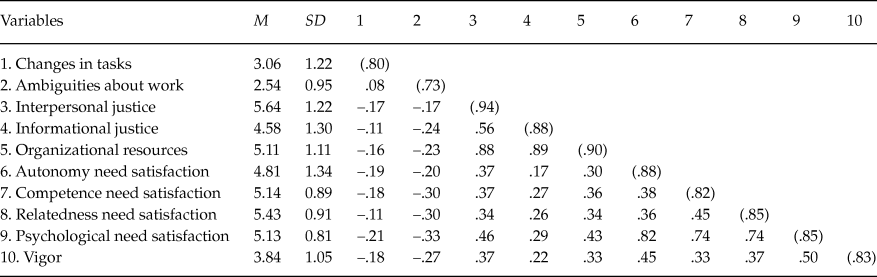
Correlations and descriptive statistics for the study variables are presented in Table 1. Alpha coefficients ranged from .73 to .94. Changes in tasks (r = –.18, p < .001) and ambiguities about work (r = –.27, p < .001) correlated negatively with work engagement, while interpersonal justice (r = .37, p < .001), informational justice (r = .22, p < .001), and higher–order factor of organizational resources (r = .33, p < .001) were positively related to work engagement. In addition, interpersonal justice, informational justice, and higher–order factor of organizational resources were positively correlated with autonomy need satisfaction (rs = .17 to .37, p < .001), competence need satisfaction (rs = .27 to .37, p < .001), relatedness need satisfaction (rs = .26 to .34, p < .001), and higher–order factor of psychological need satisfaction (rs = .29 to .46, p < .001). The opposite pattern of correlations was found for changes in tasks and ambiguities about work (rs = –.11 to –.33, p < .05). Autonomy need satisfaction (r = .45, p < .001), competence need satisfaction (r = .33, p < .001), relatedness need satisfaction (r = .37, p < .001), and higher–order factor of psychological need satisfaction (r = .50, p < .001) yielded significant positive correlations with work engagement. Finally, changes in tasks and ambiguities about work were negatively associated with interpersonal justice (rs = –.17, p < .001), informational justice (rs = –.11 to –.24, p < .05), and higher–order factor of organizational resources (rs = –.16 to –.23, p < .01). These results provide preliminary support for our hypotheses Footnote 1 .
Means, Standard Deviations, Alpha Reliabilities, and Correlations in Study 1

Note: Alpha coefficients are reported in parentheses along the diagonal.
p < .05 for rs between .09 and .11; p < .01 for rs between .12 and .16; p < .001 for r ≥ .17.
Hypothesis Tests
For the sake of parsimony (James, Mulaik, & Brett, Reference James, Mulaik and Brett2006), our hypotheses were tested using a structural equations modeling approach in which changes in tasks and ambiguities about work have direct and indirect effects on psychological need satisfaction (via organizational resources), that in turn leads to work engagement. The hypothesized model yielded a good fit to the data: χ2 (240) = 588.49, p < .001, χ2/df = 2.45, NFI = .91, IFI = .95, TLI = .94, CFI = .94, RMSEA = .06. The standardized parameter estimates associated with our hypothesized model appear in Figure 1. As can be seen, changes in tasks (β = –.16, p < .01) and ambiguities about work (β = –.21, p < .001) were negatively related to the higher–order organizational resources construct. Moreover, changes in tasks (β = –.12, p < .05), ambiguities about work (β = –.37, p < .001), and the higher–order organizational resources construct (β = .52, p < .001) significantly related to the higher–order psychological need satisfaction construct. Finally, the higher–order psychological need satisfaction construct was positively related to work engagement (β = .66, p < .001).
Completely standardized parameter estimates for the final structural model (Study 1).
*p < .05; **p < .01; ***p < .001.

We next tested three alternative models. In the first one, ambiguities about work, changes in tasks, and organizational resources predicted need satisfaction that, in turn, predicted work engagement. In the second one, ambiguities about work, changes in tasks, and organizational resources simultaneously predicted need satisfaction and work engagement. In the third one, ambiguities about work and changes in tasks mediated the effects of organizational resources on need satisfaction. In addition, need satisfaction predicted work engagement. Results revealed that these three alternative models exhibited a worse fit than the hypothesized model (see Table 2). The hypothesized model was thus judged the most plausible model on the basis of both theoretical and empirical grounds.
Goodness–of–Fit Indices of the Three Alternative Models for Study 1

Finally, to examine whether psychological need satisfaction acted as a mediator in the relationships of changes in tasks, ambiguities about work, and organizational resources to work engagement (Hypotheses 1 and 2), and whether organizational resources acted as a mediator in the relationships of changes in tasks and ambiguities about work to need satisfaction (Hypothesis 3), a bootstrapping approach was used (Preacher & Hayes, Reference Preacher and Hayes2008). Specifically, bootstrapped confidence interval (CI) estimates for the indirect effects of changes in tasks, ambiguities about work, and organizational resources on work engagement through psychological need satisfaction were first calculated. In the present study, 95% CIs for the indirect effects were computed using 1,000 bootstrapped samples. The use of bootstrap methods to estimate indirect effects is especially recommended in small–to–moderate samples (Shrout & Bolger, Reference Shrout and Bolger2002).
Bootstrap analyses revealed that the indirect effects of changes in tasks, ambiguities about work, and organizational resources on work engagement through psychological need satisfaction were as follows: –.13 (CI = –.23, –.06, p < .01) for changes in tasks, –.31 (CI = –.41, –.21, p < .01) for ambiguities about work, and .34 (CI = .25, .45, p < .01) for organizational resources. These results are consistent with Hypotheses 1 and 2. Then, bootstrapped CI estimates for the indirect effects of changes in tasks and ambiguities about work on psychological need satisfaction through organizational resources were calculated. Bootstrap analyses revealed that the indirect effects were as follows: –.08 (CI = –.16, –.03, p < .01) for changes in tasks, and –.11 (CI = –.19, –.03, p < .01) for ambiguities about work. Given that there were direct paths between changes in tasks and need satisfaction, and between ambiguities about work and need satisfaction, these mediations can be seen as partial. These findings provide support for Hypothesis 3.
Discussion
Results from Study 1 supported the positive effects of organizational resources (i.e., interactional justice) and the negative effects of job demands (i.e., changes in tasks and ambiguities about work) on work engagement through psychological need satisfaction. These findings are in line with past results on the positive influence of organizational resources and the negative impact of job demands on work engagement (e.g., Bakker et al., Reference Bakker, Hakanen, Demerouti and Xanthopoulou2007; Crawford et al., Reference Crawford, LePine and Rich2010; Schaufeli et al., Reference Schaufeli, Bakker and van Rhenen2009). In agreement with previous research (e.g., Gillet et al., Reference Gillet, Colombat, Michinov, Pronost and Fouquereau2013), the present results also confirmed that psychological need satisfaction may act as a mediator in the relationships of job demands and organizational resources to work engagement. Furthermore, organizational resources partially mediated the negative effects of changes in tasks and ambiguities about work on need satisfaction. These findings suggest that workers facing higher job demands may perceive the organizational environment as less fair, which in turn influences psychological need satisfaction. Similar results have been found in previous studies (e.g., Boudrias et al., Reference Boudrias, Desrumaux, Gaudreau, Nelson, Brunet and Savoie2011).
In Study 2, we looked at the mediating role of need thwarting in the relationships between job demands and organizational resources to burnout. Indeed, Deci and Ryan (Reference Deci and Ryan2000) posit that psychological need thwarting should provide a conceptual framework for explaining the mechanisms through which social environment relates to worker burnout. Low need satisfaction does not necessarily involve need frustration, and the difference between need frustration and low need satisfaction “is a critical issue as unfulfilled needs may not relate as robustly to malfunctioning as frustrated needs may” (Vansteenkiste & Ryan, Reference Vansteenkiste and Ryan2013, p. 265). For instance, Quested and Duda (Reference Quested and Duda2010) found that satisfaction of the three psychological needs was unrelated to burnout. In addition, Bartholomew et al. (2011, Study 3) have found that the path from need satisfaction to exhaustion was not significant, while frustration of the psychological needs emerged as a positive significant predictor of burnout. Globally, these results suggest that researchers should consider need thwarting rather than low need satisfaction to understand the presence of ill–being (e.g., burnout).
STUDY 2
Apart from studies focusing on the outcomes of need frustration, an increasing number of studies have examined the links between social factors and need thwarting. Vansteenkiste and Ryan (Reference Vansteenkiste and Ryan2013) argued that need supportive environment (e.g., high organizational resources) would be negatively related to need frustration, while need thwarting environment (e.g., high job demands) should positively lead to need frustration. In line with these arguments, Gillet et al. (2012, Study 2) have shown that perceptions of organizational support (i.e., the extent to which the organization values the contributions and cares about the well–being of their employees; Eisenberger, Huntington, Hutchison, & Sowa, Reference Eisenberger, Huntington, Hutchison and Sowa1986) and supervisor autonomy support (i.e., managers provide a meaningful rationale for doing the tasks, emphasize on choice rather than control, and acknowledge one’s feelings and perspectives; Deci & Ryan, Reference Deci and Ryan1987) were negatively associated with need thwarting, while perceptions of supervisor controlling behaviors (i.e., managers behave in a coercive and authoritarian way to pressure employees to behave in a specific and, typically, manager–directed way; Deci, Connell, & Ryan, Reference Deci, Connell and Ryan1989) have positive effects on need frustration. Additional studies need to be carried out to examine the links between job demands, organizational resources, psychological need thwarting, and burnout in the work context. This constitutes the main purpose of Study 2.
Specifically, we tested a model in which job demands have direct and indirect effects on need thwarting (via organizational resources), that in turn leads to burnout. First, need thwarting should completely mediate the relationships of organizational resources to burnout (Hypothesis 1). Second, need thwarting should completely mediate the relationships of changes in tasks and ambiguities about work to burnout (Hypothesis 2). Finally, organizational resources should partially mediate the relationships of changes in tasks and ambiguities about work to need thwarting (Hypothesis 3).
Method
Participants and Procedure
The procedure was exactly the same as that of Study 1. A convenient sample of 708 workers (229 men and 479 women) from various French companies participated in the present study. Participants’ age ranged from 18 to 68 years (M = 32.95, SD = 9.84). Organizational tenure ranged from 0.08 to 39 years (M = 7.05, SD = 8.04). Twenty–two participants (3.1%) worked in a company with less than ten employees, 89 in a company from 11 to 49 employees (12.6%), 130 in a company from 50 to 249 employees (18.4%), 80 in a company from 250 to 499 employees (11.3%), and 387 in a company with more than 500 employees (54.7%).
Measures
As in Study 1, participants completed a questionnaire packet containing assessments of job demands (i.e., changes in tasks and ambiguities about work) and organizational resources (i.e., interactional justice) along with other scales described below (i.e., psychological need thwarting and burnout). Levels of internal consistency for the four subscales used in our first study were all satisfactory with Cronbach alphas ranged from .70 to .94.
Need thwarting
Frustration of the needs for autonomy (3 items; e.g., ”I feel pushed to behave in certain ways”), competence (3 items; e.g., ”There are times when I am told things that make me feel incompetent”), and relatedness (3 items; e.g., ”I feel others can be dismissive of me”) was assessed with the French version of the Psychological Need Thwarting Scale (PNTS; Bartholomew et al., Reference Bartholomew, Ntoumanis, Ryan and Thøgersen–Ntoumani2011; Gillet, Fouquereau, Lequeurre, Bigot, & Mokounokolo, Reference Gillet, Fouquereau, Forest, Brunault and Colombat2012). All responses were indicated on a 7–point Likert scale ranging from 1 (strongly disagree) to 7 (strongly agree). Recently, Gillet et al. (Reference Gillet, Fouquereau, Forest, Brunault and Colombat2012) have provided strong evidence for the factorial structure, construct validity, and internal consistency of this scale in the work context. As suggested by Johnson et al. (Reference Johnson, Rosen and Chang2011), we conducted a CFA in which a higher–order need thwarting factor subsumes the three first–order factors (i.e., autonomy, competence, and relatedness). Results revealed an adequate fit of the model to the data (e.g., GFI = .92 NFI = .91, IFI = .92, CFI = .92). Autonomy (α = .81), competence (α = .79), and relatedness (α = .81) need thwarting also had high internal consistency. These results provide supportive evidence for our higher–order construct of need thwarting (α = .86). This view is also consistent with the numerous investigations where psychological need thwarting was found to define a single higher–order construct (e.g., Gillet et al., Reference Gillet, Fouquereau, Forest, Brunault and Colombat2012, Study 2).
Burnout
Emotional exhaustion (α = .87; e.g., ”I feel I am unable to be sensitive to the needs of coworkers”) was measured using three items of the French version of the Shirom–Melamed Burnout Measure (SMBM; Sassi & Neveu, Reference Sassi and Neveu2010; Shirom & Melamed, Reference Shirom and Melamed2006). Response was given on a 7–point Likert scale ranging from 1 (never) to 7 (always). Past studies used exploratory and confirmatory factor analyses with employees from diverse occupations and organizations and provided evidence for the factorial structure and the high internal reliability of the SMBM (e.g., Armon, Shirom, & Melamed, Reference Armon, Shirom and Melamed2012).
Results
Confirmatory Factor Analysis
We first examined the dimensionality of our variables using CFA via AMOS. A covariance matrix was used as input and models were estimated using the maximum likelihood method. The model tested in this study was composed of ten latent variables (i.e., changes in tasks, ambiguities about work, interpersonal justice, informational justice, autonomy need thwarting, competence need thwarting, relatedness need thwarting, and burnout). However, interpersonal justice and informational justice as well as autonomy, competence, and relatedness need thwarting were defined as indicators of two second–order latent variables (i.e., organizational resources and psychological need thwarting, respectively). This model yielded a good fit to the data, χ2 = 826.69 (237), p < .001, χ2/df = 3.49, NFI = .92, IFI = .94, TLI = .93, CFI = .94, RMSEA = .06. All paths were significant and had standardized factor loadings above .50: .72–.85 for changes in tasks, .54–.77 for ambiguities about work, .86–.95 for interpersonal justice, .78–.87 for informational justice, .69–.89 for autonomy need thwarting, .68–.87 for competence need thwarting, .64–.86 for relatedness need thwarting, and .67–.94 for burnout. These results suggest our theorized model was factorially valid.
The issue of common method variance was addressed using Podsakoff et al.’s (Reference Podsakoff, MacKenzie, Lee and Podsakoff2003) recommendations. We first examined a single factor model for the present data (i.e. Harman’s single factor test). This test revealed a poor fit to the data, χ2 = 6211.08 (252), p < .001, χ2/df = 24.65, NFI = .39, IFI = .40, TLI = .34, CFI = .39, RMSEA = .18. Second, we added an orthogonal latent common method factor to the hypothesized ten–factor model in order to assess the potential increase in model fit that would be gained from accounting for this unmeasured method factor. The fit of that model was good: χ2 = 462.02 (213), p < .001, χ2/df = 2.17, NFI = .95, IFI = .98, TLI = .97, CFI = .98, RMSEA = .04. Thus, the addition of a method factor to the measurement model significantly improved the fit of the model over the substantive constructs–only model, Δχ2 (24) = 364.67. However, the method factor accounted for only 18 percent of the total variance, which is lower than the median amount of method variance (25%) reported in prior studies (e.g., Williams et al., Reference Williams, Cote and Buckley1989). Overall, these results suggest common method bias was not a serious problem underlying the present data.
Descriptive Statistics and Intercorrelations
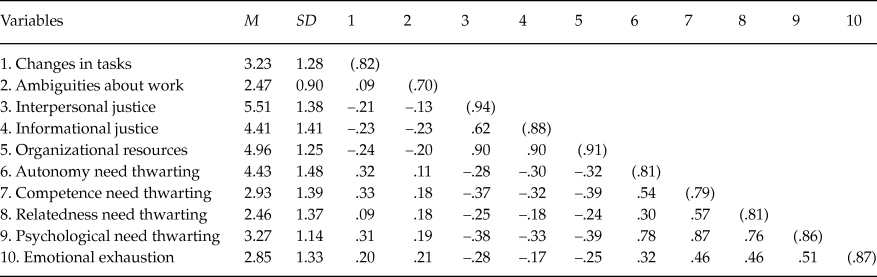
Correlations and descriptive statistics for the study variables are presented in Table 3. Alpha coefficients ranged from .70 to .94. Changes in tasks (r = .20, p < .001) and ambiguities about work (r = .21, p < .001) correlated positively with burnout, while interpersonal justice (r = –.28, p < .001), informational justice (r = –.17, p < .001), and higher–order factor of organizational resources (r = –.25, p < .001) were negatively related to burnout. In addition, interpersonal justice, informational justice, and higher–order factor of organizational resources were negatively correlated with autonomy need thwarting (rs = –.28 to –.32, p < .001), competence need thwarting (rs = –.32 to –.39, p < .001), relatedness need thwarting (rs = –.18 to –.25, p < .001), and higher–order factor of psychological need thwarting (rs = –.33 to –.39, p < .001). The opposite pattern of correlations was found for changes in tasks and ambiguities about work (rs = .09 to .33, p < .05). Autonomy need thwarting (r = .32, p < .001), competence need thwarting (r = .46, p < .001), relatedness need thwarting (r = .46, p < .001), and higher–order factor of psychological need thwarting (r = .51, p < .001) yielded significant positive correlations with burnout. Finally, changes in tasks and ambiguities about work were negatively associated with interpersonal justice (rs = –.13 to –.21, p < .001), informational justice (rs = –.23, p < .001), and higher–order factor of organizational resources (rs = –.20 to –.24, p < .001). These results provide preliminary support for our hypotheses Footnote 2 .
Means, Standard Deviations, Alpha Reliabilities, and Correlations in Study 2

Note: Alpha coefficients are reported in parentheses along the diagonal.
p < .05 for rs between .09 and .10; p < .01 for rs between .11 and .12; p < .001 for r ≥ .13.
Hypothesis Tests
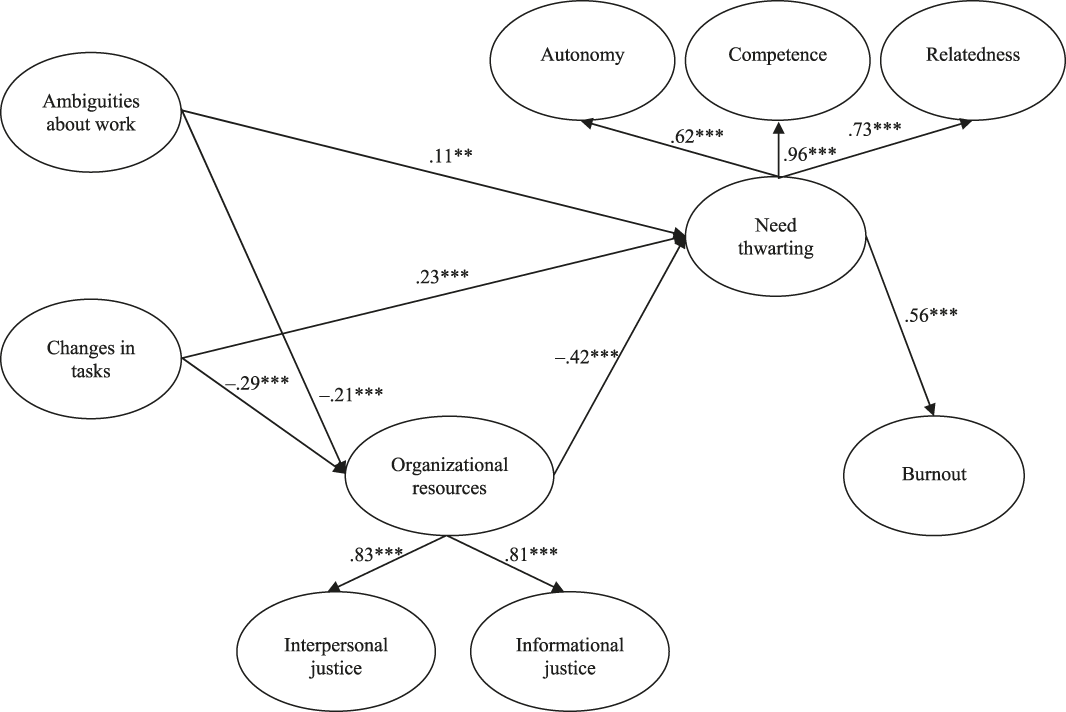
Our hypotheses were tested using a structural equations modeling approach in which changes in tasks and ambiguities about work have direct and indirect effects on psychological need thwarting (via organizational resources), that in turn leads to burnout. The hypothesized model yielded a good fit to the data: χ2 (240) = 832.91, p < .001, χ2/df = 3.47, NFI = .92, IFI = .94, TLI = .93, CFI = .94, RMSEA = .06. The standardized parameter estimates associated with our hypothesized model appear in Figure 2. As can be seen, changes in tasks (β = –.29, p < .001) and ambiguities about work (β = –.21, p < .001) were negatively related to the higher–order organizational resources construct. Moreover, changes in tasks (β = .23, p < .001), ambiguities about work (β = .11, p < .01), and the higher–order organizational resources construct (β = –.42, p < .001) significantly related to the higher–order psychological need thwarting construct. Finally, the higher–order psychological need thwarting construct was positively related to burnout (β = .56, p < .001).
Completely standardized parameter estimates for the final structural model (Study 2).
**p < .01; ***p < .001.

As in Study 1, we next tested three alternative models. In the first one, ambiguities about work, changes in tasks, and organizational resources predicted need thwarting that, in turn, predicted burnout. In the second one, ambiguities about work, changes in tasks, and organizational resources simultaneously predicted need thwarting and burnout. In the third one, ambiguities about work and changes in tasks mediated the effects of organizational resources on need thwarting. In addition, need thwarting predicted burnout. Results revealed that these three alternative models exhibited a worse fit than the hypothesized model (see Table 4). The hypothesized model was thus judged the most plausible model on the basis of both theoretical and empirical grounds.
Goodness–of–Fit Indices of the Three Alternative Models for Study 2

Finally, to examine whether psychological need thwarting acted as a mediator in the relationships of changes in tasks, ambiguities about work, and organizational resources to burnout (Hypotheses 1 and 2), and whether organizational resources acted as a mediator in the relationships of changes in tasks and ambiguities about work to need thwarting (Hypothesis 3), a bootstrapping approach was used (Preacher & Hayes, Reference Preacher and Hayes2008). Bootstrap analyses revealed that the indirect effects of changes in tasks, ambiguities about work, and organizational resources on burnout through psychological need thwarting were as follows: .20 (CI = .14, .26, p < .01) for changes in tasks, .11 (CI = .06, .18, p < .01) for ambiguities about work, and –.24 (CI = –.31, –.17, p < .01) for organizational resources. These results are consistent with Hypotheses 1 and 2. Then, bootstrapped CI estimates for the indirect effects of changes in tasks and ambiguities about work on psychological need thwarting through organizational resources were calculated. Bootstrap analyses revealed that the indirect effects were as follows: .12 (CI = .08, .17, p < .01) for changes in tasks, and .09 (CI = .05, .14, p < .01) for ambiguities about work. Given that there were direct paths between changes in tasks and need thwarting, and between ambiguities about work and need thwarting, these mediations can be seen as partial. These findings provide support for Hypothesis 3.
Discussion
Results from Study 2 supported the negative effects of organizational resources (i.e., interactional justice) and the positive effects of job demands (i.e., changes in tasks and ambiguities about work) on burnout through psychological need thwarting. These findings are in line with past results on the negative influence of organizational resources and the positive impact of job demands on burnout (e.g., Bakker et al., Reference Bakker, Demerouti and Euwema2005; Bakker et al., Reference Bakker, Hakanen, Demerouti and Xanthopoulou2007). In agreement with previous research (e.g., Gillet et al., Reference Gillet, Fouquereau, Forest, Brunault and Colombat2012, Study 2), the present results also confirmed that psychological need thwarting may act as a mediator in the relationships of job demands and organizational resources to burnout. Furthermore, organizational resources partially mediated the positive effects of changes in tasks and ambiguities about work on need thwarting.
General Discussion
In the present research, we conducted two separate studies to examine whether satisfaction and thwarting of the psychological needs for autonomy, competence, and relatedness would be explanatory mechanisms for the relationships of job demands (i.e., changes in tasks and ambiguities about work) and organizational resources (i.e., interactional justice) to work engagement and burnout. Specifically, Study 1 investigated whether job demands (i.e., changes in tasks and ambiguities about work) have direct and indirect effects on need satisfaction (via organizational resources), that in turn leads to work engagement. In Study 2, we examined the mediating role of need thwarting in the relationships between job demands and organizational resources to burnout. The present results support previous research in this area and extend our understanding of the mechanisms through which job demands and organizational resources influence employees’ work engagement and burnout. These findings bear important implications for theory and practice that we outline below.
First, we found job demands to be negatively and positively associated with work engagement and burnout, respectively, while the opposite pattern of relationships was found for organizational resources. The JD–R model assumes that organizational resources are related to both burnout and work engagement (negative and positive links, respectively), whereas job demands are positively associated with burnout and negatively linked to work engagement (Hu, Schaufeli, & Taris, Reference Hu, Schaufeli and Taris2011). As suggested by Demerouti et al. (Reference Demerouti, Bakker, Nachreiner and Schaufeli2001), job demands encourage the emergence of burnout and have a negative impact on work engagement because these aspects of the job require sustained effort or skills and are associated with certain physiological and/or psychological costs. In contrast, the positive link between organizational resources and work engagement as well as the negative relationship between organizational resources and burnout can be explained by the fact that these organizational aspects of the job are functional in meeting job requirements and instrumental to promote personal growth, learning and development. In other words, high job demands and lacking organizational resources exhaust employees' energy resources and therefore lead to burnout, while high organizational resources and low job demands have a motivating potential and lead to work engagement (Bakker & Demerouti, Reference Bakker and Demerouti2007). The observed negative association between organizational resources and burnout in Study 2 agrees with and adds to other findings that document that lack of resources are associated with high levels of burnout (e.g., Llorens, Bakker, Schaufeli, & Salanova, Reference Llorens, Bakker, Schaufeli and Salanova2006; Tims, Bakker, & Derks, Reference Tims, Bakker and Derks2013). Also, in previous studies on the JD–R model, the negative path from job demands to work engagement appeared to be significant (e.g., Hu et al., Reference Hu, Schaufeli and Taris2011).
Second, results also revealed that job demands and organizational resources have negative and positive effects on the satisfaction of the psychological needs for autonomy, competence, and relatedness, respectively (Study 1), while these needs are thwarted when employees perceive high job demands and low organizational resources (Study 2). These findings are consistent with previous research which has shown that job demands and resources are significantly linked to need satisfaction (e.g., De Cooman, Stynen, van den Broeck, Sels, & De Witte, Reference De Cooman, Stynen, van den Broeck, Sels and De Witte2013; van den Broeck, Vansteenkiste, De Witte, & Lens, Reference van den Broeck, Vansteenkiste, De Witte and Lens2008). These relationships may be explained by the fact that job demands require considerable energy and thus distract workers from the satisfaction of their psychological needs. In contrast, job resources may establish conditions of growth and goal achievement, and thereby facilitate psychological need satisfaction (Bakker & Demerouti, Reference Bakker and Demerouti2007). In addition, Study 2 is the first, to the best of our knowledge, to demonstrate that job demands and organizational resources are significantly associated with need thwarting. These results are in accordance with few recent studies which showed that social factors may relate to psychological need thwarting (e.g., Bartholomew et al., Reference Bartholomew, Ntoumanis, Ryan and Thøgersen–Ntoumani2011; Gillet et al., Reference Gillet, Fouquereau, Forest, Brunault and Colombat2012).
It is also important to note that the present research documents the links between interactional justice, need satisfaction, need thwarting, work engagement, and burnout. Perceptions of interactional justice have been found to be positively and negatively associated with psychological well–being and psychological distress, respectively (e.g., Judge & Colquitt, Reference Judge and Colquitt2004; Kausto et al., Reference Kausto, Elo, Lipponen and Elovainio2005). However, little is known about the impact of interactional justice on work engagement and burnout. In particular, Study 1 is the first, to the best of our knowledge, to examine the links between the two forms of interactional justice (i.e., interpersonal and informational justice) and work engagement. Specifically, the present results revealed that interactional justice was positively correlated with work engagement. Results from Study 1 are also in accordance with few investigations which showed that interactional justice negatively relates to burnout (e.g., Moliner et al., Reference Moliner, Martínez–Tur, Peiró and Ramos2005). More generally, the present research adds to the literature on organizational justice by demonstrating that psychological need satisfaction and thwarting represent mechanisms through which interactional justice has significant effects on work engagement and burnout.
Third, our findings revealed significant relationships between psychological need satisfaction and work engagement (Study 1) as well as between need thwarting and burnout (Study 2). Specifically, employees are fully engaged in their work when their three psychological needs are satisfied, while need thwarting leads to high levels of burnout. Research has investigated these relationships as need satisfaction has been found to be positively related to adaptive outcomes (e.g., Trépanier et al., Reference Trépanier, Fernet and Austin2013; van den Broeck et al., Reference van den Broeck, Vansteenkiste, De Witte, Soenens and Lens2010). Prior studies have also shown that need thwarting was positively associated with negative outcomes such as burnout (e.g., Balaguer et al., Reference Balaguer, González, Fabra, Castillo, Mercé and Duda2012) and negative affect (e.g., Gillet et al., Reference Gillet, Fouquereau, Forest, Brunault and Colombat2012). More generally, the present results confirm that frustrated psychological needs relate to malfunctioning, while psychological need satisfaction can substantially account for the bright side of individuals’ optimal functioning (Deci & Ryan, Reference Deci and Ryan2000; Vansteenkiste & Ryan, Reference Vansteenkiste and Ryan2013).
Fourth, the present study sheds light on the mechanisms through which job demands and organizational resources lead to work engagement and burnout. Indeed, in Study 1, we found the relationships from job demands and organizational resources to work engagement to be fully mediated by psychological need satisfaction. The stimulating influence of organizational resources on work engagement can be explained by need satisfaction because job resources are growth promoting and need satisfaction is a necessary condition for individuals to thrive. Need satisfaction also accounts for the relationship between job demands and work engagement because job demands are considered to be health–impairing and low need satisfaction is considered to have an energy–depleting effect (van den Broeck et al., Reference van den Broeck, Vansteenkiste, De Witte and Lens2008). More generally, as shown in past research (e.g., De Cooman et al., Reference De Cooman, Stynen, van den Broeck, Sels and De Witte2013; van den Broeck et al., Reference van den Broeck, Vansteenkiste, De Witte and Lens2008), the present findings confirm that psychological need satisfaction explain the effects of job demands and organizational resources.
In Study 2, our results revealed that thwarting of the psychological needs for autonomy, competence, and relatedness, mediated the relationships from job demands and organizational resources to burnout. These results are in agreement with much field research conducted over the last decade which has reported job demands to be associated with a host of negative consequences (e.g., Crawford et al., Reference Crawford, LePine and Rich2010; Guglielmi, Simbula, Schaufeli, & Depolo, Reference Guglielmi, Simbula, Schaufeli and Depolo2012), while job resources were negatively associated with burnout (e.g., Bakker et al., Reference Bakker, Demerouti, De Boer and Schaufeli2003; Schaufeli & Bakker, Reference Schaufeli and Bakker2004). Although researchers have examined the links from job demands and organizational resources to burnout, no previous studies to the best of our knowledge have investigated the influence of these aspects of the job on psychological need thwarting. Study 2 is thus the first to demonstrate the mediating role of need thwarting in the relationships from job demands and organizational resources to burnout. These findings support the view that frustration of psychological needs represent a basic mechanism contributing to the effects of job demands and organizational resources on burnout (see Ryan & Deci, 2000). Therefore, feelings of autonomy, competence, and relatedness play a central role in the development or reduction of ill–being at work. Such research is extremely useful as it advances our understanding of the processes that may be at play in the relationships of organizational factors to ill–being.
Finally, we examined the mediating role of organizational resources in the relationships from job demands to psychological need satisfaction and thwarting. Specifically, in Study 1, changes in tasks and ambiguities about work have direct and indirect effects through organizational resources on need satisfaction. In Study 2, these job demands have direct and indirect effects through organizational resources on need thwarting. These results are in agreement with those obtained by Boudrias et al. (Reference Boudrias, Desrumaux, Gaudreau, Nelson, Brunet and Savoie2011) and suggest that employees facing higher job demands tend to perceive the organizational environment as less fair, which in turn influences psychological need satisfaction and thwarting. Therefore, job demands interventions may help to improve work engagement and reduce burnout through their effects on need satisfaction and thwarting but also through organizational resources (i.e., interactional justice). In other words, interventions aimed at decreasing job demands, may improve the employees’ perceptions of interactional justice in the organization, facilitate the satisfaction of the psychological needs, lessen the thwarting of these needs, and thus lead to an increase in work engagement and a reduction in burnout.
Some limitations should be taken into account when interpreting the present results. First, our data are correlational in nature and conclusions about causality are unwarranted. Future research using longitudinal designs should attempt to replicate the present results. Experimental manipulations of antecedent variables should also be used to make causal inferences. Second, the present study draws from the JD–R model (Demerouti et al., Reference Demerouti, Bakker, Nachreiner and Schaufeli2001), organizational justice theories (Greenberg, Reference Greenberg1990), and self–determination theory (Deci & Ryan, Reference Deci and Ryan1985). However, we did not consider personal resources such as optimism and self–efficacy. It would be interesting in future research to examine the role of these dimensions (see Xanthopoulou, Bakker, & Fischbach, Reference Xanthopoulou, Bakker and Fischbach2013). Third, we only considered interpersonal and informational justice. It would be interesting in future research to examine the role of other dimensions of organizational justice (i.e., procedural and distributive justice) and other organizational resources (e.g., perceived organizational support) to identify their effects on employees’ work engagement and burnout. Fourth, we only examined the relations from job demands and organizational resources to work engagement and burnout through psychological need satisfaction and thwarting. Future research should examine other intermediate constructs (e.g., work motivation, positive and negative affect) to identify the mechanisms that might account for the significant effects of job demands and organizational resources. Fifth, future research would do well to include job demands, organizational resources, need satisfaction, need thwarting, work engagement, and burnout in the same study to provide support for both the health impairment and motivational processes postulated by the JD–R model (Bakker & Demerouti, Reference Bakker and Demerouti2007). Such a research design should also allow to make a direct comparison of the influence of need satisfaction and thwarting on work engagement and burnout, respectively. Finally, we did not look at the links from work engagement and burnout to other specific outcomes and we only relied on self–report measures. Such measures can be impacted by social desirability, and we thus encourage researchers to conduct additional research using supervisor–rated measures of performance and absenteeism as ultimate outcomes.
Notwithstanding the limitations we noted above, there are some potentially important practical implications of our research. It is clear that employee work engagement is positively associated with organizational resources and negatively related to job demands (Study 1), while the opposite pattern of relationships was found for burnout (Study 2). Thus, supervisors could potentially foster employees’ work engagement and decrease their burnout by providing additional resources and limiting the demands the employee must cope with. Specifically, we found that changes in tasks and ambiguities about work exert an indirect effect on work engagement and burnout through need satisfaction and thwarting, respectively. Employee work engagement and burnout could thus be influenced by supervisors through practices aimed at changing the level of demands confronted by workers. In other words, interventions which aim to reduce changes in tasks and ambiguities about work might help to both improve employees’ work engagement and decrease burnout.
In addition, as organizational resources, and in particular interpersonal and informational justice, were found to be positively and negatively associated with employees’ work engagement and burnout respectively, supervisors would do well to enhance the perceptions of interactional justice of their followers. In addition, supervisors can both facilitate employees’ satisfaction of the need for autonomy, competence, and relatedness, and minimize the thwarting of these needs, and through these means influence their levels of work engagement and burnout (see also van den Broeck et al., Reference van den Broeck, Vansteenkiste, De Witte and Lens2008). We thus encourage supervisors to treat their followers appropriately and provide an adequate treatment of subordinates in terms of courtesy and respect. To increase the likelihood of fair treatment, managers can receive training designed to focus on interactional justice rule adherence (see Skarlicki & Latham, Reference Skarlicki, Latham, Greenberg and Colquitt2005). Indeed, evidence presented by Skarlicki and Latham (Reference Skarlicki and Latham1997) suggests that supervisory training could promote fairer interpersonal treatment of workers, helping to improve employee well–being at work.
We examined (a) the relationships between job demands, organizational resources, need satisfaction, need thwarting, work engagement, and burnout, (b) whether need satisfaction and thwarting mediated the relationships from job demands and organizational resources to work engagement and burnout, respectively, and (c) whether organizational resources mediated the relationships between job demands and need satisfaction as well as between job demands and need thwarting. Findings highlight the important role of psychological need satisfaction and thwarting as key psychological mechanisms through which job demands and organizational resources relate to work engagement and burnout. More generally, the present research adds to the growing body of evidence suggesting that job demands and organizational resources exert direct and indirect effects on employees’ attitudes and behaviors.