INTRODUCTION
The greater amberjack Seriola dumerili is a mainly coastal pelagic species occurring in the Atlantic, Pacific and Indian Oceans. It is common in the Mediterranean and Adriatic Seas, where it is targeted by important local gill net fisheries.
Commonly greater amberjack specimens measure 110 cm and weigh 25–40 kg, the maximum reported size was 180 cm in total length and the maximum recorded body weight was 80.6 kg (Smith-Vaniz, Reference Smith-Vaniz, Whitehead, Bauchot, Hureau, Nielsen and Tortonese1986; Fredj & Maurin, Reference Fredj and Maurin1987; Fischer et al., Reference Fischer, Schender and Bauchot1987b).
Greater amberjack Seriola dumerili is a common species in Tunisian coasts especially in the Gulf of Gabes (Postel, Reference Postel1956; Ktari-Chakroun & Azouz, Reference Ktari-Chakroun and Azouz1971; Bradai & Bouain, Reference Bradai and Bouain1994; Bradai et al., Reference Bradai, Quignard, Bouain, Jarboui, Ouannes-Ghorbel, Ben Abdallah, Zaouli and Ben Salem2004; Sley, Reference Sley2010). It is taken by many fishing methods including purse seines, gill nets, and by longline. However, its commercial abundance has decreased relatively in recent years in the Gulf of Gabes (Sley, Reference Sley2010).
Some aspects of the biology of greater amberjack have been described throughout its geographic range: age and growth of this species were studied in the Gulf of Mexico (Manooch & Potts, Reference Manooch and Potts1997; Thompson et al., Reference Thompson, Beasley and Wilson1999). Embryonic and morphological development of larvae and juveniles were studied in Japanese coasts (Masuma et al., Reference Masuma, Kanematu and Teruya1990; Tachihara et al., Reference Tachihara, Ebisu and Tukasima1993).
Reproductive biology of Mediterranean amberjack was investigated by Lazzari & Barbera (Reference Lazzari, Barbera, De Pauw, Jaspers, Ackefors and Wilkins1989), Marino et al. (Reference Marino, Mandicha, Massari, Andaaloro, Porrello and Basurco1995a, Reference Marino, Mandich, Massari, Andaloro, Porrello, Finoia and Cevascob) and Micale et al. (Reference Micale, Genovesa, Greco, Perdichizzi and Carrillo1993). Food and feeding activity has been documented in the Central Mediterranean Sea especially in the Sicilian Canal (Badalamenti et al., Reference Badalamenti, D'anna, Lopiano, Scilipoti and Mazzola1995; Pipitone & Andaloro, Reference Pipitone and Andaloro1995; Andalaro & Pipitone, Reference Andalaro and Pipitone1997).
The purpose of the present study was to investigate the feeding habits of S. dumerili in the Gulf of Gabes (Tunisia), and examine the effects of sex, predator size and season.
MATERIALS AND METHODS
Sample collection
The Gulf of Gabes spreads along 750 km, from 35.8°N to the Libyan border. This region is characterized by a broad continental shelf (Ben Othman, Reference Ben Othman1973). Stomach contents of 290 specimens were examined from June 2004 to May 2006. Throughout its ranges, specimens of S. dumerili were commercially taken by purse seines, gill nets and longline. Fishes were collected from different points in the Gulf of Gabes in south-eastern Tunisia: i.e. Chebba, Mehdia, Sfax, Sidi Mansour, Islands of Kerkennah, Gabes, Gannouch, Djerba and Zarzis (Figure 1). Samples were treated altogether, without any distinction between regions. Samples were examined on a monthly basis and were random subsamples of a larger catch landed by fishermen. Total length (TL), fork length (FL) and standard length (SL) were measured in mm. Total mass (TM) and mass of eviscerated fish (EM) were weighed with a digital balance to the nearest 0.1 g. Specimens examined ranged from 155 mm TL to 1660 mm TL, and 134 to 1550 mm FL. Most fish were examined fresh, shortly after landing. Sex and date of capture were also recorded for each fish.
Map of the Gulf of Gabes (Tunisian coast, Mediterranean Sea).

In the laboratory, the stomach contents were removed, and the prey identified to the lowest taxon (Fischer et al., Reference Fischer, Schender and Bauchot1987a, Reference Fischer, Schender and Bauchotb). The number of prey found in each stomach was recorded to determine the feeding pattern of S. dumerili. Each prey item was weighed in wet condition to the nearest 0.001 g.
No single method of analysis of stomach contents completely describes the diet of a predator (Hyslop, Reference Hyslop1980); hence, the index of vacuity (%VI) was calculated to describe the trophic behaviour of this species. We evaluated the importance of the different prey types by calculating the frequency of occurrence (%O), abundance by both number (%N) and weight (%W). These indices were used to calculate the index of relative importance (IRI) (Pinkas et al., Reference Pinkas, Oliphant and Iverson1971; Hacunda, Reference Hacunda1981; Cortés, Reference Cortés1997) for each taxonomic category, using mass instead of volume. This index facilitates comparisons to other studies, provides a single measure of the diet, and is less biased than weight, frequency or number alone (Cortés, Reference Cortés1997). In the present study, the following formulae of these indices were used:
-
1. Vacuity index (%VI) = number of empty stomachs/total number of examined stomachs × 100;
-
2. Frequency of Occurrence (%O) = number of stomachs in which a food item was found/total number of full stomachs × 100;
-
3. Percentage of Numerical abundance (%N) = total number of each prey item/total number of all prey in all stomachs × 100;
-
4. Percentage of Weight (%W) = total wet weight of each prey item/ total weight of stomach contents × 100;
-
5. The main food items were determined using the Index of Relative Importance:
 $${\rm IRI}:{\rm IRI} = \% {\rm O} \times (\% {\rm N} + \% {\rm W}).$$
Morato-Gomes et al. (Reference Morato-Gomes, Sola, Gros, Menezes and Pinho1998) proposed a classification according to the following subdivision:
-
Main prey:
$${\rm IRI}\, \ge \,{\rm 3}0 \times (0.{\rm 15} \times \Sigma {\rm O}\% )$$
-
Secondary prey:
$${\rm 3}0 \times (0.{\rm 15} \times \Sigma {\rm O}\% )\, \lt \,{\rm IRI}\, \lt \,{\rm 1}0 \times (0.0{\rm 5} \times \Sigma {\rm O}\% )$$
-
Occasional prey:
$${\rm IRI}\, \le \,{\rm 1}0 \times (0.0{\rm 5} \times \Sigma {\rm O}\% ).$$
-
The index was expressed in percentage as follows:
$$\% {\rm IRI} = ({\rm IRI}/\Sigma {\rm IRI}) \times {\rm 1}00$$
-


Prey species were sorted in decreasing order according to IRI and the cumulative %IRI was calculated and recorded for the major prey taxa (Hyslop, Reference Hyslop1980) and compared between different size-groups, seasons and sex. This index was examined for three size groups that corresponded to juveniles (≤ 280 mm FL), medium-size fish (280 mm < FL < 960 mm) and adults FL ≥ 960 mm.
Statistical differences (P = 0.05) in diet composition with respect to length-class and season were assessed by Chi-square test (χ2) of the frequency of a given prey (Sokal & Rohlf, Reference Sokal and Rohlf1981). The variation in the index of vacuity (%VI) was also tested using the χ2-test over a contingency table of number of empty stomachs.
RESULTS
Feeding intensity
Of the 290 specimens examined 110 had empty stomachs (VI% = 37.9%) and 180 specimens had stomachs containing food. The proportion of empty stomachs was significantly different between the sexes (χ2 ob. = 8.5 > χ2 th = 5.99), and the %VI of females and males and juveniles which have undifferentiated sex were 44, 50.7 and 25.2% respectively.
The highest number of empty stomachs was found in winter and spring (60%), and was lowest from autumn (32%) and summer (22%).
The proportion of empty stomachs was also significantly different among size-classes (χ2 ob. = 19.24 > χ2 th = 5.99, P = 0.05), with the %VI of juveniles (≤ 280 mm FL), medium-size fish (280 mm < FL < 960 mm) and adults FL ≥ 960 mm, 25.2, 50 and 23.8%, respectively.
Diet composition
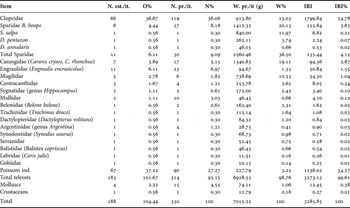
The diet of S. dumerili consisted of 346 different prey items across 20 identified prey taxa with an average of two prey items per stomach for fish containing food.
The observed prey were either teleosts, crustaceans or molluscs (Table 1), with teleosts the main groups, as indicated by %IRI for these groups (99.61%), although fishes were most important in terms of weight (98.8%) and frequency of occurrence (95.2%). Molluscs and crustaceans were only found occasionally (%IRI, 0.38 and 0.01%, respectively).
Prey categories of S. dumerili from the Gulf of Gabes (Tunisia), with the proportion of the diet by frequency of Occurrence (%O), Numerical abundance (%N), Weight (%W), IRI and %IRI.

N. est./it, number of stomachs containing prey i; N. pr./it, number of prey item i; W. pr./it (g), wet weight of prey item i.
At the family level, Clupeidae were the most numerous group (%N = 36.06%), due to Sardinella aurita and Sardina pilchardus occurring in large numbers, whereas Sparidae (B. boops, S. salpa, D. pentazoo, D. annularis) were the most important family in terms of weight (%W = 36.5%).
According to the classification of Morato-Gomes et al. (Reference Morato-Gomes, Sola, Gros, Menezes and Pinho1998), the main prey (IRI ≥ 510) were Clupeidae (IRI = 1799.8; %IRI = 54.78), while secondary prey (56.7 < IRIi < 510) were Sparidae (IRI = 135.4; %IRI = 4.12%) and Carangidae (IRI = 94.4; %IRI = 2.9%). Mugilidae and Engraulidae (Engraulis encrasicolus) and other fishes were as occasional prey with IRI ≤ 56.7. Other taxa (molluscs and crustaceans) were only taken occasionally (%IRI <2%) (Table 1).
Fish were the main prey group for all size classes (%IRI > 95%). In fish, ≥ 280 mm FL, teleosts and molluscs accounted for 99.03% and 0.07% IRI, respectively. Forever, Crustaceans were only observed in the medium size class, 280–960 mm FL (%IRI = 0.04%) (Figure 2).
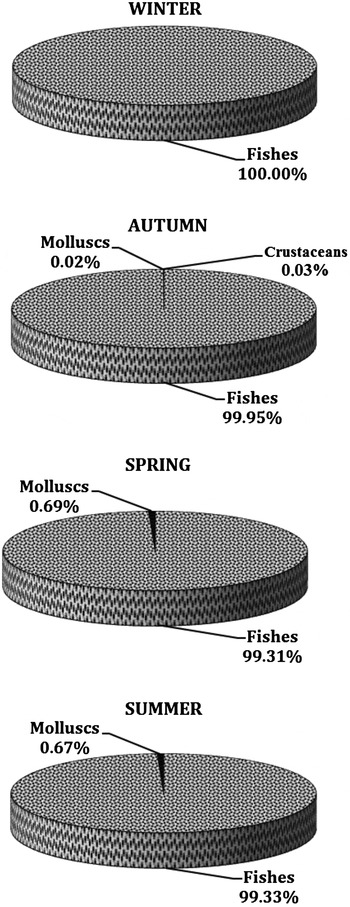
Diet composition of S. dumerili throughout the year, based in the percentage index of relative importance values of the major prey groups.

Ontogenetic differences in the teleosts diet of S. dumerili were apparent among size. In fish ≤ 280 mm FL, stomach of S. dumerili contained Clupeidae, Engraulidae and Gobiidae. However, many categories of fish prey appeared with increasing predator size. Other fish families were observed in the diet of medium size class of S. dumerili (280–960 mm FL): Sygnatidae, Belonidae, Dactylopteridae, Argentinidae, Synodontidae and Serranidae. However, for the large size class (adults; ≥ 960 mm FL), we observed new categories of fish: Sparidae, Carangidae, Mugilidae, Centracanthidae, Mullidae, Trachinidae and Balistidae. However, many fish prey were unidentified; we couldn't determine if they were pelagic or benthic species because they were in advanced stages of digestion; this may reflect short periods of feeding followed by periods of rapid digestion.
Clupeidae were the main prey for smaller (≥ 280 mm FL, %IRI = 56.7%) and medium sizes (280–960 mm FL, %IRI = 76.4%), but were absent for the large size class (≥ 960 mm FL). Other categories of fish prey were of lesser importance. Sparidae (%IRI = 49), Carangidae (%IRI = 31) were observed in the diet of adults, however, molluscs were present occasionally (%IRI = 4.48).
No significant differences between items among seasons was observed, for all taxa (χob 2 = 54.5 > χth 2 = 7.81, P < 0.05). Fish were the main prey group throughout the year, (%IRI > 95%), especially in winter (%IRI = 100%), and crustaceans were found in the stomachs only in autumn. Molluscs were absent in winter. Many prey groups of fish were observed specially in the summer (Figure 3).
Diet composition of S. dumerili among size classes, based in the percentage index of relative importance values of the major prey groups.

DISCUSSION
Feeding intensity of S. dumerili was important. In fact, the vacuity index was relatively low (VI% = 37.9%).
The IRI method is a convenient way to combine both of the above measures, plus counts of individuals eaten. The diet of S. dumerili from the Gulf of Gabes consisted almost exclusively of fish, indicating that this species is piscivorous and predates a wide range of teleots (Sparidae, Mugilidae, Engraulidae: Sygnatidae, Belonidae, Dactylopteridae, Argentinidae, Synodontidae and Serranidae) mostly on pelagic fish (Clupeidae). Some crustaceans (e.g. Penaeidae) and molluscs are also consumed. Seriola dumerili from the Gulf of Gabes is mainly a carnivorous and voracious fish as are all species of the Carangids (Overko, Reference Overko1979; Maigret & Ly, Reference Maigret and Ly1986; Chavance et al., Reference Chavance, Ba and Krivospitchenko1991; Marchal, Reference Marchal, Cury and Roy1991). The most important major category were Clupeidae (Sardinella aurita, Sardina pilchardus), which accounted for the greatest proportion of the diet by number of prey, while Sparidae and Carangidae, while more important by biomass, were of secondary importance. Other taxa (e.g. crustaceans, molluscs) were of minor importance and may be considered occasional prey. Nearly all the fish prey observed were pelagic (S. aurita, S. pilchardus and Belone belone). These prey items, which were only found in the stomachs of fish caught at shallow depths, are common in Tunisian waters (Gaamour, Reference Gaamour1999), especially in the Gulf of Gabes. Demersal fish (Gobiidae, Sparidae and Serranidae) were only observed occasionally in the stomachs of S. dumerili. The present study, as with many others (e.g. McCormick, Reference McCormick1998; Piet, Reference Piet1998; Jennings et al., Reference Jennings, Pinnegar, Polunin and Boon2001; Hanson & Chouinard, Reference Hanson and Chouinard2002; Nakamura et al., Reference Nakamura, Horimonchi, Nakai and Sano2003) indicates important ontogenetic changes in the diet, with the role of fish in the diet increasing with predator size.
In this study, the diet composition of greater amberjack S. dumerili in the Gulf of Gabes was found to be broadly similar to those of related species in the family (Sudekum et al., Reference Sudekum, Parrish, Radtke and Rarlson1991; Jobling, Reference Jobling1995) indicating that this species is piscivorous.
Similar results for feeding were recorded in the Mediterranean Sea. Lazzari & Barbera (Reference Lazzari, Barbera, De Pauw, Jaspers, Ackefors and Wilkins1989), Andalaro & Pipitone (Reference Andalaro and Pipitone1997) reported that S. dumerili from the central Mediterranean Sea was primarily a piscivorous species (Trachurus trachurus, Scomber scombrus, Engraulis encrasicolis, Sardina pilchardus and Merluccicus merluccicus). Cephalopoda (Loligo vulgaris and Sepiola sp.) and crustaceans (Squilla mantis) were observed occasionally in the stomachs of greater amberjack.
Stomachs of small-sized fish contained mainly smaller prey than the stomachs of larger-size fish. The smallest fish fed on small clupeids. As the fish grew (medium size-class and the large size-class (adults); there was an increased preference for fish, mainly E. encrasicolus and a declining proportion of crustaceans. The prey items occurring most frequently in the stomach contents of adult S. dumerili from the central Mediterranean Sea were Boops boops, Loligo ssp., Sardinella aurita, Sardina pilchardus and Sepia officinalis (Andalaro & Pipitone, Reference Andalaro and Pipitone1997).
Wooton (Reference Wooton1990) and Badalamenti et al. (Reference Badalamenti, D'anna, Lopiano, Scilipoti and Mazzola1995) reported that S. dumerili is zooplanktivorous (copepoda, larval decapods), and larval and juvenile fish are common components of its diet. In the West Indies, adult blue runner is considered to be primarily piscivorous (Randall, Reference Randall1967; Christmas et al., Reference Christmas, Perry and Waller1974). Mazzola et al. (Reference Mazzola, Lopiano, Sara and D'anna1993), Badalamenti et al. (Reference Badalamenti, D'anna, Lopiano, Scilipoti and Mazzola1995), Pipitone & Andaloro (Reference Pipitone and Andaloro1995) reported that holoplanktonic and meroplanktonic crustaceans are the main food items of juveniles of S. dumerili from the central Mediterranean Sea (Sicilian waters). Study of juveniles of S. dumerili reported that small specimens (90–185 mm SL) had a planktonic diet, based on decapod larvae, pelagic amphipods and gastropods, while larger ones (200–330 mm SL) are essentially piscivorous.
In our study, the food content of S. dumerili showed little seasonal variation, as teleosts were the main prey in all seasons. Therefore, feeding intensity decreased during winter months, as can be deduced from the high number of empty stomachs (60%). This can be explained either by the unavailability of the prey or by a temperature-dependent physiological process. In our study, Vacuity Index (%VI) values are decreased in summer (Sley, Reference Sley2010). This period coincides with the spawning season. The greater feeding intensity of S. dumerili coincides with the same time period, which may reflect that the fish require more energy during spawning than in other periods.
CONCLUSION
This research provides new and essential knowledge about feeding behaviour of Seriola dumerili of Tunisian waters especially from the Gulf of Gabes and supports the importance of its farming. Results of these surveys confirm that S. dumerili is a common component of Carangidae fisheries in the Gulf of Gabes.
FINANCIAL SUPPORT
This work was supported by National Institute of Marine Science and Technologies of Tunisia and Faculty of Sciences of Sfax (Tunisia).