

1. Introduction.
The importance of the syllable in phonological theory can hardly be exaggerated. In his groundbreaking work on Indo-European syllable structure, Eduard Hermann (1923:1) observed that “[es] bedarf keiner großen Gelehrsamkeit, um zu sehen, daß die Silbenbildung in eine ganz ungewöhnlich große Zahl von Fragen der Lautlehre tief eingreift.”
1“Great erudition is not required to see that syllable structure plays a prominent role in an unusually large number of questions of phonology” (all translations are my own).

ki
s] ‘(thou) seekest’, where nasjis contains a glide, but sôkeis has a long vowel and no glide. While both syllable structure and Sievers' Law in Gothic have been treated extensively in the relevant scholarly literature, a number of issues remain controversial. Such issues include: the syllabification of consonant + glide and MUTA CUM LIQUIDA clusters (sequences of stop or þ followed by a liquid); the domain of the Sievers' Law alternation (that is, was it foot- or syllable-based?); and how the morphological sensitivity of Sievers' Law should be accounted for.
The present work therefore analyzes syllable structure and Sievers' Law in Gothic, with a focus on the treatment of intervocalic singleton consonants and consonant clusters. The theoretical framework employed is Optimality Theory (OT), since that particular framework has proved to be more successful in analyzing prosodic phenomena (as syllable structure and Sievers' Law certainly are) than other current formal theories of phonology (as conceded by even some opponents of OT as in, for example, McMahon 2000). The analysis presented here synthesizes insights drawn from traditional Germanic philology with those of current formal approaches to phonology, without sacrificing either; it maintains a straightforward and philologically rigorous approach to the Gothic orthographic data and the interpretation of the Gothic alphabet, while remaining theoretically current.
The paper begins with a presentation of the evidence for Gothic syllable structure, followed by a few methodological remarks. An abbreviated survey of previous research is given in order to highlight some trends exhibited by these earlier approaches. After developing an OT analysis of the Gothic data, I then turn to Sievers' Law—first laying out the Gothic evidence, and then briefly commenting on some earlier analyses of it before developing a new OT analysis of the problem. The final section of the paper summarizes the arguments.
2. Syllable Structure in Gothic.
2.1. The Evidence for Gothic Syllabification.
The major source of evidence used in analyses of Gothic syllabification has been word breaks in the Gothic manuscripts, and there are a number of studies of the orthographic evidence for Gothic syllabification, most prominently Hechtenberg Collitz 1906, Schulze 1908, Vennemann 1987, and Frey 1989.2
There were four major versions of the Gothic Bible: the Codex Argenteus (currently in the Uppsala University Library), the Codex Gissensis (formerly in the Universitätsbibliothek zu Giessen, but now lost), the Codex Carolinus (in Wolfenbüttel), and the Codices Ambrosiani (in the Ambrosian Library in Milan). Other Gothic texts include the Skeireins (‘Explanation’), a fragment of a commentary on the Gospel according to John; the “New Leaf” (hereafter NL), a page from the Codex Argenteus containing Mark 16:12–18, discovered in Speyer in 1971; and a handful of other fragmentary texts, runic inscriptions, and so on. See Scardigli 1994 for details.
Note that this section is concerned with word breaks and not with syllable boundaries per se.
The relevant data can be divided into the following main groups: (i) vowel-vowel sequences, (ii) intervocalic singleton consonants or consonant clusters (which can be divided into subgroups depending on how many and what kind of consonants make up the relevant clusters), (iii) compounds, and (iv) forms containing the clitic -uh ‘and’.4
Gothic words are cited in Roman transcription; broad phonetic transcriptions are given when necessary (in the tableaux, for instance). A word break is represented by a dash, a syllable break by a period, and vowel length by a macron. Also, only basic glosses are given throughout the paper.
Vowel-vowel sequences are divided if both vowels are monophthongs, while diphthongs are not divided, as in 1.

Intervocalic singleton consonants are always placed on the following line (that is, CVCV sequences are divided CV-CV), as in 2.

If there are two or more intervocalic consonants, the final consonant of the cluster is placed on the following line, while the remaining consonants are kept on the preceding line. Thus, VCCV sequences are divided VC-CV, VCCCV sequences as VCC-CV, and so on. The forms in 3 illustrate these patterns.5
For convenience, I have largely retained here the subdivisions according to the number of consonants in the intervocalic cluster employed in Hechtenberg Collitz 1906 and Frey 1989.

Muta cum liquida clusters (clusters of a stop or þ followed by a liquid) are exceptions to the pattern just described, since such sequences are often not divided. Vennemann (1987:170) observes that in the Codex Argenteus and the Codex Ambrosianus A only one cluster per manuscript is divided—against at least 40 that are not divided in the Codex Argenteus and 12 that are not in the Codex Ambrosianus A. As for the Skeireins and the Codex Ambrosianus B, there are six cases of intervocalic muta cum liquida clusters in the Skeireins, of which four are divided and two are not (Vennemann 1987). In the Codex Ambrosianus B, both Hechtenberg Collitz (1906:88) and Schulze (1908:490) suggest that most muta cum liquida clusters were divided in this particular manuscript, and Vennemann (1987:172) cites 17 cases of muta cum liquida clusters, of which seven are divided, and ten are not.6
This last statistic is perhaps somewhat skewed, since five of the ten relevant examples are occurrences of the same word, aikklesjo ‘church’.

Compounds are divided at the boundaries of their components, such that they are divided between elements, as in the following forms:7
The term “compound” is used here not only for true compounds, but also for forms with certain prefixes and for reduplicated forms.

The final group of syllable breaks treated here consists of five forms from the Skeireins involving the clitic -uh ‘and’. This clitic is sometimes treated as a separate word and sometimes as part of a word, and is apparently unique in Gothic in that respect (Braune/Ebbinghaus 1981:15). In the five examples cited by Frey (1989:282), -uh is treated as part of a word five times, and as a separate word once. Thus, in the first two examples cited below, the CVCV cluster is divided CV-CV, while the VCV cluster in the final example is divided VC-V.

2.2. Methodological Considerations.
While an extensive methodological discussion is beyond the scope of the present work, some such remarks are in order.8
See Riad 2004 for a substantially more elaborated methodological discussion, which reaches a different conclusion from the one defended here.
See Devine and Stephens 1994 for a more general discussion of how to determine syllable structure in a dead language.
As indicated in the previous section, the major source of evidence used in analyses of Gothic syllabification has been word breaks in the Gothic manuscripts. It has traditionally been held that these word breaks were phonologically motivated and corresponded to syllable breaks. That is, it has largely been assumed, since the groundbreaking analyses of Hechtenberg Collitz (1906) and Schulze (1908), that when the Gothic scribes reached the end of a line, and did not have room to fit the entire next word on the line, they divided the word at a syllable boundary.10
Hechtenberg Collitz (1906) does not seem to have considered possible alternatives, given that her article, which really deals with word breaks in the Gothic manuscripts, is titled “Syllabication in Gothic.”
The main arguments typically presented for and against the traditional view can be summarized as follows. First, in support of the traditional view, as Frey (1989:288) notes, a syllabification for Gothic based on the traditional assumption that word breaks correspond to syllable divisions generally coincides with syllable structure in the early North and West Germanic languages and with the Syllable Preference Laws developed by Theo Vennemann (most fully in Vennemann 1988). This generalization is partially weakened if we give up the traditional view. Secondly, those scholars who reject the traditional assumption have been unable to explain why certain types of consonant clusters should be treated differently. There is no readily apparent reason why consonant + glide clusters or muta cum liquida sequences (the two favorite candidates for special treatment) should be handled differently from all other clusters, and all theories to the contrary have severe weaknesses, as discussed below. Third, word breaks in at least one of the other early Germanic languages (Old English) also generally correspond to syllable breaks, and it would therefore be unsurprising if Gothic were to fit this pattern as well.11
See Lutz (1986:193), who argues explicitly that “word division at the ends of lines in Old English is based on the syllabification of that language.”
At the same time, the traditional assumption has its own weaknesses. First, if this approach is correct, then Gothic is a typologically odd language, in that muta cum liquida clusters are generally tautosyllabified while consonant + glide clusters are heterosyllabified. Languages that tautosyllabify muta cum liquida clusters tend to tautosyllabify consonant + glide clusters as well (Vennemann 1987). Secondly, this type of analysis largely brushes sonority, and especially sonority sequencing, aside, despite the general importance of sonority for syllabification (see Riad 2004:193–197 on this point). Third, any analysis of Gothic syllabification is necessarily more complex and less elegant. Finally, the rules for word breaks in many modern languages reflect a mixture of phonological, morphological, and orthographic factors (as evidenced by the rules for word breaks in English prescribed by the Chicago Manual of Style, for instance), and perhaps the rules for word breaks in Gothic were similar. Modifying the traditional approach solves these problems, as Gothic is now no longer typologically odd (as both consonant + glide clusters and muta cum liquida clusters can be considered tautosyllabified, as argued in Barrack 1998, among others, or heterosyllabified, as suggested in Hermann 1923 and Kiparsky 1998, among others), and sonority can play a more important role in Gothic syllabification. In addition, the resulting analyses of Gothic syllabification are simpler and more elegant, and Gothic is now more like many modern languages in terms of the rules for word breaks.
Determining which of these perspectives is correct is obviously difficult, as one is inevitably in danger of over- or under-interpreting the data. This problem is compounded by the limited Gothic corpus: one can never be entirely sure if something was impossible in Gothic simply because it does not happen to occur in the preserved Gothic corpus. The result, as Riad (2004:174) phrases it, is that “a methodological vacuum of sorts is created between desired simplicity and the finite supply of data.” In light of this methodological vacuum and finite supply of data, disagreement is inevitable. When considering the comparative evidence, for instance, as proponents of the traditional view can point to the rules for word breaks in Old English in support of their claims, while opponents of the traditional view can point to the rules for word breaks in modern languages to support their own ideas.
To some extent, then, the issue has become a philosophical one. One finds either the arguments in favor of the traditional interpretation of the Gothic orthographic data or the arguments against it more convincing, and therefore faces a difficult choice: either (a) the traditional interpretation is correct, and word breaks indeed correspond to syllable breaks, meaning that Gothic is a typologically odd language that ignores sonority sequencing to some extent and requires a more complicated analysis, or (b) the traditional interpretation is substantially—but not entirely—correct, in that word breaks do not always correspond to syllable breaks, and the analysis of Gothic syllabification must therefore differ from analyses of the syllable structure of the early North and West Germanic languages, and the Gothic scribes singled out one type of consonant cluster for special treatment. The analysis developed here is based on the first of these options, as I am willing to sacrifice typology, sonority, elegance, and evidence from modern languages in favor of an analysis that fits better with analyses of the other early Germanic languages and is more philologically rigorous. In what follows, I therefore extrapolate from word breaks to syllable boundaries with a fair amount of confidence, and assume that CVCV sequences were syllabified CV.CV, that CVCCV sequences were syllabified CVC.CV (except in the case of some muta cum liquida clusters), and so on. To this point I have only referred to word breaks, but below I refer almost exclusively to syllable boundaries.12
I also note, however, that a slight modification to the analysis presented here also makes it compatible with the view that consonant + glide clusters were tautosyllabified, as discussed in section 2.4 below.
2.3. Previous Analyses of Gothic Syllable Structure.
Although an exhaustive survey of the literature on Gothic syllabification is not possible in this work, some such discussion is necessary.13
Such a discussion remains a desideratum. See Palviainen 2001, Pierce 2002, and Riad 2004 for some relevant historiographical discussion.
In Schulze 1908—the first evaluation of the Gothic evidence to link word breaks and syllable structure explicitly—it is argued that two rules account for all cases of Gothic syllable structure: (a) intervocalic singleton consonants always form the onset of the following syllable, and (b) only the last segment in intervocalic consonant clusters is placed in the onset of the following syllable. As to muta cum liquida clusters, he viewed them as “Belege einer neuen Regel” [“evidence for a new rule”] arguing that in Gothic these clusters “fordern […] jene Ausnahmestellung, die zu erkennen und anzuerkennen wir von der griechischen und lateinischen Prosodie her früh gewöhnt sind” (Schulze 1908:488).14
“demand […] the same status as exceptions that we have been accustomed to recognize from Greek and Latin prosody”
Hermann (1923:288) reached the same general conclusion as Schulze (1908), stating that all consonant clusters were heterosyllabified. Unlike Schulze, Hermann suggested that muta cum liquida clusters were only apparent exceptions to the general patterns of Gothic syllabification. In Hermann's view, these clusters were actually heterosyllabified, but the Gothic scribes tautosyllabified them in imitation of Greek scribal practices, such that the apparent tautosyllabification of muta cum liquida clusters in the Gothic manuscripts is “bloß eine Nachahmung des griechischen Musters” [“merely an imitation of the Greek pattern”] (Hermann 1923:292).
More recent work on Gothic syllable structure generally does not invoke influence from the classical languages in this area, but instead looks to Gothic-internal factors.15
Murray and Vennemann 1983:516 is the exception to this generalization; the treatment of muta cum liquida clusters is attributed there to Greek influence and to morphological factors: “it would be inappropriate […] to conclude that the failure to divide sequences of a stop or þ plus a liquid in the manuscripts reflects the phonological syllable structure of Gothic itself.” However, Vennemann has abandoned these ideas in later work, for example, in Vennemann 1987.
I assume the following relatively typical version of the sonority scale: stops >> fricatives >> nasals >> liquids >> glides >> vowels. This scale can be refined such that voiceless consonants are less sonorous than voiced consonants, and so on. These refinements are unnecessary for the analysis presented here, with one exception discussed below. Note also that some analyses refer to consonantal strength and others to sonority. In fact, the scale represents both—the greater the sonority, the lower the consonantal strength. On this scale, sound classes are listed in order of increasing sonority (that is, decreasing consonantal strength).

According to the SCL, preferred syllable contacts involve a weak coda (for example, liquids and nasals) and a strong onset (for example, stops and fricatives), while less preferred syllable contacts conversely involve a strong coda and a weak onset. Heterosyllabifying muta cum liquida clusters would therefore result in a less preferred syllable contact (as stops and fricatives are the strongest consonants and liquids the second weakest), while tautosyllabifying them eliminates such dispreferred syllable contacts. All other aspects of Gothic syllabification can then be accounted for within the other Syllable Preference Laws codified in Vennemann 1988.
The final analysis considered here is proposed by Barrack (1998), who partially rejects the traditional view of the relationship between word breaks and syllable structure. Following on an observation made by Voyles (1992:89), Barrack (1998:39) suggests that “the word division C/j may simply be a reflection of morphological rather than syllabic structure […] a similar explanation may be given for the division C/w […].”17
Riad (1992:86–87) makes the same suggestion, although Barrack only cites Voyles. This theory has also recently been endorsed by Kim (2001).
However, none of these proposals is completely unproblematic. Dismissing muta cum liquida clusters as exceptions to the general pattern of Gothic syllabification, in line with Schulze 1908, lacks explanatory value. Analyses appealing to influence from the classical languages, as proposed by Hermann (1923), must explain why this influence was limited to muta cum liquida clusters (as Frey (1989:290) also observes).
As to sonority-based analyses, they must explain why less preferred syllable contacts, specifically consonant + glide sequences, are tolerated, while muta cum liquida contacts are eliminated. One of the more persuasive suggestions along these lines is the hypothesis of “glide strengthening” (Murray and Vennemann 1983, Vennemann 1985, Frey 1989), according to which <j> and <w> did not represent glides in Gothic, but rather fricatives. Since stop + fricative contacts are much more preferred than stop + glide contacts, their heterosyllabification in the manuscripts is no longer problematic, but instead exactly what the SCL predicts.
A full treatment of glide strengthening in Germanic in general, and in Gothic in particular, is beyond the scope of this work, and the following brief remarks will therefore have to suffice. A number of arguments can be mustered in favor of glide strengthening, including the seemingly aberrant treatment of consonant + glide contacts, the spelling of certain loan words, and the occurrence of glide strengthening in the history of Faroese, Gothic, Old Norse (Holtzmann's Law), and possibly in the early West Germanic languages as well. At the same time, a number of arguments can be mustered against the hypothesis of glide strengthening, including a sporadic process of <j> epenthesis, the alternation of <j> with <i> in some Greek loan words, the lack of an orthographic indication of glide strengthening (contrary to the case of Holtzmann's Law), Sievers' Law itself, and the absence of any truly convincing synchronic evidence for glide strengthening in Gothic, barring an assumption about the role of the SCL in Gothic syllabification. In sum, I find the arguments against glide strengthening more compelling than those in favor of it, and therefore accept the traditional view that <j> and <w> represent glides, and not fricatives, in Gothic here.18
See Barrack 1997, Page 1999, and Pierce 2002 for more extensive discussion of these matters.
Finally, consider the possibility of a morphologically-based syllabification of consonant + glide clusters. This claim requires a somewhat more extensive discussion, as it has found the most resonance in the current literature (for example, Kim 2001 and Riad 2004). A syllabification of Gothic based on this idea fits better with typological considerations. This proposal is also perhaps bolstered by the observation that word breaks occurred between the elements of compounds. Kim (2001) has recently invoked this very observation to challenge the traditional view, arguing that since compounds were divided according to morphological criteria, it would not be too much of a stretch to assume that morphological considerations could have played a role in the division of simplex words as well.
Although such arguments are persuasive, they are not entirely convincing. First, in line with the point made above about possible influence from Greek scribal practices, there is no readily apparent reason why only consonant + glide clusters should have been divided at morpheme boundaries. Second, not all consonant + glide sequences contain a morpheme boundary. Consider forms affected by Holtzmann's Law, such as twaddjê ‘of two’ (where the word break/syllable boundary occurs before the j but the morpheme boundary before the ê) and the handful of verbs whose stems end in w, such as singwan ‘to sing’ (where the word break/syllable boundary occurs before the w but the morpheme boundary before the a).19
An anonymous JGL referee suggested that neither of these types of exceptions is particularly problematic for Barrack's proposal, as forms affected by Holtzmann's Law are morphologically opaque and there are very few verbs whose stems end in w. Gothic scribes may therefore have divided such clusters (rare though they may be) according to the same principles as those consonant + glide clusters containing a morpheme boundary. These observations are true, but the larger point remains: not all consonant + glide clusters contained a morpheme boundary, and such cases do indeed weaken the thesis that such clusters were divided according to morphological, and not phonological, principles.
For instance, in English, [pw] and [bw] onsets only occur word-initially, and then only in loan words like pueblo and bwana (see, for example, Hammond 1999:11).
2.4. An OT Analysis of Gothic Syllable Structure: Simplex Words.
Having presented the data and reviewed the major methodological assumptions of this analysis, as well as some earlier discussions of Gothic syllable structure, I now develop an OT analysis of Gothic syllabification. This analysis focuses on simplex words, but one slight refinement is necessary to account for the syllabification of compounds, as shown in section 2.5 below.21
Gothic stress placement should be kept in mind here. The major condition governing main stress in Gothic was the same generally reconstructed for Proto-Germanic, namely that main stress was located on the initial syllable of the root. This observation can be formalized using an ALIGNMENT constraint (McCarthy and Prince 1993), one of a family of constraints dealing with the relationship between the prosodic word and the lexical word. Since main stress invariably falls on the initial syllable of the root, the topic is not discussed further and the constraint is omitted from the tableaux below. See Bennett 1970, 1972 for extensive discussion of the stress patterns of Gothic.

Some commentary on these three constraints is appropriate. With regard to ONSET, Blevins (1995:217–219) points out that some languages require every syllable to have an onset. In certain Northern dialects of German, for instance, glottal stops are inserted at the beginning of (underlyingly) onsetless syllables, especially when the syllable is word-initial or stressed, for example, [

alt] alt ‘old’ and [

] chaotisch ‘chaotic’ (Vennemann 1988:14).
22The actual phonetics of this phenomenon are more complicated than indicated here. See Kohler 1994 for details.
There must also be a way to rule out complex onsets, as they are relatively rare in Gothic. There are a number of possible formulations of this type of constraint, including the following. Calabrese (1994) and Kiparsky (1998) both propose a Gothic-specific constraint banning consonant + j onsets, while Kager (1999) proposes a monolithic *COMPLEX ONSETS constraint, along the lines of the NOCOMPCODA constraint given above. Green (2003:239) argues in favor of a “universally and intrinsically ranked set of ONSET-WELL-FORMEDNESS (OWF) constraints” on syllable onsets, according to which syllable onsets with steep-rising sonority (for example, stop + glide onsets) are preferred to syllable onsets with shallow-rising sonority (for example, stop + fricative onsets), which are in turn preferred to syllable onsets with falling sonority (for example, fricative + stop onsets). Hall (2005:234–235) conflates several distinct constraints into a constraint called OWF, which states that “certain O[bstruent] S[onorant] sequences are ungrammatical in the onset (for example, [tl], [dl], and [gm]).
None of these proposals seems entirely satisfactory, for a variety of reasons; for example, the OWF constraints proposed by Green (2003) do not account for the absence of some syllable onsets with steep-rising sonority, such as stop + glide onsets, when other such onsets are permitted, such as voiceless stop + liquid onsets. I therefore propose a family of constraints banning various types of complex onsets, as in 9.23
An anonymous JGL referee queried the possible role of sonority here, as certain ONSETs (for example, [ns]) may be banned because they violate the Sonority Sequencing Generalization. According to this principle, which goes back to proposals originally made by Otto Jespersen and others, “complex onsets rise in sonority, and complex codas fall in sonority” (Kager 1999:267). Although the role of sonority sequencing in syllabification is well-established, its status in Gothic is somewhat unclear. For example, the Gothic manuscripts indicate a clear preference to heterosyllabify consonant + glide clusters, even when this results in complex codas with rising sonority, as in forms like waldufn.ja ‘power, authority’. Tautosyllabifying the relevant cluster would have eliminated such a coda, while producing an onset that conformed to sonority sequencing. Thus, while many of the NOCOMPONSET constraints are presumably rooted in sonority, the Sonority Sequencing Generalization is not referred to here. In addition, the term “consonant” in the following constraints is shorthand for “consonant or glide.”

The various members of this constraint family can be subdivided, and, for the purposes of this paper, one of them must be as in 10.

At first glance, the status of þ may seem problematic in this respect, as it patterns with the stops, despite being a fricative. At the same time, this type of syllabification pattern is reasonably common crosslinguistically (it seems to be present in Old Norse, for instance), and it is therefore not completely surprising that it occurs here. To account for this type of pattern, Steriade (1982:95) argues that þ is the least sonorous of the fricatives, which indicates that in some languages (including Gothic) the relevant division on the sonority scale is not stop versus fricative, but instead stop and þ versus the other fricatives, or perhaps, as the set of constraints just proposed suggests, stop versus þ versus the other fricatives.24
This is the one refinement to the sonority scale mentioned in note 16. This step is not a modification of the sonority scale per se, but rather a finer-grained version of the scale. That is, I am not proposing something along the lines of “liquids are more sonorous than glides in Gothic” here.
It is currently unclear whether there is a universal ranking for this constraint family, and I therefore leave this issue aside here, although I intend to pursue this line of inquiry in future work.
The remaining constraints employed here are FAITHFULNESS constraints, that is, constraints that regulate the relationship between the input and the output. McCarthy (1995:3–4) proposes several FAITHFULNESS constraints. Those necessary for the analysis presented here can be informally stated as in 11.26
The wording of the constraints used here generally reflects Kager 1999.

These constraints are lumped together in what follows as FAITHFULNESS.
The correct ranking of these constraints must now be established. For expository purposes, I treat the constraints in small groups. In what follows, NOCOMPONSET is shorthand for “all of the NOCOMPONSET constraints except for *σ[MUTA-LIQUID.” I propose the ranking in 12.

I begin with the ranking of FAITHFULNESS and NOCOMPONSET.
The majority of the NOCOMPONSET constraints must be extremely high ranking in Gothic, as only muta cum liquida onsets are permitted word-internally in simplex words. Word-initially, however, a wider range of complex onsets is permitted. This is unsurprising, as languages typically permit a richer set of complex onsets word-initially than they do word-internally (this is true for English, for instance, as indicated in note 20 above). In Gothic, a similar situation prevails, as onsets like [wl] and [wr] are permitted word-initially, as in forms like wlits ‘face, appearance’ and wrakja ‘persecution’, although they are not allowed word-internally.27
See Joos 1942:34 and Calabrese 1994:164 for tables of possible word-initial consonant clusters in Gothic, and Suzuki 1987 for a sonority-based analysis of these word-initial clusters.
This raises the question of the source of such complex onsets. I see them as a remnant of an earlier stage in the (pre-)history of Gothic, in the spirit of recent work on Evolutionary Phonology (Blevins 2004).
Both here and in what follows, constraints not essential to the argument at hand have been omitted; for example, the FAITHFULNESS constraints are omitted in 14, although they rule out some possible alternative candidates.

Next, NOCOMPONSET must outrank NOCOMPCODA, as the latter may be violated to ensure that illicit syllable onsets do not occur. Consider, for instance, forms like þiudangardjos ‘kingdom’, syllabified [θiu.dan.gard.jos]. As 14 shows, NOCOMPCODA could have been satisfied by having [dj] form a complex onset. The failure of this to occur indicates that NOCOMPONSET outranks NOCOMPCODA.

There does not seem to be any way to determine the relative ranking of NOCOMPCODA and ONSET, as satisfying ONSET often also leads to the satisfaction of NOCOMPCODA. For instance, in forms like bal.gins ‘wine skin’, syllabified [bal.gins], placing the [g] in the onset of the second syllable, rather than in the coda of the first syllable, allows the satisfaction of both ONSET and NOCOMPCODA. I therefore assume that these constraints are both outranked by NOCOMPONSET, but are not crucially ranked with regard to each other.30
An anonymous JGL referee pointed out that [j] can sometimes be inserted to provide syllables with ONSETs, as in forms such as fijands ‘enemy’, thus suggesting that the relative ranking of ONSET and FAITHFULNESS may not be as straightforward as I have claimed. However, this development does not necessarily contradict the proposed ranking, since this process of epenthesis is sporadic (for example, fiands, a form without the glide, is also attested, and is, in my view, the regular form).
As for NOCOMPCODA and NOCODA, in line with the generalization that languages that permit simplex syllable codas may not permit complex codas, it is to be expected that NOCOMPCODA outranks NOCODA. Moreover, this proposed ranking is supported by the treatment of certain forms containing muta cum liquida clusters, for example, Andraias [an.drai.as] ‘Andrew’. In such forms, the only type of complex onset permitted word-internally in simplex words in Gothic is created, which avoids violation of NOCOMPCODA while violating NOCODA, suggesting that violation of NOCOMPCODA is sufficient to eliminate a candidate, while violation of NOCODA is not. Thus, NOCOMPCODA outranks NOCODA, as illustrated in 15.31
Other possible ways of avoiding a NOCODA violation, for example, deleting one of the offending segments, are ruled out by FAITHFULNESS.

The final ranking to be justified at this point is the relative ranking of NOCODA and NOCOMPONSET. The treatment of muta cum liquida clusters provides the best evidence for the proposed ranking. Before this justification can be presented, however, the treatment of muta cum liquida clusters in the various manuscripts requires more extensive discussion. Therefore, I now turn to these clusters, beginning with the manuscripts where the muta cum liquida clusters tended to be tautosyllabified, the Codex Argenteus and the Codex Ambrosianus A.
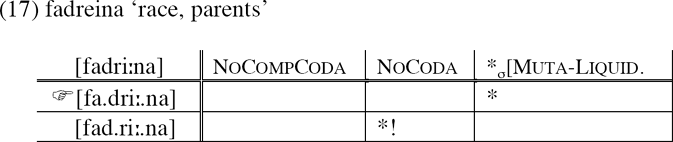
According to Vennemann 1987, the vast majority of muta cum liquida clusters are tautosyllabified in these manuscripts; there is one instance of heterosyllabified muta cum liquida cluster per manuscript, out of at least 41 cases in the Codex Argenteus and 13 in the Codex Ambrosianus A. The ranking given in 12 successfully accounts for the tautosyllabification of these clusters in these manuscripts, since NOCOMPCODA and NOCODA both outrank *σ[MUTA-LIQUID. It is better therefore to have muta cum liquida clusters form a syllable onset than to place them in the coda of the previous syllable, as illustrated in 16 for aftra ‘again, backwards’ (syllabified [af.tra]) and in 17 for fadreina ‘race, parents’ (syllabified [fa.dri
.na]).

In 16, *σ[MUTA-LIQUID could have been satisfied by heterosyllabifying the [tr] cluster. However, this would have violated NOCOMPCODA, and the relevant constraint ranking prevents this. Thus, the relevant cluster is tautosyllabified.
A similar situation prevails in the case of fadreina, although here NOCODA plays the deciding role (see 17). Again, if the relevant consonant cluster were heterosyllabified, then *σ[MUTA-LIQUID would be satisfied, but at the expense of violating NOCODA. The constraint ranking prohibits this, and the relevant cluster is therefore tautosyllabified.
The two heterosyllabified muta cum liquida clusters remain unaccounted for. The case found in the Codex Argenteus is probably a case of scribal error, since the one heterosyllabified form is neþlos [neθ.los] ‘needle’, and there is another instance of the same word where the relevant cluster is tautosyllabified. As for the heterosyllabified form in the Codex Ambrosius A, idreigondane [id.ri
.gon.da.ne] ‘repent, regret’, this is perhaps the result of paleographic considerations, as the Gothic scribes were reluctant to divide words after a single initial vowel, and the heterosyllabification of the muta cum liquida cluster in this particular form may reflect this.
32See Vennemann 1987:180, Barrack 1998:44–45, and Riad 2004:186, note 13 for discussion of this Gothic scribal practice, and also Lutz 1986:201, note 21 on a similar scribal practice in Old English.
The analysis of muta cum liquida clusters developed so far accounts only for the Codex Argenteus and the Codex Ambrosianus A; it must be modified slightly to account for the two manuscripts exhibiting more variation in their syllabification, namely the Skeireins and the Codex Ambrosianus B. In the Skeireins, there are six cases of intervocalic muta cum liquida clusters, of which four are heterosyllabified (iupaþro[iu.paθ.ro] ‘from above’ (2x), þaþro [θaθ.ro] ‘afterwards’, and wiþrus [wiθ.rus] ‘lamb’), and two are tautosyllabified (Andraias [an.drai.as] ‘Andrew’ and aftra [af.tra] ‘back, again’) (Vennemann 1987:172). In the Codex Ambrosianus B, there are seventeen cases of muta cum liquida clusters, of which seven are heterosyllabified, and ten tautosyllabified, as seen in 18 (Vennemann 1987:172).

The behavior of muta cum liquida clusters in these manuscripts can be accounted for by revising the proposed constraint ranking, such that *σ[MUTA-LIQUID outranks NOCODA in the Skeireins and the Codex Ambrosianus B (more precisely, in the dialects of Gothic represented in these two manuscripts). That is, in the Skeireins and in the Codex Ambrosianus B, the ranking in 19 holds.

This reranking is illustrated in the tableaux in 20 for þaþro [θaθ.ro] ‘afterwards’, a form from the Skeireins, and hlutrans [hlut.rans] ‘pure’, a form from the Codex Ambrosianus B. In the case of þaþro, tautosyllabifying the [θr] cluster would incur a violation of *σ[MUTA-LIQUID. Heterosyllabifying the relevant cluster avoids this problem, despite the ensuing violation of NOCODA, and the winning form is therefore [θaθ.ro]. The same argument applies to [hlut.rans].

This ranking leaves us with five exceptions, one each from the Codex Argenteus and the Codex Ambrosianus A, as well as three from the Codex Ambrosianus B. It was suggested above that the exception from the Codex Argenteus is probably a case of scribal error, and that the exception from the Codex Ambrosianus A may be the result of paleographic considerations, leaving the three exceptions from the Codex Ambrosianus B: bai.trei ‘bitterness’, hlei.þrai ‘hut, tent’, and dauht.rum ‘daughter’. The analysis predicts that the muta cum liquida clusters in bai.trei and hlei.þrai should be heterosyllabified to avoid violations of *σ[MUTA-LIQUID and that the relevant cluster in dauht.rum should be tautosyllabified to avoid a violation of NOCOMPCODA, and it seems that these three forms must remain exceptions. However, even with these exceptions, the vast majority of muta cum liquida clusters have been accounted for.33
It is possible to account for bai.trei and hlei.þrai by invoking the Stress-to-Weight-Principle (SWP), according to which stressed syllables must be heavy (both of these forms are stressed on the initial syllable), in line with the analysis presented in Pierce 2002. As the status of SWP in Gothic is extremely controversial, and dauht.rum does not yield to such an analysis, this idea is not pursued here.
At this point, I return briefly to the claim made above that the analysis developed here can easily be made compatible with the view that consonant + glide clusters were tautosyllabified. This can be accomplished by reranking the *σ[CONSONANT-GLIDE constraint proposed above with regard to NOCODA, such that NOCODA now outranks *σ[CONSONANT-GLIDE. Thus, in forms like nasjis ‘(thou) savest’—which I have argued was syllabified nas.jis, but according to this alternative view is syllabified na.sjis—the tautosyllabification of the [sj] cluster is motivated by the need to avoid a violation of NOCODA. Again, at this point I am unwilling to accept the idea that consonant + glide clusters were tautosyllabified, but I take it as a positive indication that my analysis can account for the data under both views with such a slight modification.
2.5. The Syllabification of Gothic Compounds.
I conclude this portion of the analysis with some brief remarks about the treatment of compounds.34
Recall that the term “compound” refers not only to true compounds, but also to forms with certain prefixes and to reduplicated forms.
Here ‘+’ indicates a morpheme boundary.
Muta cum liquida clusters may also be heterosyllabified in compounds. However, as such examples seem to be vanishingly rare (Hechtenberg Collitz 1906 and Frey 1989 each cite only one such case, for instance) and to be confined to the Skeireins and Codex Ambrosianus B, where the heterosyllabification of muta cum liquida clusters is relatively common, this is not as interesting as it might appear at first glance.

This constraint is undominated in Gothic, and requires word boundaries to be aligned with syllable boundaries such that the beginning of a word must be the beginning of a syllable as well. Therefore, as long as compounds are perceived as such, then each element of the compound will be aligned with a syllable boundary, and the high-ranking of ALIGN-WORD-LEFT will allow violations of NOCOMPONS and ONSET.
This constraint also accounts for the variable syllabification found in forms containing -uh discussed in Frey 1989. As long as -uh was perceived as a separate word, then forms that contained it were syllabified as compounds. If -uh was not perceived as a separate word, then forms containing it were syllabified as simplex words. Consider nauhþanuh [nauhθanuh] ‘yet’ and sumanuhþan [sumanuhθan] ‘partly’, which are syllabified [nauh.θa.nuh] and [su.man.uh.θan], respectively. It seems that nauhþanuh was perceived as a simplex word, since otherwise ALIGN-WORD-LEFT would require a syllabification *[nauh.θan.uh], while sumanuhþan was still perceived as a compound, and ALIGN-WORD-LEFT therefore compelled the alignment of phonological and morphological boundaries. As for the other clitics in Gothic, they were no longer perceived as separate words, and were therefore not affected by ALIGN-WORD-LEFT. This point is illustrated in the tableaux in 22, where the relevant constraints are ALIGN-WORD-LEFT and ONSET.

3. Sievers' Law in Gothic.
3.1. Introduction.
With an OT analysis of Gothic syllable structure on hand, one of the most famous problems of Gothic phonology, Sievers' Law, can now be considered.
37Because different scholars use the term “Sievers' Law” to refer to various types of alternations, there is a certain amount of terminological confusion in the literature. Sievers himself spoke of an i/j and a u/w alternation, as indicated in his original formulation. However, some scholars use the term to refer to an ij/j alternation (and possibly a uw/w alternation), for example Sihler (1995:175), while still other scholars use the term to refer to an alternation between a glide (or a vowel) and nothing, as in the discussion of Sievers' Law in Old Norse presented in Barrack 1998:115. Here I follow Sievers and use the term “Sievers' Law” to refer to the i/j and u/w alternations found in Gothic.
ki
s] ‘(thou) seekest’, where nasjis contains a glide but sôkeis a vowel.
38Sievers was not the first scholar to investigate these vowel/glide alternations. See Seebold 1972:24–28 for details of early investigations of the problem, Horowitz 1974 for a summary of research up to 1970 or so, and Collinge 1985 for a more abbreviated discussion up to the early 1980s. A comprehensive survey of the history of Sievers' Law as a scientific concept remains a desideratum.
“Unstressed […] i or u is a consonant following a short syllable, a vowel following a long syllable, regardless of the remaining accentual situation of the word.”
3.2. Gothic Evidence for Sievers' Law.
In Gothic, both aspects of Sievers' Law are restricted to certain morphological contexts. The i/j alternation appears in the second and third person singular and second person plural forms of Class 1 weak verbs, and the nominative and genitive singular of masculine ja stem nouns, and ja stem adjectives, where the alternation is actually between -ji and -ei ([ji] and [i
], respectively).
40There are other i/j alternations in Gothic that are not the result of Sievers' Law. Barrack (1998:87) cites the example of the nominative singular ending of the jô-stem nouns, which is -i in heavy stems (for example, bandi ‘band, bond’), but -ja in light stems (for example, sunja ‘truth’). These other alternations are not discussed here (but note that the analysis developed here can also account for such alternations).
The relevant alternation can be seen in the paradigms in 23; forms that exhibit Sievers' Law are in bold. In all these forms, main stress falls on the initial syllable; note also that Gothic <ei> represents [i
].
41The following paradigms have been extracted from Braune/Ebbinghaus 1981. Use of the terms “heavy” and “light” here follows traditional practice, in that “heavy” stems are stems containing a long vowel or a diphthong, or a short vowel followed by two or more consonants, while “light” stems are stems containing a short vowel followed by a single consonant.

3.3. Sievers' Law in Gothic: Previous Analyses.
As was the case with Gothic syllabification, the analysis of Sievers' Law in Gothic remains controversial. I do not present an exhaustive, or even an extensive, review of the relevant (and vast) literature here. Instead, I briefly discuss three recent analyses with varying assumptions and theoretical views, by way of contextualizing my own proposals, beginning with Barrack 1998.42
A number of other recent analyses of Sievers' Law are not discussed here. See Kim 2001, Palviainen 2001, and Pierce 2002 for more substantial overviews of the recent literature.
According to Barrack 1998, Sievers' Law began in Proto-Indo-European as a process of “denuclearization,” by which unaccented high vowels were lost after light syllables and following a CV sequence, and then became a nuclearization process due to the change in accent systems from Proto-Indo-European to Proto-Germanic. Barrack also links Sievers' Law to processes of glide deletion and vowel syncope, which, in his view, have combined to obscure the effects of Sievers' Law in most morphosyntactic classes. Perhaps the most intriguing aspect of Barrack's analysis is his reliance on what he calls the “Dahl/Erdmann hypothesis” to account for polysyllabic stems. This hypothesis, originally developed by Dahl (1938) to account for gemination in Old English, and extended by Erdmann (1972) to cover Sievers' Law, holds that “front-loaded” stems (stems consisting of a heavy stressed syllable followed by a light syllable) are equivalent to light monosyllabic stems, and that “balanced” stems (stems consisting of a light stressed syllable followed by another light syllable) are equivalent to heavy stems. In line with this hypothesis, Barrack's analysis predicts that front-loaded polysyllabic stems should pattern like the light stems and exhibit a glide, while balanced polysyllabic stems should pattern like the heavy stems and exhibit a vowel.
The crucial forms for this hypothesis are polysyllabic stems consisting of a heavy syllable followed by a light syllable. Erdmann (1972) suggests (and Barrack (1998) agrees) that the second and third singular forms of these verbs should end in -jis and -jiþ, respectively, and the second plural present indicative should end in -jiþ. Relevant Gothic examples include the following: audagjan ‘beautify’, glitmunjan ‘shine’, kaupatjan ‘slap one's face’, lauhatjan ‘flash’, and swogatjan ‘sigh’. Unfortunately, none of the necessary forms are preserved in the Gothic corpus (although various analyses of Sievers' Law cite the ghost form *glitmuneis ‘shines’), making it impossible to confirm Barrack's claim.
Kiparsky (1998) offers an OT analysis of Sievers' Law in Gothic. In Kiparsky's view, Sievers' Law is dependent on foot structure; the preferred foot in Gothic was the moraic trochee (a bimoraic, left-headed foot), and Sievers' Law represents an attempt to achieve maximal optimal footing. This is accounted for with four major constraints (some of which have already been cited), mandating that segments not be inserted or deleted, that consonant + j syllable onsets are not allowed, that syllables must have onsets, and that words are to be parsed into moraic trochees, ranked in the order just listed. Kiparsky also assumes that final consonants can be extrametrical and that main stress invariably falls on the initial syllable of the word.
Consider Kiparsky's treatment of harjis [har.jis] ‘army’ (gen.sg.). He argues that this is the only possible surface form of this word, since *hareis [ha.ri
s], the main competitor to harjis, cannot be parsed into moraic trochees: if it is parsed into two separate feet (that is, as [ha][ri
s]), the first foot is too short; if it parsed into one foot (as [ha.ri
s]), the foot is too long. Other possible candidates violate one or another of the constraints (for example, [ha.rjis] violates the ban on consonant + j onsets), and are therefore eliminated. The attested form harjis, by contrast, can be parsed into two separate moraic trochees without violating any of the other high-ranking constraints (that is, it can be parsed [har][jis]), and is thus the preferred form.
Like Kiparsky (1998), Kim (2001), in an analysis couched in the Lexical Phonology framework, views Sievers' Law as an attempt to yield maximal optimal footing. He also argues that the moraic trochee was the preferred foot in Gothic, and further assumes that the underlying representation of the relevant segment is /j/, that final consonants are extrametrical, and that consonant + j clusters are tautosyllabified, in accordance with the Maximal Onset Principle. He accounts for the morphological sensitivity of Sievers' Law by formulating it as a lexical rule, a type of phonological rule that can be sensitive to morpholexical information.
Consider the following examples: nasjis, sôkeis, and mikileis. According to Kim 2001:121, in nasjis (syllabified na.sjis, in his view), there are two light syllables, which form a bimoraic foot. In addition, both syllables in the word are footed; hence the structure is optimal, no repairs are needed, and the underlying /j/ therefore surfaces as [j]. In the case of sôkeis, however, without vocalization, the foot structure would be less optimal. In a form *sôkjis, the first syllable could form a bimoraic foot on its own, but, since final consonants are extrametrical, the second syllable could not. The syllables cannot be footed together, because the resulting foot structure would be less preferred. By vocalizing the /j/, however, the second syllable becomes bimoraic (even with final consonant extrametricality), and can thus be footed on its own, resulting in a more preferred foot structure. A similar argument accounts for mikileis; without vocalization of the underlying glide, a less preferred foot structure would result.
As was the case with earlier analyses of Gothic syllable structure, none of these proposals is entirely satisfactory, again for a variety of reasons. For instance, Kiparsky (1998) assumes that the treatment of muta cum liquida clusters generally reflects influence from Greek scribal practice, while there is no completely convincing Gothic evidence for the Dahl-Erdmann hypothesis that Barrack (1998) relies upon, and none of the truly crucial forms for Barrack's analysis are preserved in the Gothic corpus. This suggests that a new analysis is appropriate.
3.4. Sievers' Law in Gothic: A New OT Analysis.
The first step in the analysis is to determine the correct underlying representation of the relevant segment. There are three possibilities to be considered. First, Sievers' Law could be the vocalization of an underlying glide, as claimed by Dresher and Lahiri (1991) and Kim (2001), among others. Secondly, Sievers' Law could be the gliding of an underlying vowel, as apparently believed by Sievers (1878) himself. Third, the relevant underlying segment could be an archiphoneme, as suggested by Riad (1992) and Calabrese (1994)—in this case a segment unspecified for the feature [consonantal], although these analyses use different terminology to refer to this segment.
Employing an archiphoneme in the underlying representation has several advantages. As Riad (1992:48) argues, assuming underlying archiphonemes is “the least redundant way of deriving the sounds represented by <i, j> and <u, w> in Gothic orthography,” since the realization of such sounds is generally predictable, depending on syllabic position. Moreover, assuming archiphonemes yields a better account of forms where the relevant segments are adjacent, for example, mawi ∼ máujôs ‘maiden’ [mawi] ∼ [mau.jo
s] (nom.sg. ∼ gen.sg.). Using archiphonemes also fits better with the history of Gothic. Marchand (1973:70–71) points out that there are a handful of near-minimal pairs in Gothic that appear to require the presence of underlying /i/ or /j/, for example, juka ‘yoke’ (nom./acc. pl.) and iupa ‘above’. The best account of this seems to be, as Marchand argues, that all cases of [i]/[j] and [u]/[w] were allophones of the same phoneme, that is, they were derived from archiphonemes in Pre-Gothic. By the time of Biblical Gothic, some of these instances of archiphonemes had been lost, resulting in the presence of six phonemes (/i/, /j/, the archiphoneme /I/, /u/, /w/, and the archiphoneme /U/), where only two (the archiphonemes /I/ and /U/) existed in Pre-Gothic. This hypothesis also accounts for the morphologically restricted application of Sievers' Law, and for the more limited occurrence of the u/w portion of Sievers' Law. The assumption is that the archiphonemes were lost earlier in certain morphological contexts and that the u/w archiphoneme was lost more rapidly than the i/j archiphoneme.
The following analysis therefore employs two archiphonemes, /I/ and /U/. Forms showing an alternation between i and j or u and w somewhere in the paradigm (for example, mikiljan ‘praise’ and sôkjan ‘seek’) contain the relevant archiphoneme, while forms that do not show this alternation (for example, nasjan ‘save’) contain an underlying glide. In addition, I rely on a more specific version of IDENT [FEATURE], IDENT [CONS], which forbids changing the underlying value for the feature [consonantal]. Since the underlying archiphonemes do not have a specific underlying value for this feature, they may occur on the surface as either vowels or glides, depending on their position in the syllable. Forms containing an underlying glide, on the other hand, may not be vocalized, as this would incur a violation of IDENT [CONS].43
An anonymous JGL referee reminds me that underlying representations are not as important as surface forms in OT, especially since Richness of the Base mandates that there can be no constraints on underlying forms. An OT analysis should ideally work with a variety of inputs. While conceding that the analysis developed here does conflict with the strongest version of Richness of the Base, as it requires a specific underlying representation to work, this does not nullify my proposals. The status of the strongest version of Richness of the Base is somewhat controversial (see van Oostendorp 2000 for some relevant discussion), and, to my mind, the empirical advantages of relying on specific underlying representations outweigh the philosophical disadvantage of violating the strongest version of Richness of the Base here.
Sievers' Law falls out from the interaction of the various constraints proposed above to account for Gothic syllabification. Recall that I posited the following ranking (adapted from 12 above):44
*σ[MUTA-LIQUID is not essential for the analysis of Sievers' Law, as the following analysis yields the correct results regardless of its relative ranking to NOCODA, and it has therefore been omitted from the following discussion. FAITHFULNESS constraints other than IDENT [CONS] are also omitted.

The tableaux in 25–27 illustrate this claim. Since the same constraints and ranking account for all the alternations, only the Class 1 weak verbs are discussed here, starting with the light stem nasjis ‘thou savest’.

Here the winning candidate [nas.jis] violates only the relatively low-ranked constraint NOCODA, while the various other candidates violate one or another of the higher-ranked constraints. For instance, *[nas.i
s] is eliminated because of an ONSET violation, *[na.sjis] violates one of the high-ranking NOCOMPONSET constraints, and *[na.si
s] vocalizes the underlying glide, thus violating IDENT[CONS].
I now consider a heavy stem, sôkeis ‘thou seekest’.

The attested form [so
.ki
s] is preferred over the alternate candidates, because it only incurs one violation of the relatively low-ranking constraint NOCODA.
45In this form, as well as in all of the following forms, IDENT [CONS] is irrelevant, as the relevant segment is an archiphoneme that does not have an underlying value for [consonantal].
k.i
s] is eliminated due to a violation of ONS, and *[so
.kjis] loses because it violates one of the high-ranking NOCOMPONSET constraints. Finally, *[so
k.jis] is eliminated because it violates NOCODA twice, which the attested form violates only once.
The final form considered here is a polysyllabic stem, mikileis ‘(thou) praisest’.

Here [mi.ki.li
s] is preferred over the other possible candidates because it obeys the various high-ranking constraints while only violating the lower-ranked constraint NOCODA. The candidate *[mi.kil.i
s] is eliminated because of its violation of ONSET, while *[mi.ki.ljis] is eliminated because it violates a high-ranking NOCOMPONS constraint. The remaining candidate, *[mi.kil.jis], obeys the various high-ranking constraints, leaving NOCODA to play the deciding role. In this case, [mi.ki.li
s] only violates NOCODA once, while *[mi.kil.jis] violates NOCODA twice, and is thus eliminated.
I now examine the u/w alternation. Consider the form triu ‘tree’.

As evident in 28, NOCODA plays the deciding role, as both candidates obey the higher-ranking constraints. The attested form [triu] does not violate NOCODA, while *[triw] does, and is therefore eliminated.
Now consider the dative singular form of this word, triwis.

In this case, violations of ONSET eliminate both *[triu.is] and *[triw.is], while *[triwjs] and *[triwjs] both violate NOCOMPCODA. The attested form [tri.wis] does violate NOCODA, but this violation of a relatively low-ranking constraint is not sufficient to eliminate it from consideration.
There are a handful of forms which this analysis does not account for, the so-called “exceptions to Sievers' Law.” While the analysis outlined here predicts that the semivocalic variant will appear in the light stems, with the vocalic variant appearing in the heavy and the polysyllabic stems, a few forms run counter to this prediction, including the following (data from Murray and Vennemann 1983:525): andbahteis ‘office’ (1x), but also andbahtjis (4x); gawaírþeis ‘peace’ (7x), but also gawaírþjis (8x); and only arbjis ‘inheritance’ (2x) and reikjis ‘kingdom’ (1x). These forms have traditionally been attributed to analogy. For example, Murray and Vennemann (1983:525) refer to these forms as the “analogical violations of Sievers' Law,” and state that they developed when “gen.sg. -jis is restored after long stems, on the analogy of the short stems and the paradigmatically related forms with -ja(m) and -jê.” This position is also endorsed in some handbooks, as in Braune/Ebbinghaus 1981:44 for instance. While analogy may indeed play a role in some such cases, the bulk of these exceptions can instead be attributed to the elimination of the underlying archiphonemes, such that those forms that preserve Sievers' Law contain an underlying archiphoneme (for example, sôkeis), while those forms that have eliminated Sievers' Law contain an underlying glide (for example, arbjis), and those forms that show variation (for example, andbahteis ∼ andbahtjis) are in the process of changing from an underlying archiphoneme to an underlying glide.46
See Vennemann 1985, Kiparsky 2000, and Pierce 2005 for more extensive discussion of these exceptions.
4. Summary and Conclusions.
This paper reexamined the thorny problem of Gothic syllabification. While many aspects of Gothic syllabification are relatively straightforward (for example, the syllabification of intervocalic singleton consonants), others are more problematic (for example, the treatment of muta cum liquida clusters), and this controversy is reflected in the relevant literature. The paper, therefore, began by laying out the orthographic evidence for Gothic syllabification, and then offered a brief methodological discussion in which the traditional assumption that word breaks in the Gothic manuscripts correspond to syllable divisions was defended. Some earlier analyses were also discussed, and it was suggested that these earlier proposals were lacking in some way, normally in their interpretation of the orthographic evidence. It was then argued that Gothic syllabification results largely from the interaction of constraints that a) mandate that syllables have onsets (ONSET), b) ban complex codas (NOCOMPCODA) and syllable codas in general (NOCODA), c) regulate the relationship between the input and the output (FAITHFULNESS), and d) ban various types of complex onsets (the family of NOCOMPONSET constraints).
Given the “methodological vacuum” discussed by Riad (2004:174) and the limited supply of available Gothic data, alternative analyses are inevitably possible. It is possible, for instance, to treat Gothic syllabification in terms of syllable weight, or in terms of syllable contact. Such analyses remain controversial. For example, any analysis based on syllable contact must explain why certain types of more preferred syllable contacts, namely muta cum liquida contacts, are eliminated, while other, less preferred types of syllable contacts, namely consonant + glide contacts, are retained. This is normally accomplished by reinterpreting the orthographic data or by invoking sound change. Thus, as noted above, Frey (1989:291) rejects the traditional view that <j> and <w> represented glides, arguing instead that they were fricatives, “da ihre Bestimmung als reine ‘Halbvokale’ nicht mehr aufrechterhalten werden kann, wenn Trennungen wie bruk-jands etc. mit dem Silbenkontaktgesetz übereinstimmen sollen,” which nullifies the apparent problem of their heterosyllabification in the Gothic manuscripts.47
“since their definition as pure ‘glides’ cannot be sustained if breaks like bruk- jands, etc. are to conform to the Syllable Contact Law”
The main advantage of the analysis presented here is that it successfully accounts for the Gothic data without requiring either of these somewhat questionable proposals. Any account of Gothic syllabification assuming that consonant + glide clusters were tautosyllabified must offer a principled account of their apparent heterosyllabification in the manuscripts. Although a number of proposals have been advanced to account for this problem, none of them is completely successful. For instance, the claim that such clusters were divided according to morphological, not phonological, principles fails to account for cases where those clusters do not contain a morpheme boundary. Furthermore, such proposals do not answer the question of why just those clusters were treated differently. Additionally, as pointed out above, the arguments in favor of glide strengthening seem less convincing than those against it. Both the reinterpretation of the orthographic evidence for Gothic syllabification and the assumption of glide strengthening are unnecessary in the analysis developed here. Moreover, it was also noted that this analysis requires only a minor modification (the reranking of two constraints) to work with the major alternative interpretation of the Gothic data
Sievers' Law in Gothic was also discussed, and it was argued that this Law is best viewed as a consequence of Gothic syllabification. When the underlying archiphoneme must be an onset to satisfy ONSET, it will be a glide. When another consonant is available to satisfy ONSET, it will be a vowel. The more limited application of the u/w alternation was attributed to the more rapid loss of that archiphoneme. While it would be presumptuous to claim that this analysis has “solved” the problem of Sievers' Law, it does represent a step forward in our understanding of the topic, and does not suffer from some of the weaknesses present in other formalist accounts of the problem.
Finally, with an analysis of Gothic syllable structure in hand, it is possible to analyze a number of other phonological phenomena attested in Gothic, for example, reduplication, as well as other developments that took place in the (pre-)history of Gothic, along with developments from the other branches of the Germanic language family.


