Implications
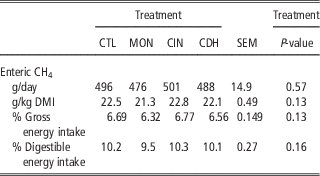
Essential oils (e.g. cinnamon oil, cinnamaldehyde) and monensin have been suggested as potential means to mitigate enteric methane production from dairy cows. Results from this study show that supplementation of dairy cow diets with cinnamon oil (50 mg/kg of dry matter intake), cinnamaldehyde (50 mg/kg of dry matter intake), and monensin (24 mg/kg of dry matter intake) had no effects on enteric methane production (g/day) and methane energy losses (% of gross energy intake). It was concluded that cinnamon oil, cinnamaldehyde and monensin are not viable dietary strategies to mitigate enteric methane production from dairy cows.
Introduction
Several dietary and nutritional strategies, such as adding essential oils to the diet have been suggested to mitigate enteric methane (CH4) production from ruminants (Benchaar and Greathead, Reference Benchaar, McAllister and Chouinard2011). In this regard, cinnamon oil (CIN) and its main component cinnamaldehyde (CDH) are of special interest because they have been shown to inhibit CH4 production in vitro. For instance, Busquet et al. (Reference Busquet, Calsamiglia, Ferret, Cardozo and Kamel2005) observed in vitro that CDH decreased acetate proportion and increased propionate proportion, which should result in a reduction of CH4 production given the inverse relationship between propionogenesis and methanogenesis in the rumen. In another in vitro study, Macheboeuf et al. (Reference Macheboeuf, Morgavi, Papon, Mousset and Arturo-Schaan2008) confirmed the antimethanogenic properties of CIN and CDH. However, in a recent review, Benchaar and Greathead (Reference Benchaar, McAllister and Chouinard2011) stressed the need for in vivo studies to confirm that essential oils represent a viable strategy to mitigate enteric CH4 production in ruminants. To the best of our knowledge, no studies have been published on the use of CIN and CDH to inhibit ruminal methanogenesis in dairy cows. Furthermore, information on the effects of CIN and CDH on dairy cows’ performance is limited (Benchaar et al., Reference Benchaar, Hassanat, Gervais, Chouinard, Julien, Petit and Massé2008).
Monensin (MON) is an ionophore antibiotic that has been shown to decrease enteric CH4 production in ruminants. Beauchemin et al. (Reference Beauchemin, McAllister and McGinn2009) reported that MON inhibits ruminal methanogenesis by shifting ruminal fermentation toward propionogenesis and reducing ruminal protozoa numbers.
Based on the reported antimethanogenic properties of CIN, CDH and MON, this study was undertaken to assess the effects of including these antimicrobials in dairy cow diets on enteric CH4 production, ruminal fermentation, protozoa population, digestion, nitrogen balance and milk performance.
Material and methods
Cows, experimental design and diets
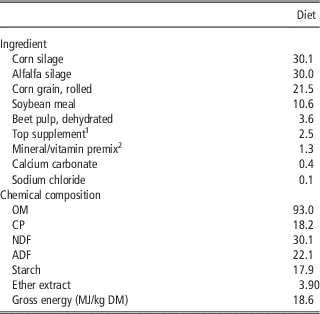
Eight multiparous lactating Holstein cows fitted with ruminal cannulas (10 cm, Bar Diamond Inc., Parma, ID, USA) were used in a replicated 4×4 Latin square (28-day periods) balanced for residual effects. At the start of the experiment, BW, days in milk, and milk yield of cows averaged 614±57.6 kg, 71±10 days and 36±3.1 kg/day, respectively. Cows were housed in individual tie stalls and had free access to water during the experiment. They were fed for ad libitum intake (5% orts, on an as fed-basis) a total mixed ration ((TMR); Table 1) not supplemented (CTL), or supplemented with CIN, CDH or MON. Cinnamon oil (containing 78% cinnamaldehyde) and CDH (98% purity) were on a silica carrier (Phodé S.A., Albi, France). The product (i.e. essential oil on the carrier) was added to the diet to provide 50 mg/kg dry matter intake (DMI) of the active compound (i.e. CIN or CDH).
Ingredient and chemical composition (% DM, unless otherwise noted) of the total mixed ration

DM=dry matter; OM=organic matter.
1 Contained 20.8% corn gluten meal, 28.3% soybean meal Trituro®, 16.7% canola meal, 34.2% dried corn distillers grains.
2 Contained 12.5% Ca, 6.80% P, 6.81% Mg, 2.49% S, 7.72% Na, 1.97% K, 2877 mg/kg Fe, 3777 mg/kg Zn, 620 mg/kg Cu, 2520 mg Mn, 96 mg/kg I, 83 mg/kg Co, 27.8 mg/kg Se, 628 000 IU/kg of vitamin A, 81 000 IU/kg of vitamin D, and 3739 IU/kg of vitamin E.
Rates of inclusion of CIN and CDH in ruminant diets varied widely (3 to 160 mg/kg of DMI) among studies depending on the type of essential oil and if the compound is used alone or in combination with other essential oil compounds (Benchaar and Greathead, Reference Benchaar, McAllister and Chouinard2011). The dietary concentration of CIN and CDH selected for use in the current study is within the range of the concentrations of CDH reported by Cardozo et al. (2006). These authors showed that when fed in combination with eugenol, CDH (24 to 77 mg/kg of DMI) reduced acetate molar proportion and increased propionate molar proportion in beef heifers, suggesting a potential for reducing enteric CH4 production given that CH4 formation is inversely related to propionate synthesis and CH4 formation in the rumen.
Monensin (Rumensin 80, Elanco Animal Health, Division Eli Lilly Canada Inc., Guelph, ON, Canada) was included in the diet at the rate of 24 mg/kg DMI. Beauchemin et al. (Reference Beauchemin, McAllister and McGinn2009) reported that at doses of 24 to 35 mg/kg of DMI, MON reduced enteric CH4 production (g/day by 4% to 10% and g/kg DMI by 3% to 8%) in dairy cows (i.e. forage-based diets) and beef cattle (i.e. grain based-diets). The dose of 24 mg/kg DMI was chosen in our study because it is the highest level of monensin premix approved for use in lactating dairy cows in Canada (Canadian Food Inspection Agency, 2007). The feed additives were premixed daily with ground corn (i.e. carrier) and incorporated in the TMR to achieve the appropriate feeding rates.
Adaptation to experimental treatments was from day 1 to 14, ruminal sampling on day 14 and 28, in sacco ruminal degradation measurements from day 15 to 19, CH4 production measurements from day 19 to 25, and sampling of milk, feces and urine from day 20 to 26. Cows were cared for in accordance with the guidelines of the Canadian Council on Animal Care (CCAC, 1993).
Intake, apparent total-tract digestibility, milk production and N balance
Methods for measuring feed intake, apparent total-tract digestibility of nutrients and N balance were described in detail in Benchaar et al. (Reference Benchaar, Petit, Berthiaume, Whyte and Chouinard2013). Briefly, the diets were offered in equal amounts at 0900 and 1800 h and feed intake was determined daily by weighing feeds offered to and refused by the cows. Samples of the TMR, feed ingredients, and refusals were collected daily and frozen at −20°C. Samples were composited by cow within period (i.e. across collection days), freeze-dried, ground to pass a 1-mm screen using a Wiley mill (standard model 4; Arthur M. Thomas, Philadelphia, PA, USA) and analyzed for DM, OM, total N, NDF, ADF, starch, ether extract (EE) and gross energy (GE).
Cows were milked twice daily at 0730 and 1830 h in their stalls and milk yield was recorded at each milking. Milk samples were taken from each cow at each milking from day 20 to 26, stored at +4°C with a preservative (2-bromo-2-nitropropan- 1,3-diol) and then sent to a commercial laboratory (Valacta Dairy Production Center of Expertise Quebec-Atlantic, Ste-Anne-de-Bellevue, QC, Canada) for analysis of milk components (fat, true protein, lactose, and milk urea nitrogen [MUN]).
Total collection of feces and urine was performed by fitting cows with harnesses and tubes allowing the collection of feces and urine separately. Fecal samples were analyzed for DM, OM, total N, NDF, ADF, starch and GE while urine samples were analyzed for total N.
In sacco ruminal degradability
In sacco measurements were performed to assess the effect of feed additive inclusion on ruminal degradation of the basal diet (i.e. with no feed additive). For this purpose, ruminal degradability of the basal diet was determined using a nylon bag procedure as described in Benchaar et al. (Reference Benchaar, Petit, Berthiaume, Whyte and Chouinard2013). Samples of the basal diet were freeze-dried, ground to pass a 2-mm screen using a Wiley mill and 5-g samples (DM) were weighed in triplicate in polyester bags (17 cm×9 cm, 53 μm pore size; Sefar Nitex®, Sefar AG, Heiden, Switzerland). Bags were incubated in the ventral sac of the rumen of each cow for 2, 4, 8, 16, 24, 48, 72 and 96 h. Bags used for time 0 disappearance were soaked in water at 37°C for 5 min, and then treated similarly to the other bags. Residues of incubation were analyzed for DM and OM contents.
Kinetics of ruminal degradation of OM were calculated using a non-linear model (McDonald, Reference McDonald1981). The NLIN procedure of SAS (SAS Institute Inc., Cary, NC, USA) was used to fit the following model:
 $$\eqalignno{ & {\rm P}\left( t \right)={\rm a}{\plus}{\rm b}\left( {{\rm 1}{\minus}{\rm e}^{{{\minus}{\rm c}(t{\minus}{\rm L})}} } \right)\,{\rm for}\,t\,\gt\,{\rm L} \cr & {\rm P}\left( t \right)={\rm a}\,{\rm for}\,t\leq {\rm L} $$
where P(t) is the percentage of OM disappearance from the nylon bag at time t, a the soluble and rapidly degradable fraction (%), b the slowly degradable fraction (%), c the fractional rate of disappearance of the fraction b (/h), L the lag time (h) and t the time of incubation (h).
The effective ruminal degradability (ERD) of OM was calculated using the equation:
 $${\rm ERD=a}{\plus}\left[ {{\rm bc}\!/\!\left( {{\rm c}{\plus}{\rm k}_{{\rm p}} } \right)} \right]{\rm }{\times}{\rm e}^{{({\minus}{\rm kpL})}} $$
where kp is the ruminal fractional passage rate assumed to be 6%/h.
Ruminal fermentation characteristics and protozoa enumeration
Sampling of ruminal content for the determination of fermentation characteristics and protozoa enumeration was performed as described in Benchaar et al. (Reference Benchaar, Petit, Berthiaume, Whyte and Chouinard2013). A composite (250 ml) of ruminal fluid was obtained from different locations within the rumen before (0 h) and at 1, 2, 4, 6 and 8 h after the morning feeding for the determination of pH and the concentrations of volatile fatty acids (VFA) and ammonia (NH3).
Protozoa enumeration was carried out on ruminal content collected 4 h after the morning feeding. Ruminal content (1 l) was strained through four layers of cheesecloth and a 5 ml portion was preserved using 5 ml of methyl green formalin-saline solution for protozoa counting. Samples were stored at room temperature in darkness until enumerating using a counting chamber (Neubauer Improved Bright-Line counting cell, 0.1 mm depth; Hausser Scientific, Horshamm, PA, USA).
Methane production
Enteric CH4 emission from each cow was measured for 6 consecutive days using the sulfur hexafluoride (SF 6 ) tracer technique with halters and polyvinyl chloride (PVC) neck yokes as described in details by McGinn et al. (Reference McGinn, Beauchemin, Iwaasa and McAllister2006). Briefly, brass permeation tubes (12.5×40 mm) contained on average 2,420±34 mg of ultra-pure SF6. The release rates of SF6 from the permeation tubes ranged from 4.146 to 4.887 mg SF6/day with an average rate of 4.479±0.282 mg SF6/day. The permeation tubes were placed in the rumen at the start of the experiment. During each measurement day, before the morning feeding, a preevacuated (103 kPa) U-shaped yoke (~2 l) was placed around the neck of each cow. Respired and eructated air was drawn continuously into the canister through a tube positioned near the nostrils of the cow. After each 24-h of sampling, each PVC yoke was over-pressurized with pure N2 and 3 sub-samples (20 ml) were taken with a syringe and injected into three corresponding 5.9 mL evacuated exetainers (Labco Ltd., Buckinghamshire, UK) for later analysis of CH4 and SF6 concentrations. Daily background concentrations of CH4 and SF6 were determined by suspending yokes in different locations of the animal facility. Daily CH4 emissions were calculated for each cow according to McGinn et al. (Reference McGinn, Beauchemin, Iwaasa and McAllister2006).
Chemical analyses
Dry matter was determined by oven-drying at 55°C for 48 h. Analytical DM was determined by drying in a vacuum oven at 100°C overnight (Association of Official Analytical Chemistry (AOAC), 1990). Ash content was determined by incineration at 550°C overnight in a muffle furnace (AOAC, 1990), and the OM content was calculated as the difference between 100 and the percentage of ash. For the determination of CP (N×6.25), samples were ground using a ball mill (Mixer Mill MM2000, Retsch, Haan, Germany) to a fine powder and total N was quantified by thermal conductivity (Leco model FP-428 Nitrogen Determinator, Leco, St. Joseph, MI, USA). The concentration of NDF was determined as described by Van Soest et al. (Reference Van Soest, Robertson and Lewis1991) without the use of sodium sulfite and with the inclusion of heat stable α-amylase. The ADF content was determined according to AOAC (1990). The NDF and ADF procedures were adapted for use in an Ankom200 Fiber Analyzer (Ankom Technology Corp., Macedon, NY, USA). The concentration of starch was determined colorimetrically according to the procedure of Hall et al. (Reference Hall, Jennings, Lewis and Robertson2001). Ether extract was determined using a Soxtec system HT6 apparatus (Tecator; Fisher Scientific, Montreal, QC, Canada) according to AOAC (1990). Gross energy was determined using an oxygen bomb calorimeter (model 6200, Parr Instrument Company, Moline, IL, USA). The concentration of N in acidified urine samples was determined by micro-Kjeldahl analysis (AOAC, 1990)).
Ruminal ammonia was determined using the method described by Weatherburn (Reference Weatherburn1967), modified for use with a microplate spectrophotometer (MRX Microplate Reader; Dynatech Laboratories, Chantilly, VA, USA). Ruminal VFA were quantified using a gas chromatograph (model 5890; Hewlett-Packard Lab, Palo Alto, CA, USA) with a capillary column (30 m×0.32 mm i.d., 1 μ phase thickness, Zebron ZB-FAAP; Phenomenex, Torrance, CA, USA), and flame ionization detection. The oven temperature was 170°C held for 4 min, which was then increased by 5°C/min to 185°C, and then by 3°C/min to 220°C, and held at this temperature for 1 min. The injector temperature was 225°C, the detector temperature was 250°C, and the carrier gas was He. True protein, fat, lactose, and urea N in milk samples were analyzed by infrared spectroscopy (System 4000 Milkoscan; Foss Electric of Hillerød, Denmark).
Methane and SF6 concentrations were analyzed using a gas chromatograph (model CP-3800, Varian Inc., St-Laurent, QC, Canada) equipped with a flame-ionization detector for CH4 and electron capture detector for SF6. The columns (Varian Inc., Lake Forest, CA, USA) used were silica plot FS (30 m×0.32 mm) for CH4 and Hayesep D stainless steel (2 m×2 mm; 80 to 100 mesh) for SF6. Temperature for the oven was 30°C, 110°C for the injector, 250°C for the flame-ionization detector, and 400°C for the electron capture detector. Helium was used as the carrier gas. Standard curves were generated using four gas standards between 1 and 110 μmol/mol for CH4 and five and 102 nmol/mol for SF6. The correlation coefficient exceeded 99.9% for all standard curves.
Statistical analyses
Data were analyzed using the MIXED procedure of SAS (SAS Institute Inc.). The model included treatment and period as fixed effects and square and cow within square as random effects. Ruminal fermentation characteristics (pH, VFA, and NH3) data were analyzed as repeated measures using the same model with the addition of the fixed effects of day, sampling time (i.e. hour) and all interactions. Data on DMI, milk performance (production and composition), digestibility and CH4 production were averaged across days for statistical analyses. Differences between treatments were declared significant at P⩽0.05 using the Tukey correction for multiple comparisons.
Results and discussion
DMI, apparent total-tract digestibility and N retention
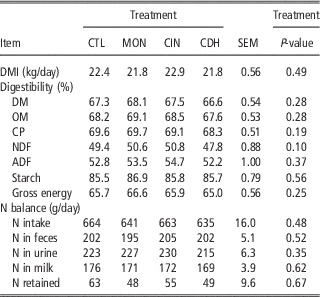
The addition of CIN and CDH had no effect on DMI (Table 2). There are no previous reports on the effect of CIN on DMI in ruminants. The lack of effects of CDH on DMI agrees with previous studies with dairy cows (Benchaar et al., Reference Benchaar, Hassanat, Gervais, Chouinard, Julien, Petit and Massé2008), sheep (Chaves et al., Reference Chaves, Stanford, Gibson, McAllister and Benchaar2008), and beef cattle (Yang et al., Reference Yang, Benchaar, Ametaj, Chaves, He and McAllister2010b). Apparent total-tract digestibility of nutrients was not affected by CIN and CDH addition (Table 2), which is in agreement with previous studies with dairy cows (Benchaar et al., Reference Benchaar, Hassanat, Gervais, Chouinard, Julien, Petit and Massé2008) and beef cattle (Yang et al., Reference Yang, Ametaj, Benchaar, He and Beauchemin2010a). Compared with CIN, the addition of CDH in the diet tended (P=0.11) to decrease NDF digestibility (47.8% v. 50.8%). No changes in N outputs and N retention were observed when cows were fed CDH- and CIN-supplemented diets (Table 2). This result may indicate that ruminal N metabolism (i.e. ruminal N degradation and NH3 production) was not modified by the inclusion of CIN and CDH in the diet (see below).
DMI, apparent-total tract digestibility of nutrients and N balance of lactating dairy cows fed a total mixed ration without supplementation (control, CTL) or supplemented with monensin (MON), cinnamon oil (CIN), or cinnamaldehyde (CDH)

DM=dry matter; DMI=dry matter intake; OM=organic matter.
The inclusion of MON did not modify DMI, apparent total-tract digestibility of nutrients, and N retention (Table 2). In agreement with our findings, Grainger et al. (Reference Grainger, Williams, Eckard and Hannah2010) also reported no change in DMI of cows fed MON at a feeding rate similar to that used in our study. Likewise, Mathew et al. (Reference Mathew, Eastridge, Oelker, Firkins and Karnati2011) observed no effect of MON on nutrient digestibility in dairy cows. In contrast, Benchaar et al. (Reference Benchaar and Greathead2006) reported increased CP digestibility in cows supplemented with MON. Discrepancies between studies could be partly due to differences in diet composition. Indeed, Plaizier et al. (Reference Plaizier, Martin, Duffield, Bagg, Dick and McBride2000) reported that supplementation with MON increased CP digestibility in cows fed high-concentrate diets, but not in cows fed high-forage diets. In the experiment by Benchaar et al. (Reference Benchaar and Greathead2006), diets contained 52% concentrate whereas diets used in the present study contained 40% concentrate; therefore, the lack of MON effect on CP digestibility observed in the current study could be related to the diet composition.
Few studies have reported the effect of MON on N retention in dairy cows. In the current study, retained N was not affected by the addition of MON, which is consistent with the absence of MON effect on N intake, excretion of N in feces and urine, and milk N secretion. Similarly, Benchaar et al. (Reference Benchaar and Greathead2006) reported no effect of MON on N retention in dairy cows although CP digestibility was improved by MON administration in that study. In contrast, Plaizier et al. (Reference Plaizier, Martin, Duffield, Bagg, Dick and McBride2000) reported improved N balance associated with increased N digestibility in dairy cows fed MON.
In sacco ruminal degradability
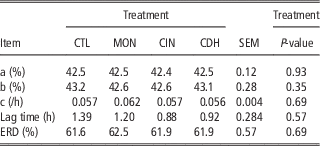
Supplementation with CIN and CDH had no effect on ruminal degradation of OM of the basal diet fed to dairy cows as revealed by in sacco measurements (Table 3). Yang et al. (Reference Yang, Ametaj, Benchaar, He and Beauchemin2010a) also reported no change in in vivo ruminal degradation of OM when feedlot cattle were supplemented with CDH at 40 mg/kg DMI, which is close to the feeding rate applied in our study. In the same study by Yang et al. (Reference Yang, Ametaj, Benchaar, He and Beauchemin2010a), including CDH at 80 mg/kg DMI also did not affect ruminal degradation of OM. However, at a higher inclusion rate of CDH (180 mg/kg DMI), Yang et al. (Reference Yang, Ametaj, Benchaar, He and Beauchemin2010a) observed a decrease in ruminal degradation of OM, which was mainly due to reductions in ruminal degradation of fiber and CP. Ruminal fibrolytic activity may be impaired when high doses of CDH are fed to dairy cows.
In sacco degradation kinetic parameters and effective degradability of organic matter of the basal diet (with no additive) incubated in the rumen of lactating dairy cows fed a total mixed ration without supplementation (control, CTL) or supplemented with monensin (MON), cinnamon oil (CIN), or cinnamaldehyde (CDH)

a=rapidly degradable fraction; b=slowly degradable fraction; c=fractional degradation rate of disappearance of the fraction b; and ERD=effective ruminal degradability.
Diet supplementation with MON had no effects on kinetics of ruminal degradation and ERD of the OM of the basal diet (Table 3), which agrees with in sacco results of Benchaar et al. (Reference Benchaar and Greathead2006) and in vivo measurements of Yang et al. (Reference Yang, Ametaj, Benchaar and Beauchemin2007).
Ruminal fermentation characteristics and protozoa
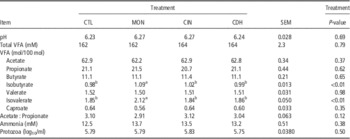
Ruminal pH, concentrations of NH3 and total VFA, and molar proportions of VFA were not changed by the inclusion of CIN and CDH in the diet (Table 4), which is consistent with the absence of CIN and CDH effects on intake and diet digestion (Tables 2 and 3). Cows supplemented with MON tended (P=0.12) to exhibit lower acetate : propionate ratio (2.91 v. 3.12) compared with cows fed CIN (Table 4).
Ruminal fermentation characteristics and protozoa counts of lactating dairy cows fed a total mixed ration without supplementation (control, CTL) or supplemented with monensin (MON), cinnamon oil (CIN), or cinnamaldehyde (CDH)

VFA=volatile fatty acid.
a,b,cWithin a row, means with different superscripts differ (P⩽0.05).
The effects of CIN and CDH on rumen N metabolism have been variable depending on the dose used. For instance, Busquet et al. (Reference Busquet, Calsamiglia, Ferret and Kamel2006) observed that high doses of CIN (3000 mg/l) and CDH (300 and 3000 mg/l) strongly inhibited NH3 concentration in 24-h batch culture incubations, but no effects were observed at low doses (i.e. 3 and 30 mg/l). However, in that study, lower NH3 concentrations were associated with a reduction in total VFA concentration, reflecting a decrease in overall fermentation of the diet. In contrast to in vitro studies, the few in vivo studies published to date reported no effects of CIN and CDH on ruminal N metabolism (Benchaar et al., Reference Benchaar, Hassanat, Gervais, Chouinard, Julien, Petit and Massé2008; Chaves et al., Reference Chaves, Stanford, Gibson, McAllister and Benchaar2008).
Effects of CIN and CDH on VFA have also been variable among in vitro studies. Cardozo et al. (Reference Cardozo, Calsamiglia, Ferret and Kamel2004) reported no changes in total VFA concentration and VFA molar proportions when CIN was supplied at 0.22 mg/l in continuous culture systems. At high doses, CDH (31.2 and 312 mg/l) reduced acetate proportion and increased the proportions of propionate and butyrate (Busquet et al., Reference Busquet, Calsamiglia, Ferret, Cardozo and Kamel2005). Lourenço et al. (Reference Lourenço, Cardozo, Calsamiglia and Fievez2008) reported that the addition of CDH at 500 mg/l in continuous culture systems dramatically decreased total VFA concentration, reduced propionate proportion and increased the proportions of acetate and butyrate. Results from these in vitro studies indicate that the effects of CIN and CDH on VFA concentration and profile is dose-dependent, but it is clear that when changes occurred, they were achieved at high dosage levels and very often associated with an inhibition of feed digestion as reflected by decreases in total VFA concentrations (Benchaar et al., Reference Benchaar, Hassanat, Gervais, Chouinard, Julien, Petit and Massé2008; Benchaar and Greathead, Reference Benchaar, McAllister and Chouinard2011). Further, many of the concentrations of essential oils that have elicited favorable fermentation responses in vitro (>300 mg/l of culture fluid) are far too high for in vivo application (Beauchemin et al., Reference Beauchemin, McAllister and McGinn2009; Benchaar and Greathead, Reference Benchaar, McAllister and Chouinard2011), which may explain the lack of CIN and CDH effects reported in a number of in vivo studies with dairy cows (Benchaar et al., Reference Benchaar, Hassanat, Gervais, Chouinard, Julien, Petit and Massé2008), beef cattle (Yang et al., Reference Yang, Ametaj, Benchaar, He and Beauchemin2010a) and sheep (Chaves et al., Reference Chaves, Stanford, Gibson, McAllister and Benchaar2008).
Diet supplementation with MON had no effect on total VFA concentration which is consistent with the absence of MON effect on in sacco ruminal degradability of the basal diet (Table 3). With the exception of isobutyrate and isovalerate molar proportions which were higher (P<0.01) for cows fed MON compared with cows fed CTL, the molar proportions of the other VFA and the acetate : propionate were unaffected by dietary addition of MON. Previous (Benchaar et al., Reference Benchaar and Greathead2006) and recent (Mathew et al., Reference Mathew, Eastridge, Oelker, Firkins and Karnati2011) studies also observed no change in the acetate : propionate ratio in dairy cows supplemented with MON. In contrast, Sauer et al. (Reference Sauer, Fellner, Kinsman, Kramer, Jackson, Lee and Chen1998) reported that feeding MON decreased the acetate : propionate ratio in dairy cows. Differences between studies in VFA pattern response to MON supplementation can be explained by the rate of MON inclusion in the diet and/or the interaction between MON and the basal diet. Indeed, Broderick (Reference Broderick2004) reported lower acetate : propionate ratio in lactating dairy cows fed MON at 10 mg/kg of dietary DM, but the magnitude of that change was much smaller than has been observed when a higher dose (24 mg/kg DMI) was used by Sauer et al. (Reference Sauer, Fellner, Kinsman, Kramer, Jackson, Lee and Chen1998). Ramanzin et al. (Reference Ramanzin, Bailoni, Schiavon and Bittante1997) showed that the effect of MON on increasing propionate proportion was more pronounced in cows fed high-concentrate diets than in cows fed high-forage diets. The dietary source of starch may also influence ruminal VFA pattern response to MON administration. Indeed, Jenkins et al. (Reference Jenkins, Fellner and McGuffey2003) observed in vitro that MON reduced the acetate : propionate ratio to a greater extent when the diet contained barley grain rather than corn grain. In the present study, diets used contained 60% forage and starch was supplied via corn silage (30% of dietary DM) and corn grain (21.5% of dietary DM), which may explain the absence of MON effect on the acetate : propionate ratio.
Protozoa numbers were not changed by the inclusion of CIN and CDH in the diet (Table 4), which agrees with previous reports on dairy cows and beef cattle (Benchaar et al., Reference Benchaar, Hassanat, Gervais, Chouinard, Julien, Petit and Massé2008; Yang et al., Reference Yang, Ametaj, Benchaar, He and Beauchemin2010a). Protozoa counts were unaffected by the addition of MON to the diet (Table 4). Recently, Mathew et al. (Reference Mathew, Eastridge, Oelker, Firkins and Karnati2011) also reported no MON effect on total numbers and the generic distribution of protozoa in ruminal fluid. A study by Guan et al. (Reference Guan, Wittenberg, Ominski and Krause2006) demonstrated the capacity of protozoa to adapt to ionophores, thus explaining the lack of MON effect on ruminal protozoa numbers observed in the current study.
Enteric CH4 production
Diet supplementation with CIN and CDH did not affect CH4 production, which is consistent with no changes in DMI (Table 2), digestion (Tables 2 and 3), fermentation and protozoa populations (Table 4). A few in vitro studies described the antimethanogenic effect of CIN and CDH, but to our knowledge, no in vivo studies have been published to date on the effects of CIN and CDH on CH4 production. Macheboeuf et al. (Reference Macheboeuf, Morgavi, Papon, Mousset and Arturo-Schaan2008) were first to report in vitro the effects of CIN and CDH on CH4 production. Those authors showed that the minimum concentration of CIN (containing 79% CDH) required to inhibit ruminal methanogenesis was 500 mg/l (i.e. providing 396 mg/l of CDH), which reduced CH4 production by 26%. The assessment of CDH under the same experimental conditions by Macheboeuf et al. (Reference Macheboeuf, Morgavi, Papon, Mousset and Arturo-Schaan2008) revealed that CH4, total VFA, acetate and propionate were not affected when CDH was added at the concentration of 132 mg/l. Increasing CDH concentration to 264 mg/l moderately reduced CH4 production (−13%), without affecting VFA production (total and individual), suggesting that, at this dosage level, CDH inhibited ruminal methanogenesis by targetting directly methanogens. Supplying CDH at 396 mg/l inhibited CH4 production (−19%) and reduced total VFA (−13%) and propionate (−22%) production. At 661 mg/l, CDH lowered CH4 production to an extent of 94% and drastically decreased total VFA (−60%), acetate (−55%) and propionate (−92%) production. Such changes indicate that, at high doses, the antimicrobial property of CDH is strong enough to greatly reduce rumen microbial activity and almost completely inhibit ruminal methanogenesis.
The in vitro inhibitory effect of CDH on ruminal methanogenesis was recently confirmed by Castro-Montoya et al. (Reference Castro-Montoya, De Campeneere, Van Ranst and Fievez2012) who reported a strong decrease (90% to 95%) in CH4 production when CDH was added at the concentrations of 1.5 and 3 mg/ml in 24-h batch culture incubations. This reduction occurred with a concomitant decrease in total VFA production, an indication of an inhibition of feed digestion. In a previous in vitro study by Pellikaan et al. (Reference Pellikaan, Hendriks, Uwimana, Bongers, Becker and Cone2011), CH4 production was almost completely inhibited (~100% reduction) during the first 30 h of 72 h incubation when CDH (2.5 mg/ml) was added to soybean hulls or corn. Interesting, in the study of Pellikaan et al. (Reference Pellikaan, Hendriks, Uwimana, Bongers, Becker and Cone2011), the extent of decrease of CH4 production from soybean hulls was only 65% after 72 h incubation, suggesting a possible adaptation of rumen microbes to CDH exposure. Adaptation of rumen microbes to essential oils was previously reported in continuous-culture studies (Cardozo et al., Reference Cardozo, Calsamiglia, Ferret and Kamel2004; Busquet et al., Reference Busquet, Calsamiglia, Ferret, Cardozo and Kamel2005). Thus, the lack of in vivo responses to essential oil (e.g. CIN and CDH) supplementation may be due the ability of rumen microbes to adapt to and/or degrade essential oils as reported by Benchaar and Greathead (Reference Benchaar, McAllister and Chouinard2011). Furthermore, many of the concentrations of CIN and CDH that have inhibited CH4 production in vitro (e.g. Macheboeuf et al., Reference Macheboeuf, Morgavi, Papon, Mousset and Arturo-Schaan2008; Pellikaan et al., Reference Pellikaan, Hendriks, Uwimana, Bongers, Becker and Cone2011; Castro-Montoya et al., Reference Castro-Montoya, De Campeneere, Van Ranst and Fievez2012) are far too high for in vivo application. Feeding high doses of essential oils to ruminants is impractical, costly, and may have adverse effects on feed efficiency (i.e. depression of intake and feed digestion), animal performance and palatability (Benchaar and Greathead, Reference Benchaar, McAllister and Chouinard2011).
Ionophores, such as MON, inhibit ruminal methanogenesis by increasing the production of propionate at the expense of that of acetate and by decreasing ruminal protozoa numbers (Beauchemin et al., Reference Beauchemin, McAllister and McGinn2009). The reduction in CH4 emissions (g/day) has also been attributed to decreases in DMI in animals fed MON (Beauchemin et al., Reference Beauchemin, McAllister and McGinn2009). In the current study, CH4 production (g/day, % of GE intake, or % of DE intake) was similar between cows fed CTL and MON (Table 5) which is consistent with no changes in DMI (Table 2), the acetate : propionate ratio (Table 4) and protozoa numbers (Table 4). Methane energy losses (% GE intake) tended to be lower (6.32% v. 6.77%; P=0.11) for cows fed MON compared with cows supplemented with CIN.
Enteric CH4 production of lactating dairy cows fed a total mixed ration without supplementation (control, CTL) or supplemented with monensin (MON), cinnamon oil (CIN), or cinnamaldehyde (CDH)

DMI=dry matter intake.
Several studies investigated the potential of MON to mitigate enteric CH4 emissions from dairy cows and the effectiveness of this ionophore for reducing CH4 production appears to be dose-dependent. Beauchemin et al. (Reference Beauchemin, McAllister and McGinn2009) reviewed the effect of MON on CH4 production (in dairy cows and beef cattle) and reported that at low doses (<20 mg/kg of DMI) MON had no effect on CH4 production whereas higher doses (24 to 35 mg/kg of DMI) reduced CH4 production by 4% to 10% when expressed as gram per day and by 3% to 8% when expressed on DMI basis (g/kg DMI). However, Grainger et al. (Reference Grainger, Williams, Eckard and Hannah2010) observed no change in CH4 production when MON was administered to dairy cows at 23 mg/kg DMI. More recently, a meta-analysis by Appuhamy et al. (Reference Appuhamy, Strathe, Jayasundara, Wagner-Riddle, Dijkstra, France and Kebreab2013) revealed that supplementation with MON at 32 mg/kg DMI reduced CH4 production (−19±4 g/day; −0.33±0.16 percentage points of GE intake) in beef steers, but the effect was marginal in dairy cows (−6±3 g/day; −0.23±0.14 percentage points of GE intake) when MON was supplemented at 21 mg/kg DMI. Appuhamy et al. (Reference Appuhamy, Strathe, Jayasundara, Wagner-Riddle, Dijkstra, France and Kebreab2013) speculated that the antimethanogenic activity of MON appears to be stronger in beef steers (fed concentrate-based diets) than in dairy cows (fed forage-based diets), but the effects in dairy cows can be enhanced by dietary modifications and increasing MON dose. Further, others (Sauer et al., Reference Sauer, Fellner, Kinsman, Kramer, Jackson, Lee and Chen1998; Guan et al., Reference Guan, Wittenberg, Ominski and Krause2006) reported that reductions in CH4 emissions caused by MON do not persist over time. Based on these considerations (i.e. small reductions and transient effect of MON), it appears that MON, at least when supplemented at doses ⩽24 mg/kg of DMI in forage-based diets may not represent a viable CH4 mitigation strategy in dairy cows.
Milk production and milk composition
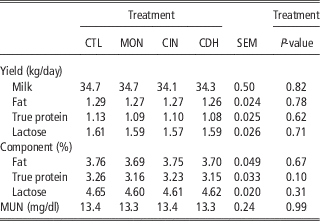
Milk yield and milk composition were not affected by the inclusion of CIN and CDH in the diet (Table 6), which is consistent with the absence of an effect of these additives on DMI (Table 2), nutrient digestion (Tables 2 and 3) and ruminal fermentation characteristics (Table 4). Little information exists on the effect of feeding CIN and CDH on milk performance. Benchaar et al. (Reference Benchaar, Hassanat, Gervais, Chouinard, Julien, Petit and Massé2008) fed CDH (1 g/cow per day) to lactating dairy cows and reported no changes in milk performance.
Milk production and milk composition of lactating dairy cows fed a total mixed ration without supplementation (control, CTL) or supplemented with monensin (MON), cinnamon oil (CIN), or cinnamaldehyde (CDH)

MUN=milk urea nitrogen.
Diet supplementation with MON had no effect on milk yield (Table 6) which agrees with the lack of change in DMI (Table 2). In agreement with our findings, Grainger et al. (Reference Grainger, Williams, Eckard and Hannah2010) also reported no change in DMI and milk yield in cows supplemented with MON (24 mg/kg DMI). In the current study, the addition of MON had no effect on concentrations and yields of milk fat and milk protein (Table 6). Other studies (Ramanzin et al., Reference Ramanzin, Bailoni, Schiavon and Bittante1997; Grainger et al., Reference Grainger, Williams, Eckard and Hannah2010) also observed no changes in concentrations and yields of milk fat and milk protein as a result of feeding MON.
Conclusions
Although in vitro experiments have reported that CIN and CDH reduce CH4 production, results of the current study show that feeding (50 mg/kg DMI) CIN and CDH to dairy cows had no effect on enteric CH4 emission (g/day) and CH4 energy losses (% GE intake). Similarly, dietary addition of MON (24 mg/kg DMI) did not reduce CH4 production (g/day or % of GE intake). It is concluded that CIN, CDH and MON cannot be promoted as effective strategies to mitigate enteric CH4 production in dairy cows.
Acknowledgments
The author thank the Dairy and Swine Research Centre (Sherbrooke, QC, Canada) staff, especially L. Croteau (technical assistance), S. Methot (help with statistical analyses), and the barn crew (care of the animals). The author is also grateful to A.D. Iwaasa (Agriculture and Agri-Food Canada, Swift Current, SK, Canada) for providing the SF6 permeation tubes. Donation of cimmamon oil and cinnamaldehyde by Phodé (Albi, France) was much appreciated. Funding for the study was from Agriculture and Agri-Food Canada (Ottawa, Ontario, Canada).