1. Introduction
Calabi–Yau threefolds, three-dimensional compact Kähler manifolds  $X$ with trivial canonical bundle such that
 $h^{1}(X,\mathcal {O}_X)$ and
 $h^{2}(X,\mathcal {O}_X)$ vanish, are intensively studied objects in both algebraic geometry and theoretical physics. Datasets of such objects have been studied since the work of Candelas, Lütken and Schimmrigk [Reference Candelas, Lütken and SchimmrigkCLS88] and Candelas, Lynker and Schimmrigk [Reference Candelas, Lynker and SchimmrigkCLS90]. In [Reference BatyrevBat94] Batyrev described a construction of a Calabi–Yau threefold from any maximal triangulation of a four-dimensional reflexive polytope; this was extended by Batyrev and Borisov [Reference Batyrev and BorisovBB96] to nef partitions of higher- dimensional reflexive polytopes. Together with the classification of four-dimensional reflexive polytopes by Kreuzer and Skarke [Reference Kreuzer and SkarkeKS00], this construction provides an enormous number of Calabi–Yau threefolds. By way of illustration, there are
 $473{,}800{,}776$ four-dimensional reflexive polytopes, without taking into account the number of triangulations.
Despite the plethora of Calabi–Yau threefolds obtained by the methods above, such lists do not necessarily imply an abundance of examples of Calabi–Yau threefolds in a particular class. For example, [Reference KapustkaKap15] contains a (then complete) list of  $151$ known constructions of Calabi–Yau threefolds of Picard rank one. In fact
 $20$ of these constructions are conjectural, and we explore the question of the existence of several such examples in § 5, in light of the recent work of Inoue [Reference InoueIno19] and Knapp and Sharpe [Reference Kontsevich and SoibelmanKS06, §
 $2.5$]. In a different direction, a list of constructions of Calabi–Yau threefolds with small Hodge numbers was compiled by Candelas, Constantin and Mishra [Reference Candelas, Constantin and MishraCCM18]. In this paper we describe an algorithm to construct a large new class of Calabi–Yau threefolds, and generate a number of specific examples. In particular, we give
 $14$ families whose topological invariants do not appear in existing lists of Calabi–Yau threefolds with
 $b_2=1$; members of at least seven of these families are simply connected (see Remark B.1).
The constructions we present in this paper are based on the Gross–Siebert programme. This is an algebro-geometric approach to the Strominger–Yau–Zaslow (SYZ) conjecture, developed by Gross and Siebert in [Reference Gross and SiebertGS06, Reference Gross and SiebertGS10, Reference Gross and SiebertGS11]. The main objects of study in this programme are toric log Calabi–Yau spaces, unions of toric varieties equipped with sections of line bundles which, by the results of [Reference Gross and SiebertGS06], determine a log structure. These spaces also determine integral affine manifolds with singularities, which play a key role in the work of Gross, of Haase and Zharkov, and of Ruan, on topological versions of the SYZ conjecture; we refer to [Reference GrossGro01c, Reference GrossGro05, Reference GrossGro01b, Reference RuanRua07, Reference Haase and ZharkovHZ05] for further details.
In what follows, we fix a lattice  $N \cong {{\mathbf {Z}}}^{4}$ and let
 $N_{{\mathbf {R}}}$ denote the real vector space
 $N\otimes _{{\mathbf {Z}}} {{\mathbf {R}}}$. Before stating our main result we recall some elementary facts concerning lattice polytopes to fix notation. Given a four-dimensional reflexive polytope
 $P \subset N_{{\mathbf {R}}}$, we write
 $\operatorname {Faces}(P,k)$ for the set of
 $k$-dimensional faces of
 $P$. This is a set of polytopes contained in
 $N_{{\mathbf {R}}}$, each of which is given by intersecting
 $P$ with a suitable hyperplane. There is a canonical bijection
 $F \mapsto F^{\star }$ between
 $d$-dimensional faces of
 $P$ and
 $(3-d)$-dimensional faces of
 $P^{\circ }$, the polar polytope to
 $P$. We write
 $\ell (E)$ for the lattice length of a one-dimensional lattice polytope
 $E$ and recall that two lattice polytopes are equivalent if they differ by an affine lattice isomorphism.
Theorem 1.1 Let  $P$ be a four-dimensional reflexive polytope and let
 $D$ be a function sending each face
 $F \in \operatorname {Faces}(P,2)$ to a Minkowski decomposition of
 $\ell (F^{\star })F$ into polytopes equivalent to standard simplices, each of which has dimension one or two. The pair
 $(P,D)$ determines a locally rigid, positive, toric log Calabi–Yau space
 $X_0(P,D)$. Moreover, the toric log Calabi–Yau space
 $X_0(P,D)$ admits a polarisation if
 $(P,D)$ is regular (see Definition 2.6).
Remark 1.2 Elements of the set  $\operatorname {Faces}(P,k)$ are polytopes contained in the four-dimensional vector space
 $N_{{\mathbf {R}}}$. Each face is contained in a unique
 $k$-dimensional affine subspace of
 $N_{{\mathbf {R}}}$. Elements of a Minkowski decomposition of a dilate of a
 $k$-dimensional face of
 $P$ (which are also contained in
 $N_{{\mathbf {R}}}$) are contained in translates of this
 $k$-dimensional affine space. The choice of these translates plays no role in what follows, and we usually describe the Minkowski summands of dilates of faces of
 $P$ as polytopes in a
 $k$-dimensional affine space. We note, however, that this is only a convenient shorthand: Minkowski decompositions of dilates of the faces of
 $P$ occur in
 $N_{{\mathbf {R}}}$.
It follows from [Reference Gross and SiebertGS11, Theorem  $1.30$] that, if
 $(P,D)$ is regular,
 $X_0(P,D)$ is the central fibre of a formal degeneration of log Calabi–Yau manifolds. It follows from the Artin approximation theorem [Reference ArtinArt68, Theorem
 $1.2$] that there is a family over an analytic disc which extends the Gross–Siebert formal family; we refer to recent work of Ruddat and Siebert [Reference Ruddat and SiebertRS20, Appendix B] for a detailed account of analytic approximation in this context. In fact Ruddat and Siebert [Reference Ruddat and SiebertRS20, Theorem
 $1.9$] show that this approximation may be made without reparametrisation of the coordinates used in the Gross–Siebert algorithm.
We note that, in describing  $X_0(P,D)$ as a toric log Calabi–Yau space, we have fixed both a reducible scheme with toric components, and a choice of log structure, as described in more detail in § 3. We note that the underlying scheme of
 $X_0(P,D)$ is related to, but not the same as, the toric boundary of the toric variety
 $X_P$ associated to the face fan of
 $P$. To ensure the hypotheses of Gross and Siebert's smoothing result [Reference Gross and SiebertGS11, Theorem
 $1.30$] are met (in particular, the condition of local rigidity), the underlying scheme of
 $X_0(P,D)$ is the result of a further degeneration of the toric boundary. However, we expect our construction to be compatible with recent work of Felten, Filip and Ruddat [Reference Felten, Filip and RuddatFFR19] on the smoothability of toroidal crossing spaces. This work does not depend on local rigidity, and should apply to a toric log Calabi–Yau space whose underlying scheme is the toric boundary of
 $X_P$. If this connection is made precise this would also suggest a direct link to work of Lee [Reference LeeLee17, Reference LeeLee18] on smoothing normal crossings Calabi–Yau varieties. Indeed, while the spaces we smooth in our construction are typically not normal crossings, it is likely that there is significant overlap in the sets of Calabi–Yau threefolds obtained by these methods.
In the second part of this paper we study the topology of the general fibre of Gross–Siebert families obtained via Theorem 1.1. One general approach to this is to consider the Kato–Nakayama space  $X^{\operatorname {KN}}$ of the given toric log Calabi–Yau space
 $X_0(P,D)$. The space
 $X^{\operatorname {KN}}$ (more precisely, the subspace of
 $X^{\operatorname {KN}}$ obtained by fixing a phase) is homeomorphic to a general fibre of the Gross–Siebert smoothing, considered as a family over an analytic disc (see [Reference ArgüzArg16, Theorem
 $3.1$] and [Reference Nakayama and OgusNO10, Theorem
 $5.1$]). However, rather than work with this space directly, we analyse a third space, the topological model introduced by Gross [Reference GrossGro01c]. Given a four-dimensional reflexive polytope
 $P$ and choice of Minkowski decompositions
 $D$, as in Theorem 1.1, we let
 $X(P,D)$ denote the topological model of
 $X_0(P,D)$. It follows from a long-standing conjecture of Gross and Siebert that
 $X(P,D)$ is homeomorphic to the subspace of
 $X^{\operatorname {KN}}$ with fixed phase. Moreover, a proof of this conjecture is ongoing work of Ruddat and Zharkov [Reference Ruddat and ZharkovRZ20]. We note, in particular, that both of these spaces admit maps to
 $X_0(P,D)$ whose general fibre in a fixed toric stratum of
 $X_0(P,D)$ is a torus of dimension equal to the codimension of the stratum.
Conjecture 1.3 (See [Reference GrossGro05, Theorem 0.1] and [Reference Ruddat and ZharkovRZ20, Theorem 11])
The space  $X(P,D)$ is homeomorphic to the subspace of the Kato–Nakayama space
 $X^{\operatorname {KN}}$ associated to the toric log Calabi–Yau space
 $X_0(P,D)$ with fixed phase, and hence to a general fibre of the Gross–Siebert smoothing of
 $X_0(P,D)$.
We note, however, that we can determine the Betti numbers of the general fibre of a Gross–Siebert smoothing without relying on Conjecture 1.3.
Theorem 1.4 (See [Reference GrossGro01b, Lemma 2.4] and [Reference Gross and SiebertGS10, Corollary 3.24])
The Betti numbers  $b^{i}(X (P,D))$ of Gross’s topological model agree with the Betti numbers of the general fibre of a Gross–Siebert smoothing.
As described in Remark 4.11, Theorem 1.4 follows from Theorem 4.8 and Lemma 4.10. We compute the Betti number  $b_2$ of the space
 $X(P,D)$ in Theorem 4.12 and note that
 $b_3$ is determined by
 $b_2$ and the topological Euler number of
 $X(P,D)$, itself computed in Proposition 4.9.
We also study the fundamental group of  $X(P,D)$. By Lemma 4.10, this group is always finite and abelian, and in Theorem A.8 we give sufficient conditions for
 $X(P,D)$ to be simply connected. While we expect this to be the generic case, there are exceptions. For example, it was shown by Batyrev and Kreuzer [Reference Batyrev and KreuzerBK06] (see also work of Doran and Morgan [Reference Doran and MorganDM07]) that there are
 $16$ four-dimensional reflexive polytopes
 $P$ such that Calabi–Yau toric hypersurfaces obtained by applying Batyrev's construction [Reference BatyrevBat94] to
 $P$ are not simply connected. We show in Example A.9 that there are choices of reflexive polytope
 $P$ and Minkowski decompositions
 $D$ such that
 $X(P,D)$ is not simply connected.
While the classification of all possible input data to Theorem 1.1 is expected to be computationally accessible, we defer such a computation to future joint work with T. Coates. Indeed, following computations performed on the hpc framework at Imperial College, we find there are slightly in excess of  $1.5$ million reflexive four-dimensional polytopes
 $P$ such that every two-dimensional face of
 $P$ admits a decomposition of the form required to apply Theorem 1.1. We also remark that each such polytope may support a number of such decompositions.
We present a family of examples in § 5. In each of these examples,  $P$ is a product of reflexive polygons, and this family combines a number of new examples with a number of classical cases. Following observations of Galkin [Reference GalkinGal15], and constructions of Inoue [Reference InoueIno19] and Knapp–Sharpe [Reference Knapp and SharpeKS19], many of these examples are related to joins of elliptic curves. In future work we will also consider products of three-dimensional reflexive polytopes with a length-two line segment, related to an algebro-geometric version of the suspension of a K
 $3$ surface; we expect many of the Calabi–Yau threefolds constructed by Lee in [Reference LeeLee17] appear in this way. Among the examples we consider in § 5, we describe pairs
 $(P,D)$, where
 $P$ is the product of two lattice hexagons in § 5.1.
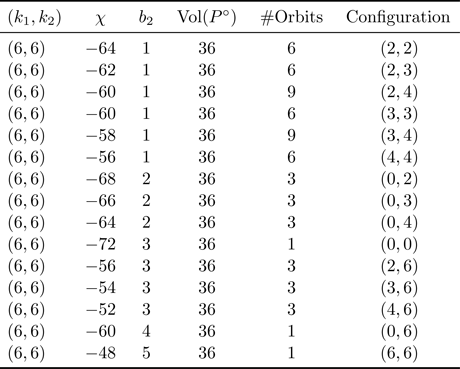
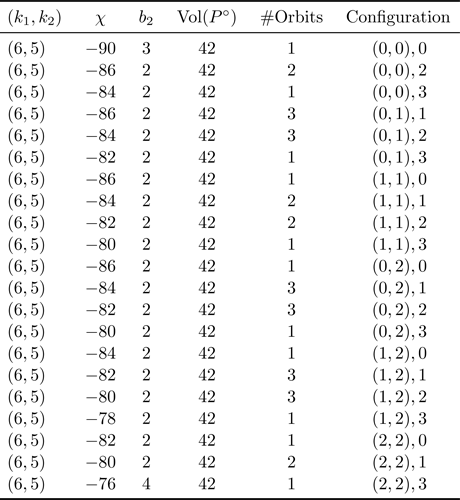
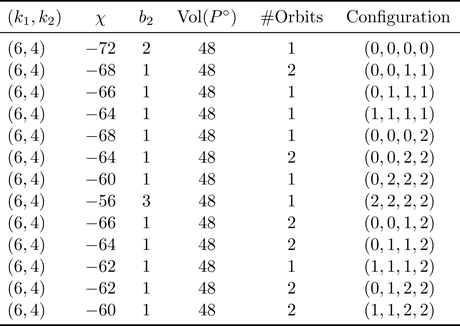
Proposition 1.5 Let  $P_6$ be the integral hexagon associated with the toric del Pezzo surface of degree six. Consider the four-dimensional polytope
 $P := P_6 \times P_6$. From the toric variety
 $X_P$ associated to the face fan of
 $P$ we can form Calabi–Yau threefolds with
 $14$ distinct sets of Betti numbers, five of which have
 $b_2=1$ and do not appear in the list of Kapustka [Reference KapustkaKap15], or among recent constructions of Lee [Reference LeeLee17, Reference LeeLee18].
In a somewhat different language, the toric variety  $X_P$ associated to
 $P$ has
 $36$ ordinary double point singularities and
 $12$ singularities locally isomorphic to the anti-canonical cone on the del Pezzo surface of degree six. The latter
 $12$ singularities admit two deformation components: the archetypal ‘Tom’ and ‘Jerry’ (see Brown, Kerber and Reid [Reference Brown, Kerber and ReidBKR12]). Famous results of Friedman [Reference FriedmanFri91] and Tian [Reference TianTia92] show that smoothing varieties with nodal singularities is generally obstructed. Consonant with this, we must verify a global condition (existence of a polarisation) before we are able to smooth all
 $48$ singularities of
 $X_P$. In this language, we expect the join construction of Knapp and Sharpe [Reference Knapp and SharpeKS19, §
 $2.5$] to be related to the ‘simultaneous Jerry’ smoothing.
Finally, we note that there are geometric transitions between the Calabi–Yau threefolds we construct, and those obtained via Batyrev's construction [Reference BatyrevBat94]. While these transitions are more general than conifold transitions (indeed, the singular locus appearing in the middle of the transition is generally non-isolated), one can view the construction we present as an extension of the approach taken by Batyrev and Kreuzer in [Reference Batyrev and KreuzerBK10].
Notation
We present a list of notation used throughout this paper.

2. Simply decomposable polytopes
We construct Calabi–Yau threefolds from toric hypersurfaces with singularities belonging to a certain class. The following definition provides a combinatorial description of this class of toric singularities.
Definition 2.1 Given a reflexive polytope  $P$, we say that
 $P$ is simply decomposable (s.d.) if every two-dimensional face of
 $P$ admits a Minkowski decomposition into lattice polytopes, each of which is equivalent to a standard simplex.
If  $P$ is a reflexive polygon we treat
 $P$ itself as the (unique) two-dimensional face of
 $P$ in Definition 2.1. We assume throughout this paper that
 $P \subset N_{{\mathbf {R}}}$, where
 $N_{{\mathbf {R}}} := N \otimes _{{\mathbf {Z}}} {{\mathbf {R}}}$ and
 $N \cong {{\mathbf {Z}}}^{4}$; we let
 $M$ denote the lattice
 $\operatorname {Hom}(N,{{\mathbf {Z}}})$ dual to
 $N$.
Definition 2.2 Given a four-dimensional s.d. reflexive polytope  $P$, let
 $D$ be a function which sends each face
 $F \in \operatorname {Faces}(P,2)$ to a Minkowski decomposition of
 $\ell (F^{\star })F$. If each summand in each element of the image of
 $D$ is equivalent to a standard simplex we say that
 $D$ is a standard decomposition. Note that each decomposition
 $D(F)$ is itself a multiset.
We fix a four-dimensional s.d. reflexive polytope  $P$ and standard decomposition
 $D$ for the remainder of this section.
Remark 2.3 Given a lattice polytope  $R \subset {{\mathbf {R}}}^{n}$, write
 $\operatorname {Lattice}(R)$ for the affine sublattice of
 ${{\mathbf {Z}}}^{n}$ generated by
 $R \cap {{\mathbf {Z}}}^{n}$. We say that a Minkowski decomposition
 $R = S+T$ of
 $R$ into lattice polytopes
 $S$ and
 $T$ is a lattice Minkowski decomposition if
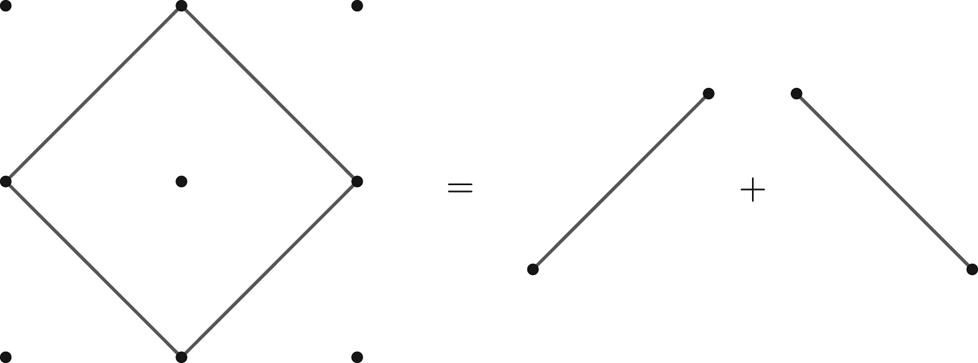
 $\operatorname {Lattice}(R) = \operatorname {Lattice}(S) + \operatorname {Lattice}(T)$. We note that the Minkowski decompositions appearing in Definition 2.2 do not need to be lattice Minkowski decompositions (see, for example, the Minkowski decomposition illustrated in Figure 1), although this condition plays a role in the topological analysis made in Appendix A. We note that all Minkowski summands are required to be lattice polytopes.
Example of a non-lattice Minkowski decomposition.

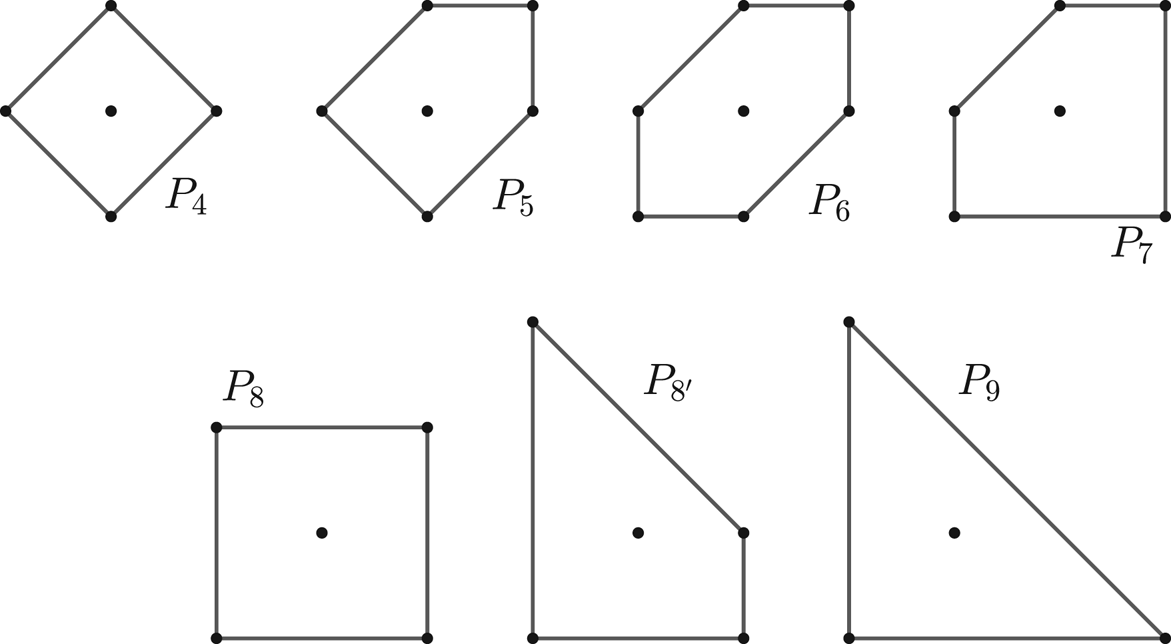
Example 2.4 Using the definition of s.d. reflexive polygon described above, there are seven s.d. polygons. These are illustrated in Figure 2. It is easy to verify that taking the product of any two of these polygons gives a four-dimensional s.d. polytope. We let  $P_{i,j}$ denote the product
 $P_i \times P_j$, where
 $P_i$ is as shown in Figure 2 for each
 $i \in \{4,\ldots , 9\} \cup \{8'\}$. We will treat
 $P_{9,9}$, the product of a pair of lattice triangles, as a running example throughout this paper. We note that
 $P_{9,9}$ contains
 $9$ vertices,
 $18$ edges,
 $6$ triangular faces (each equivalent to a dilate of a standard triangle by a factor of three),
 $9$ square faces (each with lattice edge length equal to three), and
 $6$ facets (each equivalent to the product of a triangular face with a line segment). Next observe that there is a unique choice of standard decomposition
 $D$ for
 $P_{9,9}$, sending
(i) each face equivalent to a dilate of the standard triangle to a multiset consisting of three copies of a standard triangle, and
(ii) each face equivalent to a (
 $3\times 3$) lattice square to a multiset of six line segments.

List of simply decomposable reflexive polygons.

The toric variety  $X_{P_{9,9}}$ is a complete intersection of bi-degree
 $(3,3)$ in
 ${{\mathbf {P}}}^{6}$. Indeed, letting
 $x_0,\ldots , x_6$ denote homogeneous coordinates on
 ${{\mathbf {P}}}^{6}, X_{P_{9,9}}$ is the vanishing locus of the polynomials
 \[ x_1x_2x_3 = x_0^{3}, \quad x_4x_5x_6 = x_0^{3}. \]
General anti-canonical hypersurfaces in  $X_{P_{9,9}}$ contain
 $18$ curves of transverse
 $A_2$ singularities, which intersect in six orbifold singularities
 $\mathbf {C}^{3}/G$ (where
 $G = {{\mathbf {Z}}}_3 \times {{\mathbf {Z}}}_3$) and nine (isomorphic) singularities given by the quotient of an ordinary double point by an action of
 $G$. Treating this example from the perspective of Batyrev's construction [Reference BatyrevBat94], one would fix a resolution of this singular locus. Alternatively, this variety can be smoothed by deforming the cubics cutting out this Calabi–Yau threefold in
 ${{\mathbf {P}}}^{5}$ to obtain a Calabi–Yau threefold with
 $b_2=1$. It is this variety, obtained via smoothing a hyperplane section of
 $X_{P_{9,9}} \subset {{\mathbf {P}}}^{6}$, which we expect to reproduce via our construction.
In § 3 we define an integral affine structure on  $\partial P^{\circ }$. However, before this can be used as input to the Gross–Siebert algorithm, this integral affine structure must admit a polarisation. A polarisation is a multi-valued piecewise linear (PL) function on an integral affine manifold, as described in § 3. This multi-valued PL function is strictly convex on a polyhedral decomposition
 $\mathscr {P}$ which refines the polyhedral decomposition of
 $\partial P^{\circ }$ determined by the faces of
 $P^{\circ }$. We will construct such a polarisation from a convex PL function
 $\varphi$ on
 $\partial P^{\circ }$. We remark that this function will not be linear on faces of
 $P^{\circ }$.
In the remainder of this section we introduce the combinatorial framework used to describe such polarisations in § 3.4. We begin by fixing functions over the two-dimensional faces of  $P^{\circ }$ and describe how these glue together along the edges of
 $P^{\circ }$. To describe how functions on two-dimensional faces are glued together we note that, fixing a face
 $F \in \operatorname {Faces}(P,2)$, there is a canonical matching (or multi-valued function) between the edges of any
 $m \in D(F)$ and the edges of
 $F$ (or, equivalently, of
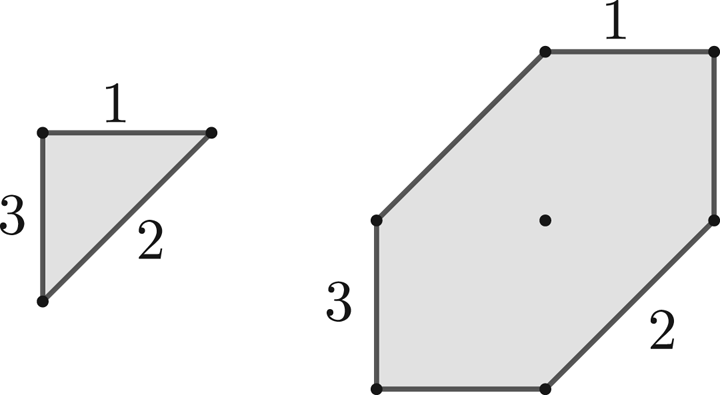
 $\ell (F^{\star })F$). For example, the edges of a Minkowski summand of a lattice hexagon are shown in Figure 3, together with the corresponding edges of the hexagon. We let
 $\operatorname {Edges}(F,m) \subseteq \operatorname {Edges}(F)$ denote the subset of edges of
 $F$ matched with some edge of
 $m$.
 $\operatorname {Edges}(F,m)$ for a lattice hexagon
 $F$ (left) and triangular summand
 $m$ (right).

Fixing a two-dimensional face  $\sigma \in \operatorname {Faces}(P^{\circ },2)$ and an edge
 $\tau \in \operatorname {Edges}(\sigma )$, we recall that
 $D(\tau ^{\star })$ is a Minkowski decomposition of
 $\ell (\tau )\tau ^{\star }$ into polygons equivalent to standard triangles and length-one line segments. This Minkowski decomposition induces a Minkowski decomposition of the edge
 $\sigma ^{\star }$ of
 $\tau ^{\star }$ into length-one line segments, an example of which is illustrated in Figure 4. Indeed, each length-one segment of
 $\ell (\tau )\sigma ^{\star }$ corresponds to a unique element
 $m \in D(\tau ^{\star })$ such that
 $\sigma ^{\star } \in \operatorname {Edges}(\tau ^{\star },m)$. We define the multiset
 \[ S(\sigma,\tau) := \{m \in D(\tau^{{\star}}) : \sigma^{{\star}} \in \operatorname{Edges}(\tau^{{\star}},m)\} \]
of summands of  $\ell (\tau )\tau ^{\star }$ whose edges ‘contribute’ to
 $\ell (\tau )\sigma ^{\star }$; in the example shown in Figure 4,
 $S(\sigma ,\tau )$ is equal to
 $D(\tau ^{\star })$. Alternatively, let
 $m$ be the lattice triangle shown in Figure 3, set
 $\tau := F^{\star }$, and let
 $\sigma \in \operatorname {Faces}(P^{\circ },2)$ a face containing
 $\tau$. The summand
 $m$ is contained in
 $S(\sigma ,\tau )$ if and only if
 $\sigma ^{\star }$ is one the edges of
 $F = \tau ^{\star }$ labelled
 $1, 2$, or
 $3$.
A Minkowski decomposition induced on the edge  $\ell (\tau )\sigma ^{\star }$ of a polygon
 $\ell (\tau )\tau ^{\star }$.

Since the size of the multiset  $S(\sigma ,\tau )$ is equal to the lattice length of the one-dimensional polytope
 $\ell (\tau )\sigma ^{\star }$, we have the following lemma.
Lemma 2.5 Fix a four-dimensional s.d. polytope  $P$ and standard decomposition
 $D$. Given a face
 $\sigma \in \operatorname {Faces}(P^{\circ },2)$ and edge
 $\tau$ of
 $\sigma$, there is a bijection
 \[
\{\text{length-one segments of}\ \ell(\tau)\sigma^\star\} \longleftrightarrow S(\sigma,\tau).
\]
Moreover, such a bijection is fixed by an orientation of the edges of  $P^{\circ }$ and an ordering on
 $D(\tau ^{\star })$ for each
 $\tau \in \operatorname {Edges}(P^{\circ })$.
The main ingredient used to construct a polarisation in § 3.4 is a tuple  $(\mu _\sigma : \sigma \in \operatorname {Faces}(P^{\circ },2))$ of PL functions on the polygons
 $\ell (\sigma ^{\star })\sigma$ which are strictly convex on a maximal triangulation; that is, such that the domains of linearity of each function
 $\mu _\sigma$ coincide with the cells of a maximal triangulation of
 $\ell (\sigma ^{\star })\sigma$. To describe how we glue these functions, let
 $\sigma _1$ and
 $\sigma _2$ be two-dimensional faces of
 $P^{\circ }$ which intersect in an edge
 $\tau \in \operatorname {Edges}(P^{\circ })$. Let
 $a_1$ and
 $a_2$ be segments of
 $\ell (\sigma ^{\star }_1)\tau$ and
 $\ell (\sigma ^{\star }_2)\tau$, and recall that
 $a_1$ and
 $a_2$ are identified with elements of
 $S(\sigma _1,\tau )$ and
 $S(\sigma _2,\tau )$, respectively. Both
 $S(\sigma _1,\tau )$ and
 $S(\sigma _2,\tau )$ are subsets of
 $D(\tau ^{\star })$ and we assume that both
 $a_1$ and
 $a_2$ are identified with the same element in the intersection
 \[ S(\sigma_1,\tau) \cap S(\sigma_2,\tau) \subset D(\tau^{{\star}}). \]
In this case,  $a_1$ and
 $a_2$ correspond to a single Minkowski summand
 $m$ of
 $\tau ^{\star }$ such that
 $\sigma _i^{\star } \in \operatorname {Edges}(\tau ^{\star },m)$ for each
 $i \in \{1,2\}$.
Definition 2.6 Fix a tuple  $(\mu _\sigma : \sigma \in \operatorname {Faces}(P^{\circ },2))$ of PL functions which, as above, are strictly convex on a maximal triangulation of each polygon
 $\ell (\sigma ^{\star })\sigma$. Moreover, let
 $\sigma _1$ and
 $\sigma _2$ be two-dimensional faces of
 $P^{\circ }$ which intersect along an edge of
 $P^{\circ }$ and let
 $a_1$ and
 $a_2$ be length-one segments of
 $\ell (\sigma _1^{\star })\tau$ and
 $\ell (\sigma _2^{\star })\tau$ which are identified with the same element in
 $S(\sigma _1,\tau ) \cap S(\sigma _2,\tau )$. We say that the tuple
 $(\mu _\sigma : \sigma \in \operatorname {Faces}(P^{\circ },2))$ is admissible if the slope of
 $\mu _{\sigma _1}$ along
 $a_1$ coincides with the slope of
 $\mu _{\sigma _2}$ along
 $a_2$ for every possible choice of
 $\sigma _1, \sigma _2, a_1$ and
 $a_2$. If
 $(P,D)$ admits an admissible tuple of PL functions, we say that
 $(P,D)$ is regular.
Example 2.7 Consider the polytope  $P_{9,9}$ described in Example 2.4. Every face of
 $P^{\circ }_{9,9}$ is equivalent to a standard triangle. Since every edge of
 $P_{9,9}$ has lattice length three,
 $\ell (\sigma ^{\star })\sigma$ is equivalent to the dilate of a standard simplex by a factor of three for any
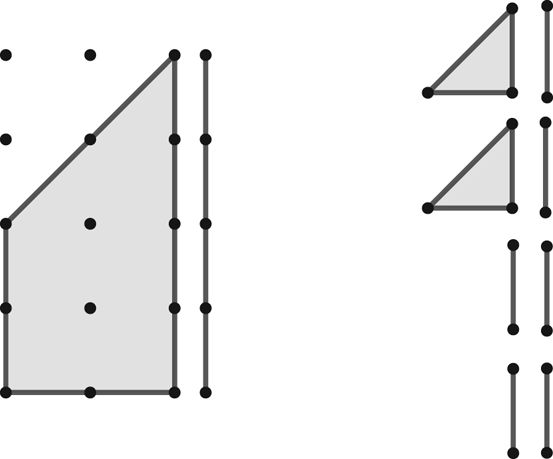
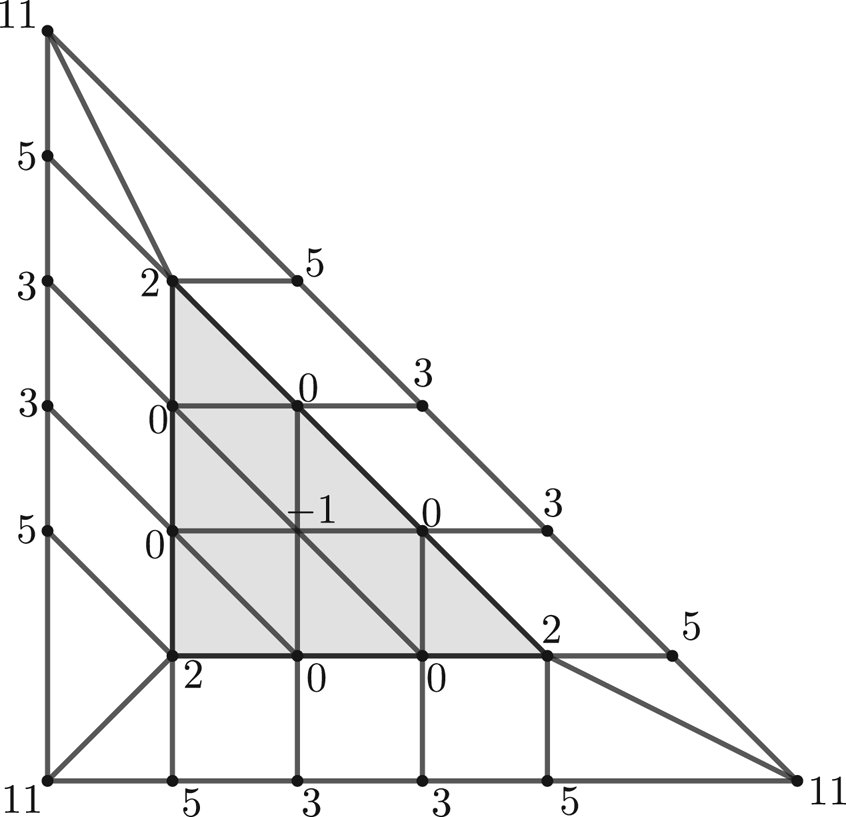
 $\sigma \in \operatorname {Faces}(P^{\circ },2)$. We illustrate a choice of piecewise linear function
 $\mu _\sigma$ on
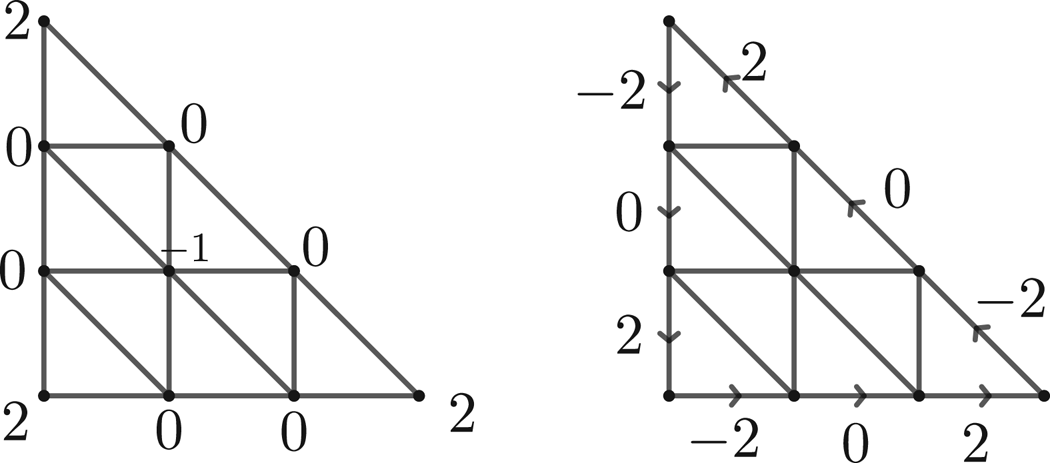
 $\ell (\sigma ^{\star })\sigma$ in Figure 5. The image on the left shows the values of
 $\mu _\sigma$ on the lattice points of
 $\ell (\sigma ^{\star })\sigma$; the right-hand image shows the slopes of
 $\mu _\sigma$ along the edges of
 $\ell (\sigma ^{\star })\sigma$. We note that, since the slopes of
 $\mu _\sigma$ are independent of the orientation of the edge, it follows immediately that these functions form an admissible collection, and hence the pair
 $(P_{9,9},D)$ (where
 $D$ is the unique standard decomposition of
 $P_{9,9}$, as described in Example 2.4) is regular.
Describing a piecewise linear function on  $\ell (\sigma ^{\star })\sigma$.

Example 2.8 In § 5.1 we give a detailed example of a pair  $(P,D)$ (in which
 $P = P_{6,6}$, as defined in Example 2.4) which is not regular. Generally, regularity fails because the conditions imposed by admissibility on the PL functions
 $(\mu _\sigma : \sigma \in \operatorname {Faces}(P^{\circ },2))$ force a function
 $\mu _{\sigma }$ to fail to be strictly convex along an edge of
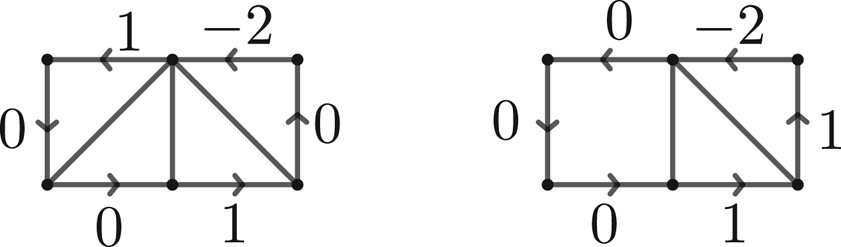
 $\sigma$. However, regularity can also fail in more subtle ways; for example, Figure 6 shows a pair of PL functions on a lattice rectangle, described by their slopes along edges. Both functions restrict to strictly convex functions on their boundary, but only one extends to a piecewise linear function which is strictly convex with respect to a maximal triangulation.
Admissible (left) and non-admissible PL functions (right).

We present an algorithm to verify whether an admissible tuple of functions exists for a pair  $(P,D)$, and include an implementation of this in Magma [Reference Bosma, Cannon and PlayoustBCP97] as supplementary material [Reference PrincePri19]. To describe this algorithm we introduce the notion of a slope function
 $V$ for
 $(P,D)$. These functions determine the slopes of a PL function along the edges of
 $P^{\circ }$.
Fix a four-dimensional reflexive polytope  $P$ and a standard decomposition
 $D$, as described in Definition 2.2. Let
 $V$ be a function taking each factor
 $m$ in the multiset
 \[ \coprod_{F \in \operatorname{Faces}(P,2)}{D(F)} \]
to an element in  ${{\mathbf {Q}}}$. We call
 $V$ a slope function for the pair
 $(P,D)$. Observe that, having fixed orientations for all the edges of
 $P^{\circ }$, an admissible tuple of PL functions
 $(\mu _\sigma : \sigma \in \operatorname {Faces}(P^{\circ },2))$ for
 $(P,D)$ uniquely determines a slope function given by the slopes of the functions
 $\mu _\sigma$ along line segments contained in the boundary of
 $\ell (\sigma ^{\star })\sigma$. Fixing an orientation of each two-dimensional face
 $\sigma$ of
 $P^{\circ }$, we set
 $\operatorname {sgn}(\sigma ,\tau ) := 1$ if the orientation of
 $\tau ^{\star }$ agrees with the clockwise ordering of the edges of
 $\sigma$, and
 $\operatorname {sgn}(\sigma ,\tau ) := -1$ if not.
Definition 2.9 We call a slope function consistent if, for each  $\sigma \in \operatorname {Faces}(P^{\circ },2)$, we have that
 \[ \sum_{\tau \in \operatorname{Edges}(\sigma)}\sum_{\substack{m \in D(\tau^{{\star}})\\ \sigma^{{\star}} \in \operatorname{Edges}(\tau^{{\star}},m)} }{\operatorname{sgn}(\sigma,\tau)V(m)} = 0. \]
Definition 2.10 We call a slope function strictly convex if elements in the multiset  $\{V(m) : m \in D(F)\}$ are pairwise distinct for any
 $F \in \operatorname {Faces}(P,2)$.
We fix a two-dimensional face  $\sigma \in \operatorname {Faces}(P^{\circ },2)$, an edge
 $\tau \in \operatorname {Edges}(\sigma )$, and let
 $\bar {\sigma }$ and
 $\bar {\tau }$ denote
 $\ell (\sigma ^{\star })\sigma$ and
 $\ell (\sigma ^{\star })\tau$, respectively. Given a consistent strictly convex slope function
 $V$, we now fix a piecewise linear function
 $\psi ^{\partial }_\sigma$ on
 $\partial \bar {\sigma }$ with slope equal to
 $V(m)$, using the bijection between length-one segments of
 $\bar {\tau }$ and
 $S(\sigma ,\tau )$. Note that, appropriately ordering
 $D(\tau ), (V(m) : m \in D(\tau ) )$ forms a monotone increasing sequence and
 $\psi ^{\partial }_\sigma$ is convex on
 $\bar {\tau }$ for any
 $\tau \in \operatorname {Edges}(\sigma )$. The piecewise linear function
 $\psi ^{\partial }_\sigma$ determines a polyhedral decomposition
 $T_0(\bar {\sigma })$ of
 $\bar {\sigma }$. Defining
 $\Gamma$ to be the lower convex hull of the set
 \[ \{(x,\psi^{\partial}_\sigma(x)) : x \in \partial(\bar{\sigma})\} \subset \bar{\sigma} \times {{\mathbf{R}}}, \]
this decomposition is defined by the projection of the two-dimensional faces of  $\Gamma$ to the polygon
 $\bar {\sigma }$. We note that the decomposition
 $T_0(\bar {\sigma })$ is independent of the choice of
 $\psi ^{\partial }_\sigma$ (which is itself uniquely determined by
 $V$ up to a constant).
Following common terminology in polyhedral combinatorics (see, for example, [Reference Nill and ZieglerNZ11]), we say a lattice polytope  $Q$ is empty if every integral point in
 $Q$ is a vertex of
 $Q$. We say that
 $Q$ is hollow if no integral point of
 $Q$ is contained in its (relative) interior.
Definition 2.11 We call a consistent strictly convex slope function  $V$ on
 $(P,D)$ regular if, for any
 $\sigma \in \operatorname {Faces}(P^{\circ },2)$, every empty polygon in the polyhedral decomposition
 $T_0(\bar {\sigma })$ of
 $\bar {\sigma }$ is equivalent to a standard triangle.
Note that, for example, the slope function shown in the right-hand image in Figure 6 is not regular: the decomposition illustrated is precisely  $T_0(\bar {\sigma })$ and the decomposition contains an empty lattice square. We now verify that the notions of regularity we have described for
 $(P,D)$ and for slope functions respectively are compatible.
Lemma 2.12 An admissible tuple of PL functions  $(\mu _\sigma : \sigma \in \operatorname {Faces}(P^{\circ },2))$ determines a strictly convex regular slope function.
Proof. Given an admissible tuple of PL functions, the slopes along the edges define a consistent and strictly convex slope function  $V$. Suppose that
 $V$ is not regular; that is, suppose there is a face
 $\sigma \in \operatorname {Faces}(P^{\circ },2)$ such that
 $T_0(\bar {\sigma })$ contains an empty polygon
 $Q$ which is not equivalent to a standard triangle. This polygon is a domain of linearity of any PL function on
 $\bar {\sigma }$ whose domains of linearity are lattice polygons and which extends the restriction of
 $\mu _\sigma$ to
 $\partial \bar {\sigma }$. In particular,
 $Q$ is a domain of linearity for
 $\mu _\sigma$, contradicting admissibility.
Proposition 2.13 The pair  $(P,D)$ is regular if and only if there exists a consistent strictly convex regular slope function
 $V$ on
 $(P,D)$.
Proof. Fix a strictly convex slope function  $V$, a face
 $\sigma \in \operatorname {Faces}(P^{\circ },2)$, and a function
 $\psi ^{\partial }_\sigma$ on
 $\partial \bar {\sigma }$ as described above. Moreover, let
 $\Gamma ^{0} := \Gamma$ be the lower convex hull of the points
 \[ \{(x,\psi ^{\partial }_\sigma (x)) : x \in \partial (\bar {\sigma })\}. \]
We note that  $\Gamma ^{0}$ is the graph of a PL function on
 $\bar {\sigma }$ determined, up to a constant, by
 $V$; we let
 $\psi ^{0}_\sigma$ denote this PL function. Since
 $V$ is strictly convex,
 $\psi ^{0}_\sigma$ is strictly convex (in the sense that this function is not linear in a neighbourhood of any lattice point) on each edge
 $\bar {\tau }$ of
 $\bar {\sigma }$.
We iteratively modify  $\psi ^{0}_\sigma$ to define a PL function
 $\psi _\sigma$ on
 $\bar {\sigma }$ which extends
 $\psi ^{\partial }_\sigma$ and which is strictly convex on a maximal triangulation. Note that if the relative interior of
 $\bar {\sigma }$ does not contain a lattice point, then we set
 $\psi _\sigma := \psi ^{0}_\sigma$ and observe that regularity of
 $V$ ensures that
 $T_0(\bar {\sigma })$ is a maximal triangulation of
 $\bar {\sigma }$. Otherwise, we fix a lattice point
 $y$ in the relative interior of
 $\bar {\sigma }$. We define the polyhedral complex
 $\Gamma ^{1}_\eta$ to be the lower convex hull of the points
 \[ \{(x,\psi^{0}_\sigma(x)) : x \in \partial(\bar{\sigma})\} \cup \{(y,\psi^{0}_\sigma(y)-\eta)\}, \]
where  $\eta$ is a positive rational number. The polyhedral decomposition of
 $\bar {\sigma }$ determined by the faces of
 $\Gamma ^{1}_\eta$ is constant for sufficiently small values of
 $\eta$. Fixing such a value of
 $\eta$, we set
 $\psi ^{1}_\sigma$ to be the PL function with graph equal to
 $\Gamma ^{1}_\eta$. The polyhedral decomposition determined by faces
 $\Gamma ^{1}_\eta$ is a star subdivision at
 $y$ of the triangulation induced by
 $\Gamma ^{0}$.
We repeat this procedure at each of the integral points  $y_1, \ldots , y_n \in \bar {\sigma }$ contained in the relative interior of
 $\bar {\sigma }$. This produces a sequence of PL functions
 $\psi ^{i}_\sigma$, and polyhedral decompositions
 $T_i$ of
 $\bar {\sigma }$. We let
 $\psi _\sigma := \psi ^{n}_\sigma$, and
 $T := T_n$ denote the final elements in these sequences. It remains to check that
 $T$ corresponds to a maximal triangulation of
 $\bar {\sigma }$. Let
 $Q$ be a polygon contained in
 $T$. By construction all integral points in
 $\bar {\sigma }$ are vertices of the triangulation
 $T$, so
 $Q$ is an empty polygon. If
 $Q$ is a face of
 $T_0(\bar {\sigma })$ then
 $Q$ is a lattice triangle by hypothesis. Otherwise,
 $Q$ is created by a star subdivision and is hence a lattice triangle. It follows that the functions
 $\psi _\sigma$ define an admissible tuple; the converse follows immediately from Lemma 2.12.
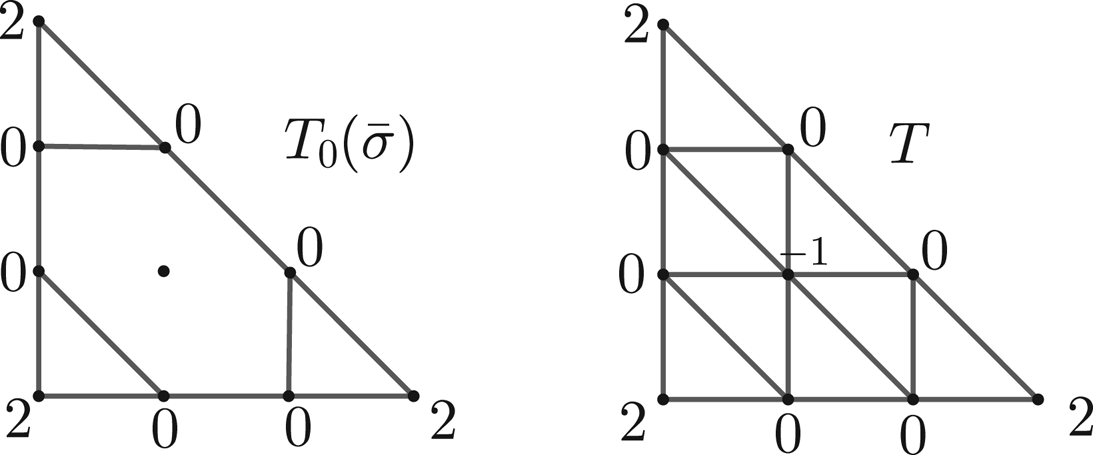
Example 2.14 The triangulation described in Figure 5 can be obtained using the construction given in the proof of Proposition 2.13. In particular, we first fix a slope function  $V$, as shown in the right-hand image in Figure 5. The subdivision
 $T_0(\bar {\sigma })$ induced by this slope function is shown in the left-hand image of Figure 7. We modify this triangulation by forming the star subdivision at the (unique) interior vertex, from which we obtain the triangulation
 $T$ as shown in the right-hand image in Figure 7.
Constructing a PL function on  $\bar {\sigma }$.

The condition that every empty polygon in  $T_0(\bar {\sigma })$ is a standard triangle can only fail in a small number of situations, which we now classify.
Proposition 2.15 Let  $T$ be a polyhedral decomposition of a polygon
 $\bar {\sigma }$ such that the vertex set of
 $T$ is equal to the set of integral points in
 $\partial \bar {\sigma }$. If
 $T$ contains an empty polygon
 $Q$, and
 $Q$ is not isomorphic to a standard simplex, then
 $Q$ is equivalent to an empty lattice square and
 $\bar {\sigma }$ is hollow.
Proof. It is well known that the only empty polygons are those equivalent to the standard triangle or to an empty lattice square. Let  $Q \subset {{\mathbf {R}}}^{2}$ be an empty lattice square in
 $T$ (after identifying
 $\bar {\sigma }$ with a lattice polygon in
 ${{\mathbf {R}}}^{2}$) and, without loss of generality, assume that
 $Q$ is the convex hull of the points given by the columns of the matrix
 \[ \begin{matrix} 0 & 1 & 1 & 0 \\ 0 & 0 & 1 & 1. \end{matrix} \]
Suppose that there exists a point  $(a,b) \in \bar {\sigma }$ such that both
 $a$ and
 $b$ are negative. Thus we have that
 $(0,0)$ lies in the interior of the convex hull of
 $\{(a,b),(0,1),(1,0)\} \subset \bar {\sigma }$. However, we have assumed that
 $(0,0)$ is contained in the boundary of
 $\bar {\sigma }$, and hence no such point
 $(a,b)$ exists. Repeating this argument at the point
 $(1,1), \bar {\sigma }$ is contained in the union of
 $[0,1] \times {{\mathbf {R}}}$ and
 ${{\mathbf {R}}} \times [0,1]$ and thus has no lattice points in its interior.
It is well known that the only hollow polygons are equivalent either to the Cayley sum of two line segments or to double the standard simplex. Thus the only possible cases in which regularity may fail are as follows.
(i) If
$\bar {\sigma }$ is a Cayley sum of two line segments, a triangulation induced by a PL function contains an empty square face if and only if length-one segments on opposite edges have the same slope. In particular, note that $\ell (\sigma ^{\star }) = 1$.(ii) If
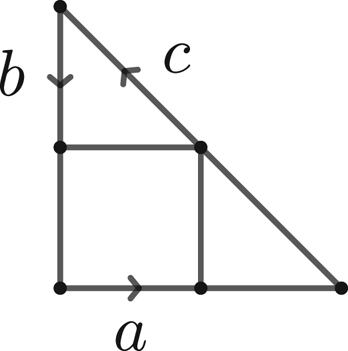
$\bar {\sigma }$ is a twice a standard triangle, a polyhedral decomposition contains an empty lattice square if and only if, up to an affine linear transformation, this decomposition is as shown in Figure 8, in which $a, b$ and $c$ denote the slopes along the edges they label and $a+b+c=0$. As above, we note that $\ell (\sigma ^{\star }) \in \{1,2\}$.


Irregular strictly convex slope function.

3. Smoothing the boundary of a reflexive polytope
3.1 A degenerate integral affine structure
The Gross–Siebert algorithm requires both discrete and algebraic input. The discrete data consists of a triple  $(B,\mathscr {P},\varphi )$, where
 $B$ is an integral affine manifold,
 $\mathscr {P}$ is a polyhedral decomposition, and
 $\varphi$ is a multi-valued piecewise linear function (see [Reference Gross and SiebertGS06, Definition
 $1.45$]). In this section we show how to assign such discrete data to a four-dimensional s.d. polytope equipped with choices of Minkowski decompositions of its two-dimensional faces. We also describe the algebraic input in § 3.4; in fact, using the main results of [Reference Gross and SiebertGS06], we can explicitly describe the possible space of such algebraic data.
Given a reflexive polytope  $P$, and following Gross [Reference GrossGro05, §
 $2$], there is a construction of an integral affine structure of on
 $\partial P^{\circ }$ without any further input data (this uses the toric degeneration of a general anti-canonical section of
 $X_P$ to the toric boundary of
 $X_P$). We follow the description given in [Reference GrossGro05, Definition
 $2.10$].
Construction 3.1 Let  $\Delta ^\textrm {c}$ denote the union of (zero- and one-dimensional) cells of the first barycentric subdivision of
 $\partial P^{\circ }$ which are disjoint from the interior of each facet of
 $P^{\circ }$ and disjoint from the set of vertices of
 $P^{\circ }$. We define an integral affine manifold with singularities
 $B^\textrm {c}$ by defining an integral affine structure on
 $B^\textrm {c} \setminus \Delta ^\textrm {c}$ as follows.
(i) For each facet
$\rho$ of $P^{\circ }$, the affine structure on the interior of $\rho$ is determined by the composition $\rho \hookrightarrow P^{\circ } \hookrightarrow {{\mathbf {R}}}^{4}$. Identifying the minimal affine linear space containing $\rho$ with ${{\mathbf {R}}}^{3}$ identifies the interior of $\rho$ with a domain in ${{\mathbf {R}}}^{3}$.(ii) Given a vertex
$v$ of $P^{\circ }$, let $W_v$ denote the open star of $v$ in the first barycentric subdivision of $\partial P^{\circ }$. We define the affine chart
by projection.\[ p_v \colon W_v \to M_{{\mathbf{R}}} / \langle v \rangle \]


The singular locus of this affine structure is a graph, with vertices located at the barycentres of the two-dimensional faces and edges of  $P^{\circ }$. Loops around the edges of
 $\Delta$ determine monodromy operators for this integral affine structure. This monodromy was computed in this case in [Reference GrossGro05, Proposition
 $2.13$], and similar calculations have been made by Ruan [Reference RuanRua07] and Haase and Zarkov [Reference Haase and ZharkovHZ05].
Fix vertices  $v$ and
 $v'$ of
 $P^{\circ }$ contained in facets
 $\rho _1$ and
 $\rho _2$. Choose a loop
 $\gamma$ based at
 $v_1$ which passes successively into the interior of
 $\rho _1$, though
 $v_2$, the interior of
 $\rho _2$, and back to
 $v_1$. The monodromy of the affine structure around
 $\gamma$ is given by the linear map
 \[ T_\gamma(m) = m + \langle n_2-n_1, m \rangle (v_1-v_2), \]
where  $n_1$ and
 $n_2$ are the lattice points at vertices dual to the facets
 $\rho _1$ and
 $\rho _2$, respectively. In particular, assuming that
 $v_1$ and
 $v_2$ are contained in an edge
 $\tau$ of a two-dimensional face
 $\sigma = \rho _1 \cap \rho _2 \subset P^{\circ }$, the map
 $T_\gamma (m)$ is given by the matrix
 \[ \begin{pmatrix} 1 & 0 & \ell(\sigma^{{\star}})\ell(\tau) \\ 0 & 1 & 0 \\ 0 & 0 & 1 \end{pmatrix} \]
in suitable coordinates. In [Reference Gross and SiebertGS06, Reference Gross and SiebertGS11], Gross and Siebert show how to form a toric log Calabi–Yau space from an integral affine manifold with simple singularities (and additional data). The general definition of simplicity for the singular locus of an affine structure is given in [Reference Gross and SiebertGS06, Definition  $1.60$]. The restriction to the case
 $\dim B =3$ is described in detail in [Reference Gross and SiebertGS06, Example
 $1.62$] and we recall the main points of this description. We first fix an integral affine manifold
 $B$ and polyhedral decomposition
 $\mathscr {P}$, recalling that polyhedral decompositions of integral affine manifolds with singularities are carefully defined in [Reference Gross and SiebertGS06, Definition
 $1.22$].
Lemma 3.2 [Reference Gross and SiebertGS06, Example 1.62]
If  $B$ is a three-dimensional integral affine manifold with simple singularities, then the singular locus
 $\Delta$ of
 $B$ satisfies the following conditions.
(i) The discriminant locus
$\Delta$ is a trivalent graph contained in B and such that every vertex is contained in a cell $\tau$ of dimension one or two.(ii) Loops passing singly around a segment of the discriminant locus induce monodromy operators on the tangent spaces of
$B$. In a suitable basis, these operators are given by the matrix
\[ T_g := \begin{pmatrix} 1 & 0 & 1 \\ 0 & 1 & 0 \\ 0 & 0 & 1 \end{pmatrix}. \](iii) If
$v$ is a vertex of $\Delta$ contained in an edge, the monodromy matrices induced by loops passing singly around edges of $\Delta$ containing $v$ are simultaneously congruent to the matrices
(1)\begin{equation} T_1 := \begin{pmatrix} 1 & 1 & 0 \\ 0 & 1 & 0 \\ 0 & 0 & 1 \end{pmatrix}, \quad T_2 := \begin{pmatrix} 1 & 0 & 1 \\ 0 & 1 & 0 \\ 0 & 0 & 1 \end{pmatrix}, \quad T_3 := \begin{pmatrix} 1 & -1 & -1 \\ 0 & 1 & 0 \\ 0 & 0 & 1 \end{pmatrix}. \end{equation}(iv) If
$v$ is a vertex of $\Delta$ not contained in an edge, the monodromy matrices induced by loops passing singly around edges of $\Delta$ containing $v$ are simultaneously congruent to the inverse transposes of the matrices appearing in (1).


Remark 3.3 Vertices of  $\Delta$ described by item (iii) (respectively, item (iv)) are called positive (respectively, negative) points of
 $\Delta$. The names (due to Morrison [Reference GrossGro01a, footnote on p. 18]) come from the fact that the total spaces of the topological torus fibrations constructed by Gross over neighbourhoods of these points have Euler numbers
 $+1$ and
 $-1$, respectively. We refer to § 4 (and particularly Remark 4.2) for further details and references.
Fixing a four-dimensional reflexive polytope  $P$, the integral affine manifold
 $B^\textrm {c}$ does not generally have simple singularities for any choice of polyhedral decomposition. Indeed,
 $\Delta ^\textrm {c}$ is not usually trivalent and the monodromy operators around segments of
 $\Delta ^\textrm {c}$ are not usually of the correct form. In [Reference GrossGro05, Reference Haase and ZharkovHZ05] the authors construct an affine manifold related to
 $B^\textrm {c}$ from triangulations of both
 $\partial P$ and
 $\partial P^{\circ }$. Central to the proof of Theorem 1.1 is the construction of an alternative perturbation of
 $\Delta ^\textrm {c}$, in the case where
 $P$ is an s.d. polytope.
3.2 Constructing a polarisation
We construct a convex PL function  $\varphi ^\textrm {r}$ on
 $\partial P^{\circ }$, and use its domains of linearity to define a polyhedral decomposition
 $\mathscr {P}$. Later, we fix fan structures (see [Reference Gross and SiebertGS11, Definition
 $1.1$]) at each vertex of this decomposition to define an integral affine structure. The function
 $\varphi ^\textrm {r}$ (the superscript
 $r$ denotes refined, in contrast to the superscript
 $c$ in
 $B^\textrm {c}$ which denotes coarse) determines a polarisation on this tropical manifold.
Fix an s.d. polytope  $P$ and a standard decomposition
 $D$, as introduced in Definition 2.2, such that
 $(P,D)$ is regular. Let
 $(\mu _\sigma : \sigma \in \operatorname {Faces}(P^{\circ },2))$ denote a tuple of admissible functions for the pair
 $(P,D)$. Moreover, let
 $\varphi ^\textrm {c}$ be the unique piecewise linear function on
 $M_{{\mathbf {R}}}$ which evaluates to
 $1$ at each vertex of
 $P^{\circ }$. We define
 \[ \varphi{}^\textrm{r} := \varphi{}^\textrm{c} + \epsilon \psi, \]
where  $\epsilon \in {{\mathbf {Q}}}_{>0}$ is a small rational value (the precise value of
 $\epsilon$ is unimportant as the domains of linearity of
 $\varphi ^\textrm {r}$ are constant for all sufficiently small values). We produce the piecewise linear (not necessarily convex)
 $\psi$ function on
 $\partial P^{\circ }$ over the next three constructions.
Construction 3.4 Fixing an edge  $\tau \in \operatorname {Edges}(P^{\circ })$, we describe
 $\psi |_\tau$. Let
 $V$ denote the slope function corresponding to
 $(\mu _\sigma : \sigma \in \operatorname {Faces}(P^{\circ },2))$; see Lemma 2.12. We fix orientations for the edges and two-dimensional faces of
 $P^{\circ }$ and order
 $D(F)$ so that
 $\{V(m) : m \in D(F)\}$ is a monotone increasing sequence.
We subdivide  $\tau$ into
 $|D(\tau ^{\star })|+2$ intervals with rational endpoints. The ordering of
 $D(\tau ^{\star })$ and orientation of
 $\tau$ determine a bijection between the
 $|D(\tau ^{\star })|$ rational intervals that do not contain a vertex of
 $\tau$, and
 $D(\tau ^{\star })$. Let
 $\psi |_\tau$ be linear on each segment, with slope
 $V(m)$ along the segment corresponding to
 $m \in D(\tau ^{\star })$. We insist that
 $\psi (v) = 0$ at each vertex
 $v$ of
 $\tau$; in particular,
 $\psi |_\tau$ is a non-positive function. These conditions uniquely determine
 $\psi |_\tau$ up to a constant (which is fixed by the value of
 $\psi |_\tau (x)$ for any
 $x$ in the relative interior of
 $\tau$). We fix this parameter arbitrarily among values for which
 $\psi |_\tau$ is strictly convex.
Construction 3.5 Fixing a two-dimensional face  $\sigma \in \operatorname {Faces}(P^{\circ },2)$, we describe
 $\psi |_\sigma$. To this end, we choose an embedding
 $j \colon \bar {\sigma } \to \sigma$, where
 $\bar {\sigma } := \ell (\sigma ^{\star })\sigma$. Specifically, we let
 $j$ be a composition of a rational scaling and translation of
 $\bar {\sigma }$ into the relative interior of
 $\sigma$. We let
 $\sigma '$ denote the image
 $j(\bar {\sigma }) \subset \sigma$. Recall that, fixing an edge
 $\tau$ of
 $\sigma$,
 \[ S(\sigma, \tau) = \{m \in D(\tau^{{\star}}) : \sigma^{{\star}} \in \operatorname{Edges}(\tau^{{\star}},m)\} \]
is in canonical bijection with the set of (lattice length one) segments of  $\bar {\tau } = \ell (\sigma ^{\star })\tau$ by Lemma 2.5. For each
 $x \in \sigma '$, we let
 $\psi (x)$ be
 $\mu _\sigma (j^{-1}(x))- K$, for a fixed large positive integer
 $K$.
We have defined  $\psi$ over
 $\partial \sigma$ and over
 $\sigma ' \subset \sigma$. To extend
 $\psi$ between
 $\partial \sigma$ and
 $\partial \sigma '$ we take
 $\psi |_\sigma$ to be the unique PL function with graph equal to the lower convex hull of the points
 \[ \{(x,\psi(x)) : x \in \sigma' \cup \partial \sigma \}. \]
Since the slopes of the given segments of  $\tau$ which do not contain a vertex agree with slopes on segments of
 $\sigma '$, the function
 $\psi |_\sigma$ is linear on a number of trapezia between
 $\partial \sigma$ and
 $\sigma '$.
Construction 3.6 To complete the construction of  $\psi$, we extend
 $\psi$ across the facets of
 $P^{\circ }$. Fixing a facet
 $\rho$ of
 $P^{\circ }$, we extend
 $\psi$ arbitrarily across
 $\rho$ subject to the conditions that the domains of linearity are either simplices or polyhedral cones over a trapezium in a two-dimensional face, and that
 $\psi |_\rho$ is convex. For example, fixing a sufficiently negative value for
 $\psi (b_\rho )$, where
 $b_\rho$ is the barycentre of the facet
 $\rho$, we can define
 $\psi |_\rho$ to be the PL function whose graph is given by the lower convex hull of the points
 \begin{equation} \{(b_\rho, \psi(b_\rho))\} \cup \bigcup_{\sigma \in \operatorname{Faces}(\rho,2)}\{(x,\psi(x)) : x \in \sigma \}. \end{equation}
In particular, we may assume that the induced polyhedral decomposition of  $\rho$ is a star subdivision (or the result of repeated star subdivisions) of
 $\rho$.
Remark 3.7 The above constructions provide a convex PL function  $\varphi ^\textrm {r}$ on
 $P^{\circ }$, and we may define a polyhedral decomposition
 $\mathscr {P}$ of
 $P^{\circ }$ via the domains of linearity of
 $\varphi ^\textrm {r}$. Moreover, scaling
 $\varphi ^\textrm {r}$ appropriately, we may assume that
 $\varphi ^\textrm {r}$ is integral on the vertex set of
 $\mathscr {P}$.
Example 3.8 Considering the polytope  $P_{9,9}$, we note that the polytope
 $P_{9,9}^{\circ }$ can be described as the convex hull of ray generators of the fan determined by
 ${{\mathbf {P}}}^{2} \times {{\mathbf {P}}}^{2}$. We fix
 $\varphi ^\textrm {c}$, a convex PL function which evaluates to
 $1$ at each of these ray generators, representing the anti-canonical divisor of
 ${{\mathbf {P}}}^{2}\times {{\mathbf {P}}}^{2}$ under the usual correspondence between PL functions on a fan and Cartier divisors.
We also fix the admissible tuple of functions  $(\mu _\sigma : \sigma \in \operatorname {Faces}(P,2))$ described in Example 2.7. Following Construction 3.4, we fix four rational points on each edge
 $\tau$ of
 $\sigma$, dividing
 $\tau$ into five segments, and fix a PL function which has slopes
 $-2, 0$, and
 $2$ along the second, third, and fourth segments of
 $\tau$, respectively; see Figure 9. Note that in Construction 3.4 we require that
 $\psi |_\tau (v) = 0$ for each vertex
 $v$ of
 $\tau$; to simplify notation, and to give compatibility with Figure 5, Figure 9 shows
 $\psi |_\sigma +11$, rather than
 $\psi |_\sigma$.
Extending the PL function  $\mu _{\sigma }\circ j^{-1}$ to a two-dimensional face
 $\sigma$ of
 $P^{\circ }$.

We fix an embedding  $j$ of
 $\ell (\sigma ^{\star })\sigma$ into
 $\sigma$, and use
 $\mu _\sigma$ to define a PL function on
 $\sigma '$ which extends over
 $\sigma$, as described in Construction 3.5. We illustrate the function
 $\mu _{\sigma }\circ j^{-1}$, and its extension to
 $\sigma$ in Figure 9, in which
 $\sigma '$ is shaded.
We now extend  $\psi$ over facets
 $\rho$ of
 $P^{\circ }$. For example, let
 $b_\rho$ denote the barycentre of
 $\rho$ and fix a value of
 $\psi (b_\rho ) \in {{\mathbf {Z}}}$ less than
 $-12$. We may then take
 $\psi |_\rho$ to be the PL function with graph equal to the lower convex hull of the set given in (2).
3.3 Tropical manifolds via fan structures
We now define an integral affine structure  $B$, such that the pair
 $(B,\mathscr {P})$ has simple singularities along its discriminant locus
 $\Delta$. Following the description of such structures used in [Reference Gross and SiebertGS11], we define the integral affine structure
 $B$ via fan structures [Reference Gross and SiebertGS11, Definition
 $1.2$]. We recall that a fan structure consists of maps from the open stars of the faces of
 $\mathscr {P}$ to
 ${{\mathbf {R}}}^{k}$ (where
 $k$ denotes the codimension of the face), together with certain compatibility conditions. We define fan structures at the vertices of
 $P^{\circ }$, and iteratively extend them over the vertices of
 $\mathscr {P}$. In what follows we let
 $\xi _\tau$ denote the minimal face of
 $P^{\circ }$ which contains a face
 $\tau$ of
 $\mathscr {P}$.
Construction 3.9 First, if  $v = v' = \bar {v} \in \operatorname {Verts}({P^{\circ }})$, we define a fan structure via the projection
 $\pi _v \colon M_{{\mathbf {R}}} \to M_{{\mathbf {R}}}/\langle v \rangle \cong {{\mathbf {R}}}^{3}$, as in Construction 3.1. Cones in this fan structure are given by the images of cells in
 $\mathscr {P}$. Similarly, if
 $v$ is contained in the relative interior of a facet of
 $P^{\circ }$ the fan structure is determined by the embedding of this facet in
 ${{\mathbf {R}}}^{4}$. We now inductively extend these fan structures to other vertices of
 $\mathscr {P}$.
To define the remaining fan structures we assume that we have defined a fan structure at a vertex  $v$ of
 $\mathscr {P}$ and that
 $\tau \in \operatorname {Edges}(\mathscr {P})$ has vertices
 $\{v,v'\} \in \operatorname {Verts}({\mathscr {P}})$. Let
 $\bar {v} \in \operatorname {Verts}({P^{\circ }})$ be a vertex of
 $\xi _\tau$. We also assume that the fan structure
 $\pi _v$ on the open star of
 $v \in \operatorname {Verts}({\mathscr {P}})$ is given by a composition
 $T \circ \pi _{\bar {v}}$ for a piecewise linear map
 $T$ (defined on
 ${{\mathbf {R}}}^{3}$) and that
 $\xi _v \subseteq \xi _{v'}$.
(i) If
$\tau \subset \sigma '$ for some $\sigma \in \operatorname {Faces}(P^{\circ },2), v = j(v_1)$ and $v' = j(v_2)$ for some vertices $v_1$ and $v_2$ of $\bar {\sigma }$. We set $\pi _{v'} = T \circ \pi _v$ where
\[ T(x) := x + \min\{0,\langle x,u \rangle\}\pi_v(v_1-v_2). \](ii) If
$\tau \subset \tau '$ for some $\tau ' \in \operatorname {Edges}(P^{\circ })$, and $\tau$ is a segment of $\tau '$ which corresponds to a summand $m \in D({\tau '}^{\star })$, we set $\pi _{v'} = T \circ \pi _v$ where
in which\[ T(x) := x + \min_{w \in \operatorname{Verts}({m})}\{\langle x,w \rangle\}\pi_v(d_{\tau'}), \]$d_{\tau '}$ is the primitive direction vector along $\tau '$ pointing from $v$ to $v'$.(iii) In any other case, the fan structure at
$v'$ is given by applying $\pi _v$ to the open star of $v'$.


In all cases the cones of the fan structure are given by the images of cells in  $\mathscr {P}$. Note that there are various sign choices involved: the choice of orientation of two-dimensional faces and edges; however, different choices yield equivalent choices of fan structure (choices which differ by a linear function). We let
 $B(P,D)$ denote the integral affine manifold with singularities defined by these fan structures.
As defined, the discriminant locus of  $B(P,D)$ is not a trivalent graph. However, following [Reference Gross and SiebertGS06, Proposition
 $1.27$] (see also [Reference GrossGro05, §
 $4$]) we may extend the affine structure over any branch of the discriminant locus around which monodromy of the lattice
 $\Lambda$ is trivial. Comparing the monodromies around loops of the affine structure defined in Construction 3.9 with those described in Lemma 3.2, we have the following result.
Proposition 3.10 Extending the affine structure of  $B(P,D)$ over the complement of the minimal discriminant locus defines an integral affine manifold with simple singularities.
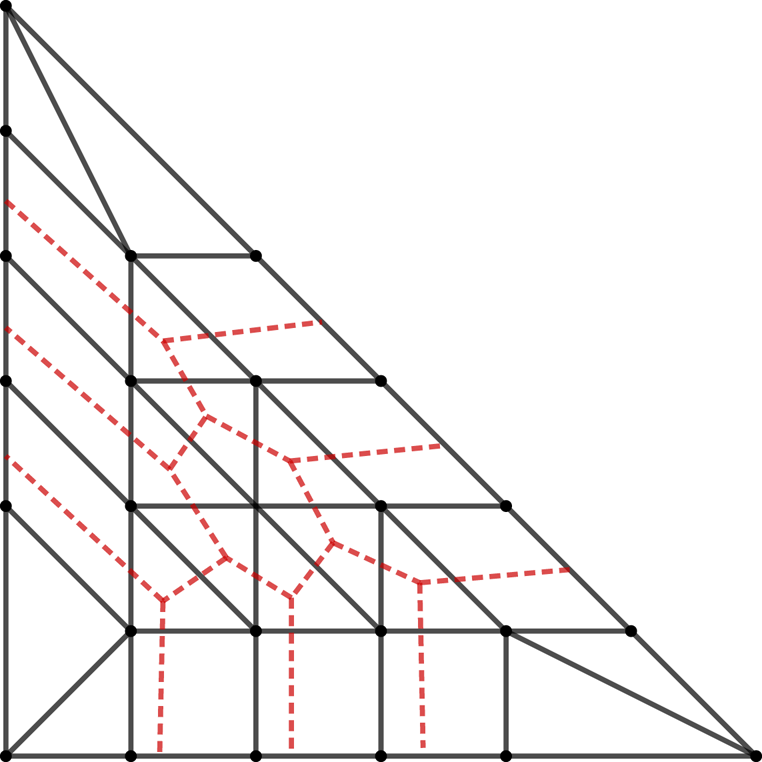
Example 3.11 We describe the (minimal) discriminant locus obtained by applying Construction 3.9 to Example 3.8 (that is, to  $P_{9,9}$ with its unique standard decomposition
 $D$). As indicated in Figure 10, there is non-trivial monodromy around any segment of
 $\Delta$ which intersects an edge of
 $\sigma ' = j(\bar {\sigma }) \subset \sigma$. Moreover, since the domains of linearity of
 $\mu _\sigma$ define a maximal triangulation of
 $\bar {\sigma } = \ell (\sigma ^{\star })\sigma , \Delta \cap \sigma '$ is a trivalent graph and each trivalent point defines a negative vertex (see Remark 3.3).
The discriminant locus in a two-dimensional face  $\sigma \in \operatorname {Faces}(P^{\circ }_{9,9},2)$.

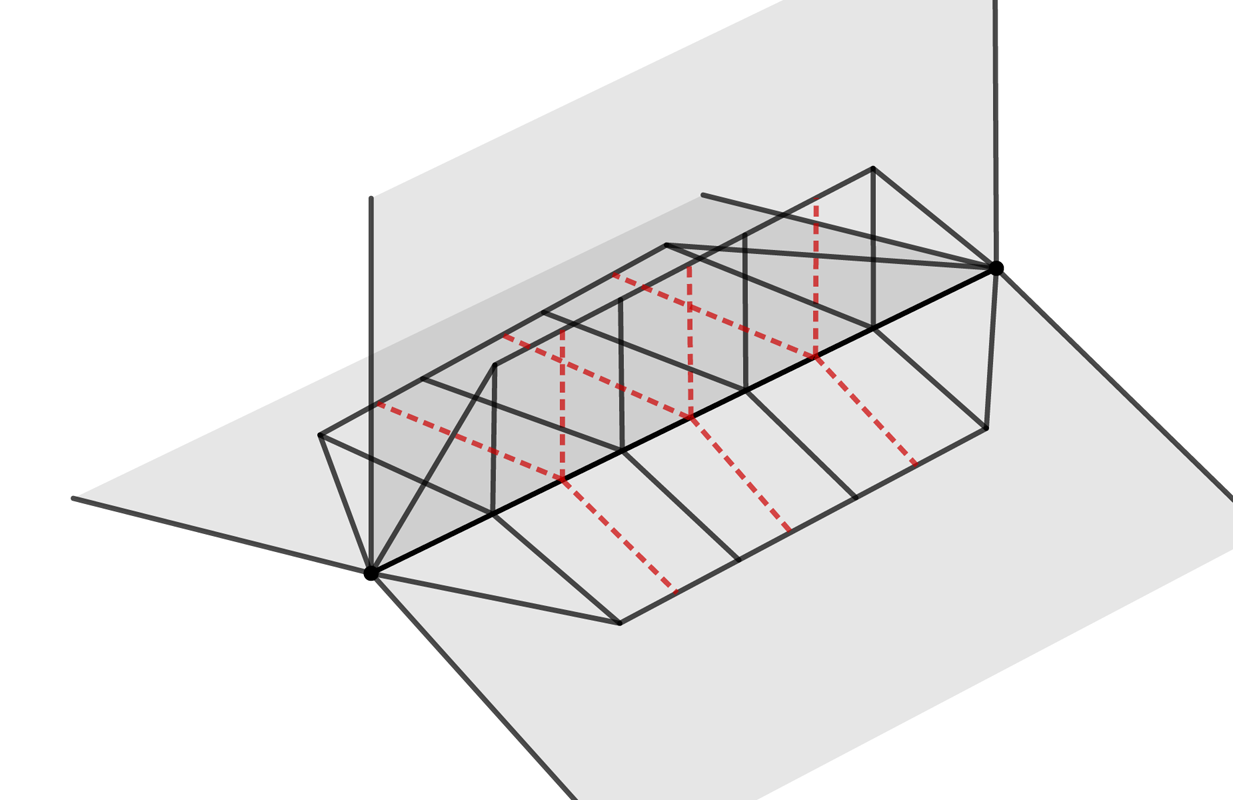
We recall from Example 2.4 that  $P_{9,9}$ contains six triangular faces. Fixing an edge
 $\tau \in \operatorname {Edges}(P_{9,9}^{\circ })$ dual to one of these six faces, Figure 11 illustrates the intersection of segments of
 $\Delta$ and
 $\tau$. Each of the trivalent points shown in Figure 11 is a positive vertex of
 $\Delta$.
The discriminant locus along an edge  $\tau$ of
 $P_{9,9}^{\circ }$.

Remark 3.12 Note that, replacing the lattice  ${{\mathbf {Z}}}^{3} \subset {{\mathbf {R}}}^{3}$ in each integral affine chart on
 $B$ by the lattice
 $({1}/{n}){{\mathbf {Z}}}^{3}$ for sufficiently divisible
 $n$, we can assume that the vertices
 $\mathscr {P}$ are lattice points, and (following Remark 3.7) that
 $\varphi ^\textrm {r}$ is integral on this vertex set. This ensures that
 $\mathscr {P}$ is a polyhedral decomposition as defined in [Reference Gross and SiebertGS06, Definition
 $1.22$] and
 $\varphi$ is an integral PL function [Reference Gross and SiebertGS06, Definition
 $1.47$].
The function  $\varphi ^\textrm {r}$ provides local representatives for a strictly convex multi-valued PL function
 $\varphi$ on
 $B$. Indeed, this follows immediately from the linearity of
 $\varphi ^\textrm {r}$ on each cell of
 $\mathscr {P}$ (see, for example, [Reference GrossGro05, Definition
 $2.14$]).
We next explain how to incorporate the algebraic data required to apply the Gross–Siebert reconstruction algorithm [Reference Gross and SiebertGS11, Theorem  $1.30$] into this construction, from which we deduce the existence of a Calabi–Yau threefold
 $X$ obtained as a smoothing.
3.4 Proof of main result
We recall the statement of our main result concerning the construction of smooth Calabi–Yau threefolds from toric hypersurfaces.
Theorem 3.13 Let  $(P,D)$ be a pair consisting of a four-dimensional s.d. polytope
 $P$, and a standard decomposition
 $D$. The pair
 $(P,D)$ determines a locally rigid, positive, toric log Calabi–Yau space
 $X_0(P,D)$. Moreover, the toric log Calabi–Yau space
 $X_0(P,D)$ admits a polarisation if
 $(P,D)$ is regular.
This result now follows directly from the results and constructions of [Reference Gross and SiebertGS11], applied to the polarised tropical manifold  $(B,\mathscr {P},\varphi )$.
Proof of Theorem 1.1 As explained in §§ 3.2 and 3.3, we can construct a polarised tropical manifold  $(B,\mathscr {P},\varphi )$ from the pair
 $(P,D)$. Following [Reference Gross and SiebertGS11, §
 $1.2$] we can form the underlying variety of a toric log Calabi–Yau space
 $X_0(B,\mathscr {P},s)$ once we have fixed open gluing data
 $s$. It suffices for our purposes to suppress the choice of open gluing data: in the terminology of [Reference Gross and SiebertGS11], we choose open gluing data cohomologous to zero (sometimes called vanilla gluing data).
We now need to fix a log structure on  $X_0(B,\mathscr {P},s)$. This is determined by sections of a sheaf
 \[ \mathcal{LS}^{+}_{\text{pre},X} \cong \bigoplus_{\rho \in \operatorname{Faces}(\mathscr{P},2)}{\mathcal{N}_\rho}, \]
where the sheaves  $\mathcal {N}_\rho$ are certain line bundles on toric strata determined by
 $(B,\mathscr {P},s)$, such that
(i) the zero locus of the section contains no toric stratum of
$X_0(B,\mathscr {P},s)$ and(ii) the section satisfies the compatibility condition [Reference Gross and SiebertGS11,
$(1.8)$].


Locally, either each two-dimensional toric stratum  $X_\rho$ of
 $X_0(B,\mathscr {P},s)$ is isomorphic to
 ${{\mathbf {P}}}^{2}$ (and corresponds to a triangle in a maximal triangulation of
 $\bar {\sigma }$ for some
 $\sigma \in \operatorname {Faces}(P^{\circ },2)$), in which case
 $\mathcal {N}_\rho$ is
 $\mathcal {O}_{{{\mathbf {P}}}^{2}}(1)$; or
 $X_\rho$ has a map to
 ${{\mathbf {P}}}^{1}$, in which case
 $\mathcal {N}_\rho$ is the line bundle associated to a fibre of this map.
Since  $B$ is positive and simple, we can apply the main results of [Reference Gross and SiebertGS06]. Indeed, by [Reference Gross and SiebertGS06, Theorem
 $5.2$], there is a unique normalised section of the bundle
 $\mathcal {LS}^{+}_{\text {pre},X}$ which induces a log Calabi–Yau structure on
 $X_0(B,\mathscr {P},s)$. If we allow
 $s$ to vary, sections of
 $\mathcal {LS}^{+}_{\text {pre},X}$ which determine a toric log Calabi–Yau space are in bijection with
 $H^{1}(B,\iota _\star \breve {\Lambda } \otimes _{{\mathbf {Z}}} \Bbbk ^{\star })$ by [Reference Gross and SiebertGS06, Theorem
 $5.4$]. We compute this dimension using topological methods in § 4.
Finally, we need to verify that this log structure is locally rigid [Reference Gross and SiebertGS11, Definition  $1.26$]. However, by [Reference Gross and SiebertGS11, Remark
 $1.29$], this follows immediately from the simplicity of the pair
 $(B,\mathscr {P})$. Hence we may apply [Reference Gross and SiebertGS11, Theorem
 $1.30$] to obtain a family which smooths
 $X_0(B,\mathscr {P},s)$. It follows from [Reference Gross and SiebertGS10, Proposition
 $2.2$] (see also [Reference Gross and SiebertGS10, p.
 $44$]) that the general fibre of such an family has at worst codimension-four singularities, and is thus smooth if
 $X_0(B,\mathscr {P},s)$ is three-dimensional.
Remark 3.14 We note that while  $X_0(P,D)$ may not be projective, the obstruction to projectivity described in [Reference Gross and SiebertGS06, Theorem
 $2.34$] vanishes if the gluing data
 $s$ is a coboundary. Hence, as the homeomorphism type of
 $X_0(P,D)$ is not affected by
 $s, h^{2}(X_0(P,D),{{\mathbf {Q}}}) \geq 1$; we make use of this fact in § 4.
4. Topological analysis
Throughout this section we fix an s.d. polytope  $P$ and standard decomposition
 $D$. In § 3.4 we have shown how to construct a Gross–Siebert smoothing from
 $(P,D)$. In a slightly different direction, given a three-dimensional affine manifold
 $B$ with simple singularities, one can form a topological space
 $X(B)$ introduced by Gross in [Reference GrossGro01b, Reference GrossGro01c]. This provides an explicit topological model of the Gross–Siebert smoothing. In this section we analyse the topological model, which we denote by
 $X(P,D)$ or (when there is no ambiguity) by
 $X$, associated to the affine manifold with singularities
 $B := B(P,D)$, as described in § 3.3.
As described in the introduction, it is still conjectural that the topological model  $X(P,D)$ is homeomorphic to the general fibre of the corresponding Gross–Siebert smoothing, as stated in [Reference GrossGro05, Theorem
 $0.1$]. Progress in understanding the structure of the Kato–Nakayama space of the Gross–Siebert smoothing (which is itself a topological space with a similar structure to the topological model
 $X(P,D)$) has been made by Argüz in [Reference ArgüzArg16]. Ruddat and Zharkov have also recently announced a proof of this conjecture [Reference Ruddat and ZharkovRZ20] in general (including in dimensions higher than three).
4.1 Topological semi-stable torus fibrations
The space  $X(P,D)$ is constructed by compactifying the total space of a canonical torus fibration over the smooth locus of
 $B = B(P,D)$. Specifically, given a three-dimensional integral affine manifold
 $B$ with simple singularities along
 $\Delta$, there is a natural torus fibration
 $f_0\colon T^{\star } B_0/\breve {\Lambda } \to B_0$, where
 $\breve {\Lambda }$ is the lattice of integral covectors and
 $B_0 := B\setminus \Delta$. Following Gross [Reference GrossGro01a, Reference GrossGro01c], we compactify this torus fibration using local models called generic, positive, and negative fibrations (these fibrations are called type I, II, and III in the related work of Ruan [Reference RuanRua07]). Summaries of these compactifications can also be found in [Reference Aspinwall, Bridgeland, Craw, Douglas, Kapustin, Moore, Gross, Segal, Szendröi and WilsonABCD+09, Chapter 6] and in [Reference Castano Bernard and MatessiCM09, § 2]. We give the statement of a theorem summarising the output of this compactification and give a brief topological description of each fibre. Note that the positive and negative fibrations compactify the torus fibration
 $f_0$ over trivalent points of
 $\Delta$. In particular, the set of trivalent points of
 $\Delta$ is necessarily partitioned into two sets, matching the partition described in Remark 3.3.
Theorem 4.1 [Reference GrossGro01c, Theorem 2.1]
Let  $B$ be a
 $3$-manifold and let
 $B_0 \subset B$ be a dense open set such that
 $\Delta := B \setminus B_0$ is a trivalent graph. Assume that the set of vertices of
 $\Delta$ is partitioned into sets
 $\Delta _+$ of positive and
 $\Delta _-$ of negative vertices. Suppose there is a
 $T^{3}$ bundle
 $f_0 \colon X(B_0) \to B_0$ such that the local monodromy of
 $f_0$ is generated, in a suitable basis, by:
(i) the matrix
$T_g$, as defined in § 3.1, when $x \in \Delta$ is not a trivalent point;(ii) the matrices
$T_i$ for $i \in \{1,2,3\}$ appearing in (1) when $x \in \Delta _+$;(iii) the inverse transposes of the matrices
$T_i$, for $i \in \{1,2,3\}$, when $x \in \Delta _-$.


There is a  $T^{3}$ fibration
 $f \colon X \to B$ and the following commutative diagram.

Over connected components of  $\Delta \setminus (\Delta _+ \cup \Delta _-)$,
 $(X, f, B)$ is conjugate to the generic singular fibration, over points of
 $\Delta _+$ it is conjugate to the positive fibration, and over points of
 $\Delta _-$ to the negative fibration.
Remark 4.2 We describe the topology of each type of singular fibre of  $f \colon X(B) \to B$, following [Reference GrossGro01c, Examples
 $2.6$ and
 $2.10$].
(i) Given a point
$b \in \Delta$ which is not trivalent, the fibre of $f \colon X(B) \to B$ over $b$ is equal to the product of a pinched torus with $S^{1}$.(ii) Given a point in
$b \in \Delta _+, f^{-1}(b)$ is homeomorphic to a $T^{3}$ in which a $T^{2}$ has been contracted. Equivalently, following [Reference RuanRua07], $f^{-1}(b)$ is the suspension of $T^{2}$ with the two poles identified.(iii) Given a point
$b \in \Delta _-$, and writing $T^{2}$ as a quotient of $[0,1]\times [0,1]$, $f^{-1}(b)$ admits a map to $T^{2}$, defining a circle bundle over $(0,1)\times (0,1)$ and a one-to-one map over boundary points.


Notation 4.3 Given an integral affine manifold  $B$ with simple singularities and singular locus
 $\Delta$, we let
 $f \colon X(B) \to B$ denote the result of applying Theorem 4.1 to the map
 $f_0 \colon T^{\star } B_0/\breve {\Lambda } \to B_0$, where
 $B_0 := B \setminus \Delta$. In the case where
 $B = B(P,D)$, we let
 $X(P,D)$ denote the space
 $X(B(P,D))$.
Following [Reference Castano Bernard and MatessiCM09], we call maps obtained via Theorem 4.1 topological semi-stable compactifications of torus fibrations. The following well-known observation (see Remark 3.3), while straightforward, is fundamental to topological calculations on  $X$.
Lemma 4.4 Given a topological semi-stable torus fibration  $f \colon X \to B$, the Euler number of
 $X$ is equal to the difference between the number of positive and negative vertices.
Proof. It follows from the topological descriptions of the fibres given in Remark 4.2 that the only fibres which have non-zero Euler number are the fibres over positive and negative vertices; these fibres have Euler number  $+1$ and
 $-1$, respectively.
We recall some additional results on the topology of the total spaces of topological semi-stable torus fibrations from [Reference GrossGro01c, §  $2$].
Proposition 4.5 [Reference GrossGro01c, Proposition 2.13]
Given a topological semi-stable torus fibration  $f \colon X \to B$ such that
 $B$ is homeomorphic to
 $S^{3}$, the second Steifel–Whitney class of
 $X$ vanishes. That is,
 $X$ is a spin
 $6$-manifold.
Fixing a topological semi-stable torus fibration  $f \colon X \to B$, we will make considerable use of the critical locus
 $\operatorname {Crit}(f) \subset X$ which, following [Reference GrossGro01c, Definition
 $2.14$], is a union of (real) surfaces meeting in finite sets of points. Note that the image of these real surfaces under
 $f$ is precisely the discriminant locus
 $\Delta$. Over non-trivalent points of
 $\Delta$, the critical locus
 $\operatorname {Crit}(f)$ restricts to a circle. This circle degenerates to a point over a positive vertex, and degenerates to the wedge union of two circles over a negative vertex.
Proposition 4.6 [Reference GrossGro01c, Proposition 2.17 (2)]
Given a topological semi-stable torus fibration  $f \colon X \to B$ such that
 $B$ is homeomorphic to
 $S^{3}$, the first Pontryagin class
 $p_1(X) = -2\operatorname {Crit}(f) \in H^{4}(X,{{\mathbf {Q}}})$.
We recall from [Reference GrossGro01c, Theorem  $0.1$] that topological semi-simple torus fibrations admit dual fibrations. In particular, fix an integral affine manifold
 $B$ with simple singularities and let
 $\breve {f}_0 \colon T B_0/\Lambda \to B_0$ denote the dual fibration to
 $T^{\star } B_0/\breve {\Lambda } \to B_0$. The map
 $\breve {f}_0$ satisfies the conditions of Theorem 4.1, and hence admits a topological semi-stable compactification; we let
 $\breve {f} \colon \breve {X}(B) \to B$ denote this (compactified) fibration.
We also recall the following result of [Reference GrossGro01b], which allows us to describe cohomology groups of  $X$ in terms of sheaf cohomology groups on
 $B$.
Proposition 4.7 (See [Reference GrossGro01b, Lemma 2.4], [Reference Aspinwall, Bridgeland, Craw, Douglas, Kapustin, Moore, Gross, Segal, Szendröi and WilsonABCD+09, Theorem 6.103])
Let  $B$ be an integral affine manifold with simple singularities. We assume that
 $H^{0}(B,R^{3}f_\star {{\mathbf {Q}}}) \cong {{\mathbf {Q}}}$, and the fundamental groups of the spaces
 $X(B)$ and
 $\breve {X}(B)$ are finite. Under these hypotheses, the Leray spectral sequence
 $H^{i}(X(B),R^{j}f_\star {{\mathbf {Q}}}) \Rightarrow H^{i+j}(X(B),{{\mathbf {Q}}})$ degenerates at the
 $E_2$ page. Consequently, we have that
 \begin{align*} b_2(X(B)) &= h^{1}(B,\iota_\star\Lambda \otimes_{{\mathbf{Z}}} {{\mathbf{Q}}}),\\ b_3(X(B)) &= 2h^{1}(B,\iota_\star\breve{\Lambda} \otimes_{{\mathbf{Z}}} {{\mathbf{Q}}})+2, \end{align*}
where  $\iota$ denotes the inclusion of
 $B_0 = B \setminus \Delta$ into
 $B$.
Proof. This result follows immediately from [Reference Aspinwall, Bridgeland, Craw, Douglas, Kapustin, Moore, Gross, Segal, Szendröi and WilsonABCD+09, Theorem  $6.103$]. The assumptions in [Reference Aspinwall, Bridgeland, Craw, Douglas, Kapustin, Moore, Gross, Segal, Szendröi and WilsonABCD+09, Theorem
 $6.103$] are that
 $B$ has holonomy in
 ${{\mathbf {R}}}^{3} \rtimes \operatorname {SL}_3({{\mathbf {Z}}})$ and that
 $H^{1}(X(B),{{\mathbf {Q}}}) = H^{1}(\breve {X}(B),{{\mathbf {Q}}})=0$. Since
 $B$ has simple singularities,
 $R^{3}f_\star {{\mathbf {Q}}} \cong \bigwedge ^{3} \iota _\star \Lambda \otimes _{{\mathbf {Z}}} {{\mathbf {Q}}}$, where
 $\iota$ denotes the inclusion
 $B\setminus \Delta \hookrightarrow B$. This sheaf has a non-zero global section if and only if the holonomy of
 $B$ is contained in
 ${{\mathbf {R}}}^{3} \rtimes \operatorname {SL}_3({{\mathbf {Z}}})$. The finiteness of
 $\pi _1(X(B))$ and
 $\pi _1(\breve {X}(B))$ ensures that the first Betti numbers of
 $X(B)$ and
 $\breve {X}(B)$ vanish.
An important application of Proposition 4.7 is that, in this three-dimensional setting, we can ensure the Betti numbers of the  $6$-manifold
 $X(P,D)$ agree with those of the general fibre of the Gross–Siebert smoothing.
Theorem 4.8 (See Theorem 1.4)
Fix a triple  $(B,\mathscr {P},\varphi )$ describing the discrete data for the Gross–Siebert algorithm, so that there exists a positive pre-polarised locally rigid toric log Calabi–Yau space
 $X_0(B,\mathscr {P},s)$. Moreover, assume that
 $H^{0}(B,R^{3}f_\star {{\mathbf {Q}}}) \cong {{\mathbf {Q}}}$, and that the groups
 $\pi _1(X(B))$ and
 $\pi _1(\breve {X}(B))$ are finite. Under these hypotheses the Betti numbers
 $b^{i}(X(B))$ of Gross’s topological model agree with the Betti numbers of the general fibre of a Gross–Siebert smoothing of
 $X_0(B,\mathscr {P},s)$.
Proof. By Proposition 4.7, the Leray spectral sequence associated to the map  $f \colon X(B) \to B$ degenerates at the
 $E_2$ page. Hence the Betti numbers of
 $X(B)$ determine the affine Hodge numbers
 $h^{i}(B,\bigwedge ^{j}\Lambda \otimes _{{\mathbf {Z}}} {{\mathbf {Q}}})$. Moreover, as explained in [Reference Gross and SiebertGS10, Remark
 $4.3$], it follows from [Reference Gross and SiebertGS10, Corollary
 $3.24$ and Theorem
 $4.1$] (see also [Reference RuddatRud10]) that the Hodge numbers of the Gross–Siebert smoothing are equal to the affine Hodge numbers. Note that this relies on conditions on the pair
 $(B,\mathscr {P})$ specified in [Reference Gross and SiebertGS10, Theorem
 $3.21$] which are stronger than simplicity of
 $(B,\mathscr {P})$ (see [Reference Gross and SiebertGS06, Definition
 $1.60$]). However, since
 $B$ is three-dimensional, these additional conditions are automatically satisfied (since the classes of elementary and standard simplices coincide in dimensions less than three).
We now turn to an analysis of the topology of the fibration  $f \colon X(B) \to B$ in the special case where
 $B$ is equal to
 $B(P,D)$ and
 $X(B)$ is equal to
 $X(P,D)$ for some s.d. polytope
 $P$ and standard decomposition
 $D$. We first note that the topological Euler number can be deduced from the structure of topological semi-stable compactifications.
Proposition 4.9 The topological Euler number of  $X(P,D)$ is given by the formula
 \[ \chi(X(P,D)) = \sum_{\tau \in \operatorname{Edges}(P^{{\circ}})}{\big(\#\{m \in D(\tau^{{\star}}) : \dim(m) = 2\}\big)} - \sum_{\sigma \in \operatorname{Faces}(P^{{\circ}},2)}{\big(\ell(\sigma^{{\star}})^{2}\operatorname{Vol}(\sigma)\big)}, \]
where  $\operatorname {Vol}(A)$ is the volume of the polygon
 $A$, normalised so that the volume of a standard simplex is equal to
 $1$.
Proof. By Lemma 4.4,  $\chi (X)$ is equal to the difference between the number of positive and negative vertices in
 $B$. Positive vertices occur precisely where three segments of
 $\Delta$ meet at a point contained in an edge of
 $P^{\circ }$. Such points are in bijection with triangles appearing in
 $D$. Negative vertices are trivalent points of
 $\Delta$ contained in the relative interior of a two-dimensional face of
 $P^{\circ }$. Fixing a face
 $\sigma \in \operatorname {Faces}(P^{\circ },2)$, negative vertices in
 $\sigma$ are in bijection with the triangles in a maximal triangulation of
 $\ell (\sigma ^{\star })\sigma$. This is precisely
 $\operatorname {Vol}(\ell (\sigma ^{\star })\sigma ) = \ell (\sigma ^{\star })^{2}\operatorname {Vol}(\sigma )$; from which the result follows.
We now show that the fundamental group of the spaces  $X(P,D)$ and
 $\breve {X}(P,D)$ is finite and abelian. While we do not compute these more explicitly here, we give a more detailed account of these groups in Appendix A. In particular, we make a comparison between the fundamental group of
 $X(P,D)$ and the fundamental group of the Calabi–Yau toric hypersurfaces obtained via Batyrev's construction, as studied by Batyrev and Kreuzer in [Reference Batyrev and KreuzerBK06].
Lemma 4.10 Fixing an s.d. polytope  $P$ and standard decomposition
 $D$, the fundamental groups of the
 $6$-manifolds
 $X(P,D)$ and
 $\breve {X}(P,D)$ are finite and abelian.
Proof. We begin by quoting the beginning of the proof of [Reference GrossGro01c, Theorem  $2.12$], setting
 $X := X(P,D)$.
Letting  $\mu \colon \tilde {X} \to X$ be the universal cover of
 $X$, and define
 $\tilde {B} = \tilde {X}/\sim$ where
 $x \sim y$ if
 $f(\mu (x)) = f(\mu (y)) = b$ and
 $x$ and
 $y$ are in the same connected component of
 $(f \circ \mu )^{-1}(b)$. Then
 $f \circ \mu$ factors as
 $\tilde {X} \overset {\tilde {f}}{\to } \tilde {B} \overset {\gamma }{\to } B$.
The proof of [Reference GrossGro01c, Theorem  $2.12$] then proves the claim that
 $\gamma \colon \tilde {B} \to B$ is a covering and thus, since
 $B$ is simply connected,
 $\gamma$ is an isomorphism. We note that the hypotheses of [Reference GrossGro01c, Theorem
 $2.12$] include the requirement that
 $H^{0}(B,R^{1}f_\star {{\mathbf {Z}}}_n) = \{0\}$ for all
 $n \in {{\mathbf {Z}}}_{> 1}$; however, this condition is not used until after the proof of the above claim.
Gross concludes that  $\pi _1(X)$ is the Galois group of the covering
 $\tilde {X}_b \to X_b$ for a non-singular fibre
 $X_b$. Thus
 $\pi _1(X)$ is an abelian group and, since
 $X$ is homotopy equivalent to a finite CW complex,
 $\pi _1(X)$ is finitely generated. Thus
 $\pi _1(X)$ is finite if
 $\operatorname {Hom}(\pi _1(X),{{\mathbf {Z}}}) = H^{1}(X,{{\mathbf {Z}}})$ vanishes. Moreover, using the Leray spectral sequence for
 $f$, this follows if
 $H^{0}(B,R^{1}f_\star {{\mathbf {Z}}})$ vanishes.
To verify that  $H^{0}(B,R^{1}f_\star {{\mathbf {Z}}})$ vanishes, we fix a vertex
 $v$ of
 $P^{\circ }$. We fix loops, based at
 $v$, which pass singly around each segment of
 $\Delta$ which intersects an edge
 $\tau$ of
 $P^{\circ }$ such that
 $v \subset \tau$. An element of
 $H^{0}(B,R^{1}f_\star {{\mathbf {Z}}})$ restricts over the stalk of
 $R^{1}f_\star {{\mathbf {Z}}}$ at
 $v$ to an element in
 $H^{1}(X_v,{{\mathbf {Z}}})$ which is monodromy invariant around each of these loops. However, the intersection of the monodromy invariant planes obtained from loops around segments which intersect a fixed edge
 $\tau$ is equal to the subspace of
 $H^{1}(X_v,{{\mathbf {Z}}})$ generated by the tangent direction to
 $\tau$ (recalling that
 $T_v B$ is canonically identified with
 $H^{1}(X_v,{{\mathbf {R}}})$). Varying
 $\tau$, we see that the only element of
 $H^{1}(X_v,{{\mathbf {Z}}})$ invariant under all the given loops is zero. Replacing
 $f$ by
 $\breve {f}$, we see that
 $H^{0}(B,R^{1}\breve {f}_\star {{\mathbf {Z}}})$ is zero similarly, in this case fixing a base point in a facet of
 $P^{\circ }$ and considering loops around segments of
 $B$ contained in the two-dimensional faces of this facet.
Remark 4.11 To prove Theorem 1.4, we must verify that the space  $X(P,D)$ satisfies the hypotheses of Theorem 4.8. In particular, we must show that the fundamental group of
 $X(P,D)$ is finite and that
 $H^{0}(B,R^{3}f_\star {{\mathbf {Q}}}) \cong {{\mathbf {Q}}}$. The first condition is verified in Lemma 4.10, while the second follows directly from the observation that the restriction of any of the PL maps
 $T$ defined in Construction 3.9 to any domain of linearity is orientation preserving.
4.2 Computing $b_2(X(P,D))$

We now consider the computation of the second Betti number of  $X := X(P,D)$. This is closely related to the value
 $\gamma (P,D)$; see Definition 4.24.
Theorem 4.12 The second Betti number of  $X$ is equal to
 $\gamma (P,D) - 3$.
Remark 4.13 Assuming that  $X$ is homotopy equivalent to a Calabi–Yau threefold
 $X$, the Picard rank of
 $X$ is equal to
 $b_2(X)$. Indeed, it follows immediately from the exponential sequence for
 $X$ that the first Chern class
 $\operatorname {Pic}(X) \to H^{2}(X,{{\mathbf {Z}}})$ is an isomorphism.
The proof of Theorem 4.12 makes use of a contraction map  $\bar {\xi } \colon X \to X_0$ (recalling that
 $X_0 = X_0(P,D)$ is the toric log Calabi–Yau space obtained from
 $(P,D)$). We define the map
 $\bar {\xi }$ locally; and show that the map
 $f$ factors as
 $\pi \circ \bar {\xi }$, where
 $\pi \colon X_0 \to B$ restricts to the moment map on each toric stratum of
 $X_0$.
Construction 4.14 Given a point  $b \in B_0 = B \setminus \Delta$ such that the minimal stratum
 $\sigma$ of
 $\mathscr {P}$ containing
 $b$ has dimension
 $d$, the fibre
 $f^{-1}(b)$ is equal to
 $T^{\star }_b B/\breve {\Lambda }$. There is a canonical inclusion
 $T_b\sigma \rightarrow T_bB$, inducing a projection
 $T_b^{\star } B \rightarrow T^{\star }_b\sigma$. This projection descends to
 $f^{-1}(b)$, and maps
 $f^{-1}(b)$ to a possibly lower-dimensional torus, the quotient of
 $T^{\star }_b\sigma$ by the restriction of
 $\breve {\Lambda }$. This determines a map
 \[ \bar{\xi}_0 \colon f^{{-}1}(B_0) \rightarrow X_0(B) \]
which we now compactify over  $\Delta$. Indeed, given a point
 $b' \in \Delta$, every vanishing cycle of the fibre
 $f^{-1}(b')$ is contained in the kernel of the projection
 $T_b^{\star } B \rightarrow T^{\star }_b\sigma$, where
 $b$ is a general point of
 $B_0$ close to
 $b'$. Thus we can extend
 $\bar {\xi }_0$ over
 $\Delta$ (we note that this can be realised explicitly by defining torus actions on the fibres of
 $f$, following [Reference GrossGro01c]).
We describe the possible fibres of  $\bar {\xi }$ over points in
 $X_0$.
(i) If
$x \in X_0$ and $x \notin \bar {\xi }(\operatorname {Crit}(f))$, then $\bar {\xi }^{-1}(x)$ is a torus of dimension $3-d$, where $d$ is the dimension of the minimal stratum of $\mathscr {P}$ containing $x$.(ii) If
$x \in \bar {\xi }(\operatorname {Crit}(f))$ and $x \notin X_\tau$ for any edge $\tau$ of $\mathscr {P}$, then $\bar {\xi }^{-1}(x)$ is a point.(iii) If
$x \in \bar {\xi }(\operatorname {Crit}(f))$ and $x \in X_\tau$ for some edge $\tau$ of $\mathscr {P}$, then $\bar {\xi }^{-1}(x)$ is a point if $\pi (x)$ is a positive vertex, while $\bar {\xi }^{-1}(x) \cong S^{1}$ if $\pi (x)$ is not a trivalent point of $\Delta$.


We compute the Betti numbers of  $X$ from a Leray spectral sequence. However, rather than directly applying the Leray spectral sequence associated to
 $\bar {\xi }$, we first compose it with a further contraction map.
Construction 4.15 Let  $\mathscr {P}'$ be a refinement of
 $\mathscr {P}$ to a simplicial complex such that the vertex set of
 $\mathscr {P}'$ is identical to the vertex set of
 $\mathscr {P}$. Such a refinement is uniquely determined by a choice of diagonal in each trapezoid face of
 $\mathscr {P}$. Let
 $X'_0$ denote the corresponding (reducible) union of toric varieties and let
 $\eta \colon X_0 \to X'_0$ be the corresponding contraction map. Outside of the strata of
 $X'_0$ which correspond to new faces of
 $\mathscr {P}'$, the map
 $\eta$ is a homeomorphism. Over a point
 $x$ in the relative interior of a new stratum,
 $\eta ^{-1}(x) \cong S^{1}$. We let
 $\xi$ denote the composition
 $\eta \circ \bar {\xi }$. Let
 $C \cong S^{2}$ denote the restriction of
 $\bar {\xi }(\operatorname {Crit}(f))$ to
 $X_\sigma$, where
 $\sigma$ is a trapezoid face of
 $\mathscr {P}$ subdivided in
 $\mathscr {P}'$ into faces
 $\sigma _1$ and
 $\sigma _2$. The image
 $\eta (C)$ is also a sphere, which intersects each of
 $X_{\sigma _1}$ and
 $X_{\sigma _2}$ in a disc.
Let  $\tau$ be an edge of
 $\mathscr {P}'$ which is not an edge of
 $\mathscr {P}$, and let
 $\sigma _1$ and
 $\sigma _2$ be the new two-dimensional faces of
 $\mathscr {P}'$ containing
 $\tau$. If
 $x \notin \xi (\operatorname {Crit}(f))$ then (as in our analysis of the map
 $\xi$) the fibres of
 $\xi ^{-1}(x)$ are tori of dimension
 $3-d$, where
 $d$ is the dimension of the minimal stratum of
 $\mathscr {P}$ containing
 $x$. Letting
 \[ D_1 := \xi(\operatorname{Crit}(f)) \cap X_{\sigma_1}, \]
we have that  $\xi ^{-1}(x)$ is a pinched torus if
 $x$ is contained in
 $X_\tau \cap D_1$, while
 $\xi ^{-1}(x)$ is a point if
 $x$ is contained in
 $(X_{\sigma _1}\setminus X_\tau ) \cap D_1$.
We analyse the Leray spectral sequence  $H^{i}(X'_0,R^{j}\xi _\star {{\mathbf {Q}}}) \Rightarrow H^{i+j}(X,{{\mathbf {Q}}})$ for the map
 $\xi$. We first describe the groups in low degree on the
 $E_2$ page. To do so, we introduce maps
 $i_k$ for
 $k \in \{1,2,3\}$, generalising the maps appearing in the proof of [Reference GrossGro01c, Theorem
 $4.1$]. Letting
 $F_k$ denote the union of toric codimension-
 $k$ strata of
 $X'_0$, we let
 $i_k$, for
 $k \in \{0,\ldots ,3\}$, denote the canonical inclusion of
 $F_k \setminus F_{k+1}$ into
 $X'_0$. Note that connected components of the domain are indexed by two-dimensional faces of
 $P^{\circ }$.
Lemma 4.16 We have that
 \[ H^i(X'_0,\xi_\star\mathbf{Q}) = \begin{cases} \mathbf{Q} & \text{if $i \in \{0,2,3\}$} \\ 0 & \text{if $i=1$}. \end{cases} \]
Proof. Since every fibre of  $\xi$ is connected, we have that
 \[ \xi_\star{{\mathbf{Q}}} \cong {{\mathbf{Q}}}. \]
That is, these cohomology groups are nothing other than the ordinary rational cohomology groups of  $X'_0$. Following the proof of [Reference GrossGro01c, Theorem
 $4.1$], we use the spectral sequence associated to the decomposition of
 $X'_0$ into its maximal toric strata. Recall that the underlying complex of the decomposition of
 $B$ is homeomorphic to
 $S^{3}$, and that
 $H^{0}(Y,{{\mathbf {Q}}}) \cong H^{2}(Y,{{\mathbf {Q}}}) \cong {{\mathbf {Q}}}$ for each three-dimensional toric stratum
 $Y$ of
 $X'_0$.
The bottom row of the  $E_1$ page of the spectral sequence associated to the decomposition of
 $X'_0$ consists of the exact sequence associated to the C̆ech complex of the intersection graph of
 $X'_0$ (see [Reference GrossGro01c, p.
 $47$]), which has the form

where  $n_i$ records the numbers of
 $i$-dimensional cells of
 $\mathscr {P}$ for each
 $i \in \{0,1,2,3\}$. The odd-numbered rows of the
 $E_1$ page vanish, while the row
 $E_1^{\bullet ,2}$ is the truncation of (
) to its first three terms. Indeed, for each face  $\sigma$ of
 $\mathscr {P}'$, the toric variety
 $X_\sigma$ is a weighted projective space, and
 $H^{2}(X_\sigma ,{{\mathbf {Q}}}) \cong {{\mathbf {Q}}}$. The cohomology groups of (
) are  ${{\mathbf {Q}}}$,
 $0, 0$, and
 ${{\mathbf {Q}}}$, respectively (since they compute the cohomology of
 $S^{3}$), and hence
 $H^{2}(X'_0)$ and
 $H^{3}(X'_0)$ are determined by the differential
 $d^{3}\colon E^{3}_{0,2} \to E^{3}_{3,0}$ Since
 $X_0$ is projective,
 $X'_0$ is projective and, similarly to [Reference GrossGro01c, p. 47],
 $H^{2}(X'_0,{{\mathbf {Q}}})$ cannot vanish. It follows that
 \[ H^{2}(X'_0,{{\mathbf{Q}}}) \cong H^{3}(X'_0,{{\mathbf{Q}}}) \cong {{\mathbf{Q}}}. \]
Proposition 4.17 The  $E_2$ page of the Leray spectral sequence associated to
 $\xi$ consists of the following groups in low degree.

Consequently,  $b_2(X)$ is equal to
 $1+\dim (\ker d)$.
Proof. We follow the proof of [Reference GrossGro01c, Theorem  $4.1$], noting that a similar calculation was made in [Reference PrincePri18, Proposition
 $7.9$]. First observe that
 $R^{3}\xi _\star {{\mathbf {Q}}} = {\bigoplus} _{v \in \operatorname {Verts}({P^{\circ }})}{{\mathbf {Q}}}_v$, the direct sum of skyscraper sheaves over the zero-dimensional strata of
 $P^{\circ }$. Thus,
 \[ H^{0}(X'_0,R^{3}\xi_\star{{\mathbf{Q}}}) \cong \bigoplus_{v \in \operatorname{Verts}({P^{{\circ}}})}{{\mathbf{Q}}}. \]
Second, we consider the map
 \[ R^{2}\xi_\star{{\mathbf{Q}}} \rightarrow {i_2}_\star i_2^{{\star}} R^{2}\xi_\star{{\mathbf{Q}}}. \]
Following the argument used in [Reference GrossGro01c], this map is monomorphic and there is an inclusion
 \[ H^{0}(R^{2}\xi_\star{{\mathbf{Q}}}) \hookrightarrow H^{0}({i_2}_\star i_2^{{\star}} R^{2}\xi_\star{{\mathbf{Q}}}). \]
The sheaf  ${i_2}_\star i_2^{\star } R^{2}\xi _\star {{\mathbf {Q}}}$ is nothing but the direct sum of its restrictions to the one-dimensional toric strata of
 $X'_0$ (corresponding to edges
 $\tau$ of
 $\mathscr {P}'$). Each such stratum
 $X_\tau$ is isomorphic to
 ${{\mathbf {P}}}^{1}$. The restriction of
 ${i_2}_\star i_2^{\star } R^{2}\xi _\star {{\mathbf {Q}}}$ of
 $X_\tau$ is isomorphic to the constant sheaf
 ${{\mathbf {Q}}}$ away from either a finite set of points, or a circle of points, which have trivial stalks. The first case applies to edges
 $\tau \in \mathscr {P}$, the second to edges introduced in
 $\mathscr {P}'$. Fix a tuple of sections
 \[ s := (s_\tau : \tau \in \operatorname{Edges}(\mathscr{P}')) \in H^{0}({i_2}_\star i_2^{{\star}} R^{2}\xi_\star{{\mathbf{Q}}}). \]
Each component  $s_\tau$ of
 $s$ can be identified with an element of
 $H^{2}(\xi ^{-1}(x),{{\mathbf {Q}}})$ for a point
 $x \in X_\tau$. This vector space is canonically isomorphic to
 $T^{\star }_v\tau$ for any
 $v \in \operatorname {Verts}({\tau })$. Note that
 $s_\tau = 0$ for any
 $\tau$ such that
 $\tau \cap \Delta \neq \varnothing$. Now assume that
 $s$ defines a section of
 $H^{0}(R^{2}\xi _\star {{\mathbf {Q}}})$. Thus, for any vertex
 $v$ of
 $\mathscr {P}$, the elements
 $s_\tau$ for edges
 $\tau$ incident to
 $v$ are all obtained by projections
 \[ T^{{\star}}_vB \to T^{{\star}}_v\tau. \]
Let  $R$ denote the restriction of
 $\xi (\operatorname {Crit}(f))$ to
 $X_\tau$. We have that
 $H^{0}(X_\tau ,{{\mathbf {Q}}}_{X_\tau \setminus R}) \cong H^{0}_c(X_\tau \setminus R,{{\mathbf {Q}}}) \cong \{0\}$. Hence, letting
 $v$ be a vertex of
 $P^{\circ }$, all such projections vanish (since
 $s_\tau = 0$ for any
 $\tau$ such that
 $\tau \cap \Delta \neq \varnothing$); hence the section
 $s$ of
 $R^{2}\xi _\star {{\mathbf {Q}}}$ vanishes at every vertex of
 $P^{\circ }$. This implies that
 $s$ vanishes at every vertex of
 $\mathscr {P}$, and hence
 $s=0$. A similar argument, applied to the map
 \[ R^{1}\xi_\star{{\mathbf{Q}}} \rightarrow {i_1}_\star i_1^{{\star}} R^{1}\xi_\star{{\mathbf{Q}}}, \]
shows that  $H^{0}(X'_0, {i_1}_\star i_1^{\star } R^{1}\xi _\star {{\mathbf {Q}}})$ vanishes. Indeed, letting
 $C$ denote the restriction to
 $X_\sigma$ for a face
 $\sigma \in \mathscr {P}'$, we have that
 $X_\sigma$ is a weighted projective plane and
 $C$ is either a sphere or a disc. In either case,
 $H^{0}_c(X_\sigma \setminus C,{{\mathbf {Q}}}) = \{0\}$.
The groups appearing in the bottom row of the spectral sequence are given by Lemma 4.16, from which the result follows.
Lemma 4.18 Writing  $X'_0$ for the topological space obtained by degenerating
 $X_0(P,D)$ as above, the map
 \[ d \colon H^{1}(X'_0,R^{1}\xi_\star{{\mathbf{Q}}}) \to H^{3}(X'_0,\xi_\star{{\mathbf{Q}}}), \]
which appears in the statement of Proposition 4.17, vanishes. Hence, by Proposition 4.17,  $b_2(X) = h^{1}(B,R^{1}\xi _\star {{\mathbf {Q}}})+1$.
Proof. This follows from the argument used in [Reference GrossGro01b, Lemma  $2.4$] to prove that the Leray spectral sequence associated to
 $f$ degenerates at the
 $E_2$ page. In particular, we recall that
 $d$ fits into an exact sequence
 \[ H^{1}(X'_0,R^{1}\xi_\star{{\mathbf{Q}}}) \overset{d}{\to} H^{3}(X'_0,\xi_\star{{\mathbf{Q}}}) \to H^{3}(X,{{\mathbf{Q}}}). \]
Moreover, the second map is the pullback  $\xi ^{\star } \colon H^{3}(X'_0,\xi _\star {{\mathbf {Q}}}) \to H^{3}(X,{{\mathbf {Q}}})$. The topological torus fibration
 $f$ factors through
 $\xi$; indeed,
 $f = \bar {\pi }\circ \xi$, where
 $\bar {\pi }$ is the collection of moment maps of maximal toric strata of
 $X'_0$. The map
 $f$ admits a section which factors through
 $\xi$. Hence the image of
 $\xi ^{\star }$ has positive dimension, and the image of
 $d$ is trivial.
To compute  $h^{1}(X'_0,R^{1}\xi _\star {{\mathbf {Q}}})$ we consider the inclusion of the disjoint union of two-dimensional toric strata
 ${i_1}_\star i_1^{\star } R^{1}\xi _\star {{\mathbf {Q}}}$. Let
 $\mathcal {F}$ denote the cokernel of the monomorphism
 \[ R^{1}\xi_\star{{\mathbf{Q}}} \to {i_1}_\star i_1^{{\star}} R^{1}\xi_\star{{\mathbf{Q}}}. \]
In particular,  $\mathcal {F}$ fits into a short exact sequence; analysing the corresponding long exact sequence, we obtain a relation between
 $H^{0}(X'_0,\mathcal {F})$ and
 $H^{1}(X'_0,R^{1}\xi _\star {{\mathbf {Q}}})$. To state this, we define
 $t(P,D)$ to be the number of two-dimensional faces of
 $\mathscr {P}'$ disjoint from
 $\Delta$.
Lemma 4.19 The space  $H^{0}(X'_0, {i_1}_\star i_1^{\star } R^{1}\xi _\star {{\mathbf {Q}}})$ has dimension
 $t(P,D)$. Moreover, there is an equality
 \[ h^{0}(X'_0,\mathcal{F}) = h^{1}(X'_0,R^{1}\xi_\star {{\mathbf{Q}}}) + t(P,D). \]
Proof. Recall the equality of sheaves
 \[ {i_1}_\star i_1^{{\star}} R^{1}\xi_\star{{\mathbf{Q}}} = \bigoplus_{\sigma \in \operatorname{Faces}(\mathscr{P}',2)} {{\mathbf{Q}}}|_{X_\sigma \setminus C}, \]
where  $C := \xi (\operatorname {Crit}(f)) \cap X_\sigma$. First assume that
 $\sigma \cap \Delta \neq \varnothing$; this case separates into two sub-cases.
(i)
$X_\sigma \cong {{\mathbf {P}}}^{2}$ and $C$ is a sphere in the class of a complex projective line. In this case $H^{i}(X_\sigma , {{\mathbf {Q}}}_{X_\sigma \setminus C}) = H^{i}_c(X_\sigma \setminus C, {{\mathbf {Q}}})$. By Poincaré duality this is isomorphic to the group $H_{4-i}(X_\sigma \setminus C, {{\mathbf {Q}}})$, which vanishes for each $i \in \{0,1\}$.(ii)
$X_\sigma$ is a weighted projective plane, and $C$ is a disc. In this case the complement retracts onto a projective line, and again $H^{i}$ vanishes for $i \in \{0,1\}$.


Next assume that  $\sigma \cap \Delta = \varnothing$. In this case
 $X_\sigma$ is a weighted projective plane, and
 $H^{0}(X_\sigma ,{{\mathbf {Q}}}) \cong {{\mathbf {Q}}}$ and
 $H^{1}(X_\sigma ,{{\mathbf {Q}}}) \cong \{0\}$. To prove the final equality in the statement of Lemma 4.19, we study the following exact sequence:
 \begin{align*} &H^{0}(X'_0, R^{1}\xi_\star{{\mathbf{Q}}}) \to H^{0}(X'_0, {i_1}_\star i_1^{{\star}} R^{1}\xi_\star{{\mathbf{Q}}}) \to H^{0}(X'_0, \mathcal{F}) \to\\ \to\, & H^{1}(X'_0, R^{1}\xi_\star{{\mathbf{Q}}}) \to H^{1}(X'_0, {i_1}_\star i_1^{{\star}} R^{1}\xi_\star{{\mathbf{Q}}}) . \end{align*}
By Proposition 4.17,  $H^{0}(X'_0, R^{1}\xi _\star {{\mathbf {Q}}})$ vanishes. Moreover, the above analysis of
 ${{\mathbf {Q}}}_{X_\sigma \setminus C}$ for each face
 $\sigma \in \operatorname {Faces}(P^{\circ },2)$ shows that
 $H^{1}(X'_0, {i_1}_\star i_1^{\star } R^{1}\xi _\star {{\mathbf {Q}}}) = \{0\}$, from which the result follows.
Our first step to compute  $H^{0}(X'_0,\mathcal {F})$ is to compute the stalks of the sheaf
 $\mathcal {F}$, which is supported on the one-dimensional toric strata of
 $X'_0$. To this end we fix an edge
 $\tau$ of
 $\mathscr {P}'$, a point
 $b \in \tau \setminus \Delta$, and let
 $\sigma _1,\ldots , \sigma _k \in \operatorname {Faces}(\mathscr {P}',2)$ denote the faces of
 $\mathscr {P}'$ meeting
 $\tau$. We divide the computation of the stalk
 $\mathcal {F}_q$, where
 $q$ is a point in the projective line corresponding to
 $\tau$, into three cases. These depend on whether
 $\bar {\pi }(q) \in \Delta$, and, if so, whether
 $\bar {\pi }(q)$ is a trivalent point of
 $\Delta$ or not, where
 $\bar {\pi } \colon X'_0 \to B$ is the map introduced in the proof of Lemma 4.18. Given a face
 $\zeta$ of
 $P^{\circ }$ containing
 $b$, we let
 $T_b\zeta$ denote the linear span in
 $T_bB$ of vectors tangent to
 $\zeta$.
Lemma 4.20 Fix a point  $q \in X_\tau$ such that
 $\bar {\pi }(q) \notin \Delta$. The stalk
 $\mathcal {F}_q$ is canonically isomorphic to the cokernel of the map
 \[ T_bB/T_b\tau \to \mathop{\bigoplus}\limits^{k}_{j=1} T_bB/T_b\sigma_j. \]
Proof. The stalk  $\mathcal {F}_q$ is the cokernel of the map
 \[ H^{1}(\xi^{{-}1}(q),{{\mathbf{Q}}}) \cong {{\mathbf{Q}}}^{2} \rightarrow \bigoplus_{1 \leq j \leq k} H^{1}(\xi^{{-}1}(q_j),{{\mathbf{Q}}}) \cong {{\mathbf{Q}}}^{k}, \]
where  $q_j \in X_{\sigma _j} \setminus X_{\tau }$ are points close to
 $q$ for each
 $j \in \{1,\ldots ,k\}$.
In the case in which  $q$ lies over a trivalent point of
 $\Delta$, let
 $j_1, j_2$, and
 $j_3$ in
 $\{1,\ldots ,k\}$ be the indices of the faces whose relative interiors intersect
 $\Delta$, and let
 $I_q := \{1,\ldots , k\} \setminus \{j_1,j_2,j_3\}$.
Lemma 4.21 Fix a point  $q \in X_\tau$ such that
 $\bar {\pi }(q)$ is a trivalent point in
 $\Delta$. The stalk
 $\mathcal {F}_q$ is canonically isomorphic to the vector space
 \[ \bigoplus_{j \in I_q}T_bB/T_b\sigma_j. \]
Proof. In this case  $q$ is the image under
 $\xi$ of the unique singular point in the fibre of
 $f$ lying over a positive node of
 $B$. The stalk
 $\mathcal {F}_q$ is the cokernel of the map
 \[ H^{1}(\xi^{{-}1}(q),{{\mathbf{Q}}}) \cong \{0\} \rightarrow \bigoplus_{j \in I_q} H^{1}(\xi^{{-}1}(q_j),{{\mathbf{Q}}}) \cong {{\mathbf{Q}}}^{k-3}, \]
where  $q_j \in X_{\sigma _j} \setminus X_{\tau }$ are points close to
 $q$ for each
 $j \in I_q$.
In the final case (in which  $\bar {\pi }(q) \in \Delta$ is not a trivalent point), let
 $j_1$ and
 $j_2$ in
 $\{1,\ldots ,k\}$ be the indices of the faces whose relative interiors intersect
 $\Delta$, and let
 $I_q := \{1,\ldots , k\} \setminus \{j_1,j_2\}$.
Lemma 4.22 Fix a point  $q \in X_\tau$ such that
 $\bar {\pi }(q) \in \Delta$ is not a trivalent point. The stalk
 $\mathcal {F}_q$ is canonically isomorphic to the cokernel of the map
 \[ T_b\sigma_{j_1}/T_b\tau \to \bigoplus_{i \in I_q} T_bB/T_b\sigma_i. \]
Proof. The stalk  $\mathcal {F}_q$ is the cokernel of the specialisation map
 \[ H^{1}(\xi^{{-}1}(q),{{\mathbf{Q}}}) \cong {{\mathbf{Q}}}^{1} \rightarrow \bigoplus_{j \in I_q} H^{1}(\xi^{{-}1}(q_j),{{\mathbf{Q}}}) \cong {{\mathbf{Q}}}^{k-2}. \]
We note there is a factorisation,
 \begin{equation} {{\mathbf{Q}}}^{1} \to H^{1}(\xi^{{-}1}(q'),{{\mathbf{Q}}}) \to \bigoplus_{j \in I_q} H^{1}(\xi^{{-}1}(q_j),{{\mathbf{Q}}}) \cong {{\mathbf{Q}}}^{k-2}, \end{equation}
where  $q' \in X_\tau$ is a nearby point not contained in
 $\xi (\operatorname {Crit}(f))$, lying over
 $b \in \tau \setminus \Delta$. The second map is given by
 $T_bB/T_b\tau \to {\bigoplus} _{j \in I_q} T_bB/T_b\sigma _j$, as in Lemma 4.20. To describe the first map, consider the family obtained by moving along a path from
 $q'$ to
 $q$ in
 $X_\tau$. The image of such a path in
 $B$ takes
 $b$ to
 $\bar {\pi }(q) \in \Delta$. The induced map of cohomology groups
 $H^{1}(f^{-1}(\bar {\pi }(q)),{{\mathbf {Q}}}) \to H^{1}(f^{-1}(b),{{\mathbf {Q}}})$ is given by the inclusion
 $\Pi \to T_bB$ of the monodromy invariant plane
 $\Pi$ (for loops based at
 $b$ around the segment of
 $\Delta$ which contains
 $\bar {\pi }(q)$). The inclusion of the fibres of
 $\xi$ into fibres of
 $f$ gives the following commuting square of cohomology groups.

Since it follows from the definition of  $\xi$ that the vertical maps are quotient maps by
 $T_b\tau$, and the monodromy invariant plane
 $\Pi$ is equal to
 $T_b\sigma _{j_1}$ (and
 $T_b\sigma _{j_2}$), the result follows.
Remark 4.23 Note that the analysis set out in Lemma 4.22 holds for  $q \in X_\tau$, independently of whether
 $\tau \in \operatorname {Edges}(\mathscr {P})$, although if
 $\tau \notin \operatorname {Edges}(\mathscr {P})$ there is a circle of points
 $q \in X_\tau \cap \xi (\operatorname {Crit}(f))$. Note that
 $\operatorname {Ann}(T_b\tau ) \subset T^{\star }_bB$ is the monodromy invariant plane in
 $H_1(f^{-1}(b),{{\mathbf {Q}}})$ for loops around the given segment of
 $\Delta$ if and only if
 $\tau \in \operatorname {Edges}(\mathscr {P})$.
To compute the dimension of  $H^{0}(X'_0,\mathcal {F})$, we make use of an inverse limit of a system of vector spaces associated to
 $(P,D)$, defined as follows. Note that, for any polytope
 $\rho$ in
 $N_{{\mathbf {R}}}$, we can define a subspace
 $T\rho \subset N_{{\mathbf {R}}}$ by translating
 $\rho$ so that
 $\rho$ contains the origin and taking the linear span. Equivalently,
 $T\rho$ is the minimal vector subspace of
 $N_{{\mathbf {R}}}$ containing some translate of
 $\rho$.
(i) Observe that the set
is partially ordered by inclusion (using the canonical matching of edges of each\[
\operatorname{Edges}(P)~{\text{ $\coprod$}}~~\coprod_{\rho \in \operatorname{Faces}(P,2)}{D(\rho)}
\]$m \in D(\rho )$ and edges of $\rho$).(ii) To each edge
$E$ of $P$ we associate the vector space $(TE \cap N_{{\mathbf {Q}}})^{\star }$.(iii) To each
$m \in D(\rho )$ we associate the vector space $(Tm \cap N_{{\mathbf {Q}}})^{\star }$.(iv) We define an inverse system by associating the map dual to the inclusion
$TE \to Tm$ if $E \leq m$ in this partially ordered set.


Definition 4.24 The inverse limit of the above system is a  ${{\mathbf {Q}}}$-vector space
 $\Gamma (P,D)$. We let
 $\gamma (P,D)$ denote the dimension of
 $\Gamma (P,D)$.
Remark 4.25 Note that an element of  $\Gamma (P,D)$ is determined by its projection to vector spaces associated to the edges of
 $P$. Equivalently, we may consider these to be vectors associated to elements of
 $\operatorname {Faces}(P^{\circ },2)$, and the condition of lying in the inverse limit imposes conditions on these vectors. In other words, we may identify
 $\Gamma (P,D)$ with a subspace of
 ${\bigoplus} _{\sigma \in \operatorname {Faces}(P^{\circ },2)}{T_vB/T_v\sigma }$, where
 $v$ is a vertex of each face
 $\sigma$. Note that we may drop the dependence on
 $v$ since
 \[ T_vB/T_v\sigma \cong M_{{\mathbf{R}}}/\langle \sigma \rangle \cong (T\sigma^{{\star}})^{{\star}}, \]
where  $\langle \sigma \rangle$ denotes the linear span of (the cone over)
 $\sigma$.
To compute  $h^{0}(X'_0,\mathcal {F})$, we make use of an additional sheaf
 $\mathcal {G}$ on
 $X'_0$. This is defined to be such that
 $\mathcal {G}_q = M_{{\mathbf {Q}}}/\langle \sigma \rangle$, where
 $\sigma$ is the minimal face of
 $\mathscr {P}'$ such that
 $q \in X_\sigma$. We note that
 $\mathcal {G}$ is defined only using the structure of
 $\mathscr {P}$, and hence has a purely combinatorial character. However, we note that there is a canonical map
 $R^{1}\xi _\star {{\mathbf {Q}}} \to \mathcal {G}$. This map is an isomorphism away from
 $\xi (\operatorname {Crit}(f))$, while if
 $q \in \xi (\operatorname {Crit}(f))$ the map
 \[ (R^{1}\xi_\star{{\mathbf{Q}}})_q \to \mathcal{G}_q \]
is identified with the canonical map  $H^{1}(\xi ^{-1}(q),{{\mathbf {Q}}}) \to H^{1}(\xi ^{-1}(q'),{{\mathbf {Q}}})$, where
 $q'$ is a point near
 $q$, not contained in
 $\xi (\operatorname {Crit}(f))$, and contained in the same toric stratum as
 $q$. This map fits into the following diagram of sheaves.

where  $\bar {\mathcal {F}}$ is defined to be the cokernel of the canonical map
 $\mathcal {G} \to {i_1}_\star i_1^{\star } \mathcal {G}$. The proof of Theorem 4.12 rests on an analysis, similar to that pursued in [Reference PrincePri18, §
 $7$], of the induced maps between long exact sequences of cohomology groups (see (9)). To carry out this analysis, we describe the induced morphism between stalks of
 $\mathcal {F}_q$ and
 $\bar {\mathcal {F}}_q$. These maps are defined by the following diagram.

Following the proof of Lemma 4.21, diagram (
5) becomes

when  $q$ lies over a positive node in
 $\Delta$ (corresponding to a two-dimensional factor in
 $D(\tau ^{\star })$). That is, a vector in
 ${{\mathbf {Q}}}^{k}$ represents an element in the image of
 $\mathcal {F}_q \to \bar {\mathcal {F}}_q$ if its components corresponding to cells
 $\sigma_j$ for which
 $\sigma_j^\star \in {Edges}(\tau^\star,m)$ are determined by a single element of
 $T_bB/T_b\tau \cong \mathbf{Q}^2$. Assuming instead that
 $\dim m = 1$, and applying Lemma 4.22, the diagram (
) becomes

In other words, for a vector in  ${{\mathbf {Q}}}^{k}$ to represent an element in the image of
 $\mathcal {F}$, the two components corresponding to faces
 $\sigma$ which intersect
 $\Delta$ near
 $q$ must sum (up to a sign which depends on the choice of basis in each of the spaces
 $H^{1}(\xi ^{-1}(q_j),{{\mathbf {Q}}}) \cong {{\mathbf {Q}}}$) to zero. The left-hand vertical map in (
) is the left-hand map appearing in (4).
Lemma 4.26 The canonical map  $\theta \colon \mathcal {F} \to \bar {\mathcal {F}}$ is a monomorphism.
Proof. This follows directly from our analysis of the commutative diagram (5). If  $q$ is not in
 $\xi (\operatorname {Crit}(f))$, then
 $\mathcal {F}_q \to \bar {\mathcal {F}}_q$ is an isomorphism by Lemma 4.20, and hence injective. If
 $q \in \xi (\operatorname {Crit}(f))$ lies over a positive node of
 $\Delta$, then the morphism
 $\mathcal {F}_q \to \bar {\mathcal {F}}_q$ is described in (6). An element in the kernel of this map lifts to an element of
 ${{\mathbf {Q}}}^{k-3}$ whose image in
 ${{\mathbf {Q}}}^{k}$ lies in the image of
 ${{\mathbf {Q}}}^{2}$. However, the images of
 ${{\mathbf {Q}}}^{k-3}$ and
 ${{\mathbf {Q}}}^{2}$ intersect trivially. Similarly, if
 $q \in \xi (\operatorname {Crit}(f))$ lies over a general point in
 $\Delta$, then an element in the kernel of
 $\mathcal {F}_q \to \bar {\mathcal {F}}_q$ lies in the intersection of both
 ${{\mathbf {Q}}}^{k-2}$ and
 ${{\mathbf {Q}}}^{2}$. However these intersect in a one-dimensional space, the image of
 ${{\mathbf {Q}}} \to {{\mathbf {Q}}}^{k-2}$.
Lemma 4.27 Given the sheaf  $\mathcal {G}$ on
 $X'_0$ as above, we have that
 \[ H^{0}(X'_0,\mathcal{G}) \cong M_{{\mathbf{Q}}}\quad \text{and}\quad H^{1}(X'_0,\mathcal{G}) = \{0\}. \]
Proof. There is a C̆ech-to-derived spectral sequence associated to the decomposition of  $X'_0$ into toric varieties given by the maximal cells of
 $\mathscr {P}'$. The bottom row of this complex has the form
 \begin{equation} 0 \to \bigoplus_{v \in \operatorname{Verts}({\mathscr{P}'})} M_{{\mathbf{Q}}}/\langle v \rangle \to \bigoplus_{\tau \in \operatorname{Edges}(\mathscr{P}')} M_{{\mathbf{Q}}}/\langle \tau \rangle \to \bigoplus_{\sigma \in \operatorname{Faces}(\mathscr{P}',2)} M_{{\mathbf{Q}}}/\langle \sigma \rangle. \end{equation}
Moreover, since  $H^{1}(X_\sigma ,{{\mathbf {Q}}}) = \{0\}$ for all faces
 $\sigma$ of
 $\mathscr {P}'$, we have that
 $H^{1}(X'_0,\mathcal {G})$ is isomorphic to the first cohomology group of (8).
Taking cones over the faces of  $\mathscr {P}'$ defines a simplicial fan
 $\Sigma$, and a corresponding toric variety
 $X_\Sigma$. There is a spectral sequence [Reference Cox, Little and SchenckCLS11, §
 $12.3$],
 \[ E_1^{p,q} = H_c^{p+q}(X_p,X_{p-1},{{\mathbf{Q}}}) \Rightarrow H_c^{p+q}(X_\Sigma,{{\mathbf{Q}}}), \]
where  $X_p$ denotes the union of the
 $p$-dimensional toric strata of
 $X_{\Sigma }$. Moreover, the row
 $(E^{p,\bullet }_1,d)$ of this sequence is dual to (8) (after replacing the leftmost zero of (8) with
 $M_{{\mathbf {Q}}}$). Applying [Reference Cox, Little and SchenckCLS11, Proposition
 $12.3.10$], this spectral sequence degenerates at the
 $E_2$ page and hence
 $H^{1}(X'_0,\mathcal {G})$ is dual to a graded piece of
 $H^{3}(X_\Sigma ,{{\mathbf {Q}}})$. However, the latter group vanishes by [Reference Cox, Little and SchenckCLS11, Theorem
 $12.3.11$(a)]. Similarly,
 $E^{3,1}_2$ is dual to the quotient of the first cohomology group of (8) by the image of the canonical map
 \[ M_{{\mathbf{Q}}} \to \bigoplus_{v \in \operatorname{Verts}({\mathscr{P}'})} M_{{\mathbf{Q}}}/\langle v \rangle. \]
This quotient vanishes by [Reference Cox, Little and SchenckCLS11, Theorem  $12.3.11$(b)].
Lemma 4.28 Given  $X'_0$ and
 $\mathcal {F}$ as above, we have an equality
 \[ h^{0}(X'_0,\mathcal{F}) = \gamma(P,D) + t(P,D) - 4. \]
Proof. We first compare the global sections of the sheaves  $\mathcal {F}$ and
 $\bar {\mathcal {F}}$. We recall that
 $\bar {\mathcal {F}}$ is the cokernel of the canonical map
 \[ \mathcal{G} \to {i_1}_\star i_1^{{\star}} \mathcal{G}. \]
We form the commutative diagram

noting that  $H^{1}(X'_0,\mathcal {G}), H^{0}(X'_0,R^{1}\xi _\star {{\mathbf {Q}}})$ and
 $H^{1}(X'_0, {i_1}_\star i_1^{\star } R^{1}\xi _\star {{\mathbf {Q}}})$ vanish by Lemma 4.27, Proposition 4.17 and Lemma 4.19, respectively. By Lemma 4.26 and left exactness of
 $H^{0}, \theta$ is injective. Thus, applying Lemma 4.27,
 $H^{0}(X'_0,\mathcal {F})$ may be viewed as a subspace of
 $V/M_{{\mathbf {Q}}}$, where
 \[ V := \bigoplus_{\sigma \in \operatorname{Faces}(\mathscr{P}',2)}{T_vB/T_v\sigma} \]
is canonically isomorphic to  $H^{0}(X'_0, {i_1}_\star i_1^{\star } \mathcal {G})$. Note that the inclusion
 $M_{{\mathbf {Q}}} \to V$ is defined by sending
 $u \in M_{{\mathbf {Q}}}$ to the tuple of equivalence classes
 $[\pi _v(u)] \in T_vB/T_v\sigma$, where
 $\pi _v$ is the map defining the fan structure at
 $v \in \operatorname {Verts}({\mathscr {P}'}) = \operatorname {Verts}({\mathscr {P}})$.
All that remains is to show that the subspace of  $V$ which maps onto the image of
 $\theta$ has dimension
 $t(P,D) + \gamma (P,D)$. Any element in
 $V$ determines a section of
 $\mathcal {F}$ away from
 $\xi (\operatorname {Crit}(f))$. Thus, the conditions on
 $V$ which express
 $H^{0}(X'_0,\mathcal {F})$ as a subspace of
 $V/M_{{\mathbf {Q}}}$ appear from extending this section over
 $\xi (\operatorname {Crit}(f))$.
The result now follows from the analysis of the stalks of  $\mathcal {F}$ and
 $\bar {\mathcal {F}}$ made above Lemma 4.26. Indeed, any element in
 $H^{0}(X'_0,\bar {\mathcal {F}})$ determines a section of
 $\mathcal {F}$ away from the singular locus. Fixing a face
 $\sigma \in \operatorname {Faces}(P^{\circ },2)$, the condition imposed by (7) implies that if
 $x \in V$ determines an element of
 $H^{0}(X'_0,\mathcal {F})$, coordinates of
 $x$ corresponding to every face
 $\bar {\sigma } \subset \sigma$ of
 $\mathscr {P}$ such that
 $\bar {\sigma } \cap \Delta \neq \varnothing$ coincide; let
 $y_{\sigma }$ denote this value. Moreover, the equations defining the inverse limit
 $\Gamma (P,D)$, are precisely those imposed by positive vertices (see (6)), and non-trivalent points (see (7)) contained in the
 $1$-skeleton of
 $P^{\circ }$. In other words, the subspace of
 $V$ which maps onto the image of
 $\theta$ is generated by the direct sum of a subspace of dimension
 $t(P,D)$ (corresponding to faces which do not meet
 $\Delta$) and a subspace of dimension
 $\gamma (P,D)$ (corresponding to the subspace
 $\Gamma (P,D)$ of
 $\{y_\sigma : y_\sigma \in {{\mathbf {Q}}}, \sigma \in \operatorname {Faces}(P^{\circ },2)\}$).
Combining the above lemmas, we complete our combinatorial description of the second Betti number of  $X$.
Proof of Theorem 4.12 From the analysis of the Leray spectral sequence carried out in Proposition 4.17,
 \[ h^{2}(X,{{\mathbf{Q}}}) = h^{1}(X'_0, R^{1}\xi_\star{{\mathbf{Q}}}) + 1. \]
By Lemma 4.19,
 \[ h^{1}(X'_0,R^{1}\xi_\star {{\mathbf{Q}}}) = h^{0}(X'_0,\mathcal{F}) - t(P,D); \]
while, by Lemma 4.28,  $h^{0}(X'_0,\mathcal {F}) = \gamma (P,D) + t(P,D) - 4$. Thus, combining these results,
 $b_2(X) = \gamma (P,D) - 3$.
We now consider the above arguments in the context of two examples, beginning with the continuation of Example 3.11, based on the product of a pair of lattice triangles.
Example 4.29 We recall from Example 2.4 that the toric variety  $X_{P_{9,9}}$ is given by a pair of cubic equations in
 ${{\mathbf {P}}}^{6}$. A general anti-canonical (hyperplane) section is thus a
 $(3,3)$ complete intersection in
 ${{\mathbf {P}}}^{5}$. We note that such a complete intersection
 $X$ has
 $b_2(X) = 1$ and
 $\chi (X) = -144$. We verify the compatibility of these statements with the results of § 4.
We first note that the value  $\chi (X)$ is given in Proposition 4.9. There are a total of
 $18$ standard simplices in the standard decompositions
 $D(F)$ for
 $F \in \operatorname {Faces}(P_{9,9},2)$. The number of negative vertices in
 $B(P_{9,9},D)$ is equal to
 $9 \times \#\operatorname {Edges}(P_{9,9}) = 9 \times 18 = 162$. Hence observe that
 $-144 = 18 - 162$, as expected.
To compute  $b_2(X)$, we assign variables to the elements of
 $\operatorname {Edges}(P_{9,9})$, and compute
 $\gamma (P_{9,9},D)$ by imposing conditions associated to each two-dimensional face of
 $P_{9,9}$. Index the edges and vertices of
 $P_9$ clockwise, let
 $x_{i,j}$ be the variable corresponding to the product of the
 $i$th edge and
 $j$th vertex, and let
 $x^{i,j}$ be the variable corresponding to the product of the
 $j$th vertex and
 $i$th edge. The conditions imposed by the Minkowski factors of each element of
 $\operatorname {Faces}(P_{9,9},2)$ depend on an orientation of the edges of
 $P_{9,9}$. We fix a cyclic orientation of the edges of
 $P_9$; this induces an orientation of every edge of
 $P_{9,9}$. The conditions imposed along square faces of
 $P_9$ take the form
 $x_{i,j} = x_{i,j+1}$ and
 $x^{i,j} = x^{i,j+1}$, interpreting the indices cyclically (so that, for example,
 $x_{1,3+1} = x_{1,1}$). Writing
 $x_i := x_{i,j}$ for all
 $j \in \{1,2,3\}$ and
 $x^{i} := x^{i,j}$ for all
 $j \in \{1,2,3\}$, the conditions imposed at triangular faces of
 $P_{9,9}$ take the form
 \[ x_1+x_2+x_3 = 0, \quad x^{1}+x^{2}+x^{3}=0. \]
This results in a four-dimensional space of solutions  $\Gamma (P_{9,9},D)$, and, applying Theorem 4.12, we conclude that
 $b_2(X) = 1$.
Example 4.30 By way of a further computation of  $b_2(X(P,D))$ using Theorem 4.12, we let
 $P$ be the polytope in
 $N_{{\mathbf {R}}}$ be such that the toric variety
 $X_P$ determined by the spanning fan of
 $P$ is isomorphic to
 ${{\mathbf {P}}}^{2} \times {{\mathbf {P}}}^{2}$. To fix notation, let
 $P_3$ the convex hull of
 $(1,0), (0,1)$ and
 $(-1,-1)$; we identify
 $P$ with the convex hull of
 $P_3^{1} := P_3 \times \{0\}$ and
 $P_3^{2} := \{0\} \times P_3$. In this case there is a unique choice of standard decomposition
 $D$, as every two-dimensional face of
 $P$ is isomorphic to the standard triangle, and we write
 $X := X(P,D)$. Note that we expect that
 $b_2(X) = 2$, and hence that
 $\gamma (P,D) = 5$.
Fixing orientations of the edges of  $P$ determines an isomorphism
 $\Gamma (P,D) \cong {{\mathbf {Q}}}^{\gamma (P,D)}$. We fix specific orientations for the edges of
 $P$ as follows.
(i) Orient the edges in the polygons
$P_3^{1}$ and $P_3^{2}$ clockwise.(ii) Orient every other edge from its vertex in
$P_3^{1}$ to its vertex in $P_3^{2}$.


Number the edges and vertices of  $P_3^{1}$ and
 $P_3^{2}$ clockwise, such that the
 $i$th edge contains the
 $i$th and
 $(i-1)$th vertices. Let
 $x_i$ and
 $x^{i}$ denote the coordinates on
 $H'$ corresponding to edges of
 $P_3^{1}$ and
 $P_3^{2}$, respectively. Let
 $y_{i,j}$ denote the coordinate on
 $H'$ corresponding to the edge between the
 $i$th vertex of
 $P_3^{1}$ and the
 $j$th vertex of
 $P_3^{2}$. There are
 $15$ variables, and
 $18$ equations of the form
 \[ y_{i,j} = y_{i-1,j} - x_i, \quad y_{i,j} = y_{i,j-1} + x^{j}, \]
for  $i,j \in \{1,2,3\}$. First, eliminate the variables
 $x_i = y_{i-1,i} - y_{i,i}$ and
 $x^{i} = y_{i,i} - y_{i,i-1}$. The remaining
 $12$ equations are equivalent to a subset of six equations. Solutions to these are given by
 $3\times 3$ matrices
 $(y_{i,j})$ for which the difference
 $y_{i_1,j} - y_{i_2,j}$ between elements in different rows and the same column is independent of
 $j$. Such matrices are uniquely determined by fixing all the elements in a single row and column. Hence we obtain a five- dimensional space of solutions, and it follows that
 $\gamma (P,D) = 5$ and
 $b_2(X)=2$.
5. Products of polygons
As described in Example 2.4, there are seven s.d. reflexive polygons, which give rise to a total of  $28$ four-dimensional s.d. by taking products of these seven polygons. We recall that
 $P_{i,j}$ denotes the product
 $P_i \times P_j$, where
 $P_i$ is as illustrated in Figure 2 for each
 $i \in \{4,\ldots , 9\} \cup \{8'\}$.
We recall from Example 4.29 that the polytope  $P_{9,9}$, together with its unique choice of standard decomposition
 $D$, corresponds via Theorem 1.1 to a Calabi–Yau threefold with the same topological invariants as a codimension-two complete intersection in
 ${{\mathbf {P}}}^{5}$ with bidegree
 $(3,3)$. This calculation may be generalised to a number of other products of s.d.
(i) The toric varieties determined by the face fans of
$P_{8,9}$ and $P_{8',9}$ are $(2,2,3)$ complete intersections in ${{\mathbf {P}}}^{6}$.(ii) The toric varieties determined by the face fans of
$P_{8,8}, P_{8,8'}$, and $P_{8',8'}$ are $(2,2,2,2)$ complete intersections in ${{\mathbf {P}}}^{8}$.(iii) The toric variety determined by the face fan of
$P_{7,9}$ smooths to a $(1,3)$ complete intersection in $\operatorname {Gr}(2,5)$.(iv) The toric variety determined by the face fan of
$P_{7,8}$ smooths to a $(2,2)$ complete intersection in $\operatorname {Gr}(2,5)$.


In these cases we may verify that Proposition 4.9 and Theorem 4.12 reproduce the Betti numbers of anti-canonical hypersurfaces in these Fano  $4$-folds. In the tables contained in Appendix B we analyse all possible examples of the form
 $(P_{k_1,k_2},D)$. While still a small subclass of s.d. polytopes, this class contains a significant number of new examples. We recall that, to apply Theorem 1.1, we must determine which pairs
 $(P_{k_1,k_2},D)$ are regular. To this end we have included source files for an implementation of the method described in § 2 in the computer algebra system Magma [Reference Bosma, Cannon and PlayoustBCP97] as supplementary material [Reference PrincePri19]. We note that pairs of the form
 $(P_{4,k},D)$ do not give locally torsion-free (see Definition A.3) topological models
 $X(P_{4,k},D)$.
5.1 Smoothing a product of hexagons
We now consider the polytope  $P := P_{6,6}$ in greater detail. We first observe that a general anti-canonical hypersurface in the toric variety
 $X_P$ determined by the face fan of
 $P$ has
 $48$ singular points. Of these,
 $36$ are ordinary double points, while
 $12$ are given by the anti-canonical cone on the (rigid) del Pezzo surface
 $dP_6$. The latter
 $12$ singularities are known to admit a pair of smoothings (which correspond to embedding
 $dP_6$ in either
 ${{\mathbf {P}}}^{2}\times {{\mathbf {P}}}^{2}$ or
 ${{\mathbf {P}}}^{1}\times {{\mathbf {P}}}^{1}\times {{\mathbf {P}}}^{1}$). We note that it is not known when such singularities may be simultaneously smoothed and it would be interesting to describe the notion of regularity given in Definition 2.6 in this case in terms similar to the homological conditions of Friedman [Reference FriedmanFri91] and Tian [Reference TianTia92].
Notation 5.1 Throughout the rest of this section we use the notation  $[k]$ to represent the set
 $\{1,\ldots , k\}$.
Since each hexagonal face of  $P$ admits a pair of possible Minkowski decompositions, there are
 $2^{12}$ possible choices of Minkowski decompositions
 $D$, and we let
 $\mathcal {D}$ denote this set of possible decompositions. The automorphism group of
 $P$ is isomorphic to the wreath product
 $G := D_{12} \wr C_2$, a group of order
 $288$. The group
 $G$ acts on
 $\mathcal {D}$, resulting in a set of
 $91$ orbits; to describe these orbits we let
 $v_i$ denote the (cyclically ordered) vertices of
 $P_6$ for
 $i \in [6] := \{1,\ldots ,6\}$. Each hexagonal face of
 $P_{6,6}$ is either equal to
 $\{v_i\} \times P_6$ or
 $P_6 \times \{v_i\}$ for some
 $i \in [6]$. We record
 $D \in \mathcal {D}$ as a pair
 $(A_1,A_2)$ of subsets of
 $[6]$. The first of these contains indices
 $i$ such that
 $D$ assigns
 $\{v_i\} \times P_6$ its Minkowski decomposition into a pair of triangles. The second contains indices
 $i$ such that
 $D$ assigns
 $P_6 \times \{v_i\}$ its Minkowski decomposition into a pair of triangles.
Writing  $n_i$ for the number of elements in
 $A_i$ for each
 $i \in \{1,2\}$, note that
 $G$ acts on the subsets of
 $\mathcal {D}$ with fixed values of
 $n_1$ and
 $n_2$. We tabulate the number of orbits in each case, where
 $n_1$ and
 $n_2$ are given by the row and column index respectively in Table 1. We now consider the topological invariants of the spaces
 $X(P,D)$ as
 $D$ ranges over the possible sets of Minkowski decompositions in
 $\mathcal {D}$.
Proposition 5.2 Let  $P := P_{6,6}$, and let
 $D \in \mathcal {D}$ be determined by a pair
 $(A_1,A_2)$ of subsets of
 $[6]$. Writing
 $n_1$ and
 $n_2$ for the size of
 $A_1$ and
 $A_2$ respectively, we have that
 $\chi (X(P,D)) = 2n_1+2n_2 - 72$. The second Betti number admits the following possibilities:
(i)
$b_2 = 5$ if $n_1=n_2=6$;(ii)
$b_2 = 4$ if $\{n_1,n_2\}=\{0,6\}$;(iii)
$b_2 = 3$ if $\{n_1,n_2\}=\{0,0\}$ or $\{k,6\}$ for $k \notin \{0,6\}$;(iv)
$b_2 = 2$ if $\{n_1,n_2\}=\{0,k\}$ for $k \notin \{0,6\}$;(v)
$b_2 = 1$ in all other cases.


Number of  $G$ orbits in
 $\mathcal {D}$ for each
 $0 \leq n_1 \leq n_2 \leq 6$.

Thus we obtain  $22$ topological types of
 $X(P,D)$; the invariants of these types are displayed in Table 2.
Invariants  $(b_2,\chi )$ of
 $X(P,D)$ for each
 $D \in \mathcal {D}$.

Proof. The calculation of  $\chi (X(P,D))$ is a direct application of Proposition 4.9, similar to that appearing in Example 4.29. We also compute the second Betti number of
 $X(P,D)$ using the approach taken in Example 4.29.
Assign variables  $x_{i,j}$ and
 $x^{i,j}$ (the product of the
 $i$th edge and
 $j$th vertex, or
 $j$th vertex and
 $i$th edge) to each of
 $72$ edges for
 $i,j \in [6]$. We observe that relations obtained from square faces of
 $P$ imply that
 $x_{i,j} = x_{i,k}$ for all
 $i, k \in [6]$. Hence we have a
 $12$-dimensional space of solutions, generated by variables
 $x^{i}$ and
 $x_i$ for
 $i \in [6]$, before applying relations coming from hexagonal faces. We divide the possible relations imposed by hexagonal faces between three cases.
(i) If
$D$ assigns every face $P_6 \times \{v_i\}$ for $i \in [6]$ to the Minkowski decomposition into a triple of line segments, the relations imposed on variables $x_i$ have the form
\[ x_1+x_4 = 0, \quad x_2+x_5 =0, \quad x_3+x_6=0. \](ii) If
$D$ assigns every face $P_6 \times \{v_i\}$ for $i \in [6]$ to the Minkowski decomposition into a pair of triangles, the relations imposed on variables $x_i$ have the form
\[ x_1+x_3+x_5 = 0, \quad x_2+x_4+x_6=0. \](iii) If
$D$ assigns at least one face $P_6 \times \{v_i\}$ for $i \in [6]$ to each possible Minkowski decomposition we impose all five of the above equations on $\{x_i : i \in [6]\}$. Note that these five equations are not independent, and the subspace of solutions to these equations has codimension $4$.


Applying similar conditions to the variables  $x^{i}$ for
 $i \in [6]$, we obtain the list presented in the statement of Proposition 5.2. Note that this calculation is easy to generalise to any
 $(P_{k_1,k_2},D)$, a calculation used to compute entries in the columns titled
 $b_2$ in Appendix B.
So far our analysis has only concerned the topology of the space  $X(P_{6,6},D)$, which can be performed irrespective of the regularity of
 $(P_{6,6},D)$, as introduced in Definition 2.6. We now determine which of these topological types can be realised with a regular pair
 $(P_{6,6},D)$.
Proposition 5.3 The pair  $(P_{6,6},D)$ is regular unless either
 $n_1$ or
 $n_2$ belongs to
 $\{1,5\}$.
In order to prove Proposition 5.3, we introduce notation for the faces of  $P^{\circ }_{6,6}$ and the slopes of candidate PL functions
 $(\mu _\sigma : \sigma \in \operatorname {Faces}(P^{\circ },2))$.
We first recall that  $P^{\circ }_{6,6}$ is the convex hull of the union of
 $P^{\circ }_6\times \{0\}$ and
 $\{0\} \times P^{\circ }_6$ in
 $M_{{\mathbf {R}}}$. Noting that
 $P^{\circ }_6$ is equivalent to
 $P_6$, we let
 $v_i$ (respectively,
 $v^{i}$) denote the vertices of
 $P^{\circ }_6\times \{0\}$ (respectively,
 $\{0\} \times P^{\circ }_6$) for
 $i \in [6]$. We cyclically orient the edges of
 $P^{\circ }_{6,6}$ contained in
 $P^{\circ }_6\times \{0\}$ and
 $\{0\} \times P^{\circ }_6$. Moreover, noting that any other edge of
 $P^{\circ }_{6,6}$ contains vertices
 $v_i$ and
 $v^{j}$ for some
 $i,j \in [6]$, we orient these edges from
 $v_i$ to
 $v^{j}$ (see Figure 12). We fix notation for the edges and two-dimensional faces of
 $P^{\circ }_{6,6}$ as follows.
(i) We let
$\tau ^{j}_i$ denote the edge of $P^{\circ }_{6,6}$ with vertices $v_i$ and $v^{j}$.(ii) We let
$\tau _i$ (respectively, $\tau ^{j}$) denote the edge of $P^{\circ }_{6,6}$ with vertices $v_i$ and $v_{i+1}$ (respectively, $v^{j}$ and $v^{j+1}$) where addition is interpreted cyclically (thus, for example, $v_{6+1} = v_1$).(iii) We let
$\sigma ^{j}_{i,i+1}$ (respectively, $\sigma ^{j,j+1}_i$) denote the two-dimensional face of $P^{\circ }_{6,6}$ with vertices $v_i, v_{i+1}$ and $v^{j}$ (respectively, $v_i, v^{j}$ and $v^{j+1}$).


Orienting edges of  $P_{6,6}^{\circ }$.

We also fix notation for the slopes of a tuple of functions  $(\mu _\sigma : \sigma \in \operatorname {Faces}(P^{\circ }_{6,6},2))$, as described in § 2. Noting that
 $\ell (\sigma ^{\star }) = 1$ for all
 $\sigma \in \operatorname {Faces}(P^{\circ }_{6,6},2)$, each function
 $\mu _\sigma$ is an affine linear function on an empty triangle. Such functions are described, up to a constant, by the triple of the slopes of these functions along their edges. Fixing a two-dimensional face
 $\sigma ^{j}_{i,i+1}$ we let:
(i)
$x^{j}_{i,0}$ (respectively, $x^{j}_{i,1}$) denote the slope of $\mu _{\sigma ^{j}_{i,i+1}}$ along the edge $\tau ^{j}_i$ (respectively, along the edge $\tau ^{j}_{i+1}$);(ii)
$x^{j,0}_i$ (respectively, $x^{j,1}_i$) denote the slope of $\mu _{\sigma ^{j,j+1}_i}$ along the edge $\tau ^{j}_i$ (respectively, along the edge $\tau ^{j+1}_i$).(iii)
$y^{j}_i$ (respectively, $z^{j}_i$) denote the slope of $\mu _{\sigma ^{j}_{i,i+1}}$ along the edge $\tau _i$ (respectively, $\tau ^{j}$).


Lemma 5.4 We have that
 \[ x^{j}_{i,1} = y^{j}_i + x^{j}_{i,0}, \quad x^{j,1}_i = z^{j}_i + x^{j,0}_i, \]
for all  $i,j \in [6]$.
Proof. These equations follow from the fact that the slopes of the functions in  $(\mu _\sigma : \sigma \in \operatorname {Faces}(P^{\circ }_{6,6},2))$ must sum to zero (orienting edges cyclically). Using the orientations of the edges given above, the result follows.
Lemma 5.5 We have that
 \[ x^{j}_{i,1} = x^{j}_{i+1,0}, \quad x^{j,1}_i = x^{j+1,0}_i, \]
for all  $i,j \in [6]$.
Proof. These equations follow directly from the requirement that the tuple of functions  $(\mu _\sigma : \sigma \in \operatorname {Faces}(P^{\circ }_{6,6},2))$ is admissible along
 $\tau ^{j}_{i+1}$. Indeed, we note that the two-dimensional faces
 $\sigma ^{j}_{i,i+1}, \sigma ^{j}_{i+1,i+2}$ contain the edge
 $\tau ^{j}_{i+1}$, and that these two faces are dual to opposite edges of the lattice square
 $(\tau ^{j}_{i+1})^{\star }$. It follows from the definition of admissibility that slopes
 $x^{j}_{i,1}$ and
 $x^{j}_{i+1,0}$ are equal; a similar observation identifies
 $x^{j,1}_i$ and
 $x^{j+1,0}_i$.
Combining the equations in Lemmas 5.4 and 5.5, the values  $x^{j}_{i,0}$ and
 $x^{j}_{i,1}$ are determined uniquely by
 $x^{j}_{1,0}$ and
 $y^{j}_i$ for all
 $i,j \in [6]$. Similarly, the values
 $x^{j,0}$ and
 $x^{j,1}_i$ are determined uniquely by
 $x^{1,0}_i$ and
 $z^{j}_i$ for all
 $i,j \in [6]$. We now describe the constraints imposed on the slopes of the functions in
 $(\mu _\sigma : \sigma \in \operatorname {Faces}(P^{\circ }_{6,6},2))$ by the admissibility of this tuple of functions along the edges
 $\tau _i$ and
 $\tau ^{j}$ for
 $i,j \in [6]$.
Lemma 5.6 If the tuple  $(\mu _\sigma : \sigma \in \operatorname {Faces}(P^{\circ }_{6,6},2))$ is admissible, the slopes
 $y^{j}_i$ satisfy the following system of linear equations:
 \begin{equation}
\begin{array}{rr}
\displaystyle\sum^6_{i=1} y^j_i = 0 & \text{for all $j \in [6]$},\\
y^1_i = y^3_i = y^5_i,\ y^2_i = y^4_i = y^6_i & \text{if $D(\tau^\star_i)$ contains a pair of triangles}, \\
y^1_i = y^4_i,\ y^2_i = y^5_i,\ y^3_i = y^6_i & \text{if $D(\tau^\star_i)$ contains three line segments},
\end{array} \end{equation}
Proof. The first six equations follow from Lemmas 5.4 and 5.5 since these imply that
 \begin{align*} x^{j}_{1,0} &= x^{j}_{6,1} = x^{j}_{6,0}+y^{j}_6 =\\ &= x^{j}_{5,0}+y^{j}_6+y^{j}_5 = \cdots = x^{j}_{1,0} + \sum^{6}_{i=1}{y^{j}_i}. \end{align*}
The remaining equations follows directly from the definition of admissibility. Note that  $y^{j}_i$ records the slope of a function on the two-dimensional face
 $\sigma ^{j}_{i,i+1}$. This face is dual to an edge of the lattice hexagon dual to
 $\tau _i$. In the case where
 $D(\tau ^{\star }_i)$ contains a pair of triangles, the edges of the lattice hexagon
 $P_6$ which correspond to a triangular summand are shown in Figure 3.
Proof of Proposition 5.3 We recall that  $n_1$ (respectively,
 $n_2$) denotes the number of faces of
 $P_{6,6}$ of the form
 $\{v\} \times P_6$ (respectively,
 $P_6 \times \{v\}$) which are decomposed into a pair of triangles. First suppose that
 $n_1=1$. Suppose, without loss of generality, that
 $\tau ^{\star }_1$ decomposes into a pair of triangles. By Lemma 5.6, we have that
 $y^{1}_1 = -\sum ^{6}_{i=2}{y^{j}_i}$ and
 $y^{4}_1 = -\sum ^{6}_{i=2}{y^{4}_i}$. However, we have that
 $y^{1}_i = y^{4}_i$ for all
 $i \in \{2,\ldots ,6\}$ (as
 $n_1=1$). Hence
 $y^{1}_1 = y^{4}_1$, contradicting strict convexity, which requires that the slopes
 $y^{1}_1 = y^{3}_1 = y^{5}_1$ and
 $y^{2}_1 = y^{4}_1 = y^{6}_1$ are distinct. We note that exactly analogous arguments treat the cases
 $n_1=5, n_2=1$, and
 $n_2=5$.
All that remains is to show that strict convexity can be realised in the remaining cases. Each case now follows from a straightforward computation; we present the case  $n_1=4$ and assume that the faces
 $\tau ^{\star }_1$ and
 $\tau ^{\star }_2$ decompose into a triple of line segments. Set
 $y^{j}_i$ to be the
 $(i,j)$ value in the matrix
 \[ \begin{matrix} 0 & 1 & -1 & 0 & 1 & -1 \\ 0 & -1 & 1 & 0 & -1 & 1 \\ 0 & a_3 & 0 & a_3 & 0 & a_3 \\ 0 & a_4 & 0 & a_4 & 0 & a_4 \\ 0 & a_5 & 0 & a_5 & 0 & a_5 \\ 0 & a_6 & 0 & a_6 & 0 & a_6 \\ \end{matrix} \]
where  $(a_3,a_4,a_5,a_6)$ is a tuple of four integers, all different from zero, whose sum is zero. We need to verify that we can make choices of the slopes
 $x^{j}_{i,k}$ and
 $x^{j,k}_i$ for
 $i,j \in [6]$ and
 $k \in \{0,1\}$ which correspond to strictly convex tuple of functions. We are free to set the values
 $x^{j}_{1,0}$ to zero, thereby fixing all the slopes
 $x^{j}_{i,k}$. Fixing sufficiently large values of
 $x^{1,0}_i$ for
 $i \in [6]$, and noting that by Lemma 5.4 these determine all the slopes
 $x^{j,k}_i$, we can ensure that
 $x^{j}_{i,0}$ and
 $x^{j,0}_i$ are distinct for all choices of
 $i,j \in [6]$, from which the result follows.
Proposition 5.3 suggests a conjecture on the existence (and non-existence) of certain smoothing components for anti-canonical sections of the toric variety  $X_{P_{6,6}}$. Recall that, as well as
 $36$ nodes, anti-canonical sections of
 $X_{P_{6,6}}$ have
 $12$ additional singularities which we label
 \[ \{p_1,\ldots p_6,p^{1},\ldots,p^{6}\}. \]
Each such singularity is isomorphic to the cone on the toric del Pezzo surface  $dP_6$. We can choose one of two smoothing components for each of these
 $12$ singularities. Indeed, following Altmann [Reference AltmannAlt97], these are in canonical bijection with the Minkowski decompositions of the lattice hexagon
 $P_6$.
Conjecture 5.7 Fix local smoothing components for the  $12$ singularities of a general anti-canonical hypersurface
 $X \subset X_P$ locally isomorphic to the cone on
 $dP_6$. These choices determine a smoothing of
 $X$, simultaneously smoothing each of these
 $12$ singularities in the chosen component, unless precisely five of the six smoothing components chosen for the singularities
 $\{p_1,\ldots , p_6\}$ or
 $\{p^{1},\ldots ,p^{6}\}$ coincide.
5.2 Candidate mirror pairs
One important feature of Batyrev's construction [Reference BatyrevBat94] is that it gives Calabi–Yau threefolds in mirror pairs. We note that the construction given by Theorem 1.1 does not provide mirror-dual families of Calabi–Yau threefolds in general, and in this concluding section we propose mirrors to two of the examples we have considered in this paper. Moreover, we relate these to the work of Almkvist, van Enckevort, van Straten and Zudilin [Reference Almkvist, van Enckevort, van Straten and ZudilinAESZ05] on Calabi–Yau differential operators.
We first recall that rank-one Calabi–Yau threefolds are expected to be mirror-dual to a family of Calabi–Yau manifolds with a one-dimensional complex moduli space. The middle-dimensional cohomology of this family determines a variation on Hodge structure over a (rational) curve, which in turn determines a Picard–Fuchs operator of Calabi–Yau type [Reference Almkvist and ZudilinAZ06, Reference Almkvist, van Enckevort, van Straten and ZudilinAESZ05, Reference van Enckevort and van StratenvEvS06]. Such equations can be used to predict the existence of Calabi–Yau threefolds; in particular, Almkvist et al. exhibit a list of Calabi–Yau differential equations in [Reference van StratenvStr]. Moreover, van Enckevort and van Straten give a list of candidate operators for (mirrors to) rank-one Calabi–Yau threefolds in [Reference van Enckevort and van StratenvEvS06], based on an analysis of the monodromy of known operators of Calabi–Yau type. We provide candidate mirrors in the following pair of examples:
(i) the threefold obtained from Theorem 1.1 from the polytope
$P_{9,9}$, together with its unique standard decomposition;(ii) the threefold obtained from
$P_{6,6}$ in which $D$ is taken to be the function which takes each two-dimensional face to its decomposition into line segments.


In each case we describe the mirror family as a polynomial  $f \colon (\mathbf {C}^{\star })^{4} \to \mathbf {C}$, with coordinates
 $x_1, \ldots , x_4$ on
 $(\mathbf {C}^{\star })^{4}$, and recall that the period
 \begin{equation} \pi_f(z) = \int_{\Gamma}{\frac{1}{1-zf}\bigwedge^{4}_{i=1}\frac{dx_i}{x_i}}, \end{equation}
where the cycle  $\Gamma$ is a compact torus in the complex torus
 $\operatorname {Spec}\mathbf {C}[N]$, gives a solution of the Picard–Fuchs equation associated to (the relative middle-dimensional cohomology of) the family defined by
 $f$. While the Laurent polynomials we describe are particular to these examples, they are related to the mirror construction of Batyrev and Kreuzer [Reference Batyrev and KreuzerBK10] for conifold transitions, and can be regarded as a version of the Minkowski ansatz of Coates, Corti, Galkin, Golyshev and Kasprzyk [Reference Coates, Corti, Galkin, Golyshev and KasprzykCCGGK14].
Example 5.8 Let  $P$ be the polytope
 $P_{9,9} = P_9 \times P_9$, and let
 $D$ be its unique standard decomposition. Recalling that
 $P_9 \subset {{\mathbf {R}}}^{2}$ is given by a translate of a dilate of a standard triangle, we associate the polynomial
 \[ \frac{(1+x+y)^{3}}{xy} \]
to  $P_9$. The period determined by this Laurent polynomial via (11) satisfies a Picard–Fuchs equation, mirror to the anti-canonical linear system in a cubic surface. A series solution for this second-order equation is given by
 \begin{equation} \sum_{n = 0}^{\infty}{\frac{(3n)!}{n!^{3}} z^{n}}. \end{equation}
Recalling that  $P_{9,9} = P_9\times P_9$, we consider the polynomial
 \[ f = \frac{(1+x_1+x_2)^{3}(1+x_3+x_4)^{3}}{x_1x_2x_3x_4}, \]
where  $x_i$, for
 $i \in \{1,\ldots ,4\}$, are coordinates on
 $(\mathbf {C}^{\star })^{4}$. The period of
 $f$ has the series solution
 \begin{equation} \sum_{n = 0}^{\infty}{\bigg\{\frac{(3n)!}{n!^{3}}\bigg\}^{2}z^{n}}. \end{equation}
Note that, by construction, the series (13) is the Hadamard square  $\sum ^{\infty }_{n=0}{a^{2}_nz^{n}}$ of the series solution
 $\sum ^{\infty }_{n=0}{a_nz^{n}}$ given in (12). We refer to [Reference Almkvist, van Enckevort, van Straten and ZudilinAESZ05] for more details on, and properties of, Hadamard products. Letting
 $\theta = z({d}/{d z})$, this period satisfies the differential equation
 \[ \theta^{4} - 3^{6}z\big(\theta + \tfrac{1}{3}\big)^{2}\big(\theta + \tfrac{1}{3}\big)^{2}. \]
This differential equation is  $\#4$ in [Reference van StratenvStr]. This is indeed the Picard–Fuchs operator of the mirror-dual Calabi–Yau to a
 $(3,3)$ complete intersection in
 ${{\mathbf {P}}}^{5}$, as shown by Libgober and Teitelbaum [Reference Libgober and TeitelbaumLT93].
We conclude with a second example related to Hadamard products, related to the polytope  $P_{6,6}$ studied in § 5.1.
Example 5.9 We consider the pair  $(P_{6,6},D)$, where
 $D$ is the function sending each two-dimensional face of
 $P_{6,6}$ to its unique Minkowski decomposition into length-one line segments. It follows from Proposition 5.3 that
 $(P_{6,6},D)$ is regular, and it follows from Proposition 5.2 that
 $\chi (X(P_{6,6},D)) = -72$ and
 $b_2 = 3$. Since the Picard rank of the corresponding Calabi–Yau threefold is higher than one, we do not necessarily expect this example to correspond to a Calabi–Yau operator obtained in [Reference van Enckevort and van StratenvEvS06]. However, fixing the polynomial
 \[ \frac{(1+xy)(1+x)(1+y)}{xy} \]
with Newton polytope  $P_6$ (associated to the decomposition of
 $P_6$ into a triple of line segments), we fix the Laurent polynomial
 \[ f = \frac{(1+x_1x_2)(1+x_1)(1+x_2)(1+x_3x_4)(1+x_3)(1+x_4)}{x_1x_2x_3x_4}. \]
The period of the Laurent polynomial  $f$ is given by the series
 \[ \sum_{n = 0}^{\infty}{\bigg\{\sum_{k=0}^{n}{\binom{n}{k}}\bigg\}^{2}z^{n}}. \]
This series is also a Hadamard square, and is annihilated by the operator
 \begin{align} L &:=\theta^{4} - t(73\theta^{4} + 98\theta^{3} + 77\theta^{2} + 28\theta + 4) + t^{2}(520\theta^{4} - 1040\theta^{3}- 2904\theta^{2} - 2048\theta - 480) \nonumber\\ &\quad+ 2^{6}t^{3}(65\theta^{4} + 390\theta^{3} + 417\theta^{2} + 180\theta + 28)- 2^{9}t^{4}(73\theta^{4} + 194\theta^{3} + 221\theta^{2} + 124\theta + 28) \nonumber\\ &\quad+ 2^{15}t^{5}(\theta + 1)^{4}, \end{align}
where  $\theta = z({d}/{dz})$. We note that
 $L$ is operator
 $\#100$ in the tables [Reference van StratenvStr].
Knapp and Sharpe describe a family of (rank-one) Calabi–Yau threefolds in [Reference Knapp and SharpeKS19] corresponding to the Picard–Fuchs operator (14). We suggest the following conjecture, relating the family obtained in [Reference Knapp and SharpeKS19] to that described in Example 5.9
Conjecture 5.10 The differential operator  $L$ is associated to the invariant part of the rank-three Calabi–Yau threefold
 $X$ (with
 $\chi = -72$) obtained from the pair
 $(P_{6,6},D)$ with respect to a
 ${{\mathbf {Z}}}_2$ subgroup of
 $\operatorname {Aut}(X)$. This
 ${{\mathbf {Z}}}_2$ action is free, and the quotient of
 $X$ by this action is the rank-one Calabi–Yau threefold with
 $h^{1,2} = 19$ obtained in [Reference Knapp and SharpeKS19, §
 $2.5$].
Acknowledgements
We thank Johanna Knapp for bringing to our attention recent progress on smoothing joins of elliptic curves. There is also a clear intellectual debt owed to the work of Gross and Siebert, and to Gross's study of topological mirror symmetry. We thank Tom Coates for his assistance with the computational aspects of this project. TP was supported by a Fellowship by Examination at Magdalen College, Oxford.
Appendix A. The fundamental group of $X(P,D)$

In this appendix we extend the analysis of the fundamental group of the  $6$-manifold
 $X(P,D)$ (see Notation 4.3) begun in § 4. In particular, we fix a four-dimensional s.d. polytope
 $P$ and standard decomposition
 $D$ throughout this appendix.
Our analysis involves two distinct parts. First, since the space  $X(P,D)$ is expected to be a (topological) smoothing of an anti-canonical hypersurface in
 $X_P$, we describe a condition, locally torsion-free, analogous to the condition that the Milnor fibres of a smoothing have no torsion in
 $H_1$. Second, assuming this condition, we show in Theorem A.8 that
 $\pi _1(X(P,D))$ is isomorphic to the fundamental group of a toric hypersurface obtained via Batyrev's construction [Reference BatyrevBat94], applied to the reflexive polytope
 $P$. Moreover, we recall that the fundamental groups of such Calabi–Yau toric hypersurfaces were calculated by Batyrev and Kreuzer in [Reference Batyrev and KreuzerBK06]. In particular, aside from
 $16$ possible cases for
 $P$, we have that
 $X(P,D)$ is simply connected if it is locally torsion-free.
Our first step is to study open subsets of  $X(P,D)$ given by preimages of neighbourhoods of edges of
 $P^{\circ }$ under the map
 $f \colon X(P,D) \to B(P,D) \cong \partial P^{\circ }$ described in § 4.1. To do this, we fix an edge
 $\tau$ of
 $P^{\circ }$ and a small neighbourhood
 $U_\tau$ of
 $\tau$ which retracts onto
 $\tau$. We also fix a basepoint
 $u \in U_\tau \setminus \Delta$ and let
 $s_1,\ldots , s_k$ denote the segments of
 $\Delta$ which intersect
 $U_\tau$. Each segment
 $s_i$ determines a monodromy invariant plane in
 $T_uB$, the fixed point set of the monodromy operator induced by any loop
 $\gamma _s$ in
 $U_\tau \setminus \Delta$ based at
 $u$ which passes singly around
 $s_i$ (see Figure A.1). More precisely, we require that (the class of)
 $\gamma _s$ generates the fundamental group of the complement (in
 $U_\tau$) of the connected component of
 $U_\tau \cap \Delta$ which contains
 $s$ and vanishes in the fundamental group of the complement in
 $U_\tau$ of any other connected component of
 $U_\tau \cap \Delta$. Let
 $a_1,\ldots , a_k \in \breve {\Lambda }_u \subset T^{\star }_bB$ denote primitive integral generators of the annihilators of these planes. The vectors
 $a_1,\ldots , a_k$ are independent of the choice of curves
 $\gamma _s$.
Proposition A.1 Let  $\tau$ and
 $U_\tau$ be as above. We have that
 $H^{0}(U_\tau ,R^{1}f_\star {{\mathbf {Z}}}) \cong {{\mathbf {Z}}}$ and
 \[ H^{0}(U_\tau,R^{1}f_\star{{\mathbf{Z}}}_n) \cong {{\mathbf{Z}}}_n \oplus T, \]
for a cyclic  ${{\mathbf {Z}}}_n$-module
 $T$. Moreover, if the set
 $\{a_1,\ldots , a_k\}$ spans
 $\tau ^{\bot } \subset \breve {\Lambda }$, then
 $T$ is trivial.
The neighbourhood  $U_\tau$ of an edge
 $\tau \in \operatorname {Edges}(P^{\circ })$.

Proof. Given a constant sheaf of abelian groups  $G$ on
 $f^{-1}(U_\tau )$,
 $H^{0}(U_\tau ,R^{1}f_\star G)$ is the intersection of the planes annihilated by the vectors in
 $\{a_1,\ldots , a_k\}$ in
 $\Lambda _b \otimes _{{\mathbf {Z}}}G_b$. Note that
 $\langle a_i, d_\tau \rangle = 0$ for all
 $i \in \{1,\ldots , k\}$. Hence
 $H^{0}(U_\tau ,R^{1}f_\star G)/\langle d_\tau \rangle$ is equal to the intersection of
 $k$ rank-one free submodules in
 $G^{\oplus 2}$. Since there are at least two (distinct) monodromy invariant planes in
 $T_bB$, this intersection is trivial if
 $G={{\mathbf {Z}}}$. If
 $G = {{\mathbf {Z}}}_n$, this intersection is also trivial unless the vectors in
 $\{a_1,\ldots,a_k\}$ coincide after reduction modulo n. In this case,
 $T$ is a cyclic module over
 ${{\mathbf {Z}}}_n$. Moreover,
 $T \neq 0$ implies that the vectors
 $\{a_1,\ldots , a_k\}$ are contained in a proper sublattice of
 $\breve {\Lambda }$.
Remark A.2 We note that, while Proposition A.1 suffices to establish our results on  $\pi _1(X(P,D))$, it is not difficult to identify the homotopy type of
 $f^{-1}(U_\tau )$. Fixing a basepoint
 $b \in U_\tau \setminus \Delta$, we note that the three-dimensional torus
 $f^{-1}(b)$ contains a canonical
 $2$-torus
 $S \subset T$, given by the annihilator in
 $T^{\star }_b B$ of the line generated by
 $\tau$. Fixing paths from
 $b$ to each point in
 $\Delta \cap \tau$, one can show that the homotopy type of
 $f^{-1}(U_\tau )$ is given by attaching a cone on a two-dimensional torus to
 $S$ for each trivalent point in
 $\Delta \cap \tau$, and attaching a solid torus to
 $S$ for each bivalent point in
 $\Delta \cap \tau$.
We note that the direction vector along  $\tau$ provides a non-zero class in
 $\operatorname {Hom}(H_1(f^{-1}(U_\tau )),{{\mathbf {Z}}})$, and hence we have that
 $H_1(f^{-1}(U_\tau ),{{\mathbf {Z}}})$ contains a torsion-free element. Proposition A.1 allows us to characterise precisely when
 $H_1(f^{-1}(U_\tau ),{{\mathbf {Z}}}) \cong {{\mathbf {Z}}}$.
Definition A.3 We say that  $X(P,D)$ is locally torsion-free if, for all
 $F \in \operatorname {Faces}(P,2)$, either
 $D(F)$ contains a two-dimensional summand or, regarding the Minkowski summands in
 $D(F)$ as subsets of a two-dimensional affine space, the direction vectors of the segments in
 $D(F)$ form a spanning set for the lattice of integral points in this affine space.
Remark A.4 Definition A.3 can be expressed using the notion of lattice Minkowski decomposition (see Remark 2.3). In particular, the space  $X(P,D)$ is locally torsion-free if and only if the Minkowski decompositions
 $D(F)$ of the polygons
 $\ell (F^{\star })F$ (regarded as polygons in a two-dimensional affine space) are lattice Minkowski decompositions for all
 $F \in \operatorname {Faces}(P,2)$.
We now show that, if  $X(P,D)$ is locally torsion-free,
 $\pi _1(X(P,D))$ is isomorphic to the fundamental group of a crepant toric resolution of a general anti-canonical hypersurface in the four-dimensional Fano toric variety
 $X_P$ determined by the face fan of
 $P$. In particular, we compare
 $H^{0}(B,R^{1}f_\star {{\mathbf {Z}}}_n)$ with the combinatorial description of the fundamental group given by Batyrev and Kreuzer in [Reference Batyrev and KreuzerBK06]. Following [Reference Batyrev and KreuzerBK06], we let
 $N'_P$ denote the sublattice of
 $N$ generated by points in
 $P \cap N$ in faces of codimension greater than one, and let
 $M''_{P^{\circ }}$ denote the sublattice of
 $M$ spanned by the set of integral points
 $M \cap P^{\circ }$ which are contained in faces of
 $P^{\circ }$ of codimension greater than two. We recall the following result from [Reference Batyrev and KreuzerBK06].
Theorem A.5 [Reference Batyrev and KreuzerBK06, § 4]
For any four-dimensional reflexive polytope  $P \subset N_{{\mathbf {R}}}$ the abelian groups
 $N/N'_P$ and
 $\wedge ^{2} M/(M\wedge M''_{P^{\circ }})$ are isomorphic. There are
 $16$ polytopes for which these groups are non-trivial, and in each such case both groups are isomorphic to
 ${{\mathbf {Z}}}_p$ and
 $M/M''_{P^{\circ }} \cong {{\mathbf {Z}}}_p\oplus {{\mathbf {Z}}}_p$ for some
 $p \in \{2,3,5\}$.
Fixing a vertex  $v \in P^{\circ }$, we recall (as described in § 3.3) that an affine chart for
 $B(P,D)$ in a neighbourhood of
 $v$ is given by the projection
 $\operatorname {pr}_v \colon M_{{\mathbf {R}}} \to M_{{\mathbf {R}}}/\langle v \rangle$.
Lemma A.6 Let  $\mathbf {L}$ denote the sublattice of
 $M_{{\mathbf {R}}}/\langle v \rangle$ generated by the images of primitive integral direction vectors along the edges of
 $P^{\circ }$; we have that
 $\mathbf {L} = \operatorname {pr}_v(M''_{P^{\circ }})$.
Proof. First note that, by definition,  $\mathbf {L} \subseteq \operatorname {pr}_v(M''_{P^{\circ }})$. Next observe that
 $\operatorname {pr}_v(v) = 0$ is trivially an element of
 $\mathbf {L}$. Since any vertex
 $v'$ of
 $P^{\circ }$ connected to
 $v$ by an edge
 $\tau$ can be written as
 $v' = v + kd_\tau$, where
 $d_\tau$ is a primitive integral vector along
 $\tau$, we have that
 $v' \in \mathbf {L}$ and (continuing by induction) the image of all vertices of
 $P^{\circ }$ is contained in
 $\mathbf {L}$. Hence
 $\mathbf {L}$ contains every element in a spanning set of
 $\operatorname {pr}_v(M''_{P^{\circ }})$ and the result follows.
To study  $H^{0}(B,R^{1}f_\star {{\mathbf {Z}}}_n)$, we fix a neighbourhood
 $U_\tau$ of each edge
 $\tau$ of
 $P^{\circ }$, as in Proposition A.1 (see Figure A.1). Fixing an edge
 $\tau$ of
 $P^{\circ }$ and vertex
 $u$ of
 $\tau$, we recall from Proposition A.1 that
 \[ \Gamma(U_\tau,R^{1}f_\star{{\mathbf{Z}}}) \cong \langle d_\tau \rangle \subset \Lambda_u, \]
where  $d_\tau$ denotes a primitive tangent vector along
 $\tau$ and
 $\Lambda _u$ denotes the lattice of integral tangent vectors at
 $u$. We now describe the effect of parallel transport on these tangent vectors. Given an edge
 $\tau$ with vertices
 $u$ and
 $v$ and a path
 $\gamma _\tau$ from
 $u$ to
 $v$ contained in
 $U_\tau \setminus \Delta$, we can identify vectors in
 $\Lambda _u \subset T_uB$ with vectors in
 $\Lambda _v \subset T_vB$ via parallel transport along
 $\gamma _\tau$. Hence we fix a linear isomorphism
 \[ M/\langle u\rangle \cong \Lambda_u \overset{\Gamma_{u,v}}{\longrightarrow} \Lambda_v \cong M/\langle v\rangle. \]
Note that this isomorphism depends on the (homotopy class of the) path  $\gamma _\tau$ in
 $U_\tau \setminus \Delta$. Fixing a vertex
 $v$ of
 $P^{\circ }$, consider an edge
 $\tau$ of
 $P^{\circ }$, a vertex
 $u$ of
 $\tau$, and a path of edges from
 $u$ to
 $v$. We define
 \[ \Gamma_{u,v} := \Gamma_{u_{k-1},v}\circ \Gamma_{u_{k-2},u_{k-1}} \circ \cdots \circ \Gamma_{u,u_1} \]
where  $u = u_0, u_1, \ldots u_k = v$ denote the vertices which appear in a path of edges from
 $u$ to
 $v$ of minimal length. Let
 $\mathbf {L}'$ denote the lattice in
 $\Lambda _v \cong M/\langle v\rangle$ generated by vectors in the set
 \begin{equation} \bigcup_{u \in \operatorname{Verts}({P^{{\circ}}})}\big\{\Gamma_{u,v}(d_\tau) : \tau \in \operatorname{Edges}(P^{{\circ}}), u \in \operatorname{Verts}({\tau}) \big\}, \end{equation}
where  $d_\tau \in \Lambda _u$ is a primitive lattice vector along
 $\tau$.
Lemma A.7 The lattice  $\mathbf {L}' \subseteq \Lambda _v$ is equal to
 $\mathbf {L}$ and hence equal to
 $\operatorname {pr}_v(M''_{P^{\circ }})$.
Proof. Fix an edge  $\tau \in \operatorname {Edges}(P^{\circ })$ with vertices
 $u$ and
 $w$. It follows from the description of the integral affine charts of
 $B$ which cover the open set
 $U_\tau$ that the map
 $\Gamma _{u,w}$ has the form
 \begin{equation} \Gamma_{u,w} \colon \operatorname{pr}_u(x) \mapsto \operatorname{pr}_w(x) + k\operatorname{pr}_w(u) \end{equation}
for each  $x \in M$, where
 $k \in {{\mathbf {Z}}}$ is an integer which depends on the choice of path
 $\gamma _\tau$. Note that
 $\operatorname {pr}_w(u)$ is a multiple of
 $\operatorname {pr}_w(d_\tau )$, the image of a primitive direction vector
 $d_\tau$ along
 $\tau$. It follows immediately that
 $\mathbf {L}' \subseteq \mathbf {L}$; indeed, composing the maps
 $\Gamma _{u_i,u_{i+1}}$ along the fixed path of edges
 $\tau _1, \ldots , \tau _k$ from
 $u$ to the fixed vertex
 $v$ (with vertices
 $u = u_0, u_1, \ldots u_k = v$), we see that each
 $\operatorname {pr}_u(d_\tau )$ is mapped to
 $\operatorname {pr}_v(d_\tau ) + y$, where
 $y$ is a linear combination of vectors
 $\operatorname {pr}_v(d_{\tau _i})$ for
 $i \in \{1,\ldots ,k\}$.
All that remains is to verify that  $\mathbf {L}'$ contains a generating set of the lattice
 $\mathbf {L}$. By Lemma A.6 it suffices to show that
 $\operatorname {pr}_v(d_\tau ) \in \mathbf {L}'$ for all edges
 $\tau$ of
 $P^{\circ }$. Let
 $\tau$ be an edge of
 $P^{\circ }$ containing a vertex
 $u$, and let
 $\tau _1, \ldots , \tau _k$ be a path of edges from
 $u$ to
 $v$ of minimal length. Let
 $u = u_0, u_1, \ldots u_k = v$ denote the vertices contained in this path of edges. We proceed by induction on the minimal length of a path from
 $u$ to
 $v$; we use the hypothesis that
 $\Gamma _{u,v}(\operatorname {pr}_u(x))$ is the sum of
 $\operatorname {pr}_v(x)$ and a linear combination of vectors
 $\operatorname {pr}_v(d_{\tau _i})$ for
 $i \in \{1,\ldots , k\}$.
We first note that  $\mathbf {L}'$ contains
 $\operatorname {pr}_v(d_\tau )$ if
 $u$ is equal to
 $v$, that is, when the length of the shortest path of edges from
 $u$ to
 $v$ is zero. By (A.2), we have that
 $\Gamma _{u,u_1}(\operatorname {pr}_u(d_\tau ))$ is the sum of
 $\operatorname {pr}_{u_1}(d_\tau )$ and an integer multiple of
 $\operatorname {pr}_{u_1}(d_{\tau _1})$. By hypothesis,
 $\Gamma _{u_1,v}(\operatorname {pr}_{u_1}(d_{\tau _1}))$ is a linear combination of the vectors
 $\operatorname {pr}_v(d_{\tau _i})$ for
 $i \in \{1,\ldots , k\}$. Similarly,
 $\Gamma _{u_1,v}(\operatorname {pr}_{u_1}(d_\tau ))$ is the sum of
 $\operatorname {pr}_v(d_\tau )$ and a linear combination of the vectors
 $\operatorname {pr}_v(d_{\tau _i})$ for
 $i \in \{1,\ldots , k\}$. Hence
 $\operatorname {pr}_v(d_\tau )$ is contained in
 $\mathbf {L}'$ for any
 $\tau \in \operatorname {Edges}(P^{\circ })$.
We use the lattice  $\mathbf {L}'$ to describe the global sections of
 $H^{0}(B,R^{1}f_\star {{\mathbf {Z}}}_n)$ for
 $n \in {{\mathbf {Z}}}_{>1}$. Indeed, an element of
 $\Lambda _v \otimes _{{\mathbf {Z}}} {{\mathbf {Z}}}_n$ in the span of
 $\Gamma _{u,v}(d_\tau )$ determines an element of
 $\Gamma (U_\tau ,R^{1}f_\star {{\mathbf {Z}}}_n)$. Fixing sections
 $\Gamma (U_\tau ,R^{1}f_\star {{\mathbf {Z}}}_n)$ for all
 $\tau \in \operatorname {Edges}(P^{\circ })$ which agree over the intersections of the open sets
 $U_\tau$, one can uniquely extend the induced element of
 $\Gamma ({\bigcup} _{\tau \in \operatorname {Edges}(P^{\circ })}U_\tau ,R^{1}f_\star {{\mathbf {Z}}}_n)$ over
 $B$. Hence
 $H^{0}(B,R^{1}f_\star {{\mathbf {Z}}}_n)$ is given by the intersections of the submodules of
 $\Lambda _v \otimes _{{\mathbf {Z}}} {{\mathbf {Z}}}_n$ generated by vectors
 $\Gamma _{u,v}(d_\tau )$.
Theorem A.8 If  $X(P,D)$ is locally torsion-free,
 $\pi _1(X(P,D))$ is isomorphic to
 \[{\wedge}^{2}M/(M\wedge M''_{P^{{\circ}}}) \cong N/N'_P. \]
Proof. The lattice  $\mathbf {L}' \subset M/\langle v \rangle \cong {{\mathbf {Z}}}^{3}$ describes the image under parallel transport of the sections
 $\Gamma (U_\tau , R^{1}f_\star {{\mathbf {Z}}})$ to
 $T_vB$ for each
 $\tau \in \operatorname {Edges}(P^{\circ })$. We fix a basis
 $\{e_1,e_2,e_3\}$ of
 $\Lambda _v$ such that
 $\mathbf {L}'$ has basis
 $e_1,c_2e_2,c_3e_3$ and
 $c_2|c_3$. Letting
 $E$ denote the set (A.1), we verify that the intersection of submodules generated by elements of
 $E$ is isomorphic to
 ${{\mathbf {Z}}}_d$, where
 $d := \operatorname {hcf}(c_2,n)$.
First note that, in this basis, we can assume that  $e_1 \in E$. We consider the intersection of a submodule
 $\langle [a,b,c] \rangle \subset {{\mathbf {Z}}}_n^{3}$, where
 $(a,b,c)$ is an element of
 $E$ and
 $[a,b,c]$ denotes the class of this element in
 ${{\mathbf {Z}}}_n^{3}$, with the submodule generated by
 $e_1$. Clearly such a submodule is cyclic. Since elements of
 $E$ are primitive, the order of this intersection is equal to
 $\operatorname {hcf}(b,c,n)$, which is divisible by
 $d=\operatorname {hcf}(c_2,n)$; hence
 ${{\mathbf {Z}}}_d$ is contained in the intersection of all submodules of the form
 $\langle [a,b,c] \rangle \subset {{\mathbf {Z}}}_n^{3}$. Letting
 $(a_i,b_i,c_i)$, for
 $i \in \{1,\ldots , \lvert E\rvert \}$, denote the elements of
 $E$, we recall that
 $E$ spans
 $\mathbf {L}'$. In particular, the intersection of submodules generated by elements
 $[a_i,b_i,c_i]$ is contained in the subgroup of
 $\{(a,0,0) : a \in {{\mathbf {Z}}}_n\} \subset {{\mathbf {Z}}}_n^{3}$ given by the intersection of the subgroups of order
 $\operatorname {hcf}(b_i,n)$. Since this group has order
 $\operatorname {hcf}(c_2,n)$, the intersection of submodules generated by
 $[a_i,b_i,c_i]$ is contained in
 ${{\mathbf {Z}}}_d$.
We now have that  $H^{0}(B,R^{1}f_\star {{\mathbf {Z}}}_n) = \operatorname {Hom}(\pi _1(X(B,P)),{{\mathbf {Z}}}_n) = {{\mathbf {Z}}}_d$, where
 $d=\operatorname {hcf}(c_2,n)$. Since
 $\pi _1(X(B,P))$ is finite and abelian by Lemma 4.10, it is determined by the groups
 \[ \operatorname{Hom}(\pi_1(X(B,P)),{{\mathbf{Z}}}_n) \]
for  $n \in {{\mathbf {Z}}}_{>1}$. In particular, the result follows if
 \begin{equation} {\wedge^{2}}M/(M\wedge M''_{P^{{\circ}}}) = {{\mathbf{Z}}}_{c_2}. \end{equation}
However, applying Lemmas A.6 and A.7, we can find a basis  $\{f_0,f_1,f_2,f_3\}$ of
 $M$ such that
 $M''_{P^{\circ }}$ has basis
 $\{f_0,f_1,c_2f_2,c_3f_3\}$. The identity (A.3) now follows, as described in [Reference Batyrev and KreuzerBK06, §
 $4$].
Example A.9 The best-known non-simply connected Calabi–Yau threefolds are quotients of a quintic in  ${{\mathbf {P}}}^{4}$ and a degree-
 $(3,3)$ hypersurface in
 ${{\mathbf {P}}}^{2}\times {{\mathbf {P}}}^{2}$ by a finite group respectively (see [Reference Batyrev and KreuzerBK06, §
 $2$]). In the first case we let
 $\mu _5 = \langle \xi \rangle$ act by
 $(1,\xi ,\xi ^{2},\xi ^{3},\xi ^{4})$ on
 ${{\mathbf {P}}}^{4}$; in the second we let
 $\mu _3 = \langle \zeta \rangle$ act by
 $(1,\zeta ,\zeta ^{2})$ on each
 ${{\mathbf {P}}}^{2}$ factor. Both threefolds are hypersurfaces in toric varieties with isolated singularities. On the one hand, the corresponding polytopes
 $P$ are s.d. polytopes (all two-dimensional faces are empty triangles) with unique standard decompositions
 $D$. On the other hand, the affine manifolds
 $B(P,D)$ coincide with those constructed by Gross [Reference GrossGro05] and Haase and Zharkov [Reference Haase and ZharkovHZ05] when
 $X_P$ has isolated singularities and we cannot expect Theorem 1.1 to (re)produce anything other than a hypersurface in
 $X_P$.
Appendix B. Tables of Calabi–Yau threefolds
In this appendix we describe collections of pairs  $(P,D)$, where
 $P = P_{k_1,k_2}$ and
 $k_1, k_2$ range over
 $\{4,5,6,7,8,9\}$. Note that we ignore the value
 $8'$, since we do not expect it to provide Calabi–Yau threefolds we cannot obtain from polytopes of the form
 $P_{k_1,8}$. Noting that D is unique if both
 $k_1$ and
 $k_2$ are different from six, we record the topological invariants of the Calabi–Yau threefolds corresponding to such regular pairs in Table B.1.
The value  $\operatorname {Vol}(P^{\circ })$ is recorded as a proxy for
 $H^{3}$, where
 $H$ is a hyperplane section. In rank-one cases
 $\operatorname {Vol}(P^{\circ })$ is the cube of a generator of
 $H^{2}(X,{{\mathbf {Z}}})$, if this value is cube-free. The columns titled ‘configuration’ record how different Minkowski decompositions are chosen, while the columns titled ‘orbits’ contain the number of orbits for each specified configuration. We describe how to read the column ‘configuration’ in each case.
(i) In Table B.2 ‘configuration’ records the number
$n$ of hexagonal faces decomposed into a pair of triangles; hence $k-n$ two-dimensional faces are decomposed into a triple of line segments.(ii) In Table B.3 ‘configuration’ records pairs
$(n_1,n_2)$. We assume $n_1$ faces of the form $\{\star \} \times P_6$, and $n_2$ faces of the form $P_6 \times \{\star \}$, are decomposed into a pair of triangles. This case is discussed in greater detail in § 5.(iii) In Table B.4 ‘configuration’ records pairs
$(n_1,n_2)$ together with values $m \in \{0,1,2,3\}$. The edge of $P^{\circ }_{5,6}$ dual to two of the five hexagonal facets has length two; hence we must choose one of three possible Minkowski decompositions of $2 \times P_6$ for each of these two faces. These decompositions are stored as $n_1$ and $n_2$, respectively. The value $m$ stores the number of the remaining three hexagonal faces which are decomposed into a pair of triangles.(iv) In Table B.5 ‘configuration’ records tuples
$(n_1,n_2,n_3,n_4)$. All four hexagonal faces of $P_{4,6}$ are dual to edges of length two. Hence we must choose one of three Minkowski decompositions of $2 \times P_6$ for each such hexagonal face. These are stored in $n_i$ for each $i$, where the vertices of $P_4$ are labelled in a clockwise direction.


Calabi–Yau threefolds from regular pairs  $(P_{k_1,k_2},D), k_1,k_2 \neq 6$.

Calabi–Yau threefolds from regular pairs  $(P_{6,k},D), k \in \{7,8,9\}$.

Calabi–Yau threefolds from regular pairs  $(P_{6,6},D)$.

Calabi–Yau threefolds from regular pairs  $(P_{5,6},D)$.

Calabi–Yau threefolds from regular pairs  $(P_{4,6},D)$.

Entries  $n_i, i \in \{1,2,3,4\}$ in Tables B.4 and B.5 label each hexagonal face dual to a length-two line segment with a value in
 $\{0,1,2\}$. The value
 $0$ corresponds to the Minkowski decomposition of
 $2 \times P_6$ into six line segments; the value
 $1$ corresponds to the decomposition into three line segments and two triangles; and the value
 $2$ corresponds to the decomposition into four triangles.
Remark B.1 With the exception of the entry in Table B.2 with  $(k_1,k_2) = (6,8)$ and
 $\chi = -116$, all entries with
 $b_2=1$ correspond to Calabi–Yau threefolds with invariants which do not appear in the tables given in work of Kapustka [Reference KapustkaKap15] or Lee [Reference LeeLee17]. There are
 $14$ distinct such entries (we note that there are entries with duplicate invariants in Tables B.3 and B.5). Note that if s
 $\operatorname {Vol}(P^{\circ })$ is not cube-free we check the various possible values of
 $H^{3}$ in lists of known Calabi–Yau threefolds. We also note that
 $X(P_{k_1,k_2},D)$ is locally torsion-free (see Definition A.3) if and only if
 $k_1 \neq 4$ and
 $k_2 \neq 4$, which is the case in seven of the
 $14$ cases. In these seven cases it follows from Theorem A.8 that
 $X(P,D)$ is simply connected.
Remark B.2 We conclude with a remark on the completeness of the tables. The table rows correspond to collections of orbits. The presence of a row means we found some representative  $D$ in at least one such orbit such that
 $(P,D)$ is regular. Moreover, the absence of a configuration in a table means there is at least one pair
 $(P,D)$ of the given configuration for which regularity is not satisfied. We have not checked every orbit in every class, so it remains possible that our tables are incomplete.