INTRODUCTION
Laeonereis is a genus belonging to the family Nereididae de Blainville, 1818, which is one of the most diverse families of polychaetes with more than 700 nominal species (Read & Glasby, Reference Read, Glasby, Read and Fauchald2011), and is known from virtually all aquatic environments (de León-González, Reference de León-González, de León-González, Bastida-Zavala, Carrera-Parra, García-Garza, Peña-Rivera, Salazar-Vallejo and Solís-Weiss2009). The morphological characteristics that distinguish Laeonereis from other genera are the presence of circular groups of papillae on the maxillary ring of the pharynx, and triangular papillae along with papilliform globose structures on the oral ring of the pharynx.
Laeonereis comprises five estuarine species, four of which are located on the East coast of the Americas and the other on the West coast of Central America. Recently, de Jesús-Flores et al. (Reference de Jesús-Flores, Salazar-González and Salazar-Vallejo2016) indicated that species included in the genus Laeonereis are only known from tropical and subtropical American estuaries, from North Carolina to Uruguay on the Atlantic coast (L. culveri, L. nota, L. acuta, L. pandoensis), and in El Salvador to Costa Rica along the Pacific coast (L. brunnea). These authors traced the taxonomic history of the genus, clarified its status, and included a taxonomic key of the five known species in the genus.
Here we describe a new species of Laeonereis collected in a shrimp farm associated with a tropical coastal lagoon in Sinaloa, north-western Mexico.
MATERIALS AND METHODS
Study area
The Acuícola Don Jorge shrimp farm is located in the upper Estero de Urías, a low-energy tropical coastal lagoon (Lankford, Reference Lankford and Wiley1977), situated south of the city of Mazatlán in the south-eastern part of the Gulf of California, Pacific coast of Mexico (23°13′N 106°25′W). The lagoon has a surface area of 18 km2, a length of 17 km, and ranges in depth from 1 to 3 m, except for the navigation channel, which can reach 12 m (Montaño-Ley, Reference Montaño-Ley1985). The climate is tropical/sub-tropical with two contrasting seasons (Montaño-Ley & Páez-Osuna, Reference Montaño-Ley and Páez-Osuna1990). It is a shallow and brackish lagoon with intense vertical water mixing (Salgado-Barragán et al., Reference Salgado-Barragán, Méndez and Toledano-Granados2004). The system has an average mixed tidal amplitude of 1.5 m and a positive salinity gradient (negative estuary, as defined by McLusky, Reference McLusky1971) towards the interior during the dry season (November–May). The system changes to a negative gradient during the rainy season from June to October (Villalba-Loera, Reference Villalba-Loera1986; Ochoa-Izaguirre et al., Reference Ochoa-Izaguirre, Carballo and Páez-Osuna2002).
The shrimp farm is mostly bordered by species Rhizophora mangle (Linnaeus, 1753), Avicennia germinans (Linnaeus, 1753), Conocarpus erectus (Linnaeus, 1753) and Laguncularia racemosa (Linnaeus, 1753) (Álvarez-León, Reference Álvarez-León1980). This zone is made up of tidal flats and flooding areas. Water from a tidal channel is pumped to the farm and mostly discharged to another channel. During 1997–98, the farm's pond area was extended from 150 to ~250 hectares (Salgado-Barragán & Hendrickx, Reference Salgado-Barragán, Hendrickx and Hendrickx2002) and currently covers 300 ha (Navedo et al., Reference Navedo, Fernández, Fonseca and Drever2015).
Sampling
Sampling was performed prior to harvesting the shrimp during October and November 2014 in pond number 18 of the shrimp farm. About 67 worms were collected using a shovel at 0.5 m depth. The sediment was sieved through a 0.5 mm mesh, and worms were later collected with forceps and placed in a flask containing water from the shrimp farm. About half of the specimens were immersed in 95% alcohol for about 5 s to extend the proboscis, and then fixed in formaldehyde, while the remainder were relaxed at 1°C for 15 min prior to storage in 4% formaldehyde. Subsequently, the specimens were washed with running water and preserved in ethyl alcohol at 70%.
Type material was deposited in the Colección Poliquetológica de la Universidad Autónoma de Nuevo León (UANL), and in the Los Angeles County Museum of Natural History (LACM). Non-type material was deposited in the ICML.
RESULTS
SYSTEMATICS
Order Phyllodocida Fauchald, 1977
Family Nereididae de Blainville, 1818
Genus Laeonereis Hartman, 1945
Type species: Laeonereis culveri (Webster, Reference Webster1879)
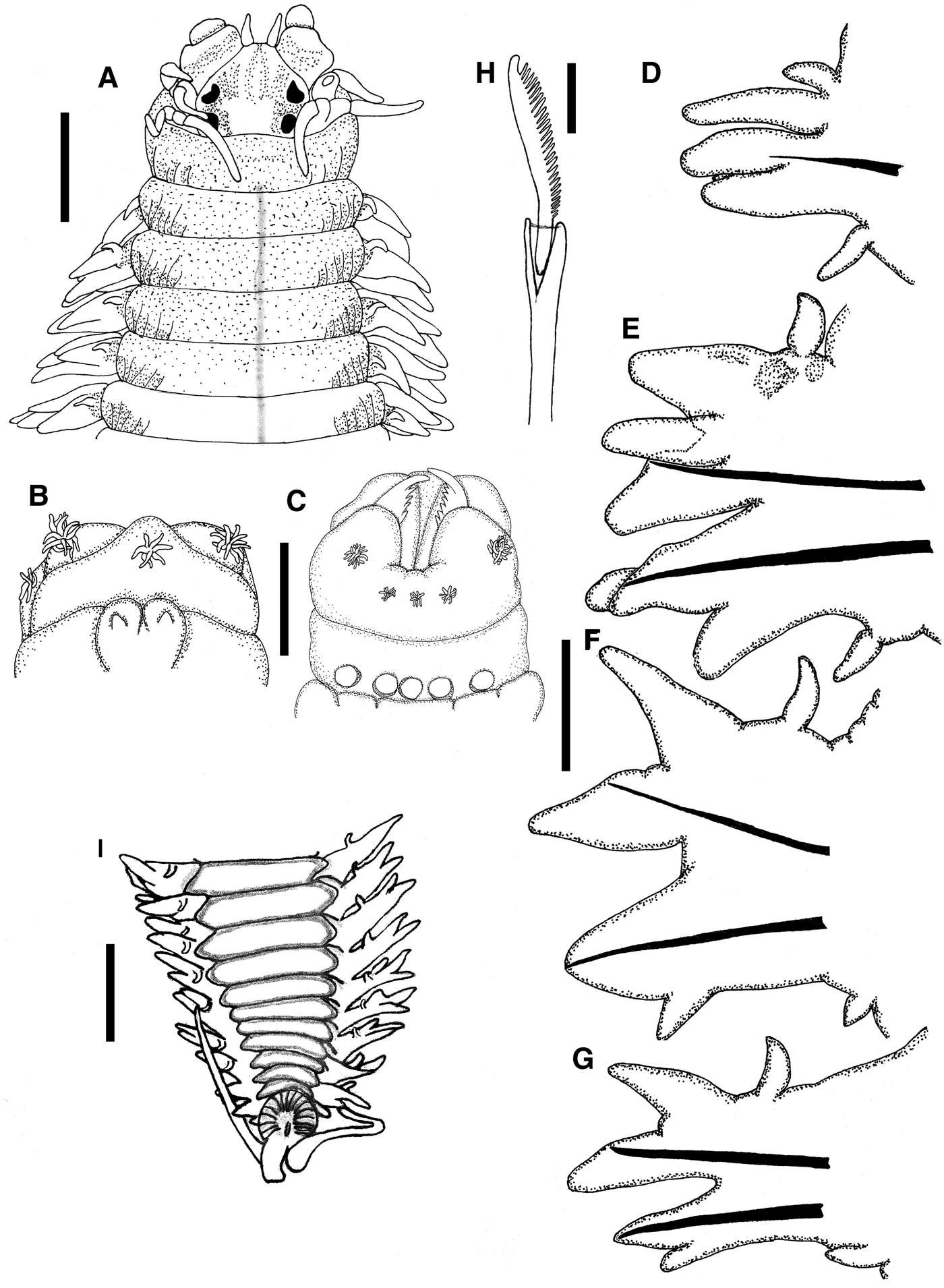
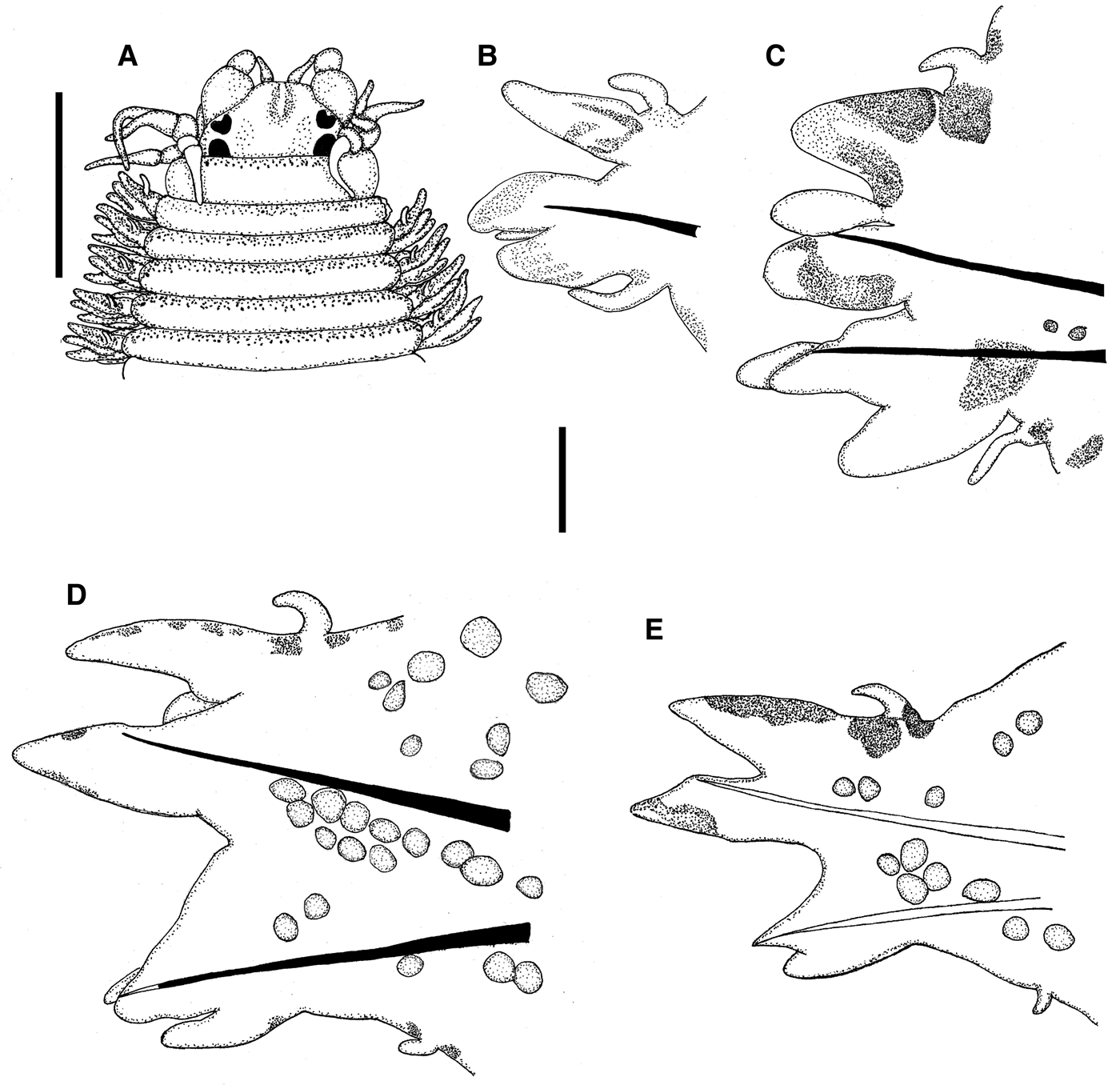
Laeonereis watsoni sp. nov. (Figures 1A–H & 2A–E)
Laeonereis watsoni sp. nov. (A) Holotype (UANL 7843) anterior end in dorsal view; (B) eversible pharynx in dorsal view; (C) eversible pharynx in ventral view. (D) Parapodium 1, anterior view; (E) Parapodium 10, anterior view; (F) Parapodium 28, anterior view; (G) Parapodium 63, anterior view; (H) Neuropodial infracicular homogomph falciger of median parapodia; (I) Posterior end in dorsal view. (A, D–I Holotype (UANL 7843); B–C Paratype (UANL 7844)). Bars: A–C, I: 0.5 mm; D–G: 150 µm; H: 10 µm.

Laeonereis watsoni sp. nov. Mature female (UANL 8118), (A) Anterior end in dorsal view; (B) Parapodium 1, anterior view, (C) Parapodium 10, anterior view; (D) Parapodium 30, anterior view; (E) Parapodium 65, anterior view. Bars: A: 0.5 mm; B–E: 150 µm.

MATERIAL EXAMINED
Acuícola Don Jorge shrimp farm, Estero de Urías, Mazatlán, Sinaloa, Mexico, 23°09′05′′N 106°17′23′′W, Holotype (UANL 7843), Paratype (UANL 7844), 5 Paratypes (LACM-AHF Poly 9314) and 21 specimens, 10.5.2014 (UANL 8117); 40 specimens, 17.11.2014 (ICML).
DESCRIPTION
Complete holotype with 83 chaetigers, 18 mm in length, 1 mm wide at chaetiger 10 (excluding parapodia); 2 mm wide (including parapodia). Complete paratypes with 59–95 chaetigers, 11–28 mm long, 0.7–1.2 mm wide at chaetiger 10 (excluding parapodia), and 1.1–2.2 mm wide (including parapodia). Most of the body pale. Prostomium, peristomium and first four chaetigers with brown pigment, with a prominent dorsal brown line that runs throughout the body. The pigment disappears with preservation in ethanol.
Prostomium wider than long, with small depression from base of antennae to mid-prostomium, antennae minute, slender distally, about 1/3 length of prostomium. Two pairs of eyes in trapezoidal arrangement, anterior pair more separate, reniform, posterior pair closer, rounded in shape. Biarticulate palps globose, with spherical palpostyle. Tentacular ring short, with four pairs of tentacular cirri, posterodorsal pair extending back to anterior margin of first chaetiger (Figure 1A).
Pharynx without paragnaths, but with soft digitate papillae arranged in circular groups on maxillary ring, and single soft papillae on oral ring. Maxillary ring: Area I = group of 7; Area II = group of 12 papillae in each side; Area III = three small groups of 8 papillae each; Area IV = group of 15 papillae in each side. Oral ring: Area V bare; Area VI conical structure in each side; Area VII–VIII 5 large soft projections in line (Figures 1B, C).
First two chaetigers uniramous, dorsal and ventral cirri conical, dorsal cirri longer than half part of ventral cirri, with three lobes; notopodial one digitiform, associated with dorsal cirri, neuropodia represented by a superior and inferior lobes subequal, subulate (Figure 1D). Supracicular chaetae four homogomph spinigers, infracicular chaetae nine homogomph spinigers separated in two groups. Subsequent, parapodia are biramous. Anterior parapodia with short dorsal cirri inserted at base of subulate notopodial dorsal ligule; notopodial ventral ligule subtriangular, with digitiform notopodial prechaetal lobe shorter than notopodial ventral ligule; prechaetal lobes present to parapodia 25; neuropodia with subulate inferior lobe; superior lobe not seen; neuropodial postchaetal lobe slightly longer than inferior lobe, similar in shape; neuropodial ventral ligule subulate; dorsal cirri slightly longer than ventral one (Figure 1E). Supracicular notopodial chaetae 14 homogomph spinigers; supracicular superior neurochaetae 10 homogomph spinigers, infraciculars 17 similar chaetae. Median parapodia with dorsal cirri two times longer than ventral ones, notopodial dorsal ligule triangular, with wide base, tapering distally; neuropodia lacking superior, inferior and postchaetal lobes; neuropodial ventral ligule reduced, subulate, similar in length to the notopodial ligules (Figure 1F). Supracicular notopodial chaetae 10 homogomph spinigers; supracicular neurochaetae five homogomph spinigers, infraciculars three homogomph spinigers and nine homogomph falcigers with blunt distal tooth and a line of marginal teeth on inner side (Figure 1H). Posterior parapodia similar to medians but shorter; notopodial dorsal ligule subtriangular, tapered, shorter than subtriangular notopodial ventral ligule; neuropodial ventral ligule short, digitiform (Figure 1G). Supracicular notopodial chaetae four homogomph spinigers; supracicular neurochaetae four homogomph spinigers, infraciculars a single homogomph spiniger and five homogomph falcigers, similar to those of median parapodia.
Pygidium darkly pigmented, with terminal anus and a pair of short cirri inserted ventrally to anal opening (Figure 1I).
Mature female
Two specimens possessed chaetigers with oocytes and exhibited anatomical modifications (UANL 8118). One complete, 95 chaetigers, 28 mm in length, 1.5 mm wide at chaetiger 10 excluding parapodia, 2.5 mm wide including parapodia. Body pale. Prostomium, tentacular segment and first chaetigers with brown pigment spots.
Prostomium, tentacular segment and pharynx with characteristics similar to non-reproductive specimens, eyes similarly shaped but the posterior pair oval, larger than reniform anterior pair (Figure 2A).
First two parapodia uniramous, dorsal cirri digitiform, 1/2 as long as ventral cirri, with three lobes; superior lobe narrow, subtriangular, associated with dorsal cirri; median and inferior ones are prechaetal, subequal, subulate (Figure 2B). Subsequent parapodia biramous. Anterior parapodia with short dorsal cirri inserted at the base of the triangular notopodial dorsal ligule; notopodial ventral ligule wide, subulate, rounded anteriorly, slightly longer than notopodial dorsal ligule, with a digitiform notopodial prechaetal lobe; neuropodia with inferior lobe subulate; superior lobe not developed; neuropodial postchaetal lobe slightly longer than inferior lobe, similar in shape; neuropodial ventral ligule subulate; ventral cirri thin, digitate, two times longer than dorsal cirri (Figure 2C). Median parapodia with dorsal cirrus two times longer than ventral one, notopodial dorsal ligule narrow, subtriangular; notopodial ventral ligule lanceolate, longer than notopodial dorsal ligule, notopodial postchaetal lobe reduced to a rounded structure; neuropodia with superior and inferior lobes fused, postchaetal lobe subequal; neuropodial ventral ligule subulate, shorter than neuropodial lobes (Figure 2D). Posterior parapodia with triangular notopodial dorsal ligule slightly shorter than notopodial ventral ligule; neuropodial ventral ligule subtriangular (Figure 2E).
ETYMOLOGY
The species name is for Mr Roberto Watson who allowed us to sample inside the shrimp-ponds where we found this new species.
Distribution
Laeonereis watsoni is known only for the type locality, Estero de Urías, Mazatlán, Sinaloa, Mexico.
Remarks
Although the epitokous specimens of the new species are not completely modified from atokous individuals, some morphological differences can be observed. The epitokous specimens have a prostomium wider than long and the posterior oval eyes are larger in relation of those of anterior ones. Body segments are wider and shorter. Parapodia of the epitokes, besides being massive, differ in the shape of the dorsal and ventral cirri as well as lobes and ligules along the body; additionally the neuropodial ventral ligule diminishes in size in posterior parapodia of epitokes. Parapodia with patches of pigment throughout the body which are more evident on the notopodia.
DISCUSSION
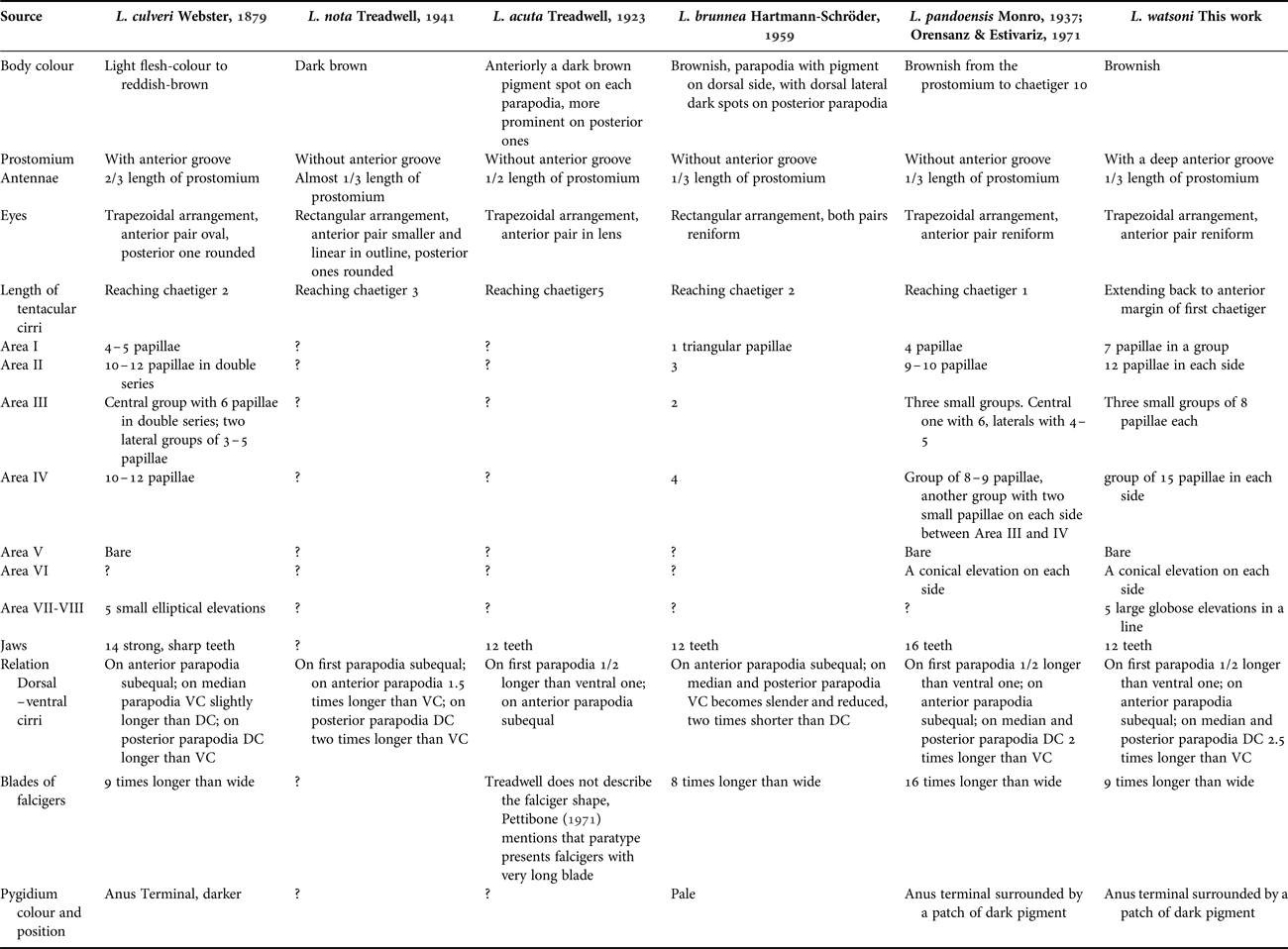
Although characters used to separate species of Laeonereis are subtle, they are sufficient to make a proper morphological characterization (Table 1). Laeonereis watsoni sp. nov. as well as L. culveri are the only species within Laeonereis with an anterior groove on prostomium, while the other species have an anteriorly rounded prostomium. The two species differ by the following: in L. culveri the longest tentacular cirri reaches chaetiger 3, area I of the proboscis has a group of 4–5 papillae, area III has a central group of 6 papillae and two lateral groups of 3–5 papillae, area IV has 12 papillae, jaws have 14 small teeth, notopodial postchaetal lobe absent, and blades of falcigers 13 times longer than wide, while in L. watsoni the longest tentacular cirri reaches the anterior end of chaetiger one, area I has 7 papillae, area III has three groups of 8 papillae each, area IV has 15 papillae, jaws have 12 teeth, notopodial prechaetal lobe present until chaetiger 25, and blade of falcigers nine times longer than wide.
Morphological characteristics of known Laeonereis species.

The other Pacific Laeonereis species is L. brunnea, which differs from the new one in the absence of a frontal notch, antennae 2/3 length of prostomium, area I with 5 papillae, area II with 8–10 papillae, area IV with 10 papillae, jaws with 16–18 teeth, on posterior chaetigers the dorsal cirri is two times shorter than ventral cirri of the first one, blades of falcigers 5–6 times longer than wide, and the pygidium pale, while in L. watsoni the prostomial anterior notch is present, antennae are 1/3 length of prostomium, area I with 7 papillae, area II with 12 papillae, area IV with 15 papillae, jaws with 12 papillae, dorsal cirri on posterior parapodial 2.5 times longer than ventral cirri, blades of falcigers 9 times longer than wide, and pygidium surrounded by a patch of black pigment.
Previous polychaete studies performed in Estero de Urías during February and April 1997 (Méndez, Reference Méndez2002), February and August 2008 (Ferrando & Méndez, Reference Ferrando and Méndez2011), and October 2008 (A. Ferrando unpublished data) indicated the presence of the nereidids Alitta succinea (Leuckart, 1847), Perinereis monterea (Chamberlin 1918) and Nereis procera (Ehlers 1868), but no members of the genus Laeonereis were found. However, microhabitat conditions within ponds during the shrimp growing cycle observed in this study were very different from those of the previous studies so we cannot discard the possibility that it was present in the early studies but not sampled.
Although we have not measured organic matter content in the substrate where L. watsoni was found, due to restricted water renewal within ponds and daily feeding with pellets, it should be much greater than in the Estero de Urías, and even greater than in places with high organic pollution (>12%; Ferrando & Méndez, Reference Ferrando and Méndez2011). On the other hand, in other farms in Sinaloa, overall temperature and salinity conditions within shrimp-ponds during the growing cycle fluctuated between ~27 and 31°C during the first 14 weeks of the culture with no sudden variations. Salinity is affected by periods of rain, which can cause a sudden drop from 50‰ to almost 30‰ in a few days (Peinado-Guevara & López-Meyer, Reference Peinado-Guevara and López-Meyer2006). Therefore, environmental conditions at the shrimp farm probably provided a unique ecological niche for the species.
As with other polychaete species (i.e. Ficopomatus miamiensis and Branchiomma bairdi Salgado-Barragán et al., Reference Salgado-Barragán, Méndez and Toledano-Granados2004; Tovar et al., Reference Tovar-Hernández, Méndez and Villalobos-Guerrero2009, respectively), the possible introduction of L. watsoni into the Acuícola Don Jorge shrimp farm could occur by passive transport. Nevertheless, Mazurkiewicz (Reference Mazurkiewicz1975) stated that Laeonereis has a low dispersal potential since larvae live in the flocculent layer of sediments and not in the water column. This fact discounts ballast water and the transport of shrimps between farms as means of dispersal. Notably, Hendrickx & Meda-Martínez (Reference Hendrickx, Meda-Martínez and Páez-Osuna2001) reported L. culveri as one of the taxa identified in the immediate area surrounding the main entry gate of this shrimp farm. Since distribution of L. culveri is restricted to Atlantic coasts (de Jesús-Flores et al., Reference de Jesús-Flores, Salazar-González and Salazar-Vallejo2016), we thus argue that these authors probably misidentified the Laeonereis species found. Unfortunately, this material was lost (N. Méndez personal observation), which prevents us from revising these specimens. Although further studies are required to particularly address this issue, we postulate that L. watsoni is probably part of the invertebrate communities of the upper parts of this and other similar low-energy coastal lagoons that are commonly present along the tropical coasts of Mexico (Lankford, Reference Lankford and Wiley1977). However, the possibility that this species has been introduced should not be discarded. It is known that members of Laeonereis are usually a significant food source in shrimp ponds (de Paiva & da Silva, Reference de Paiva and da Silva1998) or for migrating shorebirds (Weber & Haig, Reference Weber and Haig1997; Palomo et al., Reference Palomo, Botto, Navarro, Escapa and Iribarne2003). Laeonereis culveri is one of the main food sources of shorebirds belonging to the Charadriiformes (Weber & Haig, Reference Weber and Haig1997; Martínez-Curci et al., Reference Martínez-Curci, Isacch and Azpiroz2015) which could passively disperse smaller worms or larvae within the sediment taken on their feet and plumage. Thus, an alternative explanation for the observed distribution of L. watsoni is one of introduction from another estuary or shrimp farm on the American continent.
ACKNOWLEDGEMENTS
Thanks are given to Mr Roberto Watson for allowing us to sample in Acuícola Don Jorge shrimp farm. Orlando Obeso, Juanita Fonseca and Sergio Rendón helped during sampling and processing of samples. Beatriz Yáñez-Rivera identified the specimens to the genus level. Tyler McFadden helped us with the final English edition. We are grateful to Cinthya Santos and an anonymous reviewer for helping us improve the manuscript.