Kefir as a fermented milk product is reported to have high nutritional value containing live probiotic bacteria, easily digestible intact proteins, vitamins, minerals, and essential amino acids that help to heal and maintain body functions (Ahmed et al. Reference Ahmed, Wang, Ahmad, Khan, Nisa, Ahmad and Afreen2013). Several health promoting e.g. antitumor (Furukawa et al. Reference Furukawa, Matsuoka and Yamanaka1990), antibacterial (Zacconi et al. Reference Zacconi, Parisi, Sarra, Dalvalle and Botazzi1995) antioxidative (Liu et al. Reference Liu, Chen and Lin2005), anti-inflammatory and antiallergic (Lee et al. Reference Lee, Ahn, Kwon, Kim, Kim, Lee, Oh and Lee2007) properties are reported to be associated with kefir. Additionally, it has been reported that kefir is positively affecting gastrointestinal system and helping people with lactose intolerance (Farnworth, Reference Farnworth2005).
Kefir contains a variety of aromatic substances that give the product a characteristic flavour (Chen et al. Reference Chen, Liu, Lin and Yeh2005). It has uniform creamy consistence, slightly acidic taste due to carbon dioxide, lactic and acetic acids, and contains small amount of ethyl alcohol produced by yeasts (Magalhăes et al. Reference Magalhăes, Melo-Pereira, Campos, Dragone and Schwan2011). Codex Standard for Fermented Milks (Codex Alimentarius Commission, 2003) lays down the minimum counts of microorganisms and yeasts as 107 and 104 cfu/g, respectively.
The fatty acid (FA) composition of milk products has also been linked with human health and in this respect the most important fatty acids in kefirs are ω-3 fatty acids and conjugated linoleic acid (CLA) (Meremäe et al. Reference Meremäe, Roasto, Kuusik, Ots and Henno2012).
There is an increasing interest in finding natural antioxidants from foods of animal origin. Liu et al. (Reference Liu, Chen and Lin2005) found that kefir had significantly higher free radical scavenging activity upon DPPH radicals compared to the non-fermented milk, and concluded that kefir components may be considered promising in preventing mutagenic and oxidative damage. Other studies have shown that peptides and protein hydrolysates could possess significant antioxidant activity (Hernández-Ledesma et al. Reference Hernández-Ledesma, Dávalos, Bartolomé and Amigo2005; Aloğlu & Öner, Reference Aloğlu and Öner2011). Ebner et al. (Reference Ebner, Arslan, Fedorova, Hoffmann, Küçükçetin and Pischetsrieder2015) detected 236 peptides unique in kefir but not in raw milk and also indicated that fermentation process altered the composition of the peptide fraction.
The aim of the present study was to compare microbiological, chemical and sensory characteristics of kefirs commercially available in Estonian, Latvian and Lithuanian retail outlets.
Materials and methods
Kefir samples
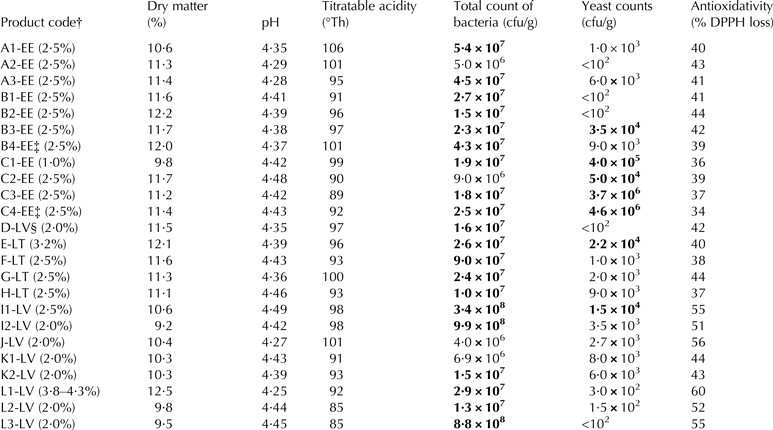
Kefirs of bovine origin were purchased from supermarkets of Estonia (EE), Latvia (LV) and Lithuania (LT) in different package forms (carton, glass bottle, plastic bag, jug and bottle) and fat content (Table 1), altogether 24 kefirs from 12 producers. In two Estonian products probiotic lactic acid bacteria Lactobacillus fermentum ME3 or Lactobacillus rhamnosus GG were added. The packages were opened for analysis on the ‘use by’ date.
The average values of chemical and microbiological parameters of Baltic kefirs

Bold indicates the products that correspond to the suggestions of Codex Alimentarius for fermented dairy products, the voluntary standard for dairy producers and the requirements of GOST P 52093-2003
† Letters indicates different producers and numbers different kefirs from the same producer, Estonia (EE), Latvia (LV), Lithuania (LT), and fat % from package label
‡ With added probiotic lactic acid bacteria
§ Produced for Estonian market
pH, titratable acidity, dry matter
pH was measured at room temperature using a digital pH-meter HI 9321 Hanna Instruments (Rhode Island, USA). The titratable acidity was determined by titration with 0·1 N NaOH and the results were expressed in Thörner degrees. The dry matter was determined gravimetrically, using Binder FED 115 heating oven (Binder GmbH, Tuttlingen, Germany).
Sensory evaluation
A method for sensory evaluation of dairy products, described by Irigoyen et al. (Reference Irigoyen, Arana, Castiella, Torre and Ibanez2005), was used. Trained assessors evaluated four characteristics describing taste/flavour (sour, yeasty, bitter, unclean), three characteristics describing odour (sour, yeasty, unclean), and three characteristics of consistency (lumps or flakes, viscosity, ropy/stringy). The scoring scale was from one (not present) to seven (very intense). The overall acceptability was evaluated on a modified hedonic scale from one (extremely dislike) to seven (extremely like) as described by Peryam & Pilgrim (Reference Peryam and Pilgrim1957).
Microbial enumeration
Enumeration of the total count of viable bacteria was performed in accordance with the method EVS-EN ISO 4833:2006 and the Milk Plate Count Agar Lab 115 (LAB M™, Lancashire, UK) was used. The plates were incubated aerobically at 30 °C for 72 h. Enumeration of yeasts in kefir samples was performed in accordance with EVS-ISO 21527-1:2009 standard. Rose Bengal Chloramphenicol Agar Base medium Lab 36 (LAB M™ Lancashire, UK) with Chloramphenicol Selective Supplement (Abtek Biologicals Ltd, Liverpool, UK) was used. The plates were incubated aerobically at 25 °C for 5 d. All enumeration analyses were performed in duplicate series.
Analysis of fatty acids
The total lipids were extracted from the samples by a modified Folch procedure using dichloromethane : methanol (2 : 1, v/v). The fatty acids were transesterified with 1 m sodium methoxide and were analysed by Agilent 6890 gas chromatograph (Agilent Technologies Inc, Santa Clara, CA, USA) equipped with a split/splitless inlet, flame ionisation detector and CP7420 (100 m × 0·25 mm) column. Method is described in detail in our previous study Meremäe et al. (Reference Meremäe, Roasto, Kuusik, Ots and Henno2012). All determinations were carried out in duplicate and results were expressed as a percentage of total fatty acids (FAs) in kefirs.
Free radical scavenging capacity assay
The modified DPPH (2,2-diphenyl-1-picrylhydrazyl) free radical scavenging assay was performed according to the method described by Helmja et al. (Reference Helmja, Vaher, Püssa, Raudsepp and Kaljurand2008). Kefir samples were centrifuged with Eppendorf MiniSpin (Eppendorf AG, Hamburg, Germany) at 12 000 g for 10 min, 250 µl of supernatant was mixed with 3750 µl DPPH (23·7 mg/l) methanol solution, centrifuged in Eppendorf 5810R centrifuge (Eppendorf AG, Hamburg, Germany) at 3220 g for 5 min and absorbance was recorded after 60 min at 515 nm using AnalyticJena Specord 200 spectrophotometer (AnalyticJena AG, Germany) with WinASPECT software package. The reference cuvette contained methanol as a blank. All determinations were carried out in duplicate and the results were expressed in percentage of scavenged DPPH radical.
LC-MS analysis
The chromatographic analysis of kefirs was conducted on a 1290 Infinity system (Agilent Technologies, Waldbronn, Germany) coupled to an Agilent 6450 Q-TOF mass spectrometer equipped with a Jetstream ESI source.
Kefir samples were mixed with two volumes of acetonitrile for protein precipitation and centrifuged at 12 000 g for 10 min. The obtained supernatant was subjected to Eclipse Plus C18 RRHD column (100 mm, L × 2·1 mm, I.D × 1·8 mm, Agilent Technologies) kept at 40 °C. For the elution of the samples the linear gradient of mobile phases consisted of 0·1% of formic acid in water (A) and in acetonitrile (B) from 1 to 40% of solvent B was delivered at 0·44 ml/min during 1 to 60 min. Mass-spectrometric detection of peptides was carried out in the positive ionisation mode in the m/z range 100–1000 at the rate four spectra per se. MS/MS analyses were performed in the data dependent acquisition mode. One MS analysis was followed by eight data-dependent MS/MS measurements. Double, single and triple charged precursor ions were selected based on their charge and then abundance and were excluded for 30 s after being fragmented twice. The quadrupole was operated at medium resolution and the collision energy was fixed at 25. Data acquisition and initial data processing were carried out by MassHunter software (Agilent Technologies) using feature extraction algorithm taking account all ions exceeding 1000 counts. Isotope grouping was based on peptide model. Protonated molecules, sodium and potassium adducts were found and combined by adduct deconvolution procedure. The resulting data were searched against peptide sequences with reported health promoting effects using an in-house database compiled from published data taking account an accurate mass and isotope distribution. The identity of detected peptides was confirmed by comparison of collision fragment spectra with in silico fragmentation by MS-Product online software.
Additionally Accurate Mass LC/Q-TOF detector was used to detect 200 most abundant and unidentified ions in positive mode of samples to discover the most common chemical patterns of studied kefirs.
For analysis of other kefir constituents by method described by Püssa et al. (Reference Püssa, Raudsepp, Toomik, Pällin, Mäeorg, Kuusik, Soidla and Rei2009), liquid chromatography-mass spectrometry in negative ionisation mode and m/z interval between 50 and 1000 amu on Agilent 1100 Series LC/MSD Trap-XCT (Agilent Technologies, Santa Clara, CA, USA) was used. ChemStation software with ChemStation Spectral SW module was used for both process guidance and for data processing. For identification and quantification of oxylipins standard compounds 9-HODE, 13-HODE, 9,10-DiHOME, 12,13-DiHOME (Cayman, Europe, Tallinn) were used.
Statistical analysis
The principal component analysis of the 200 most abundant compounds was performed using Mass Profiler Professional version 12.1 (Agilent Technologies). The correlation analysis of the sensory, microbiological and chemical characteristics followed by principal component analysis was performed using statistical software R 3.1.1. The right skewed variables microorganism count, yeast count and neutral loss values of 44 and 30 were logarithm-transformed before analyses. The relationship was considered as strong, intermediate or weak if the absolute value of correlation coefficient exceeded 0·6, 0·3 or was below 0·3, respectively. Statistical significance has been declared at P < 0·05.
Results and discussion
pH, titratable acidity, dry matter
The duration of industrial fermentation process of kefir is 16–24 h, which normally results in pH not below of 4·0. The pH of tested kefirs ranged from 4·28 to 4·48 and titratable acidity was in range of 85–106 °Th (Table 1), which is in agreement with Codex Alimentarius recommendations for fermented milk products and kefir standard GOST 52093-2003. According to Păucean et al. (Reference Păucean, Rotar, Jimborean, Vodnar and Mudura2012), low pH values prevent the growth of most spoilage and pathogenic organisms, but create suitable environment for growth of yeasts and probiotic lactic acid bacteria. Dry matter content of tested kefirs varied between 9·21 and 12·46% (Table 1) and correlated with fat content (r = 0·74, P < 0·05).
Sensory evaluation
The strongest positive correlations between acceptability and sensory attributes were found between viscosity (r = 0·49, P < 0·05) and ropiness (r = 0·35, P < 0·05). As noticed in our study, the more viscous and therefore more pleasant kefirs could be related to the more rigid containers, e.g., glass or plastic bottles or carton packages.
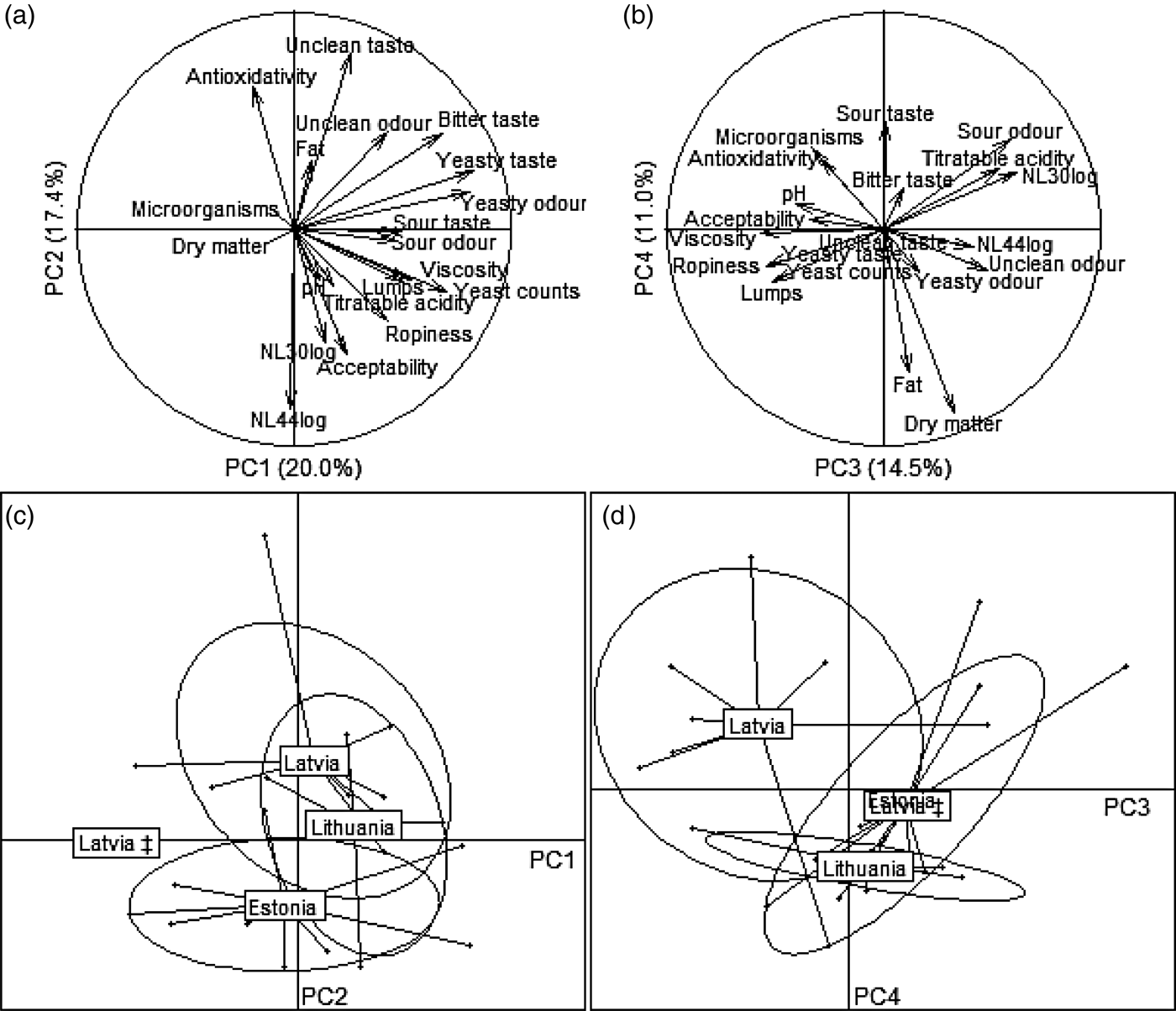
The results of principal component analysis (PCA) of measured characteristics of the kefirs are shown on Fig. 1. The first four principal components accounted for 62·9% of the total variability of considered variables. The first principal component (20·0%) revealed the most common pattern that kefirs disliked by assessors had low grades in almost all sensory parameters, and vice versa. Clear differences between countries did not exist in PC1, however, the Lithuanian kefirs tended to have more and Latvian kefir produced for Estonian market less intense sour, bitter and yeasty taste and odour. The second principal component (17·4%) reflected mainly the differences in microbiological and chemical characteristics of Estonian and Latvian kefirs, where the Estonian kefirs tended to have lower antioxidativity and higher acceptability compared to Latvian kefirs (Fig. 1a, c). The third and fourth principal component (14·5 and 11·0%, respectively) combined more sensory, and microbiological and chemical characteristics of different kefirs (Fig. 1b), indicating that kefirs (mainly of Latvian origin) having higher values of microorganisms and antioxidativity (Table 1), had often also higher values of pH, acceptability, viscosity and less unclean and sour odour (Fig. 1d). It revealed also, that kefirs (mainly of Lithuanian origin) having higher values of fat and dry matter tended to have less microorganisms, antioxidativity and sour taste.
The principal component analysis of the measured sensory, microbiological and chemical characteristics. In (a) and (b), factor loadings showing the relative importance of the analysed sensory and microbiological characteristics in principal components are presented. In (c) and (d) the principal component scores of single kefirs and average scores by producing country are presented. (NL44log and NL30log – logarithm transformed neutral loss values of 44 and 30, respectively. Latvia‡ – kefir produced for Estonian market in Latvia).
Enumeration results
The microbial enumeration data is presented in Table 1. The highest (108 cfu/g) bacterial counts were found in three kefirs of Latvian origin from two different producers. The lowest (106 cfu/g) counts were found in Estonian and Latvian origin kefirs representing four different producers. Generally, the total counts of viable bacteria in 88% of kefirs were in accordance with the criteria presented in Codex Standard for Fermented Milks which lays down the minimum sum of microorganisms 107 cfu/g.
Enumeration of yeasts (Table 1) showed that 21% of kefirs, representing the products of two Estonian and two Latvian producers contained yeasts less than 102 cfu/g. In the other kefirs the total yeast counts ranged from 103 to 106 and only 29% of kefirs from four different producers were fulfilling the Codex Standard minimum criteria for yeasts counts, 104 cfu/g respectively. The highest yeast counts 106 cfu/g were found in two kefirs of Estonian origin which were produced for export purposes. Different studies have reported yeast counts from 103 cfu/ml to 106 (Ertekin & Guzel-Seydim, Reference Ertekin and Guzel-Seydim2010; Grønnevik et al. Reference Grønnevik, Falstad and Narvhus2011; Hsieh et al. Reference Hsieh, Wang, Chen, Huang and Chen2012; Suriasih et al. Reference Suriasih, Aryanta, Mahardika and Astawa2012), and in very few cases even up to 108 cfu/g (Loretan et al. Reference Loretan, Mostert and Viljonen2003).
In general, yeasts are acidophilic organisms that grow better under acidic conditions with the optimal pH from 4 to 6 (Narendranath & Power, Reference Narendranath and Power2005). In our study, the analyses were made on ‘use by’ date and the pH of kefirs ranged from 4·25 to 4·49 which is optimal for yeast growth. Codex Standard declares that starter microorganisms shall be viable, active and abundant in the fermented milk product to the ‘use by’ date. We may conclude that only 30% of the products in our study were in agreement with these requirements, and only two producers among twelve were following the Codex Standard suggestions both for viable bacteria and yeast counts.
Fatty acid contents
Our findings indicated that the fatty acid compositions of all Baltic kefirs were uniform and the different fat % of kefirs did not influence the fatty acid composition. The saturated fatty acids (∑SFA) were the dominant group of FAs (from 68·4 to 69·6%), followed by ∑MUFA (from 26·3 to 27·3%) and ∑PUFA (from 3·0 to 3·3%). In all tested kefirs, palmitic acid (C16:0) (28·5% (EE), 31·1% (LV), 28·9% (LT)), myristic acid (C14:0) (10·4% (EE), 10·9% (LV), 10·2% (LT)) and stearic acid (C18:0) (10·7% (EE), 9·4% (LV), 10·3% (LT)) were most frequently determined SFAs. It is in accordance with results of Talpur et al. (Reference Talpur, Bhanger and Memon2008). Among unsaturated fatty acids the dominant fatty acid was cis-oleic acid (C18:1c9) with an average content of 19%. Similarly to the results of Talpur et al. (Reference Talpur, Bhanger and Memon2008) our findings showed that trans fatty acids (∑TFA) ranged from 3·1 to 3·9%. The main trans C18:1 isomer was vaccenic acid, on average 1·2% in our study. The average content of ω-6 and ω-3 FAs, the most important fatty acids in kefirs in the human health perspective, was 1·9 and 0·8%, respectively.
Free radical scavenging capacity
The results of antioxidativity of Baltic kefirs varied slightly (Table 1). The average values of Latvian kefirs (52%) were higher than Estonian and Lithuanian kefirs (both 40%). The free radical scavenging capacity of Estonian kefirs varied between 34 and 43%, Lithuanian kefirs 37 and 44%, and Latvian kefirs between 43 and 60%. The statistical analysis showed that, in the pH range characteristic to the product, there is a weak negative correlation between pH value and antioxidativity (r = −0·25, P < 0·05), and intermediate negative correlation between total counts of yeasts and antioxidativity (r = −0·50, P < 0·05). Intermediate positive correlation was found between counts of microorganisms and antioxidativity (r = 0·32, P < 0·05) as well as between antioxidativity and unclean taste (r = 0·36, P < 0·05), both can be related to the presence of bitter peptides, mentioned in critical review by Kilara & Panyam (Reference Kilara and Panyam2003), with antioxidant properties but unpleasant taste (Elias et al. Reference Elias, Kellerby and Decker2008).
LC-MS analysis
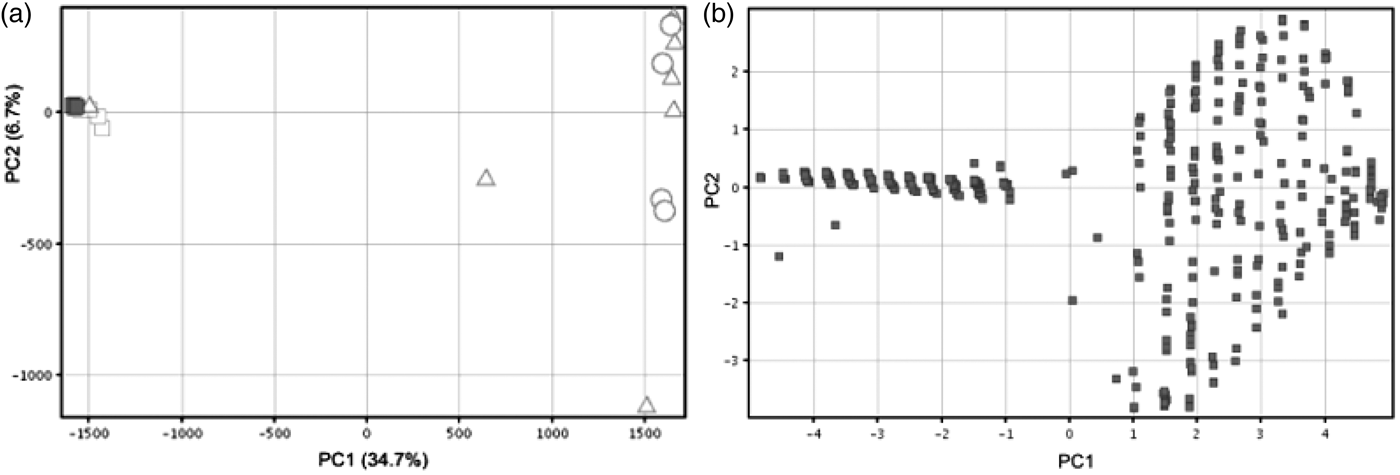
PCA of the 200 most abundant compounds, obtained with LC/Q-TOF detector revealed that Estonian kefirs differed from Lithuanian and Latvian kefirs, and formed a separate cluster (Fig. 2), whereas Latvian and Lithuanian kefirs had similar PCA scores. The reasons for such clustering hypothetically points to the differences in the starter cultures' compositions and production technology of the kefirs.
The principal component analysis of the compounds, detected with LC/Q-TOF Accurate Mass detector in positive mode. 200 most abundant ions of each sample were used in analysis. In (a) principal component scores of single kefirs are presented (□ Estonian, ∆ Latvian, ○ Lithuanian, ■ Estonian probiotic kefirs; one triangle in left side of figure among Estonian kefirs correspond to the kefir produced for Estonian market in Latvia). In (b) factor loadings showing the importance of the analysed compounds in principal components are presented.
Bioactive peptides
The following peptides with proven positive physiological effect were found in kefir samples: antihypertensive LLF and LHLPHP; antioxidant ARHPHPHLSFM and VLPVPQK; antibacterial IQY (Ricci-Cabello et al. Reference Ricci-Cabello, Herrera and Artacho2012), and IKHQGLPQE (Hayes et al. Reference Hayes, Ross, Fitzgerald, Hill and Stanton2006). Also, nine angiotensin-converting enzyme (ACE) inhibitors ENLLRF; KAVPYPQ; MPFPKYPVEP; NLHLPLP; SQSKVLPVPQ; VYPFPGPIPN; LNVPGEIVE; RDMPIQAF; SKVLPVPQ were detected. The latter three, one immunomodulating LYQEPVLGPVRGPFPIIV, one antibacterial ENLLRF, and one multifunctional peptide YQEPVLGPVRGPFPIIV were found in all studied Baltic kefirs. However, concentrations of these peptides considerably varied between different kefirs. Peptides KAVPYPQ, NLHLPLP, SQSKVLPVPQ and VYPFPGPIPN missed in all kefirs of Estonian origin. LLF, VYPFPGPIPN and VLPVPQK missed only in one and the same Latvian kefir. Semi-quantitation by the areas of peaks of extracted ion chromatograms showed that generally antihypertensive peptide LLF was present at the highest content. Comparing our and Ebner et al. (Reference Ebner, Arslan, Fedorova, Hoffmann, Küçükçetin and Pischetsrieder2015) results we can conclude that ten bioactive peptides of 16 were also found in Baltic kefirs but seven found in our study were not detected in Ebner's study.
Oxylipins and other components
For the first time for dairy products, the level of fatty acid early oxidation was estimated by quantitation of oxylipins, the primary oxygenated metabolites of unsaturated fatty acids, using LC-MS/MS. This study showed very low extent of linoleic acid oxidation, that can be explained both by low content of oxidisable fatty acids and antioxidative properties of kefirs. One of the main primary oxidation products of linoleic acid, 9-hydroxy-10,12-octadecadienoic acid (9-HODE; m/z = 295) was detectable, but not quantifiable (LOD = 6 ng/ml; LOQ = 20 ng/ml). Among other linoleic acid oxy-derivatives, the concentrations of toxic 12,13-dihydroxy-9-octadecenoic (12,13-DiHOME) and 9,10-dihydroxy-12-octadecenoic (9,10-DiHOMe) acids (m/z = 313), also known as leukotoxin diols, were under the limits of detection. These oxylipins have revealed mitogenic activity and stimulated human breast cancer cell proliferation in vitro (Markaverich et al. Reference Markaverich, Crowley, Alejandro, Shoulars, Casajuna, Mani, Reyna and Sharp2005). Also detectable but not quantifiable was 10-oxystearic acid (m/z = 299) as the main oxylipin of cis-oleic acid, the major MUFA in the kefirs.
A large group of substances with negative m/z values in the interval between 445 and 903, and fragmentation spectra characterised by multiple constant neutral loss values of 44 and 30, putatively indicating loss of carboxyl and HO-C-H groups, respectively, were discovered in all studied kefirs. Earlier, similar compounds were discovered by us in cottage cheeses and yogurts and in considerably lower concentrations in cheeses (unpublished results). The clarification of substances behind these molecular parameters is a matter of our ongoing studies.
In summary, the Lithuanian and Latvian kefirs form a coinciding cluster and Estonian kefirs form a separate cluster at PCA. We assume that due to the customers taste preferences, the producers use starter cultures with lower yeast content for Estonian market. The total counts of viable bacteria and yeasts were higher in kefirs of Estonian origin destined for export. Only 30% of all the kefirs studied were in agreement with voluntary criteria for viable bacteria and yeast counts presented in Codex Standard for Fermented Milks. Extremely low fatty acid oxidation level is favourable from the viewpoint of healthiness of the kefirs. Further investigations are in progress and special attention will be paid to ACE inhibiting (blood pressure lowering) peptides and their connection to the microbiological composition of the commercial starter cultures, and their impact on human health.
The research was co-financed by the European Union Regional Development Fund in the framework of the Competence Centre Programme of the Enterprise Estonia under project EU30002 of Bio-Competence Centre of Healthy Dairy Products.