Santalum austrocaledonicum Vieill. (Santalaceae) is a small tree endemic to New Caledonia and Vanuatu, well-known for the highly priced aromatic oil of its heartwood (Nasi & Ehrhart Reference NASI and EHRHART1996). In New Caledonia, sandalwood grows on Loyalty Islands, the Isle of Pines and Grande-Terre (Bottin et al. Reference BOTTIN, TASSIN, NASI and BOUVET2006). The tree produces single-seeded fleshy drupes, which turn dark-red at maturity. Sandalwood seeds are dormant because of their hard coat and germinate only on physical scarification, or after removing the coat (Chauvin & Ehrhart Reference CHAUVIN, EHRHART, Radomiljac, Ananthapadmanabho, Welbourn and Satyanarayana1998). In natural habitats, such seeds need further processing to relieve dormancy and promote germination, within a period where there is a good chance of successful seedling establishment (Murdoch & Ellis Reference MURDOCH, ELLIS and Fenner2000).
Fruits of several species of Santalum have been observed being eaten by birds (Bottin et al. Reference BOTTIN, VERHAEGEN, TASSIN, OLIVIERI, VAILLANT and BOUVET2005, Ford & Paton Reference FORD and PATON1986, Johnson Reference JOHNSON1981). Extinct pigeons may have played a main role in seed dispersal of sandalwood in New Caledonia and other Pacific islands (Steadman Reference STEADMAN2006). Ducula species are considered as potential vectors in the movement of sandalwoods throughout the Pacific (Carlquist Reference CARLQUIST, Keast and Miller1996, Harbaugh & Baldwin Reference HARBAUGH and BALDWIN2007). Within the Loyalty Islands of New Caledonia, Ducula pacifica has been recorded only on Lifou, and Ducula goliath has never been observed (Barré et al. Reference BARRÉ, VILLARD, MANCEAU, MONIMEAU and MENARD2006). The widely distributed metallic pigeon (Columba vitiensis) also eats sandalwoods fruits (Bottin et al. Reference BOTTIN, VERHAEGEN, TASSIN, OLIVIERI, VAILLANT and BOUVET2005) but seeds are crushed during gut passage (N. Barré pers. obs.). The two bird species most likely to be potential candidates in assuring S. austrocaledonicum dispersion and gene flow in New Caledonia are the cloven-feathered dove Drepanoptila holosericea Temminck and the red-bellied fruit-dove Ptilinopus greyii Bonaparte. Drepanoptila holosericea is endemic to Grande-Terre, New Caledonia, and P. greyii is a native bird of this archipelago where it has been recorded on Grande-Terre, Loyalty Islands and the Isle of Pines (Barré et al. Reference BARRÉ, VILLARD, MANCEAU, MONIMEAU and MENARD2006). Drepanoptila and Ptilinopus are very similar in their general appearance and breeding behaviour, and both live in lowland forests (Gibbs et al. Reference GIBBS, BARNES and COX2001). As with most extant frugivorous birds of New Caledonia, these species are small-bodied (Lord Reference LORD2004).
We aimed to explore if D. holosericea could be a potential disseminator of S. austrocaledonicum. In this study, our objective was to investigate the effect of ingestion by D. holosericea on seed germination of S. austrocaledonicum.
We used five individual birds maintained in three separate compartments of an aviary, respectively containing two, one, and two birds.
Fully ripened dark-purple fruits (n = 160) were randomly collected from eight trees planted near Nouméa, originating from Maré (Loyalty Islands), where the fruits are known as the biggest within S. austrocaledonicum populations of New Caledonia (Bottin et al. Reference BOTTIN, TASSIN, NASI and BOUVET2006). Fruits were transported to the laboratory using a cool-bag to prevent them from drying or fermenting. Fruit equatorial diameter and weight were immediately measured. As birds swallow an ovoid fruit along the fruit's longest axis, the upper size limit swallowed is not the fruit's length but the equatorial diameter (Meehan et al. Reference MEEHAN, MCCONKEY and DRAKE2002).
Ingestion of seeds by frugivorous birds can affect germination by mechanical or chemical alteration of seed coat structure in the gut and by removal of chemical compounds in the pulp that would inhibit germination if left in contact with seeds (Samuels & Levey Reference SAMUELS and LEVEY2005). Therefore, fruits of sandalwood were prepared in four ways. Batch A: intact fleshy fruits were put into germination conditions on the day after collection. Batch B: seeds were manually extracted and rapidly washed, and were put into germination conditions. Batch C: seeds were physically scarified using a potato-peeling machine and processed for 2 h, then put into germination conditions. Batch D: fruits were fed to the five captive birds, seeds were collected separately from the droppings of each aviary compartment, rapidly washed, and then put into germination conditions on the day following the defecation. As seeds passed through faecal dropping generally occurred in clumps and were grey-coloured; they could be easily distinguished from the eventual dark-red regurgitated seeds (Hegde et al. Reference HEGDE, SHAANKER and GANESHAIAH1991). Each treatment A, B and C, was replicated four times, using 25 seeds for each replication. Treatment D, based on the utilization of the three compartments of the aviary, was replicated three times, also using 25 seeds for each replication.
Using growth chambers would have induced favourable conditions, then obscuring significant differences between treatments (Traveset et al. Reference TRAVESET, RIERA and MAS2001). Consequently, batches were monitored in a room where temperature was close to ambient. Batches were sown in on sterilized perlite substrate saturated with water. Every day, the dishes were examined: germinated seeds were counted and removed to reduce a possible effect on the remaining ungerminated seeds. Germination was defined as rootlet emergence from seed or fruit. As germination responses, we considered (1) the length of dormancy T0 (defined as the time elapsed from sowing until first germination), (2) the germinability G (defined as the proportion of seeds that germinated in the monitoring period, considered long enough to approximate final germination), and (3) the germination index GI (Scott et al. Reference SCOTT, JONES and WILLIAMS1984, Traveset et al. Reference TRAVESET, RIERA and MAS2001). GI was defined as  , where Ti is the number of days after sowing, Ni is the number of seeds germinated on day i, and S is the total number of seeds sown. A small GI value indicates a shorter germination time (Scott et al. Reference SCOTT, JONES and WILLIAMS1984). Mann–Whitney non-parametric statistical test was used for comparisons between treatments. Since each treatment involved three or four replications, we calculated median instead of mean values.
Mean fruit equatorial diameter within collected, then distributed seed-lots, was 13.8 mm ± 0.7 mm and mean fruit weight was 1.3 g ± 0.2 g. No fruit was observed to be regurgitated, consistent with the rather small size of fruits. Observations during the trial showed that fruits were easily and rapidly ingested.
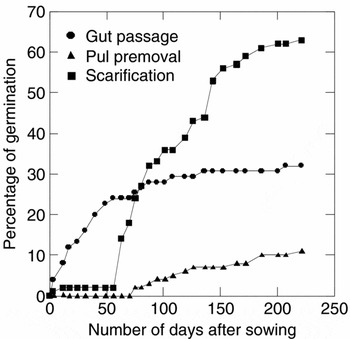
Seeds were monitored during 221 d (c. 7 mo). Non-treated fruits did not germinate. The passage of sandalwood seeds through the digestive tract of the bird individuals significantly increased the germination indices compared with pulp removal. The length of seed dormancy T0 was shortened following a passage through the digestive tract (T0 = 3 d), compared with pulp removal (T0 = 97 d, Mann–Whitney test: χ2 = 4.58, P = 0.032) but did not differ from the value obtained from physical scarification (T0 = 34.5 d, Mann–Whitney test: χ2 = 0.271, P = 0.271). Germinability was enhanced after ingestion by birds (G = 0.36), compared with pulp removal (G = 0.10, Mann–Whitney test: χ2 = 4.68, P = 0.031) but physical scarification was more efficient (G = 0.62, Mann–Whitney test: χ2 = 4.67, P = 0.031). Germination Index did not differ between ingestion (GI = 12.9) and pulp removal (GI = 14.6, Mann–Whitney test: χ2 = 0.125, P = 0.724), but it was lower than using physical scarification (GI = 62.7, Mann–Whitney test: χ2 = 4.50, P = 0.034).
Ingestion and defecation did not consist in a simple pulp removal effect: a further facilitation process probably due to the scarification of the seed coat was observed. Yet, such a facilitation effect was not as efficient as physical scarification (Figure 1). The small size of fruits was probably responsible for the absence of regurgitation. Ducula pacifica is known not to regurgitate any seed smaller than 20 mm (McConkey et al. Reference MCCONKEY, MEEHAN and DRAKE2004). Such a behaviour makes seed dispersal more efficient. In Santalum album, small seeds are more likely than large ones to be dispersed on long distances by birds, as large ones are rapidly regurgitated (Hegde et al. Reference HEGDE, SHAANKER and GANESHAIAH1991).
Variation in percentage germination of Santalum austrocaledonicum seeds with the number of days after sowing, comparing three treatments: digestion of fruits from Drepanoptila holosericea, pulp removal and physical scarification using a potato-peeling machine. The fourth treatment, intact fruits, resulting in no germination, is not shown.

In our study, the facilitation effect represented by gut passage does not consist simply of de-inhibition, but also shows evidence of a strong scarification effect. This increase of germinability following gut passage is uncommon. Reviews on the effect of seed passage through vertebrate frugivore guts on germination showed that the enhancement of germination is commonly caused mostly by pulp removal rather than scarification (Robertson et al. Reference ROBERTSON, TRASS, LADLEY and KELLY2006, Traveset Reference TRAVESET1998). The shortening of the duration of seed dormancy is also an important result, since sandalwood seeds are well known for their strong dormancy (Chauvin Reference CHAUVIN1988, Chauvin & Ehrhart Reference CHAUVIN, EHRHART, Radomiljac, Ananthapadmanabho, Welbourn and Satyanarayana1998). Our results show that the ingestion by D. holosericea is likely to produce a chemical or mechanical abrasion of the seed coat that both reduces the length of dormancy and enhances germinability. Yet, such an effect is not optimal as mechanical scarification remains more efficient, probably because seed coat is more deeply abraded using this process than during gut passage.
While high germinability increases reproductive success, more rapid germination can be either beneficial or detrimental, depending on the ecological conditions prevailing in the habitat (Kelly et al. Reference KELLY, LADLEY and ROBERTSON2004, Peco et al. Reference PECO, LOPEZ-MERINO and ALVIR2006). More rapid germination may be an advantage for S. austrocaledonicum which produces fruits mainly in rainy season (J. Tassin unpubl. data). Moreover, pulp fermentation rapidly occurs if pulp is not removed, which prevents germination (Chauvin Reference CHAUVIN1988). Yet, seedlings are rarely observed beneath sandalwood trees (J. Tassin pers. obs.). Pulp removal by natural means (e.g. ingestion by vertebrates) is likely to be necessary to process germination. Yet, the evidence for an absolute requirement for de-inhibition and the benefits of scarification by gut passage is preliminary and needs to be confirmed in field trials (Robertson et al. Reference ROBERTSON, TRASS, LADLEY and KELLY2006, Traveset et al. Reference TRAVESET, ROBERTSON, RODRIGUEZ-PEREZ, Dennis, Green, Schupp and Westcott2007).
Studies on the dynamics and structure of genetic diversity of S. austrocaledonicum based on molecular markers have demonstrated significant gene flow within islands but also among islands of New Caledonia (Bottin et al. Reference BOTTIN, VERHAEGEN, TASSIN, OLIVIERI, VAILLANT and BOUVET2005). Ptilinopus greyii probably plays a significant role in such gene flows between islands. More studies are needed to investigate further the role of both D. holosericea and P. greyii on seed dispersal of sandalwood in New Caledonia. To our knowledge, no vertebrate species other than P. greyii are currently capable of sandalwood seed dispersal between islands of New Caledonia. Further investigations could address the relation between sandalwood seed size and its frugivore gape size in the archipelago (Lord Reference LORD2004).
AKNOWLEDGEMENTS
We thank Jacques Morel for assistance in the trial on facilitation effect of cloven-feathered dove on germination, and Alexandre Bouarat for germination monitoring. The study was funded by Caledonian Agronomy Institute.