This article describes an uncommon approach to service learning. To
demonstrate points of access to the political system, I place students in my
class with experts of the political advocacy process, not with charitable
nonprofits. And to reach a wide spectrum of students, I integrate the
service-learning component in one section of the basic American and state
government course, which is a general education requirement for all college
graduates in the state of California. This report explains the approach,
evaluates the course based on student responses, identifies reasons for its
success, and points out some of the limits encountered. The article follows
the tradition of Battistoni (2000), Battistoni and
Hudson (1997, 1), Zlotkowski (1998), and others by sharing insights into the theory and
practice of service learning in political science, in the hopes of making
transparent the advantages and limits of this form of experiential
learning.1
The syllabus and other
documents generated in connection with the course are available upon
request. A previous version of this research was presented at the
2003 Annual Meeting of the American Political Science Association,
Philadelphia.
After an activist start in the 1960s and 1970s, service learning in more
recent years has, to a great extent, evolved into charitable work, as the
testimonies by pioneers indicate (Stanton, Giles, and
Cruz 1999) and the Campus Compact (2002a; 2003; 2004) surveys have documented. High school and college students
are asked to volunteer in nonprofit organizations to help needy children and
adults. That is the “service” part of the service-learning mission. In
political science courses, the instructor introduces the “learning”
component by asking the students to reflect on the causes of poverty or
other deficiencies, to study the public policies that alleviate or fail to
resolve the problems, and to devise strategies of advocacy on behalf of the
needy.
Service learning is different than internships, even though the activities
can overlap. Internships are intended to prepare students for their future
career and to provide some work experience. In contrast, the goal of service
learning is citizenship education: to prepare young people for a responsible
role as citizens, as well as to generate a sense of community with social
groups the students might otherwise not interact with.
My wish to introduce students at the California State University, Los Angeles
(CSULA) to political institutions that may be beyond the students' cognitive
horizon has been the central reason for pursuing the service-learning
project described in this article. The project introduces students to three
pathways citizens have to influence the political process and governmental
action:
- local chapters of organized interests;
- government programs that bring city hall closer to the community, such
as the Department of Neighborhood Empowerment (DONE), in the city of Los
Angeles;
- district offices of elected officials.
A fourth pathway would be through involvement in election campaigns. But the
service learning literature excludes partisan politics from service learning
considerations, a distinction made clear to the students and to the elected
officials who participated (Walker 2000, 647).
Approaches to Service Learning in Political Science
In line with other social science fields, the prevailing
community-service activity in political science has been charitable
work—with no direct political content. Proponents often envision a
political dimension to enter the learning process during periods of
reflection, which the instructor is supposed to nurture in class
discussions and journal entries. In the course of the verbal and written
expressions, students are encouraged to reflect on the public policies
that may contribute to or reduce a specific societal problem. In
addition to the analysis of public policies, some of the literature and
web sites on service learning courses in political science include
advocacy projects as a way of serving the needy and learning about
political empowerment.
The influential Principles of Good Practice for Combining Service and
Learning (Honnet and Poulsen 1989),
composed at the Wingspread meeting in 1989, mentions a variety of
possible charitable projects in which to engage students. The activities
range from tutoring at-risk youngsters to serving the homeless at soup
kitchens. The document suggests including a political dimension at the
reflection stage. The text is subdivided into 10 principles, the second
of which reads: “An effective program provides structured opportunities
for people to reflect critically on their service experience.” The
subsequent explanatory paragraph reads in part: “Through discussions
with others and individual reflection on moral questions and relevant
issues, participants can develop a better sense of social
responsibility, advocacy, and active citizenship” (3). The Wingspread
document does not take diverse student populations into consideration,
not all of whom may require the same lessons in social responsibility
and civic involvement.
Recent data collected by the Campus Compact on nationwide
service-learning approaches reflects the same bent toward charitable
work. The Compact is a national coalition of more than 750 colleges and
universities promoting community-campus partnerships. It has collected
statistics from its member institutions that show the nature of service
learning activities. The questionnaire lists 22–24 issue areas,
depending on the year; respondents are asked to check all those areas
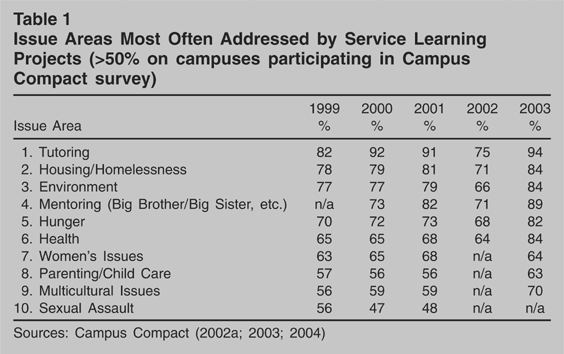
that are addressed by their campuses' service projects. Table 1 shows the findings for issue areas
addressed by 50% or more of the service-learning projects between 1999
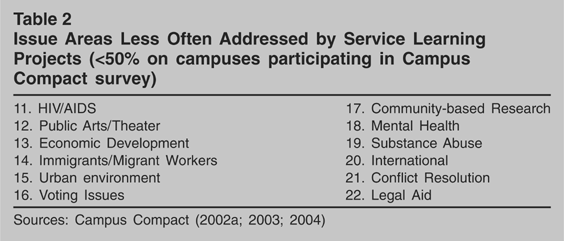
and 2003. Issue areas addressed by fewer than 50% of the
service-learning activities are presented in descending order in Table 2.
Issue Areas Most Often Addressed by Service Learning Projects
(>50% on campuses participating in Campus Compact survey)
Issue Areas Less Often Addressed by Service Learning Projects
(<50% on campuses participating in Campus Compact survey)
Most of the 22 issue areas introduce the student only tangentially to the
advocacy process or other civic involvement associated with active
citizenship and direct, democratic engagement in the public sphere. A
second limit of the approaches is the not-so-hidden class nature of the
partnerships—middle-class students serving the poor. The class nature of
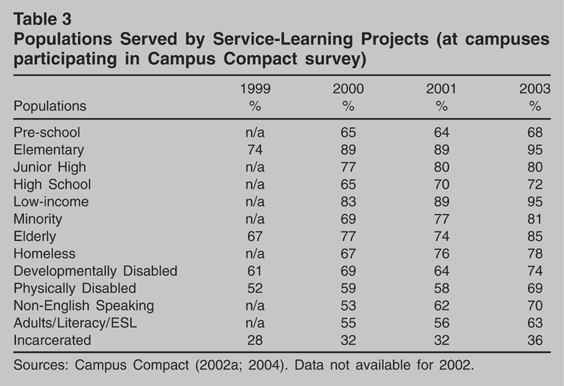
most service-learning projects is more obvious in Table 3, which shows the populations covered by the Campus
Compact surveys. The percentage refers to the proportion of projects
that serve a particular population, with 100% being the total of all
service-learning projects on the campuses participating in the
surveys.
Populations Served by Service-Learning Projects (at campuses
participating in Campus Compact survey)
The tendency to target minorities or the needy as recipients of student
volunteer activities is problematic at CSULA for two reasons. First,
minorities are in the majority on the campus and often also in their
respective neighborhoods. Second, while generally not poor themselves,
our students tend to be familiar with poverty issues. Accordingly, to
realize the central purpose of service learning and connect our students
to the larger polity, I was looking for a service-learning experience
that would be inclusive in socio-economic terms (Guarasci, Cornwell, and Associates 1997, xiii) and would not
appear patronizing (Zook and Gitelson 2004,
483). The experience should also be politically empowering (Claus and Ogden 1999) and should address a
problem our students share with young adults across the country—a low
level of interest in political issues (Bennett
2000; Walker 2000, 647; Colby et al. 2002; Carnegie
2002; Campus Compact 2002b; Galston 2004; APSA Standing
Committee on Civic Education and Engagement 2004, Ch. II)
To energize students, some political scientists have suggested advocacy
work and community action projects as alternatives to the traditional
charitable service learning activities (Robinson
2000; Walker 2000; Zook and Gitelson 2004, 482). Serving while
learning how to be an agent of change can be good pedagogy, but it
requires time (Jacoby and Associates 1996).
Specifically, the project needs to ensure that there will be enough time
for the community partner to reap some benefits from the collaboration.
Instructors and students live by academic cycles, which may not coincide
with the time needed for successful political action. Students may
parachute into a neighborhood and create a lot of hope, but then
disappear at the end of the semester. The quarter system, under which
CSULA operates, compresses the time even more than the semester
system.
Volunteering for established and successful interest groups, for a
municipal neighborhood empowerment agency, or in the field offices of
elected officials proved to be an excellent alternative to creating
community action projects de novo. The participating community
partners had ongoing programs that could benefit from the entry of the
student volunteers. The following description combines information from
the three times, starting in fall 2001, that the basic American and
state government course has been offered with a service-learning
component.
Course Organization
In retrospect, the organization of the course looks straightforward. But
getting university approval and finding appropriate community partners
takes time. The process is described here in some detail for the benefit
of instructors who may want to implement a similar approach.
Participating Organizations
Months before the start of the first class in fall 2001, I contacted
30 entities operating in the greater Los Angeles area. Of these, 17
were “interest groups” in the sense used in the political science
literature. Their web sites indicated that their work was divided
between educating government officials and the public about the
cause they advocated as well as serving their members and their
target population directly in various ways. Most of the
organizations were national in scope, with headquarters in
Washington, D.C. Some operated primarily at the state level, and a
few were of a local nature. I also contacted the district offices of
12 federal and state elected officials who represented areas where
most CSULA students live. Finally, one newly created city agency,
the Department of Neighborhood Empowerment (DONE), was added because
of its mission to foster public engagement in the city of Los
Angeles.
For the pilot project in fall 2001, the organizations received a
letter summarizing the project and inviting participation. The
letter emphasized a common goal of the organization and the course:
educating the next generation in active and responsible citizenship.
The letter also stated that the collaboration may have synergistic
benefits—that together we might be more effective in achieving our
mission than operating separately. The letter played up the
projects' long-term benefits, since the short-term volunteer work by
itself may be construed by the agency more as a disruption than a
plus. The response to the first letter and subsequent contacts was
very encouraging. Over time, some agencies dropped out and others
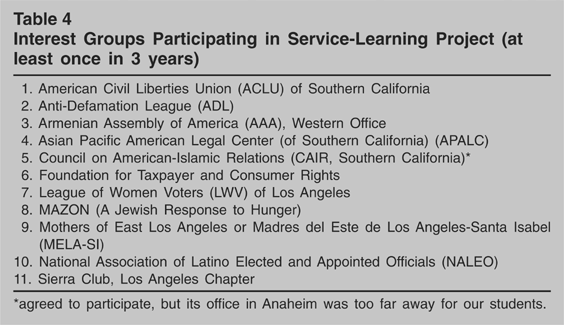
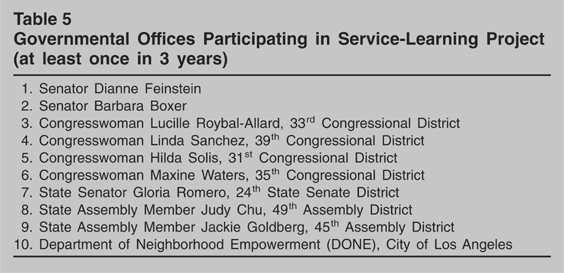
were added, leaving 21 agencies that participated at least once.
They are shown in Tables 4 and 5.
Interest Groups Participating in Service-Learning Project (at
least once in 3 years)
Governmental Offices Participating in Service-Learning
Project (at least once in 3 years)
The participating organizations welcomed the student volunteers and
took great pains to make the service a memorable learning
experience. In most instances, the organizations were run by
professionals and had experience in managing volunteers. Strong and
caring mentors reduced the trial-and-error period, kept frustrations
in check, and enabled the students to be productive in a short
period of time. The welcoming attitude contributed greatly to the
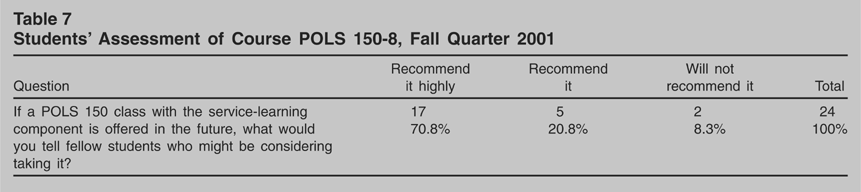
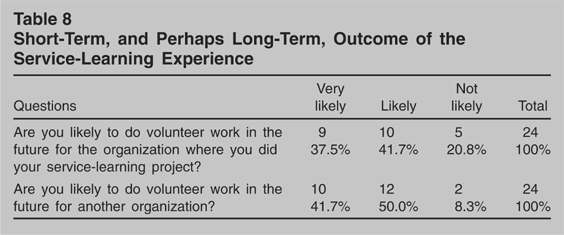
overwhelmingly positive student responses shown in Tables 7 and 8.
Students' Assessment of Course POLS 150-8, Fall Quarter
2001
Short-Term, and Perhaps Long-Term, Outcome of the
Service-Learning Experience
The community partners benefited from the collaboration in various
ways. In some instances, students did general clerical work. In
other cases, the organizations took advantage of the diversity the
students brought to the work site—for instance, bilingual skills
were helpful in creating informational flyers for distribution in
immigrant communities, and the volunteers could be used to draft
age-appropriate messages when targeting high school youth.
Participating Students
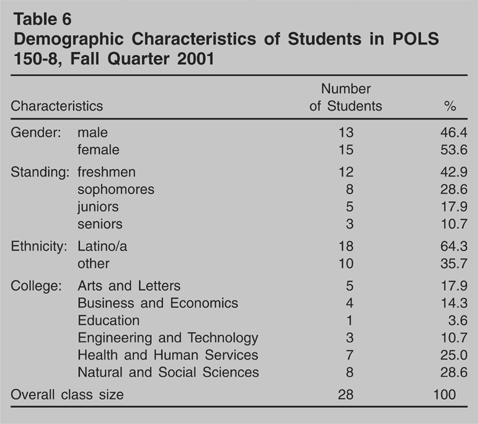
The department of political science and the university agreed to
limit the class to a manageable size of about 25 students. Table 6 shows the demographic distribution
of the students when the class was offered for the first time in
fall 2001. Only one of the 28 students had declared political
science as her major. This is noteworthy because the experiment was
intended to reach students who had no particular interest in
government or politics. Raising their sense of political efficacy
and demonstrating points of access to the political process were
important course objectives. Depending on the preference of the
agency, students did their service work in teams or
individually.
Demographic Characteristics of Students in POLS 150-8, Fall
Quarter 2001
Structure of the Course
The course chosen for the service-learning project, POLS 150,
Government and American Society, is part of a state-mandated
requirement. All California college graduates are supposed to be
knowledgeable about the U.S. Constitution as well as the state and
local government. It is a challenge to cover the material in one
semester, and more so at universities operating on the quarter
system, which gives the instructor 10 weeks plus the finals'
week.
Including a service-learning component in a regular,
general-education course requires finding a proper balance between
time in the classroom, time in the field, and time for studying and
reflection. Enough time has to be allotted to the fieldwork to give
students the opportunity to observe and to learn, and enough time
has to be dedicated to actual volunteer work to make it worthwhile
for the community partner to participate. Then, in the classroom,
time must be set aside for students to report on their service
activities as well as to share their reflections.
But most of the time in the classroom should be devoted to the
academic subject matter to do justice to the course material that
must be covered. On top of that, an interpretation of current
events, for instance, the 9/11 terrorist attacks, is commonly
integrated in an American government course. We settled on 25 hours
spent in the classroom and 18 hours of fieldwork.
Hurdles
Several challenges cropped up, but the students were quite
resourceful in dealing with them. Among the problems were:
- lack of familiarity on the part of some students with the
working world
- high cost of parking at the organizations' sites, such as in
downtown, on Wilshire Blvd., or in Santa Monica
- organization failing to provide adequate mentorship
- agency quitting the program in the middle of the quarter
In the last case, when an agency dropped out of the arrangement in
the middle of the quarter and a placement with another organization
was not feasible, the affected students were asked to write a 5-page
briefing paper about the organization they had chosen.
The issue of liability needs to be clarified before the start of the
class. The university may have a blanket insurance policy that
covers off-campus student activities required in connection with a
course. Established nonprofit organizations may have insurance
policies that cover volunteers. Finally, some states, such as
California, have laws that protect volunteers as long as they act in
good faith (Oleck and Stewart 1994,
998–1002; Joyce and Ikeda 2002). The
nonprofit literature points out that, to avoid negligence claims,
organizations need to be as careful in selecting and training
volunteers as they are with paid employees (Freyss and Behrens 1994). To help the nonprofits,
students were encouraged to treat their placement as volunteers with
as much care as they would in seeking paid employment. Students had
to prepare a résumé and they were interviewed before being accepted
by the organization.
Tracking and Assessment of Students' Field Work
Approximately one quarter of the students' final grade depended on
the quality of their journal and on their performance at the
organization where they completed their service-learning
project.
Once the placement of students got underway after the midterm exam, I
distributed a form called “progress report” at the beginning of each
class period. On the form, students indicated the starting date of
their service-learning assignment and the number of hours completed.
The students were also asked to assess the service-learning
experience on a scale from (1) very satisfied, (2) satisfied, to (3)
not satisfied, and the form had space to answer the following two
questions:
- What do (did) you like about your s-l experience?
- What do (did) you not like about your s-l experience?
This written feedback tool proved valuable and efficient in
monitoring and mentoring the 25 or so students, who were spread out
over several different sites.
For the final evaluation, all organizations received a form letter by
email or fax. The form consisted of two parts. First, it asked the
agency to verify whether the student had completed the required 18
hours of service, and second, the mentor was asked to rate the
student's performance on a three-point scale:
Of the 26 students in the fall 2001 class who completed their
service-learning assignments, 20 (76.9%) exceeded performance
expectations and six (23.1%) met expectations. No participant
received a “below expectations” rating. In the subsequent quarters,
the exceeded-expectations ratings by the community partners were not
as high, but no student has ever received a below-expectations
rating.
Self-selection may have contributed to the high ratings. Students
were informed before the start of the quarter about the nature of
the service-learning project, and one can assume that the more
mature students were willing to participate. Students had 10
sections of POLS 150 to choose from, with only one section including
the service-learning component.
Students' Assessment of the Course
It is difficult to gauge whether it was the 9/11 terrorist attacks or the
service-learning experience that heightened students' interest in
government and political issues. Both factors probably raised awareness
that made them eager and efficient learners. Research has linked length
of service to effectiveness in terms of knowledge gained and attitudinal
changes (Hepburn, Niemi, and Chapman 2000,
619–620). But such research needs to look at particular student
populations (Junn 2004). Minorities, who have
been denied political participation for several generations, and
immigrants from authoritarian political regimes may respond more
favorably to the opportunity of getting a foot in the political door
through a relatively short service-learning experience than the
traditional white, middle class student. According to the survey
administered in class, 43% of the students were born outside the United
States.
The students' support for the service-learning project confirms the
appropriateness of the approach. Table 7 shows
the results of questions given to the first cohort of students at the
end of the fall quarter 2001. Of 24 students, 91.6% liked the course and
would recommend it, or highly recommend it, to fellow students.
Service learning is supposed to encourage life-long civic engagement, and
the findings presented in Table 8 show promise
in that respect. Of 24 students, 79.2% were likely, or very likely, to
volunteer in the future for the organization where they did their
service-learning project. Moreover, 91.7% were likely, or very likely,
to volunteer in the future for another organization. Some organizations,
for instance the ACLU, provided such meaningful work that students
stayed on over the winter holiday break to complete their projects.
In the two subsequent courses, the satisfaction of students with their
chosen community organization was also high. At the end of the quarter,
the proportion of students being “very satisfied” to “satisfied” was
nearly 50/50, with nobody expressing dissatisfaction. Two primary
reasons for being satisfied or very satisfied emerged:
- The friendly reception the students received.
- The insights the students gained about the political process.
Dissatisfaction revolved primarily around lack of mentoring or
repetitive, boring work.
The subtext of respect and acceptance that many students voiced in their
weekly progress reports was an indication of the success of the
service-learning component. The purpose of the fieldwork was to
introduce students to various points of access to the political system
and to foster life-long civic engagement. One can assume that a good to
very good service-learning experience increased the likelihood of
students remaining politically involved in the future. Learning
political engagement from the experts brought government closer to the
young people and the students closer to government.
The journal entries echoed the statements students made in their weekly
progress reports. Each entry in the journal was to consist of at least
two paragraphs, one describing the service or work the students did for
the community partner and the other containing the learning component in
the form of reflections and insights. The latter, or a third, paragraph
was also supposed to draw connections between the organization's
activities and the concepts students learned in class about the American
political system. Some class members did not see this relationship in
the beginning, but they were willing to struggle with the idea and over
time their observations became more sophisticated.
Behavioral Changes and Cognitive Learning Outcomes
In addition to the verbal comments, the weekly written progress reports,
and the journal, the learning outcomes of the first class were also
examined using a quasi-experimental research design. The students
received a pre- and post-test questionnaire; another daytime section of
the POLS 150 class which did not include the service-learning component
was used as the comparison group. The survey instrument contained 25
items associated with various degrees of civic engagement, ranging from
following the news to joining an interest group. On many variables, the
differences between the experimental group, i.e., the service-learning
class, and the comparison group were not statistically significant at
the time of the pre-test, but became so at the time of the post-test.
Five outcomes are shown here:
- contacting an elected official,
- attending a political meeting,
- joining an interest group,
- considering joining an interest group, and
- perceived effectiveness of interest groups.2
The number of students participating in the pre-test
was substantially larger than the number of students who
completed the post-test questionnaire; therefore, only
results showing large differences between the experimental
group and the comparison group are shown. The experimental
group shrunk from 30 to 24 students, a 20% reduction; the
comparison group shrunk from 54 to 29 students, a 46%
decline.
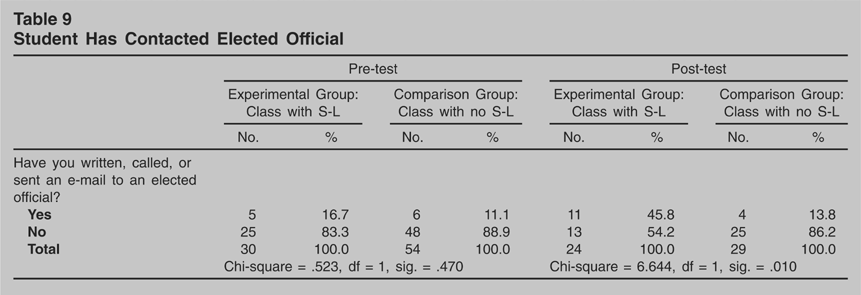
Concerning contacting an elected official, at the time of the pre-test
the two classes were quite similar, but by the end of the quarter the
percentages differed to a statistically significant extent. As shown in
Table 9, 45.8% of the students in the
service-learning class, but only 13.8% in the other class, had made
contact with an elected official.
Student Has Contacted Elected Official
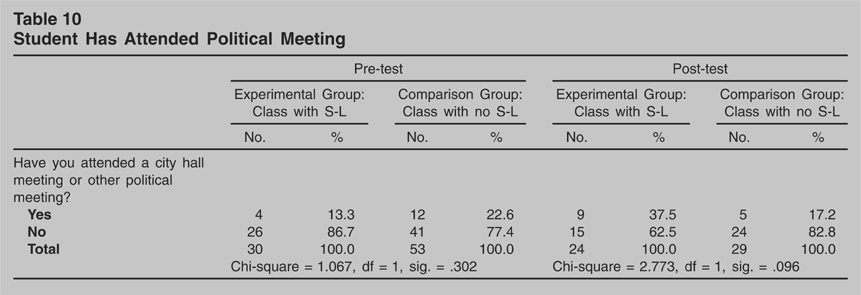
Table 10 covers attendance at political
functions. At the time of the pre-test, a smaller number of
experimental-group students had participated in a meeting at city hall
or at another political venue than comparison-group students, 13.3%
versus 22.6%. But this difference was reversed by the time of the
post-test, 37.5% versus 17.2%.3
The fact
that a smaller percentage of the comparison group students
answered “yes” at the time of the post-test may be due to the
differences in the size of the class at the time of the pre-test
and at the time of the post-test.
Student Has Attended Political Meeting
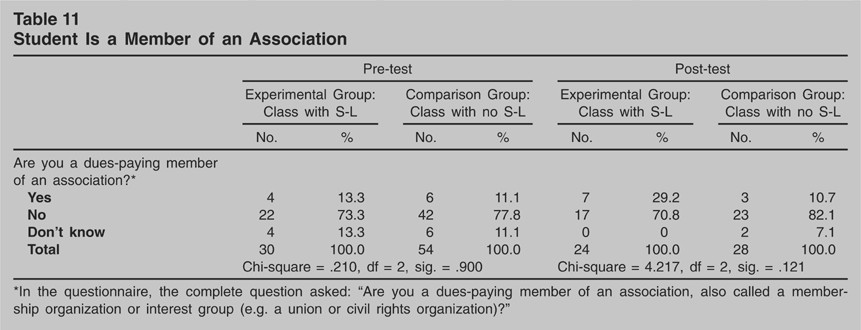
The two classes also showed substantial differences at the end of the
quarter concerning their relationship to interest groups. As presented
in Table 11, at the time of the pre-test, the
students in the two classes were similar in their association
membership, 13.3% and 11.1%. At the end of the quarter, however,
membership in the service-learning class had doubled, while it remained
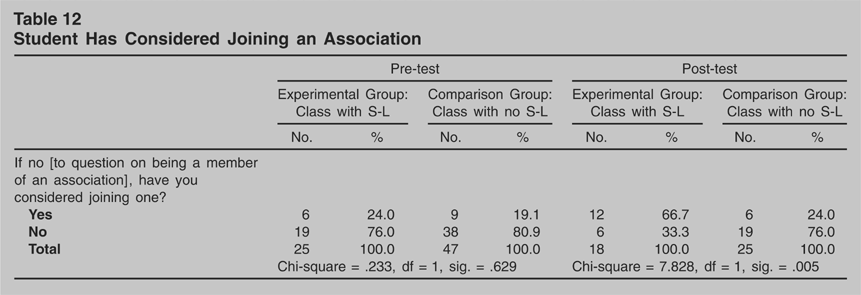
the same in the comparison group. Also, awareness of the option to join
had increased substantially among the service-learning students. Table 12 shows the statistically significant
difference of 66.7% versus 24.0%.
Student Is a Member of an Association
Student Has Considered Joining an Association
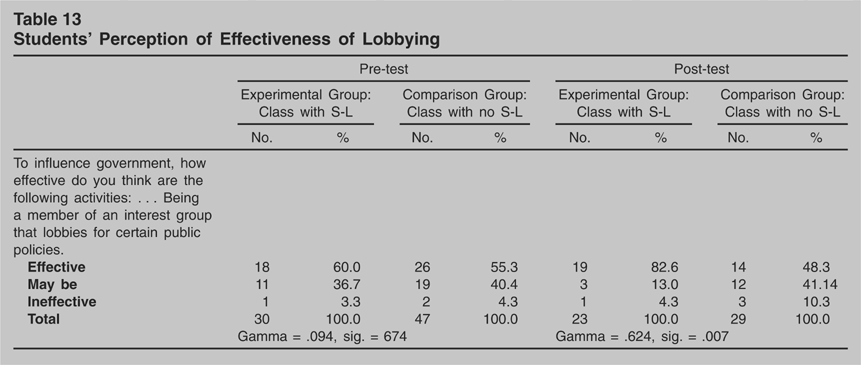
At the beginning of the quarter, the students in both classes held the
same views on the effectiveness of interest group lobbying. By the time
of the post-test, however, the service-learning class increased its
perception of effectiveness to a statistically significant extent, as
seen in Table 13.
Students' Perception of Effectiveness of Lobbying
Unexpected Outcomes
Each cohort of students unconsciously developed a common theme or subtext
in their observations. For the first class in fall 2001, it was respect.
In journal entries and in reflection periods in class, respect emerged
as an important issue. Students liked to work at organizations where
their presence was acknowledged, where they were introduced to staff and
other volunteers and invited to join lunch groups. Several of the
participating organizations do advertise their internship and volunteer
programs on all campuses in the region, including CSULA. But students
from Occidental College, UCLA, and USC are apparently more likely to
make use of the opportunities. The service-learning course provided the
opportunity for our students to join the area-wide corps of young,
politically engaged volunteers.
In the second class, in addition to respect and acceptance,
interconnectedness emerged as an important theme. The National
Association of Latino Elected and Appointed Officials (NALEO), the
League of Women Voters (LWV), and the Los Angeles Department of
Neighborhood Empowerment (DONE) were involved in managing or overseeing
neighborhood council elections. When student teams volunteering for
these three organizations found themselves in the same meeting hall,
they realized how small the political world was even in a large city
like Los Angeles.
The subtext of the reflections in the third class was the value of role
models and reaching out to young adults. The primary election season
happened in California during the winter quarter. Observing adults who
deeply care about the future of their state and community raised the
students' interest in local and state politics. The students also noted
the small number of young people who participated in the political
process prior to the primary election, and they appreciated it when the
older adults welcomed their presence and supported their continuous
engagement.
In general, it appears the students accepted the service learning
challenge because they could see how political and governmental actions
could help their own communities as well as the public in general. Some
students were so eager to spread the word on environmental preservation
that they leafleted the class. Others were happy to participate in the
creation of a CD that informed high school students about the nature and
negative consequences of hate crimes.
A third team took its charge quite seriously: finding ways to inform
needy car owners about a new state program offering low-cost car
insurance. Students who volunteered in the offices of elected officials
showed dedication in helping constituents get results from unresponsive
administrative agencies. There was no political apathy among these
students, apparently because their projects were challenging and
meaningful. I have to agree with Liu's (1996,
6) observation that young people at the present time are as idealistic
as young people in previous generations and that they will express their
values when given the opportunity to do so.
The process was also important. Some students learned to interact and
recognize similarities with members from different ethnic communities,
leading to a feeling of inclusiveness and shared experiences. Others
appreciated the self-help efforts and initiatives taken by elders in
their own neighborhoods. Observing these senior role models and their
political effectiveness energized the students to actions of their
own.
Implications
I call this approach of learning from the experts “uncommon” because it
shows a new way of combining service learning with political science
courses. The first, and most common, method is charitable work. The
second type involves creating new community action projects. Both
approaches are appropriate for certain student populations, but not
suitable for others. This article proposes a third type of activities
that meet the learning needs of a student body that may be more
alienated from civic involvement than the majority of college
students.
The approach has one limitation. It is primarily suited for metropolitan
regions, where there will be a variety of organizations and enough
collaborating community partners to find interesting placements for
students. In addition, the field offices need to be of a size that will
make service attractive while learning about political involvement.
Smaller communities may have chapters with more or less regular
meetings, but the chapters are not likely to manage sizeable projects
that offer a glimpse into the workings of the larger political system
and that would invite ongoing political engagement.
Biography
Siegrun Fox Freyss is associate professor of political science at
California State University, Los Angeles. Her research on urban politics
and local governance issues, as well as on the nexus between public
sector and nonprofit sector institutions, has appeared in books and in
journals of political science and public administration.