


On the morning of 25 July 1894, while on patrol in the Yellow Sea between China's Shandong peninsula and Korea's western coast, the Japanese navy cruiser Naniwa attacked and sank the British steamship Kowshing. Officials of the Chinese government had chartered the S.S. Kowshing from its British owners, the Indo-China Steam Navigation Company, in order to transport Chinese soldiers to Korea, whose king had requested the assistance of Chinese troops in suppressing a local revolt. Most historians of Japan and China, as well as Japanese woodblock illustrators from the time, attach the sinking of the Kowshing to “the naval battle of P'ung Island” and treat the event as the opening battle of what came to be called the Sino-Japanese War.Footnote 2 Other historians—of the Sino-Japanese War and Chinese diplomacy—treat the sinking of the Kowshing as a surprise attack at sea, which inaugurated not only this particular war but a Japanese pattern of aggressive behavior.Footnote 3 But no historian has yet recounted the surprising denouement of the sinking of the Kowshing: Britain's attempt to force China to pay reparations. Known in diplomatic records as the “Kowshing Incident”, its resolution dragged on for a decade as the governments of Britain, Japan, and China debated two major issues. One was the legality of Japanese actions: because Japan did not declare war on China until six days later, 1 August 1894, did it have legal right to fire upon the S.S. Kowshing, a neutral ship flying the British flag? The other had to do with liability: who, if anyone, was responsible for compensating the British ship owners for their loss?
Central to this pair of issues was the legal status of international law. While some international lawyers argue that there is indeed a power of enforcement in international law—that we can and do, in other words, construe the existence of a sovereign authority in international legal agreements—other experts conclude that international law is better considered a species of morality—an international morality that marks but does not govern the behavior of states. In the Kowshing incident, as is often the case, international law was enlisted after the fact in order to reach a judgment of responsibilities and liabilities. Indeed, the incident occurred at a critical time for international law, as new international legal organizations and international diplomacy were collectively attempting to regularize the practices of war as a formal “laws of war”. One such principle at issue in the Kowshing incident, for example, was the neutrality of a ship in the absence of a declaration of war. But practice and principle—description and prescription—were not identical, so the Japanese in this case were able to exploit existing disagreements within international law: Was a declaration of war necessary? And in the absence of a declaration of war, are neutral parties free to trade contraband with belligerents?
The emphatic Japanese “no” to both of these questions was strongly supported by British international legal experts and government officials. But with a twist. In judging that the Kowshing was acting as a belligerent under conditions of a de facto state of war, British legal experts determined that the Japanese were right to treat the vessel as prize and thus to sink it when it resisted detention. Liability lay with the captain of the Kowshing, and the British ship owners rightly suffered their loss. But contrary to that judgment, the British Foreign Office pursued the Chinese government for damages, a series of events taken up below. Suffice it for now to note that the Chinese argued the progressive position increasingly advocated during the nineteenth century (and formalized in the 1907 Hague Convention)—that declarations of war are mandatory and thus the Kowshing was a neutral ship. By contrast, Japanese experts argued the longstanding position based on raison d'état—that warlike intent or behavior is proof of war, so that formal declarations are unnecessary. Thus the Kowshing was not a neutral ship.
Historians of the Sino-Japanese War rarely treat these issues, unless to revisit the matter of legal and/or moral responsibility examined at the time by international legal experts. Typically, the first question that historians ask is “when did the war start?” Ueda Toshio, Shiraha Yūzō, and Qi Qizhang revisit the three alternative arguments provided at the time: (a) that the war began on 23 July, when peaceable talks between China and Japan broke down, signaling an end to conditions of peace and a recognition of hostile intentions; (b) that the war began on 25 July, when Chinese ships fired on Japanese ships in the vicinity of P'ung Island, signaling the start of hostilities; and (c) that the war began on 1 August, with formal declarations of war.Footnote 4 Perhaps needless to say, the answer to this question points in a very partisan manner to the assigning of blame—either China or Japan is to be held responsible for the war—and of course informs the answer to the second question revisited by these historians—was the Kowshing sinking justified or not?—from which follows the assigning of liability for the incident.
Unlike that body of scholarship, which tends toward one or another moral judgment upon past national events, this essay seeks to understand the interactions of force, international law, and diplomacy in the decade-long negotiations to reach some resolution to the Kowshing incident. For the Sino-Japanese War broke out at a time of unsettling imperial expansion in world history. An arms race between Britain and Germany in Europe, the expansion of Russian interests into China, and the overall continued decline of the strength of the Chinese government, among other developments, conspired to give both Britain and Japan pause as they proceeded with their respective national interests. While many historians have argued that Britain supported Japan's actions in the Sino-Japanese War, out of a common interest in containing Russia and in premeditation of the Anglo-Japanese Alliance of 1902, historians of Anglo-Japanese relations such as Ian Nish and Kenneth Bourne have convincingly demonstrated that Britain seriously undertook a position of neutrality during the Sino-Japanese War.Footnote 5 This essay adds to that history an important observation: In spite of British efforts at neutrality during the war, the Kowshing incident marks the solidification of a pro-Japanese attitude among international legal experts in Britain, whose testimony in favor of Japanese civility and respect for international law was key to the British government's judgment in favor of Japanese actions in the Kowshing incident.
At the time of Japan's sinking of the Kowshing, Britain had just accorded equal treaty status to Japan and was welcoming Japan into the family of civilized nations.Footnote 6 China, by contrast, remained outside the family of nations and none of China's arguments, no matter their expertise in international law, swayed British judgments. Thus the Kowshing incident posed a novel situation in that China and Japan, inferior to British strength and expertise, resorted to the language of international law as a defense against potential charges of illegality. At the same time, the Kowshing incident not only reminds us that international law in the nineteenth century was a Western and imperialist project, but also reveals that three classes of powers had been constructed in East Asia: the fully constituted and civilized Great Britain, the woefully uncivilized and unequal China, and the new intermediary category of Japan, a “civilizing” power in the process of mastering the imperialism implicit in international law. The Kowshing incident was an important milestone in Japan's attainment of “civilized” status in the international arena.
The Event
It was a full week before the story of what happened on 25 July was known, by which time the Imperial Japanese government had declared war upon China. Japanese officials gathered information between 27 July and 1 August, with an official version appearing on 2 August and a final report issued on 10 August.Footnote 7 Foreign Minister Mutsu Munemitsu urged his subordinates to be particularly mindful of their sources of information, presumably to heed the testimony of reliable sources such as officers.Footnote 8 He also urged his Minister in London, Aoki Shūzō, first, to take care in releasing details to the press—for example, Aoki initially did not need to tell the press that it was a British ship that had been sunk. Second, Mutsu urged Aoki to assure the British and other western governments that Japan would assume all responsibility for the affair, if it were proved that her naval officers had acted improperly, and that Japan intended to obey international law in all its undertakings. For, in addition to the sinking of the Kowshing, Mutsu was aware that the Japanese Consul in Shanghai had already received complaints from German officials of illegal Japanese searches of German ships in international waters.Footnote 9 For his part, Aoki had already cased the press in London and knew from which newspapers favorable reports could be purchased and for how many pounds sterling. In fact, just days before the sinking of the Kowshing, Mutsu had authorized Aoki to undertake a payment of 600 pounds to Reuters telegraph agency for a trial year of favorable news dissemination; and on 4 August, Aoki cabled Mutsu to report favorable press in Britain and Germany and to request an additional 1,000 pounds for further “secret service”.Footnote 10
Thus on 2 August 1894, Mutsu and Aoki offered an initial official version of what had happened, constructed through Japanese interviews of the Japanese officers aboard the Naniwa and the two surviving British officers of the Kowshing, who had been rescued by the Japanese navy and transported to hospital at the Japanese naval base in Sasebo (on the northwestern coast of Kyūshū). It was this story, supplemented with official testimony of the British officers and other survivors, that was presented in two British naval court hearings held at Her British Majesty's Consulates, first in Nagasaki on 7 August and second in Shanghai on 20 August. The story subsequently made its way into the diplomatic record, and perhaps more importantly, into the writings of key international legal scholars whose judgments informed the official views of the British and Japanese governments: John Westlake of Cambridge University; Thomas Erskine Holland at Oxford University; and Takahashi Sakue at the Imperial Naval Staff College in Tokyo (who served as legal advisor to the Japanese Navy during the war). The official story, in other words, was constructed largely without the input of the Chinese soldiers, most of whom had perished, and would eventually be challenged by the Chinese government when it subsequently became involved in the affair.
So what had happened?
According to the official story recorded in documents of the British Foreign Office, in the early morning of 25 July 1894 (between 7:00 and 8:00 a.m.), three Japanese warships were fired upon by two or three Chinese warships in the vicinity of P'ung Island (a.k.a. P'ungdo, Phungdo, or Fengdao) off the western coast of Korea.Footnote 11 (See Map.) After exchanges of fire, the Chinese ships fled. The Japanese would reiterate that this “Battle of P'ung Island” was the opening battle of the Sino-Japanese war and that China's belligerent actions justified what followed. This is an important point, because subsequent Chinese arguments regarding British neutrality would run aground upon this alleged act of war.
“Map by Molly O'Halloran”
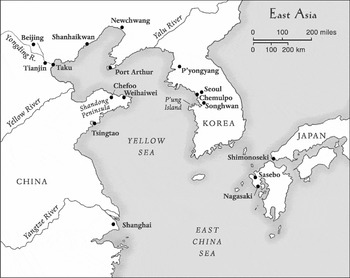
An hour or so later that morning, one of these three Japanese ships, the Naniwa, came upon the British transport S.S. Kowshing and forced her to stop; Japanese officers would insist that the Kowshing was accompanied by a Chinese warship, but the British captain testified that the Kowshing was proceeding to Korea alone. In either case, armed Japanese officers boarded the Kowshing, discovered that she was transporting Chinese soldiers to Korea, and ordered the captain of the Kowshing, Thomas Ryder Galsworthy, to follow the Naniwa, presumably to the Japanese base in Sasebo where the Chinese on board were likely to be detained as prisoners of war. When the Chinese officers on board the Kowshing heard this, they protested to their German advisor, Lieutenant Constantin von Hanneken, who was in the employ of the Chinese government, and they demanded that the ship return to their port of origin in China, Taku (or Dagu), the seaport downriver from Beijing and Tianjin. Galsworthy and von Hanneken reported this demand to the Japanese officers, who refused to allow the Kowshing to return to China. The Chinese officers then would not permit the British captain to obey Japanese orders and threatened him with violence—this would subsequently be interpreted as a Chinese seizure of the command of the Kowshing—and accordingly, the Japanese torpedoed and broadsided the British steamship. The crew of 75, including seven British officers, the one European passenger von Hanneken, and about 1100 Chinese soldiers jumped or were blown into the water when the Kowshing exploded after its boilers were hit.Footnote 12 Galsworthy and Japanese officers reported that some enraged Chinese soldiers took command of the Kowshing's guns and fired upon the Europeans as well as their fellow Chinese in the water, killing many of them. However, the German officer von Hanneken, First Mate Lewis Henry Tamplin, and a group of Chinese survivors insisted that the Naniwa sent out two heavily armed boats committed to sinking the Kowshing's lifeboats and to killing as many Chinese as possible.Footnote 13 In any event, Captain Galsworthy, First Mate Lewis Henry Tamplin, and Manila Quartermaster Lucas Evangelista were rescued by the Naniwa and taken to Sasebo, where they were detained and secluded at the Naval Hospital until, at the demand of British Vice-Admiral E. R. Fremantle, they were taken to the British Consulate in Nagasaki on 4 August.Footnote 14 Von Hanneken and about 150 Chinese managed to reach Shopaiul Island and then Chemulpo on the Korean coast; von Hanneken then made his way back to Chefoo in Shandong. And a French cruiser Lion en route from Chemulpo to Chefoo rescued another Manila Quartermaster and 44 Chinese.Footnote 15 British authorities (based on reports from Chefoo and Chemulpo) incorporated the testimony of von Hanneken and the Chinese survivors when they produced a version of the story at the initial naval court hearing in Nagasaki on 7 August.Footnote 16
The diplomatic record contains evidence that both the British and Japanese immediately set to work, either to bolster their cases if relations soured or to fend off potential points of criticism from others. Both parties wanted good relations to be maintained: their representatives had finally resolved the longstanding matter of unequal treaty revisions and had signed a new Britain–Japan treaty ten days earlier, on 16 July; and leaders in Britain—Lord Rosebery, for example—maintained that British interests lay with Japan. At the same time, diplomatic historians report, the Japanese feared a British alliance with China and the British feared a disruption of their China trade.Footnote 17 In reaction to the outrage of Vice-Admiral Fremantle, who had wanted to arrest and suspend from duty the captain of the Naniwa, the British enquired as to whether the Japanese had ever signed the Geneva accord and thus adhered to the principle of assisting wounded enemy soldiers. It was appalling that of the estimated 1176 persons on board, only two officers, two quartermasters, von Hanneken, and about 200 Chinese soldiers survived. The Japanese assured the British that yes, they had signed the Geneva accord; they implied that they had indeed assisted the Chinese, but as I indicated earlier, these facts were in dispute. In any case, the Japanese rescued no Chinese survivors.Footnote 18 For his part, Japan's foreign minister Mutsu urged Minister Aoki in London to prepare to protest if the British officers of the Kowshing proved to have been directly engaged by the Chinese government, for such action would violate the Queen's neutrality proclamation.Footnote 19 Of course, Britain had not yet formally declared itself neutral since neither Japan nor China had formally declared war. But the Japanese were prepared to argue in either of two ways, depending on where their advantage lay: to accept British neutrality if it could be used against the British captain of the Kowshing, or, as they finally did argue, to deny the relevance of British neutrality in conjunction with treating the Kowshing as a Chinese belligerent. Since the British agreed with that latter position, the Japanese Foreign Office acquiesced in the official British version of the event as it was presented in the two naval court hearings.
The Matter of Japanese Legality
It took the British government nearly four months to finalize a judgment regarding the Japanese sinking of the Kowshing. But even before the first naval court hearing, Professor Westlake wrote a letter to the Times, printed on 3 August, in which he justified the behavior of Japan. Westlake's main points in support of his opinion were three. In the first place, the Kowshing was “acting as a transport in the Chinese service”, a belligerent service, from which he concluded that it was “not entitled to any protection from the British flag and ownership”. Second, the Japanese were not precluded from treating the Kowshing as a belligerent simply because war had not yet been declared. Westlake insinuated that it is preferable that wars be formally declared, but practice is often the opposite, and in either case, the neutrality of a British ship was not the issue, for the Kowshing was behaving as a belligerent, because China was a belligerent. And third, since the Japanese could prove that the Chinese troops on board the Kowshing were heading for Korea in an effort contrary to the Japanese position there, and that their behavior on board the Kowshing was belligerent, the Japanese faced the military necessity of sinking the boat.Footnote 20
Professor Holland reiterated much of Westlake's argument in his own letter to the Times, printed on 7 August. He went perhaps further in asserting conclusions that exonerated Japan's behavior, for his first point was that even without a formal declaration of war, a state of war existed; moreover, the captain of the Kowshing knew that a state of war existed when the Japanese commander ordered him to stop. Second, the captain of the Kowshing knew that she was a neutral ship in the transport service of a belligerent, and hence its flying the British flag was immaterial. It undertook the hostile expedition of transporting belligerents, knowing full well that it could be stopped and seized for adjudication by a Japanese prize court. Because the Japanese seemed to have made every effort to rescue the British officers, and set them at liberty, Holland concluded that there had been no violation of the rights of neutrals.Footnote 21
One wonders why two British legal experts were motivated so quickly to defend Japan's position in this affair. Both Westlake and Holland note that they were dismayed by the public outcry against Japan and the vehemence of anti-Japanese diatribes once the news of the sinking of the Kowshing reached London.Footnote 22 In addition to wanting to curtail such public emotion, they had both been committed to the progress of Japan in its adoption of international law. For both were involved in efforts to formalize international law during the last third of the nineteenth century and to encourage the uncivilized countries of the “Orient” to adopt international law.Footnote 23 Both Holland and Westlake worked with Japanese legal scholars in international organizations such as the Institut de Droit International to develop a rationale by which the practice of consular jurisdiction (or extraterritoriality) could be eliminated and sovereign rights restored to Japan. The new Anglo-Japanese treaty signed days before the sinking of the Kowshing represented a significant first step in this international effort, and Holland and Westlake took pride in noting the advances made by Japan in the 1880s and 90s—Japan was joining the family of civilized nations. Both scholars would subsequently befriend Takahashi Sakue when he came to England in 1898 to further his expertise in international law; and he would reciprocate in 1902 by arranging official Japanese decorations for Holland and Westlake for their services rendered to Japan.Footnote 24
Moreover, a second undertaking of both Holland and the Institut de Droit International, which figured specifically in the Kowshing case, was the issue of prize. By 1887, the Institut had adopted an extensive set of “International Regulations for Prizes”, and Holland himself in 1888 completed A Manual of Naval Prize Law on behalf of the Lords Commissioners of the Admiralty, in which he attempted to synthesize existing law and practice so as to provide a reliable set of procedures for naval officers to follow in time of war—a manual, incidentally, with which Japanese government and naval officials were undoubtably familiar.Footnote 25 His (and Westlake's) treatment of the Kowshing case is consistent with the rules outlined in both the Institut's “International Regulations” and his own Manual: neutral vessels transporting soldiers in the service of a belligerent cease to be neutral; and, should such a vessel resist detention, the commander of the ship attempting the detention is justified in resorting to coercion and is not liable for injury to vessel or crew in forcibly preventing her escape.Footnote 26 Although Holland was silent on the possibility of a vessel being destroyed, rather than being forced to proceed to a port of adjudication in order to be treated formally as prize, we do see why Westlake and Holland were so keen to insist that a state of war already existed and that Captain Galsworthy surely knew that fact. The sole pertinent assurance of the neutrality of a vessel, according to Holland's Manual, is the ignorance of the captain that war has broken out. Hence it was imperative that he and Westlake begin by asserting the existence of a state of war, of which Galsworthy was aware.Footnote 27 To Holland and Westlake, the Kowshing incident was interesting as a novel point of international law regarding the rights and duties of neutrals in time of war; for the case of the Kowshing represented the first time that a war had begun by an act of violence against the persons and property of neutrals.Footnote 28 But in raising the procedures presented for British naval officers to the status of an international standard, Holland insisted that, because the British ship was in the transport service of a belligerent, its flying the British flag was immaterial: the boat was not a neutral vessel and could be seized as prize.
But it was precisely this conundrum of the neutrality of the British ship—not to mention Korea—in the absence of a declaration of war that incited most debate at the time. Nineteenth-century efforts to formalize international law had concentrated on the rights of neutrals, whose duties to respective belligerents depended upon notification of a state of war. Thus the Revue générale de droit international public insisted that a declaration of war cannot be publicized by military action against a neutral or on neutral territory such as that of Korea.Footnote 29 The difficulty with such a position arose from the very methodology of modern international law, conceived by Henry Wheaton in his 1836 Elements of International Law not as prescription of principles of action but as a description of current practices. As many international jurists had observed, classical Roman principles and early modern authorities such as Grotius had recommended formal declarations of war as proper procedure, but, for better or worse, modern states usually disregarded formal declarations, preferring to strike with the advantage of surprise. In the Kowshing case, supporters of Japan turned this observation of modern practice into its justification. So, for example, Tokichi Masao, writing in the 1896 Yale Law Journal, argued not that many writers acknowledge the situation, but that most writers agree that a declaration of war is not necessary, which is a minor but significant shift of emphasis that pointedly sanctions Japanese actions.Footnote 30 In other words, where the Revue générale would articulate principles of right action, Japanese and British experts treated observations as though they were such principles. Eventually, in 1904, the Institut de Droit International would recommend that formal declarations of war be mandatory, and such a convention would be signed at the 1907 Peace Conference in the Hague.Footnote 31
In spite of the consonance of the learned opinions of Holland and Westlake, the British government deliberated somewhat slowly. On the advice of the Law Officers of the Crown, the Foreign Office officially held Japan responsible for the loss of British life and property as of 3 August, the same day as Westlake's letter to the Times. This position was reiterated on 12 August, after the first naval court hearing in Nagasaki and after a final Japanese inquiry reached Foreign Secretary Kimberley in London on 10 August. Only after the second naval court hearing in Shanghai on 20 August did the British government's position begin to change.Footnote 32 The Foreign Office referred the matter to the Law Officers of the Crown, who filed conflicting legal opinions on 28 September, one exonerating Japan and one holding Japan responsible. Ultimately, in a memorandum of 10 November written by the Lord Chancellor, Lord Herschell, the British position was publicly reversed. Herschell was apparently persuaded by Holland's Manual of Naval Prize Law and his argument in the Times. Contrary to the initial judgment, that Japan had destroyed a neutral vessel belonging to a British subject, Herschell instead determined that a state of war existed at the time of the sinking of the Kowshing: he appealed to common sense in maintaining that even in the absence of any declaration of war, everyone in the area knew or should have known that war was imminent. Given the belligerent mission of the Kowshing and the belligerent behavior of the Chinese on board, it was reasonable for the Japanese to detain and then to sink it. Thus the British government sanctioned the legality of Japan's sinking of the S.S. Kowshing.Footnote 33
This is a somewhat surprising decision, given evidence to the contrary in the diplomatic record. As late as 31 July, the Colonial Office noted that Britain had made no official declaration of neutrality since no declaration of war had yet been issued by either China or Japan. Foreign Secretary Kimberley in London wrote to Japanese Minister Aoki as late as 1 August, encouraging Japan to pursue diplomatic negotiations rather than resort to war. And both of these documents, note well, were issued after reports of a major land battle on the Korean peninsula between the Chinese and Japanese armies at Songhwan, south of Seoul, on 29 July.Footnote 34 Clearly, some offices of the British government were awaiting a formal declaration of war before acknowledging that a state of war existed in the vicinity of Korea—or, perhaps more importantly, before behaving as though a state of war existed.Footnote 35
But what is most striking is that this decision favorable to Japan was reached without the input of the Chinese government. The partiality of the British inquiry—cautioned, of course, by our ignorance of the deliberations of the Law Officers of the Crown—suggests that the British government's ultimate interest was the recovery of damages for the loss of British property. For once Japan was cleared from charges of wrongdoing, British victims turned to their Foreign Office for assistance in suing China for compensation. Robert Hart, the Imperial Commissioner for Maritime Customs in China, was appalled by the British decision; his reaction lamented the fact that Britain's economic interests in Asia had so often guided her geopolitical and military interests there.Footnote 36 The first Opium War with China is perhaps the most memorable example in which international law served Britain's interests in property. Given such a precedent, the Japanese and Chinese understood that Britain would demand that someone compensate for the loss of British property. What was novel about the China–Japan conflict was that two so–called second-rate powers undertook a war in which they resorted to the language of international law in order to defend themselves from charges of illegality and responsibility. In the Kowshing incident, it was the world's major power, Britain, who appeared the victim, and the lesser powers were left to defend themselves from charges of illegality. Japan, however, had an advantage: it had been raised to the status of “civilized” power ten days prior to the incident, by virtue of Britain's having accorded Japan equality in its newly renegotiated treaties.
The immediate problem for Chinese officials in Beijing was that they were held accountable for the behavior of Chinese soldiers aboard the Kowshing, who had acted on their own and not on orders from any central authority. With most of them dead, no immediate chain of responsibility led back to Beijing. As the subsequent Chinese ambassador to the Court of St. James, Luo Fenglu, put the point in 1898: “It is not given to a blundering Lieutenant, whose acts may be repudiated by his Government, the power of making War—That, like the right of making Peace, is the prerogative of the Sovereign, and can only be exercised with his knowledge and by his order”.Footnote 37 Logically, Japan was the immediately responsible party, but it was a point of Western and international law that governments are responsible for the acts of their agents, so Luo's objection had no legal standing. And with the British government's official conclusion that Japan had acted not improperly, Japan was exonerated. Lord Herschell noted the difficulty of the case as an afterthought:
I think it may now be taken as recognized that war may be commenced and a state of war exist without any formal declaration of war. A declaration is however usual for the purpose of giving notice to neutrals on whom a state of war imposes obligations. As a matter of international courtesy at the least such declaration ought to be made. It may then perhaps be contended that where war is commenced prior to such a declaration neutral subjects engaged in a peaceful and lawful enterprise undertaken without notice of a state of war, should receive redress at the hands of a belligerent by whose warlike operations prior to any declaration of war, they suffer personal injury. As I have said I do not feel satisfied that this case can be claimed as of right, but the present case is a very peculiar one and it is possible that if presented in this way the government of Japan might be disposed to consider it favourably.Footnote 38
Nonetheless, he concluded with some ambivalence that he could not advise “on what principle of international law a claim for redress on the part of the owners against the government of Japan can be based. Their claim if any would seem to be rather against the government of China”.Footnote 39 Hence the Indo–China Steam Navigation Company enlisted the assistance of the British Foreign Office in prosecuting its claim for damages against the government of China.
The Chinese Response
Before turning to that eight-year effort, however, it is imperative to examine the Chinese reaction to this decision, for much of the delay in reaching a settlement to the Kowshing incident was directly a consequence of the Chinese government's wish to reopen the charges of Japanese illegality. The Chinese position was outlined in a lengthy memorandum sent from Minister Luo Fenglu to the Marquis of Salisbury, Secretary of State for Foreign Affairs, and dated 22 August 1898. In this document, the Chinese specifically denied points central to the arguments of Westlake, Holland, the Law Officers of the Crown, and Lord Herschell. First, the troops aboard the Kowshing were being sent to Korea “on the invitation of the King of that country to assist in suppressing a rising in the Southern part of his dominions”.Footnote 40 Indeed, Korea had invited Chinese assistance in suppressing the Tonghak rebellion and thus Japan and Britain were in error when they asserted that the Kowshing was categorically engaged in belligerent transport contrary to the position of Japan in Korea. Moreover, providing assistance to Korea in suppressing the Tonghak rebellion was one of the reasons that Japan too had given in sending its own troops to Korea; and most histories of the Sino-Japanese War note that both China and Japan used the terms of the Tianjin Treaty of 1885 and their respective Korean allies' requests for assistance to reinforce their own military positions there.Footnote 41 The British judgment simply ignored the legitimacy of such claims—not to mention the independence and interests of Korea, a point raised by George Curzon in an irate letter to the editor of the Times.Footnote 42
Luo's second point was that contrary to British arguments, the captain of the Kowshing was ignorant of the alleged fact that, a few hours prior to the sinking of the ship, an engagement had taken place between Japanese and Chinese vessels of war—he could not possibly have had any means of knowing about it. Thus, when British authorities argued that by virtue of that engagement, the Kowshing “had been made a neutral ship and, as such, saddled with all the duties and obligations of a neutral in time of War”, they overturned a principle firmly established in international law, namely,
that as regards third parties, these hostilities do not exist, except upon notification from one or other of the belligerents. The reason for this is evident; for, without the knowledge of the existence of a state that imposes on third parties exceptional duties, how can they perform those duties, unless the existence of such a state has been made known to them, or at least, has become a matter of common notoriety?Footnote 43
Luo carefully cited eminent scholars of international law (and standard precedents of neutral Spanish ships illegally searched in the course of Anglo–French hostilities) to demonstrate the established principle that belligerents cannot expect other states “to take up the attitude of neutrality contemporaneously with the outbreak of hostilities”, and that, moreover, the belligerent's right of search and visitation of neutral vessels cannot begin until neutral states are formally notified of hostilities through proper diplomatic channels.Footnote 44 Indeed, the Revue générale de droit international et public concluded at the time of the sinking, since a neutral ship cannot be the object of a declaration of war, the Kowshing should have been allowed to return to its port of departure in China.Footnote 45
Luo's conclusions were considerably more strongly worded versions of those points which Lord Herschell had so blandly suggested. In the first place, the Japanese action “was wholly tortious and utterly unjustifiable . . . it was an insult to the British Flag, and, as such, ought to have been avenged by the British Government: and, that having failed to do so, Her Majesty's Government are now estopped from claiming compensation from the Chinese Government, the charterers of the vessel”.Footnote 46 After all, André Weiss and other authorities on international law had argued that the neutral state had a right to claim damages incurred in an illegal search from the belligerent perpetrating the illegal search. In the second place, Japan's attempt to capture the Kowshing “was, in the absence of any notification, from either of the belligerents to neutral nations, of the commencement of hostilities, clearly an act of usurpation which, had the “Kowshing” been in a position to resist, she would . . . have been justified in doing, not only passively, but actively”.Footnote 47 Luo insisted that the illegality of Japan's action nullified the alleged interference of the passengers of the Kowshing with the control of the vessel, and concluded that:
it is a novel dictum to put forward, that because the “Kowshing” refused to assist in her own capture—the only offense of which she is accused—the would-be captor was entitled to send her to the bottom. The Imperial Government are advised that a proposition so monstrous as this has never before been advanced.Footnote 48
Indeed, given that so much of the effort to formalize maritime law in the nineteenth century was meant to protect neutral ships, why was the British government willing to forsake established principles and to reassert a measure of uncertainty into the responsibilities of neutral states? Both Herschell's appeal to common sense and his willingness to uphold as valid a belligerent's expectation that third parties will “take up the attitude of neutrality contemporaneously with the outbreak of hostilities” fly in the face of the legal scholars cited by Luo. Moreover, given Westlake's and Holland's summary dismissal of the relevance of the British flag and British ownership, it is hard to see on what grounds the British owners might seek compensation from anyone other than the Japanese government—a point muddled in Herschell's opinion. To put the issue another way, Luo strongly rejected the abstract separation of Chinese seizure of command of the Kowshing, which justified Japan's sinking of the ship, and British ownership of the Kowshing, which justified the subsequent British demand for compensation.
Minister Luo and the British Foreign Office continued to dither over Luo's citations of legal authorities through April 1899. Foreign Secretary Salisbury discounted the relevance of the points made by Luo and stubbornly reiterated Herschell's judgment; for his part, Luo continued to point out the discrepancies within the British position.Footnote 49 One senses a hardened disingenuousness in the British argument, which finally came to rest on a footnote in a posthumous edition of W. E. Hall's Treatise on International Law, an earlier edition of which was one of Luo's original citations. The footnote, incidentally, was added by T. E. Holland with specific reference to the Kowshing incident, and read: “What is said . . . as to the moment from which States, and, therefore, their subjects, become affected by the consequences of non-neutral actions, does not apply to cases in which neutral persons are engaged knowingly, or even ignorantly, in carrying out a naval or a military operation for an intending belligerent”.Footnote 50 Luo pointed out, as had Holland in his original argument, that if China were indeed a belligerent, and if the Kowshing were engaged in a naval or military operation, then the owners of the Kowshing could have expected their ship to be confiscated as prize. Holland had expressly concluded that the British owners had no grounds whatsoever for seeking compensation for the loss of their belligerent ship.Footnote 51 But if the Chinese were not belligerent, then the footnote did not pertain and Hall's text supported the position of the Chinese government—that Japan was utterly responsible for its illegal search and destruction of the Kowshing.Footnote 52 Since the British government had found no fault with either Captain Galsworthy or the Indo–China Steam Navigation Company, had then spurned the precedents of international law, and then proceeded to support the Company's claims against the Chinese government, one must conclude that the British government was motivated out of political and diplomatic interests to support Japan and, as we see below, to force China to compensate the ICSN Company.Footnote 53
The Matter of Chinese Liability
The British Foreign Office undertook the request of the Indo–China Steam Navigation Company (owned by Jardine, Matheson, and Company) to pursue damages from the Chinese government on 27 April 1896.Footnote 54 There are two main reasons for this decision. In the first place, the British Foreign Office had decreed an absolute right on behalf of British subjects to claim redress for property taken in the course of the war.Footnote 55 China did not have jurisdiction to establish prize courts; and although Japan's new status under the newly revised treaties granted it the jurisdiction to establish prize courts as a point of international law, such an undertaking was nonetheless an experimental foray into the practice. Even though the Kowshing had not been treated as prize, but had been destroyed, the British right to claim redress applied. In the second place, the longstanding policy in the Foreign Office, to pursue British commercial interests in China, was given new enthusiasm in the 1890s. The China Association, an alliance representing commercial interests in China and founded in 1889, worked to pressure the government generally and the Foreign Office in particular to pursue their goals in China. William Keswick, its Chairman for much of the 1890s, had been a partner in Jardine, Matheson, and Company, a director of the Indo–China Steam Navigation Company, and became after 1899 a Member of Parliament. The matter of recovering damages for the Kowshing is a fitting example of this reenergized official pursuit of commercial interests.Footnote 56
But because the Chinese Minister to Britain at the time, Gong Zhaoyuan, suffered a stroke in August 1896, the case began with a year-long delay until a new ambassador was in residence. That was Luo Fenglu, who received a follow-up letter from Foreign Secretary Salisbury dated 29 May 1897.Footnote 57 Luo deliberately stalled progress in the case, to the fuming impatience of the British Foreign Office, as he dutifully consulted the Chinese Foreign Office (Zongli yamen) back in Beijing and carefully prepared his legal rebuttal. His first roadblock was to officially note the hesitation on the part of the ICSN Company as to against whom it should make its claim, since it had waited one year and eleven months to do so.Footnote 58
Salisbury's assistant Sanderson was most dismayed by this observation, for he feared that Luo would subsequently raise a technicality over the fact that claims had to be made within five days of the occurrence of damage. Thus he wrote an official note on the history of the ICSN Company's claim. The Company had reported the sinking of the Kowshing to the Foreign Ofice on 30 July 1894 and had requested that compensation be claimed from the Japanese government. On 6 August, because the Foreign Office had determined that the Japanese government was responsible, the ICSN Company was asked to supply details, which it did on 19 September.Footnote 59 But on 5 February 1895, it was informed by the Foreign Office that, according to the revised judgment of the Law Officers of the Crown, liability for compensation rested with China. The ICSN Company thus presented an initial claim against China on 12 March 1895, which greatly dissatisfied the Foreign Office; the latter charged that the ICSN Company had failed to provide evidence for the specific amounts of its claim and had instead supplied arbitrary figures. After nearly six months' delay, the ICSN Company presented a claim acceptable to the Foreign Office on 6 September 1895 for 46,167 pounds (rounded up to the nearest pound).Footnote 60 Sanderson concluded that “It was then decided to open negotiations for settlement of the claim through the Chinese minister in London”.Footnote 61
After eight months more, the new Chinese Minister to Britain Luo Fenglu submitted the memorandum that conveyed the legal opinion of the Chinese Foreign Office, and which was discussed above. As a consequence of the inability of the Chinese and British governments to agree over the legality and liability of Japan, the British Foreign Office began to pursue the alternative of arbitration on 18 March 1899, a proposal which Luo recommended to the Chinese Foreign Office on 18 July and which the Chinese Foreign Office accepted on 10 December of that year.Footnote 62
But choosing to submit the Kowshing affair to arbitration proved to be no easy solution. The first order of business was the British request that the Chinese choose one of three possible venues of arbitration: an international tribunal at the Hague; an English judge; or a foreign jurist of recognized eminence and authority.Footnote 63 It is not clear why the Chinese chose to proceed with a foreign jurist, but they seemed optimistic with the selection of Joseph Hodges Choate, then the United States Ambassador in London, to serve as arbitor. Unfortunately, this choice would later invite the imposition of a British technicality that sought to undermine the Chinese position: the British would claim that, in choosing not to use an international tribunal in the Hague, the Chinese had disqualified themselves from raising points of international law in the arbitration process, and once in the process, they could not choose another venue.Footnote 64
The second step was to jointly compose a draft protocol for arbitration, and this effort merely renewed the dispute between Britain and China as to the illegality of Japanese actions. The British refused to include in the protocol Chinese statements about Japan's “willful destruction” of the Kowshing and insisted that since Japan was not a party to the arbitration, Japanese involvement in the dispute could not be considered. When Luo pointed out that this was the very issue that had encouraged both parties to seek arbitration, and thus perhaps Japan should become a party to the arbitration, the British simply dismissed the suggestion, reiterating that the British government had not found the Naniwa's actions unjustifiable.Footnote 65 It is curious that an announcement in the Times on 18 January 1901 informed the public that the purpose of the scheduled arbitration was to seek to demonstrate Chinese culpability and thus to secure compensation from the Chinese government; by comparison, the British Foreign Office continued to presume Chinese culpability for the destruction of the Kowshing and thus to treat as a foregone conclusion Chinese responsibility for compensation. As the Foreign Office represents the arbitration process, it was wholly a matter of when and how much the Chinese would pay.
This stalemate persisted from April 1900 to April 1902, when the British government at last offered to make a deal: if China would eliminate all references to Japanese responsibility in the draft protocol, Britain would agree to omit all references to Chinese responsibility in the document. The draft protocol that Britain proposed is a curious document, for it attests only to the facts that the Chinese government chartered the steamship and that a Japanese warship sank it.Footnote 66 Had this protocol gone to arbitration, it may very well have encouraged would-be arbiter Choate to reopen, as the Chinese wished, the points of international law at issue. But arbitration was eventually abandoned.
Possible motives cannot adequately explain why arbitration was abandoned, and in the absence of further evidence, we can only speculate. In January 1901, the British Foreign Office began to receive whining and irate inquiries from successive Chairmen of the ICSN Company, which move from invoking the “no inconsiderable suffering” of the company to enlisting, in their capacity as constituents, the assistance of their Member of Parliament, Alex Ure, who also began to write the Foreign Office. Even though these letters persist through 1902, it is hard to believe that the British Foreign Office would succumb to such public pressures.Footnote 67 Meanwhile, the Boxer Rebellion and the allied occupation of Beijing had intervened in 1900 and 1901, with British involvement central to the military action and subsequent settlement. In comparison to that sequence of events, a Kowshing settlement was a minor matter that Britain could perhaps now afford to treat with greater equanimity. A third possible explanation is that Chinese resistance gave in, whether traumatized by the Boxer Rebellion or vindicated by the British offer to radically rewrite the protocol so as to better accommodate the Chinese position.
For whatever attendant motives, both Britain and China turned to personal diplomacy in May 1902. Britain's Minister to China, Ernest Satow, credited with success in negotiating the Boxer settlement, began a dialogue with Chinese officials—including newly appointed Minister to Great Britain Zhang Deyi (served 1902–1906) and Yi-kuang (the Prince Qing), Chief Minister of the Foreign Office and Chief Grand Councillor (served 1903–1911)—on a number of outstanding disagreements between their governments. The Chinese proposed an eleemosynary gift to the owners of the Kowshing, stating, according to Satow, that “in light of our friendly relations”, why disagree over such a trifling matter?Footnote 68 Satow exercised tact in working with the punctilious figures insisted upon by the ICSN Company, the Chairman and Board of which finally, in October 1902, agreed to a Chinese offer to pay half the claim and half the interest on the original claim, for a total then approaching 34,400 pounds. In spite of that commitment, the ICSN Company continued to recalculate the interest due, as negotiations for the actual transfer of funds ensued. The company communicated to the Foreign Office progressively higher sums of money and their sincere hope that the Chinese would pay 40,000 pounds. Quite competent in that sporting style of negotiation, the Chinese flatly authorized only 33,411 pounds (989 less than the original figure), which British officials in China urged the ICSN Company to accept and which they were paid in March 1903.Footnote 69
This is an unexpected conclusion to the Kowshing affair, given the strength of Chinese arguments regarding Japan's culpability. Why did the Chinese government pay? Certainly, Chinese attitudes toward indemnities and reparations are quite complex: officials considered Japanese demands for reparations after the Taiwan Incident of 1874 as evidence of Japanese moral degeneracy—what sort of human being would settle on money as recompense for human life? But within a decade, the Chinese government was willing to pay Russia a significant compensation for the return of most of the Ili region in Xinjiang—grateful to avoid a distant war with Russia—and yet refused outright to pay anything to France in the aftermath of the Sino-French dispute of 1885. In the wake of the Boxer Rebellion, a traumatized and chastened court paid vast indemnities to the western powers and Japan, a set of transactions far more agreeable than the lawless plundering that had plagued Beijing.Footnote 70
Be that as it may, my examination of the evidence leads me to conclude that China, as a final gesture, acknowledged the original lease agreement between none other than Luo Fenglu, acting as Naval Secretary to Viceroy Li Hongzhang, and Jardine, Matheson, and Company, as the agents of the ICSN Company. For the lease specified that in the event of hostilities between China and Japan, the Kowshing was to return to Shanghai and the agreement would be terminated; otherwise, the Chinese charterer could purchase the ship for the sum of 190,000 Mexican dollars within one month of the termination of the agreement. Although Japan's destruction of the ship had introduced a mess of complications, I believe that in the end, the Chinese government simply returned to this original agreement and acknowledged their option to buy the Kowshing. Indeed, at the time of the sinking, diplomats in Beijing and Tokyo understood that the Chinese had already acknowledged the risk to the Kowshing and had arranged to pay 40,000 pounds for the boat—the very sum which the ICSN Company had hoped to recover.Footnote 71 Nonetheless, it remains curious that the Company made no mention of the agreement in their representations to the Foreign Office, and saw their action only in terms of the recovery of damages for a ship destroyed.
As an epilogue to the British diplomatic record, an exchange between the Foreign Office and Freshfields (solicitors for the ICSN Company) reveals the latter seeking the sanction of the Foreign Office for their arrangements regarding the distribution of funds to the survivors of the sinking of the Kowshing. Apart from informing the Foreign Office of their plans for paying compensation to the surviving British officers and descendants of the deceased, some of whom—they noted apprehensively—were bankrupt and on the lookout for available cash, Freshfields wanted the approval of the Foreign Office in allotting 1634 pounds to the Chinese crew—a mere five per cent of the total compensation—from which they hoped to subtract the Company's legal expenses incurred in London and Shanghai. The final entry in the British diplomatic record is a 1904 letter from solicitors to the Foreign Office on behalf of an eager relation of one of the deceased officers, who has heard that the government has obtained a sum of money for survivors, to which he is entitled and would like to know the amount of his share. Finished with the affair, the Foreign Office instructed the claimant to contact Freshfields.Footnote 72
What began as an international incident and ended as a domestic query became, from the British perspective, a matter regarding the property of a private British steamship company. In the transformation—that is, in pursuing private damages from the Chinese government—the British government went against the opinions of legal experts Westlake and Holland and contravened nineteenth-century developments in international law. For precedents of international law supported only two positions. Either a state of war (with or without a formal declaration) encumbered the British ship with its duty as a neutral not to transport belligerent soldiers, so that the British captain and ship owners justly suffered the loss of the Kowshing as prize. Or the Kowshing was always a neutral vessel in the absence of a state of war, so that the Japanese were utterly liable for their illegal search and destruction of the ship. British government action forsook these public principles of international law and returned the incident to its semi-private beginnings–the lease agreement between the Chinese government and the ICSN Company, as though the Japanese had never sunk the ship.
Conclusions
This narration of the Kowshing incident represents a new development in the international order in East Asia, for it points toward two ways in which the “far eastern question” became more unsettled. In the first place, insofar as all the participants to the incident—Britain, China, and Japan—were involved in collective efforts within international law organizations both to normalize the rights and duties of belligerents and neutrals and to formalize the conduct of war, British behavior undermined those efforts in two important ways. First, when the British government agreed with Westlake, Holland, and the Japanese that any outbreak of hostilities simultaneously encumbered non-belligerents with the responsibilities of neutral states, it forsook established principles regarding those responsibilities and introduced new uncertainties. The nineteenth-century trend was to demand that a belligerent formally notify the family of nations of its hostilities, but the British judgment in the sinking of the Kowshing sanctioned the willful use of power and perpetuated the very “modern” trends that were the object of legal reform. And second, in agreeing to pursue the claims of the ICSN Company—contrary to the opinions of Westlake and Holland, who had prevailed in the former argument—the Foreign Office spurned international law in favor of British commercial interests and rights of private property. Westlake and Holland had insisted, in designating the Kowshing as a belligerent, that if the Kowshing were engaged in belligerent behavior by transporting Chinese troops, its owners forfeited all claims based upon neutral status. In its handling of the Kowshing incident, in other words, the Foreign Office confirmed the priority of economic interest, justified through the relatively primitive principle of self-preservation within a theory of natural law, over efforts to erect a civilized code of international conduct that, ideally, should displace natural law and its primitive urges. To be sure, a cynic might perceive a double irony here—duplicitous Chinese behavior in using a British ship to further its war aims, followed by duplicitous British behavior in holding China responsible for Japanese aggression. But even in such a hypothetical case, British hypocrisy was an affront to principles of international law and a blow to nineteenth-century efforts to civilize the barbaric practices of war. That is, in the Kowshing incident, Britain reinforced the fact that international law remained beholden to the will of its imperial masters.
In the second place, the Kowshing incident disclosed Britain's new ordering of world powers in east Asia. With Japan now eligible as an equal partner in treaty arrangements and the recipient of British favor, China faced an uncertain future alone within the unequal regime of extraterritorial jurisdiction, and Japanese leaders put into practice the lesson expounded by Bismarck to members of a Japanese mission in 1873—that power to manifest national sovereignty lends credence to international law and not the other way around.Footnote 73 Japan would go on to annex Korea in the very legal manner established by U. S. precedents in Panama.Footnote 74 At the same time, there remains the Japanese atrocity of drowning 900 or more Chinese soldiers, those unfortunate souls missing from nearly everyone's concerns in this narrative. (In 1894, the Geneva Conventions did not yet apply to the wounded at sea.) For if, as the arguments of legal experts Westlake and Holland intimated, Japan's sinking of the Kowshing coincided with Japan's having become civilized while China remained barbaric, such a justification demonstrates, in retrospect, a terrible complicity with further atrocities that followed.Footnote 75


