1. Introduction
In this paper I redefine the concept of factuality, elsewhere also called ‘realis’ (e.g., Mithun, Reference Mithun1999; Palmer, Reference Palmer2001), ‘factivity’, ‘reality’, ‘actuality’ (e.g., Kiparsky & Kiparsky, Reference Kiparsky, Kiparsky, Bierwisch and Heidolph1971; Chung & Timberlake, Reference Chung, Timberlake and Timothy1985; Papafragou Reference Papafragou2000), or ‘validity’ (Kiefer, Reference Kiefer1987; Dietrich, Reference Dietrich1992). The term ‘factuality’ has been extensively discussed by Narrog (Reference Narrog2002, Reference Narrog2005a, Reference Narrog2005b, Reference Narrog2009, Reference Narrog2012), who seeks to discriminate modally marked statements from unmarked ones. More specifically, in Narrog’s account modality is the domain marking the non-factuality or ‘undetermined-factuality’ of an event, as opposed to non-modal statements, generally portraying a situation as a fact. The main aim of this work will be to redefine factuality as a gradient notion unfolding dynamically through several stages of certainty with respect to a proposition P. In this sense, I adopt the term ‘factualization’ so as to to describe the cognitive process that progressively – or abruptly – leads to a subjective belief towards a proposition P. I define factualization as a conceptual phenomenon determined by an embodied mechanism (Lakoff & Johnson, Reference Lakoff and Johnson1980, Reference Lakoff and Johnson1999; Lakoff, Reference Lakoff1987, Reference Lakoff, Sanford and Johnson-Laird2003; Grush, Reference Grush2004; Gallese & Lakoff, Reference Gallese and Lakoff2005) of cyclic acquisition and control with respect to a new proposition P. Being a form of subjectification (Traugott, Reference Traugott1989, Reference Traugott, Stein and Wright1995, Reference Traugott and Hickey2003, Reference Traugott, Davidse and Vandelanotte2010, Reference Traugott2012; Traugott & Dasher, Reference Traugott and Dasher2002), it occurs both on a synchronic and a diachronic level. The former occurs textually throughout the ongoing discourse, the latter is the result of the semasiological semantic reanalysis of an epistemic construction.
Drawing on Langacker’s (Reference Langacker1991, Reference Langacker2008, Reference Langacker2009) notion of the ‘epistemic control cycle’ (see also Kan et al., Reference Kan, Teubner-Rhodes, Drummey, Nutile, Krupa and Novick2013, on cognitive control), I provide robust evidence to claim that epistemic predicates originally expressing weak certainty towards a proposition P diachronically acquire an increasingly factual meaning conveying more and more frequently a subjected form of certainty. I will show this through a synchronic quantitative analysis from the BNC of three polysemous epistemic predicates in MEFootnote 2 (I think, I believe, and I reckon), each potentially conveying different degrees of epistemic commitment towards P. This study will be carried out through a collostructional analysis (cf. Stefanowitsch & Gries, Reference Stefanowitsch and Gries2003; Schmid & Küchenhoff, Reference Schmid and Küchenhoff2013) so as to statistically measure the degree of attraction between a first person epistemic predicate and the type of epistemic adverbials co-occurring with it within a specific word-span scope.
In addition to that, I will further adopt a corpus-illustrated (Tummers, Heylen, & Geeraerts, Reference Tummers, Heylen and Geeraerts2005) qualitative method to identify the dynamic increasing of subjective commitment towards P of an epistemic predicate. Finally, I will provide a corpus survey from the diachronic corpus of written Italian (diaCORIS) on the factualization process of (Io) penso ‘I think’ in Modern Italian during the last 150 years, demonstrating how the contemporary usage of (Io) penso is notably more oriented towards absolute factuality than it was 150 years earlier.
This paper is structured as follows. Section 1.1 gives a general overview of the notion of factuality in the literature and its relationship with modality. In Section 2, I introduce the notion of the epistemic control cycle (ECC) (Langacker, Reference Langacker1991, Reference Langacker2008, Reference Langacker2009), which will constitute a theoretical basis for further discussions and analyses on the gradience of factuality. In Section 3, I present the concept of factualization, which I discuss both on a conceptual and on a linguistic level. In the latter case, I describe factualization as a form of subjectification (Traugott, Reference Traugott1989, Reference Traugott, Stein and Wright1995, Reference Traugott and Hickey2003, Reference Traugott, Davidse and Vandelanotte2010, Reference Traugott2012; Traugott & Dasher, Reference Traugott and Dasher2002). More specifically, I discuss the notion of factualization as a SP/W’sFootnote 3 oriented semantic reanalysis of a construction which diachronically acquires an increasingly factual meaning. In Section 4, I provide a quantitative study from the BNC, where I analyse three polysemous epistemic verbs in ME: I think, I reckon, and I believe. In the same section, I will provide an operational methodology to differentiate the dynamic increasing of epistemic commitment towards P. Finally, in Section 5, I provide a corpus survey on the diaCORIS (a diachronic balanced corpus of written Italian) demonstrating the diachronic factualization process of the predicate (Io) penso ‘I think’ in Modern Italian during the last 150 years.
1.1. on factuality and factual statements
This section aims at providing a brief overview of the notion of factuality, crucial for a better understanding of the concepts of epistemic inclination and factualization.
Intuitively, factuality refers to the state of affairs of a proposition P posed as a fact, or in other words as something that truly happened in the real world. In the literature, the same concept has been labelled in different ways: terms such as ‘realis’ (e.g., Mithun, Reference Mithun1999; Palmer, Reference Palmer2001), ‘factuality’, ‘factivity’, ‘reality’, ‘actuality’ (e.g., Kiparsky & Kiparsky, Reference Kiparsky, Kiparsky, Bierwisch and Heidolph1971; Chung & Timberlake, Reference Chung, Timberlake and Timothy1985; Papafragou, Reference Papafragou2000; Narrog, Reference Narrog2002, Reference Narrog2005a, Reference Narrog2005b, Reference Narrog2009, Reference Narrog2012; Squartini, Reference Squartini, Hansen and Visconti2009), or ‘validity’ (Kiefer, Reference Kiefer1987; Dietrich, Reference Dietrich1992), all in a way or another refer to the same idea.
The present study is theoretically grounded in Narrog’s understanding of factuality, which in his framework represents a fundamental concept for defining modality and (secondarily) evidentiality. To explain, Narrog (Reference Narrog2005a, Reference Narrog2005b, Reference Narrog2009, Reference Narrog2012) defines modality as the domain marking the non-factuality or ‘undetermined-factuality’ of an event. Modal propositions are thus opposed to non-modal statements, which generally portray a situation as a fact. Consider the minimal pair below (Narrog, Reference Narrog2005b, p. 187):
(1) Mary is at home now.
(2) Mary may be at home now.
According to Narrog, as (1) is not modally marked, it is portrayed as a “factual, actualised event” (p. 187). In contrast, may be in (2) portrays the situation purely within the realm of thought, as indeterminate with respect to its factuality. Given that factuality in language is a way for the SP/W to express his/her certainty about the state of affairs of a situation,Footnote 4 factual statements can be pragmatically paraphrased as As (I am sure that) P is true, P. This is the reason why (1a) is logically inconsistent, whereas (2a) is perfectly acceptable:
(1) a. *Mary is at home now, (although) I am not sure.
(2) a. Mary may be at home now, (although) I’m not sure.
A non-factual statement – as (2a) above – is semantically open to challenge. In Narrog’s account, the reason for this is that the SP/W overtly marks the possible non-occurrence of the event. Conversely, a factual assertion as in (1a) covertly entails the SP/W’s subjective certainty about the actualization of the event in the real world. It follows from this that an assertion is pragmatically and logically factual as long as it is not marked by constructions encoding epistemic uncertainty. Conversely, modally marked propositions are logically consistent with constructions expressing doubtfulness or hesitancy on an epistemic level.
2. The control cycle
In this section and in Section 2.1, I will introduce to the reader to the notion of epistemic control cycle proposed by Langacker (Reference Langacker1991, Reference Langacker2008, Reference Langacker2009). Starting from Section 2.2, I will then draw on this to discuss the semasiological process of factualization.
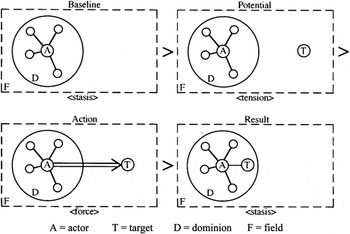
Adopting an ‘embodied’ (for the notion of embodiment see Lakoff & Johnson, Reference Lakoff and Johnson1980, Reference Lakoff and Johnson1999; Lakoff, Reference Lakoff1987, Reference Lakoff, Sanford and Johnson-Laird2003; Grush, Reference Grush2004; Gallese & Lakoff, Reference Gallese and Lakoff2005) approach to cognition and knowledge, Langacker (Reference Langacker1991, Reference Langacker2008, Reference Langacker2009) proposes a conceptual model to represent the scalar gradience of epistemic reasoning. With the term control cycle (2009, p. 130) he refers to a dynamic phenomenon unfolding at any level, be it physical, perceptual, mental, or social. For instance, in terms of bodily functions, feeling hungry and noticing an apple can form a state of tension, which can be resolved by taking it and finally eating it. The result would be a new state of relaxation corresponding to the cessation of hunger. Similarly, on a more social plane we encounter and get to know new individuals, achieving a form of control by establishing relationships with definite expectations and obligations, which essentially – in Langacker’s words – is a way to incorporate and situate individuals in our ‘social dominion’ (2009, p. 259). Finally, and most interestingly, the control cycle often occurs at the cognitive level: we entertain or get to know new ideas and information, and assess them for their possible validity, before resolving this tension of uncertainty by believing them to be either true or false. In other words, the tension of uncertainty between a subject and the information s/he takes into account must be resolved in some way. S/he must thus decide whether to believe that a proposition P is true or false so that s/he can ‘exert epistemic control’ over that particular piece of knowledge. Langacker’s notion of the control cycle seems to be in line with the most influential works in psychology concerning ‘conflict monitoring theory’ and perceptual/informational ‘cognitive control’ (cf. Norman & Shallice, Reference Norman, Shallice, Davidson, Schwartz and Shapiro1986; Desimone & Duncan, Reference Desimone and Duncan1995; Botvinick, Braver, Barch, Carter, & Cohen, Reference Botvinick, Braver, Barch, Carter and Cohen2001; Miller & Cohen, Reference Miller and Cohen2001; Schlaghecken & Martini Reference Schlaghecken and Martini2012; see also Kan et al., Reference Kan, Teubner-Rhodes, Drummey, Nutile, Krupa and Novick2013).
As shown in Figure 1, the control cycle (Langacker Reference Langacker1990a, 2008, 2009) includes four stages: a baseline, a potential, an action, and a result stage. In the initial ‘baseline phase’ an actor (A) has a multiplicity of entities (represented by small circles) under his/her control, which together constitute his/her dominion (D). In the next stage, some target (T) enters the actor’s field (F), which corresponds to A’s scope of potential interaction. At this point a state of tension between the actor and the target has already been created and A must now start to deal with T in some manner. This tension is typically resolved with A exerting some force over T (the double arrow) in the action phase, before incorporating it under its dominion in the result phase.
The control cycle (Langacker, Reference Langacker2009, p. 131).

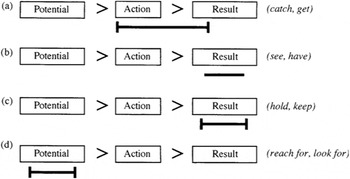
To clarify Figure 1, Langacker provides a sort of metalanguage of the control cycle, showing how the lexical meaning of a verbal construction can actually profile one (or two) of the stages described above. As shown in Figure 2, telic verbs such as catch or get, profile the action together with the result phase of the cycle. On the other hand, absolute states like see or have in (b) or transitory states like hold and keep in (c) encode the resulting stage of the cycle. Finally, predicates such as reach for or look for only profile the potential phase where some tension between the actor and the target has recently been established (see Croft, Reference Croft2012, for a detailed account of the geometrical representation of aspectual construing). In a strictly embodied sense, “some predicates profile bounded actions in which the actor establishes control over the target. Others profile stable situations which result from such actions. Other predicates designate the activity of maintaining control once it has been achieved” (Langacker, Reference Langacker2009, p. 131).
The metalanguage of the control cycle (Langacker, Reference Langacker2009, p. 131).

As can be noted, all the predicates mentioned above mainly pertain to the physical domain. However, as I have already suggested, Langacker goes beyond this by mapping the control cycle model onto a more conceptual scope. The next section will provide a general semantic account of the relationship between epistemic reasoning (the act of engaging in a certain form of belief) and the control cycle.
2.1. the epistemic control cycle
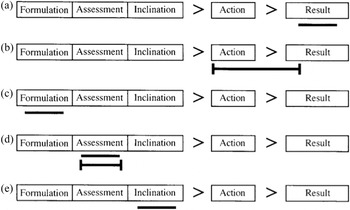
As previously mentioned, the control cycle determines various forms of ‘acquisition’, both at the physical and at the conceptual level. In the latter case, it occurs when an actor (A) is called to add a particular idea or piece of information to his/her current view of reality. As already pointed out, the phase where a new target enters the actor’s field is called the potential stage. Concerning epistemic judgements of any sort, what was previously defined as an actor is reformulated by Langacker as a conceptualizer C; his/her target is now a proposition P; and his/her dominion in this case corresponds to his/her view of reality or epistemic dominion D. Drawing on Sumnicht (2001,) the potential phase of the epistemic control cycle is broken down by Langacker into three successive substages called formulation, assessment, and inclination.
We can speak of formulation when a proposition merely enters the conceptualizer’s field of awareness as something that cannot be rejected outright, and thus has to be dealt with in some fashion. This can lead to active assessment, signalled grammatically by the use of whether in the subordinate clause. Assessment may lead to some preliminary inclination to accept the proposition (or else to reject it).Footnote 5 (Langacker, Reference Langacker2009, p. 133)
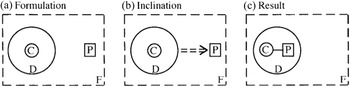
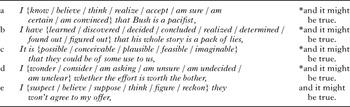
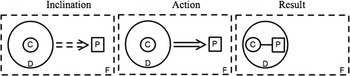
Formulation consists in the introduction of a new proposition P in a discourse without any commitment to it. This stage may lead to assessment, where the SP/W takes into consideration the possibility for P to be true, yet without implying the intention to believe it. Assessment is generally uttered as an indirect question, and is always characterized by the use of whether or if in the subordinate clause. Subsequently, assessment can become inclination, which represents the SP/W’s first active step towards belief. It is at this point that SP/W expresses to the AD/RFootnote 6 his/her intention to possibly believe P to be true. Langacker considers assessment and action as rather transitory states leading quite naturally to adjacent ones. In this sense, as represented more schematically in Figure 3, the three cardinal phases of the ECC can be considered the ones of formulation, inclination, and result.
Formulation – inclination – result (Langacker, Reference Langacker2009, p. 133).

Among them, inclination ideally corresponds to the moment when the conceptualizer C assesses his/her intention to believe P (as represented by the dotted arrow). In the result stage, this new piece of knowledge has become part of C’s epistemic domain D. All the phases of the epistemic control cycle can be profiled by different verbal constructions. They are exemplified in Figure 4.
The epistemic control cycle (Langacker, Reference Langacker2009, p. 132).

As can be noted, mental state predicates of various sorts profile different stages of the ECC. To be more specific, consider the corresponding five types of predicates provided below (Langacker, Reference Langacker2009, p. 132):
(3) a. Result: He {knows / believes / thinks / realizes / accepts / is sure / is certain / is convinced} that Bush is a pacifist.
b. Action: She {learned / discovered / decided / concluded / realized / determined/ found out / figured out} that his whole story was a pack of lies.
c. Formulation: It is {possible / conceivable / plausible / feasible / imaginable} that they could be of some use to us.
d. Assessment: He {wondered / considered / asked / was unsure / was undecided / was unclear} whether the effort was worth the bother.
e. Inclination: I {suspect / believe / suppose / think / figure / reckon} they won’t agree to my offer. Footnote 7
The metalanguage provided by Langacker is useful to describe semantically what can be seen as a conceptual gradience of believing. The dynamic process by which a conceptualizer ‘decides’ to incorporate a proposition into his/her view of reality – hence to believe it to be true – can be schematically divided into several stages of acquisition or REAL-ization (cf. Langacker, Reference Langacker2009, p. 306). From a different perspective, Nuyts (2001, p. 111) argues that epistemic mental state predicates are generally quite vague regarding the strength of the qualification expressed. In Nuyts’ words, they simply indicate a positioning on the positive side of the scale. Although this might be true for predicates in isolation, it must be also observed that the gradience of the ECC is undeniable for more complex verbal constructions (cf. Goldberg, Reference Goldberg1995, Reference Goldberg2006). As an illustration, the initial formulation phase (3c) is always marked by the impersonal pronoun it or by indirect evidential constructions (cf. Tantucci, Reference Tantucci2013, on the relationship between evidentiality and interpersonal/intersubjective semantics). At this initial stage the SP/W has no intention to express any personal epistemic commitment towards P. Similarly, as we noted previously, the assessment phase (3d) is characterized by constructions involving the connectives whether or if in the subordinate clause, hence posing the proposition in the form of an indirect question. On the other hand, the action phase (3b) is often marked perfectively – often encoded in the simple past or in the perfect form together with perfective adverbials – so as to indicate the aspectual completion of the process of believing P. Similarly, the result stage (3a) is generally expressed imperfectively – usually in the present tense – in order to indicate the relaxed state of certainty achieved by the SP/W.
Throughout the whole ECC process, the crucial gradient stage from possibility towards belief is the one of epistemic inclination in (3e). At this point a proposition P starts to be more oriented towards factuality, which means that although P is still not posed as absolutely true, nonetheless SP/W expresses to AD/R a subjective intention to consider it as a fact.
2.2. the ‘inclination test’
To better comprehend the semantics of epistemic inclination, consider the semantic test (still referring to the examples in (3)) I propose in Table 1. The set of propositions in Table 1 has been marked by the final epistemic statement and it might be true. None of the propositions from (a) to (d) are semantically acceptable, whereas the statements expressing an epistemic inclination in (e) are the only logically consistent ones. The reason is that the epistemic expression it might be true is itself a function of epistemic inclination: on one hand it conveys that P is not yet seen as factual, on the other it marks the SP/W’s subjective intention to believe it. The semantic compatibility between P and the final epistemic expression in (e) is in fact due to the positive inclination of the SP/W to incorporate P in his/her view of reality.
Epistemic inclination test

To be more specific, we can now look at the pragmatics of each stage of the cycle provided in Table 1:
[Result]
(4) a.a: I know that Bush is a pacifist.
b*: Might that be true, in your view?
The logical incongruence of the question in (4a *b) is due to the incompatibility between inclination and result. The result stage expressed by a in (4a) corresponds to the final factual phase of the cycle, that is, the SP/W is here dealing with a piece of information that is already part of his/her epistemic dominion or view of reality. From SP/W’s perspective, the fact that Bush is a pacifist is already a true fact, thus it would not make sense for him/her to express the inclination to believe it.
[Action]
(4) b.a: I have learned that his whole story is a pack of lies.
b*: Might that be true, in your view?
Similarly, the proposition uttered by a in (4b) corresponds to the action stage. Here, the SP/W has just reached the certainty that P is real or true. Intuitively, from the SP/W’s perspective it is not logically consistent to express a subjective intention to believe P, as s/he has already reached the conclusion that P is true.
[Formulation]
(4) c.a: It is possible that they could be of some use to us.
b: Might that be true, in your view?
a´*: Personally, it is possible.
In (4c) above, we are back at the beginning of the cycle, which is the first of the three epistemic substages of the potential phase: the formulation. Again, the question asked by b requires an inclinational commitment on behalf of a´. At this point, there is no marked intention to subjectively believe P. In other words, a is not trying to convey any epistemic inclination towards the factuality of P. The co-occurrence of inclinational element might be true and the subjective epistemic adverbial personally require the SP/W’s personal commitment to a ‘likely’ truth which is semantically never encoded in a formulation statement. If a´ wanted to convey inclination, s/he should then abandon the neutrality of his/her original formulation for an inclinational proposition (personally) I think P. Consider now the following assessment stage:
[Assessment]
(4) d.a: I wonder whether the effort is worth the bother.
b: Might that be true, in your view?
a´*: Personally I wonder that/so.
Along a gradient scale of personal commitment to the truth, the SP/W in the assessment stage is taking into consideration the possibility to believe P. Nonetheless, s/he has not moved a single step towards that direction yet, as s/he is just wondering whether to do it or not. The incompatibility with the inclinational might that be true is then easily explained in terms of a mismatch between the mental state of wondering and the one of expressing the subjective intention to believe P. Below in (4e a) I finally provide an inclinational proposition.
[Inclination]
(4) e.a: I suspect they won’t agree to my offer.
b: Might that be true, in your view?
a´: Personally, I suspect so.
In (4e) the question asked by b is pragmatically plausible. In this case, with the epistemic predicate to suspect, the SP/W moves to the inclinational stage of the cycle, namely the one where the SP/W is expressing his/her intention to believe P. This is the reason why, when asked to confirm his/her inclination towards P, a´ can consistently reaffirm his/her intentional belief.
As the test above might be flawed by personal judgements of logical and/or pragmatic acceptability, a questionnaire with the five dialogues above was given to forty English native speaker graduates. The participants were simply requested to judge with a positive/negative answer whether any of the dialogues was unacceptable on a either semantic/logical or a grammatical level.Footnote 8 The results confirmed my speculations: 33/40 (82.5%) of the students marked (4e) as the only acceptable dialogue, 4/40 (10%) of them marked both (4e) and (4c) as acceptable, while the last two (5%) considered (4b–4c–4e) all plausible. As this preliminary test suggests, the semantic and pragmatic incompatibility among the different epistemic phases of the ECC can be identified and analyzed empirically.
To conclude, I have argued in this section that epistemic modality – and epistemicity in general – is a gradient domain, where the commitment to the truth of the SP/W can vary along a continuum. In other words, we do not simply imply whether we believe a certain proposition or not, we rather mark whether we came to the conclusion that P is true (action phase) or we rather express to an AD/H the intention to believe it to be true (inclinational phase), and so on. Belief is a dynamic process along which the crucial phase where a conceptualizer subjectively decides to consider a piece of knowledge as (likely) true is constituted by the epistemic inclination stage. This notion conceptually corresponds to a proper psychological decision (or quasi-decision) made by a subject and will constitute a fundamental concept for my next discussion on factualization.
3. Factualization
In this section I will argue that the ECC is a dynamic process unfolding both synchronically and diachronically. I will argue that the continuity among the different stages of the cycle historically triggers epistemic polysemies in predicates with an inclinational meaning, such as to think, to reckon, and others. Concerning this point, Simon-Vandenbergen (1996, pp. 405–406) points out that I think in different contexts can express lack of commitment as well as certainty. Similarly, Holmes (1990, p. 187) distinguishes between a tentative and a deliberative function of I think, the former indicating a limited commitment to the truth, the latter conveying confidence and certainty (cf. also Holmes, Reference Holmes1984, p. 354). Traugott (1995, p. 38) argues that – especially in the form of a parenthetical construction – I think developed a more subjectified meaning conveying a speaker’s epistemic attitude. Nuyts (2001, p. 113) argues that the verb to think can express either epistemic possibility or certainty.
More specifically, my claim is that to think and similar polysemous epistemic verbs can express in different contexts either inclination, action, or result. This is due to a dynamic gradience among the last three stages of the cycle. In other words, according to the embodied idea of the ECC, the conceptualizer is often ‘inclined’ to exert some control over a particular piece of knowledge: s/he wants to reach the certainty according to which P is ultimately true or not. Interestingly, it is quite common to encounter inclinational verbs covering all the last three epistemic stages of the cycle (inclination, action, and result). However, the same cannot be said for the two initial ones (formulation and assessment). To explain, verbs originally only conveying inclination, diachronically acquire new meanings corresponding to the right end of the cycle. They thus progressively shift towards factuality, as they move from inclination to action and finally result.Footnote 9 On the other hand, we apparently have no examples of inclinational predicates which historically moved in the opposite direction, towards the left end of the scale. That is to say, it is hard to find any example of inclinational predicates which developed through time new meanings of assessment or formulation.
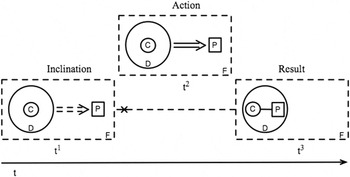
The reason is that the inclinational stage conceptually entails action and then result. When a subject is ‘inclined’ to believe P (P being either a positive or a negative proposition), it is more likely for him/her to finally decide to accept it without reserve rather than questioning ‘ex novo’ its truthfulness. Therefore, the main argument of this paper – and a crucial complement to Langacker’s framework – is that epistemic inclination both synchronically and diachronically triggers factualization, which is here defined as the SP/W’s increasing certainty about the realization of an event or situation. More schematically, factualization is the progressive or abrupt shift from the inclinational to the actional and resultative stage of the cycle. Adopting Langacker’s ECC model, I represent in Figure 5 the three phases of the factualization process.
Epistemic factualization.

As can be seen from Figure 5, the process of factualization involves three stages: inclination, action, and result. The dotted arrow in the inclination stage represents the likely factual (or not-yet-factualFootnote 10) state of a proposition P. At this point the conceptualizer C considers positively the possibility of believing P (and to communicate his/her epistemic inclination to the AD/H). In the action stage the act of believing has just been realized, P has just become factual, and the inclination – previously expressed by a dotted arrow – has become acceptance, now marked by a full arrow. In the result stage P has been incorporated into C’s epistemic dominion D, which stands for his/her view of the world.
As we have already mentioned, the gap between action and result can often be expressed aspectually: the former is generally encoded by perfective constructions and/or telic situation types, the latter imperfectively and/or by more continuous situation types. However, as the corpus data I analyzed will suggest, aspect cannot be considered the only criterion to differentiate them.
3.1. factualization is a form of subjectification
The present description of factualization is in line with the conceptual mechanism triggering language change known as ‘subjectification’ (Traugott, Reference Traugott1989, Reference Traugott, Stein and Wright1995, Reference Traugott and Hickey2003, Reference Traugott, Davidse and Vandelanotte2010, Reference Traugott2012; Traugott & Dasher, Reference Traugott and Dasher2002; Langacker, Reference Langacker and Haiman1985, Reference Langacker1987, Reference Langacker1990a, Reference Langacker1990b, Reference Langacker1991, Reference Langacker, Athanasiadou, Canakis and Cornillie2006, Reference Langacker2008, Reference Langacker2009). Traugott’s and Langacker’s accounts of subjectification present some important differences, the former being more centred on a SP/W’s pragmatic attitude towards P, the latter being more concerned with the deictic construal of a conceptualizer C with respect to an event imagined or experienced. As the present discussion will address subjectification from a diachronic perspective, I will thus pay greater attention to Traugott’s definition, which is more focused on the semasiological reanalysis of a construction or a lexeme L through time (cf. Traugott & Dasher, Reference Traugott and Dasher2002, p. 25). In so doing, I will test in Section 5 the ECC as a method of enquiry for diachronic phenomena of language change and pragmatic–semantic reanalysis. As Traugott points out:
Subjectification is the semasiological process whereby linguistic expressions acquire subjective meaning. In particular, it refers to the tendency whereby lexical material tend[s] to become increasingly based in the SP/W’s subjective belief state or attitude to what is being said and how it is being said. (Traugott, Reference Traugott and Hickey2003, p. 125; see also 1989, p. 35, 1995, p. 47)
Notably, a crucial shift taking place in the subjectification process is the one from a ‘syntactic subject’/‘sujet d’énoncé́’ to a ‘speaking subject’/‘sujet d’énonciation’ (Benveniste, Reference Benveniste and Meek1971 [1958]; Lyons, Reference Lyons, Jarvella and Klein1982; Langacker, Reference Langacker and Haiman1985, Reference Langacker1990a. 1990b). More specifically, one important point emphasized by Traugott is that subjectification involves “strengthening of focus on knowledge, belief and speaker’s attitude towards the proposition” (Traugott, Reference Traugott1989, p. 49). In this respect she first notices that many speech act verbs in present day English can have assertive meaning, “in the sense that they express belief about the truth of the proposition” (p. 43). She points out how in present-day English verbs such as to assume, to observe, to insist, and others can express a non-speech act meaning as well as more subjectified speech-act meanings, the latter conveying the SP/W’s belief towards P. For instance, insist is first attested in the 1590s in the original Latin meaning ‘stand on, dwell at length on, persevere’. Sometime later in the sevemteenth century it starts to convey a new deontic meaning ‘demand that’ (p. 45):
(5) We insisted that when we struck and saluted them, the Frigot should hang out either the French or the English Colours.
(OED: 1676 tr. Guillatiere’s Voy. Athens 17)
A century it is finally attested with the epistemic facet of ‘maintain that’ (p. 45):
(6) I begged a thousand pardons, but insisted it was no more than an ejaculation.
(OED: 1768 Sterne, Sent.later Journ., Case of Delicacy 252)
According to Traugott’s analysis, in (6) the continuative meaning originally conveyed by insist has been subjectified into an epistemic expression. Here the SP/W describes what s/he believes rather than what s/he physically is doing. In other words, according to Traugott, the predicate in (6) no more conveys the physical scenario of someone insisting throughout a discussion, but rather the SP/W’s epistemic attitude towards P (alternatively paraphrasable as I pointed out / emphasized / stressed that it was no more than an ejaculation). At this point, it is clear that, in the epistemic domain, factualization and subjectification are two indicators of the same conceptual phenomenon of embodied control.
The diachronic continuity from the deontic to the epistemic domain for modals and speech act verbs is due to a shift from a ‘physical’ to an ‘epistemic’ scope of the control cycle (see Sections 2–2.1). Deontics typically involve “language as action” (Palmer, Reference Palmer2001, p. 121). The conceptual source of obligation/permission in prototypical deontics is human: “[t]here is some force that is characterised by an ‘element of will’” (Jespersen, Reference Jespersen1924, pp. 320–321). Sweetser (1990, p. 52) also proposes that the epistemic domain should be understood in terms of a metaphorical mapping from the socio-physical world of obligation (the ‘root’ / deontic domain) to the world of reasoning (the epistemic domain).Footnote 11 As Figure 1 will remind us, the real trigger of deontic modality and epistemicity is the actor A’s impulse to exert a control – be it physical or conceptual – over a target T. In this sense, the subjectification of must can be quite revealing. Consider the following couple of examples (Sweetser, Reference Sweetser1990, p. 61):
(7) a.You must be at home by ten. (Mom said so.)
[deontic]
b. You must have been home last night.
[epistemic]
As Sweetser points out, in the deontic usage of must “the direct force of mom’s authority compels you to come home by ten” (1990, p. 61). The SP/W in (7a) is exerting physical control over the AD/H as s/he is trying to affect directly the state of affairs of a target T in the external world. On the other hand, in (7b) must is more subjectified as the SP/W exerting epistemic control over a proposition P. In this latter case, the SP/W is seeking certainty about a proposition P, or to put it differently, is conveying an epistemic inclination towards P. Accordingly, Traugott (1989, p. 43) argues that some modals in English not only show a diachronic shift from non-epistemic to epistemic, but also from relatively ‘weak’ to ‘strong’ epistemicity. Drawing on Visser (1963–73, p. 1700), she crucially notes that epistemic modals such as must or will in English did not acquire a strong epistemic meaning before the eighteenth and the twentieth century, respectively.
What Traugott defines as a shift from weak to strong epistemicity along the subjectification cline is consistent with my more fine-grained notion of epistemic factualization. This seems to confirm important findings in cognitive psychology regarding perceptual and linguistic cognitive control and ‘conflict monitoring theory’ (cf. Norman & Shallice, Reference Norman, Shallice, Davidson, Schwartz and Shapiro1986; Desimone & Duncan, Reference Desimone and Duncan1995; Botvinick et al., Reference Botvinick, Braver, Barch, Carter and Cohen2001; Miller & Cohen, Reference Miller and Cohen2001; Schlaghecken & Martini Reference Schlaghecken and Martini2012), according to which “experiencing [perceptual or linguistic] ambiguity appears sufficient to yield conflict adaptation” (Kan et al., Reference Kan, Teubner-Rhodes, Drummey, Nutile, Krupa and Novick2013, p. 647). In the epistemic domain, uncertainty is itself a form of conflict between two propositions: P is true vs. P is false. In this respect, my claim is that epistemic inclination and factualization correspond to a general embodied impulse to resolve epistemic conflicts in favour either of the former (P is true) or the latter (P is false). In the next sections I will study empirically the diachronic unfolding of factualization and its semasiological effects on epistemic predicates.
3.2. factuality is a gradient notion
As the term ‘factualization’ suggests, factuality is not a dual category opposing a positive pole to a negative one. Factuality is a gradient concept which is often modified by a conceptualizer C’s epistemic attitude towards P. It might then be useful to adopt a specific terminology so as to give an account of the different epistemic polysemies along the ECC and their degree of factuality. More specifically, in the rest of the paper I will use notions such as suspended-factuality, questioned factuality, not-yet-factuality, just-then-factuality, and absolute factuality. In Table 2 they correspond to the five stages of the ECC. As can be easily inferred from Table 2, factuality is encoded differently in every stage of the cycle.
Factual gradience

Formulation – generally expressed by impersonal or indirect evidential constructions – conveys suspended-factuality. At this stage, the SP/W is merely introducing a new proposition P as external information and s/he is not expressing any commitment regarding the factuality of P. At a subsequent stage, assessment corresponds to a way of first considering factuality as a relevant aspect of P. For this reason, it is always expressed in the form of a direct or indirect question and is here labelled as a questioned factual. Inclination, on the other hand, corresponds to the SP/W’s communicated intention to believe P. At this point, P is likely to be soon subjectively factualized, and can thus be marked as a not-yet-factual. Action then indicates that the SP/W (has) realized that P is true; it hence expresses what I call just-then-factuality. Result, finally, refers to the SP/W’s absolute belief towards P and it is here labelled as absolute factuality.
4. From inclination to result: a method of inquiry
In this section I will provide a quantitative and qualitative synchronic methodology useful to determine and quantify the polysemy of an inclinational predicate in a target language.
4.1. the polysemy of inclinational verbs: a quantitative analysis of i think
As discussed in Section 3, mental verbs such as to think, to believe, and to reckon are epistemically polysemous as they can convey in different contexts either inclination, action, or result. In this subsection I will consider a set of examples from the BNC, giving a quantitative and qualitative account of the epistemic polysemy of I think. From a constructional point of view, I think can alternatively occur with adverbials of inclination, result, or action. This is significant as the polysemy of inclinational verbs is most affected by the presence of adverbials of inclination/action/result. To explain, the occurrence of inclinational adverbs such as perhaps or maybe can neutralize the result meaning that futuroids like will or shall might confer to an inclinational verb. Consider the example below:
(8) a. I think the ladies will like it.
b. I think the ladies maybe will like it.
(BNC A0D 2676Footnote 12)
As can be observed, the result meaning potentially conveyed by (8a) is completely turned into an inclinational one by the adverbial maybe, added in (8b). This can be tested by adding an additional result element I’m sure:
(9) a.I think the ladies will like it, I am sure.
b. ?I think the ladies maybe will like it, I am sure.
While in the case of (9a) the result meaning conveyed by I am sure is semantically compatible with the previous predicate, in the case of (9b), I am sure is not semantically consistent with the preceding predicate.Footnote 13 On the other hand, the inclinational meaning of epistemic modal auxiliaries like might or could is not so clearly neutralized by result adverbials:
(10) a.After all that exercise she might sleep too long.
b. After all that exercise she might certainly sleep too long.
(BNC A0R 2196Footnote 14)
Interestingly, as shown in (10b), result adverbials such as certainly or definitely cannot turn the inclinational meaning of might into an absolute factual statement:Footnote 15
(11) a. *After all that exercise she might sleep too long, I am sure (she will).
b. ?After all that exercise she might definitely sleep too long, I am sure (she will).
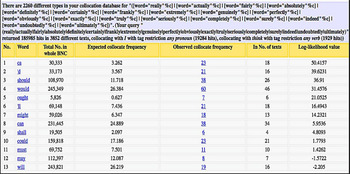
That being said, in the whole BNC inclinational auxiliaries such as might, could, ought, would, should, may and the reduced form ‘d co-occur quite rarely together with result adverbials and predicates of inclination in a sentence. The screenshot in Figure 6 is taken from the CQPweb version of the BNC and shows all the verb auxiliaries co-occurring with result adverbs (really, actually, absolutely, definitely, certainly, frankly, extremely, genuinely, perfectly, obviously, exactly, truly, fairly, seriously, completely, surely, indeed, undoubtedly, ultimately) within a contextual space of one collocate to the left (1L) and five to the right (5R) with respect to the main predicate I think. The adverbs included in the query correspond to all the possible result adverbs co-occurring with I think within a contextual space of one collocate to the left and five to the right (I obtained them from a separate queryFootnote 16).
Modal auxiliaries, result adverbials, and I think as main predicate.

As can be seen, I think collocates 175 times with an inclinational auxiliary (i.e., might, would, could, etc.) and a result adverbial within a contextual space of L1 and 5R.Footnote 17 This number corresponds to 9.072% out of a total of 1,929, as the latter indicates all the co-occurrences of I think together with the same result adverbials within the same contextual space (L1, 5R).
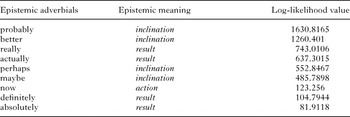
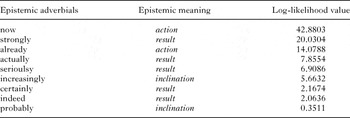
To clarify, what these numbers tell us is that in the whole BNC I think statistically conveys result almost 91% of the times it occurs with a result adverbial. Conversely – as shown in (10a–b) and (11a–b) above – it semantically always conveys inclination when it occurs with an inclinational adverbial. For this reason, from a quantitative point of view, the polysemy of epistemic predicates can be most significantly tested by looking at their statistical co-occurence with various types of epistemic adverbs rather than modal auxiliaries. With this in mind, we can now look at Table 3, which is also drawn from the BNC and shows the nine highest log-likelihoodFootnote 18 values of I think/thought when co-occurring with any epistemic adverbial within the same contextual space (1L, 5R) within a sentence boundary.Footnote 19
Log-likelihood value of I think with epistemic adverbials collocates

In Table 3 we have a list including inclinational epistemic adverbials such as probably, better, perhaps, and maybe, result adverbs like really, actually, definitely, and absolutely, and the adverb of action now. On the basis of their statistical attraction to I think, it is possible to first observe that:
a. I think is epistemically polysemous.
b. I think prototypically conveys inclination.
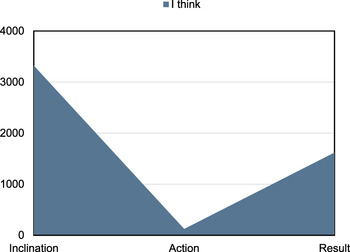
These two conclusions can be better understood by looking at the graph in Figure 7, which represents the sum of the likelihood values of the adverbials of inclination, action, and result appearing in Table 3.
Log-likelihood value of the co-occurrence of I think with epistemic adverbials.

As shown in the graph in Figure 7, the epistemic polysemy of think is disambiguated most significantly with adverbs of inclination, followed by adverbs of result and finally by action adverbs. However, Figure 7 still needs to be taken cautiously, as the log-likelihood coefficient relies on the chi-square distribution for significance testing and is sometimes considered unreliable by some scholars, given the kind of sparse data often encountered in corpus-linguistics tasks (cf. Manning & Schütze, Reference Manning and Schütze2000, p. 175; Weeber, Baayen, & Vos, Reference Weeber, Baayen and Vos2000; Stefanowitsch & Gries, Reference Stefanowitsch and Gries2003). For this reason, I additionally adopted a collostructional approach (cf. Stefanowitsch & Gries, Reference Stefanowitsch and Gries2003; Schmid & Küchenhoff, Reference Schmid and Küchenhoff2013) so as to further investigate the constructional attraction between I think and its co-occurring epistemic adverbials. In particular, their constructional co-occurrence can be most revealing for two reasons:
a. It can give a descriptive (non-inferential) statistical account of the polysemy of I think or other inclinational predicates.
b. It can show on a quantitative level that the factualizing stages of inclination, action, and result can vary along a semantic continuum within a construction.
Briefly, a collostructional analysis always starts with a particular construction and investigates which lexemes are strongly attracted or repelled by a particular slot in the construction (i.e., occur more frequently or less frequently than expected). Lexemes that are attracted to a particular construction are referred to as collexemes of this construction; conversely, a construction associated with a particular lexeme may be referred to as a collostruct; the combination of a collexeme and a collostruct is then intended as a collostruction (Stefanowitsch & Gries, Reference Stefanowitsch and Gries2003, p. 214).
The collostructional strength between a lexeme L and a construction C is generally obtained with Fisher’s exact test (cf. Pedersen, Reference Pedersen1996) and is based on four frequencies: the frequency of L in C, the frequency of L in all other constructions, the frequency of C with lexemes other than L, and the frequency of all other constructions with lexemes other than L. These values can then be entered in a 4×4 table and submitted to Fisher’s exact test (or any other distributional statistic) as exemplified n Table 4.
Collostructional analysis

In our case, L corresponds to the predicate I think/thought, and C refers to an eight collocates slotFootnote 20 (1L, 5R) including a first person predicate and one of the inclinational adverbs probably, better, and perhaps. These three were chosen as they show the highest log-likelihood value as inclinational collocates of I think/thought within the eight-words slot considered (this is shown in Table 5). Finally, the frequency of the d cell was calculated by counting the total number of verb tags in the BNC – as we are dealing with a clause-level construction centred around the verb think (cf. Stefanowitsch & Gries, Reference Stefanowitsch and Gries2003, p. 218) – to which I subtracted the total number of (a+b). As a result, it was possible to measure statistically the two-sided collostructional strength between I think/thought and its most significant adverbial constructions of inclination. The same calculation was also made for the three most significant adverbs of action and result, although in this case it was necessary to subtract all the inclinational auxiliaries both from the frequency of L in C (Table 4, cell a) and from the frequency of C with other than L (Table 4, cell c). The results of this analysis are summarized in Table 5.
I think and adverbial collostructs of inclination/action/result

note: Probabilities dropped below 1E-324; reported values are an upper bound of the true values.
The most significant p-value from Table 5 is 3.654E-320,Footnote 21 indicating that, as would be expected, the ‘real’ (non-inferential) association between I think/thought and adverbial constructions of inclination is extremely strong (cf. Whitley & Ball, Reference Whitley and Ball2002, Loughin, Reference Loughin2004, for some specific discussions about the comparability of p-values and other means of proportions). Nonetheless, the epistemic polysemy of I think/thought is unquestionable, as its collostructional attraction to adverbial constructions of result and action is also remarkably high. This result will appear most revealing in comparison with later analyses. As we will see, while the polysemy of I think shows a fairly balanced proportion with respect to the three epistemic functions of inclination, action, and result, in the case of other epistemic predicates such as I believe or I reckon we will see a more uneven distribution of usages.
In this section I have provided a demonstration of how to carry out a corpus-driven quantitative analysis to look at the polysemy of an epistemic predicate. In the next section I will provide a ‘corpus-illustrated’ (cf. Tummers et al., Reference Tummers, Heylen and Geeraerts2005, p. 234) qualitative methodology to test the polysemy of I think within specific epistemic constructions.
4.2. the polysemy of epistemic verbs: a corpus illustrated qualitative analysis of i think
The qualitative methodology I will provide in this section will serve as a complement to the quantitative study given in Section 4.1 As discussed so far, I think is epistemically polysemous as it can alternatively convey inclination, action, or result. Consider the first inclinational usage below from the BNC:
[Inclination]
(12) I was amazed! It all happened so quickly – sometimes I think it may have been too quickly. The only other experience I had was playing Essie in Shaw's play The Devil’s Disciple at Leeds …
(BNC A06 1681)
In (12) the co-occurrence of I think and the modal may suggests an inclinational stance conveyed by the SP/W. The not-yet-factualityFootnote 22 of P can be confirmed by adding an element conveying epistemic result:
(12) a.*I was amazed! It all happened so quickly – I think it may have been too quickly, (and) I’m certain of it. The only other experience I had was playing Essie in Shaw’s play The Devil's Disciple at Leeds …
The semantic inconsistency of (12a) is due to a mismatch between inclination and result along the ECC. May in (12a) is an inclinational epistemic expressing not-yet-factuality; it hence cannot be coordinated with a construction conveying absolute factuality such as I’m certain of it. The latter is an epistemic result construction, indicating that P has been completely incorporated in the SP/W’s view of the world. The non-acceptability of (12a) constitutes good evidence to consider (12) an epistemic inclinational statement. Concerning this point, it is worth mentioning that in the whole BNC the chunk I think it may never occurs in coordination with a result predicate such as I’m certain appearing in (12a). We can now look at usage of think conveying epistemic action:
[Action]
(13) Then I thought that he wasn’t really there at all, and he wasn’t God but my father, who also wasn’t there.
(BNC G06 1383)
In (13) above the verb to think conveys action as it collocates with the adverbial then – marking the beginning of a new event – and the simple past, which in this construction acquires a perfective reading. More specifically, the SP/W describes the moment s/he realised that P was true, or in other words the moment when P had become a just-then-factual. Consider now the test in (13a) below:
(13) a.Then I thought that he wasn’t really there at all, and he wasn’t God but my father, who also wasn’t there. I was certain of it.
Here I was certain of it is perfectly acceptable due to the fact that the action phase conveyed in (13a) is compatible with result predicates such as I know, I am sure, I am certain, etc. Differently put, along the ECC action directly entails result; iconically one is a continuation of the other. For this reason the just-factuality conveyed by then I thought that … really can easily shift to absolute factuality in I was certain of it. Action chunks such as when I thought / then I thought are found to be followed by predicates of result such as I was certain above. We now look at a result usage of I think:
[Result]
(14) a: I wonder how he would have done in today’s game, do you think there would have been room for him today?
b: Yes, absolutely <pause> I think so Mr Cameron.
(BNC HM5 333)
In (14) to think conveys result. This can be concluded from the use of the adverb absolutely conveying epistemic certainty, entailing that the SP/W is convinced of the factuality of P. The absolute-factuality of (14 b) can be easily demonstrated. Semantically, any inclinational statement can always be mitigated by adding a not-yet-factual element such as but I am not sure:
(14) a.a: I wonder how he would have done in today’s game, do you think there would have been room for him today?
b: *Yes, absolutely <pause> I think so Mr Cameron, (although) I’m not sure.
The logical inconsistency of b in (14a) is due to a mismatch between inclination and result. If an inclinational interpretation were plausible in (14a b), it should then logically co-exist with the mitigator although I’m not sure. However, the incompatibility of the two indicates that (14 b) is an epistemic result statement.
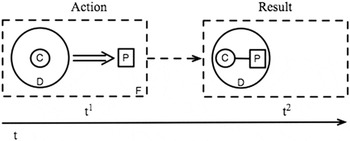
To conclude, we considered in (13a) how action can directly trigger result. However, the same cannot be said for result and inclination: (14a b) shows how the absolute-factuality of result cannot lead back to the not-yet-factuality of inclination. In Figure 8 I provide a symbolic representation of the iconic and temporal continuity between action and result.
From action to result.

Along a conceptual timeline t, a conceptualizer C accepts the factual status of P (just-then-factuality) in the action stage at a certain moment in time t1. Subsequently, in the result stage, at a new point in time t2, P becomes part of his/her epistemic dominion D. Intuitively, action iconically conveys result as t1 and t2 are linked by temporal and logical contiguity as exemplified in example (13a). Consider now Figure 9.
From result to inclination?

As already explained, through the process of factualization, inclination may lead progressively or abruptly either to action or result, but it cannot be the other way round. In other words, an inclinational proposition P can throughout the discourse become action or result. However, a result proposition P cannot be reformulated as an inclinational one. This is not to say that te SP/W will never change his/her mind about a result proposition P. When the SP/W changes his/her mind, s/he starts a new ECC on a new proposition P´ that will take the place of the original P (or even co-exist with it). P´ will then progressively or abruptly factualize running from the left to the right end of the cycle.Footnote 23
Moving back to the unidirectionality of the ECC, Figure 9 represents the incongruity of an inclinational P after a result one. When a conceptualizer C at a certain point in time t3 has the absolute certainty that P is true (the right-hand side of Figure 9), it is then not logically – nor conceptually – consistent for him/her to rephrase P as an inclinational statement. Result at t3 is the temporal and logic endpoint of the ECC; it is conceptually prompted by inclination (t1) first and action (t2) then. In Figure 9, the dotted line running backwards from result to inclination is marked with an ‘x’ so as to indicate the conceptual inconsistency of this passage. Figure 9 is the schematic representation of the semantic incongruity in (14a b*).
4.2.1. Only factualized predicates are epistemically polysemous
The epistemic polysemy of I think or other similar inclinational predicates is due to factualization: a process of semasiological reanalysis of an original inclinational meaning towards action and result (see Sections 3 and 5). While inclinational predicates tend to become polysemous to different degrees, constructions of formulation and assessment are not characterized by such semantic ambiguity. This is easily clarified if we look at the constructional interplay of epistemic adverbials together with verbs or chunks of formulation or assessment. Consider for instance the usage of I wonder from the BNC below:
(15) a.I wonder if she wants to be out of bed this morning, talking to a couple of lunatics, or not.
b. I wonder if she really wants to be out of bed this morning, talking to a couple of lunatics, or not.
c. I really wonder if she wants to be out of bed this morning, talking to a couple of lunatics, or not.
(BNC G27 683Footnote 24)
As already pointed out in Section 2.2, according to Langacker’s account (2009, p. 132) I wonder prototypically conveys assessment. This is evident in (15a) where I wonder appears without any additional epistemic element. That being said, the result adverb really can appear in the complementing clause after the main predicate in (15b) and before I wonder in (15c). Interestingly, in both cases, the assessment expressed by I wonder is not affected by the presence of the result adverbial really. That is, the assessment construction in (15a), is still an assessment construction in (15b–c).
This is a fundamental difference between inclinational predicates like I think or I reckon and formulation or assessment constructions such as it is possible or I wonder. To explain this in more detail – as discussed in Sections 4.1 and 4.2 – the epistemic commitment of an inclinational predicate can often be easily identified by the occurrence of specific epistemic adverbials (from inclination, to action and even result). In contrast, as shown in (15b–c) the meaning of formulation and assessment constructions remains constant even in the presence of epistemic adverbials of any sort. This semantic phenomenon can be easily interpreted conceptually: in the first two stages of formulation and assessment, the SP/W has not yet decided to express a subjective intention to believe P, thus epistemic elements from the surrounding contexts will not affect the factuality of P whatsoever. On the other hand, things change once the SP/W adopts an inclinational stance: it is at this point that contextual elements like modal auxiliaries or epistemic adverbials can determine semantically the affect of the SP/W’s epistemic commitment towards P, and thus determine whether a construction conveys inclination, action, or result.
4.3. the polysemy of epistemic verbs: i believe
Adopting the same quantitative method proposed in Section 4.1, we can now look at the polysemy of the epistemic predicate I believe. Footnote 25 Correspondingly, the data from the BNC in Table 6 below indicate the log-likelihood value concerning the co-occurrence of I believe(d) and epistemic adverbials within the contextual space of five collocates to the right and one to the left:Footnote 26
Log-likelihood value of the co-occurrence of I believe with epistemic adverbials

From Table 6 we can first observe three important phenomena:
a. I believe is epistemically polysemous.
b. I believe most prototypically seems to be an action predicate in its co-occurrence with epistemic adverbials.
c. The overall log-likelihood value of epistemic adverbials co-occurring with I believe (102) is far lower than the one of I think (~5063). The reason might be that the epistemic meaning of I believe in isolation is less ambiguous than the one of I think. The former in fact occurs almost ten times more frequently in the BNC (41,268 > 4,138). Most likely I think is comparatively more subjectified and hence semasiologically more prone to polysemies (see Bybee Reference Bybee, Joseph and Janda2003, Reference Bybee and Cuyckens2007, Reference Bybee2010, on the importance of frequency in diachronic change and phenomena of chunking).
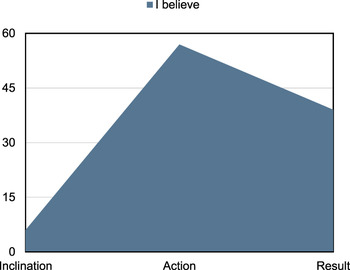
The sum of the likelihood values from Table 6 with respect to the epistemic functions of inclination, action, and result is given in Figure 10.
Log-likelihood value of the co-occurrence of I believe with epistemic adverbials.

As shown in Figure 10, differently from what we observed for I think, I believe appears to be most prototypically marked adverbially with an action meaning, indicating that the SP/W has decided to incorporate P into his/her epistemic dominion. We can verify this result by looking at the collostructional strength between I believe(d) and its most significant collostructs of inclination, action, and result, given in Table 7.Footnote 27
I believe and adverbial collostructs of inclination/action/result

Slightly differently from what emerged in Figure 10, the collostructional analysis shows that I believe(d) is most significantly attracted to constructions of result, giving good reason to consider it a more prototypical result predicate rather than an inclinational or an action one. Nonetheless, I believe still appears to be a polysemous epistemic verb as the p-value relative to action and secondly inclination is still significant (albeit less evenly distributed than the one of I think). We can now test the epistemic polysemy of I believe by first analyzing an inclinational usage from the BNC:
[Inclination]
(16) […] don’t know that I know just the whisky barrels they were, a little I believe there was maybe a name for them.
(BNC G62 701)
Despite the absence of any epistemic modal verb, from a constructional point of view (16) above still conveys inclination. This can be seen from the presence of the minimizer a little and the inclinational adverb maybe. The ‘epistemic-mismatch test’ (the same we used in Section 4.2) can demonstrate this point:
(16) a.* […] don’t know that I know just the whisky barrels they were, a little I believe there was maybe a name for them, (and) I’m sure of it.
Again, (16a) is semantically inconsistent due to the presence of inclination and result elements coordinated in the same statement. Below I provide an action usage of I believe:
[Action]
(17) I now believe that she will give me a lift this evening, and this belief is justified.
(BNC F9K 449)
(17) conveys epistemic action, the adverbial now marks aspectually the act of believing as a new state of mind that the SP/W has just reached. (17) conveys just-then-factuality and as such can lead to a prototypical result predicate:
(17) a.I now believe that she will give me a lift this evening, and this belief is justified. I’m sure of it.
The result element I’m sure of it constitutes the iconic continuation of the previous action statement. After s/he realizes that P is true, the SP/W assesses his/her absolute certainty about P. Finally, we can focus on a result usage of I believe:
[Result]
(18) […] ‘I firmly believe that the brother countries and parties will unite again.’
(BNC FAN 1846)
As firmly is an absolute-factual adverbial,Footnote 28 it therefore conveys epistemic result and is semantically compatible with I believe in (18) above. As we did for I think in Section 4.2, in (18a) below we can test a result construction’s incompatibility with the following inclinational mitigator I’m not sure:
(18) a.[...] *‘I firmly believe that the brother countries and parties will unite again, although I am not sure.’
The logical inconsistency of (18a) shows that I believe in this context unequivocally conveys epistemic result.
4.4 the polysemy of epistemic verbs: i reckon
The third polysemous predicate I will focus on is I reckon. Adopting the same methodology given in Sections 4.1 and 4.3, I provide in Table 8 a first quantitative account of its statistical attraction to epistemic adverbials.
Log-likelihood value of I reckon with epistemic adverbial collocates

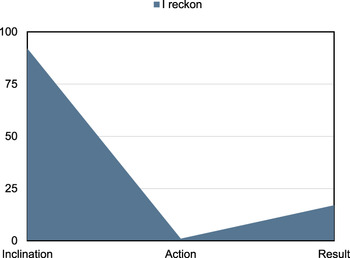
As can be seen, I reckon does not present a rich variety of co-occurring epistemic adverbs. In Figure 11 we can observe the graph summarizing the data in Table 8.
Log-likelihood value of the co-occurrence of I reckon with epistemic adverbials.

Notably, the polysemy of I reckon appears to be extremely unbalanced in comparison with I believe and especially with I think. That is to say, I reckon seems to be most prototypically an inclinational predicate, with weak semantic connotations of action and result. The collostructional analysis in Table 9 might confirm this result.
I reckon and adverbial collostructs of inclination/action/result

As can be noted, there is a marked discrepancy between the most significant p-value of inclination (5.440E-62) and the other two of result and action. From this we can understand that I reckon is most prototypically an inclinational predicate as it still shows a weak polysemy towards the right end of the ECC. If we compare the quantitative distribution of the meaning of I reckon with that of I think, we can observe that the epistemic polysemy of the latter is far more balanced and evenly distributed along the right end of the ECC. One reason for that might be that I think has diachronically factualized towards absolute factuality to a higher degree with respect to I reckon. This speculation is also supported by the remarkably higher frequency of I think in comparison with I reckon, as we should not forget the strong role played by frequency of use in grammaticalization and semantic reanalysis (cf. Bybee, Reference Bybee and Cuyckens2007, Reference Bybee2010). That being said, I reckon to a lower degree is still an epistemically polysemous predicate. In (19) below I provided a first inclinational usage:
[Inclination]
(19) I reckon Crilly might have a better chance.
(BNC HGL 950)
(19) above is an inclinational proposition, overtly marked by the epistemic modal might. This is exposed in (19a) below, where I provide an ‘epistemic-mismatch test’:
(19) a.*I reckon Crilly might have a better chance, (and) I am sure of it.
b. I reckon Crilly might have a better chance, (although) I am not sure of it.
(19a) is not logically consistent as I am sure of it is a result construction which is not felicitously coordinated with the inclinational statement appearing before.Footnote 29 Conversely, (19b) is perfectly acceptable, due to the inclinational compatibility with the mitigator I am not sure of it. This is confirmed by the frequent co-occurrence of the chunk but/although I am not sure of it with immediately preceding inclinational constructions (cf. BNC HGE 1746, BNC K4T 9299, and others). In (20) below, I reckon conveys action:
[Action]
(20) But by then I truly reckoned enough was enough.
(BNC H07 781)
The co-occurring of adverbial then and the predicate I reckoned conveys action, marking aspectually the moment when the SP/W reached the subjective conclusion that P was true. The just-then-factuality of (20) can hence also co-exist with a result construction.
(20) a.But by then I truly reckoned enough was enough, (and) I was sure of it.
Different from (19a) where we observed an epistemic mismatch between result and inclination, the iconic continuity from action to result in (20a) above is semantically consistent. Finally in (21) below, we can look at a comparatively less frequent result reading of I reckon.
[Result]
(21) I reckon he’s <pause> absolutely fantastic […].
(BNC KE3 9030)
Due to the appearance of the absolute-factual adverbial absolutely, one may conclude that the predicate I reckon in (21) conveys epistemic result. This is shown in (21a) below.
(21) a.*I reckon he’s <pause> absolutely fantastic, (although) I am not sure.
The absolute-factual proposition in (21a) cannot be followed by the mitigating not-yet-factual construction although I am not sure. Once again, the epistemic mismatch between result and inclination is easily tested on a semantic–pragmatic level. In addition, on a more quantitative level, the chunk I am not sure never occurs in a sentence following a predicate marked by absolutely in the whole BNC.
In this whole Section 4, I have provided a demonstration of how one might carry out a quantitative and qualitative method to measure and analyze the (possible) polysemies of epistemic predicates along the factualizing right end of the ECC. From what we observed, we can conclude that I believe seems to be most prototypically a result predicate with a quite strong alternative action meaning and slightly weaker inclinational connotation. I reckon appears to be the least polysemous among the predicates I analyzed, as it presents an extremely marked inclinational meaning and quite weak action and result usages. Most significantly, I think appears to be the most polysemous predicate among the ones we observed as it shows a remarkably balanced distribution of usages along the last three stages of the ECC. In the next section, I will argue that the ‘balanced polysemy’ of I think is the result of a unidirectional diachronic process of factualization where, using data from Italian, I discuss a progressive (and still ongoing) shift in meaning from the middle stage (inclination) to the right end of the ECC (result).
5. Diachronic factualization: the italian predicate (Io) penso ‘I think’
In this section I will provide a corpus survey on the factualization process of the predicate (Io) penso ‘I think’ in Modern Italian over the last 150 years. The main aim of this study is to show a progressive diachronic shift from not-yet-factuality to absolute factuality among the usages of (Io) penso. As I mentioned in Sections 3 and 3.1, epistemic predicates in English are amply discussed in the literature from both a synchronic and a diachronic perspective (Visser, Reference Visser1963, Traugott, Reference Traugott1989, Reference Traugott, Stein and Wright1995, 2002, Reference Traugott and Hickey2003, Reference Traugott, Davidse and Vandelanotte2010; Holmes, Reference Holmes1995; Aijmer, Reference Aijmer, Swan and Westvik1997; Nuyts, Reference Nuyts2001, and others). On the other hand, not much has been done for many other of the languages of Europe, especially from a diachronic point of view. For this reason, and in order to demonstrate that factualization is a phenomenon which can be compared cross-linguistically, this survey will be focused on the recent history of the epistemic predicate (Io) penso in Modern Italian. As pointed out by Beckner and Bybee (2009, p. 28; see also Bybee Reference Bybee2010), diachronic reanalysis of a construction can be gradual and not necessarily abrupt, as held by other scholars (see, for instance, Lightfoot, Reference Lightfoot1979; Roberts & Roussou, Reference Roberts and Roussou2003). (Io) penso will be here intended as a construction which is gradually undergoing a semasiological process of reanalysis from a prototypical function of epistemic inclination to the one of result. This survey will give an empirical account of the semasiological development of new epistemic polysemies towards factuality of an inclinational predicate.
5.1. the diachronic factualization of (io) penso
For this survey I consulted the diaCORIS, a balanced diachronic corpus of written Italian texts produced between 1861 and 2001Footnote 30 (Onelli, Proietti, Seidenari, & Tamburini, Reference Onelli, Proietti, Seidenari and Tamburini2006). The corpus includes the five subgenres of press, fiction, essayistic prose, legal-administrative prose, and miscellanea.
There are many caveats to consider in using written data as an account of diachronic change in spoken language (cf. Herring, van Reenen, & Schøsler, Reference Herring, van Reenen and Schøsler2000). Nonetheless, as Traugott and Dasher (2002, p. 46) point out, written language can still constitute an important window to investigate language change. In fact, while innovation is generally a product of online spoken language (cf. Croft 2007, Reference Croft2010), nonetheless “text provides a mode of speech” (Olson, Reference Olson1994, p. xviii), and histories of words and constructions in the development of languages have well-attested [gradient] reflexes in contemporary spoken data, with a definite connection between written and spoken varieties (Biber, Reference Biber1988). Although the selection of specific text-types is one of the advantages of diachronic surveys on written language (cf. Rissanen, Reference Rissanen and Sankoff1986; Traugott & Dasher, Reference Traugott and Dasher2002, p. 47), in the present survey I decided to include all the five subgenres present in the diaCORIS. The reason is that the main aim of this study is to capture a tendency of change, not its origin. More specifically, I was not interested in discovering when Io penso was first used epistemically in the history of written Italian, nor in spotting the text-type that may have prompted such a semantic reanalysis (see Traugott & Dasher, Reference Traugott and Dasher2002). Conversely, my goal was to demonstrate that factualization is a conceptual ongoing process occurring in any phase of the semasiological change of an epistemic construction.
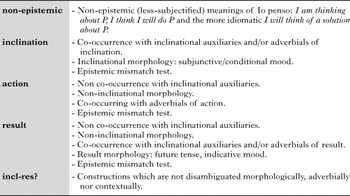
Adopting some of the criteria I provided in the previous sections (summarized in Table 10), I grouped the usages of the two collocates penso ‘I think’ and ho pensato ‘I thought’ into three main categories corresponding to the last three stages of the ECC: inclination, action, and result. All the older non-subjectified usages of the two chunks have been dropped into the ‘non-epistemic’ box, which stands for processual, intentional, and idiomatic functions. These all correspond to non-epistemic meanings describing more objectively the act of thinking, respectively I am thinking about P, I think I will do P, and the more idiomatic I will think of a solution about P. In addition I provided an ‘incl-rec?’ box, referring to all the usages where either an inclinational or a result interpretation were plausible.
Criteria for the study on the diachronic factualization of (Io) penso

The set of criteria in Table 10 were applied to 100 random occurrences (cf. Hoffmann, Evert, Smith, Lee, & Berglund-Prytz, Reference Hoffmann, Evert, Smith, Lee and Berglund-Prytz2008, on randomizing samples from a corpus) in three different time spans: 1861–1900, 1923–1945, and 1968–2001. As I pointed out previously, the present survey is centred on the employment of (Io) penso in the written language. The criteria I provide in Table 10 might be enriched if a similar study was carried out for spoken registers. In fact, marked inclinational usages of (Io) penso might be observed when the verb is accented (rather than the pronoun) or when an unstressed sequence is used as a pre-head in with a discoursal hedge function (cf. Dehé & Wichman, Reference Dehé and Wichmann2010, pp. 62–63, for a detailed account of the prosody of I think and I believe in spoken language).
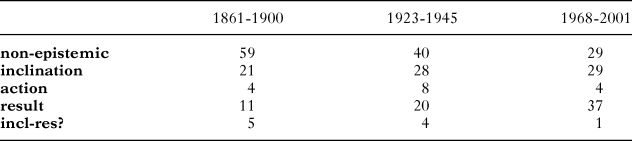
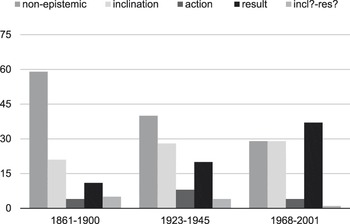
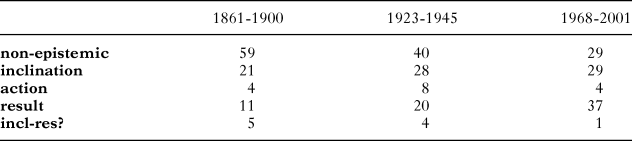
Table 11 summarizes the results of the survey of (Io) penso in written Italian. The two main points of interest for this study were to see if the non-epistemic usages of (Io) penso would decrease (being replaced by more subjectified constructions) and – more importantly – if a factualization process has been actually occurring during the last 150 years. Figure 12 gives a more visual idea of these two phenomena.
The diachronic factualization of (Io) penso
The diachronic factualization of (Io) penso in the diaCORIS.

The y-axis in Figure 12 refers to the frequency of the collocates, whereas the x-axis shows the three time spans considered in the survey. The five columns appear from left to right in each time span and stand for the five categories already mentioned in Table 11: non-epistemic, inclination, action, result, and ‘incl-rec?’.
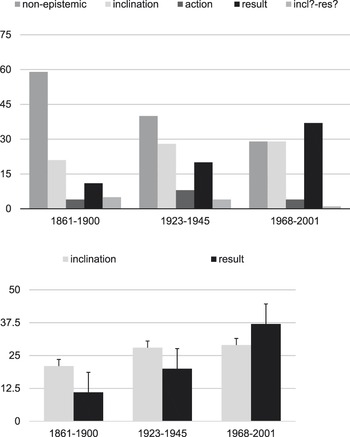
The first important tendency that can be noted is the significant decrease of the non-epistemic usages of (Io) penso: in the first time span they are 59, successively they drop to 40 and finally to only 29. The log-likelihood value for the whole period for this category is 10.44 (p < .01). This gives reason to conclude that Io penso has been notably subjectified (or de-objectified) during the last 150 years in Modern Italian. Regarding the three epistemic functions of inclination, action, and result, we can see that the first two do not show a significant change over the whole period: inclination slightly increases from 21 in the first time span to 28 and finally to 29 (with a log-likelihood value of 1.29), whereas action fluctuates at a very low frequency from 4 to 8 to 4. That being said, most intriguing is the considerable increase of the black column representing the result functions of (Io) penso: from 11 in the first period, to 20 in the second and even to 37 in the last time span, with an overall log-likelihood value of 14.7 (p < .001). This figure gives us reason to conclude that (Io) penso has progressively factualized over the last 150 years in Modern Italian. This claim can be better comprehended if we look at the two functions of inclination and result isolated in Figure 13.
Inclination vs. result in the diaCORIS.
note: Error bars represent standard errors of the mean.

Figure 13 shows that inclination was the most frequent epistemic usage in both the earlier periods 1861–1900 and 1923–1945. However, in the last time-span from 1968 to 2001 result has become the main epistemic function of (Io) penso as it finally becomes slightly more frequent than inclination. Examples (22) and (23) below give an idea of a prototypical inclinational usage in the time span 1861–1900 and a result one in the last period 1968–2001, respectively:
(22) Nel tempo in cui l’ imperatore Enrico soggiogò la Sicilia, era nella Chiesa di Palermo un decano, di nazione, secondo ch ’io penso tedesco.
‘At the time when the emperor Enrico subjugated Sicily, in the Church of Palermo there was a dean, his nationality was, I think, German.’
(diaCORIS – Saggistica – Miti, Leggende e superst. del Medio Evo – Graf Arturo 1892)
(23) Francamente penso che la democrazia deve ora fare il massimo sforzo revisionistico ed evolutivo (a sinistra) …
‘Frankly, I think democracy has now to make a greatest revisionist and evolutionary effort (to the left) …’
(diaCORIS – Miscellanea – Una scelta di vita – Amendola Giorgio 1976)
In (22) io penso is used as an inclinational construction conveying a positive attitude towards the factuality of P (not-yet-factuality), but not an absolute certainty. This can be proved by adding an additional inclinational mitigator such as anche se non ne sono sicuro ‘although I’m not sure’. Conversely (23) is a result statement conveying absolute factuality. In this case an inclinational element like anche se non ne sono sicuro ‘although I’m not sure’ would be logically and semantically inconsistent. Consider the test below:
(22) a.Nel tempo in cui l’ imperatore Enrico soggiogò la Sicilia, era nella Chiesa di Palermo un decano, di nazione, secondo ch ’ io penso tedesco, anche se non ne sono sicuro.
‘At the time when the emperor Enrico subjugated Sicily, in the Church of Palermo there was a dean, his nationality was, I think, German, although I am not sure.’
(23) a. *Francamente penso che la democrazia deve ora fare il massimo sforzo revisionistico ed evolutivo (a sinistra), anche se non ne sono sicuro.
‘Honestly, I think democracy now has to make a greatest revisionist and evolutionary effort (to the left), although I’m not sure.’Footnote 31
Finally, the low fluctuating frequency of the action column may also have a reasonable explanation. Notably, action is a useful category to express metalinguistically when a SP/W subjectively realizes that P is true. That is, action – intended as a conceptual state of mind – can be marked linguistically, either as a perfective or in co-occurrence with adverbials marking a new epistemic state of affairs such as now or finally as we discussed throughout Section 4. That said, in spoken language action can be also felicitously conveyed through prosody or can be directly substituted by result constructions. This implies that, diachronically action is not a half-way stage between inclination and result. Action is beyond doubt a conceptual mid-point between the two. However, the present data suggest that it does not constitute a bridging function between inclination and result historically. In the final analysis, this survey from the diaCORIS shows two related trends:
a. (Io) penso has consistently subjectified over the last 150 years in Modern Italian.
b. (Io) penso has increasingly factualized towards result and absolute factuality.
6. Conclusion
In this paper I have argued that factuality should be redefined as a gradient notion unfolding dynamically through several stages of epistemic commitment towards a proposition P. Drawing on Langacker’s (1991, 2008, 2009; cf. also Kan et al., Reference Kan, Teubner-Rhodes, Drummey, Nutile, Krupa and Novick2013) general notion of the ‘epistemic control cycle’ (ECC), I specifically claimed that epistemic predicates originally conveying weak certainty towards a proposition P diachronically develop an increasingly factual meaning, conveying more and more frequently a subjectified form of certainty. More specifically, I adopted the term ‘factualization’ to describe the cognitive and semasiological process that progressively – or abruptly – leads to a subjective certainty towards a proposition P. Factualization is here intended as a form of subjectification (Traugott Reference Traugott1989, Reference Traugott, Stein and Wright1995, Reference Traugott and Hickey2003, Reference Traugott, Davidse and Vandelanotte2010, Reference Traugott2012; Traugott & Dasher, Reference Traugott and Dasher2002), and it can occur both synchronically and diachronically. The former can develop textually (throughout the ongoing discourse), the latter constitutes the semantic–pragmatic and/or grammatical reanalysis of an epistemic construction. I supported this claim through a collostructional (cf. Stefanowitsch & Gries, Reference Stefanowitsch and Gries2003; Schmid & Küchenhoff Reference Schmid and Küchenhoff2013) and a qualitative analysis from the BNC on the epistemic polysemy of three mental predicates: I think, I believe, and I reckon. From this study, I think emerges as the predicate with the most balanced distribution of epistemic polysemies along the ECC, giving good reason to hypothesize a factualization process from an original ‘inclinational’ meaning to a more subjectified ‘result’ one.Footnote 32 This hypothesis was supported by a corpus survey from the diaCoris on the factualization process of (Io) penso ‘I think’ in Modern Italian during the last 150 years. The results of this study show that the contemporary usage of (Io) penso is notably more oriented towards factuality than what it was 150 years ago.
The theoretical implications of a unidirectional theory on factualization towards belief and certainty are profound. From a methodological point of view, based on Stefanowitsch and Gries’ (Reference Stefanowitsch and Gries2003) collostructional framework, this paper provides a new quantitative and qualitative approach to measure the degree of factuality of an epistemic construction in a corpus on both a synchronic and a diachronic level. To conclude, as these findings are the result of a corpus-based approach to language change on a large scale, further online experimental research on factualization phenomena and more diachronic evidence from other languages would constitute an interesting complement to the present framework.