Inns were at the centre of everyday life in the eighteenth-century British town; if not the most important they were certainly the most useful buildings in town. Most urban institutions, whether the courthouse, church, exchange, assembly room or market place, while central to civic life, had very specific functions and so were only used in specific ways on specific occasions. As buildings, they spent much of their time empty. By contrast, inns were full of people most days because they provided a neutral, flexible gathering space that was available seven days a week. Inns provided warm, dry and welcoming communal rooms with no defined purpose (besides the sale and consumption of alcohol) other than as spaces within which people could meet and spend time together for pleasure or business. The combination of availability and flexibility made them so useful day-to-day that they were considered essential threads in the urban fabric. Adding to this essential everyday usefulness, the inn was also a meeting point for groups going on to somewhere else whether race meets, hunts or as military muster points (or for socializing after), while the flexibility of space inside also allowed landlords to host those temporary activities and events that enlivened the everyday from dances to sporting events, travelling shows and political hustings. Such is their historic significance as enablers of the everyday, this article puts the case that life in the eighteenth-century British town cannot be fully understood without understanding inns.
Looking closer, however, the dominant characteristic of the urban inn is that while neutral in terms of use they were not at all neutral in terms of user; a fact of eighteenth-century life forcibly maintained, reflected and reinforced by the physical fabric of the inns themselves. Seen collectively, licensed premises – inns, taverns and alehouses – were not, as nineteenth-century romantic literature often suggests, democratic spaces where parson mixed with pedlar. Rather, each occupied a clearly delineated position within the social hierarchy; positions maintained through the strict spatial ordering of inns within a town. A typical pre-industrial British town would have had many inns in addition to taverns and alehouses. In 1620, the market town of Devizes, Wiltshire, issued licences for 15 inns, 13 alehouses and 1 tavern, most of which were lined around the central Market Place, a total of almost 30 licensed premises that through strict regulation by the town corporation remained more or less constant through to the late nineteenth century.Footnote 1 Peter Clark classified this mass of inns, taverns and alehouses according to a ‘hierarchy of victualling’.Footnote 2 That is, while inns are distinguished from taverns and alehouses by accommodating travellers as well as serving food and drink and providing sociable space, they were also distinguished by their position at the top of a social hierarchy of licensed premises (with taverns in the middle and the alehouse or common public house at the bottom).Footnote 3 As noted by Clark, just as social distinctions between taverns and alehouses were not always clear, inns were themselves hierarchical.Footnote 4 Some ‘inns’ were humble premises, little more than alehouses with rooms for poor, low-status travellers such as waggoners and drovers alongside sociable space for locals.Footnote 5 Others were large, expensive, luxurious and architecturally ambitious, serving only the upper ranks. Clark calls these ‘county inns’ and those that were ‘marginally less exclusive’, ‘secondary inns’. Footnote 6 However, the term used in the long eighteenth century was ‘principal inn’.Footnote 7 The principal inn was the best inn, or inns, in any given town: the largest, the grandest, most expensive and most exclusive. In Devizes, the principal inns were The Bear and The Black Swan, facing each other across the Market Place (The Bear being the superior of the two). This article is concerned with the principal inn as a lens through which to understand better polite society in the eighteenth-century British town. While the deeply hierarchical nature of that society is well known, this article seeks to demonstrate how hierarchy was encoded and enforced through the manipulation of urban space and the materiality of constantly occupied built spaces.
As with taverns and alehouses lower down the social scale, a principal inn was the gathering space for any of the sociable activities performed by the group it served: from dining, drinking and conversing with friends to commercial activities (from hosting public auctions to private rooms for making business deals), meetings of club and societies, legal proceedings, military musters, political meetings – hustings and campaign headquarters – civic and religious proceedings as well as leisure activities such as dancing or the eighteenth-century craze for billiards.Footnote 8 Bundling together any and all activities involving communal gathering and social exchange – from the exercise of law and government to leisure pursuits – principal inns located polite sociability within a form of built space specifically constructed to enforce social hierarchies, to exclude from the outside while offering an inclusive warm welcome inside.Footnote 9
Whether in the context of travel, commerce, sociability, drinking, law and order or any of the many other daily operations of urban life, most monographs and edited collections on early modern British towns mention inns.Footnote 10 However, despite the plethora of inn-related references, few identify the inn itself as a subject of significance. Here, A.M. Everitt's Perspectives in English Urban History (1973), Peter Borsay's The English Urban Renaissance (1989) and Rosemary Sweet's The English Town (1999) stand out as major studies that recognize the importance of the inn as ‘the focal point of the community’.Footnote 11 Outside of urban history, Peter Clark's The English Alehouse (1983), while more concerned with the history from below of the common alehouse, also recognized the wider social and economic significance of urban inns.Footnote 12 There is also an inn-shaped gap in British architectural history, only partially filled by a handful of regional studies.Footnote 13 This gap can be perhaps attributed to the awkward nature of inns as a building type. Since the 1940s, the study of building form and design has been divided between architectural history, rooted in art history as the study of buildings as authored works of art, and vernacular architecture studies, which focus on anonymous small-scale regional, often rural, buildings rooted in archaeology and folklore studies.Footnote 14 Inns, however, fall between these two disciplines as they are neither major works attributed to significant architects – though they may often be classified as ‘minor works’, such as The Crown in Stony Stratford, Staffordshire, by the society architect Henry Holland – nor are they small rural dwellings but large urban buildings that are at once anonymous, ordinary, everyday and fashionable, accomplished works of architecture.Footnote 15 However, if we look at the production and consumption of built space in terms of its users, the inn moves to centre stage.
The principal inn as polite gathering space
The principal inn existed to serve polite society or ‘the better sort’: a broad subcultural group which on any given evening in the same inn could extend from the parson to merchants, urban professionals and town aldermen upwards through the local gentry, government officials and military officers to elite ‘persons of consequence’, such as county court judges and the aristocracy.Footnote 16 Across relatively substantial gulfs in wealth and status between a parson, a lawyer and a duke, polite society gathered and mixed as a single, self-affirming group within the semi-public space of the principal inn. Drinking venues – inns, taverns and alehouses – have been presented as destabilizing, subversive elements in the early modern town but principal inns were not: they served to support and enforce the social order.Footnote 17
Besides providing sociable spaces to sit, eat and drink, principal inns supplemented or stood in for more functionally specific buildings associated with the social group they served; that is, Anglican churches, courtrooms, town halls, guildhalls, exchanges, assembly rooms, coffee houses, theatres, members’ clubs and subscription libraries.Footnote 18 The George in Stamford, Lincolnshire, for example, hosted cotillions (dances) in its assembly room, served as a bankruptcy court, an auction room, a meeting point for the local hunt and the Stamford races, a barber's shop and, in 1804, a chapel of rest for the body of the duchess of Ancaster.Footnote 19 A small town, such as Topsham, Devon, or Wells-next-the-Sea, Norfolk, may not have had a courthouse or an assembly room but it did have a principal inn – The Salutation Inn and The Crown respectively – while The Union Inn in Penzance, Cornwall, boasted its own theatre. Even if a relatively large, prosperous market town, such as Thirsk, Yorkshire, had a courthouse and assembly room, it also had at least one principal inn – The Golden Fleece – which acted either as a complementary venue, providing judges' lodgings for instance, or in direct competition with other venues. In these examples, sociable space is not the same as ‘social space’ as set out by Henri Lefebvre in The Production of Space (1991).Footnote 20 Lefebvre's model is a Marxist dialectic in which there are always inherent tensions between ‘conceived’ and ‘social space’ where conceived space is imposed hegemonic order and social space is the site of the everyday that resists that imposition. This does not fit with the complicity inherent between space and user within a principal inn where the everyday users are the hegemonic order.
Of course, unlike the tavern or alehouse, the inn also served travellers: food (communal coaching breakfasts and suppers served to coach parties), accommodation (bedchambers) and livery (extensive complexes of yards, stables, smithies, feed stores, workshops for wheelwrights). Inns, therefore, also played an important role in early modern mobilities, as travellers moved from one inn, one town, to the next through the improving and expanding turnpike road network of early modern Britain. Consequently, inns routinely featured in eighteenth-century travel maps and itineraries, such as Cary's 1799 Survey of High Roads from London.Footnote 21 This article is about urban life not mobility and travel but it is important to recognize the dual role of inns in the context of the early modern British town for two reasons: travellers provided an alternate stream of income that allowed innkeepers to maintain good rooms, menus and wine lists of a quality that elevated their inn beyond what would be possible from an entirely local customer base (allowing local customers to have a more refined experience than income from local only sales would have supported); and inns allowed locals to mix socially with travellers, thus providing an important site for cultural exchange, which located individual inns and inn-goers within a wider national elite culture. Inns functioned differently in large cities, particularly the metropolis of London. Here, a much greater population and a much greater number of travellers supported a different system for spaces of hospitality, whereby sociable gatherings for polite city-dwellers took place in taverns (no overnight accommodation) while travellers stayed in one of the large-scale inns that clustered around central transit hubs, such as The Old Nag's Head, Leicester Square, The Bull and Mouth, Piccadilly Circus, and the termini of the great roads such as The Angel, Islington, on the Great North Road or The Elephant and Castle, Southwark, on the Great West Road (inns that bequeathed their names to the areas of London that they occupied). These provided food, drink and a bed to travellers in buildings that were distinct from the sociable dining and drinking rooms provided by elite city taverns such as The Mitre, Holburn, or The City of London Tavern, Bishopsgate.
Dissecting polite society further, in larger towns there was often more than one principal inn. These acted in competition with each other and constantly vied for top position with finer interiors and finer dining. Equally, established inns could fall out of favour when considered not to be properly maintained or updated. A choice of principal inns in town meant that inn-goers fell into partisanship with different establishments serving different subcultural groups and activities within that town's polite society: one Whig, one Tory; one legal and civic, one leisured and one sporting. Yet, embodying the hierarchical nature of polite society, there was always at any one time one foremost within an urban group of principal inns, the biggest and grandest in town; in Devizes, Wiltshire, for example, The Bear stands across the Market Place from its slight social inferior, The Black Swan. The specific targeting of the better sort by the innkeepers of principal inns is clear from newspaper adverts. For example, in 1755, Robert Bragg placed the following, well-aimed advertisement: ‘NOTICE is hereby given, THAT the Angel Inn in Grantham, in the County of Lincoln. . .is now taken, and compleatly fitted up in the genteelest Manner, by ROBERT BRAGG; where all Noblemen and Gentlemen, who please to favour him with their Custom, may depend on meeting with good Entertainment and civil Usage.’Footnote 22
Hosting both informal male gatherings in small private groups and the formal meetings of so-called ‘tavern clubs’ and other societies – notorious for their organized drunkenness – the picture might be painted that within polite society the principal inn was a very male place within a wider history of polite masculinity; one of a number of predominantly male sociable spaces maintained for men to mix outside of the private family home.Footnote 23 However, this picture does not take account of the women also attending meetings, dances, performances and exhibitions, dining in mixed groups in the public rooms downstairs or the relatively large number of elite female travellers who would have been a constant presence in parlour, lobby and coach yard and on the stairs and corridors that led to bedchambers. That is, while male drinking clubs were a common and colourful feature of inn-life they were but one of the many activities hosted by an inn, most of which involved women.
It is also notable that many innkeepers were women (gentlewomen). This is apparent in the high number of widows named in licences and advertisements (suggesting many more ran inns under their husband's name).Footnote 24 Women were associated with the hospitality trade across the social scale in the eighteenth century (though by no means restricted or limited to it).Footnote 25 For instance, a 1791 advertisement in the Leinster Journal for The Kilcullen Inn, Co. Kildare, Ireland, reads: ‘Ann Hackett, widow of the late James Hackett, begs leave to inform her friends and the Public, that she continues the Business at said House, and has laid in an assortment of wines of the very best quality.’Footnote 26 Ann Hackett is not merely continuing, she is developing the business. Moreover, whether under the name of a male or female innkeeper, many inns were family businesses run by many hands, male and female, across generations of the same family. To take two examples from Yorkshire, The Golden Fleece in Thirsk was owned and run by generations of the Hall family while the Hirsts ran The Golden Lion in Northallerton.
A final point on principal inns and polite society is that, whether a man or woman, the prosperity of a large principal inn meant that innkeepers and their families were themselves members of a town's polite society. For example, the innkeeper at The George, Grantham, built in 1792 to rival The Angel across the road, was the former head waiter at White's, the exclusive gentleman's club in London, and went on to become a prominent figure in Grantham life, while the innkeeper of The George in Stamford, Lincolnshire, was town mayor. Used, occupied and owned by the better sorts in town, in providing essential – and exclusive – physical space for the performance of polite sociability, the principal inn enabled that group to locate themselves securely within a town's social ecology and, more broadly, within the cultural space of British polite society.
The principal inn at the centre of urban space
As the foremost gathering space for polite society, the principal inn was part of the authoritarian discourse of the eighteenth-century British town whereby social power hierarchies were mapped out in physical urban space.Footnote 27 Extensive fieldwork of over 300 inns throughout the British Isles has identified that every British town surveyed has or had a principal inn located at the centre of town. The premises of former inns often remain, re-used as shops, offices or flats. The town centre was a space of elite power; the physical location of the principal inn within that space corresponds to its central location in the culture of polite society.Footnote 28 At the centre of many small towns, it is often the only building of note besides the church, such as: The White Hart, Welwyn, Hertfordshire, or The Unicorn, Bowes, Cumbria. In larger towns, a principal inn is not just at the centre of town, it is consistently at the centre of a spatial network of civic buildings grouped around the market place or town square.Footnote 29 The market place, an area of the high street if not an actual square, was the central public space in town but it was not free from control and imposed order. The occupation and use of the market place itself was strictly regulated by the town corporation, or equivalent body, and overseen by town officials; civic authority over the space was often marked by a market-cross monument.Footnote 30
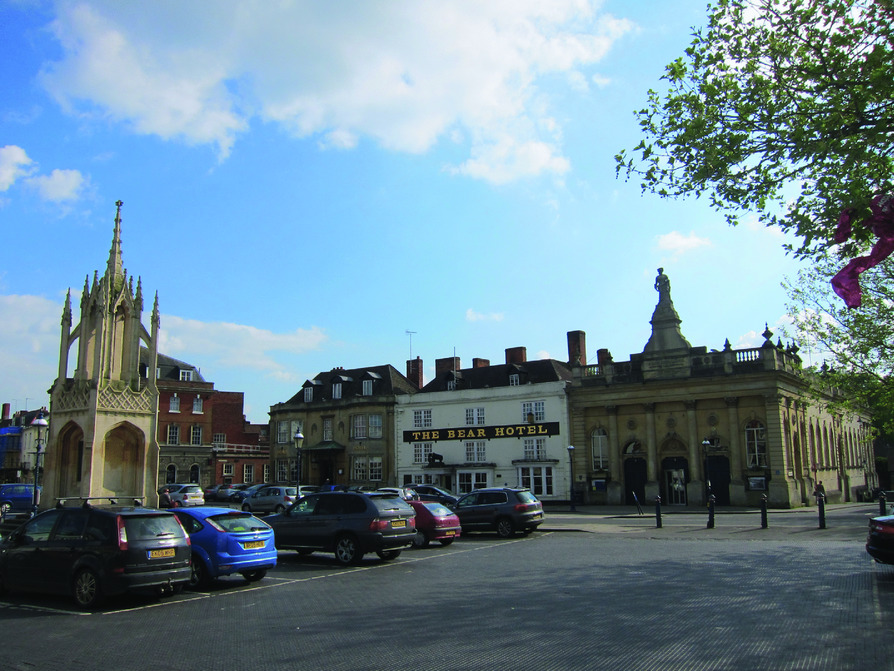
Besides shops and high-status townhouses, the rim of a typical market place is lined with often eighteenth-century buildings that housed powerful institutions: the exchange, market house, town hall, guildhall, church, courthouse, bank or assembly room.Footnote 31 This reflects a programme of Georgian urban civic development described by Jon Stobart, Andrew Hann and Victoria Morgan as ‘building the set’.Footnote 32 Not noted is that a principal inn is always part of the set.Footnote 33 To take some randomly selected examples from across Britain: The Castle Inn, Windsor, described by Karl Moritz as ‘a very capital inn where I saw many officers and several persons of consequence’, is located on the High Street close to the castle, church, Market Street and directly opposite the Guildhall; in Pontefract Market Place, Yorkshire, The Red Lion stands between the market hall and town hall and close to the church and Butter Cross or dairy market hall (marked Market Cross on map); in Crickhowell, Powys, The Bear is across the square from the courtroom, corn exchange and market hall; while The Bear, in Devizes, stands on the Market Place next to the corn exchange and across the square from the market house and bank (Figures 1 and 2).Footnote 34 A comparable arrangement is found at port towns where space is arranged around the harbour or waterfront. In early eighteenth-century King's Lynn, Norfolk, The Duke's Head stood opposite the customs house on Tuesday Market Place, a short walk down King Street to the exchange on Purfleet Quay. In Plymouth, The Fountain Inn in Devonport served officers of the Royal Navy and the local gentry while the equally substantial Three Crowns served the merchants of Sutton Harbour from its wharf-side location next to the customs house.Footnote 35
The Red Lion, Market Place, Pontefract, Yorkshire. Marked on Ordinance Survey, 1:2500 County Series 1st Edition, 1893 (© Crown Copyright and Landmark Information Group Limited (2017). All rights reserved)

The Bear, Market Place, Devizes, Wiltshire, 2017 (author)

The principal inn served the same officials, merchants and persons of consequence that populated the civic buildings it was in proximity to, while in small towns it provided the actual venue for those activities. It provided the rooms for social gatherings before, after and in-between those activities. Serving breakfast, lunch and dinner, during a court session or on market day, the inn constantly connected the surrounding civic buildings through the flow of important people within the Market Place crossing from one key building to another. As such, the sociable space of the principal inn was the linchpin that held the spatial power network of the early modern town centre together. Principal inns are also found at the centre of early modern resort towns where they provided accommodation and, importantly, sociable space for a transitory population devoted to specific leisure activities, such as The Rutland Arms, Newmarket (racing), The Crown and The White Hart, Harrogate (spa), The Castle, Brighton (sea bathing) or The Athol Arms, Dunkeld (Scottish Highland tourism).Footnote 36 At these destinations, the inn acquired a slightly different role, serving neither locals nor travellers en route but providing short-term accommodation. As travel was slow and expensive, eighteenth-century holiday-makers were exclusively elite and they spent extended periods at destinations from weeks to months. Accordingly, at spa and resort towns inns competed with a thriving market in rentable lodgings. It is perhaps at these resorts – where guests behaved differently, lingering and lounging over extended periods – that the notion of the inn as destination-hotel began to take shape.Footnote 37
Such was the commercial, civic and cultural value placed on a principal inn that planned towns laid out in the long eighteenth century almost always featured an inn, often built before or in place of any other public/civic/leisure buildings. Subsequent urban developments – the building of church, courthouse, exchange, assembly room – never superseded the inn; if a town had a principal inn, it could function without any one of these but not vice versa. Accordingly, the same spatial relations identified in the historic British market town can be found at these sites. The inns built by landowners as the centrepiece of their estate model towns and villages stand out for their architectural ambition as statements of the good taste, wealth, hospitality and hegemony of the estate owner; inns such as The Harewood Arms, Harewood village, Harewood, Yorkshire (Edward Lascelles, First Baron Harewood); The Victoria Inn, Holkham, Norfolk (earl of Leicester); The Downshire Arms, Hilltown, Co. Down, Northern Ireland (marquis of Down); The Boar's Head, Ripley Castle, Yorkshire (Ingilby); or The Bunch of Grapes, Chatsworth, Derbyshire (duke of Devonshire). On the grandest scale, in the West Highlands of Scotland the fourth and fifth dukes of Argyll built the set when laying out Inveraray on Loch Fyne from the 1760s: courthouse; jail; church; and the loch-front suite of chamberlain's house, town house, town entrance screen and, dominating the main approach to town and castle, The Argyll Arms.Footnote 38
In Devon, in south-west England, in the early nineteenth century the dukes of Bedford built a new square and civic buildings for the historic mining and market town of Tavistock immediately to the east of the town's existing medieval market square. This was intended to create a new civic centre that superseded the old commercial town centre (which already had a principal inn, assembly room and corn exchange). As a site of law, order and societal control – a civic piazza, not a market place – Bedford Square was a political act by the Bedford estates. At the centre, in place of a market cross, stands a statue of Francis Russell, seventh duke of Bedford. From his plinth, he oversees an architectural group around the square comprising a jail, courthouse, town hall, library, estate office and a very large inn, The Bedford Arms. The Bedford Arms, next to the Bedford estate office and overlooking the courthouse and statue of the seventh duke in Bedford Square, was deployed by the Russell family to lure Tavistock's polite society away from their historic centre to the Russell's new centre as part of a strategy to manipulate and control urban space and the people who used it.
Politeness as a representation of power
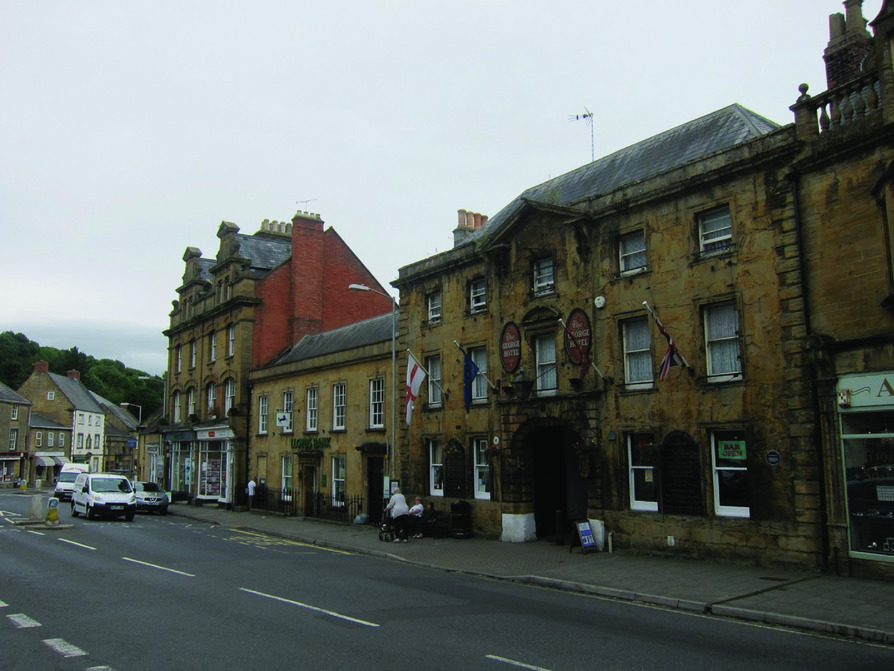
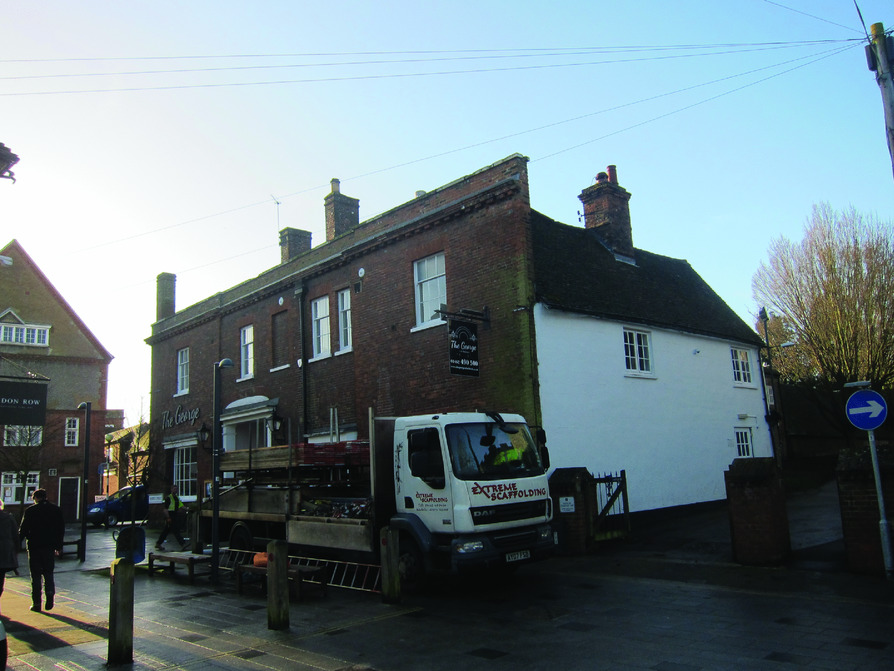
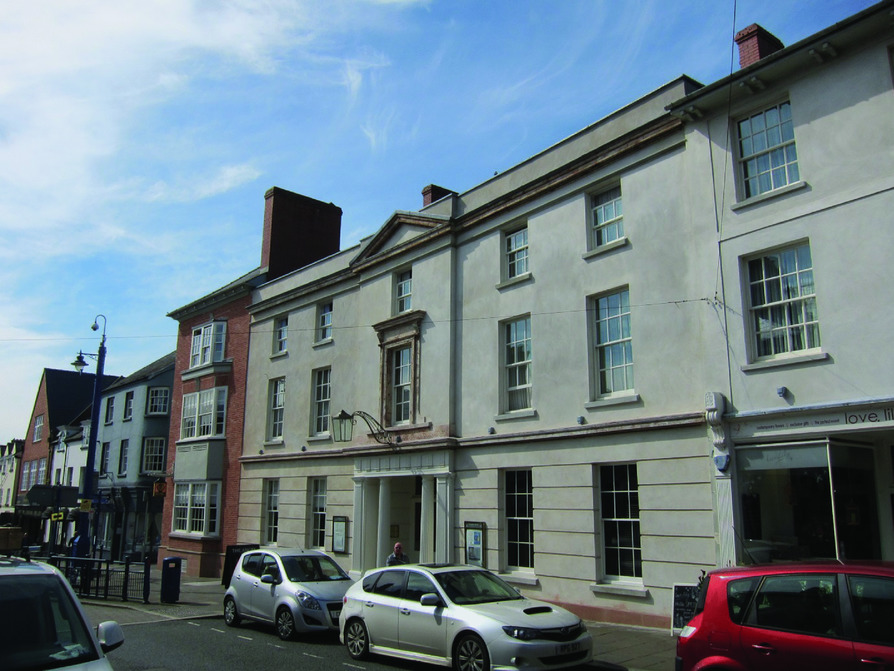
As part of ‘the set’, the principal inn was always the best inn in town, comparable in size and prominence to one of the neighbouring civic buildings. However, seen from the street, to signify the exclusive polite space within – and politeness as a physically bounded spatial practice connected to the display and enforcement of power – a principal inn such as The George in the small Somerset market town of Crewkerne needed not just to be large but architecturally accomplished as a demonstration of the polite art of good taste (Figure 3).Footnote 39 Style – the specific forms, materials and decoration of the things made and used by different societies and cultures – maps and groups those cultures in time and space.Footnote 40 If, as Jonathan Barry argues, identity in eighteenth-century Britain meant belonging to a social group, then common standards in designed things helped to define (and control) position within and between those groups.Footnote 41 Closely aligned to the notion of politeness, the appropriateness of the objects and goods a person owned, used and was seen in and around was defined by decorum which, as Amanda Vickery defines it, ‘held that all should behave strictly according to rank, station, age, gender and occasion’.Footnote 42 In architecture and design, decorum was interpreted as the ‘keeping of a due respect between the inhabitant and the habitation’.Footnote 43 Decorum was both inclusive and exclusive, connecting those within a group and excluding those outside it.Footnote 44 For most of the eighteenth century, the upper ranks of British society marked out their material world through the forms and decoration of (neo)classicism (the early modern European interpretation of the architecture and design of ancient Rome): that is, the buildings they intentionally occupied and the things they intentionally picked up, sat on or looked at were classically styled. For that group, classicism was a universal visual grammar that represented modernity, fashionability, good taste and decorum. Accordingly, it is no surprise that classicism was almost universally employed in the design of new principal inns and in the common eighteenth-century practice of re-fronting old inns. Indeed, many modern-looking eighteenth-century inns such as The Angel in Abergavenny or The George in Baldock, Hertfordshire, are in their bones medieval or Tudor buildings re-fronted and fitted out in the eighteenth century to hide the old in order to meet new expectations and standards of taste as part of the continuous process of adaptation that is fundamental to the longevity of British inn (Figure 4).Footnote 45 Collectively, the common, classical, visual language of ‘the set’, including the principal inn, asserted not only the authority of an urban elite but the coherence of that authority in all areas of town life from law and order to commerce and leisure.Footnote 46 As with other prominent civic buildings, an architecturally significant inn also served to assert the town's identity; as the fifth duke of Argyll wrote to his chamberlain James Maxwell in 1789 regarding the new town of Tobermory, Isle of Mull: ‘a building that ought to be very particularly studied and attended to. . .strangers will of course set the edge of their criticism upon the Inn in the first place’.Footnote 47
The George, Market Square, Crewkerne, Somerset, 2016 (author)

The George, Hitchin St, Baldock, Hertfordshire, 2015 (author)

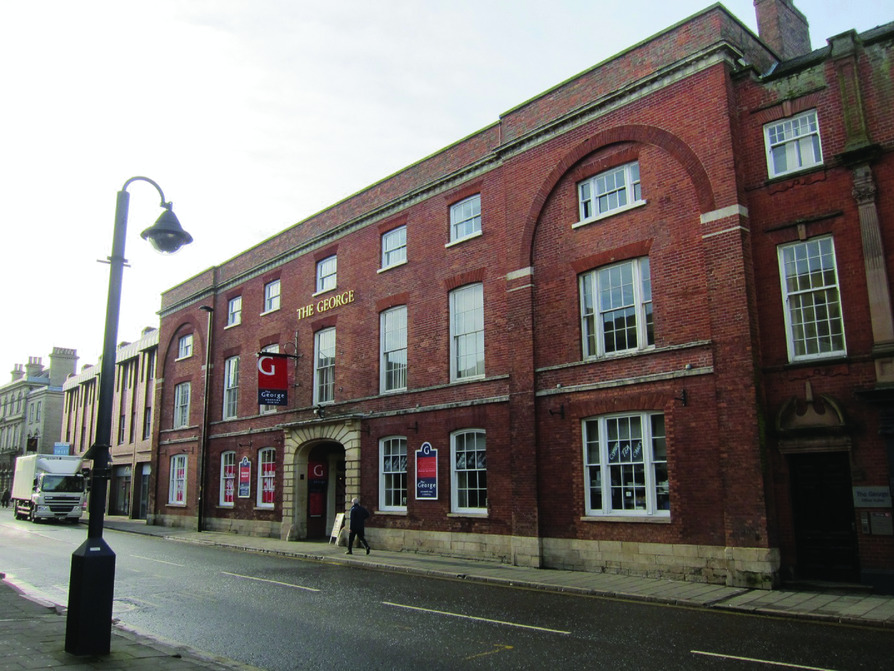
Dominating the High Street, The George, Grantham, was purpose-built in 1792 (Figure 5). As discussed, it was built in direct competition to the long-established Angel and Royal across the road; therefore, first impressions mattered. In contrast to the ancient-seeming, Tudor block-work of The Angel and Royal, to the classically informed, polite inn-goer, the front of The George would have visually communicated that the new inn in town was a modern, fashionable and polite place. By appearance alone (even when close enough to do so, people rarely touch the outside of a building), a person of consequence would know immediately it was their sort of place. Indeed, far too large for the merchants and gentry of Grantham alone, it was built to attract the highest-ranking elite travellers moving along the Great North Road between London and York. In the same manner, fine ashlar stonework, refined proportions and neoclassical pilasters assert the presence of The Angel in the centre of Abergavenny, Powys (Figure 6). In this respect, the doorway of the inn was an important social threshold: not just a physical entrance, or barrier, but a carefully nuanced social statement expressed in the architectural devices – pediments, columns, pilasters – that cluster around it. Classicism immediately anchored polite inn-goers in a known world; it promised a familiar environment within which sociable activities would be performed according to known rules. As such, when building or refurbishing an inn every spatial and material aspect had to be appropriate to the status of its intended guests whether aldermen or earls. Comparing the white stone front of The Angel, Abergavenny, with the red brick of The George, Grantham, highlights the multi-centred, regional nature of eighteenth-century building practices and serves as a metaphor for the regionally constructed nature of polite culture in eighteenth-century Britain, whereby the universalist trajectory was constantly tempered or hybridized, through regional practices. Equally, within a wider world of classical design, the unique forms of individual inns also suggests the importance of pride and competition between inns and between towns.Footnote 48
The George, High St, Grantham, Lincolnshire, 2015 (author)

The Angel, Cross St, Abergavenny, Powys, 2016 (author)

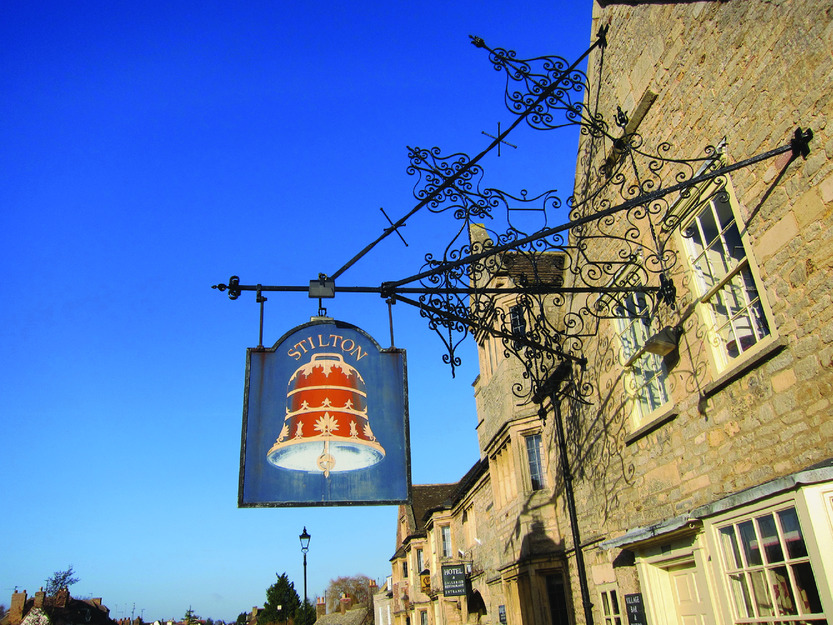
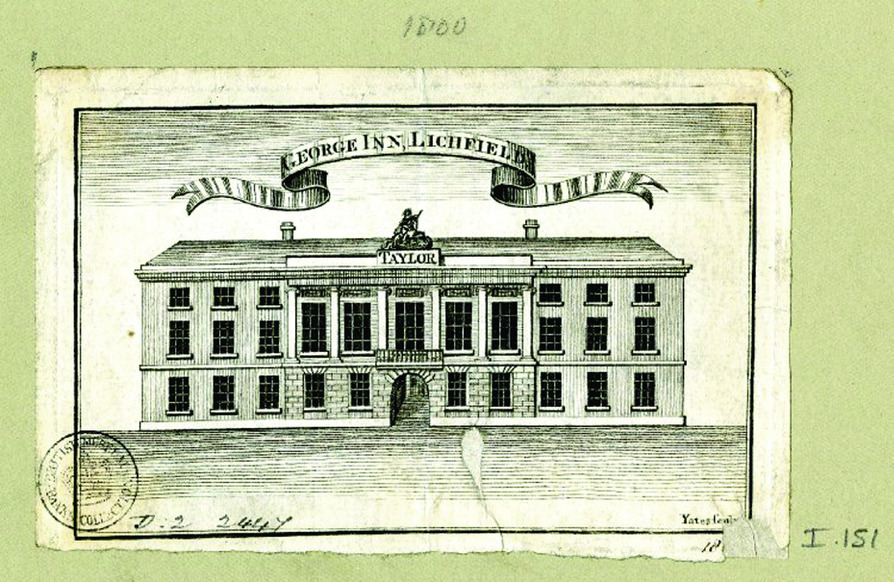
If the architectural frontage of an inn was deployed as a social signifier, inns also projected their message into urban space through the literal use of signs: substantial hanging signs with elaborate brackets, posts and statuary.Footnote 49 Projecting, hanging shop and trade signs were endemic in the eighteenth century, cluttering the space above Britain's streets.Footnote 50 Inns, however, excelled in the craft of spatial projection, extending beyond the common hanging-board sign to street-spanning beam-signs as at The George in Stamford, Lincolnshire; elaborate ironwork as at The Bell, Stilton, or The Red Lion, Salisbury; or object-signs such as the crown outside The Crown, Guildford (now a NatWest bank), or the eponymous Golden Fleece, Thirsk, Yorkshire (Figure 7). Until the mid-nineteenth century, a statue of a bear eating a bunch of grapes stood on a double-column in the centre of Devizes Market Place to advertise The Bear. In addition, beyond its immediate physical location, the image of the inn was projected out into the world through illustrations in guide books and trade cards circulated from hand to hand, inserted in pocket-books and thrown away. Trade cards typically declared the name of the innkeeper alongside an image of the sign and/or inn front as per the trade card for The George, Lichfield, Staffordshire (Figure 8).Footnote 51
The Bell, Stilton, 2016 (author)

‘Trade card of Joseph Burton, George Inn, Lichfield’, later eighteenth century (British Museum)

Peter Borsay suggests that the architectural presence of these relatively grand buildings was intended as a statement of the wealth and success of the innkeeper.Footnote 52 However, while a townhouse can be interpreted as an act of self-fashioning by the homeowner(s): that is, the ‘self-conscious generation’ and display of ‘personhood’ beyond their person and into the rooms they own and occupy; inns are more complicated.Footnote 53 An inn was neither a private residence nor a public building but an in-between, semi-public space operated, though not necessarily owned, by the innkeeper. Self-fashioning, therefore, played a smaller part in the making of a principal inn as innkeepers also had to ensure their buildings met the expectations of the right sort of inn-goer. As such, the presence projected by a principal inn can be understood as both a statement of the status of the innkeeper and a carefully constructed image of politeness created by the innkeeper not only of themselves – their own domestic tastes – but of, and for, their intended customers. Outside, physically and culturally principal inns dominated urban space. In a small town, the principal inn may have been the only prominent building on the high street. In larger towns, it was the linchpin for a group of elite civic spaces that controlled town life from their central location around the rim of the market place. From the street, a principal inn always had an imposing physical presence; equal to or exceeding the monumentality of its civic neighbours and the townhouses of the local urban elite. For the members of polite society this was a promise of elegant interior spaces and fine dining in the company of the right sort of people.
An inclusive world of interiors
Every town in the British Isles had a principal inn standing prominently at its centre, its architectural frontage welcoming or excluding according to the rank of the observing passer-by. Once inside, design continued to be deployed as a social tool. More than empty containers for sociable activities, the interior spaces within a principal inn not only controlled how those activities were physically performed through the size, shape and sequencing of rooms they also used the forms, materials and decoration of rooms, fittings and furniture to control how those spaces were understood; creating an interior the inn-goer would immediately associate with the classically contoured world of polite society. In these spaces, carefully chosen things – tables, plates and glasses – were animated by use in the consumption of food and drink from carefully chosen menus and cellar lists. Here, accessed only by the intended users, the message was inclusivity, familiarity and pleasure: the confirmation of a common cultural identity through immersion in interiors constructed to reflect and reinforce shared tastes and values. In turn, these carefully constructed interiors provided the appropriately dressed stage for the performances of equally carefully and appropriately dressed actors: the inn-goers, but also the innkeeper and liveried waiting staff. While servants and the working spaces of kitchen, cellar and yard they occupied are not the subject of this article, it should be borne in mind that for those ‘other’ people inside a principal inn it was a very different experience from that of the polite inn-goer and its material world would have held very different meanings. Servants and the backspaces of inns remain under-conceptualized and will be the subject of further study.
The totality of the experience inside a principal inn is described by early modern writers from Fynes Moryson to Robert Burns as ‘good cheer’.Footnote 54 Good cheer is the welcoming atmosphere that comes from a well-lit, well-furnished room, a warm fire, familiar noises, familiar smells, good food and drink, good company and a friendly innkeeper. A principal inn offered good cheer for the better sort. Assembled from the transitory interactions between people, built spaces and things (walls, floors and doors, plates, glasses and bowls), understanding polite inn-going centres on good cheer as a set of enjoyable (familiar) immersive experiences that brought together the conceptual or cognitive space of the polite social imaginary with physical space and the materiality of its enclosing structures and surfaces; with the people and things inside those buildings and the intangible world of touch, taste and smell.Footnote 55 It is a history of human bodies spending time within a particular spatial environment, exploring the ‘connections between activity and ideology’.Footnote 56 However, in contrast to a domestic interior, it was also the case that inns were semi-public commercial premises. Like shops, they traded in consumable goods – food, drink, hay – but, more fundamentally, where consumption was itself ‘a dynamic and creative act’, inns traded in the consumption of these immersive experiences, in the consumption of good cheer.Footnote 57 Accordingly, dependent on positive customer choice, maintaining standards was crucial to trade; a principal inn that was considered to have poor or declining standards of good cheer was quickly noted by diarists. For example, John Byng, later Viscount Torrington, found the substantial White Hart at Ampthill, Bedfordshire, ‘a mean miserable inn’.Footnote 58 However, through the exercise of consumer choice (migrating to new inns and precipitating the refurbishment of old inns), the urban inn-goer was largely assured of a high-quality experience. The real risk came when they ventured out on to the open road where they could be forced by bad weather or poor planning to stop at a common inn. Here, they were exposed to the dingy interiors, poor service and disappointing food that defined budget hospitality.
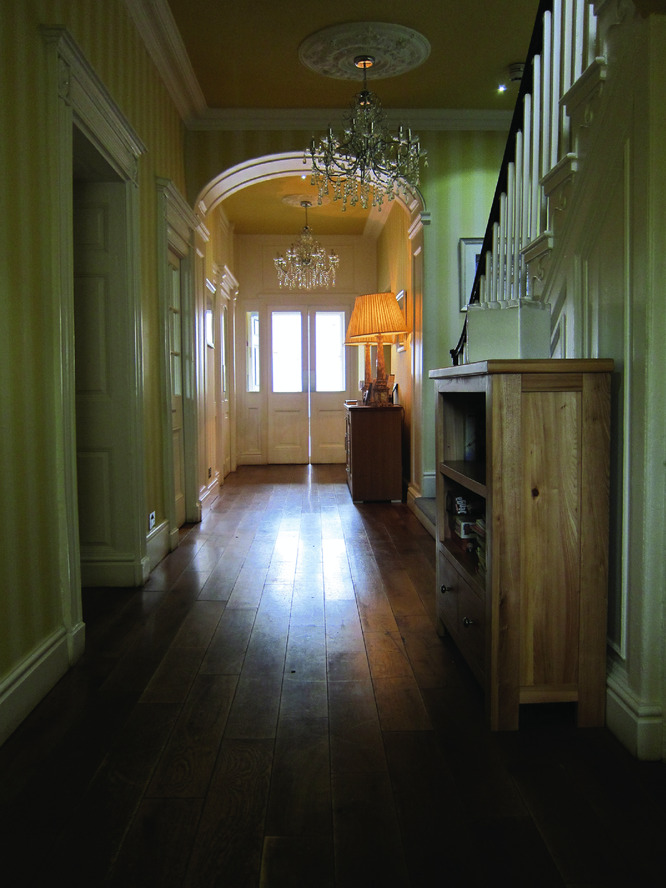
The sociable spaces inside a principal inn included rooms such as a parlour(s), a taproom, additional rooms for private hire and, often, an assembly room. These rooms were supported by the service or back space of kitchens, cellars, brew-houses, bake-houses, coach yards and stables (and the people who worked in those back spaces). A common spatial arrangement can be seen in the plan for the inn at Tobermory built in 1790 (Figure 9).Footnote 59 Of a relatively modest size, typical of a small-town inn, the plan follows a simple, symmetrical eighteenth-century house form comprising a central entrance lobby and hall with stairs to the rear. Inn-goers would enter the hall before turning into one of the parlours or proceeding upstairs to the bedchambers (no reception desks or bar in the eighteenth century). Here, the innkeeper's private apartment is on the ground floor but more typically this can be found on an upper storey. As at The Castle Inn, Brough, Westmoreland, at most inns the architectural statement of the exterior is carried over the threshold into the hall (Figure 10). Larger inns such as The George, Stamford, feature a central passageway or tunnel (for coaches) in place of the doorway which leads through to a rear yard. Parlours and other semi-public rooms are generally entered from doors within this passageway. However, these are model spatial arrangements; many ancient inns remodelled in the eighteenth century, such as The Ostrich, Colnbrook near Windsor, added on or fitted in new parlours or assembly rooms wherever possible.
Robert Mylne, Ground Plan of an Inn for Tobermory, 1790 (Crown Copyright: RCAHMS)

Hallway, The Castle Inn, Brough, Westmoreland, 2016 (author)

Meeting the expectations of the polite inn-goer, the sociable spaces inside a principal inn were expensively made and almost universally classical in decoration. By the later eighteenth century, classicism implied environments of smooth, hard surfaces and sharp edges. Politeness, the performance of good taste, was acted out through the informed consumption of these designed spaces. It was sensed by fingers touching finely plastered walls, the painted surfaces of chair rails, the smooth coldness of brass door knobs, in the feel of sunlight through large sash-and-case windows, in the warmth from large, well-tended hearths and in the distinct sound of heels on polished wooden floorboards echoing in high-ceilinged rooms. Like the design of the exterior, it was also read in the spatial and visual ideology of moulded edges (cornices, skirting boards, door frames and fire surrounds). The grammar of eighteenth-century design articulated walls, ceilings and floors and communicated to customers that, while inside that inn, whether in Scotland or Norfolk, the inn-goer was in a space of British (polite) society.Footnote 60 Thanks to unseen hands, a principal inn was also clean, giving clarity to those smooth surfaces and sharp edges and in doing so further abstracting the inn-goer from the often mucky street or market place outside. This was itself an important social distinction, as to be free of dust and muck denoted wealth.
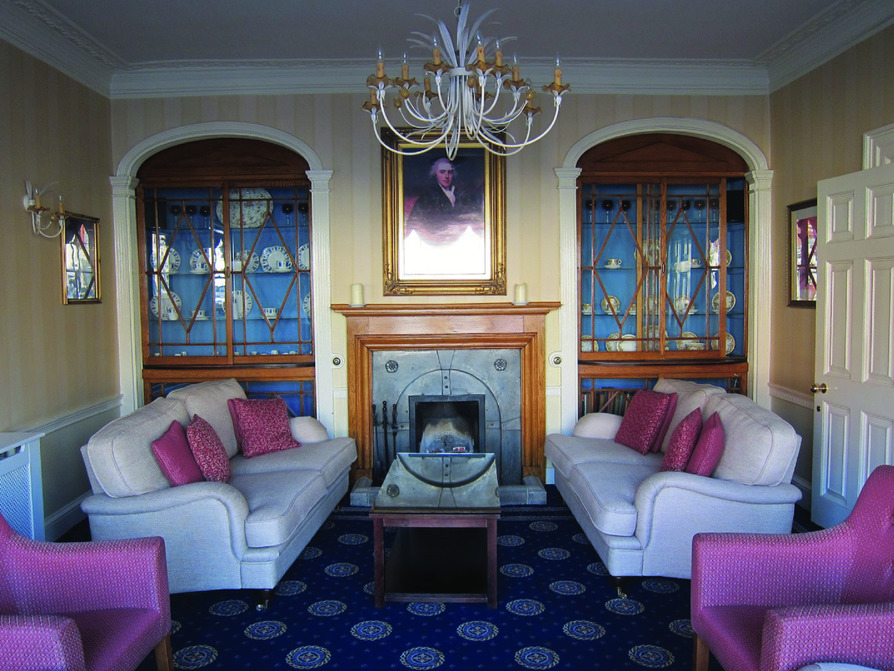
The parlour was the busiest sociable space inside a principal inn, sometimes called the ‘best room’.Footnote 61 The parlour was a shared, multi-use room (the more specific dining room, lounge and bar were not widely used until the nineteenth century). Where there was more than one parlour, these could be hired for the exclusive use of private groups. The ‘best room’ in a small-town inn can be experienced at The Kings Arms, Temple Sowerby, Westmoreland. Here, the well-proportioned parlour with neoclassical plasterwork ceiling is a revelation in an otherwise modest, everyday eighteenth-century building. Moving up a scale, The Bear in Devizes offers several parlours in a late eighteenth-century addition to its sixteenth-century core (Figure 11). The parlour shown here is high-ceilinged and classically proportioned. The walls are articulated by finely moulded cornice, chair rail and skirting boards. Opposite the large, light-bringing sash-and-case windows, cabinets are displayed within pilastered arched recesses. Carefully constructed rooms like these psychologically removed inn-goers from the immediate world outside, town and region, and relocated them in the universal space of British polite society. Like the (relatively) high-status domestic interiors they draw upon these interiors are also markedly less regionally accented than the corresponding exteriors with no sight of local materials or construction associated methods beneath plastered and painted surfaces.Footnote 62
One of the parlours, The Bear, Devizes, Wiltshire, 2016 (author)

Eighteenth-century prints give an indication of how inn-parlours were arranged and used as polite performance spaces filled with polite things: principally small groups of companions sitting around tables or as private rooms for small parties (never standing at the bar; this was a world of waiter service and most inns did not have bars in the sense of a long serving-counter). The Country Politicians, 1784, depicts ‘The Social Souls’ – gathered around the punch bowl in the parlour or taproom of an inn for one of the archetypal performances of sociable masculinity: the punch party (Figure 12).Footnote 63 They are engaged in the polite art of conversation, discussing politics and the news.Footnote 64 Such was the codification of material culture that even without knowing that they were a parson, a barber and a squire, their clothes, the linen tablecloth, porcelain punch bowl and stemmed glasses suggest that they are part of polite society in a generic British town. The scene also suggests the social mixing that took place between the different echelons of polite society, entry to the inn itself proving your rightful belonging to that broad group. It would seem the anomaly is the barber. However, the inn-barber occupied a privileged position within the culture of principal inns as a resident tradesman-cum-agent of sociability. In the politics of space, the busy, sociable parlour shown here is an in-between space – a neutral home away from home – that blurred the idea of separate public and private spheres (or ‘front space’ and ‘back space’ within urban space).Footnote 65
J. Gillray, The Country Politicians: The Parson, Barber and the Squire, Three Social Souls Who News Admire, 1784 (British Museum)

Inn – Midnight, 1825, shows the ‘company tired and retired’, leaving the tastefully expensive carpet, looking glasses, tables, chairs, sideboard, knife boxes and decanters alone in a classically articulated room (Figure 13).Footnote 66 These are luxury dining-goods as could be found in a polite household (middling to upper-rank depending on the inn).Footnote 67 Like The Country Politicians, the print depicts a commercialized version of what Bernard L. Herman describes as a ‘table-top topography’ of polite sociability acted out in the spatial relations between (polite) people and (polite) things.Footnote 68 Probate inventories further reveal the social distinctions that defined the material world of inns.Footnote 69 For instance, the 1785 probate for James Barnes, innkeeper in Dymock, Gloucestershire, lists a modest cover of ‘Nine pewter Dishes, three Doz: & five plates & Two Parringers’ and' five Tables & Two Sittles & Twelve Chairs'.Footnote 70 Whereas, in his 1773 will, Richard Gray, innkeeper of The Bell Savage, Ludgate Hill, London, bequeathed to his wife ‘all my china ware and Glasses in the said two Chambers of the Bell Savage Inn’.Footnote 71 In contrast to Barnes' pewter dishes, the things inside The Bell Savage were made of expensive materials: china, glass.Footnote 72 Following the impetus to renew, innkeepers periodically disposed of all their tableware in a pit out back to make way for new things.Footnote 73 Excavations of these pits reveal what tableware was being used prior to the date of the clearance. Excavations of an early eighteenth-century clearance pit at The Tun Inn, Guildford, produced fine late seventeenth-century fluted glassware made at The Bear Garden Glassworks in Southwark.Footnote 74
M. Agerton, Inn – Midnight Company Tired and Retired, 1825 (British Museum)

Archival sources such as diaries and receipts show that inn-goers used these fine things to consume the best in food and drink.Footnote 75 For example: at The Haycock, Wandsford Bridge, Cambridgeshire, in 1789, John Byng praised a ‘good Dinner, well chosen, and well dressed; and there was a Tench of the largest Size I ever saw’; at The Bush, Bristol, innkeeper John Weeks offered for Christmas, 1788, a seafood menu that included turtle, potted turtle, salmon, cod, turbot, brill, carp, perch, plaice, herring, eels, lampreys, pipers, rock fish, dories, sprats and sole; at Buckden, Huntingdonshire, a late eighteenth-century bill from The George reveals that one diner, or possibly diners, enjoyed a meal of fish, oysters, veal, duck, potatoes, tarts and cheese, wine, bread and beer for £1 6s.Footnote 76 This amount for one meal constituted roughly three weeks’ wages for a labourer or one week's wages for a clerk. Across the country, the expectation that a ‘good Dinner’ would be available at a principal inn made the exceptions all the more disappointing; Byng himself had to suffer ‘a chop dinner with bad wine’ at The Cock, Eaton Socomb [Socon], Cambridgeshire.Footnote 77
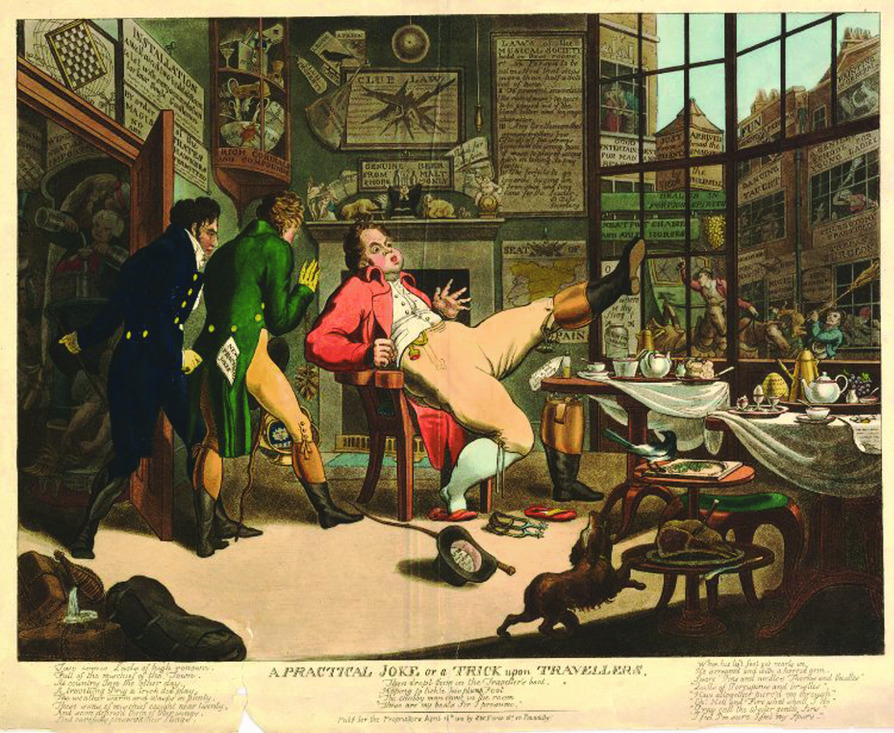
Through the day, the parlour was used by merchants, clergy and the local gentry in a similar way to a coffee house or reading room in a gentlemen's club, complete with library, newspapers and waiter service. The notices, flyers and prints that cover the walls in A Practical Joke or a Trick upon Travellers, 1810, show the well-furnished inn-parlour, complete with table set out for morning tea or coffee, was also a world of print that further positioned the inn as a hub of regional information and exchange (Figure 14).Footnote 78 Here, the sociable space of the parlour offered a conversable world akin to that of the early modern coffee house.Footnote 79 Indeed, in most provincial towns, among its many other functions, the inn was the coffee house (literally so in some cases, such as at The New Inn in Gloucester where a specific room was designated the ‘coffee house’). As such, while socially rigid, among social peers the inn was the ultimate flexible space; it could be a space for new ideas, radical politics and sedition but, in a different room at the same time, it could also be a space of public authority, accommodating a manorial court or military muster, or simply a space for fun.
S. W. Fores, A Practical Joke or a Trick upon Travellers, 1810 (British Museum)

Many principal inns also contain much larger, highly decorated rooms with large, light-bringing windows on their first floor. These were gathering spaces for the associational world of clubs and societies including the all-male dining clubs that were specific to a particular inn such as the Starcross Club that met at The Courtenay Arms, Starcross, Devon, or the Bear Club that met at The Bear, Devizes.Footnote 80 While certainly an excuse to eat and get drunk with one's peers, many such clubs also undertook charitable work funding schools, almhouses and other philanthropic good works. Away from the general unstructured bustle in the parlour, these upstairs rooms were also useful gathering places for organized sociable activities that extended beyond dining such as small dances, election hustings, touring shows and exhibitions, theatre, recitals and court sessions as at, for example, The George, Huntingdon.Footnote 81
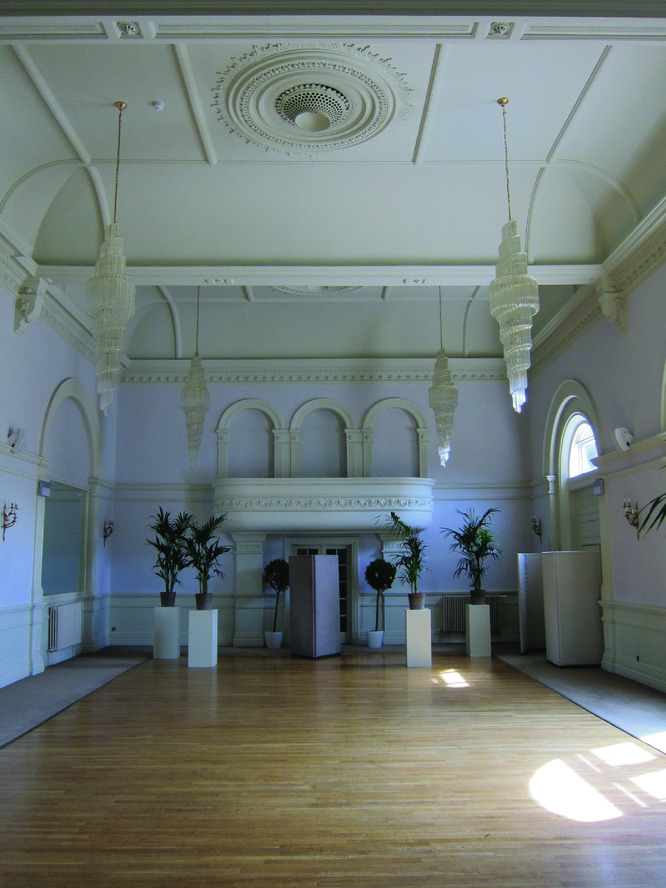
Finally, the principal space in a principal inn: at many inns the upstairs gathering space was/is a substantial purpose-built assembly room with a sprung floor and fiddlers' gallery used to host balls and dances either in place of or in direction competition with a town assembly room.Footnote 82 Inn assembly rooms – as found at principal inns such as The George, Stamford, The Lion, Leominster, The Lion, Shrewsbury, The Angel, Abergavenny, The Salutation Inn, Perth, or The Union, Penzance – can be very grand rooms of a size, proportion and decoration to rival any provincial assembly room and which move the interior space of the inn beyond the replication of polite domestic spaces into the grand architecture of civic space (Figure 15).
Whether attending a ball in the assembly room, a meeting of the Free Masons in a private room or dining with friends in the parlour, spending time in a principal inn immersed the polite inn-goer in a familiar, inclusive world of good taste and good cheer. The carefully considered design of the interior spaces and materiality of the principal inn located them within the cultural space of British polite society and reinforced a sense of belonging to that group (unlike the inn-front as seen from the street, which was intended as a display of power, dominance and exclusion).
The assembly or ball room, The Angel, Abergavenny, Powys, 2016 (author)

Coda: the decline of the urban inn?
As all-purpose, everyday spaces, inns, taverns and alehouses were at the centre of eighteenth-century urban life. Among these, in any given town, the principal inn – or inns – were the largest, grandest and most expensive; serving an exclusive clientele of that town's social, economic and political elites. Always located within a short walking distance, often within sight, of a town's other central civic institutions – church, courthouse, exchange, guildhall, assembly room – the principal inn was, however, more than just a useful space to meet and do things together, it was the hub of a massy-wheel of local power that extended across the town centre, square or high street.
The long eighteenth century was a golden age for the British inn with more, bigger and grander inns built (or old inns improved). It was a golden age because of the confluence of two processes in the history of eighteenth-century Britain: the urban renaissance within British towns and the turnpike-and-stagecoach transport revolution without and between them. The urban inn was the point, the physical space, at which these two processes came together. Principal inns, therefore, flourished because they served both increasingly wealthy local elites and the increased number of wealthy travellers. These combined revenue streams financed the architectural elegance, fine furnishings and fine dining that elite inn-goers came to expect. Accordingly, this golden age came to an abrupt end when one of these revenue streams ceased to flow with the arrival of the railways in the mid-nineteenth century.
Across the British Isles, many famous and long-established inns closed and, overall, the number of inns, including principal inns, was significantly reduced. However, that was not the end of the urban inn. Although the decline in the travel business meant that a town could no longer support several principal inns, it still needed – and could support – one useful gathering space for its local elite. And so, in most towns, the foremost inn, the principal of principal inns, survived and stayed in business throughout the nineteenth and twentieth centuries. Indeed, most are still there today, operating in much the same manner as they did in the eighteenth century, whether The Angel in Abergavenny, The Bear in Devizes, The Swan in Bedford or The Golden Fleece in Thirsk. Visiting a British principal inn today (they are easy to locate, always in the historic town centre) you will find well-dressed groups meeting for morning coffee, grandparents taking their grandchildren for afternoon tea and couples dining in the highly recommended restaurant. They have ballrooms that are popular venues for weddings, useful rooms with flipcharts for business meetings and monthly meetings of local societies and civic bodies (many have plaques next to the main entrance proclaiming they host the local Lions or Rotary Club).
That the great survival of the urban inn has perhaps gone unnoticed is, arguably, due to a shift in British cultural perceptions of the word ‘inn’. From the late eighteenth century, the principal inns of Britain's market and county towns began to re-style themselves as ‘hotels’ as a fashionable way to distinguish themselves from lesser inns: The Angel Inn became and remains The Angel Hotel; The Bear Inn, the Bear Hotel; The Swan Inn, The Swan Hotel; and The Golden Fleece Inn, The Golden Fleece Hotel. The first establishment to open with the name ‘hotel’ in the English-speaking world was the Royal Clarence Hotel, Exeter, opened in 1770 and promoted as a ‘hotel’ by its French landlord, Pierre Berlon (destroyed by fire November 2016). Consequently, while principal inns have remained much the same – in terms of what they do, the people they serve and the spaces they occupy – we now think of them as hotels.Footnote 83 At the time, this change in term caused much confusion among inn-goers and for a while many establishments advertised as ‘Hotel-Inn’ or similar: The Royal Clarence was described in The History and Description of the City of Exeter (1806) as ‘The Hotel, a large commodious Inn’.Footnote 84 In fact, this shift marks these ‘hotels’ as rather typical of inns and innkeepers through history; one of the defining characteristics of the British inn, and a reason for their incredible longevity, is their constant adaptation to change (as discussed, many apparently Georgian inns, such as The Red Lion in Salisbury, The George in Baldock or The Stag in Hastings, are themselves rebuilt, or simply re-fronted, medieval inns).
At the same time, while the grand urban inn has been lost in plain sight, the space occupied by ‘inn’ in the British cultural imagination has been appropriated by the ‘country inn’. To the Georgians, the neatness, symmetry and classical cornices of the principal inn represented a modern, universal progressive British culture, whereas the country inn was a dark, dirty backward place to be avoided. By contrast, to our post-romantic, post-picturesque imagination, ‘inn’ is today immediately associated with the dark beams and inglenooks of the country inn (at least in England). Far from a negative association, this alternate image of the inn – popularized in the early to mid-twentieth century – is highly valued, and socially desirable: like the English village, the country inn has become an embodiment of a lost rural England; rooted in tradition; defined by regional distinctiveness.Footnote 85 As such, our idea of the ideal inn is the antithesis of the urban inn and the modern, metropolitan values it represented in the eighteenth century.