State and local retirement plans differ from employer-provided pension plans in the private sector in several important ways. First, virtually all full-time public employees are covered by a pension plan in which they are required to participate. Second, defined benefit plans remain the dominant plan type for state and local pensions. Third, public plans are exempt from almost all provisions of the Employee Retirement Income Security Act (ERISA), which regulates most aspects of private retirement plans. As a result, government agencies are able to set most provisions of their plans without the constraints imposed by ERISA.
Relatively little is known on how state and local retirement systems utilize this flexibility in the pricing of annuity options and how the variation in plan parameters across states and over time affect the choice of annuities at retirement. This study examines the distribution options of 85 large public retirement plans covering general state employees, teachers, and local government employees.Footnote 1 Thus, the sample included plans in all 50 states covering these groups of workers. In 2015, the plans covered approximately 13 million public employees, beneficiaries, and annuitants. An important component of the analysis is the construction of a data set presenting the annuity options offered by each of these plans and how the monthly benefits for these distribution options are priced.
The following discussion shows considerable variation in these important plan characteristics. Differences in the interest rates used to price annuity options relative to one another result in substantial differences across states in the monthly benefit for retirees with similar career histories. An important policy question is whether the variation in monthly benefits across state and local retirement systems due to interest rate differences affects the proportion of retirees who select a J&S annuity (J&S). The analysis has four main objectives.
1. Provide a detailed description of the current status of large state managed retirement plans indicating the type of retirement plans offered to public employees. Significant changes in plan type by states has moved public plans from being exclusively defined benefit plans to a mixture of defined contribution plans, hybrid plans, and cash balance plans. A number of states now allow workers to choose among different plan types.
2. Report the types of payout options offered to retirees in each of these plans. An important contribution of this paper is to report how distribution options vary with plan types.
3. Describe how each of these annuity options is priced relative to the single life annuity monthly benefit. A key element of this research is to provide the first analysis of the interest rates used in the determination of monthly benefits for retirees selecting joint and survivor annuities.
4. Estimate whether differences in the price of joint and survivor annuities influence the likelihood that retirees will select a survivor benefit or choose a single life benefit. The most important policy issue addressed is whether variation in the pricing of annuity options leads to differences in the proportion of retirees selecting alternative annuities.
Our findings have important implications for the economic well-being of public sector employees and for the management and sustainability of state and local retirement plans. Public retirement systems are gradually lowering the interest rates used in their benefit calculations, and economists have generally agreed that interest rates in public plans are typically too high relative to market rates (e.g., Novy-Marx and Rauh, Reference Novy-Marx and Rauh2009).Footnote 2 Our research demonstrates that lower interest rates have a meaningful effect on the pricing of annuities, J&S annuities in particular. Lower interest rates imply that providing survivor benefits for one's beneficiary becomes more costly as represented in lower monthly benefits. In response to lower interest rates and reduced monthly benefits for J&S annuities, we find that fewer retirees choose J&S annuities.
If the trend toward lower interest rates in public plans continues or accelerates, these findings suggest that J&S annuities will be chosen by state and local retirees at lower rates in the future. Should policymakers be concerned about a further decline in the provision of survivor protections among public sector employees? The answer depends on whether current rates at which J&S annuities are chosen are optimal for public retirees. More research on these points is needed for a clear understanding.
1. Distribution of public pensions by plan type
There has been a major shift in the incidence of retirement plans in the private sector over the past four decades as employers eliminated defined benefit (DB) plans and established new defined contribution (DC) plans, typically 401(k) plans.Footnote 3 In contrast, DB plans remain the dominate form of retirement plans in the public sector. However, in recent years, there has been a trend by public pension systems toward offering cash balance and hybrid plans and some states now allow employees to select the type of plan that best suits their needs and preferences.
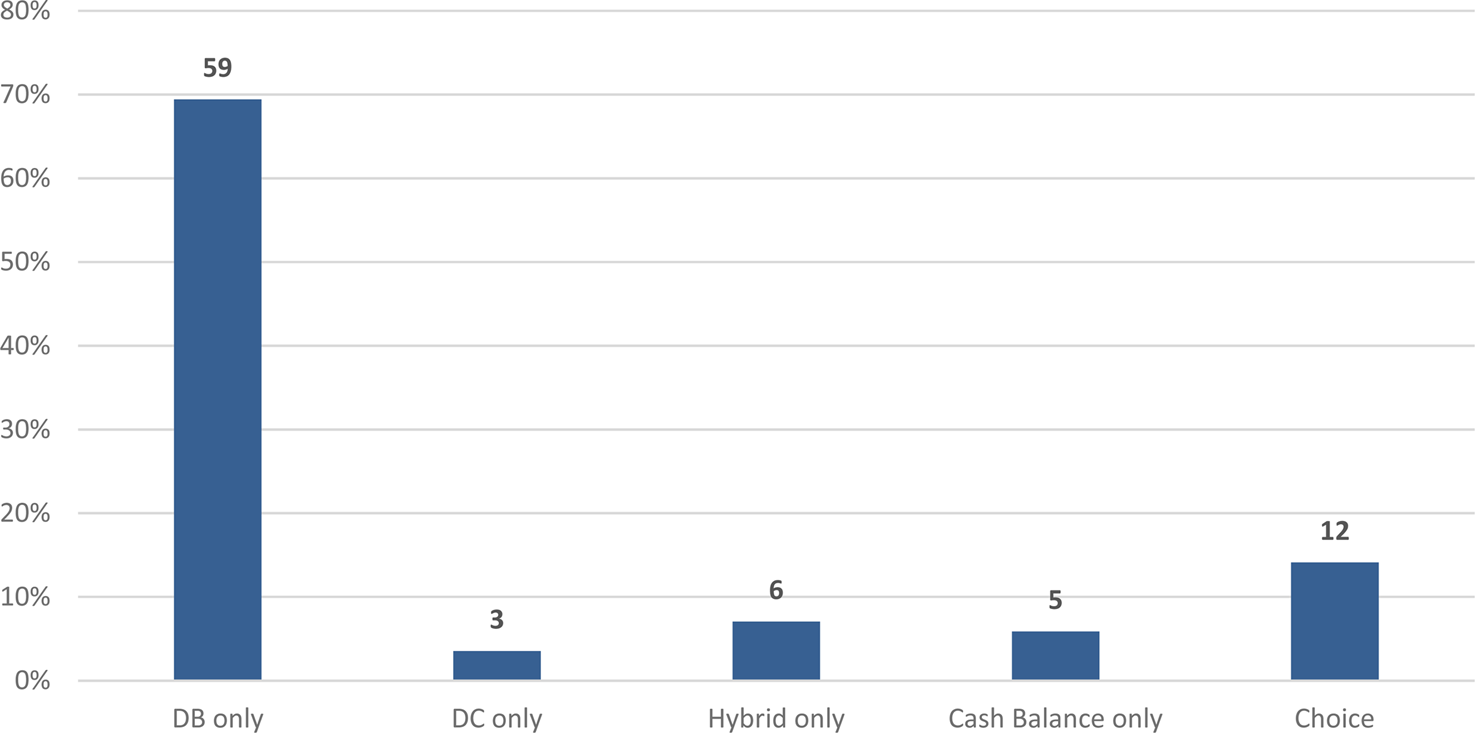
Figure 1 classifies the 85 retirement systems in our sample into the types of retirement plans offered to newly-hired employees. Many public retirement systems have made substantial changes to their plans that have reduced the generosity of benefits to future employees. Throughout this study, we examine the plans available to new employees. The chart shows that 59 systems offer only traditional DB plans, while the other 26 public plans offer other types of retirement plans to their employees or allow employees to select their preferred type of retirement plan.
State and local pensions by type of plan. The 85 retirement systems examined in this study are the plans that are reviewed periodically by the Wisconsin Legislative Council (2016). The most recent report was released in 2016 and covers plans in 2015. https://docs.legis.wisconsin.gov/misc/lc/comparative_retirement_study/2015_retirement.pdf. The authors reviewed the websites of each of these public plans. The data in the chart are based on this review. Information on type of plan offered by each retirement system is shown on our project website: https://drive.google.com/file/d/1UwKYbhFrAWxvwu_Db2oOgh5gHUb98kR_/view.

While 69% of the plans in our sample continue to offer only a traditional DB plan as the only mandatory plan, there have been significant changes by a number of state and local retirement systems in the type of plan offered to new employees. Five systems now offer only cash balance plans. Cash balance plans are a form of a DB plan but these plans indicate the value of an employee's account balances.Footnote 4 Instead of a benefit formula that is used in a traditional DB plan, cash balance plans provide a notional account for each participant, specify a monthly contribution to the balance, and promise a return on the account balance. At retirement, the account balance can be converted into an annuity (either single life or J&S) using mortality rates and an assumed interest rate.
Six additional systems offer only hybrid plans. In general, hybrid plans include mandatory coverage by both a DB and DC plan. The DB component of hybrid plans is typically less generous compared to the benefit of systems that offer only a traditional DB plan. Required participation in the DC component increases the value of total retirement benefit to participants in these plans. Twelve systems offer employees the option of selecting the type of pension they prefer with options being either DB, DC, or hybrid plans. In general, the DB plans offered as an option by these systems are similar to the plans offered by systems that offer only a traditional DB plan. All of these DB plans offer similar annuity options to their retirees and thus will be included in our examination of the pricing of J&S benefits discussed below. Finally, three systems offer only DC plans.Footnote 5 We will review the distribution options offered by these systems along with the systems with a DC option as a choice.
Distribution options vary by the type of retirement plan. All the traditional DB plans specify a benefit formula that determines a lifetime monthly benefit for the retiree. These plans then offer a J&S benefit that results in a lower monthly benefit compared to the single life benefit but the benefit will continue for the life of the designated survivor. The reduction in monthly benefits is determined by mortality rates, an interest rate, and the age of the retiree and her designated survivor. In contrast, DC and cash balance plans have account balances that are available to retirees in a lump sum. In cash balance plans, retirees are able to request an annuity. In this case, the monthly benefit is determined by converting the account balance into a single life or J&S benefit with the same present value. DC plans often allow workers the opportunity to annuitize with an insurance company selected by the retirement system. The DB and DC components of hybrid plans provide the same distribution options as described above.
2. Annuity options in state and local retirement plans
In this section, we review the distribution options offered by each of the plan types described above. Given the changes in the generosity of public retirement plans, many systems have several tiers of their plans that cover workers hired in different time periods. However, as noted earlier, our analysis focuses only on the plans covering newly hired employees. The analysis begins with an overview of the distribution options offered by retirement systems with only a traditional DB plan. Plan documents typically provide detailed information on how the monthly benefit for the retiree is determined assuming that the individual selects the single life annuity. In most cases, the benefit formula indicates the retirement benefit for a retiree and this benefit ends with the death of the retiree. This is a single life annuity and provides the maximum monthly benefit available to a retiree.
Many plans provide some variant of this life annuity to insure that retirees and their beneficiaries at least receive their own contributions back in retirement or at their death. The return of contributions can be in the form of a lump sum payout if the annuitant dies before the value of benefits paid reach the present value of the employee's lifetime contributions plus credited interest or a guaranteed number of monthly benefits even if the retiree dies prior to receiving this specified number of payments. In the following analysis, we classify all of these payout options as being a single life annuity.
All of these plans then offer additional annuity options that the retiree may select. The monthly benefit for other options is determined in a manner that keeps the present value of the benefits the same to the system regardless of which option is chosen. Next, we examine the annuity options offered by traditionally defined benefit plans, cash balance plans, DB parts of hybrid plans, the DB plans offered by state systems that allow workers a choice among plan types DC plans, and DC parts of hybrid plans. The annuity options for each plan type are taken from documents on the webpages of the retirement systems.Footnote 6
2.1 Distribution options in DB only retirement systems
Defined benefit pension plans typically have a benefit formula that specifies a monthly retirement benefit that a retiree will receive from retirement until death, i.e., a single life annuity. Most DB plans also offer other distribution options such as J&S, which promise a benefit for the life of the retiree and the designated beneficiary, typically a spouse. Public retirement systems also offer lump sum distributions; however, as mentioned above, these distributions typically are based only on employee contributions plus some specified interest rate. Unlike retirees in the private sector, public employees rarely request lump sum distributions once they are eligible to immediately begin a retirement annuity (Clark et al., Reference Clark, Morrill and Vanderweide2014).
A key question is how are the monthly benefits for the other distribution options calculated? Specifically, what is the monthly benefit for a retiree who selects the J&S option in order to provide continuing retirement income to a beneficiary after the death of the retiree? In general, plan sponsors state that the system offers J&S benefits that have the same present value as the single life annuity based on the benefit formula. In order to calculate the J&S benefit with the same present value as the single life annuity, retirement systems use appropriate mortality rates (or life tables) to determine the expected payments over the lives of the retiree and their beneficiary and an interest rate to convert the monthly flow of benefits into a present discounted value. Since the expected payout period is longer for the J&S annuity, the monthly benefit will be lower than the benefit for retirees who decline the J&S option and accept the single life benefit.
In general, state and local retirement systems use gender-specific life tables in conjunction with the gender composition of retirees and beneficiaries in order to determine the expected number of months that benefits will be paid to retirees and their survivors of specific ages. Given these mortality rates, the actual benefits for individuals selecting a J&S are independent of gender. However, the perceived present value of the present value of the J&S, or alternatively, the cost of the J&S will differ due to the differences in life expectancy by gender.
Holding mortality and interest rates constant, the monthly J&S benefit will depend on the age of the retiree and the age of the designated survivor; the younger the survivor the lower the monthly retirement benefit. Thus, the cost of selecting a J&S benefit to an individual retiree varies inversely with the age of the beneficiary relative to the retiree. One should note that based on the benefit formula, the single life annuity is not a function of the retiree's age or gender, once the conditions for unreduced retirement have been satisfied.
Holding mortality rates for both the retiree and the beneficiary constant along with the ages of the retiree and the survivor, lower interest rates will result in lower monthly J&S benefits. Thus, we might expect that changes in the interest rates used by the retirement system will alter the proportion of retirees selecting a J&S benefit. Finally, improvements in life expectancy will also affect the monthly J&S benefits; however, the impact of these changes on monthly J&S benefits depends on the relative improvement in mortality of the retirees compared to the survivors. Throughout this analysis, we refer to the reduction in the monthly J&S benefit compared to the single life annuity as the price of choosing the J&S benefit.
All public retirement plans in our sample offer J&S annuities to their retirees with most plans providing several J&S options based on the amount of the monthly benefit after the retiree dies. The most common options are 100% and 50% of the benefit that was received when the retiree was alive. If a retiree selects a 100% J&S annuity, the monthly benefit is the same before and after the retiree dies, while a 50% J&S results in the beneficiary receiving a benefit that is half the monthly amount while the retiree was alive. The 100% option results in a lower monthly benefit while the retiree is living compared to the 50% option. Some plans allow for other specified percentages that are paid to the beneficiary and still others allow the retiree to select the level of benefit that will be paid to the beneficiary. Still others also provide options that are called J&S pop-up annuities. These options provide an increase in the retiree's benefit if the beneficiary dies first. Each of the annuity options for each of the plans in our study can be found at https://drive.google.com/file/d/1UwKYbhFrAWxvwu_Db2oOgh5gHUb98kR_/view.
The retirement systems typically price each of these options so they have the same present value to the system given the assumed interest rate and mortality rates.
Private sector DB plans are covered by ERISA, which requires that J&S benefits be offered and that they be the default option for pension participants.Footnote 7 ERISA also specifies the market interest rates that must be used in the minimum J&S calculations and appropriate mortality tables. Federal regulationsFootnote 8 specify that the interest rates established by the Commissioner of Internal Revenue must be based on the yields on corporate bonds of the top three quality levels. As of September 2018, those interest rates were 3.21% for the first 5 years, 4.26% for years 5–20, and 4.55% after 20 years.
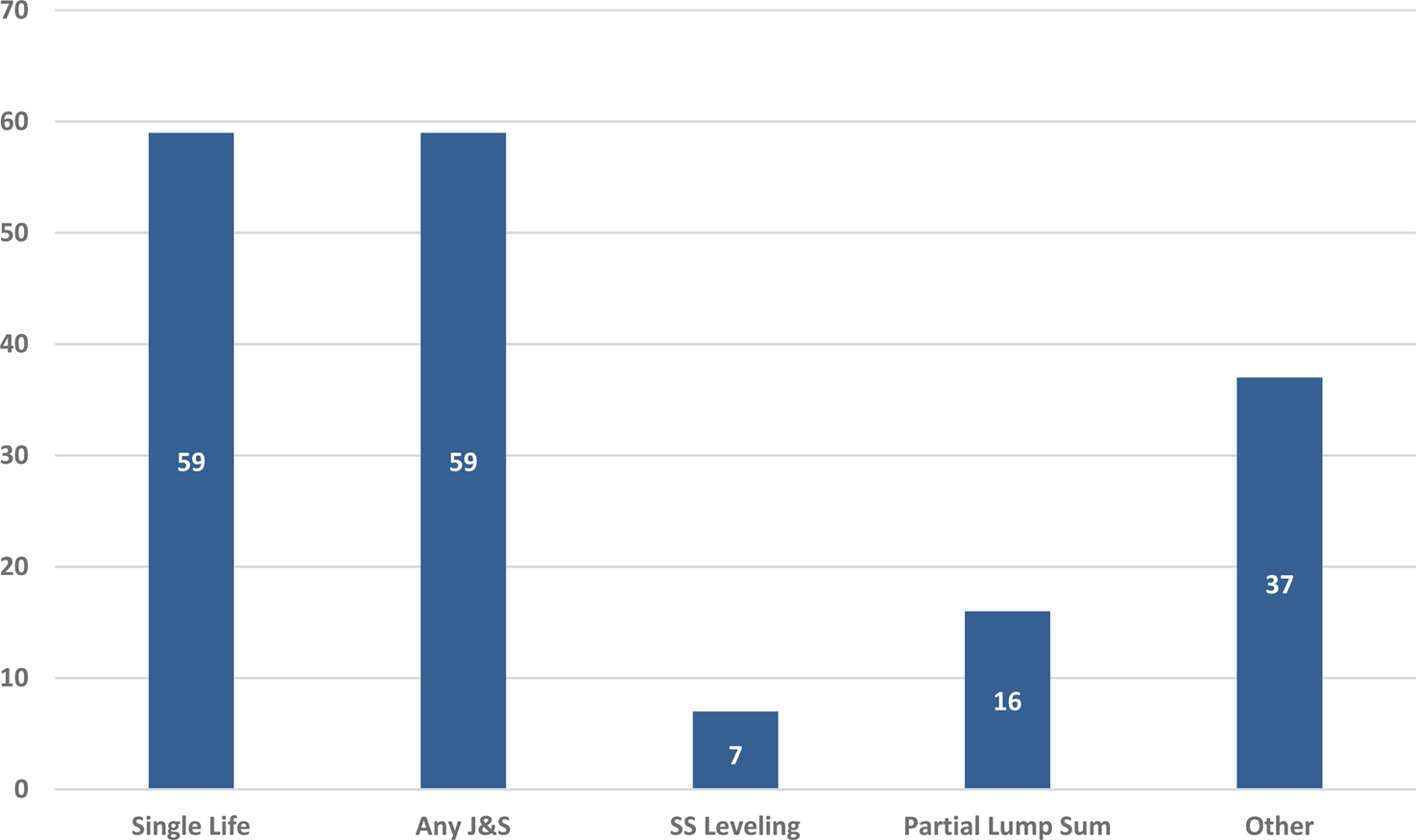
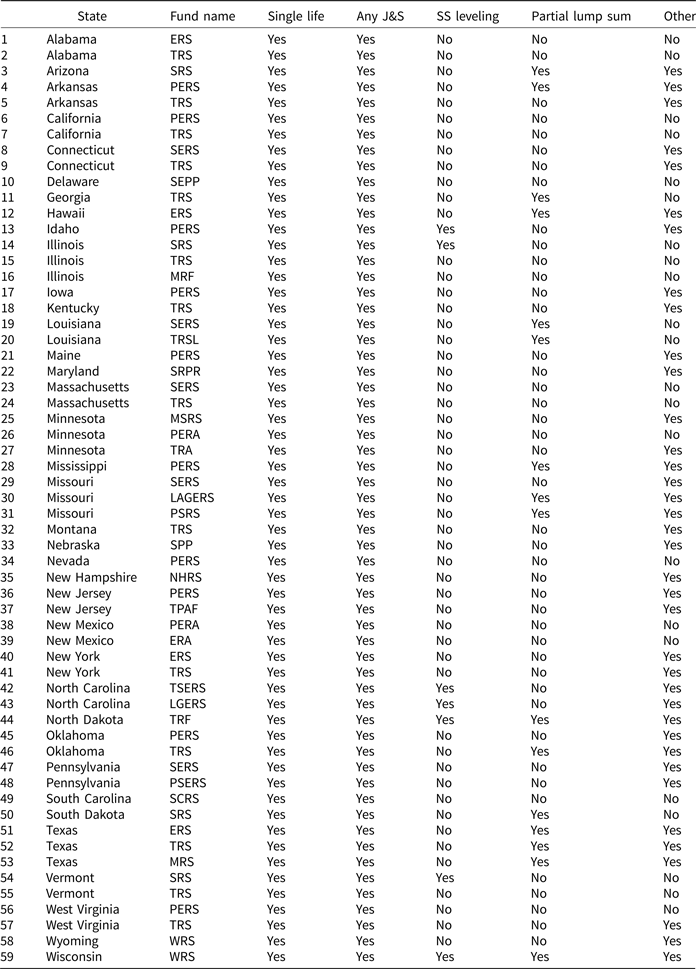
In contrast to private sector DB plans, public sector DB plans are not covered by ERISA and thus state and local plans are not required to have a J&S benefit as the default distribution option.Footnote 9 Therefore, state and local governments have considerable discretion concerning the provisions of their pension plans. Of particular interest for this study is that public retirement plans are free to select the interest rate used to convert the single life annuity to a J&S benefit. While there is considerable diversity across state and local retirement systems, most public plans use the rate of return that the plan assumes it will earn on its investment portfolio as the interest rate used to price various annuity options.Footnote 10 These assumed rates of return vary widely across states and are considerably higher than the market interest rates required by ERISA to calculate minimum J&S benefits. Figure 2 shows the number of plans that offer each of the various annuity options available to retirees in each of these plans.Footnote 11 A key point for this analysis is that the variation in interest rates produces variation in monthly benefits for J&S annuities relative to single life annuities.
Annuity options provided by state and local plans offering only traditional DB plans.

Along with a single life and J&S annuity options discussed above, most systems also offer ‘other’ annuity options that include guaranteed payments for a certain number of years even if the retiree dies.Footnote 12 A less common option is a single life annuity called Social Security Leveling, which allows retirees to have a higher pension benefit before claiming Social Security benefits in exchange for a lower benefit after claiming. Clark et al. (Reference Clark, Hammond, Morrill and Vanderweide2018a) provide a detailed discussion of the leveling annuity and its effect on benefits before and after the age of claiming Social Security benefits. Finally, some retirement systems provide a partial lump sum payment option, which allows retirees to take a portion of their retirement income in a lump sum payment at the time of retirement. The amount of partial lump sum payment differs across retirement systems and usually ranges from 36 months (Arizona SRS) to 60 months (Arkansas PERS) of single life annuity benefit.
2.2 Distribution options in other defined benefit plan types
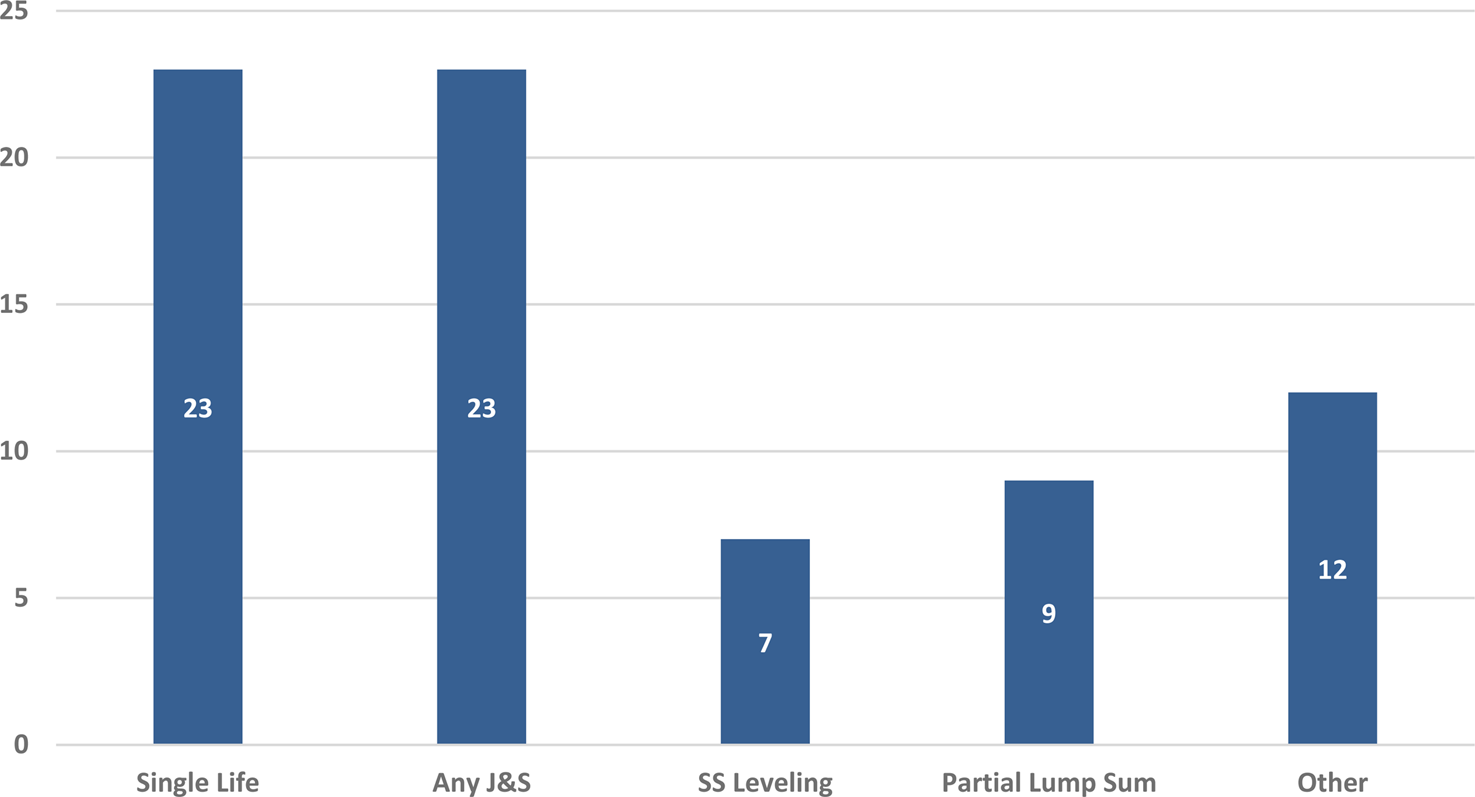
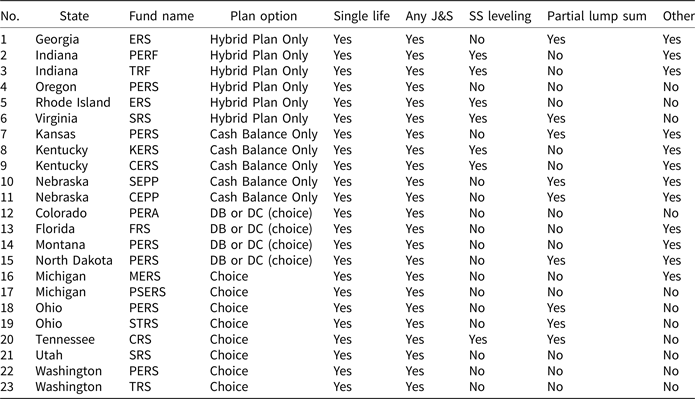
Aside from the 59 retirement systems that offer only traditional defined benefit plans, 23 other systems offer some version of a DB plan (cash balance or hybrid plans) or choice of several pension options. Figure 3 illustrates the annuity options offered by these plans. The annuity options for these plans mirror those offered by systems with only traditional DB plans. All plans offer some type of J&S annuity and a slightly higher proportion of these plans include a Social Security Leveling option. The details of these options can be found at https://drive.google.com/file/d/1UwKYbhFrAWxvwu_Db2oOgh5gHUb98kR_/view.
Annuity options provided by cash balance and hybrid plans along with DB plans in states that allow choice and have a DB plan as one of the options.

2.3 Distribution options in defined contribution plans
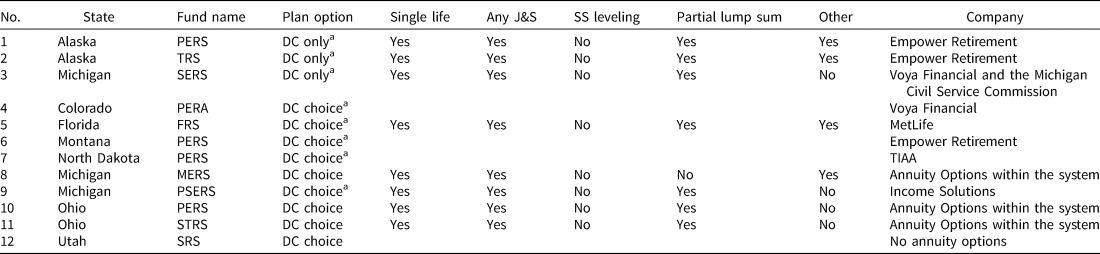
Three systems (Alaska PERS and TRS and Michigan SERS) offer only defined contribution plans to their members, while nine additional systems include a DC option as a choice to newly hired employees (see Table 1). Three DC systems (Alaska PERS and TRS and Florida FRS) allow retirees to annuitize either within the system or with the financial service company that manages the retirement accounts, while other DC systems provide only one of these two options. For example, several systems allow retirees to annuitize with the financial service company, while other DC systems offer annuity options within the system (Ohio PERS and STRS and Michigan MERS). Utah SRS only allows the retiree to withdraw their funds. In addition, each DC plan allows retirees to leave funds in the system, roll over funds to another account, or either fully or partially withdraw funds in periodic installments including monthly, quarterly, semi-annually, or annually.
Annuity options provided by DC plans

Source: Data obtained from each retirement system's webpage.
Note: DC only means that the retirement system offers only a Defined Contribution plan to their employees; DC choice means that the retirement system offers a choice among retirement plans including Defined Contribution plan choice. Alaska PERS and TRS, Florida FRS, Michigan MERS and Ohio PERS and STRS retirement systems provide annuity options within the retirement system including single life and joint & survivor options. Utah SRS only allows the retiree to withdraw funds. All DC plans offer retirees to leave funds in the system, roll over funds to another account, either fully or partially in periodic installments withdraw funds as lump sum.
a Retirees in these plans are able to annuitize with the financial service company.
3. Calculating J&S annuities
The benefit formula in DB plans indicates the monthly retirement benefit that a retiree would receive from claiming until death. This benefit is a single life annuity as benefits cease with the death of the retiree. Once a worker has satisfied the conditions for unreduced retirement, the monthly benefit is not a function of age. Thus, holding career variables constant, individuals retiring at younger ages will receive greater lifetime benefits compared to those that retire at older ages.
The stated objective of most retirement systems is to offer a menu of annuity options that are present value neutral from the perspective of the system. The first step in determining the monthly benefit for other annuity options is the calculation of the expected present value of the single life annuity. First, define PV[A] to be the present value of a $1 per year benefit payable at the end of each year for the life of an individual age A. The formula for which can be written as:
 $$PV\lsqb A \rsqb = \; \mathop \sum \limits_{{\bi a} = {\bi A} + 1}^{120} \displaystyle{{{\bi Survival}_{\bi A}^{\bi a}} \over {{\lpar {1 + {\bi r}_{\bi i}} \rpar }^{{\bi a}-{\bi A}}}},$$
where Survival is the probability of survival from age A to age a and r i is the assumed interest rate. As benefits are almost always paid in equal monthly installments, a small further adjustment would be made to reflect monthly payment of benefits using one of several standard methods. Then the present value of the monthly single life benefit, B SL, can be written as:
 $$PV_{SL}\lsqb A \rsqb = \; B_{SL} \times 12 \times PV\lsqb A \rsqb.$$
This calculation is usually based on the mortality experience of the system and the assumed rate of return on the pension fund. Having calculated the present value of the single life benefit, the retirement system then calculates a monthly benefit for the other annuity options using the same basic assumptions.
Most states provide several J&S options. Retirees that select one of these J&S options are exchanging lower monthly benefits for the continuation of benefits after their death as benefits will continue to be paid to the designated survivor until his or her death. For the present value of this annuity to be the same as that of the single life benefit, monthly benefits must be lower. The price of this insurance for a lifetime survivor benefit, or the magnitude of the reduction in monthly benefits, depends on the age of the retiree and the age of the beneficiary. To calculate the present value of the J&S benefit, first define the present value of a $1 per year benefit payable at the end of each year if and only if both annuitants are living:
 $$PV_{Joint}\lsqb {A,S} \rsqb = \; \left( {\mathop \sum \limits_{{\bi a} = {\bi A} + 1,\;{\bi s} = {\bi S} + 1}^{{\bi a} = 120,\;{\bi s} = 120} \displaystyle{{{\bi Survival}_{{\bi A},{\bi S}}^{{\bi a},{\bi s}}} \over {{\lpar {1 + {\bi r}_{\bi i}} \rpar }^{{\bi a}-{\bi A}}}}} \right),$$
where Survival is the joint probability of the retiree surviving from age A to age a and the spouse surviving from age S to age s. As with PV[A], a small adjustment would be made to reflect payment in equal monthly installments. Then the present value of the monthly J&S benefit, B J&S, can be written as:
 $$PV_{J\& S}\lsqb {A,S} \rsqb = B_{J\& S} \times 12 \times \lsqb {PV\lsqb A \rsqb + PctJ\& S \times \lpar {PV\lsqb S \rsqb -PV_{Joint}\lsqb {A,S} \rsqb } \rpar } \rsqb.$$
PctJ&S indicates the percent of the initial benefit when both the retiree and beneficiary are alive that continues after the death of the retiree. As the equations show, the interest rate is an important component in converting the single life annuity into a J&S benefit. Similar calculations are made to determine the monthly benefit of each annuity option. Many states provide retirees with online calculators that show the monthly benefits for the various annuity options given their employment and earnings history. In the next section, we present data acquired from the retirement systems on the interest rate used to determine the monthly benefits for those retirees selecting a benefit option other than the single life annuity.
4. Pricing of J&S benefits
In order to assess the magnitude of the reduction in monthly benefits for the J&S option relative to the single life annuity, one must know the interest rate used by the retirement system. There is no systematic data on interest rates used by public retirement plans in the pricing of J&S annuities. Online documents such as employee handbooks and financial documents describe retirement plans and distribution options. Most plans also have online calculators that allow employees to convert a single life annuity into a J&S benefit if they login or enter their personal earnings history, service, age, and the age of their beneficiary. However, plan documents rarely describe the actual process and assumptions behind how J&S options are priced. In this section, we first present information from our data collection effort and then illustrate how different interest rates affect the money benefit for the J&S annuity.
4.1 Pricing of J&S annuity varies widely across the retirement systems
In an effort to uncover the interest rates used by public retirement systems, we contacted each of the 85 retirement systems in our sample and requested information on how various distribution options are priced. Our informational search included e-mails, telephone calls, and freedom of information faxes.Footnote 13 Some retirement systems specifically declined to provide the requested information on the interest rate used to calculate J&S benefit. Despite repeated efforts and requests using alternative methods of communication, some systems failed to respond at all.
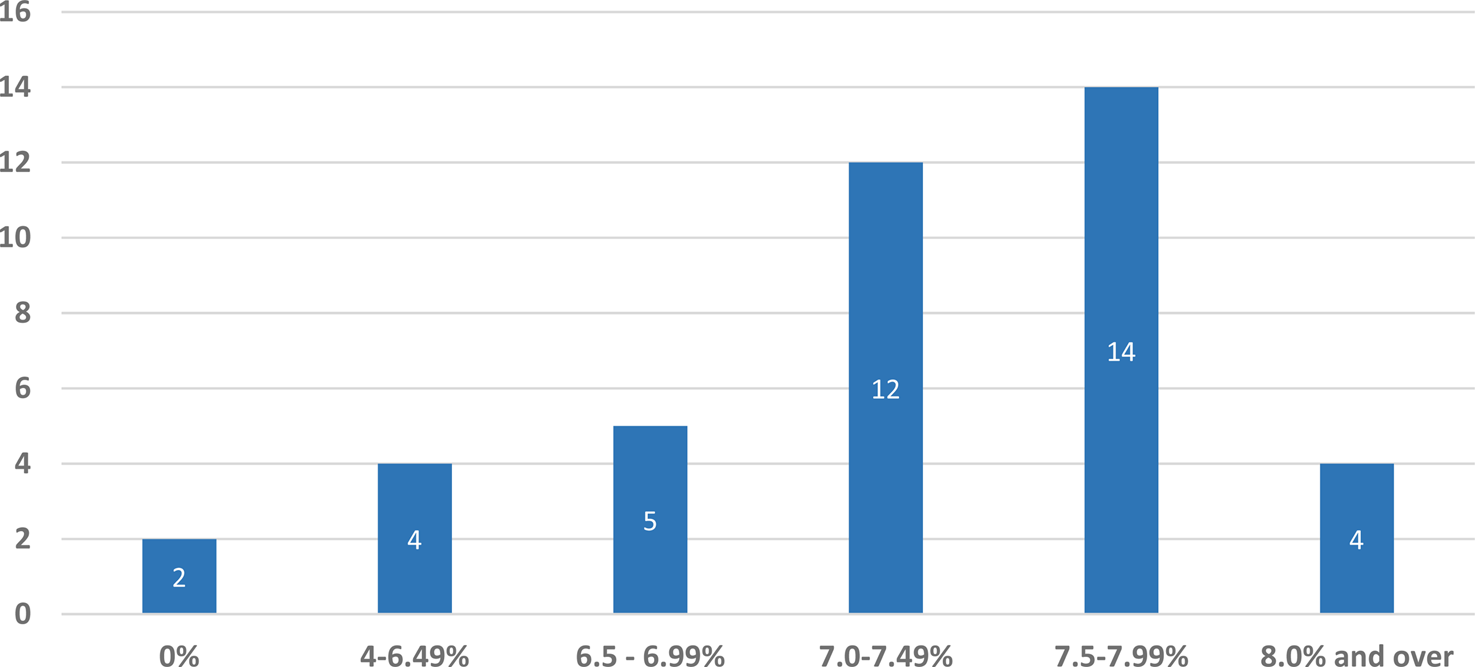
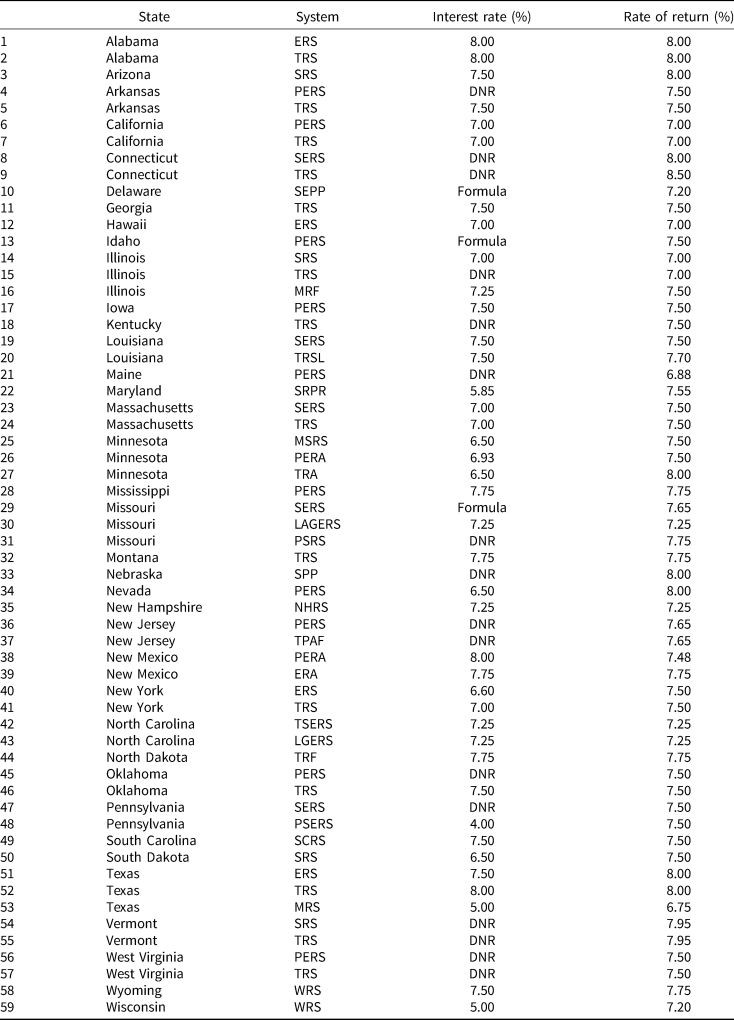
Typically, systems state that benefits for other distribution options should have the same expected present value as the single life annuity specified by the plan for the retiree; however, most plans do not publicly disclose the interest rate used to determine the present value of the annuity options. After 18 months of contacting and re-contacting retirement systems, we have obtained annuity pricing information for 64 retirement systems including 43 of the 59 plans with only traditional DB plans. Table 2 lists the interest rates used by each of the systems with only a traditional DB plan, while Figure 4 sorts plans by the interest rate used by systems. The Delaware SEPP retirement system provides some J&S coverage for beneficiaries without reducing the monthly benefit compared to the single life benefit as specified by the formula.
Pricing of Joint and Survivor Benefits for Plans Offering Only Traditional DB Plans.

Pricing of joint and survivor benefits for traditional DB plans

Source: Data provided by each retirement system, their CAFRAs, and personal correspondence.
Note: DNR denotes that the retirement system did not respond to our request for information.
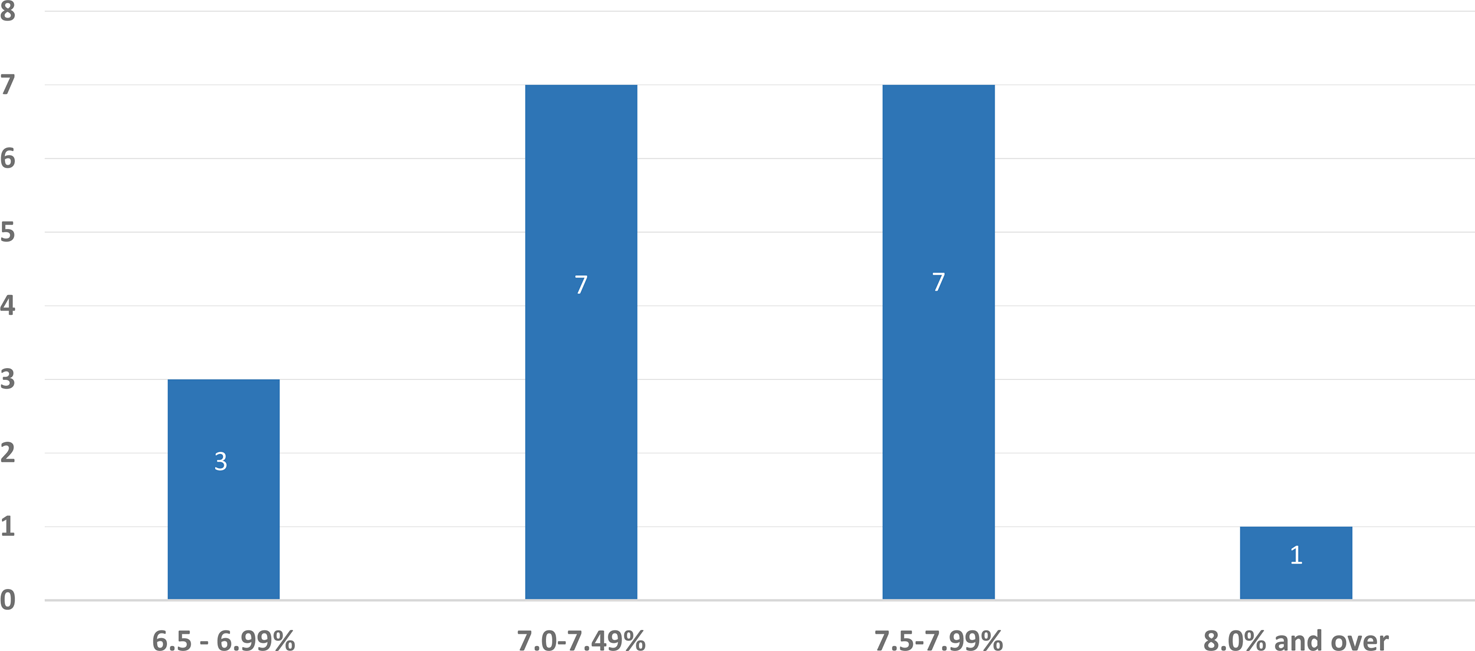
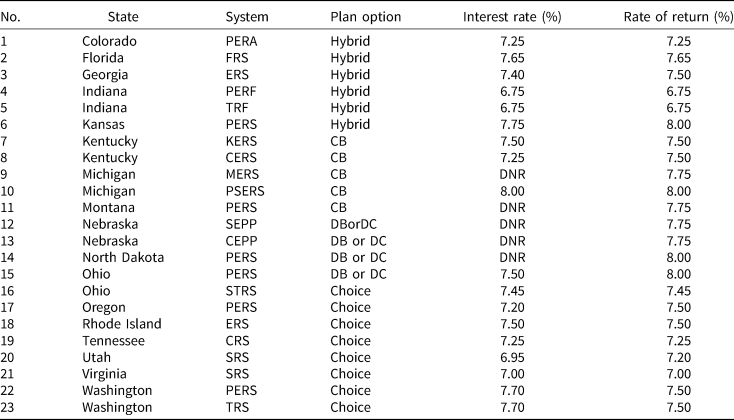
Twenty-one of the responding retirement systems use the same interest rate for these annuity calculations as the assumed rate of return of their investment portfolio while another seven systems employed interest rates that were 0.5% or less lower than the assumed rate of return. These rates vary from 6.75% to over 8%. It is important to note that the range of rates used by the public retirement plans is higher than those current rates required of ERISA plans and until this study, peer plan data have not been available for retirement plans to benchmark. Table 2 shows the interest rate used to determine the J&S benefit along with the assumed rate of return for each of the plans. Table 3 and Figure 5 provide similar information for retirement systems with hybrid plans and cash balance plans along with the systems that allow employees to select which type of retirement plan they prefer. The interest rates used by these plans are in the same range as shown for DB only retirement systems in Table 2. A few plans do not use the assumed rate of return as the interest rate in their J&S calculations. Maryland SRPR uses the 25th percentile of the expected rate of return to determine their rate. This was set in such a way so that 75% of the time the rate of return on plan investments will exceed the rate used for pricing the J&S annuity. Delaware SEPP uses several rates that vary with the survivor option and had no relationship to the rate of return. Also, three plans use a lower rate that explicitly includes the impact of post retirement increases or a COLA (Cost of Living Adjustment).
Pricing of joint and survivor benefits for DB components of hybrid plans and systems that offer choice of plan type.

Pricing of joint and survivor benefits for cash balance and hybrid plans and the DB component of plans that allow a choice

Source: Data provided by each retirement system and their CAFRAs.
Note: DNR denotes the retirement system did not respond to our requests for information.
4.2 Impact of interest rates on J&S monthly benefits
The impact of using different interest rates on the monthly J&S benefit depends significantly on the probability of the designated survivor outliving the retiree. Large public retirement systems typically use the mortality experience of their own participants. In this analysis, we calculate monthly J&S benefits using mortality tables in the calculation that reflect typical public-sector mortality experience.Footnote 14 While the published tables are gender-specific, each system would calculate benefits using the overall gender distribution of the system's participants, not the genders of the individual retiree and beneficiary, because public retirement systems are required to use a gender-neutral calculation for converting forms of payment.Footnote 15 For illustration, we assume that the single life retired worker monthly benefit is $1,000.
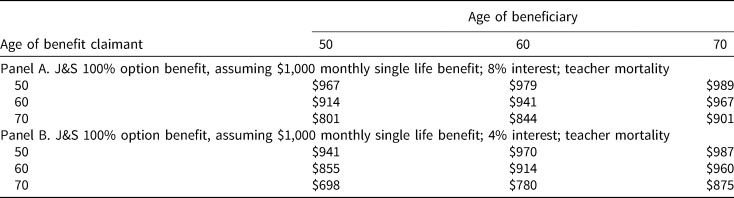
Table 4 shows examples of the J&S monthly benefit that would be payable if the retirement system uses the mortality experience described above. Panels A and B both assume the plan has a teacher population that is 65% female which results in longer life expectancies compared to populations in certain other professions and populations that have a higher percentage of males. On average, many women are married to older men and thus, their designated survivors are less likely to outlive them. Panel A uses an interest rate of 8%, the highest rate shown in the sample in Table 2, and Panel B uses an interest rate of 4%, the lowest rate shown in the sample.
J&S option benefit amounts: public school teachers

These calculations use mortality tables for the specified retiree group and contingent survivors from the headcount-weighted rates in the exposure draft of the Pub-2010 Public Retirement Plans Mortality Tables released by the Society of Actuaries (https://www.soa.org/experience-studies/2018/pub-2010-retirement-plans/), projected generationally using Scale MP-2017 assuming a retirement date in 2018. The calculations assume that 65% of retirees are female based on the demographics of the teacher dataset used in the exposure draft and that 50% of beneficiaries are female based on experience in North Carolina.
To begin, we assume that the retiree and the beneficiary are both age 60 when the benefit is initially claimed. Using an interest rate of 8% to calculate the J&S annuity (Panel A), the monthly J&S benefit is $941 or the price of the J&S benefit is a $59 per month lower monthly benefit compared to the single life annuity. In other words, for the cost of $59 per month, the retiree can insure that their beneficiary will continue to receive a benefit even after the retiree dies. The magnitude of the benefit reduction increases for each year the beneficiary is younger than the retiree and declines for each year they are older than the retiree. If the beneficiary is age 50 and the retiree is age 60, the monthly J&S benefit is only $914. Thus, the price of insuring that the beneficiary will continue to receive a retirement benefit after the death of the retiree is $86 per month.
Now consider the benefits shown in Panel B when the retirement system uses an interest rate of 4% to determine the J&S monthly benefit. For the individuals who are both age 60 at the time of claiming the retirement benefit, the monthly J&S benefit is $914 per month indicating that selecting a J&S benefit lowers the monthly benefit by $86. The benefit using a 4% interest rate is only $27 lower than if the system used an 8% rate, despite the large difference in interest rates. The biggest difference in the monthly benefit amounts between the two panels occurs for the age combinations where the designated survivor is most likely to outlive the retiree, for example, a 70-year-old retiree and a 50-year-old designated survivor. In this case, the monthly J&S benefit using a 4% interest rate is $103 lower than the J&S benefit using an 8% rate; $698 per month compared to $801 per month using an 8% interest rate.
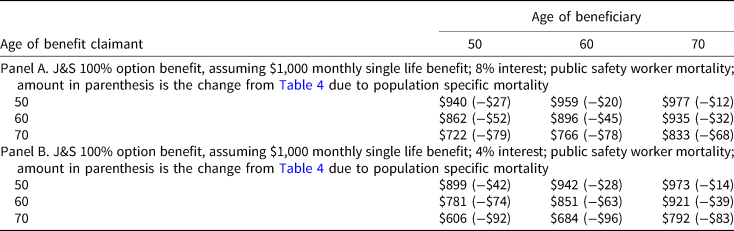
The proportion of women in public employment is much lower in occupations outside of teaching and certain other professions experience higher rates of mortality independent of gender. As a result, the mortality experience used by a retirement system that does not cover teachers is considerably different and this difference in life expectancy magnifies the benefit reduction associated with selecting a J&S benefit. Consider these same calculations for the J&S benefit using the mortality experience for public safety workers that is only 10% female. Panels A and B (Table 5) show the monthly J&S benefit for this population using 8% and 4% interest rates. Panel A calculates the J&S benefit using an interest rate of 8%, the same as Panel A (Table 4), and Panel B uses an interest rate of 4%, the same as Panel B (Table 4).
J&S option benefit amounts: public safety workers

These calculations use mortality tables for the specified retiree group and contingent survivors from the headcount-weighted rates in the exposure draft of the Pub-2010 Public Retirement Plans Mortality Tables released by the Society of Actuaries (https://www.soa.org/experience-studies/2018/pub-2010-retirement-plans/), projected generationally using Scale MP-2017 assuming a retirement date in 2018. The calculations assume that 10% of retirees are female based on the demographics of the public safety dataset used in the exposure draft and that 90% of beneficiaries are female based on experience in North Carolina.
Because the population in these panels has a higher proportion of male retirees (and therefore a higher percentage of beneficiaries are female) and because public safety retirees experience greater mortality independent of gender it is more likely compared to many other public-sector retiree groups for the retiree to be outlived by their designated beneficiaries. Thus, the differences in benefit amounts using a 4% compared to an 8% interest rate (compare Panel A to Panel B) are larger than the differences in benefit amounts shown in Table 4. The monthly benefits in Panel A are for a public safety worker using an 8% interest rate. For an individual retiring at age 60 with a spouse who is also age 60, the monthly J&S benefit is only $896 or the price of selecting the monthly J&S benefit is $104 relative to the single life benefit. Using the mortality experience of teachers, the reduction in the monthly benefit was only $59 in the previous example.
These calculations highlight the role of the assumed interest rate, population-specific mortality, and the age of the retiree and her beneficiary in determining the price or benefit reduction associated with selecting a J&S benefit. Lower interest rates imply a larger cost to the retiree in the form of lower monthly benefits from choosing a J&S benefit compared to the single life annuity. It is clear that the purchase of income protection for a spouse is costly with the magnitude of the price being determined in part by the interest rate used by the retirement system. There is a trend for public retirement plans to lower the interest rate used in these calculations. As a result, the price of choosing J&S benefits will increase. We now explore whether the increase in the price of the J&S benefit can be expected to influence the proportion of public retirees who select the J&S annuity.
5. Does the price of J&S annuity matter?
As we have shown, most public employees continue to be covered by defined benefit pension plans. These plans include a formula that indicates the monthly benefit that an individual can receive when they claim a retirement benefit. Typically, retirement benefits will cease when the retiree dies. The decision of which annuity to select at retirement is a difficult and complex decision (Brown and Poterba, Reference Brown and Poterba2000; Aura, Reference Aura2005; Clark et al., Reference Clark, Hammond and Vanderweide2019).Footnote 16 If the retiree wishes to provide a benefit that continues for the life of their beneficiary, retirement systems allow participants to select a J&S benefit at the cost of lower monthly benefits. The choice of an annuity is influenced by many personal and household factors the most important of which is the presence of a spouse or partner. This decision will influence well-being throughout the retirement years of the retiree and the potential beneficiary.
Retirees are typically faced with a menu of distribution options; however, the primary decision is whether the retiree wants a single life annuity that ends with her death or whether she wishes to provide a continuing benefit to a designated beneficiary, usually a spouse. The most important factor influencing the decision to select a J&S benefit is the presence of spouse. While plans usually do not limit beneficiaries in J&S annuities to spouses, the typical case is that the retiree names their spouse as the beneficiary when selecting a J&S annuity.
The work history of the spouse will likely influence the annuity choice. If the spouse has been a career worker and expects to receive a pension, the retiree may consider this future income and be less likely to request a J&S benefit since the spouse will receive a pension after the death of the retiree even if the retiree selects the single life annuity. Other employer-provided benefits earned by the spouse such as retiree health insurance should also affect the choice of an annuity.
The public sector workforce has a higher percentage of females compared to the entire US labor force. As such, we might expect some different patterns of annuity choices by retirees from state and local retirement plans. Clark et al. (Reference Clark, Hammond and Vanderweide2019) found that among retirees in North Carolina, men are much more likely to choose a J&S annuity compared to women (61% compared to only 35%).Footnote 17 The difference in the proportion of women selecting J&S probably reflects the fact that women have lower age specific mortality rates and are more likely to outlive their spouse. We should also note that gender is highly correlated with many of the other variables that affect annuity choice such as the work history of their spouse.
Retirees will be more likely to choose a J&S annuity if they have a low life expectancy and are married to spouses with high life expectancy, holding age constant. Thus, the health of both the retiree and the potential beneficiary enter into the decision making of which annuity to accept. Higher levels of wealth may influence the annuity choice as households with greater wealth have greater liquidity and hence more options in how to finance future consumption. Individuals with higher personal discount rates place greater value on money in the early retirement years. Thus, they are expected to favor a single life annuity instead of a J&S annuity.
The primary unanswered question for this paper is whether the pricing of J&S annuities as measured by the use of alternative interest rates affects the probability of retirees choosing a J&S benefit over a single life annuity. Our data collection effort has shown that the interest rates used by public retirement plans vary substantially. This variation means that holding constant the monthly benefit for a single life annuity, the J&S monthly benefit is much smaller for retirees in states that have used lower interest rates. In the previous section, we showed that this reduction in monthly benefit (holding the interest rate constant) can be in the range of 5–10% for retirees and beneficiaries who are about the same age and up to 30% when the beneficiary is much younger than the retiree.
There are two approaches to attempt to observe how changes in the price of a J&S annuity affects decisions to select a J&S annuity instead of the maximum monthly benefit associated with accepting a single life annuity. First, one can compare the proportion of retirees selecting a J&S benefit across retirement plans to the interest rate used by the retirement system. Second, one can examine changes in the percent of retirees selecting a J&S before and after the price of the J&S benefit has been changed. In the remainder of this section, we present evidence using both of these methods.
5.1 Variation in acceptance of J&S annuity across plans using different interest rates
Examining the effect of price changes on take-up rates of J&S benefits across plans requires data from individual retirement systems on the percent of retirees selecting alternative types of annuities. In general, this information is not available on plan websites and we have found that many plans are reluctant to provide this information. In addition to variation in interest rates, the choice of J&S benefits can be expected to vary by the demographic composition of plan participants and any regional mortality differences.
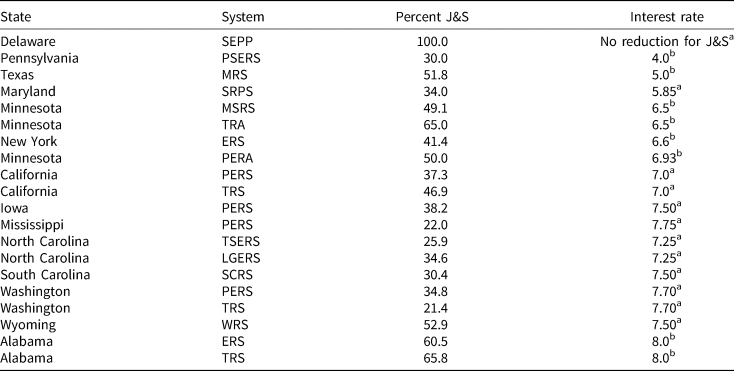
Over the past 3 years, we have attempted to gather information from state and local retirement systems concerning the proportion of retirees selecting a J&S benefit. In 2016, Janet Cowell, the Treasurer of North Carolina, sent a request to the state treasurers of all states asking for information on the percentage of recent retirees who selected various pension options (Clark and Cowell, Reference Clark, Cowell, Mitchell, Hammond and Utkus2017). Nine states covering 12 retirement systems responded to her request for this information. More recently, we have contacted retirement systems and checked their websites in an effort to augment the earlier list. Table 6 reports the responses from 20 retirement systems that responded to our two efforts along with the interest rates used by each retirement system to price the J&S annuity.
Percent of retirees selecting a J&S annuity and interest rate used to price the benefit

a Percent of participants choosing J&S as reported by Clark and Cowell (Reference Clark, Cowell, Mitchell, Hammond and Utkus2017).
The table ranks the systems by the interest rates employed to calculate the J&S benefit. This small sample of retirement plans provides little indication that the interest rate and hence the reduction in monthly benefit influences the proportion of retirees selecting a J&S annuity. To look at these data statistically, we ignore Delaware because there is no reduction associated with J&S. Among the remaining 19 systems, the correlation of the interest rate and the rate of J&S choice is 3.7%. We perform a χ 2chi-squared test whose null hypothesis is that interest rates and J&S choice are independent. The test statistic is 209.0 and the p-value is 0.28, which we interpret as very weak evidence, albeit in the correct direction with respect to our argument that lower interest rates will lower rates of retirees choosing J&S annuities. Given this very small sample and a cross-sectional analysis that does not allow a rich set of controls, we now turn to a detailed empirical analysis of data from a single state.
5.2 Change in the likelihood of choosing a J&S annuity due to a change in price
As noted earlier, many public retirement plans have been reducing the assumed rate of return on their assets and in conjunction reducing the interest rate used for pricing J&S annuities. In most cases, the change in interest rate is usually relatively small and these changes are sometimes made simultaneously as the system updates its mortality assumptions. In the following analysis, we assume that retirees are interested in the total change in the price of the J&S annuity and are indifferent to whether the price change is due to changes in interest rates or mortality rates. With this in mind, we examine data from the public sector plans in a single state, North Carolina.Footnote 18
The data consist of administrative records for state and local government retirees in North Carolina who initiated retirement benefits between 2009 and 2014. During this period, North Carolina repriced its annuity options relative to the standard single life annuity. Annuities are priced using factors that are based on the mortality experience of the system and the assumed rate of return on the pension fund. In 2012, the interest rate was reduced from 7.5% to 7.25%. At the same time, the system updated its mortality tables. The result was a large change in the relative prices of the available annuities with the largest effect coming from the change in mortality assumptions. Our analysis does not allow a clean causal interpretation of the changes we observe in the data, but we provide evidence that the annuity choices in these data are consistent with our central point: interest rates matter for annuity choice.
Upon termination and achieving the age and service requirements, retirees in North Carolina must request from the retirement system that their benefits begin and choose an annuity option. This is a one-time option and there is no default annuity option; retirees must request a benefit and specify a distribution option before receiving any benefit. Teachers and State employees in North Carolina are covered by the Teachers' and State Employees' Retirement System (TSERS), while local government workers participate in the Local Governmental Employees' Retirement System (LGERS). Both plans have the same six annuity options, which include a single life annuity (called the maximum benefit), a 100% J&S, a 50% J&S, Social Security Leveling, and two additional J&S options with a pop-up provision if the retiree's beneficiary dies first.
We use these North Carolina data to estimate the responsiveness of retirees' choice of a J&S annuity with respect to its price and predict the change in the rate of J&S annuity choice from particular interest rates. We represent the price of a J&S annuity as the monthly benefit from a J&S annuity divided by the monthly benefit from the maximum benefit from a single life annuity. As discussed above, the price of a J&S annuity changed meaningfully in 2012, which gives us a pre-change period from 2009 to 2011 and a post-change period from 2012 to 2014. The responsiveness of J&S choice is estimated by mapping the change in the price of a J&S annuity in 2012 into the change in the rate of J&S choice pre- and post-2012. For this analysis, we consider the overall rate at which retirees choose any of the J&S annuity options offered by the state. The price change is based on the reduction in the monthly benefit for a 100% J&S annuity; the analysis using the other types of a J&S annuity is available from the authors upon request.
We calculate the price of a J&S annuity in the context of a hypothetical retiree, expressing the monthly benefit she would receive if she chose each annuity option. The hypothetical retiree considered in Table 7 is 60 years old with a 61-year-old beneficiary.Footnote 19 For full details on calculations such as those in Table 7, see Clark et al. (Reference Clark, Hammond and Vanderweide2019).
Prices of annuity options (annuity option payment/MAX payment)

Note: These figures consider a 60-year-old North Carolina retiree with a 61-year-old beneficiary. The 100% P/U and 50% P/U annuities are pop-up annuities in which the retiree's benefit increases if the beneficiary dies first.
The price of a 100% J&S annuity is the reduction in the monthly benefit for a retiree who chooses a 100% J&S annuity. We calculate the price by first dividing the J&S monthly benefit by the monthly benefit had she chosen a standard single life annuity. Prior to 2012, this ratio was 0.856, which says that our hypothetical retiree would have received 85.6 cents in monthly benefit if she chose a 100% J&S annuity relative to each $1 in monthly benefit from choosing a standard single life annuity. In other words, the price of selecting a J&S benefit for this retiree is a lifetime reduction in the monthly benefit of 14.4% in the monthly benefit. The changes in 2012 in North Carolina to the assumed interest rate and mortality assumptions resulted in a post-2012 J&S benefit ratio of 0.907. The change made a J&S annuity cheaper in the sense of a smaller reduction relative to single life. In this example, the price of the J&S benefit declined from a 14.4% reduction to a 9.3% reduction in monthly benefits. Given the lower price of purchasing survivor protection, we would expect that a higher proportion of retirees would select the J&S annuity.
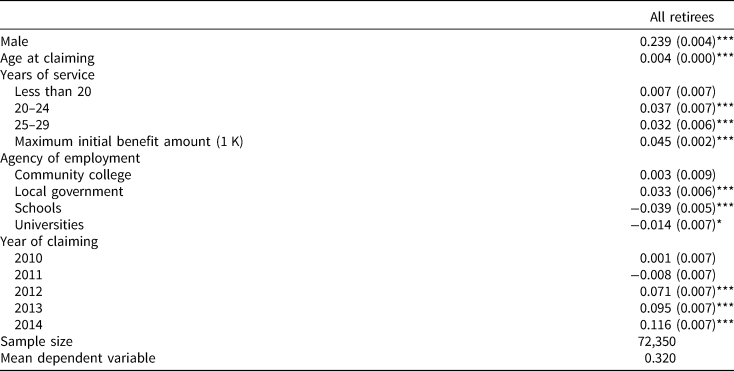
Table 8 presents a regression analysis of the choice of J&S over time by retiring state and local employees in North Carolina. The analysis controls for a set of individual characteristics including age at claiming, years of service, and initial benefit amount as well as controls for employer type and year of claiming. Despite these regression controls, we do not claim that the results in Table 8 have a clean causal interpretation. Instead, these results are intended to provide one piece of evidence that interest rates and mortality assumptions matter for annuity choice. In these regression results, the years 2012, 2013, and 2014 are associated with a statistically significantly higher rate of J&S choice relative to 2009. Averaging the regression coefficients corresponding to the years 2012–2014, the average J&S choice rate was 9.4 percentage points higher post-change. Combined with the change in the J&S benefit price from 14.4 cents per dollar of benefits to 9.3 cents, the increase of 9.4 percentage points in the rate of J&S choice implies that J&S choice responds to changes in its price at a ratio of 1.85 (or 0.094/(14.4–9.3)).
Choice of joint and survivor option among all North Carolina retirees between 2009 and 2014

Notes: The data are from administrative records and include all North Carolina state and local government retirees who claimed benefits between 2009 and 2014. The dependent variable is selecting any Joint and Survivor annuity option. Average marginal effects from a probit model are presented.
Standard errors are in parentheses. ***p < 0.01, *p < 0.1.
This ratio indicates the responsiveness of North Carolina retirees to changes in the price of a J&S annuity relative to a single life annuity. Given our focus on the importance of interest rates, we use the responsiveness to predict the change in the rate of J&S choice in response to changes in the assumed interest rate across the range of interest rates currently being used by state and local retirement plans. A retirement system that reduces its assumed interest rate will in turn increase the price of a J&S annuity to retirees. We consider a decrease in the interest rate by 4 percentage points, which is the range of rates that we observe in national data; see Tables 4 and 5. For the same 60-year-old retiree with a 61-year-old beneficiary as above, we calculate the price of a 100% J&S annuity, holding constant the system's mortality assumptions at the post-2012 level, while varying the interest rate.Footnote 20 The J&S benefit ratio is 0.908 at an interest rate of 7.5%, while it is 0.879 at an interest rate of 3.5%. That is, when the interest rate decreases by 4 percentage points, the price of a J&S annuity increases: the reduction at 7.5% in monthly benefit relative to a single life annuity is 9.2 cents for each dollar, while the reduction in the J&S benefit at 3.5% is 12.1 cents for each dollar.
The responsiveness ratio of 1.85 implies that this increase in the price of a J&S annuity of 2.9 cents would be associated with a rate of J&S choice that is 5.36 percentage points lower. From 2012 to 2014, 36.3% of retirees in North Carolina chose a J&S annuity. Thus, our prediction is that if North Carolina changed the interest rate used in its calculation of the price of a J&S benefit from 7.5% to 3.5%, the proportion of retirees selecting a J&S annuity would decline from 36.3% to 30.9%, or a 14.9% decline. As emphasized earlier, our evidence should be interpreted with caution given the lack of a perfectly exogenous change in rates. Despite this caveat, the large response we find by retirees to the change in the price of a J&S benefit demonstrates the importance of interest rates as we have argued. While lowering assumed rates of return is consistent with changes in market conditions and economic theory, plan managers should be cognizant of the effect that such changes will have on retirees.
One could also look at the effect on J&S choice of changing mortality assumptions, as this was the larger driver of the change in the price of the J&S benefit in North Carolina in 2012. We have not considered a broader application to changing mortality assumptions for several reasons. First, we do not have readily available information on the mortality assumptions being used by different systems in calculating optional forms of payment. Second, we understand that in many cases those assumptions reflect system-specific differences in mortality experience that would tend to persist over time and reflect legitimate differences in the value of the J&S annuity across different populations. Third, the actuarial profession has encouraged the use of projected mortality, where future improvements in lifespans are reflected in today's assumptions, for many years now. Thus, the direction and magnitude of future adjustments in those mortality assumptions are uncertain. However, an individual system that is about to implement a new mortality assumption with a known impact on J&S annuity prices may find the elasticity result above useful for predicting changes in J&S choice under the new assumption.
6. Conclusions
We have provided a picture of the current status of state and local retirement plans offered to newly hired workers. While DB plans remain the most common form of pension offered to public employees, there have been considerable changes in plan offerings. An important difference in the types of public sector pension relates to the annuity options offered to retirees and how they are calculated. The data indicate that all DB plans considered in this study offer both single life and J&S benefits. The pricing of the J&S annuity differs based on the interest rate used by the retirement system. Our analysis highlights the price of the J&S benefit in terms of the lower monthly benefit associated with lower interest rates. Examining how the proportion of retirees selecting J&S annuities varies with alternative interest rates, we provide some evidence that a higher price of a J&S annuity results in a lower likelihood of retirees selecting this option.
The impact of lower interest rates on J&S benefits and the resulting proportion of individuals opting for a J&S over the single life annuity deserves additional study. Public retirement systems are gradually lowering their assumed rate of return on their assets in response to lower realized returns on their portfolio. Since most systems use the assumed rate of return as the interest rate in the annuity calculates, this trend will result in lower monthly benefits for retirees selecting the J&S benefit. It is important to determine how these changes will impact the proportion of retirees selecting the J&S benefit.
Appendix
Annuity options provided by state and local systems providing only traditional DB plans

Annuity options provided by cash balance and hybrid plans along with DB plans in states that allow choice and have a DB plan as one of the options