Introduction
A wish to die is common in older adults (≥65 years). Prevalence estimates have varied between 2% and 9.5% (Scocco and De Leo, Reference Scocco and De Leo2002; Kim et al., Reference Kim, Bogner, Brown and Gallo2006; Corna et al., Reference Corna, Cairney and Streiner2010). By aging, people face various changes, surrounding not only their health but also their social circumstances. Studies on the risk of suicide in older adults indicate an increased risk with the presence of medical comorbidities (Juurlink et al., Reference Juurlink, Herrmann, Szalati, Kopp and Redelmeier2004; Woaklander et al., Reference Woaklander2008). Furthermore, the high prevalence of depression and anxiety in this population may also contribute to the presence of suicidal thoughts (Forsell et al., Reference Forsell, Jorm and Winblad1997; Scocco et al., Reference Scocco, Meneghel, Caon, Dello Buono and Leo2001) Studies have shown that older adults with depression are less likely to consult for their mental health problems as compared to younger adults, potentially leading to a higher risk of suicide in the elderly (Klap et al., Reference Klap, Unroe and Unützer2003). Reports from the Centers for Disease Control and Prevention (2003) suggest that people with suicidal ideation or death thoughts often present with an unremitting depression and inadequate treatment usually leads to worsening clinical symptoms and a higher risk of suicide. A recent study on the World Health Organization world mental health surveys (Borges et al., Reference Borges2010) showed that 30% of suicidal ideations pass to the planning phase and 50% of these lead to actual attempts. These reports highlight the importance of routine follow-up in clinical practice for the presence of suicidal thoughts in older adults.
To date, much research has been done to identify the most common factors associated with suicidal ideation in adolescents and adults. Just recently, Murphy et al. (Reference Murphy2012) examined the determinants of repeated self-harm and suicide risk in older adults presenting to hospital with self-harm. The authors noted that previous self-harm, psychiatric diagnosis, and men aged 75 years and over were at an increased risk for suicide. Population-based studies that focus on suicidal ideation in the older adult population are even scarcer, especially in Western countries. Determinants associated with increased suicidal thoughts, in community dwelling older adults, include for example, being widowed or single (Jorm et al., Reference Jorm, Henderson, Scott, Korten, Christensen and Mackinnon1995; Forsell et al., Reference Forsell, Jorm and Winblad1997; Scocco et al., Reference Scocco, Meneghel, Caon, Dello Buono and Leo2001; Corna et al., Reference Corna, Cairney and Streiner2010) and reporting low social support (Vanderhorst and McLaren, Reference Vanderhorst and McLaren2005; Yen et al., Reference Yen2005; Corna et al., Reference Corna, Cairney and Streiner2010). Studies on the effect of education on suicidal ideation have also shown inconsistent results in older adults (Scocco et al., Reference Scocco, Meneghel, Caon, Dello Buono and Leo2001; Awata et al., Reference Awata2005; Yen et al., Reference Yen2005). With regard to gender, studies have presented diverging results. This divergence is contrary to the higher suicide rates observed for males in the majority of westernized countries.
Although the consensus in the scientific literature indicates that suicide is an important public health issue and a preventable mental health outcome, relatively few resources have been made available for its prevention worldwide. This study will carry out gender-specific analyses to ascertain the determinants of suicidal ideation or death thoughts in a large representative sample of community dwelling older adults in Quebec, Canada. This analysis will use both survey and administrative data, thus increasing the validity of the determinants assessed. These results will be beneficial to inform public health suicide prevention and mental health promotion campaigns within Quebec and Canada.
Methods
Study sample
This study was based on data collected in the ESA (Enquête sur la Santé des Aînés – Survey on the Health of the Elderly) survey conducted in 2005–2006 using a probabilistic sample of the community living older adult population aged 65 years and over in Quebec. Subjects living in the northern regions of Quebec were excluded from the sampling frame due to the feasibility and limited resources available for in-person contact (over 800 km separated sites). These subjects however consisted of less than 9% of the population of the province of Quebec. The method of random digit dialing was used to develop the study sampling frame which considered regions stratified according to three types of geographical areas, based on population centers and rural regions: (1) metropolitan (population ≥100,000); (2) urban (1,000–99,999); and (3) rural (<1,000), according to the Quebec Institute of Statistics. In each geographic area, a proportional sample of households was constituted according to the 16 health administrative regions of Quebec. A random sampling method was also used to select only one older adult (aged 65 years or older) within the household. The response rate at baseline was 76.5%. Analyses showed no significant difference between participants and non-participants for age, gender, and region (Préville et al., Reference Préville2008). The ESA study was reviewed and provided ethics approval by the Ethics Committee of the Sherbrooke Geriatric University Institute.
Data collection
First, a health professional contacted potential participants by phone to present the objectives of the study and solicit their participation in an in-home interview within two weeks. A letter was then sent to those who agreed to participate describing the study in more detail for legitimacy and to reassure potential participants. Subjects who agreed to participate were offered $30.00. The interviewers were health professionals and staff members of a national polling firm. The interviewers were given two days of training on the measurement instruments and the administration of the ESA computer-assisted questionnaire.
A written consent to conduct the interview was obtained at the beginning of the interview from all respondents. In order to increase the validity of the information provided, respondents presenting severe or moderate cognitive problems based on the mini-mental state examination (<22; Crum et al., Reference Crum1993) were excluded at the beginning of the interview and did not continue with the ESA questionnaire and thus were excluded from the analyses. Participants who completed the interview were asked to provide written informed consent for the research team to access their health and pharmaceutical services registry data from the Régie d'Assurance Maladie du Québec (RAMQ, Quebec's health insurance plan agency) and this was done for the year prior to the interview. The self-reported data from the ESA survey were linked to individual level information from the RAMQ's pharmaceutical services databases using the participant's health insurance number or, in the case where this number was missing, using the name, sex, address as well as month and year of birth. A success rate of 99.6% (n = 2,494) was obtained in the matching of the data.
Measures
Suicidal ideation: Suicidal ideation was assessed by asking respondents who answered yes to any of the two screener questions in the depression module the following question: ‘‘During the past year and thinking of the period, lasting two weeks or more, where your symptoms were the most severe, did you have a period of at least two weeks when you thought that you would be better off dead?” For respondents who were not screened into the depression module, the presence of suicidal thoughts was also ascertained by asking the following question: “During the last 12 months, did you have a period of 6 months when you thought you would be better off dead?” All respondents were also asked the following question at a later time during the interview: “During the last 12 months, did you seriously think to commit suicide or to take your own life?”
Depression: The presence of depression and anxiety in the past year was measured using a computer-assisted questionnaire, the ESA Diagnostic Questionnaire (ESA-Q). The ESA-Q, based on Diagnostic and Statistical Manual for Mental Disorders, Fourth Edition (DSM-IV) criteria (American Psychiatric Association, 1994), is similar to the Diagnostic Interview Schedule (DIS) and the Composite International Diagnostic Interview (CIDI), which have demonstrated satisfactory reliability and validity (Robins et al., Reference Robins, Eaton and Kessler1985; Wittchen et al., Reference Wittchen1991). Briefly, respondents with depression were those who presented with either a depressed mood or loss of interest or pleasure in usual daily activities nearly every day and most of the day during at least two consecutive weeks, who reported impairment in at least one area of social functioning, and who reported at least five of the seven associated symptoms for major depression or two of the seven associated symptoms for minor depression. Respondents who met DSM-IV criteria for panic disorder, agoraphobia, generalized anxiety disorder, obsessive compulsive disorder, social and/or specific phobia during the preceding year and who reported impairment in at least one area of social functioning were classified as having anxiety. Respondents who attributed their symptoms to a physical health problem or to grief were not considered to have depression or anxiety.
Morbidity: Morbidity was measured by the addition of the number of chronic health problems (arthritis, cardiac disease, disorders of the digestive system, endocrine system, diabetes, diseases of the kidney, liver, and eyes) as defined in the International Classification of Diseases, version 9 (ICD-9), developed and revised by the World Health Organization (2004).
Daily hassles: The number of daily hassles was measured with a version of the Daily Hassle Scale (DHS; Kanner et al., Reference Kanner, Coyne, Schaefer and Lazarus1981). This French version, adapted for the elderly, produced a Cronbach's α of 0.90 and test–retest reliability coefficients of 0.79 for the frequency of hassles (Vézina and Giroux, Reference Vézina and Giroux1988). The ESA version used a 30-item scale (DHS-30) of which seven items were added that describe hassles relevant to older people. The presence of a perceived daily hassle was considered so that scores on the DHS-30 ranged from 0 to 30, i.e. higher scores meant a higher number of daily stressors.
Social support: Social support was measured using three questions from the Quebec Health and Social Survey: (1) the availability of a confidant to talk about various problems, (2) the presence of someone who could provide instrumental help and (3) the presence of someone who could provide emotional support.
Mental health service use: Mental health service use was ascertained from respondents’ self-report and identified with the following questions: ‘‘Did you ever consult in person or by telephone a health professional for your mental health problem?’’ and ‘‘Did you consult in the past 12 months?’’
Antidepressant use: Antidepressant use (yes/no) was identified from the RAMQ pharmaceutical services registry, which includes, for each Quebec resident with public drug insurance, each drug dispensed (DIN: drug identification number), the quantity, dosage, the date the prescription was filled, and the length of treatment.
Socio-demographic factors: The socio-demographic factors considered in the analysis were age, gender, marital status (married vs. separated/divorced/widowed/never married), education (0 to 7 years and 8 years and over), income (divided into two categories: less than $15,000 and $15,000 and over) and region of residence (urban/rural vs. metropolitan).
Analyses
Gender-specific multivariate logistic regression analyses were carried out to study the association between suicidal ideation as a function of socio-demographic and economic factors, social support, daily hassles, the presence of chronic physical conditions and depression, anxiety, as well as antidepressant and mental health service use. Wald chi-squared statistics were used to assess gender-specific differences. All results presented were weighted to ensure that the true proportion of older adults within each of the regions and geographical areas was reflected in the analysis. The weight attributed to each subject represented the inverse of its probability of selection. The statistical software package SAS version 9.1 was used for all statistical analyses.
Results
The ESA survey respondents were representative of the older adult population of Quebec (Institut de la Statistique du Québec (INSPQ) 2005; 2012). Based on the weighted sample, respondents' mean age was 73.8 years (SD = 6.1), 58% were women, 54% were single or widowed, and 23% had some secondary education. The majority of the respondents were from an urban or rural region (56%) and reported an annual household income higher than $15,000 a year (76%). Among participants, 40% declared having at least two chronic health conditions. With respect to the presence of a psychiatric disorder, our results indicated that 5% of respondents presented at least one anxiety disorder and 6% presented a major or minor depression. The results also indicated that 14.1% of respondents had consulted in the past year for mental health reasons and 13.8% had been dispensed an antidepressant.
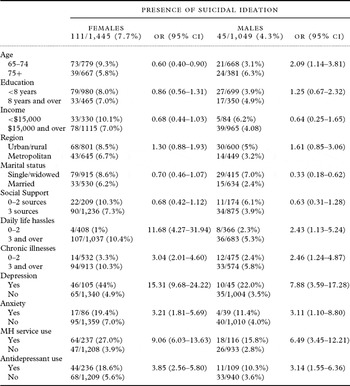
With respect to the presence of suicidal thoughts, 6.3% of respondents reported suicidal ideation in the previous year and these were more likely to be women (1.88 OR; 95% CI: 1.32–2.69). Significant statistical differences in suicidal ideation were observed for different respondent clinical and socio-demographic profiles depending on gender status (see Table 1). In females, suicidal ideation was associated with younger age (1.67 OR; 95% CI: 1.11–2.5), reporting three or more daily hassles (11.68 OR; 95% CI: 4.27–31.94) and three or more chronic illnesses (3.04 OR; 95% CI: 2.01–4.60). In addition, the presence of depression (15.31 OR; 95% CI: 9.68–24.22), anxiety (3.21 OR; 95% CI: 1.81–5.69), consulting for mental health reasons (9.06 OR; 95% CI: 6.03–13.63), and being dispensed an antidepressant (3.85 OR; 95% CI: 2.56–5.80) in the past year were also associated with suicidal ideation in females. In males, the presence of suicidal thoughts was associated with older age (2.09 OR; 95% CI: 1.14–3.81), being single (3.03 OR; 95% CI: 1.63–5.56), reporting three or more daily hassles (2.43 OR; 95% CI: 1.13–5.24), and three or more chronic illnesses (2.46 OR; 95% CI: 1.24–4.87). In addition, the presence of depression (7.88 OR; 95% CI: 3.59– 17.28) or anxiety (3.11 OR; 95% CI: 1.10–8.80), and the use of mental health services (6.49 OR; 95% CI: 3.45–12.21) and antidepressants (3.14 OR; 95% CI: 1.55–6.36) in the past year were also associated with suicidal ideation in males.
Characteristics of the study sample as a function of the presence of suicidal ideation

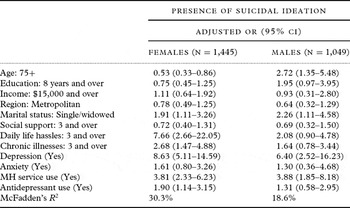
The results from the gender-specific multivariate analyses (Table 2) showed that suicidal ideation in females was positively associated with younger age, being single, reporting three or more daily hassles or three or more chronic illnesses, the presence of depression, and the use of mental health services and antidepressant usage in the past year. In males, suicidal ideation was positively associated with older age, being single, the presence of depression and mental health service use in the past year.
Gender-specific multivariate analyses on the determinants of suicidal ideation

Discussion
This study contributes to the present literature specifically by addressing gender differences in our understanding of the determinants associated with suicidal ideation in an older adult population. The use of both survey and administrative data lends to the validity of results.
The annual prevalence of suicidal ideation in this population reached 6.3%. This estimate is similar to a previous population-based study in older adults reporting suicide ideation rates reaching 6.5% (Yip et al., Reference Yip2003). This estimate however is higher than the one reported in a national Canadian study where the reported rate was 2% (Corna et al., Reference Corna, Cairney and Streiner2010). This difference can be in part attributed to the fact that our study population consisted of French-speaking residents in the province of Quebec, which has one of the highest rates of suicide worldwide and in Canada (INSPQ, 2006).
In this study, females (7.7%) were more likely to report suicidal ideation as opposed to males (4.3%), which has similarly been reported elsewhere (Scocco et al., Reference Scocco, Meneghel, Caon, Dello Buono and Leo2001; Yip et al., Reference Yip2003; Yen et al., Reference Yen2005; Jeon et al., Reference Jeon2010). When looking at the gender-specific multivariate analyses, the results showed a number of differences between males and females. First, adjusting for all other variables, suicidal ideation was associated with younger age in females and older age in males. Corna et al. (Reference Corna, Cairney and Streiner2010), using Canadian data on both genders combined, showed a significant decrease in suicidal ideation with increasing age. This may be due to the fact that the previous study included both males and females aged 55 years and over whereas our estimates were gender specific and included the French Canadian population aged 65 years and over in Quebec. A recent study focusing on self-harm in older adults however also showed that men aged 75 years and over were more likely to repeat self-harm and suicide (Murphy et al., Reference Murphy2012).
When controlling for a number of clinical factors, education was not associated with suicidal ideation in both males and females, which has been reported in a number of prior studies (Yip et al., Reference Yip2003; Corna et al., Reference Corna, Cairney and Streiner2010; Jeon et al., Reference Jeon2010). Others, measuring literacy instead, have reported increased odds of reporting suicidal ideation with illiteracy, and this in a Taiwanese community living older adult population (Yen et al., Reference Yen2005). Income was also not associated with suicidal ideation and this has been reported in a previous Canadian study (Corna et al., Reference Corna, Cairney and Streiner2010). Others, reporting in a Taiwanese and Korean older population, however did report increased suicidal ideation with lower reported income (Yen et al., Reference Yen2005; Jeon et al., Reference Jeon2010). These studies highlight the different impact that socio-economic variables may have on suicidal ideation in different ethnic populations and cultures. Region of residence was not a significant factor and this has been reported elsewhere (Corna et al., Reference Corna, Cairney and Streiner2010).
In our study, social support was not significantly associated with suicidal ideation in older adults, as has been previously suggested (Yen et al., Reference Yen2005; Corna et al., Reference Corna, Cairney and Streiner2010). In the paper by Corna and colleagues (Reference Corna, Cairney and Streiner2010), social support was measured on a continuous scale and included measures of tangible support, affection, positive social interaction, and emotion–informational support, whereas our study did not include positive social interaction, which may explain the differing results. Marital status, however, was a significant factor where being single, not married, or widowed increased the odds of suicidal thoughts for both males and females as previously reported (Corna et al., Reference Corna, Cairney and Streiner2010; Jeon et al., Reference Jeon2010). Thus, marital status in this older French-speaking population may have a more important role to play in the reporting of suicidal ideation.
In females, suicidal ideation was also significantly associated with the reporting of three or more daily hassles. Prior studies have shown an association between the accumulation of stressors such as daily hassles and depression and suicidal ideation (Kraaij et al., Reference Kraaij, Arensman and Spinhoven2002). It was interesting to note that this was not significant in males in the adjusted model. A recent study on the topic did not show any significant difference in the overall number of daily hassles reported between those with and without wishes to die (Lapierre et al., 2012). However, when considering the 30 items of the daily hassles scale, Lapierre and colleagues (2012) showed that the majority of the daily hassles (25 items) when considered individually, in a bivariate analysis, had been reported more frequently in those wishing to die. Future studies should consider male and female differences regarding the association between different perceived stressful daily hassles, while controlling for a number of potential confounders, in order to contribute to our understanding of gender-specific suicidal ideation.
Also, the reporting of three or more chronic illnesses was associated with suicidal thoughts but again only in females. Other studies have similarly shown an association between the presence of physical comorbidities and increased suicide behaviors (Yip et al., Reference Yip2003). In fact, Juurlink and colleagues (Reference Juurlink, Herrmann, Szalati, Kopp and Redelmeier2004) showed that patients with three physical diseases had three times the risk of suicide, whereas patients with seven physical diseases had nine times the risk of suicide. Lapierre and colleagues (2012) also reported that older adults with chronic physical illnesses, such as arthritis, respiratory problems, back pain, and headaches, were more likely to report wishes to die after adjusting for a number of confounding factors. The non-significant association between chronic illnesses and suicidal ideation in males may be due to the small sample size in our study.
In this study, depression was associated with suicidal ideation in both males and females, as has been reported in previous studies (Forsell et al., Reference Forsell, Jorm and Winblad1997; Scocco and De Leo, Reference Scocco and De Leo2002; Yip et al., Reference Yip2003; Yen et al., Reference Yen2005; Corna et al., Reference Corna, Cairney and Streiner2010). With regard to past year mental health service use, Corna and colleagues (Reference Corna, Cairney and Streiner2010) demonstrated a significant association with suicidal ideation. Our gender-specific analyses also showed that this was true for both male and female older adults. Given our access to administrative health data, we were able to include antidepressant use in our study. The results showed that antidepressant use was associated with suicidal ideation but only in females and this after controlling for a number of socio-demographic, economic, and clinical factors. This is consistent with the literature that shows that women are more likely to use psychotropic drugs. A recent study using national survey data in the general population demonstrated higher rates of health service use for mental health reasons and antidepressant use in older adult females (5%) as opposed to males (3%; Mosier et al., Reference Mosier2010). These results have important implications; however, given the nature of our data we cannot support the literature on the effects of antidepressants in reducing suicide behaviors as shown by Mulder and colleagues (Reference Mulder, Joyce, Frampton and Luty2008) or go against the warnings of the possibility of increased suicidal ideation and behavior during antidepressant treatment in adults (Geddes et al., Reference Geddes, Barbui and Cipriani2009).
The results of this study need to be considered with the following strengths and limitations. First, it relies on a unique data set, linking data from standardized questionnaires with extensive administrative data on health service use. As a result, determination of depression and anxiety status is much more reliable than from billing data alone. Second, the questionnaires permitted the assessment of physical health and the presence of comorbidities for which we controlled. Third, the sample was large, and selected at random, with a high response rate (above 75%). With regard to the limitations, the data were collected from the ESA survey which included a representative sample of community living French-speaking elderly in the province of Quebec which excluded people living in the northern regions, residing in institutions, and the homeless. The results cannot be extrapolated to these groups, which usually exhibit different and more complex mental health problems and different patterns of health service use. Second, the assessment of the presence of depression and anxiety was based on self-reports which may be subject to recall and social desirability bias. Although inter-rater reliability was not specifically assessed for the ESA questionnaires, health professionals were trained in interviewing techniques and used highly standardized procedures in order to minimize the potential for such biases. Furthermore, the cross-sectional nature of the data does not permit to study the adequacy of care regarding past year mental health service and antidepressant use on the presence of suicidal ideations or other mental health problems. Finally, our paper on suicidal ideation and death thoughts was limited to the study of socio-demographic, economic and chronic physical conditions, the presence of major or minor depression combined, anxiety, and use of mental health services. Recent studies on suicide behaviors in mood disorders have suggested a link between different affective temperament profiles and white matter hypersensitivities, examined by MRI (Serafini et al., 2011). Others have also suggested the importance of identifying the affective temperament profile in people with mood disorders as screening tools for suicidal behavior (Pompili et al., 2012). Future research on a larger sample size, including the study of sub-clinical affective temperament traits in addition to minor and major depression, would help elucidate clinical profiles associated with suicidal ideation and behaviors that can in turn inform suicide prevention.
Conclusion
The findings of this study show that the presence of suicidal ideation in females is associated with younger age, single or widowed status, the reporting of daily life stressors, and chronic conditions as well as the presence of depression. In males, suicidal ideation is associated with older age, single or widowed status, and depression. Furthermore, suicidal ideation is significantly associated with antidepressant use in females but not males and this after controlling for a number of clinical factors. Future research should focus on the gender-specific determinants of mental health service and antidepressant use in populations presenting with suicidal ideation and consequently on suicidal risk.
Conflict of interest
None.
Description of authors' roles
H.-M. Vasiliadis, the corresponding author, carried out the analyses and interpretation of results and writing of the paper. S. Gagné contributed to the literature review and writing of the paper. M. Préville was responsible for the ESA survey and data collection and contributed to the interpretation of results and writing of the paper.
Acknowledgments
This study was supported by a Canadian Institutes of Health Research (CIHR) operating grant (200403MOP) and a Quebec Health Research fund – Fonds de recherche en Santé du Québec (FRSQ) (ref: 9854). Dr Vasiliadis is a J2 Research Scholar with the Fonds de la Recherche en Santé du Québec.