

Introduction
In the last years, party systems have undergone deep changes even in the long-established Western European democracies. Electoral volatility has generally increased, sometimes reaching unprecedented levels (Drummond, Reference Drummond2006; Dassonneville and Hooghe, Reference Dassonneville and Hooghe2015), and new parties have successfully emerged, while others have disappeared, thus changing the structure of inter-party competition (Emanuele and Chiaramonte, Reference Emanuele and Chiaramonte2016; Hernández and Kriesi, Reference Hernández and Kriesi2016). Furthermore, in some countries, these events seem to occur not simply as a one-off but to recur over time (Chiaramonte and Emanuele, Reference Chiaramonte and Emanuele2017). These outcomes call into question the conventional wisdom about the strong institutionalization of party systems in Western Europe. Indeed, stability and predictability in the patterns of inter-party competition have generally been taken for granted for a long time in this area, and this can probably explain the lack of systematic studies on party system institutionalization (PSI). Conversely, this topic has been widely analyzed virtually in all the other regions of the world, from Latin America (Mainwaring and Scully, Reference Mainwaring and Scully1995; Sanchez, Reference Sanchez2009) to Central and Eastern Europe (Tavits, Reference Tavits2005), up to Africa (Kuenzi and Lambright, Reference Kuenzi and Lambright2005) and Asia (Hicken and Kuhonta, Reference Hicken and Kuhonta2015), or in cross-regional studies (Mainwaring and Zoco, Reference Mainwaring and Zoco2007).
What has been the evolution of PSI in Western Europe over the past 70 years? Is there a pattern of stability or a process of de-institutionalization taking place? Which factors explain the variance in PSI? Do they change through time? This article answers these questions by moving forward the research on the topic in some respects. First, it provides a clarification of what PSI is, specifying which are its constituent dimensions and distinguishing it from the broader – and often misused – concept of party system change. Second, following this conceptual clarification, this article proposes an original operationalization of PSI by developing an index that allows for cross-country and cross-time comparisons and goes further with respect to existing measures that rely almost exclusively on total volatility (Tavits, Reference Tavits2005; Mainwaring and Zoco, Reference Mainwaring and Zoco2007) or only focus on patterns of government formation (Casal Bértoa and Enyedi, Reference Casal Bértoa and Enyedi2016). Third, this work investigates the explanatory factors of PSI in Western Europe through time by testing the impact of four competing arguments: the cleavage structure of the polity, the state of the economy, the political and institutional arrangements, and the length of democratic experience. Our analysis covers 324 Western European elections in 19 countries since 1945. The empirical results prove, on the one hand, that our index of PSI is able to capture what is implied by the concept better than existing measures, and, on the other hand, provide evidence of which factors do explain party system (de-)institutionalization in Western Europe and which others do not. This article shows some relevant differences from the findings of the analyses where total volatility is the dependent variable. Indeed, since the 1970s there has been a decline in the levels of PSI in Western Europe, and in some countries this trend has undergone a further acceleration in the last years; overall, PSI is mainly explained by the cleavage structure of the society as well as by the number of electoral competitors, while – in contrast to what has been highlighted so far by the existing literature on volatility – other factors like the economic performance or the electoral system turn out to be not significant. Yet, the relative impact of these factors has changed through time, with class cleavage losing relevance in the last decades and others, such as turnout change, economic performance, and cultural heterogeneity, becoming important.
Theoretical framework
PSI is a concept widely discussed in the literature on party system change and democratic consolidation (Przeworski, Reference Przeworski1975; Mainwaring and Scully, Reference Mainwaring and Scully1995; Mair, Reference Mair1996; Mainwaring and Zoco, Reference Mainwaring and Zoco2007; Casal Bértoa, 2017; Chiaramonte and Emanuele, Reference Chiaramonte and Emanuele2017) and scholars agree that it is a crucial factor affecting the stability and the quality of democracy.Footnote 1 Building on the concept of institutionalization introduced by Huntington (Reference Huntington1968), Casal Bértoa defines PSI as ‘the process by which the patterns of interactions between political parties become routine, predictable and stable over time’ (2017: 407). This definition has the merit of emphasizing stability and predictability of inter-party competition as the key elements of the concept and stressing the need to take the temporal dimension into account. As a process, PSI is not something to be taken for granted since it can undergo trend reversals and is a matter of degree. However, notwithstanding the widespread agreement on the definition of the concept, its operationalization is problematic and varies considerably according to the different authors.
The first and preliminary contentious issue to deal with is where PSI takes place and therefore where it needs to be observed. There are two opposite views about it. Relying on Mair’s approach on party system closure and openness (Reference Mair1996), Casal Bértoa and Enyedi focus exclusively on the governmental arena, since ‘the seizure of governmental power is the principal, even if not the only, prize of party competition’ (Reference Casal Bértoa and Enyedi2016: 266). On the contrary, Mainwaring and Scully (Reference Mainwaring and Scully1995) and others focus mainly on the electoral arena, because according to them PSI is strongly connected to the stability of the relative strength of parties in terms of votes. Following Bardi and Mair (Reference Bardi and Mair2008), we recognize that, in general, party systems and their change can be analyzed at different (electoral, parliamentary, governmental) levels.Footnote 2 However, we do believe that the electoral arena is still crucial to detect whether a party system is institutionalized or not, for two main reasons: first, the electoral arena is where the interactions between parties and voters can be taken into account; second, the electoral one comes first with respect to other arenas,Footnote 3 even though sometimes electoral instability might not cause parliamentary/governmental instability, while parliamentary/governmental instability can produce electoral one.
A second controversial question is how to measure PSI. Przeworski (Reference Przeworski1975), for example, argues that a strong institutionalization is revealed by low levels of volatility, while high levels of volatility indicate the opposite process, thus a decay in the established patterns of voting behavior and inter-party competition. Mainwaring and Scully (Reference Mainwaring and Scully1995) consider PSI as consisting of four conditions,Footnote 4 but in their empirical analysis, as much as in subsequent works (Mainwaring and Torcal, Reference Mainwaring and Torcal2006), they rely mainly on total volatility either alone or together with various measures of parties’ rootedness in society (for instance ‘party age’ or ‘identification with parties’). However, on the one hand, as underlined by Luna (Reference Luna2014), the latter measures may be well conceived as causes rather than indicators of PSI, thus posing serious problems of endogeneity; on the other hand, by using total volatility solely the concept of PSI becomes indistinguishable from that of party system stability/change.
Given these premises, it should be now clear that operationalizing PSI requires taking into account both the primary relevance of the electoral arena and the inherently multidimensional nature of the concept. Thus, consistently with its consolidated general definition, the concept of party system (de)institutionalization can be disaggregated into three constituent dimensions: (1) the (in)stability of the pattern of inter-party competition; (2) the (un)predictability of the same pattern of interactions; (3) the occurrence of (1) and (2) over time, namely its nature as a process. In other words, we claim that party system (de-)institutionalization is not just a matter of stability vs. instability of party alignments at one point in time – something which can be referred to simply as party system stability/change (Dalton et al., Reference Dalton, Flanagan and Beck1984) – but implies both (in)stability and (un)predictability together with their occurrence over a period of time.Footnote 5
Stability of the electoral environment is the first dimension of PSI. Since Pedersen’s seminal contribution (Reference Pedersen1979), the index of electoral volatility has become the most widely used indicator of party system stability. However, if we can be sure that low levels of total volatility signal the stability of the party system (at least in the electoral arena) and, if recurring over time, the institutionalization of the party system, we cannot be sure of the opposite. High levels of total volatility are certainly indicators of instability, but not necessarily of party system de-institutionalization. In fact, high levels of volatility can be due only to vote shifts among established parties (for instance, between governing and opposing political parties), but may not significantly affect the structure of the inter-party competition and therefore put its predictability at risk. This is why, again, we should not rely on total volatility alone to measure the degree of institutionalization of party systems.
The second dimension of PSI is predictability. The pattern of inter-party competition may be considered predictable when the set of party alternatives is stable, even in spite of continuous changes in the (established) parties’ relative electoral strength. On the contrary, it becomes more unpredictable when new parties emerge and/or old parties disappear and, of course, it will be the more unpredictable the more electoral support they receive. We refer to this phenomenon of new parties entry and old parties exit as party system regeneration.
The third necessary dimension of PSI is that both the stability and the predictability of the structure of inter-party competition occur not occasionally but repeatedly over a period of time. As already stressed, PSI is a process and as such time has a decisive importance. If stability and predictability are observed and analyzed with reference to the electoral arena, then we must be aware that whatever we may detect in a single, isolated, election is not sufficient to produce patterns of (de-)institutionalization. In other words, elections with either a stable and predictable or an unstable and unpredictable structure of inter-party competition must be sequential or at least cluster in a certain period of time in order to foster, respectively, PSI or de-institutionalization.
Measurement
Following the theoretical framework developed in the previous section, it should now be clear that any measure of PSI needs to take into account stability, predictability and time. This is exactly what we will try to do here.
As for party system stability, the Pedersen index of total volatility (TV)Footnote 6 still represents a widespread standard measure. As for the predictability of party system, we rely on the index of volatility by regeneration (RegV), which is a component of the total volatility index and measures specifically the vote shifts caused by the entry and exit of parties from the political system.Footnote 7 Finally, we need to tackle the issue that PSI is a process and, as such, goes through time. Thus, it can be empirically detected at one point in time – namely in a given election – only if what happened in previous elections is also properly taken into account. Given this caveat, we will measure PSI for each country in each election by making use of the moving average of TV and volatility by regeneration (RegV) for the last three consecutive elections.Footnote 8 Furthermore, we will weigh data of each of the three elections based on their temporal intervals, with those of the elections at time t 0 and t+1 weighing more the closer these elections are to the election at time t+2. The rationale behind this choice is that the outcome of previous elections will affect the outcome of the most recent election the less the far back they occurred. The weight of the three elections contributing to determine the value of PSI in a given election corresponds to the following formula:
 $$k_{t} \,{\equals}\,a\,{\minus}\,b{\times}d_{t} $$
where t represents the (three) elections taken into consideration, so that t=[0,1, … T]; k
t is the weight of the election at a certain point in time; d
t is the temporal distance, expressed as the ratio between the number of months elapsed from each election considered to the election at T (in this case, the election at t+2)Footnote
9
and the average length of the theoretical legislatureFootnote
10
; a and b are arbitrary coefficients representing, respectively, the intercept and the slope of the linear equation. We assign to a and b the arbitrary value of, respectively,
 ${3 \over 6}$
and
 ${1 \over 6}$
, so that in the ideal case where the three elections are equally spaced in time and are separated by the exact length of the average theoretical legislature in Western Europe, the election at time t+2 will weigh 3/6 of the final index of PSI (given that d
t is equal to 0), the election at time t+1 will weigh 2/6 of the final index of PSI (d
t is exactly one legislature) and finally the election at time t
0 will weigh 1/6 (d
t is exactly two legislatures). Conversely, in the opposite case where, hypothetically, the three elections are held within a very short period of time (e.g., in the same month), then they would contribute equally to the value of PSI (d
t will be 0 for each of the three elections) and they will weigh 33% each.Footnote
11
Starting from this weighting procedure, the index of PSI is the result of the following formula:
 $${\rm PSI}\,{\equals}\,{\rm 100}\,{\minus}\,{{\sum_{t\,{\equals}\,{\rm 0}}^T k_{t} {\times}{{\left( {{ Tot}\,V_{t} {\plus}RegV_{t} } \right)} \over {\rm 2}}} \over {\sum_{t\,{\equals}\,{\rm 0}}^T k_{t} }}$$
where the average level of total volatility and volatility by regeneration in each election is weighted for k t and then the expression is normalized by dividing the numerator by the sum of these weights, so as to obtain – after subtracting the whole expression from 100 – an adjusted index ranging from 0 to 100, where 0 means a complete lack of institutionalization and 100 means that the party system is fully institutionalized.Footnote 12
Based on this operationalization and relying on the Dataset of electoral volatility and its internal components in Western Europe (1945-2015) recently released by Emanuele (Reference Emanuele2015) we have calculated the values of PSI in the 19 countries of our sample, for a total of 324 elections. As stated previously, this index is the first systematic attempt to build a measure of PSI that relies on the electoral arena and properly takes into account the effect of time. This index is not based exclusively on total volatility, thus introducing a theoretical and empirical distinction between the concept of PSI and that of party system stability/change, namely what total volatility actually measures (see the previous section). In other words, we argue that the content validity, that is, the degree to which an indicator adequately captures the content of the measured concept (Adcock and Collier, Reference Adcock and David2001), of our PSI index is higher than the simple total volatility index, since the former includes some key elements of the concept that are omitted in the latter (specifically, as stated above, the dimensions of unpredictability of inter-party competition and time). Moreover, in order to gauge the convergent/discriminant validity of the PSI index, that is, the degree to which alternative indicators of the same concepts are empirically associated, we need to correlate PSI with total volatility. We did so with five data sets on total volatility in Western European countries, those by Bartolini and Mair (Reference Bartolini and Mair1990), Powell and Tucker (Reference Powell and Tucker2014), Dassonneville (Reference Dassonneville2015), Emanuele (Reference Emanuele2015), and Mainwaring et al. (Reference Mainwaring, Gervasoni and España-Najera2016): the Pearson’s r coefficient of the correlation between PSI and Bartolini and Mair’s data is −0.79 (N=134), that with Powell and Tucker’s data is −0.60 (N=95), that with Dassonneville’s data is −0.80 (N=312), that with Emanuele’s TV is −0.84 (N=324),Footnote 13 and finally that with Mainwaring, España and Gervasoni’s data is −0.77 (N=229). While the differences among the three correlation coefficients depend upon the different rules employed in the calculation of volatility data,Footnote 14 these results clearly indicate that the association between PSI and volatility is high, but far from deterministic. In other words, while PSI is certainly highly influenced by volatility levels (after all, total volatility represents one of the dimensions of the index), it also diverges from them to a certain extent. This means that PSI captures something more than the simple Pedersen index.
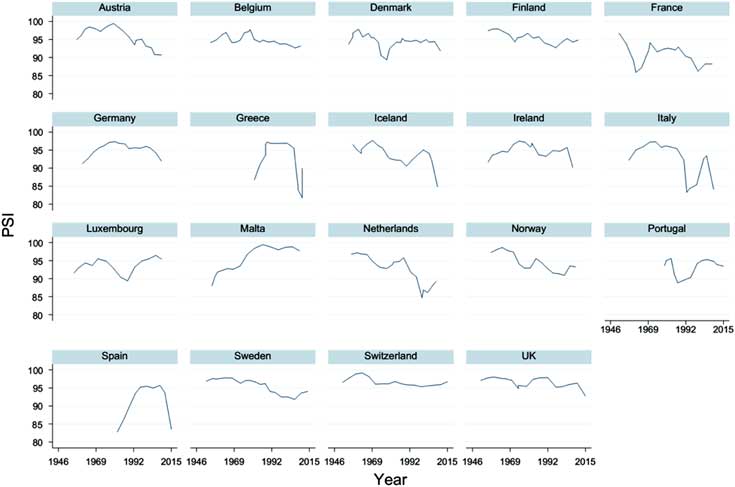
Figure 1 shows the trends of PSI over time for each country.Footnote 15 An overall trend towards de-institutionalization can be clearly detected, with all except four countries (Luxembourg, Malta, Portugal, and Switzerland) showing decreasing levels of PSI over time and particularly in the last two decades. Among the large set of countries experiencing a decrease of PSI over time, we note the presence of different levels of the index as well as different trajectories. As for the levels, Austria, Malta, Sweden, Switzerland, and UK can be considered as the most institutionalized party systems; conversely, while France shows the lowest values of PSI over the whole period, other countries like Greece, Iceland, Italy, the Netherlands, and Spain have undergone an accelerated decreasing trend during the last years. As regards the trajectories, while most countries show linear and somewhat limited patterns of change, some others, such as France, Greece, Italy, and Spain display greater variation with noticeable ups and downs.
Trends of party system institutionalization in Western Europe.

What can explain such different patterns of PSI? The next part of the article is devoted to answering this question.
Hypotheses and data
This section raises hypotheses about the determinants of PSI in Western Europe belonging to four competing arguments: the cleavage structure of the society, the economic context, the political–institutional framework, and the timing of democracy.Footnote 16 So far, these arguments have been employed in explanatory analyses of PSI in Central and Eastern Europe (Birch, Reference Birch2003; Tavits, Reference Tavits2005; Powell and Tucker, Reference Powell and Tucker2014), Latin America (Roberts and Wibbels, Reference Roberts and Wibbels1999; Madrid, Reference Madrid2005), or in cross-regional studies including both new and ‘semi-democracies’ (Mainwaring and Zoco, Reference Mainwaring and Zoco2007; Mainwaring et al., Reference Mainwaring, Gervasoni and España-Najera2016). Alternatively, in Western Europe, such arguments have been tested as determinants of the more general concept of party system stability/change (Bartolini and Mair, Reference Bartolini and Mair1990; Dassonneville and Hooghe, Reference Dassonneville and Hooghe2015).
Cleavage structure
Starting with the first argument, the macro-sociological literature (Lipset and Rokkan, Reference Lipset and Rokkan1967; Bartolini, Reference Bartolini2000) has emphasized the role of social cleavages in shaping Western European party systems and in the structuring of stable electoral alignments. Stability is caused by the fact that parties are deeply rooted in the society, since they have stemmed from a specific cleavage like class, religion, ethnicity, and voters vote according to the specific social group they belong to. As a consequence, a strong cleavage structure closes off the political marketplace and constraints the electoral mobility of voters, thus making inter-party competition more predictable (Bartolini and Mair, Reference Bartolini and Mair1990; Roberts and Wibbels, Reference Roberts and Wibbels1999; Tavits, Reference Tavits2005). Hence, the hypothesis is straightforward:
Hypothesis 1 The more structured and salient the social cleavages in a society, the higher the level of PSI.
As for the empirical measurement, we will take into account the impact of two different aspects: class cleavage strength and cultural heterogeneity. Following Bartolini and Mair (Reference Bartolini and Mair1990: 231–238), the best proxy for class cleavage strength can be achieved by focusing on the level of ‘organizational density’, through the use of two indices: the ratio between left parties’ membershipFootnote 17 and total electorate and the trade-union density, which is the ratio between union membershipFootnote 18 and total dependent labor force of a country. Following again Bartolini and Mair’s strategy (Reference Bartolini and Mair1990) we have combined the two indices into a single standardized index of class cleavage strength.Footnote 19 Data for the two measures come, respectively, from the MAPP Project Data Archive (Van Haute et al., Reference Van Haute2016),Footnote 20 and from Ebbinghaus and Visser (Reference Ebbinghaus and Visser2000) and Armingeon et al. (Reference Armingeon, Isler, Knöpfel, Weisstanner and Engler2015) before and after 1960, respectively.
As regards cultural (i.e., ethnic, linguistic, and religious) heterogeneity, the most commonly used measure is the Fractionalization index by Alesina et al. (Reference Alesina, Devleeschauwer, Easterly, Kurlat and Wacziarg2003). Given that Alesina et al.’s data archive only provides one score for each country and we are interested in temporal variation, we have relied on Bartolini (Reference Bartolini2000) for data between 1950 and 1970,Footnote 21 and on Patsiurko et al. (Reference Patsiurko, Campbell and Hall2012) for the later period.Footnote 22
Economic performance
As far as the economic context is concerned, the argument follows the general reasoning of economic voting (Lewis-Beck, Reference Lewis-Beck1988; Remmer, Reference Remmer1991). At the individual level, the argument is clear: people hold parties accountable for the state of the economy, establishing a reward-and-punishment mechanism with the incumbent. At the macro level, ‘economic hardship can be expected to increase electoral volatility by undermining established political loyalties, increasing anti-incumbent voting and encouraging voters to support new political alternatives’ (Roberts and Wibbels, Reference Roberts and Wibbels1999: 577). Moreover, recent studies based on the disentanglement of electoral volatility show that poor economic performance especially fosters ‘type A volatility’ (Powell and Tucker, Reference Powell and Tucker2014; Hernández and Kriesi, Reference Hernández and Kriesi2016) or ‘extra system volatility’ (Mainwaring et al., Reference Mainwaring, Gervasoni and España-Najera2016), which is analogous to our party system regeneration. Therefore, we assume a positive linear relationship between economic performance and PSI. The hypothesis is the following:
Hypothesis 2 The better the national economic performance the higher the level of PSI.
Given that voters are usually sensible by short-term economic fluctuations, we use the GDP growth rate at constant prices (i.e., adjusted for inflation), measured 1 year before the election.Footnote 23
Political and institutional framework
Waves of electoral mobilization and demobilization may affect PSI. Previous studies on Western Europe (Bartolini and Mair, Reference Bartolini and Mair1990), Central and Eastern Europe (Birch, Reference Birch2003; Birnir, Reference Birnir2007; Tavits, Reference Tavits2008; Gherghina, Reference Gherghina2015), and Latin America (Madrid, Reference Madrid2005) have pointed out that it is not the level of turnout per se but turnout change between elections to influence party system stability and predictability. When former non-voters decide to participate, they alter the former balance of power among the existing parties. The same result is achieved when former voters withdraw and decide to abstain.
Hypothesis 3 The higher the turnout change between elections the lower the level of PSI.
Turnout change has been measured as the absolute difference between two consecutive elections.Footnote 24
As far as the structure of competition is concerned, the party system format has to be taken into account. The rationale is threefold. First, ‘voter choice is characterized by a certain degree of randomness. An increase in the number of competitors leads to an increase in random choices. Accordingly, volatility increases as a result of this randomness’ (Gherghina, Reference Gherghina2015: 24). Second, volatility increases in multiparty systems because the greater the number of parties ‘the smaller will be the average perceived distance between parties and the higher the probability that the average voter will transfer his vote from party to another party’ (Pedersen, Reference Pedersen1983: 46). Third, in a more fragmented setting, ‘voters can defect to more options’ (Mainwaring et al., Reference Mainwaring, Gervasoni and España-Najera2016: 2) and new parties have a greater opportunity to enter the system successfully, thus fostering party system regeneration. Several empirical studies have confirmed the presence of a positive relationship between the number of parties and total volatility (Bartolini and Mair, Reference Bartolini and Mair1990; Remmer, Reference Remmer1991; Roberts and Wibbels, Reference Roberts and Wibbels1999; Tavits, Reference Tavits2005; Mainwaring and Zoco, Reference Mainwaring and Zoco2007; Dassonneville and Hooghe, Reference Dassonneville and Hooghe2015). The expected relationship between the number of parties and PSI is, therefore, the following:
Hypothesis 4 The larger the number of parties the lower the level of PSI.
The number of parties is measured through the Effective Number of Electoral Parties (ENEP)Footnote 25 developed by Laakso and Taagepera (Reference Laakso and Taagepera1979). Following the choice of other authors (Mainwaring and Zoco, Reference Mainwaring and Zoco2007; Powell and Tucker, Reference Powell and Tucker2014; Dassonneville and Hooghe, Reference Dassonneville and Hooghe2015; Mainwaring et al., Reference Mainwaring, Gervasoni and España-Najera2016) we measured the lagged effective number of parties, that is, ENEP at the previous election.
Among the institutional constraints, the electoral system is certainly a factor to be taken under control, although its effect is not entirely clear. On one side, Bartolini and Mair (Reference Bartolini and Mair1990) have argued that the level of volatility is more pronounced in more disproportional systems. On the other side, other authors support the idea that a proportional electoral system with a large district magnitude makes it easier for new parties to emerge (Powell and Tucker, Reference Powell and Tucker2014; Mainwaring et al., Reference Mainwaring, Gervasoni and España-Najera2016). Empirical evidence is also mixed, since Bischoff (Reference Bischoff2013), Powell and Tucker (Reference Powell and Tucker2014), Dassonneville and Hooghe (Reference Dassonneville and Hooghe2015), and Mainwaring et al. (Reference Mainwaring, Gervasoni and España-Najera2016) find no significant effect of district magnitude. Given these contrasting results, we will take the effects of electoral system under control in the analysis without proposing a specific hypothesis. Our measure is the natural log of the average district magnitude, which is calculated by dividing the total number of seats to be allocated by the total number of districts.Footnote 26
Democracy and time
Finally, we add in the explanatory model some variables related to democratic experience and time. As stated in section one, time is a fundamental element in the process of PSI: patterns of inter-party competition need time to become predictable and routinized (Mainwaring and Scully, Reference Mainwaring and Scully1995; Casal Bértoa, Reference Casal Bértoa2017). Therefore, it is reasonable to expect that democracies that were inaugurated earlier show higher PSI. Similarly to Mainwaring and Zoco (Reference Mainwaring and Zoco2007) and Mainwaring et al. (Reference Mainwaring, Gervasoni and España-Najera2016) we measure the ‘Birth year of democracy’ through the logged number of years since the inauguration of democracy until 2016.Footnote 27 Birth year of democracy measures a ‘cohort effect’, that is ‘the causal impact of factors associated with characteristics of the historical period in which a democracy was born’ (Mainwaring et al., Reference Mainwaring, Gervasoni and España-Najera2016: 6). Our underlying hypothesis is the following:
Hypothesis 5 PSI is higher in democracies that were inaugurated earlier.
Beyond the effect of the timing of the democratization process, it should be argued that the time elapsed since the previous election may affect the level of PSI. According to Bischoff (Reference Bischoff2013: 541) the probability of a change in the factors influencing the vote choice ‘simply increases with the passage of time. Therefore, we would expect an increase in vote switching as well’. Moreover, as underlined by Powell and Tucker (Reference Powell and Tucker2014: 143), ‘the business of a new party entry is time consuming and (…) the less time available to create a new party, the fewer successful new parties will emerge’. Therefore, we assume that:
Hypothesis 6 The longer the time elapsed since the previous election, the lower the level of PSI.
Finally, we have added a trend variable (‘Time’) operationalized as the number of years elapsed since 1945. As claimed by Roberts and Wibbels (Reference Roberts and Wibbels1999: 581–582), ‘in time-series analysis, the trend variable helps to avoid the problem of spurious correlation arising when the values of the dependent variable and those of more independent variables vary independently but in a consistent direction over time’. With this time variable we can also control the statistical validity of our hypothesis related to the decrease of PSI in Western Europe during the last years. More precisely, we expect a non-linear relationship between time and institutionalization (the level of institutionalization increases until the late 1960s and then decreases). That is why we have estimated not only the linear effect of time, but also (in different models) its curvilinear effect through a second-order polynomial model (on this point see Tavits, Reference Tavits2005; Powell and Tucker, Reference Powell and Tucker2014) and its sequential effect including a dummy for each decade since the 1950s.
Hypothesis 7 After an initial increase until the late 1960s, since then on the level of PSI has decreased.
The model to be estimated is therefore the following:
 $$\eqalignno{ {\rm Party}\,{\rm system}\,{\rm institutionalization}\, {\equals}\, & \alpha {\plus}\beta \left( {{\rm Class}} \right){\plus}\beta \left( {{\rm Cultural}\,{\rm fractionalization}} \right) \cr &{\plus}\beta \left( {{\rm GDP}\,{\rm growth}} \right) {\plus}\beta \left( {{\rm Turnout}\,{\rm change}} \right) \cr & {\plus}\beta \left( {{\rm ENEP}_{{t{\minus}1}} } \right){\plus}\beta \left( {{\rm ADM}_{{{\rm ln}}} } \right)\cr &{\plus}\beta \left( {{\rm Birth}\,{\rm Year}\,{\rm of}\,{\rm democracy}_{{{\rm ln}}} } \right) \cr & {\plus}\beta \left( {{\rm Time}\,{\rm between}\,{\rm elections}} \right)\cr &{\plus}\beta \left( {{\rm Time}\,{\rm since}\,1945} \right) \cr & {\plus}\beta \left( {{\rm Time}\,{\rm since}\,1945} \right)^{2} {\plus}e $$
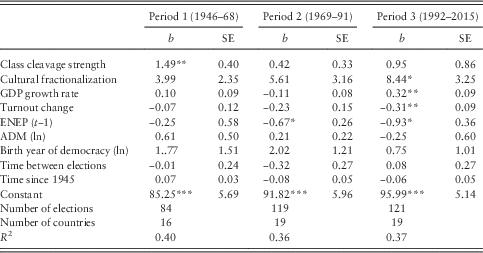
Beyond this general explanatory framework, we are also interested to see whether and how the determinants of PSI have changed through time. In other words, we want to discover which are the factors explaining the stability and predictability of inter-party competition today and if they are somewhat different from those explaining it after World War II. This task will be accomplished by splitting our sample into three time periods (1946–68; 1969–91; 1992–2015)Footnote 28 and running separate regression models for each of them. Our expectation is that, at least until the end of the 1960s, in an era of party systems’ freezing (Lipset and Rokkan, Reference Lipset and Rokkan1967) and strong ties between parties and voters, PSI was mainly a function of the cleavage structure of the society and little – if any – space was left to other factors. Then, since the 1970s, as the cleavage structure and particularly class become less salient (Dalton et al., Reference Dalton, Flanagan and Beck1984; Franklin et al., Reference Franklin, Mackie and Valen1992; Drummond, Reference Drummond2006), we expect that the stability and predictability in the patterns of inter-party competition have decreased, and PSI has been influenced by other contextual factors. In this regard, the importance of the economy on the level of PSI is expected to enhance during the last years, namely after the hit of the economic crisis in 2008–2009: as argued by different authors (Casal Bértoa, Reference Casal Bértoa2014; Hernández and Kriesi, Reference Hernández and Kriesi2016), the economic crisis has provided additional fuel to the long-term process of restructuration of Western European party systems, increasing volatility and fostering the rise of new political parties.
Method and results
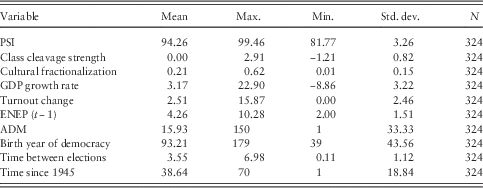
Table 1 reports the descriptive statistics of the dependent and (unlogged) independent variables. Dealing with a time-series cross-section data set, with repeated observations over time (elections) on the same fixed units (countries), problems of heteroscedasticity and autocorrelation may arise (Stimson, Reference Stimson1985). In particular, unlike in classic ordinary least squares regression (OLS), errors may not be independent and identically distributed given that each panel (i.e., each country) has its own variance; moreover, errors are serially correlated, that is, the errors for a given country are correlated with previous errors for that country.
Descriptive statistics

PSI=party system institutionalization; ENEP=Effective Number of Electoral Parties; ADM=average district magnitude.
Diagnostics tests confirmed the presence of heteroscedasticity and autocorrelation in our data.Footnote 29 In order to tackle these issues, we have estimated the regression models using the generalized estimating equations (GEE)Footnote 30 with an autoregressive correlation structure (AR1) and semi-robust standard errors. As reported by Mainwaring et al. (Reference Mainwaring, Gervasoni and España-Najera2016: 7), ‘GEE models are appropriate for data sets with temporally correlated errors and with more units than time periods’ (we have 19 countries and a mean of 17 time periods per country).
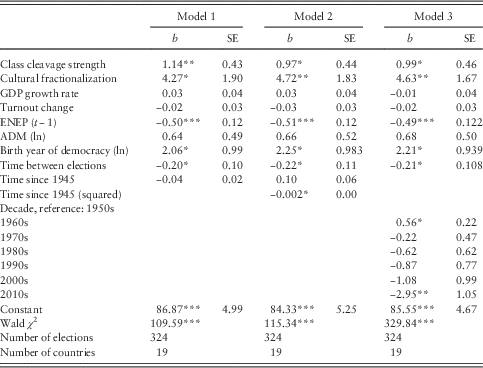
Table 2 presents the results of three models that differ only for the specification given to the time variable. Model 1 presents the linear effect of time on PSI, Model 2 the curvilinear effect through the second-order polynomial model and finally Model 3 reports a dummy for each decade.
Generalized estimating equations (GEE) (AR1) models for party system institutionalization in Western Europe (1945–2015)

ENEP=Effective Number of Electoral Parties; ADM=average district magnitude.
GEE with autoregressive correlation structure (AR1); b coefficients and semi-robust SE are reported. R 2 is not reported because this statistic is not defined for GEE models.
*P<0.05, **P<0.01, ***P<0.001.
Comparing the three models, regardless of the specification given to the time variable, all of them show very similar results in terms of sign, size and significance of the hypothesized predictors. Given the sensitivity of time-series cross-section analysis to different specifications (Mainwaring et al., Reference Mainwaring, Gervasoni and España-Najera2016), Table A3 in online Appendix provides further robustness checks by replicating the analysis of Model 3 through four alternative techniques.
All the hypotheses raised in the previous section are confirmed as regards the direction of the effect of our predictors on PSI, but only some of them have a statistically significant impact. The most robust findings are the positive effect of the cleavage structure (Hypothesis 1) and the negative effect of the party system format (Hypothesis 4) on PSI.
As far as the class cleavage gets stronger and the level of ethnic, linguistic, and religious fractionalization becomes higher, the patterns of inter-party competition become more stable and predictable; conversely, all else equal, an increase in the number of parties (ENEP) is associated with a decrease in the level of PSI: in Models 1–3 PSI decreases by about 0.5 points when the effective number of parties increases by one unit. These three variables are the only ones showing a significant impact on PSI in all models. Conversely, the state of the economy (Hypothesis 2), the waves of electoral mobilization (Hypothesis 3) and the electoral system do not seem to have a robust impact on PSI, although the direction of the sign is the one we have previously hypothesized.Footnote 31 While the relevance of the cleavage structure and the number of parties are in line with those resulting from Bartolini and Mair’s analysis (1990), it is interesting to note that our findings about the irrelevance of turnout change and GDP growth rate are in contrast with, respectively, Bartolini and Mair (Reference Bartolini and Mair1990) and Dassonneville and Hooghe (Reference Dassonneville and Hooghe2015). However, these apparent inconsistencies may be explained by the different dependent variable used (once again, they employ total volatility alone). Indeed, vote shifts between two consecutive elections (total volatility) are likely to be comparatively more sensitive to short-term factors such as turnout change and GDP change than a long-term process like PSI. These findings represent a further confirmation that PSI is something that cannot be reduced to total volatility only, and consequently its explanatory framework is not exactly the same of party system stability/change.
As regards the relationship between the timing of democratization and institutionalization (Hypothesis 5), the relevance of Birth year of democracy is confirmed given that PSI is higher in democracies that were inaugurated earlier. Furthermore, in the GEE models reported in Table 2, even the time elapsed since the previous election seems to have a negative and significant impact on PSI (Hypothesis 6). Yet, despite the direction of the two effects is always consistent across the different estimating techniques, the validation of Hypothesis 5 and Hypothesis 6 is not robust since at least one of the other models shown in Table A3 rejects these hypotheses.
Finally, the effect of time perfectly confirm our expectation about its non-linear impact on PSI (Hypothesis 7). The linear hypothesis tested in Model 1 reveals that, notwithstanding the negative sign of the coefficient (PSI decreases over time) the association is not significant; on the contrary, the curvilinear effect tested in Model 2 is empirically confirmed and the specification included in Model 3 with the dummies for each decade contributes to providing a clearer picture: PSI increases up to the end of the 1960s (the coefficient is positive and significant) and then it starts to decrease (the coefficient becomes negative since the 1970s, and it gains statistical significance in the 2010s).
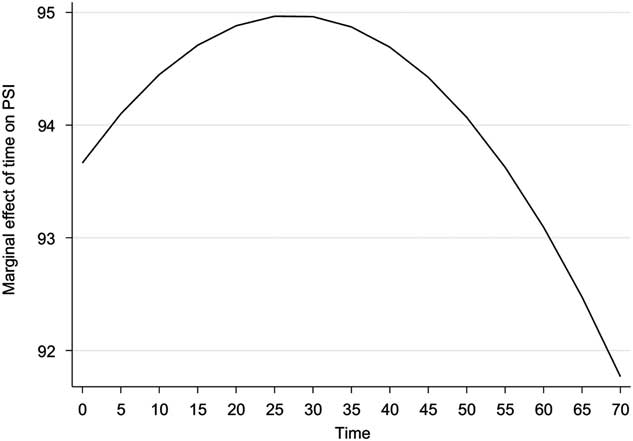
The chart reproducing the predictive levels of PSI at different levels of time, estimated from Model 2, is helpful to visualize this relationship better (see Figure 2): a bell-shaped curve clearly emerges, with the level of PSI that has increased in Western Europe for 28 years after 1945, reaching its highest peak around 1973; then, it has started to decrease, with the negative curve that has become increasingly sharp across the decades.
Predictive levels of party system institutionalization (PSI) at various levels of time.

For the analysis of the determinants of PSI in each period, the structure of the data changes, since we have by far more panels than time units (19 countries and a mean of time units ranging between 4.4 and 6.4 according to the period). With such structure, there is no reason to expect problems of autocorrelation between the observations, while concerns of heteroscedasticity remain (Beck and Katz, Reference Beck and Katz1995; Tavits, Reference Tavits2005). That is why we have run these analyses using OLS with Huber/White/sandwich robust standard errors within the country clusters. The results are reported in Table 3, separately for each of the three periods (1946–68, 1969–91, and 1992–2015).
Ordinary least squares (OLS) regression with country clusters for three time periods

ENEP=Effective Number of Electoral Parties; ADM=average district magnitude.
OLS regression with robust SE clustered by country; b coefficients and robust SE are reported
*P<0.05, **P<0.01, ***P<0.001.
Empirical evidence emerging from Table 3 substantially confirms our expectations: over the course of the past 70 years there has been a significant change in the explanatory factors of PSI. During the first period (1946–68) the class cleavage created very strong ties between parties and voters and its variation across Europe was strongly associated with the level of PSI. The encapsulation of voters within class bonds was so pervasive that it prevented other factors from becoming statistically relevant in the explanation of PSI.
Then, in the second period (1969–91) – a phase of transition from an old ‘frozen’ period to a recent volatile and unpredictable period – the class cleavage loses salience, and the only significant variable appears to be the number of electoral competitors (ENEP). During the last period (1992–2015), along with the number of parties, other factors acquire relevance. First, a cleavage-related measure comes back in the explanation, but this time is the ethnic, linguistic, and religious diversity that matters: while class division is no longer significant, Western European voters are increasingly clustered and segmented across cultural lines (the level of ethno-linguistic and religious fragmentation is growing due to immigration and secularization) and culturally segmented societies develop more stable and predictable party systems than homogeneous societies.Footnote 32 Second, short-term factors related to the retrospective evaluation of the economic condition and turnout change, which were irrelevant in the overall models (see Table 2) and specifically in the first two periods, namely in times of strong social encapsulation, become crucial now: on the one hand, the worse the economic performance, the lower the level of PSI; on the other hand, huge waves of remobilization or – as more common in recent times – demobilization are associated with an increasing instability and unpredictability in the patterns of inter-party competition.Footnote 33
Conclusion
This article has focused on PSI, a topic that has been widely investigated across different regions so far, from Latin America to Central and Eastern Europe, while it has received little attention in the long-term consolidated Western European democracies where the stability in the patterns of inter-party competition has been taken for granted for a long time. In this regard, this article has provided three main contributions: a conceptual clarification of PSI; a new operationalization and the development of a new index; the detection of the explanatory factors of PSI.
First, building upon the conceptualization of PSI as the process by which the patterns of inter-party competition become stable and predictable over time, we have clarified its three constituent dimensions (stability, predictability, and time).
Second, following this conceptualization, we have operationalized PSI through an index that combines the indicators of the three dimensions of the concept highlighted before. This represents a step forward in the study of such topic given that previous empirical studies have so far operationalized PSI in the electoral arena primarily or exclusively through total volatility, and without accounting for the effect of time. Indeed, we claim that our measure is more satisfactory than total volatility to account for the dimensions underlying the concept of PSI. Moreover, empirical tests of validity have shown that our measure is not perfectly convergent with total volatility, thus demonstrating that the concept we capture is not exactly the same.
Third, we have looked for an explanation, by investigating the potential determinants of PSI and by comparing the relative impact of factors belonging to four competing arguments: cleavage structure, state of the economy, political–institutional framework, and length of democratic experience. Results show that the two main factors explaining the variance in PSI are the cleavage structure of a given society and the number of parties. These two factors have an opposite impact on PSI: while strong cleavages (both class and cultural heterogeneity) foster PSI, the number of parties is instead negatively related to our dependent variable.
Another important and original finding emerging from all the analyses is that PSI has followed a non-linear trend over time: as expected, PSI has generally increased between World War II and until the late 1960s and has declined from then on following an accelerated pattern of decrease in the last decades. Indeed, this finding confirms our descriptive evidence based on national variations, showing a general trend towards decreasing levels of PSI since the 1970s that becomes particularly strong in some countries over the last two decades.
Beyond the findings provided by the general explanatory model, other interesting and meaningful results emerge by splitting the analysis into three different periods of the same length (about 23 years each). The results clearly emphasize that, moving from the first (1946–68) to the second (1969–91) and especially to the third (1992–2015) period, the explanatory factors of PSI change: while until the end of the 1960s the class cleavage appears as the only significant determinant of PSI, this effect progressively loses its relevance in later periods. Since the 1970s, the number of parties becomes the most important determinant but, interestingly, in the last period, other factors emerge as relevant: cultural heterogeneity, economic performance, and turnout change. Some well-known processes have characterized the last period: the further decline of the class cleavage, the increase in party system fragmentation and in abstention rates, and eventually the hit of the harshest economic crisis since 1929, all of them pushing party systems towards de-institutionalization. Should these recent trends gain even more importance in the years to come, Western European party systems might be heading towards even more turbulent times.
Acknowledgments
A previous version of this article has been presented at the EPOP (Elections, Public Opinion and Parties) conference, University of Bologna, 26 February 2016, at the 74th annual conference of the Midwest Political Science Association, Chicago, 7–10 April 2016, at the 23rd International Conference of the Europeanists, Philadelphia, 14–16 April 2016, and finally at the LUISS-CISE Conference ‘Turbulent times. Economic crisis and political instability in Europe and the United States’, Rome, 21 April 2016. The authors thank Susumo Shikano, Gijs Schumacher, and Bruno Marino for comments and suggestions on earlier drafts of this article.
Financial Support
The research has been funded by the University of Florence and LUISS Guido Carli in Rome.
Data
The replication data set is available at http://thedata.harvard.edu/dvn/dv/ipsr-risp
Supplementary Material
To view supplementary material for this article, please visit https://doi.org/10.1017/ipo.2017.27