Introduction
Postnatal growth of preterm infants is a major focus in neonatal medicine. Since the statement made by the American Academy of Pediatrics Committee on Nutrition to achieve a goal of a growth rate and a composition of weight gain similar to those of a normal fetus, investigations have been focused on optimization strategies of postnatal nutrition administration with a hope to solve issues related to postnatal growth failure.1–Reference Horbar, Ehrenkranz and Badger3 Postnatal early parenteral nutrition starting at birth and fortifying enteral nutrition with protein both play key roles in postnatal growth of extremely low birth weight (ELBW) infants.Reference Stephens, Walden and Gargus4–Reference Mariani, Biasini and Marvulli10 Postnatal growth has been associated with neurodevelopmental outcomes, with or without adjusting for common comorbidities of prematurity, emphasizing long-term benefit of optimal growth in the immediate postnatal period.Reference Ehrenkranz, Dusick, Vohr, Wright, Wrage and Poole11–Reference Zozaya, Díaz and Saenz de Pipaón14 Despite these efforts and recommendations, suboptimal postnatal growth continues to be a major issue in infants born less than 1500 g, especially those who are born less than 1000 g.Reference Horbar, Ehrenkranz and Badger3, Reference Zozaya, Díaz and Saenz de Pipaón14–Reference Griffin, Tancredi, Bertino, Lee and Profit15 A recent report based on the Vermont Oxford Network database found over 50% of infants born less than 1000 g had a discharge weight below the 10th percentile on the Fenton Growth Chart.Reference Horbar, Ehrenkranz and Badger3 Another report using the California Perinatal Quality Care Collaborative database showed that, albeit a small but statistically significant improvement in the proportion of infants discharged with a weight below the 10th percentile line or a fall in weight z-score of more than one between birth and discharge between 2005 and 2012, there were still around 50% of infants born in 2012 who were discharged with a weight of less than the 10th percentile, and nearly 40% of infants had a weight z-score decline of more than one between birth and discharge in 2012, only a marginal improvement from 47% in 2005.Reference Griffin, Tancredi, Bertino, Lee and Profit15 These recent reports following decades of focus on postnatal nutrition implied that postnatal nutrition is not the only answer to postnatal growth and that there may be additional hidden factors to influence postnatal growth in parallel to postnatal nutrition. Coincidentally, reports focusing on studying the impact of amino acid intake have observed a plateau in the amount of amino acid in early parenteral nutrition for overall growth benefit, suggesting that postnatal nutrition may not be the only answer to postnatal growth.Reference Clark, Chace and Spitzer16–Reference Bellagamba, Carmenati and D’Ascenzo19
As expected, an association between common morbidities and postnatal growth, including late-onset sepsis, medical or surgical necrotizing enterocolitis, chronic lung disease, severe retinopathy of prematurity (ROP), and severe intraventricular hemorrhage (IVH) have been reported.Reference Griffin, Tancredi, Bertino, Lee and Profit15, Reference Bartholomew, Martin and Allred20,Reference Lee, Kim, Namgung, Park, Park and Jeon21 These findings confirmed that the postnatal course plays a significant role in postnatal growth and that the catabolic state in a severely ill infant greatly hinders their rapid growth potential. However, the association between comorbidity and growth does not constitute the big picture, as comorbidity, by definition, is the consequence of an earlier event or a series of earlier events that led to its presence. Therefore, comorbidity may at best serve as a mediator between an undefined early-life event and postnatal growth.
Intriguingly, recent studies have also indicated birth weight z-score as a significant predictor of postnatal growth failure.Reference Griffin, Tancredi, Bertino, Lee and Profit15, Reference Lee, Kim, Namgung, Park, Park and Jeon21 As fetal weight gain in the first and second trimesters is largely determined by cell number expansion, which is governed primarily by nutrient and oxygen availability for cells to undergo rapid replication, we asked whether intrauterine conditions that lead to compromise in nutrient and oxygen delivery would impact postnatal growth in the ELBW population.Reference Sharma, Shastri and Sharma22 Placental insufficiency is a condition where blood flow from the placenta to the fetus is compromised. Placental insufficiency is the consequence of abnormal placentation, trophoblast invasion, and spiral artery remodeling due to various maternal and placental etiologies. Placental insufficiency is by far the most common cause of chronic fetal hypoxia and nutrient deficiency and may lead to fetal growth restriction. In this study, we hypothesize that exposure to placental insufficiency is a major determinant of postnatal growth in infants born less than 1000 g.
Materials
Study data source and population
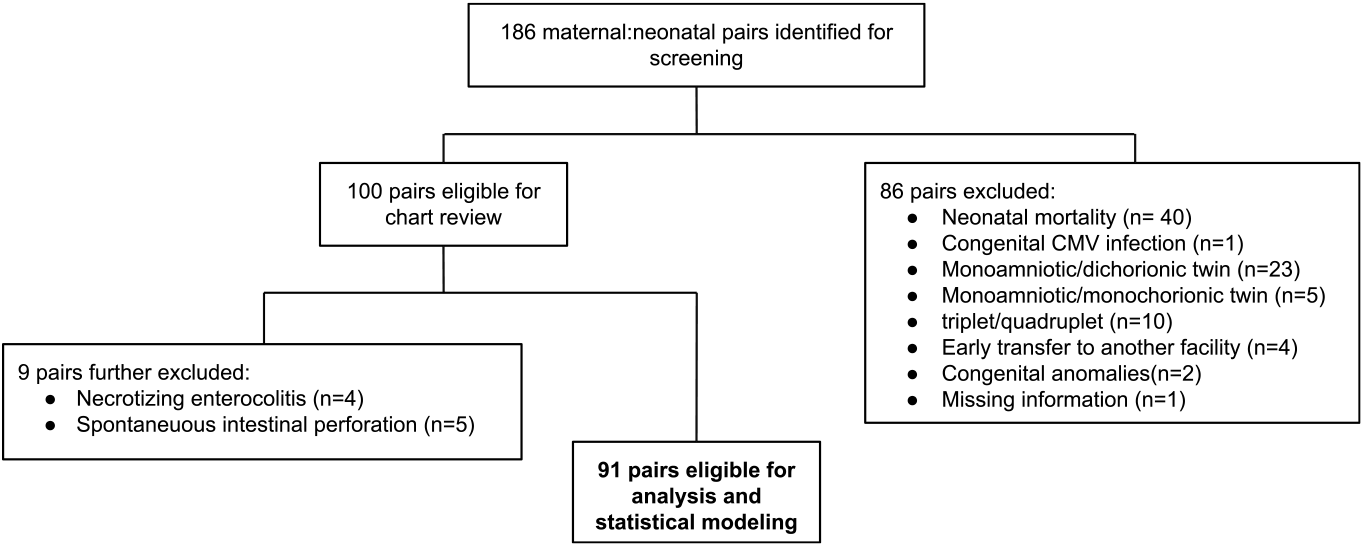
This is a retrospective cohort study with prospective data collection from a single academic medical center. The neonatal intensive care unit (NICU) at the University of Kansas Medical Center (KUMC) is a level III unit caring for 330–370 sick full-term and preterm newborns annually. The obstetrics service is one of the region’s largest referral centers for high-risk pregnancies. The average number of deliveries is approximately 2000 per year. This study was approved by the Institutional Review Board at KUMC. The Center for Medical Informatics and Enterprise Analytics at KUMC is in charge of a clinical database search tool, Healthcare Enterprise Repository for Ontological Narration (HERON), to assist researchers in identifying patients for retrospective studies.Reference Murphy, Weber and Mendis23, Reference Waitman, Warren, Manos and Connolly24 Using HERON, we screened newborns admitted to the nursery or the NICU from October 01, 2010 to June 30, 2018 with birth weight less than 1000 g, which is defined as ELBW newborns in the study. The exclusion criteria, as listed in Fig. 1, were defined before the data collection was started. A total of 91 patients were included in the statistical analysis. A detailed algorithm for patient inclusion and exclusion was provided in Fig. 1.
Flowchart depicting subject inclusion and exclusion processes.

Data collection
Maternal data collected included age, race and ethnicity, antenatal steroid status, mode of delivery, obesity (defined as Body Mass Index ≥30), smoking status, and the presence of hypertensive disorders prior to or during pregnancy. The fetal Doppler reports closest to delivery were accessed to extract umbilical artery (UA) flow data. Placental insufficiency in this study was defined as abnormal UA blood flow, including a pulsatility index of >95%, absent end-diastolic flow, or reversed end-diastolic flow.Reference Unterscheider, Daly and Geary25 In the absence of a universal definition of placental insufficiency, we adopted this definition based on the multicenter Prospective Observational Trial to Optimize Pediatric Health (PORTO) study which showed a consistent association between these findings on the UA and adverse perinatal outcome.Reference Unterscheider, Daly and Geary25 The two perinatologists (G.T.L. and M.R.P.) who reviewed the fetal Doppler studies were blinded to neonatal weight data. Neonatal data collected included gender, gestational age at birth, APGAR scores at 1 and 5 min and weekly weights as documented in the growth charts of the electronic medical records. Nine mothers did not have fetal Doppler studies performed prior to birth due to urgency for immediate delivery, including one with placental abruption, five with premature preterm rupture of membrane with preterm labor, and three with preterm labor without report of underlying etiology in the medical records. These patients were considered to have no placental insufficiency because their clinical presentations were not commonly associated with placental insufficiency. Prior to analysis, all weights were transformed into z-scores using the 2013 gender-specific Fenton growth charts.Reference Fenton, Nasser, Eliasziw, Kim, Bilan and Sauve26 Nutrition data including daily calories and amino acid intake via parenteral nutrition in the first 7 days of life, as well as daily calories and protein intake after establishment of full enteral nutrition until NICU discharge were also collected. For parenteral nutrition intake, data extracted were based on hourly infusion of parenteral fluid in the first 7 days of life. Each day starts and ends at midnight. If a patient was born before 12 p.m., day of birth was considered day 1. For those patients born after 12 p.m., day of birth was not counted, and the second day of life was considered day 1. For enteral intake, data were extracted from weekly dietician notes to average intake. The presence or absence of moderate-to-severe bronchopulmonary dysplasia (BPD), severe ROP (Stage 3 or above in either eye, or meeting criteria for treatment), severe IVH (Grade 3 or 4 on either or both sides), culture-positive sepsis, and the duration of antibiotics use were also recorded.
Statistical analysis
Descriptive statistics: continuous maternal and neonatal characteristics were summarized by mean and standard deviation, the ordinal variables or variables taking integer values (APGAR scores and days on antibiotics) by median and interquartile range, and binary variables by frequency and percentage. The differences between infants with or without placental insufficiency were assessed by effect size measures of Cohen’s d, risk difference, and Cliff’s Delta for continuous, ordinal, and binary variables, respectively. Weight z-score trajectories were described by using spaghetti plots.
Linear mixed-effects regression models (LMMs) were then used to examine the effects of placental insufficiency on weight z-score trajectory (excluding birth weight for collinearity concern). LMM may include placental insufficiency, linear, and/or quadratic terms of gestational age, and/or their interaction terms as fixed-effects; random intercept and/or random coefficients for the gestation age were considered to allow each infant to have her/his own intercept, slope, and/or curvature for the trajectory curve. Considering the linear and quadratic terms of gestational age was highly correlated and would inflate their standard error, they were shifted by a constant, identified via a grid search to minimize the correlation and thus variance inflation. We also explored the possibility of including potential maternal and neonatal covariates in the LMM. Potential covariates included (1) demographic variables (maternal obesity, smoking status, and infant gender), (2) neonatal nutritional variables (average daily calories and amino acid intake in the first 7 days of life, average daily calories and protein intake after enteral nutrition was fully established until NICU discharge), and (3) neonatal comorbidity (BPD, ROP, IVH, blood culture-positive sepsis, and days of antibiotics use during NICU stay). The optimal combinations of fixed- and random-effects and inclusion of covariates were determined by the smallest values of Akaike Information Criterion (AIC) and Bayesian Information Criterion (BIC), both penalized model goodness-of-fit by model complexity, with heavier penalty in BIC than in AIC. For model selection purpose, we used maximum likelihood estimation method to compute the likelihood function component of AIC and BIC for model comparisons and then applied the restricted maximum likelihood estimation method for regression parameters.
The entire analyses were conducted using R Statistical Language in the R Studio integrated development environment (R Studio IDE version 1.1.463).27, Reference Ripley28 Effect sizes were calculated using the effsize package for Cohen’s d and Cliff’s Delta and the PropCIs package for risk difference).Reference Torchiano29, 30 LMMs were built using the Ime4 package (version 1.1-21).Reference Bates, Mächler, Bolker and Walker31 Model inference was conducted using the limerTest package.Reference Kuznetsova, Brockhoff and Christensen32 The results were summarized using the sjPlot package.Reference Lüdecke33 Image and table rearrangement was performed in Adobe Illustrator CC (2017.1.0 Release).
Results
Characteristics of the patient cohort
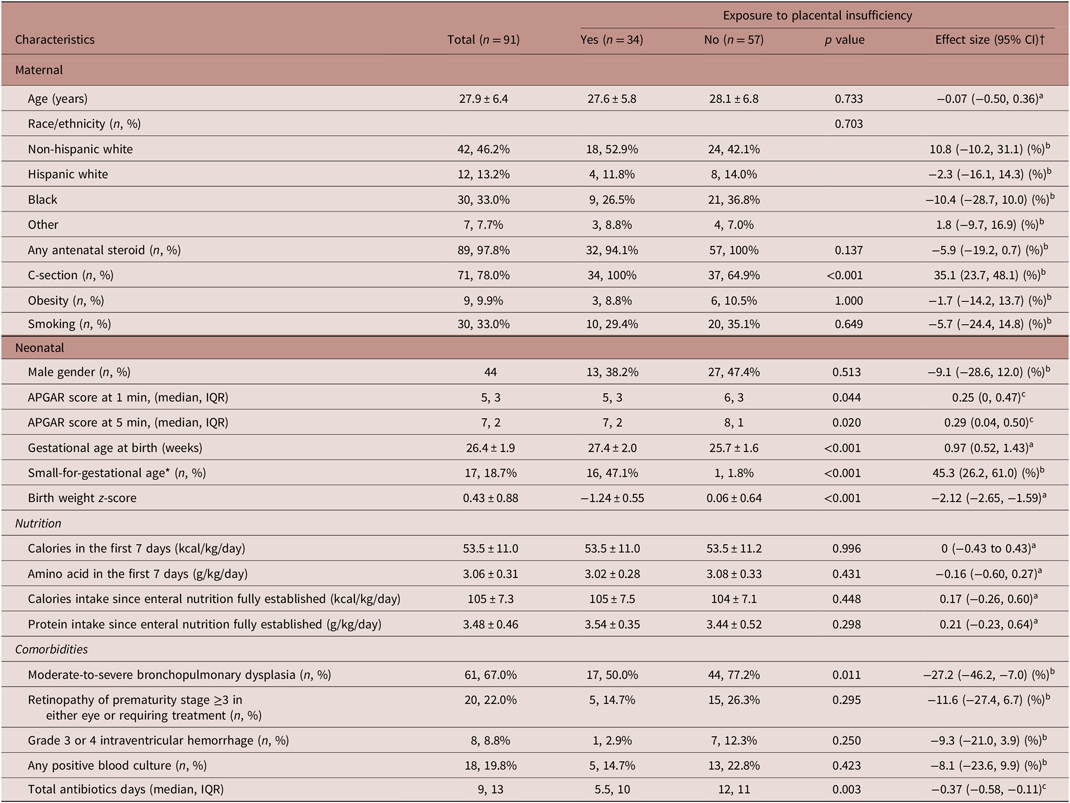
The characteristics of the patient cohort and the respective descriptive statistics are listed in Table 1. Exposure to placental insufficiency was associated with a lower birth weight z-score and a later gestational age at birth. All newborns exposed to placental insufficiency were born via C-section, while the C-section rate was 65% in the non-exposed newborns. Interestingly, exposure to placental insufficiency was associated with a decrease in the total days of antibiotics administration. The exposed group seemed to show lower rate of positive blood cultures, with wider CIs in differences, as well as lower prevalence of neonatal comorbidities and small differences in terms of Cohen’s d as compared to their counterpart in our patient cohort. Spaghetti plots (Supplementary Figure S1) suggested non-linear trends in weight trajectories, with substantial between-subject variation across gestational age.
Characteristics of patient population

Continuous variables are presented as mean ± SD. IQR stands for inter-quartile range. CI stands for confidence interval.
* Defined as birth weight <10th percentile on gender specific 2013 Fenton growth chart.
† Placental insufficiency Yes minus No.
a Cohen’s d.
b Risk difference.
c Cliff’s Delta.
Models for the effects of placental insufficiency exposure
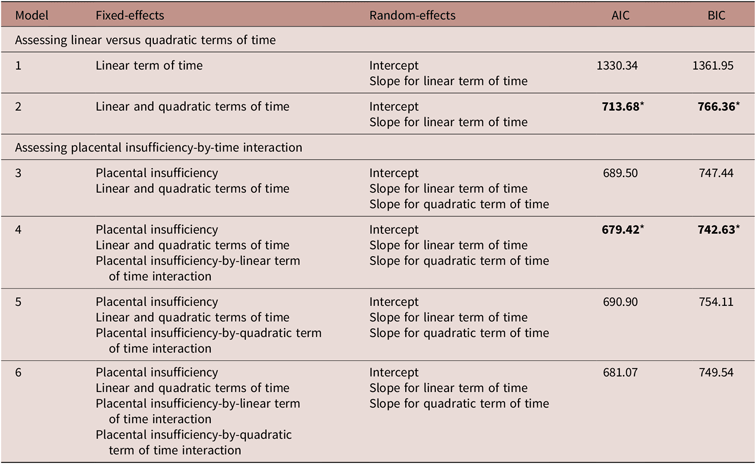
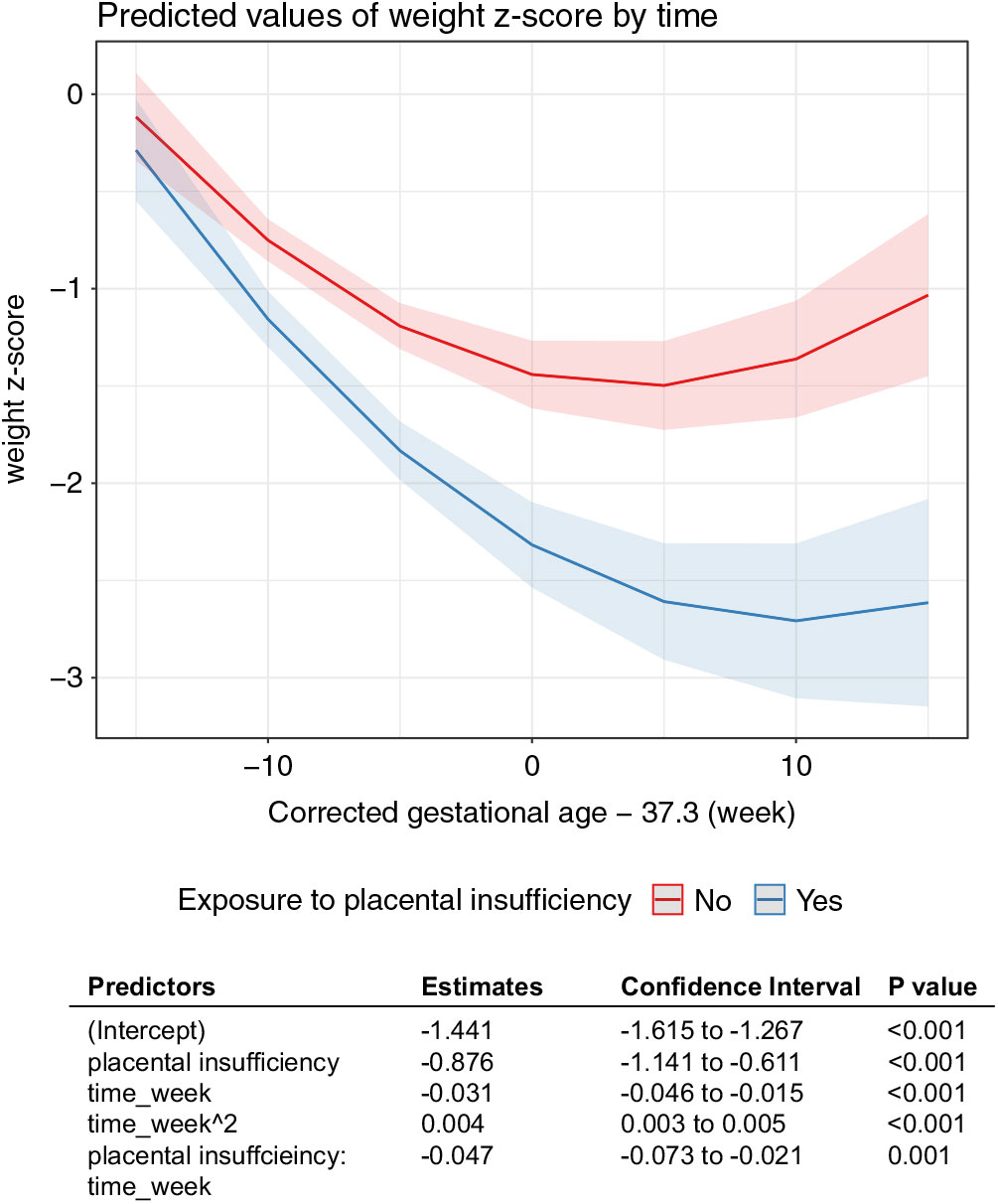
With a grid search over the first and the third quartiles of gestational age using 0.1-week intervals, we identified that shifting gestational age by 37.3 weeks would minimize the correlation (from Pearson r > 0.99 to r < 0.01) between the linear and quadratic terms. Hence, observed gestational ages were then shifted by this amount and entered into modeling process. When covariates were not considered, AIC and BIC both favored the model that contained fixed-effects of a linear and a quadratic term of time, exposed to placental insufficiency, and the interaction term between placental insufficiency and linear term of time, and random intercept and random coefficients for linear and quadratic time (Model 2 in Table 2). The fixed-effect interaction term indicated alterations in postnatal weight trajectories in the presence of antenatal exposure to placental insufficiency (Fig. 2), and specific fixed-effects can be interpreted as follows: (1) for the group not exposed to placental insufficiency, the average weight z-score was −1.441 (95% CI from −1.615 to −1.267) at gestational age of 37.3 weeks (estimate for Intercept in Fig. 2); the first derivative of the expected z-score took the form as  $$\partial E\left[ Z \right]/\partial T = {\rm{ }}\;\left( { - 0.031} \right) + \,\,2\,\,\, \times \,\,0.004\; \times \;\left( {T\; - 37.3} \right)\; = 0.008T - 0.3294,$$
, where −0.031 is the estimate for the linear term of time, 0.004 is the estimate for the quadratic term of time, T was a gestational age, and
 $$\frac{{\partial E\left[ Z \right]}}/{{\partial T}}\;$$
was the slope of the curve, implying that expected z-score decreased (negative
 $$\frac{{\partial E\left[ Z \right]}}/{{\partial T}}\;$$
slope) before 41.2 weeks gestational age then increased (positive slope) afterwards; (2) for the group exposed to placental insufficiency, the average weight z-score was 0.88 (95% CI from 0.61 to 1.14) lower than their counterpart at 37.3 weeks gestational age (estimate for the placental insufficiency variable in Fig. 2); the first derivative of the expected z-score
 $$\partial E\left[ Z \right]/\partial T = {\rm{ }}\;\left( { - 0.031} \right){\rm{ + }}\;\left( { - 0.047} \right) + \,\,2\,\,\, \times \,\,0.004\; \times \;\left( {T\; - 37.3} \right)\; = 0.008T - 0.3764,$$
, where −0.031 and −0.047 are estimates for the linear term of time and the placental insufficiency-by-time interaction term, respectively, 0.004 is the estimate for the quadratic term of time, and T was a gestational age, suggested that the expected z-score continued to decrease (negative slope) before 47.1 weeks gestational age then increased (positive slope) afterwards.
AIC and BIC scores for various linear mixed-effects regression models

AIC, Akaike Information Criterion; BIC, Bayesian Information Criterion.
* Lowest score.
(Color online) Predicted values of weight z-score by time in the presence or absence of exposure to placental insufficiency and the related statistical output. Lines denote predicted values. Shades denote 95% confidence interval. Time scale (x-axis) is shifted by 37.3 weeks to minimize correlation between the linear term and the quadratic term of the time variable (see text for detail).

Roles of covariates were then explored by including them in the model as described above. Each group, namely, demographics, comorbidities-related, and nutrition-related covariates, was incorporated in the model selection process separately (Supplementary Table S1). Comparing models with various combinations of demographic covariates, AIC and BIC both still favored the original model (Supplementary Table S1), suggesting that, in our cohort, neonatal gender, maternal smoking, maternal obesity, or maternal race/ethnicity did not influence postnatal weight z-score trajectory up to 50 weeks corrected gestational age. For nutrition covariates, the most favored model selected by both AIC and BIC included calories in the first 7 days (Table 3 and supplementary Table S1). For comorbidity-related covariates, the most favored model selected by both AIC and BIC included total days of antibiotics during NICU stay (Table 3 and Supplementary Table S1). Finally, we included calories in the first 7 days of life and total days of antibiotics, along with their respective interaction terms with time, in the model. We found that neither AIC nor BIC favored a model with additional covariate-by-time interaction terms (Supplementary Table S2).
AIC and BIC scores for including selected covariates in the linear mixed-effects regression model

AIC, Akaike Information Criterion; BIC, Bayesian Information Criterion.
* Lowest score.
Overall, the model with the lowest AIC and BIC scores include the following variables:
(1) Fixed-effects – placental insufficiency, linear term of time, quadratic term of time, placental insufficiency-by-time interaction term, calories in the first 7 days of life, days of antibiotics.
(2) Random-effects – slope for linear term of time, slope for quadratric term of time.
Discussion
In this report, we investigated postnatal weight z-score trajectories of preterm infants which is similar to the approach used in a recent international study that studied postnatal growth trajectories in healthy preterm infants.Reference Rochow, Raja and Liu34 We demonstrated the impact of an antenatal factor, placental insufficiency, on postnatal weight trajectory of ELBW by a mixed-effects modeling approach. We first examined the need to include a quadratic term of time and the placental insufficiency-by-time interaction term. We then explored the roles of additional demographic, nutrition-related, or comorbidity-related covariates, as well as their interactions with the time variable, in the heterogeneity in weight z-score trajectories. We relied on AIC and BIC, instead of p-values of individual fixed-effects, to compare various models during the modeling process and to avoid overfitting. Our results indicated that weight z-score trajectory in ELBW infants followed a quadratic curvature against time and differed between the placental insufficiency-exposed and the non-exposed groups. We further showed that the inclusion of certain covariates (calories in the first 7 days of life and total antibiotics duration) may improve model fitness, but these covariates have minimal effect on the curvatures of the weight trajectories. Overall, our findings provide evidence that placental insufficiency, an antenatal factor, is a major determinant of postnatal growth in infants born less than 1000 g.
Normalization of postnatal weights of ELBW infants using the Fenton growth chart takes into account the gender as well as the birth gestational age and postnatal age. It is a common practice to compare growth of individual infants. After birth, all neonates lose weight due to water contraction and the poor resorptive ability of water by the kidneys. In ELBW infants, it typically takes up to 2 weeks to regain back to birth weight. Therefore, z-scores almost universally decrease in the first few weeks of life as a result of normal postnatal physiology. Intuitively, after ELBW resumed weight gain, the velocity of weight gain would be close to that of normal fetuses, and the z-score trajectory would remain constant. However, factors that lead to suboptimal weight gain, such as the severity of illness after birth, postnatal comorbidity, suboptimal nutrition delivery via the parental route, and the pace of enteral nutrition transitioning may cause weight z-scores to continue to decrease over time beyond the period of physiological transitioning. In this study cohort, the overall estimated z-score decreased from birth of −0.43 to 43 weeks corrected gestational age, with a predicted nadir of −1.9 (data not shown). The weight z-score nadir indicates a change in the slope from negative to positive values and signals the beginning of “catch-up growth”. The placental insufficiency-exposed group reached nadir at 6 weeks later compared to the non-exposed group (47.1 weeks vs. 41.2 weeks). Although our model was able to catch the nadirs in both groups, our weight data did not allow us to examine whether weight z-score trajectories in both groups continued to separate or eventually crossed with each other.
We speculate that the delay in reaching the nadir in the placental insufficiency group is due to poor tissue growth instead of decreased calories and protein intake or the severity of illness, as we did not observe differences in calories and amino acid intake in the first 7 days of life and after enteral nutrition is fully established; in addition, the total duration of antibiotics days was longer in the placental insufficiency-non-exposed group, which implies overall high severity of illness in the non-exposed group. Poor tissue growth may result from poor nutrient absorption or lack of tissue growth potential.
It has long been postulated that fetal reprogramming occurs in response to adverse intrauterine environment and that the reprogramming process may predispose an individual to an altered long-term health and developmental outcome.Reference Baschat35–Reference Longo, Bollani, Decembrino, Comite, Angelini and Stronati37 Some of the most well-characterized impacts of intrauterine growth restriction include premature cardiometabolic disorders and neurodevelopmental disadvantage.Reference Hoyer, Tetschke and Jaekel38–Reference Rodríguez-Rodríguez, Ramiro-Cortijo, Reyes-Hernández, López de Pablo, González and Arribas41 It has also been suggested that an adverse intrauterine environment may play a role in abnormal pancreatic and muscular tissue development.Reference Brown and Hay42, Reference Mohan, Baumann and Alejandro43 Plausible explanations for the link between antenatal exposure and postnatal growth include reduced nutrition digestion and absorption, as well as reduced lean mass development due to impaired muscle cell differentiation.Reference Brown and Hay42–Reference Wang, Degroote and Van Ginneken46 Future studies are warranted to further investigate mechanistic connections between placental insufficiency and postnatal growth.
In addition to mechanistic understanding, we may also begin to rethink strategies for tackling issues related to suboptimal postnatal growth based on the findings in this report. First, the use of the term “failure” in postnatal growth failure indicates that postnatal growth is the end result of a specific clinical intervention, which, to the majority of neonatal care providers, is equivalent to postnatal nutrition strategy. Although postnatal nutrition, comorbidity, and demographic variables may contribute to weight and weight z-score (as fixed-effects), our analysis did not suggest that any of these variables carries equally critical weight (compared to the placental insufficiency variable) when it comes to their interaction with the time variable. In other words, the interaction term between these covariates and time only contributed to an increase in the complexity of the model but not improvement in model fitness. The difference between their impact on absolute weight z-scores (assessing repeatedly measured weight per se) and on weight z-score trajectory (assessing repeatedly measured weight-by-time interaction) may not be distinguishable using the conventional approach to postnatal growth by defining postnatal growth failure based on arbitrary cutoff values derived from a growth chart-dependent normalization method. Second, with the knowledge that antenatal factors may play a role in postnatal growth, we may begin to revisit our approaches to the assessment of postnatal nutrition strategies or other strategies to improve postnatal growth in the ELBW population by incorporating antenatal factors into study design. By stratifying target population based on antenatal exposure, we may be able to further tailor our clinical management toward a subset of patients who will show a positive response to a particular treatment without risking the non-responsive group to the adverse effects of the treatment. On the other hand, it is reasonable to speculate that nutrition needs may be different between the placental insufficiency-exposed group and the non-exposed group, and that, in order to achieve the similar postnatal growth trajectory, their nutrition goals should not be the same. Finally, there is ample evidence from the body composition studies suggesting that ELBW and IUGR infants are at high risk of having higher fat mass and lower lean mass as compared to their term or non-IUGR counterparts following “catch-up” growth.Reference Cooke47–Reference Simon, Borrego, Darmaun, Legrand, Rozé and Chauty-Frondas51 Whether such phenomenon is linked to antenatal factors like placental insufficiency, or whether an interplay between antenatal factors and suboptimal postnatal nutrition strategy leading up to the undesired outcome also warrants further studies.
AIC and BIC are both penalized-likelihood criteria that are used to assist in model selection. They both consist of a likelihood function and a function of the degrees-of-freedom that penalize for the complexity of the model to provide a trade-off between model goodness-of-fit and model complexity. A lower AIC or BIC score means a better balance in the trade-off. BIC penalizes model complexity more heavily than AIC, especially for large sample sizes; therefore, it tends to favor simpler models with fewer variables. AIC and BIC do not always lead to the same model. Having different results from AIC and BIC may seem confusing, but they preserve the uncertainty as a result of limited information. When AIC and BIC disagree with each other, it is helpful to revisit the clinical question that the study is trying to answer. In our analysis, model selection by AIC and BIC was consistent both for the placental insufficiency-by-time interaction term. However, AIC and BIC did not agree with each other in terms of covariate inclusion. AIC had the lowest score when both calories in the first 7 days of life and days of antibiotics administration were both included as main effects, but BIC favored inclusion of only calories in the first 7 days of life. Nevertheless, as the clinical question this study aims to address is whether placental insufficiency exposure alters postnatal weight z-score trajectory, the disagreement between AIC and BIC in terms of covariate inclusion as main effects does not affect our conclusion.
In our modeling approach, we were not able to include placental insufficiency, birth weight, and gestational age altogether as main effects in the same model due to collinearity concerns. In a separate analysis substituting birth weight z-score for placental insufficiency exposure, we found that birth weight z-score-by-time interaction was also picked by both AIC and BIC (Supplementary Table S3), suggesting that, in the absence of antenatal fetal Doppler prior to birth, birth weight z-score may serve as a surrogate. We, however, do not suggest using small-for-gestational age to predict postnatal growth for a few reasons. First, in our analysis, we found that AIC and BIC did not agree with each other in terms of including the small-for-gestational age-by-time interaction term in the model (Supplementary Table S3). Second, the nature of the definition of small-for-gestational age requires the use of an arbitrary cutoff weight percentile, which does not represent the continuous nature of weight. Third, it has been shown in the literature that infants born appropriate-for-gestational age but with intrauterine growth restriction may have clinical and ultrasound features of placental insufficiency, suggesting that weight category per se does not reflect the presence or absence of the antenatal insult.Reference Bardien, Whitehead, Tong, Ugoni, McDonald and Walker52 In our cohort, more than 50% of infants with ultrasound evidence of placental insufficiency had a birth weight higher than the 10th percentile. Additionally, 24% (18 out of 74 patients) of infants with a birth weight higher than the 10th percentile was exposed to placental insufficiency prior to birth.
We considered several limitations of this work, including a small sample size and the lack of controls of potential confounders such as gestational age at birth. Also, the results were based on single-center experience, which may be biased as a result of institutional approaches to antenatal management style and postnatal nutrition provision, although, as a tertiary referral academic center, our patient care approaches have largely been based on contemporary consensus in both maternal–fetal medicine and neonatology fields. Additionally, the post-NICU discharge weight recordings depend on the frequency of outpatient follow-up and not all patients followed in our healthcare system, mostly due to geographic concerns or restrictions by insurance. Our data also did not include the severity of the illness as a variable, which may also affect postnatal weight z-score trajectory. There was also no long-term health and neurodevelopmental data for correlation analysis. To overcome limitations of our study, we need multi-center involvement and a large sample size in future prospective studies which will allow sophisticated statistical methods to address confounders. In order to facilitate transparency and future collaborations, we included the data collection templates and the R codes in supplementary information. Interested readers may perform analysis based on their institutional cohorts and share their results with our team for future meta-analysis.
In conclusion, we described, for the first time, the impact of an antenatal factor, placental insufficiency, on postnatal growth trajectory using a mixed-effects modeling approach. The most noticeable advantage of this study is the use of weight trajectory, instead of snapshots of weight z-scores. A prospective multi-center observational study is needed to confirm our findings.
Supplementary Material
To view supplementary material for this article, please visit https://doi.org/10.1017/S2040174419000564
Acknowledgements
None.
Financial Support
The authors received financial support from Children’s Mercy Kansas City Children’s Research Institute.
Conflicts of Interest
The authors have no conflict of interest to declare.
Ethical Standards
The authors assert that all procedures contributing to this work comply with the ethical standards of the relevant national guidelines on chart review-based retrospective studies and with the Helsinki Declaration of 1975, as revised in 2008, and has been approved by the Human Research Protection Program at the University of Kansas Medical Center.