INTRODUCTION
Cancer diagnosis and treatment are typically considered adverse experiences. For most individuals, these experiences represent significant stressors or traumatic events (Costanzo et al., Reference Costanzo, Ryff and Singer2009). The prevalence of cancer-related posttraumatic stress disorder (PTSD) ranges from 5 to 35% (Kangas et al., Reference Kangas, Henry and Bryant2002). These traumatic experiences can affect the most fundamental conditions of human existence by threatening a person's sense of meaning in life and lead to reexamination of life purpose and priorities, while still providing opportunities for positive psychological change and growth (Cordova, Reference Cordova, Joseph and Linley2008; Tedeschi & Calhoun, Reference Tedeschi and Calhoun2004).
Although the adaptive roles of positive active coping strategies (e.g., religious and spiritual development, problem-solving coping initiatives, active cancer rumination, and acceptance coping) in cancer patients is well known (Rajandram et al., Reference Rajandram, Jenewein and McGrath2011), a recent growing emphasis has been placed on the role of meaning in the psychosocial adjustment to cancer because of the existential concerns associated with life-threatening illnesses (Lee, Reference Lee2008).
Despite the recent resurgence in meaning-related research in the context of medical illness, attention has focused mainly on the role of the presence of meaning, defined as “the cognizance of order, coherence, and purpose in one's existence, the pursuit and attainment of worthwhile goals, and an accompanying sense of fulfillment” (Reker & Wong, Reference Reker and Wong1988). By contrast, the search for meaning has been excluded as an empirical construct. Several investigations have affirmed the link between the presence of meaning in life and well-being (King et al., Reference King, Hicks and Krull2006; Mascaro & Rosen, Reference Mascaro and Rosen2005; Steger & Frazier, Reference Steger and Frazier2005; Urry et al., Reference Urry, Nitschke and Dolski2004). More specifically, research has consistently shown that the presence of meaning is a significant correlate of mood, dispositional behavior, relationship, and attitudinal variables (Melton & Schulenberg, Reference Melton and Schulenberg2008). Meaning has also been shown to be a facilitator of psychological adjustment to illness, particularly with respect to cancer (Breitbart, Reference Breitbart2002; Lee et al., Reference Lee, Cohen and Edgar2004; Stefanek et al., Reference Stefanek, McDonald and Hess2005; Visser et al., Reference Visser, Garssen and Vingerhoets2010; White, Reference White2004).
However, a paper by Steger and colleagues (Reference Steger, Kashdan and Sullivan2008) posits that the presence of meaning must be understood in relation to the search for meaning and emphasizes that the scientific research in this field began with Viktor Frankl's (Reference Frankl1959a ) work on the will to meaning, which he defined as the primary motivation in human beings. He asserted that existential frustration results when a person's search for meaning is blocked, which can eventually lead to “existential neurosis,” characterized by an affective tone of apathy and boredom and by an absence of selectivity in actions (Maddi, Reference Maddi and Page1970).
Therefore, clarifying the dynamic between a search for meaning and the presence of meaning is an important research aim. To date, there are few systematic research studies on the relationship between the search for and presence of meaning (Steger et al., Reference Steger, Kashdan and Sullivan2008), particularly in the cancer literature (Kernan & Lepore, Reference Kernan and Lepore2009).
Although the search for meaning has been commonly defined as the absence of meaning (Klinger, Reference Klinger, Wong and Fry1998), multi-trait, multi-method matrix evidence has emphasized that these concepts should be differentiated (Steger et al., Reference Steger, Kashdan and Sullivan2008; Reference Steger, Frazier and Oishi2006; Steger, Reference Steger2006). Consistent with Steger and colleagues' (2008) perspective, we regard the search for meaning in life as “the strength, intensity, and activity of people's desire and efforts to establish and/or augment their understanding of the meaning, significance, and purpose of their lives” (Steger et al., Reference Steger, Kashdan and Sullivan2008). There are some controversial perspectives regarding the healthy function of a search for meaning. In some theories, the search for meaning is perceived to be salutogenic (Frankl, Reference Frankl1959a ; Maddi, Reference Maddi and Page1970), whereas in other theories this process is perceived as symptomatic of dysfunction (Baumeister, Reference Baumeister1991; Klinger, Reference Klinger, Wong and Fry1998). Theory-driven research on this topic could be important factor in attaining a deep understanding of the relationship between the search for and presence of meaning, but there are scant studies on the topic.
Park and Folkman (Park & Folkman, Reference Park and Folkman1997; Park, Reference Park2010) provided the meaning-making model (MMM), which is one of the most complete and parsimonious paradigms of the meaning-making process when confronted with stress and coping. This model appears useful for organizing research concerning the role of existential meaning in the adaptation to life stressors in general and to life-threatening illnesses in particular.
The model draws from the work of a number of important theorists (Bonanno & Kaltman, Reference Bonanno and Kaltman1999; Davis et al., Reference Davis, Wortman and Lehman2000; Janoff-Bulman, Reference Janoff-Bulman1992; Joseph & Linley, Reference Joseph and Linley2005; Lepore & Helgeson, Reference Lepore and Helgeson1998; Neimeyer, Reference Neimeyer2001; Taylor, Reference Taylor1983; Thompson & Janigian, Reference Thompson and Janigian1988). Although differing in some details, these theoretical perspectives converge on essential tenets that the MMM (Park, Reference Park2010) summarized as follows: (a) individuals possess a global meaning prior to the event, which is conceptualized as an orienting system consisting of beliefs, goals, and subjective feelings that provides them with the cognitive framework to interpret their experiences with motivation; (b) when encountering a situation that challenges or stresses their global meaning, individuals appraise the situation and assign a situational meaning; (c) the extent to which the situational meaning is discrepant with their global meaning determines the extent of distress experienced; (d) the distress caused by the discrepancy initiates a search-for-meaning process; (e) through the search for meaning efforts, individuals try to reduce the discrepancy between situational and global meaning and restore a sense of their own lives as worthwhile; and (f) when this process is successful, the individuals develop a new meaning made or a new presence of meaning in life. When the search for meaning is unsuccessful—that is, when subjects do not discover a new positive meaning for their life—these subjects become unhealthy. On the contrary, the new presence of meaning enhances adjustment to the adverse event in terms of an absence of stress symptoms or a state of eudaimonic well-being (Joseph & Linley, Reference Joseph and Linley2005; Joseph & Wood, Reference Joseph and Wood2010).
There are multiple studies on psychological adjustments when confronting medical illness; however, research on eudaimonic well-being—which pertains to striving for the realization of one's true potential, personal growth, and development—is insufficient in this field, despite evidence that eudaimonic well-being can influence specific physiological systems related to immunological functioning and health promotion (Ryff & Singer, Reference Ryff, Singer, Wong and Fry1998). Furthermore, the absence of eudaimonic well-being appears to be a risk factor for future depression (Wood & Joseph, Reference Wood and Joseph2010).
The study of eudaimonic well-being has recently been applied in oncology to demonstrate its heuristic power in the study of psychosocial adjustment of cancer survivors by Costanzo and colleagues (Reference Costanzo, Ryff and Singer2009). In their survey, cancer survivors demonstrated a higher impairment in mental health, psychological well-being, and mood than the comparison group; however, survivors also exhibited resilience and personal growth (Costanzo et al., Reference Costanzo, Ryff and Singer2009). These results highlight the importance of studies specifically designed to address psychosocial functioning and eudaimonic well-being among cancer patients because they are more consistent with the full range of responses to trauma.
Other recent evidence sustains the positive relationship between the presence of meaning and eudaimonic well-being (Vehling et al., Reference Vehling, Lehmann and Oechsle2010), but associations between the search-for-meaning process and both the presence of meaning and eudaimonic well-being have been rarely examined (Park et al., Reference Park, Edmondson, Fenster and Blank2008; Steger et al., Reference Steger, Kashdan and Sullivan2008). In Kernan's systematic literature review of studies on the search for and making of meaning in cancer patients, only 2 of 21 studies identified (Gotay, Reference Gotay1985; Taylor, Reference Taylor1992) assessed both the search for and presence of meaning; no studies have measured eudaimonic well-being.
AIMS AND HYPOTHESES
Progressing from theoretical suggestions and empirical evidence, our study aims to examine the role of both the search for and presence of meaning in cancer patients' reports of mental adjustment and eudaimonic well-being. This study is innovative from both the theoretical and methodological points of view. It is theory-driven research that aims to examine the associations between the search for and presence of meaning and their combined contribution in promoting a psychosocial adjustment to cancer. The unique contribution of predictor variables is also tested using bootstrap bias-corrected confidence intervals (CI), as recommended by MacKinnon and colleagues (Reference MacKinnon, Lockwood and Williams2004).
Based on the mixed-methods model (Park, Reference Park2010) and the above-reviewed empirical evidence, it was hypothesized that both the search for and presence of meaning would be direct significant predictors of mental adjustment and eudaimonic well-being. Furthermore, it was hypothesized that the influence of the search-for-meaning process on mental adjustment and eudaimonic well-being would be partially mediated by the presence of meaning.
Such theories as Frankl's logotherapy (Frankl, Reference Frankl1959b ) suggest that an unresolved meaning-making process may be accompanied by a missing sense of direction and purpose in life and a desire for new experiences. Consistent with these theories, the possibility of a collinear association between the search for meaning and the presence of meaning was controlled for by the tolerance and the variance inflation factor (VIF).
METHODS
Participants and Procedures
A cross-sectional study was conducted from May to September of 2009 at the IRCCS Foundation, National Cancer Institute of Milan, and at the Institute for the Study and Prevention of Cancer (ISPO) in Florence. The study was approved by the ethics committees of both hospitals in which data were collected (ethics board reference numbers 03/09 and 341/09, respectively).
The participants were cancer patients from the inpatient and outpatient populations of the two participating centers. Patients were included in the study if they were 18 years or older, spoke Italian fluently, their condition was not so severe that they could not complete the questionnaire, they did not have severe mental disorders or dementia, and if they provided written informed consent to participate in the study.
For each ward at the two centers, a number of sample days were selected for data collection. During these sample days, eligible patients were enrolled in the study by a psychologist who administered a structured questionnaire that assessed global meaning, the meaning-making process, the mental adjustment to cancer, and eudaimonic well-being. All questionnaires were self-completed. Basic demographic and clinical characteristics and the creed and religious affiliation of enrolled patients were also gathered.
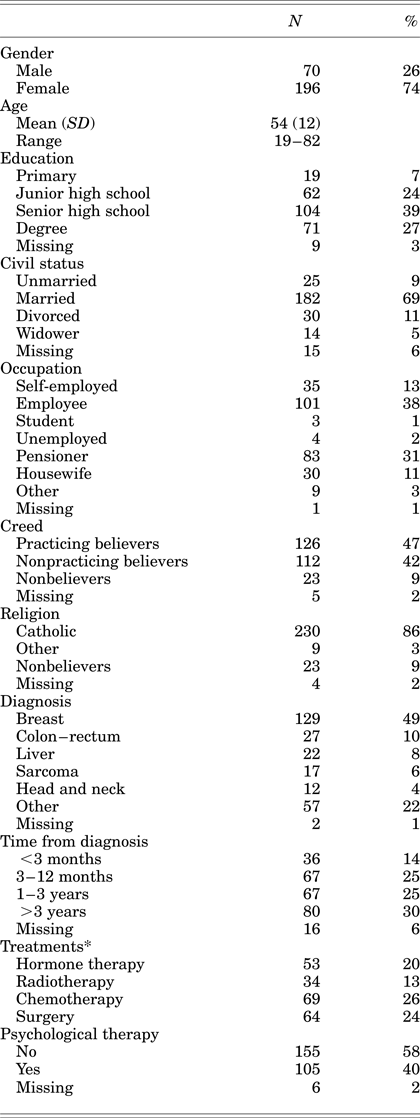
Among the 288 enrolled patients who met the inclusion criteria, 266 (92%) completed the entire structured questionnaire. The primary reason for noncompletion was refusal or consent withdrawal (n = 17), followed by organizational reasons (n = 5), and cognitive or physical problems (n = 2). Table 1 presents the demographic characteristics of the participating patients. The 266 patients who completed the questionnaires were mainly women (74%), 54 years old on average, possessed a medium to high level of education (66% senior high school or above), and were married (69%) (Table 1).
Demographic characteristics for patients participating in the study

* More than one choice is possible.
Most patients declared themselves to be religious (89%), and the main religion was Catholicism (86%). The most frequent cancer diagnosis was breast (49%), and the time from diagnosis was greater than one year for approximately half the patients (55%). A psychologist followed 105 patients (40%).
Measures
Predictor Variables
The search for meaning
The patients' processes in the search for a new life meaning after their cancer diagnosis was assessed by the Italian-validated version of the Seeking of Noetic Goals (SONG) Test (Brunelli et al., Reference Brunelli, Bianchi and Murru2012; Crumbaugh, Reference Crumbaugh1977), which includes 20 items answered on a 7-point Likert-type scale (1 = never to 7 = constantly) to measure the motivation to find meaning in life because of the subjective perception of an absence of meaning in the responder's current life. It was developed as a complement to the Purpose in Life Test (PIL). The sample items include: “I feel the lack of (and a need to find) a real meaning and purpose in my life” and “Over my lifetime, I have felt a strong urge to find myself.” Subjects were invited to respond with thoughts concerning the period of their life from their diagnosis to the present. The total score, obtained as a sum of all 20 items, ranged from 20 to 140, with higher scores indicating a successful meaning-making process in the subject's current life. The use of the SONG Test as a unidimensional measure is recommended by the results of exploratory factor analysis, which indicate that the first factor accounts for 71% of the variance, and the scale contains a high internal consistency (α = 0.90).
The presence of meaning
The patients' newly oriented system (i.e., personal goals, beliefs, and subjective feelings) was assessed with the Italian-validated version of the PIL test (Brunelli et al., Reference Brunelli, Bianchi and Murru2012; Crumbauch & Maholick, Reference Crumbauch and Maholick1969; Crumbaugh, Reference Crumbaugh1977). This questionnaire contains 20 self-reported items using 7-point semantic differential scales with two anchoring phrases to assess the degree to which the responders found a meaning and purpose in life. The sample items include: “In life I have: no goals or aims; clear goals and aims”; and “In achieving life goals I have: made no progress whatsoever; progressed to complete fulfillment.” Subjects were invited to respond with thoughts concerning the period of their life from their diagnosis to the present. The total score, obtained as a sum of all items, ranges from 20 to 140, with higher scores indicating a clearer meaning and purpose in life (Crumbaugh, Reference Crumbaugh1968; Reker & Cousins, Reference Reker and Cousins1979). The unidimensional structure of the PIL in this sample was suggested by an exploratory factor analysis that showed that the first factor accounted for 77% of the variance and by an excellent internal consistency (α = 0.91).
Outcome Variables
Mental Adjustment to Cancer
The cognitive, emotional, and behavioral patient responses to cancer were assessed by two subscales of the Italian version of the Mini-Mental Adjustment to Cancer (Mini–MAC) Scale (Grassi et al., Reference Grassi, Buda and Cavana2005). These subscales were 29-item self-report questionnaires that employed a 4-point Likert-type scale (1 = not at all my condition to 4 = exactly my condition) to assess both mental adjustment (i.e., anxiety and depression) and three specific cancer coping strategies (i.e., fighting spirit, fatalism, and cognitive avoidance). In the present study, only the anxious preoccupation (8 items, α = 0.85) and hopelessness (8 items, α = 0.88) subscales were assessed.
Eudaimonic Well-Being
Eudaimonic well-being was assessed with the Psychological Well-Being Scale, created by Carol Ryff (Ryff & Keyes, Reference Ryff and Keyes1995). This is an 18-item self-report questionnaire that uses a 6-point Likert-type scale (1 = completely disagree to 6 = completely agree) to assess eudaimonic well-being over six dimensions (i.e., autonomy, personal growth, self-acceptance, life purpose, mastery, and positive relatedness). In our study, the subscale “life purpose” was removed to avoid possible overlap with the presence of the life-meaning measure. The total score was obtained as a sum of all items and ranged from 18 to 108, with higher scores indicating a higher level of psychological well-being. In this sample, the internal consistency of the scale was acceptable (α = 0.76)
Statistical Analysis
Analyses were conducted using STATA (Stata Statistical Software, release 11.0; Stata Corporation, College Station, Texas). Preliminary analyses were conducted to examine the association of patients' demographic and medical characteristics with the outcome variables. The results of the t tests and analyses of variance indicated no significant differences in mental adjustment and eudaimonic well-being associated with gender, education, marital status, occupation, creed, religion, cancer site, treatments, disease stage, or psychological therapy. No significant correlation was observed between the outcome variables and age or time since diagnosis.
A correlation analysis was employed to examine the association of a search for meaning and the presence of meaning with reports of hopelessness, anxious preoccupation, and eudaimonic well-being. The variance inflation factor showed that multicollinearity was not an issue.
Three mediation analyses were performed to test the hypothesis that the presence of meaning mediates the effects of the search-for-meaning process on the psychological adjustment and eudaimonic well-being indicators. Each analysis was based on 5,000 bootstrapping samples using bias-corrected 95% confidence intervals (Preacher & Hayes, Reference Preacher and Hayes2004). Each mediation analysis employed a specific indicator of psychological adjustment and eudaimonic well-being (i.e., anxious preoccupation, helplessness, and psychological well-being total scores).
RESULTS
Descriptive and Intercorrelations
Table 2 shows the means, the standard deviations, the intercorrelations, and their 95% CI (CI 95) values for the predictor and outcome variables. All correlation coefficients indicate statistically significant associations among the variables examined (no CI 95 values enclose zero). The search for meaning was strongly related to higher levels of anxious preoccupation (r = 0.30) and hopelessness (r = 0.25) and with lower levels of eudaimonic well-being (r = −0.42). Consistent with expectations, the presence of meaning was negatively correlated with hopelessness (r = −0.53) and anxious preoccupation (r = −0.24), and positively correlated with eudaimonic well-being (r = 0.67). Consistent with the MMM, an unsuccessful search for meaning was strongly correlated with lower levels of the presence of meaning (r = −0.45), and eudaimonic well-being was significantly correlated with lower anxious preoccupation (r = −0.30) and lower hopelessness (r = −0.47). Finally, anxious preoccupation and hopelessness were highly correlated (r = 0.58).
Means, standard deviations, and intercorrelations with 95% CI for predictor and outcome variables

Mediation Analysis
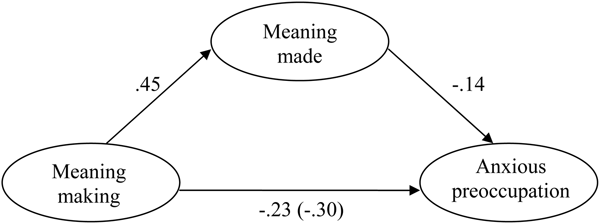
When anxious preoccupation was used as an outcome, the results showed that the search for meaning had a significant total effect on anxious preoccupation (b = 0.072, CI 95 = 0.043–0.101), a significant residual direct effect (b = 0.057, CI 95 = 0.025 to 0.089), and a significant indirect effect (b = 0.015, CI 95 = 0.001–0.030). The proportion of the total effect that was mediated was 21%.
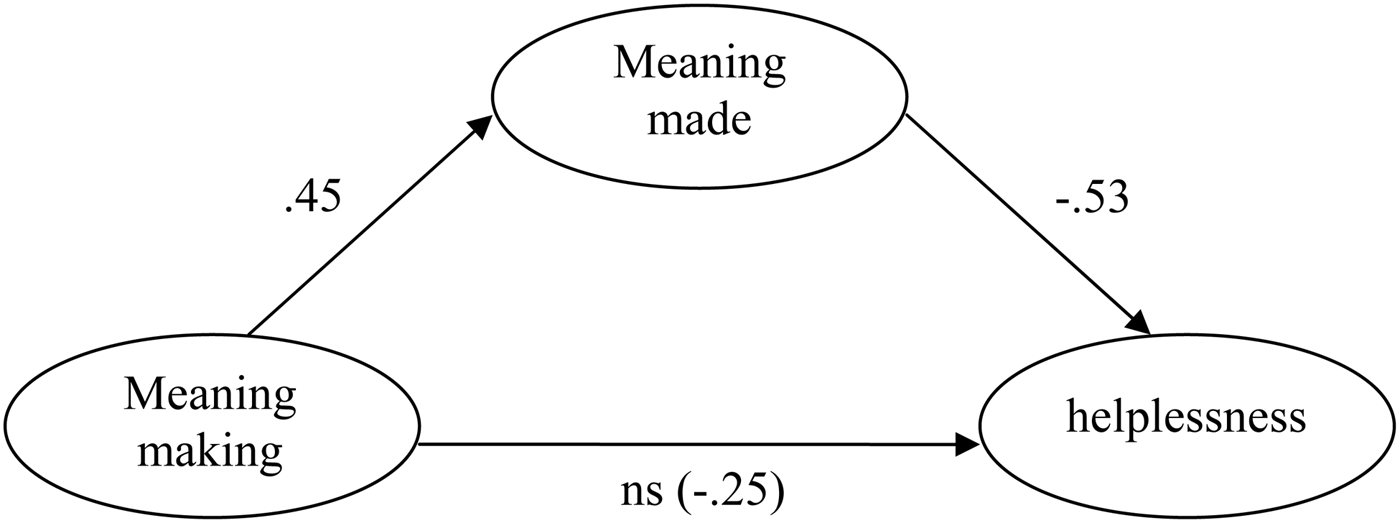
When the outcome was hopelessness, the search for meaning had a significant total effect on the outcome (b = 0.053, CI 95 = 0.028–0.078), a nonsignificant direct effect (b = 0.002, CI 95 = −0.022 to 0.027), and a significant indirect effect (b = 0.051, CI 95 = 0.034–0.066).
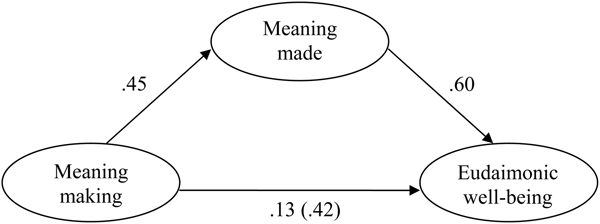
Finally, when employing psychological well-being as an outcome, the search for meaning had a significant total effect on psychological well-being (b = −0.26, CI 95 = −0.34 to −0.19), a residual direct effect (b = −0.085, CI 95 = −0.15 to −0.02), and a significant indirect effect (b = −0.17, CI 95 = −0.22 to −0.12); the proportion of the total effect that was mediated was 68%.
Figures 1–3 depict the complete mediation models and the effects using standardized regression coefficients (i.e., beta weights).
Complete mediation model for anxious preoccupation.

Complete mediation model for hopelessness.

Complete mediation model for eudaimonic well-being.

DISCUSSION
Our study utilized theoretical assumptions from the meaning-making model as a framework to explain psychological adjustment and eudaimonic well-being in a traumatic and chronic stressful condition, such as cancer. Moving from the MMM (Park & Folkman, Reference Park and Folkman1997; Park, Reference Park2010), this study examined whether the search for meaning and the presence of meaning promoted eudaimonic well-being and less psychological maladjustment. This study also aimed to explore the combined contribution of these two features of meaning.
High levels of a search for meaning were significantly associated with lower levels of a presence of meaning. This result appears consistent with the assumptions of the meaning-making model. The MMM posits that only a successful search for meaning, or a search related to high levels of a new presence of meaning in life after a traumatic event, can be considered healthy.
The mediation analysis emphasized that only the presence of meaning had a direct effect on both psychological adjustment and eudaimonic well-being. These results are consistent with recent work by Linley and Joseph (Reference Linley and Joseph2011), who showed that, whereas the presence of meaning is adaptive and associated with a greater positive change, the search for meaning is also related to greater distress and negative change. These results appear to clarify the role between the search for meaning and the presence of meaning in fostering psychological well-being after adversity. The meaning-making process enhances the conscious cognitive engagement necessary to search for meaning; namely, the positive accommodation of a traumatic event in making a new meaning in life plays a crucial role in promoting both psychological adjustment and eudaimonic well-being.
Furthermore, the high negative correlation between eudaimonic well-being and hopelessness is consistent with the recent longitudinal research of Wood and Joseph (Reference Wood and Joseph2010), who emphasized the relevance of eudaimonic well-being as a protective factor for depression. Even after controlling for demographic characteristics, medical conditions, personality, and levels of depression, individuals with low eudaimonic well-being remained more than twice as likely to be depressed in the future.
The findings of the present study are important for several reasons. From a theoretical point of view, the results confirm the usefulness of the meaning-making model to organize research concerning adaptation and well-being following life-threatening illnesses. Furthermore, whereas previous works have focused on identifying impairment among cancer patients, our study focused on both psychological adjustment and growth among cancer patients.
From a clinical point of view, the results support the recent clinical psychology of posttraumatic growth (Joseph, Reference Joseph2011), which suggests that aspects of eudaimonic well-being are important keys to understanding this disorder and which supports the interventions that are developed to increase eudaimonic well-being as a method of preventing mental maladjustment (Wood & Joseph, Reference Wood and Joseph2010). Consistent with recent studies on this topic (Kernan & Lepore, Reference Kernan and Lepore2009; Steger et al., Reference Steger, Kashdan and Sullivan2008), the crucial role of the presence of meaning in promoting psychological well-being and adjustment emphasizes the importance of a clinical therapy that supports a positive search-for-meaning process (Joseph, Reference Joseph2011).
The major strengths of our study are that it is theory driven and examines both the psychological adjustment and eudaimonic well-being of cancer patients. However, some limitations must be taken into account. The cross-sectional design of the research restricts the interpretation of the results related to the cause-and-effect relationship between the variables. A deeper understanding of the process of adjustment and growth related to a traumatic event, such as cancer, may be gained through the use of a long-term longitudinal design. Future research should also include a control group of healthy individuals to verify whether the meaning-making model is attributable to the cancer experience or whether it reflects a possible process in the aftermath of all stressful life conditions.
ACKNOWLEDGMENTS
This study was partly funded by the Cariplo Foundation. We also wish to express our gratitude for the important data entry contributions of Mrs. Anna Maria Bolzern.