Ontogeny denotes the origins and development of an organism throughout its life span. Viewed through the lens of developmental psychopathology (DP), models of ontogenesis can become quite complex, featuring processes such as risk and protection, reciprocal causation and transaction, multifinality and equifinality, and epigenesis and allostasis (for detail, see Beauchaine & McNulty, Reference Beauchaine and McNulty2013; Cicchetti & Cohen, Reference Cicchetti and Cohen2016; Hinshaw, Reference Hinshaw, Beauchaine and Hinshaw2013; Rutter & Sroufe, Reference Rutter and Sroufe2000). That is, neither simple linear models nor categorical demarcations of diagnosed versus nondiagnosed clinical groups provide sufficient explanatory power in the search for ontogenic processes related to psychopathology.
Furthermore, it is rare for any particular form of psychopathology to appear in isolation. When considered in categorical terms, the relevant phenomenon is comorbidity, signifying the presence of two or more independent forms of pathology in the same individual (in terms of continuous/dimensional models, the relevant phrase would be associated psychopathology). Comorbidity is not only highly expectable in most domains of behavioral and emotional dysfunction but also may provide essential clues as to developmental mechanisms underlying impairment and resilience (e.g., Angold, Costello, & Erkanli, Reference Angold, Costello and Erkanli1999; Beauchaine & Hinshaw, Reference Beauchaine and Hinshaw2013; Caron & Rutter, Reference Caron and Rutter1991). Diagnostic comorbidity (or associated psychopathology) may signal shared vulnerabilities or risk factors, as well as convey the presence of essential developmental progressions.
Our overarching goal here is to model the ontogenesis of associated psychopathology in a well-characterized sample of girls with clinically significant problems related to inattention and hyperactivity–impulsivity, who were followed prospectively from childhood through early adulthood. With the aim of guiding the next generation of longitudinal research efforts in DP (Hinshaw, Reference Hinshaw2015), we focus on elucidating relevant mechanisms linked to the development of associated psychopathology in this sample, because girls and women still comprise an understudied group in research on impulsive and externalizing pathology. In order to make our case, we begin by briefly reviewing core DP principles before moving to (a) further discussion of the important phenomena of comorbidity and associated psychopathology, (b) consideration of early neurocognitive vulnerability in ontogenic processes, and (c) justification of core mediator and moderator variables that may help to elucidate relevant developmental progressions.
Principles of DP
A thumbnail sketch of DP principles provides important context for ontogenic process models in psychopathology and comorbidity research. Initial formulations of DP emphasized both the mutual interplay of normative and pathological development and the need to consider transactional processes between individuals and their social–cultural contexts (e.g., Cicchetti, Reference Cicchetti, Rolf, Masten, Cicchetti, Neuchterlein and Weintraub1990; Sroufe & Rutter, Reference Sroufe and Rutter1984). In the DP framework, psychopathology is viewed “not as a static set of diagnostic entities but rather as the product of the failure to attain core developmental competencies, leading to a progressive veering from normative trajectories and an accumulation of behavior patterns considered maladaptive in most contexts, even though at least some of those behaviors may have been ‘adaptive’ in the context of deprived or harsh early environments” (Hinshaw, Reference Hinshaw2015). In all, interplay between child-level and contextual processes is expected to be the rule rather than the exception in accounting for the development of pathological outcomes.
As summarized in Hinshaw (Reference Hinshaw, Beauchaine and Hinshaw2013), the following principles and axioms are typically viewed as central to the DP approach:
-
1. The investigation of normative development is necessary for understanding pathological states. The converse applies as well, in that studying pathology should inform knowledge of normative development. Thus, psychopathology cannot be considered to be the investigation of wholly separate diagnostic entities, removed from typical developmental processes. Moreover, inclusion of theory and variables related to models of normative development should greatly benefit the search for trajectories leading to pathology and impairment.
-
2. Such developmental processes are typically reciprocal in nature, with child-level factors influencing environmental forces and vice versa (see Bell, Reference Bell1968, for an early formulation related to parent–child mutual influence). Spiraling, transactional influences on development typically ensue; reciprocal, cascading models of causation and reverberation have come to the fore in current formulations of DP (e.g., Boyce, Reference Boyce, Cicchetti and Cohen2006; Masten & Cicchetti, Reference Masten and Cicchetti2010). Prospective longitudinal research is a priority for elucidating such pathways.
-
3. Continuities can and do occur with regard to the development of maladaptive behavior. That is, early risk and vulnerability are lawfully related to later outcomes of importance. In many cases, however, the specific behavioral manifestations of such outcomes will change as the individual matures, exemplifying a process known as heterotypic continuity, whereby the continuity or stability lies at the level of an underlying trait. In short, manifest behaviors often transform, sometimes drastically, with development, as vulnerabilities interact and transact with contextual processes.
-
4. Gains in understanding the origins of and protection from psychopathology will occur when multiple levels of analysis are incorporated, ranging from molecular (genes and epigenetic processes) through both individual (e.g., temperament and emotion regulation) and wider contextual forces (e.g., families, neighborhoods, schools, and cultures at large).
-
5. Because of the above principles, several disparate pathways and trajectories can lead to similar pathological or comorbid outcomes, exemplifying equifinality. In addition, a given risk factor, vulnerability, or early manifestation of pathology may well yield disparate outcomes, depending on transactional influences across development, exemplifying multifinality (e.g., Cicchetti & Rogosch, Reference Cicchetti and Rogosch1996).
Comorbidity and Associated Psychopathology
For several decades it has been established that comorbidity is the rule and not the exception in psychopathology, even in community samples (for a classic review, see Angold et al., Reference Angold, Costello and Erkanli1999). This phenomenon is puzzling: if the conditions in question are truly independent, their overlap should equal the product of their base rates, but in nearly all instances the observed overlap is far higher. Several explanations have been proffered, as elaborated in extremely articulate fashion by Caron and Rutter (Reference Caron and Rutter1991). For one thing, at least some comorbidity may be artifactual, related to the use of clinically referred versus epidemiologically ascertained samples (comorbidity will be spuriously inflated in the former) or the use of screening tools with inherent biases in terms of selecting broad symptom patterns (which are bound to produce high rates of overlap). Moreover, some diagnostic classification systems may themselves be inherently biased toward detection of associated psychopathology. Specifically, if underlying dimensions rather than true categories exist in the population, arbitrary cutoffs may well inflate apparent comorbidity between such conditions. Furthermore, diagnostic criteria for different disorders may well include several overlapping symptoms or may include a number of poorly conceived subdivisions, as has occurred historically in the case of anxiety disorders, both of which spuriously inflate rates of apparent comorbidity.
It may also be the case that one apparently independent disorder is actually an early manifestation of another. In ontogenic process models, supposed comorbidity may actually be the heterotypically continuous unfolding of an individual's trajectory across development. In the externalizing realm, Beauchaine and McNulty (Reference Beauchaine and McNulty2013) proposed that seemingly separable externalizing behavior disorders (e.g., attention-deficit/hyperactivity disorder [ADHD], oppositional defiant disorder, conduct disorder, substance use disorders, and adult antisocial personality disorder) can represent, at least in a subset of high-risk youth, the developmental unfolding of an initial propensity (in their model, trait impulsivity) as it unfolds in the context of insecure attachment bonds, verbal and executive function deficits, coercive parental discipline, peer rejection, and/or neighborhood dysfunction across the life span.
Finally, it is also distinctly possible that, in cases of true rather than artifact-related comorbidity or associated psychopathology, shared risk factors or overlap between sets of risk factors may be relevant in producing the overlap. Only longitudinal research designs with careful adjustment for preexisting risk factors and vulnerabilities, and ideally with genetically informative designs, can begin to separate the possibilities (see Caron & Rutter, Reference Caron and Rutter1991; for further discussion, see Lilienfeld, Waldman, & Israel, Reference Lilienfeld, Waldman and Israel1994; Rutter, Reference Rutter1994; for a different angle on comorbidity related to schizophrenia, see Hwang & Buckley, Reference Hwang and Buckley2013).
In short, a prospective examination of early vulnerability, unfolding in form across childhood, adolescence, and adulthood, could illuminate pathways toward the rampant but puzzling comorbidity that appears in much of the literature on the development of psychopathology. Our use of dimensional rather than categorical indicators of associated psychopathology, in the context of a prospectively followed all-female sample enriched for early-appearing inattention and hyperactivity–impulsivity, should help to elucidate relevant developmental mechanisms.
Neurocognitive Vulnerability
Ontogenic process models often posit an underlying vulnerability as central to the development of psychopathology or comorbidity. In the heuristic model of Beauchaine and McNulty (Reference Beauchaine and McNulty2013), the heritable, biologically based vulnerability marker for externalizing behavior is known as trait impulsivity, linked to dysfunction in the mesolimbic dopamine tracts and behaviorally indexed by preference for immediate over delayed rewards. As children with this vulnerability interact and transact with toxic environmental inputs, an unfolding of externalizing conditions often ensues, as noted above (see Beauchaine & Hinshaw, Reference Beauchaine and Hinshaw2016; for an alternative, temperamental conception of early vulnerability, see Stringaris, Maughan, & Goodman, Reference Stringaris, Maughan and Goodman2010).
Following the example of Beauchaine and McNulty (Reference Beauchaine and McNulty2013), and consistent with the aims of this Special Section, we examine the role that neurocognitive vulnerability plays in the development of co-occurring internalizing and externalizing problems by adulthood. We index our vulnerability factor during the elementary-school years, when our participants were first assessed, through a combination of (a) objectively measured executive dysfunction and (b) teacher-rated cognitive and learning problems. Executive dysfunction has been variably defined, but generally involves higher level cognitive deficits in planning, organization, response inhibition, sustained attention, working memory, reasoning, and/or set shifting, which rely on the prefrontal cortex and its extensive interconnections with other brain regions (Tranel, Anderson, & Benton, Reference Tranel, Anderson, Benton, Boller and Grafman1994). Powell and Voeller (Reference Powell and Voeller2004) also argue that childhood executive functioning is subserved by the prefrontal cortex–subcortical system, with dysfunction at least partially caused by biological insults (e.g., hypoxia or toxic exposure) or abnormalities (e.g., genetic or metabolic). Cognitive and learning problems involve difficulty understanding and retaining information, and individual differences may also be biologically based (Ashkenazi, Black, Abrams, Hoeft, & Menon, Reference Ashkenazi, Black, Abrams, Hoeft and Menon2013; Tallal & Benasich, Reference Tallal and Benasich2002). However, neither executive dysfunction nor learning problems are biologically determined or due exclusively to congenital factors. Many childhood experiences, including maltreatment and deprivation (Carrion, Wong, & Kletter, Reference Carrion, Wong and Kletter2013; Kirke-Smith, Henry, & Messer, Reference Kirke-Smith, Henry and Messer2012; Mothes et al., Reference Mothes, Kristensen, Grassi-Oliveira, Fonseca, de Lima Argimon and Irigaray2015), can contribute to executive dysfunction or learning problems.
Both executive dysfunction (Martel et al., Reference Martel, Nigg, Wong, Fitzgerald, Jester and Puttler2007; Riggs, Blair, & Greenberg, Reference Riggs, Blair and Greenberg2003) and learning problems (Al-Yagon, Reference Al-Yagon2007; Dyson, Reference Dyson2003; Lackaye & Margalit, Reference Lackaye and Margalit2006; McNamara, Vervaeke, & Willoughby, Reference McNamara, Vervaeke and Willoughby2008; Wilson, Armstrong, Furrie, & Walcot, Reference Wilson, Armstrong, Furrie and Walcot2009) have shown robust relations with concurrent and later internalizing and externalizing problems during childhood and adolescence, as well as with psychiatric comorbidities (Jonsdottir, Bouma, Sergeant, & Scherder, Reference Jonsdottir, Bouma, Sergeant and Scherder2006; Kusche, Cook, & Greenberg, Reference Kusche, Cooke and Greenberg1993; Rinsky & Hinshaw, Reference Rinsky and Hinshaw2011), although to our knowledge, no one has examined links among these constructs prospectively across 16 years. We combined these measures of executive dysfunction and cognitive/learning problems because of our desire to investigate a more general In addition, our combined measure of executive dysfunction and cognitive/learning problems was a more robust predictor of adult psychopathology than were the more circumscribed measures.
Mediators and Moderators
We include mediator variables and processes, measured during early and late adolescence, which might explain relations between childhood neurocognitive vulnerability and adult associated psychopathology. (In all relevant analyses, we also adjust for demographic and cognitive confounders measured during childhood.) Mediators are explanatory processes temporally occurring between baseline and outcome that elucidate mechanisms of association, which may illuminate causal pathways (see Kraemer, Stice, Kazdin, & Kupfer, Reference Kraemer, Stice, Kazdin and Kupfer2001; see also Kraemer, Kiernan, Essex, & Kupfer, Reference Kraemer, Kiernan, Essex and Kupfer2008). Our first mediator domain includes self-control and delay of gratification, the second includes peer-related processes, and the third includes academic performance and school success/failure. All three areas have a rich literature bolstering their inclusion as relevant mediators.
First, in the individual domain, we indexed (a) self-control in social situations and the (b) ability to delay gratification as potential mediators. These individual constructs involve behaviorally focused emotional regulation as well as impulse control. Both are clearly related to childhood neurocognitive vulnerability, as well as externalizing and internalizing psychopathology. Executive functioning deficits have been shown to be concurrently associated with poor emotion regulation and self-control (Barkley, Reference Barkley1997; Fino et al., Reference Fino, Melogno, Illiceto, D'Alesio, Pinto and Candilera2014; Vaughn, DeLisi, Beaver, & Wright, Reference Vaughn, DeLisi, Beaver and Wright2009; Zelazo & Cunningham, Reference Zelazo, Cunningham and Gross2007). Similarly, children with learning problems, especially those with ADHD (Wiener, Reference Wiener2004), demonstrate lower levels of self-regulation than typically developing peers (Bauminger & Kimhi-Kind, Reference Bauminger and Kimhi-Kind2008; Milligan, Phillips, & Morgan, Reference Milligan, Phillips and Morgan2015).
There is ample evidence that low self-control (Bradley & Corwyn, Reference Bradley and Corwyn2013; Franken et al., Reference Franken, Moffitt, Steglich, Dijkstra, Harakeh and Vollebergh2015; Rosen et al., Reference Rosen, Waugh, Epstein, Hoza, Arnold and Hechtman2014) is related to or predicts externalizing problems. Evidence suggests that difficulty delaying gratification, specifically, predicts later externalizing problems (Krueger, Caspi, Moffitt, White, & Stouthamer-Loeber, Reference Krueger, Caspi, Moffitt, White and Stouthamer-Loeber1996). Some have found low self-control to predict both externalizing and internalizing problems (Carver, Johnson, & Joormann, Reference Carver, Johnson and Joormann2013; Nie, Li, Dou, & Situ, Reference Nie, Li, Dou and Situ2014; Wills, Ainette, Mendoza, Gibbons, & Brody, Reference Wills, Ainette, Mendoza, Gibbons and Brody2007). For example, Pulkkinen (Reference Pulkkinen2009) found that low self-control in combination with passivity predicted internalizing symptoms among women, but low self-control plus activity predicted externalizing symptoms among men. However, to our knowledge the relations between self-control or delay of gratification and co-occurring internalizing and externalizing problems have not been investigated.
Second, in the peer domain, peer status and friendships during adolescence are both hypothesized to be related to earlier neurocognitive functioning. A great deal of evidence documents relations between executive dysfunction (Biederman et al., Reference Biederman, Petty, Fried, Fontanella, Doyle and Seidman2006, Diamantopoulou, Rydell, Thorell, & Bohlin, Reference Diamantopoulou, Rydell, Thorell and Bohlin2007; Miller & Hinshaw, Reference Miller and Hinshaw2010; Rinsky & Hinshaw, Reference Rinsky and Hinshaw2011) or learning problems (Baumeister, Storch, & Geffken, Reference Baumeister, Storch and Geffken2008; Dyson, Reference Dyson2003; Estell et al., Reference Estell, Jones, Pearl, Van Acker, Farmer and Rodkin2008; Luciano & Savage, Reference Luciano and Savage2007; Mishna, Reference Mishna2003; Nowicki, Reference Nowicki2003) and low peer status. As summarized by Wiener (Reference Wiener2004), youth with learning disabilities are less preferred and more likely to be rejected and neglected by their nondisabled peers. Furthermore, friendships of children with serious learning problems are likely to be of low quality. In other words, those friendships are less likely to be mutual, stable, or supportive (Wiener, Reference Wiener2004). The link between learning problems and problems in the peer domain, both in terms of status and friendships, may be linked to an underlying information processing deficit, which may reflect underlying neurocognitive vulnerability.
In turn, peer rejection predicts poor adult adjustment (Parker & Asher, Reference Parker and Asher1987), including increased psychiatric symptomatology, as demonstrated recently (Marion, Lauresen, Zettergren, & Bergman, Reference Marion, Laursen, Zettergren and Bergman2013). Peer difficulties may be a particularly important risk factor for girls because those females who struggle with fewer or lower quality friendships are vulnerable to psychosocial stressors (Burhmester, Reference Buhrmester1990; Wilkinson, Reference Wilkinson2004), which puts them at greater risk for both internalizing and externalizing problems (Ritakallio, Luukkaala, Marttunen, Pelkonen, & Kaltiala-Heino, Reference Ritakallio, Luukkaala, Marttunen, Pelkonen and Kaltiala-Heino2010; Steinberg & Morris, Reference Steinberg and Morris2001). In addition, Molina, Pelham, Cheong, Marshal, and Gnagy (Reference Molina, Pelham, Cheong, Marshal and Gnagy2012) note that because social dysfunction is a major impairment among children with ADHD, it is important to include in models of vulnerability to negative outcomes.
Third, neurocognitive problems, including executive dysfunction (Biederman et al., Reference Biederman, Monuteaux, Doyle, Seidman, Wilens and Ferrero2004; Clark, Pritchard, & Woodward, Reference Clark, Pritchard and Woodward2010; Langberg, Dvorsky, & Evans, Reference Langberg, Dvorsky and Evans2013; Miller & Hinshaw, Reference Miller and Hinshaw2010; Miller, Nevado-Montenegro, & Hinshaw, Reference Miller, Nevado-Montenegro and Hinshaw2012) and learning problems, are powerful predictors of poor academic performance and school failure. Deficits in executive functions, including planning, working memory, and sustained attention, clearly impede academic success. What may be less intuitive is that poor achievement and school failure are related to concurrent and subsequent internalizing and externalizing problems. However, it is reasonable to assume that failure at a major developmental task (e.g., successfully completing school) might have important psychological consequences. Molina and Pelham (Reference Molina and Pelham2014) point to poor school performance and academic disengagement as a likely mechanism by which poor adult outcomes are obtained for among children with ADHD. Among the women with ADHD in the current sample, school failure is a significant mediator of the relation between early conduct problems and adult global functioning (Owens & Hinshaw, Reference Owens and Hinshaw2016).
In addition to expecting within-domain sequential indirect effects to account for relations between childhood neurocognitive vulnerability and psychopathology during adulthood, we believe that certain cross-domain sequential effects may be important as well. Self-control during early adolescence should contribute to peer attachment and friendships, as well as school failure, by late adolescence. Our measure of self-control specifically taps self-regulation in social situations, which should influence the later quality of peer attachment and the extent and quality of friendships. These hypothesized associations are empirically supported (Boman, Krohn, Gibson, & Stegner, Reference Boman, Krohn, Gibson and Stogner2012; Lopes, Salovey, Cote, & Beers, Reference Lopes, Salovey, Cote and Beers2005; Schwarz, Stutz, & Ledermann, Reference Schwarz, Stutz and Ledermann2012). Self-control and behavioral regulation of emotions are also implicated in the genesis of underachievement and school failure (Gumora & Arsenio, Reference Gumora and Aresnio2002; Kuhnle, Hofer, & Kilian, Reference Kuhnle, Hofer and Kilian2012; Singh & Singh, Reference Singh and Singh2013). In addition, it is likely that low self-control is implicated in the types of behavior problems that lead to disciplinary encounters at school, culminating in the need for a more restrictive educational setting or school termination.
We also expect to find that following childhood neurocognitive vulnerability, peer rejection and conflict during early adolescence contribute to school failure by late adolescence, which may then lead to adult associated psychopathology. Evidence for an association between peer rejection and low academic achievement, a component of our measure of school failure (Fite, Hendrickson, Rubens, Gabrielle, & Evans, Reference Fite, Hendrickson, Rubens, Gabrielli and Evans2013; Zettergren, Reference Zettergren2003), supports our hypothesized serial indirect pathway through the peer then school domains, although it is likely that the relation between peer rejection and poor achievement is reciprocal (Bellmore, Reference Bellmore2011; Greenman, Schneider, & Tomada, Reference Greenman, Schneider and Tomada2009; Veronneau, Vitaro, Brendgen, Dishion, & Tremblay, Reference Veronneau, Vitaro, Brendgen, Dishion and Tremblay2010). Peer rejection may also be associated with school termination (Zettergren, Reference Zettergren2003), but perhaps only in the context of concurrent antisocial behavior (French & Conrad, Reference French and Conrad2001). The mediating mechanism in this case may be that peer rejection is associated with school disinvestment (and then failure or dropping out) because school is socially unrewarding, or that peer rejection is associated with behavioral problems that lead to school disciplinary actions.
Finally, with the objective of modeling the complexity inherent in developmental pathways related to associated psychopathology, we tested whether the family context moderates these pathways. Moderators are variables measured at baseline in a developmental study; their presence conditions predictive relations of interest, usually in terms of subgroups of participants who show differential associations between risks and outcomes (see Kraemer et al., Reference Kraemer, Stice, Kazdin and Kupfer2001). Herein, we examined whether mediational pathways through individual, peer, and school domains depend on, or are moderated by, parental distress during childhood. For our purposes, parent distress involves parental (both mother and father) depressive symptomatology, marital dissatisfaction, and self-reported levels of stress related to childrearing. These tests were highly exploratory, because at least two alternative hypotheses are plausible. First, on the context of low parental distress, pathways from neurocognitive vulnerability to adult psychopathology might be weaker because parents have the personal resources (e.g., the mental and physical energy) to fully support their cognitively challenged children so that the offspring are able to avoid individual, school, and peer problems that can cascade toward adult psychopathology. For example, parents who are low on distress might be better able to arrange educational support, schedule constructive play dates and social experiences, model self-regulative behavior, and advocate for their children at school so that the child's neurocognitive problems have less pernicious effects over time. Parents who are depressed and stressed would presumably be less able to support their children in these ways.
Second, when parental distress is high, pathways from neurocognitive vulnerability to adult comorbidity might be weaker because individual, peer, and school effects are simply less consequential relative to direct effects of parental dysfunction on later psychiatric status. In other words, if a child's parents are depressed and overwhelmed, her self-control, peer relations, and school achievement may be relatively inconsequential, either because parental distress creates a highly problematic proximal environment (e.g., parental hostility and negativity or withdrawal, dysfunctional behavior management and discipline, insecure attachment, and marital conflict, all of which powerfully influence the development of psychopathology; see Hammen, Reference Hammen, Goodman and Gotlib2002; Radke-Yarrow & Klimes-Dougan, Reference Radke-Yarrow, Klimes-Dougan, Goodman and Gotlib2002) or because a genetic liability for symptoms and impairment has been transmitted from parent to child.
Hypotheses and Exploratory Questions
Based on the literature review above, and consistent with the core principles and tenets of DP, we hypothesize the following:
-
1. In this sample of women in their mid-20s, 61% of whom had childhood diagnosis of ADHD, internalizing and externalizing problems will typically co-occur.
-
2. Neurocognitive vulnerability during childhood will predict co-occurring internalizing and externalizing problems during adulthood, covarying family socioeconomic status (SES) and child IQ, as well as early internalizing and externalizing problems.
-
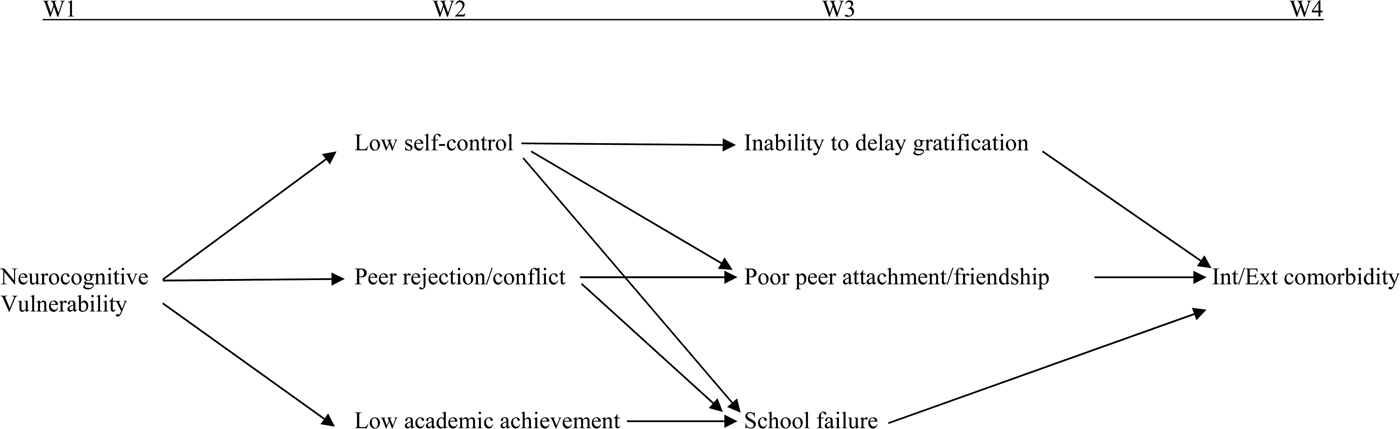
3. Three domains (individual, peer, and school, measured in both early and at late adolescence) will mediate the relation between childhood neurocognitive problems and adult associated psychopathology, covarying family SES and child IQ. Serial mediation indirect effects will be significant within the same domain across time (i.e., within the individual, peer, and school domains during early and late adolescence). Serial mediation indirect effects will also be significant in the following three pathways that cross domains from early to late adolescence: self-control to peer attachment/friendship, self-control to school failure, and peer rejection/conflict to school failure. These six pathways are depicted heuristically in Figure 1.
Heuristic model. Ext, Externalizing; Int, internalizing.

We also ask the following exploratory questions:
-
4. Which of these six indirect pathways is the most salient, given correlations among mediators?
-
5. Are any significant serial mediational pathways moderated by the family context?
Method
Participants and procedures
Data were obtained from 228 participants in the Berkeley Girls with ADHD Longitudinal Study (Hinshaw et al., Reference Hinshaw, Owens, Zalecki, Huggins, Montenegro-Nevado and Swanson2012), who were initially recruited from schools, mental health centers, pediatric practices, and through direct advertisements to take part in a 5-week summer camp, which we refer to as Wave 1 (W1). Camps were held in 1997, 1998, and 1999. Eligibility was established using a multigated teacher- and parent-report process, with participation contingent upon meeting full criteria for ADHD via the parent Diagnostic Interview Schedule for Children—Fourth Edition (Shaffer, Fisher, Lucas, Dulcan, & Schwab-Stone, Reference Shaffer, Fisher, Lucas, Dulcan and Schwab-Stone2000). Participants included 93 girls who met criteria for ADHD-combined type and 47 who met criteria for ADHD-predominantly inattentive type. Common comorbidities were allowed (see Hinshaw, Reference Hinshaw2002, for details). Eighty-eight age- and ethnicity-matched comparison girls were also enrolled.
At W1, girls were between the ages of 6 and 12 years (mean age = 8.9). They were socioeconomically and ethnically diverse (53% Caucasian, 27% African American, 11% Latina, and 9% Asian American). A wide variety of multimethod, ecologically valid measures were obtained from parents and teachers prior to the summer camp and from observers, peers, and participants during the camp. Five years later (Wave 2 [W2]; mean age = 14.1 years, range = 11–17 years; see Hinshaw, Owens, Sami, & Fargeon, Reference Hinshaw, Owens, Sami and Fargeon2006) and 10 years later (Wave 3 [W3]; mean age = 19.6 years, range = 17–24; see Hinshaw et al., Reference Hinshaw, Owens, Zalecki, Huggins, Montenegro-Nevado and Swanson2012) the girls were invited for follow-up assessments that involved two blinded, half-day lab visits for participants, and a single half-day assessment for the participant's parent. At Wave 4 (W4), 16 years after baseline, measurement when the sample had attained a mean age of 25.6 (range = 21–29), a single, blinded half-day visit for participants was conducted, with questionnaires completed by a parent, as well as by a peer, romantic partner, and job supervisor when available. Measures administered were selected to assess ADHD-related and other psychiatric symptomatology, cross-domain impairment (educational, occupational, well-being, self-harm, social relationships, substance use, and driving), and service utilization.
Retention was 92% at W2, 95% at W3, and 93% at W4, although numbers for particular measures were somewhat lower. Analysis of 18 W1 characteristics (seven demographic, nine clinical, and two cognitive) revealed that at W4, the retained sample had significantly more two-parent families during childhood (16% vs. 4%), higher income (d = 0.80), and higher levels of maternal education (d = 0.87) than those not retained. There were no significant differences for child age or race, or for whether or not the child had been living with biological parents or receiving public assistance. There were also no significant differences in mother's report of child symptomatology (inattention, hyperactivity/impulsivity, externalizing, and internalizing) or impairment. However, those not retained at W4 had significantly higher teacher-reported symptomatology (inattention, hyperactivity/impulsivity, externalizing, and internalizing) than those retained. These differences were of medium magnitude (ds = 0.62–0.77). Finally, those children who were not retained at W4 were similar to those who were in terms of W1 academic achievement, but their mean full-scale IQ score was significantly lower (d = 0.91).
Measures
It is widely acknowledged that a multimethod, multisource approach is optimal for assessing psychological and related problems, especially among children. Kraemer et al. (Reference Kraemer, Measelle, Ablow, Essex, Boyce and Kupfer2003) argue that the best way to approximate the true score or real extent and nature of those problems is through the use of multiple, valid, and unique (i.e., uncorrelated) perspectives. Essex et al. (Reference Essex, Kraemer, Armstrong, Boyce, Goldsmith and Klein2006) also argue that combining reports from individuals who view the child from different perspectives and in different contexts is an optimal measurement strategy because it reduces error resulting from informants' varying perspectives and contexts. Thus, we integrated data from informants who each offer different but valid perspectives on the constructs of interest. We also chose measures that differed in their form (interview vs. rating scale), when possible, to optimize the ultimate validity of our variables.
W1 neurocognitive vulnerability
A composite measure of child neurocognitive problems was created by standardizing and averaging two scores: the error proportion score (Sami, Carte, Hinshaw, & Zupan, Reference Sami, Carte, Hinshaw and Zupan2004) from the Rey–Osterrieth complex figure task (Rey, Reference Rey1941), and the cognitive problems index from the Conners Teacher Rating Scale—Revised (Conners, Sitarenios, Parker, & Epstein, Reference Conners, Sitarenios, Parker and Epstein1998), completed by the child's primary teacher. The error proportion score on the Rey taps (among other variables) planning, a key executive function; it has been shown to differentiate girls with and without ADHD in both immediate and delayed recall conditions (Sami et al., Reference Sami, Carte, Hinshaw and Zupan2004) with large effect sizes. The cognitive problems score on the Conners scale is composed of five items reflecting cognitive and learning problems (e.g., “forgets thing she has already learned,” “not reading up to par,” and “lacks interest in schoolwork”) and in our sample demonstrates good internal consistency (Cronbach α = 0.84). These two measures of neurocognitive problems were significantly but mildly correlated (r = .24, p = .000) in our sample.
W1 SES
Maternal education, rated on a scale from 1 to 6 (M = 4.8, SD = 1.0), and family income, rated on a scale from 1 to 9 (M = 6.4, SD = 2.6), were standardized and averaged to create our SES variable.
W1 child IQ
Child full-scale IQ from the Wechsler Intelligence Scale for Children—Third Edition (Wechsler, Reference Wechsler1991) was also used as a covariate (M = 104.4, SD = 14.5).
W1 parental distress
Parental distress was broadly conceived and included symptoms of depression, marital dissatisfaction, and childcare-related stress during childhood and early adolescence. We used indicators of mother and father distress to better represent the overall family emotional climate, rather than relying on reports of maternal distress alone. We standardized and averaged eight scores (two reflecting parental depressive symptomatology, four reflecting parental childrearing stress, and two reflecting marital dissatisfaction). We used mother and father total scores on the Beck Depression Inventory (Beck, Reference Beck1978) at W1, a reliable and valid measure of depressive symptomatology. In addition, we used mother and father total scores at both W1 and W2 (minus the difficult child factor score) from the Parenting Stress Index (Abidin, Reference Abidin1995), a widely used measure with strong psychometric properties. We omitted the difficult child factor score because it reflects parental perception of the child rather than perception of parenting stress per se. Finally, we used mother and father overall marital/partner satisfaction, reverse scored, from the Dyadic Adjustment Scale (Spanier, Reference Spanier1976), a widely used measure of marital cohesion, consensus, and satisfaction. Our measure of parenting distress across W1 and W2 has a Cronbach α of 0.76.
W2 self-control
Self-control at W2 was measured using the Social Skills Rating System (Gresham & Elliot, Reference Gresham and Elliott1990), a widely used measure that assesses social skills including self-control, assertion, and cooperation using frequency ratings from never to very often. Twelve parent-reported items reflecting self-control in social situations (Cronbach α = 0.88), and 11 teacher-reported items reflecting the same (Cronbach α = 0.91) were each averaged, and we then averaged the mother and teacher scores (r = .38, p = .000) to create an overall measure of self-control.
W2 peer rejection/conflict
Scores from three measures were used to create our peer rejection/conflict variable. First, the Social Relationships Interview was project derived and provided three self-report items: “How easy/hard is it for you to make friends?” “How often are you teased to your face?” and “How often are you teased behind your back?” The intercorrelations of these items ranged from r = .17 to .49. We standardized and summed item responses into a self-report measure of peer conflict. Second, the Social Relationships Questionnaire is a 12-item parent-reported measure of an adolescent's relationships with peers and friends. A principal components analysis with oblique rotation yielded two 6-item factors with eigenvalues greater than 1, accounting for 44% and 11% of the variance, respectively. The first we termed peer conflict (α = 0.83). Scores on this factor correlated moderately with problem behavior and social competence scores in the current sample and were utilized in the present analyses. Third, the Dishion Social Acceptance Scale (Dishion, Reference Dishion and Leone1990) is a 3-item, teacher-completed measure of the proportion of peers who accept, reject, and ignore the adolescent in question, with each item rated on a 5-point metric. Dishion (Reference Dishion and Leone1990) reported moderately strong correlations between these items and peer-derived sociometric indicators. We used the “reject” item in our analyses.
We standardized and averaged these three variables reflecting peer conflict and rejection, one each from the participant, the mother, and the teacher. The adult-informant measures were correlated with r = .57, p = .000, but each was essentially unrelated to the self-report measure (rs = .10, ns). Nevertheless, we believed that it was important to include self-report, especially when assessing peer relations among adolescent girls, and the advice of Kraemer et al. (Reference Kraemer, Measelle, Ablow, Essex, Boyce and Kupfer2003) suggests that such integration of orthogonal measures improves the validity of our resulting score.
W2 academic performance
We averaged the basic reading and mathematics reasoning scores on the Wechsler Individual Achievement Test (Wechsler, Reference Wechsler1992) to create an overall score. Then we standardized this overall score, as well as the academic performance score on the Teacher Report Form (Achenbach, Reference Achenbach1991a), before averaging the two. In our sample, these two measures of academic performance were correlated at r = .47, p = .000. The Wechsler Individual Achievement Test and the Teacher Report Form are both widely used, psychometrically sound instruments.
W3 delay of gratification
Within the self-control domain at W3, we employed the delay of gratification score, a facet of the conscientiousness factor measured by the Big-Five Inventory (John & Srivastava, Reference John, Srivastava, Pervin and John1999). This self-report measure has 44 items that measure five dimensions or factors of personality, each of which is further divided into personality facets. The delay of gratification facet has 8 items, such as “I usually start what I finish,” “I can't relax until I have finished all of my work for the day,” “I rarely start one thing before I am done with another,” and “I don't have trouble waiting for things that I want,” which in our sample yielded a Cronbach α of 0.73.
W3 peer attachment/friendship
Scores from three measures were used to create our variable in the peer problems domain at W3. First, from the Inventory of Peer Attachment (Armsden & Greenberg, Reference Armsden and Greenberg1987) we obtained a self-report measure of the trust, communication, and closeness the participants feel with peers (α = 0.94 in our sample). Armsden and Greenberg (Reference Armsden and Greenberg1987) provide evidence of the Inventory of Peer Attachment's reliability and validity as an indicator of perceived peer attachment and friendship quality in late adolescence. Second, from the Adult Self-Report (ASR; Achenbach & Rescorla, Reference Achenbach and Rescorla2003), a widely used measure with excellent psychometric properties, we used the friends factor, which contains four items reflecting the quantity and quality of friendships. Third, the Adult Behavior Checklist (Achenbach & Rescorla, Reference Achenbach and Rescorla2003), another widely used measure with excellent psychometric properties, was administered to the participant's primary parent. From this measure we used the friends factor, which was equivalent to that from the ASR. These three scores were standardized and averaged to create a peer attachment and friendship quality score.
W3 school failure
School failure and disciplinary problems were assessed by summing the number of suspensions/expulsions, grade failures or retention, placements in more restrictive settings, and school termination (dropping out) as reported by parents during adolescence (i.e., between W2 and W3). This construct reflects serious academic underachievement (grade failure or retention), as well as serious disciplinary problems (suspensions/expulsions). Dropping out and placements in more restrictive settings, which in our sample included placements in schools for children with learning disabilities, placement in a full-time resource room or independent study, as well as placements in residential centers, may reflect academic failure and/or serious behavioral problems at school.
W4 externalizing/internalizing comorbidity
A single score for externalizing (Ext) problems was created by averaging parent report on this factor from the Adult Behavior Checklist (Achenbach & Rescorla, Reference Achenbach and Rescorla2003) and self-report on the same factor from the ASR (Achenbach & Rescorla, Reference Achenbach and Rescorla2003). We followed parallel procedures to create a single score for internalizing (Int) problems. As noted below, these scores were strongly correlated (r = .74, p = .000), so that identifying girls with versus without “comorbidity” (i.e., those with high scores on Ext versus Int or vice versa) posed a significant challenge.
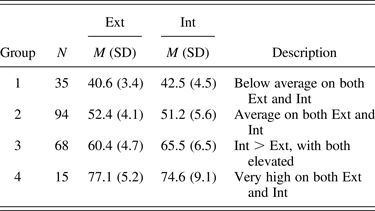
Latent profile analysis using Mplus, version 7.4 (Muthén & Muthén, Reference Muthén and Muthén1998–2015) enabled us to empirically identify groups of girls whose combinations of internalizing and externalizing scores varied. Models with one through six latent profiles (which are like latent classes but are determined using continuous rather than categorical variables) were computed, and their Bayesian information criteria were compared. In each analysis, two continuous indicators were used: W4 Int (averaged across self and parent) and W4 Ext (averaged across self and parent). The four-group solution produced the lowest Bayesian information criterion (3,098.825), indicating the best model fit. Furthermore, the four-group solution was highly interpretable and could be ordinally arranged, which is necessary for mediational tests in PROCESS, described below. The four latent profile groups are described in Table 1. The first group (n = 35) was very low on both Ext and Int. The second group (n = 94) was average on Ext and Int. The third group (n = 68) had elevations on both Ext and Int, but the average level of Int (65.5) was higher than Ext (60.4). Among the 20 participants (29% of this group) with Ext/Int discrepancies greater than 1 SD, 18 had Int scores that were more than 10 points higher than their Ext scores. Group four (n = 15) had very high levels of both Ext (77.1) and Int (74.6).
Wave 4 associated psychopathology groups

Note: Ext, Externalizing; Int, internalizing.
Data analytic plan
We examined data for missing values and computed zero-order correlations among all study variables. To address Hypothesis 1, concerning the co-occurrence of Int and Ext problems, we computed Pearson product–moment correlations among W4 measures of Int and Ext problems. To address Hypothesis 2, related to the prediction of co-occurring Int and Ext problems during adulthood, we used hierarchical linear regressions in which the W1 neurocognitive vulnerability variable was entered last, following W1 SES and child IQ. We then repeated this regression after additionally covarying Ext and Int problems at W1, and computed effect sizes between each of the ordinally arranged groups. Finally, in order to further understand whether the association between childhood neurocognitive vulnerability and adult psychopathology was specific to the comorbid condition, we conducted two hierarchical linear regressions in which we predicted adult Ext or Int problems, covarying the other.
Hypothesis 3, concerning mediational models, was tested via a bootstrap method for identifying indirect effects using PROCESS (Hayes, Reference Hayes2013). The bootstrap method is a statistical simulation in which a new mathematical sample is created by randomly sampling observations from the original data with some replacement. Then, a point estimate of the indirect effect is generated for each random sampling and repeated 10,000 times, with all point estimates aggregated to arrive at an overall estimate of the indirect effect. The mediators were entered serially, with six indirect pathways tested: three through the same domain at W2 and W3 (individual, peer, and school), and three through pathways chosen a priori based primarily on developmental theory: self-control at W2 through peer attachment/friendship at W3, self-control at W2 through school failure at W3, and W3 peer rejection/conflict through W3 school failure. For each of the six pathways through serial mediators, we calculated the point estimate of the indirect effect plus the 95% bias-corrected confidence interval based on the distribution of these effects, after accounting for the association between the W1 covariates (SES and child IQ) and W4 associated psychopathology. We inferred statistical significance if this interval did not contain 0 (see Hayes, Reference Hayes2013).
To test our exploratory question 4, related to the salience of such mediational paths, we recomputed the significant serial mediation pathways, covarying mediators from overlapping pathways. In other words, we covaried W2 mediators that were known (from tests of Hypothesis 3) to also lead to the W3 mediator in question, and we covaried other W3 mediators that were known to lead from the W2 mediator in question. Finally, to test our exploratory question 5, we used a new procedure developed by Hayes (Reference Hayes2015) to test moderated serial mediation, which creates point estimates of indirect effects, conditioned on family distress (our proposed moderator), using bootstrapped samples. We probed indirect effects that showed evidence of significant moderation by calculating the size of the indirect effect at different levels of the moderator, and by splitting the sample at the median on the moderator and conducting the test of serial mediation separately in each subsample.
Results
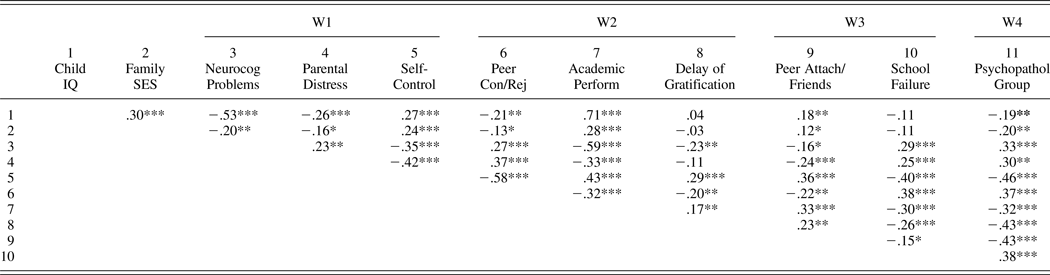
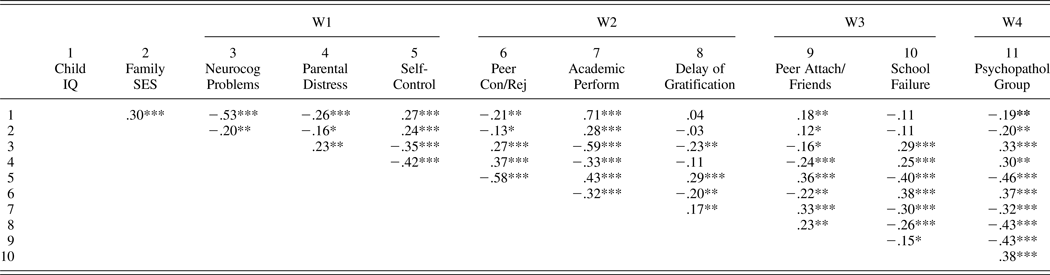
Initial rates of missing values ranged from 0% (for mother education, child age, child neurocognitive problems, and parental distress) to 14% (for W3 delay of gratification), with a mean of 5.2%. Zero-order correlations are presented in Table 2.
Zero-order correlations among study variables
Note: W1–W4, Waves 1–4.
*p < .05. **p < .01. ***p < .001.
Regarding Hypothesis 1, the correlation between W4 Int and Ext problems was r = .74 (p = .000), with similar correlations obtained when we used only parent-report scores (r = .77, p = .000) or self-report scores (r = .68, p = .000). Only 15 cases (7.1% of those with W4 data) had clinically significant elevations (T score greater than or equal to 65) on either Int or Ext, with the alternate score at least 1 SD lower and in the normal range. Thus, for 92.9% of our participants (97.6% of the comparison girls and 89.8% of the girls with ADHD), intraindividual levels of Ext and Int problems were comparable.
Regarding Hypothesis 2, W1 neurocognitive vulnerability accounted for significant variance in W4 associated psychopathology scores (R 2 change = .064), F (1, 206) = 14.98, p = .000, above and beyond W1 SES and child IQ. The same held true when W1 Ext and Int problems (measured by parent report on the Child Behavior Checklist; Achenbach, Reference Achenbach1991b) were entered prior to W1 neurocognitive vulnerability (R 2 change = .017), F (1, 205) = 4.45, p = .036. In addition, because the psychopathology score comprised ordinal categories, we computed effect sizes for differences in W1 neurocognitive vulnerability between adjacent groups. Between Group 1 (very low) and Group 2 (average), the Cohen d was small to moderate (0.41, p = .031). Between Group 2 (average) and Group 3 (higher on Int), the d was small (0.26, p = .082). However, between Group 3 (higher on Int) and Group 4 (very high on both), the d was large (0.78, p = .004). Overall, the relation appears linear, but the difference between Groups 3 and 4 also suggests a threshold effect whereby childhood neurocognitive vulnerability increases risk for Ext and Int comorbidity per se, and not for elevated levels of Int alone. Finally, when we regressed W4 Ext problems on W1 neurocognitive vulnerability, covarying W1 SES and IQ as well as W4 Int problems, the relation between W1 neurocognitive vulnerability and W4 Ext problems remained significant (R 2 change = .020), F (1, 205) = 9.45, p = .002, but the reverse was not true. That is, W1 neurocognitive vulnerability was not related to W4 Int once its relation with W4 Ext problems was taken into account (R 2 change = .000), F (1, 205) = 0.10, p = .753.
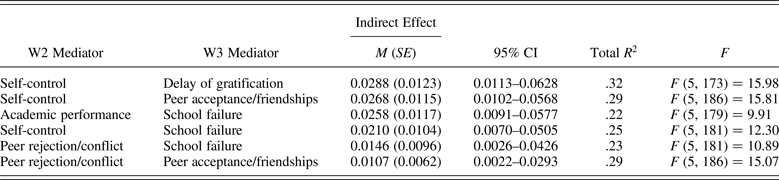
Regarding Hypothesis 3, all six serial mediator pathways showed significant indirect effects, and all accounted for substantial variance in W4 associated psychopathology (between 23% and 32%). These are listed in order of their effect size in Table 3. The indirect effects from W1 neurocognitive problems to W4 associated psychopathology were significant through the following early- and late-adolescent variables: W2 self-control to W3 delay of gratification (indirect effect = 0.0288, SE = 0.0213, 95% confidence interval [CI] = 0.0113 to 0.0826), W2 self-control to W3 peer attachment/friendship (indirect effect = 0.0268, SE = 0.0115, 95% CI = 0.0102 to 0.0568), W2 academic performance to W3 school failure (indirect effect = 0.0258, SE = 0.0117, 95% CI = 0.0091 to 0.0577), W2 self-control to W3 school failure (indirect effect = 0.0210, SE = 0.0104, 95% CI = 0.0070 to 0.0505), W2 peer rejection/conflict to W3 school failure (indirect effect = 0.0146, SE = 0.0096, 95% CI = 0.0026 to 0.0926), and W2 peer rejection/conflict to W3 peer attachment/friendship (indirect effect = 0.0107, SE = 0.0062, 95% CI = 0.0022 to 0.0293). Thus, when these pairs of serial mediators were considered individually, they all appeared viable as potential causal pathways between childhood neurocognitive vulnerability and adult associated psychopathology.
Serial mediation from Wave 1 neurocognitive problems to Wave 4 associated psychopathology
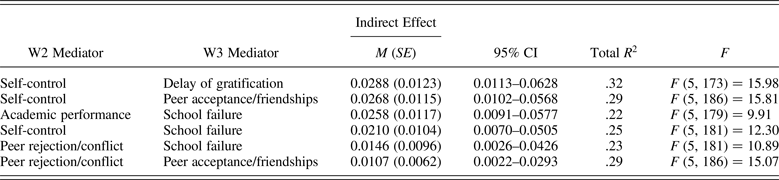
Note: All pathways tested controlling for Wave 1 family socioeconomic status and child IQ; W2, Wave 2; W3, Wave 3. For all F values, p = .000.
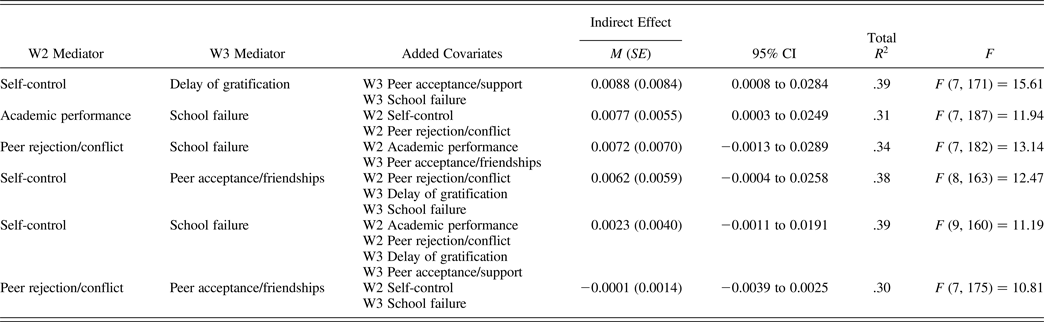
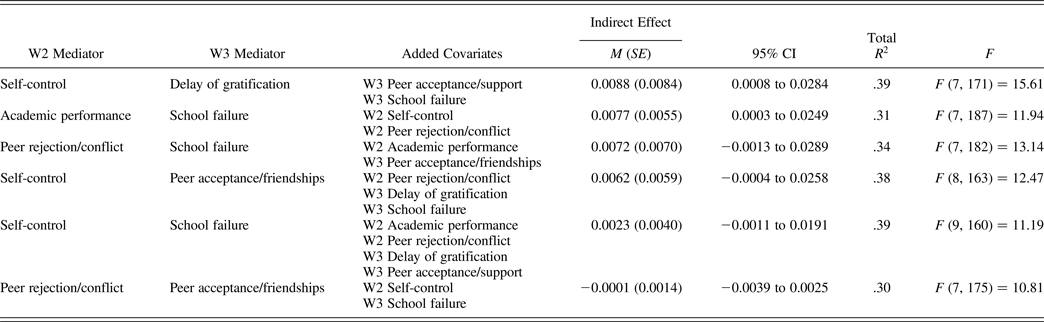
Next we considered our exploratory questions 4 (relative salience of these mediational paths) and 5 (moderation by family context). To address question 4, we recomputed each of the six significant serial mediation pathways, covarying mediators from overlapping pathways, as listed in Table 4. For example, when recomputing the significant serial mediation pathway from W1 neurocognitive vulnerability to W2 self-control to W3 peer attachment/friendship, we covaried W3 delay of gratification and W3 school failure. We did so because in our tests of Hypothesis 3, the serial mediation pathway from W2 self-control to each of these other W3 mediators was also significant. We also covaried W2 peer rejection/conflict because the serial mediation pathway through W2 and W3 peer relations was significant.
Serial mediation from Wave 1 neurocognitive problems to Wave 4 associated psychopathology, covarying alternate mediators
Note: All pathways tested controlling for Wave 1 family socioeconomic status and child IQ; W2, Wave 2; W3, Wave 3. For all F values, p = .000.
When we recomputed the six significant serial mediation pathways covarying these “competing” pathways, two remained significant: the indirect effect from W2 self-control through W3 delay of gratification (indirect effect = 0.0088, SE = 0.0084, 95% CI = 0.0008 to 0.0284, as seen in Table 4), and the indirect effect from W2 academic performance through W3 school failure (indirect effect = 0.0077, SE = 0.0055, 95% CI = 0.0003 to 0.0249).
Once we identified these key mediational pathways, we needed to establish that school failure and delay of gratification temporally preceded adult psychopathology. We modeled it in such fashion, but our methodological decision may not have reflected reality. The “effects” of school failure and delay of gratification might have been related to concurrent associations with ongoing psychopathology, rather than a true temporal ordering, which is a minimum criterion for inferring causality. When we predicted W4 associated psychopathology from W3 school failure, covarying child IQ, family SES, and the level of Ext and Int problems at W3, school failure accounted for a significant percentage of additional variance in adult psychopathology (R 2 change = .09), F (1, 188) = 22.06, p = .000, suggesting that school failure was driving the development of (or at least the further development of) co-occurring Int and Ext problems. The same was true for delay of gratification, which accounted for a large and significant percentage of additional variance in adult psychopathology, even after concurrent psychopathology was covaried (R 2 change = .17), F (1, 181) = 42.40, p = .000.
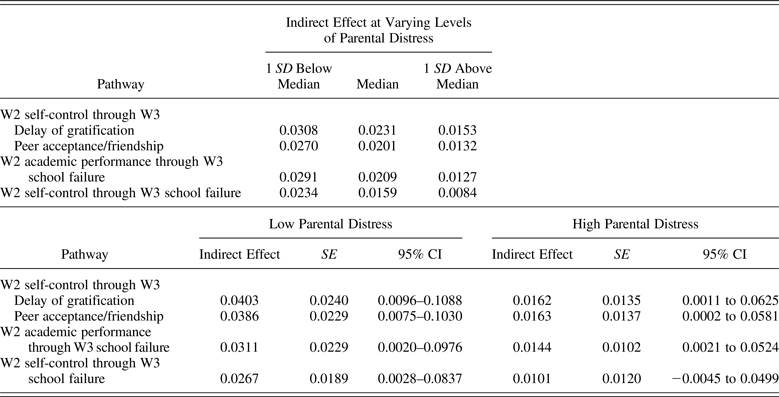
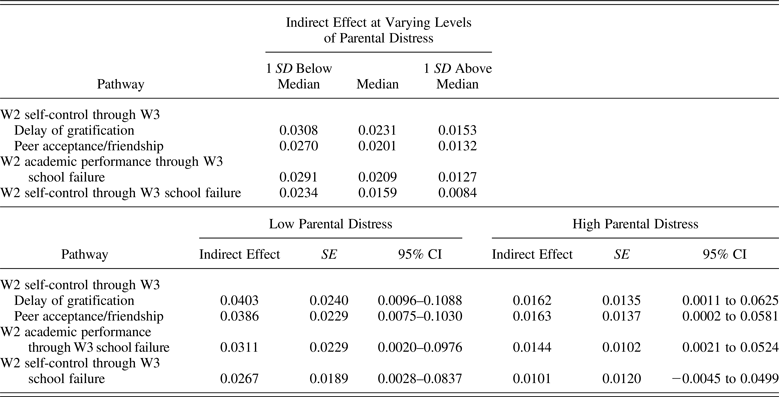
To address exploratory question 5, we tested whether any of the six serial mediation pathways was moderated by parental distress during childhood and early adolescence. Four such pathways were. The pathway from W2 self-control to W3 delay of gratification was moderated by parental distress (95% CI = –0.0323 to –0.0017), as were the pathways from W2 self-control to W3 peer attachment/friendships (95% CI = –0.0281 to –0.0013), W2 academic performance through W3 school failure (95% CI = –0.0245 to –0.0008), and W2 self-control through W3 school failure (95% CI = –0.0281 to –0.0004). We probed these interactions first by using equation 23 in Hayes (Reference Hayes2015) to compute the size of the serial indirect effect at three values of parental distress: 1 SD below the median, the median, and 1 SD above the median. Results are presented in Table 5. At these three values of the moderator, the indirect effects of W2 self-control through W3 delay of gratification were 0.0308, 0.0231, and 0.0153, respectively. Thus, the indirect effect of childhood neurocognitive problems on adult associated psychopathology through W2 self-control and W3 delay of gratification was smaller when the level of parental distress was high and larger when the level of parental distress was low. The same pattern was revealed in each of the other serial mediation pathways moderated by parental distress. For W2 self-control through W3 peer attachment/friendships the indirect effects, conditioned on lower to higher levels of parental distress were 0.0270, 0.0201, and 0.0132; for W2 academic performance through W3 school failure they were 0.0291, 0.0209, and 0.0127; and for W2 self-control through W3 school failure they were 0.0234, 0.0159, and 0.0084.
Serial mediation pathways conditioned on varying levels of parental distress and among those with low and high levels of parental distress
Note: W2, Wave 2; W3, Wave 3.
This pattern of larger indirect effects at lower levels of parental distress was confirmed when we split the group according to high parental distress (at or above the median) and low parental distress (less than the median). As shown in Table 5, among the high parental distress group, the serial indirect effect for W2 self-control through W3 delay of gratification was 0.0162 (SE = 0.0135, 95% CI = 0.0011 to 0.0625); among the low parental distress group, it was 0.0403 (SE = 0.0240, 95% CI = 0.0096 to 0.1088). The indirect effect through W2 self-control and W3 peer attachment/friendships was 0.0163 (SE = 0.0137, 95% CI = 0.0002 to 0.0581) when parental distress was high and 0.0386 (SE = 0.0229, 95% CI = 0.0075 to 0.1030) when parental distress was low. The indirect effect through W2 academic performance and W3 school failure was 0.0144 (SE = 0.0102, 95% CI = 0.0021 to 0.0524) when parental distress was high and 0.0311 (SE = 0.0229, 95% CI = 0.0020 to 0.0976) when parental distress was low. Finally, the indirect effect through W2 self-control and W3 school failure was 0.0101 (SE = 0.0102, 95% CI = –0.0045 to 0.0499) when parental distress was high and 0.0267 (SE = 0.0189, 95% CI = 0.0028 to 0.0837) when parental distress was low. The indirect effects through individual, peer, and school domains were always larger when parental distress was low.
Discussion
Our primary purpose was to ascertain, among our sample of women with and without childhood diagnoses of ADHD, prospective associations between (a) neurocognitive vulnerability during childhood and (b) dimensionally measured and co-occurring internalizing and externalizing psychopathology during adulthood. These types of psychopathology were strongly associated, and such “comorbidity” was predictable from childhood neurocognitive vulnerability. We then identified six significant serial mediation pathways from childhood neurocognitive vulnerability to adult associated psychopathology through three early- and late-adolescent domains: individual (self-control and delay of gratification), peer (rejection/conflict and acceptance/friendship), and school (academic performance and school failure). We isolated the key indirect effects through self-control and delay of gratification and through academic performance and school failure by covarying competing mediational processes. We also found these pathways, as well as two others, to be moderated by parental distress during childhood and early adolescence, such that under conditions of high parental distress, the indirect effects through the individual, peer, and school domains were weaker than when parental distress was low. In all, we believe that this set of findings represents an advance in the specification of core ontogenic processes between childhood and adulthood regarding the development of psychopathology within the vulnerable population of girls and women with significant problems of inattention, impulsivity, and hyperactivity.
As expected, externalizing and internalizing problems were strongly associated in our sample. Co-occurrence was the rule, with very few exceptions. Similarly, Masten et al. (Reference Masten, Roisman, Long, Burt, Obradovic and Riley2005) reported that the positive link between externalizing and internalizing problems was particularly pronounced for the girls in their longitudinal sample during emerging adulthood. Of course, the majority of our participants had been diagnosed with childhood ADHD. Although not clinically referred per se, our sample was enriched for psychopathology, which might partially explain the tendency for internalizing and externalizing problems to co-occur during adulthood. However, 97.6% of the comparison girls in our sample were concordant for levels of internalizing and externalizing problems (vs. 89.8% of the girls with childhood ADHD), which is consistent with findings that comorbidity tends to be quite common in community samples as well (Angold et al., Reference Angold, Costello and Erkanli1999; Lilienfeld, Reference Lilienfeld2003). Thus, our results provide further support for the contention that psychological problems typically do not occur in isolation.
In line with the goals of this Special Section, we isolated a childhood neurocognitive vulnerability factor reflecting executive dysfunction and teacher-rated cognitive and learning problems. This factor predicted associated psychopathology more than half a generation later (16 years) even covarying initial levels of associated internalizing and externalizing problems, as well as SES and child IQ. It is also noteworthy that there was no shared source or method variance across these measurements obtained in childhood and adulthood. However, without sizable groups that were high on one form of psychopathology and not the other, we were unable to directly address questions regarding whether the risk incurred by neurocognitive vulnerability was specific to the co-occurring adult condition. Instead, when we predicted adult levels of externalizing problems, adjusting for internalizing problems, childhood neurocognitive vulnerability predicted substantial additional variance, but not vice versa. In other words, the association between childhood neurocognitive vulnerability and adult associated psychopathology seems to be driven by its relation to later externalizing problems. However, caution is warranted: there were only two participants (both in psychopathology group 3) whose externalizing score was elevated in the absence of elevated internalizing problems. Neurocognitive problems may be particularly predictive of later externalizing problems, but such problems co-occurred with internalizing problems almost universally in our sample. Whether childhood neurocognitive vulnerability is a specific risk factor for adult externalizing problems would require adequate sampling of participants who evidenced a single type of pathology.
Although evidence of a direct effect is not required for testing mediational pathways (Hayes, Reference Hayes2013), our compelling evidence for an enduring association between earlier neurocognitive vulnerability and later associated psychopathology mandates examination of how children with neurocognitive problems end up with complex psychopathological problems years later. Consistent with the main tenets of DP, we tested potential mechanisms at multiple levels of analysis across child and contextual domains. To reflect the complexity of the ontogeny of psychopathology, our heuristic model was broad rather than specific, although it was certainly not exhaustive (e.g., heritable factors are just one of several potentially important explanatory variables missing from our model).
When hypothesized pathways through and across domains (individual, peer, and school) were considered individually, each showed a significant indirect effect. That is, each pathway, when tested in isolation, mediated the relation between childhood neurocognitive vulnerability and adult associated psychopathology. Childhood neurocognitive vulnerability was associated with co-occurring psychopathology during adulthood via the following adolescent mechanisms: (a) difficulties with self-control and then decreased ability to delay gratification, (b) peer rejection and then poor friendship quality, (c) academic underperformance and then school failure, (d) difficulties with self-control and then poor friendship quality, (e) difficulties with self-control and then school failure, and (f) peer rejection and then school failure. These findings are not surprising, given the breadth of empirical literature supporting relations among these domains, as well as the uniformly significant (but small to moderately sized) correlations in our sample. What is notable, however, was the large amount of variance in adult psychopathology accounted for in each of these models (R 2 between .22 and .32). The largest R 2 values were associated with mediational pathways involving self-control and peer relations.
When the effects of other mediational pathways were covaried, only the pathways (a) through self-control in early adolescence and the ability to delay gratification during early adulthood, and (b) through academic problems early in adolescence and school failure later in adolescence helped to explain how children with neurocognitive vulnerability eventually display significant externalizing and internalizing problems as adults. These findings are important for two reasons. First, if we had focused on only a single level of analysis or single domain, we would have encountered a substantial “missing variable” problem and might have mistakenly concluded that any of the pathways we initially tested was potent. Essex et al. (Reference Essex, Kraemer, Armstrong, Boyce, Goldsmith and Klein2006) note that this problem occurs in many studies of childhood risk factors for mental health problems that limit their coverage to particular domains or developmental periods. Our model certainly does not account for all potentially important variables, but by taking a broader view across multiple levels and domains of analysis, we were able to more accurately ascertain key pathways explaining the development of adult psychopathology in our sample: (a) one that begins with childhood neurocognitive vulnerability, leads to problems with self-control during adolescence and then problems with the delay of gratification during young adulthood, and that culminates with significant psychological problems in adulthood; and (b) one that begins with childhood neurocognitive vulnerability, leads to academic underperformance and then school failure during adolescence, and also culminates with significant psychological problems in adulthood.
Many studies of adolescents have also found academic and school problems to be predictors of or mediators through which psychological symptoms (especially externalizing problems) emerge (Ansary & Luthar, Reference Ansary and Luthar2009; Aunola, Stattin, & Nurmi, Reference Aunola, Stattin and Nurmi2000; Esch et al., Reference Esch, Bocquet, Pull, Couffignal, Lehnert and Graas2014; Essex et al., Reference Essex, Kraemer, Armstrong, Boyce, Goldsmith and Klein2006; Gonzales et al., Reference Gonzales, Wong, Toomey, Millsap, Dumka and Mauricio2014; Lewinsohn et al., Reference Lewinsohn, Roberts, Seeley, Rohde, Gotlib and Hops1994; Masten et al., Reference Masten, Roisman, Long, Burt, Obradovic and Riley2005). However, Ansary and Luthar (Reference Ansary and Luthar2009) noted that once the cycle of academic failure and behavior problems has begun, it may be all but impossible to identify which took precedence. At least prior to adolescence, school impairment and psychological symptoms are probably reciprocally causal (e.g., Arnold, Reference Arnold1997; Hinshaw, Reference Hinshaw1992; Metsapelto et al., Reference Metsapelto, Pakarinen, Kiuru, Poikkeus, Lerkkanen and Nurmi2015).
Associations between self-control (e.g., Franken et al., Reference Franken, Moffitt, Steglich, Dijkstra, Harakeh and Vollebergh2015; Rosen et al., Reference Rosen, Waugh, Epstein, Hoza, Arnold and Hechtman2014) or problems with delaying gratification (Dolan & Lennox, Reference Dolan and Lennox2013; Krueger et al., Reference Krueger, Caspi, Moffitt, White and Stouthamer-Loeber1996) and externalizing problems in adolescence have also been documented, whereas evidence for the association between these self-regulatory capacities and internalizing problems is sparse (for an exception, see Maalouf et al., Reference Maalouf, Brent, Clark, Tavitian, McHugh and Sahakian2011). However, in our all-female sample, associations between self-control and delay of gratification with adult internalizing problems (r = –.40 and –.36, respectively) are highly comparable to the same associations with externalizing problems (r = –.45 and –.43, respectively).
In our sample we were able to demonstrate that school failure and problems with the delay of gratification during late adolescence do precede the development of, or further the development of, internalizing and externalizing problems. These temporal and perhaps causal relations should be given closer scrutiny. How does the tendency to prefer immediate reward to delayed gratification lead to psychopathology? Is the same underlying executive dysfunction responsible for the association, or does the preference for immediate reward lead to impairments that contribute to psychopathology (e.g., impulsively deciding to drop a class, quit a job, or use illicit substances leading to emotional problems)? Similarly, how does school failure lead to serious psychological maladjustment? Are processes of reduced self-efficacy, loss of perceived control, or lower self-esteem involved (Aunola et al., Reference Aunola, Stattin and Nurmi2000; Chen, Rubin, & Li, Reference Chen, Rubin and Li1995; Maughan, Rowe, Loeber, & Stouthamer-Loeber, Reference Maughan, Rowe, Loeber and Stouthamer-Loeber2003)? Might this process be particularly the case for girls (Cole, Martin, & Powers, Reference Cole, Martin and Powers1997; Herman, Lambert, Reinke, & Ialongo, Reference Herman, Lambert, Reinke and Ialongo2008), who, on average, outperform boys academically (Newcomb et al., Reference Newcomb, Abbott, Catalano, Hawkins, Battin-Pearson and Hill2002; Pomerantz, Altermatt, & Saxon, Reference Pomerantz, Alternatt and Saxon2002)? Higher expectations of academic success for girls versus boys (Hinshaw & Kranz, Reference Hinshaw and Kranz2009), at least in the United States, might explain why the link between academic problems and internalizing symptoms is stronger for girls than it is for boys (Pomerantz et al., Reference Pomerantz, Alternatt and Saxon2002; Reinherz, Giaconia, Hauf, Wasserman, & Silverman, Reference Reinherz, Giaconia, Hauf, Wasserman and Silverman1999). Alternately or in addition, does school failure lead to association with deviant peers who subsequently model externalizing behavior (Deater-Deckard, Reference Deater-Deckard2001; Patterson, Forgatch, Yoerger, & Stoolmiller, Reference Patterson, Forgatch, Yoerger and Stoolmiller1998)? Is there a critical “third variable,” such as family psychiatric history, which helps to explain the association? Further investigation in this sample and others might shed light on factors mediating the associations between these late adolescent problems (school failure and problems delaying gratification) and adult psychopathology, especially for girls.
In the meantime, however, our findings suggest that it is imperative to address the academic and educational impairments associated with childhood neurocognitive vulnerability, especially during adolescence when the successful completion of high school and, for many children, the pursuit of postsecondary education is a critical developmental task. The importance of school engagement and educational success for future functioning in the psychological domain is consistent with a core tenet of DP: namely, that successful attainment of developmentally relevant competencies (e.g., secure attachment in early childhood, or in this case, academic success and school completion during adolescence and early adulthood) is crucial for later adaptation across domains (Elicker, Englund, & Sroufe, Reference Elicker, Englund, Sroufe, Parke and Ladd1992; Roisman, Masten, Coatsworth, & Tellegen, Reference Roisman, Masten, Coatsworth and Tellegen2004). Treatment of children at risk for or demonstrating early academic underachievement and school disengagement should emphasize educational support and interventions to ensure that these children progress successfully through school, which could be an important strategy through which the burden of adult psychopathology in this population could be reduced. As Masten et al. (Reference Masten, Roisman, Long, Burt, Obradovic and Riley2005) note, it may be that the best way to prevent problems in one domain (in this instance, comorbid psychopathology) is to intervene earlier in a rather different domain (in this instance, educational failure). They also note that historically, mental health professionals may not have been attuned to the importance of academic success for the development of psychopathology because remediating academic performance is not in their skill set.
Our findings also suggest that it is imperative to address problems with self-control, especially in social situations, and to build the capacity to delay gratification, among girls at risk for psychopathological outcomes due to early neurocognitive problems. These objectives are consonant with evidence suggesting that for children more generally, social–emotional learning is associated with increased academic success as well as reductions in behavior problems (Bierman et al., Reference Bierman, Coie, Dodge, Greenberg, Lochman and McMahon2010; Espelage, Rose, & Polanin, Reference Espelage, Rose and Polanin2015; Jones, Brown, Hoglund, & Aber, Reference Jones, Brown, Hoglund and Aber2010; Shonfeld et al., Reference Shonfeld, Adams, Fredstrom, Weissberg, Gilman and Voyce2015), and that “grit” (i.e., perseverance toward important long-term goals) is fundamental to success at school (Duckworth & Quinn, Reference Duckworth and Quinn2009; Wolters & Hussain, Reference Wolters and Hussain2014) and may also protect against outcomes including suicidality (Blalock, Young, & Kleiman, Reference Blalock, Young and Kleiman2015).
Our final hypothesis involved whether any of the individually identified indirect pathways between childhood neurocognitive problems and adult psychopathology were moderated by, or depended on, the family context. Again, this question was devised in light of the complexity inherent in the multiple levels of influence involved in the ontogeny of psychopathology. We found that four of the six serial mediation pathways were moderated by the family context, which in this paper was conceptualized as parental distress indexed by mother and father report of depressive symptoms, marital dissatisfaction, and childrearing-related stress across childhood and early adolescence. It is not uncommon to find that childhood risk factors for later psychopathology operate differently in different contexts, that is, in the presence of moderators including family SES (Essex et al., Reference Essex, Kraemer, Armstrong, Boyce, Goldsmith and Klein2006), ethnicity (Deater-Deckard, Dodge, Bates, & Pettit, Reference Deater-Deckard, Dodge, Bates and Pettit1998), or poor quality and conflictual family relationships (Repetti, Taylor, & Seeman, Reference Repetti, Taylor and Seeman2002). At first, we were surprised that each of the serial indirect effects was smaller when parental distress was high because from an additive or interactive risk perspective, we expected that the effects of neurocognitive problems would be larger in a detrimental family context. However, the moderational findings did not apply to the direct relation between childhood neurocognitive problems and adult psychopathology but rather to the indirect effects linking one to the other. We first considered our previous conjecture that when parental distress is high, individual, peer, and school factors may matter less in terms of predicting adult psychopathology because parental distress is a relatively more powerful predictor. Post hoc analyses did not reveal this pattern, however.
Instead, we suggest the following. Because caregiver variables including depression and stress can influence neurobiological development early in life (Adam, Klimes-Dougan, & Gunnar, Reference Adam, Klimes-Dougan, Gunnar, Coch, Dawson and Fischer2007; Ashman & Dawson, Reference Ashman, Dawson, Goodman and Gotlib2002; Repetti, Taylor, & Saxbe, Reference Repetti, Taylor, Saxbe and Grusec2007), we speculate that when parental stress, depression, and conflict are high, child neurocognitive problems may be more environmentally than genetically determined, in which case the mechanistic pathways involving child self-control, peer relations, and academic/school success are more malleable. In contrast, when parents are not overly distressed (i.e., they report lower levels of depressive symptoms, marital conflict, and childrearing stress), the mechanistic effects of the child self-control, peer relations, and academic/school success are larger because child neurocognitive problems are more likely to be heritable. In these families, the mechanistic pathways were perhaps more predetermined or fixed. We advance this interpretation cautiously because these findings, although replicated across four serially mediation pathways in this study, are unique and our explanation is quite speculative. However, it is clear that the heritability of key traits can be moderated by familial factors (specifically, SES). For example, IQ is substantially heritable in the highest SES strata but almost nil in conditions of poverty (Turkheimer, Haley, Waldron, D'Onofrio, & Gottesman, Reference Turkheimer, Haley, Waldron, D'Onofrio and Gottesman2003).
A key aim of this Special Issue is to illuminate mechanisms underlying comorbidity in DP through consideration of neurobiological vulnerability as it interacts and transacts with contextual risk factors (e.g., Beauchaine & McNulty, Reference Beauchaine and McNulty2013). Our sample was ascertained, however, when the girls were already in school, and our measure of neurocognitive vulnerability was not neurobiological. As noted above, there is agreement that both executive functioning and cognitive/learning problems in children are at least partially mediated by neurobiological mechanisms. Although we did not employ an early, directly measured indicator of neurobiological functioning, we argue that our index of childhood neurocognitive vulnerability reflects early individual neurobiological differences. Nonetheless, it is a priority for the field to identify early neurobiological vulnerabilities via objective biological indicators in order to map predictive pathways.
Our study is certainly not without limitations. It is most important to remember the population from which our participants were drawn: females both with and without ADHD. Findings regarding rates and types of co-occurring psychopathology, as well as findings regarding predictors, mediators, and moderators, might have been different had our sample not been exclusively female or enriched for ADHD. Relations and processes might be different among males, among children with other initial clinical presentations, or within a normative sample. Another potential limitation was the wide spacing of our assessment points. Although our approximately 5-year intervals confer the advantage of viewing development over the long term (16 years), it may fall short when the window of influence of one temporally ordered variable on another is relatively small. For example, the relation between self-control and peer attachment and friendship may be less salient across 5 years than across a shorter period (e.g., 6 months). Finally, because our interest was in the relative size of within- and cross-domain indirect effects, we tested our hypotheses using a series of computations, rather than indexing the overall fit of our model. Overall model fit (not included in this paper) might have been a useful metric given a somewhat different set of hypotheses. In addition, because we conducted multiple tests, we increased the chance of Type I errors; however, 12 of our 18 mediational tests were significant, and it is unlikely that these were mostly false positives.
In conclusion, in our sample of females with and without ADHD followed from childhood to adulthood, intraindividual levels of internalizing and externalizing problems were highly similar. In other words, in almost every case where one type of problem did (or did not) exist, the other did (or did not) as well. Simply put, comorbidity (or associated psychopathology, viewed dimensionaly) was the rule rather than the exception (Angold et al., Reference Angold, Costello and Erkanli1999; Caron & Rutter, Reference Caron and Rutter1991). Childhood neurocognitive vulnerability was a significant predictor of adult co-occurring psychopathology, and this relation was partly accounted for by self-regulatory abilities, academic performance, and school failure during adolescence, particularly when parenting distress was low. Our analyses provide an example of how the complex ontogenetic processes involved in the development of psychopathology can be considered and tested. Although microanalytic investigations play a crucial role in understanding circumscribed aspects of the development of psychopathology, we contend that research looking broadly across domains and time is essential as well.