Introduction
Patients with chronic ear disease present a difficult treatment challenge. The indolent course of the disease and the recalcitrant nature of its response to treatment often frustrate both the clinician and the patient. Traditionally, bilateral chronic mastoiditis has been treated by staged mastoidectomies. However, in patients with chronic disease who are ill or who repeatedly refuse surgery, it may be preferable to perform both procedures simultaneously. In the otologic community, this practice has been avoided due to the risks of ear surgery, primarily sensorineural hearing loss. Tympanoplasty, with or without mastoidectomy, for chronic ear disease has a 0.8–4.5 per cent incidence of post-operative sensorineural hearing loss of at least 10 dB.Reference Smyth1–Reference Tos, Lau and Plate3
The risk of hearing loss after surgery for chronic ear disease must be weighed against the natural course of the disease. If untreated, hearing degenerates in the chronically infected ear.Reference Proctor4 The goal of surgery is primarily to eradicate disease and to stay the progression of hearing loss. Improvement of the patient's hearing is a secondary, albeit important goal.
We reviewed the outcomes of simultaneous bilateral mastoidectomies in 12 patients. We then surveyed US otologists to assess their experiences and opinions.
Materials and methods
We reviewed the charts of 94 patients who had undergone mastoidectomy for chronic ear disease, cholesteatoma or tumour resection. We identified 12 patients, with ages ranging from one to 56 years, who had undergone bilateral, simultaneous mastoidectomies. These patients' pre-operative evaluations, intra-operative findings, indications for simultaneous operation and post-operative courses were recorded in a spreadsheet. Forty data fields were collected for each patient. Pure tone thresholds were calculated by averaging all available air conduction thresholds on pre- and post-operative audiograms. We also recorded the middle-ear risk index, which is an indication of middle-ear pathology and hearing prognosis.Reference Kartush5, Reference Pasha, Hill and Burgio6 The middle-ear risk index was calculated from the history of previous surgery, otorrhoea, middle-ear granulation, middle-ear effusion, tympanic membrane perforation, presence or absence of cholesteatoma, and status of the ossicular chain. Possible index scores range from zero to 12; a low score suggests that the post-operative hearing outcome will be good, while a high score predicts a poor post-operative hearing outcome.
A survey of US otologists was distributed to determine the otologic community's opinion of simultaneous bilateral mastoidectomy. The survey was sent to the 452 otologists who were members of the American Neurotology Society. The survey was sent via first class mail, with a detachable, stamped, self-addressed answer postcard to enable an anonymous response.
Results and analysis
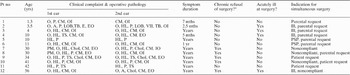
Table I lists the patient's clinical evaluations, intra-operative findings and indications for simultaneous operation. Tables II and III describe the first and second ears selected for operation, respectively. The Tables show the indications for selection of the first or second ear, what operation was performed, intra-operative and post-operative complications, and hearing results. Of the 12 patients who underwent bilateral, simultaneous mastoidectomy, half were children. Twenty-two of the 24 ears had marked middle-ear or mastoid disease. (Patient number five showed little mastoid disease during his first ear mastoidectomy and therefore underwent only a tympanoplasty in his second ear; see Tables II and III.) All of the adults and one of the children had a history of ear problems lasting years, and five of the adults had been refusing ear surgery for years. Four of the six adults were non-compliant, having missed and rescheduled appointments for months or years on end.
Patients' condition at time of surgery

* Years=several years of symptoms. Pt no=patient number; yrs=years; O=otorrhoea; P=perforation; CM=chronic mastoiditis; OI=ossicles intact; mths=months; A=anacusis; LOB=loss of balance; TB=tuberculosis; E=exposed cerebellar dura, tegmen, jugular bulb, carotid artery and open lateral semicircular canal; EO=eroded ossicles; HL=hearing loss; VII=weak facial nerve; TS=tympanosclerosis; PSP=poor scholastic performance; PM=previous mastoidectomy; chol=cholesteatoma
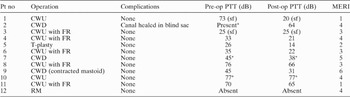
Surgical outcomes: first ear

* Poor reliability during testing. Pt no=patient number; Pre-op=pre-operative; PTT=pure tone threshold; Post-op=post-operative; MERI=middle-ear risk index; CWU=canal wall up mastoidectomy; FR=facial recess; sf=sound field testing; CWD=canal wall down mastoidectomy
Surgical outcomes: second ear

* Poor reliability during testing. Pt no=patient number; Pre-op=pre-operative; PTT=pure tone threshold; Post-op=post-operative; MERI=middle-ear risk index; CWU=canal wall up mastoidectomy; sf=sound field; CWD=canal wall down mastoidectomy; FR=facial recess; T-plasty=tympanoplasty; RM=radical mastoidectomy
Among the children, three were acutely ill at the time of surgery, one (patient two) with undiagnosed, disseminated tuberculosis.Reference Mongkolrattanothai, Oram, Redleaf, Bova and Englund7 In each paediatric case, the parents requested simultaneous procedures, even after learning of the length of the procedure. The mothers of two children (patients five and six) insisted on operations and that they be simultaneous. These mothers attributed their children's scholastic problems to their ear disease, and, indeed, all four ears showed improved hearing following surgery.
Among the six adults, one patient (patient 12) had become repeatedly ill from acute and chronic otitis media in his only hearing ear. He and three of the other adults had refused previous surgical recommendations. One of these four patients requested simultaneous bilateral surgery, one acquiesced to his mother's request, and the other two agreed to the surgeon's suggestion. The other two adults (patients nine and 11) requested simultaneous surgery for their own convenience.
Table II shows the operations and outcomes on the first ears operated upon. We selected the ear that would require the most attention to be operated on first. In cases three and 11, the clinical picture was identical in both ears, and we arbitrarily selected the first ear. In case 12, we operated on the only hearing ear first. In the remaining nine cases, we selected the ear with the most clinical disease, or the worse hearing, or both. This was so that the surgeons would be freshest while operating on the more difficult ear, and the ear that was more important to treat, should the operation need to be interrupted between ears.
All patients underwent mastoidectomy in their first ear. One patient had such mild disease in the first ear that he received only a tympanoplasty in the second ear (patient five). There were two intra-operative complications, both of which occurred during the first ear's operation. Patient two's first ear was filled with white debris, with such erosion of bony structures that the cerebellar dura, the tegmen dura, the carotid artery and the jugular bulb were all exposed. In addition, the lateral semicircular canal was open and the stapes was loose in the oval window. The stapes was dislocated during surgery with minimal pressure and was immediately replaced on the oval window. On the other side, all care was taken not to touch the stapes at all, and there was no similar problem. Post-operatively, the hearing in the first ear improved compared with pre-operative levels.
Patient nine had such a contracted mastoid in the first ear that the second genu of the facial nerve was quite close to the tegmen and to the roof of the aditus ad antrum. This area, already difficult to access and visualise, was also filled with cholesteatoma. The second genu was exposed with the drill, and the patient subsequently had a House grade two function of the nerve on that side. The second ear had identical anatomy, also with a cholesteatoma tucked up into the narrow aditus. However, having just seen the anatomy and the necessity for dissecting in the tight area, the cholesteatoma was removed completely, with no facial nerve exposure.
There were no intra-operative complications during surgery of any of the 12 second ears. In the long term, both of patient two's external canals ended in blind sacs, as did patient twelve's first ear, although each of these three ears had undergone canal wall down mastoidectomy.
In Tables II and III, the higher middle-ear risk index values tended to be associated with worse pre-operative hearing. Patients two, seven and 10 gave unreliable responses on audiometric testing. Patient two, the child with disseminated tuberculosis, was simply too sick to test well pre-operatively. Adult patients seven and 10 were erratic in their responses both pre- and post-operatively. Patient seven's hearing was worse in the first ear post-operatively than pre-operatively. Patient eight's hearing was 3 dB worse in the first ear post-operatively, and patient twelve's hearing was 1 dB worse in the first ear post-operatively. Hearing in all the other 21 ears improved or was the same post-operatively. In the first ear operated upon, patients one, two, five, six, nine and 10 showed a greater than 10 dB hearing improvement, as did patients one, four, five, six, eight and nine in the second ear operated upon.
Post-operative recuperations were unremarkable. No patient complained of the inconvenience of bilateral external canal packing.
Of 452 surveys distributed postally, 70 were returned by the postal service, leaving a total of 382 inquiries successfully despatched. Of these 382 surveys, 121 anonymous reply cards were returned. Sixteen respondents added their names, addresses or telephone numbers to the reply cards. Appendix 1 shows the questions asked and the replies given.
The first three questions of the survey focussed on respondents' personal experiences and observations. One hundred and twenty of the 121 respondents answered the first question (i.e. whether they personally had ever performed simultaneous bilateral mastoidectomies on the same patient in the same sitting). Fourteen respondents had performed simultaneous mastoidectomies. Of the 106 respondents who had not performed simultaneous mastoidectomies, 28 circled the option ‘absolutely not’, which we had offered so that the respondents could indicate the conviction of their reply.
One hundred and ten respondents answered the second question (i.e. ‘have you ever experienced or learned of any complication of bilateral mastoidectomy which would have been avoided by staging the procedure?’). One hundred respondents answered in the negative. Of the 10 respondents who had heard of complications, none had ever performed simultaneous mastoidectomies themselves, and therefore had not caused these complications themselves.
In answering question three (requesting respondents to list known complications), eight of the nine respondents who had heard of complications listed them, and one listed two. One respondent's comment was ‘no need for the second operation – nor the first’. One respondent felt that the procedures were inadequately performed secondary to surgeon fatigue. One respondent who listed facial nerve injury had also heard of a case of iatrogenic sensorineural hearing loss. Six respondents reported post-operative sensorineural hearing loss. One specified that the loss was bilateral and one specified that the loss was unilateral. Three did not specify whether the loss was unilateral or bilateral. We included only those complications which would have been avoided by staging the mastoidectomies. Not included in the count was one respondent's report of two cases of bilateral sensorineural hearing loss which, according to the respondent, had probably resulted from the surgeons' skill (or lack thereof) and would not have been avoided by staging. We also excluded one report of bilateral hearing loss following bilateral stapedectomy. Therefore, respondents reported the following hearing complications due to the simultaneity of bilateral mastoidectomies: one case of sensorineural hearing loss in one ear; one case of hearing loss in both ears; and three cases of hearing loss of unspecified laterality.
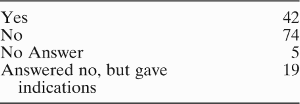
The fourth and fifth questions of the survey focussed on the otologists' opinions about safety and indications. One hundred and sixteen respondents answered the fourth question (i.e. whether simultaneous mastoidectomies were ever a good treatment strategy). Seventy-four respondents replied in the negative, while 42 replied that simultaneous operations could be indicated. Of the 74 respondents who stated that simultaneous operations were never indicated, 19 went on, in the fifth question, to enumerate indications for simultaneous mastoidectomies. Therefore, 61 respondents gave possible indications for simultaneous operations, although 19 of these respondents appeared to give indications only upon second thought. Interestingly, two respondents replied that they ‘absolutely had not’ performed simultaneous operations, but also said that such operations could be indicated. Five more respondents, who replied that they ‘absolutely had not’ performed simultaneous operations, also answered that there were no indications for simultaneous operations but went on to provide indications in question five.
Discussion
Our series of 12 patients, some quite ill, included one adult who was losing his only hearing ear through his own neglect. Most of the ears were quite diseased. Fighting chronic otitis media and chronic mastoiditis, especially in the face of eustachian tube dysfunction, is often a losing battle. However, despite the patients' disease, in only one ear of the 24 studied was hearing noticeably worse post-operatively. In the other 23 ears, hearing was basically the same or better post-operatively. In half of the first ears and half of the second ears, hearing improved more than 10 dB post-operatively, for a total of eight of 12 patients with post-operative hearing improvement. All of the parents of paediatric patients requested simultaneous bilateral operations and were pleased to address the problem in one sitting. For the non-compliant patients, simultaneous operations interrupted the downhill course of the second ear earlier than would otherwise have been possible.
The survey respondents' objections to simultaneous procedures were based almost entirely on the risk of bilateral sensorineural hearing loss (although a few respondents worried about the risk of bilateral facial nerve injury, transient hearing loss during the recovery period, vestibular symptoms, surgeon fatigue and sterility of the operating field). We too were anxious about the possibility of bilateral complications in our patients. However, the two intra-operative complications in our series occurred only in the first-operated ear. After observing the pathology in the first ear, we were better prepared for the similar challenges in the second ear. In fact, we felt that it was safer, for the patient, to continue with the anatomy fresh in our minds. Indeed, there were no intra-operative complications in any of the second ears.
Despite our own positive experience, an undetected mistake might occur in each ear, and such a mistake might deafen the patient bilaterally. Fear of such an outcome would be especially valid if the inner ear was intentionally entered bilaterally, as in the early days of bilateral stapedectomy. Nonetheless, the same fear is valid for mastoidectomy, an operation in which the inner ear is never entered intentionally. Several respondents mentioned that this treatment strategy ‘doubles the risks’. While it is true that the risk of damage to a single ear is doubled, the risk of damage to both ears is very low. A 0.8–4.5 per cent risk of sensorineural hearing loss to each ear means a 1.6–9 per cent risk of hearing damage in one ear or the other. This risk is the same if the operations are staged. However, the probability of deafening both ears is the square of the probability of deafening one ear, or 0.006–0.2 per cent. Of the 121 respondents, 10 actual cases of complications related to the simultaneity of the operations were reported. Of these complications, five were sensorineural hearing loss but only one was explicitly bilateral. Furthermore, if the argument against simultaneity is the risk of bilateral deafness, then the otologist must be committed to not operating on a diseased only-hearing ear.
Sixty-one of 121 respondents gave indications for simultaneous operations. Only 14 respondents had performed simultaneous bilateral mastoidectomies. Nineteen respondents stated that simultaneous operations were never indicated, but then gave indications. This probably reflects ambivalence about the theoretical risks of surgery versus other pressures on the patient and the surgeon. These pressures include the progressive nature of the disease, the occasional very ill patient, the problem of the noncompliant patient and patient convenience.
Perhaps the most powerful pressure on the surgeon is the early history of stapedectomy versus the unlikelihood of sensorineural hearing loss from mastoidectomy. As demonstrated above, the risk of bilateral deafness from mastoidectomy is quite low, and there are important differences between stapedectomy and mastoidectomy. The stapedectomy patient is not sick, and delay in treatment does not preclude a good outcome. Stapedectomy patients are also compliant, and present requesting surgery. Stapedectomy is an operation solely for the purpose of hearing improvement. All these features are in sharp contrast to surgery for chronic ear disease.
• Bilateral, simultaneous mastoidectomies have been traditionally opposed due to the risk of sensorineural hearing loss
• A single case series of three patients is reported in the literature
• In certain scenarios, it may be beneficial to the patient to perform simultaneous tympanomastoidectomies, rather than staged mastoidectomies
• Bilateral, simultaneous mastoidectomies can be a hearing-sparing operation which can stay the progression of sensorineural hearing loss earlier in patients who were previously reluctant to undergo surgery
• The risk of bilateral sensorineural hearing loss following bilateral, simultaneous mastoidectomies is very low (0.006–0.2 per cent)
• A survey of US otologists revealed a strong aversion to performing bilateral, simultaneous mastoidectomies
• Bilateral, simultaneous mastoidectomies for hearing preservation can be performed safely
Performing simultaneous bilateral mastoidectomies is not comparable to performing simultaneous stapedectomies. Instead, it is more similar to operating on a diseased only-hearing ear, and requires the same level of vigilance. In chronic mastoiditis, without intervention, that ear is at risk of continued deterioration. Nevertheless, performance of a mastoidectomy on such an ear must be undertaken with careful consideration, and the patient must be fully versed in the risks. Similarly, when performing simultaneous bilateral mastoidectomies, the surgeon must draw on the specific patient's situation and the intra-operative findings to determine the probability that the second ear has become an only-hearing ear. If the first ear was very diseased and difficult to clean, then there is more chance that the inner ear will be injured (than if the ear was easy to clean). Next, the surgeon must decide if the second ear's situation merits operation as an only-hearing ear. Finally, in simultaneous bilateral mastoidectomy, the surgeon is probably better prepared for the second ear than would otherwise be possible. An anatomical or pathological finding in the first ear will probably alert the surgeon to similar problems waiting in the second ear.
Conclusion
We performed simultaneous bilateral mastoidectomies on 12 patients with bilateral ear disease. We selected the more challenging ear for the first operation, and we had two intra-operative complications, both in the first of the two operated ears. There were no intra-operative complications in any of the second operated ears. In 23 of the 24 ears, hearing was the same or better post-operatively. A survey of otologists found that most opposed the idea of simultaneous bilateral mastoidectomies, citing the risk of bilateral sensorineural hearing loss. However, the statistical probability of bilateral deafness is quite low. Interestingly, 61 of 114 respondents gave indications for simultaneous mastoidectomies, despite their opposition, reflecting the tension between tradition and the low risk of complications. We suggest that, after the first ear procedure, the surgeon makes three assessments: (1) how likely it is that the first ear was injured?; (2) is the diseased second ear bad enough to warrant surgery even if it is the only hearing ear?; and (3) are the anatomical and pathological conditions of the first ear sufficiently unusual or difficult that it is safer, for the patient, to address the second ear while all the relationships are fresh in the surgeon's mind?
Appendix 1. Survey and responses
(Note that data given are number of replies.)
1 Have you ever performed simultaneous bilateral mastoidectomies on the same patient at the same sitting? (Please exclude cochlear implantation.)

2 Have you ever experienced or learned of any complication of bilateral mastoidectomy which would have been avoided by staging the procedure?
3 What was it?
4 Do you think bilateral mastoidectomy is ever a good treatment strategy?
5 Why or why not?