Fifty years ago French colonial Africa was in the grips of a referendum that spawned huge controversies. This was the case in Niger, a colony the French considered of immense strategic importance. The referendum, held on 28 September 1958 in the metropole and overseas possessions, has figured extensively in the literature on decolonization, while at the time it led to politically charged books and pamphlets representing specific stances towards the choice the plebiscite offered.Footnote 1 The immediate cause for the referendum was the crisis of French rule in Algeria and the inability of the Fourth Republic to deal with the conflicting demands of Algerian nationalists and colonial interests. The crisis triggered the return to power, in the spring of 1958, of General de Gaulle, who had the constitution rewritten to replace France's weak parliamentary government with the presidential rule of the Fifth Republic. This would enable the metropole to deal with the Algerian crisis and growing political demands in sub-Saharan territories.Footnote 2
The referendum was meant to obtain approval for the constitution and legitimize the way de Gaulle came back to power through the combined effects of popular unrest, an unruly military and a paralysed political class. At that moment in time the new Gaullist elite, concerned with maintaining France's stature, was not yet prepared to let go of Algeria or the sub-Saharan territories. Hence, the new constitution catered for autonomy for overseas colonies within a greater framework with France – called the ‘Communauté’ – that stopped short of independence. Due to pressure from African leaders, however, an independence clause was belatedly inserted, but the Gaullists made it clear this was not meant to be consummated. Thus, the referendum provided a choice between ‘Yes’ – meaning autonomy within a Community still dominated by the metropole – and ‘No’, entailing immediate independence, but also a rupture with the overarching French framework and an end to economic aid.Footnote 3
The referendum was thus part of attempts to defuse the nationalist struggles in sub-Saharan Africa, some of which have been revisited by new studies. Reassessments of metropolitan policy have also appeared. Tony Chafer has argued that French responses, rather than part of a decolonization policy controlled by the metropole, were makeshift, retrospectively dressed up as strategy but consisting of provisional reactions to growing local pressures. By the mid-1950s, effective nationalist movements began to emerge in ‘Afrique Occidentale Française’ (AOF), boosted by the introduction in 1956 of the ‘Loi-cadre’ that led to the introduction of universal suffrage and more powers for the governments of the territories making up AOF's inter-territorial federation. The ‘Loi-cadre’ broke an impasse in the relations between African political forces and France, but only to give rise to new challenges in 1958, which, this time, were defused by the ‘Communauté’. By and large the French achieved success through the combined action of the metropolitan government, colonial officials and accommodating African leaders, thereby ensuring a French presence at independence two years later – when the Community had outlived its tactical purpose. ‘Decolonization’ was therefore not the end of an era but a transition to neo-colonial consolidation.Footnote 4
The tactics of 1958 failed in Guinea, whose nationalists were revisited by Elizabeth Schmidt.Footnote 5 The strength of Guinea's ruling party, which under Sékou Touré decided to campaign for ‘No’, appeared to lie in a broad-based ethnic, gender and class alliance shaping the party from the bottom up, affecting agendas, deciding methods of struggle and pushing the leadership to the left. Bowing to these forces, Touré rejected the ‘Communauté’,Footnote 6 assuming independence and facing up to the severance of links by France. As Jean Suret-Canale argued earlier, Touré could do so as his government, having done away with the chiefs, exercised solid control over Guinea's territorial administration.Footnote 7
France's success in containing the challenges of 1958, with Guinea's exception eventually giving rise to its engineered form of decolonization, came at a price for those at the receiving end. As Chafer noted, nationalists active in French West Africa's unions, the students and youth movements – many of whom campaigned for ‘No’ – were sidelined, their organizations destroyed or absorbed into ruling parties, often with the metropole and its moderate allies working together towards this end.Footnote 8 Consequently, the referendum of 1958 triggered an asortment of politically motivated books. The Senegalese novelist Ousmane Sembene later recounted in L'Harmattan how devastated radicals felt upon the defeat of ‘No’, echoing the referendum diary of the Upper Voltan nationalist Ahmadou Dicko.Footnote 9
Since many one-party states owed their origin to the battles surrounding the referendum, the plebiscite is of more than passing interest, especially the transforming elements of its context: it can contribute to a deeper understanding of the transitions that materialized in 1960. Ahmadou Dicko narrated how the forces for ‘Yes’ reinforced themselves by subduing the recalcitrant minority in a climate of harassment, as well as by tampering with voting procedures. In addition to listing the sanctions imposed on ‘No’ voters, Ousmane Sembene subtly painted how Senegal's leadership inserted the referendum into a hegemonic atmosphere of festivities confirming the dominance of the ‘Yes’ camp.Footnote 10
If the forces in favour of immediate independence were a minority, Guinea was not the only anomaly detracting from the engineered decolonization France had in store. In Niger a substantial number of people – according to the French still a minority – rejected the constitution, following ‘Sawaba’, the party that formed the country's first autonomous government since the ‘Loi-cadre’ came into operation. De Benoist reported, in his study of AOF's inter-territorial politics, that the ‘No's totalled more than 21%, i.e. markedly more than in other territories where with the exception of Guinea (95%) and Mauritania (5,96%) voters in favour of independence never reached the 3% mark’.Footnote 11 The case of Niger is therefore worth revisiting, also because the referendum there triggered intense disagreement and the controversy surrounding its conduct found its way into the academic literature. Thus, in 1973, Finn Fuglestad published an article to debunk accusations that the plebiscite was not free and fair and the results concocted.Footnote 12 Thereafter the matter seemed settled in favour of this revisionist viewpoint and interest in the issue waned.
In addition to the importance of the Niger anomaly for understanding the transitions in French Africa, the referendum has bearing on the historiography of Niger, a country that attracts comparatively little interest from historians, which is probably why Fuglestad's contribution went undisputed in the English-speaking world. This article argues that his revisionist view was based on an incorrect reading of the nature of Sawaba. Led by Djibo Bakary, a left-leaning charismatic nationalist, it gained support from various segments in society, developing into a mass movement whose core of semi-urbanized hardliners regularly exerted pressure on Sawaba's leadership, pushing Bakary to adopt militant postures on many issues. The parallel with the bottom-up organization of Guinea's ruling party, and the interaction between its leadership and rank and file, insert Niger's case into a more recent body of literature that has benefited from insights of social history to draw attention to grassroots forces in nationalist movements.Footnote 13
This also has consequences for understanding Niger's historical continuities after 1960, when its engineered decolonization brought independence under another political party more accepting of French interests, and the Sawaba movement – evicted from government after losing the ‘No’ vote in the referendum – organized a guerrilla campaign to win back power. This article therefore revisits the context, conduct and consequences of the 1958 referendum in Niger, analysing its changing historical narratives, reexamining the revisionist thesis and replacing it with an explanation in the light of research by other scholars and research on the history of the Sawaba rebellion during the 1960s.Footnote 14
THE SHIFTING NARRATIVES OF A REFERENDUM
Across West Africa the referendum stance was complicated by controversy over AOF's federal structure, weakened by the ‘Loi-cadre’ but coveted by politicians such as Senegal's Senghor and Djibo Bakary. They desired autonomy or independence within the framework of the federation and were opposed by politicians from their own or other territories, led by Côte d'Ivoire's heavyweight, Houphouët-Boigny. Anti-colonial politics was territorial and federal, complicating party dynamics.Footnote 15 This was even more the case as the main inter-territorial formation, the Rassemblement Démocratique Africain (RDA) absorbed the more radical elements into its fold – but not everywhere, for example not in Senegal, Dahomey and Niger. In Niger the administration obliterated the RDA as a nationwide party in 1950-1 over its association with the French communist party.Footnote 16 While most of its Nigérien leaders later broke with the communists, the void Niger's RDA left was filled by the Sawaba movement, which in July 1958 proposed an alternative inter-territorial grouping: the Parti du Regroupement Africain (PRA) established at a conference in Cotonou.
Many African leaders felt awkward about the choice the plebiscite represented. Not only was autonomy out of tune with the political passions raging by the summer of 1958,Footnote 17 but the choice the Gaullists offered was not real. They campaigned for the constitution's approval with all government means, in the metropoleFootnote 18 and overseas, creating a context militating against consummation of the independence clause. Thus, as Joseph Ki-Zerbo wrote in his preface to Ahmadou Dicko's diary, ‘defeat was sensed in advance’.Footnote 19 Moreover, as independence would lead to the severance of aid, the referendum was tinged by blackmail.Footnote 20 This was expressly articulated by Sékou Touré and Djibo Bakary.Footnote 21 Perhaps the greatest objection was not that leaders still had to forgo independence (people like Senghor swallowed recently assumed commitments over this) but that they were publicly made to submit to the Gaullist scenario, making the whole thing psychologically objectionable. For the above reasons, however, most did not dare to go against the French.
The consequences of a ‘No’ vote failed to intimidate Bakary's government. It decided to campaign for rejection of the constitution and go for independence, but, in contrast to Touré's administration, was defeated amidst allegations of fraud and intimidation. The result showed that Niger's electorate had voted massively in favour of ‘Yes’.Footnote 22 However, according to Bakary's government, the outcome was the result of intimidation by administrators, who mustered funds and resources on a massive scale, mobilized (para)military forces and harassed Sawaba's campaigners, notably with the help of the chiefs − minions of the colonial bureaucracy. The campaign was allegedly orchestrated by Don Jean Colombani, who was appointed Niger's new governor weeks before the plebisicite and, a fortnight before polling, intervened to remove the powers of Bakary's cabinet.Footnote 23
Sawaba protested against persecution and obstruction weeks before polling. Its complaints reappeared in a tract in 1961, two years after it was outlawed.Footnote 24 It detailed how Colombani revoked power from ministers on the pretext that they had used state funds and vehicles for the ‘No’ campaign and how those same vehicles were given to Niger's RDA section (Parti Progressiste Nigérien, PPN), the chiefs and the French military, who used them to campaign for ‘Yes’. It also narrated how campaigners were harassed, paratroopers flown in from Algeria to criss-cross the country in motorized columns, and planes nose-dived over villages dropping leaflets in an intimidating show of strength, driving home the message that power was on the side of ‘Yes’. The booklet pointed out that gendarmes arrived from other territories to man roadblocks and obstruct activists, many of whom were arrested or transferred to remote regions; that chiefs banned ‘No’ campaigners from villages; military officers presided over polling stations, with Sawaba monitors and ‘No’ voters chased or humiliated; and that the majority obtained for ‘Yes’ was delivered under an extremely low turnout.Footnote 25
Sawaba's allegations were given publicity in a book by journalist Georges Chaffard, lending more credence to them.Footnote 26 It was not until 1973 that these assertions were disputed. Fuglestad argued that the party owed its defeat to a fragile power base, which had led it to opt for a ‘No’ vote because independence could provide the means with which to crush Sawaba's enemies. French intervention allegedly was ‘lighthanded’ and the referendum a ‘cleaner affair’ than many claimed. He asserted that Colombani was treated ‘very ungallantly’ by narrators of the referendum since the governor had been forced to act. Intervention in the plebiscite amounted at most to a few short visits to the majority of villages.Footnote 27
The benefit of Fuglestad's argument was that it ‘denationalized’ the plebiscite's narrative. Since Sawaba was a left-leaning party and the PPN–RDA (known in Niger as ‘RDA’) acquiesced in the maintenance of French influence in the wake of its accession to power after the referendum, the events could be construed as a victory for ‘neo-colonialism’. Claude Fluchard reiterated Fuglestad's views, adding that Niger had so few planes at its disposal that it was improbable they were used to terrorize the population. He thought it unlikely that French troops were flown in from Algeria since these were preoccupied with quelling that country's nationalists.Footnote 28 The 2001 doctoral thesis of Mamoudou Djibo also did little to alter this revisionist view, at any rate as established in English by Fuglestad.Footnote 29 This is surprising as Djibo took issue with many of his contentions. Moreover, French officials had begun publishing memoirs in which they appeared to belie the revisionist view.Footnote 30 While Fuglestad could not have included them in his article as they had not yet been written, Djibo overlooked these accounts, including the reminiscences of Raoul Salan, commander-in-chief of the French forces in Algeria. Salan openly bragged about his intrusion in Niger's referendum, something that did not square with Fuglestad's presentation.Footnote 31
THE REVISIONIST VIEW IN DETAIL
The revisionist view argued that it was difficult to see why Sawaba opted for ‘No’. It could lead to a revolt of chiefly interests, then a precarious part of Bakary's governing coalition, while economically a ‘No’ vote did ‘not make sense’ since Niger needed all the assistance it could get. Sawaba's threat to turn to the Russians or NigeriaFootnote 32 if the French cut aid couldn't be taken seriously, as this was insufficient to offset economic losses. Bakary, therefore, ‘had the bad luck to believe in ideas and to stand for a policy for which there was no firm socio-economic basis’.Footnote 33 Fuglestad also advanced another motive for Bakary's action, which he found in the party's power base. This, he argued, was eroding fast, citing a drop in support between the elections of 1956 and those of 1957, which brought Sawaba to power. Niger's chiefs, whose Bloc Nigérien d'Action (BNA) participated in the government, were dissatisfied with their treatment by Bakary and could be expected to revolt, given the chance. Hence, Bakary aimed for command of state machinery to crush his enemies, as shown by his alleged suspension of twenty of the country's chiefs. His decision to aim for independence was, in other words, a flight forward rather than a principled stand. Sawaba's reasons for rejecting de Gaulle's constitution − that it did not sufficiently provide for independence, would break up AOF and was a humiliating choice in that it blackmailed Africans into submission − should not be taken seriously: the party had made it clear it did not wish to leave the French sphere of influence after independence, and before polling day it changed position on the constitution several times.Footnote 34
Bakary's requisitioning of government cars would have been illegal. Colombani therefore used his constitutional powers and deposed Sawaba's ministers. Under the ‘Loi-cadre’ these governed by delegation from the governor, who was forced by Sawaba's propaganda to act. However, while many officials would have remained aloof from Colombani's actions, it required only a little push for Bakary's power base to crumble. On the whole, the revisionist view argued, the administration did not maintain neutrality because Sawaba's ministers did not do so either, which meant that Bakary forced the French to tour the country and ‘explain to the people’ what the plebiscite was about − officials acting through the chiefs to refute Sawaba's arguments. The French had to do so since the RDA was ‘incapable of waging an effective campaign in favour of “Yes”’. But their intervention remained limited, and fraud only took place where the military were in control (Agadez), as Bakary was still too powerful. Evidence for this was the fact that two cercles or constituencies returned majorities for ‘No’ (Tessaoua and N'Guigmi) and that, overall, turnout was very low – 36 per cent, the lowest in AOF. In contrast to the implausible rates elsewhere this suggested that Niger's referendum ‘was not too rigged after all’. There would have been no violence either.Footnote 35
Colombani ‘more or less’ forced Bakary to resign two weeks later and dissolved the Assembly to organize new elections. As Bakary no longer had a majority in the Assembly, the governor should have tried to topple him ‘in a parliamentary way’. Yet Colombani ‘was in a hurry and … wanted to clarify the situation’. In the subsequent elections the governor ordered subordinates to maintain ‘complete neutrality’ and, although many ignored this, wishing to ‘crush Djibo completely’, again there was no violence. Also, ‘very little detectable fraud’ took place, and that ‘it was not too fraudulent an election’ was shown by the fact that Sawaba won in Tessaoua and Zinder. Sawaba was, nevertheless, defeated. Thus, Bakary brought about his own downfall through ‘miscalculations and blunders’ – the party's subsequent repression being ‘another story’.Footnote 36
SAWABA AND THE NATURE OF ITS POWER
At the heart of the revisionist view was a difficulty to understand why Bakary opted for ‘No’, ‘since it was so obviously the wrong thing to do’.Footnote 37 While this argument fed on the benefit of hindsight, it ignored the strength of the political ardour marking the politics of AOF by the summer of 1958. At the founding conference of the PRA, in July that year, politicians for the first time committed themselves to the goal of ‘immediate’, ‘total’ independence, an issue spearheaded by Sawaba's delegation. True, other delegates backtracked their statements when confronted with the Gaullist design, but not Sawaba. As in Guinea (though the parallel is incomplete), the reasons lay in the nature of Niger's nationalist movement.Footnote 38
First, looking at the broader context of Niger in 1958, colonial officials claimed that rural areas were unaware of the goal of independence.Footnote 39 It is true that the peasantry conditioned political debate with its own cultural views and the urgency of its needs, yet this does not mean that it had no clue about grander ideas. Many peasants were aware that Bakary was a visionary politician who agitated for something which mattered to them and which they lived through in straightforward terms like ‘total liberty’ or ‘justice’.Footnote 40 That people did not understand the constitutional subtleties of the CommunityFootnote 41 was hardly decisive. Even the French observed that Bakary's prestige depended on his assertion that independence would bring deliverance from socioeconomic miseries. In fact, in August they estimated that, if nothing were done, the chiefs would not go against Sawaba and the population would follow Bakary.Footnote 42 Moreover, people in the cities may have had a clearer idea about the choice at hand, if not about its consequences. That no one had actually seen the constitution says little about their consciousness, as attitudes crystallized through propaganda, assisted by the offensive lack of choice the French had formulated.Footnote 43
Second, the contention that Sawaba, when in government with the BNA, was a mere ‘administrative party’,Footnote 44 ignored the social core of the receptiveness to Bakary's independence stand. This was formed by the ‘petit peuple’ – ‘small folk’ – and some related social strata, who together formed the party's backbone.Footnote 45 They were people of rural origin, commoner status and low on the social ladder, who had broken the confines of village life, moved to the cities, and in some cases taken up professions that developed through colonial government, technological innovation and the new urban life. An assortment of petty traders, workers, artisans and manufacturers belonged to this category, in addition to marabouts, ‘coxeurs’,Footnote 46 petty employees – as domestics, office boys, keepers – as well as the odd prostitute. They all had an interest in social mobility, something they shared with slightly better placed, technologically more sophisticated workers such as drivers, mechanics, postal clerks or lower-placed administrative cadres. The social position of the latter drew nearer to that of the educated ‘évolués’, who usually voted RDA but shared with the ‘petit peuple’ and allied groups a conflict of interest with the chiefs – whose power as non-commoners depended on the status quo and French benevolence.
The small folk developed into a semi-urban proletariat, which, despite an interest in social mobility, maintained links with the rural areas, assuring a constant flow of ideas between city and countryside. Consequently, it was with the party's birth under the name ‘Union Démocratique Nigérienne’ (UDN, 1954) that modern politics began to penetrate the rural world. Colonial officers were alarmed to see how it made headway among the rural populace.Footnote 47 As it also gained the backing of a certain intellectual elite,Footnote 48 the party attracted support from different segments in society and assumed the hallmarks of a genuine social movement – the only party to do so. This was reinforced by its social objectives, which aimed for broad societal transformation,Footnote 49 and was reflected in the name by which it was known among the rural population: ‘Sawaba’, a name borrowed from a kindred group in Northern Nigeria − NEPUFootnote 50 – and related to the Hausa word ‘sawki’, meaning ‘relief’, ‘solace’, i.e. deliverance from misery or constraint. The fact that people began to refer to the UDN as ‘Sawaba’ was thus linked not so much to its formal political goals as to its ideas of social upliftment.Footnote 51 In the process, the notion of ‘independence’ got conflated with assessments of self-interest among party supporters. By the time it was stymied by the French it was developing towards the kind of quasi-millenarian movement aiming for the vaguely defined good life that characterized much of nationalist politics in Africa during the later 1950s.
A vocal minority, it was the ‘petit peuple’ who pushed Bakary to adopt militant postures. At conferences they pressed for action against the chiefs and the RDA, and for the stance on independence.Footnote 52 In contrast to the situation in Guinea, these pressures destabilized the coalition with the BNA, but with partial roots in the union world − in which Bakary played a leading role − the party leader was forced to take note.Footnote 53 This he regularly did, since he was not immune to political passions himself.Footnote 54 It is in these shared political commitments, then, that one should search the motives to come out in favour of ‘No’. The fact that Colombani's predecessor, Governor Rollet, was sympathetic to Bakary, allowing him considerable freedom of manoeuvre, encouraged the latter in this course of action. There is evidence that Bakary − despite the last-ditch replacement of Rollet by the hard-nosed Colombani − found it difficult to believe that the Gaullists would go so far as to destroy him.Footnote 55 Here, too, is a parallel with Guinea, where Touré failed to comprehend the determination of the new metropolitan elite.Footnote 56 Of course, retrospectively, Sawaba's threatened search for aid from the Soviet Union or Nigeria seems frivolous. Yet, at the time, the Eastern Bloc posed a formidable alternative to the manna of the Western world, as Bakary pointed out when he put down French threats to cut aid as unimpressive ‘in the hour of Sputniks’. Indeed, as Michael Crowder observed, it was thanks to this aid that Guinea's regime held together rather well after the rupture with France.Footnote 57 By then Bakary's relations with Northern Nigeria were also developing, and NEPU, in opposition to the region's aristocracy, decided to end ties with the RDA to link up with Sawaba – its natural social counterpart.Footnote 58 Sawaba nevertheless articulated an accommodating posture on foreign policy,Footnote 59 which hopeful officialdom mistook for wavering on the independence stand. Instead of pointing to changes in its stance on the constitution, pronouncements ahead of polling day were intended to convince the French that concerns about their sphere of influence were groundless. The wishful-thinking interpretation of this as wavering was fed by Bakary's decision to postpone the formal stance on the constitution until a meeting of the inter-territorial PRA on 14 September, where he hoped to win more AOF partners for his viewpoint. After the July Cotonou conference, however, pronouncements on independence never changed in content. In fact, by 3 August, Bakary had given the order to take the call for independence to the bush.Footnote 60
The suggestion that Sawaba's control was shaky is based on a backward-looking perspective that compressed its period in office (March 1957− September 1958) to a singular point in time. While it is true that the government coalition contained fractures that led to a rebellion of chiefs against the UDN core in November 1957, the repercussions of events in April 1958 considerably strengthened Sawaba's position. During that month the RDA tried to break into Sawaba strongholds, something that led to serious rioting. In late April, Bakary retaliated by orchestrating riots that led to ferocious street battles in the capital Niamey, dealing a sharp blow to the RDA's position.Footnote 61 Bakary proceeded to weaken the RDA's parliamentary voice, appoint Sawabists to a few command positions in the administration and dismiss a couple of disloyal chiefs. In June, the French observed that RDA influence was waning. Limited to the western region, its support was not even uncontested there and now suffered spectacular defections. In early August, Governor Rollet estimated that many chiefs would not dare to cross Bakary, and on 5 September France's High Commissioner in AOF, Messmer, thought it unlikely that RDA propaganda for ‘Yes’ would encounter much response.Footnote 62 This does not mean that Sawaba did not face opposition. Chiefs, the RDA, nomads worrying about independence under a sedentary population, higher-placed civil servants – all had concerns about Bakary. However, these fractures were not the only ones in Niger's political landscape, nor were they, until early September, as prevalent as they were to become as a result of French manipulation.
COUP D'ÉTAT, CAMPAIGN AND COUNT
Instead of 20, only 9 out of 149 canton chiefs were ever removed or suspended during Bakary's period in office.Footnote 63 Of these, 8 were dismissed on political grounds −6 in the wake of the April riots (1 of whom was an important personality), and 2 in August. Of these latter dismissals, 1 was related to the referendum.Footnote 64 While there can be little doubt that Sawaba's government was prepared to use state power against disloyal chiefs, its actions were not as sweeping as suggested. Moreover, disciplinary action against chiefs for political reasons was common under the French themselves. That official motives to revoke Bakary's powers were therefore contrived becomes clear from Colombani's other charge: that Sawaba used government funds and cars for the ‘No’ campaign. Although the party employed administrative vehicles and gasoline, this was parallelled by their massive mobilization for ‘Yes’ elsewhere. After Colombani's intervention the vehicles were handed over to those campaigning for ‘Yes’, while colonial officers used their own vehicles for this purpose.Footnote 65
It is also doubtful whether the governor was allowed to revoke government powers. Under regulations of April 1957, withdrawal of ministerial powers required the advice and signature of the prime minister. Gubernatorial intervention had to pass through the cabinet with − since the summer of 1958− the prime minister as its ‘president’. Cabinet deliberations could only be annulled through intercession of AOF's High Commissioner and the colonial minister, upon advice of the metropolitan Council of State.Footnote 66 Nevertheless, Colombani's intervention on 19 September, nine days before polling, was brutal and excessive. Bakary and the ministers of the interior, finance and the civil service were stripped of all their powers.Footnote 67 Other ministers were also hit.Footnote 68 With delegation of ministerial signature suspended, Sawaba's cabinet emasculated and public meetings banned, the constitutional order was all but suspended. The intervention represented, in fact, Africa's first modern coup d'état, with which Colombani recovered the powers the French had progressively lost in Niger since the ‘Loi-cadre’ had come into operationFootnote 69 – parallelling the unconventional way in which de Gaulle himself came to power in the metropole.Footnote 70
That there were reasons why the French considered intervention urgent was also recognized by Fuglestad, who noted that the government had decided that ‘things had to change’ ‘at all cost’.Footnote 71 In contrast to Guinea, the French considered Niger of immense importance, as it had a long frontier with Algeria, bordered on Nigeria – soon to become independent and, as an economic powerhouse, an obsession for French officialdom – and possessed uranium vital for France's energy supplies and ‘force de frappe’, one of the reasons why its northern region was administered under the ‘Organisation Commune des Régions Sahariennes’ (OCRS).Footnote 72 In addition, there are grounds to dispute the good intentions of Colombani himself. In his own election report – not yet accessible when the revisionist view of the 1958 transformations was advanced – Colombani displayed a malicious attitude to Bakary's government, castigating its actions as deceitful and slating its politicians as ‘not very intelligent’, ‘greedy’ and ‘overexcited’.Footnote 73 This hostility was later confirmed by Jacques Foccart, who gave a racist explanation for Colombani's ‘efficiency’, arguing the governor treated the referendum as a ‘Corsican electoral history’ in which ‘Bakary was the adversary’. Messmer saw Colombani's role in terms of ‘demolishing’ Sawaba and re-establishing control, thus confirming reports about Colombani's ‘energetic attitude’ and his conception of the referendum as ‘a battle’. Indeed, Colombani, a Corsican career officer in Senegal known as an adroit manipulator, on 25 August replaced Governor Rollet to this very purpose, as the latter had made it clear that he would not help the Gaullists get a ‘Yes’ vote at any cost.Footnote 74
What this entailed became clear quickly. The governor reinstated the chiefs Sawaba had fired and pressed others to come out for ‘Yes’. Some were threatened with sanctions if they did not comply.Footnote 75 Many people of BNA provenance now dared to abandon the coalition, whose UDN core had brought them to the brink of revolt before. Although not all traditional leaders broke with Bakary,Footnote 76 many who defected were chiefs, who were treated by Houphouët-Boigny to journeys by air. Côte d'Ivoire provided the ‘Yes’ campaign with vast sums of money, cars and staff (armed personnel, advisers, election ‘specialists’).Footnote 77 Funds used in the referendum involved a metropolitan credit of 24 million francs, meant to cover expenses but in all probability also directed to the ‘Yes’ campaign.Footnote 78 Moreover, ‘substantial’ sums arrived from the French military in Algeria, as Salan later bragged, ‘to reverse the situation in favour of “yes”’.Footnote 79 The French socialist party provided unidentified sums, while even RDA witnesses later confirmed that Côte d'Ivoire's contributions were of considerable importance.Footnote 80
The French also put on an imposing display of military power. Garrisons in Gao and Niamey were put on alert and paratroopers did arrive from Algeria as back-up.Footnote 81 There is an eyewitness account of two motorized columns travelling the length and breadth of the land. While not seeking contact with the population, it confirms that the French tried to impart the impression that the powers of the day were on the side of ‘Yes’.Footnote 82 Eyewitnesses have testified that the army was omnipresent, soldiers positioned near towns and trucks stationed everywhere.Footnote 83 People across Niger have confirmed allegations about planes hedge-hopping over villages and hamlets, showering them with propaganda material and voting bulletins.Footnote 84 While in a large country this was an effective way of coping with election logistics, the pamphlets appealed to villagers to vote ‘Yes’, warned that Bakary would sell them ‘to the communists’Footnote 85 and accompanied disinformation of the RDA threatening ‘No’ voters with dire consequences, such as death or bombardment.Footnote 86 The aerial campaign − the first display of air power in Niger's history − coupled to the military presence on the ground thus contributed substantially to a climate of unease.
As in other territories, direct intimidation also occurred. Georges Condat, chairman of the Assembly, was detained an entire night by officers of General Massu, leader of France's paratroopers in Algiers.Footnote 87 Sawaba activists were arrested on flimsy charges, including high-ranking cadres like Ousmane Dan Galadima, MP for Madaoua.Footnote 88 That Colombani observed in his election report that some subordinates were remarkably active in countering Sawaba propaganda puts allegations about bullying into perspective and contradicts the claim that most remained aloof from the governor's actions – an assertion that was only backed up by reference to the situation in Tessaoua, a Sawaba stronghold where intervention was more difficult.Footnote 89 Higher-ranked bureaucrats campaigned in the cities, while the RDA – more comfortable in the west – focused on the centre and east, and chiefs took care of remote areas. Before the total mobilization of the administrative apparatus, the playing field became highly skewed, even if visits to villages were short. Radio Niamey was allegedly put under gubernatorial control, and the confiscation of vehicles and withholding of gasoline hindered Sawaba's canvassing, humiliating its leaders in the eyes of the electorate.Footnote 90 Sawabists and people who defected later confirmed the difficulty of campaigning. In the cities they would have been treated to the jeers of paratroopers, and in the countryside they faced obstruction from the chiefs. One campaigner reminisced how he was constrained to visit hamlets at night, going from door to door trying to persuade people to vote ‘No’.Footnote 91
Sawaba's canvassing was thus forcibly low-key, even if arguments on either side were none too subtle.Footnote 92 Violence occurred – one Sawabist sustained a bullet wound in TillabériFootnote 93 – but was not widespread, probably because the ‘Yes’ camp was dominant. Uniformed and non-commissioned officers presided over polling stations, even in tiny settlements, and witnesses of RDA persuasion later confirmed that, on polling day, Sawabists were bullied and intimidated. Although Mamadou Djibo suggested this was a generalized pattern, persecution was probably directed at known activists, not voters at large. It nevertheless created a climate of fear, as testified by eyewitness accounts. Harassment on polling day itself remained limited.Footnote 94
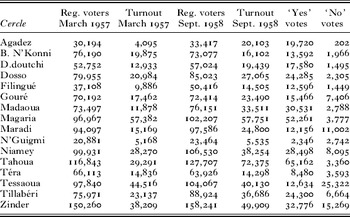
Did all this affect polling? That the low turnout pointed to the freedom of people to stay away is a perverse argument, and Colombani's explanation that it was caused by harvest time is unconvincing. It is unthinkable that the administration would not have ordered people to stop work, as was customary.Footnote 95 Turnout rates were traditionally low, yet it is more than probable that many people voted with their feet to avoid a confrontation at the ballot box. This becomes certain when looking at turnouts by constituency. Djibo demonstratedFootnote 96 that all regions committed to the RDA, or where Sawabists had defected or people worried about independence – as in the nomadic zones – produced inflated turnouts and figures of registered voters, sometimes to fantastic extents. The Agadez and Tahoua regions yielded, as Colombani boasted, such ‘astonishing proportions’ of ‘Yes’ voters that they flatly contradicted demographic data (Table 1).Footnote 97 Together with four other cercles where chiefs were still influential or Sawaba suffered major defections, registered voters there rose comparably and turnout increased by an absurd 108,000.Footnote 98 Voters' roll and turnout also rose sharply in the five predominantly RDA cercles of the west.Footnote 99 This contrasted with constituencies where Sawaba had solid followings, where few defections took place or where defecting politicians carried little weight.Footnote 100 Here, voters' rolls and turnouts declined or stagnated. In other words, districts attached to Sawaba were deprived of voters, while those predicted to go to ‘Yes’ gained new ones, in extravagant numbers. Cercles with the lowest turnouts generally delivered considerable gains for ‘No’, while those with the highest were regions where ‘Yes’ predominated. This means that potential ‘No’ voters were disenfranchised on a massive scale, by not getting registered, by not reaching the polling booth or by the disappearance of bulletins.Footnote 101 That the high turnout in pastoral communities went unexplainedFootnote 102 pointed to the trick the administration played: the decline of ‘No’ voters engineered elsewhere was matched by inflation of registered and participating (would-be) voters in constituencies that were loyal to the RDA or had seen interference and, hence, stood a chance of voting ‘Yes’. This provided the collated result with a plausible gloss.
Registered voters, turnouts and results of the referendum in Niger
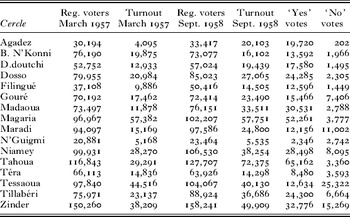
Sources: Consultation du Peuple français par voie de référendum; Djibo, Les transformations, 125–6.
Notes:
a For purposes of comparison, figures pertaining to March 1957 (previous general elections) are included.
b ‘Yes’ and ‘No’ votes taken together need not match turnouts in view of invalid votes.
c Grand totals are not given as they did not tally because of the cavalier manner in which the results were published.
The ‘Yes’ majority thus produced had an artificial character, as did the ‘No’ reported shortfall of c. 270,000, skilfully hidden in a range of figures. This is not to say that Sawaba actually won, since without BNA support the UDN fraction did not have a majority. Yet the results constituted a sudden change compared to the 1957 elections and French assessments of August–September 1958. This reflected the near-total control that the administration, Africanized in a limited way, exercised over campaigning, voting, counting and collating results. Sawaba monitors everywhere were chased from polling stations,Footnote 103 except in Tessaoua where ‘No’ came out on top.Footnote 104 The referendum thus formed part of an older tradition of manipulation, not just in Niger and other territories but also in the metropole itself, where in the nineteenth and early twentieth centuries tampering with the processing of electoral results was quite commonplace.Footnote 105 Later RDA testimonies confirmed that the real results did not matter, as it was decided beforehand that ‘Yes’ would win. Three days before the announcement of the official results, Messmer telegraphed to Paris that Bakary had lost and ‘[could] no more remain in office’.Footnote 106
DECEIT, DISSOLUTION, DEMISE
While Bakary was not required to resign since this was not a parliamentary election, there is reason to believe that the French desire to see his ruin extended to Sawaba as a whole.Footnote 107 A movement that had the audacity to stand up against the metropole had to go, particularly in view of Niger's strategic position and the fact that France had already had to stomach the loss of Guinea. Hence, after the referendum, complaints about harassment continued.Footnote 108 Messmer engaged in a series of manoeuvres with West African leaders, leading Bakary to tender his resignation on 19 October. Reflecting the absence of constitutional rule, he did so to Colombani rather than the Territorial Assembly, as he should have, on the understanding that a government of national unity be formed and that Sawaba appoint his successor. Messmer later flatly denied such an accordFootnote 109 and reminisced that Colombani, who feigned neutrality, encouraged MPs to hand in their resignation so as to renew the Assembly through elections.Footnote 110
Messmer was in some haste as he wanted a non-Sawaba dominated Assembly to participate in de Gaulle's election to the Fifth Republic's presidency on 21 December. Since a delay of one month was required between Assembly dissolution and elections, Colombani had to act before the third week of November. After a precipitate announcement of a majority in favour of dissolution,Footnote 111 a fortnight of intrigues enabled him to deliver his superiors a list of just more than thirty names on an Assembly of sixty. Several MPs appeared to have been pushed, bought or tricked.Footnote 112 Contrary to regulations, resignation letters were not addressed to the Assembly chairman but to Colombani, who sent them to Paris on 13 November. The next day, the metropolitan government dissolved Niger's parliament and announced elections for 14 December. That same afternoon the resignation letters arrived at the Assembly. Its chairman had not been forewarned,Footnote 113 nor the Permanent Committee, one of whose members, Ousmane Dan Galadima, was still in jail anyway. The fact that logistical preparations had begun on 7 November puts the fait accompli in perspective.Footnote 114
As we now have at our disposal the mission papers of Pinassaud,Footnote 115 a metropolitan inspector sent to monitor the polls, it is possible to present an alternative view of the December 1958 elections. Instead of peaceful, they show that the campaign was the most violent in Niger's short electoral history, probably because – with French aid – the RDA saw a possibility for victory and revenge for the defeat it had suffered in the riots of the previous April. Sawaba, moreover, was fighting a battle for survival. Administrative involvement on the RDA's behalf made canvassing difficult as the ban on public meetings enacted in September was enforced in a partisan way.Footnote 116 That the governor ordered subordinates to maintain neutrality was meant for public consumption and to conceal administrative involvement. Colonial officers needed little encouragement to pester a nationalist movement that had always lambasted them, thus enabling Colombani to stand back and only curb the over-eager. At a distance, Jacques Soustelle, metropolitan minister, hardline opponent of colonial withdrawal and soon to be responsible for the OCRS, gave his blessing by warning that France would follow the campaign ‘with particular vigilance’.Footnote 117
Sawaba regularly protested against campaign conditions.Footnote 118 While the French argued that this was to build up a contentious case file, protests were consistent and repetitive, thus rendering them convincing as far as the overall picture was concerned.Footnote 119 Harassment included arrests and interrogations; transfers to remote outposts; obstruction of vehicles; and blockades of towns and villages. Chiefs canvassed actively for the RDA, as did officials, who disguised involvement under the pretext of administrative tours.Footnote 120 Under these conditions Sawaba meetings could be interfered with at will. Consequently, numerous scuffles broke out between Sawabists, RDA supporters and police. Particularly the Maradi region – but also places like Tessaoua, Miria and Zinder – became the scene of vicious street battles. Dozens of people were wounded, party vehicles were forced off the road, windows smashed, and speeches at markets shouted down. Some incidents were serious enough for Colombani to admonish subordinatesFootnote 121 for a breakdown of order. Against this background, Sawaba's leaders went canvassing while carrying automatic pistols in their pockets.Footnote 122
The turnout was the lowest ever: 24·8 per cent. While the French attributed this to agricultural duties, in all probability it was the generalized state of constraint that put voters off. The political climate, for a second time, drove home a message that there was no real choice. The military, chiefs and their auxiliaries exercised firm control over the voting process, while assessors of voting procedure were generally chosen from among the chiefs, including members of the RDA. Sawaba was obliterated. That it still won Tessaoua and Zinder could hardly corroborate the view that the election was not too fraudulent. In Zinder the administration relied on the sultan, underestimating the importance of local small folk.Footnote 123 In Tessaoua the commandant de cercle had been replaced to prevent a repetition of the ‘Yes’ defeat. His successor invalidated the results of three polling stations and declared RDA candidates elected with a narrow margin. This so manifestly contradicted reality that Léopold Senghor sent a protest to Paris. When Colombani inquired about the annulment, the commandant de cercle did not bother to explain but changed the tally and declared Sawaba elected.Footnote 124 This cavalier treatment constituted a Pyrrhic victory. Repression of cadres continued, culminating in 1959 in the cancellation of the election results for Tessaoua and Zinder, the eviction of Sawaba's MPs and the outlawing of the party.
CONCLUSIONS
By the early 1970s the referendum was still too sensitive an issue to be discussed openly,Footnote 125 as the RDA, lifted into the saddle in the wake of it, owed its ascendancy to the plebiscite while Sawaba's followers lingered in the wilderness after their guerrilla campaign to win back power (1961–6) had failed. Even by the beginning of the new millennium, the referendum still constituted an obsession amongst its erstwhile supporters.Footnote 126 The interpretation of the 1958 plebiscite was no harmless matter, as it interlocked with radically different historical trajectories that amounted to a position at the helm of a one-party state for one group and unrelenting persecution from the time of Colombani's coup d'état for the other – including incarceration, maltreatment and torture, accompanied by a yearning for deliverance that would never come.Footnote 127
Far from lighthanded, the conduct of the referendum in Niger was unique in AOF for its brutality. In one way this makes the case anomalous since, while the writings of Ousmane Sembene and Ahmadou Dicko demonstrate that intimidation and fear characterized the situation for ‘No’ campaigners elsewhere, in all other territories except Guinea the plebiscite was marked by a hegemonic supremacy of ‘Yes’ that made more brutal measures against recalcitrants unnecessary.Footnote 128 But this also shows, as Chafer has noted,Footnote 129 how far the French were prepared to go in stifling more militant representations of nationalist forces in favour of a doctored form of decolonization later on. It is here that the Niger case sets the transitions in French Africa in 1960 in a wider perspective. This is not to say, as Cooper has observed,Footnote 130 that the assumption of formal independence in that year did not matter; it did so even in Niger, where the French were to retain a disproportionate degree of influence. Yet, as Jacques Foccart remarked in another bout of cynicism, for Niger this constituted not a difference of two years but one of ‘centuries’.Footnote 131
This alluded indirectly to the violence of the intrusion in Niger in the wake of the referendum, involving deliberate metropolitan assistance – before and after independence – in the annihilation of what represented the country's only modern social movement. This was to have a profound influence on the course of Niger's history during the 1960s and 1970s, since, as a political formation with specific social roots, Sawaba did not acquiesce in a transformation of the empire that left segments such as the ‘petit peuple’ and related strata marginalized, especially as unremitting repression bred new adherents. There are parallels here with the late colonial and postcolonial histories of Cameroon and Madagascar, as well as Britain's repression of Mau Mau.Footnote 132 But in the context of the referendum the parallel with metropolitan retaliation against Guinea is closer.Footnote 133 From what we now know through Schmidt's study of the nationalist movement there, it would have been difficult for Touré, let alone the French, to mobilize the country for ‘Yes’. Coupled to the mass base of the ruling party the other factors contributing to Guinea's ability to leave the French fold were its abolition of chieftaincy, the Africanization of the administration and the country's lesser strategic importance.
While these three factors account for Niger's different trajectory, the cause for its anomalous record in the referendum must be sought in its nationalist movement. This article analysed the referendum stance from the perspective of the nature of Sawaba, benefiting from insights that social history has yielded with regard to grassroots forces in the nationalist movements of the 1950s,Footnote 134 the opening of colonial archives and memoirs of French officials.Footnote 135 Where earlier studies held that Niger had no nationalist movement,Footnote 136 it can be safely concluded that, after the destruction of the RDA as a nationwide party in the early 1950s, such a movement was developing around the UDN/Sawaba. With its core of semi-urbanized little folk it grew into an effective political force that made rapid headway among the rural populace, assisted by its programme of social upliftment that earned it its honorary title ‘Sawaba’ – as a pointer to its embodiment of the popular yearning for deliverance. This provided a measure of idealism that played an important part in the decision to opt for independence. However, having at its heart a determined group of semi-urbanized ‘petit peuple’ and associated strata, with one foot in the Marxist-inspired union world, Sawaba, instead of absorbing and neutralising the radical undercurrents of nationalist passion, gave them free rein. As in Guinea, leadership and rank and file were tied in a mutual balancing act, influencing each other on the basis of a common bond of aspirations. By going for independence, Bakary enhanced his prestige but also strengthened the position of the hardliners. One could argue that his inability to resist the pressures of his followers pointed to a structural weakness of the party, but such a top-down observation misses the point that the strength of some of the nationalist movements of the 1950s lay precisely in the participation of grassroots groups.Footnote 137
Until August 1958 Sawaba, instead of weakening, was growing in strength in the wake of the showdown with the RDA in the riots of April that year. This encouraged it to reject the constitution and helps to explain why Bakary underestimated the metropolitan forces pitted against him. In contrast to the situation in Guinea, Colombani's intrusion uprooted a governing coalition that left Bakary with his minority UDN core. The referendum results as such bore little significance since the ‘Yes’ victory was preordained. Thus, as Mamoudou Djibo argued – contradicting Virginia Thompson –Footnote 138 instead of to the chiefs, it is to the French, who mobilized the chiefs to help subvert the referendum, that the defeat of ‘No’ and Sawaba's fall must be attributed. The movement's repression, rather than an outcome, was an integral part of the decline in Bakary's fortunes, following Colombani's coup d'état and continuing unabated into the 1960s.
Research on Sawaba's rebellion shows that its persecution, involving close collaboration between the RDA regime and officers of the French intelligence community, provided the building blocks for a dictatorship that would rule Niger for 15 years and whose institutional dimensions, like the SÛreté and the Bureau de Coordination et de Liaison, reinforced the military regime following it. Hence, the long-term consequences of the metropole's 1958 intervention were profound and underscore the need for new research into how African and metropolitan trajectories intertwined to produce the transformations of the independence era.