Introduction
Coronary artery bypass grafting is the most frequent cardiovascular surgery performed worldwide, with almost 400,000 cases/year Reference Bachar and Manna1 representing over 70% Reference Bolotin, Medalion, Ghandakly, Iacona and Bakaeen2 of all cardiac surgeries. The procedure is indicated for multivessel coronary artery disease, usually caused by atherosclerosis. However, in the paediatric population, the indications for coronary artery bypass grafting are different and infrequent. Main indications are Kawasaki disease, intraoperative iatrogenic coronary injury, and late post-operative coronary occlusion (i.e. h/o arterial switch). Reference Komarov, Ismailbaev and Chragyan3,Reference Kitamura4 The literature shows that paediatric coronary artery bypass grafting (sometimes referred as Kitamura procedure) is safe with good short- and long-term outcomes, and since it is not a frequent procedure, the success lies in a heart team with surgeons with extensive experience and expertise in coronary artery bypass grafting. Reference Arnaz, Sarioglu and Yalcinbas5 We present a case series of paediatric coronary artery bypass grafting in a middle-income country.
Materials and methods
A descriptive analysis was conducted on paediatric patients who underwent coronary artery bypass grafting, with paediatric status defined as individuals under 18 years of age, in accordance with the World Health Organization criteria and Colombian regulations, specifically the Code of Childhood and Adolescence (Law 1098 of 2006). Medical records were reviewed at a cardiovascular centre in Bogotá, Colombia, covering the period from 2004 to 2023. Clinical data were extracted from electronic records, including demographic characteristics, preoperative diagnoses, surgical details, and post-operative studies and outcomes, always with the protection of patient confidentiality. All pre- and post-operative imaging studies were re-evaluated for the purposes of this analysis.
The data were analysed using descriptive analytics, and categorical variables were presented as percentages.
Individual consent was not obtained from patients enrolled in this study because patients are not identified. The Institutional Research Ethics Board approved the study (CEIC–135-2025), which was carried out within ethical norms and under the precepts of Resolution 8430 of 1993 of the Ministry of Health of the Republic of Colombia, and it was classified as a no-risk study. The authors guarantee the confidentiality of all the data used in this study.
Results
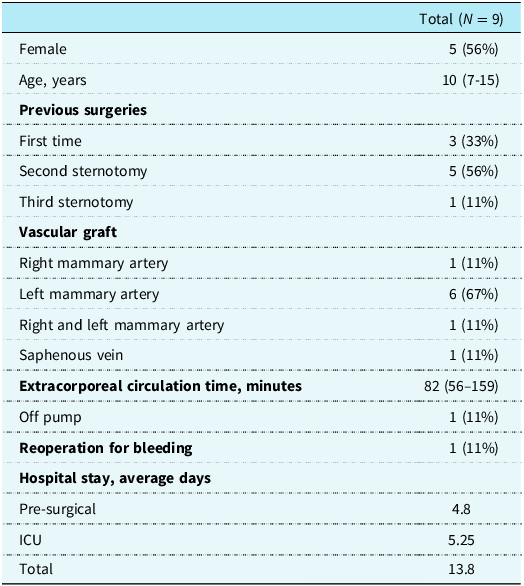
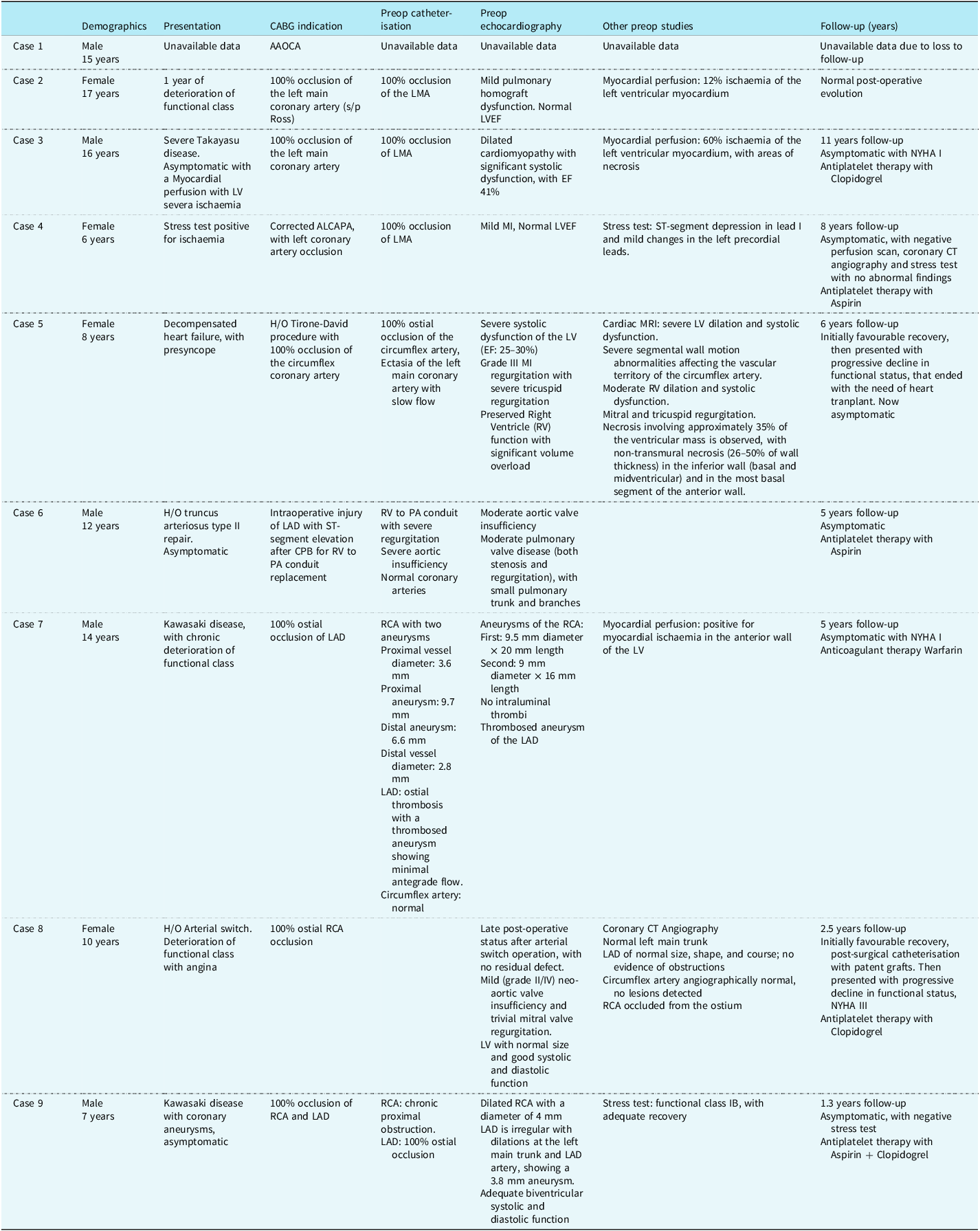
All paediatric patients, defined as individuals under 18 years of age, who underwent surgical revascularisation were included in the study. A total of nine patients met these criteria, aged between 6 and 17 years; most of them were female (56%). The most common underlying diagnosis was Kawasaki Disease in 3 cases (33%), followed by coronary occlusion secondary to arterial switch procedure. Other diagnoses include anomalous origin of the Left Coronary Artery (LCA) from the pulmonary artery (11%), anomalous origin of coronary arteries from the aorta (11%), Takayasu disease (11%), and iatrogenic injury (11%), as shown in Table 1.
Coronary artery bypass graft patient characteristics

Data are presented as number with percented or median with percentile 25 to percentile 75.
Of the nine patients included, seven were under follow-up by paediatric cardiology or heart failure services. In these cases, either cardiovascular symptoms were identified during outpatient visits, or patients were asymptomatic but presented with an abnormal finding on routine follow-up imaging. These findings prompted further evaluation, ultimately revealing the need for surgical intervention. The specific presentation of each patient is detailed in Table 2.
Indication and follow-up of patients receiving CABG

Arterial grafts, primarily the internal mammary artery, were used as the first-choice option in nearly all cases. The left internal mammary artery was the most commonly used, employed in six patients (67%), followed by the right internal mammary artery and bilateral mammary arteries. A saphenous vein graft was used in only one patient (11%), in whom revascularisation was required due to an intraoperative injury.
The mammary artery was harvested using a skeletonised technique to maximise its length, preserve sternal perfusion, and decrease the risk of mediastinitis. The artery was mobilised with low electrocautery settings to minimise thermal injury, with careful dissection along its course. Distal anastomosis was performed using 7–0 or 8–0 Prolene sutures, depending on the vessel size, with a running suture technique, which provides reduced anastomotic time and ensures a smooth luminal surface.
The median bypass time was 82 minutes, with a range of 56–159 minutes, and the median stay in the ICU was 5.25 days. One-third of the cases were a first-time surgery, 56% a first redo surgery, and in one case, it was a fourth sternotomy.
Two of the cases were combined interventions: one included mitral valve replacement and tricuspid repair; another included truncal valve repair (patient with h/o Truncus repair) with replacement of an RV to PA conduit.
There were no mortalities, and all patients experienced an uneventful postoperative recovery. In 100% of cases, the preoperative revascularisation plan was successfully completed, with an average hospital stay of 13.8 days. No immediate reinterventions were necessary. However, one patient, despite an initially favourable recovery and discharge without complications, returned two months later with a progressive decline in functional status, ultimately requiring heart transplantation. The post-operative course following transplantation was favourable, resulting in sustained clinical improvement.
In all patients, an antiplatelet regimen with aspirin and Clopidogrel was initiated in the immediate post-operative period once bleeding risk was deemed to be under control. All patients had indication for long-term anticoagulation, and once the anticoagulant was initiated, the aspirin was suspended and Clopidogrel was maintained for at least 1 year.
Although Colombia’s social and demographic context, along with the structure of its healthcare system, presents challenges to long-term follow-up, all patients in this series were evaluated post-operatively in outpatient clinic visits. As recommended by current guidelines, follow-up included both clinical assessment and imaging with echocardiography, which demonstrated improvement in functional class and a significant enhancement in biventricular function. In addition, telephone follow-up was successfully achieved for eight patients, with an average follow-up duration of 5.5 (1.3–11) years as previously mentioned.
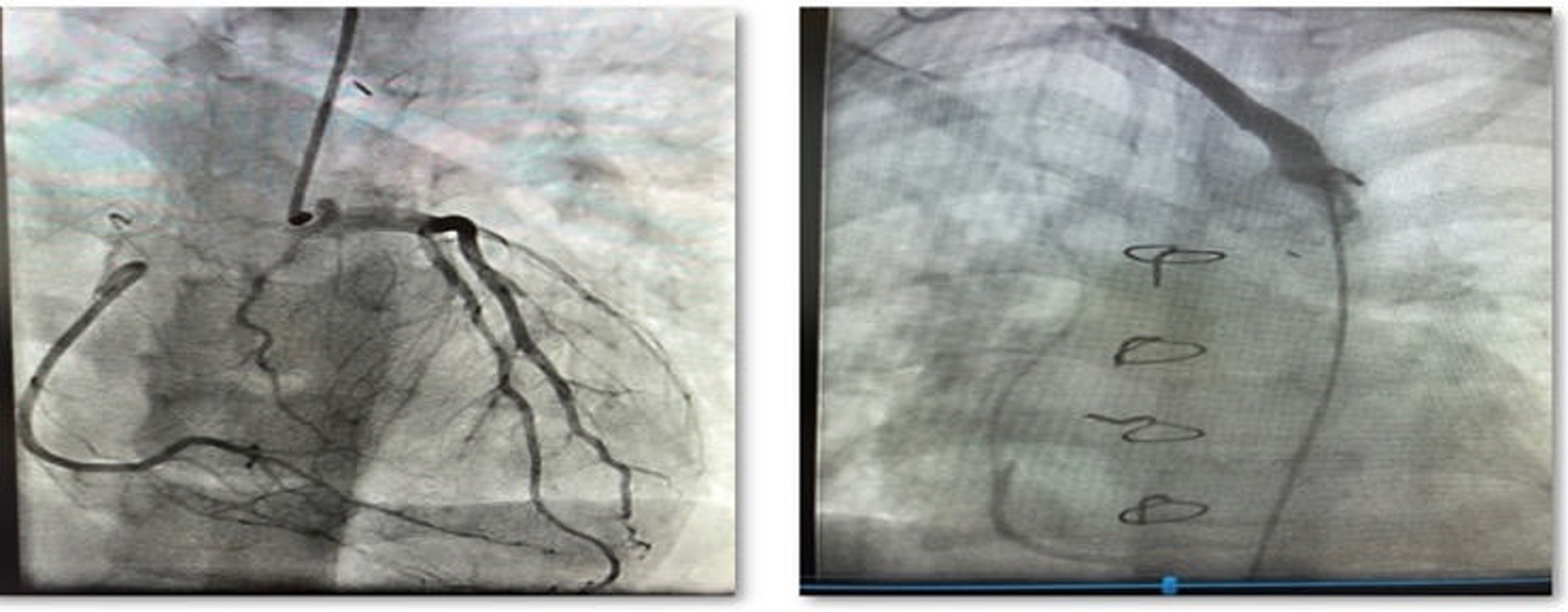
Post-operative coronary catheterisation was performed only in one patient indicated due to a decline in functional status five months after surgery; coronary angiography (Figure 1) was performed and demonstrated patent grafts with normal function and adequate flow. Another patient, whose follow-up is extra-institutional, a coronary artery angiography was requested, with adequate patency of the graft.
Post-operative angiographic image showing a successful coronary artery bypass grafting, using the right internal mammary artery (RIMA) on the right coronary artery in a 10-year-old with transposition of the great arteries, with subsequent intervention for mitral and aortic repair.

We report our experience in a middle-income country with 9 patients, a five-year follow-up, and no mortality. Imaging was requested in two cases, with 100% graft patency.
Discussion
Before 1970, paediatric coronary artery bypass grafting was seldom done due to a lack of indications; however, the ascending mortality rate, mainly in Japan, due to coronary complications secondary to Kawasaki disease, led to the development and growth of strategies of myocardial revascularisation in children.
Even though Kawasaki disease is the main cause of acquired coronary abnormality in children, in addition to being the most dangerous complication of this disease, Reference Kitamura4 it is not the only indication for paediatric coronary artery bypass grafting and nowadays the surgical necessity for coronary intervention in this age group is quite broad, either due to congenital or acquired causes.
There are few large studies in the literature with concise results on this topic. Kitamura et al. reported excellent long-term outcomes in paediatric patients with Kawasaki disease undergoing coronary artery bypass grafting, with Internal Thoracic Artery (ITA) being the most favourable graft for this population. Reference Kitamura, Tsuda and Kobayashi6 The European multicenter study by Vida et al. evaluates the hospital and medium-term results of different revascularisation techniques in paediatric patients. This study highlights that both paediatric coronary bypass and other coronary procedures are viable surgical options, and that a lifelong follow-up is needed to prevent and treat any further coronary/myocardial complications. Reference Vida, Torregrossa and De Franceschi7 Thammineni et al. provide data on coronary revascularisation in children with CHD in a multicenter retrospective review, indicating that long-term outcomes are acceptable, but they include coronary artery bypass grafting and non-coronary artery bypass grafting procedures. In their coronary artery bypass grafting cohort of 72 patients in 30 years, the early mortality was 18%, especially in the urgent rescue cases.8 In any case, long-term outcomes are mainly documented in patients with Kawasaki disease, with a 10-year survival rate of 98% and a 25-year survival rate of 95%. Reference Vida, Torregrossa and De Franceschi7
Among the CHD that may require coronary intervention are anomalous origin of the LCA from the pulmonary artery, congenital ostial stenosis or atresia, and anomalous origin of coronary arteries from aorta or supravalvular aortic stenosis. On the other hand, the most frequent acquired clinical scenarios can be Kawasaki disease, familial hypercholesterolaemia or coronary occlusion late after arterial switch operations, Ross procedure or correcting of Tetralogy of Fallot, where it is usually indicated as a salvage or rescue procedure.3 In our series, we found one case of coronary artery bypass grafting to repair a congenital disease, the rest of the cases were due to acquired coronary lesions (five late post-operative coronary occlusion).
The age of the patient, the affected coronary artery, and the location and type of the lesion must be taken into consideration when choosing the graft. In general, the internal thoracic artery is the recommended conduit for coronary intervention in children, is considered to be superior to the saphenous vein mainly due to its physiological characteristics that allow somatic growth and a long-term patency, which has been reported at 87% at 20 years, while the saphenous graft patency is around 44%. Reference Das and Narayan9 Given its limited long-term patency and lack of growth potential, we believe that the saphenous vein graft should be reserved for specific indications: as a complementary conduit in multivessel disease when internal mammary arteries are unavailable; when patient-specific anatomical factors render their use technically challenging or unfeasible; or in cases of low-grade stenosis (< 80% diameter) where competitive flow might jeopardise Internal mammary artery (IMA) flow. Reference Kitamura4,Reference Arnaz, Sarioglu and Yalcinbas5 Moreover, in emergency or salvage settings, such as perioperative complications following other cardiac procedures, the saphenous vein remains a practical option due to its immediate availability and ease of harvest. Reference Arnaz, Sarioglu and Yalcinbas5 When employed, the graft should be obtained with sufficient length and positioned meticulously to prevent kinking. Reference Das and Narayan9 Long-term outcomes are mainly documented in patients with Kawasaki disease, with a 10-year survival rate of 98% and a 25-year survival rate of 95%. Reference Vida, Torregrossa and De Franceschi7
Although paediatric-specific guidelines remain limited, certain management strategies may be adapted from adult protocols with appropriate modifications. However, children require a highly individualised approach that accounts for their distinct physiological characteristics and clinical contexts. In this setting, meticulous post-operative follow-up is essential to assess recovery and to prevent or promptly detect complications. Routine clinical and echocardiographic evaluation before hospital discharge is recommended, with particular focus on biventricular function.10
Antiplatelet therapy in paediatric patients remains a complex and less standardised domain, largely due to the rarity of cases and the heterogeneity of underlying conditions.11 As in adults, aspirin/Clopidogrel is routinely employed to prevent early graft thrombosis; however, dosing and treatment duration may vary, and clinicians must remain vigilant for the rare but serious risk of Reye’s syndrome. Reference Baumann Kreuziger, Karkouti, Tweddell and Massicotte12 In contrast, evidence supporting dual antiplatelet therapy in children is limited, and its use should be individualised, weighing the underlying pathology against the potential risks and benefits. Reference Lawton, Tamis-Holland and Bangalore11,Reference Baumann Kreuziger, Karkouti, Tweddell and Massicotte12 If there is another indication for anticoagulation, aspirin should be stopped because of a higher risk of bleeding complications.
In our study, we report that myocardial revascularisation in paediatric patients, even in cases involving complex or rare coronary artery conditions, can lead to favourable clinical outcomes with high rates of surgical success and no observed mortality. Despite the challenges posed by diverse underlying diagnoses, all patients experienced satisfactory recoveries with minimal post-operative complications, which were limited and manageable. The use of internal mammary artery grafts was predominant, contributing to effective myocardial perfusion, as evidenced by improved echocardiographic findings and preserved ventricular function, as evaluated prior to discharge in every case. Our findings support the efficacy and safety of paediatric coronary artery bypass grafting, while highlighting areas for further research, such as imaging follow-up and antiplatelet therapy for this age group, to optimise outcomes for patients with more complex surgical histories or associated comorbidities. We report our experience in a middle-income country with 9 patients. During follow-up, only two patients needed imaging of the bypass with 100% patency 5 years postop and no mortality.
Conclusion
Coronary artery disease is a condition that is not always easy to diagnose in children; so, a high degree of suspicion is required, and for its treatment, paediatric coronary artery bypass grafting is a suitable surgical option. This study contributes to the growing body of evidence supporting the effectiveness and safety of paediatric coronary artery bypass grafting as a treatment for both congenital and acquired coronary abnormalities.
The discussion about the type of grafts used for coronary artery bypass grafting has been an ongoing debate in the adult population, but the position in paediatric patients is clear, with the use of unilateral or bilateral ITA being the standard procedure, creating a new surgical arena in cardiac surgery. Therefore, we think that paediatric coronary artery bypass grafting should represent a fundamental part of the training of contemporary congenital heart surgeons. Our findings align with existing literature, emphasising the superiority of using the internal thoracic artery as the preferred conduit.
Clinical and imaging follow-up after surgical myocardial revascularisation is essential to assess patient recovery and prevent adverse events. In addition, antiaggregation therapy should be initiated in the immediate post-operative period, and indefinite anticoagulant therapy should be individualised to reduce adverse cardiovascular events.
The results in terms of short and long-term outcomes are favourable but it must involve an experienced surgeon in coronary artery bypass grafting and a complete heart team.
Acknowledgements
None.
Financial support
None.
Competing interests
The author(s) declare none.