





Introduction
Orientable cohomology theories in algebraic geometry
In algebraic geometry a cohomology theory can be said to be orientable if it can be endowed with a suitable notion of push-forward maps for projective morphisms. For example, push-forward maps in Chow groups can be defined using the direct image of cycles, in K-theory of smooth varieties one can define push-forward maps using the right derived functor of the push-forward of coherent sheaves, and in Weil-type cohomology theories, e.g. étale cohomology, push-forward maps can be described using Poincare duality.
It was observed by Panin and Smirnov [Reference Panin and SmirnovPS00] that the orientation can also be given by the structure of Chern classes of line bundles satisfying certain axioms. As the projective bundle theorem is usually contained in the axioms of these cohomology theories, one can define higher Chern classes by the classical method of Grothendieck. Moreover, one could say that an orientable theory is a cohomology theory which can be endowed with a suitable notion of Chern classes. A possibility to be oriented then leads to the computation of the ring of operations from
$\mathrm {K}_0$
 to many cohomology theories (e.g. for free theories, see below), which is freely generated by Chern classes.
Altogether these observations confirm a distinguished role of K-theory with respect to orientation. The scope of this paper is a search for a different notion of orientability where the distinguished role is played by Morava K-theories
$\mathrm {K}(n)_{int}^*$
 instead of
$\mathrm {K}_0$
 . To introduce
$\mathrm {K}(n)_{int}^*$
 let us recall how one can construct oriented cohomology theories in algebraic geometry.
There exists the universal oriented cohomology theory
$\Omega ^*$
 which is called algebraic cobordism of Levine-Morel [Reference Levine and MorelLM07]. The universality has the following meaning here: for every oriented theory
$A^*$
 there exists a unique morphism of presheaves of rings from
$\Omega ^*$
 to
$A^*$
 which respects both push-forward and pullback maps.
Another universal property of algebraic cobordism permits to introduce many new cohomology theories. The ring of coefficients of
$\Omega ^*$
 , at least over fields of zero characteristic, is isomorphic to the Lazard ring classifying formal group laws. For any formal group law
$F_R$
 over a commutative ring
$R$
 the presheaf of rings
$\Omega ^* \otimes _{\mathbb {L}} R$
 is an oriented cohomology theory, called a free theory, where the map
$\mathbb {L}\rightarrow R$
 corresponds to
$F_R$
 . Well-known examples of free theories are Chow groups and K-theory
$\mathrm {K}_0$
 obtained via the additive and the multiplicative formal group laws over
$\mathbb {Z}$
 , respectively.
Morava K-theories
If one takes
$R$
 to be
$\mathbb {Z}_{(p)}$
 where
$p$
 is a prime number, and chooses a formal group law over
$\mathbb {Z}_{(p)}$
 with the logarithm of the form
$\log _{\mathrm {K}(n)_{int}}(x) = x+\frac {a_1}{p}x^{p^n}+\frac {a_2}{p^2}x^{p^{2n}}+\ldots $
 , where
$a_1\in \mathbb {Z}_{(p)}^\times $
 , then the corresponding free theory
$\mathrm {K}(n)_{int}^*$
 is called an
$n$
 -th algebraic Morava K-theory. In a special case
$n=1$
 and
$\log _{\mathrm {K}(1)_{int}}(x)=\sum _{i\ge 0} \frac {1}{p^i}x^{p^i}$
 the free theory
$\mathrm {K}(1)^*_{int}$
 is isomorphic to
$\mathrm {K}_0\otimes \mathbb {Z}_{(p)}$
 as a presheaf of rings. It seems that this isomorphism was the main motivation for topologists to call such cohomology theories similarly: Morava K-theories.
The definition of Morava K-theories given above is quite ad hoc and demands some explanations, which we adopt from topology. Algebraic cobordism
$\Omega ^*$
 of a smooth variety together with Landweber-Novikov operations on it defines a quasi-coherent sheaf on the moduli stack of formal groups (see e.g. [Reference SechinS18b, Prop. 2.10]). This stack has a particularly nice description after base change to
$\mathbb {F}_{p}$
 : there exists a decreasing filtration by closed substacks
$\mathcal {M}_{fg}^{\ge n}$
 which classify formal group laws of height not less than
$n$
 , and
$\mathcal {M}_{fg}^{\ge n+1}$
 is a Cartier divisor in
$\mathcal {M}_{fg}^{\ge n}$
 . Moreover,
$\mathcal {M}_{fg}^{\ge n} \setminus \mathcal {M}_{fg}^{\ge n+1}$
 has an essentially unique geometric point.
Formal group laws yield free theories as explained above, and isomorphic formal group laws yield multiplicatively isomorphic free theories. Thus, a field-valued point of the stack of formal groups defines a free theory as a presheaf of rings (but the orientation on it can be chosen differently). Morava K-theories
$\mathrm {K}(n)_{int}^*/p$
 , as defined above, are those free theories that correspond to some of the
$\mathbb {F}_{p}$
 -points of
$\mathcal {M}_{fg}^{\ge n} \setminus \mathcal {M}_{fg}^{\ge n+1}$
 , but these theories become multiplicatively isomorphic with
$\overline {\mathbb {F}_{p}}$
 -coefficients. Thus Morava K-theories exhaust all free theories with
$\mathbb {F}_{p}$
 -coefficients except for the geometric point ‘at infinity’, i.e. in the intersection of all substacks
$\mathcal {M}_{fg}^{\ge n}$
 ,
$n\ge 1$
 . This point corresponds to Chow groups modulo
$p$
 , sometimes called the infinite Morava K-theory.
As the first Morava K-theory is nothing other than K-theory modulo
$p$
 , the ‘chromatic structure’ of the stack
$\mathcal {M}_{fg}$
 places
$\mathrm {K}(n)_{int}^*$
 into an intermediate position between
$\mathrm {K}_0/p$
 and
${\mathrm {CH}}^*/p$
 . This is the underlying reason why Morava K-theories behave in a simpler way than Chow groups, and yet more complicated than
$\mathrm {K}_0$
 . Known instances of this phenomenon are the computation of operations (see theorems below) and some results about motives. For example, if
$X$
 is a projective homogeneous variety such that
$M_{\mathrm {K}(n)_{int}^*}(X)$
 is a Tate motive (here
$M_{\mathrm {K}(n)_{int}^*}$
 is a functor to the category of pure motives corresponding to an oriented theory
$\mathrm {K}(n)_{int}^*$
 ), then
$M_{\mathrm {K}(m)^*_{int}}(X)$
 is also a Tate motive for
$m<n$
 ([Reference Sechin and SemenovSS21, Cor. 7.11]). This result gives rise to an effective ‘linear’ strategy for the study of motives of projective homogeneous varieties that goes from
$\mathrm {K}(1)^*_{int}*$
 (aka
$\mathrm {K}_0$
 ) to
$\mathrm {K}(n)_{int}^*$
 ,
$n>1$
 , and finishes with
${\mathrm {CH}}^*\otimes \mathbb {Z}_{(p)}$
 for every prime
$p$
 .
Even though the results about Morava K-theories
$\mathrm {K}(n)_{int}^*$
 might be interesting by themselves, one also hopes to obtain some information about the more classical theories such as Chow groups with their help. The first step in this direction was made in [Reference SechinS18a] where so-called Chern classes, operations from
$\mathrm {K}(n)_{int}^*$
 to
${\mathrm {CH}}^*\otimes \mathbb {Z}_{(p)}$
 were constructed. These Chern classes are similar to the classical Chern classes from
$\mathrm {K}_0$
 to
${\mathrm {CH}}^*$
 : they are free generators of all operations and satisfy a Cartan-type formula. This result led us to ask the question about the existence of the notion of Morava-orientable theories ([op.cit., Introduction]). The goal of this paper is to construct new Chern classes from
$\mathrm {K}(n)_{int}^*$
 to many other oriented theories and to provide at least a partial answer to the question of orientability. Among these operations, perhaps, the most important are the endo-operations of
$\mathrm {K}(n)_{int}^*$
 which give rise to the gamma filtration on
$\mathrm {K}(n)_{int}^*$
 and provide a tool to calculate Chern classes from
$\mathrm {K}(n)_{int}^*$
 to
${\mathrm {CH}}^*\otimes \mathbb {Z}_{(p)}$
 for certain varieties.
Results of the paper
Morava-orientable theories and Chern classes
We start with the description of the results of the paper with the following definition generalizing Cartier’s
$p$
 -typical formal group laws.
Definition (for the full definition encompassing the torsion case see Section 3.1, cf. the notion of formal
$A$
 -module [Reference HazewinkelHa78, Ch. 21])

Let
$A$
 be a torsion-free
$\mathbb {Z}_{(p)}$
 -algebra. A formal group law
$F$
 over
$A$
 is called
$p^n$
 -typical if its logarithm is of the form
$\log _F(x) = \sum _{i\ge 0} l_i x^{p^{ni}}$
 where
$l_i \in A\otimes _{\mathbb {Z}} \mathbb {Q}$
 .
A free theory is called
$p^n$
 -typical if the corresponding formal group law is
$p^n$
 -typical.
The main result of this paper is the following.
Theorem (Theorem 3.17; if
$A^*={\mathrm {CH}}^*\otimes \mathbb {Z}_{(p)}$
this is [Reference SechinS18a, Th. 4.2.1])

For every Morava K-theory
$\mathrm {K}(n)_{int}^*$
 and every
$p^n$
 -typical theory
$A^*$
 there exists a series of operations
$c_j\colon \mathrm {K}(n)_{int}^*\rightarrow A^*$
 for
$j\ge 1$
 satisfying the following conditions.
-
i) The operation $c_j$
takes values in
$\tau ^jA^*$
, where
$\tau ^\bullet $
is the topological filtration on
$A^*$
. -
ii) Denote by $c_{tot} = \sum _{i\ge 1} c_it^i$
the total Chern class in a formal variable
$t$
. Then the Cartan formula holds universally: $$ \begin{align*}c_{tot}(x+y)=F_{\mathrm{K}(n)_{int}}(c_{tot}(x),c_{tot}(y)),\end{align*} $$
where $x,y\in \mathrm {K}(n)_{int}^*(X)$
for a smooth variety
$X$
and the identity takes place in
$A^*(X)[[t]]$
; -
iii) If $A=A^*({\mathrm {Spec}} k)$
is a free
$\mathbb {Z}_{(p)}$
-module, then all operations from
$\mathrm {K}(n)_{int}^*$
to
$A^*$
are uniquely expressible as series in Chern classes: $$ \begin{align*}[\tau^1 \mathrm{K}(n)_{int}^*, A^*] = A[[c_1,\ldots, c_i,\ldots ]],\end{align*} $$
where $\mathrm {K}(n)_{int}^*=\mathbb {Z}_{(p)}\oplus \tau ^1 \mathrm {K}(n)_{int}^*$
as presheaves of abelian groups, and
$[\mathcal {F},\mathcal {G}]$
denotes the set of natural transformations of presheaves of sets
$\mathcal {F}, \mathcal {G}$
on the category of smooth varieties.


Examples of
$p^n$
 -typical theories include Morava K-theories
$\mathrm {K}(mn)^*_{int}$
 for
$m\ge 1$
 , Chow groups
${\mathrm {CH}}^*\otimes \mathbb {Z}_{(p)}$
 and the universal
$p^n$
 -typical theory
$BP\{n\}^*$
 whose ring of coefficients is a polynomial algebra
$\mathbb {Z}_{(p)}[v_n, v_{2n}, \ldots ]$
 . Following an analogy with K-theory
$p^n$
 -typical theories might be called Morava-orientable even though we do not give any geometric definition of Morava orientation.
We also provide some circumstantial evidence that
$p^n$
 -typical theories are precisely the Morava-oriented theories: if the right notion of Morava-orientability exists, then the intersection of Morava-orientable theories with oriented theories is exactly the set of
$p^n$
 -typical theories (see Appendix B.1). Nevertheless, questions of the existence of Morava-orientable but non-orientable theories and of finding a correct and geometric definition of Morava-oriented theories remain open.
Uniqueness of Morava K-theories
We should also mention that for each prime number
$p$
 and each number
$n\in \mathbb {N}$
 the definition of Morava K-theory above yields infinitely many oriented theories
$\mathrm {K}(n)_{int}^*$
 . It is not true that all of them are multiplicatively isomorphic (Appendix B.2), however we can prove the following.
Theorem (Theorem 5.3)
Let
$\mathrm {K}(n)_{int}^*$
 ,
$\overline {\mathrm {K}(n)}_{int}^*$
 be two
$n$
 -th Morava K-theories over
$\mathbb {Z}_{(p)}$
 .
Then there exists an isomorphism of presheaves of abelian groups
$\mathrm {K}(n)_{int}^*\xrightarrow {\sim } \overline {K}(n)^*$
 .
The uniqueness of Morava K-theories is not an issue in topology, where there exists a unique spectrum with
$\mathbb {F}_{p}$
 -coefficients representing the
$n$
 -th topological Morava K-theory. The arguments used there, however, cannot be applied in the algebraic situation, and, moreover, we do not know whether any kind of uniqueness statement for spectra representing Morava K-theories with
$\mathbb {Z}_{(p)}$
 -coefficients is known even in topology. It may be possible, however, to prove a uniqueness result of this kind in the topological setting using the results or the methods of the preprint [Reference Luecke and PetersonLP22].
Gamma filtration on Morava K-theories
The main application of the existence of Chern classes from
$\mathrm {K}(n)_{int}^*$
 in this paper is the construction of the gamma filtration on
$\mathrm {K}(n)_{int}^*$
 .
Definition. Let
$c_i\colon \mathrm {K}(n)_{int}^*\rightarrow \mathrm {K}(n)_{int}^*$
 be Chern classes constructed in the theorem above. Define the gamma filtration on
$\mathrm {K}(n)_{int}^*(X)$
 for a smooth variety
$X$
 by the following formula

where the brackets denote the generation as
$\mathbb {Z}_{(p)}$
 -module.
The gamma filtration satisfies properties similar to those of the classical gamma filtration on
$\mathrm {K}_0$
 which we summarize below. The main difference is that Chern classes from corresponding graded factors on
$\mathrm {K}(n)_{int}^*$
 map surjectively to Chow groups
${\mathrm {CH}}^*\otimes \mathbb {Z}_{(p)}$
 of codimension up to
$p^n$
 (in contrast to up to
$p$
 in the case of
$p$
 -local K-theory).
Theorem (Prop. 3.2)
Denote by
$c_i^{{\mathrm {CH}}}$
 the Chern classes from
$\mathrm {K}(n)_{int}^*$
 to
${\mathrm {CH}}^*\otimes \mathbb {Z}_{(p)}$
 .
The gamma filtration
$\gamma $
 and the topological filtration
$\tau $
 on
$\mathrm {K}(n)_{int}^*$
 satisfy the following properties:
-
i) $\gamma ^i\mathrm {K}(n)_{int}^*\subset \tau ^i\mathrm {K}(n)_{int}^*$
; -
ii) $\gamma ^\bullet \otimes \mathbb {Q} = \tau ^\bullet \otimes \mathbb {Q}$
; -
iii) $c_i^{{\mathrm {CH}}}|_{\tau ^{i+1}\mathrm {K}(n)_{int}^*}=0$
; -
iv) the operation $c^{{\mathrm {CH}}}_i$
is additive when restricted to
$\tau ^i \mathrm {K}(n)_{int}^*$
, and the following maps are isomorphisms of abelian groups: $$ \begin{align*}gr^i_\gamma \mathrm{K}(n)_{int}^*\otimes\mathbb{Q} \rightarrow gr^i_\tau \mathrm{K}(n)_{int}^*\otimes\mathbb{Q} \xrightarrow{c_i^{{\mathrm{CH}}}} {\mathrm{CH}}^i\otimes\mathbb{Q};\end{align*} $$
-
v) $c_i^{{\mathrm {CH}}}\colon gr^i_\tau \mathrm {K}(n)_{int}^*\rightarrow {\mathrm {CH}}^i\otimes \mathbb {Z}_{(p)}$
is an isomorphism for
$i\colon 1\le i \le p^n$
; -
vi) $c_i^{CH}\colon gr^i_\gamma \mathrm {K}(n)_{int}^*\rightarrow {\mathrm {CH}}^i\otimes \mathbb {Z}_{(p)}$
is surjective for
$i\colon 1\le i \le p^n$
.


The property vi) is a new tool for obtaining estimates on the
$p$
 -torsion in Chow groups of codimension up to
$p^n$
 . Even though the problem of calculating
$gr_\gamma ^\bullet \mathrm {K}(n)_{int}^*(X)$
 is not an easy one, we describe now a situation when it can be solved. If
$X$
 is a geometrically cellular variety, such that the map
$\mathrm {K}(n)_{int}^*(X)\rightarrow \mathrm {K}(n)_{int}^*(\overline {X})$
 is an isomorphism (where
$\overline {X}$
 is the base change of
$X$
 to a base field where it becomes cellular, e.g. to the separable closure of the base field), then the graded pieces of the gamma filtration can be calculated over the algebraic closure and thus depend only on the ‘combinatorial’ cellular structure of the variety
$\bar {X}$
 . The first example of such a variety was found by Voevodsky and it is a Pfister quadric of dimension
$2^{n+2}-2$
 [Reference VoevodskyVo95]. In a joint paper with Semenov [Reference Sechin and SemenovSS21] we show that many other quadrics satisfy this assumption and the results of this paper are then crucial for obtaining new bounds on torsion in the groups
${\mathrm {CH}}^{\le 2^n}$
 of them [Th. 8.14, loc.cit.], see Section 6.5.
Methods and ideas of the proof
Having summarized the results, let us briefly describe the methods and the tools of the paper. Note that algebraic cobordism admits a geometric description [Reference Levine and PandharipandeLP09]: the generators of the abelian group
$\Omega ^k(X)$
 ,
$k\in \mathbb {Z}$
 , for a smooth variety
$X$
 are classes of isomorphisms of projective morphisms
$f\colon Y\rightarrow X$
 of codimension
$k$
 with
$Y$
 being a smooth variety, and the relations are generated by an analogue of the classical cobordance relation and, also, by so-called double-point relations. Therefore the same classes generate all free theories (as a module over the ring of coefficients), however, it is unclear whether one could write explicit geometric relations between these generators
$f\colon Y\rightarrow X$
 for any free theory apart from
${\mathrm {CH}}^*$
 and
$\mathrm {K}_0$
 . Despite this lack of geometric description there exist tools to calculate operations between free theories in an efficient way. Namely, the problem of constructing operations between free theories was reduced to a purely algebraic question by Vishik in [Reference VishikVi19, Reference VishikVi20]. More precisely, Vishik’s result says that an operation
$\phi $
 from
$A^*$
 to
$B^*$
 can be uniquely reconstructed by the data of the action of
$\phi $
 on products of projective spaces which commutes with pullbacks along several types of morphisms between them. For additive operations this produces a linear system of equations which depend only on formal group laws of the theories involved. For general operations the system of equations can be considered as non-linear but still depends only on the formal group laws over
$A$
 and
$B$
 .
The case of classification of operations from
$\mathrm {K}(n)_{int}^*$
 to
${\mathrm {CH}}^*\otimes \mathbb {Z}_{(p)}$
 which we treated in [Reference SechinS18a] turns out to be the simplest case, mainly because the topological filtration is split on Chow groups by the graded components. The general case can be reduced to it by the following construction.
First, we prove that an operation
$\phi \colon A^*\rightarrow B^*$
 takes values in the
$i$
 -th part of the topological filtration
$\tau ^i B^*$
 if and only if it does so on products of projective spaces (Prop. 2.2). Second, we construct an injective map of
$B$
 -modules (Section 2.2):

where
$[A^*,\tau ^j B^*]$
 has a natural structure of an abelian group since
$\tau ^j B^*$
 is a presheaf of abelian groups, and we call
$tr_i$
 the truncation map. For an operation
$\phi \colon A^*\rightarrow \tau ^i B^*$
 the operation
$tr_i \phi \colon A^*\rightarrow {\mathrm {CH}}^i\otimes B$
 can be characterized by the equation:

where
$\rho _B\colon {\mathrm {CH}}^i\otimes B\rightarrow gr^i_\tau B^*$
 is the canonical morphism of theories. In other words,
$tr_i\phi $
 is the lift of the operation
$\phi \mod \tau ^{i+1}B^*$
 to Chow groups along the map
$\rho _B$
 .
Finally, we show that when
$A^*=\mathrm {K}(n)_{int}^*$
 and
$B^*$
 is a
$p^n$
 -typical theory, the truncation map is an isomorphism, and we reduce the classification of operations to the already known case where
$B^*$
 is the
$p$
 -local theory of Chow groups. We should emphasize that these results are also based on Vishik’s theorem which, thus, constitutes the main tool of the paper.
Outline of the paper
Section 1 is a recap of oriented cohomology theories, Vishik’s results on operations between them and the properties of the topological filtration on free theories.
Section 2 contains the construction of the truncation map. We classify operations between free theories which target a part of the topological filtration (2.1), provide an algebraic description of the truncation map and discuss its properties (2.2). We also consider a special refinement of the truncation map which we will need later (2.3). Finally, we investigate the general properties of modules of operations when all the truncation maps are isomorphisms (2.4).
Section 3 contains definitions of
$p^n$
 -typical formal group laws (3.1), Morava K-theories (3.2) as well as their properties and the statement of the main theorem on the classification of operations from
$\mathrm {K}(n)_{int}^*$
 to
$p^n$
 -typical theories (3.4).
Section 4 contains the proof of the main theorem for which we need also to classify additive operations from Morava K-theories to
$p^n$
 -typical theories (4.1).
In Section 5 we prove the uniqueness of
$n$
 -th Morava K-theory as a presheaf of abelian groups.
Section 6 contains the definition and properties of the gamma filtration on Morava K-theories (6.1), the proof of its uniqueness (6.3) and calculation of some computational constants related to it (6.4).
Appendix B contains results which are complementary to the rest of the paper. In B.1 we show that there could not exist Chern classes from the
$n$
 -th Morava K-theory to the
$m$
 -th Morava K-theory except for the cases treated in the main theorem. Section B.2 contains examples of
$n$
 -th Morava K-theories which are not multiplicatively isomorphic. Finally, Section B.3 gives an inductive formula for the image of Chern classes from
$gr^i_\tau \mathrm {K}(n)_{int}^*$
 in
${\mathrm {CH}}^i\otimes \mathbb {Z}_{(p)}$
 .
1 Preliminaries
Fix a field
$k$
 , throughout the paper it is assumed to have characteristic
$0$
 . All varieties over
$k$
 are assumed to be quasi-projective.
In this section we recall basic definitions of oriented theories and describe the key input results of Vishik on the classification of operations.
1.1 Oriented theories and formal group laws
The following definition is a version of [Reference Levine and MorelLM07, Def. 1.1.2] (cf. also [Reference Panin and SmirnovPS00, 2.0.1]) with an additional axiom (LOC) and no grading on rings.
Definition 1.1 [Reference VishikVi19, 2.1]
An oriented cohomology theory (or just an oriented theory) is a presheaf
$A^*$
 of commutative rings on the category of smooth quasi-projective varieties over
$k$
 supplied with the data of push-forward maps for projective morphisms. Namely, for each projective morphism of smooth varieties
$f\colon X\rightarrow Y$
 , morphisms of abelian groups
$f_*\colon A^*(X)\rightarrow A^*(Y)$
 are defined.
The structure of push-forwards has to satisfy the following axioms (for precise statements see ibid): functoriality for compositions (A1), base change for transversal morphisms (A2), the projection formula, the projective bundle theorem (PB),
$\mathbb {A}^1$
 -homotopy invariance (EH) and the localization axiom (LOC).
Definition 1.2. Two oriented theories
$A^*$
 ,
$B^*$
 are called multiplicatively isomorphic, if there is an isomorphism between underlying presheaves of commutative rings, i.e.
$A^*(X)\cong B^*(X)$
 as rings, functorially in
$X$
 with respect to pullback maps (these isomorphisms do not have to preserve push-forward maps).
Recall that
$A^*$
 satisfies (LOC) (see [Reference VishikVi19, 2.1], cf. [Reference Levine and MorelLM07, 3.2]), if for any smooth
$X$
 , a closed subset
$Z$
 in
$X$
 and its open complement
$U$
 the following sequence is right exact:

where
$A^*(Z)$
 is defined as a colimit of the groups
$A^*(\widetilde {Z})$
 over projective morphisms
$\tilde {Z}\rightarrow Z$
 with smooth
$\tilde {Z}$
 .
Notation 1.3. If
$A^*$
 is an oriented theory, we denote by
$A$
 its ring of coefficients, i.e.
$A=A^*({\mathrm {Spec}} k)$
 .
Recall that a pair of morphisms between smooth varieties
$f\colon X\rightarrow Z$
 ,
$g\colon Y\rightarrow Z$
 is called transversal if
${\mathrm {Tor}}^{\mathcal {O}_Z}_q(f_*\mathcal {O}_X,g_*\mathcal {O}_Y)=0$
 for all
$q>0$
 , and
$X\times _Z Y$
 is a smooth variety ([Reference Levine and MorelLM07, Def. 1.1.1]). The axiom (A2) says that if
$f$
 is a projective morphism, then
$g^*f_* = f^{\prime *}g^{\prime }_*$
 where base change morphisms are denoted according to the following diagram:

Note that in the definition above we do not assume that
$A^*$
 is a presheaf of graded rings, and it will often be the case that
$A^*$
 has either no grading (as in the case of
$\mathrm {K}_0$
 ) or has
$\mathbb {Z}/m$
 -grading for some
$m\in \mathbb {N}$
 (as in the case of Morava K-theories
$\mathrm {K}(n)_{int}^*$
 ,
$n\in \mathbb {N}$
 ). If
$A^*$
 is a graded theory, then the push-forward maps shift the grading by codimension, but even if
$A^*$
 is non-graded we still keep the
${}^*$
 -sign to distinguish the presheaf from its ring of coefficients
$A:=A^*({\mathrm {Spec}} k)$
 (see Notation 1.3).
Each oriented theory
$A^*$
 can be endowed with Chern classes of vector bundles
$c_i^A$
 using the classical method due to Grothendieck. The first Chern class allows to associate the formal group law
$F_A\in A[[x,y]]$
 to the theory
$A^*$
 ([Reference Levine and MorelLM07, Lemma 1.1.3]) so that it satisfies the following equation:
$c_1^A (L_1\otimes L_2)=F_A(c_1^A(L_1),c_1^A(L_2))$
 for every pair of line bundles
$L_1, L_2$
 over a smooth variety
$X$
 . Recall that the formal group laws (FGLs) over a ring
$A$
 are in 1-to-1 correspondence with the ring morphisms from the Lazard ring
$\mathbb {L}$
 to
$A$
 . In particular, the construction above yields a morphism of rings
$\mathbb {L}\rightarrow A^*({\mathrm {Spec}} k)$
 for all oriented theories
$A^*$
 .
Theorem 1.4 (Levine-Morel, [Reference Levine and MorelLM07, 1.2.6])
There exists the universal oriented theory
$\Omega ^*$
 called algebraic cobordism, i.e. for any oriented theory
$A^*$
 there exists a unique morphism of presheaves of rings
$p_A\colon \Omega ^*\rightarrow A^*$
 which respects the structure of push-forwards.
The associated formal group law of algebraic cobordism is the universal formal group law, and
$\Omega ^*(\mathrm {Spec\ }k)$
 is canonically isomorphic to the Lazard ring
$\mathbb {L}$
 .
Once
$\Omega ^*$
 is known to exist, one can construct an oriented theory with a prescribed formal group law in the following way.
Definition 1.5 (Levine-Morel, [Reference Levine and MorelLM07, Rem. 2.4.14])
Let
$R$
 be a ring, let
$\mathbb {L}\rightarrow R$
 be a ring morphism corresponding to a formal group law
$F_R$
 over
$R$
 .
Then
$\Omega ^*\otimes _{\mathbb {L}} R$
 is an oriented theory which is called a free theory (the morphism
$\mathbb {L}\rightarrow R$
 and the identification
$\Omega ^*(\mathrm {Spec\ }k)\cong \mathbb {L}$
 are hidden in the notation). The ring of coefficients of
$\Omega ^*\otimes _{\mathbb {L}} R$
 is
$R$
 , and its associated FGL is
$F_R$
 .
Chow groups
${\mathrm {CH}}^*$
 and K-theory
$\mathrm {K}_0$
 are the most well-known examples of free theories (see op.cit.) which also have alternative definitions via generators and relations.
Note that there is no condition imposed on the formal group law in this definition, in particular, no Landweber-exactness. Although it looks wrong from the perspective of topology, this definition makes sense in algebraic geometry and can be compared to the topological situations in many instances. In particular, for the topological Morava K-theory
$\mathrm {K}(n)^{top}$
 there exists a motivic spectrum
$\mathcal {K}(n)$
 in the stable motivic category
${\mathrm {SH}}(k)$
 , which is constructed from the algebraic cobordism spectrum
${\mathrm {MGL}}$
 by a similar procedure as
$\mathrm {K}(n)^{top}$
 is constructed from
$MU$
 . Moreover, for a smooth variety
$X$
 over
$k$
 there is an isomorphism

We refer the reader to Appendix A for the explanation of this phenomenon in algebraic geometry, where we give an overview of the relevant references without claiming any originality.
1.2 Operations and poly-operations
Definition 1.6. Let
$A^*, B^*$
 be presheaves of sets (resp. of abelian groups) on the category of smooth varieties over a field.
An (additive) operation
$\phi \colon A^*\rightarrow B^*$
 is a morphism of presheaves of sets (resp. of abelian groups). The set of all (additive) operations from
$A^*$
 to
$B^*$
 is denoted by
$[A^*, B^*]$
 (resp.
$[A^*,B^*]^{add}$
 ).
If
$B^*$
 is a presheaf of commutative rings, the set
$[A^*, B^*]$
 has the natural commutative ring structure given by the multiplication and addition on the target theory: for
$\phi _1,\phi _2\colon A^*\rightarrow B^*$
 we have

where
$x\in A^*(X)$
 for some smooth quasi-projective
$X$
 over
$k$
 .
As we will see (e.g. in Section 1.3) non-additive operations naturally give rise to poly-operations.
Definition 1.7 [Reference VishikVi20, Def. 4.2]
Let
$A^*, B^*$
 be presheaves of sets (or abelian groups, or rings) on the category of smooth varieties over a field
$k$
 .
An external r-ary poly-operation from
$A^*$
 to
$B^*$
 is a morphism of presheaves of sets on the
$r$
 -product category of smooth varieties over a field
$k$
 from
$(A^*)^{\times r}$
 to
$B^*\circ \prod ^r$
 .
Explicitly, for smooth varieties
$X_1, \ldots , X_r$
 an external poly-operation yields a map of sets

in a functorial way.
An internal r-ary poly-operation from
$A^*$
 to
$B^*$
 is a morphism of presheaves of sets on the category of smooth varieties over a field
$k$
 from
$(A^*)^{\times r}$
 to
$B^*$
 .
Explicitly, for a smooth variety
$X$
 an internal poly-operation yields a map of sets

in a functorial way.
It is not hard to see that there is a 1-to-1 correspondence between these two notions ([Reference VishikVi20, Section 4]). The set of all (internal or external)
$r$
 -ary poly-operations is denoted by
$[(A^*)^{\times r}, B^*\circ \prod ^r]$
 .
1.3 Derivatives and products of poly-operations
There are two straight-forward ways to produce some poly-operations from operations, or in other words to increase the arity of operations.
First, if
$\phi _1, \phi _2$
 are external
$r_1$
 -ary and
$r_2$
 -ary poly-operations, respectively, from a presheaf of sets to a presheaf of rings, then we can define an
$(r_1+r_2)$
 -ary poly-operation
$\phi _1\odot \phi _2$
 as their external product:

where
$x_i\in A^*(X_i)$
 for
$i\colon 1\le i\le r_1$
 ,
$y_i\in A^*(Y_i)$
 for
$j\colon 1\le j\le r_2$
 , and
$\pi _1\colon \prod _i X_i \times \prod _j Y_j \rightarrow \prod _i X_i$
 ,
$\pi _2\colon \prod _i X_i \times \prod _j Y_j \rightarrow \prod _j Y_j$
 are projections. Similarly, one can define products of internal poly-operations which we also denote as
$\phi _1 \odot \phi _2$
 .
If
$B^*$
 is a presheaf of (commutative) rings, this construction defines a morphism of (commutative)
$B$
 -algebras

where
$B=B^*({\mathrm {Spec}} k)$
 (Notation 1.3).
In some cases this morphism of algebras turns out to be an isomorphism, which may be seen, perhaps, as some kind of Künneth formula. When this property is satisfied for all
$r_1, r_2$
 for
$A^*$
 and
$B^*$
 (see e.g. Th. 1.14), we will write
$[(A^*)^{\times r}, B^*\circ \prod ^r] = [A^*,B^*]^{\odot r}$
 .
Second, if
$\phi $
 is an external
$r$
 -ary poly-operation, then one can define an
$(r+1)$
 -ary external poly-operation
$\eth ^1_i \phi $
 as its derivative with respect to the
$i$
 -th component ([Reference VishikVi20, Def. 3.1, end of Section 4]). Denote by
$Z_{<i}=(z_1,\ldots ,z_{i-1})$
 ,
$Z_{>i}=(z_{i+1}, \ldots , z_r)$
 , then

where
$z_j \in A^*(X_j)$
 for
$j\colon 1\le j\le r$
 ,
$j\neq i$
 , and
$x\in A^*(X)$
 ,
$y\in A^*(Y)$
 ,
$\pi _{1}$
 ,
$\pi _{2}$
 are projections from
$X\times Y$
 to
$X$
 and
$Y$
 respectively. Similarly, one can define internal derivatives
$\partial _i \phi $
 of internal poly-operations.
If
$r=1$
 , i.e.
$\phi $
 is an operation, we will omit the subscript and write
$\partial \phi $
 and
$\eth \phi $
 to mean its derivatives. Iterating the procedure one can easily define
$\eth ^s_{(r_1,\ldots ,r_s)}=\eth ^1_{r_s}\circ \eth ^1_{r_{s-1}}\circ \cdots \circ \eth ^1_{r_1}$
 . However, it is easy to see that all
$s$
 -derivatives of an operation are symmetric and thus derivatives do not depend on the order of derivation. We will write
$\eth ^s \phi $
 to denote any of them. Similarly, we define
$\partial ^s \phi $
 to be the
$s$
 -th internal derivative of
$\phi $
 .
By definition of the derivative of
$\phi $
 one can express values of
$\phi $
 on the sum of two elements as the sum of values of
$\phi $
 and
$\partial ^1\phi $
 . It is useful for computations to have analogous formulas for the values on the sum of any number of elements. We state this result for derivatives of maps between abelian groups ([Reference VishikVi20, Def. 3.1]), and it is clear that it can be applied to both internal and external derivatives.
Proposition 1.8 (Discrete Taylor Expansion, [Reference VishikVi20, Prop. 3.2])
Let
$f\colon A\rightarrow B$
 be a map between abelian groups. Denote by
$\partial ^if\colon A^{\times i}\rightarrow B$
 its derivatives.
For any set
$\{a_i\}_{i\in I}$
 of elements in
$A$
 the following equality holds:

1.4 Vishik’s classification of operations from theories of rational type
Theories of rational type were introduced by Vishik in [Reference VishikVi19] and are those oriented theories which satisfy an additional axiom (CONST) and whose values on varieties can be reconstructed by induction on the dimension.
Definition 1.9 [Reference Levine and MorelLM07, Def 4.4.1]
An oriented theory
$A^*$
 satisfies the axiom (CONST) if for every smooth irreducible variety
$X$
 the value of the theory in its generic point

is canonically isomorphic to the ring of coefficients of the theory
$A:=A^*(Spec (k))$
 (Notation 1.3). The colimit in the above formula is taken over all non-empty open subsets of
$X$
 .
In particular, this allows to split
$A^*$
 as presheaf of abelian groups into two summands:
$A^*=\tilde {A}^*\oplus \underline {A}$
 , where
$\underline {A}$
 is a constant presheaf (the value of this presheaf on a variety
$X$
 is
$A^{\pi _0 X}$
 where
$\pi _0 X$
 is the set of generic points of
$X$
 ) and
$\tilde {A}^*$
 is an ideal subpresheaf of elements which are trivial in generic points.
Algebraic cobordism satisfies this axiom ([Reference Levine and MorelLM07, Cor. 4.4.3]), and therefore every free theory does as well. As we have already mentioned theories of rational type satisfy other properties except for (CONST), which are, however, very technical. Fortunately, the following theorem allows us to skip the definition of theories of rational type.
Theorem 1.10 (Vishik, [Reference VishikVi19, Prop. 4.9])
Theories of rational type are precisely free theories.
Throughout the paper we will refer to theories of rational type as ‘free theories’.
The main tool that we use in this paper is Vishik’s theorem classifying operations from free theories to oriented theories.
Theorem 1.11 (Vishik, [Reference VishikVi19, Th. 5.1], [Reference VishikVi20, Th. 5.1])
Let
$A^*$
 be a free theory and let
$B^*$
 be an oriented theory.
Then the set of operations from
$A^*$
 to
$B^*$
 preserving zero is in 1-to-1 correspondence with the data of pointed maps of sets (where the values of theories are pointed by zero)
$A^*((\mathbb {P}^\infty )^{\times l})\rightarrow B^*((\mathbb {P}^\infty )^{\times l})$
 for
$l\ge 0$
 which commute with the pull-backs for:
-
(1) the permutation action of symmetric groups $\Sigma _{l}$
; -
(2) the partial diagonals;
-
(3) the partial Segre embeddings;
-
(4) the partial point embeddings;
-
(5) the partial projections.

See also [Reference VishikVi20, Th. 5.2] for the classification of external poly-operations.
Remark 1.12. If the target theory is graded, then the theorem allows one to compute poly-operations to each of the components of the target.
To see this note that the grading on
$B^*$
 yields (additive) projectors
$p_n\colon B^*\rightarrow B^n$
 and an operation to a component
$B^n$
 is just an operation which is zero when composed with
$p_m$
 ,
$m\neq n$
 . As follows from the theorem, this property may be checked on products of projective spaces.
Remark 1.13. A similar result was known in topology due to Kashiwabara (see [Reference KashiwabaraKa94, Th. 4.2] where it is formulated for spectra representing cohomology theories). Note that an oriented cohomology theory in the sense of Definition 1.1 is not representable by a motivic spectrum – in the best case it is a part of a representable theory, see Appendix A. This might explain the difference between Vishik’s and Kashiwabara’s theorems, since the latter demands certain additional conditions for spectra to be satisfied. We do not know whether these conditions are fulfilled in our main cases of interest.
1.5 Chern classes as free generators of operations from
$\mathrm {K}_0$

The following is an application of Vishik’s classification of operations that provides motivation for our results. It shows that (classical) Chern classes freely generate all operations from
$\tilde {K}_0$
 to any oriented theory
$A^*$
 . The main result of this paper will be concerned with replacing
$\mathrm {K}_0$
 in this statement by the
$n$
 -th Morava K-theory
$\mathrm {K}(n)_{int}^*$
 by defining new ‘Chern classes’, albeit restricting the class of oriented theories
$A^*$
 to a class of so-called
$p^n$
 -typical oriented theories.
Theorem 1.14 (Vishik, for the proof see [Reference SechinS18a, Th. 2.1])
Let
$A^*$
 be an oriented theory.
Then the ring of
$r$
 -ary poly-operations from a presheaf
$\tilde {\mathrm {K}_0}$
 to
$A^*$
 is freely generated over
$A$
 by products of Chern classes.
Remark 1.15. Note that there is no issue of convergence of a series of Chern classes for any particular element of
$\mathrm {K}_0$
 , since Chern classes
$c_i^A$
 are nilpotent on each variety. (Indeed, it is enough to show this for the universal oriented theory
$\Omega ^*$
 , and in this case the claim follows because
$\Omega ^i(X)=0$
 for
$i>\dim X$
 .)
Using notations from Section 1.3, we may write
$[(\tilde {K}_0)^{\times r}, A^*\circ \prod ^r] = A[[c_1^A,\ldots ,c_i^A,\ldots ]]^{\odot r}$
 .
1.6 Notation and continuity of operations
Recall that by the projective bundle theorem for every oriented theory
$A^*$
 its value on the product of projective spaces is a quotient of a polynomial ring generated by the first Chern class of the anti-canonical line bundle. For the product of projective spaces
$z_i^A$
 denotes
$c_1^A(\mathcal {O}(1)_i)$
 where
$\mathcal {O}(1)_i$
 is the pull-back of
$\mathcal {O}(1)$
 from the
$i$
 -th factor. Then we have

One can form an ind-variety
$\mathbb {P}^\infty $
 as a formal colimit of linear inclusions of projective spaces. The value of cohomology theories on it can be formally defined as a limit of the values on projective spaces, thus, for an oriented theory
$A^*$
 we obtain
$A^*((\mathbb {P}^\infty )^{\times l}) = A [[z_1^A, \ldots , z_l^A]]$
 . If the theory
$A$
 is clear from the context we shall drop
$A$
 from the notation of
$z_i^A$
 for brevity.
We should point out that working with infinite dimensional projective space is a handy but totally formal convention. However, one needs to be careful with it as the restriction of every operation to products of (infinite) projective spaces satisfies the property of continuity which we now explain (following [Reference VishikVi20]).
Let
$G\colon A^*\rightarrow B^*$
 be an operation from a free theory
$A^*$
 to an oriented theory
$B^*$
 which preserves 0. By Theorem 1.11 the operation
$G$
 is determined by maps of pointed sets
$G_{\{l\}}\colon A[[z^A_1,\ldots , z^A_l]]\rightarrow B[[z^B_1,\ldots , z^B_l]]$
 for all
$l\ge 0$
 . As
$G_{\{l\}}$
 ’s have to commute with pull-backs along partial projections the following diagram is commutative for any
$l\ge 0$
 :

This allows to use only one transform, the inductive limit of maps
$G_{\{l\}}$


where
$A[[\bar {z}^A]]:= \cup _{l\ge 0} A[[z^A_1,\ldots , z^A_l]]$
 , and similarly, for
$B[[\bar {z}^B]]$
 . The map
$G$
 uniquely determines
$G_{\{l\}}$
 for any
$l$
 . Since
$G$
 preserves 0 we have
$G(0)=0$
 .
Denote by
$F^k_A$
 an ideal in
$A[[\bar {z}^A]]$
 of series of degree
$\ge k$
 (
$F^k_B$
 is defined analogously).
Proposition 1.16 (Vishik, [Reference VishikVi20, Prop. 5.3])
Let
$P, P'\in A[[\bar {z}^A]]$
 be s.t.
$P \equiv P' \mod F^k_A$
 . Then

This allows to calculate approximation of
$G(P)$
 approximating
$P$
 . In particular, the operation
$G$
 is determined by its restriction to the products of finite-dimensional projective spaces, or equivalently by the maps

In other words, maps
$G_{\{l\}}$
 or map
$G$
 are determined by their restriction to the polynomial rings
$A[z^A_1,\ldots , z^A_l] \subset A[[z^A_1,\ldots , z^A_l]]$
 , and analogous statements are true for poly-operations as well.
1.7 General Riemann-Roch theorem
Let
$A^*$
 be a free theory, let
$B^*$
 be an oriented theory, and let
$\phi \colon A^*\rightarrow B^*$
 be an operation.
Let
$X$
 be a smooth variety and let
$i\colon Z\rightarrow X$
 be its closed smooth subvariety. Denote by
$G^c_Z$
 the composition

If
$\mu _i \in B^*(Z)$
 for
$i\colon 1\le i \le c$
 are nilpotent elements, we will denote by
$G^c_Z|_{z_i^B=\mu _i}$
 the composition of
$G^c_Z$
 with the
$B^*(Z)$
 -linear map
$B^*(Z)[[z_1^B,\ldots , z_c^B]]\rightarrow B^*(Z)$
 which sends
$z_i^B$
 to
$\mu _i$
 . For a formal group law
$F_B$
 denote by
$\omega _B \in B[[t]]dt$
 the unique invariant differential s.t.
$\omega _B(0)=dt$
 .
The following result is a general form of Riemann-Roch-type theorems for non-additive operations.
Theorem 1.17 (Vishik, [Reference VishikVi20, Th. 5.19])
Let
$\alpha \in A^*(Z)$
 , denote by
$\mu _1,\ldots , \mu _c$
 the
$B$
 -roots of the normal bundle
$N_{Z/X}$
 .
Let
$L_i$
 be line bundles over
$Z$
 for
$1\le i\le k$
 , and denote by
$x_i=c_1^A(L_i)$
 ,
$y_i=c_1^B(L_i)$
 their first Chern classes.
Then

1.8 Topological filtration on oriented theories
Definition 1.18. Let
$A^*$
 be a presheaf of abelian groups on the category of smooth varieties over a field
$k$
 . Define the topological (or sometimes called support codimensional) filtration
$\tau ^\bullet $
 on the values of
$A^*$
 on a variety
$X$
 by the formula:

where the union goes over all open subvarieties
$U$
 in
$X$
 with the complement of codimension at least
$i$
 .
Note that, if
$A^*$
 is an oriented theory satisfying the (CONST) axiom (e.g. a free theory), then the zero-th graded quotient of the topological filtration is split:
$\tau ^1 A^*=\tilde {A}^*$
 ,
$\tau ^0A^*/\tau ^1A^*=A$
 ,
$A^*=\tilde {A}^*\oplus A$
 (see Section 1.4).
We summarize well-known properties of the topological filtration in the following proposition.
Proposition 1.19. Let
$A^*$
 be a free theory.
-
(1) The canonical map $(\tau ^i \Omega ^*)\otimes _{\mathbb {L}} A \rightarrow \tau ^i A^*$
is surjective; -
(2) $\tau ^i \Omega ^n=\sum _{m\le n-i} \mathbb {L}^{m} \Omega ^{n-m}$
; -
(3) if $f\colon X\rightarrow Y$
is a projective morphism of codimension
$c$
, then
$f_*\tau ^i A^*(X) \subset \tau ^{i+c}A^*(Y)$
; -
(4) Chern class $c_i^A$
takes values in
$\tau ^iA^*$
; -
(5) the topological filtration on $A^*$
is multiplicative, i.e.
$(\tau ^i A^*)(\tau ^j A^*)\subset \tau ^{i+j}A^*$
; -
(6) there exists a canonical surjective map of $A$
-modules
$\rho _A\colon {\mathrm {CH}}^\bullet \otimes _{\mathbb {Z}} A \rightarrow gr_\tau ^\bullet A^*$
, where
$A=A({\mathrm {Spec}} k)$
(Notation 1.3); -
(7) if $X$
is a smooth variety,
$E$
is a vector bundle on
$X$
of rank
$r$
,
$n\ge 0$
,
$i\ge 0$
, then $$ \begin{align*}\tau^i A^*(\mathbb{P}(E)) = \sum_{m=0}^{r-1} \tau^{i-m}A^*(X)\cdot \xi^m,\end{align*} $$
where $\xi = c_1^A (\mathcal {O}(1))$
on
$\mathbb {P}(E)$
.In particular, we have
$$ \begin{align*}\tau^i A^*(X\times (\mathbb{P}^\infty)^{\times n}) = \sum_{m\ge 0} \tau^{i-m}A^*(X)\otimes_A A[[z_1^A, \ldots, z_n^A]]^{\deg \ge m},\end{align*} $$
where $z^A_i$
is the first Chern class of the line bundle
$\mathcal {O}(1)_i$
(see Section 1.6).


Proof. (1) Let
$\alpha \in A^*(X)$
 be supported on a closed subvariety
$Z$
 ,
$j\colon Z \hookrightarrow X$
 , of codimension
$i$
 (i.e.
$\alpha \in \tau ^i A^*(X)$
 ). If
$Z$
 is smooth, then
$A^*(Z)=\Omega ^*(Z)\otimes _{\mathbb {L}} A$
 , and there exist
$\beta _k \in \Omega ^*(Z)$
 ,
$a_k\in A$
 ,
$k\in J$
 , s.t.
$\sum _{k\in J} (j_*\beta _k) \otimes a_k$
 is a lift of
$\alpha $
 to
$(\tau ^i \Omega ^*(X))\otimes _{\mathbb {L}} A$
 . However, if
$Z$
 is not smooth, we need to consider Borel-Moore oriented cohomology theories to make the argument work, see [Reference Levine and MorelLM07, Section 2.1]. More precisely, one extends free theories to presheaves of abelian groups on all quasi-projective varieties [Reference Levine and MorelLM07, Remark 2.1.4] and proves the (LOC) axiom for them. We leave the details to the reader.
(2) is [Reference Levine and MorelLM07, Th. 4.5.7]. Note, however, that they use homological grading for algebraic cobordism.
(3) follows for algebraic cobordism by (2), since pushforwards are
$\mathbb {L}$
 -linear; and for an arbitrary free theory by (1).
(4) follows from the construction of Chern classes and from the fact that
$c^A_1(L) \in \tau ^1 A^*$
 for a line bundle
$L$
 . The latter property can be checked using the (CONST) axiom and the fact that every line bundle is trivial at the generic point.
(5): It follows from (1) that it is enough to consider the case
$A^*=\Omega ^*$
 , and the statement then follows from the explicit description of the topological filtration in (2).
(6) In the case
$A^*=\Omega ^*$
 the map is constructed in [Reference Levine and MorelLM07, Cor. 4.5.8]. From (1) it follows, that there is a canonical surjective map
$(gr^\bullet _\tau \Omega ^*)\otimes _{\mathbb {L}} A\rightarrow gr^\bullet _\tau A^*$
 . We define
$\rho _A$
 as the composition of this map with
$\rho _\Omega \otimes _{\mathbb {L}} A\colon {\mathrm {CH}}^*\otimes A \rightarrow (gr^\bullet _\tau \Omega ^*)\otimes _{\mathbb {L}} A$
 .
(7): It follows from (4) and (5) that the RHS is contained in the LHS. Let
$\alpha \cdot \xi ^k \in \tau ^i A^*(\mathbb {P}(E))$
 . Then by (6) there exists an element
$z\in {\mathrm {CH}}^i(\mathbb {P}(E))\otimes A$
 which maps to
$\alpha \cdot \xi ^k$
 . By the projective bundle theorem for Chow groups we see that
$z=x\cdot \xi ^k$
 for some
$x\in {\mathrm {CH}}^{i-k}(X)$
 , and its image in
$\tau ^i A^*(\mathbb {P}(E))/\tau ^{i+1}$
 is of the form
$\beta \cdot \xi ^k$
 where
$\beta \in \tau ^{i-k} A^*(\mathbb {P}(E))$
 . Lifting this element to
$\tau ^i A^*(\mathbb {P}(E))$
 we can argue by induction on
$i$
 that
$\alpha \in \tau ^{i-k} A^*(\mathbb {P}(E))$
 .
For the convenience of readers, we include the proof of the following well-known statement for which we were not able to find a reference.
Lemma 1.20. Let
$B^*$
 be a free theory. Then
$gr_\tau ^\bullet B^*:=\oplus _{c\ge 0} gr_\tau ^c B^*:=\oplus _{c\ge 0} \tau ^c B^*/\tau ^{c+1} B^*$
 is an oriented theory in the sense of Levine-Morel ([Reference Levine and MorelLM07, Def. 1.1.2]), i.e. it satisfies Definition 1.1 except for the (LOC) axiom.
Moreover, the map
$\rho _B\colon {\mathrm {CH}}^\bullet \otimes _{\mathbb {Z}} B\rightarrow gr_\tau ^\bullet B^*$
 is a morphism of oriented theories, where
$B$
 is the coefficient ring of
$B^*$
 (Notation 1.3).
Proof. To prove that
$gr_\tau ^\bullet B^*$
 is an oriented theory we need to show the following:
-
(1) the topological filtration on $B^*$
is respected by pullbacks; -
(2) if $f\colon X\rightarrow Y$
is a projective morphism of codimension
$c$
, then
$f_* \tau ^i B^*(X) \subset \tau ^{c+i} B^*(Y)$
for all
$i\ge 0$
; -
(3) $gr_\tau ^\bullet B^*$
satisfies the projective bundle theorem (PB); -
(4) If $p\colon E\rightarrow X$
is a vector bundle on
$X$
, then
$p^*$
strictly preserves the topological filtration.


(1) and (2) allow to define the structure of push-forward and pullbacks on
$gr_\tau ^* B^\bullet $
 . Properties (A1), (A2) and the projection formula for
$gr_\tau ^\bullet B^*$
 follow directly from the corresponding properties of
$B^*$
 . (PB) and (EH) follow from (3) and (4) above, respectively.
Properties (1) and (2) follow from Prop. 1.19, (2), (3). To show property (4) it suffices to treat the case of
$B^*=\Omega ^*$
 due to Prop. 1.19, (1), and it follows from Prop. 1.19 (2) since
$p^*\colon \Omega ^*(X)\rightarrow \Omega ^*(E)$
 is an isomorphism of
$\mathbb {L}$
 -modules. Also, (3) follows from Prop. 1.19 (7).
It is left to show that the map
$\rho _B$
 commutes with pullbacks and push-forwards. Again it is enough to treat the case
$B^*=\Omega ^*$
 . However, the map
$(\rho _\Omega )^{\deg i}\colon {\mathrm {CH}}^i \rightarrow \tau ^i\Omega ^i/\tau ^{i+1}\Omega ^i=\Omega ^i/\tau ^{i+1}\Omega ^{i+1}$
 is the inverse of the isomorphism of theories
$\Omega ^* \otimes _{\mathbb {L}} \mathbb {Z} \cong {\mathrm {CH}}^*$
 , and commutes with push-forwards and pullbacks. The whole map
$\rho _\Omega $
 is just the
$\mathbb {L}$
 -linearization of this map, and since pullbacks and push-forwards are morphisms of
$\mathbb {L}$
 -modules we obtain the claim. Similarly, it follows that
$\rho $
 is multiplicative.
Remark 1.21. Even though
$gr^\bullet _\tau \Omega ^*$
 is an oriented theory in the sense of Levine-Morel, it does not satisfy the localization axiom (Vishik kindly provided a counter-example to this statement via personal communication) and therefore is not an oriented theory (Def. 1.1). In particular, Vishik’s results on the classification of operations (Th. 1.11) cannot be applied to operations with the target theory
$gr^\bullet _\tau B^*$
 where
$B^*$
 is a free theory.
1.9 The gamma-filtration on
$\mathrm {K}_0$

Chern classes
$c^{\mathrm {K}_0}_i$
 from
$\mathrm {K}_0$
 to
$\mathrm {K}_0$
 are closely related to
$\lambda $
 -operations ([Reference Grothendieck and IllusieGr71, Exp. 0]), which are more well-studied in the literature. In particular, Theorem 1.14 actually can be restated as saying that all endo-operations of
$\mathrm {K}_0$
 are freely generated by
$\lambda $
 -operations. Nevertheless we prefer to work with Chern classes. The gamma filtration is defined by the following formula:

We summarize well-known properties of the gamma filtration below, so that thereafter we could compare them with analogous statements about the gamma filtration on Morava K-theories. We do not provide proofs, as we will not use these results, however, proofs can be obtained in the same manner as it will be done for Chern classes from
$\mathrm {K}(n)_{int}^*$
 in Section 6.
Proposition 1.22.
-
(1) $\gamma ^i\mathrm {K}_0 \subset \tau ^i\mathrm {K}_0$
for
$i\ge 0$
; -
(2) $\gamma ^1=\tau ^1$
,
$\gamma ^2=\tau ^2$
; -
(3) $\gamma ^i\otimes \mathbb {Q} = \tau ^i\otimes \mathbb {Q}$
as filtrations on
$\mathrm {K}_0\otimes \mathbb {Q}$
; -
(4) The $i$
-th Chern class
$c_i^{{\mathrm {CH}}}\colon \mathrm {K}_0\rightarrow {\mathrm {CH}}^i$
induces additive morphisms $$ \begin{align*}c^{{\mathrm{CH}}}_i\colon gr^i_\tau \mathrm{K}_0 \rightarrow {\mathrm{CH}}^i, \quad c^{{\mathrm{CH}}}_i\colon gr^i_\gamma \mathrm{K}_0 \rightarrow {\mathrm{CH}}^i;\end{align*} $$
-
(5) $c^{{\mathrm {CH}}}_i\otimes id_{\mathbb {Q}}$
yields an isomorphism between
$gr^i_\gamma \mathrm {K}_0\otimes \mathbb {Q}$
(or
$gr^i_\tau \mathrm {K}_0\otimes \mathbb {Q}$
) and
${\mathrm {CH}}^i\otimes \mathbb {Q}$
; -
(6) $c^{{\mathrm {CH}}}_1\colon gr^1_\gamma \mathrm {K}_0 \rightarrow {\mathrm {CH}}^1$
is an isomorphism, and
$c^{{\mathrm {CH}}}_2\colon gr^2_\gamma \mathrm {K}_0 \rightarrow {\mathrm {CH}}^2$
is surjective. -
(7) $c^{{\mathrm {CH}}}_i\colon gr^i_\gamma \mathrm {K}_0\otimes \mathbb {Z}_{(p)} \rightarrow {\mathrm {CH}}^i\otimes \mathbb {Z}_{(p)}$
is surjective for
$i\le p$
.


The gamma filtration has a description that does not use the existence or particular properties of Chern classes. Namely, the gamma filtration is the best ‘operational’ approximation of the topological filtration.
Proposition 1.23. For any
$m\ge 0$


i.e. the
$m$
 -th part of the gamma filtration is generated by the image of all internal poly-operations whose codomain is the
$m$
 -th part of the topological filtration on
$\mathrm {K}_0$
 .
2 Truncation of operations and the topological filtration
The Chern class
$c^B_i$
 considered as an operation from
$\mathrm {K}_0$
 to some oriented theory
$B^*$
 is an example of an operation which takes its values in
$\tau ^iB^*$
 , the
$i$
 -th part of the topological filtration (Prop. 1.19, (4)). There is also a surjective additive map
$\rho _B\colon {\mathrm {CH}}^i\otimes B\rightarrow \tau ^iB^*/\tau ^{i+1}B^*$
 (Prop. 1.19, (6)), and one can easily check that
$\rho _B\circ c_i^{{\mathrm {CH}}}= c_i^B$
 as operations to
$\tau ^iB^*/\tau ^{i+1}B^*$
 . Thus,
$c_i^{{\mathrm {CH}}}$
 is a lift of
$c_i^{B} \mod \tau ^{i+1}$
 along the map
$\rho _B$
 .
The goal of this section is to provide a construction of such a lift for all operations. Namely, for an operation
$\phi \colon A^*\rightarrow \tau ^i B^*$
 from a free theory to an oriented theory we construct its truncation
$tr_i \phi \colon A^*\rightarrow {\mathrm {CH}}^i\otimes B$
 s.t.
$\rho _B\circ (tr_i\phi )=\phi $
 as operations to
$\tau ^i B^*/\tau ^{i+1}B^*$
 . Moreover, the truncation map gives an inclusion of
$B$
 -modules
$[A^*, \tau ^i B^*]/[A^*, \tau ^{i+1}B^*]\subset [A^*, {\mathrm {CH}}^*\otimes B]$
 . The problem of calculating all operations from
$A^*$
 to
$B^*$
 then may be solved in two steps: 1. calculating all operations from
$A^*$
 to
${\mathrm {CH}}^*\otimes B$
 , 2. calculating images of truncation maps.
In Section 2.1 we characterize operations from
$A^*$
 to
$B^*$
 which take values in
$\tau ^i B^*$
 in terms of their action on products of projective spaces. In Section 2.2 we explain the construction of the truncation map and the action of the truncation of an operation on products of projective spaces. In short, the series
$G_{\{l\}}\in B[[z_1,\ldots , z_l]]$
 which determine the operation (see Section 1.6) are truncated to polynomials of degrees
$i$
 with respect to variables
$z_j$
 by forgetting the part of these series of higher degree. Section 2.3 contains a variation of the truncation construction for operations between
$p$
 -local theories. All this is based on Vishik’s Theorem 1.11. In Section 2.4 we show that if truncation maps are isomorphisms, and the
$B$
 -module
$[A^*, {\mathrm {CH}}^*\otimes B]$
 is free, then lifts of (either
$B$
 -module or
$B$
 -algebra) generators of the latter are generators of
$[A^*, B^*]$
 .
The results about truncations are among the main technical tools for the rest of the paper. In Section 4 we will apply them to the case when
$A^*$
 is the
$n$
 -th Morava K-theory
$\mathrm {K}(n)_{int}^*$
 , and
$B^*$
 is a
$p^n$
 -typical oriented theory. Note that the problem of classifying all operations from
$\mathrm {K}(n)_{int}^*$
 to
${\mathrm {CH}}^*\otimes \mathbb {Z}_{(p)}$
 was already solved in [Reference SechinS18a].
2.1 Operations which target the
$j$
-th part of the topological filtration

Proposition 2.1. Let
$A^*$
 ,
$B^*$
 be oriented theories, and assume that
$A^*$
 satisfies the (CONST) axiom (see Def. 1.9). Let
$A$
 denote the coefficient ring of
$A^*$
 (Notation 1.3).
Then there are natural isomorphisms of the following sets:

Proof. As
$A^*=A\oplus \tilde {A}^*$
 by the (CONST) property, there is a natural map
$\prod _A [\tilde {A}^*, B^*] \rightarrow [A^*,B^*]$
 which sends a tuple of operations
$(\phi _a)_{a\in A}$
 to an operation
$(a,x)\rightarrow \phi _a(x)$
 . The inverse map is just the restriction of an operation to subspaces
$a\oplus \tilde {A}^*$
 for all
$a\in A$
 .
The case of additive operations can be treated similarly.
For an oriented theory
$A^*$
 satisfying the (CONST) axiom the first piece of the topological filtration
$\tau ^1 A^*$
 equals
$\tilde {A}^*$
 . Thus, the proposition above simplifies a description of operations from
$A^*$
 . Note that since any operation which preserves zero respects the topological filtration, we see that classifying operations from
$A^*$
 to
$\tau ^j B^*$
 ,
$j\ge 1$
 , is equivalent to classifying operations from
$\tau ^1 A^*=\tilde {A}^*$
 to
$\tau ^j B^*$
 . Thus, dealing with
$\tilde {A}^*$
 instead of
$A^*$
 in the following proposition does not reduce the generality of the statement.
Proposition 2.2. Let
$A^*$
 be a free theory,
$B^*$
 be an oriented theory and let
$\phi \colon \tilde {A}^*\rightarrow B^*$
 be an operation. Then
$\phi $
 takes values in
$\tau ^i B^*$
 for some
$i>0$
 if and only if its restriction to products of projective spaces does.
Proof. The only if part is straight-forward. For the converse let
$i>0$
 , and assume that
$\phi $
 takes values in
$\tau ^i B^*$
 on products of projective spaces. Note that in particular this means that
$\phi $
 is zero over a point, i.e.
$\phi $
 preserves zero.
There exists a free theory
$\Omega ^*\otimes _{\mathbb {L}, F_B} B$
 and the canonical morphism of theories
$\Omega ^*\otimes _{\mathbb {L}, F_B} B \rightarrow B^*$
 which preserves the topological filtration. Since an operation from
$A^*$
 to
$B^*$
 lifts to the free theory
$\Omega ^*\otimes _{\mathbb {L}, F_B} B$
 by Vishik’s Theorem 1.11, we may assume without loss of generality that
$B^*$
 is also a free theory.
We follow Vishik’s proof of Th. 1.11 ([Reference VishikVi20, 5.4]) in which the operation is reconstructed on an arbitrary smooth variety by induction on its dimension. The key ingredient in this argument is the Riemann-Roch theorem (Th. 1.17) for closed smooth subvarieties.
The idea of the construction of an operation by induction is the following: if
$X$
 is a variety of dimension
$d+1$
 , and
$\alpha \in \tilde {A}^*(X)$
 is supported on a smooth divisor
$i\colon D\hookrightarrow X$
 , then
$\phi (i_*(\alpha ) z_1\cdots z_n)\in B^*(X\times (\mathbb {P}^\infty )^{\times n})$
 can be calculated by the Riemann-Roch formula using the value of
$\phi $
 on a product of projective spaces with
$D$
 , while the latter is a variety of dimension
$d$
 . There are, however, two technical issues which make the following proof a little bit cumbersome. First, the divisor
$D$
 does not have to be smooth, and if it is not, the Riemann-Roch formula cannot be applied. Second, the fact that
$\phi $
 sends additive generators of
$A^*(X\times (\mathbb {P}^\infty )^{\times n})$
 to the
$j$
 -th part of the topological filtration does not directly imply that
$\phi $
 sends every element to this part of the filtration as the operation does not have to be additive. To deal with the first problem one uses resolutions of singularities, and the second one is dealt with by considering derivatives of the operations.
Induction assumption. For an integer
$d\ge 0$
 , every smooth variety
$X$
 of dimension not greater than
$d$
 and every number
$n\ge 0$
 the map

takes values in
$\tau ^i B^*(X\times (\mathbb {P}^\infty )^{\times n})$
 .
Base of induction (
$d=0$
 ) is the assertion of the Proposition for the base field, and the case of a finite extension of the base field clearly reduces to the assertion with the help of the (CONST) and the (PB) properties.
Induction step (
$d\rightarrow d+1$
 ). Let
$X$
 be a smooth variety of dimension
$d+1$
 .
Every element of
$\tilde {A}^*(X\times (\mathbb {P}^\infty )^{\times n})$
 can be represented as a sum of two elements
$\alpha $
 and
$a$
 where
$\alpha $
 lies in the subgroup
$\tilde {A}^*(X) [[z_1,\ldots , z_n]]$
 and
$a\in A[[z_1,\ldots , z_n]]^{\deg \ge 1}$
 . Here
$A[[z_1,\ldots , z_n]]$
 is considered as a subgroup of
$A^*(X\times (\mathbb {P}^\infty )^{\times n})$
 via the map
$p_{X,n}^*$
 , where
$p_{X,n}\colon X\times (\mathbb {P}^\infty )^{\times n}\rightarrow (\mathbb {P}^\infty )^{\times n}$
 is the projection morphism.
By the definition of a derivative we have
$\phi (a+\alpha )=\phi (a)+\phi (\alpha )+\partial ^1\phi (a,\alpha )$
 , and we are going to show that each of the latter three summands lies in
$\tau ^i B^*(X\times (\mathbb {P}^\infty )^{\times n})$
 .
1. The value of
$\phi $
 on
$a\in A[[z_1,\ldots , z_n]]$
 is equal to
$p_{X,n}^*\phi _{(\mathbb {P}^\infty )^{\times n}}(a)$
 . By the base induction assumption
$\phi (a)$
 lies in
$(z_1^B,\ldots , z_n^B)^i$
 and therefore
$p_{X,n}^* \phi (a) \in (z_1^B,\ldots , z_n^B)^i \subset \tau ^i B^*(X\times (\mathbb {P}^\infty )^{\times n})$
 .
2. For
$\alpha \in \tilde {A}^*(X) [[z_1,\ldots , z_n]]$
 , there exists a divisor
$D$
 in
$X$
 , s.t.
$\alpha $
 restricts to
$0$
 over
$X\setminus D \times (\mathbb {P}^\infty )^{\times n}$
 . By the result of Hironaka [Reference HironakaHi64] (recall that we always work in characteristic
$0$
 in this paper) there exists a resolution of singularities of
$D$
 inside
$X$
 , i.e. a birational morphism
$p\colon \tilde {X}\rightarrow X$
 , which is an isomorphism outside of
$D$
 and the preimage of
$D$
 is a divisor
$E$
 with strict normal crossings.
Let us show that
$\phi (p^*(\alpha ))$
 lies in the
$i$
 -th part of the topological filtration of
$B^*(\tilde {X}\times (\mathbb {P}^\infty )^{\times n})$
 . Indeed,
$p^*\alpha $
 restricts to zero in the complement to
$p^{-1}(D)\times (\mathbb {P}^\infty )^{\times n}$
 , and therefore there exists an element
$\beta \in A^*(E\times (\mathbb {P}^\infty )^{\times n}))$
 s.t.
$p^*\alpha =f_* \beta $
 where
$f\colon E\times (\mathbb {P}^\infty )^{\times j})\rightarrow \tilde {X}\times (\mathbb {P}^\infty )^{\times n})$
 and
$E\subset X$
 is a divisor with strict normal crossings. Denote by
$J$
 the set of irreducible components of
$E$
 , i.e. for
$r\in J$
 the divisor
$E_r\subset E$
 is smooth, and for
$S\subset J$
 denote by
$E_S$
 the intersection of components
$E_s$
 where
$s\in S$
 . Note that by the definition of a divisor with simple normal crossing
$d_S\colon E_S\hookrightarrow X$
 is a closed smooth subvariety of codimension
$|S|$
 .
There is a well-defined push-forward map from the values on irreducible components of
$E$
 to the value on
$E$
 :
$\oplus _r A^*(E_r\times (\mathbb {P}^\infty )^{\times n}))\rightarrow A^*(E\times (\mathbb {P}^\infty )^{\times n}))$
 which is a surjection (see e.g. [Reference VishikVi19, Section 2.2]), and, thus, we may assume that
$p^*\alpha = \sum _{r\in J} (d_r)_* \beta _r$
 where
$\beta _r \in A^*(E_r\times (\mathbb {P}^\infty )^{\times n})$
 .
Lemma 2.3 ([Reference VishikVi20, Formula (10)])

where
$\lambda _r=c_1^B(\mathcal {O}(E_r))\in B^*(E_r)$
 and
$j_r\colon E_S\rightarrow E_r$
 is a closed embedding.
We provide the proof of this Lemma for the sake of completeness. Note that the statement differs from [Reference VishikVi20] only in notation and that there it is used to construct an operation, while we are dealing with an already existing operation
$\phi $
 .
Proof of the Lemma
Using Discrete Taylor Expansion (Prop. 1.8) we have

The internal derivative
$\partial ^{|J|-1}\phi $
 on
$X$
 is equal to
$\Delta _X^* \eth ^{|J|-1}\phi $
 on
$X^{\times |J|}$
 where
$\Delta _X\colon X\hookrightarrow X^{\times |J|}$
 is the diagonal. On the other hand by the Riemann-Roch formula for external poly-operations applied to each of the ‘variables’ separately we obtain

In order to get rid of external derivatives note that the following square is a transversal cartesian square (see Section 1.1 for the definition):

and, thus, by axiom (A2) for the theory
$B^*$
 we have
$\Delta ^*_X (\times d_r, r\in S)_*=(d_S)_*(j_S)^*$
 . Applying this equality to the expression of
$\phi (p^*\alpha )$
 in terms of external derivatives on products of divisors we obtain that

Poly-operations commute with pullbacks, thus factoring
$j_S^*=\Delta _{E_S}^*\circ (\times j_r)^*$
 we see that the following holds:
$j_S^* \eth ^{|J|-1}\phi (\beta _r z_r^A, r\in S)= \Delta _{E_S}^* \eth ^{|J|-1}\phi (z_r^A j_r^* \beta _r, r\in S)$
 , and the latter is actually an internal derivative
$\partial ^{|J|-1}\phi (z_r^A j_r^* \beta _r, r\in S)$
 . This finishes the proof of the Lemma.
To conclude that
$\phi (p^*\alpha )$
 lies in the
$i$
 -th part of the topological filtration we need to deal with fractions in the RHS of the equation (2). This is done in the following Lemma using the induction assumption.
Lemma 2.4. Let
$\phi $
 be an operation from
$A^*$
 to
$B^*$
 , let
$i\ge 1$
 ,
$d\ge 0$
 , and assume that for each variety of dimension less than
$d+1$
 we have
$\phi (A^*(X\times (\mathbb {P}^\infty )^{\times n})))\subset \tau ^i B^*(X \times (\mathbb {P}^\infty )^{\times n}))$
 for each
$n\ge 0$
 .
Let
$r\ge 1$
 and let
$D$
 be a smooth variety of dimension less than
$d+1$
 , let
$\beta _i\in A^*(D)$
 ,
$\lambda _i \in B^*(D)$
 for
$i\colon 1\le i \le r$
 . Then

Proof of the Lemma
We need to show that
$(\partial ^{|S|-1}\phi )(z^A_r \beta _r, r\in S)$
 equals
$F(\beta _r, r\in S) z_1^B\cdots z_{|S|}^B$
 for some
$F(\beta _r, r\in S) \in (\tau ^{i-|S|}B^*(D))[[z_1^B,\ldots , z_{|S|}^B]]$
 . Then the expression in question will be equal to
$\underset {t=0}{\mathrm {Res\ }} \frac {F(\beta _r, r\in S)|_{z_i^B=t+_B \lambda _i} \omega _t^B}{t}$
 , i.e. to
$F(\beta _r, r\in S)|_{z_i^B=\lambda _i}$
 .
We know that
$(\partial ^{|S|-1}\phi )(z^A_r \beta _r, r\in S)$
 is divisible by
$z_1^B\cdots z_{|S|}^B$
 which is an instance of continuity of operations (see Section 1.6). On the other hand by definition the derivative
$(\partial ^{|S|-1}\phi )(z^A_r \beta _r, r\in S)$
 is equal to
$\sum _{I\subset S} (-1)^{|I|} \phi (\sum _{i\in I} z_i^A \beta _i)$
 and the only summand of it which can be divisible by a product of variables
$z^B_r$
 is
$\phi (\sum _{r\in S} \beta _r z_r^A)$
 , because others do not contain all variables
$z_i^B$
 together and therefore are cancelled.
By the inductive assumptions we have
$\phi (\sum _{r\in S} \beta _r z_r^A)\in \tau ^i B^*(D\times (\mathbb {P}^\infty )^{\times |S|}))$
 and from Prop. 1.19, (7) it follows that those summands of
$\phi (\sum _{r\in S} \beta _r z_r^A)$
 which are divisible by
$z_1^B\cdots z_{|S|}^B$
 have coefficients in
$\tau ^{i-|S|}B^*(D)$
 .
Thus, we have proved
$p^*\phi (\alpha )\in \tau ^i B^*(\tilde {X})$
 . By the projection formula we have
$p_*p^* \phi (\alpha ) = \phi (\alpha ) p_* 1_{\tilde {X}}$
 . However, by Prop. 1.19 (3) we have that
$\phi _*$
 preserves the topological filtration, this filtration is multiplicative, and from the (LOC) axiom it easily follows that
$p_* 1_{\tilde {X}}$
 is an invertible element in
$B^*(X)$
 . Therefore
$\phi (\alpha )$
 also lies in
$\tau ^i B^*(X)$
 .
3. For
$a\in A[[z_1,\ldots , z_n]]$
 ,
$\alpha \in \tilde {A}^*(X) [[z_1,\ldots , z_n]]$
 we need to show that
$\partial \phi (a,\alpha )$
 lies in
$\tau ^i B^*(X \times (\mathbb {P}^\infty )^{\times n}))$
 . The proof is very similar to that of 2, so we only provide a sketch.
Denote by
$\Delta \colon X\times (\mathbb {P}^\infty )^{\times n} \rightarrow X\times (\mathbb {P}^\infty )^{\times 2n}$
 the morphism
$\text {id}_X\times \Delta _{(\mathbb {P}^\infty )^{\times n}}$
 where
$\Delta _{(\mathbb {P}^\infty )^{\times n}}$
 is the diagonal morphism. Then
$\partial \phi (a,\alpha ) = \Delta ^* \eth \phi (a,\alpha )$
 , and if
$\eth \phi (a,\alpha )\in \tau ^i B^*(X\times (\mathbb {P}^\infty )^{\times 2n}))$
 the claim follows.
To study
$\eth \phi (a,\alpha )$
 we can apply the Riemann-Roch formula, and acting as in 2 above we see that everything reduces to the study of
$\partial ^{|S|} \phi (a, z_r^A \beta _r, r\in S)$
 for some
$\beta _r \in A^*(D)$
 ,
$r\in S$
 and smooth variety
$D$
 of dimension less than
$d+1$
 . Similarly to Lemma 2.4 one then shows that
$\partial ^{|S|} \phi (a, z_r^A \beta _r, r\in S)$
 equals
$F(a, \beta _r) z_1^B\cdots z_{|S|}^B$
 where
$F(a, \beta _r)$
 lies in
$\tau ^{i-|S|} B^*((\mathbb {P}^\infty )^{\times n})\times D\times (\mathbb {P}^\infty )^{\times |S|})$
 . (Indeed, one has to consider only
$\phi (a+\sum \beta _r z_r^A)$
 and the coefficient of
$z_1^B\cdots z_{|S|}^B$
 lies in
$\tau ^{i-|S|}$
 by induction assumptions.)
This finishes the inductive step and the proof of the Proposition.
Remark 2.5. A similar statement with a similar proof holds for poly-operations.
2.2 Construction of the truncation of an operation
Let
$\mathbb {P}_n:= (\mathbb {P}^\infty )^{\times n}$
 be a product of
$n$
 copies of an infinite-dimensional projective space. Let
$B^*$
 be an oriented theory. Denote by
$\pi _n$
 the morphism of
$B$
 -algebras
$B^*(\mathbb {P}_n)\rightarrow ({\mathrm {CH}}^*\otimes B)(\mathbb {P}_n)$
 which sends
$z_i^B$
 to
$z_i^{{\mathrm {CH}}}$
 (see Section 1.6 for the notation). Denote by
$\pi _n^c$
 the composition of
$\pi _n$
 with the projection to
$({\mathrm {CH}}^c\otimes B)(\mathbb {P}_n)=B[z_1^{{\mathrm {CH}}},\ldots , z_n^{{\mathrm {CH}}}]^{\deg =c}$
 .
Proposition 2.6. Let
$A^*$
 be a free theory and let
$B^*$
 be an oriented theory. Let
$\phi \colon \tilde {A}^*\rightarrow \tau ^c B^*$
 be an operation for some
$c\ge 1$
 .
Then there exists an operation
$tr_c \phi \colon \tilde {A}^*\rightarrow {\mathrm {CH}}^c\otimes B$
 , s.t. for any
$n\ge 0$
 and any
${\alpha \in \tilde {A}^*(\mathbb {P}_n)}$


This defines a map between groups of operations called
$\mathbf{truncation}\ tr_c\colon [\tilde {A}^*,\tau ^c B^*]\rightarrow [\tilde {A}^*, {\mathrm {CH}}^c\otimes B]$
 and induces an inclusion

Proof. Due to Vishik’s classification of operations (Th. 1.11) the formula (3) defines an operation from
$\tilde {A}^*$
 to
${\mathrm {CH}}^c\otimes B$
 if these maps respect pull-backs along several types of morphisms between
$\mathbb {P}_n$
 ’s. This follows from the next Lemma.
Lemma 2.7. Let
$f\colon \mathbb {P}_n\rightarrow \mathbb {P}_{m}$
 be one of the morphisms between products of projective spaces appearing in the list of Th. 1.11. Then for any
$c\ge 1$
 the following diagram is commutative:

Proof. We consider only the case when
$f\colon \mathbb {P}_n\rightarrow \mathbb {P}_{n+1}$
 is a partial Segre embedding acting on the last two components, other cases can be treated similarly.
The pull-backs along Segre maps:
$f^*_{B^*}$
 sends
$z^B_{n}$
 to
$F_B(z^B_n, z^B_{n+1})$
 ,
$f^*_{CH^*\otimes B}$
 sends
$z_n$
 to
$z_n+z_{n+1}$
 . We can check the commutativity of the diagram on a monomial
$b (z_1^B)^{r_1}\cdots (z_n^B)^{r_n}$
 where
$b\in B$
 ,
$r_j\ge 0$
 ,
$\sum r_j =c$
 :

As
$F_B(z^B_n, z^B_{n+1}) \equiv z^B_n + z^B_{n+1} \mod (z^B_nz^B_{n+1})$
 the claim is checked by a straight-forward computation.
The topological filtration on the oriented theory
$B^*$
 induces a decreasing filtration on the set of all operations from the theory
$\tilde {A}^*$
 to
$B^*$
 . We denote the graded factors of it by
$gr^i_\tau [\tilde {A}^*,B^*]$
 . The truncation map
$tr_c$
 sends an operation to zero whenever the values of the operation on the products of projective spaces lie in
$\tau ^{c+1} B^*$
 , which is the same as the operation taking values in
$\tau ^{c+1} B^*$
 for all varieties by Prop. 2.2. It proves the last claim of the Proposition.
Example 2.8. It is easy to see that
$c_i^A$
 takes values in
$\tau ^i A^*$
 , and
$tr_i c_i^A= c_i\otimes \text {id}\colon \mathrm {K}_0\rightarrow {\mathrm {CH}}^i\otimes A$
 .
One can check this using the construction of Chern classes in an arbitrary oriented theory, or by calculating the action of Chern classes on products of projective spaces. Namely, it is enough to show that series
$c_i^A(z_1\cdots z_j)$
 have degree at least
$i$
 for any
$j\le i$
 , and that its
$i$
 -th degree summand does not depend on
$A^*$
 (i.e. on the formal group law of
$A^*$
 ). We leave this to the reader.
Proposition 2.9. Let
$\phi \colon \tilde {A}^*\rightarrow \tau ^c B^*$
 be an operation between free theories.
Then the following diagram of presheaves is commutative:

where the map
$\rho _B$
 is defined in Prop. 1.19, (6).
Proof. The proof goes by an induction procedure which is analogous to the one in the proof of Prop. 2.2.
Induction assumption (for
$d\ge 0)$
 . The diagram (4) commutes for values on
$X\times (\mathbb {P}^\infty )^{\times n}$
 for every smooth variety
$X$
 of dimension not greater than
$d$
 , and for every
$n\ge 0$
 .
The base of induction follows by the construction of the truncation of an operation and the property
$(LOC)$
 .
Induction step. Let
$a\in \tilde {A}^*(X)$
 . Then using Hironaka’s resolution of singularities there exist a smooth variety
$\tilde {X}$
 and a birational morphism
$p\colon \tilde {X}\rightarrow X$
 s.t.
$p^*(a)$
 is supported on a divisor
$E$
 with smooth normal crossings. Note that
$p^*$
 is injective for every free theory. Since
$p_*p^*(a)=p_*(1) a$
 and
$p_*(1)$
 is an invertible element, it follows from Prop. 1.19 (3) that
$p^*$
 strictly preserves the topological filtration. Thus, the corresponding map
$p^*$
 is also injective for
$\tau ^c B^*/\tau ^{c+1} B^*$
 , and to prove the commutativity of (4) it suffices to look at the values on
$\tilde {X}$
 .
Denote by
$J$
 the set of irreducible components of
$E$
 , i.e. for
$r\in J$
 the divisor
$E_r\subset E$
 is smooth, and for
$S\subset J$
 denote by
$E_S$
 the intersection of components
$E_s$
 where
$s\in S$
 . Denote by
$d_S\colon E_S\hookrightarrow X$
 the inclusion of a closed smooth subvariety of codimension
$|S|$
 . Then
$p^*(a)= \sum _r (d_r)_*(\beta _r)$
 , and it is enough to check the commutativity of (4) for values on
$p^*(a)$
 . For a subset
$S\subset J$
 denote by
$\Theta (\phi ;p^*(a);S)$
 the element
$\underset {t=0}{\mathrm {Res\ }} \frac {\partial ^{|S|-1} \phi (z_r^A j_r^*\beta _r, r\in S)|_{z_r^B=t+_B j_r^*\lambda _r}}{t\cdot \prod _{r\in S} (t+_B j_r^*\lambda _r)} \omega _t^B$
 , and similarly
$\Theta (tr_c \phi ;p^*(a);S)$
 .
Then by Lemma 2.3 we have

Let us show that
$\Theta (\phi ;p^*(a);S) \mod \tau ^{c+1-|S|} \equiv \rho _B (\Theta (tr_c \phi ;p^*(a);S))$
 . Since
$\rho _B$
 commutes with push-forwards by Lemma 1.20 and
$(d_S)^B_*$
 increases the topological filtration by
$|S|$
 , it would follow that
$(d_S)^B_* \Theta (\phi ;p^*(a);S) \mod \tau ^{c+1} \equiv \rho _B (d_S)^{{\mathrm {CH}}}_*(\Theta (tr_c \phi ;p^*(a);S))$
 . Thus, dealing with each summand of
$\phi (p^* \alpha )$
 in the formula (5) we will prove the commutativity of (4) on the element
$p^*(\alpha )$
 .
Recall that internal derivatives are defined using values of the operation (Section 1.3), and therefore by induction assumption we have the following relation in
$\tau ^c B^*(E_S \times (\mathbb {P}^\infty )^{\times |S|})/\tau ^{c+1}$
 :

Note that by Prop. 1.19, (7) we have

Moreover, by continuity of operations
$\partial ^{|S|-1} \phi (z_r^A j_r^*\beta _r, r\in S)$
 is divisible by
$\prod _{r\in S} z_r^B$
 , and similarly for
$tr_c \phi $
 . Thus, dividing both expressions in (6) by a product of
$z_r$
 we obtain an equality modulo
$\tau ^{c+1-|S|}$
 .
Note, however, that

because
$\omega _t^B(0)=dt$
 and positive powers of
$t$
 do not interfere with the residue. Since
$\rho _B$
 sends
$j_r^*\mu _r^B$
 to
$\mu _r^{{\mathrm {CH}}}$
 we obtain that

which is enough for the claim as explained above.
If a presheaf
$\bigoplus _c \tau ^c B^*/\tau ^{c+1} B^*$
 were an oriented theory, then it would be enough to check the claim of Prop. 2.9 on products of projective spaces using Vishik’s classification theorem. However, this is not true, see Remark 1.21.
The following proposition explains how to calculate any operation between free theories on the graded pieces of the topological filtration via classes of closed (non-necessarily-smooth) subvarieties.
Proposition 2.10. Let
$\phi \colon \tilde {A}^*\rightarrow \tau ^c B^*$
 be an operation between free theories. Then the composition of
$\phi $
 restricted to
$\tau ^c A^*$
 with the projection
$\tau ^c B^*\rightarrow \tau ^c B^*/\tau ^{c+1} B^*$
 factors through the quotient over
$\tau ^{c+1} A^*$
 yielding an operation which fits in the following commutative diagram

where
$\phi _c^{{\mathrm {CH}}} \colon {\mathrm {CH}}^c \otimes A \rightarrow {\mathrm {CH}}^c \otimes B$
 is the composition of the map
$tr_c \phi \colon \tau ^c A^*/\tau ^{c+1} A^*\rightarrow {\mathrm {CH}}^c\otimes B$
 with the map
$\rho _A$
 .
Proof. Let
$x\in A^*(X)$
 ,
$y\in \tau ^{c+1} A^*(X)$
 for some smooth variety
$X$
 . Then there exists an open subvariety
$U\subset X$
 , s.t.
$y|_U=0$
 , and the codimension of
$X\setminus U$
 in
$X$
 is greater than or equal to
$c+1$
 . The element
$\phi (x+y)-\phi (x)$
 is zero when restricted to
$U$
 since
$\phi $
 commutes with pullbacks, i.e.
$\phi (x+y)\equiv \phi (x) \mod \tau ^c B^*(X)$
 and
$\phi $
 factors through
$\tau ^{c+1} B^*$
 .
The commutativity of each face of the following diagram follows either by definition or from Prop. 2.9.

The commutativity of the diagram in the statement of the proposition follows.
2.3 Truncation modulo ideal
In the construction of Chern classes from the
$n$
 -th Morava K-theory we will need a modification of the truncation process which takes an operation from
$A^*$
 to
$B^*\otimes \mathbb {Q}$
 satisfying certain conditions and produces an operation from
$A^*$
 to
${\mathrm {CH}}^*\otimes B/p$
 . This truncation is described here purely algebraically with the use of Vishik’s classification theorem (Th. 1.11) and is not provided with a geometric interpretation.
Proposition 2.11. Let
$p$
 be a prime. Let
$A^*$
 and
$B^*$
 be free theories defined over torsion-free
$\mathbb {Z}_{(p)}$
 -algebras
$A, B$
 , respectively. Let
$G\colon \tilde {A}^*\rightarrow B^*\otimes \mathbb {Q}$
 be an operation, let
$k\ge 1$
 .
Assume that on products of projective spaces
$\phi $
 acts integrally modulo the
$k+1$
 -th part of the topological filtration and the action is zero modulo the
$k$
 -th part of the topological filtration and modulo
$p$
 , i.e.
$\forall n\ge 1$
 :

where the series
$G_{\{n\}}$
 is defined in Section 1.6.
Then maps
$(\pi _k\circ G_{\{n\}}) \mod p\colon A^*[[z_1^A,\ldots , z_n^A]] \rightarrow B/p[z_1^B,\ldots , z_n^B]^{deg=k}$
 ,
$n\ge 1$
 , define an operation
$tr^{\mathrm {mod\ } p}_{k}G\colon \tilde {A}^* \rightarrow {\mathrm {CH}}^{k}\otimes B/p$
 . If
$G$
 is additive, so is the operation
$tr^{\mathrm {mod\ }p}_{k} G$
 .

2.4 Lifting operations via truncations
The truncation map
$tr_c$
 (see Proposition 2.6) is not always an isomorphism, and we will see that this is not the case for example if
$A^*=\mathrm {K}(n)_{int}^*$
 and
$B^*=\mathrm {K}(m)_{int}^*$
 where
$m \nmid n$
 (see Appendix B.1). However, in the case of our interest when
$A^*=\mathrm {K}(n)_{int}^*$
 and
$B^*=BP\{n\}^*$
 is the universal
$p^n$
 -typical theory (see Sections 3.1, 3.2) the truncation map will be shown to be an isomorphism. In this situation the following results allow to reduce the problem of constructing operations to the classification of operations to the Chow groups.
We should note the main feature of sets of operations which is used in the following. If
$\phi _j\colon A^*\rightarrow B^*$
 ,
$j\in J$
 is a set of operations between two theories such that for every
$i\ge 0$
 all but a finite number of operations in this set map to
$\tau ^i B^*$
 , then the sum
$\sum _j \phi _j$
 is well-defined. The reason for it is that the topological filtration is finite on each variety, and therefore all but finitely many summands in the sum
$\sum _j \phi _j(a)$
 are zero for
$a\in A^*(X)$
 .
Proposition 2.12. Suppose that
$[A^*, {\mathrm {CH}}^i\otimes B]$
 is a free
$B$
 -module of finite rank for each
$i\ge 0$
 , and assume that the map
$tr_i\colon gr^i_\tau [A^*,B^*]\rightarrow [A^*, {\mathrm {CH}}^i\otimes B]$
 is an isomorphism for all
$i\ge 0$
 . Denote by
$\psi ^{(i)}_j \in [A^*,\tau ^iB^*]$
 ,
$j\in J_i$
 , a finite set of operations for each
$i\ge 0$
 , s.t. their
$i$
 -th truncations are a basis of the corresponding free module.
Then operations
$\psi ^{(i)}_j$
 freely (here ‘free’ actually means ‘topologically free’ with respect to the adic topology defined by the topological filtration on
$B^*$
 , i.e. infinite sums of operations whose target space has growing index of the topological filtrations are allowed) generate the
$B$
 -module of all operations from
$[A^*, B^*]$
 .
The same is true if one considers only additive operations instead of all operations.
Proof. Let
$\phi $
 be an operation, and let us construct its representation as
$\sum _{k\ge 0} \sum _{j\in J_k} b_j^{(k)} \psi ^{(k)}_j$
 . In order to do it we need the operation
$\phi - \sum _{k=0}^i \sum _{j\in J_k} b_j^{(k)} \psi ^{(k)}_j$
 to take values in
$\tau ^{i+1} B^*$
 , since the residual takes values in
$\tau ^{i+1}B^*$
 . Let us find coefficients
$b_j^{(k)}$
 by induction on
$k$
 .
If
$\chi _i:=\phi - \sum _{k=0}^i \sum _{j\in J_k} b_j^{(k)} \psi ^{(k)}_j$
 takes values in
$\tau ^{i+1} B^*$
 , choose coefficients
$b_{j}^{(i+1)}$
 as coefficients of the representation of
$tr_{i+1}\chi _i$
 in the basis
$tr_{i+1} \psi ^{(i+1)}_j$
 ,
$j\in J_{i+1}$
 . Thus, the
$i+1$
 -th truncation of the operation
$\chi _{i+1}=\phi - \sum _{k=0}^{i+1} \sum _{j\in J_k} b_j^{(k)} \psi ^{(k)}_j$
 is zero, and therefore the operation
$\chi _{i+1}$
 takes values in
$\tau ^{i+1} B^*$
 . The process converges due to the fact that infinite sums of operations
$\psi ^{(i)}_j$
 are defined. Thus, operations
$\psi _j^{(k)}$
 generate the
$B$
 -module of operations
$[A^*, B^*]$
 .
Let us also check that there are no relations between infinite sums of operations
$\psi _j^{(k)}$
 . Assume that
$\phi =\sum _{k\ge 0} \sum _{j\in J_k} b_j^{(k)} \psi ^{(k)}_j$
 is a zero operation, and suppose that
$b_j^{(k)}=0$
 for
$k<i$
 ,
$j\in J_k$
 . Then
$tr_i \phi = \sum _{j\in J_i} b_j^{(i)} tr_i(\psi ^{(k)}_j)$
 is zero, and therefore
$b_j^{(i)}=0$
 for all
$j\in J_i$
 .
Lemma 2.13. Let
$A^*, B^*$
 be free theories. The multiplication of operations from
$A^*$
 to
$B^*$
 defined by the ring structure of
$B^*$
 yields a structure of a
$B$
 -algebra on the set
$\bigoplus _i gr^i_\tau [\tilde {A}, B^*]$
 .
Moreover, the map
$tr\colon \bigoplus _i gr^i_\tau [\tilde {A}, B^*]\rightarrow \bigoplus _i [\tilde {A}^*, {\mathrm {CH}}^i\otimes B]$
 is a map of rings.
Proof. The first claim follows from the multiplicativity of the topological filtration (Prop. 1.19, (5)).
Let
$\phi \colon A^*\rightarrow \tau ^iB^*$
 ,
$\psi :A^*\rightarrow \tau ^jB^*$
 be operations, and we need to check that
$tr_{i+j}(\phi \psi )=tr_i(\phi )tr_j(\psi )$
 . By Vishik’s classification theorem (Th. 1.11) it is enough to prove the equality of values on products of projective spaces. According to the construction of the truncation the claim is equivalent to the following for each
$n\ge 0$
 : if
$f\in B(z_1^B,\ldots , z_n^B)^i$
 ,
$g\in B(z_1^B,\ldots , z_n^B)^j$
 , then
$\pi _{i+j}(f\cdot g) = \pi _i(f)\cdot \pi _j(g)$
 (see Section 2.2 for the notation). This is straight-forward.
Proposition 2.14. Let
$A^*$
 be a free theory, and let
$B^*$
 be an oriented theory.
Assume that the truncation maps
$tr_i\colon gr^i_\tau [\tilde {A}^*,B^*]\rightarrow [\tilde {A}^*,{\mathrm {CH}}^i\otimes B]$
 are isomorphisms for each
$i\ge 1$
 . Assume that the ring
$[\tilde {A}^*,{\mathrm {CH}}^*\otimes B]$
 is freely4 generated as a
$B$
 -algebra by operations
$\bar {t}_i\colon \tilde {A}^*\rightarrow {\mathrm {CH}}^{m_i}\otimes B$
 ,
$i \in I$
 , and assume that
$[\tilde {A}^*, {\mathrm {CH}}^i\otimes B]$
 is a finite rank (free)
$B$
 -module.
Denote by
$t_i\in [\tilde {A}^*, \tau ^{m_i}B^*]$
 a lift of the operation
$\bar {t}_i$
 with respect to the truncation map.
Then
$[\tilde {A}^*, B^*]$
 is freely4 generated as
$B$
 -algebra by operations
$t_i$
 .
Proof. It follows from Prop. 2.12 that
$t_i$
 generate the ring of all operations, i.e. any operation can be represented as a
$B$
 -series in
$t_i$
 . Let us prove that there are no algebraic relations between these operations.
Assume that
$P\in B[[t_1,\ldots , t_i,\ldots ]]$
 defines a zero operation,
$P\neq 0$
 . Define the degree of a monomial
$\prod _k t_{i_k}^{r_k}$
 to be
$\sum _k m_{i_k}r_k$
 , i.e. this monomial defines an operation which takes values in the degree-th part of the topological filtration on the target. Let
$j$
 be the minimal degree of monomial summands of
$P$
 , i.e.
$j$
 is finite.
By Lemma 2.13 the operation
$tr_j P$
 is equal to the polynomial in operations
$\bar {t}^{(i)}_j$
 obtained by truncating
$P$
 as a series. As there are no polynomial relations between operations
$\bar {t}^{(i)}_j$
 by the assumption, we come to a contradiction.
3 Morava K-theories and operations to
$p^n$
-typical theories

Fix a prime number
$p$
 . In what follows all rings will be
$\mathbb {Z}_{(p)}$
 -algebras if not specified otherwise.
3.1
$p^n$
-typical formal group laws

Definition 3.1. A series
$\gamma \in A[[x]]$
 is called
$p^n$
 -gradable (w.r.to
$x$
 ) if it is of the form
$\sum _{j\ge 0} a_jx^{1+j(p^n-1)}$
 .
A series
$\eta \in A[[x_1,\ldots , x_n]]$
 is called
$p^n$
 -gradable if it is
$p^n$
 -gradable w.r.to any variable
$x_i$
 .
We will also say that a series
$\gamma $
 (or
$\eta $
 ) is
$p^n$
 -gradable up to degree
$k$
 if it is of the form
$\sum ^{j=k}_{j\ge 0} a_jx^{1+j(p^n-1)}$
 modulo
$(x^{k+1})$
 (of the form
$\sum ^{j=k}_{j\ge 0} P_j(x_1,\ldots ,\hat {x_i}, \ldots , x_n) x_i^{1+j(p^n-1)}$
 modulo
$(x_i^{k+1})$
 for each
$i\colon 1\le i \le n$
 , respectively).
Note that a
$p^n$
 -gradable series over
$A$
 can be made a homogeneous series of degree 1 over the ring
$A[v_n]$
 with
$\deg v_n=1-p^n$
 , and
$\deg x=1$
 .
We record the following straight-forward properties of
$p^n$
 -gradable series.
Proposition 3.2.
-
(1) Whenever composition of $p^n$
-gradable series is defined, it is
$p^n$
-gradable. -
(2) If a series is $p^n$
-gradable and invertible w.r.to composition, then its inverse is also
$p^n$
-gradable. -
(3) If a series is $p^{kn}$
-gradable, then it is also
$p^n$
-gradable.


Formal group laws (FGLs) are formal power series in two variables which model a multiplication law on a formal one-dimensional neighbourhood. We have already mentioned them in Section 1.1 where they appeared in connection with oriented cohomology theories. For general facts about formal group laws we refer the reader to [Reference HazewinkelHa78].
Recall that there exists a notion of a
$p$
 -typical FGL due to Cartier, which over a torsion-free ring is simplified to the following: a FGL is
$p$
 -typical iff its logarithm has the form
$\sum _{i=1}^\infty l_ix^{p^i}$
 ([Reference CartierCa67, Th. 4]).
There exists the universal
$p$
 -typical FGL
$F_{BP}$
 over the ring
$BP$
 , and the corresponding free theory is called the Brown-Peterson cohomology. The ring
$BP$
 is non-canonically isomorphic to the graded ring
$\mathbb {Z}_{(p)}[v_1,v_2,\ldots ]$
 where the variable
$v_i$
 has degree
$1-p^i$
 . The Araki generators are one choice of a set of generators
$v_i$
 for
$BP$
 . It is common to include
$v_0=p$
 as a ‘variable’ in notations. If we denote the coefficients of the logarithm of
$F_{BP}$
 as
$l_i$
 so that
$\log _{BP}=\sum _i l_ix^{p^i}$
 , then
$pl_n = \sum _{i=0}^{n} l_iv_{n-i}^{p^i}$
 ([Reference ArakiAr73, I.4 (6.12)]). For these generators we also have
$p\cdot _{BP} x = \sum ^{BP}_{i\ge 0} v_ix^{p^i}$
 ([op.cit., Th. 6.5]).
Here is a generalization of this notion.
Definition 3.3. A formal group law
$F$
 over a
$\mathbb {Z}_{(p)}$
 -algebra is called
$p^n$
 -typical, if it is
$p$
 -typical and
$p\cdot _F x$
 is a
$p^n$
 -gradable series.
An oriented theory is called
$p^n$
 -typical, if the corresponding FGL is
$p^n$
 -typical.
Remark 3.4. After this paper was written we learned that a similar definition has appeared under a different name as early as [Reference HazewinkelHa78, 21.5.5] and was studied in [Reference RavenelRa84, Def. 2.5], [Reference SalchSa18, Def. 2.3], [Reference SalchSa23] under the name of
$A$
 -typical formal
$A$
 -modules.
The importance of this notion was justified in these papers by certain algebraic computations related to the stack of formal groups and the second page of the Adams-Novikov spectral sequence, i.e. not by the ‘topological significance’, see e.g. [Reference RavenelRa84, Introduction].
In what follows the notion of
$p^n$
 -typical formal group law plays an important role in the classification of unstable operations from
$p$
 -local algebraic Morava K-theory. We do not know if similar results have been obtained in topology before.
The following Proposition 3.5 and Corollaries 3.6, 3.7 are standard results. We have included their proofs for the sake of completeness.
Proposition 3.5 [Reference RavenelRa84, Th. 2.6]
There exists a graded ring
$BP\{n\}$
 classifying
$p^n$
 -typical FGL’s.
The ring
$BP\{n\}$
 can be naturally identified with a factor ring of
$BP\cong \mathbb {Z}_{(p)}[v_n, v_{2n}, \ldots ]$
 where Araki generators
$v_i$
 are sent to zero for
$i\nmid n$
 and
$v_{mn}$
 is sent to
$v_{mn}$
 for
$m\ge 1$
 .
In particular,
$BP\{1\}$
 is
$BP$
 , and
$BP\{kn\}$
 is a natural factor-ring of
$BP\{n\}$
 for any
$k,n\in \mathbb {N}$
 .
Proof. It is clear that the ring
$BP\{n\}$
 exists and it can be identified with a factor of the ring
$BP$
 over the ideal generated by those coefficients of the series
$p\cdot _{F_{BP}} x$
 which stand to ‘non-
$p^n$
 -gradable’ monomials. Denote by
$F_{BP\{n\}}$
 the universal
$p^n$
 -typical FGL.
Denote by the ring map
$\phi \colon BP\rightarrow BP\{n\}$
 the canonical map classifying the universal
$p^n$
 -typical FGL over
$BP\{n\}$
 which is also
$p$
 -typical. Our goal now is to show that
$\phi $
 sends the Araki generator
$v_i$
 to zero for
$i\nmid n$
 . Suppose that
$i_0=\min \{j>0\colon \phi (v_j)\neq 0, j\nmid n\}$
 is finite. Recall that
$p\cdot _{BP} x = \sum _i^{BP} v_ix^{p^i}$
 , and therefore
$p\cdot _{BP\{n\}} x = \sum _i^{F_n} \phi (v_i)x^{p^i}$
 . By our assumption

Note that
$\log _{BP\{n\}}$
 is
$p^n$
 -gradable up to degree
$p^{i_0}-1$
 as follows from the assumptions, and therefore
$F_{BP\{n\}}$
 is
$p^n$
 -gradable up to degree
$p^{i_0}-1$
 as well. It follows that the sum of the first two summands of the RHS of (7) is
$p^n$
 -gradable up to degree
$p^{i_0}-1$
 .
The rightmost summands of (7) have degree in
$x$
 strictly bigger than
$p^{i_0}$
 , and therefore in
$p\cdot _{BP\{n\}} x$
 there appears the monomial
$\phi (v_{i_0})x^{p^{i_0}}$
 . Thus, this series is not
$p^n$
 -gradable and we get a contradiction with the finiteness of
$i_0$
 .
To finish the proof one needs to check that the
$p$
 -typical FGL
$F$
 over the ring
$BP/(v_i, i\nmid n)$
 defined by the canonical map from
$BP$
 is
$p^n$
 -typical. As the series
$p\cdot _{F} x$
 is a homogeneous series of degree 1 (where
$\deg x=1$
 ), and the degrees of all of the generators of
$BP/(v_i, i\nmid n)$
 are divisible by
$p^n-1$
 , it follows that this series is
$p^n$
 -gradable.
Corollary 3.6. A formal group law
$F$
 over a ring
$R$
 is
$p^n$
 -typical iff it is
$p$
 -typical and
$F=\sum a_{ij}x^iy^j$
 is
$p^n$
 -gradable.
Proof. The universal
$p^n$
 -typical formal group law
$F_{BP\{n\}}$
 is homogeneous of degree 1 (with
$\deg x=\deg y=1$
 ) and since the degrees of elements in
$BP\{n\}$
 are always divisible by
$p^n-1$
 it follows that
$F_{BP\{n\}}$
 is
$p^n$
 -gradable. Since a
$p^n$
 -typical formal group law
$F_A$
 over a ring
$A$
 can be obtained as
$\phi (F_{BP\{n\}})$
 where
$\phi \colon BP\{n\}\rightarrow A$
 is a ring map, the power series
$F_A$
 is also
$p^n$
 -gradable.
The converse is straight-forward: if
$F$
 is
$p^n$
 -gradable, then
$[k]\cdot _F x$
 is
$p^n$
 -gradable for any
$k\in \mathbb {Z}$
 .
Corollary 3.7. If
$A$
 is a torsion-free
$\mathbb {Z}_{(p)}$
 -algebra, then a FGL
$F$
 over
$A$
 is
$p^n$
 -typical iff its logarithm is of the form
$\sum _{i=0}^\infty l_i x^{p^{ni}}$
 .
Proof. By Cartier’s result mentioned above we know that
$p$
 -typical FGLs over torsion-free
$\mathbb {Z}_{(p)}$
 -algebras are precisely those which have the logarithm of the form
$\sum _{i=0}^\infty l_i x^{p^{i}}$
 . Thus,
$F$
 having logarithm of the form prescribed in the Corollary is
$p$
 -typical. Note that
$p\cdot _F x = \log ^{-1}(\log (px))$
 . Thus, if the series
$\log _F$
 is
$p^n$
 -gradable, then by Prop. 3.2 so is the series
$p\cdot _F x$
 and
$F$
 is
$p^n$
 -typical.
Conversely, to prove that the logarithm of a
$p^n$
 -typical FGL is of the form
$\sum _{i=0}^\infty l_i x^{p^{ni}}$
 it suffices to check that for the universal
$p^n$
 -typical FGL over the ring
$BP\{n\}$
 . To do this recall the formulas linking coefficients of the logarithm of
$BP$
 in terms of Araki generators
$v_i$
 :
$ pl_m = \sum _{i=0}^m l_i v_{m-i}^{p^i},$
 where
$v_0 = p$
 .
Denote by
$\bar {l_j}\in \mathbb {Q}[v_n, v_{2n}, \ldots ]$
 the coefficients of the logarithm of
$F_{BP\{n\}}$
 , i.e.
$\log _{BP\{n\}} = \sum _{j=0}^\infty \bar {l_j}x^{p^j}$
 . Let
$i_0:=\min \{j>0\colon l_j\neq 0, n\nmid j\}$
 , and assume that it is finite. Then by the definition of Araki generators we have an equality
$pl_{i_0} = \sum _{i=0}^{m-1} l_i v_{m-i}^{p^i}+l_{i_0} p^{p^{i_0}}$
 in
$BP$
 , and applying the map
$\phi \colon BP\rightarrow BP\{n\}$
 to it we see that
$p\bar {l}_{i_0} = p^{p^{i_0}}\bar {l}_{i_0}$
 . Indeed, if
$n\nmid i$
 then
$\phi (l_i)$
 is zero for
$i<i_0$
 , and if
$n|i$
 , then
$n\nmid (i_0-i)$
 and
$\phi (v_{i_0-i})$
 is zero. Thus,
$\bar {l}_{i_0}=0$
 which is a contradiction.
Definition 3.8. Denote by
$BP\{n\}^*$
 a free theory with the ring of coefficients
$BP\{n\}$
 and the corresponding formal group law is the universal
$p^n$
 -typical FGL.
Proposition 3.9. The free theory
$BP\{n\}^*$
 is the universal
$p^n$
 -typical oriented theory, i.e. for any
$p^n$
 -typical oriented theory
$A^*$
 there exists a unique morphism of oriented theories
$BP\{n\}^*\rightarrow A^*$
 .
Proof. Follows from the universality of algebraic cobordism (Th. 1.4).
3.2 Definition of Morava K-theories
Definition 3.10 [Reference SechinS18a, Def. 4.1.1]
Let
$n\ge 1$
 . A
$p^n$
 -typical free theory
$\mathrm {K}(n)_{int}^*:=\Omega ^*\otimes _{\mathbb {L}} \mathbb {Z}_{(p)}$
 is called an algebraic n-th Morava K-theory
$\mathrm {K}(n)_{int}^*$
 if the formal group law
$F_{\mathrm {K}(n)_{int}} \mod p$
 over
$\mathbb {F}_{p}$
 has height
$n$
 .
Remark 3.11. Formal group laws which can be associated with oriented spectra in topology (and motivic topology) are defined over a graded ring of coefficients and are graded themselves, i.e. the formal power series of the FGL is homogeneous of degree 1 where variables have degree 1. If
$F$
 is a
$p^n$
 -typical FGL over
$\mathbb {Z}_{(p)}$
 , there exists a graded FGL
$\hat {F}$
 over the ring
$\mathbb {Z}_{(p)}[v_n,v_n^{-1}]$
 where
$\deg v_n=1-p^n$
 such that
$\hat {F}|_{v_n=1} = F$
 . Indeed, if
$\log _F = \sum _{j=0}^\infty a_j x^{p^{nj}}$
 , then the logarithm
$\log _{\hat {F}}=\sum _{j=0}^\infty a_j v_n^{\frac {p^{nj}-1}{p^n-1}} x^{p^{nj}}$
 is homogeneous of degree 1 and defines a graded formal group law.
In other words, for every
$n$
 -th Morava K-theory
$\mathrm {K}(n)_{int}^*$
 there exists a graded free theory
$G\mathrm {K}(n)_{int}^*$
 with the ring of coefficients
$\mathbb {Z}_{(p)}[v_n,v_n^{-1}]$
 such that
$\mathrm {K}(n)_{int}^*=G\mathrm {K}(n)_{int}^*/(v_n-1)$
 . It is
$G\mathrm {K}(n)_{int}^*$
 which may be a part of a cohomology theory represented by a motivic spectrum. We prefer to work with the theory
$\mathrm {K}(n)_{int}^*$
 , but all the results on operations can be reformulated for
$G\mathrm {K}(n)_{int}^*$
 .
Remark 3.12. In topology the
$n$
 -th Morava K-theory usually is a unique spectrum whose homotopy groups (i.e. the value of the corresponding cohomology theory on a point) is the graded field
$\mathbb {F}_{p}[v_n,v_n^{-1}]$
 where
$\deg v_n=2(p^n-1)$
 , and there exists an orientation of it such that the corresponding graded formal group law has height
$n$
 (see e.g. [Reference RavenelRa04, Section 4.2]). Any such formal group law is liftable to
$\mathbb {Z}_{(p)}[v_n,v_n^{-1}]$
 , and if the relation
$v_n=a\in \mathbb {Z}_{(p)}^\times $
 is imposed this will be a formal group of a
$n$
 -th Morava K-theory as defined above. However, it is not clear to us which of these lifts can be performed to yield a (motivic) spectrum representing a cohomology theory, and whether the lift is in any sense unique.
For a uniqueness statement concerning algebraic Morava K-theories
$\mathrm {K}(n)_{int}^*$
 above see Section 5.
3.3 Grading on Morava K-theories
We will need the following standard result on the logarithm of the FGL of
$\mathrm {K}(n)_{int}$
 .
Proposition 3.13 (see e.g. [Reference SechinS18a, Prop. 4.3.2])
Let
$F$
 be a FGL of an
$n$
 -th Morava K-theory.
Then its logarithm has the form

where
$a_i\in \mathbb {Z}_{(p)}^{\times }$
 for all
$i\ge 1$
 . Moreover,
$a_k \equiv (a_1)^k \mod p$
 .
One can easily check that the first terms of the formal group law of any Morava K-theory
$\mathrm {K}(n)_{int}^*$
 look like this:

Remark 3.14. The Artin-Hasse exponential establishes an isomorphism between formal group laws
$F_m=x+y+xy$
 and a
$p$
 -typical FGL over
$\mathbb {Z}_{(p)}$
 of height 1. This implies that
$\mathrm {K}_0\otimes \mathbb {Z}_{(p)}$
 is isomorphic to a first Morava K-theory as a presheaf of rings.
It is not true, however, that every two
$n$
 -th Morava K-theories as defined above are multiplicatively isomorphic (see Appendix B.2).
Proposition 3.15 [Reference SechinS18a, Prop. 4.1.5]
-
(1) Morava K-theories $\mathrm {K}(n)_{int}^*$
are
$\mathbb {Z}/(p^n-1)$
-graded. -
(2) The grading on $\mathrm {K}(n)_{int}^*$
is respected by Adams operations. -
(3) The grading is compatible with push-forwards, i.e. for a proper morphism $f\colon X\rightarrow Y$
of codimension
$c$
push-forward maps increase grading by
$c$
,
$f_*\colon \mathrm {K}(n)_{int}^i(X)\rightarrow \mathrm {K}(n)_{int}^{i+c}(Y)$
.In particular, $c_1^{\mathrm {K}(n)_{int}}(L)\in \mathrm {K}(n)_{int}^1(X)$
for any line bundle
$L$
over a smooth variety
$X$
.


We denote the graded components of
$n$
 -th Morava K-theories as
$\mathrm {K}(n)_{int}^1$
 ,
$\mathrm {K}(n)_{int}^2$
 ,
$\ldots $
 ,
$\mathrm {K}(n)_{int}^{p^n-1}$
 , and freely use the following expressions
$\mathrm {K}(n)_{int}^i$
 ,
$\mathrm {K}(n)_{int}^{i \mod {p^n-1}}$
 ,
$\mathrm {K}(n)_{int}^{i+r(p^n-1)}$
 to denote the component
$\mathrm {K}(n)_{int}^j$
 where
$j\equiv i \mod p^n-1$
 ,
$1\le j\le p^n-1$
 . The reason we denote the component
$\mathrm {K}(n)_{int}^{0}$
 as
$\mathrm {K}(n)_{int}^{p^n-1}$
 is mainly because we will work with
$\widetilde {\mathrm {K}}(n)_{int}^*$
 instead of
$\mathrm {K}(n)_{int}^*$
 ,
$\widetilde {\mathrm {K}}(n)_{int}^{p^n-1}$
 contains classes of codimensions
$p^n-1 + r(p^n-1)$
 for all
$r\ge 0$
 .
The grading on the
$n$
 -th Morava K-theory splits the topological filtration ‘modulo a period of
$p^n-1$
 steps’ as explained in the next proposition.
Proposition 3.16. The topological filtration on each graded component of the
$n$
 -th Morava K-theory changes only every
$p^n-1$
 steps, i.e.

where
$j\in [1, p^n-1]$
 ,
$s\ge 0$
 .
In particular,
$gr^j_\tau \widetilde {\mathrm {K}}(n)_{int}^* = \widetilde {\mathrm {K}}(n)_{int}^j/\tau ^{j+p^n-1} \widetilde {\mathrm {K}}(n)_{int}^j$
 for
$j\colon 1\le j\le p^n-1$
 , and
$gr^j_\tau \widetilde {\mathrm {K}}(n)_{int}^*= gr^j_\tau \widetilde {\mathrm {K}}(n)_{int}^j$
 for every
$j$
 .
Proof. The topological filtration on algebraic cobordism has a description in terms of the structure of an
$\mathbb {L}$
 -module by [Reference Levine and MorelLM07, Th. 4.5.7]:
$\tau ^i\Omega ^n = \cup _{m\le n-i} \mathbb {L}^m \Omega ^{n-m}$
 , and the morphism of theories
$\Omega ^*\rightarrow \mathrm {K}(n)_{int}^*=\Omega ^*\otimes _{\mathbb {L}} \mathrm {K}(n)_{int}$
 yields a surjection
$\tau ^i \Omega ^* \otimes \mathrm {K}(n)_{int} \rightarrow \tau ^i \mathrm {K}(n)_{int}^*$
 by Proposition 1.19, 1).
It follows from Proposition 3.15, (3) that
$\Omega ^k$
 maps to
$\mathrm {K}(n)_{int}^{k \mod p^n-1}$
 for all
$k$
 , i.e.
$\mathrm {K}(n)_{int}^k = \oplus _{s\in \mathbb {Z}} \Omega ^{k+s(p^n-1)}\otimes _{\mathbb {L}} \mathrm {K}(n)_{int}$
 . Thus, for
$j\in [1, p^n-1]$
 the group
$\tau ^i \mathrm {K}(n)_{int}^j$
 is the image of
$\bigoplus _{s\in \mathbb {Z}} \tau ^i \Omega ^{j+s(p^n-1)}$
 which is equal to
$\bigoplus _{s\in \mathbb {Z}} \cup _{m\le j+s(p^n-1)-i} \mathbb {L}^m \Omega ^{j+s(p^n-1)-m}$
 .
Since the formal group law of
$\mathrm {K}(n)_{int}^*$
 is
$p^n$
 -typical, the map
$\mathbb {L} \rightarrow \mathrm {K}(n)_{int}$
 can be factored as
$\mathbb {L}\xrightarrow {\phi } \mathbb {Z}_{(p)}[v_n, v_n^{-1}]\xrightarrow {v_n=1} \mathbb {Z}_{(p)}=\mathrm {K}(n)_{int}$
 where
$\phi $
 is a graded map,
$\deg v_n=1-p^n$
 (cf. Remark 3.11). Therefore
$\mathbb {L}^j$
 maps to zero in
$\mathrm {K}(n)_{int}$
 if
$j\neq 0 \mod p^n-1$
 .
Thus, we see that
$\mathbb {L}^m \Omega ^{j+s(p^n-1)-m}$
 maps to zero in
$\mathrm {K}(n)_{int}^j$
 if
$m\neq 0 \mod p^n-1$
 , and therefore the image of the group
$\bigoplus _{s\in \mathbb {Z}} \cup _{m\le j+s(p^n-1)-i} \mathbb {L}^m \Omega ^{j+s(p^n-1)-m}$
 in
$\mathrm {K}(n)_{int}^j$
 changes only each
$p^n-1$
 steps with the change of
$i$
 .
3.4 Chern classes: statement of the main theorem
In [Reference SechinS18a, Th. 4.2.1] we have shown that for every
$n$
 -th Morava K-theory
$\mathrm {K}(n)_{int}^*$
 there exist operations from
$\mathrm {K}(n)_{int}^*$
 to
${\mathrm {CH}}^*\otimes \mathbb {Z}_{(p)}$
 which we called Chern classes. Even though these operations were not unique, let us fix and denote by
$c_j^{{\mathrm {CH}}}$
 any choice of them. Now we are going to generalize this result to a wider class of theories in place of Chow groups, namely, to the
$p^n$
 -typical oriented theories.
Theorem 3.17. For every Morava K-theory
$\mathrm {K}(n)_{int}^*$
 and every
$p^n$
 -typical theory
$A^*$
 there exists a series of operations
$c_j\colon \mathrm {K}(n)_{int}^*\rightarrow A^*$
 for
$j\ge 1$
 satisfying the following conditions.
-
i) The operation $c_j$
restricted to the graded components of
$\mathrm {K}(n)_{int}^*$
is zero except for
$\mathrm {K}(n)_{int}^{j\mod (p^n-1)}$
. -
ii) The operation $c_j$
takes values in
$\tau ^jA^*$
, and
$tr_j c_j$
is the Chern class
$c_j^{{\mathrm {CH}}}\otimes id_A$
. -
iii) Denote by $c_{tot} = \sum _{i\ge 1} c_it^i$
the total Chern class in a formal variable
$t$
. Then the Cartan formula holds universally: $$ \begin{align*}c_{tot}(x+y)=F_{\mathrm{K}(n)_{int}}(c_{tot}(x),c_{tot}(y)),\end{align*} $$
where $x,y\in \mathrm {K}(n)_{int}^*(X)$
for any smooth variety
$X$
and the identity takes place in
$A^*(X)[[t]]$
; -
iv) If $A$
is a free
$\mathbb {Z}_{(p)}$
-module, then all operations from
$\mathrm {K}(n)_{int}^*$
to
$A^*$
are uniquely expressible as series in Chern classes: $$ \begin{align*}[\widetilde{\mathrm{K}}(n)_{int}^*, A^*] = A[[c_1,\ldots, c_i,\ldots ]].\end{align*} $$
Moreover, the analogous statement is true for poly-operations.


We call operations
$c_j$
 described in this Theorem Chern classes, even though it may lead to confusion especially if the usual Chern classes are involved. For clarity we suggest using the notation
$c_j^{\mathrm {K}(n)_{int}\rightarrow A^*}$
 ,
$c_i^{\mathrm {K}_0\rightarrow A^*}$
 to distinguish the notions in writing when needed.
Remark 3.18. Petrov and Semenov introduced operations
$c_1, c_2,\ldots , c_{p^n}$
 from a specific Morava K-theory
$\mathrm {K}(n)_{int}^*$
 to Chow groups modulo
$p$
 -torsion in [Reference Petrov and SemenovPS14]. One may choose lifts of their operations
$c_1, c_2, \ldots c_{p^n-1}$
 to
${\mathrm {CH}}^*\otimes \mathbb {Z}_{(p)}$
 as the starting point of the construction of operations in [Reference SechinS18a]. However, the natural choice of the operation
$c_{p^n}$
 then will differ by a sign from the choice of Petrov-Semenov.
Remark 3.19. No uniqueness of Chern classes is claimed in the theorem even when the Chern classes to Chow groups are fixed. Moreover, one can check through the proof of Theorem 3.17 that having constructed operations
$c_1,\ldots , c_i$
 one can define
$c_i^{new}=c_i+\phi _i$
 where
$\phi _i$
 is any additive operation to
$\tau ^{i+1}A^*$
 , and then construct operations
$c^{new}_j$
 for
$j>i$
 so that all properties of the theorem are satisfied.
Remark 3.20. The ring structure on
$[\widetilde {\mathrm {K}}(n)_{int}^*, A^*] $
 is induced from the multiplication on
$A^*$
 (see Definition 1.6). In the case when
$A^*=\mathrm {K}(n)_{int}$
 there exists a different (not necessarily commutative) ring structure on the set
$[\widetilde {\mathrm {K}}(n)_{int}^*, \mathrm {K}(n)_{int}^*]$
 , as its elements are endo-operations of
$\mathrm {K}(n)_{int}^*$
 and can be composed. Although we study these endo-operations in Section 6, the composition of Chern classes
$c_j^{\mathrm {K}(n)_{int}\rightarrow \mathrm {K}(n)_{int}}$
 is not investigated there. Nevertheless, any such composition can be uniquely written as a series in Chern classes
$c_j^{\mathrm {K}(n)_{int}\rightarrow \mathrm {K}(n)_{int}}$
 as follows from Theorem 3.17. We also do not study the action of the Morava stabilizer group on
$[\widetilde {\mathrm {K}}(n)_{int}^*, \mathrm {K}(n)_{int}^*]$
 in this paper.
Remark 3.21. As we explain in Appendix A
$\mathrm {K}(n)_{int}$
 is the geometric part of a bi-graded cohomology theory represented by the motivic spectrum
$\mathcal {K}(n)_{int}$
 , i.e.
$\mathrm {K}(n)_{int}^*\cong \mathcal {K}(n)_{int}^{2*,*}$
 . If a similar property holds for
$A$
 in the theorem above, i.e.
$A^*\cong \mathcal {A}^{2*,*}$
 for some motivic spectrum
$\mathcal {A}$
 , then the computation of operations from
$\mathrm {K}(n)_{int}^n$
 to
$A^m$
 is nothing other than the computation of the set
$[\Omega ^\infty \Sigma ^{2n,n} \mathcal {K}(n)_{int}, \Omega ^\infty \Sigma ^{2m,m} \mathcal {A}]$
 .
Note that the operations of Theorem 3.17 exist over any field of characteristic
$0$
 , and, in particular, over
$\mathbb {C}$
 . By using the topological realization applied to the motivic spectra we get a map

This map is injective, since all operations act non-trivially on the products of projective spaces, and the values of oriented cohomology theories on them are essentially determined by the ring of coefficients, both in the motivic and in the topological worlds.
We do not investigate the question, whether the map is surjective, and we do not study the topological realizations of the operations that we construct.
Even though the constructed operations are not unique, one can define the gamma filtration on the
$n$
 -th Morava K-theory using them and it does not depend on any choices (Section 6).
It should also be noted that one can substitute the formal group law of
$\mathrm {K}(n)_{int}^*$
 in the Cartan formula by any
$p^n$
 -typical FGL over
$\mathbb {Z}_{(p)}$
 of height
$n$
 , i.e. to any formal group law defining
$n$
 -th Morava K-theory. At the moment it seems that there is no advantage of using one or another FGL for the Cartan formula for Chern classes from
$\mathrm {K}(n)_{int}^*$
 , however, using the same FGL as that of the orientation of
$\mathrm {K}(n)_{int}^*$
 makes it look similar to the classical case of
$\mathrm {K}_0$
 .
Remark 3.22. If
$A$
 is not a free
$\mathbb {Z}_{(p)}$
 -module, then it is not true that all operations from
$\mathrm {K}(n)_{int}^*$
 to
$A^*$
 are expressible in terms of Chern classes for
$n>1$
 .
In particular, we have shown in [Reference SechinS18a, End of Sec. 4.5] that the ring of operations from
$\mathrm {K}(n)_{int}^*$
 to
${\mathrm {CH}}^*/p$
 generated by Chern classes is not stable under the action of the Steenrod algebra.
4 Proof of Theorem 3.17
In this section an
$n$
 -th Morava K-theory
$\mathrm {K}(n)_{int}^*$
 is fixed, its FGL is denoted by
$F_{\mathrm {K}(n)_{int}}$
 and its logarithm is
$\log _{\mathrm {K}(n)_{int}}(x) = x+ \sum _{i=1}^\infty \frac {a_i}{p^i}x^{p^{ni}}$
 for some
$a_i\in \mathbb {Z}_{(p)}^\times $
 (see Prop. 3.13).
First, we classify additive operations from
$\mathrm {K}(n)_{int}^*$
 to
$BP\{n\}^*$
 in Section 4.1, and use them to construct Chern classes with values in
$BP\{n\}^*$
 in Section 4.2. Then for any
$p^n$
 -typical theory
$A^*$
 Chern classes from
$\mathrm {K}(n)_{int}^*$
 are defined as compositions of constructed operations
$c_i\colon \mathrm {K}(n)_{int}^*\rightarrow BP\{n\}^*$
 with the unique morphism of oriented theories
$BP\{n\}^*\rightarrow A^*$
 . Finally, in Section 4.3 based on the results about the truncation of operations from Section 2 we prove that if
$A$
 is a free
$\mathbb {Z}_{(p)}$
 -module then Chern classes generate all operations to
$A^*$
 .
4.1 Additive operations from Morava K-theory to
$BP\{n\}^*$

We will need to work with additive operations from
$\mathrm {K}(n)_{int}^*$
 to
$BP\{n\}^*/p$
 , however, their classification is more difficult than that of integral operations. We restrict ourselves to so-called gradable operations which are much more amenable to investigations (cf. [Reference SechinS18a, Section 4.5]).
Definition 4.1 (cf. [Reference SechinS18a, Def. 4.5.2])
An additive operation
$\phi \colon \mathrm {K}(n)_{int}^*\rightarrow A^*$
 to an oriented theory
$A^*$
 is called gradable if the series
$\phi _{\{l\}}\in A[[z_1,\ldots ,z_l]]$
 defining it (see Section 1.6) is
$p^n$
 -gradable for all
$l\ge 1$
 .
Proposition 4.2 (cf. [Reference SechinS18a, Prop. 4.5.4])
Let
$A^*$
 be a
$p^n$
 -typical oriented theory s.t.
$A$
 is a torsion-free
$\mathbb {Z}_{(p)}$
 -module. Then all additive operations from
$\mathrm {K}(n)_{int}^*$
 to
$A^*$
 are gradable.
Proof. Let
$\phi \colon \mathrm {K}(n)_{int}^*\rightarrow A^*$
 be an additive operation. Its composition with the Chern character
$ch_A\colon A^*\rightarrow {\mathrm {CH}}^*_{\mathbb {Q}}\otimes A$
 is an additive operation to
${\mathrm {CH}}^*_{\mathbb {Q}}\otimes A$
 . However, as a presheaf of abelian groups
${\mathrm {CH}}^*_{\mathbb {Q}}\otimes A$
 is a direct sum of presheaves
${\mathrm {CH}}^*_{\mathbb {Q}}$
 , and by [Reference SechinS18a, Prop. 4.5.4] any additive operation to this presheaf is gradable. Thus,
$ch_A\circ \phi $
 is gradable as well.
Note that the operation
$(ch_A)^{-1}\colon {\mathrm {CH}}^*_{\mathbb {Q}}\otimes A\rightarrow A^*\otimes \mathbb {Q}$
 is gradable. Indeed, it is a multiplicative operation, and therefore
$G_l(1)=\prod _{i=1}^l G_1(1)|_{z^{{\mathrm {CH}}}=z_i^{{\mathrm {CH}}}}$
 , so it is enough to check that
$G_1$
 is gradable. However,
$G_1(1)=\log _A(z^{{\mathrm {CH}}})$
 which is gradable by definition of
$p^n$
 -typical theory and Cor. 3.7.
Thus, the operation
$\phi \otimes \text {id}_{\mathbb {Q}}=(ch_A)^{-1}\circ (ch_A \circ \phi )$
 from
$\mathrm {K}(n)_{int}^*$
 to
$A^*\otimes \mathbb {Q}$
 is gradable, and as
$A$
 is a torsion-free ring therefore so is
$\phi $
 .
Proposition 4.3. The truncation map (see Prop. 2.6)

defines an isomorphism of free
$BP\{n\}$
 -modules of rank 1 for each
$i\ge 0$
 .
Moreover, for each
$i\ge 0$
 there exists an additive operation
$\phi _i$
 supported on
$\mathrm {K}(n)_{int}^i$
 and taking values in
$\tau ^i BP\{n\}^i$
 which generates the module above.
Proof. The group
$[\mathrm {K}(n)_{int}^*, {\mathrm {CH}}^i\otimes \mathbb {Z}_{(p)}]^{add}$
 is a free
$\mathbb {Z}_{(p)}$
 -module of rank 1 by [Reference SechinS18a, Prop. 3.6]. Since
$BP\{n\}$
 is a free
$\mathbb {Z}_{(p)}$
 -module, the presheaf of abelian groups
${\mathrm {CH}}^*\otimes BP\{n\}$
 is isomorphic to a direct sum of presheaves
${\mathrm {CH}}^*\otimes \mathbb {Z}_{(p)}$
 . Combining these two facts together we obtain that the group
$[\mathrm {K}(n)_{int}^*,{\mathrm {CH}}^i\otimes BP\{n\}]^{add}$
 is a free
$BP\{n\}$
 -module of rank 1.
Thus, to prove the proposition it suffices to find an additive operation from
$\mathrm {K}(n)_{int}^i$
 to
$BP\{n\}^i=\tau ^i BP\{n\}^i$
 such that its
$i$
 -th truncation comes from a generator of the
$\mathbb {Z}_{(p)}$
 -module
$[\mathrm {K}(n)_{int}^*, {\mathrm {CH}}^i\otimes \mathbb {Z}_{(p)}]^{add}$
 which is a submodule of the
$BP\{n\}$
 -module
$[\mathrm {K}(n)_{int}^*, {\mathrm {CH}}^i\otimes BP\{n\}]^{add}$
 . Let
$p_i\colon BP\{n\}^i\rightarrow {\mathrm {CH}}^i\otimes \mathbb {Z}_{(p)}$
 be the
$i$
 -th component of the unique morphism of theories from
$BP\{n\}^*$
 to
${\mathrm {CH}}^*$
 . Direct computation on products of projective spaces shows that for an operation
$\phi \colon \mathrm {K}(n)_{int}^*\rightarrow BP\{n\}^i$
 we have
$p_i \circ \phi = tr_i (\phi )$
 .
In what follows we will repeatedly and implicitly use Vishik’s Theorem 1.11 to identify the sets of operations from
$\mathrm {K}(n)_{int}^*$
 to
${\mathrm {CH}}^*\otimes \mathbb {Z}_{(p)}$
 (or to
$BP\{n\}^*$
 ) as subsets of those operations to
${\mathrm {CH}}^*\otimes \mathbb {Q}$
 (or to
$BP\{n\}^*\otimes \mathbb {Q}$
 , respectively) which act on the products of projective spaces integrally.
Let us first construct an additive operation
$\psi _j\colon \mathrm {K}(n)_{int}^j\rightarrow BP\{n\}^j_{\mathbb {Q}}=\tau ^jBP\{n\}^j_{\mathbb {Q}}$
 for any
$j\ge 1$
 s.t. its truncation
$tr_j\psi _j\colon \mathrm {K}(n)_{int}^*\rightarrow {\mathrm {CH}}^j\otimes \mathbb {Q}$
 is a generator of additive operations to
${\mathrm {CH}}^j\otimes \mathbb {Z}_{(p)}$
 . We have an isomorphism
$[\mathrm {K}(n)_{int}^*,BP\{n\}^*_{\mathbb {Q}}]^{add}= [\mathrm {K}(n)_{int}^*\otimes \mathbb {Q}, BP\{n\}^*\otimes \mathbb {Q}]^{add}$
 , and there exists the Chern character isomorphism
$BP\{n\}^*_{\mathbb {Q}}\xrightarrow {\sim } {\mathrm {CH}}^*_{\mathbb {Q}}\otimes BP\{n\}$
 which identifies
$\tau ^k BP\{n\}^j_{\mathbb {Q}}$
 with
$\oplus _{s\ge k} ({\mathrm {CH}}^s_{\mathbb {Q}}\otimes BP)^{\deg = j}$
 . It follows that the truncation map

is an isomorphism. Thus, a generator of additive operations from
$\mathrm {K}(n)_{int}^*$
 to
${\mathrm {CH}}^j\otimes \mathbb {Q}$
 which is supported on
$\mathrm {K}(n)_{int}^j$
 ([Reference SechinS18a, Prop. 4.1.6]) can be lifted to an additive operation
$\psi _j$
 from
$\mathrm {K}(n)_{int}^j$
 to
$BP\{n\}^j_{\mathbb {Q}}$
 .
Second, let us define the additive operation
$\phi _i$
 as an infinite
$BP\{n\}\otimes \mathbb {Q}$
 -linear combination of operations
$\psi _j$
 ,
$j\ge i$
 ,
$j\equiv i \mod (p^n-1)$
 . Such an operation will be supported on
$\mathrm {K}(n)_{int}^i$
 . The linear combination is chosen by the following inductive procedure.
On the
$k$
 -th step of the induction we construct an additive operation
$\phi _i^k\colon \mathrm {K}(n)_{int}^i\rightarrow BP\{n\}^i\otimes \mathbb {Q}$
 , s.t.
$tr_i \phi _i$
 is a generator of additive operations to
${\mathrm {CH}}^i\otimes \mathbb {Z}_{(p)}$
 and
$\phi _i^k$
 acts integrally on products of projective spaces modulo the
$(i+k(p^n-1)+1)$
 -th piece of the topological filtration. The latter condition could also be written as the series
$G_l$
 defining the operation for all
$l\ge 1$
 satisfy

We should also note that if a gradable operation
$\phi $
 on
$\mathrm {K}(n)_{int}^i$
 is integral modulo the
$(i+k(p^n-1)+1)$
 -th piece of the topological filtration, then it is also integral modulo the
$(i+(k+1)(p^n-1))$
 -th piece of the topological filtration. Indeed, the series
$G_k$
 defining the operations has non-trivial summands of degrees
$k+r(p^n-1)$
 only, where
$r\ge 0$
 . However, for the operation supported on
$\mathrm {K}(n)_{int}^i$
 we have
$G_k =0 $
 if
$k\not \equiv i \mod p^n-1$
 .
Base of induction
$\mathbf{(}\boldsymbol{k}\mathbf {=0)}$
 . Take
$\phi _i^0$
 to be equal to
$\psi _i$
 . This operation takes values in
$\tau ^i$
 , and its
$i$
 -th truncation is integral, which means that it acts integrally modulo the
$(i+1)$
 -th piece of the topological filtration on products of projective spaces.
Induction step
$\mathbf{(}\boldsymbol{k}\mathbf {\rightarrow} \boldsymbol{k}\mathbf{+1)}$
 . The operation
$\phi _i^k$
 acts integrally on the projective spaces modulo the
$(i+k(p^n-1)+1)$
 -th part of the topological filtration. Since series
$G_l$
 defining the operation
$\phi _i^k$
 are gradable for each
$l\ge 1$
 , they are integral modulo the
$(i+(k+1) (p^n-1))$
 -th part of the topological filtration.
Denote by
$m$
 the maximal
$p$
 -power in the denominators of degree
$i+(k+1)(p^n-1)$
 summands in series
$G_l$
 for all
$l\ge 1$
 . In other words,
$m$
 is the minimal number
$M$
 , s.t.
$p^M \phi _i^k$
 acts integrally on projective spaces modulo
$(i+(k+1)(p^n-1)+1)$
 -th part of the topological filtration. If
$m=0$
 , then one can define
$\phi _i^{k+1}=\phi _i$
 .
Assume now that
$m>0$
 . The operation
$p^m \phi _i^k$
 satisfies the assumptions of Proposition 2.11, and therefore there is a well-defined additive operation
$tr^{\mod p}_{i+(k+1)(p^n-1)+1} (p^m \phi _i^k)$
 from
$\mathrm {K}(n)_{int}^i$
 to
${\mathrm {CH}}^{i+k}\otimes BP\{n\}/p$
 . This operation acts on the products of projective spaces via the series
$(p^m G_l \mod (z_1, \ldots , z_l)^{i+(k+1)(p^n-1)+1}) \mod p$
 ,
$l\in \mathbb {N}$
 , which are in fact polynomials of degree
$i+(k+1)(p^n-1)$
 in variables
$z_i$
 .
Clearly, this operation is also gradable. Since the module of gradable additive operations to
${\mathrm {CH}}^{i+(k+1)(p^n-1)}/p$
 is of rank 1 by [Reference SechinS18a, Cor. 4.5.12], the operation
$tr^{\mod p}_{i+(k+1)(p^n-1)+1} (p^m \phi _i^k)$
 is proportional to the truncation of the operation
$\psi _{i+(k+1)(p^n-1)}$
 . Therefore there exists
$b\in BP\{n\}^{i-k-1}$
 s.t.
$p^m\phi _i^k-b\psi _{i+(k+1)(p^n-1)}$
 has denominators at most
$p^{m-1}$
 in the
$i+(k+1)(p^n-1)$
 -th part of the filtration. This induction process reduces
$m$
 to zero in finitely many steps, and one defines
$\phi _i^{k+1}$
 as
$\phi _i^k+x\psi _{i+(k+1)(p^n-1)}$
 for some
$x\in BP\{n\}^{i-k-1}\otimes \mathbb {Q}$
 . Thus,
$tr_i \phi _i^{k+1} = tr_i \phi _i^{k}$
 is a generator of additive operations.
Note that since the operation
$\psi _{i+k(p^n-1)+1}$
 takes values in
$\tau ^{i+k(p^n-1)+1}$
 , infinite linear combinations of these operations are well-defined and the induction process on
$k$
 converges.
Thus, the induction process yields the additive operation
$\phi _i\colon \mathrm {K}(n)_{int}^*\rightarrow \tau ^i BP\{n\}^*$
 such that its
$i$
 -th truncation is a generator of the free
$BP\{n\}$
 -module
$[\mathrm {K}(n)_{int}^*, {\mathrm {CH}}^i\otimes BP\{n\}]^{add}$
 of rank one.
Let us fix the notation
$\phi _i\colon \mathrm {K}(n)_{int}^*\rightarrow \tau ^i BP\{n\}^*$
 for the operation constructed in the proof above throughout this section.
Corollary 4.4. Let
$A^*$
 be a
$p^n$
 -typical oriented theory. Denote by
$\phi _i^A$
 the composition of the additive operation
$\phi _i$
 with the unique morphism of theories
$p\colon BP\{n\}^*\rightarrow A^*$
 .
-
(1) If $A$
is an
$\mathbb {F}_{p}$
-algebra, then the
$A$
-module of gradable additive operations from
$\mathrm {K}(n)_{int}^*$
to
$A^*$
is freely generated by
$\phi _i^A$
, i.e. $$ \begin{align*}[\widetilde{\mathrm{K}}(n)_{int}^*, A^*]^{add, grad}= \{\sum_{i=1}^\infty a_i\phi^A_i| a_i\in A \}.\end{align*} $$
-
(2) If $A$
is a free
$\mathbb {Z}_{(p)}$
-module, then the
$A$
-module of all additive operations from
$\mathrm {K}(n)_{int}^*$
to
$A^*$
is freely generated by
$\phi _i^A$
, i.e. $$ \begin{align*}[\widetilde{\mathrm{K}}(n)_{int}^*, A^*]^{add}= \{\sum_{i=1}^\infty a_i(\phi^A_i \ \mod p)| a_i\in A \}. \end{align*} $$


Proof. It follows from the construction of the truncation, that
$tr_i (\phi _i^A) = tr_i (\phi _i)\otimes \text {id}_A$
 .
If
$A$
 is an
$\mathbb {F}_{p}$
 -algebra, then
${\mathrm {CH}}^*\otimes A$
 as a presheaf of abelian groups is isomorphic to a direct sum of presheaves
${\mathrm {CH}}^*/p$
 . In this case
$tr_i (\phi _i^A)$
 is an additive generator of gradable additive operations to
${\mathrm {CH}}^i/p$
 ([Reference SechinS18a, Cor. 4.5.12]), and therefore is a generator of the
$A$
 -module of gradable additive operations to
${\mathrm {CH}}^i\otimes A$
 . The first part of this Proposition is proved then exactly in the same way as Proposition 2.12 where one considers only gradable additive operations instead of all additive operations.
If
$A$
 is a free
$\mathbb {Z}_{(p)}$
 -module, then
${\mathrm {CH}}^*\otimes A$
 as a presheaf of abelian groups is isomorphic to a direct sum of
${\mathrm {CH}}^*\otimes \mathbb {Z}_{(p)}$
 . By construction
$tr_i (\phi _i^A)$
 is a generator of the
$A$
 -module of all additive operations to
${\mathrm {CH}}^i\otimes A$
 . The claim follows from Proposition 2.12.
Remark 4.5. A particular case of Corollary 4.4 is a classification of additive endo-operations of Morava K-theories
$\mathrm {K}(n)_{int}^*$
 . Note that additive endo-operations of
$\mathrm {K}_0$
 were classified by Vishik ([Reference VishikVi19, Th. 6.8]) and are infinite linear combinations of special finite sums of Adams operations. In other words one could say that additive endo-operations of
$\mathrm {K}_0$
 (and by essentially the same argument of
$K(1)^*$
 ) are generated by Adams operations.
This is not the case for
$\mathrm {K}(n)_{int}^*$
 ,
$n>1$
 . More precisely, one can show that for a sufficiently big
$i$
 the operation
$\phi _i^{\mathrm {K}(n)_{int}}$
 constructed above cannot be equal to a ‘convergent’ infinite
$\mathbb {Z}_{(p)}$
 -linear combination of Adams operations. In Topology a similar fact about topological Morava K-theories is well-known. See [Reference RavenelRa76] for the multiplicative endo-operations of the topological Morava K-theory with
$\mathbb {F}_{p}$
 -coefficients, and also [Reference YagitaYa80, Remark on p. 437].
4.2 The construction of Chern classes
Proposition 4.6. There exist operations
$c_i\colon \mathrm {K}(n)_{int}^i\rightarrow BP\{n\}^i$
 for any
$i\ge 1$
 s.t.
-
(1) $c_{tot}=\sum _{i\ge 1} c_it^i$
satisfies a Cartan-type formula: $$ \begin{align*}c_{tot}(x+y)=F_{\mathrm{K}(n)_{int}}(c_{tot}(x), c_{tot}(y));\end{align*} $$
-
(2) the operation $tr_i c_i$
is equal to
$c^{{\mathrm {CH}}}_i\otimes \text {id}_{BP\{n\}}$
.


Proof. We will construct operations
$c_i$
 by induction, in the same way as it was done for operations to Chow groups in [Reference SechinS18a, Sec. 4.4]. This is possible as the Cartan formula restricted to the coefficient of the monomial
$t^i$
 describes non-additivity of the operation
$c_i$
 in terms of operations
$c_j$
 where
$j<i$
 . For example, Chern classes
$c_i$
 (as well as
$c_i^{{\mathrm {CH}}}$
 ) have to be additive for
$i\colon 1\le i \le p^n-1$
 .
Base of induction. Note that operations
$c_i^{{\mathrm {CH}}}$
 ,
$i\colon 1\le i \le p^n-1$
 , are chosen in [Reference SechinS18a] to be generators of modules
$[\mathrm {K}(n)_{int}^*, {\mathrm {CH}}^i\otimes \mathbb {Z}_{(p)}]^{grad}$
 . Thus, by Prop. 4.3 there exist numbers
$a_i\in \mathbb {Z}_{(p)}^\times $
 for
$i\colon 1\le i \le p^n-1$
 s.t.
$tr_i (a_i\phi _i) = c_i^{{\mathrm {CH}}}$
 . We choose
$c_i$
 to be equal to
$a_i\phi _i$
 for
$i\colon 1\le i \le p^n-1$
 .
Induction step. Assume that operations
$c_1,\ldots , c_{i-1}$
 are constructed and satisfy properties of the proposition.
Similarly to the case of Chern classes with values in Chow groups we define the operation
$c_i$
 as a sum of a polynomial in
$c_1,\ldots , c_{i-1}$
 and an additive operation. In the current situation this additive operation is taking values in
$\tau ^i BP\{n\}^*$
 .
Denote by
$P_i\in \mathbb {Q}[c_1,\ldots , c_{i-1}]$
 the coefficient of
$t^i$
 in the formal power series
$c_i - (\log _{\mathrm {K}(n)_{int}}(c_{tot}))$
 in
$t$
 . Let
$\mu _i = \max (0, -\nu _p(P_i))$
 where
$\nu _p$
 is the minimal
$p$
 -valuation of coefficients of
$P_i$
 .
Note that the polynomial
$P_i$
 has degree
$i$
 in variables
$c_j$
 (where
$\deg c_j =j$
 ), and since the topological filtration is multiplicative on
$BP\{n\}^*$
 (Prop. 1.19, (5)), by the induction assumption the operation defined by the polynomial
$P_i$
 takes values in
$\tau ^i BP\{n\}^*$
 .
It follows from Lemma 2.13 that
$tr_i P_i (c_1,\ldots , c_{i-1})$
 ,
$P_i(tr_1 c_1,\ldots , tr_{i-1}c_{i-1})$
 and
$P_i(c_1^{CH},\ldots , c_{i-1}^{CH})$
 are equal. By [Reference SechinS18a, Lemma 4.4.1]
$c_i^{{\mathrm {CH}}}$
 as an operation to
${\mathrm {CH}}^i\otimes \mathbb {Q}$
 equals
$P_i(c_1^{{\mathrm {CH}}}, \ldots , c_i^{{\mathrm {CH}}})+\frac {\psi _i}{p^{\mu _i}}$
 where
$\psi _i$
 is a generator of additive operations from
$\mathrm {K}(n)_{int}^*$
 to
${\mathrm {CH}}^i\otimes \mathbb {Z}_{(p)}$
 . By Proposition 4.3 there exist
$a_i\in \mathbb {Z}_{(p)}^\times $
 such that
$tr_i (a_i\psi _i) =\phi _i$
 , and therefore an operation
$P_i(c_1,\ldots ,c_{i-1}) +\frac {a_i\phi _i}{p^{\mu _i}}$
 takes values in
$\tau ^i BP\{n\}^*\otimes \mathbb {Q}$
 and its
$i$
 -th truncation is equal to
$c_i^{{\mathrm {CH}}}$
 . To define
$c_i$
 we now will add to this operation a linear combination of additive operations so that it acts integrally on products of projective spaces. The following induction process is a rewriting of [Reference SechinS18a, p. 33, Lemma 4.4.1 follows from Lemma 4.4.2] with minor changes.
Claim. There exists an additive operation
$\psi _i^{(r)}\colon \mathrm {K}(n)_{int}^*\rightarrow \tau ^i BP\{n\}^*$
 such that 1) the operation
$tr_i \psi _i^{(r)}$
 is a generator of additive operations to
${\mathrm {CH}}^i\otimes BP\{n\}$
 , 2) the operation
$p^{\mu _i-r}P_i(c_1,\ldots ,c_{i-1}) +\frac {\psi ^{(r)}_i}{p^{r}}$
 acts integrally on products of projective spaces.
Base of induction
$(r=0).$
 By definition of
$\mu _i$
 the polynomial
$p^\mu _iP_i$
 is integral, and one can choose
$\psi ^{(0)}$
 to be the operation
$\phi _i$
 of Prop. 4.3.
Induction step
$(r\rightarrow r+1).$
 Let
$p^{\mu _i-r}P_i(c_1,\ldots ,c_{i-1}) +\frac {\psi ^{(r)}_i}{p^{r}}$
 be an operation acting integrally on products of projective spaces.
Note that the derivative of this operation is equal to
$p^r\partial ^1 P_i$
 , and
$\partial ^1 P_i$
 is an integral polynomial in operations
$c_1,\ldots , c_i$
 by [loc. cit.]. Thus, if
$r>0$
 , then this operation modulo
$p$
 is an additive operation which takes values in
$\tau ^i BP\{n\}^*/p$
 . Moreover, it is gradable as follows by copying the argument of [op.cit., Prop. 4.5.6]. Thus, by Corollary 4.4, (1) it is equal to a sum
$\sum _{s\ge i} (b_s\phi _s \mod p)$
 modulo
$p$
 , and one can choose
$\psi ^{(r+1)}_i:=\psi ^{(r)}_i - p^r \sum _{s\ge i} b_s\phi _s$
 . Note that
$tr_i \psi ^{(r+1)}_i = tr_i \psi ^{(r)}_i-p^r b_i tr_i \phi _i$
 , and if
$r>0$
 , then by induction
$tr_i \psi ^{(r+1)}_i$
 is a generator of additive operations. In the induction step
$r=0\rightarrow r=1$
 similar arguments apply as in [Reference SechinS18a, p. 33, Lemma 4.4.1 follows from Lemma 4.4.2] to show that
$tr_i \psi ^{(1)}_i$
 is a generator of additive operations.
Having finished the induction we define
$c_i$
 as
$P_i+\frac {\psi ^{(\mu _i)}_i}{p^{\mu _i}}$
 which satisfies the demanded properties.
Thus, we have constructed Chern classes from
$\mathrm {K}(n)_{int}^*$
 to the universal
$p^n$
 -typical theory
$BP\{n\}^*$
 . As already mentioned we define then Chern classes
$c_i^A$
 from
$\mathrm {K}(n)_{int}^*$
 to any
$p^n$
 -typical theory
$A^*$
 as compositions of
$c_i^{BP\{n\}}$
 with the unique morphism of theories
$\pi _A\colon BP\{n\}^*\rightarrow A^*$
 . Operations
$c_i^A$
 satisfy the Cartan-type formula since any morphism of theories is a multiplicative map. To finish the construction we need to check that
$tr_i c_i^A = c_i^{{\mathrm {CH}}}$
 .
Proposition 4.7. Operations
$c_i^A$
 take values in
$\tau ^iA^*$
 , and
$tr_i c_i^A = c_i^{{\mathrm {CH}}}\otimes \text {id}_A$
 .
Proof. Every morphism of theories preserves the topological filtration. In particular,
$\pi _A$
 maps
$\tau ^i BP\{n\}^*$
 to
$\tau ^i A^*$
 .
On products of projective spaces
$\pi _A$
 sends
$b z^{BP\{n\}}_1\cdots z^{BP\{n\}}_l$
 to
$\pi _A(b) z_1^A\cdots z_l^A$
 , and thus by the construction of the truncation map on products of projective spaces we have
$tr_i (\pi _A \circ c_i^{BP\{n\}})=\pi _A(tr_i c_i^{BP\{n\}})$
 . However,
$tr_i c_i^{BP\{n\}}$
 takes values in
${\mathrm {CH}}^i\otimes \mathbb {Z}_{(p)} \subset {\mathrm {CH}}^i\otimes BP\{n\}$
 , i.e. coefficients of the corresponding polynomials are integral. Being a multiplicative map,
$\pi _A$
 acts on these coefficients canonically (if not to say trivially).
4.3 Chern classes generate all operations
The following proposition finishes the proof of Theorem 3.17.
Proposition 4.8. Let
$A^*$
 be a
$p^n$
 -typical theory s.t.
$A$
 is a free
$\mathbb {Z}_{(p)}$
 -module.
Then all operations from
$\mathrm {K}(n)_{int}^*$
 to
$A^*$
 are uniquely expressible as series in Chern classes:

Moreover, the analogous statement is true for poly-operations.
Proof. If
$A$
 is a free
$\mathbb {Z}_{(p)}$
 -module, then the presheaf of abelian groups
${\mathrm {CH}}^*\otimes A$
 is isomorphic to a direct sum of
${\mathrm {CH}}^*\otimes \mathbb {Z}_{(p)}$
 . Thus, the
$A$
 -module of operations
$[\widetilde {\mathrm {K}}(n)_{int}^*,CH^*\otimes A]$
 is isomorphic to
$A\otimes [\widetilde {\mathrm {K}}(n)_{int}^*,CH^*\otimes \mathbb {Z}_{(p)}]$
 .
The
$\mathbb {Z}_{(p)}$
 -algebra
$[\widetilde {\mathrm {K}}(n)_{int}^*,CH^*\otimes \mathbb {Z}_{(p)}]$
 is freely generated by Chern classes
$c_i^{CH}$
 as was shown in [Reference SechinS18a, Th. 4.2.1], and in Section 4.2 the lifts of these operations with respect to the truncation map were constructed. By Proposition 2.14 the claim now follows.
A similar proof works for poly-operations based on the same statement [Reference SechinS18a, Th. 4.2.1] for the classification of poly-operations to Chow groups.
5 On the uniqueness of Morava K-theories
In this section we construct an additive isomorphism between every two
$n$
 -th Morava K-theories. In order to do this recall the classification of additive endooperations in
$\mathrm {K}(n)_{int}^*$
 from Corollary 4.4.
There exist additive operations
$\phi ^{\mathrm {K}(n)_{int}}_i\colon \mathrm {K}(n)_{int}^i\rightarrow \tau ^i \mathrm {K}(n)_{int}^i$
 for each
$i\ge 0$
 , such that every additive endo-operation in
$\widetilde {\mathrm {K}}(n)_{int}^*$
 can be uniquely represented as an infinite sum of operations
$\phi _i$
 with
$\mathbb {Z}_{(p)}$
 -coefficients. We can take
$\phi _0$
 to be a projection to the canonical summand
$\mathbb {Z}_{(p)}$
 of
$\mathrm {K}(n)_{int}^*$
 (in other words,
$\phi _0$
 is an analogue of virtual rank for K-theory).
Proposition 5.1. An additive endo-operation
$\phi :=\sum _{i\ge 0} a_i \phi ^{\mathrm {K}(n)_{int}}_i$
 is an isomorphism if and only if
$a_i \in \mathbb {Z}_{(p)}^{\times }$
 for
$0\le i\le p^n-1$
 .
Proof. Since any additive operation preserves the topological filtration, operations
$\phi _i$
 ,
$i\ge 1$
 are supported on
$\widetilde {\mathrm {K}}(n)_{int}^*=\tau ^1 \mathrm {K}(n)_{int}^*$
 . It is clear then, that the operation
$\phi $
 is an isomorphism if and only if the operation
$\sum _{i\ge 1} a_i \phi ^{\mathrm {K}(n)_{int}}_i$
 is an isomorphism on
$\widetilde {\mathrm {K}}(n)_{int}^*$
 and
$a_0\in \mathbb {Z}_{(p)}^\times $
 .
To prove the proposition it is useful to understand the ‘coordinates’ of operations
$(\phi ^{\mathrm {K}(n)_{int}}_i)^{\circ 2}$
 in the ‘basis’
$\phi ^{\mathrm {K}(n)_{int}}_i$
 .
Lemma 5.2. For each
$i\ge 1$
 there exist numbers
$\beta _i\in \mathbb {Z}_{(p)}$
 s.t. for some
$b^i_k\in \mathbb {Z}_{(p)}, k>i$
 the following equation holds:

Moreover,
$\beta _i\in \mathbb {Z}_{(p)}^\times $
 for
$i<p^n$
 , and
$\beta _i\in p\mathbb {Z}_{(p)}\setminus \{0\}$
 for
$i\ge p^n$
 .
Proof of the Lemma
An endo-operation
$(\phi ^{\mathrm {K}(n)_{int}}_i)^{\circ 2}$
 takes values in
$\tau ^i \mathrm {K}(n)_{int}^*$
 and therefore is represented by an infinite sum of operations
$\phi _k$
 ,
$k\ge i$
 , with
$\mathbb {Z}_{(p)}$
 -coefficients. Denote the coefficients in this sum as in (8).
Denote by
$\eta _i\in \mathbb {Z}_{(p)}$
 the coefficient of the monomial
$z_1\cdots z_i$
 in the series
$G_i$
 corresponding to the operation
$\phi _i$
 . We claim that
$\eta _i = \beta _i$
 . Indeed, the series
$G_i$
 of the composition
$\phi _i^{\circ 2}$
 has the coefficient
$\eta _i^2$
 . Since for operations
$\phi _j$
 ,
$j>i$
 , the corresponding coefficient is equal to 0, we have
$\eta _i^2 = \beta _i \eta _i$
 . Therefore either
$\eta _i=0$
 or
$\beta _i=\eta _i$
 .
By the construction the
$i$
 -th truncation of
$\phi _i$
 has the polynomial
$G_i$
 equal to
$\eta _i z_1\cdots z_i$
 . Therefore, in order to prove the lemma we need to show that for a generator of additive operations from
$\mathrm {K}(n)_{int}^*$
 to
${\mathrm {CH}}^i\otimes \mathbb {Z}_{(p)}$
 the coefficient
$\eta _i\neq 0$
 for all
$i\ge 1$
 ,
$\eta _i\in \mathbb {Z}_{(p)}^\times $
 for
$i\le p^n-1$
 , and
$\eta _i\in p\mathbb {Z}_{(p)}$
 for
$i\ge p^n$
 .
An additive operation
$ch_i\colon \mathrm {K}(n)_{int}^*\rightarrow {\mathrm {CH}}^i\otimes \mathbb {Q}$
 has the polynomial
$G_i$
 equal to
$z_1\cdots z_i$
 . However, the vector space over
$\mathbb {Q}$
 of additive operations
$[\mathrm {K}(n)_{int}^*,{\mathrm {CH}}^i\otimes \mathbb {Q}]^{add}$
 is 1-dimensional by [Reference SechinS18a, Prop. 3.6], and therefore a generator of integral additive operations is proportional to
$ch_i$
 . In particular,
$\eta _i \neq 0$
 .
One checks by a direct computation that
$ch_i$
 acts integrally on products of projective spaces for
$i\le p^n-1$
 , and therefore
$\eta _i \in \mathbb {Z}_{(p)}^\times $
 for
$i\le p^n-1$
 .
On the other hand
$ch(z)=\log ^{-1}_{\mathrm {K}(n)_{int}}(z)=z-\frac {a_1}{p}z^{p^n}+\ldots $
 for some
$a_1\in \mathbb {Z}_{(p)}^\times $
 , and the polynomial
$G_{i-{p^n-1}}$
 of the operation
$ch_i$
 is equal to
$-\frac {a_1}{p}\sum _{j=1}^{i-{p^n-1}} z_1\cdots z_j^{p^n} \cdots z_{i-{p^n-1}}$
 which is not integral. Thus, a generator of additive operations to
${\mathrm {CH}}^i\otimes \mathbb {Z}_{(p)}$
 is proportional to
$ch_i$
 with the coefficient in
$p\mathbb {Z}_{(p)}$
 , and
$\eta _i\in p\mathbb {Z}_{(p)}$
 .
Let
$\phi :=\sum _{i=1}^\infty a_i \phi ^{\mathrm {K}(n)_{int}}_i$
 be an additive endo-operation of
$\widetilde {\mathrm {K}}(n)_{int}^*$
 which is an isomorphism. The inverse of
$\phi $
 is also an operation, denote it by
$\psi $
 .
The series
$G_i$
 of the operation
$\phi $
 for
$i\colon 1\le i\le p^n-1$
 equals
$a_i\beta _i z_1\ldots z_i+\mathrm {higher\ degree\ terms}$
 , where
$\beta _i$
 is defined in Lemma 5.2. Indeed, operations
$\phi _j^{\mathrm {K}(n)_{int}}$
 do not contribute to the series
$G_i$
 if
$j>i$
 , since they take values in a higher part of the topological filtration. Also, the operation
$\phi _j^{\mathrm {K}(n)_{int}}$
 is supported on
$\mathrm {K}(n)_{int}^{j \mod p^n-1}$
 , which means that series
$G_r$
 corresponding to it are zero for
$r\not \equiv j \mod p^n-1$
 . Therefore only
$\phi _i^{\mathrm {K}(n)_{int}}$
 contributes to the starting monomial of the series
$G_i$
 of the operation
$\phi $
 .
Suppose that the series
$G_i$
 of the operation
$\psi $
 is equal to
$\alpha _i z_1\ldots z_i+\mathrm {higher\ degree\ terms}$
 for some number
$\alpha _i\in \mathbb {Z}_{(p)}$
 . Therefore the series
$G_i$
 ,
$i\le p^n-1$
 of the composition
$\psi \circ \phi =\text {id}_{\mathrm {K}(n)_{int}}$
 starts with
$\alpha _i a_i \beta _i z_1\ldots z_i$
 , and on the other hand is equal to
$z_1\ldots z_i$
 , since
$\psi \circ \phi =\text {id}$
 . Thus, we may conclude that
$a_i \in \mathbb {Z}_{(p)}^\times $
 , and one part of the proposition is proved.
Now assume that
$a_i\in \mathbb {Z}_{(p)}^\times $
 for
$i\le p^n-1$
 and let us construct the inverse of the operation
$\phi $
 . We do this by induction approximating the inverse of
$\phi $
 modulo parts of the topological filtration.
Claim. There exists an operation
$\psi _k\colon \widetilde {\mathrm {K}}(n)_{int}^*\rightarrow \mathrm {K}(n)_{int}^*$
 s.t.
$\psi _k\circ \phi -\text {id}$
 takes values in
$\tau ^k \mathrm {K}(n)_{int}^*$
 .
Base of induction
$\mathbf{(} \boldsymbol{k}\mathbf {=} \boldsymbol{p^n).}$

Define the operation
$\psi _{p^n}:=\sum _{i=1}^{p^n-1} \frac {1}{a_i\beta _i^2}\phi _i$
 . Considerations as above show that for the composition
$\phi \circ \psi _{p^n}$
 the series
$G_i$
 starts with
$a_i\beta _i\cdot \beta _i \cdot (a_i\beta _i^2)^{-1} z_1\cdots z_i=z_1\cdots z_i$
 for
$i\le p^n-1$
 . On the other hand series
$G_i$
 are gradable for every additive operation (Prop. 4.2), and for the operation
$\phi \circ \psi _{p^n} - \text {id}$
 the series
$G_i$
 starts with monomials of degrees higher than
$i$
 for
$i\le p^n-1$
 , and therefore by monomials of degree higher than or equal to
$p^n$
 . Thus, by Proposition 2.2 the operation
$\phi \circ \psi _{p^n} - \text {id}$
 takes values in
$\tau ^{p^n} \mathrm {K}(n)_{int}^*$
 .
Induction step
$\mathbf{(} \boldsymbol{k}\mathbf { \rightarrow} \boldsymbol{k} \mathbf{+1,} \boldsymbol{k\ge p^n).}$

By the induction assumption we have
$\psi _k\circ \phi =\text {id} + \sum _{i\ge k} \alpha _i \phi ^{\mathrm {K}(n)_{int}}_i$
 for some
$\alpha _i\in \mathbb {Z}_{(p)}$
 . Let us find
$x\in \mathbb {Z}_{(p)}$
 such that the operation
$\psi _{k+1}=(\text {id}+x\phi ^{\mathrm {K}(n)_{int}}_k)\circ \psi _k$
 is the next approximation of the inverse of
$\phi $
 , i.e.
$\psi _{k+1}\circ \phi - \text {id}$
 takes values in
$\tau ^{k+1}\mathrm {K}(n)_{int}^*$
 .
Using Lemma 5.2 we have

where
$\delta _i\in \mathbb {Z}_{(p)}$
 . Therefore setting
$x=-\frac {\alpha _k}{1+\alpha _k\beta _k}$
 the claim is obtained. Note that
$x\in \mathbb {Z}_{(p)}$
 since
$\beta _k\in p\mathbb {Z}_{(p)}$
 for
$k\ge p^n$
 by Lemma 5.2.
The infinite induction process ‘converges’ as infinite linear combinations of operations
$\phi _i$
 are well-defined. Thus, we have constructed the left inverse of
$\phi $
 , however, the same argument applies to construct the right inverse of
$\phi $
 , and therefore
$\phi $
 is an isomorphism.
Theorem 5.3. Let
$\mathrm {K}(n)_{int}^*$
 ,
$\overline {\mathrm {K}(n)}_{int}^*$
 be two
$n$
 -th Morava K-theories over
$\mathbb {Z}_{(p)}$
 .
Then there exists an isomorphism of presheaves of abelian groups
$\mathrm {K}(n)_{int}^*\xrightarrow {\sim } \overline {\mathrm {K}(n)}_{int}^*$
 .
Proof. In what follows we prove the isomorphism between
$\widetilde {\mathrm {K}}(n)_{int}^*$
 and
$\tilde {\overline {\mathrm {K}(n)}_{int}}^*$
 , however, we omit
$\sim $
 in what follows for the clarity of reading. Clearly, this implies the statement of the theorem.
By Corollary 4.4 for
$i\ge 1$
 there exist additive operations
$\varphi _i:=\phi _i^{\mathrm {K}(n)_{int}\rightarrow \overline {\mathrm {K}(n)}_{int}}\colon \mathrm {K}(n)_{int}^i\rightarrow \overline {\mathrm {K}(n)}_{int}^i$
 and
$\psi _i:=\phi _i^{\overline {\mathrm {K}(n)}_{int} \rightarrow \mathrm {K}(n)_{int}}\colon \overline {\mathrm {K}(n)}_{int}^i\rightarrow \mathrm {K}(n)_{int}^i$
 such that
$\varphi _i$
 ,
$\psi _i$
 take values in the
$i$
 -th part of the topological filtration and their truncations are generators of additive operations to
${\mathrm {CH}}^i\otimes \mathbb {Z}_{(p)}$
 .
Denote
$\varphi =\sum _{i=1}^{p^n-1} \varphi _i$
 and
$\psi = \sum _{i=1}^{p^n-1} \psi _i$
 . We will show now that compositions of these operations are isomorphisms of
$\mathrm {K}(n)_{int}^*$
 and
$\overline {\mathrm {K}(n)}_{int}^*$
 , respectively. It would follow that both these operations are isomorphisms. Clearly, it is enough to consider only one composition by symmetry of the argument.
Let us show that for
$i\colon 1\le i\le p^n-1$
 the series
$G_i$
 of operations
$\varphi $
 and
$\psi $
 start with
$a_i z_1\ldots z_i$
 and
$b_i z_1\ldots z_i$
 , respectively, where
$a_i, b_i\in \mathbb {Z}_{(p)}^\times $
 . Let us consider only the operation
$\varphi $
 . Since operations
$\varphi _i$
 are supported on
$\mathrm {K}(n)_{int}^i$
 , the series
$G_i$
 of
$\varphi $
 for
$i\colon 1\le i\le p^n-1$
 equals the series
$G_i$
 of
$\varphi _i$
 . The truncation of
$\varphi _i$
 is a generator of additive operations from
$\mathrm {K}(n)_{int}^i\rightarrow {\mathrm {CH}}^i\otimes \mathbb {Z}_{(p)}$
 , and its corresponding polynomial
$G_i$
 is exactly
$a_i z_1\ldots z_i$
 . However,
$ch_i$
 is an integral generator of additive operations to
${\mathrm {CH}}^i\otimes \mathbb {Z}_{(p)}$
 for
$i\le p^n-1$
 , its polynomial
$G_i$
 is equal to
$z_1\cdots z_i$
 . The operation
$tr_i \varphi _i$
 has to be proportional to
$ch_i$
 by a number in
$\mathbb {Z}_{(p)}^\times $
 , and therefore
$a_i\in \mathbb {Z}_{(p)}^\times $
 .
We can represent
$\psi \circ \varphi $
 as a sum
$\sum _{i\ge 1} \alpha _i \varphi _i$
 for some
$\alpha _i \in \mathbb {Z}_{(p)}$
 . The series
$G_i$
 of this operation starts with
$\alpha _i a_i z_1\ldots z_i$
 for
$i\colon 1\le i\le p^n$
 . However, calculating the series
$G_i$
 using the composition of the corresponding series of
$\psi $
 and
$\phi $
 , one obtains that it starts with
$a_ib_i z_1\ldots z_i$
 . Thus,
$\alpha _i=b_i\in \mathbb {Z}_{(p)}^\times $
 for
$i\colon 1\le i\le p^n$
 , and it follows by Proposition 5.1 that
$\psi \circ \varphi $
 is an isomorphism.
Remark 5.4. Not all
$n$
 -th Morava K-theories are multiplicatively isomorphic, see Definition 1.2 and Appendix B.2. Note, however, that every two formal group laws over
$\overline {\mathbb {F}}_p$
 are isomorphic by a theorem of Lazard, and therefore there exists a multiplicative isomorphism between free theories
$\mathrm {K}(n)_{int}^*\otimes \overline {\mathbb {F}}_p$
 and
$\overline {\mathrm {K}(n)}_{int}^*\otimes \overline {\mathbb {F}}_p$
 for every two
$n$
 -th Morava K-theories
$\mathrm {K}(n)_{int}^*, \overline {\mathrm {K}(n)}_{int}^*$
 .
Remark 5.5. Theorem 5.3 suggests that there is a uniquely defined motivic spectrum representing
$n$
 -th Morava K-theory. Since there exist many different multiplicative structures on the
$n$
 -th Morava K-theory
$\mathrm {K}(n)_{int}^*$
 , it is also possible that this hypothetical unique spectrum admits several multiplicative structures, or admits none of them. These questions are addressed in topology [Reference Robinson, Salamon, Steer and SutherlandRo89, Reference AngeltveitAn11], however, are open in motivic homotopy, to the author’s knowledge.
6 The gamma filtration on Morava K-theories
In this section we define and investigate properties of a functorial filtration on
$\mathrm {K}(n)_{int}^*(X)$
 for all
$n\ge 1$
 which we call the gamma filtration. The definition of this filtration is verbatim the definition of the gamma filtration on
$\mathrm {K}_0$
 as defined with Chern classes.
The gamma filtration on
$\mathrm {K}(n)_{int}^*$
 has the universal property as the best approximation to the topological filtration which is defined by values of poly-operations (Prop. 6.9). Thus, even though Chern classes which we have constructed in Theorem 3.17 are not unique, the gamma filtration does not depend on their choice and is strictly compatible with additive isomorphisms between
$n$
 -th Morava K-theories (Prop. 6.10). In other words, the gamma filtration is unique on the presheaf of abelian groups
$\mathrm {K}(n)_{int}^*$
 . As expected the gamma filtration on
$K(1)^*$
 coincides with the gamma filtration on
$\mathrm {K}_0\otimes \mathbb {Z}_{(p)}$
 under an additive isomorphism between them (Prop. 6.11).
An important difference between properties of gamma filtrations on
$\mathrm {K}_0$
 and
$\mathrm {K}(n)_{int}^*$
 ,
$n\ge 2$
 , is the fact that Chern classes
$c_i^{\mathrm {K}(n)_{int}\rightarrow {\mathrm {CH}}}$
 are additive surjective homomorphisms from the
$i$
 -th graded piece
$\gamma ^i \mathrm {K}(n)_{int}^*/\gamma ^{i+1} \mathrm {K}(n)_{int}^*$
 to
${\mathrm {CH}}^i\otimes \mathbb {Z}_{(p)}$
 for
$i\le p^n$
 (in the case of
$\mathrm {K}_0$
 we have surjectivity only for
$i\le p$
 ), see Prop. 6.2. This yields a combinatorial tool for the study of
$p$
 -torsion in Chow groups for geometrically cellular varieties
$X$
 such that the pullback morphism
$\mathrm {K}(n)_{int}^*(X)\rightarrow \mathrm {K}(n)_{int}^*(X\times _k \bar {k})$
 is an isomorphism. A Pfister quadric is a well-known example of a variety satisfying this property, and we show in Section 6.4 how the calculations work out in this case. New examples of varieties satisfying the property above are studied in [Reference Sechin and SemenovSS21].
6.1 Definitions and properties
In what follows we denote by
$c_i$
 ,
$c_i^{{\mathrm {CH}}}$
 Chern classes from
$\mathrm {K}(n)_{int}^*$
 to itself and to Chow groups, respectively, which were constructed in Theorem 3.17.
Definition 6.1. Define the gamma filtration on
$\mathrm {K}(n)_{int}^*$
 of a smooth variety by the following formulas:


where
$<,>$
 -brackets denote generation as
$\mathbb {Z}_{(p)}$
 -modules.
It is clear from the definition that
$\gamma ^m \mathrm {K}(n)_{int}^*$
 is an ideal subpresheaf of
$\mathrm {K}(n)_{int}^*$
 for all
$m\ge 0$
 .
Proposition 6.2. The gamma and the topological filtrations on
$\mathrm {K}(n)_{int}^*$
 satisfy the following properties:
-
i) $gr_\gamma ^i\mathrm {K}(n)_{int}^*=gr_\gamma ^i\mathrm {K}(n)_{int}^{i\mod p^n-1}$
; -
ii) $\gamma ^i \subset \tau ^i$
; -
iii) $c_i^{CH}$
is zero on
$\tau ^{i+1}\mathrm {K}(n)_{int}^*$
; -
iv) the operation $c^{CH}_i$
is additive when restricted to
$\tau ^i \mathrm {K}(n)_{int}^*$
; -
v) the additive map $c^{CH}_i\colon gr_\tau ^i\mathrm {K}(n)_{int}^*\rightarrow {\mathrm {CH}}^i\otimes \mathbb {Z}_{(p)}$
-
1) is an isomorphism after tensoring with $\mathbb {Q}$
; -
2) is an isomorphism for $1\le i\le p^n$
and
$\rho _{\mathrm {K}(n)_{int}}$
is its inverse;
-
-
vi) the additive map $c^{CH}_i\colon gr_\gamma ^i\mathrm {K}(n)_{int}^*\rightarrow {\mathrm {CH}}^i\otimes \mathbb {Z}_{(p)}$
-
1) is an isomorphism after tensoring with $\mathbb {Q}$
; -
2) is an isomorphism for $i=1$
and surjective for
$1\le i\le p^n$
;
-
-
vii) $\gamma ^i\otimes \mathbb {Q} = \tau ^i\otimes \mathbb {Q}$
.


Proof. i) Recall that the Chern class
$c_i\colon \mathrm {K}(n)_{int}^*\rightarrow BP\{n\}^i$
 takes values in the
$i$
 -th graded part, and as the classifying morphism of theories from
$BP\{n\}^*$
 to
$\mathrm {K}(n)_{int}^*$
 respects the grading, the
$i$
 -th Chern class from
$\mathrm {K}(n)_{int}^*$
 to itself takes values in
$\mathrm {K}(n)_{int}^i$
 .
The space of all polynomials in Chern classes is split into
$p^n-1$
 summands by their degree modulo
$p^n-1$
 . It is clear that the filtration by the degree of polynomials jumps on each summand every
$p^n-1$
 steps, and thus the same is true for the gamma filtration. In particular,
$gr^i_\gamma \mathrm {K}(n)_{int}^j=0$
 if
$j\not \equiv i \mod p^n-1$
 .
ii) The Chern class
$c_i$
 takes values in
$\tau ^i\mathrm {K}(n)_{int}^*$
 by Theorem 3.17, ii). Since the topological filtration is multiplicative (Prop. 1.19), this property follows.
iii) Follows from the fact that any operation (which preserves 0) preserves the topological filtration, and that
$\tau ^{i+1} {\mathrm {CH}}^i =0$
 .
iv) By the Cartan formula the internal derivative of the operation
$c_i$
 is expressible as a polynomial in operations
$c_j, j<i$
 . However, these operations vanish on
$\tau ^i$
 by the property iii), and therefore
$c_i$
 is additive.
v) We will need the following Lemmata.
Lemma 6.3. Let
$i\ge 1$
 . Denote by
$a_i \in \mathbb {Z}_{(p)}$
 the coefficient of the monomial
$z_1\ldots z_i$
 of
$c_i(z_1\ldots z_i)$
 in the notation of Section 1.6.
Then the following diagram commutes:

Moreover,
$a_i \in \mathbb {Z}_{(p)}^\times $
 for
$i\colon 1\le i \le p^n$
 , and
$a_i\neq 0$
 for all
$i\ge 1$
 .
Proof of the Lemma
This is a version of Proposition 2.10 with the claim that the corresponding operation on Chow groups is the multiplication by
$a_i$
 . The operation
$gr^i_\tau \mathrm {K}(n)_{int}^* \xrightarrow {c_i} gr^i_\tau \mathrm {K}(n)_{int}^*$
 is additive by iv), and therefore the corresponding operation on
${\mathrm {CH}}^i\otimes \mathbb {Z}_{(p)}$
 is also additive. By Vishik’s Theorem 1.11 an additive operation
${\mathrm {CH}}^i\otimes \mathbb {Z}_{(p)}\rightarrow {\mathrm {CH}}^i\otimes \mathbb {Z}_{(p)}$
 is defined by the additive map
$G_i\colon \mathbb {Z}_{(p)}\rightarrow \mathbb {Z}_{(p)}\cdot z_1\cdots z_i$
 , i.e. it is a multiplication by the coefficient of the monomial
$z_1\cdots z_i$
 in
$G_i(1)$
 . A computation on products of projective spaces shows that this is the coefficient
$a_i$
 as specified in the Lemma.
Note that the coefficient of the monomial
$z_1\cdots z_i$
 in
$c_i(z_1\cdots z_i)$
 is the same as the coefficient of the monomial
$z_1^{{\mathrm {CH}}}\cdots z_i^{{\mathrm {CH}}}$
 for
$(tr_i c_i = c_i^{{\mathrm {CH}}})(z_1\cdots z_i)$
 by the construction of the truncation. Thus, we may work with Chern classes to Chow groups instead. For
$i\colon 1\le i \le p^n-1$
 we have
$a_i \in \mathbb {Z}_{(p)}^\times $
 because in this range Chern classes are additive operations and
$c_i^{{\mathrm {CH}}}$
 can be chosen as
$ch_i$
 as an operation to
${\mathrm {CH}}^i\otimes \mathbb {Q}$
 (this was already discussed in the proof of Lemma 5.2). For
$i=p^n$
 the construction of Chern classes yields
$c^{{\mathrm {CH}}}_{p^n}=\frac {(c^{{\mathrm {CH}}}_1)^{p}+\phi _{p^n}}{p}$
 and one checks that a generator of integral additive operations
$\phi _{p^n}$
 is equal to
$a_{p^n}p\cdot ch_{p^n}$
 where
$a_{p^n}\in \mathbb {Z}_{(p)}^{\times }$
 (see e.g. Appendix B.3, Example B.9). Since
$(c_1^{{\mathrm {CH}}})^{p^n}$
 is zero on
$z_1\cdots z_{p^n}$
 we see that this number
$a_{p^n}$
 is the coefficient we are looking for.
The last claim is that
$a_i\neq 0$
 for every
$i\ge 1$
 . As above we can consider the operation
$c_i^{{\mathrm {CH}}}$
 . By [Reference SechinS18a, Lemma 4.4.1] the following relation
$c_i^{{\mathrm {CH}}}=P_i(c^{{\mathrm {CH}}}_1,\ldots , c^{{\mathrm {CH}}}_{i-1})+\frac {\phi _i}{p^{\mu _i}}$
 holds for the action of operations on projective spaces where
$P_i$
 is a certain polynomial,
$\phi _i$
 is a generator of integral additive operations
$\mathrm {K}(n)_{int}^*\rightarrow {\mathrm {CH}}^i\otimes \mathbb {Z}_{(p)}$
 . Chern classes
$c^{{\mathrm {CH}}}_j$
 send
$z_1\cdots z_i$
 to zero if
$j<i$
 because of the continuity of operations, and therefore so does the polynomial
$P_i(c^{{\mathrm {CH}}}_1,\ldots , c^{{\mathrm {CH}}}_{i-1})$
 . Thus, it is enough to show that the operation
$\phi _i$
 sends
$z_1\cdots z_i$
 to
$a_ip^{\mu _i} z_1\cdots z_i$
 where
$a_i\neq 0$
 . However, the space of additive operations from
$\mathrm {K}(n)_{int}^*$
 to
${\mathrm {CH}}^i\otimes \mathbb {Q}$
 is 1-dimensional by [Reference SechinS18a, Prop. 3.3.1], and therefore
$\phi _i$
 is rationally proportional to
$ch_i$
 with a non-zero coefficient, and
$ch_i$
 sends
$z_1\cdots z_i$
 to
$z_1\cdots z_i$
 . This proves the claim.
Lemma 6.4. The composition
${\mathrm {CH}}^i\otimes \mathbb {Z}_{(p)} \twoheadrightarrow gr^i_\tau \mathrm {K}(n)_{int}^* \xrightarrow {c^{{\mathrm {CH}}}_i} {\mathrm {CH}}^i\otimes \mathbb {Z}_{(p)}$
 is multiplication by
$a_i$
 (the same number as in Lemma 6.3).
Proof of the Lemma
The map
${\mathrm {CH}}^i\otimes \mathbb {Z}_{(p)} \twoheadrightarrow gr^i_\tau \mathrm {K}(n)_{int}^*$
 is a surjective additive operation by Lemma 1.20, and thus the composition is an additive operation. Calculating the composition on the element
$z_1\cdots z_i \in {\mathrm {CH}}^i((\mathbb {P}^\infty )^{\times i})$
 we obtain the result.
v1), v2) now follow from Lemmata 6.3 and 6.4.
vi) We will first prove the surjectivity statement vi2). The statement vi1) will follow from v1) and vii).


Proof of the Lemma
The composition is an additive operation, and it is enough to consider its value on the element
$z_1^{{\mathrm {CH}}}\cdots z_i^{{\mathrm {CH}}}$
 of
${\mathrm {CH}}^i((\mathbb {P}^\infty )^{\times i})\otimes \mathbb {Z}_{(p)}$
 (see Section 1.6 for the notation). The morphism of the theories
$\rho _{\mathrm {K}(n)_{int}}$
 sends it to
$z_1 \cdots z_i$
 , the operation
$c_i$
 sends this element to
$a_i z_1\cdots z_i$
 as in the proof of Lemma 6.3. Similarly,
$c_i^{{\mathrm {CH}}}$
 sends
$z_1 \cdots z_i$
 to
$a_i z_1 \cdots z_i$
 , and, thus, sends
$a_i z_1 \cdots z_i$
 to
$a_i^2 z_1 \cdots z_i$
 .
By Lemma 6.5 if
$a_i\in \mathbb {Z}_{(p)}^\times $
 , then the map
$gr^i_\tau \mathrm {K}(n)_{int}^* \xrightarrow {c_i} gr^i_\tau \mathrm {K}(n)_{int}^*$
 is an isomorphism. In particular, this is true for
$i\le p^n$
 by Lemma 6.3. The image of this map lies in
$\gamma ^i/\tau ^{i+1}\mathrm {K}(n)_{int}^i\subset gr^i_\tau \mathrm {K}(n)_{int}^i$
 , and thus we see that
$\tau ^i=\gamma ^i$
 on
$\mathrm {K}(n)_{int}^i$
 in this range. Together with v2) this implies vi2).
vii) The inclusion
$\gamma _{\mathbb {Q}}\subset \tau _{\mathbb {Q}}$
 is known by ii). Note that the map
${\mathrm {CH}}^i\otimes \mathbb {Q}\rightarrow gr^i_\tau \mathrm {K}(n)_{int}^*\otimes \mathbb {Q}$
 is an isomorphism, and it follows from Lemma 6.3 and v2) that
$c_i$
 acts as multiplication by a non-zero number
$a_i$
 on
$gr^i_\tau \mathrm {K}(n)_{int}^*\otimes \mathbb {Q}$
 . In particular, if
$x\in \tau ^i \mathrm {K}(n)_{int}^*(X)_{\mathbb {Q}}$
 for a smooth variety
$X$
 , then
$a_ix-c_i(x)\in \tau ^{i+1}\mathrm {K}(n)_{int}^*(X)_{\mathbb {Q}}$
 .
For a variety
$X$
 of dimension
$d$
 we prove by a decreasing induction that
$\gamma ^i\mathrm {K}(n)_{int}^*\otimes \mathbb {Q}=\tau ^i\mathrm {K}(n)_{int}^*\otimes \mathbb {Q}$
 .
Base of induction. The equality holds for
$i=d+1$
 , since
$\tau ^{d+1}\mathrm {K}(n)_{int}^*(X)=0$
 for dimensional reasons, and polynomials of degree
$\ge d+1$
 in Chern classes
$c_i^{BP\{n\}}$
 are zero because
$BP\{n\}^{\ge d+1}(X)=0$
 and therefore
$\gamma ^{d+1}\mathrm {K}(n)_{int}^*(X)=0$
 .
Induction step. Let
$x\in \tau ^i \mathrm {K}(n)_{int}^*(X)_{\mathbb {Q}}$
 and define
$y_i(x) = a_ix-c_i(x)\in \tau ^{i+1}\mathrm {K}(n)_{int}^* (X)_{\mathbb {Q}}$
 . The element
$x+\frac {1}{a_i}y_i(x)$
 lies in
$\gamma ^i\mathrm {K}(n)_{int}^*(X)_{\mathbb {Q}}$
 , therefore it is enough to show that
$y_i(x) \in \gamma ^i\mathrm {K}(n)_{int}^*(X)_{\mathbb {Q}}$
 . However, we know that
$y_i(x)\in \tau ^{i+1}\mathrm {K}(n)_{int}^*(X)_{\mathbb {Q}}$
 and by induction assumption we know that
$y_i(x)\in \gamma ^{i+1}\mathrm {K}(n)_{int}^*(X)_{\mathbb {Q}}$
 . Thus,
$x\in \gamma ^i_{\mathbb {Q}} \mathrm {K}(n)_{int}^*(X)$
 .
6.2 Application:
$\mathrm {K}(n)_{int}$
-motives of Tate type

For the following corollary we need the notion of an
$A^*$
 -motive where
$A^*$
 is an oriented theory. This is an analogue of Grothendieck pure motives with Chow groups replaced by
$A^*$
 . We refer the reader to [Reference ManinMa68, Reference Nenashev and ZainoullineNZ06] for details. Note that we call an
$A^*$
 -motive
$M$
 Tate if it is a direct sum of powers of the Lefschetz motive in the terminology of [Reference Nenashev and ZainoullineNZ06]. For a smooth projective variety
$X$
 we denote by
$\mathcal {M}_{A}(X)$
 its
$A^*$
 -motive. Note that by [Reference Vishik and YagitaVY07] for any oriented cohomology theory
$A^*$
 there is a canonical map from the set of isomorphism classes of indecomposable objects of the category of Chow motives to the set of isomorphism classes of objects of the category of
$A^*$
 -motives, i.e. there is a way to ‘specialize’ an irreducible Chow motive to an
$A^*$
 -motive, but it may further decompose then.
Corollary 6.6. Let
$X$
 be a smooth projective variety such that
$\dim X\le p^n-2$
 , then

and therefore the decompositions of motives
$\mathcal {M}_{\mathrm {K}(n)_{int}}(X)$
 ,
$\mathcal {M}_{{\mathrm {CH}}\otimes \mathbb {Z}_{(p)}}(X)$
 are the same, i.e. the canonical lift of indecomposable summands of
$M_{{\mathrm {CH}}\otimes \mathbb {Z}_{(p)}}(X)$
 stays irreducible in
$\mathrm {K}(n)_{int}^*$
 -motives.
Moreover, the
$\mathrm {K}(n)_{int}^*$
 -motive of
$X$
 is Tate if and only if
${\mathrm {CH}}^*\otimes \mathbb {Z}_{(p)}$
 -motive of
$X$
 is Tate.
Before the proof we unravel the condition that the motive of
$X$
 is Tate in the following straight-forward lemma.
Lemma 6.7. Let
$A^*$
 be an oriented theory, let
$X$
 be a smooth projective variety over
$k$
 . Denote by
$\pi \colon X\rightarrow {\mathrm {Spec}} k$
 the structural morphism, and by
$p_1, p_2\colon X\times X \rightarrow X$
 the canonical projections.
Then the
$A^*$
 -motive of
$X$
 is Tate if and only if there exist elements
$a_i, b_i \in A^*(X)$
 for a finite set of indices
$i\in I$
 , such that
-
(1) ( $(p_1^*)(a_i)\cdot (p_2^*)(b_i)$
is a projector)
$\pi _*(a_i\cdot b_i) = 1$
in
$A^0({\mathrm {Spec}} k)$
for all
$i\in I$
; -
(2) (projectors $(p_1^*)(a_i)\cdot (p_2^*)(b_i)$
and
$(p_1^*)(a_j)\cdot (p_2^*)(b_j)$
are orthogonal)
$\pi _*(a_i\cdot b_j) = 0$
for all
$i,j\in I$
,
$i\neq j$
; -
(3) (projectors $(p_1^*)(a_i)\cdot (p_2^*)(b_i)$
exhaust the motive of
$X$
)
$\Delta _{A} = \sum _{i\in I} (p_1^*)(a_i)\cdot (p_2^*)(b_i)$
in
$A^{\dim X}(X\times X)$
, where
$\Delta _A$
is the class of the diagonal of
$X$
.


Proof of Corollary 6.6
The topological filtration restricted to a graded component of
$\mathrm {K}(n)_{int}^*$
 changes every
$p^n-1$
 steps (Prop. 3.16), e.g.
$\tau ^2 \mathrm {K}(n)_{int}^1=\tau ^3 \mathrm {K}(n)_{int}^1=\ldots =\tau ^{p^n} \mathrm {K}(n)_{int}^1$
 . Moreover,
$\tau ^1 \mathrm {K}(n)_{int}^*$
 splits off a constant summand, by the (CONST) property, Def. 1.9, of free theories. Thus, for a variety
$X$
 of dimension less than or equal to
$p^n-1$
 we have
$gr^{\dim X}_\tau \mathrm {K}(n)_{int}^*(X\times X)=\mathrm {K}(n)_{int}^{\dim X}(X\times X)$
 .
The canonical morphism
$\rho _{\mathrm {K}(n)_{int}}\colon {\mathrm {CH}}^{\dim X}(X\times X)\otimes \mathbb {Z}_{(p)} \rightarrow gr^{\dim X}_\tau \mathrm {K}(n)_{int}^*(X\times X)$
 is an isomorphism of
$\mathbb {Z}_{(p)}$
 -modules by Proposition 6.2, v2). Since
$\rho _{\mathrm {K}(n)_{int}}$
 is a morphism of theories by Lemma 1.20, i.e. commutes with pull-backs, push-forwards and multiplication, it follows that
$\rho _{\mathrm {K}(n)_{int}}$
 is an isomorphism of algebras of correspondences. Note also that
$\rho _{\mathrm {K}(n)_{int}}$
 preserves the class of the diagonal. Thus, if
$\dim X\le p^n-2$
 , then
$\rho _{\mathrm {K}(n)_{int}}\colon {\mathrm {CH}}^i(X)\rightarrow gr^i_\tau \mathrm {K}(n)_{int}^i(X)=\mathrm {K}(n)_{int}^i(X)$
 is an isomorphism for all
$i$
 . Moreover, this isomorphism for
$i=\dim X$
 agrees with the push-forwards to the point.
Assume that the
$\mathrm {K}(n)_{int}^*$
 -motive of
$X$
 is Tate, and let
$\Delta _{\mathrm {K}(n)_{int}} = \sum _{i\in I} (p_1^*)(a_i)\cdot (p_2^*)(b_i)$
 be the decomposition of the diagonal as given in Lemma 6.7. Then set
$\alpha _i:= \rho _{\mathrm {K}(n)_{int}}^{-1}(a_i)$
 ,
$\beta _i := \rho _{\mathrm {K}(n)_{int}}^{-1}(b_i)$
 , and by observations above we get

which yields the needed decomposition of the Chow motive of
$X$
 into Tate summands.
The proof in the other direction can be done by reversing the argument, or one could use the well-known corollary of Vishik and Yagita [Reference Vishik and YagitaVY07, Cr. 2.8]: If the Chow motive of
$X$
 is Tate, then the
$A^*$
 -motive of
$X$
 is Tate for every oriented cohomology theory
$A^*$
 .
Remark 6.8. If one assumes that
$X$
 is a projective homogeneous variety (or, more generally, that the Chow motive of
$X\times _k \bar {k}$
 is Tate and Rost nilpotence holds for
$M_{{\mathrm {CH}}\otimes \mathbb {Z}_{(p)}}(X)$
 ), then one can improve the bounds in the previous corollary. Namely, under these assumptions if the
$\mathrm {K}(n)_{int}^*$
 -motive of
$X$
 is Tate and
$\dim X\le p^n$
 , then the Chow motive of
$X$
 is Tate, see [Reference Sechin and SemenovSS21, Cor. 7.12].
Corollary 6.6 shows that if one is looking for smooth projective varieties such that their
$\mathrm {K}(n)_{int}^*$
 -motive is Tate, but the Chow motive is not Tate, then one has to consider varieties of sufficiently big dimension. The search for such varieties is motivated by possible applications of the gamma filtration discussed at the end of Section 6.4.
6.3 Uniqueness of the gamma filtration
The gamma filtration turns out to have another, yet similar definition which does not mention Chern classes explicitly. It shows that the gamma filtration is the best approximation of the topological filtration defined by values of poly-operations.
Recall that all internal poly-operations from
$\widetilde {\mathrm {K}}(n)_{int}^*$
 to
$\mathrm {K}(n)_{int}^*$
 are freely generated by products of Chern classes (Th. 3.17). It is clear that a series in Chern classes takes values in
$\tau ^{\nu } \mathrm {K}(n)_{int}^*$
 where
$\nu $
 is the minimal degree of non-trivial monomials in the series,
$\deg c_i=i$
 . Together with the classification of all poly-operations this gives a description of the set of internal poly-operations which take values in
$\tau ^j \mathrm {K}(n)_{int}^*$
 for any
$j\ge 0$
 .
Proposition 6.9. For
$m\ge 0$
 denote by
$F^m$
 the disjoint union of internal poly-operations from
$(\mathrm {K}(n)_{int}^*)^{\times k}$
 to
$\tau ^m \mathrm {K}(n)_{int}^*$
 for all
$k\ge 1$
 .
For any
$m\ge 0$
 we have

In particular, the gamma filtration does not depend on the choice of Chern classes
$c_i$
 (satisfying properties of Theorem 3.17).
Proof. We need only to check that if
$\phi $
 is an internal poly-operation which takes values in
$\tau ^i \mathrm {K}(n)_{int}^*$
 , then it is expressible as a series in external products of Chern classes with the minimal degree of a summand being
$i$
 . Assume the contrary, i.e. without loss of generality a polynomial
$P(c_1,\ldots , c_j)$
 of degree
$j<i$
 in external products of Chern classes takes values in
$\tau ^i \mathrm {K}(n)_{int}^*$
 .
Then the following diagram commutes (poly-operation version of Prop. 2.9):

However,
$P(c_1^{{\mathrm {CH}}},\ldots , c_{i-1}^{{\mathrm {CH}}})$
 takes values in
${\mathrm {CH}}^{<i}\otimes \mathbb {Z}_{(p)}$
 by assumptions on degrees. Thus, in this diagram the left down arrow is zero, and therefore
$P$
 is zero as well.
Proposition 6.10. Let
$\mathrm {K}(n)_{int}^*$
 ,
$\overline {K}(n)^*$
 be two
$n$
 -th Morava K-theories, and let
$\phi \colon \mathrm {K}(n)_{int}^*\rightarrow \overline {K}(n)^*$
 be an additive isomorphism between them (which exists by Theorem 5.3).
Then
$\phi $
 is strictly compatible with the gamma filtration.
Proof. It is enough to show that
$\phi $
 respects the gamma-filtration, since by symmetry it will follow that its inverse also respects it, and therefore both
$\phi $
 and
$\phi ^{-1}$
 are strictly compatible with it.
Let
$P$
 be a series of degree
$i$
 in Chern classes defining an
$r$
 -ary poly-operation from
$(\mathrm {K}(n)_{int}^*)^{\times r}$
 to
$\tau ^m \mathrm {K}(n)_{int}^*$
 . Using the description of the gamma filtration in Prop. 6.9, it is enough to show that
$\phi \circ P = \bar {P}\circ \phi ^{\times r}$
 , where
$\bar {P}$
 is an internal poly-operation from
$(\overline {K}(n)^*)^{\times r}$
 to
$\tau ^i\overline {K}(n)^*$
 .
Define
$\bar {P}$
 as the composition
$\phi \circ P \circ \psi ^{\times r}$
 where
$\psi $
 is an inverse additive operation to
$\phi $
 . The operation
$\bar {P}$
 takes values in
$\tau ^i\overline {K}(n)^*$
 since
$P$
 does and
$\phi $
 preserves the topological filtration.
Proposition 6.11. Denote by
$\theta \colon \mathrm {K}_0\otimes \mathbb {Z}_{(p)}\rightarrow K(1)$
 an invertible multiplicative operation defined by the Artin-Hasse exponential which gives an isomorphism of
$\mathrm {K}_0$
 and a first Morava K-theory with the logarithm
$\log _{K(1)}=\sum _{i=0}^\infty \frac {x^{p^i}}{p^i}$
 (cf. [Reference SechinS18a, Rem. 4.1.4]). Denote by
$\gamma ^\bullet \mathrm {K}_0$
 the classical gamma-filtration on
$\mathrm {K}_0$
 .
Then
$\theta (\gamma ^i \mathrm {K}_0 \otimes \mathbb {Z}_{(p)}) = F_\gamma ^i \mathrm {K}(n)_{int}$
 .
Proof. The proof is essentially the same as that of Proposition 6.10: one needs only to note that the usual Chern classes
$c^{\mathrm {K}_0}_i\colon \mathrm {K}_0\rightarrow \mathrm {K}_0$
 take values in
$\tau ^i \mathrm {K}_0$
 , and the classification of poly-operations in
$\mathrm {K}_0$
 works integrally (Theorem 1.14).
6.4 Computational constants of Chern classes for the Riemann-Roch formula
If we have a geometrically cellular variety
$X$
 such that the pull-back morphism
$p^*\colon \mathrm {K}(n)_{int}^*(X)\rightarrow \mathrm {K}(n)_{int}^*(\overline X)$
 is an isomorphism, then
$p^*$
 induces an isomorphism of abelian groups
$gr^i_\gamma \mathrm {K}(n)_{int}^*(X)\cong gr^i_\gamma \mathrm {K}(n)_{int}^*(\overline {X})$
 . Thus, we can compute the graded factors of the gamma filtration of
$X$
 using only the cellular variety
$\overline {X}$
 . Since
$gr^i_\gamma \mathrm {K}(n)_{int}^*(X)$
 maps surjectively to
${\mathrm {CH}}^i(X)\otimes \mathbb {Z}_{(p)}$
 for
$i\le p^n$
 by Proposition 6.2, the computation of the torsion in the abelian group
$gr^i_\gamma \mathrm {K}(n)_{int}^*(\overline {X})$
 provides an estimate of the
$p$
 -torsion in
${\mathrm {CH}}^i(X)$
 for such a variety.
The first example of a variety
$X$
 as above was found by Voevodsky based on the results of Rost: it is a Pfister quadric corresponding to a pure symbol of degree
$n+2$
 (see [Reference VoevodskyVo95]). Other examples are provided in [Reference Sechin and SemenovSS21].
In order to calculate the gamma filtration of a cellular algebraic variety it is necessary to be able to compute values of Chern classes on the classes of subvarieties. The only tool to do this at the moment is the Riemann-Roch formula (Th. 1.17). Let us recall how it applies.
Let
$\phi \colon A^*\rightarrow B^*$
 be an operation, let
$X$
 be a smooth variety, and let
$i\colon Z\hookrightarrow X$
 be its smooth closed subvariety of codimension
$c$
 . It follows from the Riemann-Roch formula that the value
$\phi (i_* 1_Z)$
 is equal to
$b\cdot 1_Z$
 modulo
$(c+1)$
 -th part of the topological filtration, where
$b\in B$
 is the coefficient of
$z^B_1\cdots z^B_c$
 in the series
$\phi (z^A_1\cdots z^A_c)$
 (for the notation see Section 1.6). We compute these coefficients for some of the Chern classes in the following propositions. Partial calculations of the gamma filtration on split quadrics based on these numbers are performed in [Reference Sechin and SemenovSS21].
Proposition 6.12. Let
$c_{p^n}$
 be the operation from
$\mathrm {K}(n)_{int}^1\rightarrow \tau ^{p^n}\mathrm {K}(n)_{int}^1$
 constructed in Theorem 3.17.
Denote by
$e_j$
 ,
$j\ge 0$
 , the coefficient of the monomial
$z_1\cdots z_{1+j(p^n-1)}$
 in the series
$c_{p^n}(z_1\cdots z_{1+j(p^n-1)}) \in \mathrm {K}(n)_{int}^1((\mathbb {P}^\infty )^{\times 1+j(p^n-1)})$
 .
Then for all
$j\ge 1$
 we have
$e_j\in \mathbb {Z}_{(p)}^{\times }$
 .
The proof of this and of the following proposition uses the next Lemma.
Lemma 6.13. Let
$\phi \colon \mathrm {K}(n)_{int}^1\rightarrow \mathrm {K}(n)_{int}^1$
 be an additive operation, such that in the notation of Section 1.6

where
$\alpha _i, \beta _i, \delta _i \in \mathbb {Z}_{(p)}$
 .
Denote by
$v_n \in \mathbb {Z}_{(p)}^\times $
 the coefficient in the following equation:
$p\cdot _{\mathrm {K}(n)_{int}}x \equiv px+v_n x^{p^n} \mod x^{p^n+1}$
 .
Then
$\alpha _{i+1} =\alpha _i -\frac {p^{p^n}-p}{v_n}\beta _i$
 for
$i\ge 0$
 ,
$\beta _{i+1}=\beta _i+\frac {p^{p^n}-p}{v_n} \delta _i$
 for
$i\ge 1$
 .
Proof of the Lemma
The pull-back of the Veronese map
$[p]$
 of degree
$p$
 on
$\mathbb {P}^\infty $
 induces the multiplicative map
$z\rightarrow p\cdot _{\mathrm {K}(n)_{int}} z$
 on
$\mathrm {K}(n)_{int}^*(\mathbb {P}^\infty )$
 . The action of the operation
$\phi $
 on products of projective spaces has to commute with pull-backs along maps
$[p]\times \text {id}^{i(p^n-1)}$
 for each
$i\ge 0$
 which gives a non-trivial relation on series
$G_i$
 . Explicitly, comparing the value of
$([p]\times \text {id}^{i(p^n-1)})^*\circ \phi $
 with
$\phi \circ ([p]\times \text {id}^{i(p^n-1)})^*$
 on
$z_1 z_2\cdots z_{1+i(p^n-1)}$
 we obtain the following. The series
$G_{1+i(p^n-1)}(p\cdot _{\mathrm {K}(n)_{int}}z_1,z_2,\ldots ,z_{1+i(p^n-1)})$
 has to be equal to
$pG_{1+i(p^n-1)}(z_1,z_2,\ldots ,z_{1+i(p^n-1)})+v_n G_{1+(i+1)(p^n-1)}(z_1^{\times p^n}, z_2, \ldots ,z_{1+i(p^n-1)})$
 modulo
$(z_1^{p^n+1})$
 .
Calculating the coefficient of the monomial
$z_1^{p^n}z_2\cdots z_{1+i(p^n-1)}$
 in this equation we obtain:
$v_n\alpha _{i+1}+p\beta _i=v_n\alpha _i+p^{p^n}\beta _i$
 . Similarly calculating the coefficient of the monomial
$z_1^{p^n}z_2^{p^n}z_3\cdots z_{1+i(p^n-1)}$
 we obtain:
$v_n\beta _{i+1}+p\delta _i=v_n\beta _i+p^{p^n} \delta _i$
 . Note, however, that we have assumed in the last conclusion that
$1+i(p^n-1)\ge 2$
 , i.e.
$i\ge 1$
 .
Proof of Proposition 6.12
The operation
$c_{p^n}\colon \mathrm {K}(n)_{int}^1\rightarrow \tau ^{p^n}\mathrm {K}(n)_{int}^1$
 as defined by the construction of Section 4.2 acts on products of projective spaces as
$\frac {c_1^{p^n}+\psi _{p^n}}{p}$
 where
$\psi _{p^n}$
 is an additive endo-operation which takes values in
$\tau ^{p^n} \mathrm {K}(n)_{int}^1$
 and its truncation
$tr_{p^n} \psi _{p^n}$
 is a generator of additive integral operations to
${\mathrm {CH}}^{p^n}\otimes \mathbb {Z}_{(p)}$
 .
As
$c_1^{p^n}$
 sends
$z_1\cdots z_{1+i(p^n-1)}$
 to the
$p^n$
 -th power of a series divisible by
$z_1\cdots z_{1+i(p^n-1)}$
 for any
$i\ge 1$
 , the coefficient of
$z_1\cdots z_{1+i(p^n-1)}$
 in
$c_1^{p^n}(z_1\cdots z_{1+i(p^n-1)})$
 is zero for any
$j$
 . Thus, the coefficient of
$z_1\cdots z_{1+i(p^n-1)}$
 in
$c_{p^n}(z_1\cdots z_{1+i(p^n-1)})$
 is equal to the corresponding coefficient of the operation
$\psi _{p^n}$
 divided by
$p$
 .
We are going to show that for the operation
$\psi _{p^n}$
 we have
$\alpha _1\in p\mathbb {Z}_{(p)}^\times $
 and
$\beta _1\in p\mathbb {Z}_{(p)}$
 in the notation of Lemma 6.13. It follows by induction on
$i$
 from relations there that
$\beta _i \in p\mathbb {Z}_{(p)}$
 for any
$i\ge 1$
 , and therefore also by induction on
$i$
 that
$\alpha _i\in p\mathbb {Z}_{(p)}^\times $
 for all
$i\ge 1$
 . Thus, we would have
$\frac {\alpha _i}{p}\in \mathbb {Z}_{(p)}^\times $
 as needed.
To calculate the coefficient
$\alpha _1$
 we note that it coincides with the corresponding coefficient of the truncation
$tr_{p^n} \psi _{p^n}$
 which is a generator of additive operations to
${\mathrm {CH}}^{p^n}\otimes \mathbb {Z}_{(p)}$
 . By a straight-forward computation one checks that a generator can be chosen to be
$p\cdot ch_{p^n}$
 where
$ch\colon \mathrm {K}(n)_{int}\rightarrow {\mathrm {CH}}^*_{\mathbb {Q}}$
 is the Chern character. Since we have
$p\cdot ch_{p^n}(z_1\cdots z_j)=pz_1\cdots z_j+\ldots $
 , it follows that
$\alpha _1$
 is proportional to
$p$
 .
Since
$pc_{p^n}=c_1^{p^n}-\psi _{p^n}$
 , we know that
$\psi _{p^n} \equiv c_1^{p^n} \mod p$
 , and therefore all coefficients of those monomials of the series
$\psi _{p^n}(z_1\cdots z_{1+i(p^n-1)})$
 which are not
$p^n$
 -powers have to be zero modulo
$p$
 . In particular,
$\beta _1$
 is a coefficient of a monomial
$z_1^{p^n}\cdots z_{p^n}$
 , and therefore we have
$\beta _1\in p\mathbb {Z}_{(p)}$
 .
For the operation
$c_{p^n}$
 we have seen that the
$p$
 -valuation of the constant term of the series
$\frac {c_{p^n}(z_1\cdots z_j)}{z_1\cdots z_j}$
 does not depend on the choice of the operation itself. However, this is not true for higher Chern classes.
In order to estimate the graded groups of the gamma filtration in the best way one has to choose those operations in which the corresponding coefficients have minimal
$p$
 -valuation. Perhaps, this explains the importance of the following clumsy proposition which is used in [Reference Sechin and SemenovSS21].
Proposition 6.14. Let
$j\ge 0$
 , and let
$p$
 be the prime number corresponding to the
$n$
 -th Morava K-theory, i.e.
$\mathrm {K}(n)_{int}^*({\mathrm {Spec}} k)=\mathbb {Z}_{(p)}$
 .
There exist operations
$\chi , \psi \colon \mathrm {K}(n)_{int}^1\rightarrow \gamma ^{2p^n-1}\mathrm {K}(n)_{int}^1$
 which satisfy the following.
Denote by
$h_j, f_j \in \mathbb {Z}_{(p)}$
 , the coefficients of the monomial
$z_1\cdots z_{1+j(p^n-1)}$
 in the series
$\chi (z_1\cdots z_{1+j(p^n-1)})$
 ,
$\psi (z_1\cdots z_{1+j(p^n-1)}) \in \mathrm {K}(n)_{int}^1((\mathbb {P}^\infty )^{\times 1+j(p^n-1)})$
 , respectively. Then
-
1) we have $h_j = f_j = 0$
for
$j=0,1$
.


Let
$j\ge 2$
 .
- 2)
-
• if $p\neq 2$
we have
$h_j \in p^{t_j}\mathbb {Z}_{(p)}^\times $
where
$t_j=\nu _p(j-1)+1$
; -
• if $p=2$
we have
$t_j=\nu _2(j-1)+2$
if
$j$
is odd and
$t_j=1$
if
$j$
is even.
2) Here $\nu _p$
is the
$p$
-valuation on integers. -
-
3) We have $f_j \in p^{p^n}\mathbb {Z}_{(p)}^{\times }$
.


Proof. Note that by Prop. 6.9 every operation
$\phi \colon \mathrm {K}(n)_{int}^*\rightarrow \tau ^j \mathrm {K}(n)_{int}^*$
 takes values in
$\gamma ^j \mathrm {K}(n)_{int}^*$
 . Thus, by Prop. 2.1 it suffices to construct operations
$\chi , \psi $
 such that on products of projective spaces they take values in
$\tau ^{2p^n-1}$
 and corresponding numbers
$h_j, f_j$
 satisfy the conditions above. In particular,
$f_j=h_j=0$
 for
$j=0,1$
 will be automatically satisfied.
Let
$k\in \mathbb {N}$
 , let
$\Psi _k\colon \mathrm {K}(n)_{int}^*\rightarrow \mathrm {K}(n)_{int}^*$
 be the
$k$
 -th Adams operation (see [Reference VishikVi19, Th. 6.16]), and consider an operation
$\chi _k= (\Psi _k - k^{p^n}\cdot \text {id})\circ c_{p^n}$
 . Both operations
$\chi , \psi $
 will be constructed as
$\chi _k$
 for specific
$k$
 .
2) First, we claim that
$\chi _k$
 takes values in
$\tau ^{2p^n-1}$
 . Using the Cartan formula one obtains that
$\partial \chi _k(u,v)=(\Psi _k - k^{p^n}\cdot \text {id})(-\frac {1}{p}\sum _{j=1}^{p^n-1}c_1(u)^ic_1(v)^{p^n-i})$
 . However,
$\Psi _k - k^{p^n}\cdot \text {id}$
 sends
$z_1\cdots z_{1+j(p^n-1)}$
 to a series in
$\tau ^{2p^n-1}$
 for
$j\ge 1$
 (the claim is non-trivial only for
$j=1$
 ), and one deduces that this operation sends a product of
$p^n$
 elements in
$\mathrm {K}(n)_{int}^1$
 to an element of
$\tau ^{2p^n-1}\mathrm {K}(n)_{int}^1$
 . Thus, it is enough to check that the (non-additive) operation
$\chi _k$
 sends additive generators
$z_1\cdots z_{1+j(p^n-1)}$
 of
$\mathrm {K}(n)_{int}^1((\mathbb {P}^\infty )^{\times {1+j(p^n-1)}})$
 to elements of
$\tau ^{2p^n-1}\mathrm {K}(n)_{int}^1$
 . This claim is non-trivial only for
$j=0,1$
 and can be checked by direct computations using the fact that
$c_{p^n}$
 takes values in
$\tau ^{p^n}\mathrm {K}(n)_{int}^1$
 .
Second, we claim that for specific
$k$
 its truncation is a generator of primitive operations to
${\mathrm {CH}}^{2p^n-1}\otimes \mathbb {Z}_{(p)}$
 , i.e.
$tr_{2p^n-1} \chi _k = a\cdot c^{{\mathrm {CH}}}_{2p^n-1}+b(c_1^{{\mathrm {CH}}})^{p^n}c^{{\mathrm {CH}}}_{p^n}+d(c^{{\mathrm {CH}}}_1)^{2p^n-1}$
 where
$a\in \mathbb {Z}_{(p)}^\times $
 ,
$b,d\in \mathbb {Z}_{(p)}$
 . In order to prove this it is enough to show that
$\chi _k$
 sends
$z_1\cdots z_{2p^n-1}$
 to
$ap\cdot z_1\cdots z_{2p^n-1}+$
 higher degree terms where
$a\in \mathbb {Z}_{(p)}^\times $
 , because
$c^{{\mathrm {CH}}}_{2p^n-1}$
 is the only operation to
${\mathrm {CH}}^{2p^n-1}\otimes \mathbb {Z}_{(p)}$
 which acts non-trivially on
$z_1\cdots z_{2p^n-1}$
 . Moreover, it acts proportionally to a generator of additive operations
$\phi ^{{\mathrm {CH}}}_{2p^n-1}$
 which can be chosen to be
$p\cdot ch_{2p^n-1}$
 (see Appendix B.3). Since
$c_{p^n}(z_1\cdots z_{2p^n-1})=e_2\cdot z_1\cdots z_{2p^n-1}$
 and
$e_2\in \mathbb {Z}_{(p)}^\times $
 by Proposition 6.12, we calculate
$\chi _k(z_1\cdots z_{2p^n-1})=e_2 k^{p^n}(k^{p^n-1}-1) \cdot z_1\cdots z_{2p^n-1}+$
 higher degree terms. Thus, it is left to calculate the
$p$
 -adic valuation of
$k^{p^n}(k^{p^n-1}-1)$
 .
Let
$k$
 be coprime to
$p$
 , then
$\nu _p(k^{p^n})=0$
 , and
$[k]\in (\mathbb {Z}/p^2)^\times $
 . If
$p\neq 2$
 , then
$(\mathbb {Z}/p^2)^\times \cong \mathbb {Z}/p\times \mathbb {Z}/(p-1)$
 , and since
$p\nmid p^n-1$
 we see that
$p^2 \nmid k^{p^n-1}-1$
 if
$k$
 is a generator of the multiplicative group
$(\mathbb {Z}/p^2)^\times $
 . If
$p=2$
 , then
$(\mathbb {Z}/4)^\times \cong \mathbb {Z}/2$
 , and since
$2^n-1$
 is odd, we similarly obtain the claim for
$k \equiv 3 \mod 4$
 . Thus, if we choose
$\chi $
 to be
$\chi _k$
 for these
$k$
 , its truncation is a primitive operation and at least the
$p$
 -adic valuation of coefficient
$z_1\cdots z_{1+2(p^n-1)}$
 of
$\chi _k(z_1\cdots z_{1+2(p^n-1)})$
 cannot be reduced.
Third, we can now calculate constants
$h_j$
 of the operation
$\chi _k$
 . The operation
$\chi _k$
 sends
$z_1\cdots z_{1+j(p^n-1)}$
 to
$e_j k^{p^n}(k^{(j-1)(p^n-1)}-1) z_1\cdots z_{1+j(p^n-1)}$
 +higher degree terms. If
$p\neq 2$
 , then
$(\mathbb {Z}/p^l)^\times \cong \mathbb {Z}/p^{l-1}\times \mathbb {Z}/(p-1)$
 . Thus, if
$k$
 is a generator of multiplicative groups
$(\mathbb {Z}/p^l)^{\times }$
 for all
$l$
 (e.g.
$k=1+p$
 ), we need to look at the order of
$j-1$
 in
$\mathbb {Z}/p^{l-1}$
 . If
$l-1=\nu _p(j-1)+1$
 , then
$p^l \nmid e_j k^{p^n}(k^{(j-1)(p^n-1)}-1)$
 and
$h_j \in p^{t_j}\mathbb {Z}_{(p)}^\times $
 where
$t_j=\nu _p(j-1)+1$
 .
If
$p=2$
 , then
$(\mathbb {Z}/2^l)^\times \cong \mathbb {Z}/2^{l-2}\times \mathbb {Z}/2$
 for
$l\ge 2$
 . Similarly, we need to look at the order of
$j-1$
 in
$\mathbb {Z}/2^{l-2}$
 . However, if
$j-1$
 is odd, then
$4\nmid k^{(j-1)(2^n-1)}-1$
 for
$k\equiv 3 \mod 4$
 . If
$j-1$
 is even and
$l-2=\nu _2(j-1)+1$
 , then
$2^l \nmid e_j k^{p^n}(k^{(j-1)(p^n-1)}-1)$
 and
$h_j \in 2^{t_j}\mathbb {Z}_{(2)}^\times $
 where
$t_j=\nu _2(j-1)+2$
 . This finishes the proof of 2).
However, in the construction above we can also choose
$k$
 to be
$p$
 , and then the
$p$
 -adic valuation of
$e_j k^{p^n}(k^{(j-1)(p^n-1)}-1)$
 is
$p^n$
 for every
$p$
 . Thus, if we choose
$\psi \colon =\chi _p$
 , this shows 3).
6.5 Application: estimates on the torsion in the Chow groups of quadrics
The gamma filtration on
$\mathrm {K}(n)_{int}^*$
 that we constructed in this paper provides a new tool for the computation of Chow groups in codimensions up to
$p^n$
 , due to Prop. 6.2, vi). However, to achieve this for a smooth variety
$X$
 , one needs to be able to compute
$\mathrm {K}(n)_{int}^*(X)$
 (in the cases when
${\mathrm {CH}}^*(X)$
 is not known).
In the rest of this section we consider only
$\mathrm {K}(n)_{int}$
 for the prime
$2$
 .
In [Reference Sechin and SemenovSS21] Semenov jointly with the author of this paper shows that there exists an abundance of quadrics
$Q$
 , for which
$\mathrm {K}(n)_{int}^*(Q)$
 is as simple as it can be:
$\mathrm {K}(n)_{int}^*(Q)$
 is isomorphic to
$\mathrm {K}(n)_{int}^*(Q\times _k \overline {k})$
 . The latter group is a free
$\mathbb {Z}_{(p)}$
 -module with the well-known generators coming from the cellular structure of the split quadric (see e.g. [loc.cit., Prop. 8.8]). By applying the constructions and computations of this section the following result is then achieved.
Theorem 6.15 [Reference Sechin and SemenovSS21, Th. 8.14]
Let
$Q$
 be a smooth quadric over a field
$k$
 such that the corresponding quadratic form
$q$
 lies either in the ideal
$I^{n+2}(k)$
 or in the set
$\langle c\rangle +I^{n+2}$
 inside the Witt ring of
$k$
 for some
$c\in F^\times $
 .
Let
$D$
 be the dimension of
$Q$
 ,
$d:=[D/2]$
 , and let
$j\in [0,2^n-2]$
 be the unique integer such that
$d\equiv 1+j\mod 2^n-1$
 .
Then
${\mathrm {CH}}^{0\le * \le 2^n-1}(Q)=\mathbb {Z}$
 and
-
(1) if $j\neq 0$
, then
${\mathrm {CH}}^{2^n}(Q)=\mathbb {Z}$
. -
(2) if $j=0$
, and the dimension of the quadric is odd, then the torsion in
${\mathrm {CH}}^{2^n}(Q)$
is at most
$\mathbb {Z}/2$
; -
(3) if $j=0$
and the dimension of the quadric is even,
$d=1+r(2^n-1)$
, then the torsion in
${\mathrm {CH}}^{2^n}(Q)$
is at most
$\mathbb {Z}/2^s$
where
$s=1$
if
$r$
is even,
$s=\min (\nu _2(r-1)+2, 2^n)$
otherwise.


So far, no other methods have reproduced the estimates obtained in this theorem. In other words, the gamma filtration on
$\mathrm {K}(n)_{int}^*$
 remains the only tool that allows one to achieve this result. We refer the reader to [Reference Sechin and SemenovSS21, Sec. 8] for the context and history of this question, and for the proof of the above theorem.
Disclaimer on the free theories with relation to the Landweber-exactness
This expository appendix clarifies the relation of Definition 1.5 to the definitions of generalized cohomology theories in topology – in particular, the lack of the Landweber-exactness condition on the formal group law. We recall what the latter means and survey the results in motivic homotopy theory about the construction and the properties of oriented motivic spectra like Morava K-theory. In particular, we review Levine’s geometric Landweber exactness, which explains why the algebraic Morava K-theory studied in this paper is a meaningful analogue of the topological Morava K-theory.
We provide ample references for the motivic side of the picture and refer the reader to [Reference AdamsAd09, Reference RavenelRa04, Reference QuillenQu71] and references therein for the classical topological results.
Landweber-exactness
By the result of Quillen, there exists a canonical isomorphism
$\mathbb {L} \xrightarrow {\cong } MU^*(pt)$
 of graded rings. Thus, given an
$\mathbb {L}$
 -module
$M$
 one can ask whether
$MU^*(X)\otimes _{\mathbb {L}} M$
 is a generalized cohomology theory. Most of the Eilenberg–Steenrod axioms are easy to verify, except for the ‘exactness’ one, which is a long exact sequence of the cohomology groups. For this axiom to hold, the long exact sequence for
$MU^*$
 should stay exact after tensoring it with
$M$
 over
$\mathbb {L}$
 , and this certainly holds if
$M$
 is a flat
$\mathbb {L}$
 -module.
However,
$MU^*(X)$
 has an additional structure of a
$(MU^*(pt), MU^*(MU))$
 -comodule, or, in more modern terms, of a quasi-coherent sheaf on the stack of formal groups. It was shown by Landweber that
$(MU^*(pt), MU^*(MU))$
 -comodules viewed as
$MU^*(pt)$
 -modules (i.e. the same as
$\mathbb {L}$
 -modules) must satisfy some severe restrictions on their structure. In particular, if
$X$
 is a finite CW-complex, then the
$\mathbb {L}$
 -module
$MU^*(X)$
 has a filtration with quotients
$\mathbb {L}/I(p,n)$
 , where
$I(p,n)$
 are certain prime ideals in
$\mathbb {L}$
 , known as Landweber ideals. For
$MU^*(X)\otimes _{\mathbb {L}} M$
 to be a cohomology theory it thus suffices to check that
${\mathrm {Tor}}^{\mathbb {L}}_{>0}(M,\mathbb {L}/I(p,n))=0$
 , the condition being generally known as Landweber-exactness.
Thus, if we have a graded formal group law
$F$
 over a graded ring
$R$
 , and
$R$
 is Landweber-exact as an
$\mathbb {L}$
 -module, then we get a generalized cohomology theory
$MU^*(-)\otimes _{\mathbb {L}} R$
 . For example, the multiplicative formal group law over
$\mathbb {Z}[\beta , \beta ^{-1}]$
 is Landweber-exact, and the corresponding generalized cohomology theory is the complex K-theory (this result is known as the Conner–Floyd isomorphism). Other Landweber-exact formal group laws include the ones of the Brown–Peterson cohomology
$\mathrm {BP^{top}}$
 and the Johnson–Wilson cohomology
$\mathrm {E(n)^{top}}$
 , as well as elliptic cohomology. However, the formal group laws of Morava K-theories are not Landweber-exact. In particular, the topological Morava K-theory
$\mathrm {K}(n)^{top}(X)$
 of a CW-complex
$X$
 is not isomorphic to
$MU^*(X)\otimes _{\mathbb {L}} \mathrm {K}(n)^{top}(pt)$
 .
The Definition 1.5, however, does not require any Landweber-exactness of the formal group law, and, in particular, the algebraic Morava K-theory
$\mathrm {K}(n)_{int}(X)$
 of a smooth variety
$X$
 that we define in Section 3 is given by the formula
$\Omega ^*(X)\otimes _{\mathbb {L}} \mathrm {K}(n)_{int}(pt)$
 . As we explain below, this is not a ‘wrong’ definition of the algebraic Morava K-theory, but only a ‘geometric’ part of the motivic analogue of
$\mathrm {K}(n)^{top}$
 .
Constructing complex-oriented spectra without Landweber-exactness
Topological Morava K-theory can be characterized as a complex-oriented cohomology theory with coefficients
$\mathbb {F}_p[v_n,v_n^{-1}]$
 and a formal group law of height
$n$
 . One constructs the spectrum
$\mathrm {K}(n)^{top}$
 representing this cohomology theory as a certain ‘quotient’ of
$MU$
 in the sense that one kills and inverts some of the coefficients of
$MU(pt)$
 .
The ring map
$\mathbb {L} \rightarrow \mathbb {F}_p[v_n,v_n^{-1}]$
 that corresponds to the
$p$
 -typical formal group law of
$\mathrm {K}(n)^{top}$
 kills
$p$
 and all the generators of
$\mathbb {L}$
 except for
$x_{p^n-1}$
 (of topological degree
$2(1-p^n)$
 ) and sends the latter to
$v_n$
 . To construct
$\mathrm {K}(n)^{top}$
 one performs the following on the level of spectra: first, killing
$p$
 and the generators
$x_i$
 of
$MU(pt)$
 ,
$i\neq p^n-1$
 , in
$MU$
 , and then inverting the generator
$x_{p^n-1}$
 . If one wants to obtain a
$p$
 -local version of
$\mathrm {K}(n)^{top}$
 , one can do a similar procedure with inverting all primes except for
$p$
 instead of killing
$p$
 .
Note that the procedures of killing coefficients in the base ring do not preserve multiplicative structures on the underlying spectra, and the question of what kind of multiplication
$\mathrm {K}(n)^{top}$
 admits is a more subtle one (although well-studied, see e.g. [Reference Robinson, Salamon, Steer and SutherlandRo89]). Below we recall that the construction of the motivic spectrum of the algebraic Morava K-theory
$\mathcal {K}(n)_{int}$
 follows the same procedure.
Motivic spectra and motivic Landweber exactness
Generalized cohomology theories in topology define spectra – objects of the stable homotopy category
${\mathrm {SH}}^{top}$
 . The algebro-geometric analogue of it is the stable motivic homotopy category
${\mathrm {SH}}(k)$
 and it was constructed by Morel and Voevodsky [Reference VoevodskyVo98], its objects are called motivic spectra. Given an inclusion of the field
$k$
 into the complex numbers, there exists a topological realization functor
${\mathrm {SH}}(k)\rightarrow {\mathrm {SH}}^{top}$
 , which allows to compare motivic spectra to the topological ones. For exposition purposes, we fix this functor in what follows.
The crucial difference between motivic spectra and the topological situation is that there are two types of ‘circles’ in
${\mathrm {SH}}(k)$
 : the ‘simplicial’ one
$S^1$
 and the ‘geometric’ one
$\mathbb {G}_m$
 . Both of these circles are sent to the topological circle
$S^1_{top}$
 by the topological realization, and so the effects coming from
$S^1$
 and
$\mathbb {G}_m$
 being different cannot be seen topologically.
In particular, the existence of two circles leads to the definition of bi-graded motivic spheres
$S^{p,q}$
 : if
$p,q\ge 0$
 , then
$S^{p,q} = S^{p-q}\wedge \mathbb {G}_m^{q}$
 . This makes the cohomology theories represented by motivic spectra bi-graded: for a smooth variety
$X$
 over
$k$
 and a motivic spectrum
$E$
 one defines

Let
$E^{top}$
 be the topological realization of the motivic spectrum
$E$
 , and denote by
$X(\mathbb {C})$
 the CW-complex underlying the complex manifold of
$\mathbb {C}$
 -points in
$X$
 . We get functorial maps on cohomology groups:

There exist motivic Eilenberg–Maclane spectrum
$\mathrm {H} \mathbb {Z}$
 that represents motivic cohomology
$\mathrm {H}^{p,q}$
 , algebraic K-theory spectrum
${\mathrm {KGL}}$
 representing algebraic K-theory and motivic algebraic cobordism spectrum
${\mathrm {MGL}}$
 (see [Reference VoevodskyVo98]), and the latter is the universal oriented motivic spectrum [Reference Panin, Pimenov and RöndigsPPR08]. The topological realization sends these motivic spectra to their topological analogues: Eilenberg–Maclane spectrum
$\mathrm {H}^{top} \mathbb {Z}$
 , the complex K-theory
$\mathrm {KU}$
 and the complex cobordism
$\mathrm {MU}$
 , respectively. Thus, we get canonical morphisms from algebraic cohomology theories to their topological analogues, as in (A.1).
Similarly to the topological situation, one can construct motivic spectra corresponding to the Landweber-exact formal group laws: if
$R$
 is a Landweber-exact graded
$\mathbb {L}$
 -algebra, then the functor on
${\mathrm {SH}}(k)^c$


is represented by a motivic spectrum [Reference Naumann, Spitzweck and ØstværNSØ09].
Quotients of
${\mathrm {MGL}}$

On the other hand, one can construct the motivic spectrum
${\mathcal {BP}}$
 using motivic Landweber-exactness, and then one can repeat the topological procedure to construct the motivic spectrum
$\mathcal {K}(n)_{int}$
 – first, kill
$p$
 and
$v_m$
 ,
$m\neq n$
 , and then invert
$v_n$
 . We are thus interested in what happens to the values of the bi-graded cohomology theory, when we kill some of the elements in the coefficient ring on the level of the motivic spectrum. It turns out that on some part of such ‘quotients’ of
${\mathrm {MGL}}$
 this can be computed purely algebraically.
Recall that the Lazard ring
$\mathbb {L}$
 is (non-canonically) isomorphic as a graded ring to
$\mathbb {Z}[x_1, \ldots ]$
 . Given a collection
$S$
 of the elements
$x_i$
 and a collection
$S_0$
 of homogeneous elements of the ring
$\mathbb {Z}[x_i, x_i\notin S]$
 , Levine–Tripathi [Reference Levine and TripathiLT15, Sections 1 and 6] construct the motivic spectrum

In particular, one can take
$S$
 to consist of
$p$
 and all
$x_i$
 with
$i\neq p^n-1$
 , which yields Morava K-theory with mod-
$p$
 coefficients. Similarly, one defines its
$p$
 -local version.
Definition A.1. We define the motivic spectrum
$\mathcal {K}(n)_{int}$
 of the
$p$
 -local
$n$
 -th algebraic Morava K-theory as

Note that the topological realization of
$\mathcal {K}(n)_{int}/p$
 is
$\mathrm {K}(n)^{top}$
 , which makes
$\mathcal {K}(n)_{int}$
 an algebro-geometric analogue of the topological Morava K-theory.
Levine’s geometric Landweber exactness
The following fundamental result explains our Definitions 1.5 and 3.10.
Theorem A.2 (Levine–Tripathi [Reference Levine and TripathiLT15, Prop 6.1, cf. Cor. 6.3])
Let
$k$
 be a field of characteristic
$0$
 . Then the following isomorphism of functors on smooth quasi-projective varieties over
$k$
 holds:

To compare
$\mathcal {K}(n)_{int}^{2*,*}$
 with
$\mathrm {K}(n)_{int}:=\Omega ^* \otimes _{\mathbb {L}} \mathbb {Z}_{(p)}[v_n,v_n^{-1}]$
 that we study in this paper it is left to recall the relation between
${\mathrm {MGL}}$
 and
$\Omega $
 . For a smooth quasi-projective variety
$X$
 over
$k$
 Levine [Reference LevineLe09] proved that
${\mathrm {MGL}}^{2*,*}(X)$
 and
$\Omega ^*(X)$
 are canonically isomorphic as graded rings. Thus, the ‘homotopically’ defined theory
${\mathrm {MGL}}$
 has a more geometric description when restricted to the
$(2*,*)$
 -graded part, sometimes called the ‘geometric part’ (e.g. [Reference Levine and TripathiLT15, Def. 5.10]). We can now reformulate the Theorem above as follows:
$\mathrm {K}(n)_{int}$
 is the geometric part of
$\mathcal {K}(n)_{int}$
 .
Let us recall some history behind Theorem A.2. Levine–Morel proved that
${\mathrm {CH}}^*$
 and
$\mathrm {K}_0[\beta , \beta ^{-1}]$
 are free theories, i.e. they are isomorphic to
$\Omega ^*\otimes _{\mathbb {L}} \mathbb {Z}$
 and
$\Omega ^*\otimes _{\mathbb {L}} \mathbb {Z}[\beta , \beta ^{-1}]$
 , respectively, where the morphisms
$\mathbb {L}\rightarrow \mathbb {Z}$
 and
$\mathbb {L}\rightarrow \mathbb {Z}[\beta , \beta ^{-1}]$
 correspond to the additive and the (graded) multiplicative formal group laws. In particular, combining it with the previous result of Levine, one sees that
${\mathrm {CH}}^*\cong {\mathrm {MGL}}^{2*,*}\otimes _{\mathbb {L}} \mathbb {Z}$
 , even though the additive formal group law is not Landweber-exact.
It was then observed by Dai and Levine [Reference Dai and LevineDL14] that a similar property also holds for the connective algebraic K-theory
$\mathrm {CK}_0$
 , which has coefficients
$\mathbb {Z}[\beta ]$
 and the multiplicative formal group law. Although
$\mathbb {Z}[\beta ]$
 is not Landweber-exact as an
$\mathbb {L}$
 -algebra, there is an isomorphism [Reference Dai and LevineDL14, Th. 6.3]:

Levine generalized this comparison to arbitrary effective covers (which is a motivic analogue of the notion of a connective cover) of motivic Landweber-exact spectra in [Reference LevineLe15]. Moreover, he introduced the notion of geometrically Landweber exact motivic ring spectrum [loc.cit., Def. 3.7]. This was later generalized to motivic spectra which are merely modules over some ring spectrum (e.g.
${\mathrm {MGL}}$
 ) by Levine–Tripathi [Reference Levine and TripathiLT15, Def. 5.11]. Without reproducing this notion let us mention that being a geometrically Landweber exact
${\mathrm {MGL}}$
 -module implies a comparison result for the geometric part of it, as in Theorem A.2, see [Reference LevineLe15, Th. 6.2] and [Reference Levine and TripathiLT15, Th. 5.12]. The main result of Levine–Tripathi is that
${\mathrm {MGL}}$
 -‘quotients’
${\mathrm {MGL}}/(S)[S_0^{-1}]$
 are geometrically Landweber-exact [Reference Levine and TripathiLT15, Prop. 6.1].
Finally, let us mention a few key ingredients that go into the proofs of the above mentioned motivic results. First, as we already mentioned, to compare the motivically representable oriented theories with the theories obtained from
$\Omega ^*$
 one needs the isomorphism
$\Omega ^*(X)\xrightarrow {\cong } {\mathrm {MGL}}^{2*,*}(X)$
 proved by Levine [Reference LevineLe09] and Spitzweck [Reference SpitzweckSp20].
Second, one tries to show that the canonical morphism of theories

coming from the orientation of
$\mathcal {K}(n)_{int}$
 is an isomorphism. The key idea is to use the localization axiom (LOC), which is satisfied by
$\Omega ^*$
 . For
$\mathcal {K}(n)_{int}$
 the localization sequence is a long exact sequence coming from the cofiber sequence in the unstable motivic category
$\mathcal {H}_\bullet (k)$
 [Reference Morel and VoevodskyMV99, Th. 2.23]:

and the Thom isomorphisms allow to identify
$\mathcal {K}(n)_{int}^{*,*'}$
 of the Thom space
$Th_Z(N_{Z/X})$
 with
$\mathcal {K}(n)_{int}^{*+2c,*'+c}(Z)$
 ,
$c$
 being codimension of
$Z$
 in
$X$
 . In the range relevant for the comparison the localization sequence now looks as follows:

If
$\Theta _{\mathrm {K}}(n)_{int}$
 of (A.3) is an isomorphism, then the morphism on the right has to be zero. One proves it before showing that
$\Theta _{\mathrm {K}}(n)_{int}$
 is an isomorphism, and, more precisely, one shows that
$\mathcal {K}(n)_{int}^{2n+1,n}(W)=0$
 for all
$n$
 and any smooth
$W$
 . This result is based on the computation of the slices of
$\mathcal {K}(n)_{int}$
 – the associated subquotients defined via the slice filtration – as certain motivic Eilenberg–Maclane spaces. The slices of ‘quotients’ of
${\mathrm {MGL}}$
 are computed by Levine and Tripathi [Reference Levine and TripathiLT15, Section 4] based on the ideas of Spitzweck [Reference SpitzweckSp10]. Since the motivic cohomology
$\mathrm {H}^{p,q}(X)$
 vanishes for
$p>2q$
 [Reference Mazza, Voevodsky and WeibelMVW06, Th. 19.3], one can then use the slice spectral sequence to conclude a similar property for
$\mathcal {K}(n)_{int}$
 . We should also note that the computations of slices require the validity of the Hopkins–Morel conjecture, which was settled by Hoyois in [Reference HoyoisHo15].
B.1. Non-existence of some operations from
$\mathrm {K}(n)_{int}^*$

In the paper we have constructed a subset of the set of oriented cohomology theories for which Chern classes from
$\mathrm {K}(n)_{int}^*$
 exist. Perhaps, vaguely speaking these
$p^n$
 -typical theories can be called Morava-orientable. It is reasonable to ask whether this subset can be expanded. We do not answer this question completely here as we have no definition of Morava-orientability, however the following results suggest that theories which are not
$p^n$
 -typical (up to a change of orientation) do not admit sufficiently good Chern classes from
$\mathrm {K}(n)_{int}^*$
 .
More precisely, Prop. B.1 shows that free theories whose height is less than
$n$
 cannot have a good theory of Chern classes since they do not admit even additive operations from
$\mathrm {K}(n)_{int}^*$
 . On the other hand Prop. B.4 shows that there could be no lifting (with respect to the truncation, see Prop. 2.9) of Chern classes from
$\mathrm {K}(n)_{int}^*$
 to
${\mathrm {CH}}^*\otimes \mathbb {Z}_{(p)}$
 to operations with the target theory
$K(m)^*$
 when
$m\nmid n$
 .
Proposition B.1. Let
$A^*$
 be a free theory s.t.
$A$
 is an
$\mathbb {F}_{p}$
 -algebra, and
$p\cdot _A x \equiv a_k x^{p^k} \mod x^{p^k+1}$
 where
$a_k \in A$
 is not a zero-divisor.
If
$k<n$
 , then there exist no non-trivial additive operations from
$\widetilde {\mathrm {K}}(n)_{int}^*/p$
 to
$A^*$
 . In particular, there exist no additive operations from
$\widetilde {\mathrm {K}}(n)_{int}^*$
 to
$BP\{k\}^*$
 or
$K(k)^*$
 for
$k\colon 1\le k <n$
 .
Proof. Let
$\phi $
 be a non-trivial additive operation from
$\widetilde {\mathrm {K}}(n)_{int}^*$
 to
$A^*$
 . Let us consider its action on products of projective spaces which is non-trivial by Vishik’s Theorem 1.11. There exists
$i>0$
 s.t.
$G_i:=\phi (z_1^{\mathrm {K}(n)_{int}}\cdots z_i^{\mathrm {K}(n)_{int}})\neq 0$
 where
$G_i$
 is a symmetric series in
$z_1^A, \ldots , z_i^A$
 divisible by
$\prod _{j=1}^i z_j^A$
 . Let
$d\ge 1$
 be the minimal degree of
$z_1$
 in
$G_i$
 .
The pull-back along the
$m$
 -Veronese map
$[m]$
 on
$\mathbb {P}^\infty $
 acts on the first Chern class
$z$
 in an oriented theory
$B^*$
 by the formula
$z \mapsto m\cdot _B z$
 . Thus, since
$\phi $
 has to commute with the pull-back along the map
$[p^N]\times \text {id}^{\times i-1}$
 on
$(\mathbb {P}^\infty )^{\times i}$
 we have
$\phi ((p^N\cdot _{\mathrm {K}(n)_{int}} z_1^{\mathrm {K}(n)_{int}})z_2^{\mathrm {K}(n)_{int}}\cdots z_i^{\mathrm {K}(n)_{int}})$
 is equal to
$G_i|_{z_1^B = p^N\cdot _A z_1^B}$
 . By the assumptions on the series
$p\cdot _A z$
 (note that
$p^N \cdot _A z = p\cdot _A (p\cdot _A (\cdots (p\cdot _A z)))$
 ) we can see that the minimal degree of
$z_1$
 in the series
$G_i|_{z_1^A = p^N\cdot _A z_1^A}$
 equals
$dp^{kN}$
 . On the other hand, the series
$(p^N\cdot _{\mathrm {K}(n)_{int}} z_1^{\mathrm {K}(n)_{int}})z_2^{\mathrm {K}(n)_{int}}\cdots z_i^{\mathrm {K}(n)_{int}}$
 has the minimal degree of
$z_1$
 equal to
$p^{Nn}$
 . By the continuity of operations the minimal degree of
$z_1$
 in
$\phi ((p^N\cdot _{\mathrm {K}(n)_{int}} z_1^{\mathrm {K}(n)_{int}})z_2^{\mathrm {K}(n)_{int}}\cdots z_i^{\mathrm {K}(n)_{int}})$
 is greater than or equal to
$p^{Nn}$
 which is bigger than
$dp^{kN}$
 for sufficiently big
$N$
 . Contradiction.
Every additive operation
$\phi $
 from
$\widetilde {\mathrm {K}}(n)_{int}^*$
 to
$BP\{k\}^*$
 or
$K(k)^*$
 factors through to an additive operation from
$\widetilde {\mathrm {K}}(n)_{int}^*/p$
 to
$BP\{k\}^*/p$
 or
$K(k)^*/p$
 , respectively. As follows from the above this mod-
$p$
 operation has to be zero. It follows from Vishik’s theorem that one can canonically divide
$\phi $
 by
$p$
 to get a new additive operation. Again,
$\frac {\phi }{p}$
 has to be zero modulo
$p$
 . Continuing this we see that
$\phi $
 is zero modulo
$p^N$
 for every
$N\ge 1$
 . However, the action of
$\phi $
 on products of projective spaces is defined by series with
$BP\{k\}$
 - or
$\mathbb {Z}_{(p)}$
 -coefficients, and therefore they are equal to zero if they are equal to zero modulo
$p^N$
 for every
$N\ge 1$
 . Thus,
$\phi $
 has to be a trivial operation.
Remark B.2. One can show that between any two free theories there exists a non-trivial (in most cases, non-additive) operation. For example, for all
$n,m$
 there exists an operation
$c\colon \mathrm {K}(n)_{int}^*\rightarrow K(m)^*$
 defined as the composition of operations
$c=c_1^{\mathrm {K}_0\rightarrow K(m)}\circ \iota \circ c_1^{\mathrm {K}(n)_{int}\rightarrow {\mathrm {CH}}}$
 where
$\iota $
 denotes a non-additive map
${\mathrm {CH}}^1\cong \mathrm {Pic}\rightarrow \mathrm {K}_0$
 .
Lemma B.3. Assume that
$m \nmid n$
 . Let
$\phi \colon \mathrm {K}(n)_{int}^*\rightarrow K(m)^*$
 be an additive operation.
Let
$\psi \colon K(m)^*\rightarrow {\mathrm {CH}}^i\otimes \mathbb {Z}_{(p)}$
 be any additive operation, where
$i\neq ip^m \mod p^n-1$
 .
Then the composition
$\psi \circ \phi $
 is 0 modulo
$p$
 .
Proof. Without loss of generality we may assume that
$\psi $
 is a generator
$\psi _i$
 of additive operations to some component
${\mathrm {CH}}^i\otimes \mathbb {Z}_{(p)}$
 . The composition
$\psi \circ \phi $
 has to be supported on
$\mathrm {K}(n)_{int}^{i \mod p^n-1}=\mathrm {K}(n)_{int}^i$
 ([Reference SechinS18a, Prop. 4.1.6]), and we may also assume that
$\phi $
 is supported on
$\mathrm {K}(n)_{int}^i$
 .
By [Reference SechinS18a, Cor. 4.3.5] there is a relation
$\psi ^{p^m} \equiv \psi _{ip^m} \mod p$
 , where
$\psi _{ip^m}\colon K(m)^*\rightarrow {\mathrm {CH}}^{ip^m}\otimes \mathbb {Z}_{(p)}$
 is a generator of additive operations. Therefore we have
$(\psi \circ \phi )^{p^m} \equiv \psi _{ip^m}\circ \phi \mod p$
 . However,
$\psi _{ip^m}\circ \phi $
 is an additive operation from
$\mathrm {K}(n)_{int}^i$
 to
${\mathrm {CH}}^{ip^m}\otimes \mathbb {Z}_{(p)}$
 . If
$ip^m \neq i \mod (p^n-1)$
 , this operation is zero by [Reference SechinS18a, Prop. 4.1.6], and therefore the composition
$\psi _{ip^m}\circ \phi $
 is zero modulo
$p$
 .
If the operation
$\psi \circ \phi $
 is non-trivial modulo
$p$
 , then it acts non-trivially on products of projective spaces, and since the theory
${\mathrm {CH}}^*/p$
 has no nilpotents in the coefficient ring the
$p^m$
 -th power of this operation also acts non-trivially on products of projective spaces. Contradiction.
Proposition B.4. Let
$m\nmid n$
 . Then there exists
$i$
 s.t.
$i\colon 1\le i\le p^m-1$
 and
$i p^m \neq i \mod (p^n-1)$
 .
For such
$i$
 the truncation map
$tr_i\colon [\mathrm {K}(n)_{int}^*, \tau ^i K(m)^*]^{add} \rightarrow [\mathrm {K}(n)_{int}^*, {\mathrm {CH}}^i\otimes \mathbb {Z}_{(p)}]^{add}$
 is not surjective.
Proof. Let
$\phi _i\colon K(m)^i\rightarrow {\mathrm {CH}}^i\otimes \mathbb {Z}_{(p)}$
 be a generator of additive operations. Then for
$i$
 in the given range the composition of an operation from
$\mathrm {K}(n)_{int}^*$
 to
$\tau ^iK(m)^*$
 with the operation
$\phi _i$
 is the same as the truncation
$tr_i$
 . One applies Lemma B.3 and the claim follows.
B.2 Existence of
$n$
-th Morava K-theories which are not multiplicatively isomorphic

Recall that an
$n$
 -th Morava K-theory
$\mathrm {K}(n)_{int}^*$
 is defined as
$\Omega ^*\otimes _{\mathbb {L}} \mathbb {Z}_{(p)}$
 where the morphism of rings
$\theta \colon \Omega ^*(k)\cong \mathbb {L}\rightarrow \mathbb {Z}_{(p)}$
 corresponds to a
$p^n$
 -typical formal group law
$F_{\mathrm {K}(n)_{int}}$
 over
$\mathbb {Z}_{(p)}$
 s.t.
$F_{\mathrm {K}(n)_{int}} \mod p$
 has height
$n$
 . However, we remarked after introducing Definition 3.10 that if a cohomology theory is represented in the stable motivic category, then its ‘geometric’ part is a graded theory. For the case of Morava K-theories this would mean investigating a theory
$\Omega ^*\otimes _{\mathbb {L}} \mathbb {Z}_{(p)}[v_n,v_n^{-1}]$
 where
$\mathbb {L} \rightarrow \mathbb {Z}_{(p)}[v_n,v_n^{-1}]$
 is a graded lift of the ring map
$\theta $
 above. Let us call this theory a graded
$n$
 -th Morava K-theory throughout this section and denote it by
$G\mathrm {K}(n)_{int}^*$
 . Note that
$G\mathrm {K}(n)_{int}^*\otimes _{\mathbb {Z}_{(p)}[v_n, v_n^{-1}]} \mathbb {Z}_{(p)}=\mathrm {K}(n)_{int}^*$
 for some choice of the ring map
$\mathbb {Z}_{(p)}[v_n,v_n^{-1}]\rightarrow \mathbb {Z}_{(p)}$
 .
There is an isomorphism of presheaves of abelian groups between
$G\mathrm {K}(n)_{int}^*$
 and
$\oplus _{i\in \mathbb {Z}} v_n^i\cdot \mathrm {K}(n)_{int}^*$
 . This allows to translate the classification of additive operations from or to
$\mathrm {K}(n)_{int}^*$
 into the classification of additive operations from, resp. to,
$G\mathrm {K}(n)_{int}^*$
 . In particular, it follows from Th. 5.3 that any two graded
$n$
 -th Morava K-theories are additively graded-isomorphic.
Comparing different graded and non-graded versions of Morava K-theories as presheaves of rings is more subtle. However, this question can be translated into a question about isomorphisms of formal group laws.
Proposition B.5. Let
$G\mathrm {K}(n)_{int}^*$
 be a graded
$n$
 -th Morava K-theory, let
$\phi _1, \phi _2\colon \mathbb {Z}_{(p)}[v_n, v_n^{-1}]\rightarrow \mathbb {Z}_{(p)}$
 be two ring maps sending
$v_n$
 to
$a_1, a_2 \in \mathbb {Z}_{(p)}^\times $
 , respectively. If
$a_1\neq a_2 \mod p$
 , then
$n$
 -th Morava K-theories
$(\mathrm {K}(n)_{int})^*_i:=G\mathrm {K}(n)_{int}^*\otimes _{\phi _i} \mathbb {Z}_{(p)}$
 ,
$i=1,2$
 are not multiplicatively isomorphic (see Def. 1.2).
Proof. By [Reference VishikVi19, Th. 6.9] the set of invertible multiplicative operations
$\phi \colon (\mathrm {K}(n)_{int})^*_1\rightarrow (\mathrm {K}(n)_{int})^*_2$
 is in bijective correspondence with the set of series
$\gamma (x) \in \mathbb {Z}_{(p)}^{\times }x+\mathbb {Z}_{(p)}[[x]]x^2$
 s.t.
$F_1(\gamma (x),\gamma (y))=\gamma F_2(x,y)$
 . Since we are working over a torsion-free ring, the latter equation is equivalent to
$\gamma :=\log _1^{-1}(\log _2(x))$
 , where
$\log _i(x)$
 is the logarithm of the formal group law
$F_i$
 of the theory
$(\mathrm {K}(n)_{int})^*_i$
 .
Using Araki relations we can write
$\log _i(x)=x+\frac {a_i}{p-p^{p^n}}x^{p^n}+\ldots $
 ,
$i=1,2$
 , and a direct computation shows that
$\log _1^{-1}(\log _2(x))$
 is not integral under the conditions on
$a_1, a_2$
 .
Similarly, for the graded theories we have the following.
Proposition B.6. There exist two
$n$
 -th graded Morava K-theories which are not graded multiplicatively isomorphic.
Proof. Two
$n$
 -th graded Morava K-theories
$(G\mathrm {K}(n)_{int})^*_i= BP\{n\}^*\otimes _{BP\{n\}} \mathbb {Z}_{(p)}[v_n, v_n^{-1}]$
 ,
$i=1,2$
 , are defined by morphisms of graded rings
$\psi _i\colon BP\{n\}\rightarrow \mathbb {Z}_{(p)}[v_n, v_n^{-1}]$
 ,
$i=1,2$
 , respectively, which define two formal group laws
$F_1, F_2$
 . Let us denote
$\psi _i(v_n)=a_iv_n$
 ,
$\psi _i(v_{2n})=b_iv_n^{p^n+1}$
 for some numbers
$a_i \in \mathbb {Z}_{(p)}^\times $
 ,
$b_i\in \mathbb {Z}_{(p)}$
 .
By [Reference VishikVi19, Th. 6.9] a multiplicative (graded) isomorphism between these two theories consists of a graded isomorphism
$\phi \colon (G\mathrm {K}(n)_{int})^*_1({\mathrm {Spec}} k)\cong \mathbb {Z}_{(p)}[v_n,v_n^{-1}]\rightarrow (G\mathrm {K}(n)_{int})^*_2({\mathrm {Spec}} k)[v_n,v_n^{-1}]$
 which sends
$v_n$
 to
$\alpha v_n$
 for some
$\alpha \in \mathbb {Z}_{(p)}^{\times }$
 and a homogeneous series
$\gamma \in \mathbb {Z}_{(p)}^\times x+\mathbb {Z}_{(p)}[v_n,v_n^{-1}][[x]]x^2$
 of degree 1 s.t.
$\phi (F_1)(\gamma (x),\gamma (y))=\gamma F_2(x,y)$
 . Without loss of generality we may assume that
$\gamma (x)\equiv x \mod x^2$
 , since we can twist the isomorphism by an invertible Adams operation otherwise. Thus,
$\gamma (x)\equiv x+cv_nx^{p^n}\mod x^{p^n+1}$
 .
Using the Araki generators of
$BP\{n\}$
 (see Prop. 3.5) we can write for
$i=1,2$
 :

On the other hand it follows from the equation on
$\gamma $
 that

where on the left hand side
$\phi $
 is applied to the series
$p\cdot _{F_1}$
 , and then
$\gamma (x)$
 is plugged into it. Rewriting this equation with given series we obtain


We get two equations from which we obtain
$\alpha \equiv \frac {a_1}{a_2} \mod p$
 ,
$b_1 \alpha ^2 \equiv b_2 \mod p$
 . However, since we can choose
$b_1, b_2$
 as we want, e.g.
$b_1=0, b_2\neq 0$
 , these equations cannot always be satisfied, and
$(\phi , \gamma )$
 does not always exist.
B.3 Image of Chern classes from
$\mathrm {K}(n)_{int}^*$
in Chow groups

One of the main results on Chern classes obtained in this paper is that operations
$c_i\colon \mathrm {K}(n)_{int}^*\rightarrow {\mathrm {CH}}^i\otimes \mathbb {Z}_{(p)}$
 ,
$i\colon 1\le i\le p^n$
 are surjective. This is not true for Chern class
$c_i$
 ,
$i>p^n$
 , however, the image of this operation is always a subgroup of the form
$b_i{\mathrm {CH}}^i\otimes \mathbb {Z}_{(p)}$
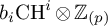 . In this section we provide an inductive way to compute numbers
$b_i$
 .
Denote by
$d_i\in p^{\mathbb {Z}}$
 the number s.t.
$d_i \cdot ch_i$
 acts integrally on products of projective spaces and this action is not zero modulo
$p$
 . In other words,
$d_i \cdot ch_i$
 can be lifted to a generator
$\phi _i$
 of additive operations from
$\mathrm {K}(n)_{int}^*$
 to
${\mathrm {CH}}^i\otimes \mathbb {Z}_{(p)}$
 . It is clear that
$d_i$
 is uniquely defined by the above.
Proposition B.7. We have
$d_1=1$
 .
-
• If $i \neq p^{sn}$
for some
$s\in \mathbb {N}$
, then
$d_i = \max _{j=1}^{i-1} (d_j d_{i-j})$
. -
• If $i = p^{sn}$
, then
$d_i =p\cdot \max _{j=1}^{i-1} (d_j d_{i-j})$
.


Proof. The operation
$ch_1$
 acts integrally on projective spaces, it is defined by series
$G_1(z)=z$
 ,
$G_j(z)=0$
 for
$j\ge 2$
 . Thus,
$d_1=1$
 .
Lemma B.8. The
$\mathbb {Z}_{(p)}$
 -module of poly-additive poly-operations of arity
$r$
 from
$\mathrm {K}(n)_{int}^*$
 to
${\mathrm {CH}}^i\otimes \mathbb {Z}_{(p)}$
 is a free
$\mathbb {Z}_{(p)}$
 -module generated by external products
$\phi _{j_1}\odot \cdots \odot \phi _{j_r}$
 where
$\sum _{s=1}^{r} j_s =i$
 ,
$j_s\colon 0\le j_s \le i$
 .
Proof. It follows from Vishik’s classification of poly-operations theorem that this module is free. Thus, its rank is equal to the dimension of the
$\mathbb {Q}$
 -vector space of additive polyoperations from
$\mathrm {K}(n)_{int}^*\otimes \mathbb {Q}$
 to
${\mathrm {CH}}^i\otimes \mathbb {Q}$
 . However, using a multiplicative isomorphism
$ch\colon \mathrm {K}(n)_{int}^*\otimes \mathbb {Q} \cong \oplus {\mathrm {CH}}^i\otimes \mathbb {Q}$
 one reduces the problem of calculating this dimension to the dimension of the vector space of poly-operations of arity
$r$
 from Chow groups to Chow groups with rational coefficients. One can show that the ring of poly-operations in Chow groups is generated by multiplications of components, and, thus, the dimension is equal to the number of external products
$\phi _{j_1}\odot \cdots \odot \phi _{j_r}$
 .
The number of poly-operations
$\phi _{j_1}\odot \cdots \odot \phi _{j_r}$
 coincides with the rank of the
$\mathbb {Z}_{(p)}$
 -module, and thus it is enough to show that there are no
$\mathbb {F}_{p}$
 -relations between them. But this is precisely the claim of [Reference SechinS18a, Lemma 4.6.2].
Proof of Proposition B.7, continued. Denote by
$m$
 the multiplication in
$\mathrm {K}(n)_{int}^*$
 which is a poly-additive poly-operation of arity 2. As follows from Lemma B.8 for each
$i$
 the poly-operation
$\phi _i\circ m$
 is of the form

where
$b^{(i)}_j\in \mathbb {Z}_{(p)}$
 and
$\phi _0$
 is the additive operation
$\mathrm {K}(n)_{int}^*\rightarrow {\mathrm {CH}}^0\otimes \mathbb {Z}_{(p)}$
 which sends 1 to 1 and is zero on
$\widetilde {\mathrm {K}}(n)_{int}^*$
 .
On the other hand, since
$ch$
 is a multiplicative operation, we have
$ch_i\circ m = \sum _{j=0}^{i} ch_{j}\odot ch_{i-j}$
 . Combining these two equations together we obtain that
$\phi _i \circ m = \phi _i\odot \phi _0 + \phi _0 \odot \phi _i + \sum _j \frac {d_i}{d_jd_{i-j}} \phi _j\circ \phi _{i-j}$
 , and therefore
$b^{(i)}_j = \frac {d_i}{d_jd_{i-j}}$
 . The number
$b^{(i)}_j$
 has to be integral since
$\phi _i \circ m$
 is an integral polyoperation, and therefore
$d_i \ge \max _{j=1}^{i-1} (d_j d_{i-j})$
 .
Assume that
$b^{(i)}_j\in p\mathbb {Z}_{(p)}$
 for all
$j\colon 1\le j\le i-1$
 , i.e.
$\phi _i\circ m\equiv \phi _i\odot \phi _0 + \phi _0\odot \phi _i \mod p$
 . In particular, this means that
$(\phi _i\mod p)(z_1\cdots z_j)=0$
 for all
$j\ge 2$
 . However,
$\phi _i\mod p\neq 0$
 as it is a generator of additive operations, and therefore
$(\phi _i\mod p)(z)$
 cannot be equal to zero. Thus,
$(\phi _i\mod p)(z) = a z^i$
 for some
$a\in \mathbb {F}_{p}^\times $
 , and we see that
$\phi _i \equiv a(\phi _1)^i \mod p$
 .
In order for
$(\phi _1)^i$
 to be additive modulo
$p$
 we need
$i$
 to be a power of
$p$
 . However, if
$i\neq p^{sn}$
 for some
$s\ge 0$
 , then
$\phi _i$
 and
$\phi _1$
 are supported on different graded components of
$\mathrm {K}(n)_{int}^*$
 by [Reference SechinS18a, Prop. 4.1.6] (or one could argue that
$(\phi _1)^i \mod p$
 is not
$p^n$
 -gradable). Thus, we see that if
$i \neq p^{sn}$
 , then there exists
$j$
 s.t.
$\frac {d_i}{d_jd_{i-j}}\in \mathbb {Z}_{(p)}^\times $
 . The claim follows.
If
$i = p^{sn}$
 , then by [Reference SechinS18a, Cor. 4.3.5] we have the relation
$\phi _i \equiv (\phi _1)^i \mod p$
 , and thus
$\phi _i\circ m\equiv \phi _i\odot \phi _0 + \phi _0\odot \phi _i \mod p$
 . We claim, however, that
$\phi _i \neq (\phi _1)^i \mod p^2$
 . Without loss of generality we may choose an
$n$
 -th Morava K-theory to have the logarithm
$\log _{\mathrm {K}(n)_{int}}(x)=\sum _{s=0}^\infty \frac {1}{p^s}x^{p^{sn}}$
 .
By the construction of Chern classes [Reference SechinS18a, Lemma 4.4.1, Lemma 4.3.3 (2p)] we have
$\log _{\mathrm {K}(n)_{int}}(c_1t+c_2t^2+\ldots +c_{p^{sn}}t^{p^{sn}})[t^{p^{sn}}]=\frac {\phi _{p^{sn}}}{p^s}$
 . Multiplying this equation by
$p^s$
 and taking it modulo
$p^2$
 we obtain

Using equality
$c_1=\phi _1$
 we may rewrite it as

where
$Q$
 is a polynomial in Chern classes. The polynomial
$Q$
 contains
$(c_{p^n})^{p^{(s-1)n}}$
 as a summand which comes from the term
$(c_1t+\ldots +c_{p^{sn}}t^{p^{sn}})^{p^{(s-1)n}}$
 and cannot be cancelled by any other summands coming from the other term. Thus,
$Q\neq 0$
 , and therefore it is not zero as an operation to Chow groups modulo
$p$
 , because Chern classes form a basis of operations and there are no relations between them modulo
$p$
 . Thus, we see that
$\phi _i \neq (\phi _1)^i \mod p^2$
 , and therefore as explained above
$\phi _i\circ m \neq \phi _i\odot \phi _0 + \phi _0\odot \phi _i \mod p$
 . Therefore the minimal
$p$
 -valuation of coefficients
$b^{(i)}_j$
 is equal to 1, and
$d_i = p\cdot \max _{j=1}^{i-1} (d_j d_{i-j})$
 .
Example B.9. Prop. B.7 allows to calculate
$d_2=\cdots = d_{p^n-1}=1$
 ,
$d_{p^n}=\cdots =d_{2p^n-1}=p$
 , and, more generally,
$d_{kp^n}=\ldots =d_{kp^n+p^n-1}=p^k$
 for
$k<p^n$
 .
Define numbers
$b_i$
 according to the rule
$b_i =\begin {cases} d_i, &\text {if } p^n \nmid i;\\ p^{-k}d_i, &\text {if } i=p^{nk}v \text { where } p^n\nmid v. \end {cases}$

Proposition B.10. For each
$i\ge 0$
 numbers
$b_i \in p^{\mathbb {N}}$
 .
The image of the map
$c_i^{{\mathrm {CH}}}\colon gr^i_\tau \mathrm {K}(n)_{int}^*\rightarrow {\mathrm {CH}}^i\otimes \mathbb {Z}_{(p)}$
 equals
$b_i\mathbb {Z}_{(p)}({\mathrm {CH}}^i\otimes \mathbb {Z}_{(p)})$
 .
Proof. It follows from Prop. 2.10 that the image is equal to the image of the operation
$\Theta _i:=(c^{{\mathrm {CH}}}_i)^{{\mathrm {CH}}}_i\colon {\mathrm {CH}}^i\otimes \mathbb {Z}_{(p)}\rightarrow {\mathrm {CH}}^i\otimes \mathbb {Z}_{(p)}$
 which is obtained as the composition of
$c_i$
 with the canonical morphism
$\rho _{\mathrm {K}(n)_{int}}\colon {\mathrm {CH}}^i\rightarrow gr^i_\tau \mathrm {K}(n)_{int}^*$
 . We are going to prove that this operation is multiplication by
$b_i$
 .
The operation
$\Theta _i$
 is a composition of additive operations and therefore it is additive itself. By Vishik’s classification of additive operations [Reference VishikVi19, Th. 6.2]
$\Theta _i$
 is determined by a symmetric polynomial
$G_i(z_1,\ldots ,z_i)$
 of degree
$i$
 which is divisible by
$\prod _{j=1}^i z_j$
 , i.e.
$G_i= \alpha z_1\cdots z_i$
 for some
$\alpha \in \mathbb {Z}_{(p)}$
 , and it is clear that
$\Theta _i$
 is multiplication by
$\alpha $
 . The polynomial
$G_i$
 for the operation
$c^{{\mathrm {CH}}}_i$
 is also equal to
$\alpha z_1\cdots z_i$
 which can be checked by comparing the action of
$\Theta _i$
 and
$c^{{\mathrm {CH}}}_i$
 on products of projective spaces using the definition of
$\Theta _i$
 . Thus, our goal is to show that
$c^{{\mathrm {CH}}}_i(z_1\cdots z_i)= a b_i z_1\cdots z_i$
 for some
$a\in \mathbb {Z}_{(p)}^\times $
 .
By construction of the operation
$c^{{\mathrm {CH}}}_i$
 ([Reference SechinS18a, Cor. 4.3.1]) we have
$c_i - P_i(c_1,\ldots , c_{i-1})=\frac {\phi _i}{p^{\mu _i}}$
 as operations to
${\mathrm {CH}}^i\otimes \mathbb {Q}$
 where
$P_i$
 is a rational polynomial,
$\phi _i$
 is a generator of additive operations to
${\mathrm {CH}}^i\otimes \mathbb {Z}_{(p)}$
 . For operations
$c_j, j<i$
 the polynomial
$G_i$
 is equal to 0 by degree reasons, and therefore so it is for
$P_i$
 . Thus, the polynomial
$G_i$
 of the operation
$c_i$
 coincides with the polynomial of the operation
$\frac {\phi _i}{p^{\mu _i}}$
 .
The operation
$\phi _i$
 is equal to
$a p^{d_i} \cdot ch_i$
 where
$a\in \mathbb {Z}_{(p)}^\times $
 by definition of numbers
$d_i$
 above. Therefore
$G_i$
 of the operation
$\phi _i$
 is equal to
$ap^{d_i} z^1\cdots z_i$
 , and
$\alpha = a p^{d_i-\mu _i}$
 . To finish the proof recall that
$\mu _i=\max (0, -\nu _p(P_i))$
 ([Reference SechinS18a, Cor. 4.3.1]) and it follows from [Reference SechinS18a, Lemma 4.3.3 (2, 2p)] that
$\mu _i = 0$
 if
$p^n \nmid i$
 and
$\mu _i=k$
 if
$i=p^{nk}v$
 where
$p^n\nmid v$
 ,
$v\in \mathbb {Z}_{(p)}$
 . Thus,
$\alpha = a b_i$
 .
Since
$\Theta _i$
 is an integral operation, it follows that
$b_i$
 is integral, i.e.
$b_i\in p^{\mathbb {N}}$
 , which is the first claim of the Proposition.
Example B.11. If
$i=kp^n+j<p^{2n}$
 where
$j\colon 1\le j\le p^n$
 , then the image
$c_i(gr_\tau ^i \mathrm {K}(n)_{int}^*)$
 is equal to
$p^{k} {\mathrm {CH}}^i\otimes \mathbb {Z}_{(p)}$
 .
Acknowledgements
The author is extremely grateful to Alexander Vishik for the attentive guidance in the earlier stages of this work.
We thank the anonymous referee for a careful reading of the paper and for many helpful comments and questions, in particular those that led to the inclusion of Appendix A.
Competing interests
The authors have no competing interests to declare.
Data Availability
None.


 Open access

