Introduction
To date, cognitive intervention used for delaying cognitive declines or maintaining cognitive function for patients with Alzheimer’s disease (AD) in the clinic has been found to be ineffective (Mehta et al., Reference Colombo2017). The main reason is that it is difficult to distinguish early stage of AD from healthy aging and that AD is already in progress at the time of intervention, thus limiting efficacy of the intervention (Metha et al., Reference Metha, Jackso, Paul, Shi and Sabbagh2017).
Since early intervention of AD has gained a lot of attention, interests in intervention from the stage of mild cognitive impairment (MCI), the early clinical stage of AD, have increased (Roberts et al., Reference Roberts, Clare and Woods2009; Park and Heo, Reference Park and Heo2017). Similar to AD, an atrophy in hippocampus is one hallmark of MCI. It induces declines in spatial cognition and episodic memory (Plancher et al., Reference Plancher, Tirard, Gyselinck, Nicolas and Piolino2012).
Accordingly, hippocampal function training would be clinically useful way to improve spatial cognition and episodic memory in people with MCI (Braak and Del Tredici, Reference Braak and Del Tredici2015). Many studies have provided evidence supporting that spatial cognitive training (SCT) could increase gray matter in hippocampus (Maguire et al., Reference Maguire, Woollett and Spiers2006; Boyke et al., Reference Boyke, Driemeyer, Gaser, Büchel and May2008). Previous studies have largely focused on spatial cognition for training older adults with MCI (Lövdén et al., Reference Lövdén2012; Migo et al., Reference Migo2016; Howett et al., Reference Howett2019). In previous studies, visual stimuli consisting of several pictures or shapes have been serially presented in a grid on a computer screen at different locations. Subjects are then asked to memorize locations of these pictures (Hayes et al., Reference Hayes, Ryan, Schnyer and Nadel2004; Kessels et al., Reference Kessels, Hobbel and Postma2007). These two dimension-based SCT has been identified to be effective in improving spatial cognition (Gaunet et al., Reference Gaunet, Vidal, Kemeny and Berthoz2001; Meneghetti et al., Reference Meneghetti, Borella and Pazzaglia2016). However, performances on SCT in two dimensions are generally different from requirements for everyday life, thus inducing low ecological validity of the training. To generalize training’s effect to subjects’ daily life, SCT needs to be implemented in three dimensions (Farias et al., Reference Farias, Harrell, Neumann and Houtz2003; Schultheis et al., Reference Schultheis, Himelstein and Rizzo2002).
Therefore, recent studies have implemented SCT using virtual reality (VR) that mimics real environment as closely as possible for high ecological validity (Lövdén et al., Reference Lövdén2012; Howett et al., Reference Howett2019). In these studies, subjects are instructed to move to goals in a virtual maze during training sessions. They are then presented the task of moving to one point that subjects have previously visited by traversing the same route they have learned during the training. These spatial cognitive tasks could be solved only by using egocentric navigation strategy with a body-centered viewpoint (Zhong et al., Reference Zhong and Moffat2018). However, several neuroimaging studies have indicated that activation in hippocampus corresponds to allocentric navigation rather than egocentric navigation (Colombo et al., Reference Colombo2017; Zhong et al., Reference Zhong and Moffat2018). Indeed, several studies on factors that differentiate older adults with MCI from healthy older adults have indicated that allocentric spatial cognition is the most powerful predictive factor (Plancher et al., Reference Plancher, Tirard, Gyselinck, Nicolas and Piolino2012; Howett et al., Reference Howett2019).
Taken together, to improve hippocampal function of patients with MCI, allocentric SCT needs to be carried out. Therefore, the objective of this study was to investigate effects of 8 weeks of allocentric SCT on hippocampal function of patients with MCI. To assess hippocampal function, both spatial cognition and episodic memory were evaluated. The author hypothesized that allocentric SCT could be effective in improving hippocampal function.
Methods
Design
This study had a single-blind randomized controlled trial design. Subjects were randomly allocated to the experimental group (EG) or the control group (CG) using a random number generated with MATLAB (2012b; MathWorks, Inc., Natick, MA, USA). For the EG, VR-based SCT (VR-SCT) was performed. Waitlist CG participated in the same training as did the EG after the study.
An occupational therapist with 6 years of clinical experience was blinded to group allocation and conducted outcome measures. This study was implemented for 8 weeks. Outcome measures were implemented before and after the 8-week intervention. This study was registered at the Thai Clinical Trials Registry ID: TCTR20191020002. All subjects provided informed consent before participating in the present study according to the Declaration of Helsinki (2004).
Subjects
Older adults over 60 years old with amnestic MCI were recruited from local senior centers in Seoul and Asan, South Korea. Amnestic MCI was defined according to a previous study (Petersen, Reference Petersen2004). Inclusion criteria were as follows: (a) subjective memory complaint, (b) objective memory impairment defined by score on the Korean version of California Verbal Learning Test, (c) intact global cognitive function as confirmed by score on the Korean version of the Mini-Mental State Examination (MMSE-K) ≥ 24, and (d) intact activities of daily living as identified by score on Seoul instrumental activities of daily living score ≤ 7. Exclusion criteria were as follows: (a) dementia diagnosed by physicians, (b) presence of neurological or psychiatric disorders such as stroke and schizophrenia, (c) moderate to severe depressive symptom as determined by score on the Beck Depression Scale, (d) presence of auditory or visual impairments, and (e) participation in any program to improve cognitive function within 3 months.
The number of subjects was calculated using G*Power (Informer Technologies, Dusseldorf, Germany) (Faul et al., Reference Faul, Erdfelder, Lang and Buchner2007). According to a previous study (Savulich et al., Reference Savulich2017), the effect size (ES) was set at 0.84, the α error at a probability of 0.05, and the power at 0.90. A minimum of 25 subjects was required for each group.
Intervention
VR-SCT, a kind of spatial cognitive task designed to improve spatial memory, was implemented by an occupational therapist with 7 years of clinical experience. VR-SCT consisted a total of 24 sessions (45 minutes a session, 3 days a week for 8 weeks). This program developed using the Unity game engine was run by using a desktop computer. Subjects in the EG used a joystick to freely move (forward, backward, turn left, or turn right) in a VR environment. Those in the EG were presented an opportunity to undergo two sessions in an open arena environment, allowing subjects in the EG to familiarize themselves with the environment and the control of the joystick until subjects became familiar with them enough. Subsequently, those in the EG were given training sessions. During training sessions, subjects in the EG were immersed in an environment with boundary cues consisting of rocks and ocean (Figure 1A). Subjects’ initial location was randomized in the environment, and then they were asked to look around. There was a gem at a certain point in the environment where subjects were instructed to move toward. Once subjects got the gem, another gem was located again at a different location from the previous gem. They were instructed to move to get the new gem, resulting in subjects got each gem in two different locations. Only one gem was shown at a time, and each gem would disappear after subjects reached it. After getting the second gem, a visual instruction on the computer screen instructing subjects to walk back to their initial location was projected (Figure 1B). After subjects moved to the estimated initial location, they were asked to press a button on the joystick. In other words, subjects had to estimate their initial location with allocentric navigation strategy using boundary cues.
Flow diagram of subjects in this study.

Every performance in training sessions was recorded using Euclidean distance between estimated and actual initial locations. If the distance was within 1 m, a feedback was provided “good job,” whereas if the distance were out of 1 m, a feedback was presented “better next time.” During these sessions, no local landmarks were presented near gems or the initial location, so it would not be a clue to remember the location within boundary, resulting in excluding compensatory navigation strategies. Three minutes of rest time was provided to minimize their fatigue after 15 minutes of training. Consequently, none of these subjects showed adverse effects when using the computer during these sessions.
Measurement
Two neuropsychological assessments were used as outcome measures before and after the intervention to evaluate spatial cognition and episodic memory. The blinded assessor conducted all assessments in a fixed order. Spatial cognition was measured using the Weschsler Adult Intelligence Scale-Revised Block Design Test (WAIS-BDT). It involves a task of arranging colored nine blocks to replicate 10 patterns within 120 seconds in order of ascending difficulty. Its score ranges from 0 to 48, with higher scores meaning better spatial cognition (Wechsler, 1981).
The Seoul Verbal Learning Test (SVLT), standardized with 12 words in three semantic categories Korean people widely use in everyday life, was used to assess episodic memory. A subject was asked to listen to 12 words at interval of 2 seconds and repeat them immediately three times. After 20 minutes, a subject was encouraged to recall the same words again regardless of the order of words. At the end of the test, a recognition test was implemented using 24 words consisting the previous words and new words that were never presented. In the recognition test, a subject was asked whether or not each word was presented. A score of 1 was allocated for correct response. Thus, the recall and the recognition test had total scores of 12 and 24, respectively (Kang and Na, Reference Kang and Na2003).
Statistical analysis
All data were analyzed using SPSS version 25.0 (SPSS Inc., Chicago, IL, USA). To confirm the normal distribution of all outcome measures, the Kolmogorov–Smirnov test was conducted. Means and standard deviations for subject characteristics of the two groups were calculated. Independent-sample t-test and chi-square test were used to investigate general characteristics of subjects between the two groups. After the 8-week intervention, to compare distance error of the spatial cognitive task during each session, a repeated one-way analysis of variance (ANOVA) and the Bonferroni method as a post hoc analysis were used. To compare outcomes between the two groups, a repeated two-way ANOVA was performed with time (pre- and post-intervention) as within-group variable and intervention as between-subject variable. The ES of each intervention group was calculated using partial η 2 (Cohen, Reference Cohen1988). A statistical significance was accepted at p < 0.05.
Results
Subject characteristics
A total of 56 elderly people with cognitive impairment were selected from 172 elderly people in local senior centers. Out of 172, 56 were finally selected according to the inclusion and exclusion criteria (Figure 1). Subjects were then randomly allocated to two groups (28 subjects per group). There were no significant differences in general characteristics between the two groups (Table 1).
General characteristics of subjects (N = 56)

Values are expressed as mean ± standard deviation.
Distance error
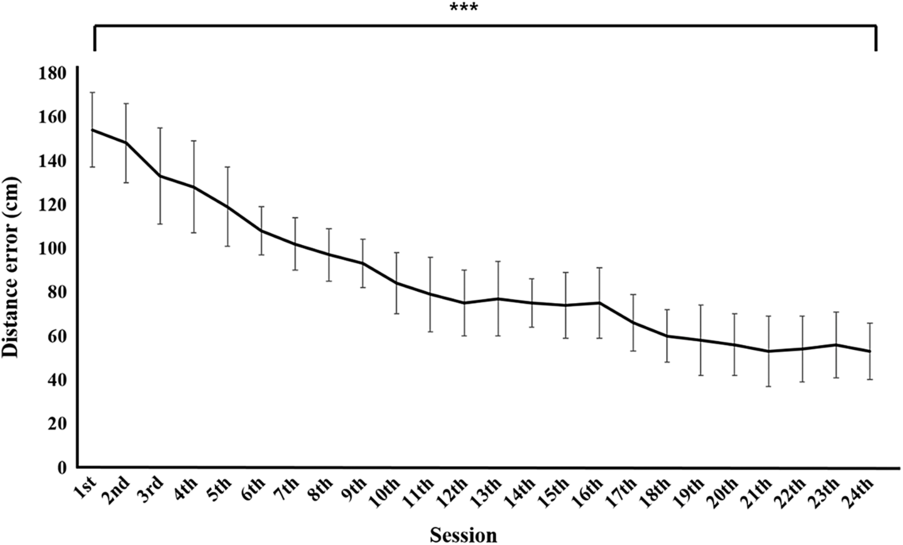
The average distance error between the estimated location and the actual initial location significantly decreased in proportion to the number of sessions (F = 3226.696, p < 0.001), indicating an improvement in spatial cognition of subjects in the EG. Post hoc test revealed a significant difference in the average of distance error between the first session and the final session (p < 0.001) (Figure 2).
Distance error of every session.

Spatial cognition
Repeated-measures ANOVA revealed that group × time interaction was significant for WAIS-BDT (p < 0.001; η 2 = 0.667) (Table 2). This result indicated that those in the EG achieved clinical improvement in spatial cognition compared to those in the CG.
Changes in hippocampal function (N = 56)

Values are expressed as mean ± standard deviation. Significant group × time interaction (*p < 0.05, ***p < 0.001).
Episodic memory
Results showed a significant group × time interaction for the recall of SVLT (p < 0.05; η 2 = 0.094). However, there was no significant group × time interaction for the recognition of SVLT (p > 0.05; η 2 = 0.001) (Table 2). These findings suggested that those in the EG showed greater improvement in recall but not in recognition.
Discussion
In this study, older adults with MCI who underwent VR-SCT showed significant improvements in both spatial cognition and episodic memory. As expected, VR-SCT might be useful for improving hippocampal function of older adults with MCI, in line with results of previous studies (Savulich et al., Reference Savulich2017; Meade et al., Reference Meade, Meade, Sauzeon and Fernandes2019).
Active navigation has a clinical usefulness in improving spatial cognition of older adults with MCI compared to passive navigation (Howett et al., Reference Howett2019). Accordingly, in this study, VR-SCT was implemented through active navigation rather than passive navigation to maximize its effects. Results of this study confirmed that spatial cognition was increased after the 8-week intervention, suggesting that VR-SCT might be helpful in improving the hippocampal function of older adults with MCI. Spatial cognition that mainly relies on hippocampal function could be enhanced following navigation experiences (Meade et al., Reference Meade, Meade, Sauzeon and Fernandes2019), consistent with results of this study. Indeed, a previous study has reported that hippocampal volumes of London taxi drivers are larger than those of controls, indicating that the hippocampal function might be due to experience-dependent changes (Maguire et al., Reference Maguire, Woollett and Spiers2006). In addition, several neuroimaging studies showed that increases of gray matter in right posterior hippocampus were observed in individuals who performed spatial tasks (Boyke et al., Reference Boyke, Driemeyer, Gaser, Büchel and May2008, Laczó et al., Reference Laczó2017).
Specifically, allocentric navigation strategy was adopted to perform VR-SCT in the present study. Allocentric navigation strategy requires visualizing cognitive map using object-to-object relationship from an environment-centered viewpoint (Colombo et al., Reference Colombo2017). Previous neuroimaging studies have indicated that allocentric strategy is correlated with hippocampal function, suggesting that VR-SCT with allocentric navigation strategy rather than egocentric navigation strategy should be implemented in order to enhance hippocampal function (Iaria et al., Reference Iaria, Chen, Guariglia, Ptito and Petrides2007). Additionally, in the present study, since no local landmark information was presented, the EG group was focused on processing allocentric boundary information. A previous study has indicated that when older adults search for a certain goal location with landmark cues, activation in striatum rather than in hippocampus is increased, suggesting that VR-SCT needs to provide minimal landmark information for hippocampal function (Schuck et al., Reference Schuck, Doeller, Polk, Lindenberger and Li2015). These characteristics of VR-SCT might be factors that could maximize effects of VR-SCT.
Meanwhile, to present conditions that resemble daily life, spatial cognitive tasks based on VR have been used in several previous studies (Daugherty et al., Reference Daugherty2015; Howett et al., Reference Howett2019) as well as in this study. Indeed, some studies on older adults with MCI have found a close correlation in performance between real and virtual environments (Cushman et al., Reference Cushman, Stein and Duffy2008; Plancher et al., Reference Plancher, Tirard, Gyselinck, Nicolas and Piolino2012). Therefore, in this study, improvements in spatial cognition of the subjects in the EG group might be said to have a high relationship with spatial cognition in their daily life.
After the 8-week intervention, episodic memory was also improved in the EG group. Previous neuroimaging studies have found that hippocampus is primarily responsible for episodic memory as well as spatial cognition (Tulving, Reference Tulving2002). Therefore, enhanced hippocampal function through VR-SCT might have a positive impact on episodic memory. Indeed, a previous study has shown that VR-SCT can induce improvements in episodic memory (Savulich et al., Reference Savulich2017). However, in the present study, VR-SCT did not result in significant improvement in recognition. This could be explained by the fact that recognition is not as closely correlated with hippocampal function as retrieval. Although recognition partially relies on hippocampal function at the stage of encoding, previous studies have consistently presented that recognition could be accomplished by familiarity rather than episodic recollection in extrahippocampal regions (Rugg and Yonelinas, Reference Rugg and Yonelinas2003; Montaldi and Mayes, Reference Montaldi and Mayes2010). These results suggest that recognition does not heavily rely on hippocampal function (Gilbert and Moran, Reference Gilbert and Moran2016).
The present study has some limitations. First, although this study attempted to secure ecological validity by using VR, real-world navigation requires actual movement, leading to limitations in generalizing the results of this study (Howett et al., Reference Howett2019). Since physical components such as locomotion and proprioception could affect navigation, future studies need to involve actual movement during VR-SCT. Second, this study could not confirm the superiority of three-dimensional SCT compared with SCT in two dimensions because two-dimensional training was not included as a control, resulting in limitations in its advancement. Finally, as changes in medial temporal lobe structures involved in spatial cognition such as entorhinal cortex were not identified using neuroimaging devices, it was hard to exclude their influence on the effect. Therefore, to demonstrate more objective effects, future studies should present neuroimaging results and behavioral or neuropsychological results.
Conclusion
These results of this study suggest that VR-SCT can improve hippocampal function. Given that the efficacy of conventional cognitive training for older adults with MCI remains controversial, results of this study have crucial important clinical significance. The current findings suggest that spatial memory training in various places in everyday life would be an ecologically validated treatment in clinical settings.
Conflict of interest
The author declares that there is no conflict of interest.
Acknowledgments
This work was supported by the Soonchunhyang University Research Fund (No. 20191017). This work was supported by the National Research Foundation of Korea grant funded by the Korea Government (Ministry of Science and ICT, MSIT) (No. 2019R1F1A1060719).