Introduction
That women live longer than men has been shown in numerous studies (e.g. Behm & Vallin, Reference Behm, Vallin and Preston1980; Trovato & Heyen, Reference Trovato and Heyen2006) and can be observed in every country of the world today (Barford et al., Reference Barford, Dorling, Davey Smith and Shaw2006). Many factors have been identified as contributing to the sex gap in mortality (Nathanson, Reference Nathanson1984; Wingard, Reference Wingard1984; Waldron, Reference Waldron1985; Vallin, Reference Vallin, Caselli, Vallin and Wunsch2006; Kolodziej et al., Reference Kolodziej, Lopuszanska and Jankowska2008). In general, these factors can be grouped into the two basic categories of biological (anatomical, physiological and genetic) and non-biological factors (social and behavioural factors such as health lifestyles, risk-taking, or working in stressful or hazardous jobs). However, in many cases it is impossible to assign a specific factor to one of these broad categories. For instance, smoking, unhealthy diet, excessive body weight in relation to height, lack of exercise and stress are thought to operate primarily by raising the mortality from coronary heart disease. That female hormones protect women against this kind of disease shows how biological differences between the sexes could play an important mediating role between non-biological factors and ultimate mortality (Retherford, Reference Retherford1975).
Excessive male mortality due to ‘external causes’ (accidents, injuries, homicides and suicides) is another prominent example for such cases since biological factors may determine sex differences in behaviour that lead to external cause deaths (Waldron, Reference Waldron1983b). Basically, two different mechanisms are suggested for explaining this phenomenon. First, the effects of prenatal and post-pubertal male hormones might drive sex differences in physical activity levels and physical aggressiveness, which may contribute to males being at higher risk for fatal accidents and other violent deaths. Although more recent research suggests that sex differences in central cholesterol and serotonin levels might be more important biological causes for male aggressiveness than androgens (Wallner & Machatschke, Reference Wallner and Machatschke2009) this explanation will be referred to as the ‘sex hormones hypothesis’. Second, inherent sex differences in reproductive function (women's role as bearers and carers of children versus males' internal competition to mate with females) appear to have influenced the cultural evolution of gender roles and consequently to have indirectly contributed to sex differences in behaviour, like risk-taking or heavy drinking, which are major causes of the higher rates of external cause deaths among males (Hirschi, Reference Hirschi1969; Waldron, Reference Waldron, Lopez and Ruzicka1983a,Reference Waldronb; Hagan, Reference Hagan1989; Carey & Lopreato, Reference Carey and Lopreato1995). This interplay between sex-specific biological functions and cultural gender roles and its consequences on male and female risk-taking will be referred to as the ‘reproductive role hypothesis’.
Several findings suggest that the high number of external cause male deaths is partly due to health and mortality risks connected to occupation (e.g. Leigh, Reference Leigh1988). Men are exposed more to occupational hazards because more men are employed, and among those who are employed more men than women work in hazardous occupations. Reviewing several studies, Waldron (Reference Waldron, Frankenhaeuser, Lundberg and Chesnay1991) concluded that approximately 95% of fatal work accidents involve men and that these higher rates for work accidents account for roughly one-fifth of the sex differences in accident fatalities. In a multivariate analysis of Swedish labour force participants, Hemström (Reference Hemström1999) arrived at the same estimate that sex differences in occupational fields account for approximately 20% of men's excess mortality from external causes. This contribution originated mainly from high job hazard levels in traditional male jobs like, for example, heavy lifting, heavy shaking or vibration, contact with dirt, inadequate ventilation and exposure to gas, vapour or smoke and exposure to chemicals and carcinogens (see also Waldron, Reference Waldron, Frankenhaeuser, Lundberg and Chesnay1991). However, when Hemström (Reference Hemström1999) restricted the analysis to those in full-time employment, there was no contribution of hazardous work to excess male deaths from external causes. This was due to the fact that female full-time workers showed a significantly higher mortality from external causes than women in part-time employment. Among men, in contrast, full-time workers had a lower mortality than part-time workers, which indicates that part-time work is clearly related to sex-specific selection (a healthy selection for married women with children and an unhealthy one for men).
This example shows what complex patterns of different factors cause mortality differentials in human populations. Since the links between biological and non-biological factors behind external cause mortality are even more complex and difficult to disentangle empirically, many questions regarding the existence and the nature of such biological causes are still unanswered and subject to controversial discussion. However, there is one group of women and men where individual behaviours and environmental conditions, i.e. the non-biological factors, are as close to being equal as can be found in modern societies, which permits the impact of biological factors to be isolated from many confounding factors: the members of religious orders. Nuns and monks lead a ‘simple lifestyle’ that is determined by vows (living in poverty, chastity and obedience), with similar daily regimes as regards time for sleep, work, study and recreation, and also with respect to diet, housing and medical care. Furthermore, cloistered life entails no sex-specific influences of reproductive roles, marital status or familial responsibilities (Madigan & Vance, Reference Madigan and Vance1957; Luy, Reference Luy2003).
Although professions differ between nuns and monks, sex-specific health risks are unlikely among the order members, above all regarding external risk factors like injuries or homicides. Aside from the typical internal occupations in male and female cloisters like household work, farming and similar occupations, most monks practise as priests while nuns mainly work as school and pre-school teachers. These preconditions make order members a valuable experimental group with a long tradition in specific medical and epidemiological research (e.g. Fecher, Reference Fecher1927; Madigan, Reference Madigan1957; Barrow et al., Reference Barrow, Quinlan, Cooper, Whitner and Goodloe1960; McCullagh & Lewis, Reference McCullagh and Lewis1960; Fraumeni et al., Reference Fraumeni, Lloyd, Smith and Wagoner1969; Kinlen, Reference Kinlen1982; Snowdon, Reference Snowdon2001; Luy, Reference Luy2003). This study is built on these specific preconditions and represents the first attempt to empirically test the sex hormones and reproductive role hypotheses. If the latter hypothesis were true and the reproductive roles of women and men were the driving force behind sex differences in external cause mortality we should expect nuns to have higher levels of mortality due to external causes of death than women of the general population since the behaviour of nuns is not influenced by the cultural female role of bearers and carers of children. Monks, on the other hand, should then show lower levels of external cause mortality than their secular counterparts since monastic life can be expected to prevent men from most external causes of death. If, however, the sex hormones hypothesis were true the external cause mortality of monks should not differ from those of the general population men since both are subject to the same influences of androgens and serotonin levels, whereas in this case nuns should show a protective cloister effect and thus lower mortality due to external causes as compared with lay women.
Data and Methods
The data used for the following analysis stem from one Benedictine monastery and two Franciscan nunneries in Bavaria which had already been part of a previous study on sex mortality differences in cloistered populations (Luy, Reference Luy2003). During the last few years, the data were updated and the individual files were extended to contain information on causes of death in these three religious communities. In order to ensure maximum possible homogeneous conditions only post-war years were considered for this analysis. Since there was no access to the official causes of death certificates of these individuals for data protection reasons it was necessary to explore alternative sources. For the Benedictine monks obituaries have been used, which in most cases contain information on the cause of death. For 711 of the 958 monks who died since 1946 obituaries were available, of which 491 allowed the identification of a specific cause of death. By their pure nature, the obituaries contain descriptions rather than precise reports of causes of death. Nevertheless, the identification of external causes of death is quite reliable as the following excerpt from an obituary demonstrates:
The Superior and the Community of […] ask for your prayers and remembrance at Holy Mass for the repose of the soul of our beloved Brother Denis Robert […] who died on Sunday morning, 26 August 1990. […] Br. Denis was seized by gunmen in his room on our compound at 11.30 pm Saturday, 25 August; outside his room he was shot in the head, and never recovered consciousness; he died at the […] Hospital at 6.30.am Sunday, 26 August, despite the great efforts of the Sisters to safe his life. He was fortified by the Last Rites of the Church. After the Requiem Mass in our chapel at midday, his body was taken to his home.
Regarding external causes of death, the obituaries contained reports about traffic accidents, several kinds of injuries, homicides and even suicides:
On the feast of the Presentation of the Lord, 2 February 2002, our Brother Gordian […] departed from us quite unexpectedly. […] After, as he described it, ‘an intensive novitiate, which was very fruitful for my spiritual life, and I got used to our community more and more’, he asked to be allowed to make his temporary profession, which he did on 23 June 2001. Br. Gordian was always a friendly and kind confrere. With the start of the new year 2002 he was supposed to familiarize himself more and more with the management of the garden. Suddenly he was overwhelmed by melancholy and became despondent. In spite of all kinds of help he could not fend it off. The scene of his death is an expression of his deep longing to be with God. The candle that burns there is a sign for us of light and hope even in the darkest night.
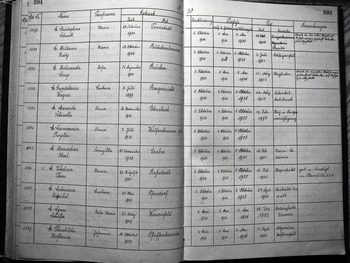
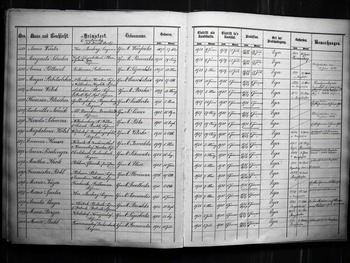
The nunnery with the highest number of members involved in the study offered better circumstances. Since the foundation of this sisterhood causes of death have been entered directly into the profession book where all individuals ever joining the community are registered. Figure 1 shows two pages of this profession book. Each line refers to one order member and contains columns with (starting from the left) the entry number, order and family name, given first name, birth date, place of birth, date of entry, date of first profession (beginning of novitiate for three years), date of second profession (lifetime order membership), date of death, cause of death and additional comments like missionary activity, local transfers, reasons for extraordinary dates of profession or dates of exits and dismissals, respectively. In this profession book, only for twelve out of 1442 post-war deaths is the information on cause of death missing. In the second nunnery causes of death are not recorded in the profession book, which contains information on entry number, birth name, place of birth, order name, date of birth, date of entry, date of first profession, date of second profession, place of profession, date of death and additional comments (see Fig. 2). However, from a nun's name and date of death it was possible to link the personal files from the profession book with the entries in the local cemetery register, which included information on causes of death for 612 out of all 875 nuns deceased since the end of World War II. In sum, 2533 deaths of order members could be linked to a specific cause of death, of which 69 belong to the group of external cause deaths.
Entries into the profession book of the St Franciscus sisters of Oberzell. Photo: M. Luy.

Entries into the profession book of the St Franciscus sisters of Gemünden/Main. Photo: M. Luy.

Although cause-of-death statistics generally include many sources of bias (Cameron & McGoogan, Reference Cameron and McGoogan1981; Modelmog et al., Reference Modelmog, Rahlenbeck and Trichopoulos1992), it is important to note that the collected information on causes of death for the nuns and monks in question contains additional uncertainties. The most important difference to official cause-of-death statistics is that the information is not necessarily based on medical doctors' declarations. In some cases the information used might indeed stem from medical diagnosis, while others might be based on the personal judgement of the documenting convent member or on information provided by other persons such as nurses or family members. However, the information on nuns' and monks' causes of death from these sources can still be expected to provide information that is more or less comparable to official statistics, at least with regard to the broad categories of causes of death.
External cause mortality of the cloistered and the general population was then compared by means of standardized mortality rates (SMRs) for ages 45 onwards using the European age standard for the age groups 45–64, 65–74 and 75+. Ages below 45 were excluded because the numbers of deaths attributable to external causes are too low among Bavarian nuns and monks. Standardized mortality rates were calculated for the calendar years 1958, 1963, 1972, 1978, 1983, 1988 and 1993 for the West German general population (data taken from Statistisches Bundesamt, 1961, 1966, 1976, 1981 1986, 1991, 1996) and for the periods 1946/76 (1960), 1950/80 (1965), 1955/85 (1970), 1960/90 (1975), 1965/95 (1980), 1970/2000 (1985) and 1975/2005 (1990) for the Bavarian order members (referring to the same periods that were also used by Luy (Reference Luy2003) for his study on the overall mortality of the Bavarian cloistered population). Finally, 95% confidence intervals were calculated for external cause SMRs of the Bavarian nuns and monks in order to test the statistical significance of the differences to the women and men of the West German general population.
Results
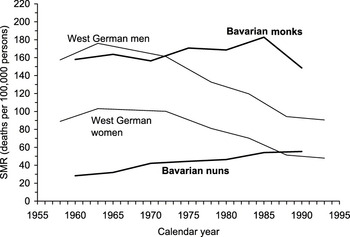
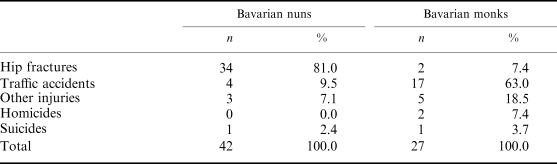
Figure 3 shows the trends in external cause mortality from age 45 onwards for order members from 1960 to 1990 (thick lines) and for the West German general population from 1958 to 1993 (thin lines). Among the general population external cause mortality has always been higher for men than for women. Nuns show an even lower external cause mortality than women of the general population, indicating the protection effect of cloistered life with regard to accidents, injuries and homicides. The differences diminish with the reduction of external cause mortality among West German women, being statistically significant at the 95% confidence level until 1980 (confidence intervals not shown in Fig. 3). Table 1 provides additional information on the more specific nature of external cause mortality for deceased order members. More than 80% of nuns' external cause deaths are documented as hip fractures. It is very likely that most of these deaths were not directly caused but only initiated by these injuries and thus would have entered into official cause-of-death statistics as heart failures rather than as external cause deaths. Thus, if official cause-of-death certificates were available the level of external cause mortality among nuns might be given as considerably lower.
Trends in age-standardized mortality from external causes of death for ages 45 onwards (deaths per 100,000 persons) for West German women and men and for Bavarian nuns and monks, 1955–1995. Relative period- and age-specific share of external cause deaths among the deceased nuns and monks of the three cloisters has been projected to the total number of deaths among all order members included in this study. SMRs (Standardized Mortality Rates) are standardized with the European age standard and refer to the periods 1946/76 (1960), 1950/80 (1965), 1955/85 (1970), 1960/90 (1975), 1965/95 (1980), 1970/2000 (1985) and 1975/2005 (1990) for the Bavarian order members and to the calendar years 1958, 1963, 1972, 1978, 1983, 1988 and 1993 for the West German general population.

Specific natures of external cause deaths of Bavarian nuns and monks, 1946–2005
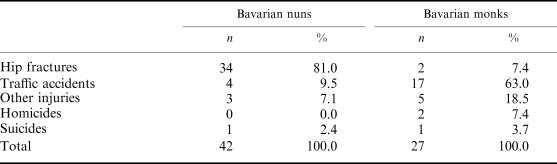
Note: figures include deaths of all ages.
Among males the differences between order members and the general population show a different picture. Between 1960 and the mid-1970s mortality due to external causes among monks was much closer and statistically insignificant to the corresponding level of the male general population as compared with the differences between the female populations. From the mid-1970s onwards external cause mortality has even been higher among monks than among men of the general population despite their living in the same protective environment as nuns. However, at no time are the differences statistically significant at the 95% confidence level. Table 1 shows that the majority of external cause deaths among monks are due to road traffic accidents. That monks often work as priests, which leads them to drive cars more frequently than nuns, might partly explain their higher number of fatal traffic accidents, as will be discussed below. However, it is unlikely that the outings connected to their priesthood activity are completely accountable for the high occurrence of this typically male cause of death among monks. This conclusion is supported by the fact that other injuries and homicides (happening outside the monasteries) also happen more often to monks than to nuns (see Table 1).
The low external cause mortality of nuns contradicts the reproductive role hypothesis but the high external cause mortality of monks provides some evidence for the sex hormones hypothesis. If the biological reproductive role of general population women was the driving force behind their more careful and responsible lifestyles and health behaviours as stated by the reproductive role hypothesis, nuns should miss this protective effect and thus should show higher external cause mortality than their counterparts in the general population. On the contrary, life as an order member even reduced the risk of dying from accidents, injuries, homicides and suicides until the women of the general population reached a similar low level of external cause mortality. Moreover, the specific kinds of external causes of deaths among nuns seem to reflect the general state of health in old age rather than an inclination to engage risky behaviour. Among men, however, cloister walls do not protect against the higher male risks of external cause mortality, especially not against the typical male risk-taking behaviours as reflected by the excess mortality due to traffic accidents, other injuries and homicides. This indicates the existence of specific causes connected to the male biology as stated by the sex hormones hypothesis.
Discussion
The main contribution of this study is that it empirically tests the reproductive role and the sex hormones hypotheses as possible biological causes behind excess male mortality due to external causes of death. According to the author's knowledge, such an attempt has not been made before, nor has there ever been an analysis of external causes of deaths among nuns and monks. The specific characteristics of the members of religious orders are valuable for getting insights into the role of biological factors for male excess mortality due to external causes, and maybe even into the specific mechanisms of these impacts as stated by the sex hormones and the reproductive role hypotheses.
The existing knowledge on the role of biological factors as causes for male external cause mortality is based on theoretical considerations and indirect indicators like the correlation between the trends of male and female external cause mortality and the changes of gender roles in different societies. The rise of the women's movement in conjunction with shifting economic factors has led to a steady increase in female labour force participation accompanied by an adjustment of gender roles and lifestyles. Despite the fact that true gender equality has not yet been achieved, women have made significant inroads into many traditionally male-dominated occupations and adopted typical male behaviours such as smoking habits. Many scholars suggested that increased gender equality, particularly in the economic sector, would lead to a narrowing of sex differentials in several kinds of externally caused deaths (e.g. Adler & Adler, Reference Adler and Adler1975; Hindelang et al., Reference Hindelang, Gottfredson and Garofalo1978; Fox & Hartnagel, Reference Fox and Hartnagel1979). More recent empirical tests of this hypothesis showed, however, that such a narrowing cannot be observed and that the differences between male and female external cause mortality persist (Maxim & Keane, Reference Maxim and Keane1992; Hemström, Reference Hemström1999). This is the most used indicator for claiming the existence of biological factors influencing male external cause mortality.
The data presented in Fig. 3 show the almost parallel decline of male and female levels of external cause mortality for the West German general population as well. No similar decline is to be found among either Bavarian nuns or monks. It could be that the level of external cause mortality has already reached its minimum among nuns and thus cannot show any further decline. Another reason might be that due to the tremendous decline in the number of new entries since the 1950s the cloistered population is ageing considerably and to a much higher degree than the German general population (Luy, Reference Luy2003). For instance, the number of people aged 65 and older per 100 people aged 25–64 increased in the general German population from 18.3 in 1950 to 35.1 in 2005, whereas for nuns the corresponding numbers are 13.6 in 1950–54 and 384.1 in 2001–05, and for monks 11.3 in 1950–54 and 98.6 in 2001–05. Maxim & Keane (Reference Maxim and Keane1992) have shown for almost all kinds of external cause deaths a rising risk with age. As the authors pointed out, ‘the high rates of motor vehicle accidents and other accidents among the aged is not likely to be because of excessive risk-taking. Rather, they may face an increased susceptibility to harm because of an environment, and objects in that environment, that may not be safely designed for those with lessened physical dexterity and reaction time’ (Maxim & Keane, Reference Maxim and Keane1992, p. 341). Thus, as already mentioned in the presentation of the empirical results of this study, it is possible that the high degree of ageing of the cloistered population is connected with increased exposure to the risk of certain kinds of external cause deaths.
Several limitations in the data and in the study design restrict the general validity of the conclusions regarding the support of the sex hormones hypothesis and the refusal of the reproductive role hypothesis. Generally, results based on case numbers as low as this must be interpreted with caution. The calculation of 95% confidence intervals reduces some – though, in the end, not all – of these uncertainties. The mentioned uncertainties resulting from the used sources for identifying the causes of death of nuns and monks have to be kept in mind as well. The aspect most difficult to assess, however, is the role of different occupations among nuns and monks in causing the huge differences in fatal road traffic accidents. Monks, especially those serving as priests in communities around their monastery, are more likely to use the car for commuting than nuns, whose major occupation activities as nurses or school and kindergarten teachers take place inside or close to their nunneries. Consequently, monks are spending a greater amount of time in vehicles than nuns and therefore have a greater exposure to the risk of being in road traffic accidents.
However, using cars more often does not necessarily mean that road traffic accidents, in particular fatal ones, have to occur more often as well. Several authors have argued – and shown empirically – that different kinds of external causes of death are strongly interrelated suggesting that certain types of individuals pursue lifestyles that expose them to violence and risk-taking in general (Porterfield, Reference Porterfield1960; Holinger & Klemen, Reference Holinger and Klemen1982; Kivelä, Reference Kivelä1985; Maxim & Keane, Reference Maxim and Keane1992; Mishra & Lalumière, Reference Mishra and Lalumière2009). In most cases, external cause mortality is directly caused by risky behaviour. Mishra & Lalumière (Reference Mishra and Lalumière2009, p. 40) define risky behaviour as ‘impulsive, reckless behaviour that maximizes short-term gains (e.g. sexual gratification, emotional arousal, relief of negative feelings) with potential for immediate future costs (e.g. car accidents, unwanted pregnancy)’. Jessor's (Reference Jessor1991) problem-behaviour theory suggests that the degree to which individuals engage in risky behaviours including substance use, delinquent behaviours, risky driving and early sexual intercourse is determined by a balance of instigations (e.g. peer modelling) and controls (e.g. parental monitoring). Daly & Wilson (Reference Daly and Wilson2001) describe risky behaviour (and crime) as analogous outcomes of steep future discounting, where the quality of one's future affects the utility of immediate risky behaviour. Since both instigation and criminal energy must be assumed to be rather low among nuns and monks and the expectations regarding their personal future are unlikely to be sex differentiated, it can be concluded that among the members of religious orders the impact of sex-specific environmental conditions on risk-taking behaviour is low as well.
In this theoretical framework the high mortality of monks due to road traffic accidents reflects a level of general risk-taking rather than being a pure consequence of spending more time on the streets. This is supported by the fact that monks serving as priests, as those who use cars most frequently, belong to the highest education group where extreme risk-taking is known to be less common than among lower education groups. Furthermore, several studies have shown the co-existence of criminal and non-criminal risky behaviours within individuals (Grasmick et al., Reference Grasmick, Tittle, Bursik and Arneklev1993; Caspi et al., Reference Caspi, Begg, Dickson, Harrington, Langley, Moffitt and Silva1997; Junger & Tremblay, Reference Junger and Tremblay1999) and fatal outcomes associated with risk-taking (homicide, suicide, motor vehicle and other fatal accidents) have been shown to co-vary over time at the national level (Holinger & Klemen, Reference Holinger and Klemen1982; Mishra & Lalumière, Reference Mishra and Lalumière2009). These and other studies support the notion of a general construct of deviance or problem behaviour encompassing both criminal and risky behaviour (Donovan & Jessor Reference Donovan and Jessor1985; Osgood et al., Reference Osgood, Johnston, O'Malley and Bachman1988; Bartusch et al., Reference Bartusch, Lynam, Moffitt and Silva1997). In this context it is interesting that among the studied Catholic communities two monks have been victims of homicides while such events are not reported from nunneries (see Table 1). This is, however, an interesting side observation only and does not reflect a statistically significant finding.
Although it can be concluded that most external cause deaths reflect impulsive risky behaviour to some degree, not all are direct indicators of risk propensity. Riskier driving is likely to lead to more car collision fatalities. There are, however, several independent influences on traffic accident fatalities including the availability of emergency care and vehicle safety features, among others. Thus, while some of the variations in fatalities are possibly due to risk-taking, they are not solely due to a variation in risk behaviour. The aforementioned high degree of ageing in the cloistered population might be connected with decreasing concentration during road traffic participation. This might contribute to the high number of fatal traffic accidents among monks in comparison to both nuns and men of the general population. Moreover, the fact that the two nunneries are closer to a bigger city and thus to hospitals than the monastery included in this study might have contributed to the high differences in traffic accident fatalities as well. One could also speculate that monks might be operating older automobiles than men of the general population, lacking some of the more recent safety features and therefore being less safe. To sum up, the various forms of external cause deaths appear to be not aetiologically distinct and thus cannot be subsumed under the single concept of ‘risk-taking’ that might be affected by biological impacts. Rather, individual and structural factors appear to play a part in the various forms of non-natural mortality. In this context one might also question if a monk's motivation for risky driving (e.g. to arrive at the bed of a dying person as fast as possible) is basically the same as in the case of a drunk reckless driver. It is unclear whether, even if the latter can be explained by operation of male hormones, the former can be explained in the same way or whether these are risk-taking behaviours of a different nature.
In the light of the numerous limitations of this study it is important to emphasize once again that the presented findings give some indications for the contribution of biological factors to excess male mortality from external causes, supporting in particular the sex hormones hypothesis, but they do not provide any proof. Still, the finding that cloistered life shows the expected protective effect against external cause deaths among women but not among men remains an interesting finding and adds material to the still open discussion on the role of biological factors in causing male excess mortality from external causes. There are many fewer confounding factors when comparing the mortality of males and females among the cloistered population. Regarding external cause mortality, it is in principle only the unequal participation in road traffic that remains, reflected by the extensive discussion of this issue in the preceding sections. Typical confounding and predictive factors such as social status, income, family status or job hazard levels do not apply to the population of order members. Nevertheless, further research is necessary to evaluate the conclusions drawn herein. For instance, studies could be done in similar experimental settings, like among mono- and dizygotic twins, incarcerated women and men, or members of academic societies.