Introduction
Epistaxis is one of the most common ENT emergencies and highly prevalent in the general population. It is estimated that at least 60 per cent of the population will have at least one episode of epistaxis in their lifetime.Reference Leong, Roe and Karkanevatos1 Most cases are self-limiting and patients do not usually seek medical attention. However, some cases can be severe and life-threatening, with 1.6 in 10 000 people requiring hospitalisation.Reference Kucik and Clenney2
While most anterior bleeds can be effectively managed by simple measures, including pressure application, vasoconstrictive agents and cautery, some will require additional measures such as nasal packing.
Posterior epistaxis, by virtue of its anatomical location, can be difficult to control. It requires nasal packing; this is highly effective in achieving haemostasis, but can be uncomfortable or even painful, causing significant distress.Reference Bresnihan, Mehigan and Curran3 Once packed, patients require hospital admission for observation, resulting in a significant financial burden for ENT departments.Reference Moumoulidis, Draper, Patel, Jani and Price4 Complicated posterior epistaxis may require electrocautery or chemical cautery under endoscopic guidance, or surgical ligation of sphenopalatine and/or anterior ethmoid arteries. Most patients affected are the elderly and have multiple co-morbidities, which makes general anaesthetic more risky.Reference Kilty, Al-Hajry, Al-Mutairi, Bonaparte, Duval and Hwang5 Radiological embolisation of the bleeding vessel is a further option, but is not without risks, including stroke.Reference Gurney, Dowd and Murr6, Reference Sacks, Sacks and Chandra7
Locally applied haemostatic agents have been developed. A number of different substances can be applied directly to the site of haemorrhage. These activate natural clotting pathways to seal the bleeding vessel. The agents are purported to treat epistaxis with no recourse to intranasal packing, embolisation or surgery.Reference Kilty, Al-Hajry, Al-Mutairi, Bonaparte, Duval and Hwang5, Reference Cote, Barber, Diamond and Wright8 FloSeal (Baxter Health Care, Deerfield, Illinois, USA) is a biodegradable haemostatic sealant composed of collagen-derived particles and bovine-derived thrombin. It is applied as a high-viscosity gel to the bleeding site and has been clinically proven to control bleeding ranging from capillary oozing to arterial spurting.Reference Oz, Rondinone and Shargill9 FloSeal is easily applied with a syringe and conforms well to irregular bleeding surfaces. It is hydrophilic and therefore adheres well to wet tissue. Given these haemostatic advantages, FloSeal has been advocated for use in endoscopic sinus surgery.Reference Baumann and Caversaccio10–Reference Jameson, Gross and Kountakis12
Recent literature has shown good success rates for FloSeal in the management of epistaxis.Reference Kilty, Al-Hajry, Al-Mutairi, Bonaparte, Duval and Hwang5, Reference Cote, Barber, Diamond and Wright8, Reference Mathiasen and Cruz13 Nevertheless, it is expensive, costing between £165 and £330 per patient. However, there is potential for cost saving if the use of FloSeal is able to reduce hospital admissions and improve a patient's experience.Reference Mathiasen and Cruz13
FloSeal was already in use in our department for the management of some epistaxis cases. We aimed to investigate the potential benefits of FloSeal as a locally applied haemostatic agent, particularly in posterior epistaxis cases.
Materials and methods
Study design
We compared the outcomes of a series of adult patients with epistaxis presenting, over a two-month period, to the Department of Otolaryngology – Head and Neck Surgery, Freeman Hospital, Newcastle upon Tyne, UK. All patients who presented with epistaxis during the months of November and December 2012 were included in the study.
We compared the outcomes of patients who, following the failure of conservative treatment methods (e.g. pressure), were treated for epistaxis with either FloSeal or with traditional epistaxis management techniques, such as nasal packing. The selection of patients for treatment with FloSeal was based purely on whether the attending doctor felt that it was appropriate, and whether the doctor had training and was comfortable using FloSeal. We introduced and trained all registrars and ENT core trainees (in year two) in the use of this technique, but uptake varied among clinicians, as would be expected with any new technique.
FloSeal technique
FloSeal was applied to all patients by a trained ENT core trainee year two, an ENT registrar or a consultant. The FloSeal was applied directly onto the bleeding point, with endoscopic guidance as required. This was often carried out after the application of vasoconstrictor agents, such as adrenaline or Co-Phe nylcaine. FloSeal was applied directly onto the bleeding point using either the standard applicator or, when available, the new long malleable applicator. One or two packs of FloSeal were used per patient. Patients were reviewed after 10 minutes to assess for haemostasis. If the bleeding was controlled, excess FloSeal was removed with suction. If the bleeding continued, nasal packs were inserted.
Data collection
A standard proforma was designed to prospectively collect information on the following: patient demographics, epistaxis location anterior or posterior, associated nasal symptoms, physical findings, previous surgery and/or medical treatment, the methods employed in the management of epistaxis, and any complications.
Statistical analysis
The data were transferred to a spreadsheet in Microsoft Excel® 2011 and analysed using IBM SPSS® for Macintosh, Version 20. Armonk, NY, USA. Descriptive statistics were used to explore patient demographics and classify epistaxis. Fisher's exact test was used to compare the success rate of FloSeal versus nasal packing. Significance was considered as p < 0.05.
Primary outcome
Our primary outcome was to assess the efficacy of FloSeal in the management of epistaxis. Complete haemostasis after the application of FloSeal, without any other intervention, was considered a successful outcome. The use of other interventions and readmission with epistaxis within 7 days were regarded as treatment failure.
Ethical consideration
Verbal consent was obtained from patients before: the examination, nasal cautery, FloSeal application and nasal packing. Written informed consent was obtained before any surgical or radiological interventions. The study was registered with and approved by the clinical governance department of Freeman Hospital.
Results
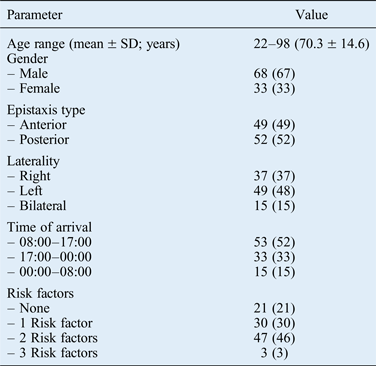
We included 101 patients who presented with epistaxis during the months of November and December 2012. The mean patient age was 70 years (range, 22–98 years). The majority of patients were male (n = 68). Half of our patients (52 per cent) presented during normal working hours (between 08:00 and 17:00), 33 per cent presented between 17:00 and 00:00, and 15 per cent presented after midnight. Posterior bleeds accounted for 52 per cent of cases (Table I).
Patient demographics

Data represent numbers (and percentages) of patients unless indicated otherwise. SD = standard deviation
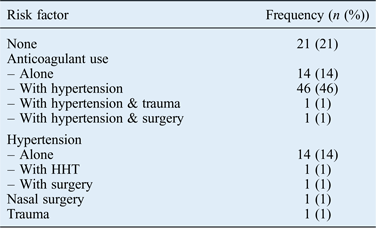
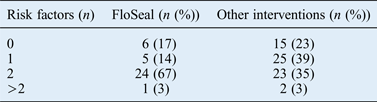
A high proportion of patients (79 per cent) had one or more risk factors for epistaxis. Anticoagulant use and hypertension were the most common risk factors (Table II). There was a slight difference between the FloSeal and non-FloSeal intervention group in terms of co-morbidities, with slightly more FloSeal patients having co-morbidities (Table III). Seventeen per cent of anticoagulated patients (11 out of 66) had their treatment reversed or stopped.
Risk factors
HHT = hereditary haemorrhagic telangiectasia
Risk factors: floseal versus other interventions
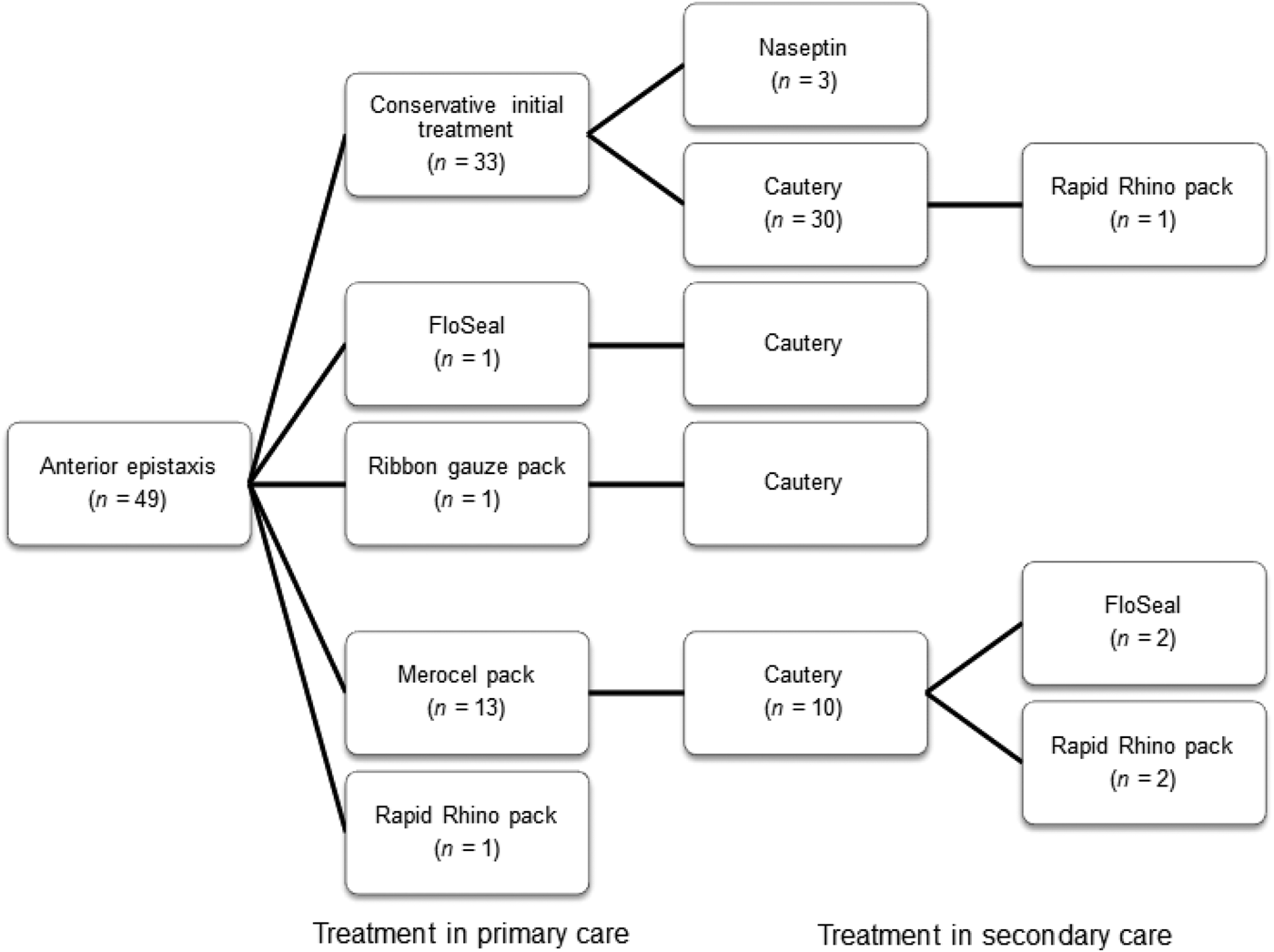
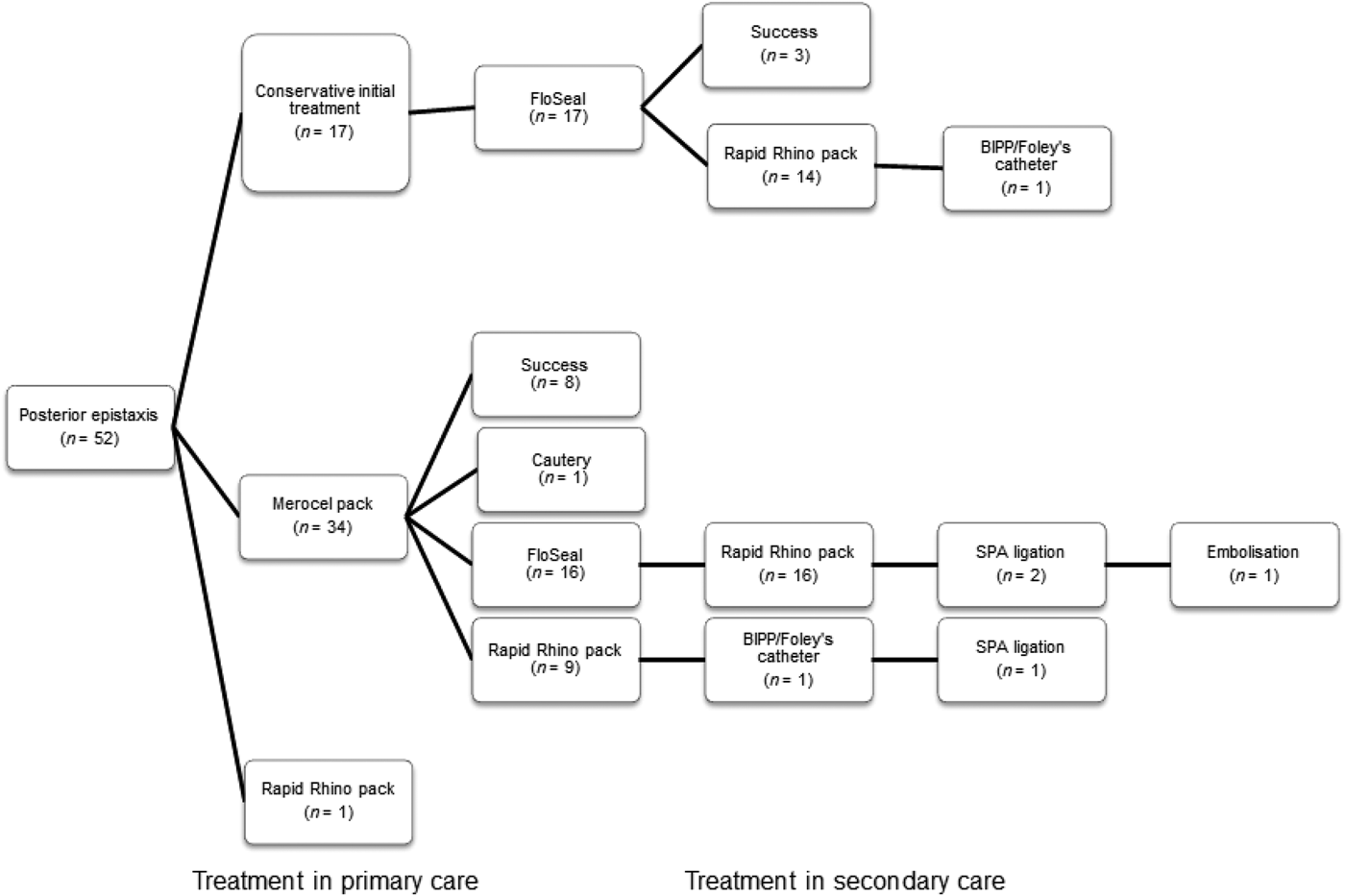
Figure 1 shows the course of management for patients with anterior epistaxis, most of whom were treated with nasal cautery (76 per cent). Figure 2 shows the course of management for patients with posterior epistaxis.
Management pathway of patients with anterior epistaxis.

Management pathway of patients with posterior epistaxis. BIPP = bismuth iodoform paraffin paste; SPA = sphenopalatine artery
FloSeal was used on 36 occasions. The total success rate was 14 per cent (5 out of 36 cases). It was successful in 2 out of 3 cases of anterior epistaxis (66 per cent) and in only 3 out of 33 cases of posterior epistaxis (9 per cent).
A Fisher's exact test indicated a significant difference in the success rates of FloSeal and nasal packing in the management of posterior epistaxis (9 per cent vs 92 per cent, respectively; p < 0.001).
No complications were recorded in our study.
Discussion
Our findings suggest that FloSeal has a limited role in the management of epistaxis. FloSeal had a significantly poor haemorrhage control rate when compared with nasal packing in posterior epistaxis cases. In our cohort, we only observed a 14 per cent success rate for FloSeal. Its bleeding control rate in posterior epistaxis cases alone was even lower (9 per cent) compared to that for nasal packing (92 per cent).
Our cohort of 33 patients is, to our knowledge, the largest series of posterior epistaxis patients managed with FloSeal to date. Limitations of our study include the lack of randomisation of the management technique, which may have resulted in selection bias. In addition, there were insufficient patients with anterior epistaxis treated by FloSeal to draw significant conclusions. However, we feel that this low number of patients is a result of the ease and effectiveness of other measures such as nasal cautery.
According to the manufacturer's instructions, FloSeal should be directly applied onto the bleeding vessel, and maintained at the source of the bleeding with gentle pressure for 2 minutes.Reference Oz, Rondinone and Shargill9, Reference Ujam, Awad, Wong, Tatla and Farrell14 This is difficult to achieve in posterior epistaxis cases as the flow rate of bleeding is usually high and this washes off the FloSeal matrix. The contact time is not long enough to facilitate clot formation. The application of FloSeal using the standard applicator was difficult, but we confirmed the presence of the FloSeal matrix on the bleeding area endoscopically. Baxter Health Care has introduced a new longer, malleable applicator for use specifically in the nasal cavities, with the aim of improving success rates; nevertheless, in our study this also failed to control bleeding.
We agree with the new epistaxis management pathway proposed by Meila and McGarry, who suggest using FloSeal as an alternative to nasal packing in anterior epistaxis cases where the Hippocratic technique and nasal cautery have failed.Reference Melia and McGarry15 These recommendations are based on the results of several clinical trials that showed successful haemostasis with FloSeal in anterior epistaxis cases.Reference Cote, Barber, Diamond and Wright8, Reference Mathiasen and Cruz13 In our study, FloSeal had a 66 per cent success rate in controlling anterior epistaxis (two out of three cases).
However, our study contradicts the high success rate achieved by other researchers using FloSeal for posterior epistaxis. Kilty et al.Reference Kilty, Al-Hajry, Al-Mutairi, Bonaparte, Duval and Hwang5 (whose study comprised 20 cases) and Cote et al.Reference Cote, Barber, Diamond and Wright8 (with 10 cases) both achieved an 80 per cent success rate with FloSeal. The differences in results could partially be attributed to sample size, but patient demographics and application technique may also play a part. We had a far higher percentage of anticoagulant users in our cohort (62 per cent in the current study vs 35 per cent and 10 per cent in the other two comparative studies); other demographic factors were comparable between the studies. Furthermore, Kilty et al. used a 2.75-inch angiocatheter instead of the standard FloSeal applicator after placing a temporising pack and a Foley's catheter in the postnasal space. Therefore, their success rate might be related to the pack and the Foley's catheter, rather than the FloSeal. Cote et al. used FloSeal on patients in whom nasal packing had previously failed. We used FloSeal as a primary treatment in over half of our cohort after initial conservative treatment had failed, with the aim of avoiding other treatments and hospital admission. With a retail price of £165, the high failure rate of FloSeal in our study and the need for a second FloSeal application (as advocated by Kilty et al.) renders it a less attractive option compared with nasal packing.
Proponents of FloSeal argue that it is more cost effective than nasal packing as it reduces hospital admissions.Reference Kilty, Al-Hajry, Al-Mutairi, Bonaparte, Duval and Hwang5 However, this is not borne out by the findings of Cote et al., where 70 per cent of patients required hospital admission and their stay ranged from 1 night to 7 days.Reference Cote, Barber, Diamond and Wright8
• Current management of epistaxis has significant drawbacks, including patient discomfort and the need for nasal packing and hospital admission
• Haemostatic agents such as FloSeal have been suggested as an effective treatment for bleeding
• In this study, the overall success rate of FloSeal in terminating epistaxis was 14 per cent
• FloSeal was successful in only 9 per cent of posterior epistaxis cases
• There was a significantly higher failure rate for FloSeal than nasal packing in posterior epistaxis cases
• The findings suggest that FloSeal has a limited role in the management of epistaxis
FloSeal is well tolerated by patients compared to nasal packing;Reference Kilty, Al-Hajry, Al-Mutairi, Bonaparte, Duval and Hwang5, Reference Cote, Barber, Diamond and Wright8, Reference Mathiasen and Cruz13 however, case studies and reports are emerging about its side effects profile. It is thought that FloSeal encourages granulomatous inflammation, which could lead to synechiae formation.Reference Chandra, Conley and Kern16–Reference Shrime, Tabaee, Hsu, Rickert and Close20 In our study, there were no serious early complications with FloSeal, but further investigation is needed.
Acknowledgements
The authors would like to thank Mrs Michaela Chambers and the staff of the Clinical Audit Department based at Freeman Hospital for their help in this study.