Introduction
Cancer of the head and neck strikes at the most basic human functions, i.e. the ability to eat, to communicate and to interact socially. Comprehensive assessment of the impact of head and neck cancer (from the disease itself and its treatment and rehabilitation) must go beyond traditional biomedical outcomes (e.g. survival and disease progression) to include patient well-being. Such non-traditional outcomes are classed under the term ‘quality of life’ (QoL).Reference Gotay and Moore1
Alteration of voice affects patients’ general QoL. The University of Washington QoL questionnaire is a broad measure suitable for assessment of disease-specific function.Reference Rogers, Lowe, Brown and Vaughan2 Many voice assessment tools are either derived by physicians or disease specific measurements, or combine general quality of life domains with voice symptoms.
The grade-roughness-breathiness-asthenia-strain scale is a short, simple scale appropriate for daily use by laryngologists and speech and language therapists.Reference Wuyts, Bodt, Molenberghs and Remacle3
The Voice Symptom Scale is a validated, patient-derived inventory of voice symptoms. This 30-item questionnaire is simple for patients to complete and easy to score, and reflects the wide range of communication, physical symptoms and emotional responses present in adult dysphonia cases.Reference Deary, Wilson, Carding and MacKenzie4 The questionnaire's total score indicates overall voice abnormality.Reference Deary, Wilson, Carding and MacKenzie4
Early glottic carcinoma can be effectively treated with conservative surgery or radiotherapy, with good results in terms of disease cure and voice preservation. Review of the management of tumour stage (T) one to T2 glottic carcinomas indicated that the local control, laryngeal preservation and survival rates are similar after transoral laser resection, open partial laryngectomy and radiotherapy.Reference Mendenhall, Werning, Hinerman, Amdur and Villaret5
In our hospital, early glottic carcinoma (i.e. tumour-node-metastasis (TNM) stages T1 N0 M0 and T2 N0 M0) has since 1999 been excised using transoral laser resection techniques, by two of our senior authors (APC and ARN). At the time of commencing this study, there was very limited information on the voice outcomes and QoL of patients undergoing these procedures. Concerns were raised by various authorities about the results of these procedures (regarding voice and QoL); it was feared that scarring and tissue loss may result, worsening patient's speech and QoL.
Previous studies have investigated patients’ QoL after treatment for early glottic tumours.Reference Smith, Johnson, Cognetti, Landsittel, Gooding and Cano6–Reference Stewart, Chen and Stach7 One study has assessed voice outcomes post-operatively.Reference McGuirt, Blalock, Koufman, Feehs, Hilliard and Greven8
The present study aimed to evaluate patients’ voice and QoL after transoral laser resection of early glottic carcinoma, and hence to generate data to facilitate future treatment decisions.
Patients and methods
Ethical consideration
Ethical approval for this study was granted by the York research ethics committee.
Written consent was obtained from all patients included in the study.
Methods
This study was a post-intervention, cross-sectional survey. We included in the study 19 patients who had undergone transoral laser resection of T1 or T2 glottic carcinoma between July 2000 and September 2003 at York Hospital, UK.
Patients with local or regional recurrence, second primaries or distant metastases were excluded. We also excluded patients who had previously undergone laryngeal surgery or radiotherapy, and those with pre-existing organic, functional or neurological laryngeal dysfunction.
Patients were asked to complete the Voice Symptom Scale and version four of the University of Washington QoL questionnaire.
The Voice Symptom Scale is a 30-item, validated questionnaire. Each item is scored on a five-point, frequency-based response scale, as 0 (= never), 1 (occasionally), 2 (sometimes), 3 (most of the time) or 4 (always). This questionnaire has three domains – impairment (15 items), emotional aspects (eight items) and related physical symptoms (seven items) – each with good internal consistency.Reference Wilson, Webb, Carding, Steen, MacKenzie and Dearey9 The total Voice Symptom Scale score ranges from 0 to 120, while individual domain scores range as follows: impairment 0–60; emotional aspects 0–32; and physical symptoms 0–28.
The fourth version of the University of Washington QoL questionnaire was used to assess patients’ QoL.Reference Weymuller, Alsarraf, Yueh, Deleyiannis and Coltrera10 This questionnaire focuses on patients' physical, social and emotional functioning. The main questionnaire has 12 domains, with a set of options (presented using a Likert scale) for each domain. The maximum (best) score is 100 and the minimum 0. The composite questionnaire score is the arithmetic mean of the 12 individual domain scores (maximum score = 100). In addition, there are four generic questions which reflect the patient's overall QoL, health-related QoL, and change in health-related QoL following surgery (‘transitional health-related QoL’).
Video-stroboscopic examination was performed in all patients, using a 70° rigid laryngoscope (Storz, Karl Storz, Germany). Recordings were made by one of the authors (ARHG). The following parameters were analysed: the percentage length and depth of the vocal fold defect; percentage contact between the vocal folds; percentage anterior commissure web; false vocal fold phonation; and presence of a ‘mucosal wave’. For those patients who could not tolerate a rigid endoscope, a flexible endoscope with a chip camera was used to assess the larynx.
Subjective voice analysis was performed using the grade-roughness-breathiness-asthenia-strain scale. Digital audio recordings of the patients reading the first two paragraphs of the rainbow passageReference Fairbanks11 were independently assessed by three independent speech and language therapists. These therapists were blinded to the treatment received by the patients and the extent of their initial lesions. Each patient's vocal grade, roughness, breathiness, asthenia and strain were assessed on a scale ranging from 0 to 3, with 0 = normal, 1 = slight, 2 = moderate and 3 = severe. These scores were then consolidated.
Objective phoniatric analysis of the digital voice recordings was performed by independent researchers at the department of electronics at York University, under the guidance of one of the authors (DMH). The fundamental frequency of each patient's voice was compared with pre-existing data for normal voices. Spectral voice analysis was also performed. The following parameters were measured: fundamental frequency, fundamental frequency irregularity, closed quotient range and closed quotient irregularity. Scores ranged from 1 (= normal) to four (= most abnormal).
Following data collection, we evaluated the relationship between patients’ voice symptom severity and QoL, and the relationship between their stroboscopy findings and grade-roughness-breathiness-asthenia-strain scale scores.
Statistical analysis
Statistical analysis was performed by a statistician at the research and development department at York Hospital. The data collected were non-parametric. Spearman's correlation coefficient was used to assess the correlation between different parameters.
Results
Our 19 patients’ glottic carcinomas were staged as T1 N0 M0 in 14 and T2 N0 M0 in five. All patients were male and aged from 54 to 87 years (mean age, 68 years). None of these patients had undergone vocal assessment with the techniques used in the study, prior to treatment.
Patient follow up ranged from 14 to 52 months (mean follow up, 33 months). Patients were assessed only once, a minimum of 12 months after surgery.
Grade-roughness-breathiness-asthenia-strain scale
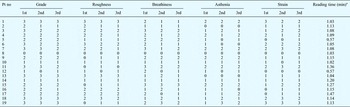
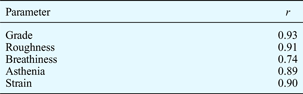
Scores for each parameter of this scale were independently given for each patient by three speech and language therapists (Table I). Intra-parameter correlation calculations revealed a high level of agreement amongst the three therapists (Table II). As the therapists’ scoring was consistent, the mean score given by all three therapists was calculated for each parameter. The overall vocal grade, roughness and breathiness was mild to moderate in 76.6 per cent of patients. Asthenia and strain was more uniformly distributed, with 21.9 per cent of patients having normal voice quality.
Grbas scale scores by 3 speech therapists

Individual speech therapists are identified as ‘1st’, ‘2nd’ and ‘3rd’. Scoring: 0 = normal, 1 = slight, 2 = moderate, 3 = severe. *Reading the rainbow passage. GRBAS = grade-roughness-breathiness-asthenia-strain; pt no = patient number
Grbas scale scores: intra-parameter correlations*
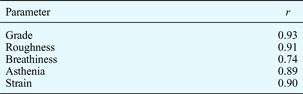
* Between 3 speech therapists working independently. GRBAS = grade-roughness-breathiness-asthenia-strain; r = correlation coefficient
Video-stroboscopy
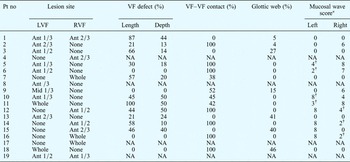
Details were recorded for each video-stroboscopic examination (Table III). Four patients could not tolerate stroboscopic examination and were excluded from this part of the analysis.
Video-stroboscopy findings

Note that stroboscopy could not be performed for patients 4, 8, 17 and 19. *Maximum score = 10. †Operated vocal folds with mucosal wave. Pt no = patient number; LVF = left vocal fold; RVF = right vocal fold; ant = anterior; NA = data not available; mid = middle
The length of the surgical defect varied from none (in four patients) to 100 per cent (in one). The depth of the defect varied from 10 to 50 per cent (mean, 22.2 per cent). The contact area between the vocal folds varied from 0 to 100 per cent (mean, 58.4 per cent). The extent of glottic webbing varied from 0 to 46 per cent (mean, 11.9 per cent). A mucosal wave was seen on the operated vocal fold in 46.7 per cent of patients (seven of 15).
Correlation coefficients were calculated for the various stroboscopy findings. No statistically significant correlation was found between the length or depth of the vocal fold defect and the presence of a mucosal wave.
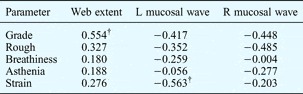
Anterior commissure involvement had been present in 10 patients pre-operatively, eight of whom developed a web in the post-operative period. Four of these patients had some degree of mucosal wave present on at least one vocal fold. There was a statistically significant correlation between a greater anterior commissure web extent and a worse grade of voice (r s = 0.554, p = 0.05, two-tailed) (Table IV).
Correlation* between stroboscopic findings and grbas scores

* Spearman correlation coefficient. †Significant correlation at p = 0.05 level (two-tailed). GRBAS = grade-roughness-breathiness-asthenia-strain scale; L = left; R = right
A mucosal wave was visible on the operated vocal fold in seven patients (46.7 per cent). This coincided with tumour excision restricted to only the anterior half to one-third of the vocal fold in five of these seven patients; however, in two patients the whole vocal fold was involved with tumour. A mucosal wave was absent on both sides in four patients, of whom one had bilateral disease and three unilateral disease involving the anterior commissure. The presence of a mucosal wave on the operated vocal fold was associated with lower strain on phonation (r s = 0.563, p = 0.05, two-tailed) (Table IV). However, there was no significant difference between patients with and without a mucosal wave, in terms of voice quality, as perceived by either the patients themselves or the speech and language therapists.
Voice Symptom Scale
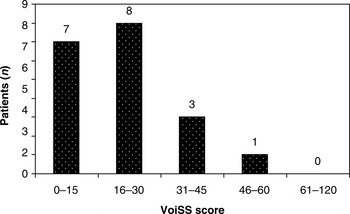
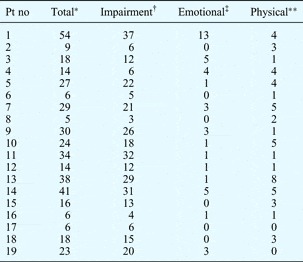
Voice Symptom Scale scores were calculated from completed questionnaires (Table V). The overall voice abnormality, as assessed by total Voice Symptom Scale score, is shown in Figure 1. The score was found to be low for the whole group, with 78.9 per cent (15/19) having a score of less than 30, indicating good voice quality in the majority of patients.
Voice Symptom Scale (VOISS) scores.

Voice symptom scale scores

Score ranges: *best = 0, worst = 120; †best = 0, worst = 60; ‡best = 0, worst = 32; **best = 0, worst = 28. Pt no = patient number
Analysis of communication impairment ratings showed that 10 patients gave a score of less than 15, seven gave a score of less than 30, and only two gave a score of more than 30. This indicates that 50.2 per cent of patients (10/19) had only minimal impairment of voice.
Scores for emotional and physical aspects of voice were low in the entire group, indicating good outcomes.
Overall analysis of Voice Symptom Scale results indicated that our patients had a reasonably good perception of their voice.
Objective voice analysis
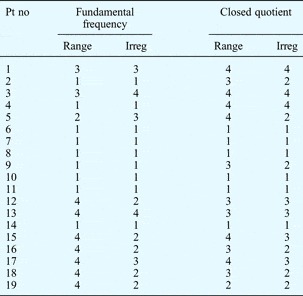
The results of objective voice analysis are shown in Table VI.
Objective voice analysis results

Scores: for range, 1 = normal, 2 = wider than normal, 3 = very much wider than normal, 4 = wider than normal particularly at high values; for irregularity (irreg), 1 = normal, 2 = more than normal, 3 = very much more than normal, 4 = highly irregular. Pt no = patient number
The fundamental frequency and degree of frequency irregularity were found to be normal in 47.3 per cent of patients (nine of 19). In the remaining 10 patients, the frequency range was found to be wider than normal (wider in one patient, very wide in two, and wider at high values in seven) and the frequency more irregular than normal (more irregular in five patients, very much more irregular in three, and highly irregular in two).
Closed quotient range and irregularity were normal in 31.5 per cent of patients (six of 19). For the other 13 patients, the closed quotient range was wider than normal (wider in one patient, very wide in six, and wider at high values in six) and the closed quotient irregularity more marked than normal (more irregular in six patients, very much more irregular in four, and highly irregular in three).
University of Washington quality of life questionnaire
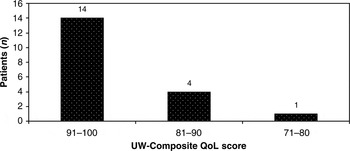
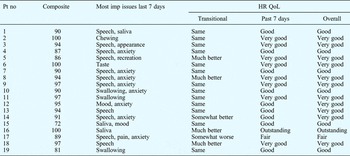
The University of Washington QoL questionnaire scores for this study group are shown in Table VII. The averaged composite QoL score was 90 or more in 14 patients (73.7 per cent) and 81–89 in four (21.1 per cent); only one patient (5.2 per cent) had a lower score (72) (Figure 2).
Averaged University of Washington quality of life version four questionnaire (UW-QOL) composite scores.

UW-QOL scores

UW-QOL = University of Washington Quality of Life version 4 questionnaire; pt no = patient number; imp = important; HR QoL = health-related quality of life
Speech, anxiety, mood, saliva and swallowing emerged as the most important issues faced by patients during the seven days preceding assessment.
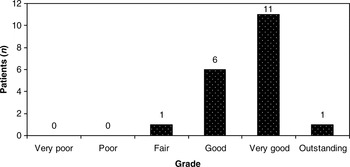
A total of 94.7 per cent of patients (18/19) felt that their post-operative health-related QoL was either the same (13 patients) or better (somewhat better for one patient, much better for four) than pre-operatively. Only one patient felt that their health-related QoL was somewhat worse than pre-operatively. Health-related QoL in the preceding seven days was reported to be very positive for all 19 patients (outstanding for one, very good for eight, good for nine and fair for one). Overall health-related QoL was reported to be positive for all patients (outstanding for one, very good for 11, good for six and fair for one) (Figure 3).
Patients’ overall health-related quality of life (QoL), from the University of Washington QoL version four questionnaire.

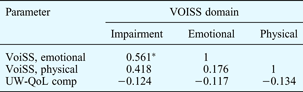
There was no statistically significant correlation between Voice Symptom Scale scores and University of Washington QoL questionnaire scores (Table VIII).
Correlation between voice symptom score and quality of life scores
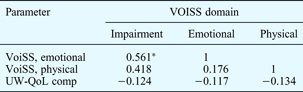
Correlations significant at p < 0.05 (2-tailed). VOISS = voice symptom scale; UW-QOL = University of Washington Quality of Life version 4 questionnaire; comp = composite score
Discussion
The impact of head and neck cancer is often devastating, as patients can suffer permanent loss of function.
Previous research found that the voice quality results of transoral laser resection for limited lesions were comparable to those of radiotherapy,Reference Mendenhall, Werning, Hinerman, Amdur and Villaret5, Reference McGuirt, Blalock, Koufman, Feehs, Hilliard and Greven8 whereas open partial laryngectomy yielded poorer results.Reference Mendenhall, Werning, Hinerman, Amdur and Villaret5 McGuirt and colleaguesReference McGuirt, Blalock, Koufman, Feehs, Hilliard and Greven8 compared voice results (assessed both subjectively and objectively) in patients with T1 glottic carcinoma undergoing radiotherapy (13 patients) and laser resection (11 patients), and found no statistically significant difference in post-operative voice quality.
The current study used the surgical resection technique described by Steiner.Reference Steiner12 The concept of this technique is that cutting through the tumour is essential, and is permissible in order to follow the tumour and find the edge of the desmoplastic stromal response to the tumour. This differs from Halsted's principle of ‘en-bloc’ resection. The principle behind Steiner's technique is that the CO2 laser beam vaporises and seals the surface it exposes, allowing the tumour to be cut into manageable pieces for extraction without disseminating cancer. This technique has disease control rates and functional results comparable to those of open surgery,Reference Steiner12 and it has been used at York Hospital since 1999.
In the current study, video-stroboscopic evaluation highlighted the increased risk of anterior vocal fold webbing following tumour excision from the anterior commissure. Furthermore, there was a statistically significant correlation between the presence of an anterior commissure web and a worse grade of voice (r s = 0.554, p = 0.05, two-tailed).
This was similar to the findings of Sittel et al.,Reference Sittel, Friedrich, Zorowka and Eckel13 who showed that preservation of the anterior commissure plays a key role in obtaining a good vocal outcome.
Studies have shown that disruption of the normal visco-elastic properties of the superficial lamina, and its replacement with fibrous tissue in the healing phase, lead to aberrant vocal fold vibration and mucosal wave propagation.Reference Colden, Jarboe, Zeitels and Bunting14 In the current study group, a pseudo-mucosal wave was observed on the operated vocal fold in seven patients (47 per cent).
The severity of dysphonia is traditionally assessed using both subjective judgement (via the grade-roughness-breathiness-asthenia-strain scale) and objective measures (i.e. stroboscopy and voice analysis). Subjective speech analysis and objective evaluation by a trained language therapist can produce variable results.Reference Hsiung, Lu, Kang and Wan15 In our study, three speech and language therapists independently assessed the recorded voices of patients, and there was good inter-operator agreement.
The grade-roughness-breathiness-asthenia-strain scale was originally proposed by the Japan Society of Logopedics, and is the perceptual judgement protocol most widely used by speech and language therapists.Reference Wuyts, Bodt, Molenberghs and Remacle3 In our study group, the overall voice grade, roughness and breathiness was mild to moderate in 84 per cent cases, with 15 per cent of patients having normal voice quality. The need for a range of outcome measures which reflect the multidimensional nature of voice problems has been acknowledged in the past.Reference Murry and Rosen16
The Voice Symptom Scale includes components derived from reports by affected patients,Reference Deary, Wilson, Carding and MacKenzie4 and also includes items reflecting well recognised aspects of dysphonia.
Two other measures frequently used to assess voice problems are the Voice Handicap Index and the Vocal Performance Questionnaire. The Voice Handicap Index has three domains – functional, physical and emotional – with 10 items in each domain.Reference Jacobson, Johnson, Grywalski, Silbergleit, Jacobson and Benninger17 However, the Voice Symptom Scale has better validated factor structure and better item coverage than the Voice Handicap Index. It also addresses related upper aerodigestive tract symptoms, which are well established correlates of dysphonia, and which also represent targets for therapeutic intervention.Reference Weymuller, Alsarraf, Yueh, Deleyiannis and Coltrera10 We therefore used the Voice Symptom Scale to assess our study group.
In the current study, the Voice Symptom Scale score was found to be low for the study group overall, with 78.9 per cent of patients (15/19) having a score less than 30, indicating good voice in the majority of patients. Ten of the 19 patients in our study (50.2 per cent) had minimal voice impairment. Furthermore, patients’ scores for emotional and physical aspects were low, indicating good outcomes. Overall, our patients’ perceptions of their voice, assessed using this scoring system, were reasonably good. Objective voice testing identified a normal fundamental frequency and frequency irregularity in 47.3 per cent of patients (nine of 19), and a normal closed quotient range and irregularity in 31.5 per cent (six of 19). These results are comparable to other, similar studies of voice outcomes after laser resection.Reference Brondbo and Benninger18
In recent years, there has been increasing interest in the use of QoL as an end-point in clinical trials of cancer treatment.Reference Gotay and Moore1 It is acknowledged that one questionnaire alone cannot adequately evaluate all aspects of QoL. However, the University of Washington QoL questionnaire appears to be a broad measure suitable for routine, low cost assessment of disease-specific functional status.Reference Rogers, Lowe, Brown and Vaughan2 For these reasons, we used this questionnaire in our study.
Smith et al. Reference Smith, Johnson, Cognetti, Landsittel, Gooding and Cano6 have reported excellent QoL outcomes and functional results in patients with glottic cancer treated with either surgery or radiotherapy. However, these authors concluded that, in addition to its actual costs, the hidden costs of radiotherapy were higher (in terms of total numbers of work hours missed, total travel time and travel distance), compared with surgical excision.
In the present study, the average University of Washington QoL composite score was 90 or more in 73.7 per cent of patients (14/19). A total of 18 patients (94.7 per cent) felt that their post-operative health-related QoL was either the same or better, compared with their pre-operative state. In addition, overall QoL was also reported as positive by patients. These results are similar to those reported by other authors.Reference Stoeckli, Guidicelli, Schneider, Huber and Schmid19
• This study undertook detailed subjective and objective evaluation of voice and quality of life (QoL) after transoral laser resection in 19 patients with early glottic carcinoma (tumour stage (T) one and T2)
• Good evidence of voice outcomes was obtained
• Transoral laser resection of T1 and T2 glottic carcinoma enables adequate tumour tissue excision together with preservation of acceptable vocal function; some patients had essentially normal voices
• The University of Washington QoL composite score was very good in most patients
There was no statistically significant correlation between the Voice Symptom Scale and University of Washington QoL questionnaire scores in the present study. Our findings are similar to those of Stewart et al.,Reference Stewart, Chen and Stach7 who found that self-rated ‘global’ health scores did not correlate significantly with voice handicap scores.
Following transoral endoscopic laser resection of early glottic tumours, patients with a weak voice may be considered for thyroplasty (18 months after the initial procedure), provided there is no evidence of tumour recurrence.
Conclusion
Transoral Laser resection for T1 and T2 glottic carcinomas allows for excision of tumour tissue with preservation of acceptable vocal function, with essentially normal voice in some cases. Quality of life was very good in most of these patients. Anterior commissure web formation was associated with poorer vocal function.
Acknowledgements
We acknowledge J N V Miles, Statistician at the Research and Development Department, York Hospital, for his help with statistical advice and calculations. We also thank Speech and Language Therapists R Wallace, E Taylor and J Denham for their help with this study.