INTRODUCTION
A division of labour has recently been observed in some species of parasitic trematodes (Hechinger et al. Reference Hechinger, Wood and Kuris2011; Leung and Poulin, Reference Leung and Poulin2011; Miura, Reference Miura2012). Trematodes have complex life cycles, requiring transmission of specific life cycle stages to two or more sequential hosts. Juvenile trematodes (either rediae or sporocysts, depending on the species) live within a first intermediate host (most commonly a gastropod) where they asexually reproduce, forming a clonal colony (Galaktionov and Dobrovolskij, Reference Galaktionov and Dobrovolskij2003). In many trematode species, including the two species in this study, the life cycle continues when free swimming life cycle stages (cercariae) develop within either the rediae or sporocysts and leave the gastropod host to encyst in or on a second intermediate host (Galaktionov and Dobrovolskij, Reference Galaktionov and Dobrovolskij2003). In colonies of species with a division of labour (including Philophthalmus sp.), there exist two distinct morphs or castes within the redial colony: a large, reproducing caste and a small, non-reproducing caste (Hechinger et al. Reference Hechinger, Wood and Kuris2011; Leung and Poulin, Reference Leung and Poulin2011; Miura, Reference Miura2012). Individuals from the large and small caste in Philophthalmus sp. differ in size (small rediae are <1 × 106 μm3 while large rediae are between 1–30 × 106 μm3), morphology (mouthparts and pharynxes of small rediae are dramatically larger, relative to body size, than those of large rediae), development (small rediae lack germinal balls while mature large rediae contain 10–20 germinal balls or cercariae, depending on their stage of development), and behaviour (small rediae are more active) (Leung and Poulin, Reference Leung and Poulin2011). The small rediae do not grow into large rediae, though there is behavioural plasticity observed among individuals of both the small and large castes (Kamiya and Poulin, Reference Kamiya and Poulin2013a ). It has been hypothesized, based on the behaviour of rediae and parallels to the well-studied division of labour in social insects, that the small, non-reproducing rediae are specialized for defence against co-infecting trematode colonies (Hechinger et al. Reference Hechinger, Wood and Kuris2011).
Philophthalmus sp. infects the common New Zealand mudsnail, Zeacumantus subcarinatus, as its first intermediate host (Martorelli et al. Reference Martorelli, Fredensborg, Leung and Poulin2008). At least four other trematode species commonly infect this host and one host individual can be infected by multiple species or multiple colonies of the same species (Martorelli et al. Reference Martorelli, Fredensborg, Mouritsen and Poulin2004, Reference Martorelli, Poulin and Mouritsen2006, Reference Martorelli, Fredensborg, Leung and Poulin2008; Keeney et al. Reference Keeney, Boessenkool, King, Leung and Poulin2008). In the first intermediate host, competition between trematode colonies is expected for resources of space and food (Sousa, Reference Sousa1992; Poulin, Reference Poulin2001). Indeed, competition between Philophthalmus sp. and the most common trematode infecting Z. subcarinatus, Maritrema novaezealandensis, is strong. The cercarial output from Philophthalmus sp. colonies co-infected with M. novaezealandensis is lower than that of Philophthalmus sp. colonies without competition, both in vitro and in vivo (Lloyd and Poulin, Reference Lloyd and Poulin2012, Reference Lloyd and Poulin2013).
Since interspecific competition is strong between Philophthalmus sp. and M. novaezealandensis, it is likely that the small rediae play an adaptive role in the interaction between these two species. This has been investigated in the past by quantifying the caste ratio (the number of small rediae in relation to the number of large rediae) from colonies with and without competition (Leung and Poulin, Reference Leung and Poulin2011; Kamiya and Poulin, Reference Kamiya and Poulin2013b ; Lloyd and Poulin, Reference Lloyd and Poulin2013). The theory of optimal caste ratios, derived from the social insect literature, predicts that in colonies with a division of labour, selection will act on the colony as a whole instead of acting on individuals. Furthermore, colony demographic traits such as caste ratio should be adaptive and optimized to varying environmental conditions (Oster and Wilson, Reference Oster and Wilson1978). Evidence supporting this theory comes from both intraspecific competitive interactions in ants (Passera et al. Reference Passera, Roncin, Kaufmann and Keller1996) and interspecific competitive interactions in polyembryonic wasps (Harvey et al. Reference Harvey, Corley and Strand2000). When applied to trematodes with a division of labour, this theory predicts that the number of small rediae in relation to large rediae should be higher in colonies involved in competitive interactions. The evidence for this happening in Philophthalmus sp. colonies is not consistent: field-collected colonies show no difference in caste ratio between those with or without co-infection by the competitor M. novaezealandensis (Leung and Poulin, Reference Leung and Poulin2011; Kamiya and Poulin, Reference Kamiya and Poulin2013b ). However, the caste ratio of in vivo Philophthalmus sp. colonies exposed to interspecific competition maintained for weeks in a laboratory experiment increased compared with those colonies without interspecific competition (Lloyd and Poulin, Reference Lloyd and Poulin2013). Furthermore, Philophthalmus sp. colonies from geographical locations with a very high combined prevalence of all trematode species have a higher caste ratio than colonies from locations with a low trematode prevalence (M. Lloyd, unpublished data).
To date, however, the role of small non-reproductive rediae has only been investigated in the context of interspecific competition between different trematode species sharing the same snail host. Intraspecific competition has been frequently documented in numerous trematode species in their first intermediate host (Minchella et al. Reference Minchella, Sollenberger and Desouza1995; Dabo et al. Reference Dabo, Durand, Morand, Diakite, Langand, Imbert-Establet, Doumbo and Jourdane1997; Sire et al. Reference Sire, Durand, Pointier and Theron1999; Theron et al. Reference Theron, Sire, Rognon, Prugnolle and Durand2004; Rauch et al. Reference Rauch, Kalbe and Reusch2005; Keeney et al. Reference Keeney, Waters and Poulin2007). This competitive interaction is hypothesized to have a negative impact on both colonies as trematode colony growth is generally limited by the resources of space and food within the host (Kuris and Lafferty, Reference Kuris and Lafferty1994; Read and Taylor, Reference Read and Taylor2001). The incidence of hosts with mixed genotype infections (and thus competing colonies of the same species resulting from separate infections of the snail by different miracidia) is generally positively related with infection prevalence of that species (Louhi et al. Reference Louhi, Karvonen, Rellstab, Louhi and Jokela2013): for example, only 11·6% of all Schistosoma mansoni infected snails were mixed genotype infections when the overall prevalence of S. mansoni was 0·21–4·76% (Sire et al. Reference Sire, Durand, Pointier and Theron1999) while up to 48% of M. novaezealandensis infections are mixed genotype infections when the overall prevalence can be up to 80% (Keeney et al. Reference Keeney, Waters and Poulin2007). Intraspecific competition has also been found to be strong, as it significantly reduces the fitness of each colony involved in the interaction. The cercarial output from mixed genotype infected hosts is not higher than that from single genotype-infected hosts, indicating that the output per colony in mixed genotype infections is reduced (Davies et al. Reference Davies, Fairbrother and Webster2002; Karvonen et al. Reference Karvonen, Rellstab, Louhi and Jokela2012). However, the incidence of mixed genotype infections can be higher than expected by chance, indicating either a passive demographic aggregation of parasites in hosts or an advantage of existing in a mixed genotype infection (Minchella et al. Reference Minchella, Sollenberger and Desouza1995; Louhi et al. Reference Louhi, Karvonen, Rellstab, Louhi and Jokela2013). The facilitation hypothesis, which explains the benefits of existing in mixed genotype infections in the first intermediate host, postulates that mixed genotype infections are more successful because the genetically diverse cercariae they release have a greater chance of evading the second intermediate host's immune systems when infecting it at the same time, increasing transmission success (Karvonen et al. Reference Karvonen, Rellstab, Louhi and Jokela2012).
Since the prevalence of Philophthalmus sp. is relatively high at Lower Portobello Bay (site of present study; up to 13%), intraspecific competition is expected to occur when host individuals are infected by multiple Philophthalmus sp. colonies. Only a negative consequence would be expected from mixed genotype infections in this system. Studies of interspecific competition (between Philophthalmus sp. and M. novaezealandensis) indicate that competitive interactions have a negative impact on Philophthalmus sp. colony fitness (Lloyd and Poulin, Reference Lloyd and Poulin2012, Reference Lloyd and Poulin2013) and cercariae of this species, after exiting the snail host, encyst on the shell of the second intermediate host (Neal and Poulin, Reference Neal and Poulin2012) so there would be no benefit of mixed genotype infections evading the second intermediate host's immune system.
Perhaps the small rediae in Philophthalmus sp. colonies are also specialized for defence against conspecific colonies. Previous studies considered only the effect of interspecific competition on the division of labour in this species, and thus ignored how caste ratios may respond to competitive interactions from conspecifics. If intraspecific competition were playing a role in this novel trait, we predict the small-to-large caste ratio to be higher in infections made up of more than one Philophthalmus sp. colony (mixed genotype infections). The aims of this study were to, first, quantify the frequency and the strength of intraspecific competitive interactions faced by Philophthalmus sp. colonies, and, second, determine if the division of labour in this species plays a role in these interactions. This was achieved by using molecular markers to identify hosts infected by mixed genotypes, counting the total number of rediae in each host, and calculating the small-to-large caste ratio in these colonies. This is the first study to identify and quantify intraspecific competition in a trematode species with a division of labour, and to assess the effects of intraspecific competition on the expression of this novel trait.
METHODS
Snail collection, dissection, counting ratio
Approximately 2000 Z. subcarinatus mud snails were collected from Lower Portobello Bay, Otago Harbour, South Island (45°52′S, 170°42′E) in September and November 2012. Philophthalmus sp. infection prevalence is high at this site compared with others and therefore, mixed genotype infections are expected. All snails larger than 11·0 mm were screened to quickly identify Philophthalmus sp. infections. This was done by forcing cercarial emergence by incubating individual snails overnight at 26 °C in wells of a 12-well culture plate filled with natural seawater. The maximum shell length of Philophthalmus sp. infected snails was measured to the closest 0·1 mm before dissection. The snail visceral mass was dissected out of the snail shell and teased apart to release Philophthalmus sp. rediae. Rediae were dyed with Neutral Red, and pressed between two glass slides. Philophthalmus sp. small and large rediae were counted separately. Large and small rediae were differentiated using both size and morphology. The size difference of individuals from the two castes is dramatic (Leung and Poulin, Reference Leung and Poulin2011), and the pharynxes of the small rediae (which are dyed dark red by the Neutral Red) are much larger than those of the large rediae, relative to body size. The caste ratio was calculated as the number of small rediae divided by the number of large ones. Approximately one third of the rediae, taken equally from small and large ones, were collected from each infection and used in genetic analysis to detect mixed genotype infection. Rediae from each infection were pooled in separate 1·5 mL Eppendorf tubes and washed three times with 95% ethanol. Philophthalmus sp. infected snails with co-infections by M. novaezealandensis were also included.
Genetics analysis
Mixed genotype infections were identified using a set of eight microsatellite markers (see Supplementary Material – in Online version only for methods used in designing microsatellite markers). Ethanol was carefully removed from the tube containing the pooled rediae from one snail and 400 μL 5% Chelex solution containing 0·2 mg mL−1 proteinase K was added. They were incubated at 60 °C overnight and boiled at 95 °C for 8 min. Tubes were centrifuged for 10 min at 20 817 g (Eppendorf centrifuge 5430). DNA in the supernatant was collected and the concentration was determined using a NanoDrop (ND-1000 spectrophotometer).
The eight microsatellite markers were designed to use the same PCR conditions (Supplementary Table 1S – in Online version only). PCRs consisted of 15 ng DNA, 0·45 U DNA Polymerase (MyTaq Red, BIO-21108, BIOLINE), 0·04 μ m forward primer, 0·16 μ m reverse primer, 0·16 μ m fluorescently dyed M13(-21) primer, 1X MyTaq red buffer (1 mm dNTPs, 3 mm MgCl2, stabilizers, and enhancers), made up to 10 μL with milliQ water. Products were amplified using an Eppendorf Mastercycler ep gradient S thermocycler and consisted of an initial 2 min at 94 °C, 30 cycles of denaturation (94 °C, 30 s), annealing (55 °C, 45 s), and extension (72 °C, 45 s), followed by 12 cycles to further amplify the dyed primer which included denaturation (94 °C, 25 s), annealing (53 °C, 45 s), and extension (72 °C, 45 s); final extension time was 10 min at 72 °C followed by 30 min at 60 °C. Electrophoresis of the amplified products was performed using the ABI 3730xl DNA Analyser (Applied Biosystems, Foster City, CA, USA). Chromatograms were scored using GeneMarker (Softgenetics, LLC, State College, PA, USA). Colonies were scored as consisting of more than one genotype if there were three or more peaks at any locus. Peaks were scored conservatively to be sure genotypes which occurred at a very low frequency were not overlooked. In any case of a discrepancy between a peak that could be a background stutter peak or an additional allele, it was scored as an additional allele.
In addition, allele frequencies estimated from individually genotyped rediae from 19 colonies were used to differentiate between single infection colonies and colonies which were potentially mixed infections masked by being homozygous at all tested loci (Supplementary Table 2S – in Online version only). For example, if results of our genetic analysis showed a colony was heterozygous at all tested markers, this colony could be either a single infection with a high level of heterozygosity, or a mixed infection which was not identified. This was done using loci which appeared homozygous according to our genetic analysis and calculating the probability of these homozygous loci occurring four times (trematodes are diploid, i.e. there would be four copies of an allele at each locus in the case of a double genotype infection). Any colony with a probability of mixed infection lower than 10−7 was considered a single infection colony, any colony showing three or more peaks at any locus was classified as a guaranteed mixed genotype colony (see above), and all remaining colonies were considered unclassifiable and not used in the statistical analysis.
Statistical analyses
All statistical analyses were completed in R version 2.14.0 (R Development Core Team, 2011). Linear Models (LMs) in the package Stats (R Development Core Team, 2011) were used to compare colony organization between colonies with and without inter- or intraspecific competition. The small-to-large caste ratio was compared between Philophthalmus sp. single infection colonies, mixed species colonies (those co-infected with M. novaezealandensis), and mixed genotype colonies. Predictor variables in the LM included the competition status (either single, mixed species or mixed genotype), the total number of rediae, and host size (shell length). The caste ratio was log transformed to meet assumptions of normality. The total number of rediae was also compared between colonies. Predictor variables in this case included the small-to-large caste ratio, host size and infection status (either single, mixed species or mixed genotype). The total number of rediae was log transformed to meet assumptions of normality. Post hoc tests were performed to detect differences in either caste ratio or total number of rediae between group pairs (i.e. single infection vs mixed genotype infection, single infection vs mixed species infection, and mixed genotype infection vs mixed species infection) using the Multcomp package (Hothorn et al. Reference Hothorn, Bretz and Westfall2008).
RESULTS
Single and mixed infections
Sixty-four Philophthalmus sp. snails were dissected, their sizes ranging from 11·9–19·2 mm. The genotype of each infection was determined using eight microsatellite markers. Infections were scored as containing multiple infections if there were three or more alleles observed at any one locus. Eight multiple infections were observed. Of the remaining 56 infected snails, 10 had double species (Philophthalmus sp. and M. novaezealandensis) infections and were put in the mixed-species infection category. For the remaining infected snails, a probability was calculated to determine the likelihood that the infection consisted of only a single genotype (Supplementary Table 3S – in Online version only). Infections were scored as single infections when the probability of mixed infection was below 10−7. Such a conservative cut-off was chosen because of the relatively large initial sample size. Using this cut-off, there were 27 single genotype infections. The remaining 19 infections were not classifiable as being either single or mixed genotype infections, and are hereafter excluded.
Effects of competition
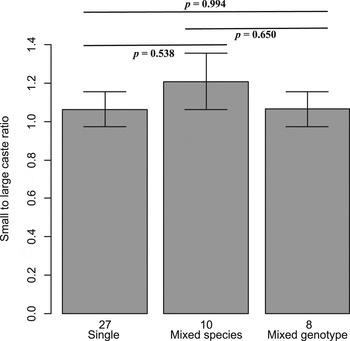
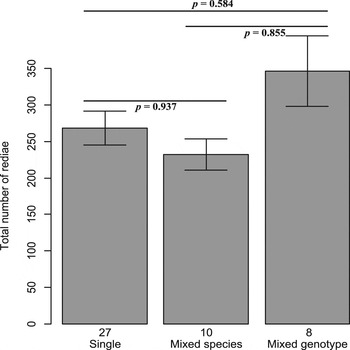
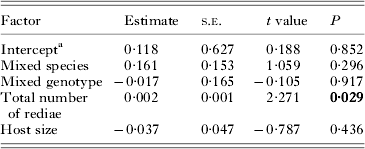
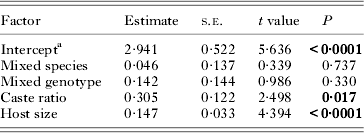
The small-to-large caste ratio of all 64 colonies ranged from 0·48–2·44. It did not differ between single genotype colonies, mixed species infections, or mixed genotype infections (Fig. 1). The total number of rediae per colony was a significant predictor variable in this model: there was a positive effect of total rediae on the small-to-large caste ratio (Table 1). The total number of rediae per colony from all 64 colonies ranged from 79–583. Similarly to caste ratio, there was no difference in the total number of rediae between single genotype colonies, mixed species colonies, and mixed genotype infections (Fig. 2). Significant factors in the linear model included the small-to-large caste ratio and the snail length (Table 2). Post hoc tests indicate there was no difference in either small-to-large caste ratio or total number of rediae between any group pairs (Figs 1 and 2). Therefore, there was no effect of either inter- or intraspecific competition on colony organization (caste ratio or total number of rediae). To check if there was an effect of competition regardless of whether it was inter- or intraspecific, a further linear model was performed which compared single infection colonies vs the combined mixed genotype colonies and mixed species colonies. However, this additional analysis also showed that there was no effect of competition on either the small-to-large caste ratio (P = 0·511) or the total number of rediae (P = 0·396).
Average (±s.e.) caste ratio of small-to-large rediae in Philophthalmus sp. single infection colonies, mixed species colonies, or mixed genotype colonies. P values from post hoc comparisons between each possible pair.

Average (±s.e.) number of rediae in Philophthalmus sp. single infection colonies, mixed species colonies, or mixed genotype colonies. P values from post hoc comparisons between each possible pair.

Results of a linear model comparing the small-to-large caste ratio of Philophthalmus sp. single infection colonies, mixed species colonies, or mixed genotype colonies. Bold numbers indicate P<0·05

a The effect of the single infection is included in the intercept.
Results of a linear model comparing the total number of rediae from Philophthalmus sp. single infection colonies, mixed species colonies, or mixed genotype colonies. Bold numbers indicate P<0·05

a The effect of the single infection is included in the intercept.
DISCUSSION
This is the first study that has identified mixed genotype Philophthalmus sp. infections in their first intermediate host, Z. subcarinatus, and the results of this study suggest that intraspecific competition does occur. Of the 64 Philophthalmus sp. infected snails used in this study, eight were mixed genotype infections and the total number of rediae did not differ between single or mixed genotype infections (Fig. 2). If intraspecific competition were absent, each individual colony in mixed genotype infections would achieve roughly the same size regardless of the presence of a conspecific colony, and the total number of rediae per snail should thus be at least two-fold higher in snails with multiple infections. Here it was found that the colonies in mixed genotype infections are made up of fewer rediae per colony than those in single genotype infections.
Furthermore, intraspecific competition is perhaps stronger than interspecific competition. Studies of interspecific competition between Philophthalmus sp. and M. novaezealandensis have found that the number of Philophthalmus sp. rediae does not differ significantly between single and double species infections. While the presence of M. novaezealandensis does not inhibit colony growth or size of Philophthalmus sp. colonies, it does have a negative impact on cercarial output (Keeney et al. Reference Keeney, Boessenkool, King, Leung and Poulin2008; Lloyd and Poulin, Reference Lloyd and Poulin2011, Reference Lloyd and Poulin2012). While cercarial output from mixed vs single genotype infections was not quantified in this study, the number of rediae per colony in mixed genotype infections is greatly reduced. It is most likely that the cercarial production per colony is reduced as well, as was seen in a similar trematode species (Karvonen et al. Reference Karvonen, Rellstab, Louhi and Jokela2012).
Despite the presence and hypothesized strength of intraspecific competition, it had no effect on the small-to-large caste ratio in Philophthalmus sp. colonies (Table 1), leading us to believe the division of labour in this species does not play a role in competition against conspecific co-infections. More evidence for this comes from the fact that the small-to-large caste ratios from colonies taken from two sites (Lower Portobello Bay, the site used in this study, and McCormack's Bay Reserve, Christchurch) are similarly high despite substantial differences in Philophthalmus sp. prevalence (up to 13% at Lower Portobello and only 2·5% in McCormack's Bay) (M. Lloyd, unpublished data). All else being equal, and invoking only passive infection mechanisms, a higher prevalence should result in a higher frequency of multiple conspecific infections of the same snail, i.e. more mixed genotype infections. Given that the overall trematode prevalence at these two sites was similar (Lower Portobello Bay = 53·9%; McCormack's Bay = 59·3%), if intraspecific competition was a driving factor in the production of small rediae, a higher ratio would be expected from Lower Portobello Bay. The fact that we did not see this pattern is not entirely surprising as small soldier-like rediae in two other philophthalmid species do not attack conspecific rediae but do attack heterospecific rediae when kept in in-vitro culture (Miura, Reference Miura2012). However, it is possible for small trematode rediae to identify and attack conspecific individuals in another trematode species from a different family (Hechinger et al. Reference Hechinger, Wood and Kuris2011).
Based on the hypothesis that intraspecific competition may be stronger than interspecific competition, it is surprising that small trematode rediae in all species with a division of labour do not readily attack conspecific individuals. Perhaps this is due to the heterogeneity of infection prevalence at different sites. For example, the prevalence of Philophthalmus sp. is high at Lower Portobello Bay but dramatically lower at other sites around New Zealand (Keeney et al. Reference Keeney, King, Rowe and Poulin2009). Substantial gene flow appears to be occurring between these sites (Keeney et al. Reference Keeney, King, Rowe and Poulin2009), which can limit the potential for local adaptation. If the frequency of intraspecific competition is very low throughout most of the geographical range of Philophthalmus sp., then the selection pressure to allow for the evolution of conspecific recognition might be relatively weak everywhere except for unusual sites such as Lower Portobello Bay. This could also explain why, in a different system (California coast) involving different trematode species, Himasthla sp. B can recognize conspecific individuals but Philophthalmid sp. I, Philophthalmid sp. II and Acanthoparyphium sp. I cannot. Infection prevalence of Himasthla sp. B is relatively high in its first intermediate host from multiple sites: up to 15·5% from Santa Barbara and 20% from San Francisco (Sousa, Reference Sousa1992; Lafferty et al. Reference Lafferty, Sammond and Kuris1994). If all, or almost all, populations of Himasthla sp. B encounter intraspecific competition, it would be advantageous for the small rediae to be able to identify conspecific individuals. While information on prevalence is not as readily available for Philophthalmid sp. I and Acanthoparyphium sp. I, the prevalence of Philophthalmid sp. II is highly variable around Japan (Miura et al. Reference Miura, Kuris, Torchin, Hechinger, Dunham and Chiba2005) and the occurrence of intraspecific competition totalled across all populations is probably low.
The results of this study do not indicate that small-to-large caste ratios in Philophthalmus sp. colonies are responding to either inter- or intraspecific competition in field-collected snails (Table 1). If the role of the small rediae is to defend the colony against co-infecting trematode colonies, then according to the theory of optimal caste ratios, a higher small-to-large caste ratio would be expected in colonies from hosts where competition is occurring. While this response has been seen in snails kept in laboratory conditions long term (Lloyd and Poulin, Reference Lloyd and Poulin2013), it has not been seen in field-collected snails, in the context of interspecific competition (Leung and Poulin, Reference Leung and Poulin2011; Kamiya and Poulin, Reference Kamiya and Poulin2013b ).
Just as evidence for this theory from trematode species is varied, evidence from species of social insects is inconsistent as well. Caste ratios in colonies of two species from the ant genus Pheidole respond differently to competition: caste ratio is altered in Pheidole pallidula colonies when faced with intraspecific competition (Passera et al. Reference Passera, Roncin, Kaufmann and Keller1996) while the caste ratio is not altered in Pheidole dentate colonies when under pressure from a competing species which provokes aggressive behaviour from soldier individuals (Johnston and Wilson, Reference Johnston and Wilson1985). Furthermore, evidence that competing conspecific individuals can be identified and defended against is also not consistent among studies on social insects. For example, two species of termite respond differently to intraspecific competition: an increase in soldier numbers is observed in Zootermopsis nevadensis colonies when faced with intraspecific competition (Thorne et al. Reference Thorne, Breisch and Muscedere2003) while Microcerotermes crassus colony members are not aggressive toward conspecific colonies (Wong and Lee, Reference Wong and Lee2010).
Perhaps the conflicting evidence for a defensive role of the small rediae in trematode colonies indicates that their role (or the role of soldier individuals in insect colonies) is more complex than originally assumed and is responsive to a suite of environmental factors in the field. Perhaps the role of the small rediae is to access nutrient sources within the snail that are not readily available to the large rediae. In this case, the division of labour would respond to variation in nutrient availability within the host. This hypothesis stems from an observation of in vitro cultured rediae where cultures of large and small rediae in contact with each other remained healthier for longer than cultures of rediae not in contact (M. Lloyd, personal observation). Another possible role of the small rediae could be to defend the host against secondary microbial infection to ensure prolonged host survival. Here, the division of labour would respond to any such infection. This would be similar to the role of non-reproductive individuals in gall-forming thrips, Kladothrips intermedius, where non-reproductive individuals have enlarged forelimbs which secrete antifungal compounds capable of controlling insect fungal pathogens (Turnbull et al. Reference Turnbull, Caravan, Chapman, Nipperess, Dennison, Schwarz and Beattie2012). These hypotheses could be tested in the future using an in vitro culture system designed specifically for Philophthalmus sp. by looking at culture survival or metacercarial output under different nutrient or microbial treatments (Lloyd and Poulin, Reference Lloyd and Poulin2011).
ACKNOWLEDGEMENTS
We would like to thank Tania King for technical assistance and the Otago Parasite Laboratory for comments on an earlier version.
FINANCIAL SUPPORT
This project was funded by the Department of Zoology, University of Otago.
Supplementary material
To view supplementary material for this article, please visit http://dx.doi.org/10.1017/S0031182013001492.