1. Introduction
The Aglaspidida (used in the sense of the ‘Aglaspidida sensu stricto’ of Van Roy, Reference Van Roy2006) is a monophyletic group of relatively poorly understood extinct arthropods. Most described species come from the Furongian Saint Lawrence Formation of Wisconsin, USA (Raasch, Reference Raasch1939; Hesselbo, Reference Hesselbo1992); however, recent reports indicate that these arthropods also occurred in South China (Lerosey-Aubril, Ortega-Hernández & Zhu, Reference Lerosey-Aubril, Ortega-Hernández and Zhu2013) and NW Tasmania (Ortega-Hernández et al. Reference Ortega-Hernández, Braddy, Jago and Baillie2010) at that time. Additionally, a few representatives have been described from the Ordovician of South Wales (Fortey & Rushton, Reference Fortey and Rushton2003, Reference Fortey and Rushton2009), Morocco (Van Roy, Reference Van Roy2006; Van Roy et al. Reference Van Roy, Orr, Botting, Muir, Vinther, Lefevbre, Hariri and Briggs2010) and China (Fortey & Theron, Reference Fortey and Theron1994; see also Ortega-Hernández, Legg & Braddy, Reference Ortega-Hernández, Legg and Braddy2013). Ortega-Hernández, Legg & Braddy (Reference Ortega-Hernández, Legg and Braddy2013) recently recognized two sub-groups within the Aglaspidida: a ‘Cambrian-type’ clade that includes representatives whose morphology has been interpreted as plesiomorphic for the group, and an ‘Ordovician-type’ clade that includes species characterized by a suite of derived characters. Furthermore, the fossil record of aglaspidids is exceedingly fragmentary, and thus many aspects of the evolutionary history and palaeobiology of the group remain elusive (Lerosey-Aubril, Ortega-Hernández & Zhu, Reference Lerosey-Aubril, Ortega-Hernández and Zhu2013).
Here we describe a new aglaspidid from the Guzhangian Weeks Formation in Utah, making this the oldest representative of the group. The arthropod is recognized as a new species of Tremaglaspis, a genus as-yet known exclusively from the Lower Ordovician (Fortey & Rushton, Reference Fortey and Rushton2003, Reference Fortey and Rushton2009). This discovery indicates that aglaspidids underwent a cryptic diversification prior to their comparatively more widespread record in the Furongian.
2. Geological setting
The Weeks Formation (Guzhangian Stage, Cambrian Series 3; Robison & Babcock, Reference Robison and Babcock2011) is the least well known of the three Cambrian Konzervat-Lagerstätten present in the House Range in Utah. It crops out only on the NE slopes of Notch Peak, where it conformably overlies the Marjum Formation, and is conformably overlain by the Orr Formation. The Weeks Formation has yielded rich assemblages of trilobites, which are remarkable for the abundance of articulated specimens (e.g. Adrain, Peters & Westrop, Reference Adrain, Peters and Westrop2009; Robison & Babcock, Reference Robison and Babcock2011) and for the rare but exquisite preservation of their digestive structures (Lerosey-Aubril et al. Reference Lerosey-Aubril, Hegna, Kier, Bonino, Habersetzer and Carré2012). The ‘shelly’ fauna also comprises abundant inarticulate brachiopods, rare echinoderms, hyolithids and sponges (e.g. Walcott, Reference Walcott1908; Rowell, Reference Rowell1966; Ubaghs & Robison, Reference Ubaghs and Robison1985; Streng & Holmer, Reference Streng and Holmer2006). The upper part of the Weeks Formation has also yielded a rather diverse fauna of soft-bodied or weakly biomineralized organisms, dominated by aglaspidids, aglaspidid-like arthropods (sensu Van Roy, Reference Van Roy2006; e.g. Beckwithia typa Resser, Reference Resser1931) and worms (palaeoscolecids, priapulids).
3. Material and methods
Two complete specimens collected in the upper part of the Weeks Formation in the North Canyon were studied. BPM 1042a is the internal mould of the dorsal exoskeleton of an individual orientated parallel to the bedding plane. BPM 1035 is preserved as a lateral compression; most of its mineralized dorsal exoskeleton is apparently dissolved. Photographs were taken with a Leica DFC420 digital camera mounted on a Leica MZ12.5 microscope or using cross-polarized light and a Nikon D3X digital camera equipped with a Micro-Nikkor AF 60mm f/2.8 D macro lens. The composition of its exoskeleton was investigated using a scanning electron microscope (SEM; JEOL 310 JSM-6490LV) equipped with an energy dispersive X-ray (EDX) module (EDAX-Ametek).
The material is housed at the Back to the Past Museum (Cancún, Mexico; BPM); high-resolution replicas (acrylic resin Acrystal Prima) have also been deposited in the palaeontological collections of the University Claude Bernard Lyon 1 (FSL 574999–57500). Abbreviations: exs. – exsagittal; sag. – sagittal; tr. – transversal; T1–11 – trunk tergites 1 to 11.
4. Systematic palaeontology
Order AGLASPIDIDA Raasch, Reference Raasch1939
Family Aglaspididae Miller, Reference Miller1877
Genus Tremaglaspis Fortey & Rushton, Reference Fortey and Rushton2003
Type species. Tremaglaspis unite Fortey & Rushton, Reference Fortey and Rushton2003 from the Lower Ordovician (upper Tremadocian) of North Wales, UK.
Assigned species. T. unite Fortey & Rushton, Reference Fortey and Rushton2003; T. vanroyi sp. nov. from the Guzhangian Weeks Formation (Utah, USA). A similar arthropod from the Lower Ordovician of Morocco (‘Tremaglaspis sp.’ in Van Roy et al. Reference Van Roy, Orr, Botting, Muir, Vinther, Lefevbre, Hariri and Briggs2010, fig. 2a) may represent another species of this genus.
Diagnosis (emend.). Genus of Aglaspididae characterized by the following unique combination of characters: cephalon ovoidal to subquadrate in outline, with a strong dorsal vaulting, rounded to slightly angular genal ‘angles’, and no dorsal eyes; large natant hypostome; trunk narrow (tr.), ending in a short tailspine with a sagittal carina.
Remarks. The new diagnosis significantly differs from that initially proposed by Fortey & Rushton (Reference Fortey and Rushton2003). Although the trunk pleurae of T. unite were initially described as ‘non-spinose’, Fortey & Rushton (Reference Fortey and Rushton2009, figs 1D, E, 2C–E, 3) later demonstrated that their tips become progressively spinose from anterior to posterior, as observed in the new species. Compared to most aglaspidids, Tremaglaspis seems to have exhibited a more prominent dorsal convexity of the body, but nothing indicates that the dorsal convexity of its trunk axial region was more pronounced than in other aglaspidid genera (e.g. Aglaspis, Chraspedops, Glypharthrus, Hesselbonia; Hesselbo, Reference Hesselbo1992, figs 2.1, 7.1, 10.7, 15.6, 7, 16.3–5). Lastly, the cephalon represents about a third of the length (sag.) of the body (tailspine excluded) in T. unite and in the new species, but this character is of little diagnostic value, since comparable or higher ratios are observed in other genera (e.g. Aglaspis, Chraspedops, Glypharthrus, Hesselbonia; Hesselbo, Reference Hesselbo1992, figs 5.2, 8.3, 10.7, 15.6, 7, 16.2, 3, 18.1). However, the absence of dorsal eyes in Tremaglaspis, the shape of its cephalon and its tailspine, and the presence of a carina on the latter are truly distinctive characters within the Aglaspidida. The absence of genal spines or acute genal angles and the prominent dorsal convexity of the cephalon are also important features, supporting close phylogenetic relationships between Tremaglaspis and the genera Chlupacaris, Flobertia and possibly also Cyclopites (i.e. ‘Ordovician-type’ clade of Ortega-Hernández, Legg & Braddy, Reference Ortega-Hernández, Legg and Braddy2013).
Tremaglaspis unite Fortey & Rushton, Reference Fortey and Rushton2003
Figure 1a
-
2003 Tremaglaspis unite Fortey & Rushton, pp. 1031–8, text-figs 1–3.
-
2006 Tremaglaspis unite Fortey & Rushton; Van Roy, pp. 327, 329, 341, 345, 347, table 1.
-
2009 Tremaglaspis unite Fortey & Rushton; Fortey & Rushton, pp. 17–23, figs 1–3.
-
2010 Tremaglaspis unite Fortey & Rushton; Ortega-Hernández, Braddy, Jago & Baillie, p. 1074, text-fig. 7G (drawing).
-
2013 Tremaglaspis unite Fortey & Rushton; Ortega-Hernández, Legg & Braddy, pp. 15, 18, 19, figs 2g, 8c (drawings).
-
2013 Tremaglaspis unite Fortey & Rushton; Lerosey-Aubril, Ortega-Hernández & Zhu, pp. 568, 569.
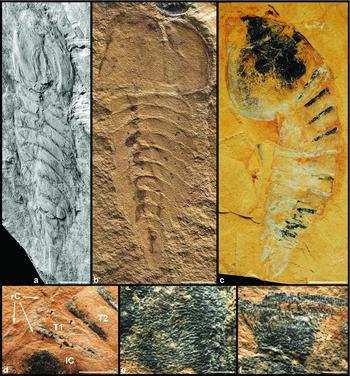
The aglaspidid genus Tremaglaspis. Anterior end facing to the top in (a–c) and to the left in (d–f). (a) Tremaglaspis unite Fortey & Rushton, Reference Fortey and Rushton2003, complete specimen NHM IA 172, Upper Mudstone Member of the Dol-cyn-afon Formation, Lower Ordovician (upper Tremadocian), Y Garth, North Wales, dorsal view; copyright Natural History Museum, London. Reproduced with permission. (b–f) Tremaglaspis vanroyi sp. nov., silty limestone of the upper part of the Weeks Formation, Cedaria Zone, Guzhangian, Cambrian Series 3, North Canyon, about 10 km NW of Notch Peak, House Range, Utah, USA. (b) Paratype (BPM 1042a), internal mould of the exoskeleton of a complete dorso-ventrally flattened individual in dorsal view; a few patches of dark bluish material may represent remains of the phosphatic cuticle and a portion of the phosphatized gut (see Fig. 3a). (c–f) Holotype (BPM 1035), dorsal exoskeleton of a complete individual preserved flattened in lateral view. (c) General view of specimen under cross-polarized light. (d) Detail of the posterodorsal part of the cephalon, the left side (lC) of which is broken, revealing the presence of T1 (black arrow heads mark its anterior and posterior margins) concealed by the right side of the cephalon (rC). (e, f) Details of the cephalic cuticle, showing wrinkle-like ridges (e) and their orientation in the vicinity of the dorsal margin (f). Scale bars = 10 mm for (a, c, d), 5 mm for (b), 1 mm for (e, f).

Material, localities and horizons. See Fortey & Rushton (Reference Fortey and Rushton2003, Reference Fortey and Rushton2009).
Diagnosis (emend.). Tremaglaspis species exhibiting the following unique combination of characters: cephalon subquadrate with slightly angular genal angles, trunk composed of ten tergites with T1–7 bearing well-developed anterior tergal processes and T7–10 significantly increasing in length (sag.) and decreasing in width (tr.) posteriorly.
Description. See Fortey & Rushton (Reference Fortey and Rushton2003, Reference Fortey and Rushton2009).
Tremaglaspis vanroyi sp. nov.
Figures 1b–f, 2
Material, locality and horizon. Holotype (BPM 1035; Figs 1c–f, 2b), dorsal exoskeleton of a complete individual preserved flattened in lateral view; paratype (BPM 1042a; Figs 1b, 2a), internal mould of the dorsal exoskeleton of a complete, dorso-ventrally flattened individual; silty limestone of the upper part of the Weeks Formation, Cedaria Zone, Guzhangian, Cambrian Series 3, North Canyon, House Range, Utah, USA.
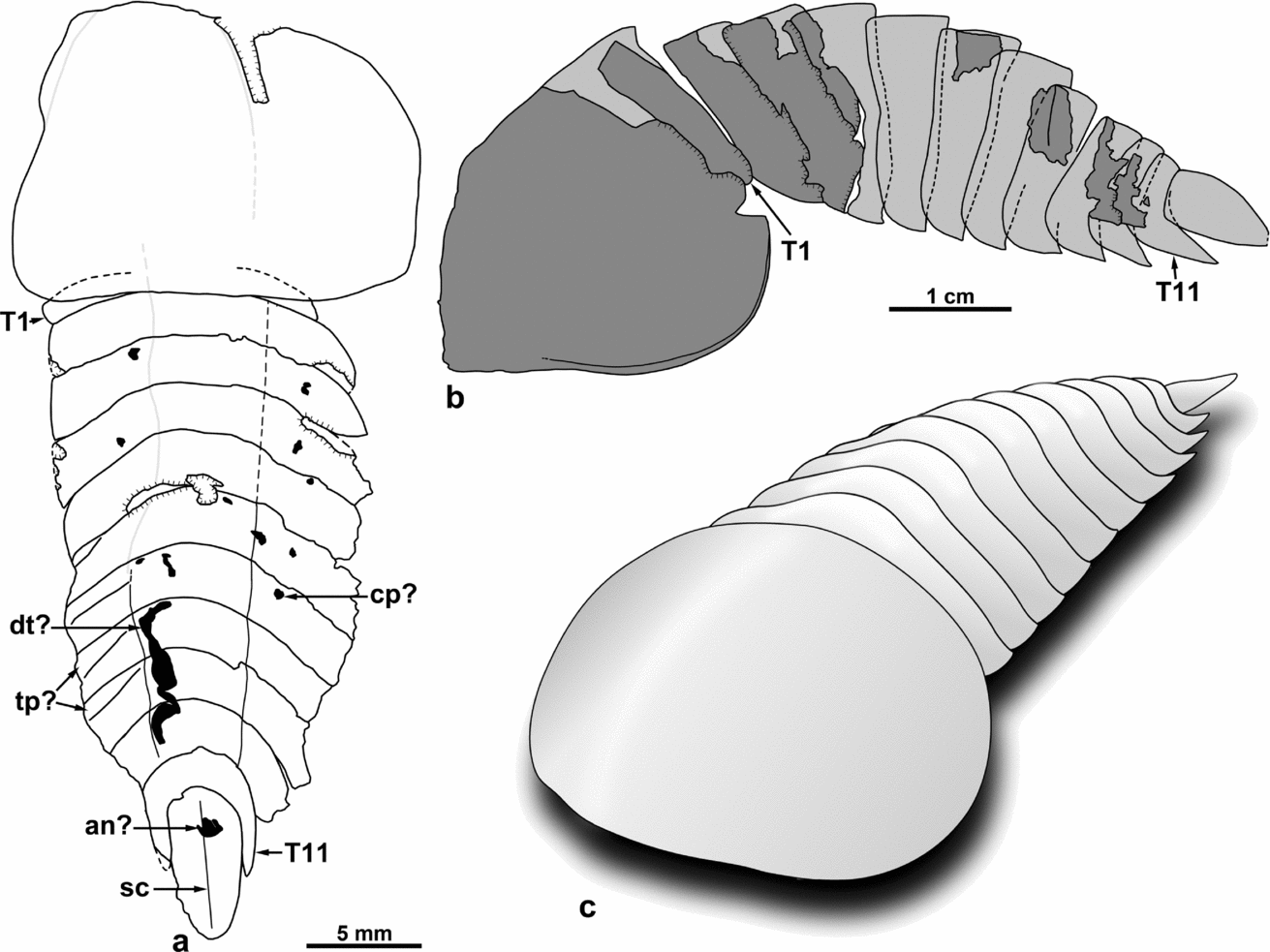
Tremaglaspis vanroyi sp. nov. from the upper part of the Guzhangian Weeks Formation, House Range, Utah, USA. (a) Interpretative drawing of paratype (BPM 1042a); folds are represented as grey lines. (b) Interpretative drawing of holotype (BPM 1035); the remains of the left side of the exoskeleton are in dark grey, those of the right side in light grey. (c) Schematic reconstruction (cuticular sculpture is not represented); note that T1 cannot be seen on this view. Abbreviations: an – anus; cp – cuticle patch; dt – digestive tract; sc – sagittal carina; tp – anterior tergal processes.

Etymology. In honour of Peter Van Roy, for his essential contribution in the redefinition of the concept of Aglaspidida.
Diagnosis. Tremaglaspis species exhibiting the following unique combination of characters: cephalon ovoid, notably wider (tr.) and higher than trunk, with rounded genal angles; T1 almost completely concealed under cephalon and short (exs., sag.), T10 and T11 particularly short (exs., sag.) and with long pleural spines; tailspine parallel-sided anteriorly.
Description. The holotype (BPM 1035) is the dorsal exoskeleton of an 86 mm long (sag.) complete individual, preserved flattened in lateral view (Figs 1c, 2b). Most of the biomineralized cuticle has been dissolved, except for a large anterodorsal area on the cephalon and bands along the anterior margins of the axial regions of T1–4, T6 and T8–10. EDX analyses indicate that the cuticle is composed of Ca, P and O, and to a lesser extent Si, Al and C. Although barely expressed as peaks on EDX spectra, traces of K and F were also detected. These results suggest a primary phosphatic biomineralization of the cuticle (see discussion below).
Cephalon large, representing c. 35% of total body length (T1 excluded) and strongly vaulted anterodorsally, being c. 50% higher than T2; genal angle rounded; narrow lateral border, becoming inconspicuous anteriorly and merging with posterior margin adaxially; left side of the cephalic shield broken off in the posterodorsal region, revealing the presence of T1 (Figs 1c, d, 2b). Trunk moderately flexed dorsally and composed of 11 telescoping tergites and a tailspine; the shape of the anterior margins of trunk tergites, and the way the patches of biomineralized cuticle are distributed, suggest that these tergites are differentiated into axial and pleural regions; it is the external surface of the left half of T1–3 and a part of T4 that is visible, but for the other part of T4, T5–11 and the tailspine, it is mostly the inner surface of their right halves (Fig. 2b); T1 almost entirely concealed under cephalon except for its pleural tips and about 40% shorter (sag. and exs.); tergite length (sag.) evolves as follows: c. 17% increase between T2 and T3, slight decrease from T3 to T7 (2–5% at each transition), abrupt decreases between T7 and T8 (c. 30%), T8 and T9 (c. 13%) and T9 and T10 (c. 40%), and moderate decrease (c. 4%) between T10 and T11; pleurae of T2–7 straight (tr.), with anterior margin curving backwards abaxially to meet straight posterior margin at an acute angle; pleurae of T8–11 increasingly curved backwards abaxially, progressively forming large spines; tailspine high, apparently broken at its posterior tip, its dorsal margin remaining subhorizontal along its anterior half, but increasingly sloping downwards posteriorly.
Where sufficiently well preserved, the cephalic exoskeleton exhibits wrinkle-like ridges (Fig. 1e), apparently resulting from the fusion of elongate tubercles; these ridges are roughly sub-parallel to the ventral margin, except near the dorsal margin that they always meet perpendicularly (Fig. 1f), which suggests that they would form concentric lines sub-parallel to the cephalic outline if seen in dorsal view; where the exoskeleton is abraded, only these ridges remain, forming lines or dots of phosphatic material depending on their orientation (Fig. 1f).
Specimen BPM 1042a is the internal mould of the dorsal exoskeleton of a complete individual, which is about 40 mm long (sag.), orientated parallel to the bedding plan, and dorso-ventrally flattened (Figs 1b, 2a). Cephalon ovoid in outline (maximal width/maximal length ratio: 1.56) and large, representing a third of body length (sag.) and being about 50% wider (tr.) than trunk anteriorly; genal angles rounded; posterior margin straight medially. Trunk composed of 11 tergites and a tailspine; differentiation of axial v. pleural regions faint on T2–5 and T11, but conspicuous on T6–10 despite the absence of axial furrows (Fig. 2a); T1 concealed under cephalon, except for its pleural tips; T2–11 of roughly equal width (tr.) up to T4, then increasingly narrowing backwards; these tergites are evenly curved backwards abaxially, but at an angle that strongly increases from T2 (c. 20°) to T11 (c. 55°); T4–9 roughly equal in length (sag.), while T2, T3 and T11 are shorter (respectively 80%, 80% and 65% of sagittal length of T4); left pleurae of T6–T9 bear faint oblique ridges possibly delimitating anterior tergal processes; tailspine broken at its posterior tip, almond-shaped, with a sagittal carina, and framed laterally by the pleurae of T11 along its anterior half (exs.). Patches of dark, bluish material (calcium phosphate?), sometimes associated with reddish halos, may represent remains of the gut and the cuticle (Fig. 2a).
Discussion. The minor morphological differences between the specimens (e.g. proportion and shape of trunk tergites) can be accounted for by their differences in size and mode of preservation (i.e. flattened laterally v. dorso-ventrally). Both exhibit a large cephalon with rounded genal angles, 11 trunk tergites, including one almost entirely concealed under the cephalon, and a similar tailspine. These characters clearly differentiate the new taxon from other non-trilobite arthropods from the Weeks Formation.
Our assignment of this new arthropod to the Aglaspidida is justified by the presence of a phosphatic exoskeleton, a cephalon devoid of dorsal ecdysial sutures, 11 trunk tergites and its close morphological similarity to T. unite. EDX analyses on BPM 1035 indicate that the composition of its exoskeleton is predominantly phosphatic. The detection of Si may result from a diagenetic silicification of the fossil, a phenomenon frequently observed in trilobites from this locality (Adrain, Peters & Westrop, Reference Adrain, Peters and Westrop2009). An alternative explanation would be that the detected Si belongs to the underlying matrix, which could account for the small peaks of K and Al. EDX analyses on 26 specimens from the Weeks Formation (mostly arthropods; unpub. data), indicate that P is only detected in the phosphatized guts of arthropods (e.g. Lerosey-Aubril et al. Reference Lerosey-Aubril, Hegna, Kier, Bonino, Habersetzer and Carré2012), the shells of inarticulate brachiopods, and the exoskeletons of T. vanroyi sp. nov. (BPM 1035) and the aglaspidid-like arthropod Beckwithia typa. P has never been detected in the matrix surrounding the fossils (including BPM 1035) using EDX, but mass spectrometry analyses have revealed that it may occur in the sediment at a very low concentration (≤300 ppm; Lerosey-Aubril et al. Reference Lerosey-Aubril, Hegna, Kier, Bonino, Habersetzer and Carré2012). Accordingly, the presence of Ca and P in the exoskeleton of BPM 1035 is interpreted as evidence of a primary phosphatic composition. This view is supported by the fact that none of the trilobite exoskeletons analysed with EDX have shown traces of P, which indicates that the fossils from the Weeks Formation were not affected by diagenetic phosphatization. In the Furongian of the USA, aglaspidid exoskeletons and inarticulate brachiopod shells exhibit a similar shiny white to pale-bluish aspect, which led Raasch (Reference Raasch1939) to hypothesize that these extinct arthropods possessed a phosphatic cuticle. Using compositional analyses, Briggs & Fortey (Reference Briggs and Fortey1982) provided conclusive arguments in support of a primary phosphatization in A. barrandei Hall, Reference Hall1862. Fortey & Theron (Reference Fortey and Theron1994) also mentioned the presence of calcium phosphate in the corneal surfaces of an aglaspidid from the Ordovician of China, whilst the rest of the exoskeleton supposedly was calcitic. However, the authors provided no evidence in support of this view. Waggoner (Reference Waggoner2003) reported that the aglaspidid-like arthropod Quasimodaspis brentsae possessed a phosphatic exoskeleton, but again without justifications and the question of a possible secondary phosphatization was not addressed. To sum up, it seems that many aglaspidids and some closely related taxa possessed a primary phosphatic cuticle, but compositional analyses would be needed to definitely prove this assumption. Moreover, direct evidence for the presence of a mineralized exoskeleton in several aglaspidids is scarce (e.g. Fortey & Rushton, Reference Fortey and Rushton2003; Van Roy, Reference Van Roy2006; Ortega-Hernández et al. Reference Ortega-Hernández, Braddy, Jago and Baillie2010; Lerosey-Aubril, Ortega-Hernández & Zhu, Reference Lerosey-Aubril, Ortega-Hernández and Zhu2013), and it is possible that this trait did not characterize the clade as a whole. A primary phosphatization of the exoskeleton remains a rare feature in Cambrian arthropods. Besides aglaspidids, it has been reported in bradoriids, phosphatocopines and the enigmatic arthropod Phytophilaspis (Lin, Ivantsov & Briggs, Reference Lin, Ivantsov and Briggs2011). Calcium phosphate was also observed in the outer layer of the cuticle in two trilobite species, but a secondary phosphatization in those cases is not excluded (Teigler & Towe, Reference Teigler and Towe1975; Dalingwater et al. Reference Dalingwater, Hutchinson, Mutvei and Siveter1991, Reference Dalingwater, Hutchinson, Mutvei and Siveter1993). T. vanroyi sp. nov. has no morphological similarity with bradoriids, phosphatocopines or Phytophilaspis, but it shares with the Aglaspidida the absence of cephalic dorsal ecdysial sutures, and the presence of 11 trunk tergites with pleurae and possibly anterior tergal processes. Accordingly, we interpret the presence of a primary phosphatic exoskeleton as indicative of aglaspidid affinities. Postventral plates could not be observed, but this may be owing to the paucity of our material.
The strongest argument supporting the assignment of the new taxon to the Aglaspidida comes from its striking similarities with T. unite: a dorsally vaulted cephalon devoid of dorsal eyes and genal spines, a narrow (tr.) trunk with spinose pleurae and a carinate tailspine. The most significant difference between the two species is the presence of an extra trunk tergite in T. vanroyi sp. nov. However, this tergite is almost completely concealed under the cephalon, and it might have been overlooked if the cephalon had not been partially broken off in BPM 1035. A similar situation may well occur in T. unite, which would explain why it is the only aglaspidid species with supposedly ten, rather than 11 trunk tergites. In any case, we do not believe that this difference in the number of trunk tergites is important enough to assign the two species to distinct genera. T. vanroyi sp. nov. can also be distinguished from the type species by its larger, oval cephalon with wrinkle-like ridges, and its shorter (exs., sag.) T10 and T11.
5. Discussion
T. vanroyi sp. nov. is the second non-trilobite arthropod described from the Weeks Formation. The first one, Beckwithia typa, was regarded for a long time as the oldest representative of the Aglaspidida (e.g. Raasch, Reference Raasch1939; Hesselbo, Reference Hesselbo1989). However, Van Roy (Reference Van Roy2006) considered that the evidence for the aglaspidid affinities of this taxon were ‘somewhat circumstantial’, probably because the presence of postventral plates and anterior tergal processes remains undemonstrated in this arthropod. Accordingly, he classified Beckwithia within the ‘aglaspidid-like arthropods’, an artificial group of taxa displaying similarities with aglaspidids. In the cladistic analysis of Ortega-Hernandez, Legg & Braddy (Reference Ortega-Hernández, Legg and Braddy2013), Beckwithia was resolved close to, but definitely outside the Aglaspidida for similar reasons. Our ongoing investigations of this taxon confirm that it exhibits morphological particularities that cannot be accommodated with the current diagnosis of the Aglaspidida. The presence of T. vanroyi sp. nov. in the Weeks Formation extends again the stratigraphical range of the clade into the Guzhangian (Cambrian Epoch 3), and indicates that the dichotomy recognized by Ortega-Hernández, Legg & Braddy (Reference Ortega-Hernández, Legg and Braddy2013) between ‘Cambrian-type’ and ‘Ordovician-type’ aglaspidids is more ancient than currently understood. Along with the recent demonstration that aglaspidids were already distributed worldwide by the Furongian (Lerosey-Aubril, Ortega-Hernández & Zhu, Reference Lerosey-Aubril, Ortega-Hernández and Zhu2013), this observation strongly suggests that the early evolutionary history of this group remains unknown.
A possible explanation for the limited fossil record of aglaspidids might come from their habitat preferences. Indeed, all Furongian species from the USA were recovered from the Saint Lawrence Formation, the lithofacies of which clearly indicate shallow-water depositional settings (Hughes & Hesselbo, Reference Hughes and Hesselbo1997; Collette & Hagadorn, Reference Collette and Hagadorn2010). Likewise, brachiopods associated with Aglaspella sanduensis Lerosey-Aubril, Ortega-Hernandez & Zhu, Reference Lerosey-Aubril, Ortega-Hernández and Zhu2013 suggest a nearshore, shallow-water environment (Zhan et al. Reference Zhan, Jin, Rong, Zhu and Han2010), and ‘extremely shallow, possibly inter-tidal’ depositional settings have been hypothesized for the sandstone containing the Late Ordovician Chlupacaris (Van Roy, Reference Van Roy2006, p. 341). Interestingly, the upper part of the Dol-cyn-afron Formation, where T. unite was found, was also deposited within a normally oxygenated, energetic, shallow-water environment (Rushton et al. Reference Rushton, Owen, Owens and Prigmore2000, p. 112). The Furongian Australaglaspis may represent an exception, since it has been found in siltstones interpreted as turbidites deposited within a submarine basin-floor fan complex (Baillie & Jago, Reference Baillie and Jago1995). If confirmed to be an aglaspidid, the Lower Ordovician ‘Tremaglaspis sp.’ of Van Roy et al. (Reference Van Roy, Orr, Botting, Muir, Vinther, Lefevbre, Hariri and Briggs2010) may be another exception. Indeed, it mostly occurs in the upper Lower Fezouata Formation and the lower Upper Fezouata Formation (P. Van Roy, pers. comm.), which supposedly represent deep-water, low-energy environments. However, a definitive answer to this question should await the formal description of this taxon and the study of the faunal and sedimentological contexts of its occurrences in the sequence. In summary, aglaspidids apparently lived preferentially on the proximal portion of the shelf, rarely exceeding the offshore transition zone distally. It seems reasonable to assume that these well-oxygenated environments, occasionally or permanently affected by the action of waves, were not particularly favourable for the preservation of their thin exoskeletons, and this could partially explain the scarcity of their fossil remains.
6. Conclusion
The recognition of a shallow-water preference among aglaspidids is instructive with regard to the environmental context of the Weeks Formation Lagerstätte. Evans, Miller & Dattilo (Reference Evans, Miller, Dattilo and Swanson2003) stated that the Weeks Formation ‘has platy, shallow-water limestone’, while Hesselbo (Reference Hesselbo1989) briefly mentioned that the upper part of this formation was deposited in an ‘open marine upper shelf environment’. In fact, no detailed study of the sedimentological sequence and associated fossil assemblages has as-yet been published. The discovery of T. vanroyi sp. nov. supports the view that the upper part of the Weeks Formation might have been deposited in a notably shallower-water environment compared to those associated with the major Cambrian Konzervat-Lagerstätten of Laurentia (Hagadorn, Reference Hagadorn, Bottjer, Etter, Hagadorn and Tang2002). This could explain the original composition of its ‘soft’-bodied fauna.
Acknowledgements
This work greatly benefited from discussions with R. Fortey, A. Rushton and P. Van Roy. The Natural History Museum, London provided the picture of NHM IA 172 (Fig. 1a). It has been funded by the Agence National de la Recherche (R. L.-A., grant number RALI 197); the Consejo Nacional de Ciencia y Tecnología, (J. O.-H., grant number 209152); and the University of Cambridge Trusts (J. O.-H., grant number 10135957).