INTRODUCTION
The ability to seamlessly switch between languages in speech production is often presented as a key feature of language use for skilled bilinguals (Bobb & Wodniecka, Reference Bobb and Wodniecka2013). Evidence indicates that highly proficient bilinguals navigate between languages at will, likely thanks to strong underlying cognitive skills related to frequent management of two languages (Bialystok, Reference Bialystok, Miller, Bayram, Rothman and Serratrice2018; Costa & Santesteban, Reference Costa and Santesteban2004; Crinion et al. Reference Crinion, Turner, Grogan, Hanakawa, Noppeney, Devlin and Usui2006; Perani & Abutalebi, Reference Perani and Abutalebi2005; Poulisse & Bongaerts, Reference Poulisse and Bongaerts1994). The apparent ease with which bilinguals switch between languages belies the complexity of the task, which involves many integrated processes (articulatory, attentional/control, cognitive representations, phonological, pragmatic, semantic, syntactic; Costa et al., Reference Costa, Santesteban and Ivanova2006) and can have processing costs (Abutalebi & Green, Reference Abutalebi and Green2008; Bobb & Wodniecka, Reference Bobb and Wodniecka2013; Meuter & Allport, Reference Meuter and Allport1999).
Language switching can occur within a meaningful sentence/utterance (intrasentential code-switching) or between utterances and can be dictated by the language user (spontaneous or voluntary) or externally induced by an external cue or requirement that causes the bilingual to switch (nonspontaneous or forced; van Hell et al., Reference van Hell, Litcofsky, Ting and Schwieter2015). The current study focuses on forced switching between languages for a complete conversational interaction or completion of task (including single-word experimental tasks). This is distinguished from code-switching, which describes situations in which words from multiple languages alternate within the same conversational turn, words from one language are inserted into grammatical frames of another, or words and/or morphemes from multiple languages are combined (Muysken, Reference Muysken2000).
Prior research has focused on identifying the neural correlates of language switching as distinct from translation (for a review, see Hernandez, Reference Hernandez2009), comparing performance between switch and nonswitch trials within single-word naming tasks, and exploring asymmetric switching costs among bilinguals with proficiency imbalance (for a review, see Bobb & Wodniecka, Reference Bobb and Wodniecka2013). Longer response times are observed for nonswitch trials in dual than in single language conditions (Christoffels et al., Reference Christoffels, Firk and Schiller2007; Jevtovic et al., Reference Jevtović, Duñabeitia and de Bruin2019). The overarching higher demands of maintaining two languages in a dual language condition additionally requires proactive control, mixing cost, which is distinct from the reactive control associated with switching (Christoffels et al., Reference Christoffels, Firk and Schiller2007; de Bruin et al., Reference de Bruin, Samuel and Duñabeitia2018). Further, neuroimaging evidence indicates language switching in comprehension activates language-specific control mechanisms while switching languages in production also recruits domain-general networks (i.e., not exclusively language-specific) management control networks (Blanco-Elorrieta & Pylkkänen, Reference Blanco-Elorrieta and Pylkkänen2016).
Comparatively less research, however, has considered the relevance and application of forced language switching in real-world settings (cf. Blanco-Elorrieta & Pylkkänen, Reference Blanco-Elorrieta and Pylkkänen2017) and, specifically, the impact on production at the utterance level. The “work” of alternating between two languages is particularly relevant for bilingual employees who are expected to perform job tasks in their two languages informally (i.e., not an explicit task such as professional interpreter). The current study addressed the following questions:
RQ1: For heritage bilinguals, does forced switching impact language production at the utterance level, specifically: mean length of utterance and type-token-ratio?
RQ2: For heritage bilinguals, does forced language switching impact self-reported stress?
In addressing these questions, the current study focused on how forced switching between the heritage language of Spanish (first language; L1; nondomain dominant) and English (second language; L2; domain dominant) influenced language production of the L2 language and felt stress. This was done by simulating a monolingual condition (English production only) and a bilingual forced switching condition (English and Spanish production), where production of English may be compared between conditions. Pre- and posttest stress assessments were also compared.
DUAL LANGUAGE ORGANIZATION AND COGNITIVE CONTROL
Many models of bilingual memory posit that separate lexical systems are mapped onto shared semantic representations (Chen & Leung, Reference Chen and Leung1989; Kroll & Curley, Reference Kroll, Curley, Gruneberg, Morris and Sykes1988; Kroll & Scholl, Reference Kroll, Scholl and Harris1992; Potter et al., Reference Potter, So, Von Eckardt and Feldman1984). For highly skilled bilinguals, two separate representations (i.e., dog and perro for a Spanish–English bilingual) are mapped onto the same conceptual representation (i.e., meaning). The Bilingual Interactive Activation Model (BIA and BIA+; Dijkstra, Reference Dijkstra2013; Dijkstra & van Heuven, Reference Dijkstra and van Heuven2002; van Heuven & Dijkstra; Reference van Heuven and Dijkstra2010) proposes that bilinguals have hierarchically organized word representations that are always activated and competing for attention. Competition occurs within and across languages, and the nontarget language must be inhibited through active, top-down inhibition (Green, Reference Green1998; Green & Abutalebi, Reference Green and Abutalebi2013; Meuter & Allport, Reference Meuter and Allport1999).
A bilingual who switches languages must switch which language is inhibited; this management likely requires recruitment of cognitive control mechanisms to manage switching (Bialystok, Reference Bialystok, Miller, Bayram, Rothman and Serratrice2018; Costa & Santesteban, Reference Costa and Santesteban2004; Crinion et al. Reference Crinion, Turner, Grogan, Hanakawa, Noppeney, Devlin and Usui2006; Perani & Abutalebi, Reference Perani and Abutalebi2005). The field generally holds that bilinguals develop language-specific inhibitory control processes that interact with domain-general inhibitory control (Bialystok et al., Reference Bialystok, Craik, Klein and Viswanathan2004; Calabria et al., Reference Calabria, Hernández, Branzi and Costa2012; Hernandez et al., Reference Hernández, Costa, Fuentes, Vivas and Sebastián-Gallés2010). Neuroimaging evidence indicates that language switching necessitates attention, controlling which language is produced, and maintaining goals (Abutalebi et al., Reference Abutalebi, Brambati, Annoni, Moro, Cappa and Perani2007; Crinion et al., Reference Crinion, Turner, Grogan, Hanakawa, Noppeney, Devlin and Usui2006; Hernandez et al., Reference Hernandez, Dapretto, Mazziotta and Bookheimer2001; Venkatraman et al., Reference Venkatraman, Siong, Chee and Ansari2006; Wang et al., Reference Wang, Xue, Chen, Xue and Dong2007).
Green and Abutalebi (Reference Green and Abutalebi2013) proposed three language use contexts: single language, dual language (two languages used with different speakers), and dense code-switching (during which either language is acceptable); each with distinct cognitive implications. Dual-language contexts are the most cognitively demanding requiring monitoring and attention, interference control/suppression, response inhibition, and goal maintenance. Blanco-Elorrieta and Pylkkänen posited that recruitment of executive control networks is limited to language-switching activities in which the switch is necessary to “accomplish the task goal” (i.e., forced), this requires monitoring and interference suppression (Reference Blanco-Elorrieta and Pylkkänen2017, p. 9034).
Dense code-switching is comparatively less demanding, as the lack of negative consequences of selecting the “wrong” language requires less monitoring and attention. Forced, as opposed to voluntary, switching is more demanding (Blanco-Elorrieta & Pylkkänen, Reference Blanco-Elorrieta and Pylkkänen2017; Gollan et al., Reference Gollan, Kleinman and Wierenga2014). For example, Jevtovic and colleagues (Reference Jevtović, Duñabeitia and de Bruin2019) found that voluntary switching elicited smaller switching costs than forced and being permitted to switch freely between languages was less demanding than being forced to use only one language (mixing benefit). de Bruin and colleagues (Reference de Bruin, Samuel and Duñabeitia2018) found faster response times for voluntary switching conditions, mixing benefits, and greater lexical access associated with being able to change languages freely. However, being forced to use two languages resulted in mixing costs (de Bruin et al., Reference de Bruin, Samuel and Duñabeitia2018). Thus, language switching is not intrinsically effortful, rather, effort is required when the bilingual must control languages per external force (i.e., forced switching).
Language production
Language switching in production is distinct from comprehension; while comprehension recruits language-specific networks, switching in production likely involves domain-general control (Blanco-Elorrieta & Pylkkänen, Reference Blanco-Elorrieta and Pylkkänen2016). Previous studies demonstrated greater response delays during trials with switches than those without (for a review, see Bobb & Wodniecka, Reference Bobb and Wodniecka2013). Additionally, so-called imbalanced bilinguals showed greater switching costs (longer delays, errors) when switching from a weaker to a stronger language than vice versa (Bobb & Wodniecka, Reference Bobb and Wodniecka2013), while highly proficient bilinguals do not show differences (Costa et al., Reference Costa, Santesteban and Ivanova2006; Costa & Santesteban, Reference Costa and Santesteban2004). Individuals producing strings of isolated single stimuli, such as words or digits, show processing costs in production (errors and naming latencies) related to switching, however, this task is rarely required in most daily environments.
Comparatively fewer studies have examined language switching and the production of meaningful utterances, and less is thus known regarding practical impacts of processing costs on the language produced in forced language switching, dual language contexts beyond the word level. There are increasing calls for examinations of language switching more aligned with naturally occurring contexts (van Hell et al., Reference van Hell, Litcofsky, Ting and Schwieter2015). A small number of prior studies have demonstrated switch costs (error rates, reaction time) with forced switching at the sentence level (Declerck & Phillip, Reference Declerck and Philipp2015; Tarlowski et al., Reference Tarłowski, Wodniecka and Marzecová2013). Relatedly, research examining perception of naturalistic switching (i.e., intrasentential code-switching) demonstrated neural differences between switching in single-word stimuli and sentence-level tasks (see Van Hell & Wittman, Reference van Hell, Witteman, Isurin, Winford and de Bot2009 for a review).
Studies in other fields have examined the impact of increasing domain-general control demands on speech production beyond the word level. Findings demonstrated impact at the utterance level on speech produced while monolingual participants engage in tasks that require simultaneous coordination of cognitive control and cognitive resource allocation (Kemper & Sumner, Reference Kemper and Sumner2001; Kemper et al., Reference Kemper, Herman and Lian2003; Kemper et al., Reference Kemper, Schmalzried, Herman, Leedahl and Mohankumar2009; Kemper et al., Reference Kemper, Schmalzried, Hoffman and Herman2010). In these studies, monolingual young adult participants produced shorter, less grammatically complex sentences (as measured by mean length of utterance) in conditions requiring production during simulations of cognitive control tasks, which was attributed to the increased processing cost of simultaneous task demands.
Stress
“Stress refers to the physiological and/or psychological arousal that occurs when an individual perceives a threat to something of value to them and that threat taxes or exhausts the resources they have available to confront it” (Harms et al., Reference Harms, Credé, Tynan, Leon and Jeung2017, p. 179). It is a multidimensional construct, encompassing the psychological factors of task engagement, distress, and worry (Matthews et al., Reference Matthews, Emo, Funke, Zeidner, Roberts, Costa and Schulze2006; Matthews & Campbell, Reference Matthews and Campbell2010). Most stress, regardless of the source or stressor, occurs because the potential threat is unpredictable, uncontrollable, or both (Cohen, Reference Cohen1980; Harms et al., Reference Harms, Credé, Tynan, Leon and Jeung2017).
Prior literature from related fields such as applied and experimental psychology has established associations between stress and cognitively demanding tasks requiring greater cognitive control, as well as greater stress with greater task complexity, and dual-task demands for tasks that do not specifically implicate language usage (Helton et al., Reference Helton, Matthews and Warm2009; Herrero et al., Reference Herrero, Saldaña, Rodriguez and Ritzel2012; Matthews et al., Reference Matthews, Emo, Funke, Zeidner, Roberts, Costa and Schulze2006; Matthews et al., Reference Matthews, Warm, Reinerman-Jones, Langheim, Washburn and Tripp2010; Warm et al., Reference Warm, Matthews and Finomore2018). Thus, language usage tasks that involve these features (switching, dual task demands, complexity) may also be associated with greater stress. Bilinguals forced to switch languages could experience stress if the switch is unpredictable and outside of the individual’s control. Bilinguals qualitatively report increased stress when required to switch between languages at work, even for brief interactions (Alarcon & Heyman, Reference Alarcón and Heyman2013; Colomer, Reference Colomer2010; Colomer & Harklau, Reference Colomer and Harklau2009); however, this could be related to switching and anxiety regarding language accuracy and quality.
HERITAGE BILINGUALS AND REAL-WORLD CONTEXTS
The term heritage bilingual refers to individuals who have a personal or historical connection to a language, such as an indigenous or immigrant language (Valdes, Reference Valdés, Peyton, Ranard and McGinnis2001). In the U.S. context, this term often applies to individuals who speak a language other than English at home from birth and learned L2 English in school/community. Although heritage bilinguals are sometimes compared to low-proficiency “imbalanced” bilinguals, they are distinct in a number of relevant features (Kupisch & Rothman,Reference Kupisch and Rothman2018; Rothman, Reference Rothman2009), including the age of acquisition of the “nondominant” language and language profiles in adulthood. Bilinguals often have a preferred language depending on domain and/or communication objective (Dewaele, Reference Dewaele and Pavlenko2006; Grosjean, Reference Grosjean2015; Hammer, Reference Hammer2018; Hoffman, Reference Hoffman1971). Many U.S. heritage bilinguals are educated nearly exclusively in English, resulting in more academic vocabulary and/or literacy skill in English. Heritage bilinguals differ from L2 learners who have received formal L2 instruction; they may be comparable in the L1 and L2 for modalities such as listening and/or speaking and may have different skill levels within the L1 depending on modality (speaking, listening, reading, writing). This article will describe bilinguals as having a domain-dominant language, rather than an overarching dominant language—for example, English is the domain-dominant language of school for many U.S.-educated Spanish–English heritage bilinguals.
One context in which externally induced switching occurs is during workplace interactions, specifically, those in which a bilingual employee does not control the language used with an interlocutor. Qualitative research indicates that heritage bilingual employees are sometimes required to perform activities in the nondomain dominant L1 and report corresponding increased stress (Alarcon & Heyman, Reference Alarcón and Heyman2013; Colomer, Reference Colomer2010; Colomer & Harklau, Reference Colomer and Harklau2009). Examples include heritage bilingual teachers acting as interpreters in parent–teacher conferences (Colomer, Reference Colomer2010), customer service representatives handling calls in Spanish (Alarcon & Heyman, Reference Alarcón and Heyman2013), and hotel workers serving customers with limited English and interpreting between coworkers (Dawson et al., Reference Dawson, Madera, Neal and Chen2014). Spanish language ability is viewed by some U.S. employers as an uncompensated “ethnic attribute” rather than a compensated skill (Alarcon & Heyman, Reference Alarcón and Heyman2013); yet employees report using the L1 for work is stressful (Alarcon & Heyman, Reference Alarcón and Heyman2013; Colomer, Reference Colomer2010). Stress reported by heritage bilinguals forced to use the non domain-dominant language in the workplace is likely a multiply determined problem, influenced by factors that include language prestige, social and cultural context, anxiety regarding accuracy and quality when using nondomain dominant language at work, and workplace context. However, forced language switching may also contribute to self-reported stress.
CURRENT STUDY
At present, research has not fully examined the impact of forced switching at the utterance level among heritage bilinguals as it relates to applied contexts. Bilingual language skills have been commodified and linked to increased professional opportunities (Carreira Reference Carreira2014; Carreira & Armengol, Reference Carreira, Armengol, Peyton, Ranard and McGinnis2001), and heritage bilinguals in Anglophone settings are increasingly forced to switch languages at work (e.g., Alarcon & Heyman, Reference Alarcón and Heyman2013; Colomer & Harklau, Reference Colomer and Harklau2009). Language switching is more costly than not switching (Bobb & Wodniecka, Reference Bobb and Wodniecka2013); forced switching and mixing has costs (Christoffels et al., Reference Christoffels, Firk and Schiller2007; de Bruin et al., Reference de Bruin, Samuel and Duñabeitia2018); and costs can be observed at the sentence level (Declerck & Phillip, Reference Declerck and Philipp2015; Tarłowski et al., Reference Tarłowski, Wodniecka and Marzecová2013). Little is known regarding practical implications of forced switching on the language produced and the effort exerted, yet, nonbalanced domain heritage bilingual workers are expected to use more than one language without specific training, compensation, or acknowledgment of additional demand (Alarcon & Heyman, Reference Alarcón and Heyman2013; Colomer, Reference Colomer2010).
Using a novel “virtual meeting” experimental paradigm, Spanish–English heritage bilinguals responded to work-themed questions posed by actors in a video conference, presented in a monolingual (control) or language switching (experimental) condition. The work-themed simulation was designed as a mimesis for real-life scenarios in which heritage bilinguals switch language based on interlocutor (i.e., a call center customer service scenario in which the caller chooses their preferred language, interactions with clients who have limited English). We hypothesized that (Hypothesis 1) shorter, less grammatically complex sentences are produced during forced language switching due to increased processing cost of simultaneous task demands. We predicted that participants in the experimental condition, which has increased task demand, would produce responses with lower mean length of utterance (MLU) and type-token-ratio (TTR) than participants in the control condition. We additionally hypothesized that (Hypothesis 2) forced language switching increases stress due to the increased cognitive demand and task complexity. Thus, we predicted that participants in the experimental condition would report higher stress levels posttask than participants in the control condition.
METHODS
Participants
Twenty Spanish–English typically developing heritage bilingual students (14 females, M = 24.1 years, SD = 6.45) from a U.S. West Coast university took part in the current study. Participants were randomly assigned to a language switching (experimental) condition (n = 10, 7 female) or an English-only (control) condition (n = 10, 7 female) (see “Virtual Meeting” section). All participants reported learning Spanish as the L1 from birth and learning English sequentially after in school, between ages 3–7 years. Five participants were born outside of the United States in a country where Spanish was the dominant language and moved to the United States between the ages 1.5–7 years, M = 4.5 years, SD = 1.78 years. Participants attended all schooling in only English, completed state-funded (public) high school in the United States, did not receive Spanish literacy instruction, and were attending university classes exclusively in English. No participant worked full or part time in a job that required Spanish use as an explicit job task; all reported previous or current work or internship experience.
Procedures
Two testing sessions of 1–1.5 hours were conducted individually by a trained tester in English and Spanish, measures were administered in the same order each time. Testing took place in a private room with minimal distractions. In session 1, the tester used the Pearson Q-interactive tablet assessment system to administer standardized psychometric and language assessments for individual characteristics, including executive function/cognitive control, nonverbal problem solving, working memory, English single-word vocabulary, and English verbal intelligence. Nonstandardized assessments of Spanish single-word vocabulary and a language and social background questionnaire were also administered. Measures of individual characteristics were included to match participants in the two conditions on background variables. See the appendices for details of session batteries. All measures, excluding the Spanish vocabulary measure, were completed in English. Session 1 verified suitability for continued participation, including confirmation of L1 Spanish and L2 English schooling. Standardized assessments were scored and encrypted through the Pearson Q-interactive testing system, then downloaded and transferred into IBM SPSS Statistics statistical analysis software. During session 2, participants were administered a previously validated stress state questionnaire, then participated in the simulated “virtual meeting” activity, immediately followed by a posttest stress state questionnaire.
Measures
Cognitive measures
The Delis-Kaplan Executive Function System (D-KEFS; Delis et al., Reference Delis, Kaplan and Kramer2001) Trail-making subtest measured executive function, specifically visual attention and task switching. Four of five conditions established normative data for visual scanning, number sequencing, letter sequencing, and motor speed. The operative task required the test taker to sequentially connect a series of points while switching between letters and numbers.
The D-KEFS Color–word Inhibition subtest utilized the Stroop effect (Stroop, Reference Stroop1935) to measure mental flexibility and inhibition. The first two trials established ability to read aloud a list of written colors and visually identify a sequence of colors. The third trial required the participant to name the color of the ink in which each color name is printed; ink colors were incongruent with corresponding color name (e.g., the word “red” printed in green ink). The test taker must inhibit the dominant response to read the word and instead name the incongruent ink color. The fourth trial combined inhibition and switching by requiring participants to switch between naming an incongruent ink color and reading written color names, producing a score for inhibition of the dominant response. Subtest raw scores were converted to scaled scores, with 10 representing the 50th percentile per test standardization.
The Wechsler Adult Intelligence Scale-Fourth Edition (WAIS-IV; Wechsler et al., Reference Wechsler, Coalson and Raiford2008) Matrix Reasoning subtest presented pattern completion activities to measure fluid intelligence, nonverbal abstract reasoning, and perceptual organization, collectively referred to as nonverbal IQ. Test takers selected an image from a set of options to complete the sequence.
The WAIS-IV Digit Span subtest measured working memory, auditory processing, and attention. The test was administered in a series of three trials, first a series of numbers were read aloud to the participant, who repeated the series as spoken. Next, a series of numbers were read aloud, and the participant reported numbers in reverse order. Finally, a series of numbers were read aloud, and the participant reported back numbers from least to greatest. The test administrator did not repeat any number or sequence of numbers.
Verbal ability measures
The WAIS-IV Verbal Comprehension and Verbal Similarities subtests measured English verbal comprehension and verbal intelligence. The raw scores for these subtests were scaled for standardized test scale at 10, with 10 representing the 50th percentile per test standardization. All measures discontinued after three consecutive errors.
Participants were administered the Spanish single word picture vocabulary subtest of the Bilingual Verbal Ability Tests (BVAT; Muñoz-Sandoval et al., Reference Muñoz-Sandoval, Cummins, Alvarado and Ruef1998), measuring verbal ability in Spanish. Participants were presented with images and asked to identify which image corresponded with a single Spanish word or were presented with an image and were asked to name the verb or noun presented in the image. Answers were scored on a binary scale and no points were given if an English word was provided. Test items were presented by a native Spanish-speaking bilingual. Raw scores are presented, out of a maximum 58 items.
Language and social background
Participants completed a modified version of the Language and Social Background Questionnaire (LSBQ; Luk & Bialystok, Reference Luk and Bialystok2013). This previously validated language and social background questionnaire was designed to explore the heterogeneity within bilingual populations and capture variation in language environment, perceived proficiency, and usage among bilinguals (Luk & Bialystok, Reference Luk and Bialystok2013). The adapted LSBQ captured language contact by skill (Speaking/Listening/Reading/Writing) and by environment (School/Work/Home). Participants reported proportion of Spanish or English use in various settings (e.g., home, university), interlocutors (e.g., family, friends), and activities (e.g., talking, reading, writing, watching TV) using sliding scales between 0% and 100%. Participants self-reported perceived ability level in English and Spanish for reading, writing, speaking, and listening.
Stress
Participants’ stress level was measured using the previously validated 24-item Short Stress State Questionnaire (SSSQ; Helton, Reference Helton2004). The SSSQ specifically addresses stress related to a task (including task engagement, distress, and worry) and is used for self-reported task-related stress. Sample items include “I feel irritated,” “Right now my mental energy is running low,” “I feel self-conscious,” and reverse scored items such as “Generally, I feel in control of things” and “I feel confident about my abilities.” Participants responded on a 5-point agreement scale (1 = Strongly disagree; 5 = Strongly agree).
Virtual meeting
The simulated video-conference “virtual meeting” presented participants with a prerecorded interactive video of diverse, bilingual actors in the roles of bosses, co-workers, and subordinates, each of whom asked the participant general workplace-related questions adapted from interview preparation materials. Each question was asked by a different speaker (i.e., one interlocutor did not ask two questions in a row), who “called” into the video conference and “spoke” to the participant in English or Spanish. Participants were given 2 minutes and 30 seconds to respond to each interlocutor’s question. Participants were instructed to respond to each interlocutor in the language used for the posed question, thus simulating externally induced interlocutor-dependent switching. Each interaction involved a question from one interlocutor and participant response time, followed by a new question from the next interlocutor, who would “call in” to ask the next question, either in Spanish or English depending on condition. In the experimental condition, an interlocutor who previously asked a question in English would, later in the task, ask a different question in Spanish, and vice versa; thus, participants could not anticipate a language switch based on which interlocutor posed the next question. Participants could not use Spanish when answering a question asked in English, and vice versa.
A total of 14 questions were asked, and six target questions were asked in English in both conditions. In the experimental condition, a total of six switches from Spanish to English occurred. In the experimental condition, the six target questions (Q1–6), asked to both conditions in English, were preceded by either one or two questions in Spanish (SQ) to make switching unpredictable (e.g., SQ, Q1, SQ, SQ, Q2, SQ, Q3, SQ, Q4, SQ, SQ, Q5, SQ, Q6). In the control condition, the same number of total questions were asked in English to ensure a comparable activity duration. Questions answered in English by both participant in both conditions (Q1–6) were analyzed. Other items (additional questions in English and Spanish used to make switching unpredictable) were not compared. Participants were randomly assigned to: (a) language switching condition (n = 10), in which interlocutors unpredictably asked questions in Spanish and English (experimental condition); (b) a monolingual English condition (n = 10; control condition). In both conditions, participants were informed prior to the “meeting” that interviewers were bilingual and might ask questions in either language, however, no language switches occurred in the control condition. Participant responses were audio recorded.
Task questions were translated into Spanish using a professional business translation service. Virtual meeting questions and simulated meeting structure was piloted with six participants, first as a live action role-playing simulation, then as a virtual meeting. Virtual meeting video segments were filmed by university audio/visual media staff in a recording studio using professional recording equipment and microphones to ensure sound and video quality. Six self-identified Spanish–English bilinguals who spoke Spanish from birth and used Spanish and English professionally acted as “callers.” Videos were recorded, transcribed, and edited by audio/visual media staff, then reviewed and approved by researchers and actors. The virtual meeting activity was then piloted with two bilinguals and one monolingual (English content only). Final question order was randomly assigned; examples of questions include: “Can you tell me about a difficult experience you had in a job or class and how you overcame it?”; “What would you do if right before a deadline you realized that a report you wrote for your boss or professor was not very good?”; and “Tell me about a time you had too many things to do and had to prioritize. How did you organize your time?”
The virtual meeting questions did not specifically require academic language; however, the content could arguably be classified as either cognitive academic language proficiency (CALP; Cummins, Reference Cummins2008) due to the context-reduced environment and moderate cognitive demand or as basic interpersonal communication skills (BICS; Cummins, Reference Cummins2008) due to the short answer format and conversational nature. The variability in skills required during our task was designed to also mimic settings (i.e., workplace) that may require both BICS and CALP.
Audio analyses
Audio recordings from the virtual meeting were transcribed using CLAN (Child Language Analysis Network), a cross-platform open source program for analyzing language transcripts. CLAN is a part of CHILDES (CHIld Language Data Exchange System), a global repository for language corpora. Founded for child language analysis, it is now used for a variety of language corpora and provides tools for complex analyses of language features and conversational interactions. Language samples were analyzed using the Computerized Language ANalysis (CLAN; MacWhinney, Reference MacWhinney2000). A total of six language samples (full participant response to each of the six target questions asked in English in both conditions) were transcribed and analyzed for each participant. Responses varied in length from 17 to 152 seconds. Each target question response contained an average of 6.5 utterances; more than 803 utterances total were analyzed. The transcription of the language samples followed the guidelines for conversational units (c-units), which indicate that an utterance or c-unit is a string of words followed by a pause of one or more seconds, concludes with intonation, or contains grammatically correct structure (Bernstein Ratner & Brundage, Reference Bernstein Ratner and Brundage2016). Language samples were examined for language metrics including: number of different words (type) and total number of words (tokens) and MLU.
Each sample was coded by two trained researchers, one with a Clinical Competence for Speech-Language Pathology (CCC-SLP) qualification. Two conversational samples were randomly selected from each participant and independently transcribed by third transcriber with a CCC-SLP qualification. Intertranscriber agreement was calculated using total number of agreements divided by the total number of agreements and disagreements. Intertranscriber agreement yielded acceptable agreement levels between approximately 93% and 96%.
Mean length of utterance
MLU is a measure of syntactic complexity, calculated by the number of morphemes divided by the total number of utterances in the sample (Nippold et al., Reference Nippold, Cramond and Hayward-Mayhew2014). MLU increases with greater use of components (subjects, adjectives, prepositional phrases) and grammatical complexity (e.g., greater use of relative clauses, infinitive complements); a higher MLU indicates a higher level of complexity (Kemper & Sumner, Reference Kemper and Sumner2001).
Type-token ratio
TTR represents the relationship between the number of different words (type) and total number of words (tokens), obtained by dividing the total number of types by its tokens. TTR represents degree of lexical variation, the higher the TTR, the greater the lexical variation, and vice versa.
RESULTS
Background descriptives
Participants all reported (a) L1 Spanish; (b) higher proficiency in English; and (c) exclusive use of English in early elementary through higher education, including literacy training in English only. Paired sample t-tests revealed that participants self-reported that their English skills were significantly stronger than their Spanish skills in three of the four modalities: speaking [t(19) = –4.66; p < .001, d = 1.14], reading [t(19) = 3.27; p = .004, d = .95], and writing [t(19) = –5.78; p < .001, d = 1.72], but reported to be comparable in English and Spanish listening comprehension [t(19) = –1.17; p = .26, d = 0.34]. See Appendix A for overall participant language characteristics.
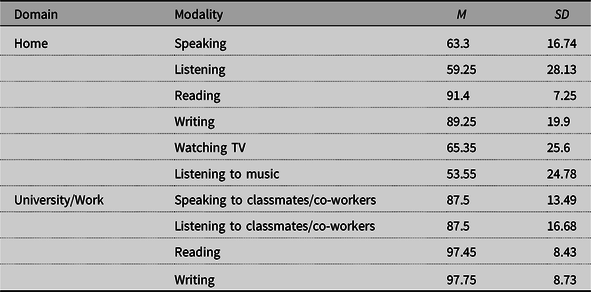
Participants reported English and Spanish used in daily life, across four language domains and in home and social settings, presented in Table 1.
Total sample reported language environment, percentage of total in English

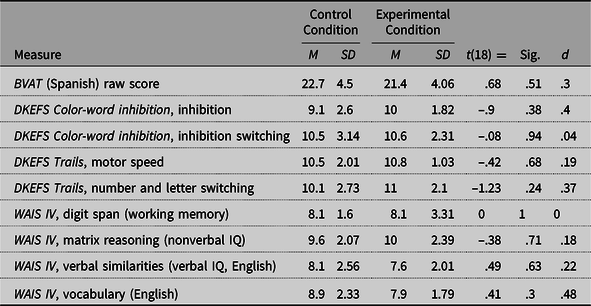
Participants from the experimental and control conditions did not differ significantly in performance on any of the psychometric or language assessments, except the DKEFS Trails subtest of motor speed, p = .05, such that the experimental condition had higher performance, with small effect size, d = –.19. Due to the size of the two sample conditions, Cohen’s d measures of effect size will be presented with significant findings where appropriate (d = 0.2 is generally considered a small effect size, 0.5 a medium effect size, and 0.8 is a large effect size). The two participant conditions were comparable in cognitive control (also known as executive function, EF), nonverbal IQ, working memory, Spanish vocabulary, and English vocabulary. Independent samples t-tests confirmed no significant differences between the conditions, see Table 2.
Participant performance on session 1 measures by condition

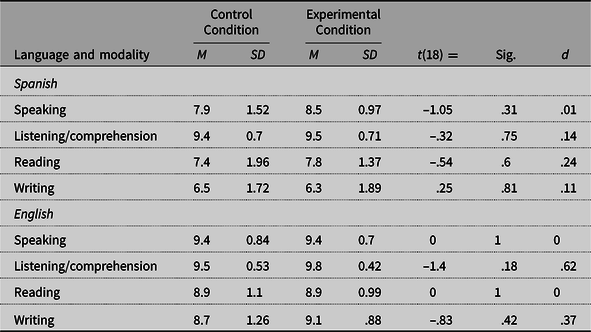
Participants in both conditions were comparable in Spanish and English language skill, daily environmental language usage, language background, and cognitive abilities that may impact language switching performance. The two conditions also did not differ significantly in self-reported abilities in English and Spanish across all four modalities, see Table 3.
Self-reported language abilities by condition, on a scale of 1–10

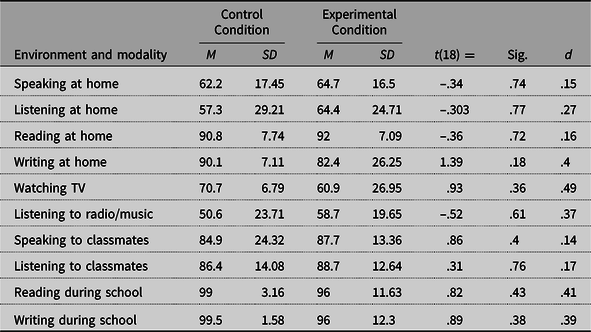
An independent-samples t-test confirmed that the two conditions did not differ significantly in language use ratios for daily language environment and as such likely engage in comparable amounts of daily switching, see Table 4.
Language environment by condition, percent of total language in English

Virtual meeting responses
English produced in meeting responses was analyzed as an outcome variable dependent on experimental condition using the following linguistic markers: (a) TTR, the ratio of different words (type) and the total number of words (tokens) and (b) MLU. Six responses (Questions 1–6) were analyzed for each participant.
Linear mixed-effects regression analyses (i.e., multilevel modeling) were conducted in SPSS 24 (IBM Corp, 2016) to test: (a) if response level performance differed between the experimental and control participant conditions (effect of condition); and (b) if response level performance differed between the two conditions over duration of activity (effect of question order) on two outcomes (TTR, MLU). Multilevel modeling with crossed sources of variability (random subject and item variability) at the same level was used to analyze performance at the item level (i.e., 60 observations per condition, 120 observations total). This method has been shown to be a valid approach for accounting for the systematic variability of individual subjects (Locker et al., Reference Locker, Hoffman and Bovaird2007). This approach controls for nonindependence of observations (i.e., violation of the assumption of independence of observations in parametric statistics; Locker et al., Reference Locker, Hoffman and Bovaird2007); items are nested within participants and participants are nested within conditions. The control condition was coded –0.5 and the experimental condition was coded 0.5.
When compared to a null model with no random effects, adding the random effect of individuals significantly improved model fit, χ2(1)Δ = 5.29, p < .021. This improvement in model fit justifies including the random effect of individuals in the model. The fixed effects regarding item type were added to the model next, and significantly improved model fit, χ2(1)Δ = 6.4, p < .001. We tested for main effects of condition (experimental, control), question order (treated as categorical; first question to last question), and interaction of condition and question order (fixed effects; random effects: participant and individual test item).
Mean length of utterance
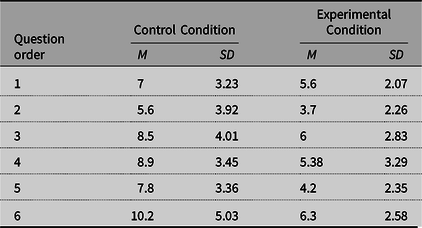
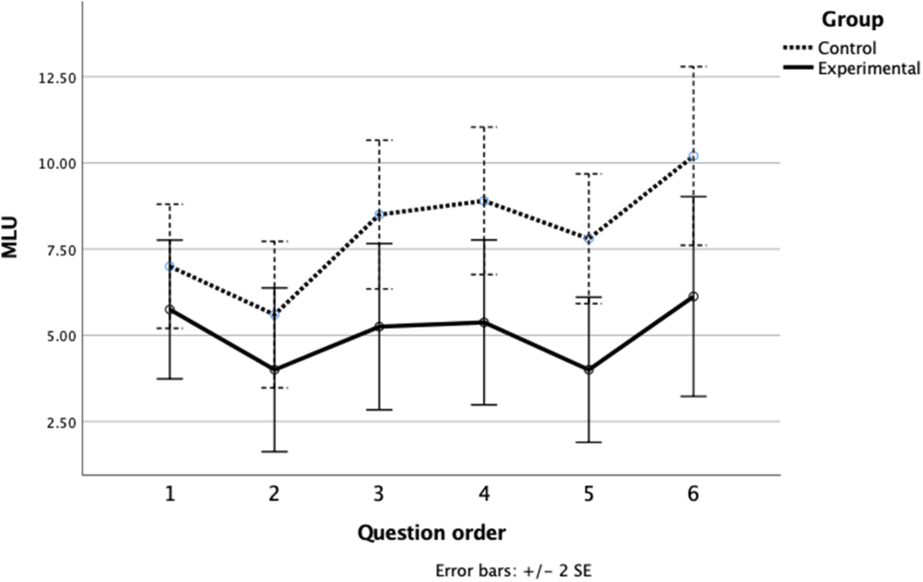
MLU by question order and by Condition are presented in Table 5 and Figure 1. Multilevel modeling revealed no significant main effects for question order [F(1,4) = 2.16, p = .21] or Condition [F(1, 27) = 1.05; p = .3]. There was, however, a significant interaction between question order and Condition, F(1, 93) = 5.51, p = .021, indicating that the two conditions did not differ at the beginning of the activity, but differed by the end. Control condition participants produced responses with increasing MLU as the virtual meeting progressed; participants in the experimental condition did not increase MLU over duration of the virtual meeting.
MLU by question, by condition

MLU by question order, by condition.

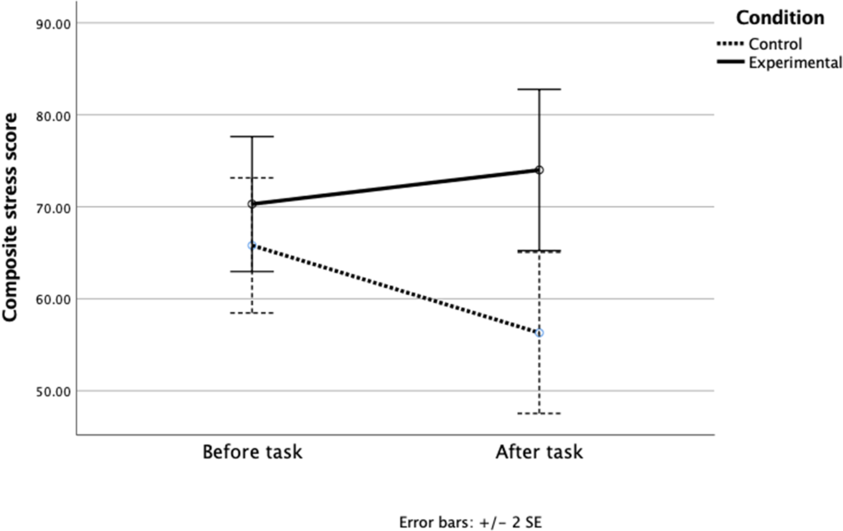
Stress scores before and after task, by condition.

Type-token ratio
Multilevel modeling indicated a significant main effect for Condition (control, M = .57, SD = .11; experimental, M = .47, SD = .13), [F(1, 26) = 4.9; p = .036]. The participants in the experimental condition showed significantly less lexical variation. There was no significant main effect for question order [F(1, 4) = 2.09, p = .22], and no significant interaction between question order and Condition for TTR [F(1, 93) = .35; p = .56].
Stress
An unweighted composite stress score (per Helton, Reference Helton2004) was calculated for each participant in the experimental condition for before [M = 70.3, SD = 14.86] and after the task [M = 74.00, SD = 14.12] and for the control condition before [M = 65.8, SD = 6.95] and after the task [M = 56.3, SD = 13.57]. A 2 × 2 ANOVA revealed a main effect of Condition (experimental, control) [F(1,18) = 4.8, p = .04, ηp2 = .21] but no main effect of Task [F(1,18) = 1.2, p = .29, ηp2 = .06], and a significant interaction of Task by Condition [F(1,18) = 6.22, p = .02, ηp2 = .26]. Independent samples t-tests revealed that the two conditions did not differ in stress prior to the activity [t(18) = –.867, p = .397, d = 0.39]; but did differ after the activity [t(18) = –2.86, p = .011, d = 1.28]. A paired samples t-test revealed that the control condition was significantly less stressed post activity [t(9) = 2.434, p = .038, d = .881] while the experimental condition did not significantly change post activity [t(9) = –1.034, p = .328, d = .255]. Stress scores before and after the task are presented in Figure 2.
DISCUSSION
Our results indicate that, for heritage bilinguals, an activity with forced switching into the nondomain dominant language (in this case, the L1) impacts spoken domain dominant language (in this case, the L2) at the utterance level. Participants in the experimental condition, who were required to switch between L1 and L2, produced shorter, less complex, and less lexically diverse utterances than participants in the control condition, who were bilinguals completing the activity in the domain dominant language exclusively. Additionally, participants engaging in the activity exclusively in the domain dominant language (L2; control condition) had significantly lower task-related stress after finishing, while participants engaging in the same activity in the experimental condition did not report a significant decrease in task-related stress after finishing (i.e., participants in the two conditions were no longer comparable because the participants in the control group had significantly lower task-related stress posttask).
Participants in both conditions were comparable in terms of L1 and L2 skill, self-reported daily environmental language usage, language background, cognitive abilities (cognitive control, working memory, nonverbal IQ), and domain general switching (measured using D-KEFS), thus, we attributed significant differences between the two conditions to the impact of the experimental condition. This may be related to maintaining two languages overall (mixing cost); because switch and nonswitch trials are not compared directly in the current study, as done in single-word tasks, our findings are more comparable to prior studies of mixing cost (i.e., Christoffels et al., Reference Christoffels, Firk and Schiller2007; de Bruin et al., Reference de Bruin, Samuel and Duñabeitia2018). We interpreted the lack of increase in MLU over the duration of the activity among participants in the experimental group (as compared to increasing MLU among participants in the control group) and lower TTR as evidence of mixing costs. Our findings extend prior findings of processing costs associated with forced switching in single-word experiments. This is the first study, to our knowledge, to demonstrate impacts of forced nondomain dominant/domain dominant switching on production at the utterance and sentence level in experimental conditions.
CONTRIBUTION TO THEORY
Our findings offer further evidence to support established theories of language switching, while expanding the literature with a novel research paradigm designed to reflect meaningful interaction contexts in a relevant U.S. population. Participants in the experimental condition showed significant differences from those in the control condition in a few specific areas.
Language production
Participants in the experimental condition used less lexical diversity in their responses, as measured by lower TTR. Participants in the experimental condition also produced shorter, less complex utterances in response to questions by end of task than participants in the control condition. Participants in the experimental condition did not increase MLU over the duration of the activity, as the participants in control condition did. From our results, we posit that dual language conditions with switching between languages impacts production at the sentence and utterance level. We expected that the forced switching condition would incur processing costs for heritage bilinguals, given that it (a) is forced, (b) involves switching between languages of different proficiency levels, (c) involves the nondomain aligned language, and (d) is a dual language context; thus costs, if existent at the production level in utterances, could be observed. This was based on prior research indicating switching costs are higher among bilinguals with greater proficiency imbalance (Bobb & Wodniecka, Reference Bobb and Wodniecka2013; Kaufmann et al., Reference Kaufmann, Mittelberg, Koch and Philipp2018) versus highly skilled bilinguals who regularly use both languages (Costa et al., Reference Costa, Santesteban and Ivanova2006; Costa & Santesteban, Reference Costa and Santesteban2004), that forced switching is more costly than voluntary switching (Blanco-Elorrieta & Pylkkänen, Reference Blanco-Elorrieta and Pylkkänen2017; Gollan et al., Reference Gollan, Kleinman and Wierenga2014; Jevtovic et al., Reference Jevtović, Duñabeitia and de Bruin2019), and that switching in production may require domain-general control networks (Blanco-Elorrieta & Pylkkänen, Reference Blanco-Elorrieta and Pylkkänen2016; this finding is not unanimous, see e.g., Calabria et al. Reference Calabria, Marne, Romero-Pinel, Juncadella and Costa2014 and Reference Calabria, Branzi, Marne, Hernández and Costa2015 showing that language and nonlinguistic switching have different underlying mechanisms).
The results from our multilevel modeling comparing response level performance are in line with previous research findings of mixing costs (Christoffels et al., Reference Christoffels, Firk and Schiller2007; de Bruin et al., Reference de Bruin, Samuel and Duñabeitia2018) and switching costs (for a review, see Bobb & Wodniecka, Reference Bobb and Wodniecka2013), however we uniquely identify costs at sentence and utterance levels to expand upon single-word and digit task data, as called for previously (van Hell et al., Reference van Hell, Litcofsky, Ting and Schwieter2015). Observing costs within the meaningful context of a “workplace” language domain requiring formulated sentences and cohesive responses furthers understanding of dual-language processing. Our findings align with the Adaptive Control Hypothesis (Green & Abutalebi, Reference Green and Abutalebi2013), which hypothesized that dual-language contexts, as opposed to dense code-switching or single language contexts, are most demanding. We found that the dual language switching context was likely more demanding than the single language context as manifested in MLU and TTR.
This may be due to the cost of maintaining two languages (mixing cost) or to the specific cost of switching from nondomain dominant back to domain dominant, or lexical access. Schrauf (Reference Schrauf2002) posited that communicating in the language not aligned to the domain context can present challenges. de Bruin and colleagues (Reference de Bruin, Samuel and Duñabeitia2018) found that in voluntary switching conditions, participants switched languages to facilitate lexical access while being forced to switch resulted in mixing costs and no mixing benefits. Carroll and Luna (Reference Carroll and Luna2011) presented domain-specific words to 30 Spanish–English bilinguals and found that words presented in the language typically used for the given domain were more quickly accessed and linked to concept than words presented in a “mismatched” language. Authors concluded that the language of presentation can impact concept accessibility (Carroll & Luna, Reference Carroll and Luna2011). In the context of the current study, participants in the switching condition had to use a language (Spanish) not aligned with the domain, which may have led to overall higher processing costs.
Stress
The two conditions were comparable in task-related stress prior to the activity, however, after finishing the activity, the participants in the control condition reported significantly lower task stress. Participants in the experimental condition, by contrast, did not report significantly lower stress after finishing the activity. Stress findings may be the related to the experimental condition being forced to switch without agency and/or related to using Spanish for the task, more broadly, even though participants in the experimental condition: (a) are L1 speakers of Spanish, (b) self-reportedly use Spanish and English in the home, and (c) volunteered to take part in a study explicitly requiring Spanish use.
The current study utilized the previously validated Short Stress State Questionnaire (SSSQ; Helton, Reference Helton2004), a measure specifically for measuring stress related to a task, to elaborate on previous research among heritage bilinguals who report stress when required to use the nondomain dominant L1 at work (Alarcon & Heyman, Reference Alarcón and Heyman2013; Colomer, Reference Colomer2010; Colomer & Harklau, Reference Colomer and Harklau2009) and prior findings of positive associations between stress other dual-task switching activities (see e.g., Matthews et al., Reference Matthews, Emo, Funke, Zeidner, Roberts, Costa and Schulze2006). Our findings contribute to the current literature by offering new evidence of differences in stress after a simulation that mimics everyday language. Specifically, the dual-language switching condition differed from a single-language nonswitching condition; there was a significant effect of Condition and an interaction between Condition and task such that after the task, participants in the control condition were significantly less stressed after the task and less stressed than the experimental condition.
Our prediction that participants in the experimental condition would have higher stress after the activity was inaccurate; instead, differences between participants in the two conditions were related to the decrease in stress reported by participants in the control group. Participants in both conditions had comparable state-specific stress prior to the activity; after the activity was complete, participants in the control condition had a significant decrease in state-specific stress while participants in the experimental condition remained at the same level of state-specific stress. Participants in the control condition could have experienced a decrease in stress for a number of reasons, including simply being relieved to have finished the activity or relieved that the activity was not as challenging as expected (i.e., did not require Spanish, see limitations). It is also possible that participants in the control condition built up a buffer to the stress of the activity due to a feeling of increased competence. For example, self-efficacy, a measure of confidence on one’s competence, is thought to help determine how an individual behaves in response to a challenge, how much effort they will put forth, and low long they will sustain that effort (Bandura, Reference Bandura1997). Prior research has indicated that self-efficacy has a direct and negative relationship with stress (see, e.g., Lu et al., Reference Lu, Siu and Cooper2005; Schwarzer & Hallum, Reference Schwarzer and Hallum2008). Perhaps the participants in the experimental condition did not have an opportunity to increase their self-efficacy related to the interview task because of the added challenge of unexpected language switches, resulting in stable levels of stress, whereas participants in the control condition increased in self-efficacy as they practiced and grew confident with the task in a single language, which reduced their feelings of stress.
The lack of decrease in stress after completing the task reported by participants in the experimental condition may thus be wholly or in part due to the dual-language switching condition. Participants could, however, have experienced stress in the experimental condition due to additional factors such as: lexical access (i.e., lacking domain appropriate Spanish vocabulary), language prestige, and overall cultural context. These factors may have impacted stress due to switching or even be the cause of stress. Despite our prediction being incorrect, our findings do advance knowledge regarding stress and switching, have implications for consequences of forced language switching in settings similar to the current study, and provide potential directionality for future research.
IMPLICATIONS FOR WORKPLACE LANGUAGE USAGE
It is common for heritage bilinguals in the United States to be expected to complete both basic and complex tasks in the L1 in the unfamiliar domain of work, without provision of training or compensation (Alarcon & Heyman, Reference Alarcón and Heyman2013; Colomer, Reference Colomer2010; Colomer & Harklau, Reference Colomer and Harklau2009). Our novel experimental paradigm was designed to mimic such scenarios, and our findings have implications for heritage bilinguals who are asked to use the L1 in workplace settings without specific training, compensation, or acknowledgment of the additional demand. Research indicates that employers do not view heritage language bilinguals’ skill in a non-English language as a skill that warrants additional compensation or training (Alarcon & Heyman, Reference Alarcón and Heyman2013), however, taking advantage of this “free” personal trait may not be “free” for the bilingual. Our findings indicate that it may be stressful and impact domain dominant language produced.
Previous studies have shown that employees who experience low levels of well-being will provide diminishing contributions over time to the organization (Danna & Griffin, Reference Danna and Griffin1999; Price & Hooijberg, Reference Price and Hooijberg1992). The stress of language switching may impact additional aspects of the individual’s life and performance. The paucity of research conducted on the effects of stress related to using the heritage language and language switching should be a targeted area of research with implications for other fields including business, education, and health care.
LIMITATIONS AND FUTURE DIRECTIONS
Limitations of the current study are addressed in the following text, the most prominent of which is the sample size (n = 20). Analyses at the item level allowed comparison of 120 total observations, however, future research should replicate findings with larger samples. Due to time and resource constraints, the current study utilized between-subjects comparisons to address RQ1. Future research could explore within-subjects comparisons using two, comparable virtual meetings, one monolingual and one requiring language switching, such that all participants experience the independent variable (i.e., forced language switching).
Participants in the current study were heritage Spanish–English bilinguals for whom English was the language of schooling and work, as reflected in self-reported higher literacy and writing skills in English. Heritage bilinguals were selected specifically because prior literature indicates they are likely to experience forced-switching conditions in the real world. Results may not be generalizable to other bilinguals (i.e., bilinguals who are biliterate, late sequential bilinguals, bilinguals who do not have comparable listening skill in the L1 and L2). Future investigations among balanced bilinguals may not find impact on spoken language at the utterance level, as switching or mixing costs may be less. While the demographic profiles of our participants are representative of many U.S. heritage Spanish–English bilingual speakers, findings should not be generalized to samples from other regions of the United States (i.e., settings in which Spanish–English bilingual education is common, Spanish-speaking regions in which heritage bilinguals use primarily Spanish for work) or bilinguals from other countries (i.e., highly proficient bilinguals living in bilingual societies, such as those in de Bruin et al., Reference de Bruin, Samuel and Duñabeitia2018; Jevtovic et al., Reference Jevtović, Duñabeitia and de Bruin2019). Participant age range is also limited and findings may not be generalizable to younger or older individuals.
Regarding experiment design, the novel virtual meeting paradigm approximated general realistic scenarios; however, the environment was simulated. Future research could improve on the paradigm by investigating field-specific, authentic scenarios in which language switching takes place and create tailored questions. The virtual meeting lasted approximately 30 minutes, whereas a full day of work involving language switching would likely provide more pronounced results and involves multiple additional factors (i.e., type of interaction, content of language, pace of switches).
Participants in the control condition were informed prior to the task that Spanish might be required in the virtual meeting and that language switching might occur through the informed consent process. This may have increased overall language monitoring among participants in the control condition. The computerized task randomly assigned participants to switching and control condition at outset and provided corresponding prerecorded task directions. Future researchers could address this weakness by creating two distinct but comparable tasks, one monolingual and one switching task, and notify participants prior to each task if both languages would be required.
The current study examined performance in L2 English to determine impact on linguistic output in the domain dominant language. The resulting comparison with the L2 English produced by monolingual control setting allowed isolation of the impact of switching on English produced. Extending RQ1 to Spanish language samples was not appropriate, as MLU is not a validated measure for Spanish and not recommended as a measure of linguistic complexity, due to the pro-drop nature of Spanish. A third, Spanish monolingual condition was, unfortunately, beyond the scope of the current study but would provide further insights. A Spanish monolingual condition could allow fine-grained exploration of lexical access (i.e., impacts of responding in a nondomain aligned language) and stress (i.e., stress related to answering in a nondomain aligned language) and could manipulate domain/nondomain aligned conditions. This would also provide further theoretical insights into general effects of the experimental condition on both languages and effects of one language over another. Additionally, research design could be manipulated to examine relevant background characteristics, particularly those relevant to theoretical models of switching such as language proficiency. Such future inquiries could lead to better understanding of the impact of language switching, in addition to having applied implications for bilingual employees required to switch between languages without compensation or language training to help them meet this demand.
Acknowledgments
The authors would like to thank all the participants and research assistants who worked on the project, including Holly Pothier and Dalia Becerra. The authors would also like to thank the anonymous reviewers and the associate editor for their thoughtful feedback. This project was funded through a Faculty Support Grant for Collaborative Research from California State University East Bay to the first two authors.