The general growth of government in the post–World War II era is one of the most important empirical regularities in political science. Measured by general government consumption or sectoral expenditures, government size grew dramatically during most of the postwar period. Intrigued by this phenomenal government growth, political scientists offered numerous accounts, some viewing this growth as a corollary of economic phenomena such as modernization, industrialization, income distribution, or fiscal illusion, and others attributing government growth to political causes such as bureaucratization, interest group politics, and electoral competition.1
For prominent examples of the research on government growth, see Coughlin, Mueller, and Murrell 1990; Larkey, Stolp, and Winer 1981; Lindbeck and Weibull 1987; Lybeck and Henrekson 1988; Meltzer and Richard 1981; Peltzman 1980; and Ram 1986 and 1987.
Recent scholarship of political economy has increasingly paid attention to the effect of economic openness on government size, as economic globalization has apparently slowed down the pace of government growth in much of the world. Under the growing influence of neoliberal economic thinking, big government is viewed to be unaffordable in an open economy, since high levels of taxes and spending hinder building an internationally competitive economy. Globalization is also claimed to drive the states to strive for world market shares; increasingly obsessed with international competitiveness, states in a globalizing world find themselves hamstrung in pursuing economic policies divergent from the interests of international capital investors.2
Contrary to this prediction, however, scholars of international political economy have found that more open economies have bigger governments.3
See Bernauer and Achini 2000; Burgoon 2001; Garrett 1995, 1998a, 1998b, and 2001; Garrett and Mitchell 2001; and Rodrik 1997 and 1998.
Although the compensation hypothesis presents a compelling explanation for the parallel growth of economic openness and government spending in the postwar period, a central puzzle in international political economy,4
Alt et al. 1996.
In this study, I revisit the openness-volatility link underlying the logic of compensation by making a conceptual distinction between economic openness and external risk and examining their differential impact on domestic economic volatility. The distinction between economic openness and external risk is crucial in understanding the effect of the international economy on domestic volatility. Openness refers to the exposure to the international economy, whereas external risk relates to the stability of terms and conditions under which a given economy trades with foreign economies. More open economies, while being more exposed to influences and developments of the international economy, do not necessarily suffer greater external volatility—for example, East Asian countries had more open economies but experienced less external volatility during most of the period of their growth, compared to other developing countries. Openness can lead to more or less domestic volatility because trade can concentrate or diversify economic risk depending on the production and market structure. By contrast, external economic risk should relate to greater domestic volatility because external risk spills over the domestic production process, as will be explained later.
My empirical reassessment of the openness-volatility relationship finds a consistently significant and strong impact of external risk on economic volatility but little support for the effect of openness. These results for external risk resonate with the findings of Rodrik, who carefully distinguished between openness and external risk.5
His work is frequently misunderstood to claim that openness directly leads to bigger government. He, in fact, claims that the effect of trade is conditional on the amount of external risk. “Openness exerts the strongest influence on government consumption in economies that are subject to the greatest amounts of external risk.” Rodrik 1998, 1028.
In examining the relationships of openness, external risk, and volatility, this analysis improves on the existing research in a few aspects. First, compiled from various sources, the current panel data set covers 175 countries from 1950 to 2002, ‘compiled’ offering one of the largest cross-national and longitudinal coverages of the postwar period. Using such comprehensive data helps to fend off the problems that often arise because of limited data samples.
Second, whereas most previous studies of the openness-volatility relationship are cross-sectional in their design of data analysis,6
my analysis draws on panel estimation that takes into account longitudinal variations within countries. The use of panel data is crucial in studying the openness-volatility relationship, because economic volatility is essentially a longitudinal phenomenon. Averaging out data for the whole sample period as done in a cross-sectional analysis would mask short-term fluctuations of economic aggregates, the very phenomenon that I intend to capture.Third, this study examines volatility of consumption and investment in addition to income or output volatility, a primary focus of existing research on the openness-volatility relationship. Consumption and investment constitute major components of the national accounting equation, capturing different aspects of the economy.7
National income or output can be decomposed as follows in the standard national accounting equation: Y = (C + G) + K + EB, where Y represents total economic output, C private consumption, G government consumption, K investment (or capital formation), and EB external trade balance.
Finally, this study undertakes various robustness tests, cross-checking them between the two major data sources—Penn World Tables (PWT) and World Development Indicators (WDI)—as well as employing different units of measurement and different estimation methods. The results for external risk hold in all these robustness tests, giving firm support to the key finding of this study.
In terms of organization, the following two sections review the compensation hypothesis, focusing on the volatility assumption, and introduce the theoretical and empirical problems of the openness-volatility link. Following is the empirical assessment of the effects of openness and external risk on economic volatility. The final section concludes with a discussion of the implications of this study.
The Volatility Assumption
It was not until the late 1970s that political scientists began to consider economic openness as a determinant of government size. Cameron's 1978 study of eighteen Organization for Economic Cooperation and Development (OECD) countries (1960–75) and Katzenstein's 1985 study of small European welfare states represent the two most widely cited pioneering studies of openness and government size. Cameron found the trade share of gross domestic product (GDP) to be the best predictor of the relative size of those OECD government revenues, and Katzenstein argued that compensatory government spending is a principal strategy that small open countries use to live with externally generated economic volatility.8
While these two scholars were the first to consider the destabilizing effect of openness on the domestic economy, a close reading of their work reveals that the primary causal factor that they drew on to account for government expansion is the size of a country rather than economic volatility. According to Cameron 1978, small countries, being more reliant on international trade, develop concentrated industrial structures as the necessity to operate on the world market leaves only a few oligopolistic firms. This concentration of production in turn leads to centralization of business and labor organizations, and centralized labor in particular facilitates the expansion of government welfare spending because it is a primary beneficiary of government welfare programs. Katzenstein 1985 proposed a similar argument: the political leaders of small countries being more vulnerable to the vicissitudes of the international markets devise strategies to live with externally generated instability, and compensatory government spending is one such strategy to cope with economic volatility that accompanies a small open economy.
With rapid growth of cross-border trade and financial transactions in the 1990s termed as economic globalization, economic openness came to take center stage in the causal accounts of government growth. Scholars studying the domestic implications of globalization noted an apparently puzzling trend in which government spending grew in tandem with international trade in most postwar years. Conventional wisdom about economic globalization predicts an inverse relationship between government spending and economic openness, since increasing global economic competition would place greater constraint on the capacity of the state to regulate and redistribute. Contrary to this prediction, however, Garrett and Rodrik found a strong positive association between openness and government size in their cross-national studies. Garrett showed that international trade and capital mobility are positively linked to welfare spending of industrialized countries, and Rodrik demonstrated a positive relationship between trade exposure and government consumption in both developing and developed countries.9
See Garrett 1998a; and Rodrik 1998, for their most representative studies of the compensation argument. See also Garrett 1998b and 2001; and Rodrik 1997.
At the center of this connection between openness and government spending is economic insecurity or volatility. To explain this counterintuitive finding, Garrett and Rodrik proposed an argument known as the compensation hypothesis, which hinges on the role of economic volatility generated by increasing exposure to the global economy. Assuming the state's objective function to be aggregate welfare maximization, Rodrik maintained that the state in an open economy, seeking an optimal mix of the public and private sectors in the face of externally generated volatility, would expand public-sector size to minimize total aggregate volatility, because the public sector is relatively insulated from the international economy. Garrett argued that the welfare state would be as popular in a globalizing world as it has ever been, given increasing economic insecurity and social dislocations accompanying globalization; in fact, large welfare spending is functional to globalization, because such spending can mitigate political and social tensions that might disrupt the globalization process by cushioning potential losers of globalization against market risks and compensating their economic losses.
Providing a neat explanation for the parallel growth of government and trade in the postwar decades, the compensation hypothesis has drawn much attention among researchers and policymakers concerned with the domestic consequences of globalization. As plausible as it sounds, however, the compensation argument rests on a dubious premise that openness brings about more volatility, which will be examined closely in the following section.
Openness Versus External Risk
Theoretically, greater integration with the international economy can bring about both more and less economic volatility. Whether openness leads to greater volatility ultimately depends on whether international market integration concentrates or diversifies economic risk.10
See Iversen and Cusack 2000, 317. As they claim, at least one of the two conditions should be met to validate the openness-volatility link. First, international market volatility must be greater than domestic market volatility, and second, trade or financial integration should concentrate rather than diversify risk. However, the first condition may not hold true because the world economy as a whole would be less volatile than its constituent economies (according to the law of large numbers), and the second condition cannot be taken for granted since trade can both concentrate and diversity risk.
On one hand, international market integration can increase domestic volatility, because trade by definition promotes specialization of production according to comparative advantage, and economies with a more specialized production structure will be more vulnerable to external economic shocks.11
More precisely, the theoretical effect of trade on macroeconomic volatility depends on the pattern of trade specialization and the nature of external shocks. If trade increases interindustry specialization across countries and industry-specific shocks are more important in driving domestic business cycles, trade will lead to greater output volatility. By contrast, if trade increases intra-industry specialization across countries, output volatility will decline as a result of trade integration because trade facilitates a supply of intermediary goods. See Kose, Prasad, and Terrones 2003.
On the other hand, greater economic integration can lead to lower volatility. Trade effectively expands the market, and because larger markets are less volatile than smaller ones, more trade-open countries will be less volatile.12
Fagerberg 1994. Related, the effects of idiosyncratic country-specific shocks must be felt less in economies more tightly integrated with the world market because the world market is much larger than domestic markets. Rodrik 1997, 55.
Reflecting this theoretical ambiguity, existing empirical evidence for the openness-volatility relationship is largely mixed. Some econometric studies report a significantly positive relationship between economic openness and output volatility, especially in developing countries,13
For instance, Easterly, Islam, and Stiglitz 2001 find that an increase in trade openness leads to greater output volatility in their sample of seventy-four developing countries, while a higher level of financial-sector development is associated with lower output volatility. See also Gavin and Hausmann 1996; and Ramey and Ramey 1995.
Brunner and Naknoi 2003 study the impact of trade costs on macroeconomic volatility constructing a two-country general equilibrium model where the degree of market integration is determined by trade costs such as transport costs and tariffs. They find that higher trade costs (that is, less market integration) are associated with higher real exchange-rate volatility and greater variability of income and consumption in their sample of twenty-three OECD countries for 1950–90. Razin and Rose 1994 examine the effect of openness on the volatility of output, consumption, and investment for a sample of 138 countries for 1950–88, finding no significant relationship between openness and the volatility of these variables.
Kose, Prasad, and Terrones 2003 found that volatility of private consumption increased in more financially integrated developing economies during the 1990s, whereas output volatility declined in the same period. From these findings, they speculate that the benefit of financial integration such as improved risk-sharing and consumption-smoothing accrues only beyond a certain level of development. This inverted U-shaped relationship may explain why more financially integrated developed economies are less volatile compared to some developing economies that are also financially integrated.
These economists are not alone in studying the openness-volatility relationship. Political scientists have also investigated the openness-volatility link in a more direct reference to the compensation hypothesis. Iversen and Cusack find no significant relationship between export dependence and the volatility of output, employment, and wages of the manufacturing sector in their sample of sixteen OECD countries (1970–93).16
Iversen and Cusack 2000. Based on this finding, they argue that the cause of welfare state expansion in OECD countries lies rather in domestic labor market changes rather than economic globalization. According to Iversen and Cusack, a transformation from a manufacturing-based to a services-oriented economy (namely deindustrialization) is a primary reason for heightened economic insecurity and uncertainty in OECD countries. Changes in the occupational structure consequent to deindustrialization in these countries have made their workers more reliant on state-provided welfare, since those shed from the traditional sectors find it difficult to transfer their benefits to new jobs in the service sector. See also Iversen 2001; and Wren 2001.
Scheve 2001. In a different study, however, Scheve and Slaughter 2004 argue that globalization of production increases labor demand elasticity, as firms increasingly substitute away labor to reduce their production costs. In their analysis of the British Household Panel Study (1991–99), the workers of industries with greater international exposure indeed turn out to feel more insecure about their jobs.
Although these contradictory findings for the openness-volatility relationship are not surprising given the theoretical ambiguity around the relationship, further work is required to resolve this empirical ambiguity because most previous investigations of the openness-volatility link suffer a few problems that limit the internal and external validity of their findings.
One of the problems plaguing the existing studies is a conceptual one. What really matters for compensatory government spending in an open economy is not the degree of openness per se but the amount of external economic risk it experiences.18
Bates, Brock, and Tiefenthaler 1991, which is not cited as often as Garrett's or Rodrik's work in the literature on the compensation hypothesis, is a rare exception in this regard. It explicitly acknowledges that the openness-welfare state nexus is due to external risk rather than just the open economy. “The international economic environment, we argue, poses not only gains from trade but also the danger of risk. One method of coping with this risk is protectionism. Another consists of domestic forms of insurance: welfare and transfer payments.” Ibid., 4.
Rodrik 1998, 1012–13.

Output volatility thus increases proportionally to trade risk.
Another problem of the existing research is what might be called the omitted variable bias, because some factors are not given due consideration in the existing research despite its causal relevance to economic volatility. One such factor is country size. Ceteris paribus, small economies are more likely to be volatile as seen in the following example. Consider two countries, A and B, with populations of n and n/2. Assume also that individual income in each country, xi, is independently and identically distributed (i.i.d.) with equal variance σ2. Then the variances of per capita income of the two countries would be:

Hence the smaller country, B, suffers higher per capita income volatility.20
See Easterly and Kraay 2000 for the empirical evidence linking country size and volatility in small states.
Political democracy is another factor treated insufficiently in the econometric studies of the openness-volatility relationship, although scholars of political economy have long studied regime effects on various aspects of economic performance. There are at least two mechanisms whereby democracy can lower volatility. First is the decentralized decision-making structure. Spreading decision-making power among multiple policymakers, democracy helps lower the probability of making an erroneous policy response to a given economic shock when uncertainty over a policy outcome is high.21
Put differently, concentrating power in one hand is akin to putting all eggs in one basket. Mobarak 2005 develops an economic model that demonstrates that the benefit of power-sharing increases with the level of uncertainty over a policy outcome.
I appreciate an anonymous reviewer for noting this fundamental trade-off between policy stability and flexibility. Greater constraints on policy changes imply more stability in policy outcomes yet less flexibility in making a necessary policy adjustment. If a status quo policy aggravates rather than stabilizes externally generated volatility, a drastic policy change in fact helps lower volatility. I also thank another reviewer for suggesting a possible link between democracy and volatility based on the relationship between political and economic stability. While there is not much doubt on the latter relationship, it is not certain whether democracies are more stable in terms of regime longevity or duration.
The other mechanism linking democracy to volatility is participatory politics, a hallmark of political democracy. With various institutional protection of political and civil rights, democracies reflect more accurately citizens' policy preferences in their policymaking processes and outcomes. Given that average citizens are risk averse, democracies will then exhibit lower volatility since democratic leaders will adopt a less risky policy option when faced with uncertainty over alternative policy outcomes.24
Quinn and Woolley 2001 present a similar logic, arguing that when presented with two alternative economic policies (one yielding high growth/high volatility and the other moderate growth/moderate volatility), risk-averse citizens would support the latter. A simple nontechnical model can show how participatory politics can lessen volatility by constraining political leaders to follow a risk-averse course of action. Consider a national political leader who seeks to achieve economic growth. Note, however, that rapid growth necessarily entails higher volatility. Since citizens value not only rapid growth but also stability, a democratic leader will face an additional constraint in seeking growth compared to an autocratic leader. The former's decision problem is thus two-fold: to maximize growth yet to minimize volatility. In contrast, the latter's decision problem is simply growth maximization, as he is relatively unconstrained by citizens' preferences for stability. Since the growth rate that minimizes volatility would be lower than the growth rate without such a constraint, a democratic regime will show lower growth but suffer less volatility.
In addition to these conceptual problems, the existing studies also show some empirical shortcomings. First, most previous studies of the openness-volatility link are hardly comparable due to the use of vastly different samples of countries and time periods. In particular, when the findings conflict with one another, it is hard to conclude whether such conflicting findings reflect the theoretical ambiguity inherent in the openness-volatility relationship, or are due to the use of different samples. Hence if little relationship is found between the two, one cannot be sure whether this finding indicates nonexistence of the relationship or is due to the data being too weak to find any relationship. In the latter case, the null finding in fact indicates Type II error (that is, failing to find a relationship in the sample data that in fact exists in the population).
Second, there is a perennial trade-off between longitudinal and cross-sectional coverage in most cross-national data sets. Those data sets with a wide cross-section of observations typically lack longitudinal data sufficiently long to conduct a time-series analysis, whereas those data sets with a good longitudinal coverage do not contain a sufficient number of countries to allow panel analysis. The existing findings on the openness-volatility relationship are mostly from a cross-sectional study of a large number of countries or a panel study of a handful of countries. Hence, not only are those findings incomparable but also limited in their external validity, which poses a problem for the generalization of the findings to a larger set of countries and periods.
The following analysis of the openness-volatility relationship presents an improved analytical and empirical investigation of the link in all these aspects. First, this analysis distinguishes and contrasts the effects of openness and external risk on domestic volatility using multiple measures of openness and risk. Second, the analysis controls for both country size and democracy, which were theorized above to have significant impact on the level of volatility. In particular, democracy is measured using alternative indicators that tap into the aspects of democracy more directly related to volatility. Finally, the analysis relies on a truly comprehensive panel data set covering most years (1950–2000) and most countries (175 nations) in the post–World War II world. To my best knowledge, this data coverage is larger than that of any existing empirical studies. In addition, I conduct various robustness checks to find out whether they are consistent across different model specifications and estimation methods. The next section reports both the design and results of the empirical reassessment of the openness-volatility link.
Empirical Assessment: Data, Method, and Findings
The current data analysis of the openness-volatility relationship builds on Rodrik's 1998 study on trade and government size, which is one of the most significant contributions to the compensation argument and more broadly to the literature of the globalization–welfare state nexus.26
I base my analysis on his 1998 article rather than his better-known 1997 book, because the article contains more detailed information on his data analysis.
Although Rodrik's analysis is careful and his cross-sectional findings hold in various robustness tests, his study still leaves room for improvement and extension. First, averaging cross-national data for the whole sample period, Rodrik does not take full advantage of longitudinal variations within the countries.27
Rodrik 1998, as well as Iversen and Cusack 2000, use a panel method when they investigate the phenomenon of their major interest. But their analyses of the openness-volatility link remain cross-sectional.
Rodrik 2000 theorizes the democracy-volatility relationship role of democracy in a separate paper, but this paper leaves out the effect of external risk.
The subsequent subsections introduce the data and design of the analysis and present the findings.
Data and Methods
The current data set contain cross-sectional time-series data from 175 countries for 1950–2002 from PWT (version 6.1), WDI (2004), and other databases (see Appendix for more information on data sources). The dependent variables are three types of economic volatility—income, private consumption, and private investment—which are measured by the five-year standard deviations of annual growth rates of each economic aggregate.
The two major independent variables are economic openness and external risk. Openness is measured chiefly by two indicators—trade and gross private capital flows as a share of GDP. Correspondingly, external economic risk is also captured by two measures—terms of trade risk and exchange-rate risk. The former is the standard deviations of the first-differenced logs of the terms of trade multiplied by the trade share of GDP (as in Rodrik's study), and the latter expressed in the same fashion for real exchange rates.
Several control variables are in place, as the level of economic volatility is determined by a number of factors. As explained earlier, country size measured by total midyear population should be linked to lower volatility. Political democracy is also controlled for given some of its institutional features that may be likely to reduce volatility. Democracy is measured using both the regime-level measure capturing the overall level of democracy and disaggregated measures that specifically tap into the features of democracy that more directly relate to economic volatility (which I introduce later).
Two additional control variables are included: the level of development and the size of a public sector. The former, measured by per capita GDP, should be linked to less volatility, as more-developed economies have more sophisticated economic institutions that insure economic agents against various risks. Public-sector size, measured by government consumption as a percentage of GDP, also matters for volatility, since as argued by Rodrik the public sector, being more isolated from external disturbances decreases the domestic economy's exposure to external risk.
All independent variables are expressed as five-year averages from 1950 to 2002 (with the exception for the last time period covering 2000–2002) in correspondence to the way the dependent variables are measured. This averaging process yields eleven data points for each country, generating another panel data set comprising eleven time periods and 175 cross-sectional units.
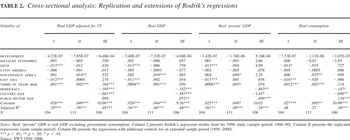
The data are initially explored for cross-sectional analysis to replicate and expand Rodrik's 1998 study. These cross-sectional regressions are reported in Table 2. Further data analysis is performed using the random-effects model, whose results are presented in Tables 3, 4, and 5. These panel regressions compare the effects of openness and external risk employing various measures of openness and risk. Table 6 presents the panel regressions checking the baseline results against alternative measures of democracy, and Table 7 further robustness tests using different estimation methods. These include: the fixed-effects model, the OLS regression model with panel-corrected standard errors (PCSE), the ordinary least squares (OLS) regressions with the lagged dependent variable, and the random-effects model with a correction for the sample selection problem. In particular, the regressions with the lagged dependent variable are run to see whether alternative methods of capturing longitudinal variations lead to different results, and the sample selection regressions are run to check the estimation bias that might arise due to a large amount of missing data in the current data set.29
In the present analysis, the sample selection problem may arise because the level of development can affect both the degree of volatility and the likelihood that the volatility data are observed. Running a regression without taking into account this possibility would risk underestimation of the development effect on volatility. To check the sample selection problem, I rely on a relatively simple method in the spirit of Heckman's sample selection procedure. In essence, Heckman 1979 treats sample selection as the omitted variable problem proposing a two-step model. The first-step regression models a selection process, where one draws the hazard rate for a dependent observation to be nonmissing given some parameters that are likely to affect this rate. The second-step regression models a phenomenon of major interest with the hazard rate entered as an additional regressor. The presence and direction of a sample selection process is indicated by the significance and sign of the coefficient estimate on the hazard rate. Since a practical application of Heckman's method to panel data is yet to be developed, the following informal method was used to model the sample selection process in the current analysis. I first created a dummy variable to indicate whether an observation for volatility is missing, regressing on the level of development and other variables likely to influence the likelihood of observing volatility data. From this selection regression, I derived a predicted probability for an observation on volatility to be missing, which was then added to the main regression.
Findings: Preliminary Evidence
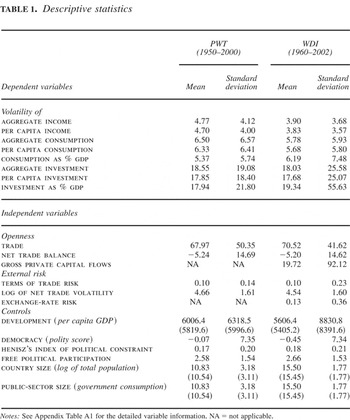
Table 1 reports the descriptive statistics derived from the PWT and WDI data. Although most variables display similar means and standard deviations, there are a few notable differences between the two data sets as well as among the different measures. The level of volatility is generally higher for the PWT data. Also, the percentage measures are most volatile in the WDI data, whereas the aggregate measures are so in the PWT data.30
I also ran pairwise correlations between the volatility measures from the two data sets; while most correlations between the PWT and WDI based measures were high, ranging from 0.66 to 0.73, the correlations were somewhat low for the volatility of consumption and investment (as a percentage of GDP)—0.56 and 0.52, respectively.
Investment flows include both real resource movements and monetary transactions that have little to do with the real economy; hence, investment is subject to greater volatility compared to income and consumption that reflect real economic changes.
Descriptive statistics

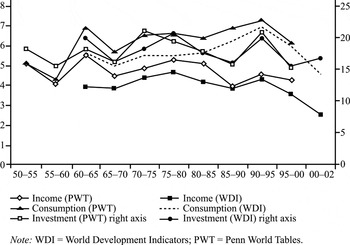
Although these descriptive statistics summarize data for the whole sample period, Figures 1 and 2 show the postwar trends for volatility, openness, and external risk. The longitudinal patterns of economic volatility in Figure 1, shows significant fluctuations for all three types of volatility. The 1970s and the early 1990s, in particular, stand out as the most volatile periods for all types of volatility.32
The trends of the volatility measures expressed as a percentage of GDP show similar patterns. While volatility is measured in aggregate, per capita, and percentage terms in this study, the per capita measures have some advantages over the other measures, because they capture individual-level economic welfare directly (unlike the aggregate measures) and because they are less sensitive to changes in other components of the national accounting equation (unlike the percentage measures).

Economic volatility (per capita measures)

Openness versus external economic risk
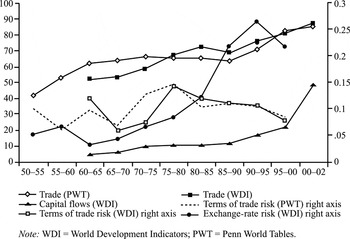
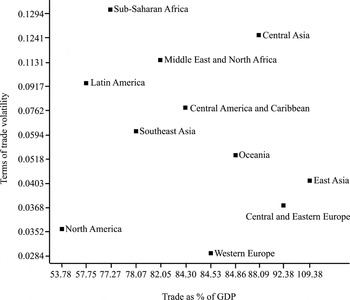
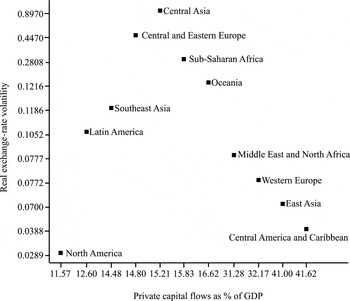
The next figures chart different geographical regions according to their levels of economic openness and external risk (averaged for the second half of the 1990s), demonstrating that more open countries do not necessarily suffer greater external volatility. As shown in Figure 3, East Asian countries have the most trade-open economies but at the same time low levels of terms of trade volatility, whereas Latin American economies are less open to international trade but characterized by high levels of terms of trade volatility. Figure 4 also reveals that Central American economies are highly open to foreign financial flows but show low exchange-rate volatility, while Central Asian economies are less financially open but suffer highly volatile exchange-rate movements.33
In fact, one might create a two-by-two matrix according to the levels of openness and risk: (1) more-open/higher-risk economies, (2) more-open/lower-risk economies, (3) less-open/higher-risk economies, and (4) less-open/lower-risk economies. According to Figure 3, East Asia and Western Europe fall into the first category, Central Asia the second category, Latin America and Sub-Saharan Africa the third category, and North America the last category.

Openness versus external risk (trade)

Openness versus external risk (capital flows)
Openness Versus External Risk
The following tables present a more comprehensive and systematic analysis of the openness–external risk–volatility relationship. In Table 2 are shown the cross-sectional regressions that replicate and extend Rodrik's analysis. Column I of this table displays Rodrik's regressions and Column II the replicated regressions. Column III shows the same regressions extended to a longer time period covering the 1950s and 1990s. These extended regressions also include additional controls—political democracy, country size, and public-sector size.
Cross-sectional analysis: Replication and extensions of Rodrik's regressions

The coefficient estimates from the replicated regressions are slightly different from those of the original regressions, which may be due to the use of the latest version of the PWT data for replication, yet both the sign and the level of significance of the replicated estimates remain the same as those of the original estimates. A couple of new results from the extended regressions are noteworthy. Most importantly, the effect of external risk associated with trade turns out to be consistently positive for income and consumption volatility, even when the regressions are expanded to longer time periods and more controls. Turning to the control variables, both country size and democracy are associated with lower volatility as anticipated. However, public-sector size is linked to higher volatility contrary to the expectation about the risk-insulation function of the public sector. The latter finding indicates that in many developing countries comprising the majority of the sample, public spending has a cyclical rather than countercyclical effect on the domestic economy, echoing Wibbels's finding on business cycles in developing nations.34
Wibbels 2006.
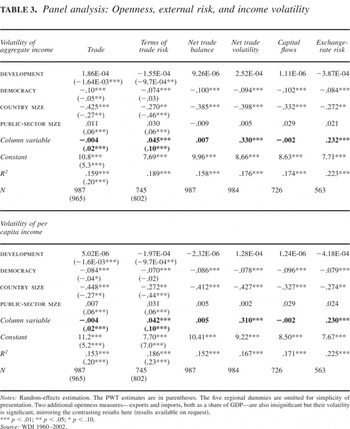
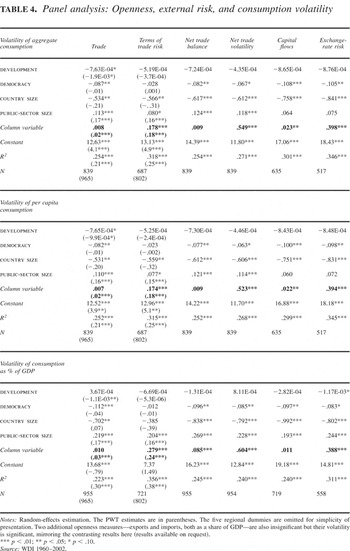
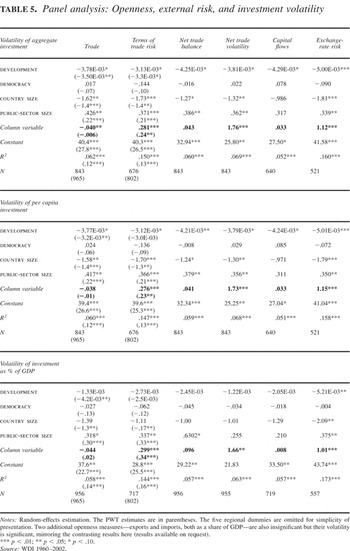
Tables 3, 4, and 5 show the panel regressions expanding Rodrik's analysis further with a focus on the differential effects of openness and external risk on volatility. The dependent variables are now the standard deviations of annual growth rates of economic aggregates taken for each five-year period rather than for the whole period. This panel analysis also examines investment volatility. Note that each type of volatility is analyzed using different measures of unit (expressed in aggregate, per capita, and percentage terms) and data sets (the PWT and WDI data).
Panel analysis: Openness, external risk, and income volatility

Panel analysis: Openness, external risk, and consumption volatility

Panel analysis: Openness, external risk, and investment volatility

Most notably, most openness variables are insignificant, whereas the external risk variables are consistently significant across all regressions. The sign and the direction of the coefficients of the openness variables differ greatly by the data set and the type of volatility. The size of trade is largely insignificant for income and consumption volatility but is negatively linked to aggregate investment volatility, the latter implying that investment is more volatile for less (rather than more) trade-open countries. The openness variables tend to be more significant for the PWT data, on which Rodrik's analysis is based.
By contrast, all of the external risk variables are significantly positive for the three types of volatility regardless of the data set or the measure being employed. Not only are these risk variables statistically significant but also considerably large in their effects. To gauge the magnitude of the effects, I derived the estimated elasticity of income volatility to the two risk variables. This elasticity calculated as d(ln y)/d(ln x) indicates a relative change in the dependent variable induced by a relative change in the independent variable. The estimated elasticity of per capita income volatility to terms of trade and exchange-rate risk based on the WDI data is 0.068 (0.026) and 0.098 (0.018), respectively, with standard errors in parentheses. Hence, if all other conditions are held constant, Lesotho's per capita income volatility in 1990–94 would have been higher by 20.4 percent than that of another African country, Malawi, given that the terms of trade volatility of the former was three times greater than the latter's. For another example, Thailand experienced a drastic increase in its exchange-rate risk (from 0.2 to 2.2) between the early and late 1990s. This change would have almost doubled its aggregate income volatility if other conditions were held constant. These contrasting results for the openness and risk variables provide strong support for the positive connection between external and internal volatility, at the same time bearing out the dual effects of openness.
As for the control variables, the results vary considerably by the type and measure of volatility as well as by the data set being used. The level of development is linked to lower volatility of consumption and investment, but inconsistently signed for income volatility. On the other hand, democracy measured by the Polity score shows a strongly significant effect on income and consumption volatility but not on investment volatility.35
The democracy results also differ by the data set used; the WDI data tend to give more significant and stronger results than the PWT data.
Robustness Checks
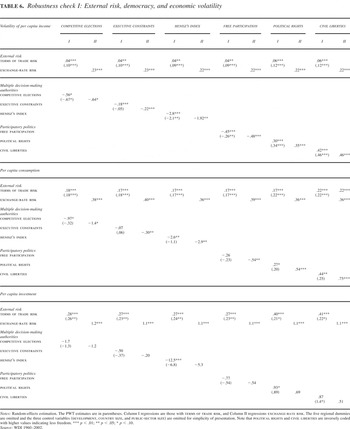
The next tables present various robustness tests alternating measures of democracy and methods of estimation. Table 6 shows the regressions testing the robustness of the external risk effect against more disaggregated measures of democracy that capture two component features of causal relevance to economic volatility—multiple decision-making authorities and participatory politics. These features were argued above to lower volatility by reducing policy mistakes and radical policy changes and by representing risk-averse preferences more accurately through greater public political participation. In the current regressions, multiple decision-making structures are captured by three variables—the presence of competitive elections, constraints on chief executive power, and Henisz's political constraint index.36
The presence of competitive elections, constructed from the Polity IV variables measuring the regulation, competitiveness, and openness of chief executive selection, indicates whether a political regime has institutionalized competitive elections. Executive constraint, also from the Polity IV data set, refers to the extent of institutional constraints on the decision-making power of the chief executive. Henisz's index measures the feasibility of policy change based on the number of independent branches of government that have veto power over policy; see Henisz 2001. More precisely, the number of independent government branches is modified by the degree of alignment across branches of government and the extent of preference heterogeneity in each branch in order to reflect an additional constraint generated when opposition branches hold homogenous party preferences or the same branch holds heterogeneous preferences; see Henisz 2002, 2.
Free political participation is a six-point scale variable from Polity IV, representing the degree to which relatively stable groups make active political participation in a competitive manner. Political rights and civil liberties from the Freedom House database measure the degree of freedom in political and civil matters on a seven-point scale inversely coded with lower values indicating higher degree of freedom.
Robustness check I: External risk, democracy, and economic volatility

For simplicity of presentation, only the risk and democracy variables are shown in these regressions, and each set of columns contain two regressions, one on terms of trade risk and the other on exchange-rate risk.38
Note that only the terms of trade risk regressions show the results from the PWT and WDI data sets, since the terms of trade risk data are available for both data sets.
These results for the external risk and democracy variables also hold for aggregate income volatility.
The democracy effect is quite large as seen in the following examples. Based on the estimated elasticity of income volatility to free political participation, one can infer that in the late 1990s Argentina, showing freer and more open political participation (scoring 1 point higher on the 0- to 5-point scale), would have aggregate income volatility lower by 0.12 percent than Colombia.40
The elasticity measure for an ordinal independent variable such as free political participation indicates a relative change in income volatility due to a one-unit increase in the independent variable, that is, d(ln y)/dx. The estimated elasticity of per capita income volatility to Henisz's index is −0.161 (0.041), and the estimated elasticity of aggregate income volatility to free participation is −0.057 (0.029) with standard errors in parentheses.
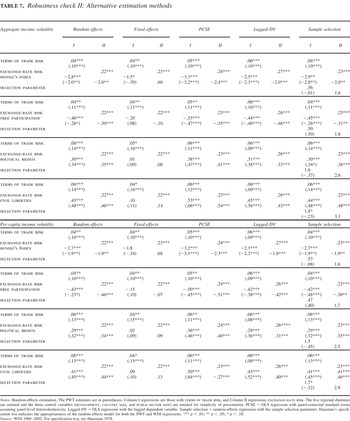
Table 7 presents further robustness tests on the effects of external risk and political democracy on income volatility using different estimation methods—fixed-effects, OLS with PCSE, OLS with a lagged dependent variable, and the sample selection model. Note that the sample selection regression includes an additional variable called the selection parameter whose coefficient estimate indicates the presence and direction of sample selection due to the possible correlation between the level of development and missing data on volatility.41
This variable, derived from the selection regression that models the sample selection process, captures the predicted probability that an observation on income volatility is missing.
Robustness check II: Alternative estimation methods

Table 7 again shows a consistently strong effect of external risk. The two risk variables are associated with higher income volatility, whether measured in aggregate or per capita terms. The four democracy variables selected because of their consistently significant coefficients in Table 6—henisz's index, free participation, political rights, and civil liberties—continue to be significantly negative in all but the fixed-effects regressions. The insignificant result for democracy in the fixed-effects regressions may be due to the possibility that these variables are highly collinear with unidentified unit conditions that are lumped together as fixed-effects; in such a case the fixed-effects estimation tends to generate downward bias in the estimates. In addition, it is hard to estimate properly the effects of less time-variant variables such as a regime type with the fixed-effects model.42
See Beck 2001; Beck and Katz 2001; and Green, Kim, and Yoon 2001. A more fundamental question about the fixed-effects versus random-effects approach is whether the cross-country differences in the relationship we try to model should be regarded as parametric shifts of the regression function (as represented by different constant terms for different countries) or as part of the random process distributed across countries. For TSCS data that have more time-series observations than cross-sectional units (for example, a regional sample of countries) the fixed-effects approach makes sense, because we seek to understand cross-country differences in the sample only. For panel data such as the current one that have more cross-sectional units than time-series observations, it can be problematic theoretically and practically. Theoretically one can pursue to make out-of-sample predictions rather than analyze the relationship conditionally on the effects of present in the sample. Practically the fixed-effects approach is costly in terms of degrees of freedom lost; see Greene 2000, 567–76.
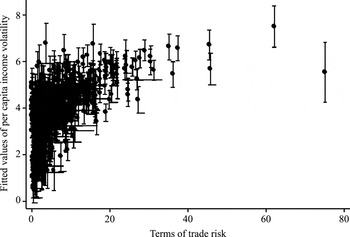
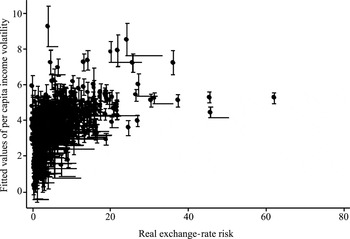
The final two figures illustrate the effects of external risk on economic volatility, plotting the two risk variables against the fitted values of per capita income volatility (with bars representing the 95 percent confidence interval based on the standard errors of the fitted values). In these figures both the terms of trade risk and exchange rate risk turn out to be strong predictors of the level of income volatility, as they are very much linear with its predicted values.43
This linear pattern becomes much clearer if some outlier cases are deleted such as Germany in 1960–64 (for terms of trade risk) and Bulgaria in 1995–95 (for exchange-rate risk).

Predicted effects of terms of trade risk

Predicted effects of exchange-rate risk
The current findings lend strong support to the theoretical prediction of the previous section about the differential effects of openness versus external risk. Those measures of economic openness are rarely linked significantly to economic volatility, whereas those of external risk are consistently and positively associated with all types of volatility examined here. This study also provides strong evidence for the democracy effect on income volatility, though the effect is not apparent for consumption and investment volatility. This may not be surprising given that income or output volatility is typically an explicit policy goal pursued by political leaders. The results for external risk (and for democracy as far as income volatility is concerned) are quite robust, holding in various tests using different data sets and alternative estimation methods.
Conclusion
Economic globalization has apparently placed greater constraints on state capacity to regulate and protect the domestic economy. Increasing competitive pressures from global market integration and rising international capital mobility have forced national governments to reduce or reconsider their commitment to social programs that are unattractive to potential capital investors in their economy. Contrary to this expectation, however, scholars of international political economy have found a simultaneous growth of government spending and international trade in much of the postwar period. The efforts to explain this puzzling finding have resulted in the compensation argument, which claims that economic openness generates greater economic volatility and insecurity, thus raising societal demand for state-provided social protection. Emphasizing the role of the state in providing social insurance against external risks, the compensation hypothesis has earned currency among academic and policy circles.
Yet one of its central assumptions stands on a shaky ground, namely that openness leads to greater volatility. The relationship of economic openness and volatility is not only theoretically ambiguous but empirically moot. My statistical analysis of the panel data from 175 countries for 1950–2002 demonstrates that economic volatility is a mistaken link in understanding the causal impact of economic openness on government size. A central finding of this analysis is that more open economies are not necessarily more volatile externally or internally, and that it is the amount of external risk rather than the level of openness that is linked to higher domestic economic volatility.
The current examination of the volatility assumption has implications for the broader research on globalization and domestic politics, as the assumption is not only central to the compensation hypothesis but also pervasive in the globalization literature. Openness-induced economic instability, whether in the form of macroeconomic volatility or personal economic insecurity, is a key element in the studies examining the problems and constraints brought up by global economic forces. A growing number of studies has explored its consequences and implications for domestic politics. Some examine the impact of increasing economic volatility on economic growth, social stability, and income inequality, and others the impact of economic insecurity on voter choice and partisan politics.44
See Breen and Carcía-Peñalosa 1999; Kwon 2003, Rodrik 1998b and 2000; Quinn and Woolley 2001; and Scheve 2001. Kwon 2003, for instance, argues that economic insecurity triggers a transition of voters toward leftist parties, which provides a link between economic changes (whether globalization or deindustrialization) and public demand for social protection.
One caveat is in order in interpreting the current findings. Although the present data analysis shows that volatility is a problematic link connecting openness and government spending, it is still possible that globalization increases individual perceptions of economic insecurity, as reported in recent studies. See Marsh and Wilson 2002; and Scheve and Slaughter 2001 and 2004. Government spending may then increase with openness due to an increase of perceived economic insecurity. It is puzzling and worth further research why subjective perceptions of economic insecurity could worsen without significant changes in the objective level of economic volatility.
If economic volatility is a dubious link in accounting for the positive relationship between government size and economic openness, what can account for it? There are two possibilities. One is that there may be some other mediating mechanism that connects openness and spending. I suspect that democracy is an alternative mediating condition underlying the openness-spending relationship.46
Another plausible mediating mechanism underlying the openness-spending association is found in the proposition known as Wagner's Law in the public finance literature, which maintains that government-provided goods are luxury goods whose income elasticity exceeds one. The law implies that more developed countries can afford larger government (cross-sectional interpretation) or that as countries develop they will become larger spenders (longitudinal interpretation). If more open economies are more developed (or grow faster) as often found in the development economics literature, they would then spend more on public goods and services according to Wagner's Law. See Dollar 1992; Edwards 1993 and 1997; and Sachs and Warner 1995. However, the proposition receives little support from cross-sectional studies, though it is generally confirmed in time-series studies. Bird 1977; Landau 1983; Pryor 1968; and Ram 1986 and 1987.
This mediating role of democracy can also solve a puzzle that might arise from the finding about democracy and income volatility (I appreciate an anonymous reviewer for noting this puzzle). If democracies suffer less income volatility, why would democracies spend more on social protection? After all, they will face less need to provide social protection. The answer is that while democracy suffers less income volatility, it is not volatility but democracy that leads more open economies to spend more on social programs. That is, more open economies show greater government social spending not because they are more volatile but because they tend to be more democratic.
See Avelino, Brown, and Hunter 2005; Brown and Hunter 1999; Kaufman and Segura-Ubiergo 2001; Lake and Baum 2001; and Rudra 2001 and 2005. Adserá and Boix 2000 suggest another possibility, in which democracy mediates the openness-spending relationship, building a formal model endogenizing the degree of openness. In this model, politicians choose the level of openness and the size of the public sector simultaneously considering a trade-off between the benefit of an open economy and the need to compensate the losers from openness. The model results in three equilibrium outcomes: democracy with free trade and compensation, autocracy with closed economy and no compensation, and autocracy with free trade and no compensation.
Another possibility is that the positive association between government spending and economic openness may be spurious, caused by a third variable that leads both to be large or small. One factor that can generate such a spurious correlation between openness and spending is country size. Under the assumption of increasing returns to scale in public goods production, small countries would have larger public sectors, since large countries can provide the same level of public service with a relatively smaller public sector. On the other hand, small countries engage more in international trade to realize the economy of scale. The positive relationship between openness and government size will then be due to the fact that small countries have more open economies and at the same time relatively larger public sectors.50
See Alesina and Wacziarg 1998 for a more elaborate country size argument as well as for cross-sectional evidence showing a positive association between population and government consumption. Country size may also be linked to government spending through a different mechanism. According to Wallerstein 1989, country size is one of the primary factors explaining cross-national variations of union density in advanced industrial countries. He theorizes that union density declines with the size of the workforce, since the benefits from expanding union membership depends on the organized proportion of the labor force whereas the costs depend on the absolute numbers of organized workers. See also Stephens and Wallerstein 1991 for a debate on the causal effect of country size on union density.
All these conjectures have yet to be tested. Answering why more open economies have bigger governments is not as easy a task as advocates of the compensation argument might have hoped.
Appendix
Country Sample
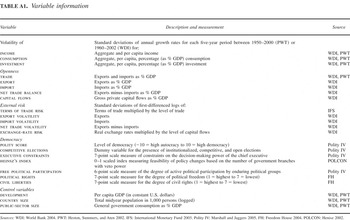
The current sample of countries include 175 countries selected from 227 countries and areas of the world that have a population larger than 250,000 as of 2000 according to the International Data Base of the U. S. Census Bureau. Note that the WDI data set contains 174 countries, since the World Bank does not keep statistics for Taiwan.
Variable information