INTRODUCTION
Authenticity is a confusing and problematic concept related to the technicalities, languages, and cultures, as well as the ethics, of the world of heritage. Tayyeb Tizini is the most prominent Syrian philosopher to tackle matters of heritage through an in-depth philosophical approach based on the five intellectual tendencies related to modern Arab thought: the Salafism, syncretism, contemporaneity, neutralism and the Eurocentrism.Footnote 1 This article attempts to clarify the understanding of “authenticity” in Syria with a focus on the inevitable consequences belonging to the upcoming postwar reconstruction.
Taking a historical and societal perspective, I first shed light on the ideological definition of cultural heritage and how it has been employed since the beginning of the twentieth century not only in the struggles against the Ottoman Empire and Western colonization but also in local propaganda legitimatizing specific aspirations to gain power. The notion of cultural heritage was one of the “modern thoughts” of the Arab Renaissance era (an-Nahda). It referred to distinct ideologies linked to different sociopolitical agendas. In the second part, I discuss the definition and shifting uses of the term “authenticity” from the mid-nineteenth century up until today. Despite the existence of the term in pre-Islamic Arabic literature, this article demonstrates that “authenticity” was not utilized in the field of cultural heritage, architecture, and urban planning until the late 1960s. This delayed utilization, as well as its permanent evolution, might be explained though long societal, political, and urban transformations that struck the Syrian cities and societies from the late nineteenth century onwards. Building upon the aforementioned context and the writings of Syrian and non-Syrian authors, I propose a definition of the term, articulating technical facts and societal and political readings. I conclude the article by proposing some updates to the understanding of the conservation paradigm and ethics that help to theorize what is heritage and authenticity in the present Syrian context.
While the temporal span of this article was easily defined (from the mid-nineteenth century to the present), its geographical framework raised several academic, methodological, and etymological interpretations related to the definition of “Syria,” “Syrian,” and “Syrian society.” This delicate subject will not be handled for the most part in this article, but in a future one. For this reason, I build my discussions on the following assumption: that the intended geographical framework is the current “Syria,” a political entity founded in 1920. In this entity, a “Syrian society” exists and has developed inclusive of different ethnic and religious groups, including tribes of bedou. However, the borders of the actual “Syria” do not match with those related to any previous political entity prior to the colonial era. For that reason, multifaceted questions linked to the definition of “Syrian identity” are raised. For instance, how do we designate the writings of an author who has lived in Alexandretta before its cession to Turkey in 1937 and continued to write in Arabic afterwards? How do we interpret the claims of the well-known Botrus al-Bustani, who qualifies parts of the current Syria, Lebanon, Jordan, Palestine, and part of Turkey al-Bilad as-souriyyah (the Syrian territories)? How do we understand the vision of the Bedouins to the local heritage in spite of their specific relationship to the urban centers of Syria until the mid-twentieth century? Are political borders able to stop the opinion’s mobility? In fact, the present article considers that the quality of the heritage elements, as well as their understanding and presentation in different parts of Grand Syria—the current Syria, Lebanon, Jordan, Palestinian Territories, Israel (later), and part of Turkey—are too common. For this reason, I consider that the qualification of a citizen being a Syrian, Lebanese, Jordanian, and so on is secondary, relative to what he or she is proposing about the article’s subject.
The definition of a “Syrian society” also depends on demographic alterations that took place after internal and external wars, disasters, and genocides—for instance, the arrival of hundreds of thousands of Armenians fleeing the Turkish genocides before and during World War I; of Palestinians after 1948; of Iraqis after 2003; and, recently, of millions of Syrians fleeing the current war. Finally, being a “Syrian” does not negate having a certain ethnic or religious tag. For instance, there are Kurdish and Armenian Syrians, who are innately involved in their ancestors’ culture in addition to a general Syrian culture. In other words, there exists a Syrian Kurdish culture, a Syrian Arab culture, a Syrian Armenian culture, and so on.
AUTHENTICITY IN THE HERITAGE DEBATE: FRAMEWORK AND EVOLUTION
After centuries of almost total immobilism, the an-Nahdah era initiated a retrieving movement of Arab thought regarding a class of Arab bourgeois in touch with Western intellectual currents. Nevertheless, the mindset of this class, which emerged from a feudal system in alliance with the Ottoman occupation, was mostly selective, hybrid, and related to a fatalist vision.Footnote 2 For this reason, it failed in assuming a general self-revolution that contributed to a radical and genuine break with rooted archaic values and thoughts. One of the primary challenges that this class has been confronting is the complex definition of the “Arab” nation and the factors of its internal cohesion such as Arab history. This challenge has led to a reformist debate that continues to prompt changes within Syrian society today.Footnote 3 It sparks divisive struggles on three fundamental issues: the attitude toward Islamic law; the interplay with dominant international powers; and, the definition of a right society and reform based on a societal modernization,Footnote 4 an enlightened society,Footnote 5 a gradual development,Footnote 6 an inclusive revolution,Footnote 7 and a societal solidarity according to the 1958 Constitution, In the framework of this cultural and sociopolitical divisiveness, the term “heritage” was born and evolved, reflecting the ideological positions of the different political regimes that governed Syria (or its territories) up until today. In other words, heritage lost its historical truth in favor to ideological readings.Footnote 8 For this reason, it is not surprising to find books including Michel Aflaq’s al-Ba’th and Heritage (1976); Tayyeb Tizini’s From the Heritage to the Revolution (1976); Tawfiq Salloum’s Towards a Marxist Approach of the Heritage (1988), and others.
In the field, the politicized dimension of matters of heritage has been obvious since the beginning of the twentieth century. This might be perceived through its instrumentalization by the Ottoman as a tool of political propaganda, reinforcing the ideology of Ottomanism against the invaded Western modernity. Equally, ideological narratives of heritage have been particularly present in the course of the colonial (1920–46) and the postcolonial (1946–63) eras.Footnote 9 While the French mandate focused on the Greco-Roman roots of Syrian heritage,Footnote 10 Syrian politicians, especially the adherents of pan-Arabism, focused on its “Arabic!” roots. The politicized dimension of heritage is also illustrated through the attitudes of international organizations in relation to the world of heritage. Recently, it was surprising how different the attitudes of the international community were toward the deliberated destruction of Syrian heritage by radical Islamist groups. The unprecedented focus on Palmyra in 2016–17 compared to other destroyed historic sites raises several questions.Footnote 11 While the Syrians’ divisiveness has escalated over decades to become a main factor in the current crisis, the vision of heritage has become more ideological and controversial, leading to intentional destruction in many cases during the current war. In this agitated context, authenticity, which is central in modern Arab thought, will occupy a fundamental position in the upcoming postwar reconstruction. The following discussion sheds light on the utilization of the term in the field of heritage conservation and management.
In his al-Muqadimah, the well-known Ibn Khaldoun associates authenticity (الأصالة) with the social and political fanaticism of people who shape an urban fabric. According to him, having this fanaticism means having authenticity: a great origin and a pure genealogy and lineage.Footnote 12 At the turn of the nineteenth century, the definition of the term turned around what was provided by Ibn Khaldoun. Although the notion of heritage has been used since the late nineteenth century, its linkage to the term “authenticity” cannot be perceived before the late 1960s. No’man al-Qasatili’s book published in 1879 dealing with the history of the urban fabric of Damascus points to the reconstruction of the Bab Touma quarter after its destruction in 1860. He does not utilize the terms of “rebuilding,” “reconstruction,” “authentic,” or “authenticity.” Rather, he utilizes the term “renewal” (تجديد).Footnote 13 Additionally, when notorious Syrian politicians and specialists of heritage have appealed to revive the “originality of the Arabs’ heritage and art,” they have not utilized the term “authenticity.”Footnote 14 The speeches of the Syrian president Shukri al-Quwwatly (1891–1967),Footnote 15 Prime-Minister Khaled al-‘Azm (1902–65),Footnote 16 and the well-known political figure Abdul Rahman al-Shahbandar (1879–1940)Footnote 17 are relevant examples. Three main reasons allowed for the insertion of the term “authenticity” in the urban and architectural literature from the 1960s onwards.
The first relies on the resuscitated Arab “cultural Salafism.” Authenticity somehow carries a Salafist significance. From the eighth century to the twelfth century, Umayyad and Abbasside caliphates confronted the movements of Shu’ubism (الشعوبية), which were embodied by non-Arabic nationalist groups, beginning with Persia. These movements struggled for equal rights with Arabs by demonstrating their civil and cultural superiority. As A-Aziz Douri has elucidated, Arabs’ answer was a kind of “cultural Salafism,” reminiscient of pre-Islam ancestors’ (السلف) language and culture.Footnote 18 At the end of the Ottoman era, parallel to the mounting of the term “état-nation,” Syrian intellectuals were forced to adopt a similar attitude in order to deal with the Turkification policies that had been accentuated by the Committee of Union and Progress since 1908.Footnote 19 During the mandate and postcolonial era, a kind of secular nationalist Salafism found its place, inviting Arabs to recover the purity and values of pre-Islamic paganism. Zaki al-Arzousy is a main figure in this tendency.Footnote 20 Other intellectuals confronted the writings of certain Orientalists and Western scholars that attributed most Islamic monuments to pre-Islamic origins: Greek, Roman, Byzantine, and Persian. In such a context, it was not surprising that people came to value their heritage most because “it seems at risk; threats of loss spur owners to stewardship,” according to David Lowenthal.Footnote 21 Accordingly, Syrian scholars endeavored to prove the “authenticity” of Islamic art, focusing on two central topics: the “originality” of local Islamic art and the inevitable interactions between Islam and the cultures of the conquered lands.Footnote 22 The writings of the directors of the Arab Scientific Academy in Damascus, such as Muhamad Kurd ‘Ali, and those of the directorate general of antiquities and museums, such as Khaled Moaz, ‘Afif Bahnasi and Abdul Qāder ar-Rīḥāwi, are relevant examples.Footnote 23
The second reason is the generally unreceptive attitude to most of the radical transformations that struck the urban and architectural environment from the late nineteenth century onwards. In reply to such a situation, “authenticity” became the stamp distinguishing the architecture of the pre-Ottoman reforms—and its twentieth-century imitation—from other architecture whose styles were imported from the West.Footnote 24 The Jesuit priest Boulos Jarroun described Aleppo’s transformations following his visit in 1898: “However, we regretted the loss of their Oriental spirit [of Cairo and Damascus] and how the European urbanization erased their splendor. On the other side, we found Aleppo as original as it has been, and its beauty has not been obliterated by the new urbanization.”Footnote 25 Hence, for both conservative and liberal reformers, the new monuments in the neoclassic, art deco, and international styles that characterized the extensions of Syrian cities over the first half of the twentieth century represented the opposite (desired or rejected) of authentic architecture. Abdul-Azīz al-‘Azmah (1856–1943) showed his disappointment and criticized the prevailing Westernized tastes without the utilization of the term “authenticity.”Footnote 26 On the other hand, Kurd ‘Ali (1876–1953) designated “Modern Damascus” as “Western quarters deprived of the Eastern spirit.Footnote 27
The third reason refers to the political context that portrayed Syrian society during the French mandate and the postcolonial period. This era was characterized by the struggle for independence and, later, by the building of the “modern State.” During this time, the term “authenticity” became unavoidable in the discourse of most Islamic, secular, and liberal reformers. However, until the 1970s, the main trend of Syrian literature was identified as Marxist and national left, both inspired by the spirit of revolutionary change.Footnote 28 After World War II, a rapprochement came about between nationalists and Marxists. It contributed to the emergence of new sociopolitical movements, such as the Ba’th Arab Socialist Party, which came into power in 1963. This movement was shaped in 1952 by the fusion of a secular nationalist party, al-Ba’th al-Arabi (Arabic Revival), which was founded in 1947, and a Marxist one party, al-‘Arabi al-ishtiraki (Arabic Socialist), which was founded in 1950. The theoretical principles of both parties demonstrate their original linkage not only to the Arabs’ history, traditions, and ethics but also to their ambitions for a radical change of society. The main founders and theoreticians of the party, including Zaki al-Arsuzi (1899–1968), Michel Aflaq (1910–89), Salah al-Bitar (1912–80), and Akram al-Hourani (1912–96), had received university training in France, with the exception of al-Hourani. All of them had used the terms “authenticity” and “authentic” in presenting their cultural and sociopolitical projects and convictions.
According to Zaki al-Arsouzi, the authenticity of a culture is expressed through the moral values that it creates;Footnote 29 therefore, its loss shapes a sign of capitalist spirit,Footnote 30 retirement, and moral deficiency.Footnote 31 Al-Arzousi declared that authenticity does not oppose liberal thought. Rather, the intellectual freedom of Arabs should be built on both authenticity and motivation (والانطلاق الأصالة).Footnote 32 As for Michel Aflaq, he has often employed the term “authentic” (أصيل) to express the concordance of the al-Bath Party’s principles with the Arabs’ history, recurrent revival,Footnote 33 and message for humanity.Footnote 34 Likewise, Article 3-b of the 1951 Constitution of the Arab Socialist Party affirms that the Arabs’ language explains their “authenticity, specificities and public establishments.” In the course of the 1960s, Ba’athist thinkers like Elias Morcos and Yaseen al-Hafez, who was the founder of the Arab Revolutionary Workers Party, sought to formulate a synthesis between Marxism, nationalism, and the continuous revolution. The ascension of the representative of their movement to power in 1966 encouraged other Syrian progressive writers to express themselves freely and to diffuse the notions of social progress, social justice, Arab unity, the Arabs’ authenticity, revolution, authenticity, change, and so on.
In addition to these reasons, Syria witnessed the return of a large number of scholars during the 1940s and 1960s who had studied and trained in Europe and the United States. After the departure of the French in 1946, these individuals were in charge of key political, administrative, and academic functions, including those in urban planning and heritage conservation. Other internal and external factors affected Syrian society’s understanding of the term “authenticity” and began to shift it. Of particular note is the continuous heritage-making process and the new technologies of construction, documentation, and heritage presentation.
The continuous heritage-making process relies mainly on the Syrian modern style.Footnote 35 Monuments of high architectural value (located, for instance, on al-Nasr Street in Damascus and in the al-‘Azīzyyeh quarter in Aleppo), which were erected between the first decade of the twentieth century and the late 1960s, reveal the main characteristics of this style, which was not recognized under this appellation during its emergence or prevailing period. Very often, the local literature utilized “Arab modern style,”Footnote 36 buildings of “Oriental form,”Footnote 37 or buildings in “pure Arabic Art.”Footnote 38 Indeed, Syrian modern style has evolved through the aspirations not only of conservative reformers but also of liberal and secular ones. Hence, it represents an authentic hybrid architecture that embodies an outcome of the syncretized tendency of modern Arab thought (a result of the convergence of Salafism and contemporaneity, according to Tizini).Footnote 39 Syrian modern style constitutes the “local” answer facing the neoclassic and konak styles that prevailed in the late Ottoman era as well as the art deco and international styles widely adopted in the course of the colonial and postcolonial periods. According to Mohammad Kurd ‘Ali, the “authenticity” of the buildings of this style rely on the “creativity” of its architects who revived, rationalized, and reformulated local references according to contemporary logics, spirits, and techniques.Footnote 40 Taqi el-dīn al-Ḥeṣnī, criticizing the blind imitation of Europeans, admitted the importance of a hybridity between “the ancestors” civilization and the Western progress.”Footnote 41
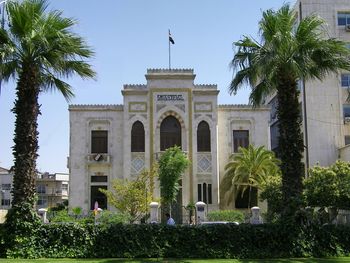
To date, the signs of the Syrian modern style have reflected the belief of the owners of buildings as well as their architects, who have been mostly European during the first three decades, in both the “glorious or romantic past” and the superiority of Western modernity. Moreover, they have reflected a kind of nationalist ideology. Kurd ‘Ali claims that the “honest nationalist” has to conserve the ancestors’ artifacts,Footnote 42 on the one hand, and “operate with Western Modernity,” on the other.Footnote 43 Jacob Petersen underlines that one of the dominant ideas of the first half of the twentieth century in the Middle East was that “the public buildings and spaces ought to express the identity of the nation.Footnote 44 Currently, several buildings of the Syrian modern style—for example, ‘Ayn al-Figeh Headquarters in Damascus—are protected and listed on the National Heritage List (Figure 1).
An example of the Syrian modern style is the ‘Ayn al-Fijeh Waters Headquarters, al-Naṣr St, Architect: Abd ar-Razzaq Malas, 1932–36 (courtesy of Anas Soufan, 2010).

The second main factor concerns the constant alteration of the techniques of construction since the late nineteenth century. In many instances, what Syrians deem to be “modern,” “imported,” or “Western” a few decades ago has become “authentic” today. During the mid-twentieth century, Abdul Azīz al-‘Azmah criticized the use of cement tiles instead of traditional marble and limestone panels.Footnote 45 Currently, owners, architects, and professionals of heritage consider the presence of these tiles in a building to be evidence of historic value.Footnote 46 Another issue is related to the new technologies of reproduction, documentation, and presentation of heritage, including, for instance, drones and 3D technology in printing and visualization, which has afforded a revolution in the field of heritage conservation. When would a Syrian consider a 3D-printed model to be a part of its heritage? Is this acceptance or rejection meaningful in this widely globalized world? The answer to these questions is primarily related to the irreversible factor of time and cultural change. Either way, thanks to the aforementioned revolution, after being destroyed, buildings and artifacts take on another life through new technologies of representation. As we shall see, destruction and loss are no longer synonymous with being forgotten.
DEFINITION OF AUTHENTICITY IN THE SYRIAN CONTEXT
As a starting point, I refer to scholars who have dealt with the definition of authenticity and, then, develop my own arguments using an empirical approach, the writings of Syrian scholars, and the methods and analyses of international experts. According to Cornelius Holtorf, authenticity is “about what you can trust to be what it purports to be.”Footnote 47 The understanding of this term by Syrian scholars does not widely differ from Holtorf’s description. However, two main distinctions are worth noting: the first is the Syrian scholars’ stronger emphasis on the articulation between authenticity with creativity and authenticity with political engagement; the second is the fact that Holtorf has a more flexible understanding of the meaning of the loss and destruction of cultural heritage.Footnote 48 Bearing in mind the previously mentioned attitudes, I suggest that authenticity in the Syrian context of the twenty-first century denotes either pastness and steadiness, physical and intellectual creativity, trustfulness and reliability, or all of these qualities together.
Pastness and Steadiness
Pastness denotes the perceived quality of something to be of the past. It involves three interrelated matters: traditions, memory, and language. Authenticity of a building or site depends on the continuity of the traditions that characterize its history and that of its environment; a state of self-governance in light of one’s highest traditions and values. According to ‘Afif Bahnasi, authenticity denotes the perceived quality of something to be the bearer of the nation’s traditions, ambitions, and hopes.Footnote 49 Bahnasi links the “authenticity” of a building or artifact to the heritage identity. As a result, the realization of an authentic building or artifact should be carried out in three steps: the rejection of the stranger art; the exploration of the codes of the local heritage identity; and the appropriation of this identity in a new product.Footnote 50 Bahnasi explains that the main problem of the Arab world belongs to its feeble knowledge of its heritage identity.Footnote 51 In the same line, Jukka Jokilehto refers to the physical criteria belonging to the “continuity of traditions which means maintaining the traditional morphology and typology even though the buildings may have differences in their details.”Footnote 52
From the colonial era onwards, a different current focusing on the disagreement between authenticity and the progress of society appeared, which is illustrated by well-known intellectuals and politicians such as the Marxist theoretician and activist Yaseen al-Hafez (1930–78) and the well-known poet Adunis (1930–). Al-Hafez advocates for the traditional frames of Arab society to be critiqued and reformulatedFootnote 53 by considering that authenticity expresses the persistence of people with their threatened or injured national identity (generating a conservative mindset).Footnote 54 As for Adunis, he affirms: “We know that instituting a new age (for Arabs) presupposes from the very beginning a complete break with the past. We also know that the starting point of this founding break is criticism, the criticism of all that is inherited, prevalent and common.” According to this reasoning, al-Azmah compares the domination of authenticity on the heritage debate with “semi-Salafism”Footnote 55 or with “orientalism” since both shape the transmission of knowledge through absolute antiphrasis.Footnote 56 This perception concurs with Ibn Khaldoun’s view that underlines the unfeasibility of getting back the value of a destroyed building since “destruction means coming back to the origin, which is the nonentity and instinctively, a differently reconstruction to the origin.”Footnote 57
Authenticity also relates to the common memories of a society, including that of wars and disasters. Indeed, the tragic collective memory related to the Syrian conflict will vanish over time and give place to new societal memories and settings. Max Weber rightly indicates that the common myths of origin, cultures, or common memories will shape a component of authenticity for the new collective identity.Footnote 58 Rodney Harrison highlights “the process of forgetting is in fact integral to remembering—that one cannot properly form new memories and attach value to them without also selecting some things to forget.”Footnote 59 Adrian Forty and Suzan Kuchler have underscored the idea that the materiality of monuments can produce a particular collective mode of remembering that shapes the consumption of the past as a shared cultural form of memory.Footnote 60 Caroline Nagel shows disappointment of how the rebuilt downtown of Beirut does not present a substantial public memorial to the civil war or to its victims.Footnote 61 Which linkage might be established between the authenticity of a reconstructed building and remembering or forgetting of the tragic memory of the Syrian war? If historic monuments are a means of retrieving collective memories of more imagination than truth, which form of memorialization should Syrians choose in dealing with the heavily damaged or completely annihilated monuments?
The linkage of authenticity to language was discussed by Charles Taylor in his thesis (1991) and George Steiner in his book Real Presences (1991). As for Syrian and Arab intellectuals, they have underlined that the evolution of thinking requires a review of the languageFootnote 62 that is a “holder of the developmentFootnote 63 and patriotism”Footnote 64 and a “container of heritage.”Footnote 65 Accordingly, the authenticity of a building or site cannot be separated from the language that constitutes part of its significance, setting, history, and future. In this framework, the continuity and steadiness of the Arabic language argues for its authentic character, on the one hand. On the other hand, the Qur’anic calligraphy in a historic building displays its linkage to an Islamic culture as well as to certain traditions and technics of the interior and exterior design. It might also express the creativity in style of new buildings or artifacts. As a result, names, inscriptions, ornamentations, and linguistic expressions in relation to a building, a place, or an object memorize it and create signs of its symbolic value, narratives, and authenticity.
Accordingly, the authenticity of al-Hejaz Railway Station in Damascus is profoundly related to its name. Up until today, it reminds Syrians of the renowned railway between Damascus and the holy lands in Al-Hejaz as well as the dream of the establishment of the “Grand Arab Kingdom,” including the natural Syria, Iraq, Najd, and al-Hejaz. For this reason, changing the appellation of this station or other historic buildings or sites affects their narratives and symbolic value and, subsequently, the people’s perception of their authenticity. However, sometimes this change might be an “authentic” way to memorialize disappeared buildings or sites. During the Syrian revolution in 1925, the French bombardment of the quarter of Sidi ‘Āmoud in Old Damascus caused a destructive fire. Today, the reconstructed quarter has been named “al-Hariqah—the Fire,” symbolizing not only the regrettable destruction of the quarter but also a major event in the modern history of Syria.
Physical and Intellectual Creativity
Taking into account that authenticity cannot be limited to the past, I suggest that a future or recent design might be described as authentic. As Aziz Al-Habbabi underlines, the relevance of the authenticity manifests when it is alive, active, questionable, and unlocked toward the unidirectional progress of history.Footnote 66 However, creativity in style or “[a]uthenticity by creation” is subjective and relies on the context, culture, convictions, and psychological state of the user and observer.Footnote 67 Several Syrian scholars have explained authenticity as a state of creativity and innovation based on a commitment to that society’s identity and values (including the political ones). In this framework, Tayyeb Tizini describes the historian as a central part of the societal understanding of a historic element considering that his or her presentation reflects innately the era’s mindset.Footnote 68 ‘Afif Bahnasi underlines that authenticity is a principle and conviction based on nationalist thinking that targets the demonstration of the Arab’s identity. It is a condition that legitimizes the work of an artist who is engaged with the nation’s interests.Footnote 69 In the same line, Badr ad-Dine Abou Ghazi links “authenticity” to the creativity that synthesizes and acknowledges the national specificities of the Arab personality. According to him, authenticity is not the opposite of contemporaneity but, rather, the idea that the latter cannot be attained without an understanding of the history and its impact on a culture.Footnote 70 Zaki al-Arsouzi outlines differently the linkage between authenticity and creativity. He relates creativity to two main factors: authenticity and the sociocultural environment.Footnote 71 According to him, the artist “polarizes” the authentic thoughts of a society in order to reformulate them in inspiring ways, thus explaining the beliefs, feelings, and ambitions of others.Footnote 72 Hence, creativity denotes authenticity and vice versa when it is consistent with a society’s traditions or with a society’s mindset. This understanding will be crucial in the upcoming postwar reconstruction since it will allow for the replacement of annihilated authenticity (by destruction) by another authenticity related to the creation and innovation (through reconstruction). Holtorf explains that “even destruction implies loss. Even destruction implies creation.”Footnote 73
Trustfulness and Reliability
Reliability can be analyzed by investigating the state of “being of itself” (أصيل’) that, in its turn, necessitates a reliable knowledge of the whole history of the concerned building or site. In other words, being of itself—or not—depends on the change affecting the studied heritage. In this framework, a reliable knowledge of the change dictates a reliable evaluation not only of the degree and nature of change but also of the societal sensitivity of it. Organic accumulative development is a property of historic monuments and sites. As they continue to live on, they alter their materials, forms, functions, and maybe narratives in response to natural influences and human interventions. During the last few years, a flagrant shift concerning heritage conservation and management has been suggested by scholars like Holtorf and Tim Ingold, who have reformulated a more dynamic view of the destruction and loss of heritage elements.Footnote 74 As Holtorf explains, “cultural heritage is no more subjected to destruction and loss” but “continuously growing.”Footnote 75 Reinhard Bernbeck discusses the question of heritage change, referring to heritagization and dis-heritagization concepts. He underscores that “if heritage does not carry in itself the potential for a lack of change, it cannot be heritage.”Footnote 76 However, as archeologist Siân Jones wonders, these proposals do not determine “to what extent monuments and artefacts should be allowed to grow, change, rejuvenate, collapse and decay.”Footnote 77
In contrast to physical deterioration, which increases the sensation of authenticity, loss and destruction erase the authenticity of material, form, and function. However, a new form of authenticity related to the geographic location and the circumstances of disappearance—either through loss or destruction—emerges. The authenticity of the 2000-year-old temple of Baal in the ancient city of Palmyra is a noteworthy case study. After the pre-Roman phase,Footnote 78 the temple we know was converted into a Christian church and then into a mosque. In the beginning of the twelfth century, its huge courtyard (approximately 200 meters by 200 meters) served as a fortified village (“Tadmur”) of mud-brick houses. In 1929, the temple and village were cleared of its postclassical elements. In 2015, a terrorist group (the so-called Islamic State of Syria and Iraq) dynamited the temple and completely destroyed it. Likewise, the Umayyad mosque in Damascus (which evolved from Aramaean, to Hellenistic, and then to a Roman temple and from a church to a mosque; was reconstructed after the fires of 1068 and 1893; and restored several times, the latest in the 1980sFootnote 79) is also a relevant example about the permanent change of function, design, users, techniques, and materials of construction.
Which phase of life of these two monuments should be qualified as authentic, supposing that the Umayyad mosque was also destroyed and that both must be rebuilt according to their authentic context? Holtorf expresses the idea that “often it is exactly the original contexts of artefacts that makes them valuable in people’s lives as precious commodities and invests them with significance as authentic artifact.”Footnote 80 Although the Palmyra temple was utilized as a mosque for eight centuries, its acknowledged original context today is a temple, not a mosque. Although the original context of the Umayyad mosque is a temple, its admitted authentic context today is a mosque. For that reason, Holtorf’s view might be applied to Palmyra’s temple but not to the Umayyad mosque. I advocate that often authenticity of function prevails on the authenticity of form, material, and setting if it is in accordance with the context of the society at the moments of destruction and reconstruction.
Change might also be needed or aspired to. The use of industrialized materials of construction has been propagated in Syrian cities from the 1880s onwards.Footnote 81 As a result, many historic buildings were consolidated, restored, or renovated by using imported materials and techniques of construction. Should such continued intrusions on what is considered today as historic buildings reduce their authenticity? Or, as Henry Cleer asks, should they be seen as having a historical significance of their own?Footnote 82 In the same line, Jukka Jokilehto wonders what is the “difference between the gradual renovation of an ancient monument and the reconstruction of a building or part of building at a particular moment in time?Footnote 83 In any case, change, even for preservation, implies loss.Footnote 84 How many historic buildings in Syria have lost part of their value—and authenticity—as a result of contractors’ work that has been presented as restoration? Bearing in mind that the quality of conservation of heritage coincides with the society’s context—Syria is more or less in permanent crisis—the popular acceptance of such change increases over time.
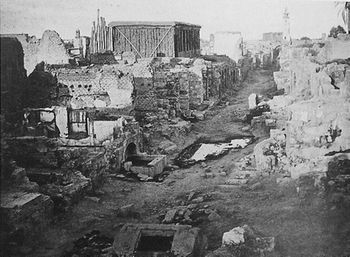
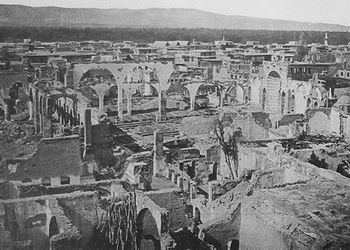
Other questions are raised about the reason of change. Is change or destruction particularly appreciated when it is caused by nature and people’s motivations and less accepted when it is produced by conflicts and political events? Does the destructor’s identity play a role? In other words, is authenticity linked to ethics and the serenity of people? In order to deal with these interrogations, I present three different experiences belonging to the intentional destruction of parts of Old Damascus. The first one refers to the reconstruction of the Bāb Tūma quarter in intramuros Damascus after the violent incidents against Christians in 1860. The inhabitants assumed the reconstruction of their severely damaged quarter from 1863 to the 1880s by reinstating its pre-accident urban pattern, traditional materials, spatial organization, and architectural styles (Figures 2 and 3). In spite of the linkage of Bāb Tūma to a desolate memory, it forms today an outstanding and inseparable part of Old Damascus, inscribed on the World Heritage List in 1979.
Bāb Tūma, 1862. Buildings on either side of the Via recta stand in ruins, prepared for reconstruction (courtesy of Francis Bedford (1815–94), Royal Collection Trust / © Her Majesty Queen Elizabeth II, 2020, www.rct.uk/collection/2700964).

Bāb Tūma, 1862. Al‐Maryamiyyah Church, prepared for reconstruction (courtesy of Francis Bedford (1815–94), Royal Collection Trust / © Her Majesty Queen Elizabeth II, 2020, www.rct.uk/collection/2700963).

The second example refers to the earlier-mentioned destruction of the Sidi ‘Āmoud quarter in intramuros Damascus. The Syrian and French mandate authorities managed the quarter’s reconstruction by imposing new urban planning, construction materials, and architectural styles. From that time until today, Syrians have not seen the reconstructed Sidi ‘Āmoud, known as al-harīqah (the “fire”), as part of the historic Damascus but, rather, as part of its Westernized quarters, even though it is included as part of the inscribed Old Damascus.
The third example concerns the actual Souk Midhat Pasha, a principal feature of the listed Old Damascus. The “authentic” souk is a result of the noticeable urban restructuration undertaken in 1880 by the well-known reformist Midḥat Pasha, who was the Ottoman governor of Damascus from 1879 to 1881. Midhat Pasha intentionally burned many houses and stores in order to apply the Ottoman law of the alignment of streets after disasters. His objective was to retrieve the original alignment (the current one) of the Roman Decumanus that crossed Old Damascus from East to the West.Footnote 85
Why does Syrian civil society recognize the authenticity of the reconstructed Bāb Tūma and Souk Midhat Pasha, yet refuse to consider al-harīqah as a part of its heritage? I suggest that the answer stems from the degree of memorialization of the related reconstructions as well as their tangible outcomes. This has four main dimensions: technical/urban-architectural, which concerns the correlation between the urban and architectural fabric of the reconstructed zone, its surroundings, and its setting; political, involving the identities and motives of the destructor and the reconstructor; cultural, referring to the influence of the media and its dissemination in forging popular knowledge and awareness of the actions taken; and, finally, societal, relating mainly to the change of the popular and official appellation of the quarters after reconstruction that could recall or omit the memory of horror. By the same token, Robert-Garlan Thomson has proposed the term “revised authenticities” that might influence the interpretation of post-conflict sites, often with far-reaching implications for significance and commemoration within their communities.Footnote 86 Besides the earlier-mentioned intentional destruction experiences, inquiries demonstrate the disposition of some of the inhabitants of Syrian historic fabrics to “demolish” their historic buildings and replace it with “higher and modern” ones as a way to preserve their “origins” embodied by the family’s and ancestors’ homes.Footnote 87
If the previously mentioned examples reveal the linkage of authenticity to geographical sites, others raise interrogations about the displaced historic elements or artifacts. This includes thousands of artifacts displayed in international museums as well as parts of displaced historic monuments. For instance, the main façades of the eighth-century Umayyad desert palaces al-Hir al-Sharqi and Mushatta were installed in the garden of the Syrian National Museum (al-Hir al-Sharqi); in the south wing of the Pergamon Museum in Berlin (al-Mushatta). After the displacement or destruction of a historic building or site, I advocate that its geographical site—reconstructed or not—transforms into a source of inspiration / a container of signs that creates ideas about reconstruction or memorializes the pre-change situation. As for the building itself, its authenticity of material and form is generally preserved.
Regarding the linkage between the societal sensitivity of change and authenticity, it might be clarified through the duality of the signifier/signified, which is presented by Reinhard Bernbeck.Footnote 88 The change of the signifier—even its destruction—does not annihilate the signified. In other words, while the physical change of a building or a site might easily be integrated into the societal sensitivity, its narratives endure if it still concerns the society or is part of it. In spite of the recognized authenticity of the Umayyad mosque in Damascus, its non-Islamic origins are still engraved in the collective memory of Syrians. This example and many others demonstrate that multiple authenticities or multiple “containers of signs” might coexist in one building or site. In any case, authenticity is not only an individual concern but also a sensitivity of a group of people. In accordance to this idea, Afif Bahnasi underlines that an authentic creation must be harmonized with the artistic tastes of the people, incorporating their context and specificities.Footnote 89
In the same line, the different societal sensitivities toward change produce different societal attitudes toward the dilemma of authenticity—contemporaneity. Very often, people have an instinctive acceptance of the “authentic” and an instinctive resistance to the new artistic, architectural, or urban tendencies. Since people accumulate their acceptance of a historic building or site, it becomes a kind of “container of authenticity.”Footnote 90 According to Tayyeb Tizini, the confrontation between the tendencies of Salafism and contemporaneity have brought the dilemma of authenticity and contemporaneity to its highest summit, producing syncretism and hybrid tendencies in the fields of art, architecture, literature, philosophy, and others.Footnote 91 The Syrian modern style is a relevant example. Furthermore, the linkage between authenticity and contemporaneity does not mean they are harmonized. Rather, the authenticity of spirit might provide continuous creativity in the contemporary framework of construction projects and artistic realizations.Footnote 92 In any case, authenticity in the face of contemporaneity is a crucial, maybe the chief, dilemma in actual Arab thought.
The societal sensitivity of change is also related to the popular and scholarly understandings of the concept of “old.” “How old is the old” is a dilemma that should be considered in evaluating the relationship of a historic building or site to its setting and its own past. This familiar international question was unwisely handled by official administrations in several Arab countries. The former Syrian Law no 222 of Antiquities (1963) considers that a monument or site is qualified to be historic if it is at least 200 years old. At the same time, monuments erected during the first half of the twentieth century such as the Ayn al-Figeh Headquarters are inscribed on the Syrian “National Heritage List.” In other Arab countries—for instance, Oman—Law no. 6 (1980) dictates that antiquities must be at least 60 years old. In fact, the discussion of the matter of heritage should not have either a start or an end. Because what seems to be an absolute start indubitably includes elements from former intellectual structures and what seems to be an end represents a beginning of a future intellectual structure.Footnote 93 Accordingly, examining the authenticity of a building or site should take into account the changing physical and ideological context that has characterized its decisive moments of life, such as birth, restoration, demolition, destruction, loss, and so on.
For this reason, the question of the “authenticity” (or not) of a postwar reconstructed heritage should be dealt with by Syrian society and scholars, despite the fact that their standards in conservation will not be as creative as certain international ones. In other words, Syrians should avoid what Hassan Fathy has qualified as the autocolonization of many Arab and Islamic countries when they adopt policies of conservation and of urban and architectural change diametrically contrary to the traditions of these countries.Footnote 94 Beyond what has been stated, postwar reconstruction offers to Syrians the opportunity to embrace a new understanding of the contemporaneity of art, architecture, and urban design, highlighting that for decades this term has meant the imitation or emulation of foreign tendencies that have implied the loss of supposedly “authentic” local artistic skills and identity.
CONCLUSIONS
The notion of heritage in “Syria” emerged in the late nineteenth century relating to sociopolitical narratives and ideologies. During the first half of the twentieth century, the term “authenticity” became widespread thanks to a Marxist-nationalist discourse built upon conflicting sociopolitical titles such as inclusive change, the glorious past, the revolution, and so on. The term found its place in the discourse of heritage, art, and architecture from the 1960s onwards thanks to three main reasons. The first, which was a kind of “cultural Salafism” faced exterior threats on the local identity, variously called Arab, Eastern, Islamic, Syrian, Damascene, and so on. In fact, the transition from the four-century-long Ottoman era to a completely different national one—under Western influences—created a societal and cultural shock. This situation pushed people to cling to their ancestors’ legacy in order to face the invaded or inserted cultures, which was Western in the first place. Until now, most Arab people are still in this position. The second reason involved the necessity to face the urban and architectural transformations conducted not only by the Ottoman rulers from the mid-nineteenth onwards but also by colonial and postcolonial regimes. This situation was characterized by a general refusal of the people. Thus, “authentic” became the appeal of the architecture of the pre-Ottoman reforms. The third reason, which involved a specific political context that characterized the building of the modern state of Syria after the departure of the Ottomans in 1918 to the ascension of the Ba’ath Party to power in 1963. At this stage, the term “authentic” became fundamental in the discourse of most political movements, being Islamic, secular, liberal, socialist, communist, and so on. Equally, the spirit of these discourses is still being used today. In any case, the significance of authenticity was noticeably shifting under the influence of the continuous heritage-making process embodied by the Syrian modern style and the constant alteration of techniques of construction since the late nineteenth century.
Taking into account this context, this article has proposed a definition of the term “authenticity” underlining Syrian literature in the twentieth and twenty-first centuries, which qualifies as “authentic” any human creation that is what it purports to be and is in accordance with the values of the society as well. The complexity of this definition resides in the inability of defining the “values” that are related to divisive narratives. While a building or site expresses certain narratives according to a group of people, it might express distinctive ones to another. This “other” is the liberal opposed to conservative; the traditionalist to modern; the religious to secular; the community to country; the ethnic to national; the bedou to sedentary; the progressive or regressive, and so on. As a result, designating a building or a site as authentic depends on technicalities as well as diverse sociopolitical agendas that produced different readings of the terms “heritage” and “authenticity.” These readings will continue until the building of a new cohesive spiritual union overcoming the interpretations of the past and focusing on the future in a global human framework. In light of what the current crisis has demonstrated as well as the multiple regional and international agendas affecting the country, Syrians need decades to build their “cohesive spiritual union.” However, in spite of this pessimistic view, some urban and architectural experiences have expressed reconciliation and a converging societal role. Syrian modern style has embodied the ambitions of both liberal and conservative wings of society, being an expression of the past and also an opening toward the West and the world. This reasoning demonstrates why many buildings of the Syrian modern style are not only inscribed on the National Heritage List but are also considered authentic expressions of the nation.
Authenticity denotes the pastness and steadiness of a building or site. It displays a certain state of continuity of traditions, and the linkage to a memory or memories and a language. It expresses a state of creativity and innovation based on a commitment to that society’s identity and values. The view of Syrian scholars to this commitment varies from considering it as a condition attesting to the engagement with the nation’s interests to an expression of semi-Salafism or Orientalism. At this rate, the main question is how society could shape a culture in which the intellectual would meld the transmitted or imported and the authentic in one coherent vision.
Authenticity also expresses the state of being itself. Hence, this article has shed light on the change that is a part of the normal life of a historic building or site. It has shown that cultural heritage is no longer subjected to destruction and loss but is “continuously growing.” However, questions concerning the degree of change and the significance of the “continuously growing” heritage need to be answered. In this framework, I suggest that the disappearance or the destruction of a building or a site creates a form of authenticity based on the combination between a geographic location, a narrative, and the specific circumstances of disappearance. The “authentic destruction” of the Sidi ‘Āmoud quarter (the reconstructed al-Hariqah quarter) in Old Damascus is a noteworthy example. Another case study has emphasized the permanent organic and accumulative development of historic monuments and sites. In fact, these monuments embody the “continuously growing” heritage. They might be considered like “instigators of authenticity”: the Umayyad mosque in Old Damascus, the Aleppo citadel, and the Baal temple in Palmyra are relevant examples.
The linkage between authenticity and ethics has also been approached in the case of destruction, reconstruction, and displacement. Contrary to the authenticity of setting and function, the authenticity of form and material might be preserved after displacement. In particular circumstances such as wars, such displacements might be beneficial. Although the loss of human beings affects the authenticity of the setting of a historic site, a “post-trauma authenticity of setting” can prevail over the precedent one. This necessitates, however, the existence of a general authentic environment that could integrate the reconstructed into the general historic fabrics. In other words, the new “authenticity of setting” of the reconstructed Bab Touma would not have been accepted and sustained without the existence of the other preserved parts of the old city of Damascus.
In any case, authenticity is not only an individual concern but also a societal collective matter. Bearing in mind the duality of the signifier and the signified, the physical change of the signifier does not annihilate the signified if it still concerns at least a part of that society. According to this reasoning, I advocate that, in some cases, multiple signified objects, or multiple “containers of signs,” might coexist to produce multiple authenticities in the same building or site. The societal sensitivity of change also implies a focus on the notions of renewal and contemporaneity, remembering that, since the departure of the Ottomans in 1918, architectural design in Syria has been held hostage by a discourse sparring authenticity against renewal and contemporaneity. In this framework, the art deco and international styles that have invaded the extensions of most Syrian cities over the first half of the twentieth century have represented the opposite of “authentic architecture.” By the same token, kitschy architecture, which is supposed to be reminiscent of historic architectural elements, might be seen as “authentic.” Unsurprisingly, this paradoxical perception materializes an aspect of the current crisis of Arab thought. Thus, in order to preserve the very appreciated term “authenticity” in the Syrian mindset, I suggest that Syrians should embrace the authenticity created in its human span—not only in the Syrian one—as objective of any production process. Overtime, a rightful linkage to “contemporaneity,” unconstrained from the past, will find its place.
Finally, linking the prior experiences of reconstruction to the current Syrian crisis has provided valuable readings of how the sociocultural aspects of the postwar reconstruction and understanding of the term “authenticity” will play out. While identic reconstruction can immediately retrieve the authenticity of form and material, the authenticity of a setting necessitates a much longer time frame to be reshaped. In this intricate context, are Syrians able to preserve the whole legacy of their destroyed cultural heritage? As this article remind us, loss and destruction are no more significant than forgetting—rather, heritage is continuously growing and shifting. For that reason, Syrians should be particularly aware that retrieving the authenticity of form, material, and setting of many destroyed and heavily damaged historic buildings and sites is not rational or realistic. Moreover, considering authenticity itself as an objective of the reconstruction transforms the Syrian society and state into prisoners of an uncompromising past and annihilates the current opportunity for a general renewal based on the inspiring transformations that destruction generates.