Introduction
The beginning of the 21st century has witnessed significant declines in child mortality (Kinney et al., Reference Kinney, Kerber, Black, Cohen, Nkrumah and Coovadia2010; You et al., Reference You, Jones, Hill, Wardlaw and Chopra2010) and maternal morbidity and mortality worldwide (Hogan et al., Reference Hogan, Foreman, Naghavi, Ahn, Wang and Makela2010; WHO et al., 2015). However, the levels of maternal mortality in sub-Saharan Africa are still alarming. The number of maternal deaths for 100,000 live births is estimated at 546 in sub-Saharan Africa – twice as high as the corresponding global figure. Only six countries (Botswana, Cape Verde, Eritrea, Malawi, Mauritius and Seychelles) were on track to achieve Millennium Development Goal 4 (MDG-4), which was to reduce the under-five mortality rate by two-thirds by 2015 (Friberg et al., Reference Friberg, Kinney, Lawn, Kerber, Odubanjo, Bergh and Nkrumah2010). Similarly, many sub-Saharan African countries were making insufficient progress in achieving the MDG-5 of reducing the Maternal Mortality Ratio (MMR) by three-quarters by 2015 (Hogan et al., Reference Hogan, Foreman, Naghavi, Ahn, Wang and Makela2010). It is therefore not surprising that research, investment and interventions on maternal, newborn and child health (MNCH) remain a top priority in the post-2015 development agenda of the Sustainable Development Goals (SDGs). The new development agenda specifically sets out in Goal 3 to ambitiously ‘ensure healthy lives and promote well-being for all at all ages’, including reducing the MMR to 70 per 100,000 live births, neonatal mortality to as low as 12 per 1000 live births and under-5 mortality to as low as 25 per 1000 live births.
Previous studies have showed that maternal health service utilization is a promising avenue to prevent pregnancy-related complications, while ensuring the health of newborns (Kinney et al., Reference Kinney, Lawn and Kerber2009, Reference Kinney, Kerber, Black, Cohen, Nkrumah and Coovadia2010; Friberg et al., Reference Friberg, Kinney, Lawn, Kerber, Odubanjo, Bergh and Nkrumah2010). Despite improvements in the delivery of MNCH services, studies have shown that low coverage, poor quality and inequities in the provision of essential MNCH interventions remain a challenge for most sub-Saharan African countries (Countdown Coverage Writing Group, 2008; Countdown Equity Analysis Group et al., Reference Boerma, Bryce, Kinfu, Axelson and Victora2008; Kinney et al., Reference Kinney, Kerber, Black, Cohen, Nkrumah and Coovadia2010). For instance, on average less than 50% of births occur in health facilities in sub-Saharan Africa, reflecting a coverage gap in obstetric care (UNICEF, 2009; Friberg et al., Reference Friberg, Kinney, Lawn, Kerber, Odubanjo, Bergh and Nkrumah2010). Yet, supervised delivery and Emergency Obstetric Care (EmOC) are important for forestalling maternal near-misses – an increasingly important criterion for assessing the quality of maternal care (WHO, 2011). Late responsiveness to pregnancy-related complications during labour can result in other problems such as intra-partum stillbirths, neonatal illness and disability, obstetric fistula and other long-term obstetric complications (Kerber et al., Reference Kerber, de Graft-Johnson, Bhutta, Okong, Starrs and Lawn2007). Notwithstanding these known negative consequences, supervised skilled deliveries and the availability of EmOC remain sub-optimal in a number of developing countries (Dogba & Fournier, Reference Dogba and Fournier2009). Within health facilities in developing countries, only a few women and newborns have access to a full range of necessary services, so creating a ‘quality gap’ (Hofmeyr et al., Reference Hofmeyr, Haws, Bergstrom, Lee, Okong and Darmstadt2009).
Access to a skilled birth attendant has been shown to be unequal between poor and non-poor in some countries, suggesting an ‘equity’ gap (Lawn et al., Reference Lawn, Lee, Kinney, Sibley, Carlo and Paul2009), and disparities between rural and urban areas are worryingly high (Ronsmans et al., Reference Ronsmans, Etard, Walraven, Hoj, Dumont, de Bernis and Kodio2003; Koblinsky et al., Reference Koblinsky, Matthews, Hussein, Mavalankar, Mridha and Anwar2006; Kinney et al., Reference Kinney, Kerber, Black, Cohen, Nkrumah and Coovadia2010; Crowe et al., Reference Crowe, Utley, Costello and Pagel2012). For instance, a study using data from two population-based studies conducted in sixteen sites in eight West African countries (Senegal, Guinea-Bissau, Gambia, Burkina Faso, Ivory Coast, Mali, Mauritania and Niger) showed that 80% of rural women gave birth at home without a skilled birth attendant (Ronsmans et al., Reference Ronsmans, Etard, Walraven, Hoj, Dumont, de Bernis and Kodio2003). The postpartum period is also critical to the survival of mothers and children, and timely postnatal care can avert postpartum haemorrhage, birth asphyxia, sepsis and complications of preterm birth, which increase the risk of sudden maternal death (Thaddeus & Maine, Reference Thaddeus and Maine1994). Indeed, globally about 4 million neonatal deaths occur within the first 4 weeks of birth (Lawn et al., Reference Lawn, Cousens and Zupan2005).
Education and maternal health service utilization: evidence and pathways of influence
Studies on factors associated with maternal health service utilization (MHSU) and child health frequently point out female education as an important factor for the improvement of MHSU in developing countries (Cleland & Van Ginneken, Reference Cleland and Van Ginneken1988; Gabrysch & Campbell, Reference Gabrysch and Campbell2009; Greenaway et al., Reference Greenaway, Leon and Baker2012; Worku et al., Reference Worku, Yalew and Afework2013). Caldwell’s seminal work (Caldwell, Reference Caldwell1979) and subsequent studies (Elo, Reference Elo1992; Raghupathy, Reference Raghupathy1996; Fotso et al., Reference Fotso, Ezeh and Essendi2009a, Reference Fotso, Ezeh, Madise, Ziraba and Ogollahb; Levine & Rowe, Reference Levine and Rowe2009; Ahmed et al., Reference Ahmed, Creanga, Gillespie and Tsui2010; Rai et al., Reference Rai, Singh and Singh2012) have consistently reported that a higher level of maternal formal education significantly increases utilization of maternal health services, even after controlling for other socioeconomic factors. A systematic review of the factors affecting utilization of antenatal care in developing countries reached a similar conclusion (Simkhada et al., Reference Simkhada, Teijlingen, Porter and Simkhada2008). This review reported that maternal education, husband’s education, marital status, availability and cost of services, household income, women’s employment, media exposure and history of obstetric complications are among the factors affecting antenatal care uptake. Additionally, women’s schooling has been found to be related to the chances of child survival under diverse economic circumstances (Levine & Rowe, Reference Levine and Rowe2009). A higher propensity to utilize maternal health services probably mediates the relationship between maternal education and child health (Raghupathy, Reference Raghupathy1996; Ahmed et al., Reference Ahmed, Creanga, Gillespie and Tsui2010). However, the pathways through which women’s education operate to influence MHSU might vary within and across countries, and under different socioeconomic circumstances. First, evidence suggests that well educated women are more responsive to new health-enhancing ideas and this strengthens the demand side of health (Ensor & Cooper, Reference Ensor and Cooper2004). Women’s education increases their capacity to recognize illness symptoms and the desire to seek appropriate health care, and a certain quality of health is demanded, although this may be determined by availability of health services.
Second, women’s education improves literacy, which in turn is associated with a wide range of positive health outcomes as a result of advantaged ‘health literacy’, conceptualized as ‘the degree to which individuals have the capacity to obtain, process and understand basic health information and services needed to make appropriate health decisions’ (Kindig et al., Reference Kindig, Panzer and Nielsen-Bohlman2004). Proponents of this thesis argue that health literacy improves the use of available health information and services, which can be linked to responsiveness to health education, use of disease prevention services and better self-management of disease (DeWalt & Hink, Reference DeWalt and Hink2009). Health literacy’s association with level of schooling has been found to be an ‘asset’ that offers a wide range of impacts, including better communication between health providers and users (Nutbeam, Reference Nutbeam2000).
Third, women’s education modifies their traditional balance of power with men, especially in patriarchal sub-Saharan African societies; it enhances women’s empowerment, and thus decision-making power at the household and community level. Well-educated women are able to make positive decisions about their own and their children’s health (Ahmed et al., Reference Ahmed, Creanga, Gillespie and Tsui2010; Corroon et al., Reference Corroon, Speizer, Fotso, Akiode, Saad, Calhoun and Irani2014; Sado et al., Reference Sado, Spaho and Hotchkiss2014). For instance, underpowered women in north-eastern Ghana have been shown to be virtually unable to decide on the place of delivery, childcare health matters and even their own nutritional needs (Moyer et al., Reference Moyer, Adongo, Aborigo, Hodgson, Engmann and DeVries2014). Besides, through direct or indirect learning of health enhancement behaviours, myths and misconceptions/beliefs about disease causation are discarded. Myths and misconceptions have been shown, in different contexts, to thwart some of the gains expected in maternal health service utilization. Also, facility-based delivery may be considered a sign of weakness for a woman (Ganle et al., Reference Ganle, Otupiri, Parker and Fitpatrick2015). Better-educated women are, however, less likely to subscribe to these misconceptions. Education also increases people’s predisposition to discounting the present by investing in the future, and this impacts positively on the choices they make in respect of their health. The argument here is that persons who are future-oriented, or have strong preferences for future time, attend school for longer periods and make larger investments in their own and their children’s health (Fuchs, Reference Fuchs1980; Grossman, Reference Grossman2008).
Equity gaps in maternal health service utilization
Previous studies have established that women’s education is significantly associated with an increase in MHSU in developing countries. However, there is almost no research addressing the relationship between women’s education and MHSU in the context of a coverage gap, quality gap and equity gap; yet the SDGs emphasize equity, especially for vulnerable populations. Put differently, there exist some contingencies on the relationship between women’s education and MHSU under different socioeconomic circumstances for the following reasons. First, previous research has shown an increasing gap between non-poor and poor in terms of access to obstetric care (UNICEF, 2009); therefore, the ‘education advantage’ may be questionable when women are treated homogeneously. Second, because poor women are likely to be less educated than rich women, the association between education and MHSU among the poor could be less important. Although previous research has included socioeconomic status (SES) in the analysis of MHSU, there is no study to the best of the authors’ knowledge that has addressed the associations between women’s education and MHSU through a lens of inequities at the individual level in different social and cultural contexts. This kind of research is important for designing effective context-specific interventions. Indeed, the needs of specific segments of a population can vary significantly, calling for specific interventions to mitigate the burden of those sub-populations.
Methods
Data and study sample
The study used the most recent Demographic and Health Surveys (DHS) available from the Democratic Republic of the Congo (2013–14), Egypt (2014), Ghana (2014), Kenya (2014), Nigeria (2013) and Zimbabwe (2015). The DHS are nationally representative standardized surveys conducted approximately every 5 years in several developing countries around the world. Though countries might have specific modules included or modified depending on different needs and priorities, most countries with a DHS have comparable information on the health of women aged 15–49 years, and who have experienced at least one pregnancy within the last 3–5 years preceding the date of the survey. In the selected countries, the DHS uses a multi-stage complex cluster sampling methodology to achieve a nationally representative sample of households. All women of reproductive age (15–49 years) in the sample households are interviewed. Over the years, modules about household characteristics, reproductive health, contraceptive history and mortality among women of reproductive age, and the health, nutrition and mortality of all children under age 5, are often implemented. The present analysis used data collected from the standard DHS. Data from DHS surveys and associated documentation are publicly available from the DHS Measure website upon making an official application indicating intended use (www.dhsprogram.com).
Countries were selected to represent the geographic regions of Africa: Democratic Republic of the Congo for Central Africa, Ghana and Nigeria for West Africa, Egypt for North Africa, Kenya for East Africa and Zimbabwe for Southern Africa. A systematic analysis of progress towards the MDG-5 in 181 countries between 1980 and 2008 by Hogan et al. (Reference Hogan, Foreman, Naghavi, Ahn, Wang and Makela2010) provides the rationale for focusing on these countries. This study showed that Zimbabwe has seen, on average, an increase of 5.5% in maternal mortality per year during this period, probably due to the high proportion of adults affected by AIDS (Bicego et al., Reference Bicego, Boerma and Ronsmans2002). The study also reported that more than 50% of all maternal deaths during the period occurred in six countries in 2008, including Nigeria and the Democratic Republic of the Congo. Other studies have reported that nine countries (Cameroon, Ethiopia, Ghana, Kenya, Nigeria, Senegal, South Africa, Tanzania and Uganda) account for approximately 50% of all maternal and child deaths in sub-Saharan Africa (Kinney et al., Reference Kinney, Lawn and Kerber2009; Friberg et al., Reference Friberg, Kinney, Lawn, Kerber, Odubanjo, Bergh and Nkrumah2010). Taken together, these are justifiable reasons to focus on the selected countries to further our understanding of MHSU in sub-Saharan Africa.
Dependent variables
This study examined five core dependent variables related to maternal health service utilization: antenatal care provider, timing of first antenatal care visit, frequency of antenatal care visits, place of delivery and presence of a birth attendant. Previous studies addressing MHSU in developing countries have defined these variables differently depending on their research interests, and finally focused on one or two MHSU outcomes. For instance, Ochako et al. (Reference Ochako, Fotso, Ikamari and Khasakhala2011) were interested in the timing of the first antenatal care visit and presence of a birth attendant. They found a strong association between early timing of the first antenatal care visit and use of skilled professionals at delivery. However, in the context of equity, it is important to emphasize how access to a skilled professional at delivery differs among SES strata. Another study, by Malqvist et al. (Reference Malqvist, Lincetto, Du, Burgess and Hoa2013), focused on skilled antenatal care provider and place of delivery, which are considered key indicators of MDG-5. However, other dimensions of MHSU are also important to provide a thorough landscape in the countries of interest. Almost 30 years after the World Bank launched the Safe Motherhood initiative in collaboration with WHO and UNFPA, studies including a wide range of MHSU indicators to address the coverage gap, quality gap and equity gap are still uncommon. In this study, the dependent variables were defined as follows:
Antenatal care provider
The DHS programme considers the following categories of antenatal care provider: doctor, nurse/midwife, community health officer/nurse and traditional birth attendant (TBA), and ‘none’ for women who did not have any antenatal care. This study was interested in antenatal care provided by a doctor, with the assumption that the quality of care provided by a doctor (to address the quality gap) is different from that of other ‘skilled’ providers. The antenatal care provider took the value ‘1’ if antenatal care was provided by a doctor, and ‘0’ otherwise for those women who received antenatal care.
Timing of first antenatal care visit
The WHO recommends that pregnant women receive antenatal care during the first trimester; this is referred to as ‘early antenatal care’ (WHO, 2003), because early antenatal care provides an opportunity to detect and treat some pregnancy-related complications and forms an appropriate benchmark for appropriate management during delivery and better planning of postnatal care (Alexander & Kotelchuck, Reference Alexander and Kotelchuck2001; Ochako et al., Reference Ochako, Fotso, Ikamari and Khasakhala2011; Gebremeskel et al., Reference Gebremeskel, Dibaba and Admassu2015). The timing of the first antenatal care visit takes the values ‘1’ if it occurred during the first trimester of pregnancy, and ‘0’ otherwise.
Frequency of antenatal care visits
The WHO recommends that all pregnant women should attend at least four antenatal care visits during the whole gestational period (Villar et al., Reference Villar, Ba’aqeel, Piaggio, Lumbiganon, Miguel Belizan and Farnot2001). This variable takes the value ‘1’ if the woman attended at least four antenatal care visits, and ‘0’ if otherwise.
Place of delivery
Place of delivery was coded ‘1’ if the woman delivered in a health facility, and ‘0’ otherwise. In the DHS, women were asked about place of delivery. Information was collected on whether the delivery took place in ‘a health facility’, ‘at home’ or ‘en route to a health provider’.
Skilled birth attendant
The categories for skilled birth attendant included doctor, midwife/nurse and community health officer/nurse. Based on the aforementioned assumption, it was posited that doctor-attended deliveries offer a novel way to assess geographical (remote areas are less likely to have doctors while rural residents are disadvantaged compared with their urban counterparts) and/or financial (the poor are less likely to have access to a doctor) access. Therefore the variable was coded ‘1’ if a doctor assisted the delivery of the baby, and ‘0’ otherwise.
Stratification variable
The study was interested in the differential effect of woman’s education on maternal health service utilization contingent on socioeconomic stratum. Therefore the population of interest (women of aged 15–49 years interviewed in the DHS) was stratified using the Household Wealth Index (HWI) available in the DHS datasets. The original variable has five categories (poorest, poor, middle, rich and richest). To ensure statistical stability of the models and to avoid the effects of small cell size on the estimations, three SES strata were defined as follows: Poor (40%), Middle (40%) and Rich (20%).
Predictor variables
Maternal education is a key factor that has been shown to predict the utilization of maternal health services in developing countries (Say & Raine, Reference Say and Raine2007; Simkhada et al., Reference Simkhada, Teijlingen, Porter and Simkhada2008; Levine & Rowe, Reference Levine and Rowe2009). However, in most of these studies, maternal education is often used as a categorical variable to distinguish between women with no education, and primary, secondary and higher education, which makes it difficult to assess the impact of an additional year on the likelihood of MHSU. In this study, maternal education was measured in single years, enabling the effect of an additional year of education on the outcome of interest within a specific SES group to be captured.
Control variables
To examine the relationship between maternal education and maternal health service utilization, the analyses included the following control variables: age (continuous), parity (continuous), employment status (binary; took the value 1 if woman was working) and marital status (polytomous variable taking the values 0=never married; 1=married/cohabiting; and 2=formerly in union); access to health facility (binary; took the value 1 if access to health was a problem), health insurance (binary; took the value 1 if woman was insured), media exposure (access to radio, television, newspapers; and frequency), husband’s education (continuous) and occupation, and place of residence (binary; took the value 1 if rural woman).
Analytic strategy
The analyses examined the relationships between maternal education and five outcomes related to maternal health service utilization in six sub-Saharan African countries within each SES stratum. Country-specific analyses were carried out, with survey-specific weights employed to account for the complex survey design of the DHS data using the Taylor Linearization Method (Wolter, Reference Wolter2003). The DHS use a two-stage probabilistic sampling technique to select clusters or enumeration areas at the first stage and households at the second level in order to provide unbiased estimates and confidence intervals. Descriptive analyses describing the outcomes within each stratum are presented first. The ‘rich/poor ratio’ was computed as an indicator of inequity between better-off and disadvantaged women (Fotso & Kuate-Defo, Reference Fotso and Kuate-Defo2005). For multivariate analyses, two logistic regression models were run for each outcome. Model 1 estimates the crude/gross effect of maternal education on the outcomes within a specific SES stratum, while Model 2 extends Model 1 to include woman’s characteristics (age, parity, marital status, employment status, health insurance and media exposure), access to a health facility, husband’s education and occupation, and place of residence. The estimated standard errors of log odds ratios were also adjusted to account for the complex survey design. Because the analyses are stratified by Household Wealth Index (HWI), the option ‘subpop’ was used in the svy prefix of STATA to ensure unbiased estimates and standard errors. To assess multicollinearity among variables included in the multivariate analyses, the outcomes were regressed on all independent variables using the Variance Inflation Factor (VIF). The analyses showed no multicollinearity problems among the variables included in the models.
Results
Descriptive results
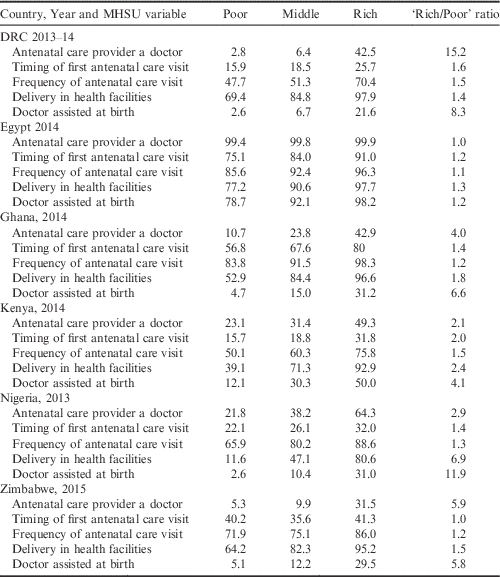
The summary characteristics of the outcomes of interest for the six African countries are presented in Table 1 by socioeconomic strata. This table also reports ‘rich/poor’ ratio as an indicator of ‘equity’. The findings reveal country-specific situations and variations depending upon the outcome of interest. For most MHSU indicators, a clear gradient is observed among SES strata: women living in better-off households exhibited better outcomes in terms of access to, and utilization of, maternal health services. For instance, while antenatal care was almost universal in Egypt, women in the rich stratum had greater access (99.9%) compared with those in the poor stratum (99.4%). There are no significant differences between rich and poor. The ‘rich/poor’ ratio shows that inequities between rich and poor vary and widen from one country to another. In Egypt, the ratio is fairly equal for women living in rich and poor households regarding doctor as antenatal care provider. In contrast, access to a highly skilled antenatal care provider in the DRC showed a wide gap between rich and poor, with a ratio of 15. Having a highly skilled antenatal care provider also showed a significant gap in Ghana and Zimbabwe, with ratios of 4.0 and 6.0, respectively. The corresponding figures for Kenya and Nigeria were 2.1 and 2.9. Concerning delivery in health facilities, the gap between rich and poor was not very large, except in Nigeria, which exhibited a ratio of 7.0. Within each country, except Egypt, having a doctor as skilled attendant at birth showed the most dramatic pattern of inequity. Indeed, the ratio of rich/poor for doctor as skilled attendant at birth varied from 4.1 in Kenya to 11.9 in Nigeria.
Descriptive statistics (%) of sample women by country and socioeconomic status

Results of multivariate analysis
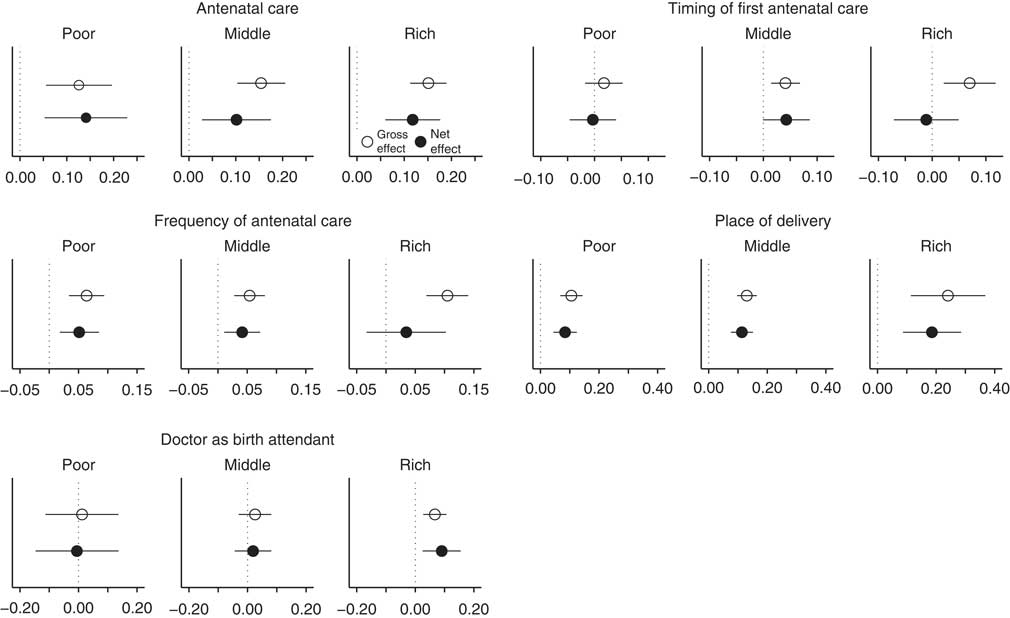
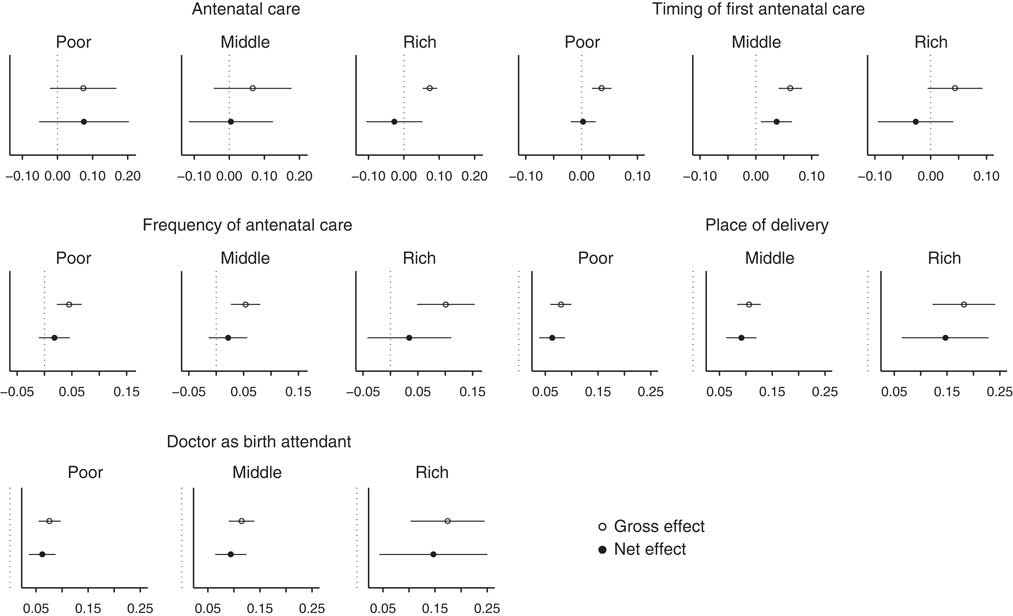
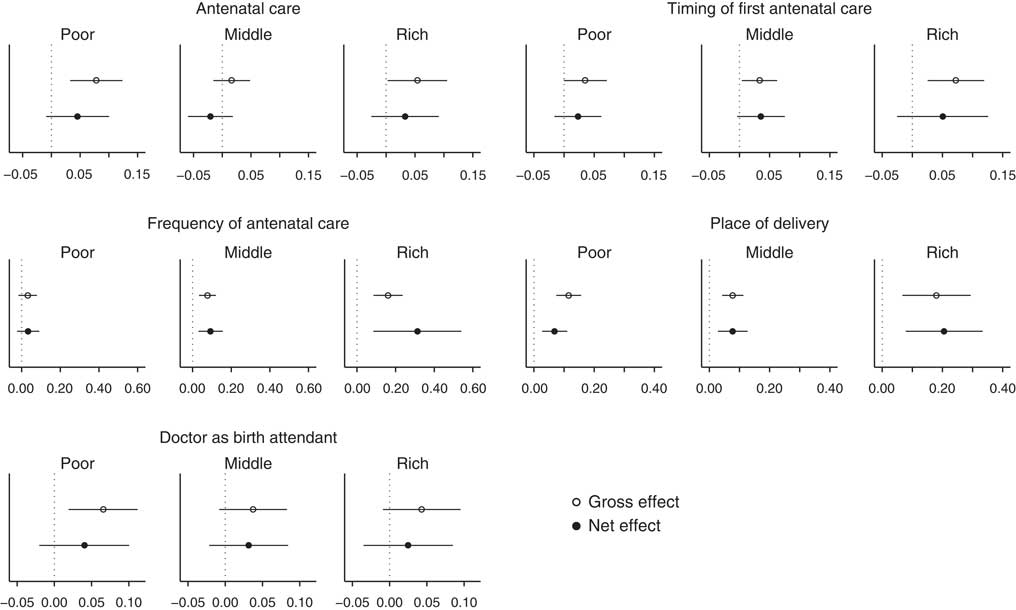
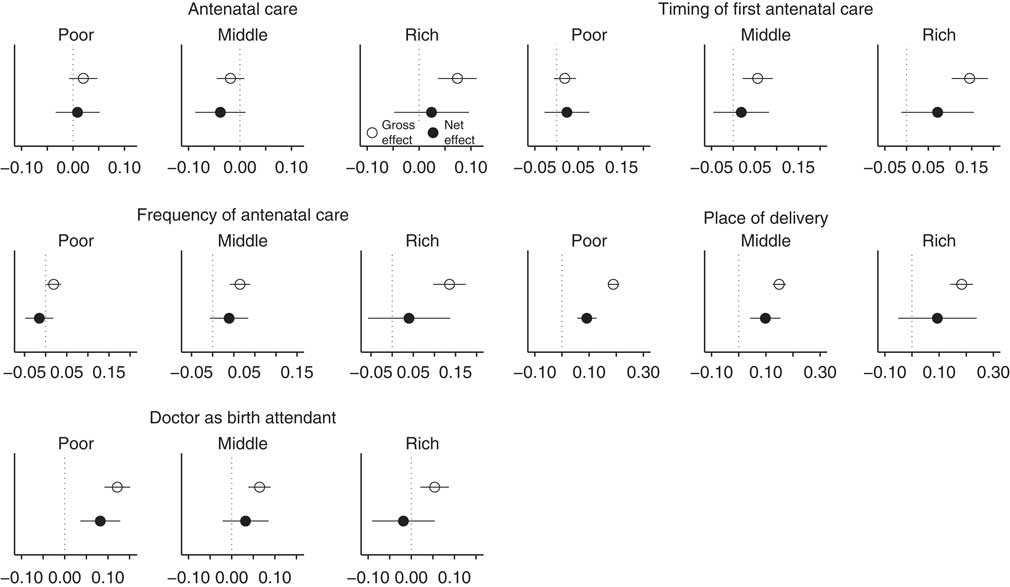
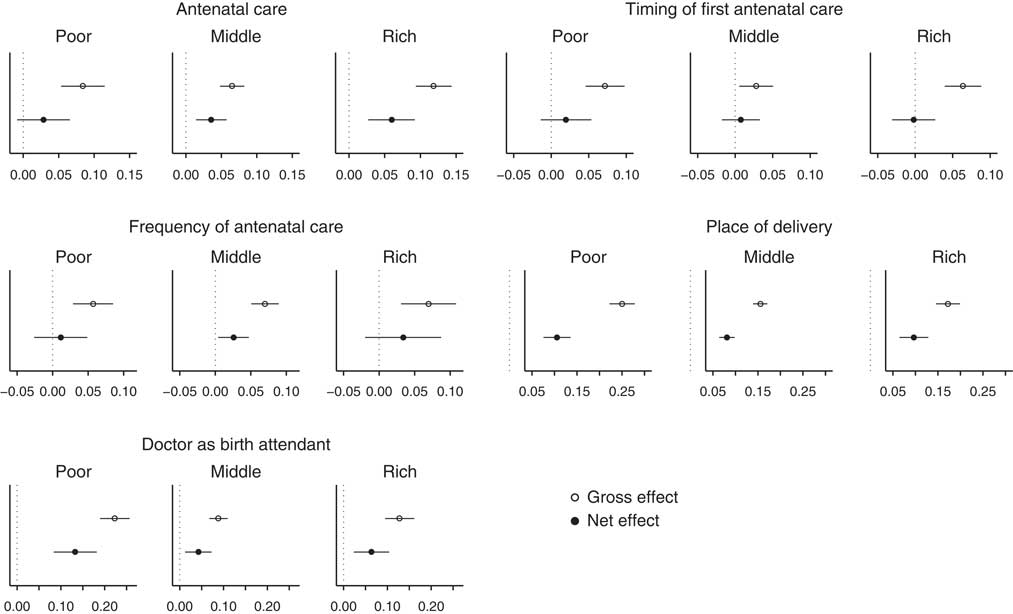
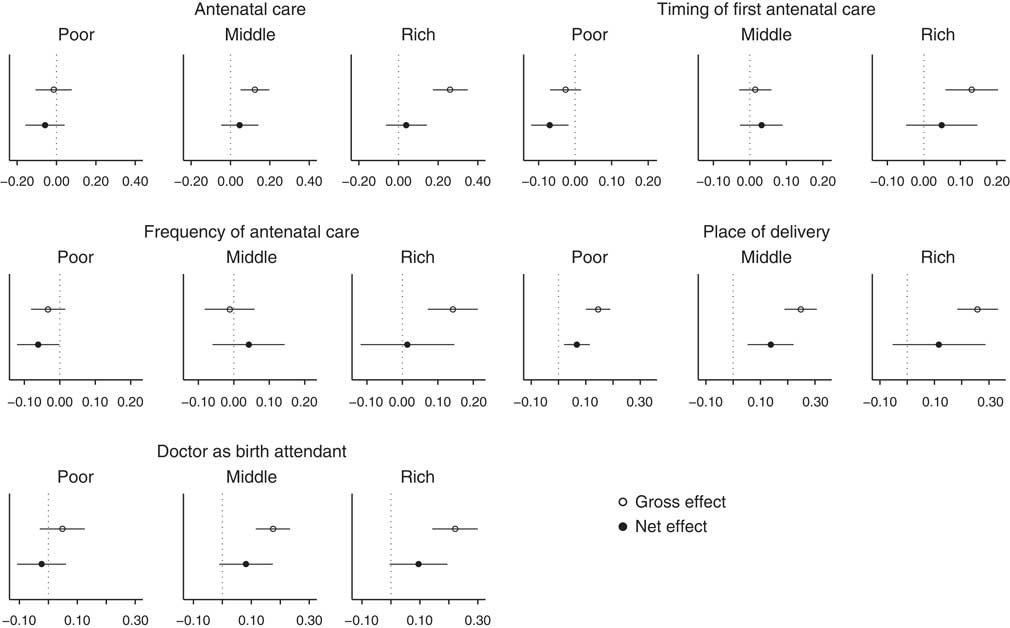
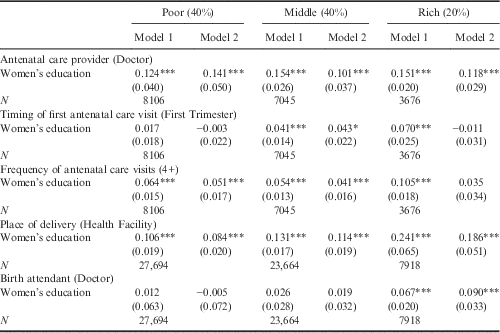
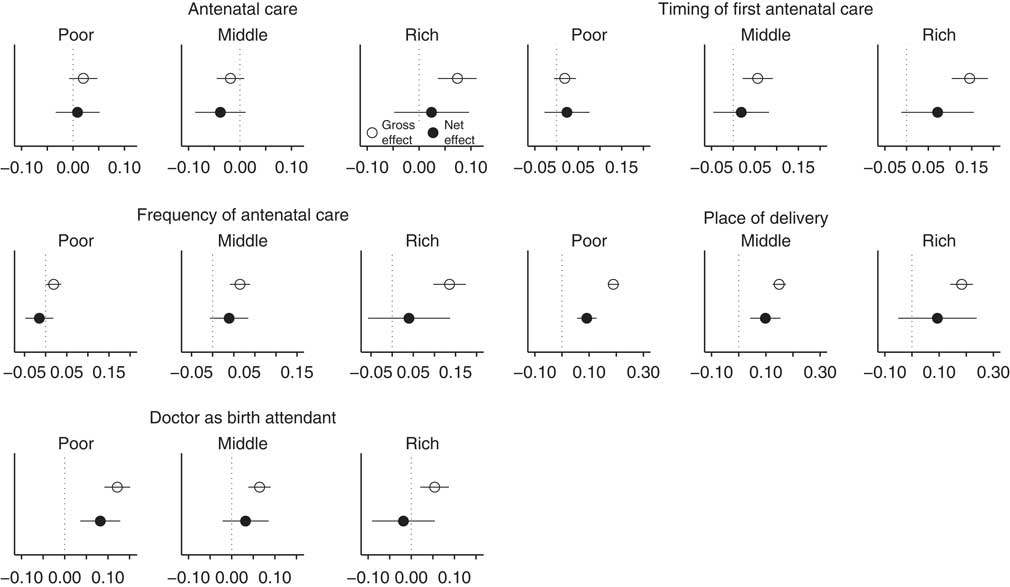
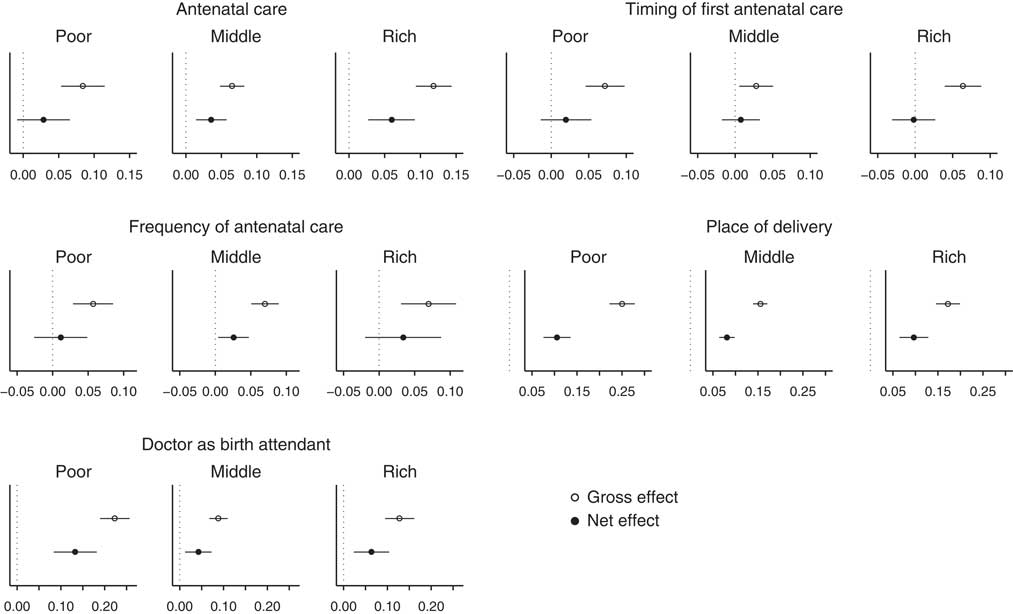
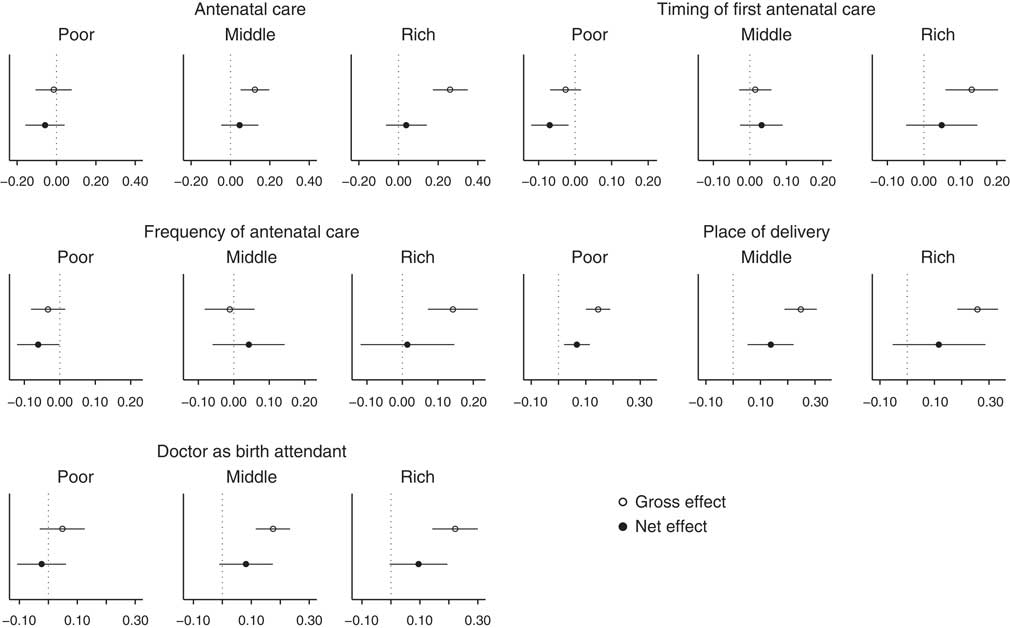
Tables 2–7 and Figures 1–6 summarize the multivariate results for the five outcome variables. Model 1 in the tables estimates the gross association between women’s education and each outcome, while Model 2 controls for potential confounding factors, including woman’s age, parity, religion, marital status, working status, health insurance, access to health facility, media exposure, partner’s education and occupation, and current place of residence. With a few exceptions, the findings were in the expected direction, though some variation was still observed across countries. Overall, maternal education had a positive effect on highly skilled antenatal care provider (e.g. a doctor), timing of first antenatal care visit, facility-based delivery and having a doctor as birth attendant.
Women’s education and maternal health service utilization in the DRC by socioeconomic status. Source: DRC DHS 2013–2014. Gross effect: only women’s education is included in the estimations. Net effect: women’s education and controls are included in the estimations.
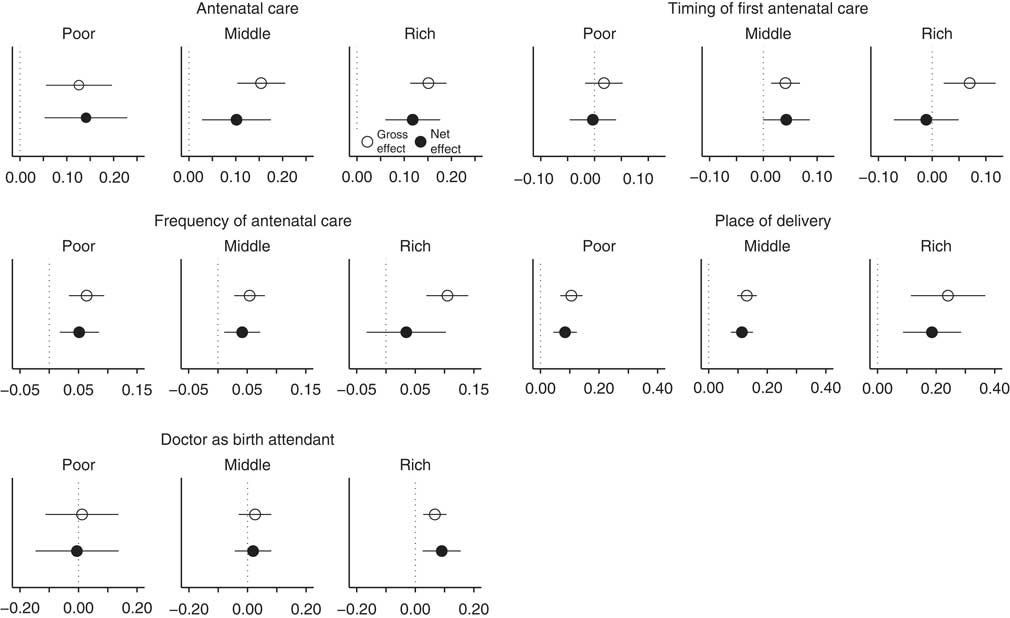
Women’s education and maternal health service utilization in Egypt by socioeconomic status. Source: Egypt DHS 2014.
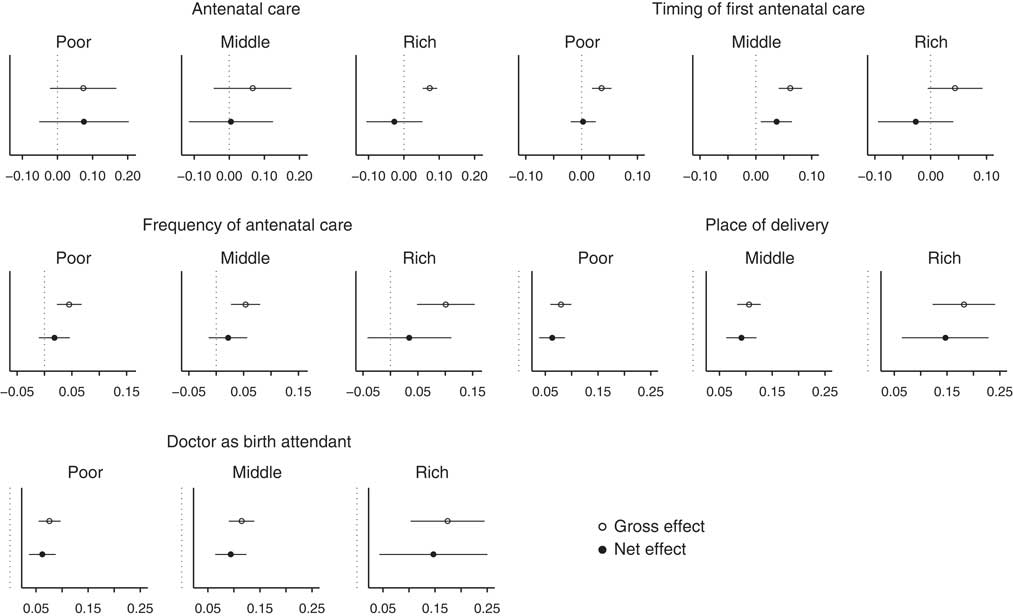
Women’s education and maternal health service utilization in Ghana by socioeconomic status. Source: Ghana DHS 2014.
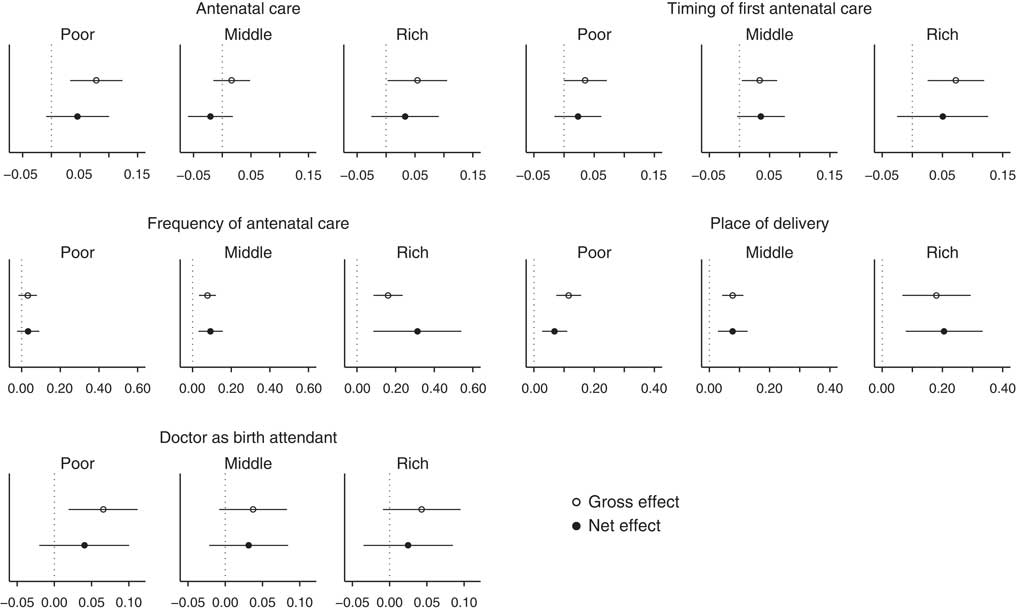
Women’s education and maternal health service utilization in Kenya by socioeconomic status. Source: Kenya DHS 2014.
Women’s education and maternal health service utilization in Nigeria by socioeconomic status. Source: Nigeria DHS 2013.
Women’s education and maternal health service utilization in Zimbabwe by socioeconomic status. Source: Zimbabwe DHS 2015.
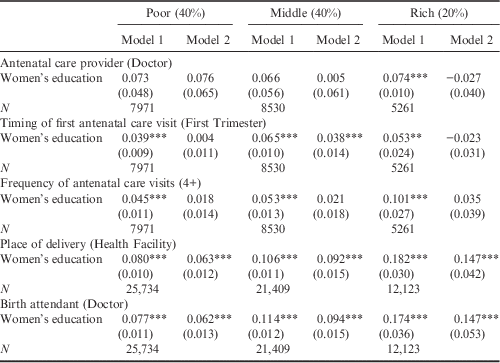
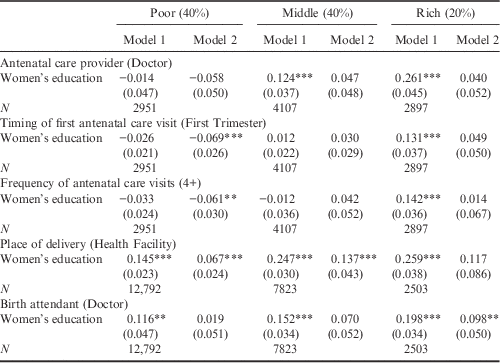
Estimated coefficients of women’s education on maternal health service utilization, Democratic Republic of Congo DHS 2013–14
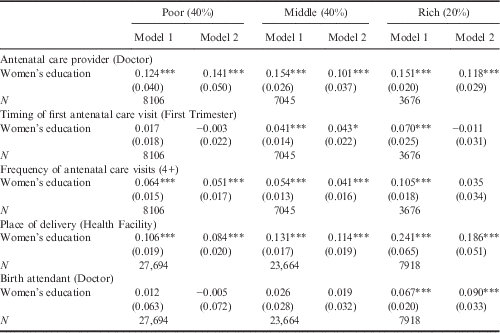
Model 2 controls for woman’s age, parity, working status, religion, marital status, health insurance, access to health facility, media exposure and frequency (e.g. radio, television, newspapers), partner’s education and occupation and current place of residence.
The sample sizes for the estimations are different in Tables 2–7 for the outcomes because the unit of analysis varies. ‘Woman’ is the unit of analysis for the provider of antenatal care, timing of antenatal care and frequency of antenatal care; ‘live births’ are the unit of analysis for place of delivery and birth attendant.
Standard errors in parentheses.
*p<0.1; **p<0.05; ***p<0.01.
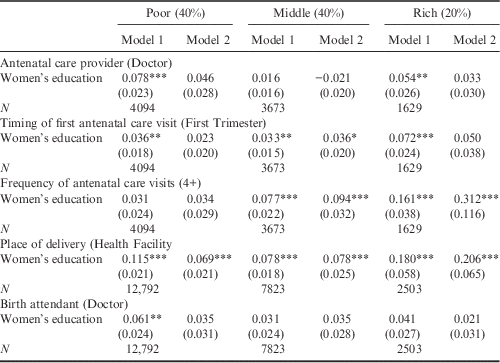
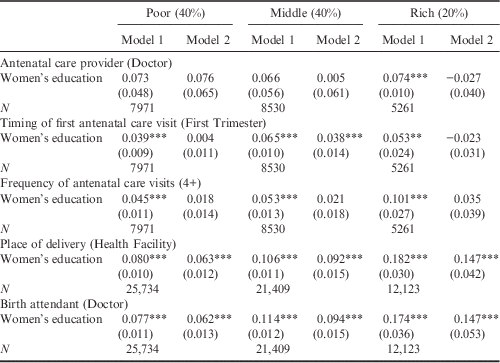
Estimated coefficients of women’s education on maternal health service utilization, Egypt DHS 2014
See footnote to Table 2 for explanation of Model 2 and units of analysis.
Standard errors in parentheses.
*p<0.1; **p<0.05; ***p<0.01.
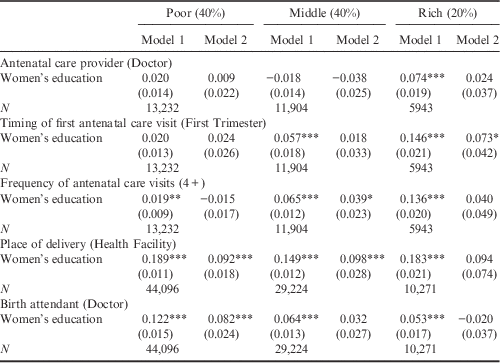
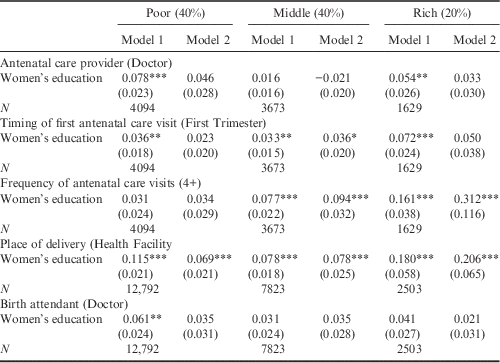
Estimated coefficients of women’s education on maternal health service utilization, Ghana DHS 2014
See footnote to Table 2 for explanation of Model 2 and units of analysis.
Standard errors in parentheses.
*p<0.1; **p<0.05; ***p<0.01.
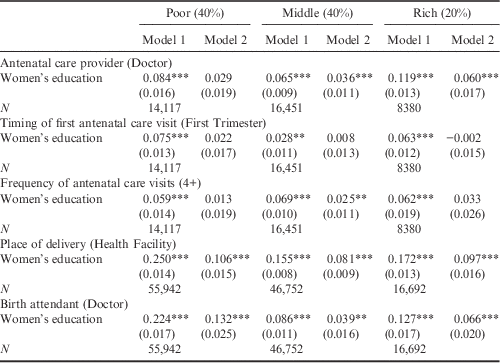
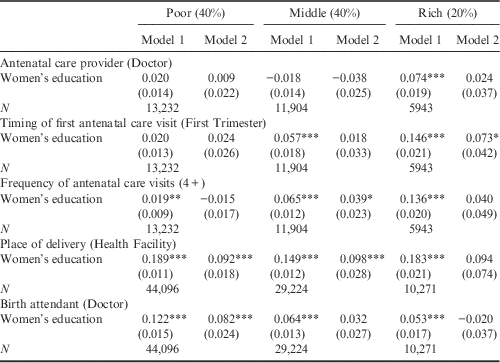
Estimated coefficients of women’s education on maternal health service utilization, Kenya DHS 2014
See footnote to Table 2 for explanation of Model 2 and units of analysis.
Standard errors in parentheses.
*p<0.1; **p<0.05; ***p<0.01.
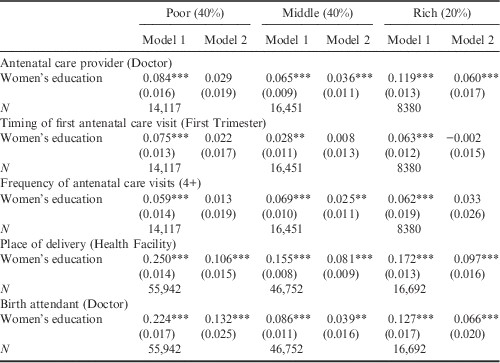
Estimated coefficients of women’s education on maternal health service utilization, Nigeria DHS 2013
See footnote to Table 2 for explanation of Model 2 and units of analysis.
Standard errors in parentheses.
*p<0.1; **p<0.05; ***p<0.01.
Estimated coefficients of women’s education on maternal health service utilization, Zimbabwe DHS 2015
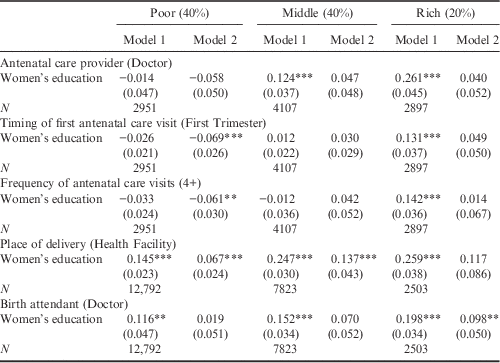
See footnote to Table 2 for explanation of Model 2 and units of analysis.
Standard errors in parentheses.
*p<0.1; **p<0.05; ***p<0.01.
Antenatal care provider
Women’s education was found to be positively associated with the use of a doctor as provider of antenatal care, but the results varied by SES strata. In Ghana and Kenya, some findings were not in the expected direction. The strongest positive associations between education and antenatal care provider were observed in the DRC and Nigeria. For instance, an additional year of woman’s education in the DRC increased by 14% the odds of having a doctor as antenatal care provider among women in poor households, net of control variables in the model. The corresponding figure for women in rich households was 13%.
Timing of first antenatal care visit
The associations between women’s education and timing of first antenatal care visit were less conclusive. In the DRC, the association was statistically significant (p<0.01) in Model 1 for the middle SES stratum. In Egypt, the results were significant for Models 1 and 2 for the middle stratum, while they were significant for Model 1 only for the poor and rich strata. In Ghana, the results were positive and significant for Model 1 for all strata. In Kenya, the association was significant for Model 1 in the middle stratum, while statistically significant for both Models 1 and 2 for the rich stratum. In Nigeria, only the gross effects were positive and statistically significant for all strata. Finally, associations between women’s education and timing of first antenatal care visit in Zimbabwe were significant only for Model 1 in the rich stratum.
Frequency of antenatal care visits
In the six countries, the associations between women’s education and frequency of antenatal care visits (i.e. at least four visits) were positive; however, the strengths of the relationship varied among SES strata and across countries. In the DRC, both the gross and net effects were statistically significant (p<0.01), except in the rich stratum where the net effect was not significant. In Egypt and Nigeria, women’s education was positively and significantly associated with the frequency of antenatal care visits; however, the significance disappeared when other variables were included in the estimations. In Ghana, the gross and net effects were significant (p<0.01) for the middle and rich strata. In Kenya, while most associations were positive and statistically significant, the net effect of women’s education on frequency of antenatal care visits for women in poor households was unexpectedly negative and did not reach statistical significance. In Zimbabwe, the associations were unexpectedly negative, except the gross effect for women living in the rich stratum (p<0.01).
Place of delivery (health facility deliveries)
The associations between women’s education and the likelihood of giving birth in a health facility showed a consistent pattern in all countries. Indeed, women’s education was positively and significantly associated with the likelihood of health facility delivery across the different SES groups. The gross effect of women’s education on health facility delivery was statistically significant in Kenya. This association became non-significant when the control variables were introduced in Model 2, suggesting that some of the impact of mother’s education on place of delivery was a reflection of other factors including age, partner’s education and place of residence. In Zimbabwe and Kenya the net effect was not significant for women from the rich stratum.
Skilled birth attendant
The association between women’s education and having a doctor as skilled birth attendant at delivery varied by country and SES strata. In Egypt, Nigeria and, to some extent in Zimbabwe, women’s education was significantly (p<0.01) associated with the likelihood of having a doctor as skilled birth attendant. In the DRC, the findings reached statistical significance only for women from the rich stratum. In Ghana, only the gross effect of women’s education on the likelihood of having a highly skilled birth attendant was significant (p<0.01) for women from the poor stratum. The findings from Kenya indicated that women’s education and having a highly skilled birth attendant were positively and significantly associated for women from the poor stratum. Likewise, the gross effects were significant for the middle and rich strata.
Additional factors associated with utilization of maternal health services in multivariate analyses
The paper is primarily interested in the effects of women’s education on maternal health service utilization. However, multivariate analyses showed that women’s education is not the only variable playing a key role in shaping maternal health utilization in sub-Saharan Africa (results not shown here but available upon request). In Egypt, the findings showed that the gross effects of women’s education and timing of first antenatal care visit were significant for all SES strata, but the net effects were significant for women living in middle households. Other factors were significant for each SES stratum. For the poor, parity and partner’s education were significant while women’s age and partner’s education were significant for women living in middle and rich households, respectively. In Ghana, the gross effect of women’s education was marginally significant among the poor and statistically significant among women in middle and rich households. However the net effects were not significant in the three SES strata. Parity had significant and negative and significant effect among poor and rich. In Kenya, a different pattern was observed. In fact, the gross effect of women’s education on timing of first antenatal care visit was significant in middle and rich strata. The net effect was insignificant for women in middle households and no other factors were significant. For the rich, the net effect was significant; in addition, health insurance had a positive and significant effect on timing of first antenatal care visit. In Nigeria, women’s education had a significant and positive effect on timing of first antenatal care visit in all SES strata. These effects vanished and became statistically insignificant when other factors were introduced in the estimations. Among poor women, access to a health facility had a negative and significant effect on the timing of first antenatal care visit, while health insurance was positively and marginally significant. In middle households, parity and religion were negatively and significantly associated. Being Muslim had a negative and significant effect on timing of first antenatal care visit. Among rich women, parity, partner’s education, and working status were important factors associated with timing of first antenatal care visit. Parity had a negative and significant effect, while working status and partner’s education had positive and significant effects. In Zimbabwe, the gross effect of women’s education was significant for women in rich households. When other factors were included in models, the effect vanished and became insignificant. Parity had a negative effect on the timing of first antenatal care visit; age and health insurance had positive and significant effects.
Discussion
This study examined the relationship between women’s education and maternal health service utilization in six sub-Saharan African countries with an ‘equity’ lens. To achieve this goal, Household Wealth Index (HWI), a proxy for the socioeconomic circumstances of women’s living environment, was not introduced in the estimations as an explanatory variable. Instead, it was used as a stratification variable to differentiate the effects of women’s education and MHSU by SES strata. In doing so, the paper adopts an ‘equity’ approach (Countdown Equity Analysis Group, Reference Boerma, Bryce, Kinfu, Axelson and Victora2008; Ganle et al., Reference Ganle, Parker, Fitzpatrick and Otupiri2014), providing new insight into the secular and persistent finding that women’s education is positively and significantly associated with MHSU and child health (Cleland & Van Ginneken, Reference Cleland and Van Ginneken1988; Levine & Rowe Reference Levine and Rowe2009; Ahmed et al., Reference Ahmed, Creanga, Gillespie and Tsui2010).
Furthermore, previous studies often addressed one or two dimensions of maternal health services, precluding comparisons of the associations between women’s education and MHSU outcomes within identical populations (or sub-populations) during the same period. By covering five dimensions of maternal health services – antenatal care provider, timing and frequency of antenatal care visits, place of delivery and highly skilled birth attendant at delivery – and by adopting an ‘equity’ approach to emphasize what can really make a difference between poor and rich in terms of access to high-quality maternal health services, this study fills an important gap and provides evidence to devise effective interventions to reduce the increasing gap between poor and rich in sub-Saharan Africa, where maternal and child mortality is still alarming high. For instance, the study assumed that it is more difficult for the poor to access a doctor as antenatal care provider or birth attendant.
The descriptive findings showed a gradient of the effect of SES on the five MHSU outcomes of interest, with women living in better-off households being advantaged compared with those living in poor households. They also showed the extent and magnitude of inequity in access to maternal health services in the selected countries. For instance, where socioeconomic development is slightly more advanced in comparison with other countries (e.g. in Egypt) the inequities were less alarming. In Egypt, the ratio rich/poor was barely above 1.0, suggesting low levels of inequity in access to maternal health services. In contrast, the rich/poor ratio for some MHSU outcomes in other countries was alarmingly high. For instance, in the DRC the ratios for having a doctor as antenatal provider and having a doctor as birth attendant were 15.2 and 8.3, respectively. In Ghana and Nigeria, the rich/poor ratios for having a doctor as birth attendant were 6.6 and 11.9, respectively. These findings provide clear evidence of persistent inequities by SES strata in terms of access to universal maternal health services in sub-Saharan Africa.
That said, it can be argued that the associations between women’s education and different components of MHSU are not univocal. They are largely contingent on (i) socioeconomic circumstances at the household level as an alternative to analyse inequities in access to high-quality maternal health services, and (ii) the national context of MHSU coverage and socioeconomic development. Therefore, a naïve generalization of the associations between women’s education and MHSU outcomes can be misleading. A closer examination of the association between women’s education and timing of first antenatal care visit (an early antenatal care visit during the first trimester of pregnancy) showed variations within and across countries. The findings also showed that many other factors (results not shown) are at play and need to be taken into account for a thorough understanding of the relationship between women’s education and MHSU outcomes, and for the development of sustainable social and health policies aimed at improving maternal and child health while promoting an equity approach. For instance, the associations between women’s education and timing of first antenatal care visit in the DRC showed that the gross effects were significant for women living in middle and rich households. After controlling for other factors shown to be important predictors of maternal health service utilization (age, parity, religion, marital status, working status, health insurance, access to health facility, media exposure, partner’s education and occupation, and current place of residence; see Sreeramareddy et al., Reference Sreeramareddy, Shankar, Sreekumaran, Subba, Joshi and Ramachandran2006; Simkhada et al., Reference Simkhada, Teijlingen, Porter and Simkhada2008; Tawiah, Reference Tawiah2011; Singh et al., Reference Singh, Rai and Singh2012a, Reference Singh, Rai, Alagarajan and Singhb; Sreeramareddy et al., Reference Sreeramareddy, Sathyanarayana and Kumar2012; Tsawe et al., Reference Tsawe, Moto, Netshivhera, Ralesego, Nyathi and Susuman2015), the effects became statistically non-significant for women in middle wealth households, while they turned counterintuitively negative for rich households. For women living in middle wealth households, parity and mother’s age appeared to be the most influential factors, showing significant negative and positive effects, respectively. For women in rich households, parity, working status and partner’s education were significant while the net effect of women’s education became statistically insignificant.
Multivariate analyses have shown that other factors such as parity (Tsawe et al., Reference Tsawe, Moto, Netshivhera, Ralesego, Nyathi and Susuman2015), partner’s education (Say & Raine, Reference Say and Raine2007; Dalal et al., Reference Dalal, Shabnam, Andrews-Chavez, Martensson and Timpka2012), women’s age (Babalola & Fatusi, Reference Babalola and Fatusi2009; Saxena et al., Reference Saxena, Vangani, Mavalankar and Thomsen2013; Tsawe et al., Reference Tsawe, Moto, Netshivhera, Ralesego, Nyathi and Susuman2015), access to health facility (Tsawe & Susuman, Reference Tsawe and Susuman2014), religion (McGlynn et al., Reference McGlynn, Wilk, Luginaah, Ryan and Thind2015) and working status (Dalal et al., Reference Dalal, Shabnam, Andrews-Chavez, Martensson and Timpka2012) are also important factors associated with the outcomes of interest. However, their effects are stratum-specific and country-specific; some factors play a significant role within a specific stratum and specific country. This suggests that besides the key role women’s education can play in maternal health utilization, policymakers and stakeholders working to improve maternal, newborn and child health (MNCH) in sub-Saharan Africa should equally focus on other important factors to ensure sustainable results.
The study had certain limitations. First, the cross-sectional nature of the data limited the possibility of drawing any conclusion from the analyses about causation. Because causation implies a time-order of the events under study, with cause X preceding effect Y, this study only allowed the detection of associations between women’s education and the five outcomes, not causality. Second, stratifying the entire sample into SES strata had the benefit of capturing the specific effects of women’s education on MHSU outcome, but post-stratification may have resulted in under-representation of certain categories of the variable used in the models within each SES stratum, yielding statistical instability in the estimations. Third, the education systems in selected countries may be slightly different; the number of years of education at each level (primary, secondary, tertiary) may vary from one country to another. However, using women’s education in single years in the study circumvented the problems because whichever education system considered, one year of education would remain constant. The only remaining issue is the content of the education system in terms of curricula, which can influence the skills of women to understand and adopt good care-seeking behaviours towards maternal health services. Fourth, in some countries, women’s education had an unexpectedly counterintuitive negative effect. The quality of data may explain this finding. The caution here is that this counterintuitive effect was also observed among women in rich households, which are on average more educated compared with women in poor and middle households.
In conclusion, despite these limitations, the study findings have important implications for research and programmes/interventions aimed at reducing the gap between poor and rich in maternal health service utilization in Africa. The findings suggest that an over-generalization of the association between women’s education and maternal health service utilization can be misleading, because the effects were found to vary by SES strata. The attitudes and behaviours towards maternal health services can vary by SES strata. Though improving women’s education remains an effective necessary intervention in poor settings to improve the utilization of maternal health services, it is not sufficient on its own. Programmatic interventions should be a combination of promoting women’s education, especially among the poor, and other influential factors associated with the utilization of maternal health services. For instance, where religion and ethnicity as recipient of culture are very important, women’s education will be a necessary condition but not sufficient.
Acknowledgments
The authors would like to express their gratitude to MEASURE DHS+ for providing free access to data. Analysis and writing time were supported by the following funding sources: the William and Flora Hewlett Foundation (Grant 2015-2530), Comic Relief (Grant GR002-12547), Swedish International Development Cooperation (Grant 54100029), the Bill and Melinda Gates Foundation (Grant OPP1021893) and the Strengthening Evidence for Programming on Unintended Pregnancy (STEP UP) Research Program Consortium, funded by the UK Department for International Development (Grant SR1109D-6).