Introduction
There are scant data on why medical students or junior doctors pursue a career in otolaryngology over and above the attractions of other medical specialties. Previous studies have found that important determinants of medical students’ and junior doctors’ career choice include: exposure to a specialty,Reference Maiorova, Stevens, Scherpbier and van der Zee 1 role models and mentors in a specialty,Reference Sternszus, Cruess, Cruess, Young and Steinert 2 , Reference McCord, McDonald, Sippel, Leverson, Mahvi and Weber 3 and factors intrinsic to the specialty, including lifestyle factors, patient contact, income and prestige.Reference Newton, Grayson and Thompson 4 – Reference van der Horst, Siegrist, Orlow and Giger 7 Although these studies provide a framework for understanding some of the broad determinants of medical career choice, they do not illuminate what specifically determines a decision to pursue a career in a specialty such as ENT.
Research has previously been conducted to investigate why people choose a career in other medical and surgical specialties;Reference West, Drefahl, Popkave and Kolars 8 – Reference Marshall, Salciccioli, Walton, Pitkin, Shalhoub and Malietzis 15 however, in ENT, the only existing study is a US survey of 96 medical students.Reference McCaffrey 16 These students, who had previously expressed interest in a career in ENT, were asked to select the most important reason for their interest from one of only five options. Most answered that it was their exposure to the residents (specialist trainees) that encouraged them.
Here, we undertook a UK-based, more in-depth exploration of the determinants of interest in a career in ENT surgery, through a survey of medical students and junior doctors. Building on findings from previous studies, we wanted to understand when people choose to pursue a career in ENT, and what determines that choice, including factors intrinsic to the specialty, educational exposure during undergraduate or post-graduate training, and the influence of particular clinicians.
Materials and methods
The study was not subject to formal ethical review, but nevertheless underwent internal review at University College London.
Medical students, foundation year trainees, core trainees and locum specialist trainees were recruited at five different events. Specifically, we targeted attendees at: three independent interview courses for national selection in ENT, at locations in London, Northampton and Leeds, between January and April 2015; the ENT-UK 5th Foundation ENT Conference, in London, in April 2015; and a course for medical students on operative skills in ENT, run at Imperial College, London, in April 2015.
Attendees at these events were asked to complete a voluntary, anonymous questionnaire. The survey explored: prior ENT exposure in undergraduate or post-graduate training, factors that determined interest in ENT (motivating factors), factors that detracted from that interest (demotivating factors), other careers being considered, and a subspecialty interest within ENT. The survey, which had previously been piloted with ENT trainees for comprehensibility, comprised a mixture of Likert scale, forced response and single option questions, plus free text responses.
Results
The response rates at each event are summarised in Table I, with an overall response rate of 87 per cent. Of those who responded, 43 were applicants for national selection, 15 were foundation doctors and 23 were medical students; the results were analysed under these groupings.
Events and attendees, and survey respondents and response rates

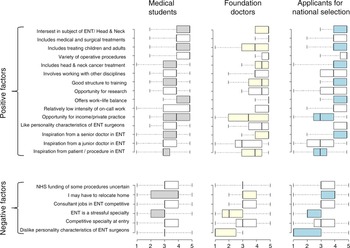
A summary of the motivating or demotivating factors in pursuing a career in ENT are represented using box and whisker plots in Figure 1. These results show no striking differences in motivating or demotivating factors between medical students, foundation doctors or applicants for national selection. The most highly rated motivating factors (defined as a median score of 5) for all groups of respondents were: ‘interest in the subject of ENT’, ‘that ENT includes a variety of operative procedures’, ‘that ENT offers work–life balance’ and ‘inspiration to pursue ENT from a senior doctor’. Applicants for national selection also rated ‘I like the personality characteristics of ENT surgeons’ as a highly significant motivating factor (median score of 5, minimum score of 4). The most variable response to a motivating factor (widest interquartile range) was ‘opportunity for private practice’. There was a wide variation in response to demotivating factors in pursuing an ENT career, with no clear consensus. However, in free text responses, several applicants for national selection stated that ‘competitive entry’ (n = 6) and ‘the need to relocate home’ (n = 4) were significant.
Box and whisker plots of survey responses to motivating (positive) and demotivating (negative) factors in the decision to pursue a career in ENT. Data are divided by respondent type (medical students n = 23, foundation doctors n = 15 and applicants for national selection n = 43). Ratings are on an ordinal Likert scale, where 1 = not at all important and 5 = very important. The dark line represents the median response, the box the interquartile range, and the whiskers the minimum and maximum values.

To evaluate the effect of exposure to ENT in determining career choice, we used data only from the 43 applicants for national selection (the inclusion of data from medical students or junior doctors in this analysis may have skewed the results: we surveyed those with an expressed interest in a career in ENT, and so have excluded medical students or foundation doctors who may decide upon this career at a later stage in their training). Of this group, 34 respondents (79 per cent) were exposed to ENT in medical school, and of these 16 started to consider a career in ENT at medical school, but only 6 had definitely decided upon this career during medical school. Eighteen respondents (42 per cent) definitely decided upon ENT only after exposure during foundation years training, and of these four had been exposed in medical school but had not previously considered this option. A further 18 respondents (42 per cent) definitely decided upon ENT only after exposure during core training, and for 7 of these this was their first ENT exposure, and they had not considered this career prior to that. Only one respondent decided to pursue a career in ENT without exposure to it in either medical school or during post-graduate training (further information on determinants of this decision was not provided).
Of the 43 applicants for national selection, 20 (47 per cent) were considering careers in other specialties, including anaesthetics, other surgical subspecialties, general practice and radiology. However, all respondents stated that ENT was their preferred specialty.
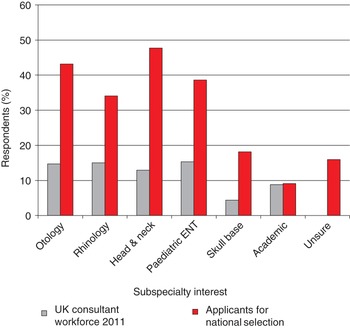
When questioned about subspecialty interest, there was a range of responses (Figure 2). These data align with data on the subspecialty interest of current ENT consultants from a 2011 survey, 17 and so predict adequate workforce renewal in the future, notwithstanding changes in subspecialty interest during the course of training.
Preferred subspecialty interest of applicants for national selection in ENT (n = 43), compared to actual subspecialty interest of the current ENT consultant workforce derived from a 2011 survey. 17 Note that in this survey and that of 2011, several respondents stated interest in more than one subspecialty, and some stated no subspecialty interest.

Discussion
In our study, the important factors that encourage medical students and junior doctors to consider ENT as a career included: the variety of operative procedures that ENT offers, the work–life balance, an inherent interest in this clinical area and inspirational senior role models. In recent decades, there has certainly been an expansion in the breadth and depth of operative procedures in ENT, enabled through pioneering surgeons and technological advances (most notably in endoscopes). A better work–life balance is possible in ENT compared to other surgical specialties because emergency admissions are generally less frequent and pathology less severe. Indeed, data from large-scale US studies show that lifestyle choices play an increasing role in medical students’ specialty career preferences.Reference Newton, Grayson and Thompson 4 , Reference Dorsey, Jarjoura and Rutecki 18 Previous studies have also discussed the importance of inspirational role models or mentoring in medical career choice, which Burack et al. described as a socially constructed process of ‘trying on possible selves’.Reference Burack, Irby, Carline, Ambrozy, Ellsbury and Stritter 19
Another, and arguably the most important finding from this survey, is the near universal exposure to ENT in either medical school and/or during post-graduate medical training amongst those who had decided to pursue a career in this specialty. Importantly, 7 of the 43 applicants for national selection (16 per cent) had not been exposed to ENT in medical school or foundation training, and had not considered this career until they were exposed during a core training post. At this stage, that group decided that ENT was their definite and preferred career choice.
It is perhaps unsurprising that exposure is a necessary factor in deciding to pursue a career in this specialty, but there are important implications of this finding. In the UK, ENT typically comprises less than 1 per cent of the medical school curriculum,Reference Davies and Elhassan 20 and one-third of medical schools do not offer an ENT placement.Reference Khan and Saeed 21 Even amongst those taught ENT in medical school, many students do not understand what the specialty comprises, with one-third not aware that head and neck surgery is part of the specialty.Reference Ranta, Hussain and Gardiner 22 Previous surveys from the UK have shown that 76 per cent of all doctors, and 90 per cent of those successfully pursuing a surgical career, had decided upon a probable career choice within a year of qualification,Reference Surman, Lambert and Goldacre 23 , Reference Goldacre, Laxton, Harrison, Richards, Lambert and Parks 24 but many choosing to pursue a career in ENT decide this only later in post-graduate training.Reference Powell and Doshi 25 Competition for ENT training posts in the UK remains high, with ratios at national selection for ENT currently at 5:1 to 3:1 (Health Education England, personal communication), but the lack of universal or systematic exposure to ENT in undergraduate or post-graduate training means that these ratios may nevertheless be artificially low.
There are limitations to this study. The survey was centred on forced rather than open responses; the limiting of response options may lead to ambiguity or misinterpretation of reasons for responses. The groups surveyed were a convenience sample as opposed to a random or comprehensive sample, although it seems unlikely that this would introduce significant bias. Individuals who had not chosen a career in ENT were not surveyed, and it would be interesting to know how this group differs from the surveyed group, and to investigate whether there are factors that made people either unaware of or reject a career in ENT.
-
• Determinants of career choice are known to include specialty exposure, role models and mentors, lifestyle factors, income, and perceived prestige
-
• No previous study has analysed the factors that encourage junior doctors or medical students to pursue a career in ENT surgery
-
• In this study, the most important factors were: variety of operative procedures, work–life balance and inspirational senior role models
-
• In addition, exposure in undergraduate or post-graduate training was critical in decisions to pursue an ENT career
In summary, this is the largest study to date that evaluated factors determining the decision to pursue a career in ENT. Many respondents stated that interest in the subject itself, the variety of operative procedures and the opportunity for work–life balance were significant factors in their decision. Promotion of these aspects of the ENT career may attract more people to it. Inspiration from senior doctors was also important, and senior doctors should remember this in their interactions with medical students and junior doctors. Our results also show that exposure to ENT in medical school or during junior doctor training is a critical determinant in choosing ENT as a career. This provides further impetus to those pursuing the inclusion and expansion of ENT teaching in medical school curricula.
Acknowledgement
We wish to thank all those who participated in this study and Derek Skinner for comments on the pilot questionnaire.