In the wake of the third and fourth waves of democratization, elections spread around the world (Doorenspleet Reference Doorenspleet2000; Huntington Reference Huntington1991). For all but a handful of countries, holding elections seems to have become a global norm. More than 90 per cent of the world’s states currently select national leaders through multiparty elections (Global Commission on Elections, Democracy and Security 2012; Hyde Reference Hyde2011). However, the early optimism about this unprecedented development soon gave way to increasing scepticism. Observers noted that many of the newly democratizing regimes lacked basic guarantees of civil liberties and other aspects commonly considered as vital elements of democracy, such as institutions of horizontal accountability and enforcement of the rule of law (Diamond Reference Diamond2002; O’Donnell Reference O’Donnell1998, Reference O’Donnell2004; Rose and Shin Reference Rose and Shin2001; Zakaria Reference Zakaria1997).
Africa is no exception to this trend. About a quarter of all the world’s states are found on the continent and it has accordingly produced a wide variety of political institutions and outcomes. While a number of countries in Africa held multiparty elections in conjunction with decolonization, by the end of the 1980s 42 out of 47 regimes in Africa were either closed autocracies or socialist regimes holding non-competitive, single-party elections. The end of the Cold War marked the start of a rapid transition. In just a few years, almost all the previously autocratic regimes started holding multiparty elections (Bratton and van de Walle Reference Bratton and van de Walle1997; Lindberg Reference Lindberg2006). There was an outburst of optimistic scholarship voicing hopes for a ‘second liberation’ (for example, Ayittey Reference Ayittey1992; Hyden and Bratton Reference Hyden and Bratton1992) that soon turned into sour commentaries on the lack of ‘real’ change (for example, Carothers Reference Carothers1997; Joseph Reference Joseph1998). The picture is now mixed, with some countries moving ahead and becoming democratic (such as Ghana), while others drag their feet (such as Mozambique) or regress (such as Zimbabwe). The introduction of de jure multiparty elections in many African countries thus did not mark the ‘moment of transition to democracy’, but rather indicated the starting point of slow, protracted transitions with uncertain outcomes.
Nevertheless, despite these setbacks, Lindberg (Reference Lindberg2006, Reference Lindberg2009) notes that the introduction of multiparty elections influences the prospects for democratization. The analyses suggest that successive elections lead to subsequent increases in civil liberties and as a consequence improve the overall quality of democracy. Likewise, van Ham (Reference van Ham2012) finds that, when taking all African regimes together and using all the available data sets, election quality (how free and fair they are) increases as more elections are held. However, this aggregate trend hides substantial variation between countries. While in a range of countries the quality of elections improves with successive elections, in others elections continue to be marred by irregularities and fraud. Hence, while almost all African nations currently hold multiparty elections, the quality of these elections varies widely, ranging from elections plagued by violence and fraud (like the Kenyan 2007 elections or the 2011 elections in DR Congo) to elections that were relatively ‘free and fair’ (such as the 2008 elections in Ghana or the 2011 elections in Cape Verde).
Research on election fraud and electoral malpractice has identified several factors explaining cross-national variation in the quality of elections (Birch Reference Birch2011; Donno Reference Donno2013; Norris Reference Norris2014; Simpser Reference Simpser2013). However, there are several different forms of electoral manipulation. Little is known about their use as alternative strategies during democratization. This article addresses that gap by mapping trends in African elections over time and analysing the trade-offs between different types of electoral manipulation. We argue that the choices of specific types of manipulation by incumbent and opposition actors are driven by trade-offs between available resources and associated costs. These are in turn shaped by the political context in which elections take place.
The next section presents our theoretical argument and hypotheses pertaining to trade-offs between different strategies to manipulate elections. The subsequent section provides descriptive statistics on the development of a select set of qualities of 286 African elections from 1986 to 2012, using the new Varieties of Democracy data (Coppedge et al. Reference Coppedge, Gerring, Lindberg, Teorell, Altman, Bernhard, Fish, Glynn, Hicken, Knutsen, Kroenig, McMann, Pemstein, Reif, Skaaning, Staton, Tzelgov and Wang2014). The fourth section discusses the data and methods used, followed by the results of our empirical analyses. In the final section, we conclude and reflect on the implications of our findings for the future of democracy in Africa.
Democratization and Strategies of Electoral Manipulation
Almost all modern definitions of democracy encapsulate Dahl’s (Reference Dahl1971) dictum that democracy is a political system in which government reflects the will of the people. This requires not only popular participation but also competition (or contestation, as Dahl would have it). It is not uncommon to take as a starting point the Schumpeterian notion that identifies electoral competition as the minimal criterion of a democratic system. Hence, not only is democracy a ‘regime in which those who govern are selected through contested elections’ (Przeworski et al. Reference Przeworski, Alvarez, Cheibub and Limongi2000: 15; cf. Przeworski and Limongi Reference Przeworski and Limongi1997: 178), but more importantly ‘democracy is a system of government in which parties lose elections’ (Przeworski Reference Przeworski1991: 10; cf. Sartori Reference Sartori1987). For this to become reality, elections must not only allow multiple parties and candidates to compete, but they must also be sufficiently free from manipulation to allow for de facto competition, resulting in alternation in power if citizens so desire.
In short, elections must be multiparty and free from manipulation in order to function as ‘instruments of democracy’ allowing citizens to hold incumbents to account for their past performance, and at the same time creating incentives for representatives to be responsive to citizens’ needs (Powell Reference Powell2000; Przeworski et al. Reference Przeworski, Stokes and Manin1999). If elections are not multiparty there is no political opposition, and without political opposition there is no choice. When there is no choice, the mechanism of vertical accountability breaks down (Dahl Reference Dahl1971, Reference Dahl1989; Hermet et al. Reference Hermet, Rose and Rouquie1978; Przeworski et al. Reference Przeworski, Stokes and Manin1999). But even in multiparty elections, electoral manipulation can tilt the playing field to such an extent that the possibility of alternation is undermined, thereby limiting the power of citizens to hold their governments to account (and thus eliminating the incentives for governments to be responsive to their needs). As noted by Huntington (Reference Huntington1991: 174), the power to ‘throw the rascals out’ is citizens’ main weapon in the constant struggle to make sure that elected representatives are responsive. By removing or at least diminishing the threat of alternation, electoral manipulation undermines the principle of vertical accountability, thereby undermining the main function of elections in democratic systems.
Hence, the quality of elections is critical for democracy even though other ‘partial regimes’ such as civil liberties, rule of law and institutions of horizontal accountability are important features as well (Diamond Reference Diamond2002; Karl Reference Karl1995, Reference Karl2000; Schmitter and Karl Reference Schmitter and Karl1991). Democratization occurs when the quality of the overall regime, i.e. the composite of partial regimes, improves over time.Footnote 1 The core argument we make in this article is that democratization writ large shapes the context in which elections take place, thereby shaping the incentive structure for political actors to engage in different strategies of electoral manipulation.Footnote 2
The emerging literature on electoral manipulation has identified several factors explaining cross-national variation in overall levels of election integrity (Birch Reference Birch2011; Donno Reference Donno2013; van Ham Reference van Ham2012; Norris Reference Norris2014; Simpser Reference Simpser2013). Much less is known about trade-offs between different strategies of electoral manipulation and about the differences between incumbent and opposition actors’ manipulative strategies.
Elections are complex processes, and irregularities can occur at all the different stages of the electoral cycle: starting from the pre-election legal framework, registration and campaigning, to the actual voting on election day, to post-election vote counting and the adjudication of results (Elklit and Reynolds Reference Elklit and Reynolds2005; Norris Reference Norris2014). Hence, electoral manipulation can take many forms, ranging from voter and candidate intimidation, to manipulation of the electoral management body, to vote buying and violence (Elklit and Reynolds Reference Elklit and Reynolds2005; Lehoucq Reference Lehoucq2003; Schedler Reference Schedler2002).
In general, manipulative strategies aimed at candidates and voters can be classified along a continuum from more coercive to more co-optive strategies. One way to determine the outcome of elections is to intimidate voters and opposition candidates to such an extent that competition is reduced sufficiently for the incumbent to stay in power. Another way to undermine the integrity of an election is to engage in vote buying to ‘persuade’ voters with gifts and financial rewards.Footnote 3 In addition to such sticks and carrots, a third strategy is to manipulate institutions – that is, the legal framework and administration of elections. In this article we argue, first, that the choices for specific types of manipulation by either incumbent or opposition actors are driven by available resources and potential costs associated with varying strategies and, second, that these costs are shaped by the political context in which elections take place.
Actors engaging in electoral manipulation are likely to incur two types of costs: implementation and legitimacy costs (Birch Reference Birch2011). Implementation costs are the financial and organizational resources needed to engage in manipulation: for example, the costs to mobilize party loyalists to engage in intimidation of other candidates or voters; the costs to select and convince polling staff to stuff ballot boxes, bribe and/or co-opt judges, journalists and election officials; the costs to buy votes and organize brokers to approach and monitor potential vote ‘sellers’; and so on. Legitimacy costs are potential costs that are only incurred if electoral manipulation is discovered, yet they can be quite high. For example, if the legitimacy of the incumbent takes a hit, it can lead to lower compliance with legislation and taxation – by organizations as well as citizens. There are numerous examples of election-related losses of legitimacy leading to large-scale protests, violent rebellions and attempted coups d’état (Norris et al. Reference Norris, Frank and Martinez i Coma2015). Obvious fraud typically affects international legitimacy as well and sometimes leads to political pressures for reforms and political changes, or economic sanctions by international organizations and powerful states.Footnote 4 Taking too large-scale and obvious manipulation of elections thus can be a high-risk game for incumbents, but can potentially also discredit an opposition that engages in similar acts.
It follows that manipulative strategies that are more visible also increase the costs of manipulation. Hence, we expect that rational actors would prefer manipulative strategies that are cheaper (both in financial and organizational terms) and less visible over more expensive and more visible strategies of manipulation.Footnote 5
Following this logic we would expect the manipulation of institutions – that is, the legal framework and administration of elections – to be the most cost efficient and secure way to manipulate elections as it does not require financial resources and is generally less visible and less easy to detect than other forms of manipulation (Birch Reference Birch2011). From the perspective of incumbents, manipulation of electoral laws and electoral administration should be the least costly option. Subsequently, intimidation is reasonably the second-best option since it requires relatively few financial and organizational resources and is thus likely to be a ‘cheaper’ form of manipulation than co-opting strategies such as vote buying (Bratton Reference Bratton2008; Collier and Vicente Reference Collier and Vicente2013). However, intimidation is typically more visible to voters and other domestic and international actors and therefore has a higher likelihood of leading to losses of legitimacy and producing counter-reactions, which may end up undermining regime stability. At a certain point, intimidation therefore places the incumbent in a dilemma where the costs of using it may be greater than the benefits (Schedler Reference Schedler2009).
Finally, among the different electoral manipulation strategies, vote buying is probably the most costly form of manipulation and therefore should be the last resort for an incumbent. Whether vote- or turnout buying, it requires substantial financial and organizational resources in order to affect the electoral outcome.Footnote 6 Detailed country case studies on vote buying have described how vote buying requires not only substantial financial resources, but also extensive local networks of brokers who can contact potential vote sellers and monitor compliance (Brusco et al. Reference Brusco, Nazareno and Stokes2004; Schaffer Reference Schaffer2007; Stokes et al. Reference Stokes, Dunning, Nazareno and Brusco2013).Footnote 7 Vote buying is also typically illegal and quite easily detectable. Keefer and Vlaicu (Reference Keefer and Vlaicu1997) posit that political clientelism is a strategy for politicians to gain repute when it is otherwise lacking, which accords with our last resort argument here. Voters in Africa’s emerging democracies often respond to offers of clientelistic goods sometimes said to be distributed along ethnic lines (for example, Burnell Reference Burnell2001; Nugent Reference Nugent2001; Posner Reference Posner2005; Vicente and Wantchekon Reference Vicente and Wantchekon2009). This logic is equivalent to accounts of how political parties provide private goods and policy favours primarily to groups who are receptive to material incentives (for example, Lindbeck and Weibull Reference Lindbeck and Weibull1987; Persson and Tabellini Reference Persson and Tabellini2000). Therefore, it seems likely that vote- and turnout buying will be targeted to specific groups of voters and will not be used if other possibilities for manipulation exist. It seems unlikely that vote buying would be a preferred strategy as long as other possibilities for electoral manipulation are available.
In short, we expect the choice of different manipulative strategies to depend on both direct and indirect costs associated with these respective strategies. This implies that cheaper methods of electoral manipulation, such as manipulation of electoral laws and administration as well as intimidation will be preferred to forms of manipulation that are more costly, such as vote buying. Hence, our first hypothesis refers to these trade-offs between strategies of electoral manipulation:
Hypothesis 1: Vote buying increases as electoral administration manipulation and government intimidation decline.
However, the ‘menu of manipulation’ – that is, the strategies of electoral manipulation that are available to actors – is likely to differ depending on the political and economic context in which elections take place, as well as on the type of actors involved in manipulation (Schedler Reference Schedler2002). For example, political actors will not be able to get away with manipulating electoral laws and administration, or intimidation, in more developed democracies where independent media and judiciaries will denounce (and prosecute) such behaviour. Manipulating electoral laws and administration may really only be a manipulative strategy available in more hegemonic electoral authoritarian regimes, where the rule of law is weaker and the state bureaucracy is more vulnerable to partisan capture. Hence, we expect that democratization will lead to increases in vote buying as ‘cheap’ forms of electoral manipulation available to incumbents such as intimidation and manipulating electoral administration become less viable. It is an empirical question to what degree the development of aspects of democracy other than elections will subsequently lead to an eventual decline in vote buying. Thus, we hypothesize that:
Hypothesis 2: Improvements in democracy of partial regimes beyond elections lead to a decline in government intimidation and electoral administration manipulation and an increase in vote buying.
In a similar vein, we would expect that election violence is not a viable strategy for opposition actors in the most oppressive electoral autocracies, where election violence, or other forms of active dissent, are likely to be met with severe repression. At the lowest level of (or lacking) democratic qualities in partial regimes beyond elections, we therefore expect low levels of election violence. But, following the reasoning of costs above, we expect the initial stages of democratization when regimes become slightly less repressive to be associated with an increase in election violence (Norris et al. Reference Norris, Frank and Martinez i Coma2015; Reif Reference Reif2009). At higher levels of democracy, we would then expect the opposition strategy of using violence to affect the outcome of elections to become increasingly costly. When the regime becomes more democratic, using electoral violence should damage the opposition’s credibility and weaken its position but also become less and less necessary. Our intuition is that opposition parties realize this and should therefore actively scale down their use of violence as democratization progresses further. Our final hypothesis hence refers to the consequences of democratization for strategies of election violence as a curvilinear effect.
Hypothesis 3: Democratization has a curvilinear relationship to election violence: an increase in violence as a consequence of initial democratization followed by a decline as the level of democracy increases further.
It is important to note that access to manipulative strategies tends to be unevenly distributed. While incumbents typically have access to a wide range of manipulative strategies, opposition parties’ ‘menu of manipulation’ (Schedler Reference Schedler2002) is more constrained. For example, incumbents can often manipulate electoral laws and the electoral administration, have access to state resources, and are more likely to be able to influence state media. Opposition actors’ options are limited mainly to the use of illicit coercion and to the co-optation of voters but with less access to financial resources, thus often tilting their preferred strategy of manipulation towards coercion. Indeed it has been suggested in the case of Africa that incumbents engage more in vote buying while opposition agents engage more in election violence (Bratton Reference Bratton2008; Collier and Vicente Reference Collier and Vicente2013).
This does not mean that opposition actors necessarily always engage in less electoral manipulation than incumbents. Evidence from international election observation missions in Africa suggests that agents of opposition parties were involved in attempts to steer elections towards their preferred outcome as well.Footnote 8 However, incumbents have a larger menu of choice and typically larger resources available when it comes to manipulating elections. Thus, election administration manipulation, intimidation and to some extent vote buying can be thought of more as government-dominated activities, while election violence may be the opposition’s main choice of weapon, with the more costly vote buying a second-best option.
The Quality of Elections in Africa
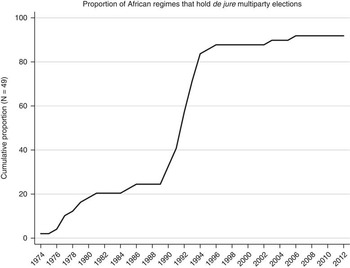
In 1974, only one country on the continent allowed for multiple parties and candidates in elections. As displayed in Figure 1, the number of countries in Africa holding regular multiparty elections has since increased dramatically, particularly following the end of the Cold War in 1989. In only five years, the proportion of countries holding multiparty elections jumped from just 25 per cent in 1988 to 84 per cent in 1994. In 2012, virtually all African countries held multiparty elections for national offices (92 per cent).Footnote 9
The Spread of Multiparty Elections in Africa Source: van Ham (Reference van Ham2012).

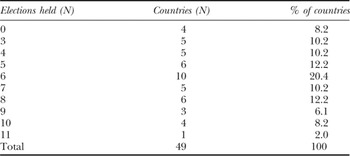
In addition to the increasing number of countries holding elections, the number of successive elections within Africa’s nations has increased substantially. Table 1 shows that by 2012 more than 80 per cent of states in Africa had held four or more elections, and over 60 per cent had held six or more successive elections. Yet, the quality of elections varied widely, ranging from elections plagued by violence and fraud – as the Kenyan 2007 elections or the 2013 elections in Zimbabwe – to elections that were essentially ‘free and fair’, as the 2012 elections in Ghana or the 2011 elections in Cape Verde.
Number of National Multiparty Elections Held per Country (1986–2012)

Source: V-Dem Database, December 2014. National elections include direct elections for the national legislature and executive.
Out of the 286 multiparty elections held on the continent between 1986 and 2012, country experts consulted by the Varieties of Democracy (V-Dem) project evaluate 46 per cent as substantively free and fair.Footnote 10 The other elections were deemed either ‘not at all’ or ‘not really’ free and fair (28 per cent) or of ‘ambiguous’ quality (26 per cent).
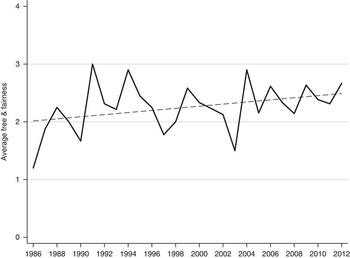
Figure 2 shows that the average quality of elections in Africa has increased over time, yet even in 2012 a substantial proportion of elections still displayed problems that undermined the extent to which they can be considered free and fair.Footnote 11
The Quality of Elections in Africa (1986–2012) Source: V-Dem Dataset v3, December 2014.

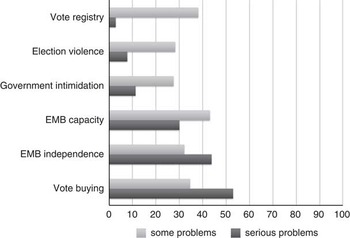
The V-Dem expert survey also asks experts to evaluate the presence of a number of specific irregularities and forms of manipulation occurring in elections. Figure 3 provides an overview of the types of irregularities and manipulation that occur most often in African elections. While (non-government) election violence receives much attention in media coverage of African elections, experts judged that in only about 8 per cent of elections it was a serious problem, and slightly over 28 per cent suffered from some amount of election violence. Grave government intimidation also occurred in a minority of elections, though it was somewhat more frequent than election violence.
Types of Manipulation in African Elections (1986–2012) Note: EMB = electoral management body. Source: V-Dem Dataset v3, December 2014.
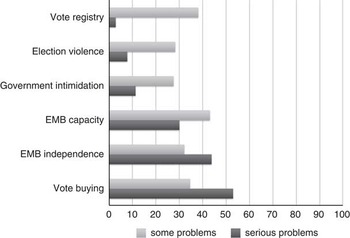
Problems with the voter registry were also relatively uncommon. Severe problems occurred in a small proportion of elections while about 38 per cent of elections had some problems with their voter registries. This relative cleanliness may partly be the result of the intensive involvement of international election assistance in African elections, with much investment geared at improving civil and voter registries (Evrensel Reference Evrensel2010). The problems with electoral management bodies’ (EMB) capacity to organize elections are recurrent, however: about 30 per cent of elections displayed serious problems, and over 43 per cent of elections faced some problems. This is perhaps not surprising, considering the fact that elections are complex logistical operations that require substantial financial and organizational resources, both of which can pose considerable challenges in less-developed countries.
The most profuse problems signalled in African elections concern the political independence of electoral management bodies and vote buying. In 44 per cent of elections, experts flashed serious problems with the autonomy of the electoral management body from the government, and in over 32 per cent of elections there were some problems with electoral management bodies’ autonomy. That leaves less than a quarter (24 per cent) of elections without issues in this regard. Finally, vote buying appears to be the most common form of electoral manipulation in African elections: vote buying was a serious problem in about 53 per cent of elections.
In conclusion, even if the quality of elections in Africa has improved overall, many elections continue to suffer from different types and varying levels of manipulation. A key question is how this variation can be explained, and under what conditions which sorts of transgressions are most likely to occur.
Data and Methods for the Explanatory Analysis
We test the three theoretical propositions using data from the V-Dem project. This is a new comprehensive data set on democracy that collects data on almost 400 indicators of democracy in 173 countries around the world from 1900 until 2012, engaging over 2,300 country experts worldwide to collect data (Coppedge et al. Reference Coppedge, Gerring, Lindberg, Teorell, Altman, Bernhard, Fish, Glynn, Hicken, Knutsen, Kroenig, McMann, Pemstein, Reif, Skaaning, Staton, Tzelgov and Wang2014).Footnote 12 In this article we use the V-Dem data on the quality of elections and strategies of electoral manipulation. Since very few de jure multiparty elections took place in Africa before 1986, we limit the period analysed to elections held between 1986 and 2012.
The V-Dem data set includes data on the following types of electoral manipulation: electoral management body capacity, electoral management body autonomy, voter registry accuracy, vote buying, government intimidation and election violence.Footnote 13 To measure electoral management body capacity, experts were asked to evaluate: ‘Does the Electoral Management Body (EMB) have sufficient staff and resources to administer a well-run national election?’ Answers could be given on a five-point scale varying from ‘No. There are glaring deficits in staff, financial, or other resources affecting the organization across the territory’ to ‘Yes. The EMB has adequate staff and other resources to administer a well-run election’.Footnote 14 To measure electoral management body autonomy, experts were asked to evaluate: ‘Does the Election Management Body (EMB) have autonomy from government to apply election laws and administrative rules impartially in national elections?’ Answers could be given on a five-point scale varying from ‘No. The EMB is controlled by the incumbent government, the military, or other de facto ruling body’ to ‘Yes. The EMB is autonomous and impartially applies elections laws and administrative rules’.Footnote 15
To measure the accuracy of the voter registry, experts were asked to evaluate: ‘In this national election, was there a reasonably accurate voter registry in place and was it used?’ Answer categories varied on a five-point scale from ‘No. There was no registry, or the registry was not used’ to ‘Yes. The voter registry was reasonably accurate (less than 1% of voters were affected by any flaws) and it was applied in a reasonable fashion’ (see Coppedge et al. Reference Coppedge, Gerring, Lindberg, Teorell, Altman, Bernhard, Fish, Glynn, Hicken, Knutsen, Kroenig, McMann, Pemstein, Reif, Skaaning, Staton, Tzelgov and Wang2014).
Vote buying in elections was measured by asking experts whether: ‘In this national election, was there evidence of vote and/or turnout buying?’ Again answers could vary along a five-point scale from ‘Yes. There was systematic, widespread, and almost nationwide vote/turnout buying by almost all parties and candidates’ to ‘None. There was no evidence of vote/turnout buying’ (see Coppedge et al. Reference Coppedge, Gerring, Lindberg, Teorell, Altman, Bernhard, Fish, Glynn, Hicken, Knutsen, Kroenig, McMann, Pemstein, Reif, Skaaning, Staton, Tzelgov and Wang2014).
Government intimidation was measured by asking experts: ‘In this national election, were opposition candidates/parties/campaign workers subjected to repression, intimidation, violence, or harassment by the government, the ruling party, or their agents?’ Answer categories varied on a five-point scale from ‘Yes. The repression and intimidation by the government or its agents was so strong that the entire period was quiet’ to ‘None. There was no harassment or intimidation of opposition by the government or its agents, during the election campaign period and polling day’.Footnote 16
Finally, opposition election violence was measured by asking experts: ‘In this national election, was the campaign period, election day and post-election process free from other types of violence related to the conduct of the election and the campaigns (but not conducted by the government, the ruling party, or their agents)?’ Answers varied on a five-point scale from ‘No. There was widespread violence between civilians occurring throughout the election period, or in an intense period of more than a week and in large swathes of the country. It resulted in a large number of deaths or displaced refugees’ to ‘Peaceful. No election-related violence between civilians occurred’ (Coppedge et al. Reference Coppedge, Gerring, Lindberg, Teorell, Altman, Bernhard, Fish, Glynn, Hicken, Knutsen, Kroenig, McMann, Pemstein, Reif, Skaaning, Staton, Tzelgov and Wang2014). Note that the election violence indicator asks about violence related to the conduct of the election that was not conducted by the government, the ruling party, or their agents, and hence provides us with a measure of manipulation engaged in primarily by the opposition.
Since electoral management body capacity, electoral management body autonomy and the accuracy of the voter registry are very highly correlated, in the African elections we combine these three measures into a single indicator of electoral administration manipulation by taking the average score on all three indicators for each election.Footnote 17 This leaves us with four types of electoral manipulation to test the hypotheses: electoral administration manipulation, vote buying, government intimidation and opposition violence. All variables were reversed so that higher scores indicate higher manipulation.
To measure the level of democratization with an indicator that is sufficiently independent of electoral procedures in order to limit endogeneity, we use the Freedom House civil liberties indicator (cf. Lindberg Reference Lindberg2006, Reference Lindberg2009, for further discussion and justification). This is an effort to use an indicator of a partial regime of democracy associated with de facto democratic quality of civil liberties, access to justice and rule of law that are also independent of the V-Dem data. In addition, we lag this indicator with one year, measuring civil liberties in the year before the elections took place. To test the robustness of our results, we also carried out the analyses presented here with alternative democratization indicators, the Polity IV democracy indicator, the Freedom House political rights, as well as the combined indicator of Polity IV and Freedom House developed by Hadenius and Teorell (Reference Hadenius and Teorell2005).Footnote 18 These data were all derived from the Quality of Government data set (Teorell et al. Reference Teorell, Charron, Dahlberg, Holmberg, Rothstein, Sundin and Svensson2013).
Apart from the level of democratization, some types of electoral manipulation are likely to be influenced by other contextual factors as well. As such, we would expect vote buying, but not other manipulative strategies, to be higher in countries with large proportions of poor citizens, as buying votes will be cheaper in these circumstances. In addition, we expect vote buying to be higher in countries that exploit natural resources, as this may provide incumbent governments with access to financial resources to fund vote buying. Finally, we expect the relative ‘costs’ of election violence to be lower in countries that experienced civil war in the years preceding the elections. Demilitarization after civil war is difficult and almost never fully successful, increasing ‘easy’ access of political factions to weapons that can be used at times of elections. Accordingly, we need to include controls in our analyses for these factors.
To measure poverty, we use data on GDP per capita from the World Development Indicators. However, since GDP per capita is not a very efficient indicator of poverty, particularly not for countries with large informal economies, we include an alternative indicator as well: average life expectancy from the World Development Indicators, taken from the Quality of Government data set. Since it has also been argued that citizens in rural areas may be more vulnerable to electoral manipulation, we include an indicator for the proportion of the population that lives in rural areas (Birch Reference Birch2011; Bratton Reference Bratton2008; Hicken Reference Hicken2007). To measure the degree to which incumbents may have access to state resources to finance electoral manipulation, we include a measure of the net oil exports per capita (Ross Reference Ross2013). We include a dummy variable indicating whether the country was in a civil war at the time of the elections in order to control for this circumstance.Footnote 19 The data were taken from van Ham (Reference van Ham2012). Finally, we include type of election (legislative, executive or concurrent) as control variable since executive elections might be the subject of greater attempts at manipulation in the many presidential regimes we find in Africa.
We analyse the data using time series cross-national analysis with fixed effects since we assume that choices of strategies of electoral manipulation are essentially driven by within-country dynamics. As often occurs when analysing developing democracies that made the transition to holding multiparty elections at different times, our panels are unbalanced – that is, some countries have held more elections than others (see Table 1 for details). We test whether this affects our results by excluding countries that had held fewer than five elections as of 2012, and report the results of those analyses in Table 4 in the online Appendix.Footnote 20 The results do not change substantively, except for the effect of democratization on government intimidation that is no longer significant.
Results
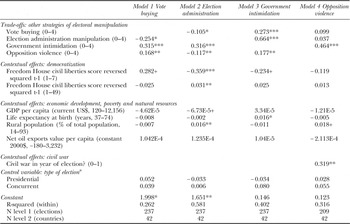
The results of the analyses are presented in Table 2. Models 1, 2 and 3 speak to Hypothesis 1, positing that there is a trade-off between ‘cheaper’ strategies of manipulation such as electoral administration manipulation and government intimidation and more costly strategies such as vote buying. The results corroborate that the hypothesized trade-off between manipulation of election administration and vote buying exists. As manipulation of the election administration declines, vote buying increases. The intuition here is that every incumbent would manipulate electoral administration if they could do so without incurring costs, hence the actual decline in such manipulation indicates decreasing opportunities and increasing costs. Thus, it makes it rational for incumbents to turn to vote buying as an alternative strategy, which is also what the results suggest.
Explaining Strategies of Electoral Manipulation in African Elections (1986–2012)

Note: aLegislative is reference category.
Time series cross-section analyses, fixed effects. P-values: +0.1, *0.05, **0.01, ***0.001 (two-sided).
We do not find such a trade-off with government intimidation, however. It tends to vary in tandem with vote buying, suggesting that these two strategies are complementary rather than supplementary. Hence, Hypothesis 1 is partly confirmed and makes us rethink our theoretical assumptions to some extent. A possible explanation for this finding is that incumbent governments may use both strategies to target different groups of citizens: using government intimidation in opposition strongholds while using vote buying to mobilize their supporters. The data we have from V-Dem consist of national aggregates, however, and therefore do not allow us to test this possibility here. Another option is that incumbent intimidation, in part at least, is reactive to opposition violence. The results reported in Model 3 support this intuition.
Turning to Hypothesis 2 about the consequences of democratization for the choice of manipulative strategy, Models 2 and 3 demonstrate that democratization is associated with a decline in the use of electoral administration manipulation and to a lesser extent government intimidation. This corroborates the reasoning that these forms of manipulation simply become less viable as countries democratize. This is especially the case for electoral administration manipulation, as the effect of democratization on government intimidation is less robust when checking for the effects using other indicators of democratization. For the complete results, see Tables 3 and 4 in the online Appendix.
Model 1 also substantiates that democratization is concomitant with an increase in vote buying. The squared indicator for democracy indicates that as countries further democratize towards the highest levels of democracy, vote buying becomes less viable as a manipulative technique and eventually declines; this effect is not statistically significant, however.
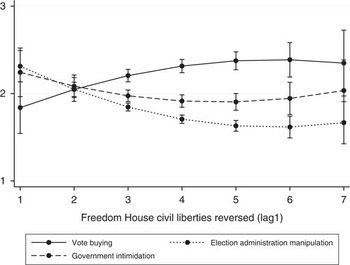
To illustrate the substantive effects, Figure 4 demonstrates the predicted values of vote buying, election administration manipulation and government intimidation by levels of democratization. It shows that vote buying increases as countries democratize up until a level of civil liberties of about 5 on the (reversed) Freedom House scale, after which there is no further increase. This is an unexpected result from the point of the theoretical reasoning above yet it makes intuitive sense. At the lower levels of democracy, steps towards greater democratization make the alternative strategies of manipulation less viable and the more costly strategy of vote buying emerges as it increasingly becomes the most viable mechanism to affect the outcome of an election. After a certain breaking point, vote buying no longer increases.Footnote 21
Predicted Values of Electoral Manipulation by Democratization

This seems intuitive if one considers what happens at these levels of democracy. Voters become more and more sophisticated and also gain experience with elections and start monitoring what incumbents have done in office. Institutions of the state, judiciary and election administration gain additional autonomy and increasingly gain capacity to impose sanctions on illicit actions of this nature. The media become more independent and professionalized and will report cases of illicit activities that threaten to cost candidates more votes than are gained by vote buying, and policy goals rather than immediate gratification in terms of small gifts gain more traction. In the end, we should expect vote buying to decrease as a consequence of moving from the middle to the highest end of a democratization scale. The lack of a statistically significant finding (although the coefficient on the squared term is in the right direction) for an inverted U-shaped relationship may be due to the fact that our current sample includes very few cases on this highest end of the democratization scale. Future research using a larger sample of countries is warranted to clarify if the drop-off in vote buying at the highest levels of democratization can be corroborated.
Finally, Model 4 in Table 2 does not support our expectation of a curvilinear dynamic for election violence in this sample of African elections. Rather, the results suggest that opposition election violence may decline in a linear fashion as democratization progresses, but the results do not reach conventional levels of statistical significance. We can thus not reject the null hypothesis regarding our third proposition about the consequences of democratization for election violence. Instead the relationship between government intimidation and election violence shown in Model 4, and Model 3 indicates that these strategies of electoral manipulation are mutually reactive.Footnote 22 We thus find stronger evidence that election violence is shaped by the level of government intimidation, than that it is related to the level of democratization.
The controls suggest that several factors are not related to these outcomes in the ways the literature suggests. Neither GDP per capita, life expectancy, urbanization nor oil exports seem to affect the level of vote buying in ways that can be statistically corroborated at conventional levels of significance. The economic variables are mostly not related to other types of electoral manipulation either. The exception is electoral administration manipulation, which occurs more frequently in poor countries and in countries with a larger proportion of citizens living in rural areas. Finally, we also find (as expected) that civil war increases the propensity of election violence substantially. The results thus confirm the importance of including the control for civil war in order to isolate the incidences of election violence that occur as part of an ongoing civil war.
Conclusions and Reflections
This article is one of few existing so far trying to disentangle varying strategies for the manipulation of elections. We chose to focus on the African continent since it harbours a set of less-developed countries, and to evaluate a first set of theoretical propositions.
The results largely support the theory. An incumbent’s choice of strategies of manipulation seems to go from more dictatorial rulers in electoral authoritarian regimes mainly using electoral administration and government intimidation, to these becoming less and less attractive tools to stay in power as countries democratize. Vote buying conversely increases with democratization and becomes more and more pervasive as the level of democracy rises, as predicted by the theory. We also find evidence suggestive of a drop-off in the use of vote buying when countries reach the highest levels of democracy but it is not a statistically significant finding.
The main form of manipulation available to the opposition – election violence – does not appear to be strongly related to democratization, but rather appears to be driven to an important extent by the level of government intimidation. The fact that we find the reverse relationship to hold as well (though weaker) indicates that incumbents’ and oppositions’ use of violence in elections are indeed mutually responsive. Future research with more detailed data on the timing of government and opposition violence is needed to further disentangle which actors initiate violence and under which circumstances.
We think these findings put us in a position to indicate a few things that are relevant for the future of democracy in Africa. More than half of the countries in the continent are still on what we may consider a ‘lower band’ on the democratization spectrum. For these countries, the future will hold elections where the administration of elections becomes better and better but at the same time other illicit activities such as vote buying will increase. Not all things go together – at least not all the time. The future of democracy in Africa will mean more money in politics, more patronage and more clientelistic offers thrown around. Whether money politics will eventually decline as democratization progresses remains to be seen. Clientelism as a tool for parties to connect to citizens is persisting in some long-standing democracies, as demonstrated by Wilkinson (Reference Wilkinson2015, in this issue), for example, in his contribution to this special issue.
While the global trend towards increasing democracy has stalled, and some say it has even reversed, the trend in Africa is still positive. It is true that the continent was far behind the world in the early 1990s and therefore it is perhaps not surprising that relative improvements have been on a greater scale there than anywhere else (save perhaps Eastern Europe). This may also contribute to Africa still gradually moving, generally, towards more democracy while the world as a whole has stalled. Yet, there is a cautionary note to be issued in this respect. If the above is true, we should perhaps expect the developments towards greater democracy to stall in Africa as well soon, if the continent follows the general pattern.
In addition, we cannot help noticing that in many respects the regimes in Africa that are still more harshly authoritarian also seem to be the ‘hardest nuts to crack’ if the reader allows for the expression. This includes war-scarred countries such as the two Sudans, Central African Republic and Somalia, resource-rich and repressive states such as Equatorial Guinea and Angola, and ruthless dictatorships such as Eritrea and Zimbabwe. For democracy to make substantial gains in the near future in these and other similar countries, something more than just repeating elections is naturally needed.
Supplementary material
To view supplementary material for this article, please visit http://dx.doi.org/10.1017/gov.2015.6.