The Great War is not a historical episode that easily lends itself to studying the subtleties of religious belief systems. Believers on opposite sides claimed that they were engaged in a just war of defense against aggression. They argued that God was on their side, and they prayed for victory of their nation—even if that meant the destruction of their fellow believers who were now considered the enemy. Despite Catholic claims to internationalism and universalism, the overwhelming majority of Catholic bishops and prominent clerics in the public sphere devoted themselves to national causes.Footnote 1 Clerical nationalism seemed to overwhelm Christian fellowship, and the clerical nationalist paradigm often served as scholarly shorthand for the experience of religion during the war, especially for long-term studies of Christianity and war.Footnote 2 The implacable hostility between French and German Catholic bishops became a convenient symbol of European national enmity in an age of total war.Footnote 3
In studying the Great War as a cultural event, however, the tendency to subsume every religious impulse under the common heading of clerical nationalism obscures important analytical differences of religious groups. Catholicism in particular, as a religion whose universalistic liturgy and theology readily promote transnational conceptualization, offers alternative dimensions to a story where the paradigm of the nation dominates thinking on religion and war. Seen from a historiographic perspective, World War I has begun a new generation of transnational writing, and this essay contributes perspectives toward that approach.Footnote 4
There is much work to be done. Focused on modes of irony and meaninglessness, modernist literary representations of the conflict tended to reduce religious belief to a superfluous relic, an archaic vestige of the old order that was no longer relevant in an age of industrialized slaughter.Footnote 5 Although Jay Winter's classic comparative work demonstrated the persistence of classical, romantic, and religious tropes as necessary avenues for grieving people trying to cope with the war's devastating losses, for a long time the majority of cultural histories of the war tended to focus on the avant garde culture of major cities.Footnote 6
Religious histories have done little to widen this narrow perspective. Although Catholic histories of the war have shown some attempts to overcome the previous focus on institutional history, they remain largely focused on the peacemaking efforts of the papacy.Footnote 7 Recent religious histories freely admit that the everyday experience of Catholics during the Great War remains a neglected historical episode.Footnote 8 Overall, as Michael Snape has argued in the recent Cambridge History of Christianity, “Despite its magnitude as a global event, the First World War has not been well-served by historians of Catholic and Protestant Christianity. Although numerous studies have been published on the churches' involvement in the war, they have tended to adopt a relatively narrow national or denominational focus, a tendency which has hampered the identification of connecting themes and which has served to obscure the wider impact of the war on Western Christianity as a whole.”Footnote 9
After the cultural turn in World War I studies, histories of religion during the war have stressed the autonomous power of religion to shape identities, albeit largely in national frameworks.Footnote 10 The recent work on religion as part of a “war culture” has helped to focus attention on the everyday motivations of ordinary citizens for whom religious faith was a key part of their identity.Footnote 11 When these works are read collectively, however, nationally oriented religious scholarship and the “war culture” approach often unintentionally reduce religion to instrumental terms of mobilization (i.e., the crusading effort to win hearts and minds devoted to victory). Thus religion can still be read as a form of propaganda: did it further victory or defeat? Particularly for the defeated, this narrative convenience quickly transforms frustrated collective spiritual energy into a tale of political religions and new authoritarian messiahs who promised revenge and redemption.Footnote 12
By going beyond the rhetoric, stereotypes, and narrative conventions and instead focusing on Catholic belief as what Charles Taylor has termed “lived conditions,” this essay sheds new light on not only the history of the Great War but also its place within a Catholic twentieth-century Europe dominated by the meta-narrative of Franco-German hostility.Footnote 13 Viewed through archival evidence of German Catholic chaplains, as well as personal published accounts from French citizens under occupation, this essay reveals a shared public religiosity that defies national stereotypes. The communal French-German Catholicism was based on an asymmetrical power relationship fundamental to the dynamics of occupation in which German military power was sovereign—an attitude that strongly filtered surviving documentation from both sides. For French civilians who endured occupation, keeping a diary was a testimonial form of resistance. For German chaplains, pastoral reports and diaries were part of their official record-keeping duties, as reported back to their superiors both in military and church administration.Footnote 14 Nevertheless, both types of sources reveal a synthetic, impromptu Catholic worship under duress that provides a more nuanced portrait of occupation during the Great War. As Annette Becker, the leading historian of the French religious experience of the Great War has recently observed, empirical evidence of intangible concepts is always a problem for historians of religion.Footnote 15 Though they served in the administrative apparatus of a brutal occupying power, the records of German Catholic chaplains in the occupied territories help to provide details of daily religious life, thus recapturing more autonomous expressions of public religiosity that otherwise would not have been historically recorded.
The social position of Catholic chaplains highlights avenues in which Catholic tradition adapted to the circumstances of war and occupation. The Catholic military chaplain serves as an analytical lens to examine how national sentiments compete with supranational and subnational identities. Long dismissed as an epiphenomenal superfluity or an unreflective defender of the old order, the military chaplain is, in fact, a key figure for examining issues of church and state in times of war.Footnote 16 As state-sponsored clergy responsible for ministering to soldiers and civilians under military control, the military chaplain is a frame of analysis for not only the dissemination of top-down military-religious decrees but also popular religiosity and more autonomous religious agency filtered back to military and religious authorities.Footnote 17 Located in the experiences of everyday events in adapted, improvised circumstances, the military chaplain offers avenues for discussing how religious believers strive to imbue with transcendent meaning their earthly struggles during a time of war. The wartime religiosity recorded by chaplains reveals Catholic believers simply persisting in their daily religious life under extreme circumstances that at first glance would seem to generate chaos, meaninglessness, and the ultimate futility of sacrifice so fundamental to the religious imagination.Footnote 18 The religious faith of those in extreme conditions, however, was much more complex than Manichean alternatives of either blind faith or disillusioned “realism.”
German Catholic chaplains serving in the occupied territories in the Great War were micro-level examples of the challenges that Catholic traditionalism faced in adapting to the circumstances of modern war. Unlike their French clerical counterparts who were subject to conscription as part of the nation-in-arms, German chaplains were ordained priests designated as noncombatants, a separate liminal caste. Attached at the division level as members of disparate federal army contingents in the German Empire, Catholic chaplains were subject to a variety of church-state accords negotiated by the Vatican with each German state on the issues of military chaplaincy. Theoretically, German Catholic chaplaincy during wartime fell under the centralizing authority of the Prussian Feldpropst, Heinrich Joeppen.
During the Great War, however, centrifugal tendencies became exacerbated. Institutional chaos reigned regarding German chaplains' identities, rights, and duties. Even such a basic task as organizing a common Catholic field manual proved troublesome. Only in summer 1918 did Catholic authorities issue a field manual for Prussian Catholic chaplains, which was largely based on the experiences of one Eastern Front chaplain, Franz Albert of the 10th Army in Vilnius, and which did not have time to find widespread usage in the German army as a whole.Footnote 19 Further underscoring the fragmentation of the German Catholic war effort, the Prussian War Ministry disparaged even this late attempt at a common pastoral aid as something that would hold “no special interest for Bavarian military chaplains” because the handbook was designed for “Prussian chaplains.”Footnote 20 Similarly, Vatican attempts to coordinate religious duties in wartime proved of limited value, as the decrees of the Holy See had to be filtered through imperial, national, and federal contexts.Footnote 21
Such structural confusion helped to reinforce the nature of chaplaincy as worked out at a local level, based on shifting needs. Confusion and uncertainty reigned, leading to much improvisation and individual adaptation, as senior commanders recognized. For instance, the commanding general of the staging area of the German 6th Army Oberkommando wrote in January 1918 that military chaplains “are subordinate to, on the one hand, their military, and on the other hand, their church laws. The double subordination places high demands on the discretion of the clergy, since it is in many cases difficult to separate sharply the boundaries between military and pure church activities [rein kirchlichen Angelegenheiten].”Footnote 22
Coupled with the lack of French clergy due to mobilization, this created a situation of transnational cooperation to cope with the available manpower resources. German chaplains were mostly stationed in German military accommodations alongside German troops, but chaplains also were billeted in French homes and religious institutions.Footnote 23 Together with the remaining French clergy, the German chaplains coordinated Catholic services for both the French civilians and German soldiers. German and French Catholics adapted to the situation as best they could because priests were in such shortage. For such a sacramental religion as Catholicism, where priests performed the sacred rites, the importance of this point should be underscored.
German military and religious authorities recognized this at the time, and their shifting reactions hint at the localized nature of chaplaincy in practice. Late at the end of the war in 1918, facing a grim strategic situation that was unraveling more each day and threatening to break out into full-scale social revolution, the German High Command became much more nervous about the morale of its troops and their possible ideological contamination by enemy priests. Over protests from the head of the German Catholic chaplaincy, Heinrich Joeppen, the High Command suddenly reversed its earlier position about international religious services, instead taking a much more hard-line approach that would forbid “soldiers to participate in the Masses of enemy clergy and above all to receive absolution” from French priests.Footnote 24 Soon thereafter, at another chaplains' conference in occupied Brussels, Joeppen and his colleagues collectively affirmed that they would vigorously protest this decision, saying that such a move would “restrict the freedom of conscience [Gewissensfreiheit] of soldiers in an impermissible way.”Footnote 25 While there was too little time left in the war for more of a bureaucratic battle to take place, Joeppen went on the record advising his chaplains to work out with their military commanders “verbal agreements . . . from case to case” that would allow for the skirting of the High Command's absolute prohibition on the grounds of practical necessity.Footnote 26
At a level of individual conscience observed in their letters and diaries, German Catholic chaplains were not troubled by the ancient dilemma of religious believers serving two masters.Footnote 27 In their official theoretical implementation of military administrative policies, German chaplains were often servants of Caesar. German chaplains reasoned that Germany was fighting a just war of defense against aggression. German chaplains did not take orders from French clergy, even their ecclesiastical superiors, and any French cleric who proved stubborn would incur the wrath of the German military state. Due to the manpower crisis, however, German chaplains wound up taking time away from Catholics in the German army to minister to the needs of the French civilian population. Conversely, German Catholic troops found themselves begging to receive sacraments from French clergy, and thus found themselves imploring theoretically enemy civilians for religious worship. In such cases, German Catholic soldiers participated in communal religious life with their enemy more than they did with fellow German soldiers who were Protestant or Jewish. Particularly in contrast to their relations with French clerics, German Catholic soldiers' religious interaction with German Protestant and Jewish clergy was much more limited and in many cases, nonexistent.
Thus, German military chaplains were intermediary authority figures of little direct agency, more effective as both observers as well as conduits of top-down and bottom-up religiosity. Nevertheless, as numerous historical studies since the cultural turn have shown, it is precisely by studying previously marginalized figures that historians have been better able to understand the dominant social representations that inform perceptions of “normality.” While scholars should be wary of enthusiastic assertions of peaceful coexistence found in the chaplains' reports presented solely from the German point of view, the German chaplains' evidence hints at narratives that do not neatly fit generic verdicts of the historiography of the Great War.
The demonstration of mentalities is a notoriously difficult subject, but many Catholic believers especially from rural regions across Europe have found themselves as voiceless historical subjects in a conflict where the reigning trope is disillusioned futility.Footnote 28 Documents that demonstrate the continued persistence of religious life must be balanced against the collective disenchanted judgments of nihilism given by urbane elites, whose own subjective perspectives on religion during the Great War have not received a comparative amount of critical distance. Only through evaluating a plurality of participants can scholars achieve a more balanced assessment of religiosity during the era of total war.
This essay proceeds to sketch the historiography of occupied France during the Great War and the Catholic nature of the occupation. The following sections elaborate, in an admittedly pointillist fashion, religious themes of the cradle-to-grave Catholic caritas network that persisted during the occupation from 1914–1918; the methodological pointillism reflects both the fragmentary nature of the source base and an approach to the study of religion that does not favor quantifiable systematic analysis.Footnote 29 Next, a brief section continues the chronology after 1918 to emphasize continuities after the war's conventional narrative endpoint. Finally, a concluding section offers reflections on the wider relevance of a more personalized religious history of the war beyond national frameworks and standard cultural narratives.
Instead of national paradigms, it is more advantageous to look at the German occupation of northern France during World War I as an “entangled history.”Footnote 30 By reassessing occupation dynamics, the study of military chaplains contributes new empirical evidence to a study of daily life of occupied France during the Great War. The story of the occupation of northern France during the Great War allows researchers to examine the Catholic experience of the war as a supranational and local religious experience. While national armies violently clashed over no-man's-land and bishops wrote their screeds from the safety of the home front, the occupied territories were a shared space of transnational Catholic cooperation under the burdens of military administration.
The Historiography of Occupation
The old dichotomy of a war in which the battlefront was separated from the home front has increasingly given way to portrayals of the war that emphasized the overlap of these previously exclusive domains. The civilians' war cannot be easily divorced from the soldiers' war.Footnote 31 For all these recent developments, however, the daily life of occupied civilians during World War I still has not received the attention it deserves, especially in contrast to the material written about occupation during World War II.Footnote 32
The French story of occupation does not easily fit with French heroic memories of victory and consequently remains a neglected narrative. In a recent theoretically and empirically sophisticated piece of collaborative scholarship, two leading historians of World War I from French and German scholarly traditions, Jean-Jacques Becker and Gerd Krumeich, have jointly written a monograph entitled La grande guerre: Une historie franco-allemande, in which they declare that “a scientific history of this regime of occupation has to this day only partially been written.”Footnote 33 In her path-breaking work on the occupation, Annette Becker writes that the occupied French citizens (as well as French prisoners of war) were vociferously discussed and indeed instrumentalized as objects of propaganda during the war. Ironically, it was precisely the French victory that caused prisoners of war and occupied civilians to become forgotten after the war, compared to the portrayals of heroic combat. Dishonor and shameful humiliation of these groups of French citizens did not accord with the narrative of final victory.Footnote 34 Those French and Belgian citizens who became intimately associated with the occupying German forces during World War I represent one of the most scholarly neglected social groups of the entire conflict. Even less studied, except in the morally charged terms of collaboration, are daily relationships of more enthusiastic cohabitation, despite the fact that individual personal loyalties were far more complicated than national frameworks allow.Footnote 35
Annette Becker's influential work on the religious imagination in France during World War I helped to inaugurate a cultural history of religion during the war, and she has also written and directed research on the occupied regions of northern France.Footnote 36 Approaching the work from the perspective of an increasingly brutalizing “war culture” from 1914–1945, she concludes that the occupation experience was a decisive step “toward the system of Nazi death camps.”Footnote 37 Larry Zuckerman's study of occupied Belgium rests on exactly the same premise.Footnote 38
Becker's most recent work on occupation expands her frame of reference to include both Belgium and northern France in a monograph that augments her previous studies. Offering new conceptual refinements as well as empirical support, she reinforces her earlier work, drawing on Ashvali Margolit's notion of witnessing. To make analytical points about the period of 1914–45 as one continuum of brutalized warfare, this passionate revisionist desire to give voice to suppressed victims tends toward moral advocacy. Indeed, to bolster her case that the barbarization, terror, and extermination during World War I occupation set the path toward genocide, Becker invokes no less a moral-juridical authority than Raphael Lemkin, citing his views on occupied northern France.Footnote 39
Instead of rushing to the story of Nazism as the ultimate moral-political parable of the twentieth century (though one certainly can see it in those terms), however, more historical contextualization on the issue of military occupation is necessary. As Jan T. Gross has written, scholars should strive to represent occupations as at least partially endogenous social systems with peculiar dynamics of time, place, identity, and agency.Footnote 40 Although Gross refers explicitly to World War II and its aftermath, his observations need to be applied to World War I as well. The conceptual history of the term “collaboration” itself underscores the comparative neglect of the phenomenon during World War I.Footnote 41 For the occupation regimes during the Great War, as Philippe Nivet has recently indicated, relations between occupier and occupied took on varied forms, ranging from hostility and direct resistance to indifference and sometimes acceptance.Footnote 42 Therefore, the need remains to write a critical history of occupation that acknowledges the importance of the extremes of both brutality and fraternization. The occupied territories were a moral gray zone: historians need to search for a plurality of truths in between the moral extremes.
The theme of religious life in occupied France, however, lends itself to either marginalization or one-sided heroic moralizing. Despite recent empirical research by Becker and others into the brutal administrative details of the occupation, the story of religiosity during the occupation often resembles a clear-cut morality tale instead of a work of critical social science.Footnote 43 Only a handful of secondary accounts calls attention to religious aspects of the occupation, which are largely subsumed under the heading of heroic collective endurance, and thus resembles and echoes the published firsthand accounts of religious life under the occupation.Footnote 44 The act of writing a diary was expressly forbidden by German occupation authorities, and thus the mere act of record-keeping was in a profound sense a form of resistance. As an empirical matter, however, this predisposes the surviving written evidence from French citizens toward a collective interpretation of defiance. Thus, the extant French sources also need to be read against the grain for evidence of forms of coexistence that do not neatly fall into dichotomies of resistance or collaboration.
The seductive narrative simplifications of national histories, however, remain powerful.Footnote 45
The Character of the Occupation
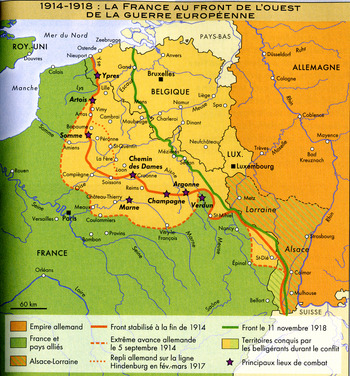
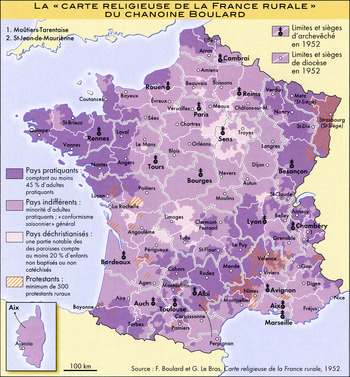
The German occupation on the Western Front involved all of Belgium's sole Archdiocese of Mechelen-Brussels plus eleven Catholic dioceses in northern France. Of the French dioceses, Cambrai, Lille (with the exception of Dunkirk), and Reims were totally occupied for almost the entire duration of the war. In contrast, Arras, Amiens, Beauvais, Châlons, Soissons, Nancy, Saint-Dié, and Verdun found themselves under partial occupation either geographically or chronologically (see maps 1 and 2).Footnote 46 The legal situation of the occupied territories was ostensibly clear-cut, insofar as the invading power had assumed responsibility for the religious care of the occupied civilian population.Footnote 47 Article 43 of the Hague Convention of 1907 declared that “The authority of the legitimate power having in fact passed into the hands of the occupant, the latter shall take all the measures in his power to restore, and ensure, as far as possible, public order and safety, while respecting, unless absolutely prevented, the laws in force in the country.” Regarding religious matters, Article 46 stated, “Family honor and rights, the lives of persons, and private property, as well as religious convictions and practice, must be respected.”Footnote 48 A diplomatic complication arose, however, because France was not directly represented in the Vatican, having severed relations with the Holy See in 1904, even before the laïcité law of the following year.Footnote 49 Bishop Thomas Heylen of the Archdiocese of Namur, Belgium, exercised ecclesiastical jurisdiction for the territories of occupied northern France with special powers delegated by the Holy See.Footnote 50 Given the symbolic importance of Belgian innocence, Cardinal Désiré Mercier of Belgium became an outspoken leader of opposition to the German occupation regime, which placed him under house arrest. The Germans considered taking more direct punitive action against him but ultimately refrained from doing so.Footnote 51
Source: Jean Boutier, Olivier Guyotjeannin, Grand Atlas de l'histoire de France, 225. © Editions Autrement, 2011.

Source: Jean Boutier, Olivier Guyotjeannin, Gillies Pécout, Grand Atlas de l'histoire de France, 258. © Editions Autrement, 2011.

Besieged by advocates seeking to advance national causes, the Holy See managed to remain fairly neutral. The Great War represented the decisive moment in which the Vatican abandoned its hostility to modernity, at least in terms of international relations. Precisely because of its loss of the Papal States during the 1870 unification of Italy, the Catholic Church became a more believable supranational actor during the Great War, a diplomatic player advocating humanitarian concerns. Benedict XV condemned the horrors of the unfolding war, which he deemed “useless slaughter,” a “tragedy of human madness,” and the “suicide of civilized Europe.” A reactionary pope could have easily lapsed into apathetic and unmoving Schadenfreude directed against industrial society. Instead, the pope devoted massive amounts of energy and resources in the pursuit of vigorous humanitarian initiatives, especially caring for prisoners of war and displaced persons. In the long term, such measures helped to acclimate foreign powers to the idea that the Holy See was a more impartial advocate of humanitarian interests, as opposed to advancing its own political agenda as it unabashedly had done throughout the centuries. In the short term during the Great War, however, both the Central Powers and the Triple Entente held the belief that the Holy See was partial to the interests of the other side, which ironically helped to reaffirm the papacy's neutrality. The status of the occupied territories became a key point of dispute for the appeals of both sides to the Holy See. Despite desperate pleas from Catholics seeking to advance their national cause, the pope managed to remain relatively impartial.Footnote 52
Having to the serve the needs of both Catholics in the German army as well as ministering to the needs of the French civilian population, the German army faced a fundamental clerical manpower crisis in the occupied territories. Relying on nineteenth-century administrative structures that often failed to adjust to the age of mass mobilization, German Catholic chaplains, officially attached to German army units at the division level, were part of a federally fragmented army bureaucracy that often failed to provide a unified conception of military-religious requirements.Footnote 53 As the size of the armies swelled, the number of chaplains failed to keep pace. In extreme cases in some Prussian divisions, for instance, the one official Catholic chaplain, if not supplemented by more ad hoc measures, was theoretically responsible for the pastoral care for every Catholic solider in a division of around 17,000 men if the unit were at full strength.Footnote 54
In the occupied territories, French priests were in extremely short supply because the 1905 laïcité law did not exempt them from conscription. Due to France's mobilization requirements in the war's early phase, the occupied population consisted heavily of women and children as well as men who were too old to be mobilized. The few able-bodied French men who remained in the occupied territories were often sent back to Germany as forced laborers. This exacerbated prewar tendencies toward the feminization of lay piety in the nineteenth century, a fact that German Catholic chaplains often noticed. In mid-1916, for instance, Chaplain Jakob Ebner held Mass and preached in French to townspeople in Sugny, noting in his diary, “Sad! Poor France! . . . The church was filled to capacity, but the men are missing.”Footnote 55
The precise numbers of French priests in the occupied territories are difficult to ascertain due to the war's administrative confusion as well as destruction during two world wars.Footnote 56 For the foreseeable future, it will remain unlikely to distinguish between generic categories of clerics such as those who were mobilized quickly, those who fled, and those who remained during the occupation. Nevertheless, a general idea can be extrapolated from mobilization figures of the dioceses not under occupation. For example, the diocese of Lyon held the largest number of clergy and religious: 2,249 of which 1,150 were mobilized (in echelon throughout all years of the war). Of the thirty-five dioceses not under occupation at any time (with the partial exception of Besançon) represented in Fr. Frédéric Rouvier's postwar survey, most dioceses were considerably smaller, averaging around 700 clerics each. Of these dioceses, mobilization rates of the total number of clerics ranged from around thirty to fifty percent.Footnote 57 Furthermore, a postwar assessment of casualties and mobilization gives some idea of the magnitude of both French clerical sacrifice as well as the lack of clergy in the occupied territories: 3,101 priests and seminarians, as well as 1,517 members of religious orders died in the conflict; this represented fourteen percent of all French priests and religious mobilized. Of the almost 79,000 clergy who were mobilized worldwide, France alone provided nearly 45,000.Footnote 58 Thus, on a purely quantitative scale, French clergy remaining in the occupied territories were comparatively few. Coupled with the escalating size of the German army, the Catholic Church in the occupied territories of the Western Front faced a severe manpower crisis of clerical resources.
Regarding the historical character of the occupation, there is now a well-documented scholarly consensus: the German military administration of Belgium and northern France was brutal and coercive in its design and application.Footnote 59 John Horne and Alan Kramer have recently given systematic empirical foundation to the widespread reports of German wartime atrocities. In the war's opening phases, largely deluded by the specter of franc-tireurs partisans from the Franco-Prussian War of 1870–1871, the German army committed atrocities against civilians in Belgium and northern France by shooting around 6,500 innocent civilians as collective reprisals against imagined snipers.Footnote 60 After the initial confusion of the war's opening weeks, the oppressive occupation regime enforced a code of conduct in which ordinary French citizens lived their daily lives under martial law subject to the basic requirements of the German army and the German state. During the stalemate on the Western Front, the German occupation of northern France was an attempt to exploit the material resources of one of France's most vital industrial centers, directly depriving the French war effort and strengthening the German war machine.
Although the mass killings of the invasion's initial phase were not repeated, anything that interfered with industrial exploitation incurred the full wrath of the German military state. The German authorities often suspected French priests of fomenting trouble and shot French clerics by firing squad on vague pretenses of espionage.Footnote 61 French citizens underwent severe rationing, often leading to malnourishment. French citizens were under constant suspicion by the occupying powers, and the Germans denied them freedom of movement, forcing them to display identity cards and travel permits to any German soldier who demanded to see them. Furthermore, the Germans forcibly deported French and Belgian workers to industrial sites in Germany, and German military authorities routinely commandeered French citizens to build military fortifications for German troops, a cause of no little consternation to the occupied people who were indirectly helping to kill their countrymen.Footnote 62 Finally, when the German high command initiated a strategic retreat to the defensive positions of the Hindenburg Line in 1917, the Germans conducted a brutal scorched-earth policy, poisoning wells, booby-trapping houses, and generally destroying anything of value that was left in the swathe of recovered French territory.Footnote 63
This article represents not a root-and-branch revisionist history of these previous accounts, but rather an alternative dimension with symbolic importance for the Catholic narrative of Europe over the course of the twentieth century. It is important to focus on the asymmetrical power relationship between German Catholic chaplains and their French Catholic temporary parishioners. Ultimately, German military power was sovereign, and religious life in northern France was subject to the German state's control. The surviving written documentation from French Catholics was understandably colored by the constant threat of force.Footnote 64
Within these severe constraints, however, the persistence of a cradle-to-grave caritas network of the Catholic Church continued under occupation, forming a hazy middle ground in which the ostensibly clear legal ideals of international and canon law were translated into localized practices under improvised and confusing circumstances. Were it not so neglected in the historiography, it would be a banality to state that French Catholics under occupation continued to be born, live their lives, and die as Catholic believers and members of a universal church.
For some of the most devout French Catholics, the German invasion was seen as a justly deserved divine punishment for waning faith, especially the laïcité law of 1905, but some even thought as far back as the anticlericalism of the French Revolution and the growth of secular forces in the public sphere over the course of the nineteenth century.Footnote 65 Chaplain Jakob Ebner, serving with the 1st Badisches Leibgrenadier Regiment, noted in his diary that he was greeted with tears by an old French couple in Manhoué, who offered him food and shelter. The couple proceeded to show Ebner a room full of saints' devotional portraits, declaring, “We are good Catholics. The French government earned what's coming now. They plundered the cloisters and persecuted the monks and nuns. They abandoned God, who now abandons and punishes them.”Footnote 66 Conversing with Ebner in French and Latin, a French priest complained to the chaplain about the “robbing of the churches by the French government and the alliance with the barbaric Russians,” claiming that these events “were responsible for the terrible war.”Footnote 67 After offering the chaplain a bottle of the “finest Burgundy wine,” another French priest near the town of Tincry told Ebner succinctly, “Our Lord God cannot bless hands that have broken churches. God chastens the French government through the German fist.”Footnote 68 Whether they wished for French chastisement or complete defeat, such utterances came dangerously close to confirming the “infamous rumors” (rumeurs infâmes) that French anticlericals suspected of their Catholic conationals. Especially at the outset of the war, such French sentiments were no doubt attempts to win the hearts of the invading German forces. Many such sentiments no doubt disappeared as the invasion became an oppressive occupation. In any event, such utterances help to reveal the persistence of social divisions in French society, thus modifying portrayals of the union sacrée.Footnote 69
From many of their own written accounts, German chaplains generally got along quite well with French Catholics—at least in the initial phases of the war, but often continuing deep into the war as the chaplains were the church's only recourse for providing pastoral care to the citizens of occupied France. Of course, as the German occupation wore on and daily hardships became more oppressive and seemingly endless, there are indications that such overt displays of sympathy with the invaders became more muted, sometimes turning into hostility. Yet, the supranational mission of the Catholic Church created bonds of solidarity that provided means for transcending exclusivist national superiority. Deep into the war, Louis Joseph Le Port, a French priest in the occupied territories who critically judged the German depredation, would reflect on these Catholic bonds. Le Port referred to a helpful German Jesuit chaplain as “always fraternally obliging” in the chaplain's attempts to intervene on Le Port's behalf with the German military. As late as September 1918, Le Port described his German Jesuit colleague as possessing the “true heart of an apostle.” By 1917 Le Port's Catholic background enabled him to work more closely with the unnamed military commander of the local unit, who presided over judicial proceedings against civilians. Le Port described the commander as “the son of a president of a Catholic center” and a “very great Catholic, who is a great and fine man.”Footnote 70
For French citizens under occupation, their Catholic faith provided an outlet for culture, a semi-protected space that they could use to endure the daily indignities and humiliations of occupation, expressing their values under duress—even when those values had distinctly national ascriptions such as the cult of the Sacred Heart or the devotion to Our Lady of Lourdes. One should underscore the extent to which religion provided a coping mechanism for French Catholics at a time when the opportunity for cultural expression was severely curtailed by the occupation authorities.
In keeping with the universalizing mission of the Catholic Church and the requirements of international law, German chaplains were the primary official clergy in occupied northern France, but they formed part of a larger Catholic associational network of caritas. The church tried to coordinate humanitarian care that crossed figurative and literal national boundaries, such as when the Apostolic Nunciatur of Belgium invoked the authority of the Holy See to send a French priest, Joseph Hégo, a diocesan missionary from Cambrai, on a special mission into German-held territory to minister to French prisoners of war.Footnote 71
The ambiguous existence of German Catholic chaplains' presence and their ministry can be demonstrated by the cradle-to-grave caritas network that the church claimed to offer. Although German military authority theoretically retained ultimate political sovereignty, in practice, French clergy and civilians at a local level exercised disparate, relational, and circumstantial degrees of agency in fulfilling the requirements of their Catholic faith.
Cradle
The caritas network of Catholicism began as German chaplains initiated French newborns into the rites of the Catholic Church. For instance, on November 8, 1914, chaplain Jakob Ebner of the 1st Badisches Leibgrenadierregiment baptized two French children into the faith. One of these children, Henri Pierre Jacques, the son of Jean Léon Chrochart, a soldier, and Therése Elisabeth Billon, a local woman in Villers, had been born on September 12 but had not yet been baptized in the confusion of the war's initial phase. The other child, Auguste Pauline, daughter of Jules Charaden, also currently serving in the French army, and Josefine Serrurier, his wife in Villers, had been born the previous evening. In the latter case, August Pauline Charaden's godparents were the German regimental medical officer, Dr. Vieser, and his wife, in absentia, in Germany.Footnote 72
As the German occupying troops became more of a permanent presence, Catholic chaplains also began to baptize the children of liaisons between German troops and French civilians. Of course German military regulations forbade such fraternization with enemy noncombatants, but military chaplains generally blessed the children of such unions into the Catholic faith.Footnote 73 In one such instance on July 12, 1916, Jakob Ebner baptized a child, Margarete Charlotte Mary, born on May 17, 1916, to Germaine Mary of the town of Loisy. Ebner noted in his diary that Germaine was “unmarried” and the father was a Sergeant Weber of the 50th platoon (presumably of the 1st Badisches Leibgrenadierregiment), who “was three months in the house” of Germaine Mary, living there until September 27, 1915.Footnote 74
Infant baptism could be dealt with eventually if not immediately, even by the strained and ad hoc German chaplaincy. Schooling of children, as well as religious instruction, however, presented much more of a problem. Unlike the prewar era, a regular, sustained catechism class and instruction in the sacraments was impossible for many French children under occupation who were outside of the purview of the remaining French clergy in the occupied territories. Religious instruction was sometimes improvised by chaplains but often devolved to the children's parents. For their part, German chaplains tried to make provisions for the religious education of the young, but because the religious needs of German soldiers often took precedence, this happened only when the chaplains were so inclined to spend their time with the occupied population.
On one such occasion, the mother of the town priest in Villers, who himself had gone off to war, intervened to ask the German chaplain to conduct an impromptu catechism class, in French, for the children of the village. The chaplain did so, and eventually made it a habit to pass out chocolates and medallions to the children who came to the class and progressed well with their lessons, a measure that, of course, helped to increase attendance and participation.Footnote 75 After offering Mass for the children of the village of Sugny in the Champagne region, Jakob Ebner gave religious instruction to the children of the village, inviting them afterward to confession and communion. Three girls named Helene, Lucia, and Elisabeth took him up on his offer, and he noted that “They made a good impression.” But such instruction was not always pleasant. In fact, it sometimes testified to prewar French society's neglect of religion and the war's disruption, as Ebner noted in a counterexample that three boys, ages eight, nine, and eleven, could not even pray the “Our Father,” no doubt, he surmised, because the eldest was the son of an “unbeliever.” Ebner could only comment that the situation was “Depressing. Depressing.”Footnote 76
Chaplains, however, did their best to provide religious care for the French youth. As part of the nineteenth-century culture wars, the French Republic had striven to keep clerics out of the classroom. Hence, during the Great War, some French priests, even those who strongly resisted the German occupation from the outset, found satisfaction in noting that it was the German enemy who allowed French Catholic believers a measure of religious freedom by reintroducing religious instruction and prayer in the schools.Footnote 77
Daily Life in the Middle
The caritas network continued to provide pastoral ministry for the daily requirements of most French Catholics. This often depended on the acquiescence of local German military commanders as well as the initiative of individual chaplains, thus creating an ad hoc quality of pastoral care, which was in keeping with the improvised nature of military chaplaincy. When conditions allowed, German chaplains said Mass, heard confessions, performed marriages, and provided counseling for the occupied civilians.
In carrying out these functions, many German chaplains reported excellent relationships with the remaining French clergy in the occupied territories. Jakob Ebner, for instance, reported working at hospitals with French nuns who “gladly gave everything to me whenever I asked for it” and reported discussing with the parish priest of Senones “only religious questions about the religious relationships in the archdiocese of Freiburg.” Although they may have avoided broaching the war too directly, evidently the two priests maintained an amicably conversational form of sociability, as Ebner would describe his companion as “a very worthy, smart, dear cleric.”Footnote 78
On another occasion, chaplain Ebner established a rapport with the parish priest in the town of Tincry. When the priest became ill and unable to perform Mass, Ebner substituted for him. On one such instance on October 11, 1914, Ebner, along with a Landwehr infantryman from Karlsruhe, headed to a small village church in the parish's jurisdiction to say Mass. The Landwehr man served as ministrant for the chaplain, who noted in his diary that “People came in numbers when it became known in the little village that a German military chaplain was holding church services that day.” Ebner noted that the congregation of French parishioners “communally sang the Latin Mass beautifully and worthily, but in French pronunciation.” After concluding services in the village church, Ebner headed back to his post to say a field Mass for the German troops.Footnote 79
Similarly, other German chaplains testified to the cooperative arrangements they made with French clerics to minister to the civilians. In the diocese of Nancy in October 1915, the Catholic chaplain of the 1st Bavarian Landwehr Division, Freiherr Theophil von Hansen, equally divided the pastoral care for the civilian population in the area between himself, his chaplains stationed in a field hospital (Feldlazarettgeistliche), and the French priest Jules Jacquot. Together they shared responsibility for the towns of Fuvrecourt, Réchicourt la petite, Caincourt, Hures, Vancourt, Housse, Remoncourt, Avricourt, and Amenoncourt.Footnote 80
Contrary to many home front depictions of Catholics being deprived of the opportunity to worship, some French Catholics proudly testified to the resilience with which frequent Mass attendance demonstrated active piety. Eugène Delahaye-Théry of occupied Lille kept daily notes during the war, which her son used to publish a memoir in the interwar period. In that memoir, contrary to the depictions of empty churches and no services, Delahaye-Théry wrote that in May 1915, “The church was packed,” especially on occasions when the Patriotic League organized Masses to benefit French soldiers and evacuees.Footnote 81 French Catholic believers such as Delahaye-Théry used their writings as documentation of endured suffering. Their testimony to their continuity of belief in the face of hopelessness and brutal occupation became a form of resistance to the German occupiers and a reaffirmation of their own faith.Footnote 82 Yet when examined against the grain of national-religious stereotypes, even the strongly defiant attitudes of someone such as Eugène Delahaye-Théry hint at nuanced relations of religious life in the occupied territories. Delahaye-Théry, for instance, profusely denounced the “horror” of French Catholic churches being requisitioned specifically for German Protestant services in 1915. She was silent on the issue of German Catholic requisitioning, however, indicating that German Catholic presence in the French churches was less of an outrage.Footnote 83 Though it is doubtful that she participated in combined French-German services later in the war, her description of a Christmas Mass early in 1914 indicated a more tolerant attitude toward German Catholics. In mild tones that contrasted with the normal undercurrents of outrage that she felt toward the occupiers, she noted that several German Catholic soldiers participated in the international service and “prayed respectably.”Footnote 84
Similarly interactions would continue throughout the war. After he was transferred in 1915, for instance, Jakob Ebner continued to reach out to the occupied populations of northern France. Serving in the Champagne region near Sugny and Mars-sous-Bourcq, Ebner noted in his diary that “As before, the French population was given the opportunity to come to Holy Mass and receive the Blessed Sacrament.”Footnote 85
International Services
Since Mass attendance was such a keystone of the Catholic faith, international services between French civilians and German Catholic soldiers form some of the most poignant scenes of communal Catholicism in the face of adversity. Early in the war, the General Governor of Belgium, Moritz von Bissing, outlined theoretical general rules of religious interaction for German Catholics with their enemy coreligionists. German military chaplains were responsible for ministering to the entire German army, but in cases of needing to meet religious obligations, a German soldier could make a “private visit of civilian religious services held by Belgian clergy” who could also hear the soldier's confessions and distribute communion to him. Although German clergy were obliged to minister to Belgian wounded in hospitals, von Bissing allowed Belgian patients to request that Belgian clergy minister to them. Belgians interned by the German government would receive religious ministry from both German military chaplains and captured Belgian clergy.Footnote 86 German commanders sometimes enforced strict separation by reserving time for military religion in which soldiers were kept apart from French civilians and clergy, who were consequently denied use of their churches.Footnote 87 In practice, however, interaction between German, French, and Belgian Catholics was of a much more fluid, impromptu nature that blurred national boundaries.
On one of these occasions later in the war, Polykarp Schmoll was a Minorite Friar from Munich who served as a military chaplain in the Bavarian Reserve Division. For the Easter services of April 25–26, 1916, Schmoll wrote that French civilians and German artillerists celebrated Mass together in Thumeréville, further noting in his diary that “All the church services of Holy Week were well attended; opportunity to receive the Easter sacraments was very eagerly used.”Footnote 88 Later that year, Schmoll helped to lead the Corpus Christi processions in numerous towns in his section of occupied France, including Thumeréville, Olley, St. Jean, Gussainville, Boinville, Baumont, and Villers. Although he noted that the services were primarily for the towns' inhabitants, it is likely that German Catholic soldiers participated, too. In any event, this was another case of a German Catholic priest spending his time and energy for the local population, even as German Catholic chaplaincy was suffering a severe shortage of manpower.Footnote 89 Similarly, even late into the war, the chaplain Oskar Krafft sent the Bavarian military chaplaincy a picture postcard that documented the combined participation of French civilians and German soldiers for the Corpus Christi processions of 1917.Footnote 90
The most poignant examples of a wartime transnational Catholicism during occupation were the High Masses for Christmas and Easter. In Lille, in the war's opening year, Eugène Delahaye-Théry described in her diary a Christmas Mass where “the church was packed” with French citizens and German troops, and the diarist noted that “the Germans prayed there respectfully.”Footnote 91 By Easter 1916, however, the situation in Lille was particularly depressing given the shortages of food and the forced deportation of French women and children.Footnote 92 As the occupation became more oppressive, French civilian enthusiasm for international services slackened considerably.
One of the war's most nostalgic episodes, the “Christmas truce” offers a poignant but teleological impression of religiosity between the nations in microcosm: a nostalgic return to peace and nineteenth-century sensibility that gave way to the iron logic of industrial slaughter throughout the remainder of the war.Footnote 93 In fact, developments were far from linear. The first Christmas services under occupation also showed some of the limits of transnational Catholicism during wartime: in the end, it was the German authorities who were setting the limits. Chaplain Fridolin Mayer, serving with the 28th Infantry Division noted that the 1914 Christmas Eve service showed a contrast of friendly national music styles offered to the mixed Franco-German congregation, as the German soldiers sang German hymns with full men's chorus in contrast to the vespers that evening that had been sung by solo French women's voices. Most likely, the sermon that evening to the mixed congregation focused on the peace and unity of the Christmas message. In contrast, the Christmas Day services were given separately to the soldiers and civilians, with soldiers having use of the village church first; overall the style of the Mass was much more nationalistic and chauvinistic when the populations were kept separate. Mayer noted that the sermon for the soldiers on Christmas Day was entitled “Come, let us go to Bethlehem with our German flag black-white-red” and concluded with a reading of the military order of the day, which closed with the slogan, “Our body for the fatherland until the last breath, our souls for God for all time.”Footnote 94
While revealing elements of national chauvinism, Mayer's diary also offers a glimpse of a transnational Catholicism that sometimes privileged international relations at the expense of inter-confessional bonds. For instance, Mayer noted that French priests “were more receptive to interaction with me (friendlier treatment, prior discussions [of courses of action]),” which he contrasted with the “drill-sergeant tone of my chief,” a Protestant pastor who was the commanding chaplain of Mayer's division.Footnote 95 In this regard, the case of Fridolin Mayer's Christmas services, and their transnational and confessional implications, is also instructive. It should be remembered that French civilians and the German Catholic soldiers in Mayer's unit at least shared a Christmas Eve service in 1914. Regarding this episode, Mayer notes that the Catholic and Protestant soldiers of his unit held totally separate services that year. Furthermore, when a Protestant officer approached Mayer the next year about the possibility of holding a communal Christmas service for German Catholic and Protestant soldiers, Mayer dismissed the officer's suggestion with a single word: “No.”Footnote 96
Indeed, German Catholic chaplains sometimes fought strenuously to preserve a separate Catholic religious identity within army life. Such confessional disputes even became evident to French observers, such as the priest Charles Calippe of Amiens who noted that, protesting orders from their commander, German Bavarian Catholic chaplains complained to the Cardinal of Munich about being forced to hold a single, communal religious army service with their Protestant counterparts. Even in the presence of French clergy, Calippe noticed that one Bavarian chaplain “was not always successful in hiding his disdain for Prussia and even for the Kaiser.”Footnote 97 Religion and nationhood contained entangled loyalties, and nationalism did not always win out in the end.Footnote 98 Thus, in terms of communal religious life, many Catholic believers in the German army participated in services more with enemy civilians than with German comrades-in-arms who happened to be Protestant or Jewish.
Many of the regular French diocesan priests were no longer available, either having fled the advancing German army or having been called to active duty to fight it. French parishioners in occupied areas had no other recourse than to turn to German military chaplains to fulfill religious requirements. Since autumn 1914, Jakob Ebner was responsible for the religious ministry in Villers. The departing French priest, called to serve in the army, had issued instructions to his congregation that they should confess to “whomever they wanted.” After three French children bravely came to the chaplain one morning to offer their confessions, the rest of the town began to follow suit. Eventually, the townspeople began attending Sunday military services to receive the Sacrament alongside members of the German army. Ebner noted in his diary that German songs were sung during Mass.Footnote 99 Due to Ebner's influence, Villers was fairly well accommodated with opportunities for religious participation for both German soldiers and French civilians. Ebner reported that of the 403 French Catholics in the town, “nearly all of them” attended his 1915 Easter services and took communion from him.Footnote 100
The corporate attitudes of French clergy who remained in the occupied territories largely became solidified under the heading of collective heroic resistance, in many cases regaining the civic stature that they had lost in previous decades.Footnote 101 It was precisely due to their positions of cultural authority that the remaining French priests in the rural areas of northern France roused enormous suspicion among German military leaders as possibly dangerous influences on the German troops. The largely dominant Prussian military in particular looked askance at the influence of enemy Catholic noncombatants. On April 20, 1915, at a conference in Laon of military chaplains of the German 7th Army, chaplains revealed that after the initial hesitancy from the High Command, most junior officers were finally allowing French priests to minister to German troops. Wherever possible, the officers insisted that the language of service be German. One captain, however, refused to let his troops hear Mass from a French priest on the grounds that church services with an enemy priest would lead “to a falsely understood friendship [zu einer falsch verstandenen Freundschaft].”Footnote 102 As in much religious life during the Great War, however, conditions were improvised on the ground according to necessity.
Because of the shortage of chaplains, German army officials were forced to acknowledge the need to allow French priests to minister to German troops. Abbé Charles Calippe of Amiens wrote of his ministry to combined congregations of German troops and French civilians. At one service, soldiers filled the grand nave of the church while the officers sat near the pulpit and French civilians sat in the small nave on the left. The soldiers sang the Mass parts of the Kyrie, Gloria, Credo, Sanctus, and Agnus Dei, after which Calippe declared in French translation the pope's prayer for international peace. Calippe noted that the German commander ordered him to pray for the souls of the dead soldiers as well as deliver a sermon that explicated the Gospel readings. The French priest responded by extolling the virtues of the Sacred Heart and of Our Lady of Lourdes. Far from inciting national religious hatred in the pews, Calippe's sermon instead led to a friendly disputation between him and the German soldiers, with the Catholic soldiers claiming that they prayed just as devotedly to the Sacred Heart in Munich as in Montmartre, but Calippe forced them to admit that they did not have Our Lady of Lourdes.Footnote 103 In these services, German chaplains occasionally even served in subsidiary roles as the deputies of French priests in the case of Abbé Lacorne, the parish priest of Mesnil-en-Arrouaise, who also took on extra pastoral duties in Manancourt and Etricourt.Footnote 104 In ways scarcely imaginable to high-ranking ecclesiastics in jingoistic national mindsets, German and French lower clergy in the occupied areas worked together to minister to civilians and soldiers, sometimes together as one common group.
Grave
Churches in the occupied areas often became hospitals, makeshift gathering areas for the sick and wounded.Footnote 105 French and German clergy consoled the wounded and dying at religious sites and hospitals, but clergy also made more improvised visits to individual destinations as circumstances allowed. The sacrament of Extreme Unction could only be given by an ordained priest, and Catholic believers were vitally dependent on whatever priestly manpower resources were available in local areas. In its efforts to offer believers the opportunity of eternal salvation, the Catholic caritas network continued to provide pastoral care including death and burial rites. Some of these took place in especially grim circumstances, such as executions of French citizens for espionage. Mostly, however, German chaplains continued to offer sacramental rites to French believers in circumstances that attempted to restore a sense of normality to religious life that would complete the life cycle of the believer.
German Catholic chaplains in occupied France such as Polykarp Schmoll took their interpretation of duty to include the entire life cycle of their flock. His time was often quite evenly divided between civilian and military needs, as on June 12, 1916, when Schmoll's main activity for the day consisted of two burials. The morning was spent officiating at the burial of a seventy-six-year-old Frenchwoman, Marie Payon, in St. Jean, while the afternoon saw Schmoll presiding over the funeral of a German infantryman named Vilus of the 28th Regiment, 10th Company, who drowned while bathing in the Orne.Footnote 106
For the reader of priests' accounts, the most poignant moments of transnational Catholicism are often the likely romanticized and stylized death scenes, which sound naïve and credulous to the modern reader. Some German chaplains reported that the very last words of French civilians before they died were “Thank you, Father” spoken in French and sometimes both French and German.Footnote 107 Nevertheless, one should keep in mind that to the Catholic believer, a Catholic priest was the essential figure authorized to perform sacramental rites that would assure the eternal salvation of the believer. Archival records indicate the German Catholic authorities empowered German chaplains with tools for enabling final reconciliation, such as a sheet of French translations for the sacrament of penance.Footnote 108
Even in death, however, national reconciliation could not always be achieved. Many Catholic burials in the occupied territories were separate services in which French or German priests administered the final rites to Catholics of their own nation.Footnote 109 Especially in smaller villages and rural areas, however, French civilians and German soldiers had to cope with whatever priestly resources were available. For Catholic believers in the occupied territories, the threat of dying without atonement for mortal sins was a more serious matter than national stereotypes. To fulfill the spiritual requirements of their faith, Catholic German troops and French civilians appealed to Catholic priests of whatever nationality to conduct the final rites of the faith, even if that meant supplicating oneself to a theoretical enemy.
Exultation at the End
Despite the transnational Catholic experiences that they had shared under the occupation, there was little doubt that the overwhelming majority of French Catholics were overjoyed at the German departure. After Lille was finally liberated, a huge Mass of thanksgiving was held in the church of St. Maurice on October 20, 1918, and the event became a cathartic outpouring of intertwined religious patriotic fervor. After the blessing of the Holy Sacrament, the organ played la Marseillaise, la Brabançonne, and various English hymns. In this atmosphere of “delirium,” in which she was so excited that she could not remember the contents of the sermon, Eugène Delahaye-Théry wrote, “An hour like that which I've passed is worth years of suffering. Thank you, my God!”Footnote 110
As fitting as it might be for occupation narratives, the story of transnational Catholicism did not end with the departure of German troops, however, for as the war came to a close, the cleanup and restoration process began. In addition to the physical damage done to religious sites, many French dioceses had witnessed looting and destruction of church property. Valuable items such as chalices, monstrances, and vestments were either lost or stolen during the confusion of the occupation. Even during the war itself, the Catholic Church acted as an intermediary for repatriation of peoples and property between the combatants.Footnote 111 Based on the pressure exerted by German Catholics, by 1917 the issue became a directive of the Quartermaster General of the Prussian army, who spoke directly to German Catholic chaplains:
I request German chaplains to make it their duty in their conduct with their local commanders to take care that religious paraphernalia and vestments of churches that have fallen prey to destruction should be quickly salvaged and given, with a receipt, either to a French civilian chaplain in a large staging-area locale or else delivered to the staging-area inspection so that the objects can be removed from desecration through improper usage, etc., and can be returned to their owners after the war.Footnote 112
After the war, French dioceses advanced claims to the German state for compensation for the items they had lost. As their coreligionists, German Catholics who had been in occupied France, including many military chaplains, intervened to lobby the German state on behalf of the French dioceses. In March 1919, for instance, the Archdiocese of Bamberg forwarded to the Bavarian War Ministry a request on behalf of the cities of Guise and St. Quentin for the return of “religious vestments and paraphernalia” or their monetary replacement in the amount of 2,130 marks. The items had gone missing as German troops were leaving the occupied areas in November 1918, and the Bamberg Archdiocese underscored that “We are of the opinion that the religious paraphernalia should be given back at once to the rightful owners.” If this was impossible, then Bamberg argued that the German government should cover the replacement costs.Footnote 113 Due to the devastated economic circumstances of the immediate postwar situation, however, it is unlikely that many of these requests for compensation were fulfilled by either the German government or the governments of the various German federal states.Footnote 114
Other legacies of German occupation on Catholics in occupied France and Belgium remain underexplored. Most histories of religious sentiment focus on the importance of the martyr motif of national suffering and Catholic resurgence in the interwar period.Footnote 115 On a local level, however, this becomes much more problematic regarding the issue of collaboration. The boundaries of official/unofficial persecutions remain unclear regarding French and Belgian Catholic believers who tried to fulfill their religious obligations through overenthusiastic interaction with German Catholic chaplains.Footnote 116
Nevertheless, after the guns of the Western Front fell silent, the Catholic Church provided a transnational way of reconciliation in ways unimaginable to the embittered national chauvinists, especially those from defeated Protestant Prussia.Footnote 117 During the postwar period, the influential German Jesuit journal Stimmen der Zeit accorded prominent space to the essays written by Paul Doncoeur, a French Jesuit who had served as a French army chaplain in the war and who had been severely wounded at the Somme. Doncoeur claimed that a visit to Lourdes had miraculously healed his wounds, allowing him to rejoin his regiment and participate in the final push to victory in 1918. His Catholic sensibility was not exultant in service of the winning power; he struck a chord in the German Jesuits of the losing side. In the conclusion to one of his articles published in 1922, Doncoeur emotionally wrote of the necessity of Catholicism as a force for reconciliation in a fallen world:
Despite everything that can temporarily separate us here below [on Earth], it is nevertheless a wonderful thought that there are millions of souls all over the world who strive to give honor to the same Heavenly Father. We become aware that we are brothers, born of the same blood that flowed out of the same heart at one and the same Calvary. May this feeling of the unity of all sons of the church triumph over all the obstacles that battle against love and unification. It was for them [i.e., all sons of the church] that our Savior prayed in high priestly prayer: may they be one.Footnote 118
Conclusion
In a recent article, Brad S. Gregory has perceptively written that a cultural history of religion must seek to interrogate its historical actors with the question, “What did it mean to them?”Footnote 119 This accords well with the recent ecclesiology written by the Catholic scholar Richard P. McBrien, who notes that the Catholic Church is, in the minds of believers, “not simply a religious community, institution, or movement (although it is all of these and more),” but it is also a “mystery, or sacrament . . . the corporate communal presence of the triune God in the world.”Footnote 120 Seen through these perspectives, there is much work to be done on the story of religious believers during the Great War. Historians of Catholicism have offered suggestive avenues for transnational histories of Catholicism that end in 1914 and continue the story after 1945, but during the period of the world wars, the category of the nation remains the touchstone of religious histories.Footnote 121
Contrary to the stereotypes of disillusioned modernism, the interwar period saw a resurgence of an activist Catholicism, expressed politically as well as liturgically.Footnote 122 Even at the level of party politics, Catholics in interwar Europe engaged in convoluted courses of action. Some Catholics eagerly embraced reactionary authoritarian nationalist politics.Footnote 123 Others pursued what John W. Boyer has termed a politics of “corporate modernity” that drew on the sociopolitical critique articulated by Pope Leo XIII in Rerum Novarum, avoiding the alternatives of both individualist and collectivist utopias.Footnote 124 In terms of everyday beliefs and practices, many Catholics from rural regions did not magically transform into avant-garde nihilists once bullets started flying in 1914. Rather, Catholic believers strove to understand and live the Great War in terms of their traditional worldviews, adapted to local particularities of place. Only after the social upheavals of World War II, not World War I, did many European Catholics adapt to patterns of religious observance more in line with trends associated with the disputed secularization thesis.Footnote 125
This article has focused on many developments in occupied France to offer new perspectives on the French-German meta-narrative of the twentieth century. The implacable national opposition of France and Germany during the wars from 1870–1945, and the countries' subsequent reconciliation that provided the support for European unification, forms a key element in a story of supranational transcendence that informs many grand narratives of Europe in the twentieth century.Footnote 126 This meta-narrative of European unification after 1945 needs to account for the disparate Catholic narratives that complicate the stories of political development in twentieth-century Europe.Footnote 127 For French, Belgian, and German Catholics in occupied territories during the Great War, the story was more complicated than standard national histories allow. There were axes of loyalty that did not always privilege the category of the nation.
This essay has shown that reconciliation, accommodation, and persistence of belief occurred amid the harsh pressures of occupation during the Great War. German military chaplains and French clerics who remained behind enemy lines struggled to cope with their pastoral responsibilities as best they could in impromptu circumstances that depended on local conditions. Often, priestly resources were simply inadequate to the task, but lay believers were desperate for any available priests. Because of the sacramental importance of the Catholic priest, French civilians and German soldiers in occupied northern France often sought out the religious pastoral care of their theoretical enemy. Bonds of Catholic solidarity helped French and German believers worship with each other more than with their own conationals who happened to be of a different religion, particularly Protestants and Jews.Footnote 128 This was not simply making a virtue of necessity. If national hatred were the overwhelming ideological motivating factor, these Catholic believers in the occupied territories could simply have declined any aid from enemy clerics. Many Catholic believers, however, did not choose to do this.
Beyond simply enduring terrible circumstances, Catholic French civilians and German soldiers exercised a degree of voluntarism, supplicating themselves to the enemy in disparate ways that formed a moral gray zone between the Manichean extremes of nationalist ideologies. At the high point of clerical nationalism in an age of total war, religion and nation did not map out into neat categories. Using Catholicism as a frame of liturgical reference, a comparison of entangled local histories during the Great War demonstrates that shared public religiosity took a variety of forms that often went above and below the level of the nation-state.
The Catholic historical legacies of World War I will continue to unfold as scholarly work attempts to go beyond the polarizing war jingoism of the national episcopates. Rooted in subnational and supranational stories that complicate the standard national histories of the Great War, the local everyday Catholic religiosity during occupation remains a story whose relevance necessitates further exploration. Born of necessity under the duress of military administration in the Great War, the experience of the occupied territories shows that even during dark times, the theory of a supranational Catholic Church had a local basis in reality.