Introduction
An overarching problem faced by biodiversity conservation programmes in natural protected areas (NPAs) is their lack of long-term viability, mostly due to insufficient recognition of the needs of people living there (Bruner et al. Reference Bruner, Gullison, Rice and da Fonseca2001, Porter-Bolland et al. Reference Porter-Bolland, Ellis, Guariguata, Ruiz-Mallén, Negrete-Yankelevich and Reyes-García2012). Prompted by this situation, in the 1980s, integrated conservation and development projects (ICDPs) emerged as a key strategy that combines biodiversity protection and socioeconomic development of people living in NPAs (Adams et al. Reference Adams, Aveling, Brockington, Dickson, Elliott, Hutton and Roe2004, Naughton-Treves et al. Reference Naughton-Treves, Holland and Brandon2005, Brockington et al. Reference Brockington, Igoe and Schmidt-Soltau2006, Roe Reference Roe2008), but their success has been unsatisfactory and their long-term operability seems unfeasible (Kremen et al. Reference Kremen, Merenlender and Murphy1994, Wells & McShane Reference Wells and McShane2004, Brooks et al. Reference Brooks, Waylen and Borgerhoff2012).
A widely supported ICDP modality consists of conservation-linked enterprises that promote biodiversity conservation through sustainable use of natural resources. These enterprises are diverse and may belong to the primary (e.g., hunting or wood extraction), secondary (handicrafts, plant propagation) or tertiary (ecotourism) economic sectors. An underlying assumption of these enterprises is that funded communities will favour the long-term maintenance of biodiversity, as their viability depends on it (Salafsky et al. Reference Salafsky, Cauley, Balachander, Cordes, Parks, Margoluis and Bhatt2001).
The theory guiding these projects highlights the complex interplay of intervening ecological, economic, social and institutional factors. Therefore, the specific approaches of projects aimed at integrating conservation and development goals can diverge considerably. For example, in defining conservation objectives, the focus may range from entire ecosystems (Gurney et al. Reference Gurney, Cinner, Ban, Pressey, Pollnac, Campbell, Tasidjawa and Setiawan2014), through ecological communities (Barrett & Arcese Reference Barrett and Arcese1995), to one or various species (Vovides et al. Reference Vovides, Pérez-Farrera and Iglesias2010). Similarly, the search for ways to encourage socioeconomic development may emphasize either monetary revenues (Bauch et al. Reference Bauch, Sills and Pattanayak2014), social capital strengthening or the improvement of the technical or administrative skills of local stakeholders (Stocking & Perkin Reference Stocking and Perkin1992).
The theoretical flexibility of ICDPs to link conservation with development is often confusing and hinders their systematic evaluation (Margoluis & Salafsky Reference Margoluis and Salafsky1998). For example, many projects have improved local economies, but have failed to maintain biodiversity (Orozco-Quintero & Davidson-Hunt Reference Orozco-Quintero and Davidson-Hunt2010). Conversely, natural resources management may be ecologically viable but profitless (McShane et al. Reference McShane, Hirsch, Trung, Songorwa, Kinzig, Monteferri and Mutekanga2011). Consequently, numerous projects worldwide have either stopped functioning or face multiple challenges to survive, as they cannot accomplish their objectives simultaneously (Newmark & Hough Reference Newmark and Hough2000, Wells et al. Reference Wells, McShane, Dublin, O’Connor, Redford, Wells and McShane2004).
The goal of fostering people’s well-being in Mexican NPAs was included in the biodiversity conservation paradigm c. 1990 (Melo Gallegos Reference Melo Gallegos2002). Thenceforth, important investments were made in ICDPs by international and national agencies. Despite the millions of dollars allocated so far to these programmes, their success is difficult to assess, mostly due to the lack of standardized evaluation procedures (Garnett et al. Reference Garnett, Sayer and du Toit2007).
Community nurseries in Mexico that propagate native species represent a much-favoured type of conservation-linked enterprise, mirroring trends observed elsewhere in the tropics (Jagawat & Verma Reference Jagawat and Verma1989, Böhringer et al. Reference Böhringer, Ayuk, Katanga and Ruvuga2003, Botha et al. Reference Botha, Witkowski and Cock2006). Native species propagation potentially increases the sustainability of poor smallholder farms, as these species can restore soil fertility and ecological functions; thus, they are currently used to rehabilitate farming and cattle production lands (Murgueitio et al. Reference Murgueitio, Calle, Uribe, Calle and Solorio2011, Leakey Reference Leakey2018). Ideally, community nurseries should accomplish at least two of the following goals (Shanks & Carter Reference Shanks and Carter1994, Böhringer & Ayuk Reference Böhringer and Ayuk2003): (1) to propagate native species, preferably threatened taxa; (2) to propagate species traditionally extracted from NPAs; (3) to propagate useful species for restoration/reforestation; (4) to develop people’s skills for plant propagation, business administration, interinstitutional cooperation or environmental education; (5) to generate profits from plant commercialization; and (6) to create permanent or temporary jobs.
Despite existing frameworks to assess ICDP success through qualitative or quantitative indicators (Kremen et al. Reference Kremen, Merenlender and Murphy1994, Waylen et al. Reference Waylen, Fischer, McGowan, Thirgood and Milner-Gulland2009, Mistry et al. Reference Mistry, Berardi, Simpon, Davis and Haynes2010), community nursery viability still lacks formal examination. In addition to the lack of institutional evaluation frameworks, available methodological proposals for community nurseries ignore specific aspects essential to their monitoring and evaluation. Given this information gap, the goals of this study were: (1) to analyse the impact of the main instrument of the Mexican Government for promoting community nurseries within NPAs; (2) to identify major challenges faced by community nursery operations through the analysis of one community nursery; and (3) to suggest a framework for systematic evaluation of community nursery viability.
Material and methods
National-scale analysis of a governmental programme’s impacts on community nurseries
To provide a national-level overview of community nurseries in Mexican NPAs, we gathered annual reports (2010–2016) of the Conservation Program for Sustainable Development (PROCODES), the main official initiative promoting community nurseries in Mexico. This programme was created in 2001 to finance communities working in four broadly defined conservation-related areas, namely community projects, training, technical studies and responses to environmental contingencies (CONEVAL 2013). PROCODES evaluation indicators focus on the program’s performance rather than on its accomplishments; thus, the information provided for each project is limited to its geographical location, project classification, resources granted and number of beneficiaries (Supplementary Table S1, available online). With this information, we selected those projects explicitly including the goal of propagating plants in community nurseries. Based on propagated plant type, nurseries were classified into the following six categories: (1) forestry (mainly native species for reforestation, restoration, agroforestry or silviculture); (2) horticultural (edible species); (3) ornamental; (4) medicinal plants; (5) forage; and (6) undefined. Some nurseries propagated more than one plant type (e.g., horticultural and ornamental), but we were always able to identify a preferred type.
Prior to the study, we knew that the gathered information would not include indicators to assess success in individual nurseries funded by PROCODES. Thus, in order to deepen our understanding of this matter, we decided to draw on the experience based on the examination of an individual nursery.
Llano de Ojo de Agua community nursery
The community nursery selected is located in Llano de Ojo de Agua (henceforth referred to as LOA; Churumuco County, Michoacán State, Mexico) and is part of a larger region known as Tierra Caliente (Hot Land). In this sparsely populated region (all settlements <5000 inhabitants), c. 40% of the population lives in extreme poverty with few basic services, poor infrastructure and scarce employment (INEGI 2010).
Tierra Caliente is a high-biodiversity region that harbours great plant species richness; many species are endemic (Rodríguez-Jiménez et al. Reference Rodríguez-Jiménez, Fernández-Nava, Arreguín-Sánchez and Rodríguez-Jiménez2005). On these grounds, the Federal Government decreed in 2007 the Zicuirán-Infiernillo Biosphere Reserve, encompassing 267 000 ha of secondary and old-growth tropical dry forest (TDF), as well as areas devoted to low-impact economic activities (CONANP 2007). The main land tenure regime is the ejido, a communal institution of collective land management and distribution among its members. This ejido comprises 2750 ha with elevations ranging from 200 to 1100 m asl. LOA has a strong internal organization, with recognized authorities and monthly assemblies; it is engaged in community projects and is receptive to initiatives promoting biodiversity conservation and the improvement of life conditions (Kieffer & Burgos Reference Kieffer and Burgos2015).
Several reasons led us to choose this case study. First, the LOA nursery shares important attributes with many other nurseries established in the TDF region of south-western Mexico, where over 450 community nurseries financed by PROCODES in the period 2010–2016 were located. Common features of these nurseries are their presence in highly marginalized rural areas mostly devoted to suboptimal agriculture and cattle raising, conducted under harsh climatic conditions (in Churumuco, mean annual temperature is 28°C and average precipitation is 650 mm/year). These nurseries often bring additional income to local people, whose experience in running small enterprises is meagre. Second, the analysis of a community nursery in a NPA context is relevant, as most PROCODES-financed projects in Mexico are linked to this conservation policy. Thirdly, the LOA objectives are decisive; they explicitly cover the ecological, economic and social domains.
To evaluate the LOA nursery operation, we performed a timeline analysis in order to capture the temporality of events, actors, relations and participation spaces involved in its functioning (Adriansen Reference Adriansen2012). The information originated in two workshops held with focal groups in which 19 nurserymen took part, facilitated by the Balsas Group for Ecosystem Study and Management (BG), a non-governmental organization (NGO) that assisted in the nursery’s establishment and operation. Four semi-structured interviews with nursery managers helped us clarify parts of the collective narrative.
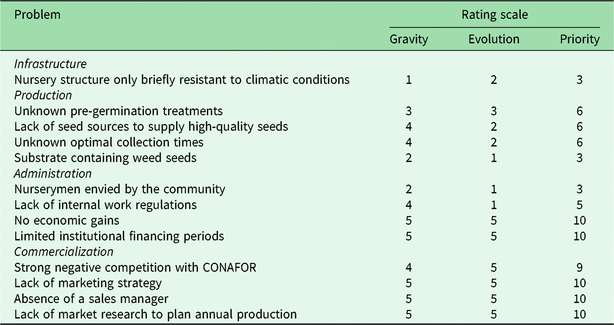
We calculated the project’s management costs for 2008, the only year for which complete information was available. This was achieved by searching the LOA archives, as well as the BG annual reports. Additional semi-structured interviews completed the information on the nursery’s incomes and expenses. Finally, to identify the nursery’s strengths, weaknesses and accomplishments, we conducted one more workshop with 12 nurserymen, who shared their perceptions regarding four operational areas: infrastructure, production, administration and commercialization. Participatory observation supplemented this information. For this analysis, we used ordinal scales to assess the problem’s gravity (0 = insignificant, 1 = mild, 2 = moderate, 3 = grave, 4 = very grave and 5 = critical), and solvability (0 = positive, 1 = near to solution, 2 = indifferent, 3 = regular (feasible solution identified), 4 = negative (identified but unfeasible solution) and 5 = very negative (no solution in sight)). The two values so assigned to each problem were added to assess the problem’s priority (i.e., the urgency for an intervention to solve it; 0–3 = low concern, 4–7 = intermediate concern, 8–10 = serious concern).
Designing a proposal for systematic nursery viability assessment
The descriptions of all PROCODES-financed community nurseries and our in-depth experience with one of them, along with a comprehensive literature review on community nurseries, aided us in defining all possible objectives that nurseries established under an ICDP approach may pursue, regardless of their idiosyncrasies. We grouped these objectives into ecological, economic and social domains. Then, we specified the hypotheses underlying these objectives and the information needed to assess the proposed indicators in order to evaluate community nursery viability.
Results
Nationwide investment of PROCODES in community nurseries
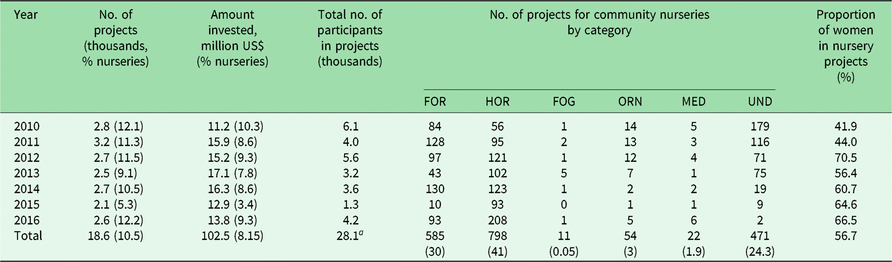
Between 2010 and 2016, PROCODES funded a total of 18 537 projects in Mexico (annual mean ± SD = 2248 ± 303; Table 1). Among the four items funded, community projects prevailed (79%) over all other projects: training on natural resource management (13%), technical studies (5%) and natural phenomena risk prevention (3%). Community projects were in turn classified into ecosystem conservation and restoration (53%) or productive (47%) projects. Community nurseries were the most frequently funded type of productive project (1946 projects), followed by ecotourism (1550), apiary (700) and soil recovery (600) projects. During this period, the proportion of nursery-related projects ranged between 5.3% and 12.2% of all PROCODES-funded projects.
Yearly investment by PROCODES (the Mexican Program for Conservation and Development) from 2010 to 2016 and its percentage allocation to community nurseries. The distribution of the investment among nursery categories and the proportion of women participating in nursery projects are also indicated.

In the ‘Total’ row, values in parentheses below the number of projects by nursery category indicate the fraction of all community nursery projects that correspond to each category.
a Since some people participated in these projects in more than 1 year, this figure may be better interpreted as human-years invested in the projects.
FOR = forestry; HOR = horticultural; FOG = forage; ORN = ornamental; MED = medicinal; UND = undefined.
PROCODES invested US$102 521 653 during the study period, with an annual mean (± SD) of US$14 645 940 ± 1 735 042. On average, the yearly budget allotted to community nursery establishment and operation was 8.2% of PROCODES investment (Table 1). A quarter of nursery projects did not specify which plants were propagated; among those that could be ascribed to one category, horticultural (41%) and forestry nurseries (30%) prevailed. Due to the impossibility of knowing how many people worked in these nurseries for more than 1 year, the sum of the yearly number of participants (28 136) represented the amount of yearly work done by them. Overall, women accounted for a slightly greater percentage than men (Table 1).
Llano de Ojo de Agua community nursery
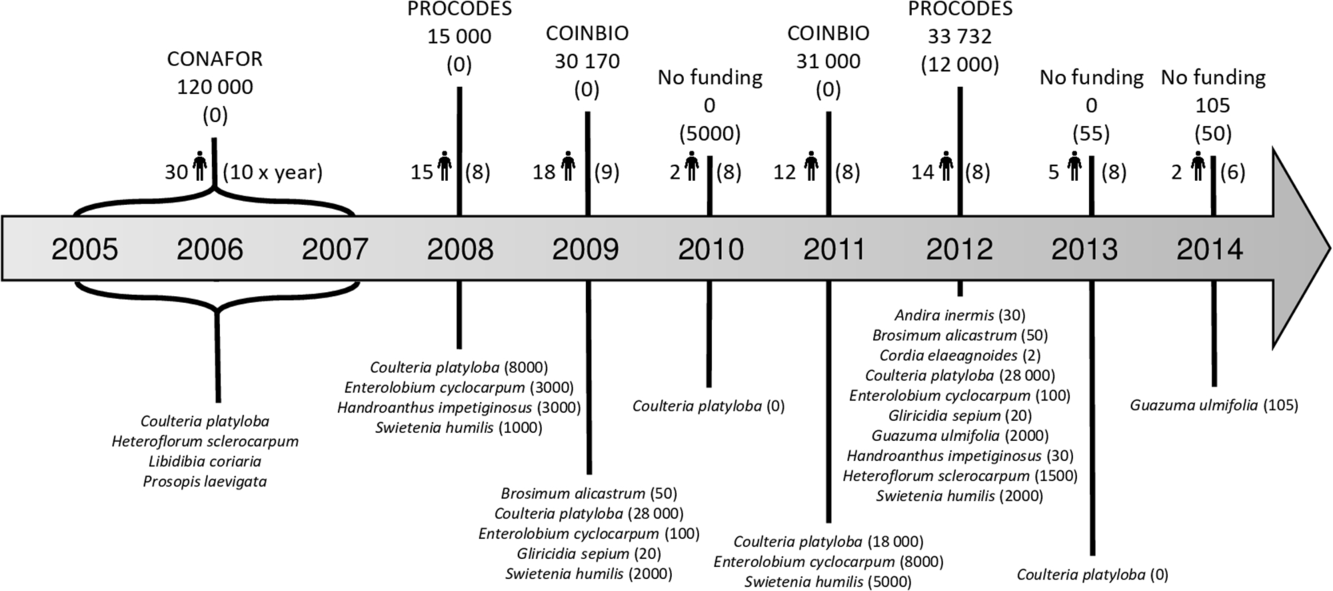
In 2003, the ejido joined the Biodiversity Conservation by Indigenous Communities Project (COINBIO), whose goal is to promote biodiversity conservation and sustainable management of natural resources (Fig. 1). Thereafter, it received support and advice from the BG. Together, they undertook several projects, one of which intended to reconvert old fields to agroforestry systems, and between 2005 and 2007, ejido members propagated 120 000 native trees in their backyards (Fig. 1), which were used to rehabilitate 106 ha of former pastures. This initial success motivated the establishment of a community nursery, the operation of which began with PROCODES funding in 2008. The nurserýs capacity was 50 000 plants per year, and it aimed to propagate native trees for reforesting degraded areas, to foster local people’s abilities in plant production, to develop business administration skills and native plant marketing and to create temporary jobs.
Timeline of the Llano de Ojo de Agua nursery (Michoacán, Mexico) for the period 2005–2014. The values below the financing programme indicate the number of plants produced and the number of plants sold (in parentheses) yearly. The values next to the person icon represent the number of jobs associated with the nursery operation and their duration (weeks). Below the timeline arrow, the species and the number of plants (in parentheses) propagated each year are listed, except for the years 2005–2007 due to unreliable information.

The nursery’s active period was during 2008–2014 (Fig. 1), for which this enterprise received US$29 111 through intermittent funding from COINBIO and PROCODES; 98 temporary jobs were created, and 110 000 plants of 11 native species were propagated, of which 12 600 (12%) were sold. Plant production was highly irregular, ranging from 33 732 in 2012 to none in 2010 and 2013, when no funding was received. With the creation of the LOA Cooperative in 2009, this enterprise acquired the capacity to deliver commercial invoices. Unfortunately, this resulted in plant sales in 2 years only (500 in 2010, representing an income of US$200, and 12 000 in 2012, with an income of US$4000). Given the nursery’s failure to obtain external financing in 2010, that year’s income was spent on wages and advertisement. In turn, the PROCODES financing for 2012 served to fund germination trials and to pay wages, leaving a profit of US$2000. Nursery managers did not invest this profit in plant production in subsequent years. Overall, during the entire nursery’s active life period, but strikingly in 2009, much of the production was lost due to the nursery’s inability to sell plants and to take proper care of them. The many plants produced in 2011 (31 000) were conveyed to a reforestation programme involving 16 ejidos. Funding ceased in 2013, but the nursery still produced some plants in 2014, after which its operation came to an end.
Based on the financial information for 2008, the production of 30 000 plants required an investment of US$7148 in basic supplies, US$7550 in jobs and US$5934 in redeemable equipment and infrastructure (Supplementary Table S2). To estimate mean cost per plant, we first calculated the annualized costs of supplies by considering their life cycles; for example, if the irrigation system cost US$669 and its life cycle was 2 years, its annualized cost was US$335. Mean cost per plant was estimated at US$0.54 by dividing the sum of all costs by the number of plants produced that year.
Problems and achievements of Llano de Ojo de Agua community nursery
Among the four areas of the nursery’s operation examined, commercialization was the most problematic, requiring urgent attention (Table 2). Lack of marketing strategies based on a clearly identified target market and its demands and the absence of a sales manager responsible for these actions resulted in no plant sales in most years. Competition with state-run nurseries emerged as a serious problem, mostly because those nurseries offered plants at lower prices (US$0.12 cheaper each).
Main problems faced by the Llano de Ojo de Agua nursery (Michoacán, Mexico). Rating scale of the problems ranges from 0 (no problem) to 10 (most severe problem).
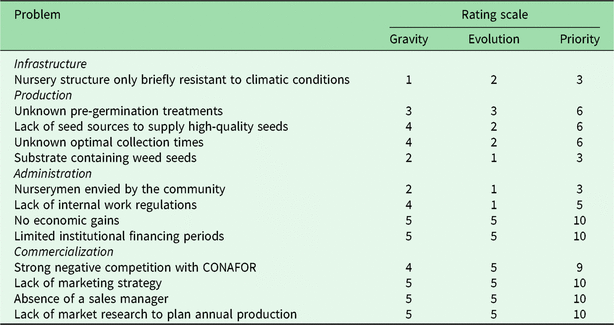
Inadequate nursery administration was another issue of concern. This was mostly due to untimely funding, which made it difficult to cover the expenses of production processes (seed collection, substrate preparation, client contacting, cleaning and pre-germination seed treatments). In addition, the lack of internal work regulations resulted in the omission of some tasks, such as plant watering or facility maintenance.
Problems directly related to plant production were also noteworthy. In particular, managers pointed to substrate inadequacy due to a large weed-seed load. In addition, lack of knowledge on pre-germination treatments for some species or on adequate sites to collect high-quality seeds was mentioned, although nursery managers thought they could gain such knowledge by themselves, provided enough funding would be allocated to this purpose. In contrast, the opinion prevailed that the nursery had good infrastructure overall, even though some improvement was possible.
Framework for systematic nursery viability assessment
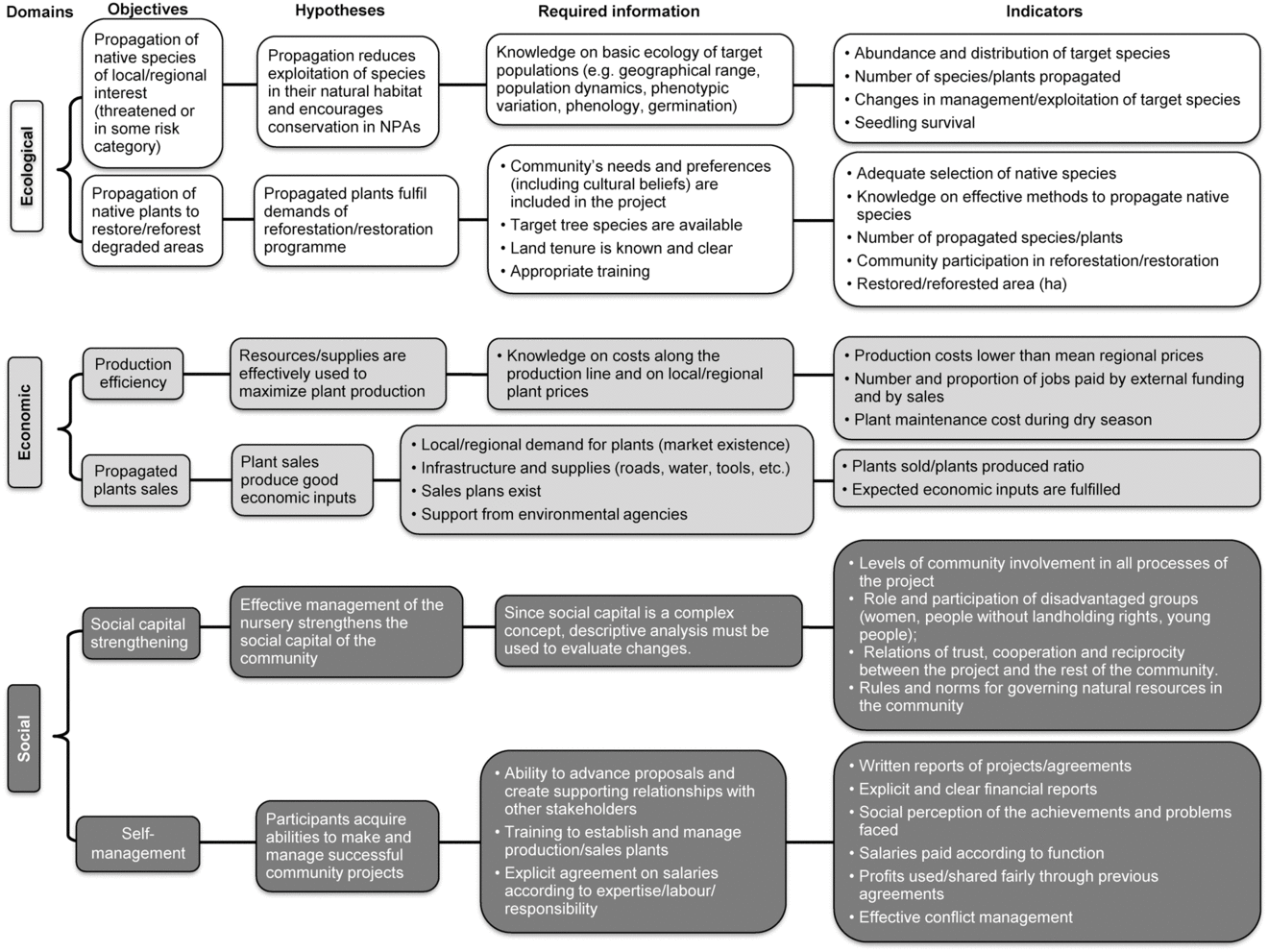
All nurseries established under an ICDP approach seek to propagate plants and encourage community development. However, as with any other ICDP project, these objectives are attainable through different means, depending on the prevailing socioeconomic, cultural and environmental conditions of each nursery. The framework that we propose (Fig. 2) encompasses all possible routes that nurseries could follow to address their particular objectives. This proposal lists specific indicators for measuring the outcomes of nurseries in the ecological, economic and social domains at an annual scale. The application of these indicators requires information that is easy to obtain, and the managers can choose those indicators that best suit their particular needs in order to analyse their effectiveness.
Methodological framework proposed for evaluating community nursery viability in the ecological, economic and social domains. Examples are given of objectives, the hypotheses underlying them, requirements to reach each objective and indicators of performance. NGO = non-governmental organization; NPA = natural protected area.

Discussion
Although community nurseries are among the best-funded Mexican ICDPs, our results highlight the uncertainty in their long-term viability in marginalized rural communities. We first discuss the efficacy and impacts of PROCODES, then we examine the challenges faced by our focal nursery to achieve its objectives. Finally, we discuss our proposed framework that may enable more fitting evaluations of community nursery viability.
PROCODES efficacy and impacts
Arguably, the design of PROCODES is innovative and aligned with new conservation paradigms, as it favours social organization and collective action while promoting biodiversity conservation. Yet, the way in which PROCODES-financed projects are evaluated is not conducive to the assessment of their viability. This may be explained by the emphasis placed on numerical descriptors of the projects, such as number of participants, area covered and proportion of the funds actually spent (CONANP 2007).
Besides the frequent absence of explicit objectives (Kapos et al. Reference Kapos, Balmford, Aveling, Bubb, Carey, Entwistle and Hopkins2008), we also found that PROCODES funded many community projects lacking the basic knowledge needed to implement them. Notwithstanding, access to PROCODES funds also has some positive effects, as it encourages new productive activities, such as the regulated trade of plants and animals previously absent in the market, ecotourism and certified organic production. Moreover, it encourages the participation of women in economic activities that traditionally exclude them. A further drawback identified in PROCODES’ operation rules is that some requirements established therein are difficult for rural communities to fulfil, ultimately limiting access to the programme. In particular, in order to be eligible for funding, communities must be able to write a formal proposal. These conditions are often not met, underscoring the need to adjust government programmes to the real conditions in target populations (Chapela-Mendoza Reference Chapela-Mendoza2013).
Viability of the focal nursery
In the ICDP context, the issue of project viability may be controversial, as it embraces ecological, economic, social and institutional dimensions, which necessarily entails unresolved conservation-development trade-offs. In the case of the LOA nursery, the participants perceived that, despite its economic unsustainability, the project brought about improvements in various community dimensions, in agreement with findings for other Mexican nurseries (Pulido & Cuevas-Cardona Reference Pulido and Cuevas-Cardona2013).
In the short period of nursery active operation, 11 species were propagated, although 70% of the production centred on a single species. The remaining species were less favoured due to insufficient seed availability, deficient knowledge on their biology and low local demand. Despite such uneven plant production, the focus on native TDF trees not propagated in other regional nurseries potentially contributed to the maintenance of the regional flora; this is relevant considering the low diversity of TDF species propagated in Mexican nurseries (Bonfil & Trejo Reference Bonfil and Trejo2010).
Although the loss of a large proportion of propagated plants restricted the nursery’s contribution to conservation/restoration, 30 000 plants produced in 2011 were routed to a reforestation campaign involving 16 ejidos and 12 000 plants produced in 2012 were sold. This alone indicates the nursery’s potential regional impact. A sound evaluation of the real contribution of community nurseries to restoration would require information on the number of plants used, the extent of restored areas and initial plant survival (Böhringer et al. Reference Böhringer, Ayuk, Katanga and Ruvuga2003). Further, making realistic production plans would require nurserymen to know how plants will be used and to consider maintenance, delivery and sales costs. This gap in institutional and community planning explains the short lifespans of many community nurseries. Despite these problems, the LOA nursery undoubtedly contributed to community environmental education and awareness. Group trips to collect seeds allowed women, children and teenagers to become acquainted with their conservation areas, which were previously unknown to them. Practical activities highlighted the relevance of knowing basic tree species biology and of keeping well-preserved areas to obtain high-quality seeds (Luna-Nieves et al. Reference Luna-Nieves, Meave, Morellato and Ibarra-Manríquez2017).
According to interviewees, the LOA nursery also fostered communal knowledge of their native species and strengthened their management and accounting abilities. They are now able to: (1) propagate nearly a dozen species with which they had no previous experience; (2) identify ways to improve nursery operation; (3) recover information produced in each production cycle and communicate it clearly; (4) create and maintain social networks with external stakeholders (academia, NGOs); and (5) benefit from experience indirectly related to the nursery’s administration (e.g., signing agreements with other communities, purchasing products from distant places to reduce costs and managing bank accounts). A further achievement declared by nurserymen was an infrastructure capable of producing thousands of plants annually.
Although not every nursery established under ICDPs realizes profits, LOA did briefly do so, but it failed to become independent of external funding. In the nurserymen’s view, this failure largely resulted from their inability to run an enterprise, although poor timing of funding also played an important role. Overall, managers stated that longer funding cycles would encourage better sales plans. Botha et al. (Reference Botha, Witkowski and Cock2006) argued that nurseries can be self-sustaining if funded continuously for 5–10 years. Yet, funding is not the only main challenge in community nurseries such as LOA. These operations can lower production costs and improve their management skills, but they will never be economically viable if undercut by state-subsidized nurseries. Therefore, it is imperative that public policies are coordinated and aligned towards common objectives (e.g., conservation and socioeconomic development of people in high-biodiversity regions).
A proposal for systematic nursery viability assessment
A proper evaluation framework for performing the systematic analysis of community nursery viability (and that of other ICDPs) would enable agencies to detect operational problems and to search for solutions; moreover, it would allow for more effective resource management. These evaluations should consider at least three conditions (McShane et al. Reference McShane, Hirsch, Trung, Songorwa, Kinzig, Monteferri and Mutekanga2011; Agol et al. Reference Agol, Latawiec and Strassburg2014): (1) projects should have clear objectives, specifying the temporal and spatial scales for their fulfilment and recognizing conservation/development trade-offs; (2) there should be clear and easy-to-measure indicators of the effects of actions on these objectives; and (3) basic ecological, social and economic information for the selected indicators should exist. Our proposed framework fulfils these conditions.
For example, the ecological goal of the LOA nursery was to propagate native species in order to restore degraded areas, assuming that these plants would meet the demands of restoration programmes. An essential condition to accomplish this objective was community knowledge on these species’ biology and training to propagate them. In turn, the indicator to evaluate this objective could be the number of species/plants produced and/or the size of the restored area.
Regarding the economic domain, production efficiency and ability to place plant production in the market are key objectives, both of which rest on the assumption that participants are knowledgeable of costs and regional plant prices and of local and regional demands (market existence). This knowledge would increase production efficiency and economic profit. Potential economic indicators are the number of plants sold, the sales income/production costs ratio and the number of jobs paid for by sales or external funding. In the case of nurseries operating in TDF regions, climatic seasonality must be considered, as the costs of caring for the plants increases during the lengthy dry season.
Within the social domain, it would be desirable to strengthen the social capital, such as through increasing community involvement and the participation of disadvantaged groups. However, since this complex concept is unlikely to be represented by any single measure or figure, qualitative analysis must be used for evaluating changes, in addition to the specific indicators (Claridge Reference Claridge2004). Emphasis should also be given to the examination of gender-based dimensions, such as the income gap, differential control over resources or voice and influence in decision-making (Manfre & Rubin Reference Manfre and Rubin2012). Nurseries should foster self-management in such a way that all participants are able to make proposals, as well as to make production and sales plans. Indicators can be obtained from project reports or from exploring the social perceptions among participants on problems and achievements, as we did in the case of LOA.
Conclusion
Community nurseries established under an ICDP approach may function, but not necessarily in the way they were originally envisioned. After operating for over 40 years, it is now urgent to make sound assessments of their ability to promote biodiversity conservation and rural development in NPAs. Their underlying assumptions must be reviewed, and ecological, economic and social information must be gathered and analysed in order to develop clear and simple performance indicators. The trade-offs between biodiversity conservation and socioeconomic development in implementing ICDPs must be recognized. Sustainable management of natural resources implies continuous self-correction and improvement, so the adaptive management approach (Folke et al. Reference Folke, Carpenter, Elmqvist, Gunderson, Holling and Walker2002) should be adopted in order to adequately respond to the intrinsic complexity of socioecological systems. To achieve positive results with their implementation, it must be recognized that no single social actor (communities, government institutions, NGOs, academia) possesses all of the abilities required to become engaged in the processes involved in ICDP development. Encouraging synergies to support the genuine interest of communities to diversify productive activities and to find a balance between biodiversity conservation and rural development is essential.
Supplementary material
To view supplementary material for this article, please visit https://doi.org/10.1017/S0376892919000201
Acknowledgements
The Grupo Balsas para el Estudio y Manejo de Ecosistemas A.C. kindly provided information on nursery administration. Lorenzo Sánchez and Misael Rojas assisted in various stages of the study, and the Llano de Ojo de Agua ejido participated enthusiastically in it. Marco Antonio Romero assisted with figure preparation.
Financial support
The senior author thanks the Graduate Program in Biological Sciences of the Universidad Nacional Autónoma de México and the National Council of Science and Technology (CONACYT) for a doctoral scholarship.
Conflict of interest
None.
Ethical standards
The authors obtained express permission from the people to conduct the study and respected their privacy.