In the autumn of 1873, Hermann Laroche, a prominent music critic in St Petersburg, began to serialize his five-part essay entitled ‘Russian Musical Composition of our Days’.Footnote 1 Although Laroche’s focus was on recently published works by Russian composers, he acknowledged that his ultimate goal was to provide a panoptic perspective on developments in Russian music since the death of Mikhail Glinka in 1857. Among the subjects of this survey was Alexander Dargomyzhsky, nowadays remembered almost exclusively for his final opera, The Stone Guest, in which he abandoned traditional number forms in favour of through-composed melodic declamation.Footnote 2 Laroche had valued The Stone Guest highly when he reviewed it in 1871,Footnote 3 but now, two years later, he focused almost exclusively on Dargomyzhsky’s three orchestral fantasias on folk themes – Baba-Yaga (1862), the Little-Russian Kazachok (1864) and the Chukhon Fantasy (1867). Not only did he regard them as being on a par with the opera, but he even went so far as to label aspects of them ‘strokes of genius’.Footnote 4
Laroche’s effusive praise for the fantasias is a far cry from the dismissive tone with which they have typically been passed over in scholarship throughout the past century. Almost invariably, accounts of Russian orchestral music during this period lead from Glinka’s Kamarinskaya (1848) to Mily Balakirev’s two overtures on Russian themes, composed in 1859 and 1864 respectively.Footnote 5 In these accounts, Kamarinskaya functions as the seminal wellspring for the idiosyncratic variational treatment of folk themes that is now commonly associated with Russian instrumental music, while Balakirev’s overtures are typically positioned as the creative development of this idiom, subsequently perpetuated by native composers for decades to come. Dargomyzhsky’s fantasias, however, are at best mentioned as unremarkable, epigonal imitations of Glinka, of little interest even for the most specialized investigations of this repertory. For example, Richard Taruskin has described them as ‘fairly lumpish’ clones of Kamarinskaya, and concluded that ‘from the crucial point of view of craft and professionalism they can bear comparison neither with Glinka nor with Balakirev’.Footnote 6 In her Geschichte der russischen und der sowjetischen Musik, Dorothea Redepenning confined her description of the fantasias to a single sentence, characterizing them as ‘unpretentious variation cycles on folk songs and folkloristic themes’.Footnote 7 In a few instances, most notably in the writings of Gerald Abraham and Mikhail Pekelis, the verdict has been more generous, but even then, the discussion has never exceeded a handful of paragraphs.Footnote 8 In short, Dargomyzhsky’s fantasias are a footnote in the historiography of Russian music.
This modern indifference is at odds with the pervasive interest that nineteenth-century composers, critics and audiences took in the fantasias. Laroche’s acclaim from 1873 has already been mentioned, and in later years he asserted that the Chukhon Fantasy was the greatest achievement of the New Russian School (the nineteenth-century term often applied collectively to the Balakirev circle and Dargomyzhsky), rating it above any instrumental composition by Balakirev, Nikolai Rimsky-Korsakov or Alexander Borodin.Footnote 9 The members of the Balakirev circle themselves did not go quite as far as Laroche in their laudatory remarks, but César Cui nevertheless held up Dargomyzhsky’s three fantasias as ‘opening up new, previously entirely unknown artistic vistas’,Footnote 10 while Borodin touted them as worthy of extensive study and emulation.Footnote 11 Other admirers of the fantasias included Franz Brendel in Leipzig and Charles-Louis Hanssens in Brussels, as well as (apparently) large swathes of the Russian concert-going public, since the Little-Russian Kazachok and the Chukhon Fantasy were performed as frequently throughout the second half of the nineteenth century as Balakirev’s most popular overtures (see Table 1).Footnote 12 Even Tchaikovsky, who was generally ambivalent about Dargomyzhsky’s music, modelled the finale of his Second Suite (1883) after the fantasias, and gave it the subtitle ‘Imitation of Dargomyzhsky’.Footnote 13
PERFORMANCES OF SELECTED ORCHESTRAL COMPOSITIONS BY GLINKA, DARGOMYZHSKY AND BALAKIREV AT SELECTED VENUES IN ST PETERSBURG AND MOSCOW, 1859–99
Key:
FMS Free Music School, St Petersburg
PS Philharmonic Society, St Petersburg
RMS (M) Russian Musical Society, Moscow
RMS (SP) Russian Musical Society, St Petersburg
RSC Russian Symphonic Concerts, St Petersburg
| RMS (M) | RMS (SP) | FMS | RSC | PS | Total | |
| GLINKA | ||||||
| Jota aragonesa (1845) | 14 | 10 | 3 | 2 | 1 | 30 |
| Memory of a Night in Madrid (1851) | 9 | 13 | 1 | 2 | — | 25 |
| Kamarinskaya (1848) | 5 | 6 | 4 | 3 | — | 18 |
| Total | 28 | 29 | 8 | 7 | 1 | 73 |
| DARGOMYZHSKY | ||||||
| Little-Russian Kazachok (1864) | 4 | 8 | 1 | — | — | 13 |
| Chukhon Fantasy (1867) | 3 | 4 | 1 | 2 | — | 10 |
| Baba-Yaga (1862) | — | — | 1 | — | — | 1 |
| Total | 7 | 12 | 3 | 2 | — | 24 |
| BALAKIREV | ||||||
| Russian Overture no. 1 (1858) | 1 | 5 | 4 | 1 | — | 11 |
| Russian Overture no. 2 (1864) | 2 | 3 | 4 | 2 | — | 11 |
| Czech Overture (1867) | 3 | 2 | 2 | — | — | 7 |
| Total | 6 | 10 | 10 | 3 | — | 29 |
The following pages are an attempt to illustrate some of the roles that Dargomyzhsky’s fantasias played for nineteenth-century audiences. All three fantasias were widely seen by Russian listeners as manifestations of a distinct expressive avenue in the development of native music – one primarily concerned with grotesque humour. Cui illustrated this point in 1870 by contrasting the fantasias with Kamarinskaya and noting, ‘Glinka is not merely funny, but always graceful and elegant, whereas Dargomyzhsky is sarcastic, deliberately cartoonish and ugly, in order to bring out the humour more vividly.’Footnote 14 The deliberately cartoonish and ugly is already on display in Baba-Yaga, where Baltic Germans are depicted as vapid and pedantic by way of mechanistic Kapellmeistermusik procedures, and with this unflattering representation further deformed through grotesque orchestrational and harmonic effects. Within a year of completing this first orchestral caricature, Dargomyzhsky hatched plans for an entire gallery of further humorous fantasias that would take as its subjects the various nationalities residing on the western border of the Russian Empire, including Poles, Ukrainians and Finns alongside the Baltic Germans of Baba-Yaga. On the one hand, this gallery of comical, exaggerated and unflattering portrayals of the chosen nationalities was an effective way of capturing the attention of domestic audiences, since the western borderlands of the Russian Empire were at the forefront of Russian popular attention in the wake of the Polish uprising of 1863. On the other hand, Dargomyzhsky repeatedly reiterated his intention that the fantasias should function as a means of achieving international recognition, and once he completed the Little-Russian Kazachok, he actually set off on a promotional tour across Europe, receiving moderate approbation in Leipzig and enjoying a wildly successful stay in Brussels. Dargomyzhsky’s international outlook coincided with his increased reliance on sophisticated compositional means for the depiction of the chosen subjects, and already in the Little-Russian Kazachok he demonstrates greater attention to formal design and tonal relationships than in the potpourri-like Baba-Yaga. It is the Chukhon Fantasy, however, completed by Dargomyzhsky two years after his return from Europe, that was widely seen as his greatest achievement in the realm of instrumental music, since it portrays the dance of drunken Finnic peasants through formal and harmonic strategies seemingly inspired by Liszt’s most ambitious orchestral works. Together, the programmatic implications of the three fantasias, their imperial context, Dargomyzhsky’s attempts to market them abroad and the compositional inventiveness of the Chukhon Fantasy all set Dargomyzhsky’s orchestral oeuvre apart from those of Glinka and Balakirev. A closer consideration of the fantasias can thus not only locate them as a crucial node in the convoluted aesthetic and cultural negotiations of Russian nineteenth-century music, but also nuance many existing assumptions about these negotiations.
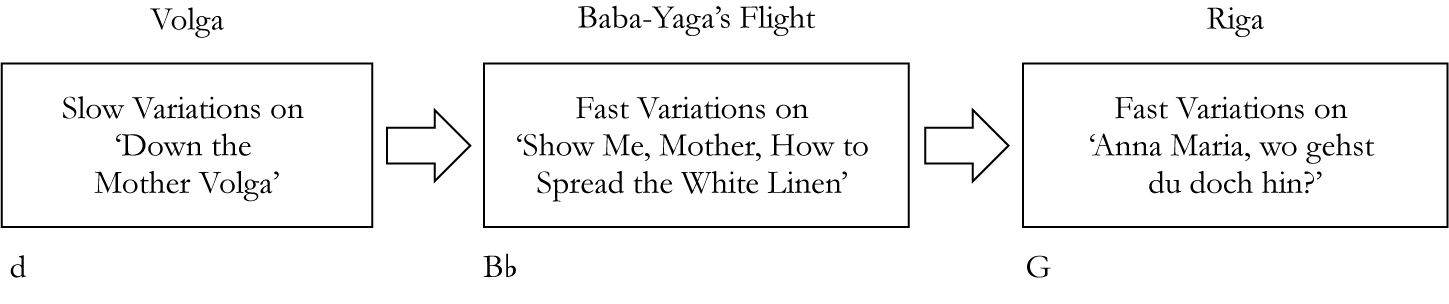
On the surface, Dargomyzhsky’s first fantasia, Baba-Yaga (1862), belongs to the travelogue potpourri genre that was popular in the nineteenth century, where a number of motivically unrelated sections marked by contrasting local colour succeed each other. In accordance with the title, the journey in the fantasia is undertaken by Baba-Yaga, a witch from Russian folklore who flies in a mortar while wielding a pestle, from her homeland to German-speaking Riga. This premiss is reflected in the overall form of the work (see Figure 1), which consists of three sections on different national melodies, consisting of two Russian ones followed by a German one.Footnote 15 What makes Baba-Yaga worthy of closer attention, notwithstanding its simple premiss, is the fashion in which Dargomyzhsky deploys this layout in order to depict a stylistic opposition that was being debated in Russian musical discourse of the time – that between Glinkian ostinato variations and Germanic motivic development. In particular, he employs ostinato variations in the Volga (Russian) section and motivic development in the Riga (German) section, while the central section, portraying the witch’s flight by means of grotesque orchestrational and harmonic effects, functions as a conduit between the two outer ones. This stylistic contrast, the disparity between the profound atmosphere of the Russian section and the banality of the German one, and the distortions inflicted upon the German theme by the witch, reflect cultural stereotypes of the time that played a major role in the ongoing construction of Russian national identity. Baba-Yaga’s unpretentious patchwork exterior thus conceals satirical commentary, recognized by Dargomyzhsky’s contemporaries, on the musical and cultural affairs of Russia in the 1860s.
Formal outline of Baba-Yaga.

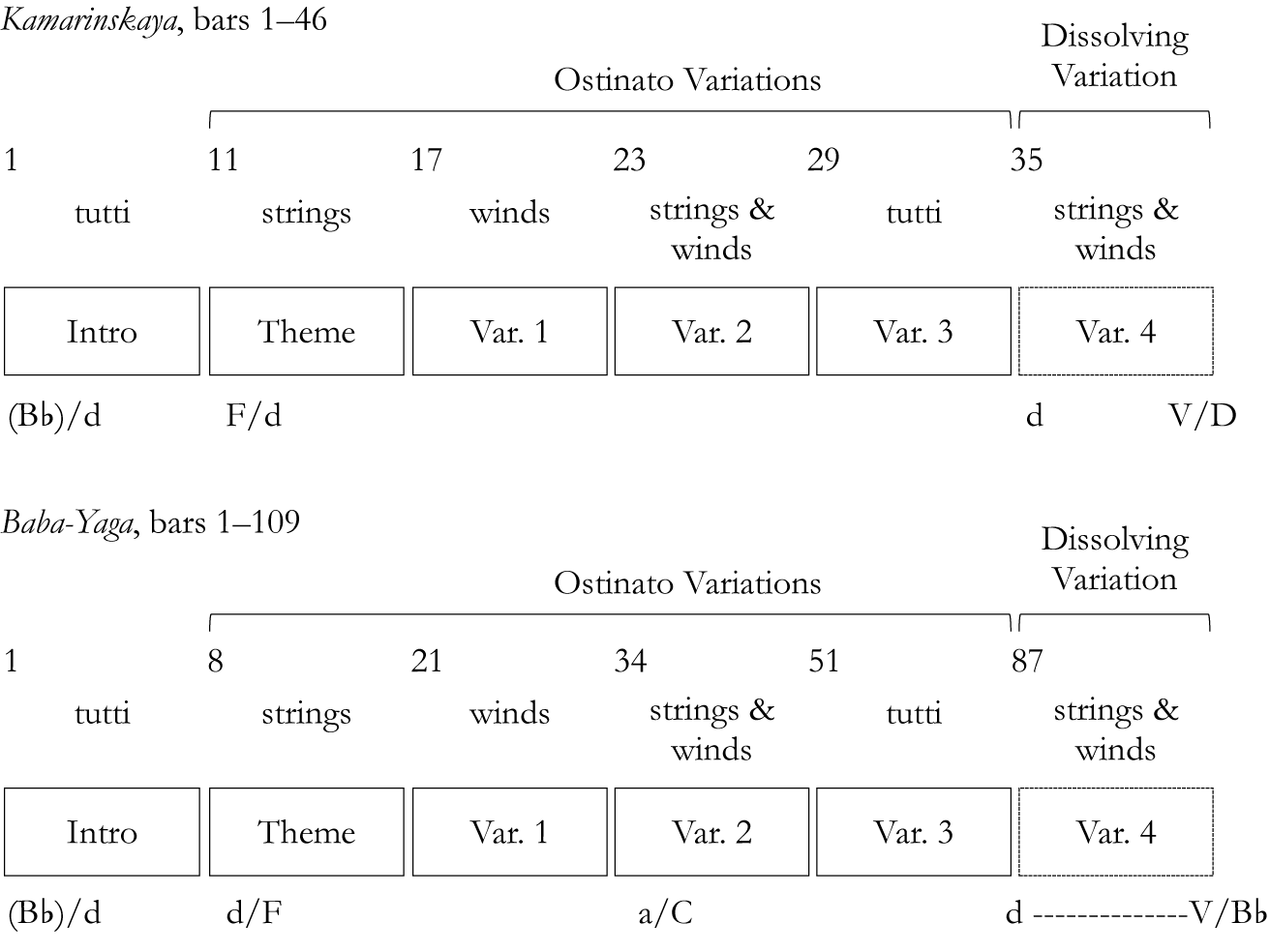
From the very first notes, Dargomyzhsky invites his listeners to associate the opening section with Russia, both through his choice of musical material and through his treatment of it. The plaintive, undulating melody throughout the section is a variant of ‘Down the Mother Volga’, a well-known tune commonly attributed to barge haulers, and Dargomyzhsky presents this melody as a chain of ostinato variations. Glinka had used this variational technique prominently in a number of works starting in the 1840s, and in subsequent decades it came to be seen by many Russian musicians as a distinctly native method of thematic treatment.Footnote 16 In contrast to conventional melodic variations (where a theme is subjected to increasing levels of melodic alteration) and to the thematic transformations of Liszt and Berlioz (where the general contour of a theme is retained while it undergoes expressive metamorphoses), the ostinato variation procedure, as used by Glinka, emphasizes melodic invariance and textural variation during thematic restatements. Already through his choice of melody and variational process, Dargomyzhsky clearly signals to his listeners the national affinity of the first section, yet he goes a step further to drive the point home by structuring the section as a close imitation of the slow introduction of Glinka’s Kamarinskaya (see Figure 2). Both fantasias commence with brief introductory gestures on B♭, and in both cases these gestures are followed by four ostinato statements of a plaintive Russian folk theme, oscillating between F major and D minor, and concluding with a final dissolving statement. Dargomyzhsky even copies Glinka’s orchestrational scheme, where the first thematic statement occurs in the strings in unison, the second in the winds, the third in the strings and winds together, the fourth as a fortissimo tutti, and the final one dissolving again in the strings and winds.
Comparison of slow openings of Kamarinskaya and Baba-Yaga.

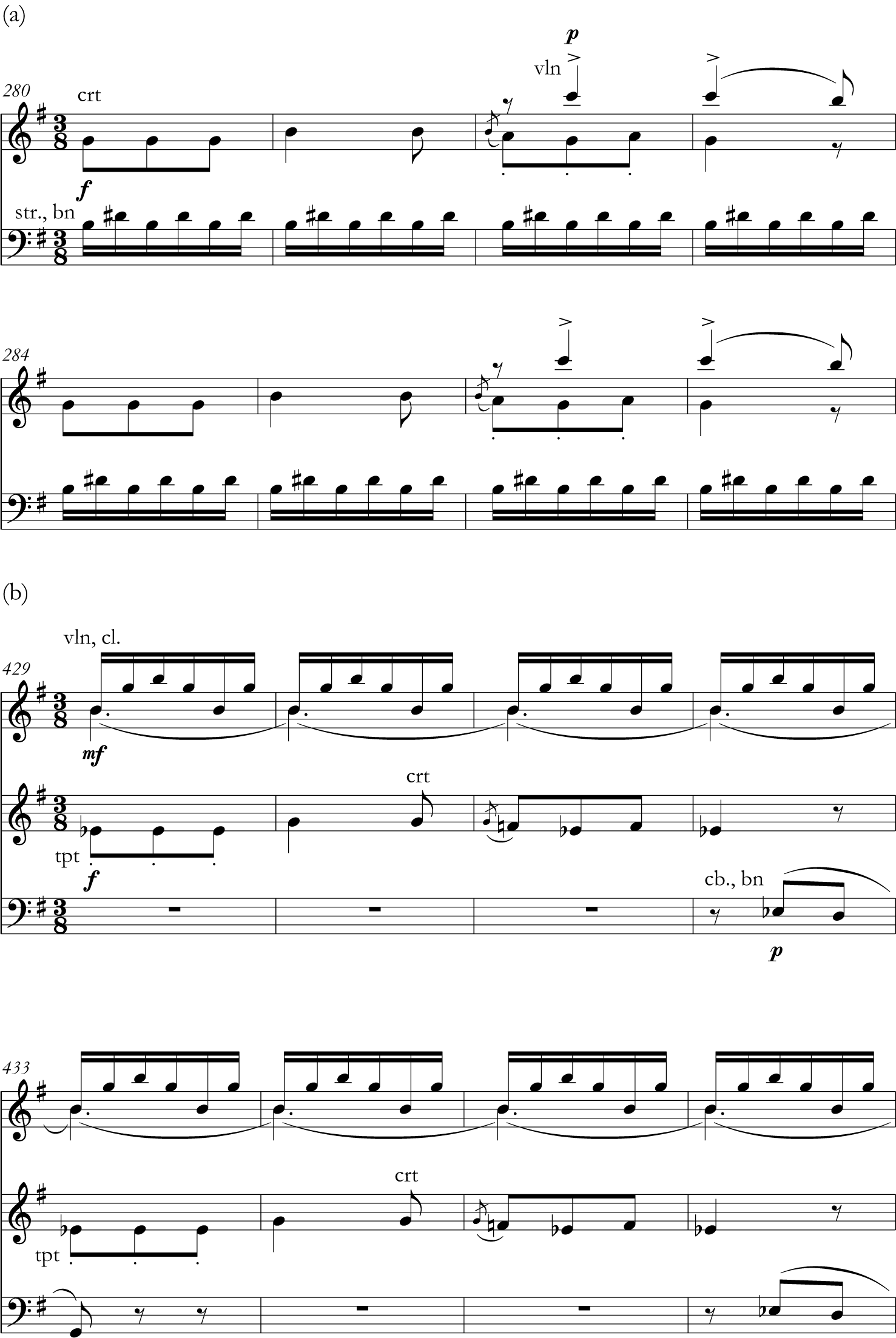
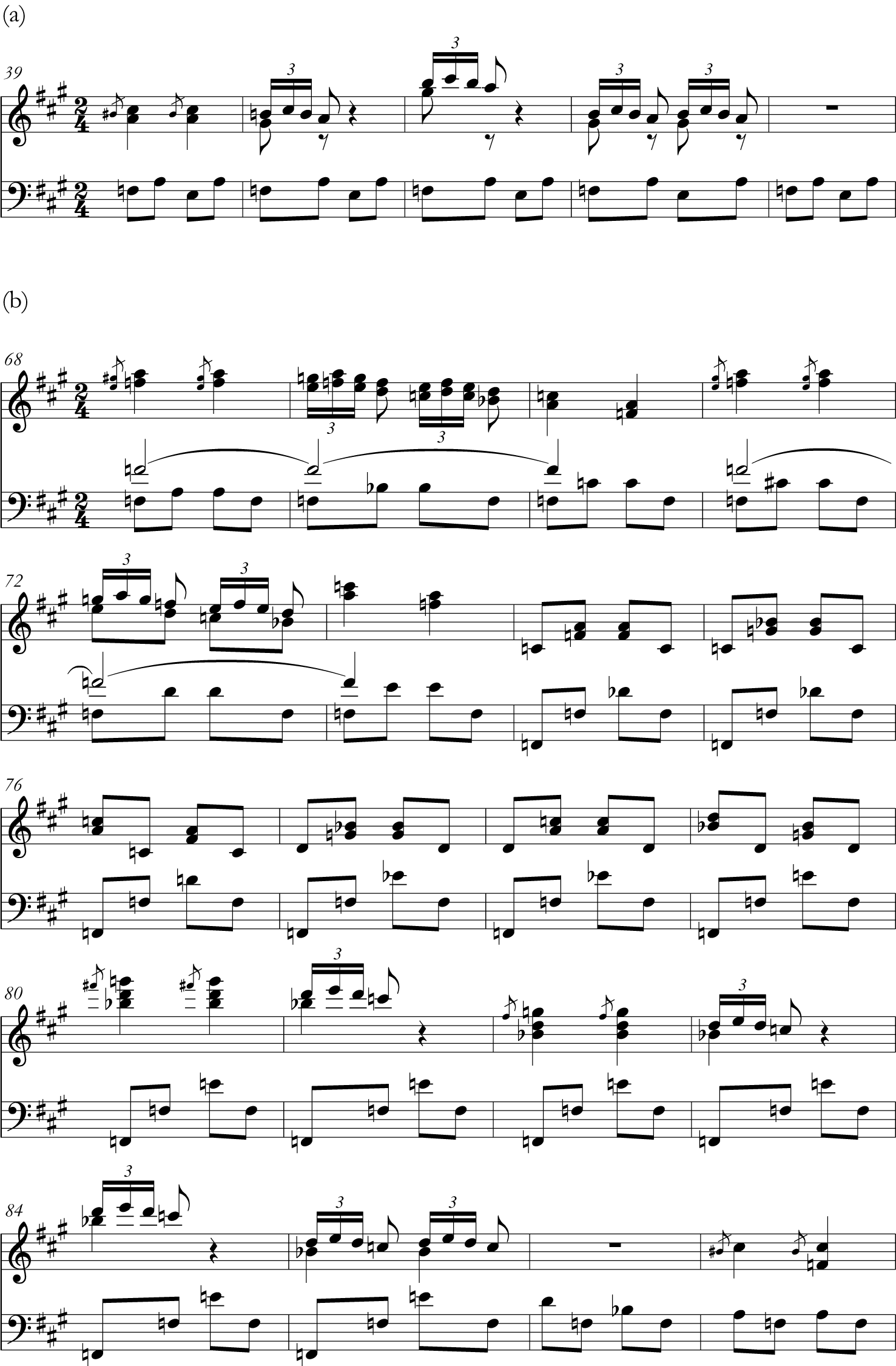
The close correspondence of the openings brings into sharp relief Baba-Yaga’s subsequent deviations from its prototype, the first significant example of which occurs during the final dissolving statement of the first theme.Footnote 17 In Kamarinskaya, this statement is an undistinguished transition to ostinato variations on a different fast theme, followed by a second rotation of the same material in a slow–fast layout. Instead, in Baba-Yaga, Dargomyzhsky uses the corresponding transition to introduce the witch, who derails Glinka’s structural layout and launches the fantasia on a trajectory away from the opening theme, both geographically and stylistically.Footnote 18 During the dissolving statement of Baba-Yaga, the first theme appears, to cite Cui, ‘in mutilated form, with an ugly harmonization on the augmented fifth’, and then leads into the second section of the fantasia, intended to represent the flight of the witch to Riga.Footnote 19 This second section also consists of variational restatements of a Russian folk theme, but the variations are no longer of the ostinato kind, and instead entail a continuous, irregular rearrangement and sequencing of motivic fragments. Moreover, both the dissolving statement of the first section and the entire second section are decorated with orchestrational and harmonic effects that give the flight of the witch an appropriately grotesque tint.Footnote 20 Such effects include, for example, assigning the melody to staccato bassoons (described by Berlioz as the grotesque instrument par excellence),Footnote 21 and the use of hexatonic poles (frequently invoked by nineteenth-century composers to signify uncanny phenomena).Footnote 22 The most prominent colouristic technique employed by Dargomyzhsky in this section, however, is the generation of augmented triads by means of the lowered sixth or sharpened fifth scale degree in the major mode. Initially, such augmented triads are merely the fleeting result of passing and auxiliary motion (see Example 1), but as the fantasia progresses, they begin to appear as accented and sustained sonorities (see Example 2).Footnote 23 For the remainder of Baba-Yaga, augmented triads become the primary means of characterizing the witch’s presence.
Dargomyzhsky, Baba-Yaga, second section, witch theme, bars 115–18.

Dargomyzhsky, Baba-Yaga, third section: (a) bars 280–7; (b) bars 429–36.

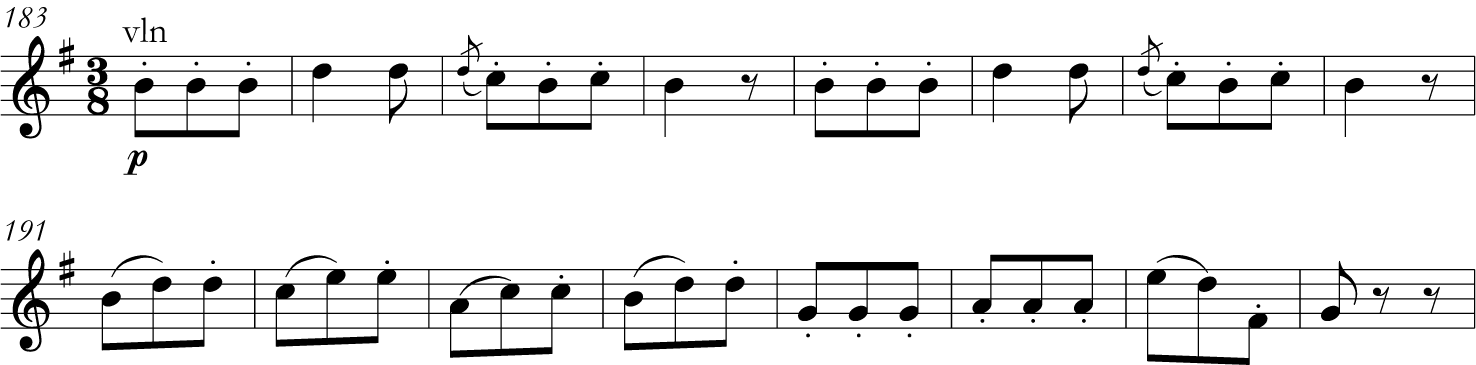
A number of pre-revolutionary commentators acknowledged the mundaneness of the German theme on which the third section is based (see Example 3). For example, Cui referred to it as ‘exceedingly banal [and] waltz-like’,Footnote 24 while Nikolai Findeizen described it as depicting the ‘peaceful land of domesticity, gossip and beer’.Footnote 25 The banality and four-squareness of the lilting German theme, particularly apparent in comparison with the sombre gravitas of the opening Russian theme, is further underscored through the techniques by means of which Dargomyzhsky develops it. The third section, like the preceding ones, is structured as a chain of variational restatements, but the variational procedures employed throughout are the very opposite of the melodic invariance in the opening Volga section. Instead, Dargomyzhsky now repeatedly extracts motivic fragments from the melody and subjects them to mechanical sequencing and circle-of-fifths progressions. This is not to say, however, that the entirety of the third section proceeds as if by clockwork. Already within a few variations it becomes apparent that the Russian witch remains present in Riga, subverting the music of the final section through her harmonic tricks. The German theme repeatedly recovers from such manipulations, but as the section proceeds they become more aggressively overt, particularly through the foregrounding of augmented triads (see again Example 2). Eventually, the witch gains the upper hand, and the fantasia concludes with her shrieks above an extended 5–♭6 oscillation that generates copious augmented triads
Dargomyzhsky, Baba-Yaga, third section, German theme, bars 183–98.

.
As a whole, Baba-Yaga then appears to be a programmatic commentary on a prominent opposition in Russian nineteenth-century musical discourse, namely the constructed distinction between Russian and German modes of musical composition. The foundations for this distinction were formulated by Glinka, who claimed in one of his letters to have discarded his ‘Taras Bulba’ Symphony because the German developmental techniques (fragmentation, sequencing, accumulative alteration of thematic material and so on) in the middle of the Allegro were incompatible with the Ukrainian character of the piece.Footnote 26 Glinka’s remark, merely pointing to a stylistic discrepancy between such developmental techniques and any characteristic folk material (Ukrainian, Spanish or otherwise), was subsequently picked up by successive generations of Russian composers and transformed into what Marina Frolova-Walker has called the ‘polemical cornerstone of Russian musical nationalism’.Footnote 27 By the early 1860s, the search for a distinct national musical grammar, uncontaminated by foreign constructions, became a major preoccupation for many Russian composers, and they found a solution to this problem in Glinka’s ostinato variation technique. Notwithstanding the fact that this technique’s connections to actual folkloric practice were rather tenuous, it was quickly mythologized as an essentially Russian method of musical composition, in opposition to Germanic motivic development. This myth was further reinforced by reference to broader discourse on Russian national identity, which frequently concerned itself with national definition vis-à-vis the West, and proceeded by exaggeratedly portraying Western virtues in such a way as to make them appear as pathological vices, which were then juxtaposed with diametrically opposite Russian virtues.Footnote 28 A popular manifestation of this argumentative strategy, prominently found in literary works such as Lev Tolstoy’s War and Peace and Ivan Goncharov’s Oblomov, was the juxtaposition of unfavourable caricatures of insipid and pedantic Germans with positive portrayals of intuitive and contemplative Russians.Footnote 29 This juxtaposition was also projected onto the distinction between Glinkian variations and Germanic motivic development, and by the time Mussorgsky got around to discussing symphonic development in a letter to Rimsky-Korsakov in 1868, he bluntly concluded his argument with the assertion that, ‘When a German thinks, he first rambles and then delivers the proof, [while] our Russian brother gets to the point straight away and then amuses himself with waffling.’Footnote 30
Baba-Yaga enacts this mythical distinction between Russian and German musical languages, along with the underlying cultural stereotypes. Dargomyzhsky thus juxtaposes the mournful boatman song of the first section, closely modelled on one of Glinka’s paradigmatic ostinato variation compositions, with the hackneyed waltz-like theme and mechanical developmental procedures of the third section. The mocking portrayal of Germany is further reinforced by the fact that the Russian witch not only flies to Riga over the course of the second section, but also infiltrates and perverts the German theme through her grotesque chromaticisms. On a hermeneutic level, such a process may suggest the emergence of Russian music as a viable alternative to the German variety, or perhaps even a Russian challenge to German musical hegemony in European instrumental music. In this sense, Baba-Yaga can be viewed as a satirical pamphlet that relies on comedy and exaggeration to comment on cultural preoccupations of the day, and this is precisely how Cui described it in his review of the posthumous première in 1870. After admiring the breadth of the Volga section, laughing at ‘the amusing flight of our witch’ and observing the banality of the Riga theme, Cui concluded, ‘Those who acknowledge the greater possibilities of musical language, and do not reject caricature in the visual arts or the satire in poetry, will be captivated by Dargomyzhsky’s boundless wit and a sarcasm worthy of Shchedrin.’Footnote 31
Dargomyzhsky’s composition of Baba-Yaga is consistent with his preoccupations during this period. Starting in the late 1850s, he was frequently engaged with satire, both as a composer of vocal sketches and as a contributor to journals, and many of his satirical creations deal explicitly with musical themes, such as the hegemony of Italian opera in St Petersburg and the obsession of the local public with Johann Strauss’s waltzes.Footnote 32 Baba-Yaga was then a logical projection of Dargomyzhsky’s preoccupations with satire into the realm of instrumental music, and within a few months of completing this first satirical fantasia he formulated plans for at least three more.Footnote 33 Just like Baba-Yaga, these projected fantasias were all intended to be humorous caricatures of other nationalities, including Poles, Ukrainians and Finns. Whereas Baba-Yaga’s satirical portrayal of stereotypical German traits was, however, primarily suitable for domestic consumption, Dargomyzhsky explicitly affirmed his desire to use the newly projected fantasias as a means of achieving artistic visibility in Western Europe. Such international aspirations on Dargomyzhsky’s part were not entirely baseless, since he had already received some attention from famous musicians on his first trip abroad in the 1840s, and since a number of Russian composers began to experience increased exposure in the West starting in the late 1850s. Dargomyzhsky’s plan to export his gallery of characteristic national portraits, moreover, mirrors the path taken by many other composers from the European cultural periphery, who relied on local colour and exoticism in order to market their music to audiences in the cultural centres. At the same time as he made plans to have his works performed abroad, however, his decision to create caricatures of nationalities on the Russian Empire’s western frontier also carried charged implications for audiences in St Petersburg and Moscow. Only a few weeks before Dargomyzhsky formulated his decision to write the new fantasias, the Polish uprising of January 1863 had unleashed a violent reprisal by the Russian government. Even before the rebels were subjugated, the imperial government began to enact – not only in Poland but also in many other western provinces – a series of forced integrative and Russifying policies, which were met with overwhelming support by the Russian public and press. The convoluted cultural implications of Dargomyzhsky’s plans for his fantasias in some ways retrace the familiar nineteenth-century dynamics of cultural periphery and centre, but they complicate this duality with an imperial twist.
The initial impetus for Dargomyzhsky’s decision to expand his portfolio of humorous orchestral fantasias appears to have been the persistent failure of his operas to establish themselves in the domestic repertory. Following the limited performance run of Esmeralda (1841) and the inability even to achieve a staging of The Triumph of Bacchus (1848), he had high hopes for Rusalka (1856); but notwithstanding the positive reception of Rusalka in artistic circles, it was performed only sporadically in the years following the première.Footnote 34 Although Dargomyzhsky began work on a number of new operatic projects in the late 1850s and early 1860s, he quickly abandoned all of them, discouraged by what he perceived to be both a lack of support from the directorate of the imperial theatres and a perversion of the tastes of domestic audiences by Italian opera. Dargomyzhsky’s frustrations, along with his plans to overcome them, are displayed in a letter to Nestor Kukol′nik of 4 February 1863:
You are asking how my music is going. How could it possibly be going, when there is so little room for it to go anywhere? From one side there is the vile despotism of the directorate, and from the other – the ignorance of the public. I decidedly gave up on the comic opera that I had begun. Now, I am writing various characteristic fantasias for orchestra. For example, a Polonaise, a Kazachok, a Russian fairy tale, a Chukhon dance and others. The novelty of these elements will, perhaps, attract some attention abroad, where I have been longing to go for a while now in my dreams. Here, I am completely suffocating! And if these works of mine also turn out to be superfluous in this world, then I will listen to them myself, amuse myself – and then off into the fire (the works, of course, not myself )!Footnote 35
Dargomyzhsky’s hypothesis that he might be able to achieve international success with a series of orchestral fantasias was not unfounded. In 1844, he had travelled across Europe and become acquainted with many prominent musicians, including Giacomo Meyerbeer in Berlin, Daniel Auber and Fromental Halévy in Paris, and François-Joseph Fétis and the clarinettist Arnold Joseph Blaes in Brussels.Footnote 36 The last two in particular took an interest in Dargomyzhsky’s compositions, and Blaes promoted them in the Brussels press, while Fétis sent an adulatory account of them to the Parisian Revue et gazette musicale. Footnote 37 The positive reception that he experienced during his trip abroad, reinforced 17 years later when Fétis restated his praise in the Biographie universelle des musiciens, accordingly would have given Dargomyzhsky the impression that he was perhaps capable of achieving more lasting international acknowledgement.Footnote 38 This sentiment would have been further reinforced by the fact that a number of Russian composers had recently achieved notable levels of European renown. There were the successes not only of Glinka, whose death in 1857 coincided with a heightened interest in his music across Europe,Footnote 39 but also of Anton Rubinstein and Vladimir Kashperov in Germany and Italy respectively.Footnote 40
Dargomyzhsky’s specific choice of characteristic fantasias on national themes as a means of realizing his international aspirations was also hardly random, since it succinctly satisfied the fetishization of exoticism that he had observed among European audiences. Already during his trip abroad in the 1840s, he had noticed the Parisian fashion for everything exotic, and reported on it in detail to his father back in St Petersburg. For example, in one letter he described the enthusiasm with which the Parisian public received a vaudeville about the adventures of a Russian serf at the royal court in St Petersburg, while in another he relayed the stunning success of the première of Félicien David’s Le désert, sarcastically noting that the muezzin’s call to prayer in the opera reminded him of the serf ’s song in the vaudeville.Footnote 41 The impression that exoticism was an effective way of capturing the interest of European audiences would have been repeatedly confirmed for Dargomyzhsky in subsequent years (for example, by the far-reaching success of Liszt’s Hungarian Rhapsodies).Footnote 42 Most significantly, though, Dargomyzhsky would undoubtedly have been aware of the international exposure that Glinka had posthumously achieved specifically with his own three fantasias on national themes. Following their publication in Germany in 1858, Glinka’s Kamarinskaya, Jota aragonesa and Memory of a Night in Madrid became the subjects of numerous positive reviews, most notably the extended discussion by Felix Draeseke in the Neue Zeitschrift für Musik in 1859, and they also began to appear on concert programmes across Europe.Footnote 43 By the time he wrote his letter to Kukol′nik in 1863, Dargomyzhsky thus had substantial evidence not only that musical exoticism was an obvious way to attract audiences across the Continent, but also that variational orchestral fantasias on national themes had a proven track record of success with such audiences.
At the same time, it was probably clear to Dargomyzhsky that Western audiences would perceive his potential musical exoticisms in a different manner from the way they would perceive the exoticisms of compositions such as David’s Le désert. If we understand exoticism as the constructed representation of otherness against which the equally constructed self can be defined, then Le désert functioned for Parisian audiences primarily as a representation of the alterity of the Orient.Footnote 44 An exotic composition by a Russian composer, however, would have been understood by such audiences as doubly exotic, functioning as a representation of otherness that is, moreover, itself created by an exotic other. This sentiment is readily on display in an article about Dargomyzhsky published in Brussels in 1844. The author of the article marvelled at the improbable existence of a real Russian composer brought up beneath the ‘icy and foggy skies by the Neva shore’, and counterfactually suggested that Dargomyzhsky’s visit to Western Europe was motivated by his failing health, brought on by the poor weather in Russia.Footnote 45 The writer next proceeded to discuss Dargomyzhsky’s music, focusing his attention on Esmeralda, which was based on Victor Hugo’s Notre-Dame de Paris, and concluded, ‘We would be very curious to hear the gitana, the fiery daughter of the south, singing and dancing with accompaniment of the orchestra, written by a youth accustomed to northern frosts and blizzards.’ As the Brussels article illustrates, for Western audiences, Dargomyzhsky’s representations of exotic others were often also representations of exotic Russia, regardless of the specific subject that he may have chosen to represent. In a familiar nineteenth-century inversion, what may have been exotic at home in St Petersburg often became understood as essentially national upon presentation abroad in Brussels, Paris or Berlin.Footnote 46
Dargomyzhsky’s specific choices of subjects for his fantasias were, however, far from a random selection of exotic locales, and instead carried substantial implications for listeners at home. All four of the proposed fantasias were to be based on national themes by subjects of the Russian Empire, including Poles (in the polonaise), Ukrainian Cossacks (in the kazachok), Baltic Germans (in Baba-Yaga) and Finns (in the Chukhon dance). By electing imperial subjects as objects of representation, Dargomyzhsky tapped into a long-standing Russian artistic tradition that concerned itself with transcultural imperial encounters and the metaphorical mapping of imperial geography.Footnote 47 In the early nineteenth century, these imperial encounters and mappings served as a formational site of national literature in the works of Pushkin and Lermontov, and they continued to occupy artists until the revolution, resulting in works such as Tolstoy’s Caucasian novellas and Vasily Vereshchagin’s depictions of Turkestan. Russian artists engaged with the imperial theme in a variety of ways, and their representations of the empire can be understood as performing different functions depending on the historical moment and the recipient’s vantage point.Footnote 48 Nevertheless, a common theme uniting many of these representations is what Katya Hokanson has described as the interplay of two sets of centre and periphery, including ‘that of Russia’s metropolitan centres vis-à-vis her distant borders, and that of Russia’s peripheral status vis-à-vis European centres of culture’.Footnote 49 On the one hand, an artwork dealing with imperial encounters could thus function not unlike David’s Le désert for Parisians, and present Russians with images of constitutive others that could then be utilized for the ongoing formation of national identity (since imperial encounters in Russian art frequently took place in the Caucasus and Central Asia, the constitutive others provided by such art were typically the orientalist complement to the occidentalist stereotypes already discussed in connection with Baba-Yaga).Footnote 50 On the other hand, artistic portrayals of imperial encounters could also function as depictions of the empire itself, painting it as a particular kind of multi-ethnic political entity, which Russian audiences could then compare and contrast with other empires.Footnote 51
Dargomyzhsky’s projected gallery of orchestral fantasias on national themes by various Russian imperial subjects appears to anticipate succinctly the different expectations of audiences at home and abroad. At home, the fantasias would have participated in discourse on Russian national and imperial identity, and while the nuances of this discourse would have been lost on most foreign listeners, these foreign listeners in turn would have been satisfied by the exoticism of the fantasias and, moreover, would have strongly associated them with Russia. This dual reception of Russian art at home and abroad has so far been presented largely as a conjecture, but it was in fact commonplace throughout the nineteenth and early twentieth centuries, and is particularly well illustrated by the reactions to the Balakirev circle’s orientalist compositions. In the domestic context, these compositions often functioned in the orientalist vein by portraying current and potential Russian imperial subjects in the Caucasus and Central Asia as languorous, seductive, feminized others, standing in implicit contrast with purposeful, enlightened and masculine Russians.Footnote 52 In some instances, the subtexts were even more explicit, such as in Borodin’s Prince Igor, which Taruskin has described as a ‘racially justified endorsement of Russia’s militaristic expansion to the east’, reflecting Russia’s imperial conquest of Central Asia, which was under way at that very moment.Footnote 53 Few of these cultural and political nuances, however, mattered to Parisian audiences in the early years of the twentieth century, when Sergei Diaghilev and his Ballets Russes conquered their attention by way of these compositions. The orientalisms that functioned for Russians as depictions of exotic subjects from the imperial borderlands were instead understood by Parisians as representations of Russia itself, to the point that Diaghilev’s subsequent attempts to introduce non-oriental fare into his concerts were perceived by these audiences as inauthentic.
The tendency of Western audiences to perceive exoticisms created by Russian composers as manifestations of Russian national identity remained remarkably constant over the course of decades (for example, Anton Rubinstein’s music was received in a similar fashion to that of the Ballets Russes when it was performed at the Paris Exposition in 1878).Footnote 54 What did change substantially depending on the author and the historical moment were the specifics of the imperial encounters depicted by Russian artists. This multiplicity of imperial representations is readily apparent when we compare Prince Igor (composed between 1869 and 1887) with another prominent essay in such representations, namely Glinka’s Ruslan and Lyudmila (composed between 1837 and 1842). It is plausible to understand Prince Igor as a glorification of Alexander II’s expansionist policies in Turkestan, but a similar interpretation of Ruslan and Lyudmila would be obviously anachronistic. Instead, as Frolova-Walker has shown, Ruslan and Lyudmila reflects a different imperial conception, which largely eschews the ethnic conflict at the core of Prince Igor, and instead foregrounds the ethnic diversity of the empire, alongside Russia’s fraternal love towards other nationalities.Footnote 55 Whereas Prince Igor revolves around the opposition of Russians and Polovtsians, Ruslan contains a multitude of nationalities that become united under Russian leadership over the course of the opera; to make this multicultural coming together as unambiguous as possible, Glinka had even intended the finale of the last act to include a series of tableaux vivants characterizing the different regions of the empire.
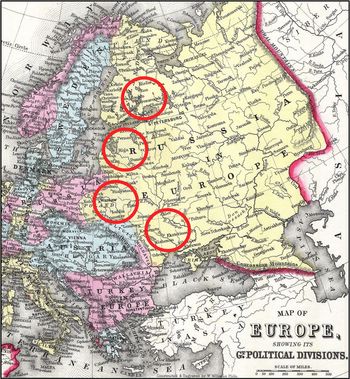
The metaphorical representations of the Russian Empire in Ruslan and Lyudmila and Prince Igor were highly dependent not only upon the personal predilections of their creators but also upon the specific historical moments in which they appeared. Whereas the harmonious coexistence of Ruslan is more representative of early nineteenth-century conceptions of the empire, the military and cultural subjugation of the borderlands presented in Prince Igor is more reflective of sentiments during Alexander II’s reign.Footnote 56 The same sort of historical specificity is also evident in the case of Dargomyzhsky’s plans for his fantasias, and is signalled most prominently by his rather unusual choice of locales for them. Most nineteenth-century Russian artists who engaged in representations of imperial subjects were primarily drawn to the pronounced alterity of the southern and eastern frontiers, most of all the Caucasus, and such alterity would also have been the most obvious way to meet foreign audiences’ demand for exoticism. Instead, the four nationalities that Dargomyzhsky chose for his planned orchestral fantasias were all on the western frontier of the empire, extending in a neat arch from the southern boundary of this frontier to its northern one (see Figure 3). At the southernmost point, close to the border with the Ottoman Empire, were the Ukrainian Cossacks, represented by the kazachok. Slightly further north, in proximity to the Austro-Hungarian Empire, were the Poles, represented by the polonaise. Yet further north, only miles away from Prussia, were the Baltic Germans, represented by the German song from Riga. Finally, close to the northernmost border of the Empire with Sweden, were the Finns, represented by the Chukhon dance.
Locations of Dargomyzhsky’s four projected fantasias, represented on Samuel Augustus Mitchell’s map of European geopolitical divisions in 1860. From Mitchell’s New General Atlas, Containing Maps of the Various Countries of the World, Plans of Cities, etc. Embraced in Forty-Seven Quarto Maps, Forming a Series of Seventy-Six Maps and Plans, together with Valuable Statistical Tables (Philadelphia, PA: S. A. Mitchell, Jr, 1860), available at <https://commons.wikimedia.org/wiki/File:1860_Mitchell_Map_of_Europe_-_Geographicus_-_Europe-m-63.jpg>.

The elegant specificity of this geographical layout, which maps the Russian Empire’s western borderlands through representations of four nationalities along this frontier, reflects one of the empire’s greatest anxieties in the 1860s.Footnote 57 In 1856, the Crimean War concluded with Russia’s loss to an alliance that included the Ottoman Empire, France and Britain, and while the military outcome of the conflict was hardly catastrophic, the loss exposed the social, economic and military backwardness of Russia compared with its Western rivals. In the years following the defeat, Alexander II turned his attention to domestic reforms, including most notably the emancipation of the serfs in 1861, while the empire’s previously active involvement in European politics was reduced to a passive role. This passive position was partially the result of the military and financial losses brought about by the war, but it also arose from the sense that the empire’s western frontier was difficult to defend, spanning hundreds of miles through territories with little developed infrastructure. As it happened, the threat to the stability of the empire did end up originating in the western borderlands, but from within, in the form of the national uprising that broke out in Poland on 10/22 January 1863. At one point, it seemed possible that Britain and France might intervene on behalf of the Polish rebels, but in the end Russia secured its western border through an alliance with Prussia, and the rebels were crushed by the middle of 1864. The failed uprising accelerated certain trends already under way in the empire’s policies on non-Russian nationalities, and resulted in the forced administrative, social and cultural integration of the western borderlands.Footnote 58 The most immediate manifestations of this forced integration, widely supported by the Russian public and press, were felt in Poland and Ukraine, where the empire openly pursued Russification starting in 1863, abolishing administrative autonomy, promoting Russian orthodoxy over Catholicism and restricting the use of local languages in favour of Russian.Footnote 59 Such extensive measures would not be applied to the Baltic provinces and Finland until the closing decades of the nineteenth century, but the necessity for forced integration of these provinces was actively promoted in the Russian press, and moderate cultural Russification began to be enacted in the Baltic region in the late 1860s.Footnote 60
Dargomyzhsky penned the letter in which he formulated his plan for the four fantasias less than a month following the commencement of the Polish revolt. There is little direct evidence regarding his views on the revolt, but his plans for the fantasias and his subsequent execution of them suggest that he probably sided with the majority opinion of the Russian public, who supported the suppression of separatist sentiments and the Russification of the western provinces.Footnote 61 Although the focus of Baba-Yaga when it was completed a few months earlier may have been on the opposition of Russian and German musical styles, following the uprising it became possible also to view this first fantasia as a convenient metaphor for the cultural inferiority specifically of Baltic Germans, and perhaps even for the projected Russification of the Baltic region that was being discussed at the time in the press. The two other fantasias that Dargomyzhsky would complete in subsequent years, namely the Little-Russian Kazachok (1864) and the Chukhon Fantasy (1867), can well be understood in a similar vein, since both portray the chosen imperial subjects by way of exaggerated negative stereotypes. Alongside the imperial implications of his fantasias, however, Dargomyzhsky also seems to have kept in mind his stated goal of using them as a means of achieving international artistic success. Like Glinka, Balakirev and countless other nineteenth-century composers from the European cultural periphery, Dargomyzhsky seems to have been aware that in order for a composer like himself to be recognized in the European cultural centres, he had to engage with the high-prestige norms of musical discourse in these centres.Footnote 62 This meant that the design of Baba-Yaga was hardly going to suffice, and accordingly Dargomyzhsky’s next two fantasias demonstrate substantial growth in terms of compositional sophistication, particularly with regard to form and harmony, and especially in the Chukhon Fantasy. It is the reliance on increasingly sophisticated compositional techniques for grotesque depictions of the chosen nationalities that constitutes the primary interest of Dargomyzhsky’s final two fantasias.
Of Dargomyzhsky’s three completed fantasias, the Little-Russian Kazachok has most often been cited as a direct imitation of Kamarinskaya. For example, Taruskin described the work as an ‘out-and-out copy of Kamarinskaya’, particularly for the fashion in which Dargomyzhsky structures the fantasia as a set of ostinato variations on a native folk tune.Footnote 63 Yet while Dargomyzhsky undeniably relies on variational techniques in the Little-Russian Kazachok, there are a number of crucial distinctions between it and Glinka’s fantasia. First, instead of the Russian themes that Glinka had used in Kamarinskaya, Dargomyzhsky employs well-known Ukrainian melodies, not easily conflatable with Russian ones, and by doing so creates one of the first major Russian compositions that engages with the Ukrainian topos. Secondly, over the course of the Little-Russian Kazachok, restatements of the main theme are continuously subjected to orchestrational and harmonic distortions unlike anything to be found in Glinka’s orchestral oeuvre, and these distortions result in the Cossack dance implied by the title growing ever more boisterous and rambunctious, thus feeding into Russian stereotypes about Ukrainian Cossacks. Finally, Dargomyzhsky in fact neither copies Kamarinskaya’s idiosyncratic bi-rotational formal layout nor relies substantially on Glinkian ostinato variation procedures, and instead structures the Little-Russian Kazachok as a series of melodic variations unfolding over the course of an idiosyncratic take on monothematic sonata form. Whereas the first two of these qualifications made the work of particular interest for domestic audiences, the third made it particularly suitable for export, and indeed, shortly after completing the fantasia in 1864, Dargomyzhsky took it with him on a promotional tour across Western Europe. Although not all the stops on this tour were successful, Dargomyzhsky’s hypothesis that he may be able to achieve international recognition with orchestral fantasias on national themes was proved correct in Brussels, and for the duration of his stay there he enjoyed the greatest public success of his career.
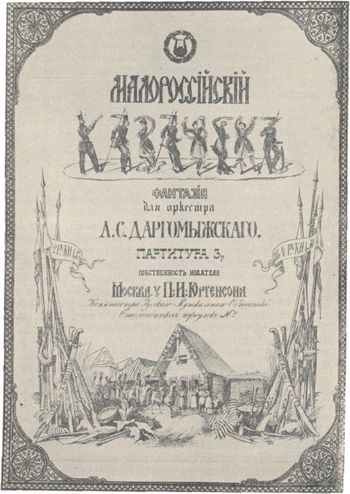
Dargomyzhsky signals the Ukrainian subject of his fantasia with little ambiguity. The title itself, Little-Russian Kazachok, refers to a dance of the Zaporozhian Cossacks (a historical semi-military community widely seen as a symbol of Ukrainian identity at the time),Footnote 64 and the fast torso of the fantasia is based on a Cossack tune that had been well known in Russia since the eighteenth century (see Example 4).Footnote 65 To make the national subject of the fantasia even more unambiguous, Jurgenson, the publisher of the first edition (1867), designed the cover as a depiction of a Cossack army going off to battle, and included on it images of scimitars and ferns that would have been entirely out of place in a typical Russian setting (see Figure 4).Footnote 66 By pursuing a characteristic musical portrayal of Ukraine, Dargomyzhsky did in some ways follow Glinka, who had attempted two such portrayals late in his life, including the opera The Bigamist as well as the programmatic ‘Taras Bulba’ Symphony, based on Nikolai Gogol’s novella that deals specifically with the lives and customs of the Zaporozhian Cossacks.Footnote 67 Yet Glinka never completed either of the projects, or even left behind any substantial sketches for them, and as a result Dargomyzhsky had no musical precedents or tropes to rely on for his portrayal of Cossacks. There were, however, ample tropes to be found in Russian literary representations of Cossacks throughout the nineteenth century, which are particularly prominent in the writings of Gogol. A concise illustration of these tropes can be found towards the conclusion of Gogol’s ‘A Glance at the Making of Little Russia’:
This society maintained all those features that are used to depict a band of bandits; but if one were to look deeper, one could see in it the embryo of a political entity, the foundation of a characteristic nation, which already at its inception had one primary goal – to wage battle with the infidels and to maintain the purity of its religion […] Everything was communal for them – their wine, their money, their dwellings. Perpetual fear, perpetual danger instilled in them a sort of contempt for life. A Cossack was more concerned about a good measure of wine than about his fate. But during raids one could observe all his flexibility, all his sharpness of mind, all his ability to take advantage of the circumstances. One had to see this inhabitant of the rapids, in his semi-Tatar, semi-Polish costume, on whom the transitional nature of the borderlands has imprinted itself so sharply, as he raced on his horse in Asiatic fashion, disappeared in the thick grass, pounced with the quickness of a tiger from his inconspicuous hideouts, or crawled suddenly out of a river or swamp, covered in slime and mud, appearing to the approaching Tatar as a kind of monster. After the raid, when this very same Cossack was celebrating and carousing with his comrades, wasting and scattering around the stolen treasures, he would be senselessly drunk and carefree until the next raid.Footnote 68
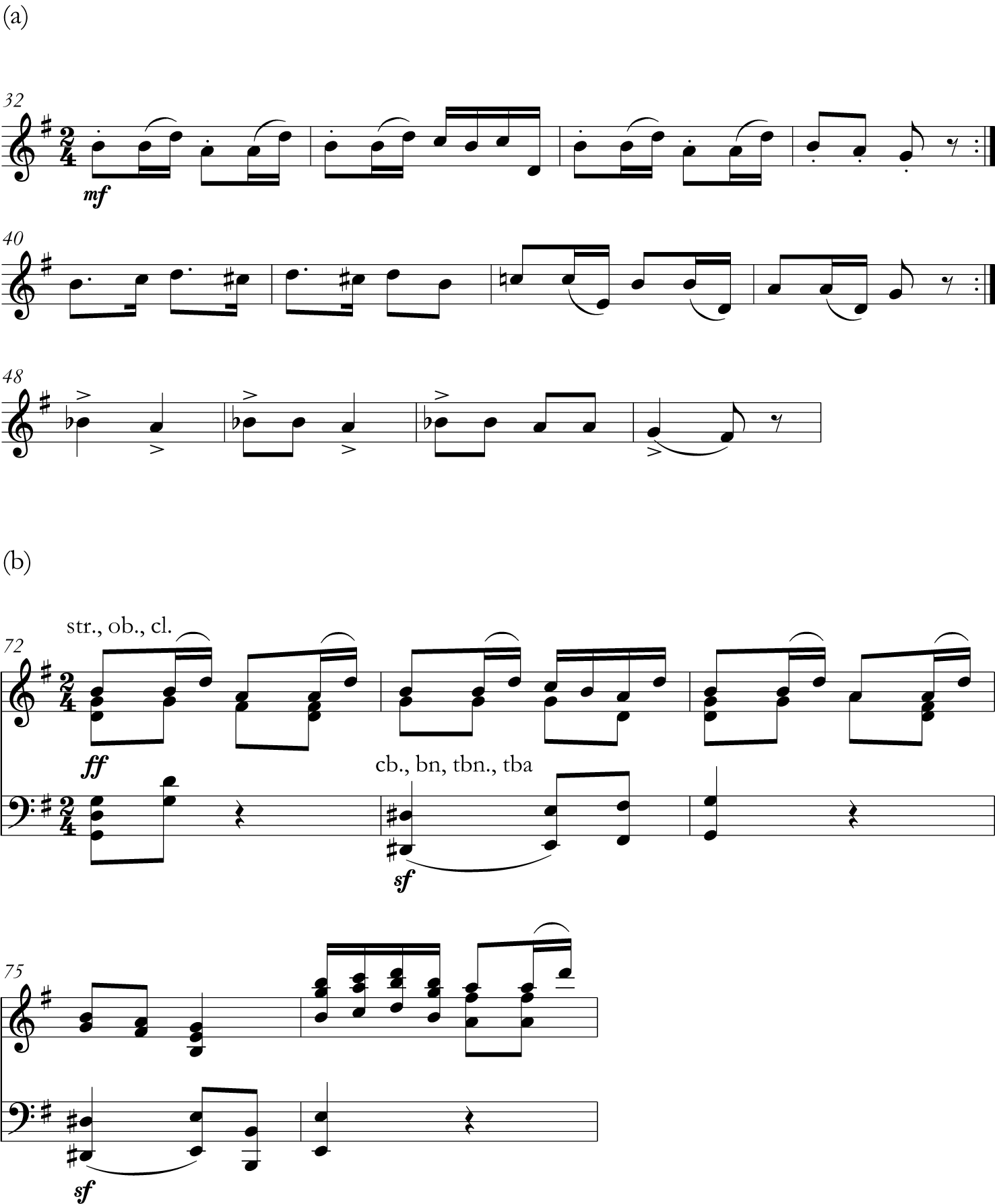
Dargomyzhsky, Little-Russian Kazachok: (a) bars 32–51; (b) bars 72–6 (adapted from Tchaikovsky’s piano transcription); (c) bars 161–76 (adapted from Tchaikovsky’s piano transcription).


Cover of the first edition of the Little-Russian Kazachok (Moscow: P. Jurgenson, 1867).

On the one hand, Gogol portrays the Cossacks as a fraternal community of brave, intelligent, freedom-loving warriors who passionately defend their land and the Orthodox faith. On the other, he shows a side of them that makes them seem akin to a group of anarchic bandits – unruly, reckless and always on the edge of descent into drunken stupor. Here and elsewhere in his writings, Gogol maintains a dialectical tension between these two sides, but other authors, less inclined to nuance and multivalency, often elected merely one of the sides depending on their artistic and ideological aims.Footnote 69
Dargomyzhsky’s portrayal of the dancing Cossacks, completed just as the Russian government was in the process of enacting a series of repressive Russifying measures in Ukraine,Footnote 70 appears to be a grotesque caricature based on the negative tropes. The main fast Cossack theme seems innocuously lighthearted at first, but becomes gradually more distorted over the course of successive variational restatements. Just as in Baba-Yaga, the distortions are frequently effected through the accented deployment of sections featuring exposed instruments employing dissonant intervals on the one hand, and the foregrounding of sustained augmented fifths and triads on the other. As Cui put it in his review of the St Petersburg première of the Little-Russian Kazachok, it has ‘many exceedingly curious harmonies, especially the augmented fifth’ – an interval that he deemed marked by a ‘painfully sharp character’.Footnote 71 These grotesque orchestrational and harmonic effects are already evident in the third statement of the theme (see Example 4b), where low brass repeatedly enter on a down-beat sforzando D♯ to form a sustained augmented triad with the upper voices, sometimes resolving to the G major tonic, sometimes to the relative minor. The progressive accumulation of such forceful timbral and harmonic effects, possibly representing the increasingly reckless swagger of the Cossacks, eventually gives way to a slower, quieter section (see Example 4c), where oscillating augmented and diminished fifths now create a feeling of dizziness and disorientation, as if the rambunctious Cossacks have finally become excessively intoxicated.Footnote 72 Subsequent restatements of the theme are accompanied by renewed rhetorical energy gain, and eventually the fantasia concludes with a boisterous fortissimo that contains, in the words of the Russian critic Alexei Suvorin, the ‘painfully irritating repetition of a dissonance in the trombones that is not resolved over the course of five or six bars’.Footnote 73
In Baba-Yaga, the orchestrational and harmonic distortions of the German theme were caused by witchcraft, but no such other-worldly catalyst can be identified in the Little-Russian Kazachok. Instead, the fortissimo dissonances and oscillating augmented fifths appear to be part of the representation of the Cossacks themselves, feeding into stereotypes of their reckless violence and rambunctiousness. Apart from this expressive distinction, however, there is an arguably more significant difference between Dargomyzhsky’s first two fantasias, which concerns the respective levels of their compositional sophistication, measured as the nineteenth century often measured it, in terms of formal complexity. Whereas Baba-Yaga was an unpretentious potpourri with few noticeable motivic and tonal connections between the sections (other than the chromatic manipulations of the witch), the Little-Russian Kazachok demonstrates a more systematic and elaborate approach to formal organization, as well as to motivic and tonal coherence. This systematic approach is already apparent in the relationship between the slow introduction and the Allegretto that follows it. Most of the characteristic harmonic effects in the Allegretto are brought about through the use of the pitches E♭ (as ♭6 of G major), A♭ (as ♭2 of G major) and B♭ (as ♭6 of D major). The special role of these pitches is foreshadowed by the unconventional tonal relationship between the introduction, set in C minor, and the Allegretto, set in G major. The three pitches that differ between the tonalities of the introduction and the Allegretto are thus precisely the ones that generate most of the dissonances throughout the Allegretto.Footnote 74
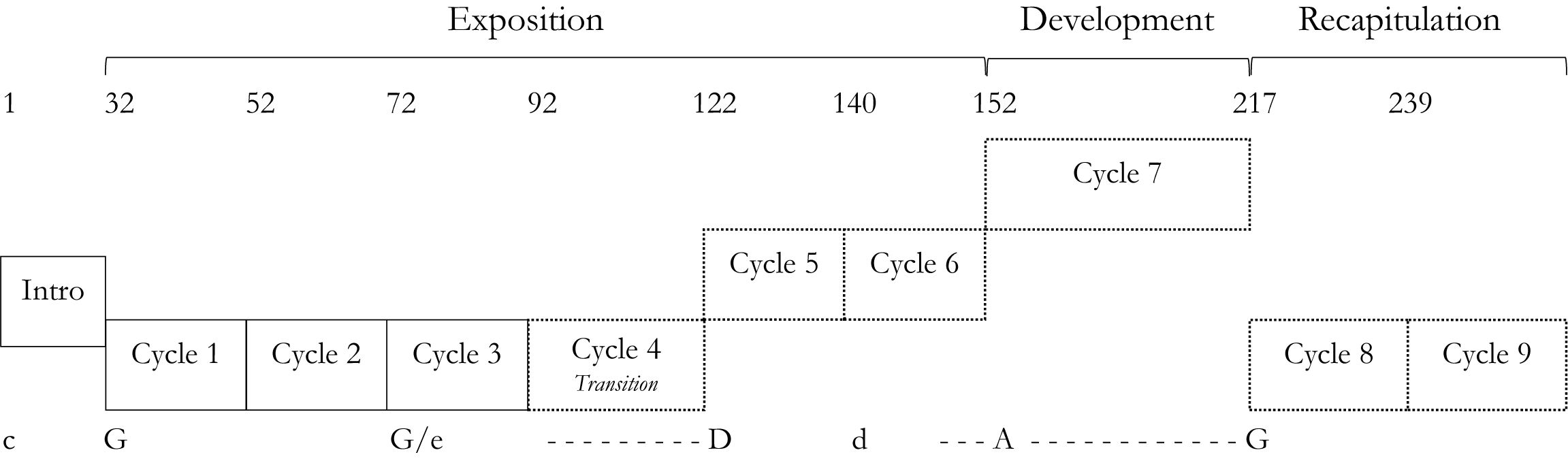
The Allegretto itself is structured in dialogue with sonata form and is based entirely on what could be approximately described as nine variational statements of the Cossack dance theme (see Figure 5). The primary thematic zone consists of the first three statements of the theme, which are firmly rooted in G major, subjected only to minor melodic modifications and varied predominantly through changes in orchestration and harmonization. Following these first three statements, which recall Glinkian ostinato variation procedures, Dargomyzhsky begins to vary the Cossack theme melodically, and the original melody never returns in its initial form for the remainder of the fantasia. At times, the theme appears in transformed guise, while in other instances Dargomyzhsky treats it in quasi-developmental fashion, extracting fragments from it and sequencing them. By varying the degree of developmental activity in restatements of the theme, Dargomyzhsky differentiates between transitional and developmental sections of the Little-Russian Kazachok on the one hand and the secondary thematic zone and recapitulation on the other. Accordingly, the fourth statement of the theme functions as an extended, tonally unstable transition that eventually sets up the dominant of the D major secondary thematic zone. The fifth thematic statement, commencing this secondary thematic zone, is in turn marked by tonal stability and a return of the melodic incipit of the original melody. This return of stability is only temporary, however, and over the course of the fifth and sixth statements the theme is dissolved through further developmental activity, leading to what could be considered the development proper in the nominal seventh statement of the theme. This multisectional development eventually concludes by way of an incongruous incomplete half-diminished seventh chord on A, and is followed by the recapitulation, which commences unambiguously in G major with the opening of the original melody, and which remains tonally stable through the conclusion of the fantasia. There is much about Dargomyzhsky’s deployment of sonata form in the Little-Russian Kazachok that is unconventional, such as the disproportionate length of the transition in the exposition and the harmonically absurd retransition from the development, but all of the normative formal zones and tonal relationships are clearly articulated throughout the fantasia.
Formal outline of the Little-Russian Kazachok. Solid boxes represent variational statements where the original melody is largely preserved, whereas boxes with a dotted outline represent looser variational and developmental treatment of the melody.

The formal design of the Little-Russian Kazachok is hardly virtuosic, but its engagement with sonata norms made it a better vehicle than Baba-Yaga for Dargomyzhsky’s international aspirations, since it demonstrated his ability to participate in the discourse norms of Germanic instrumental music. Baba-Yaga’s through-composed form was an appropriate means of eliciting some chuckles from listeners in St Petersburg, but it was less likely to earn Dargomyzhsky any accolades from audiences and particularly other musicians in Germany or France. The fact that the object of satire in Baba-Yaga was Germany also potentially made the first fantasia less palatable for German listeners. These distinctions between the Little-Russian Kazachok and Baba-Yaga help to explain the fact that Dargomyzhsky turned down an offer to have his music performed in Germany during the 1863 – 4 concert season – an offer that he received only a few months after he announced to Kukol′nik his intention to seek international recognition, and when he had not yet completed the Little-Russian Kazachok. The offer came from Yuri Arnold, a composer and critic from St Petersburg, who had recently moved to Leipzig and immediately became closely acquainted with Franz Brendel, the famous publicist of the New German School.Footnote 75 Brendel engaged Arnold to write for the Neue Zeitschrift für Musik, and Arnold’s very first essay, on recent developments in Russian opera, had featured Dargomyzhsky heavily.Footnote 76 The essay aroused some interest in Germany and helped Arnold to persuade Brendel to promise performances of Dargomyzhsky’s works, either by the Allgemeiner Deutscher Tonkünstler Verein or by the Euterpe Musikgesellschaft. Having received this promise, Arnold wrote to Dargomyzhsky and asked him to mail orchestral scores of his choosing to Leipzig at his earliest convenience. Dargomyzhsky, however, refused this offer, overtly citing his reluctance to have his works performed without his presence, but undoubtedly also aware that a potpourri mocking German ways was unlikely to earn him the recognition from German audiences that he desired.Footnote 77
In the autumn of 1864, with the Little-Russian Kazachok now completed, Dargomyzhsky received another invitation from Arnold, who insisted that Dargomyzhsky should bring his compositions to Leipzig himself. Doing so, Arnold emphasized, would allow Dargomyzhsky not only to attend performances of his own works, but also to ‘make a name for [himself] in Europe, in order to gain stature in the eyes of the Russian “musical bureaucracy”’.Footnote 78 This time, Dargomyzhsky responded affirmatively to Arnold’s invitation, writing back on 5 October 1864 with a promise to make the trip to Saxony and asking him to ‘pass on a generous, artistic handshake to Mr Brendel, whom I have already heard much about and whom I deeply respect’.Footnote 79 Within less than a month, he departed for Leipzig with a chest of musical manuscripts that included not only the Little-Russian Kazachok but also Rusalka and a number of romances. On his way to Leipzig he briefly stopped in Warsaw, which was still agitated from the recent revolt, and reported in his letters home about the military presence and his accommodations at the quarters of the Volynsk Regiment (which had been engaged in battle with the rebels only months earlier).Footnote 80 Following another stop in Berlin, Dargomyzhsky arrived in Leipzig on 13 November 1864, and was soon introduced to Brendel, for whom he played his compositions on the piano during a private meeting.Footnote 81 Brendel was sufficiently impressed by the Little-Russian Kazachok and excerpts from Rusalka that he asked for their orchestral scores so that they could be performed by the Allgemeiner Deutscher Tonkünstler Verein. Shortly after this initial meeting, Dargomyzhsky conducted the same compositions at a private orchestral rehearsal,Footnote 82 but he never actually submitted the scores to Brendel, and instead departed for Brussels after staying in Leipzig for only five days.Footnote 83
The reasons for Dargomyzhsky’s abrupt departure from Leipzig are not entirely clear, but two related factors appear to have played a role in his decision. For one, the level of interest that his persona attracted in Leipzig clearly did not measure up to his expectations, and in his otherwise detailed reports on his travels to his sister, he merely noted curtly that ‘in Leipzig only a few people knew about me’.Footnote 84 Whereas 20 years earlier he was greeted with substantial public attention upon his arrival in Brussels and Paris, his presence in Leipzig was virtually ignored by the local press, and he appears to have been met with rather subdued enthusiasm by Brendel and his colleagues. Although Brendel did state his desire to organize public performances of Dargomyzhsky’s compositions, he stipulated that Dargomyzhsky nevertheless had to submit these compositions for evaluation to the programme committee, for what he described as a perfunctory review.Footnote 85 Such lukewarm reception was probably not what Dargomyzhsky had hoped for, particularly given the enthusiasm with which Arnold had repeatedly invited him to Leipzig, but what appears to have surprised him even more is the fact that the exoticism cum nationalism of his compositions, expressed through the use of national colour and variational techniques, failed to make any impression on the local musicians. He alluded to this very point in a letter that he wrote to his sister shortly after his departure from Leipzig, when he noted that although Brendel and his colleagues found his music very interesting, ‘They understand in it merely one side, namely the side of compositional technique, [while] nationality is inaccessible to them.’Footnote 86 If Dargomyzhsky had any expectations that his reputation, identity and musical exoticisms would facilitate his success in Germany, then these expectations were hardly borne out by his reception in Leipzig, where he was instead treated as merely one more composer jostling for recognition in the saturated local musical scene.
The very opposite scenario played out when Dargomyzhsky arrived in Brussels, less than two weeks after leaving Leipzig. Not only was he greeted warmly by his old friend Blaes, but also he was received like a major celebrity, and he described this reception in a number of letters that he sent back to St Petersburg in subsequent days:
I was immediately sent tickets to concerts of the main musical society. The piano master refuses to charge me for piano rentals. Yesterday I introduced myself to the main local Kapellmeister, [Charles Louis] Hanssens, positively the best musician here, respected by all. He was so kind that he immediately told me: Monsieur, si vous avez une composition que vous désirez faire entendre ici, nous serons heureux de l’exécuter dans notre premier concert.Footnote 87 – Can you imagine, how strange all this is for me, after all the abuse that I have had to bear in dear Russia! I say to Blaes: Mon cher, c’est vous qui avez arrangé tout cela?Footnote 88 He says: Vous êtes fou! Comment voulez vous qu’on ne vous connaisse pas? Fètis a de vos ouvrages au conservatoire; il a souvent parlé de vous dans ses articles. Ce n’est pas notre faute, si vous ne lisez rien: je leur ai dit seulement que le compositeur russe est arrivé, et voilà tout.Footnote 89
Within weeks, Hanssens organized multiple performances of the Little-Russian Kazachok and excerpts from Rusalka, and these performances were subject to overwhelmingly positive reception by the artistic community, the press and the public.Footnote 90 In his letters, Dargomyzhsky repeatedly remarked that Belgian audiences turned out to be much more receptive than German ones to the ‘fresh national elements’ of his musical works.Footnote 91 The Little-Russian Kazachok, he noted, particularly enticed the Belgians, since it was ‘an element that was novel for them, and moreover idiosyncratically worked out’.Footnote 92 In addition to describing the standing ovations and the attention that was being lavished on him, Dargomyzhsky also continuously attached reviews of his concerts to his letters, and asked for them to be relayed for reprinting in St Petersburg periodicals. For the duration of his two-month stay in Brussels, he frequently described himself as being under the auspices of a benevolent fairy, and felt that he had finally found the wide-reaching public success that had eluded him in Russia throughout his life. Upon his departure from Brussels in February 1865, Dargomyzhsky was firmly convinced that ‘it is time to abandon the vocal business and turn to the symphonic one’, since ‘here they are willing to perform anything and everything for orchestra that I will send them’.Footnote 93
Dargomyzhsky first stated his plan to write a Chukhon dance in his letter to Kukol′nik from early 1863, but he would not complete the Chukhon Fantasy until the summer of 1867.Footnote 94 Two years earlier, he had returned from Brussels full of intentions to capitalize on his success there by writing further symphonic compositions for international consumption, and he openly restated these intentions in an autobiographical sketch from early 1866.Footnote 95 However, his return to St Petersburg coincided with heightened domestic interest in his operas, all three of which were staged between 1865 and 1867. Encouraged by this belated success at home, Dargomyzhsky resumed work on the previously abandoned Rogdana and commenced The Stone Guest. Footnote 96 It was in the midst of work on The Stone Guest that he put the finishing touches to the Chukhon Fantasy, which, following its première shortly after his death in 1869, became widely regarded in Russia as a masterpiece, on a par with his experimental final opera. Such admiration was elicited both by the unusual programmatic subject that Dargomyzhsky had chosen for this fantasia and by his creative compositional execution of this subject. As in the previous two fantasias, Dargomyzhsky’s expressive objective in the Chukhon Fantasy was ostensibly a grotesque humorous portrayal of an ethnic minority from the western borderlands of the Russian Empire. This time, however, the chosen nationality was neither geographically remote like the Baltic Germans nor residing in a semi-mythical past like the Ukrainian Cossacks, but consisted instead of the various Finnic peoples that made up a prominent minority population of St Petersburg and its environs.Footnote 97 The compositional means by which Dargomyzhsky achieved the depiction of a drunken dance by Finnic peasants set the Chukhon Fantasy apart from its two predecessors even further. In this work, Dargomyzhsky no longer employs chromaticism merely as a surface phenomenon, but instead relies on the augmented triad for the organization of harmonic progressions, tonal relationships and formal junctures. As we shall see, this harmonic sophistication left such an impression on Balakirev and Rimsky-Korsakov that they extensively discussed it in the last months of their lives, half a century after they had first encountered it.
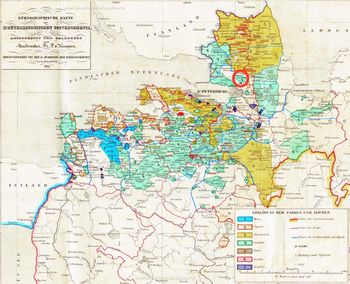
The title of the Chukhon Fantasy has commonly been translated as Finnish Fantasy, and in the 1873 published score it was rendered as Fantaisie sur des airs Finlandais, but both of these translations lack the specificity of the Russian original, Chukhonskaia fantaziia. In nineteenth-century Russia, the term chukhonets was used in ways that could be either neutrally descriptive or vaguely pejorative. Sometimes the designation was applied indiscriminately to all individuals of Finnic background, including migrant workers who had recently arrived in St Petersburg from the Grand Duchy of Finland; at other times it was used specifically to identify indigenous Finnic groups, including Ingrians, Izhorians and Votes (see Figure 6). Together, these migrant and indigenous Finnic populations constituted approximately a tenth of the total population of the St Petersburg Governorate in the middle of the nineteenth century, and they accordingly occupied a visible role in the life of the Russian capital and its suburbs. In his 1846 essay ‘Chukhons in St Petersburg’, the ethnographer Vladimir Dal noted a particularly high concentration of Finnic peoples in certain professions, including egg and milk product vendors, carriage drivers, kitchen maids, jewellers and especially chimney sweeps, of whom most were apparently of Finnic background.Footnote 98 Dal observed that the Finnic population of St Petersburg seemed to span a continuum in terms of their assimilation: some could be unusually dressed Lutheran Ingrians who spoke Russian with a heavy accent, while others were Orthodox Izhorians virtually indistinguishable from Russians in terms of costume and speech. The nationality chosen by Dargomyzhsky for representation in the Chukhon Fantasy thus differed substantially from the nationalities represented in the previous two fantasias in terms of its role in nineteenth-century Russian society. Unlike the Germans in Baba-Yaga, who could function as a symbol of the West against which Russian ressentiment was projected, and unlike the Cossacks in the Little-Russian Kazachok, who could function as semi-mythical anarchic bandits from a different time and place, the Finns of the Chukhon Fantasy were a sort of liminal internal other – firmly embedded in the everyday experience of St Petersburg residents such as Dargomyzhsky himself, yet different enough to be perceptible as outsiders in relation to the dominant Russian culture.
Peter von Köppen’s ethnographic map of St Petersburg and its environs from 1849 (edited excerpt). Coloured patches indicated major populations of various Finnic peoples. Murino, the village where Dargomyzhsky obtained the fast theme for the Chukhon Fantasy, is circled. Peter von Köppen, Ethnographische Karte des St. Petersburgischen Gouvernements (St Petersburg: K. Akademie der Wissenschaften zu St. Petersburg, 1849).

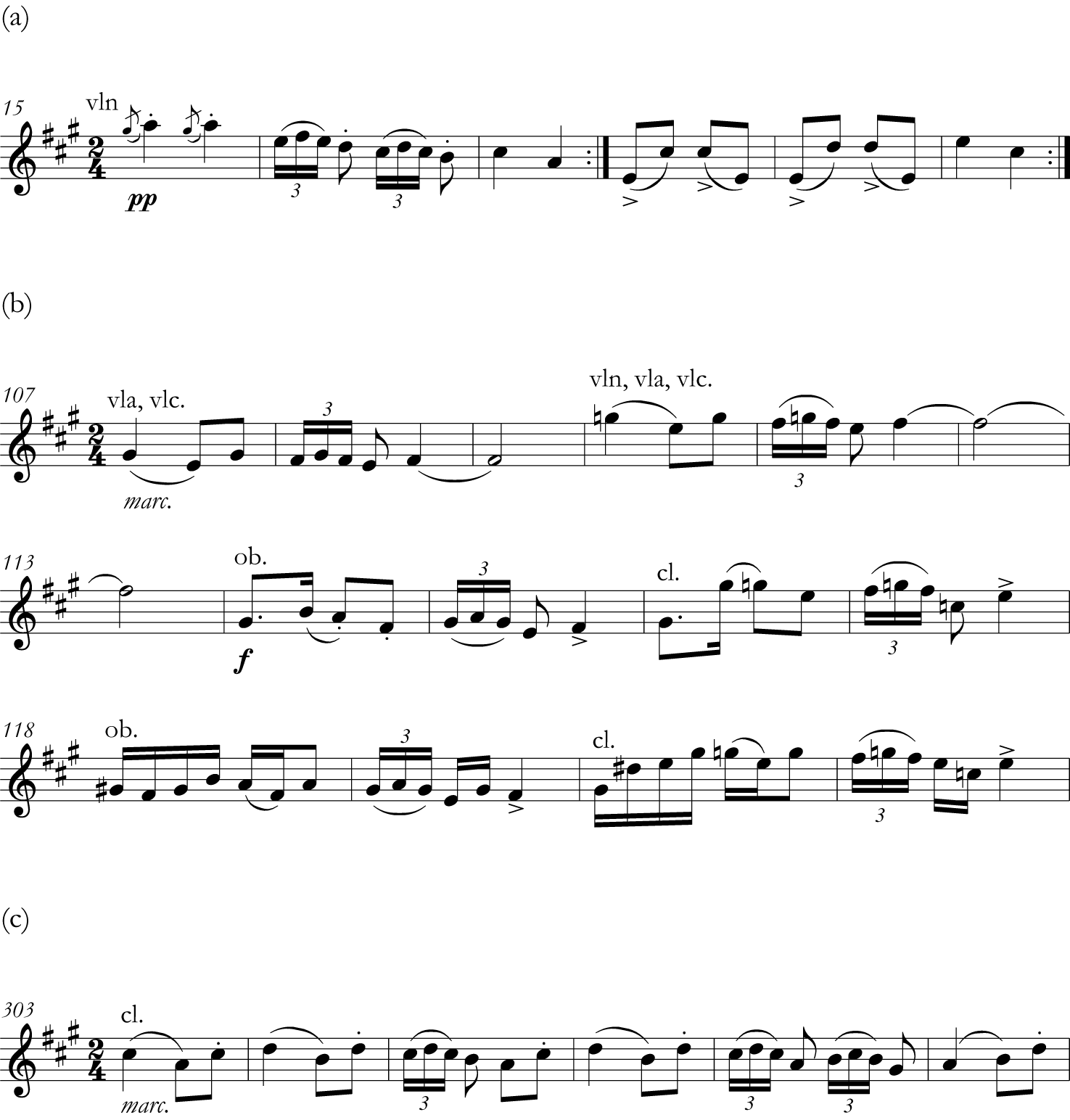
Dargomyzhsky’s cultural proximity to the subject of the Chukhon Fantasy manifested itself most obviously in his choice of musical material. The themes that he had used in Baba-Yaga and the Little-Russian Kazachok were readily available in numerous popular folk-song collections of the time, and this can also be said of the Chukhon Fantasy’s slow introductory theme, which Dargomyzhsky probably took from Johann Filip von Schantz’s collection of Finnic folk songs, published in Helsinki in 1855.Footnote 99 The origin of the primary theme (see Example 5a), however, is quite different, since it is the only theme in Dargomyzhsky’s three fantasias that he had heard and notated himself. His first biographer, Ivan Korzukhin, described the encounter with Ingrian peasants that yielded the primary theme as follows:
This composition was conceived by Dargomyzhsky outside St Petersburg, in the village of Murino [which had a substantial Ingrian population], where his sister Sof′ia Sergeevna Stepanova lived during the summer, along with the Purgold family, with whom Dargomyzhsky was in a most intimate relationship. At the Purgolds’ he once heard a Chukhon song which he liked so much that he decided to use it as a theme for his fantasia. Moreover, Dargomyzhsky probably also saw a Chukhon dance somewhere by Murino. Later, after he had composed the fantasia, Dargomyzhsky liked to describe its content, and hilariously imitated the clumsy movements of the dancing Chukhons.Footnote 100
Dargomyzhsky, Chukhon Fantasy: (a) primary theme, bars 15–26; (b) secondary theme, bars 107–21; (c) coda theme, bars 303–8.

A slightly different, but consistent, account of these events can be found in one of Balakirev’s last letters before his death, addressed to the linguist and ethnographer Sergei Bulich. Bulich was at the time working on an article dealing with connections between Slavic and Finnic folk music, and since the Finns to whom he sang Dargomyzhsky’s themes could not recognize them he had written to Balakirev to enquire about Dargomyzhsky’s sources for the Chukhon Fantasy. Footnote 101 Balakirev responded in characteristically aggressive fashion:
The Allegro theme of the Chukhon Fantasy, as far as I remember, was heard by Dargomyzhsky sometime near Pargolovo [a village adjacent to Murino] […] If your Finn acquaintances absolutely do not know the themes that served as the material for Dargomyzhsky’s fantasia, this by no means diminishes their true folkishness. Usually, it is the most banal themes that enjoy popularity, particularly in our time, when old songs are falling into complete oblivion with the folk, and are replaced by ditties […] I vaguely remember that Dargomyzhsky would tell us about the dance that he saw of a drunken Finn, to the melody of the Allegro theme.Footnote 102
The hostility of Balakirev’s response betrays his attachment to early kuchkist rhetoric, which drew a constructed boundary between corrupted urban tunes and unadulterated folk songs.Footnote 103 In 1908, when Balakirev wrote his letter, such rhetoric appeared hopelessly anachronistic, but in the 1870s, when the Chukhon Fantasy entered the repertory of Russian concert halls, it was still enough of a marketing point for Cui repeatedly to emphasize in his reviews that Dargomyzhsky had used ‘a real Chukhon dance theme’.Footnote 104 Instead of abstractly plucking a theme from a printed collection, Cui and Balakirev implied, Dargomyzhsky had overheard a melody in his everyday life, and was now relaying that experience to his listeners.
Korzukhin’s and Balakirev’s accounts of the inception of the Chukhon Fantasy also yield insight into its extramusical inspiration, namely the drunken dance of Ingrian peasants. This inspiration aligned well with Dargomyzhsky’s hypothesized goal of presenting listeners to his fantasias with grotesquely exaggerated negative stereotypes of various nationalities in the Russian Empire. Because of the liminal role occupied by Finnic peoples in nineteenth-century St Petersburg culture, most of their appearances in writings from this period amount to passing mentions of their capacity as carriage drivers or kitchen maids, and they are often portrayed in positive terms, particularly as cleaner and more honest than their Russian counterparts.Footnote 105 At the same time, however, some writers emphasized their drunkenness as a highly visible character trait. For example, two of the three references to ‘chukhontsy’ in Dostoevsky’s Crime and Punishment include descriptions of their drunkenness,Footnote 106 and Dal’s ethnographic account concludes with a description of singing and dancing drunk ‘chukhontsy’, one of whom he later sees passed out in a carriage, ‘dead asleep, blissfully dreaming, until he has to wake up in a ditch on the side of the road’.Footnote 107
If we are to believe the written reception of the Chukhon Fantasy, most nineteenth-century listeners understood it precisely as a representation of this negative stereotype, and interpreted it as a sort of genre scene depicting the drunken dance of a Finnic worker or peasant. Such an interpretation is already prominent in Borodin’s review of the première:
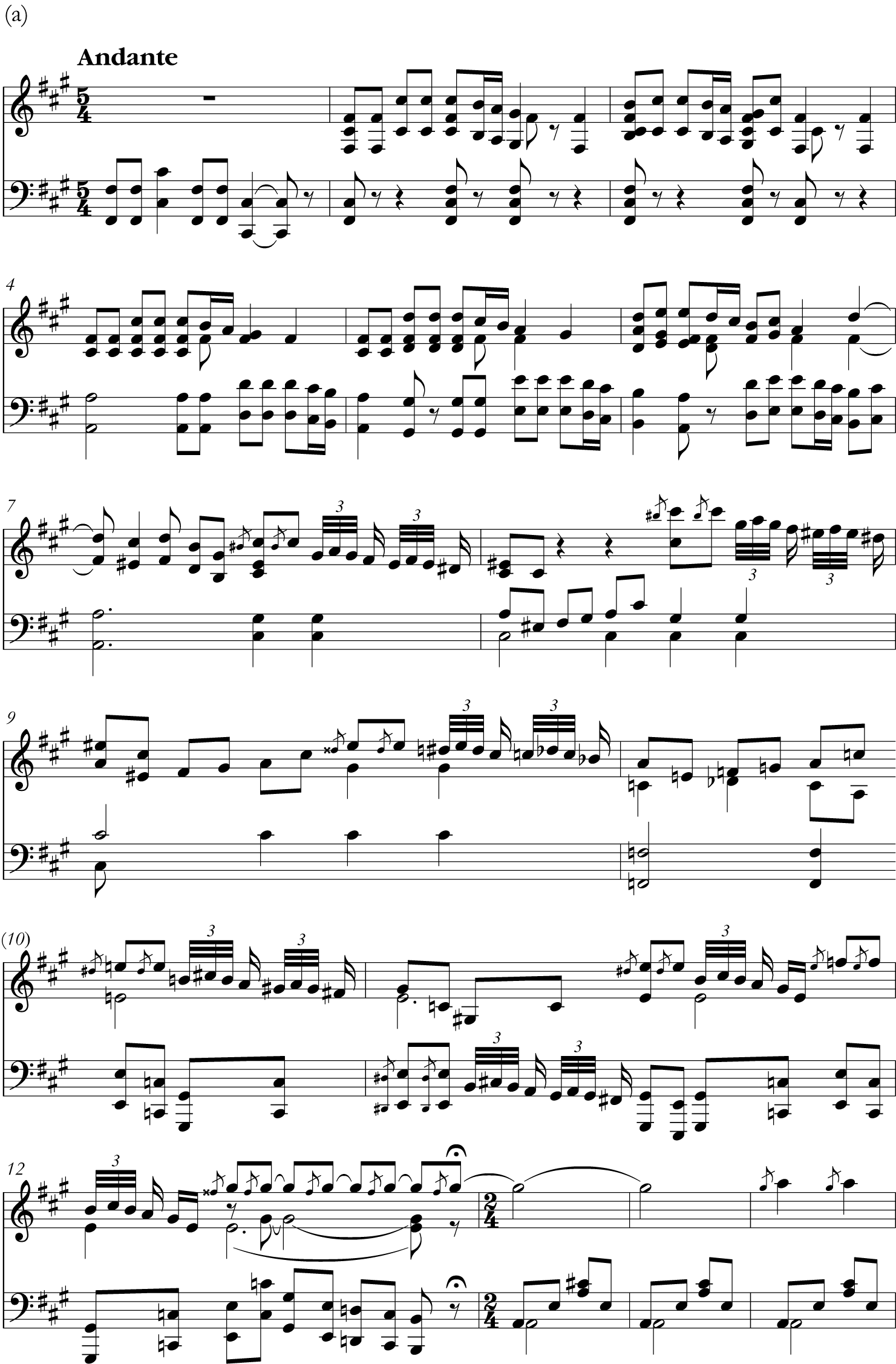
The fantasia is built on Chukhon folk themes and paints the carousing and revelling Chukhons. First, they begin to chant one of their mournful songs (introduction, F♯ minor, 5/4); then, beginning to amuse themselves, they break into a dance, first with restraint, but little by little growing to the utmost extremes of Chukhon boldness and Chukhon ardour – languid, feeble, clumsy and comical in the extreme (Allegro, A major, 2/4).Footnote 108
Similar sentiments abound in subsequent discussions of the Chukhon Fantasy, with certain phrases (for example, ‘pathetic and miserable’, ‘clumsy, vulgar bacchanalia’) recurring with remarkable regularity.Footnote 109 With even greater clarity than in the cases of Baba-Yaga and the Little-Russian Kazachok, Russian listeners thus perceived the Chukhon Fantasy as an unfavourable caricature of a particular nationality in the Russian Empire. The difference was that whereas the pedantic Baltic Germans of Baba-Yaga were generally materially better off than Russians and occupied prominent positions in Russian society, and whereas the boisterous Cossacks of the Little-Russian Kazachok were largely a figment of the popular imagination, the drunken Finns depicted in the Chukhon Fantasy were a caricature of the very carriage drivers who would take St Petersburg audiences home from the concert at which the work itself was being performed.
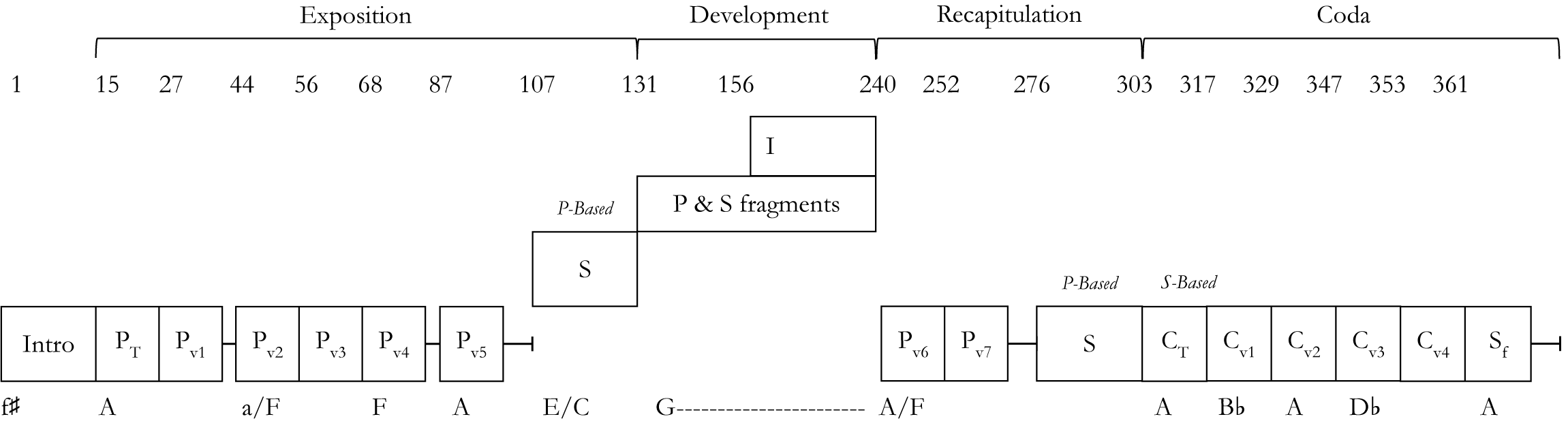
What differentiates the Chukhon Fantasy even further from its two predecessors is Dargomyzhsky’s utilization of the most advanced compositional techniques available in European music of the time for the portrayal of this vulgar caricature. Such techniques are already evident in the structural design of the Chukhon Fantasy (see Figure 7), which combines sonata form with Glinkian variations and Lisztian thematic transformations.Footnote 110 The Chukhon Fantasy begins with a slow introductory theme that briefly returns in the development, but otherwise the entirety of the melodic material throughout the sonata and coda is generated through a series of transformations of the Ingrian theme that Dargomyzhsky had noted near Murino (see Example 5). Each of these thematic transformations, occupying a different section of the sonata, is in turn subjected to a series of variational restatements recalling Glinka’s ostinato variation technique, albeit without the same degree of strict melodic invariability. Whereas this transformational and variational approach to thematic material ensures a high degree of motivic coherence throughout the Chukhon Fantasy, Dargomyzhsky relies on other parameters, such as orchestration, metre and harmony, both to delineate formal zones with greater clarity and for humorous decorations of the themes. For example, he largely confines the brass and percussion sections to the development and coda, where the orchestral texture expands substantially in comparison with the exposition and recapitulation. The grandiosity of the orchestration in these sections in turn produces a humorous effect stemming, in the words of one critic, from the ‘discrepancy between the puny themes and the grandeur that they are trying to achieve’.Footnote 111 Similarly, metric contrast helps to distinguish between the introduction (in 5/4), the primary thematic zone (2/4 in three-bar hypermetre) and the secondary thematic zone (2/4 in two-bar hypermetre), while the breakdown of metric regularity in the development creates a vivid portrayal of the disorderliness of the drunken dance.
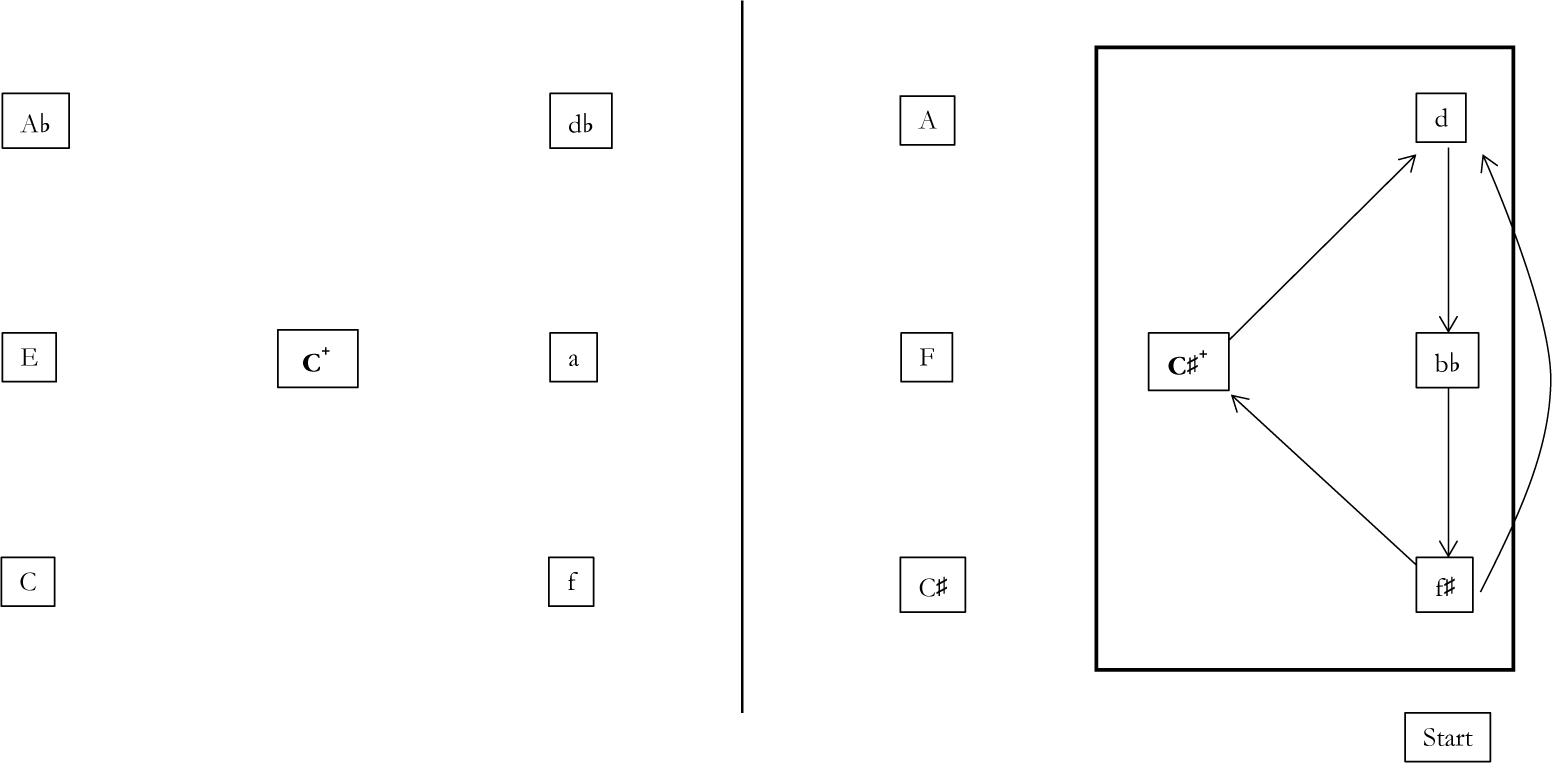
Formal outline of the Chukhon Fantasy. For an alternative representation that foregrounds the role of augmented triads as structural sonorities, see Example 7.

It is the idiosyncratic harmonic language and tonal organization of the Chukhon Fantasy, however, that is most noteworthy, and that many nineteenth-century commentators saw as the primary source of the work’s comedy. For example, Cui asserted that the humour of the fantasia consists primarily of the continuous stream of ‘entirely unprecedented and funny harmonic combinations’,Footnote 112 while Laroche described Dargomyzhsky’s harmonic inventions with the German moniker ‘das Fratzenhafte’ (‘the grotesque’) and deemed them worthy of a genius.Footnote 113 In the same review, Laroche also clarified that he viewed the main idiosyncrasy of Dargomyzhsky’s harmonic language to be his ubiquitous reliance on augmented triads, noting, ‘Dargomyzhsky exploited his beloved chord with inexhaustible ingenuity, and was able to adapt it to an enormous multitude of combinations, sometimes merely strange ones, but often even truly beautiful ones.’Footnote 114 Such was the impression that Dargomyzhsky’s use of augmented triads in the Chukhon Fantasy made on Rimsky-Korsakov that in 1908, a few months before his death, the latter repeatedly spoke about it with Vasily Iastrebtsev: ‘Today Nikolai Andreevich talked about Dargomyzhsky’s Chukhon Fantasy again, about how the augmented triad appeared in it as an independent entity for the first time in Russian music, in order to give the work a comic character, and about how this remarkable fantasia should absolutely be performed in one of the upcoming Beliaev concerts.’Footnote 115 Rimsky-Korsakov’s description of the role of the augmented triad in the Chukhon Fantasy is vague, but from the very first bars it is clear that its use is qualitatively different from the episodic and superficial fashion in which it appeared in Baba-Yaga and the Little-Russian Kazachok. Augmented triads are now present in nearly every bar, often in rhythmically accented positions, and are further foregrounded through orchestration. The diatonic triads to which these augmented triads resolve in turn tend to be a major third apart from each other, thus spelling out horizontally the constituent intervals of the augmented triad. Furthermore, while the exposition of the sonata alludes to the conventional tonic–dominant tonal opposition, most other primary tonal areas throughout the fantasia are yet again related to each other by major thirds. Such is the systematic nature of Dargomyzhsky’s deployment of the augmented triad in the foreground, middleground and background of the Chukhon Fantasy that at times it can strike one as a performative theoretical treatise.
The first 15 bars (see Example 6a) provide a succinct illustration of Dargomyzhsky’s use of the augmented triad on multiple structural levels. Following an imitative opening in F♯ minor, we move to the dominant C♯ major triad (bar 7). This move is effected by way of the augmented triad on C♯, which functions as a link between the tonic and dominant, smoothing out the idealized voice-leading movement between them, since it is one semitone away in a single voice from both of the surrounding triads.Footnote 116 Every subsequent diatonic triad in the introduction is similarly preceded by a related augmented triad one voice-leading semitone away. When we move away from the C♯ major triad (bar 10), it is to F major, that is, another triad one voice-leading semitone away from the C♯ augmented triad. Next, we move to the dominant of A major (bar 11), and this E major triad is also prepared by a related augmented triad a voice-leading semitone away, now on C. Once the E major dominant chord resolves to A major (bar 13), the related C♯ augmented triad reappears within a few bars. The overall harmonic trajectory of the introduction then moves from F♯ minor to its dominant and then across a major thirds cycle that horizontally outlines a C♯ augmented triad, starting with C♯ major and F major, followed by A major prepared by an interpolated dominant (see Example 6b).
Dargomyzhsky, Chukhon Fantasy, introduction: (a) bars 1–15; (b) bars 1–15, harmonic reduction.


Throughout this passage, Dargomyzhsky exploits the fact that the C♯ augmented triad can be resolved by a single semitonal voice-leading motion to either F♯ minor, C♯ major, F major or A major. This property of the augmented triad, commonly referred to as Mehrdeutigkeit (multiplicity of meanings), was first articulated by Abbé Georg Vogler in 1802, and is utilized in a number of early nineteenth-century compositions including Schubert’s Second Symphony.Footnote 117 It is Carl Friedrich Weitzmann’s theorization of this concept in his monograph Der übermässige Dreiklang (The Augmented Triad, 1853), however, that is of particular relevance to the Chukhon Fantasy. Weitzmann organized the 24 major and minor triads that are possible in equal-tempered space into four groups, with each group centred on an augmented triad located a voice-leading semitone away (see Figure 8).Footnote 118 Most immediately, Weitzmann’s approach systematized the Mehrdeutigkeit and potential resolutions of each of the four augmented triads. More significantly, it conferred conceptual priority not on consonant triads, as was done by theorists before him, but rather on the augmented triads that serve as the generators of the semitone-related consonant triads. For the first time, the augmented triad was presented not as a peripheral or passing sonority, but as a prominent and independent harmonic entity.
Weitzmann’s representation of the four possible augmented triads and their related major and minor triads. Weitzmann, Der übermässige Dreiklang, 24.

Weitzmann’s theorization of the relationship between augmented and consonant triads closely resembles the harmonic organization of the introduction of the Chukhon Fantasy. While Dargomyzhsky does not entirely abandon an underlying diatonic framework, every consonant triad that appears in the introduction is accompanied by its related augmented triad. Moreover, apart from the E major dominant triad that briefly appears in bars 11 and 12, all of the consonant triads present in the introduction are related by semitonal motion to the C♯ augmented triad, which functions as a sort of switching station between them.Footnote 119 A Weitzmann-inspired representation of the harmonic motion throughout the introduction of the Chukhon Fantasy is shown in Figure 9. As we shall see, the C♯ augmented triad acts as the central structural sonority in the fantasia (with the C augmented triad taking on a secondary, dominant-like role), and nearly all subsequent consonant triads and tonal areas are derived from this C♯ augmented triad by way of semitonal motion.
Chukhon Fantasy, introduction, bars 1–15, Weitzmann-inspired representation. The two regions separated by the vertical line depict the C and C♯ augmented triads along with their semitone-related consonant triads. Arrows indicate the fantasia’s trajectory through this harmonic space starting with F♯ minor in the bottom right corner.

The connection between Weitzmann’s theory and the Chukhon Fantasy may well have been more than simply one of accidental resemblance. For one, Weitzmann’s work was well known in Russia in the 1860s. For example, Vladimir Odoyevsky, a close acquaintance of Dargomyzhsky, wrote in an encyclopedia article from around this time that Weitzmann was one of the few theorists with whose work ‘every musician properly engaged in his art’ was familiar.Footnote 120 Furthermore, Dargomyzhsky probably even knew Weitzmann personally, since the latter was a violinist and conductor at the court orchestras in St Petersburg from 1836 to 1846 (and participated in the first production of Glinka’s Ruslan and Lyudmila).Footnote 121 Even if Dargomyzhsky was not aware of Weitzmann’s treatise, however, there is absolutely no doubt that as a participant in the gatherings of the Balakirev circle in the 1860s he would have been familiar with Liszt’s Faust Symphony (1854), often seen as the musical complement to Weitzmann’s treatise.Footnote 122 The very opening of the symphony presents the four complementary augmented triads; the remainder of it prolongs the one constructed on C, with its three pitches also serving as the most prominent tonal areas throughout the composition. Weitzmann’s representation of the relationship between augmented and consonant triads and Liszt’s musical setting of this relationship are thus not merely close correlates to the harmonic organization of the Chukhon Fantasy, but also likely sources of inspiration.
As already suggested, the pairing of diatonic triads with their augmented neighbours and the primacy of the C♯ augmented triad explicitly invoked in the introduction define the entirety of the fantasia’s tonal design (see Example 7). The first half of the exposition heavily features the C♯ augmented triad while alternating between A major and F major. The second half of the exposition foregrounds the C augmented triad and pivots between E major and C major. The customary tonal opposition of a sonata exposition is thus expanded from being merely one between two diatonically related keys to one between two distinct augmented triads (C♯ versus C) and two of their semitonally related consonant triads (A major and F major versus E major and C major). Within this overarching tonal structure, Dargomyzhsky continuously foregrounds the relevant augmented triad at a local level. Example 8a demonstrates the bridge between the first and second variations, and consists entirely of an oscillation between C♯ augmented and A major triads. Example 8b shows the fourth variation, which begins firmly in F major before unfolding an extended chromatic linear progression over an F pedal, with plenty of C♯ augmented triads along the way.Footnote 123 Although the outer voices at the opening of the fifth variation (the final five bars of Example 8b) imply a resolution to A major, the inner voices remain in F major, and the linear progression that started at the opening of Example 8b concludes on yet another C♯ augmented triad. Example 8c shows the opening of the secondary theme, outwardly in E major, but with this E major appearing only fleetingly before the harmony settles first on the C augmented triad and subsequently on C major.
Dargomyzhsky, Chukhon Fantasy, tonal layout, emphasizing the role of the augmented triad. Accordingly, only augmented triads are designated in the development, even though it is predominantly diatonic.

Dargomyzhsky, Chukhon Fantasy: (a) bars 39–43; (b) bars 68–91; (c) bars 107–17.


Whereas augmented triads in general, and the C♯ augmented triad in particular, function as prominent structural agents in the exposition, suffusing the surface as vertical sonorities and governing harmonic progressions and tonal relationships, they are largely absent from the development. Instead, the development is harmonically remarkably conventional, especially given what preceded it, with plenty of functional progressions and applied dominant motion. In this way, Dargomyzhsky inverts the normative relationship between a harmonically stable exposition and a mobile development, with this inversion underscoring the unusual function of the augmented triads within the fantasia. Since in the exposition augmented triads functioned not as passing sonorities but rather effectively as stable, structural ones, it makes perfect sense for them to be absent in the development – chromaticism and diatonicism thus trade places within their normative roles in sonata form (and perhaps illustrate the carnivalesque inversion of social norms during the drunken dance of the Finns). Crucially, in the few instances where augmented triads do appear in the development, they are always constructed on C (for example, at bar 189), on D (for example, at bar 232) or on E♭ (for example, at bar 138), but never on C♯. By using in the development only the three augmented triads complementary to C♯, Dargomyzhsky further underscores the primacy of the C♯ augmented triad since the opening bars of the introduction.
The recapitulation accordingly marks the return of the C♯ augmented triad and its related keys of A major and F major – true to sonata form, both primary and secondary thematic material now return in the same C♯ augmented/A major/F major tonal space. The C♯ augmented triad and A major also prevail at the opening of the coda, but now, instead of moving a major third down to F major, as in the exposition and recapitulation, Dargomyzhsky pivots a major third up, to D♭ major. This is nothing but the enharmonic equivalent of C♯ major, namely the third major triad complementary to the C♯ augmented triad, alongside A major and F major. All three of these major triads, themselves outlining a C♯ augmented triad, occurred in quick succession in the introduction, but the entirety of the sonata was based merely on two of them, namely A major and F major. Now, in the coda, the third and final complementary major triad occurs, closing the cycle of major thirds that was signalled at the very outset of the fantasia.
The Chukhon Fantasy’s portrayal of a drunken Finnic dance by way of thematic transformations and augmented triad prolongations can be understood as Dargomyzhsky’s most elaborate ploy to capture a wide audience across national boundaries and musical proficiency levels. Less technically discerning listeners, both at home and abroad, would have appreciated the humorous orchestrational and harmonic effects on the surface of the work. The Chukhon Fantasy would also have satisfied foreign audiences’ desire for exoticism, while simultaneously eliciting heightened interest from domestic audiences because of its portrayal of a subject that was intimately familiar to them from their everyday experiences in St Petersburg. At the same time, Dargomyzhsky’s use of sophisticated compositional techniques, associated with cutting-edge Weimar modernism, and his presentation of such techniques in an overt and systematic fashion throughout the Chukhon Fantasy, illustrated (much more than Baba-Yaga or the Little-Russian Kazachok) his ability to participate in the high-prestige norms of discourse associated with European compositional practice. The musical inventiveness of the Chukhon Fantasy was, as we have already seen, highly valued by Dargomyzhsky’s contemporaries in Russia, and it may well also have been valued greatly by the likes of Brendel and Hanssens, had Dargomyzhsky gone on another trip abroad and taken the composition with him.
Alas, Dargomyzhsky never left Russia again, and died within two years of completing the Chukhon Fantasy, without having ever heard it performed by an orchestra. Subsequent decades showed that his triumph in Brussels was ephemeral, and all three of his fantasias were only rarely performed or even mentioned beyond the borders of the Russian Empire after his death.Footnote 124 The fantasias did, however, remain prominent fixtures in domestic concert halls and in the consciousness of Russian musicians well into the twentieth century. For example, in 1904, Findeizen could still argue that Dargomyzhsky’s fantasias were one of the two foundational pillars on which the subsequent developments of Russian symphonic music were based (he deemed the Balakirev circle’s orchestral works as the next generation in this development).Footnote 125 Even as late as 1930, Boris Asafiev emphasized that Dargomyzhsky had contributed substantially to the formation of native instrumental music by introducing into it the idea of the grotesque, particularly for humorous representations of cultural stereotypes.Footnote 126 Findeizen’s claim may strike one as exaggerated, particularly next to Asafiev’s more modest assertion, but one can indeed find traces of Dargomyzhsky’s orchestral style in a wide array of later Russian compositions. In some instances, these traces take the shape of direct borrowings. For example, in order to depict Bobyl’s drunken dance in the prologue of Snow Maiden (1881), Rimsky-Korsakov used a nearly verbatim quotation of the third phrase of the fast theme in the Little-Russian Kazachok, and harmonized it with augmented and diminished triads.Footnote 127 In other cases, these traces appear on the level of subject matter and compositional technique. For example, the final movement of Tchaikovsky’s Second Symphony, which is commonly seen as his closest engagement with Glinka’s Kamarinskaya, in fact bears a greater similarity to the Little-Russian Kazachok, not only in its setting of a Ukrainian tune, but also by subjecting a multisectional theme to a variational process in which the original tune is developed melodically and exposed to a variety of orchestrational and harmonic distortions.Footnote 128 Nowhere is the intertextual relationship with Dargomyzhsky made clearer, however, than in Tchaikovsky’s Second Orchestral Suite, entitled ‘Danse Baroque (Imitation of Dargomyzhsky)’ and loaded with an array of orchestral and harmonic curiosities borrowed directly from the three fantasias.
For the most part, Russian nineteenth-century composers seem to have agreed with Asafiev, valuing Dargomyzhsky’s fantasias primarily as a repository of humorous and grotesque expressive effects. Yet in at least one instance, the Chukhon Fantasy appears to have played a more substantial role, namely in Rimsky-Korsakov’s turn towards harmonic experimentation in the late 1860s. The primary influences on Rimsky-Korsakov’s first forays into octatonicism and hexatonicism are usually understood to be Glinka and Liszt,Footnote 129 but Dargomyzhsky’s idiosyncratic use of augmented triads in the Chukhon Fantasy would also have been prominently on Rimsky-Korsakov’s mind during these early experiments. Throughout the 1860s, Dargomyzhsky was a frequent participant in the gatherings of the Balakirev circle, where they analysed and discussed each other’s works, and there is evidence that Rimsky-Korsakov intimately knew each of Dargomyzhsky’s three fantasias well before they were completed, and valued them highly.Footnote 130 Particularly by the early months of 1867, when Dargomyzhsky was finishing the Chukhon Fantasy, he began to be treated by the Balakirev circle with great reverence, and it was later that same year that Rimsky-Korsakov began work on his Antar, completed a year later. Antar commences with major-third cycles and prolongations of the C♯ augmented triad by way of semitone-related triads – that is, precisely in the same way as the introduction of the Chukhon Fantasy (compare Example 6b on page 307 and Example 9; Figure 9 on page 309 and Figure 10).Footnote 131 Rimsky-Korsakov’s early experimentation with hexatonicism thus took place precisely at the time when he looked up to Dargomyzhsky as a mentor, and with the Chukhon Fantasy fresh in his mind. It is particularly telling in this context that he would ruminate on the role of the augmented triad in the Chukhon Fantasy throughout the last months of his life.
Rimsky-Korsakov, Antar, bars 1–11, harmonic reduction.

Nikolai Rimsky-Korsakov’s Antar, bars 1–11, Weitzmann-inspired representation.

Compositions by Rimsky-Korsakov and Tchaikovsky illustrate the veracity of Findeizen’s and Asafiev’s assertions regarding Dargomyzhsky’s fantasias, but it would be reductive to view them merely as a toolbox for the representation of grotesque alterity in subsequent Russian music. Much more remarkable about the fantasias is the way in which they illustrate the curious hybridity of Dargomyzhsky’s artistic persona, seamlessly moving across national borders and simultaneously playing to vastly different audiences around Europe. With each fantasia, Dargomyzhsky further calibrated his conspicuous blend of ethnic alterity and political commentary (for domestic audiences), Russian national mythology (for Western audiences) and the latest musical trends and fashions (for musical power brokers around the Continent). In recent decades, scholarship on Russian music has shifted away from the once dominant hermetic nationalist paradigm and towards an interpretation of Russian composers’ artistic choices through the prism of pan-European aesthetic currents. Dargomyzhsky’s fantasias and travels demonstrate the value of this historiographic shift with great clarity and expose the vast extent to which 1860s Russian music was integrated into the Continental mainstream. It is not Russianness that is stable about Dargomyzhsky’s music, as we may have assumed half a century ago, but rather its ability to monopolize on a quintessentially modern transnational fluidity.