Introduction
Taenia solium cysticercosis is a foodborne, zoonotic neglected parasitic disease that poses a significant burden in low- and middle-income countries across Latin America, sub-Saharan Africa, and South and Southeast Asia. Humans become infected with T. solium by consuming raw or undercooked pork containing viable cysticerci – the larval stage of the tapeworm. Cysticercosis can also be acquired indirectly through ingestion of infective T. solium eggs via contaminated food, water, or unwashed hands, as well as through autoinfection or direct contact with another tapeworm carrier (Acosta Soto et al Reference Acosta Soto, Parker, Irisarri-Gutierrez, Bustos, Castillo, Perez, Munoz-Antoli, Esteban, Garcia and Bornay-Llinares2021).
Each day, an individual harbouring an adult T. solium tapeworm releases vast quantities of eggs into the environment through faecal matter. In settings where open defaecation is practised or sanitation infrastructure is inadequate, free-roaming pigs readily access and consume human waste, sustaining the parasite’s transmission cycle between humans and pigs. Should either humans or pigs inadvertently ingest these eggs, the oncospheres hatch, penetrate the intestinal wall, enter systemic circulation, and disseminate to various tissues where they develop into cysticerci – a condition termed cysticercosis. While cysticerci can establish themselves in multiple anatomical sites, the central nervous system represents the most clinically consequential location in humans. Invasion of brain tissue triggers a spectrum of neurological manifestations, most notably seizures, collectively referred to as neurocysticercosis (NCC). The global health implications of NCC are profound; the World Health Organization estimates that it underlies nearly 30% of epilepsy cases attributable to an identifiable cause in regions where the parasite is endemic (Ndimubanzi et al Reference Ndimubanzi, Carabin, Budke, Nguyen, Qian, Rainwater, Dickey, Reynolds and Stoner2010).
The transmission and persistence of cysticercosis and taeniasis are deeply rooted in conditions of poverty, where inadequate sanitation, poor personal hygiene, unregulated pig husbandry, and limited veterinary oversight of meat production create an environment conducive to parasite spread (Mwape et al Reference Mwape, Phiri, Praet, Speybroeck, Muma, Dorny and Gabriel2013). Among the neurological consequences, epilepsy stands out as a major public health concern, with global estimates exceeding 70 million affected individuals (Trinka et al Reference Trinka, Kwan, Lee and Dash2019). The disproportionate concentration of epilepsy cases in low- and middle-income countries is, in considerable part, a reflection of the endemicity of NCC in these regions. Geographically, the prevalence of taeniasis demonstrates marked variation, with European populations recording relatively low rates of 0.05–0.27%, whereas figures across African, Asian, and Latin American settings span a considerably wider range of 0–17.25% (Okello and Thomas Reference Okello and Thomas2017).
At the continental level, a systematic review and meta-analysis focusing on Eastern and Southern Africa revealed substantial inter-country differences in T. solium cysticercosis burden, with South Africa bearing the highest point prevalence of 37.2%, Madagascar occupying second position, and Tanzania recording the most modest estimate at 0.7% (Zulu et al Reference Zulu, Stelzle, Mwape, Welte, Stromme, Mubanga, Mutale, Abraham, Hachangu, Schmidt, Sikasunge, Phiri and Winkler2023). Community-level data from twelve villages in the remote Ifenadiana district of Madagascar placed local prevalence at 29.8% (Rahantamalala et al Reference Rahantamalala, Ra kotoarison, Rakotomalala, Rakotondrazaka, Kiernan, Castle, Hakami, Choi, Rafalimanantsoa, Harimanana, Wright, Grandjean Lapierre, Schoenhals, Small, Marcos, Vigan-Womas, Fairley and Jex2022), highlighting how geographic isolation and constrained access to sanitation and healthcare services can amplify transmission intensity.
Nigeria presents a notable gap in the literature concerning the epidemiology of human cysticercosis, with only a handful of studies having examined its occurrence at the population level. A seroprevalence of 14.3% was documented in pig-farming communities in Kaduna, Northwest Nigeria (Edia-Asuke et al Reference Edia-Asuke, Inabo, Mukaratirwa, Umoh, Whong, Asuke and Ella2015), while more recent investigations in two districts of Plateau State in North Central Nigeria yielded a notably higher seroprevalence of 27.2% (Kum et al Reference Kum, Yohanna and Adeiyongo2023). Conspicuously absent from the existing body of evidence, however, is any inquiry into the relationship between T. solium cysticercosis and epilepsy within the Nigerian population. The present study was designed to address this void by determining the seroprevalence of cysticercosis and its associated risk factors, and by exploring its potential connection to epilepsy across five communities in Southern Nigeria. It should be noted that while seropositivity provides evidence of exposure to T. solium, a definitive diagnosis of NCC necessitates neuroimaging confirmation; given resource constraints inherent to the study setting, access to such diagnostic modalities was not available for all participants.
Materials and methods
Study design and sites
A community-based, case-control study was conducted between September and December 2023, employing a door-to-door survey for epileptic seizures with a two-step protocol for diagnostic confirmation. The study was carried out across five communities spanning two geopolitical zones of Nigeria. In the Southwest, the study site comprised Ijebu-Jesa, situated within Oriade Local Government Area (LGA), while the Southeast zone contributed four communities: Ohaisu and Nkpoghoro in Afikpo North LGA, and Ogui and New Haven in Enugu North LGA (Figure 1). The selection of these specific communities was informed by an earlier investigation into the burden of epilepsy conducted within the same localities (Watila et al Reference Watila, Balarabe, Komolafe, Igwe, Bimbo Fawale, van Diessen, Nyandaiti, Singh, Winkler and Sander2021).
Map of the study sites showing Oriade Local Government Area, Enugu North Local Government Area, and Afikpo North Local Government Area with the communities where sampling was carried out.

Figure 1. Long description
A complex map consisting of five panels.
1. Top-Left: A map of Nigeria showing state boundaries with two highlighted regions in the South.
2. Middle-Left: Two regional maps. The left shows Osun state with Oriade L G highlighted in light blue. The right shows Enugu and Ebonyi states with Enugu North L G in tan and Afikpo North L G in pink.
3. Top-Right: A detailed map of Enugu North L G in tan. Two yellow circular sample locations are marked: Ogui in the West and New Haven in the North-Central region. A scale bar indicates 0 to 16 Kilometers.
4. Bottom-Left: A detailed map of Oriade L G in light blue. A yellow circular sample location is marked at Ijebu Jesa in the North. A scale bar indicates 0 to 32 Kilometers.
5. Bottom-Right: A detailed map of Afikpo North L G in pink. Two yellow circular sample locations are marked in the South: Ohaisu and Nkpoghoro. A scale bar indicates 0 to 32 Kilometers.
All detailed maps include latitude and longitude coordinates on the axes and a compass rose indicating North, South, East, and West.
Selection of cases and controls
The study was implemented in two sequential phases. In phase I (September–October 2023), a community-based door-to-door seizure screening survey was conducted by trained research assistants. A validated ten-item screening questionnaire, adapted from the ‘Questionnaire for Investigation of Epilepsy in Tropical Countries’ and previously validated by Watila et al (Reference Watila, Balarabe, Komolafe, Igwe, Bimbo Fawale, van Diessen, Nyandaiti, Singh, Winkler and Sander2021), was administered in two local languages. Screening was conducted at the household level, with the head of household or most senior available member responding on behalf of all members; for individuals below 18 years of age, responses were provided by a parent or household head. Respondents who endorsed at least one screening item were assigned a unique identification number and directed to the nearest community health facility for further neurological evaluation.
Phase II (November–December 2023) comprised comprehensive epileptological assessment of all screen-positive individuals by certified neurologists. Neurologists conducted thorough assessments using a structured questionnaire capturing demographic, clinical, and neurological information, including medical history, seizure classification, family history of epilepsy, and potential risk factors such as head trauma, alcohol use, and prior neurological infections. Individuals confirmed to have epilepsy underwent both physical and neurological examination. Those presenting with inactive epilepsy, non-epileptic seizure events, or a single isolated seizure were excluded. It is acknowledged that loss to follow-up and non-participation occurred during recruitment and evaluation; this attrition may have introduced selection bias, and findings should be interpreted with this limitation in mind. Confirmed epilepsy cases completed a supplementary questionnaire addressing risk factors associated with T. solium infection, and written informed consent was obtained from all such participants. This risk-factor questionnaire captured sociodemographic characteristics (age, sex, education, occupation, residence and religion); dietary and meat-handling practices (consumption of undercooked meat, frozen meat, pig meat, raw vegetables and unwashed fruits); pig rearing and contact (rearing of pigs, working on a pig farm and sharing a compound with pigs); drinking-water source and defaecation site; hand-hygiene practices (hand washing before eating, with water only, and with soap and water); and knowledge of cysticercosis and of its transmission from pigs to humans.
For every confirmed epilepsy case, one age-matched healthy control – defined as an individual with no known neurological disorder and no personal history of seizures or epilepsy – residing within the same community was randomly selected from the study area. Controls were drawn from households distinct from those of the epilepsy cases. All controls provided informed consent prior to enrolment and completed the epilepsy screening questionnaire; any control who screened positive was excluded. Controls also completed the T. solium infection risk factor questionnaire.
Sample size estimation
To estimate the sample size, a seroprevalence of 30% for Taenia solium was assumed based on previous epidemiological surveys in Nigeria (Edia-Asuke et al Reference Edia-Asuke, Inabo, Mukaratirwa, Umoh, Whong, Asuke and Ella2015; Kum et al Reference Kum, Yohanna and Adeiyongo2023). An estimated sample size of 38 participants per group (cases and controls) was required to detect an odds ratio (OR) of 3.5 with 80% power at a two-sided significance level of 5%.
Blood sample collection and serological evaluation
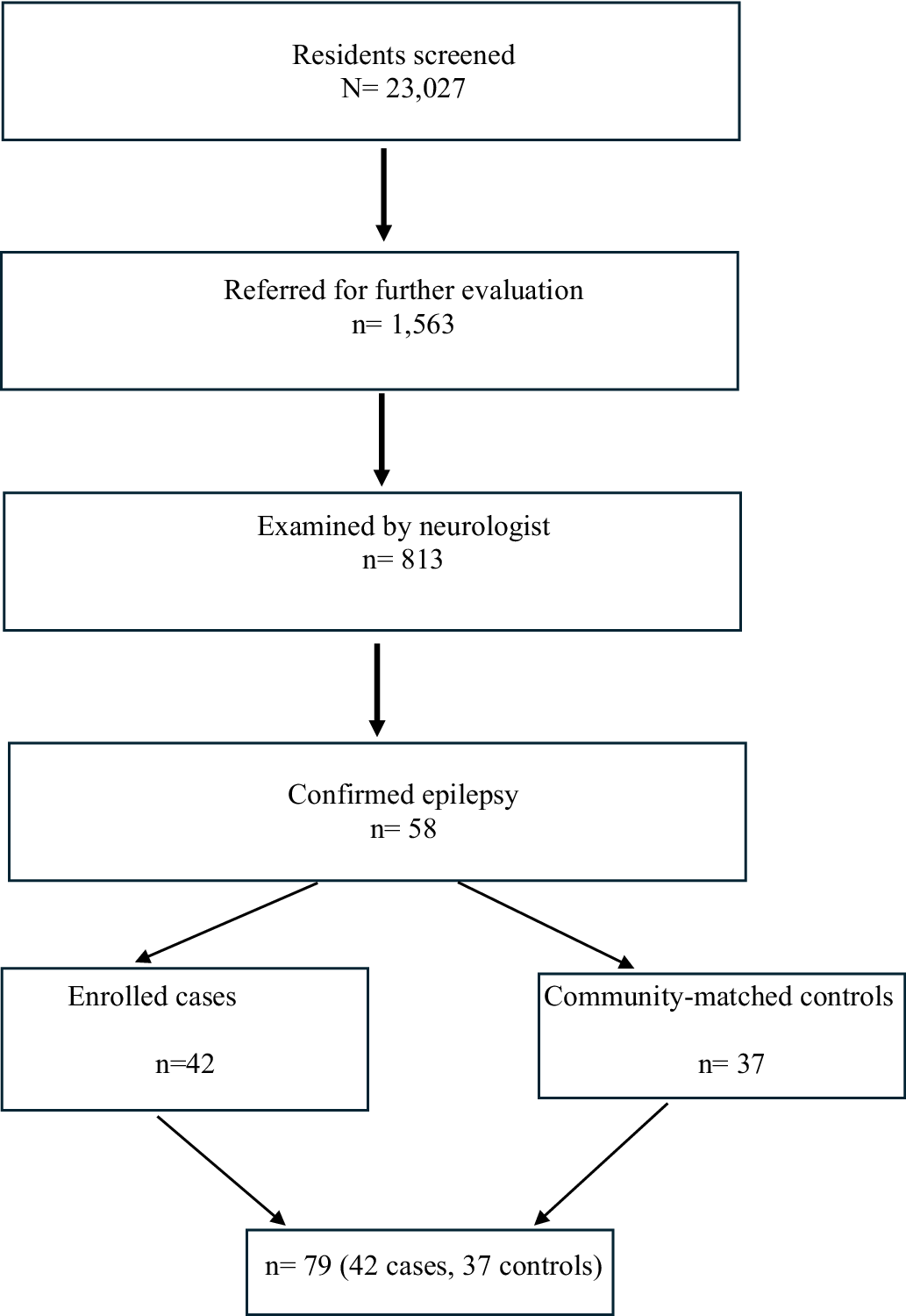
For serological testing, 5 mL of whole blood was collected by phlebotomists into plain blood collection tubes from both persons with epilepsy (PWE) and healthy controls. Samples were left undisturbed at room temperature for approximately 30 minutes to allow clotting, then centrifuged at 3,000 rpm for 5 minutes. Sera were collected into Eppendorf tubes, transported in a medical cooler box with ice packs to the Parasitology Laboratory, Department of Zoology, Obafemi Awolowo University, Ile-Ife, for temporary storage at −20°C. The frozen sera were subsequently shipped on dry ice, maintaining the cold chain at −20°C or below throughout international transport, to the Molecular Parasitology Laboratory, Department of Molecular Parasitology and Tropical Diseases, Taipei Medical University, Taiwan, for antibody detection against T. solium cysticerci using the enzyme-linked immunoelectrotransfer blot for lentil-lectin purified glycoprotein (LLGP-EITB) as described by O’Neal et al (Reference O’Neal, Townes, Wilkins, Noh, Lee, Rodriguez, Garcia and Stauffer2012). The LLGP-EITB assay uses a semipurified fraction of homogenised T. solium cysticerci containing seven glycoprotein antigens (GP50, GP42, GP24, GP21, GP18, GP14, GP13). Reactivity to any of these seven glycoprotein antigens, defined by the presence of one or more antibody bands, was considered a positive result. The participant flow diagram is shown in Figure 2.
Flow diagram of study participants. A total of 23,027 residents were screened for epilepsy. Of 1,563 referred for further evaluation, 813 were examined by neurologists, and 58 were confirmed with epilepsy. Forty-two confirmed cases and 37 community-matched controls were enrolled, resulting in 79 participants analysed in the case–control study.

Stool sample collection and detection of Taenia spp. eggs
Stool samples were collected from each participant into sterile screw-capped 30 mL bottles for parasitological analysis. Approximately 200 g of fresh stool was transported in a medical cooler box on dry ice to the Parasitology Laboratory, Obafemi Awolowo University, and preserved in 10% aqueous formaldehyde until processed. Samples were analysed for Taenia spp. eggs using the modified Kato–Katz technique (Forrester and Scott Reference Forrester and Scott1990). A sample was considered negative if no Taenia eggs were observed in three consecutive smears from the same sample. Individuals with Taenia eggs in their stools were treated under the supervision of clinicians. Given the limited sensitivity of stool microscopy for detecting Taenia eggs, the true prevalence of taeniasis may have been underestimated; molecular diagnostic methods would improve detection sensitivity.
Statistical analysis
Data were entered into Microsoft Excel and analysed using IBM SPSS Statistics version 20.0 (IBM Corp., Armonk, NY, USA). Continuous variables were compared using Student’s t-test. Associations between categorical variables and disease status were assessed using Pearson’s chi-square test, with Fisher’s exact test substituted where expected cell counts were small. Univariate logistic regression was first performed to evaluate associations between T. solium seropositivity and selected sociodemographic characteristics and potential risk factors. Variables with a p-value <0.10 in the univariate analysis were subsequently entered into a multivariable logistic regression model. Crude ORs (cORs), adjusted ORs (aORs), and corresponding 95% confidence intervals (CIs) were calculated. A two-sided p-value <0.05 was considered statistically significant.
Results
Participant enrolment
During phase I, a total of 23,027 individuals underwent seizure screening using the epilepsy screening questionnaire. Of these, 1,563 were identified as screen-positive and referred for neurological evaluation; however, only 813 (52%) proceeded to clinical assessment, while the remaining 750 (48%) were lost to follow-up. Among those who completed neurologist evaluation, 58 received a confirmed diagnosis of epilepsy. Of this confirmed group, 42 were ultimately available and enrolled in the case-control component of the study.
Sociodemographic characteristics
The 37 randomly selected controls were drawn from households distinct from those of the epilepsy cases. Sociodemographic characteristics and cysticercosis-related practices for all study participants are summarised in Table 1. Among epilepsy cases, age ranged from 3 to 75 years with a median of 48.74 ± 21.24 years, while controls ranged from 6 to 80 years with a median of 32.27 ± 20.18 years. Female participants constituted the majority of the study population. Unskilled labour – predominantly subsistence farming and petty trading – was the most frequently reported occupation. Educational attainment was modest but measurable, with 48 participants (60.8%) having completed either primary or secondary schooling. Sanitation conditions were comparatively favourable, as 75.9% of participants reported access to water closet facilities or pit latrines.
Sociodemographic characteristics of persons with epilepsy and community controls in Southern Nigeria

Table 1. Long description
The table is structured with five columns: Characteristics, Cases (N = 42) Number and Percentage, and Controls (N = 37) Number and Percentage.
* Age (Years): Cases have a median age of 48.74 plus or minus 21.24 (range 3 to 75). Controls have a median age of 32.27 plus or minus 20.18 (range 6 to 80). Distribution by age group shows the highest concentration of cases in the 21 to 30 group (81.8 percent) and the highest concentration of controls in the 61 and older group (76.5 percent).
* Gender: Cases include 12 males (40.0 percent) and 30 females (61.2 percent). Controls include 18 males (60.0 percent) and 19 females (38.8 percent).
* Education: Cases are most prevalent among those with no education (64.3 percent) and secondary education (65.2 percent). Controls are most prevalent among those with tertiary education (64.7 percent).
* Occupation: Skilled workers comprise 19 cases (61.3 percent) and 12 controls (38.7 percent). Nonskilled workers comprise 23 cases (47.9 percent) and 25 controls (52.1 percent).
* Residence: Rural areas have 23 cases (56.1 percent) and 18 controls (43.9 percent). Urban areas are evenly split with 19 cases (50.0 percent) and 19 controls (50.0 percent).
* Defecation site: Pit latrine use is associated with 15 cases (57.7 percent). Water closet use has 18 cases (52.9 percent). Bush use has 9 cases (47.4 percent).
* Type of drinking water: Tap water users include 31 cases (57.4 percent) and 23 controls (42.6 percent). Well or stream users include 11 cases (44.0 percent) and 14 controls (56.0 percent).
Cysticercosis seroprevalence and risk factors
Of the 79 serum samples subjected to LLGP-EITB serological analysis, 10 yielded positive results for cysticercosis antibodies, corresponding to an overall seroprevalence of 12.7%. Within the epilepsy case group, 5 of 42 individuals (11.9%) tested positive, a proportion virtually identical to the 5 of 37 controls (13.5%) who also returned reactive results. The absence of a statistically meaningful difference between the two groups (p > 0.05) suggests that seropositivity was distributed comparably regardless of epilepsy status (Table 2). A noteworthy but inconclusive pattern emerged with respect to sex, where female participants demonstrated a tendency towards greater odds of seropositivity (OR = 2.37, 95% CI: 0.94–6.00; Fisher’s exact test, p = 0.07); however, the threshold for statistical significance was not met. Potential associations between antibody positivity and other variables of interest – pig contact and familial epilepsy history – likewise did not attain significance, an outcome that may be attributable, at least in part, to insufficient statistical power resulting from the limited number of participants enrolled (Table 2).
Risk factors associated with Taenia solium cysticercosis and taeniasis among persons with epilepsy and controls

Table 2. Long description
The table lists several variables and their association with cysticercosis and taeniasis.
* Age (Years): Cases have a mean of 48.74 plus or minus 21.34, while controls have 32.27 plus or minus 20.18 (p-value less than 0.001).
* Gender: 40.0% of males (N = 30) are cases vs 60.0% controls. 61.2% of females (N = 49) are cases vs 38.8% controls (O R 2.37, p-value 0.07).
* Cysticercosis antibody: 50.0% of those with antibodies (N = 10) are cases vs 50.0% controls (O R 0.89, p-value 0.86).
* Education: Primary or less (N = 39) shows 53.8% cases; less than primary (N = 40) shows 52.5% cases (p-value 0.90).
* Occupation: Skilled workers (N = 31) have 61.3% cases compared to 47.9% for non-skilled workers (N = 48) (p-value 0.24).
* Drinking water: Tap water users (N = 54) have 57.4% cases; well or stream users (N = 25) have 44.0% cases (p-value 0.27).
* Residence: Rural (N = 41) has 56.1% cases; Urban (N = 38) has 50.0% cases (p-value 0.59).
* Defecation site: Pit latrine users (N = 26) have 57.7% cases; water closet users (N = 34) have 52.9%; bush (N = 19) has 47.4% (p-value 0.79).
* Religion: Christians (N = 74) have 56.8% cases; Muslims (N = 5) have 0.0% cases (O R 12.6, p-value 0.01).
* Meat Consumption: Undercooked meat consumers (N = 51) have 60.8% cases (p-value 0.07); frozen meat consumers (N = 45) have 62.2% cases (p-value 0.06).
* Pig-related factors: Pig meat consumers (N = 36) have 55.6% cases; those living in compounds with pigs (N = 9) have 55.6% cases (O R 1.11, p-value 0.88).
* Hygiene: Hand washing with soap and water (N = 46) shows 54.3% cases (p-value 0.80); eating unwashed fruits (N = 8) shows 25.0% cases (O R 0.26, p-value 0.09).
* Family history of epilepsy: Those with a history (N = 5) have 20.0% cases (O R 0.20, p-value 0.12).
a Fisher’s exact test. All other categorical comparisons were performed using Pearson’s chi-square test, and age was compared using Student’s t-test.
Risk factor analysis revealed that epilepsy was significantly associated with age (p < 0.001) and religion (p = 0.01), while no other examined variables reached statistical significance (Table 2). Notably, all 42 confirmed epilepsy cases identified themselves as Christian, with no Muslim participants receiving an epilepsy diagnosis.
In the multivariable logistic regression model examining predictors of anti-cysticercal antibody positivity on EITB, only age retained independent significance upon adjustment for confounding variables (aOR = 0.95; 95% CI: 0.92–0.98; p = 0.01), suggesting that older age was associated with a modest but statistically significant reduction in the odds of seropositivity. Consumption of frozen meat emerged as an independent protective factor against T. solium infection (aOR = 0.23; 95% CI: 0.06–0.98; p = 0.04), rather than conferring any elevated risk (Table 3).
Multivariate logistic regression analysis of predictors of Taenia solium seropositivity

Table 3. Long description
The table consists of four columns: Variables, Odds ratio O R, 95 percent C I, and p-value.
* Age: O R 0.95, 95 percent C I 0.92 to 0.98, p-value 0.01.
* Gender: Female N equals 49 is the reference group with O R 1.00. Male N equals 30 has O R 2.64, 95 percent C I 0.65 to 10.83, p-value 0.18.
* Consumption of undercooked meat: No N equals 28 is the reference group with O R 1.00. Yes N equals 51 has O R 0.24, 95 percent C I 0.06 to 1.02, p-value 0.05.
* Consumption of frozen meat: No N equals 34 is the reference group with O R 1.00. Yes N equals 45 has O R 0.23, 95 percent C I 0.06 to 0.98, p-value 0.04.
* Consumption of raw vegetables: No N equals 49 is the reference group with O R 1.00. Yes N equals 30 has O R 2.68, 95 percent C I 0.69 to 10.44, p-value 0.16.
* Eating unwashed fruits: No N equals 71 is the reference group with O R 1.00. Yes N equals 8 has O R 0.80, 95 percent C I 0.07 to 8.96, p-value 0.85.
Taeniasis prevalence
Stool microscopy revealed a taeniasis prevalence of 6.6% (2/30) among PWE and 8.3% (1/12) among controls. The two positive stool samples within the epilepsy group were obtained from male patients aged 24 and 35 years, in whom Taenia spp. eggs were identified.
Seizure characteristics and neurocysticercosis
Seizure characterisation was performed for all PWE enrolled in the study. Among the five individuals with active epilepsy, the predominant seizure type was generalised tonic-clonic, accounting for four cases (80%), with the remaining patient presenting with myoclonic seizures. None of the PWE reported a family history of epileptic seizures. Age at seizure onset ranged from 1.5 to 24 years, while pre-treatment seizure frequency ranged from one to seven episodes per month. One participant reported a history of head injury preceding seizure onset. Comprehensive neurological profiles for all active epilepsy patients are detailed in Table 4.
Neurological characteristics of patients with active epilepsy

Table 4. Long description
The table consists of seven columns: I D No. (Identification Number), Age/years, Gender (M/F), Seizure type, Age at first seizure/yrs, Freq. of seizure/month, and Family history of epilepsy.
* Row 1: I J - 0 0 1, 22, F, Generalised tonic-clonic, 1 and a half, 5-7, None.
* Row 2: I J - 0 0 2, 7, M, Generalised tonic-clonic, 5, 2-4, None.
* Row 3: I J - 0 1 8, 28, F, Generalised tonic-clonic, 24, 1, None.
* Row 4: A 1 - 0 0 1, 20, F, Generalised tonic-clonic, 17, dash, None.
* Row 5: A 1 - 0 0 2, 15, F, Generalised myoclonic, 1, dash, None.
Only 21% (9/42) of confirmed epilepsy cases were able to undergo brain magnetic resonance imaging (MRI) owing to financial constraints. Nonetheless, applying the diagnostic criteria of Del Brutto et al. (Reference Del Brutto, Nash, White, Rajshekhar, Wilkins, Singh, Vasquez, Salgado, Gilman and Garcia2017) – including the detection of anti-cysticercal antibodies via immunodiagnostic assays, evidence of household-level contact with T. solium carriers, and the presence of seizures – one case of NCC (2.4%) was confirmed among the 42 PWE.
Discussion
Epidemiological data on the co-occurrence of taeniasis, cysticercosis, and epilepsy within Nigerian communities remain scarce, and to the best of our knowledge, the present investigation represents the first community-based survey to characterise the prevalence of human T. solium cysticercosis and its associated risk factors specifically among PWE in Southern Nigeria. The overall burden of anti-T. solium antibodies was low and did not differ meaningfully between PWE and non-epileptic controls. The 11.9% seroprevalence of anti-cysticercal IgG recorded among PWE aligns closely with the 11.7% documented in a comparable investigation conducted in Burundi (Newell et al Reference Newell, Vyungimana, Geerts, Van Kerckhoven, Tsang and Engels1997), and is consistent with similarly modest rates reported among epileptic populations in Southwest and Northwest Cameroon (Elliott et al Reference Elliott, Jerome, Angwafor, Smith, Takougang, Noh, Tsang, Wilkins, Cockburn, Keystone, Njamnshi and Snead2013; Nkouawa et al Reference Nkouawa, Sako, Itoh, Kouojip-Mabou, Nganou, Saijo, Knapp, Yamasaki, Nakao, Nakaya, Moyou-Somo and Ito2010), Bangoua in West Cameroon (Nkouawa et al Reference Nkouawa, Sako, Itoh, Kouojip-Mabou, Nganou, Saijo, Knapp, Yamasaki, Nakao, Nakaya, Moyou-Somo and Ito2010), rural districts of Northern Uganda (Alarakol et al Reference Alarakol, Joloba and Aginya2017), urban Abidjan (Soumahoro et al Reference Soumahoro, Melki, Assi, Kangah, Camara, Tazemda-Kuitsouc, Nowakowski, Yapo-Ehounoud, Sonan, Bellalou and Jambou2021), and other endemic contexts (Cherian et al Reference Cherian, Syam, Sreevidya, Jayaraman, Oommen, Rajshekhar, Radhakrishnan and Thomas2014). Taken together, these observations raise questions about the extent to which cysticercosis functions as a primary aetiological driver of epilepsy in the communities under study. That said, the present findings stand in contrast to a body of evidence from Cameroon and other high-burden regions, where a statistically significant relationship between epilepsy and cysticercosis has been established, frequently accompanied by markedly higher seroprevalence among individuals with epilepsy (Moyano et al Reference Moyano, Saito, Montano, Gonzalvez, Olaya, Ayvar, Gonzalez, Larrauri, Tsang, Llanos, Rodriguez, Gonzalez, Gilman and Garcia2014; Praet et al Reference Praet, Speybroeck, Manzanedo, Berkvens, Nsame Nforninwe, Zoli, Quet, Preux, Carabin and Geerts2009; Rottbeck et al Reference Rottbeck, Nshimiyimana, Tugirimana, Dull, Sattler, Hategekimana, Hitayezu, Bruckmaier, Borchert, Gahutu, Dieckmann, Harms, Mockenhaupt and Ignatius2013).
The modest seroprevalence recorded in this study may be partially attributable to the limited extent of pig husbandry within the surveyed communities. Only 11% of participants (9/79) reported involvement in pig farming, and among these, the predominant practice was confinement of animals within household premises. Such containment considerably diminishes the probability of pigs encountering human faecal matter, effectively disrupting a critical link in the parasite’s transmission chain. Compounding this, the relatively widespread adoption of latrine use among participants likely curtailed environmental dispersal of T. solium eggs. This interpretation finds support in comparisons with higher-burden settings, where elevated prevalence has consistently been associated with unrestrained pig movement and open defaecation practices (Assana et al Reference Assana, Amadou, Thys, Lightowlers, Zoli, Dorny and Geerts2010; Shey-Njila et al Reference Shey-Njila, Zoli, Awah-Ndukum, Nguekam, Assana, Byambas, Dorny, Brandt and Geerts2003).
The identification of seropositivity in participants as young as 7 and 22 years points to T. solium exposure occurring across younger age brackets in endemic communities. The inverse relationship between age and seropositivity detected in this study may reflect cohort-level differences in exposure history, though longitudinal investigations will be necessary to clarify the underlying dynamics – an observation that resonates with findings from prior studies in comparable settings (Nkouawa et al Reference Nkouawa, Sako, Itoh, Kouojip-Mabou, Nganou, Saijo, Knapp, Yamasaki, Nakao, Nakaya, Moyou-Somo and Ito2010; Xu et al Reference Xu, Acosta, Hou, Manalo, Jiz, Jarilla, Pablo, Ovleda, Langdon, McGarvey, Kurtis, Friedman and Wu2010).
While antibody detection in community-based surveys can offer useful geographic signals of where T. solium transmission is occurring (Hancock et al Reference Hancock, Pattabhi, Greene, Yushak, Williams, Khan, Priest, Levine and Tsang2004), reliance on serology alone introduces important interpretive caveats. Chief among these is the risk of prevalence overestimation, which arises when antibody-based assays yield reactive results due to cross-reactivity with structurally similar antigens from other taeniid species – a scenario particularly plausible in settings where co-endemic parasitic infections are common. Beyond cross-reactivity, a fundamental constraint of antibody-based diagnostics is their inability to resolve the temporal dimension of infection; a positive result may equally represent an ongoing active infection or the residual immunological footprint of a resolved encounter with the parasite (FAO/OIE/WHO 2018).
With respect to risk factor analysis, age emerged as a consistent predictor of cysticercosis seropositivity across both univariate and multivariable models, a pattern that corroborates observations from earlier investigations (Mwanjali et al Reference Mwanjali, Kihamia, Kakoko, Lekule, Ngowi, Johansen, Thamsborg and Willingham2013; Mwape et al Reference Mwape, Phiri, Praet, Speybroeck, Muma, Dorny and Gabriel2013; Soumahoro et al Reference Soumahoro, Melki, Assi, Kangah, Camara, Tazemda-Kuitsouc, Nowakowski, Yapo-Ehounoud, Sonan, Bellalou and Jambou2021). Religion also surfaced as a noteworthy variable. Given that 94% of study participants identified as Christian – a group among whom cysticercosis cases were detected – while the five Muslim participants recorded no seropositivity, dietary abstinence from pork on religious grounds likely accounts for this disparity, effectively removing a primary route of T. solium exposure.
A particularly compelling finding from the multivariable model was the classification of frozen meat consumption as a protective rather than a risk factor, lending biological plausibility to the well-established observation that freezing temperatures are lethal to cysticerci (Sotelo et al Reference Sotelo, Rosas and Palencia1986). This suggests that encouraging consistent and adequate freezing of pork products could constitute a pragmatic and accessible preventive strategy at the community level. However, this protective effect is contingent on the thoroughness of the freezing process; inadequately frozen meat may still harbour viable cysts, warranting caution against uncritical endorsement of freezing as a standalone safeguard.
The detection of Taenia spp. eggs in the faecal samples of epileptic participants confirmed the presence of taeniasis within the study population, albeit at a low prevalence of 6.6%. This figure is numerically identical to that documented through microscopy-based diagnosis in a tea garden community in Assam, Northeast India (Devi et al Reference Devi, Borbora, Upadhyay, Goswami, Rajguru and Narain2021), suggesting comparable transmission intensities across geographically distinct endemic settings. The present finding diverges, however, from data reported in Bangoua, West Cameroon, where stool examination of epileptic patients yielded no evidence of Taenia egg shedding (Nkouawa et al Reference Nkouawa, Dschanou, Moyou-Somo, Sako and Ito2017). Egg-positive samples were exclusively recovered from middle-aged male participants, a demographic pattern that may warrant further exploration.
A notable limitation of the present study was the restricted access to neuroimaging, with only 21% (9/42) of confirmed epilepsy cases able to undergo brain MRI, primarily due to financial constraints. The absence of neuroimaging data for the remaining cases precluded definitive characterisation of intracranial lesion type and location, both of which are central to a conclusive NCC diagnosis. Drawing on the diagnostic criteria of Del Brutto et al (Reference Del Brutto, Nash, White, Rajshekhar, Wilkins, Singh, Vasquez, Salgado, Gilman and Garcia2017), one case of NCC (2.4%) was confirmed among the 42 PWE – a prevalence that closely mirrors findings from Dar es Salaam, Tanzania, where six NCC cases (2%) were identified within a cohort of 306 epileptic patients (Schmidt et al Reference Schmidt, O’Hara, Ngowi, Herbinger, Noh, Wilkins, Richter, Kositz, Matuja and Winkler2019).
The present study carries several notable strengths. It ranks among the largest community-based seizure screening exercises conducted in Nigeria, with over 23,000 individuals assessed. The population-based recruitment strategy ensured that cysticercosis prevalence was assessed among PWE irrespective of whether they had sought care at a clinical facility, substantially reducing the ascertainment bias that affects institution-based studies. The door-to-door community recruitment of both cases and controls further strengthens the representativeness of the study sample, and the insights generated are arguably of greater utility for informing community-level control interventions than evidence derived from hospital-based cohorts.
The study is also subject to several limitations. First, clinical evaluation was restricted to individuals who screened positive in phase I, precluding calculation of the sensitivity and specificity of the screening questionnaire. Second, the deeply entrenched stigma surrounding epilepsy in sub-Saharan African communities may have discouraged candid responses among some PWE, introducing the possibility of underreporting and a consequent underestimation of true seizure prevalence (Kaddumukasa et al Reference Kaddumukasa, Kaddumukasa, Buwembo, Munabi, Blixen, Lhatoo, Sewankambo, Katabira and Sajatovic2018). Third, participant attrition was considerable, driven in part by difficulties recontacting individuals whose home addresses and telephone numbers were incomplete or unavailable at follow-up. Furthermore, electroencephalography was not incorporated into the diagnostic workup, and access to brain MRI remained restricted to a minority of PWE owing to prohibitive costs. Finally, antibody detection in peripheral blood reflects prior immunological exposure to T. solium rather than confirming the presence of viable metacestodes, and therefore cannot be equated with active cysticercosis infection. A further limitation concerns the matching of controls: although controls were selected to be age-matched to cases, the achieved age distribution differed appreciably between the two groups (median 48.7 years in cases versus 32.3 years in controls), and the groups were not matched for sex. Because increasing age was the strongest correlate of seropositivity in this study, this residual imbalance may have introduced confounding; we sought to mitigate it by adjusting for both age and sex in the multivariable logistic regression model, although the possibility of residual confounding cannot be entirely excluded. Future studies should employ both age- and sex-matched controls with tighter age-banding to strengthen comparability.
Conclusions
This study represents the first community-based investigation in Nigeria to simultaneously characterise the prevalence of human T. solium cysticercosis among PWE, document taeniasis burden, and identify risk factors associated with cysticercosis acquisition. The seroprevalence of cysticercosis was comparably low across both epileptic and non-epileptic participants, suggesting that NCC may not constitute the predominant aetiological driver of epilepsy in the communities examined. These findings nonetheless underscore the continued presence of T. solium transmission in Southern Nigeria and highlight the need for integrated surveillance, improved sanitation infrastructure, and targeted public health interventions to curtail parasite spread and its potential neurological consequences in vulnerable populations.
Data availability statement
The data underlying this article cannot be shared publicly due to ethical and privacy reasons. The data will be shared on reasonable request to the corresponding author.
Acknowledgements
The authors are grateful to all communities involved in this study, including the community leaders, community health workers, and facilitators for their support and cooperation throughout the entire study.
Author contribution
Conceptualisation: O.A.S. and C.K.F. Methodology: O.A.S., M.B.F., C.M.C., M.A.K., O.P.A., C.K.F., A.D.O., B.A.A., and A.A.A. Data curation: P.C.C., B.A.A., A.A.A., V.P.G., and T.N. Data analysis: T.W.C. Funding acquisition: O.A.S., C.K.F., and O.P.A. Writing – original draft: O.A.S. and C.K.F. Project administration: O.A.S., M.B.F., B.A.E., and S.C.I. All authors contributed to the critical review of the manuscript.
Financial support
This research was partially supported by the Nigerian Institute of Medical Research, Lagos, Nigeria (Grant No. 5NM-ADJGT-22-0081, awarded to O.A.S.) and by Taipei Medical University (Grant No. 4152D3-7, awarded to C.K.F.).
Competing interests
The authors declare that they have no conflicts of interest.
Ethical standards
The authors assert that all procedures contributing to this work comply with the ethical standards of the relevant national and institutional committees on human experimentation and with the Helsinki Declaration of 1975, as revised in 2008. Informed consent was secured from all adult participants prior to enrolment. Where participants were literate, written consent was obtained; in cases where literacy constraints precluded written documentation, verbal consent was administered in the presence of a witness following a clear explanation of the study’s objectives and procedures in the participant’s local language. For individuals under 18 years of age, consent was sought from a parent or legally recognised guardian. Ethical approval was granted by the health research committees of three tertiary health institutions: the Institute of Public Health, Obafemi Awolowo University, Ile-Ife (IPH-HREC, ref. IPH/OAU/12/2316); Alex Ekwueme Federal University Teaching Hospital, Abakaliki (AEFUTHA-HREC, ref. NHREC/16/05/22/243); and the University of Nigeria Teaching Hospital (UNTH-HREC, ref. NHREC/05/01/2008B-FWA00002458-IRB00002323).