Introduction
The San Juan Formation in the Argentine Precordillera yields many fossil gastropod remains, most of which are preserved as molds; thus, it is difficult or almost impossible to identify them at a genus or even family level. The first descriptions of Ordovician Precordillerean gastropods were by Kayser (Reference Kayser1876), who described and figured representatives of Ophileta Vanuxem, Reference Vanuxem1842, Maclurites Le Sueur, Reference Le Sueur1818, and Murchisonia d'Archaic, Reference d'Archaic1841; subsequently, some taxa were mentioned by Kobayashi (Reference Kobayashi1935, Reference Kobayashi1937). Rohr et al. (Reference Rohr, Beresi and Yochelson2001) provided a list of several gastropod taxa from the San Juan Formation, including 14 genera that were not well preserved, with a diversity comparable to coeval North American faunas, and emphasized their paleobiogeographical significance. Later, Bertero (Reference Bertero2009) described the genus Malayaspira Kobayashi, Reference Kobayashi1958, from the middle interval of the San Juan Formation. More recently, Cuen-Romero et al. (Reference Cuen-Romero, Rohr, Noriega-Ruiz, Monreal, Blodgett, Beresi and Buitrón-Sánchez2022) described a Middle Ordovician gastropod assemblage from Mexico and suggested some paleobiogeographical affinities between these faunas with the coeval Argentine Precordillera gastropods.
Among these gastropod specimens, conspicuous opercula appear isolated, but they occur very rarely in anatomical continuity or even in close association with the teleoconch. Within these opercula, a particular conical one with longitudinal tubes was misidentified by Kayser (Reference Kayser1876) as a new species of bryozoan, Monticulipora argentina Kayser, Reference Kayser1876. Carrera (Reference Carrera1994, Reference Carrera1999) revised these opercula and reassigned Monticulipora argentina Kayser to the gastropod opercula of Teiichispira Yochelson and Jones, Reference Yochelson and Jones1968. The authors then transferred Monticulipora argentina Kayser to Teiichispira argentina (Kayser, Reference Kayser1876). Unfortunately, no gastropod teleoconch of appropriate size and shaped could be related to these opercula thus far.
New findings of well-preserved gastropod opercula in close association with their shells allow for description and illustration of a new species of Teiichispira, namely Teiichispira teresea n. sp., and link the opercula of T. argentina with its teleoconch. The mode of life and autecology of the genus is also assessed. Finally, the “unguiculate” (nail-like) morphology of the opercula is interpreted as protection and as a mechanism for increasing the shell weight and ensuring anchoring to the substrate in a more or less fixed mode of life for Teiichispira.
Geological setting
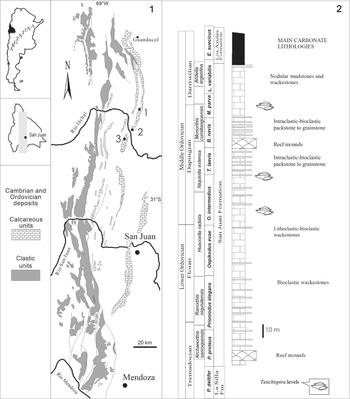
The gastropod samples were collected from exposures of the San Juan Formation in the Cerro Viejo, Cerro La Silla, and Cerro Cumillango localities (Fig. 1.1). The material described is restricted to the Niquivilia extensa and the base of Monorthis cumillangoensis brachiopod zones, which, according to the associated conodonts, can be referred confidently to the Oepikodus evae (upper part), Oepikodus intermedius, Tripodus laevis, and Baltonodius navis zones, of late Floian–early Dapingian age (Lower/Middle Ordovician) (Benedetto, Reference Benedetto2001) (Fig. 1.2). The fossil assemblage is dominated by brachiopods (mainly orthids and leptellinids), sponges, trilobites, encrusting receptaculitids, bryozoans, and gastropods. This association was referred by Carrera et al. (Reference Carrera, Sánchez, Benedetto, Kraft and Fatka1999) and Carrera (Reference Carrera2001) to the leptellinid-dominated biofacies, which flourished in a middle ramp setting (Cañas, Reference Cañas, Ramos and Keppie1999; Carrera, Reference Carrera2001).
(1) Map of the study area including the Early Ordovician marine localities at the San Juan Formation, Precordillera Argentina: 1, Cerro Viejo locality; 2, La Silla locality; 3, Cerro Cumillango locality. (2) Vertical distribution of the collected material in a composite column of the San Juan Formation.

The San Juan Formation is a muddy fossiliferous carbonate unit developed on top of a Cambrian–Lower Ordovician carbonate platform succession (Cañas, Reference Cañas, Ramos and Keppie1999). Skeletal wackestones and packstones intercalated with storm-related intraclastic grainstones are the most conspicuous lithologies in the gastropod interval (Fig. 1.2). Frequent centimeter-thick, lithoclastic-bioclastic grainstone and rudstone beds interpreted as storm layers usually have sharp, irregular erosive bases developed on top of underlying wackestone (Cañas, Reference Cañas, Ramos and Keppie1999). Above, amalgamated medium-bedded lithoclastic-bioclastic grainstone, packstones, or intraclastic rudstone occur in the Monorthis cumillangoensis brachiopod zone, associated with sponge algal reef-mounds (Cañas, Reference Cañas, Ramos and Keppie1999; Cañas and Carrera, Reference Cañas, Carrera and Benedetto2003).
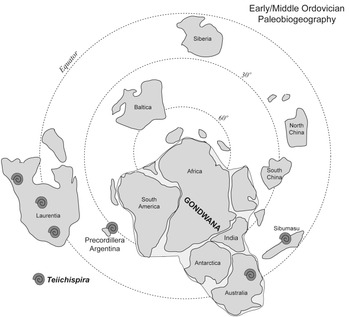
The Argentine Precordillera records a particular paleogeographical history. During the Cambrian (Furongian) and Middle Ordovician, the Precordillera or Cuyania Terrane drifted away from Laurentia and located within the southern Iapetus Ocean (Fig. 2) until its final docking with western Gondwana during the Late Ordovician (Astini et al., Reference Astini, Benedetto and Vaccari1995; Benedetto et al., Reference Benedetto, Sánchez, Carrera, Brussa, Salas, Ramos and Keppie1999; Benedetto, Reference Benedetto2004; Keller, Reference Keller, Derby, Fritz, Longacre, Morgan and Sternbach2012).
Paleobiogeographical map showing the distribution patterns of the genus Teiichispira during the Early/Middle Ordovician worldwide (modified from Cocks and Torsvik, Reference Cocks and Torsvik2002, and Bertero, Reference Bertero2009).

Materials and methods
The gastropod material described here was collected during the last two decades by V. Bertero and M. Carrera in several fieldtrips to the San Juan Formation outcrops (Huacoella–Niquivilia and Monorthis zones) of a Dapingian age (Lower/Middle Ordovician) (see above). The stratigraphical sections for the localities were constructed by M. Carrera, indicating the fossiliferous levels where the Teiichispira material was found (Fig. 1.2).
Specimens were prepared by V. Bertero at the CIPAL-CICTERRA laboratory using mechanical and chemical methods. The specimens were coated with ammonium chloride sublimated to enhance sculpture details for photography. Photographs were taken using a Leica binocular microscope (MZ7 and S6D).
Repository and institutional abbreviation
The specimens are housed in Centro de Investigaciones en Ciencias de la Tierra (CICTERRA) repository, Universidad Nacional de Córdoba, Argentina (CEGH-UNC).
Systematic paleontology
Superfamily Macluritoidea Carpenter, Reference Carpenter1861
Family Macluritidae Carpenter, Reference Carpenter1861
Remarks
The present classification follows Bouchet et al. (Reference Bouchet, Rocroi, Hausdorf, Kaim, Kano, Nützel, Parkhaev, Schrödl and Strong2017). These authors included the Superfamily Macluritoidea and Family Macluritidae within the “Paleozoic Basal Taxa that are certainly Gastropoda” (Bouchet et al., Reference Bouchet, Rocroi, Hausdorf, Kaim, Kano, Nützel, Parkhaev, Schrödl and Strong2017, p. 333). Frýda and Rohr (Reference Frýda, Rohr, Webby, Paris, Droser and Percival2004) pointed out that members of Macluritoidea lived in warm, shallow marine waters in both carbonate and siliciclastic facies and are known from all Ordovician paleocontinents that were situated in tropical regions. The Macluritoidea are restricted to the Ordovician and reached their highest diversity in the early Middle Ordovician. Toward the mid-Darriwilian (late Middle Ordovician), Macluritoidea generic diversity dropped rapidly and the superfamily became extinct toward the latest Ordovician (Frýda and Rohr, Reference Frýda, Rohr, Webby, Paris, Droser and Percival2004). According to Wagner (Reference Wagner2002) and Frýda et al. (Reference Frýda, Nützel, Wagner, Ponder and Lindberg2008), species within this superfamily typically are diagnosed by a base formed from a posteriorly projected inner margin, nearly planispiral to visually dextral coiling, open-coiled and heterostrophic early shell, a shallow V-shaped sinus, and a sharp thin peripheral band located on top of the aperture. Another diagnostic character is the change in shape of the aperture during ontogeny. Wagner (Reference Wagner2002) also pointed out that a horn-shaped calcified operculum with a handle-like knob diagnoses Teiichispira and more-derived macluritid species. The Family Macluritidae is mostly represented by genera restricted to the Ordovician (Frýda et al., Reference Frýda, Nützel, Wagner, Ponder and Lindberg2008) with a cosmopolitan paleobiogeographical distribution. In the Argentinean Precordillera, the genera Teiichispira and Maclurites are known probably as a result of the extensive record and good preservational conditions in which their opercula are found. Carrera (Reference Carrera1999) reported the occurrence of Maclurites and Teiichispira (Teiichispira argentina Carrera, Reference Carrera1999) from the Early Ordovician of the Argentine Precordillera (see below). Rohr et al. (Reference Rohr, Beresi and Yochelson2001) mentioned a possible occurrence of Teiichispira in the Early Ordovician of South America.
Genus Teiichispira Yochelson and Jones, Reference Yochelson and Jones1968
Type species
Teiichispira kobayashi Yochelson and Jones, Reference Yochelson and Jones1968, from the Early Ordovician of Malaysia.
Other species
Monitorella auricula Rohr, Reference Rohr1994; Teiichispira odenvillensis Yochelson and Jones, Reference Yochelson and Jones1968 (according to Wagner, Reference Wagner2002).
Occurrence
North America, Malaysia, Australia, and Argentina; Lower/Middle Ordovician.
Remarks
The phylogenetic analysis of Wagner (Reference Wagner2002) showed that Teiichispira is a paraclade composed of species with juvenile whorls similar to that of adult Macluritella, but with apertures becoming more lenticular during ontogeny. The diagnosis of Teiichispira was originally based on the operculum (Yochelson and Jones, Reference Yochelson and Jones1968; Wagner, Reference Wagner2002), although providing a characterization of the genus based entirely on shell features. Representatives of Teiichispira are “slowly expanding hyperstrophic gastropods having a steeply inclined, moderately high outer whorl face, distinct sutures, and an elongate, curved, calcified operculum. Apical cavity deep with smooth, slightly arched walls. Outer whorl face steep except for rounded basal angulation where it curves strongly inward. Basal sutures distinct. Operculum elongate, slightly torted, with a sharply carinate upper surface; composed of elongate polygonal to rounded tubes” (Yochelson and Jones, Reference Yochelson and Jones1968, p. 7).
The genus Teiichispira has a wide paleobiogeographical distribution restricted to tropical and subtropical regions (Ebbestad et al., Reference Ebbestad, Frýda, Wagner, Horný, Isakar, Harper and Servais2014). It has been reported in North America (Yochelson and Jones, Reference Yochelson and Jones1968; Yochelson, Reference Yochelson1992), Australia and Malaysia (Gilbert-Tomlinson, Reference Gilbert-Tomlinson1973; Yu, Reference Yu1993) and in South America (Carrera, Reference Carrera1999; Bertero, Reference Bertero2009) (Fig. 2).
Teiichispira teresae new species
Figure 3.1–3.8
- Reference Bertero2020
Teiichispira n. sp.; Bertero. p. 62, pl. 4, figs. 7–9.
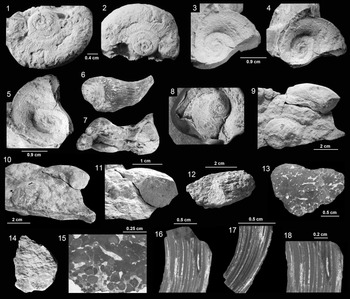
(1–8) Teiichispira teresae n. sp. from the Early Ordovician, San Juan Formation, Precordillera Argentina. (1, 2) Holotype, CEGH-UNC 24767, basal views; (3–5) paratype, CEGH-UNC 24766, apical views; (6) paratype, CEGH-UNC 24768, operculum; (7) holotype, CEGH-UNC 24767, lateral and apertural views; (8) paratype, CEGH-UNC 24769, apical view. (9–18) Teiichispira argentina (Kayser, Reference Kayser1876) from the Early Ordovician, San Juan Formation, Precordillera Argentina. (9–11) CEGH-UNC 23196, operculum and associated shell in life position, apical and lateral views; (12, 14) CEGH-UNC 23198, CEGH-UNC 23199; (13, 15) CEGH-UNC 3599, thin sections of the operculum in transversal views; (16–18) CEGH-UNC 23198, thin sections of the same operculum in longitudinal views, showing irregular, longitudinal tubes (new photographs and different views of the sectioned material published in Carrera, Reference Carrera1994).

Paratypes
Four specimens preserved as composite internal molds, counterparts and operculum. One specimen shows fragmentary external shell features and ornamentation; CEGH-UNC 24766, 24768–24770.
Diagnosis
Planispiral, low-spired shell; teleoconch with four whorls, last whorl markedly expanded; base flattened; umbilical angle of 85–90°; growth lines orthocline in the outer whorl surface, prosocline to opisthocline on the basal surface, and repeating this pattern until the deepest umbilical area; apical cavity deep with regularly spaced spiral cords; operculum elongated with a horn-like shape.
Occurrence
Cerro Cumillango locality, San Juan Formation, San Juan Province, Argentina; Middle Ordovician (Dapingian; Niquivilia extensa–Monorthis cumillangoensis brachiopod zones, Oepikodus intermedius–Baltonodius navis conodont zones; Fig. 1.2).
Description
Dextral, phaneromphalous, planispiral to lenticular, low-spired and small-sized shell; height 19–35 mm; width 7–13 mm. Teleoconch consists of about four whorls, with the last whorls markedly expanded. Suture is deeply impressed. Base is flattened with an umbilical angle of 85–90°; outer part of basal whorl surface slightly rounded. Growth lines orthocline in the outer whorl surface but curving abruptly to prosocline toward the basal surface; then changing again to opisthocline and repeating this pattern until the deepest umbilical area. Apical cavity deep and ornamented by regularly spaced spiral cords. The operculum is elongated, curved, with a horn-like (or nail-like) shape, with the upper edge sharply angulated (Fig. 3.6).
Etymology
In memoriam to Dr. Teresa M. Sánchez (University of Córdoba, Argentina).
Remarks
According to the original diagnosis proposed by Yochelson and Jones (Reference Yochelson and Jones1968), the new species here described represents a true member of the genus. Teiichispira teresae n. sp. is very similar in ornament pattern (opisthocline to orthocline collabral lines) to the type species Teiichispira kobayashi Yochelson and Jones, Reference Yochelson and Jones1968 (p. 8, pl. 1, figs. 2–8), from the Early Ordovician of Malaysia, although the new form differs in having a much wider umbilical angle. Teiichispira teresae n. sp. differs from Teiichispira cornucopiae Gilbert-Tomlinson, Reference Gilbert-Tomlinson1973, in expanding at a faster rate, resulting in a lower-spired shell. Teiichispira? sylpha (Billings, Reference Billings1865) (Yochelson and Jones, Reference Yochelson and Jones1968, p. 12, pl. 1, fig. 1), also from the Early Ordovician of Malaysia, has a higher and more steeply inclined outer whorl face, a narrower and deeper apical cavity, and a flattened base without prosocline and opisthocline collabral elements. Teiichispira sp. (Laurie, Reference Laurie1997, p. 714, pl. 11, fig. 4), from the Early Ordovician of Western Australia, is represented by unsilicified opercula that are very similar in shape to the one here described for Teiichispira teresae n. sp.; however, the teleoconch details of Teiichispira sp. are not documented. Teiichispira cornucopiae Gilbert-Tomlinson, Reference Gilbert-Tomlinson1973, from the Ordovician of Australia, differs from the new species in having a slightly faster translation rate of the shell during growth resulting in a slightly higher teleoconch. According to Yu (Reference Yu1993), Teiichispira cornucopiae is probably conspecific with Teiichispira kobayashi.
Teiichispira argentina (Kayser, Reference Kayser1876)
Figure 3.9–3.18
- Reference Kayser1876
Monticulipora argentina Kayser, p. 13, pl. 5, figs. 8, 8a, 9.
- Reference Carrera1994
Fiscella argentina (Kayser); Carrera, p. 198, pl. 1, figs. 2, 3, 5–9.
- Reference Carrera1999
Teiichispira argentina (Kayser); Carrera, p. 92, fig. 1A.
Holotype
The original description of Monticulipora argentina Kayser, Reference Kayser1876 (p. 13, pl. 5, figs. 8, 8a, 9) does not provide the holotype number. The holotype is most probably housed in the repository of the Museum für Naturkunde (Berlin, Germany), although it has not been found so far. We suggest keeping the Teiichispira argentina holotype information as stated in the present manuscript until further data are available.
Occurrence
Niquivil, Cerro la Chilca, Cerro Viejo, Huaco, and Cerro Cumillango localities, San Juan Formation, San Juan Province, Argentina; Lower/Middle Ordovician (Floian–Dapingian; Huacoella radiata–Niquivilia extensa brachiopod zones, Oepikodus evae–Oepikodus intermedius–Baltonodius navis conodont zones; Fig. 1.2).
Description
The teleoconch is fragmentary and consists of about three whorls, with the last whorls markedly expanded. The apical cavity is slightly deep without ornamentation. Characters of the base are missing. The elongated, horn-like to unguiculate (nail-like) curved operculum consists of longitudinal tubes; it has a sub-oval shape in cross section with a height of 20 mm, a width of 25 mm, and a length of 65 mm.
Material
Four fragmentary opercula CEGH-UNC 23279, 23197–23199. Operculum and associated shell in life position CEGH-UNC 23196
Remarks
Teiichispira argentina has been reported from the Early Ordovician of Argentina (see Carrera, Reference Carrera1999). The specimen here described was found with the operculum in life position in the teleoconch, allowing a complete description of the species. Teiichispira argentina differs from T. teresae n. sp. in having a less deeply impressed apical cavity and in lacking the regularly spaced spiral cord in the apical cavity.
Discussion
Most early Paleozoic gastropods had bipectinate gills, so they were effective filter feeders inhabiting clear shallow waters (Rohr, Reference Rohr, Gray and Boucot1979; Peel, Reference Peel1984). Yochelson (Reference Yochelson1992) suggested that Teiichispira most probably had an extended planktotrophic larval stage allowing a widespread distribution during the Early Ordovician. An interesting pattern that emerged from paleobiogeographical studies with Teiichispira as an example is that extremely shallow-water faunas living in a high-stressed environment are excellent fossils for intercontinental correlation (Yochelson, Reference Yochelson1992).
The macluritids are conspicuous elements in Ordovician limestones worldwide and Yochelson (Reference Yochelson1992) suggested a tropical carbonate distribution for this taxon. Ordovician genera, such as the large planispiral macluritoids, were interpreted to be sedentary filter feeders resting directly over the substrate with the more-flattened shell side facing the sediment surface. Teiichispira was considered to be a grazer in a broad sense rather than a strict herbivore. This interpretation was based on finding a Teiichispira operculum associated with a large number of sponges (Yochelson, Reference Yochelson1992).
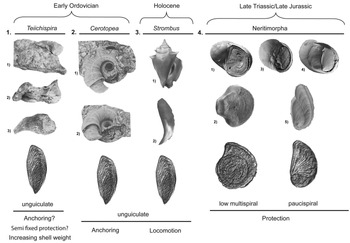
Less-abundant Ordovician trochospiral forms were probably herbivores with high mobility (Rohr, Reference Rohr, Gray and Boucot1979, Reference Rohr1994). Bertero (Reference Bertero2020) recognized an important diversity of gastropod morphotypes in the San Juan Formation of the Argentine Precordillera, with the vertical distribution of morphotypes seemingly related to paleoenvironmental conditions. The planispiral gastropod morphotype (Maclurites, Teiichispira, Lytospira) mainly is concentrated in the middle part of the San Juan Formation (late Floian–early Dapingian levels), in shallow subtidal paleoenvironments that had very low sedimentation rates, coincident with a high sea level stand. An important variety of isolated gastropod operculum also has been reported in these levels, as have the largest individual teleoconch sizes (up to 30 cm in shell diameter). This record also includes simple discoid opercula covering the shell aperture with concentric growing lines or “nail-like” opercula consisting of parallel tubes. Both morphologies are typical of the macluritoid opercula. Simone (Reference Simone2020) classified the nail-like type of operculum as “unguiculate” (Fig. 4.1), which is elongated with a terminal inferior nucleus from which successive commarginal sculpture begins. This operculum shape fits the aperture in many modern Caenogastropoda taxa (e.g., Cerithioidea, Stromboidea, Buccinoidea) (Fig. 4.3).
Disposition, morphology, and possible functions of the opercula in different gastropod taxa across the Phanerozoic. (1) Early Ordovician Teiichispira: 1. Teiichispira argentina (Kayser, Reference Kayser1876); 2. Teiichispira teresae n. sp.; 3. Unguiculate operculum of Teiichispira teresae n. sp.; (2) Early Ordovician Ceratopea: 1, 2. Ceratopea unguis Yochelson and Bridge, Reference Yochelson and Bridge1957, life association of the shell and unguiculate operculum (taken from Rohr et al., Reference Rohr, Fix and Darrough2004); (3) Holocene Strombus: 1. Strombus pugilis Linnaeus, Reference Linnaeus1758 (taken from the www.marinespecies.org); 2. unguiculate operculum Strombus pugilis (taken from Simone, Reference Simone2005); (4) Late Triassic/Late Jurassic Neritimorpha: 1. Late Triassic Fedaiella neritacea (Münster, Reference Münster, Wissmann and Münster1841) with the low multispiral operculum in place (taken from Bandel, Reference Bandel2007); 2. Late Jurassic Neritopsis subvaricosa Brösamlen, Reference Brösamlen1909, operculum with an adaxial projection (taken from Kaim and Sztajner, Reference Kaim and Sztajner2005); 3. Middle Jurassic Neridomus sp. with the paucispiral operculum in place (taken from Bandel, Reference Bandel2008); 4. Recent Smaragdia Issel, Reference Issel1869, with the paucispiral operculum in place showing close resemblance to the Jurassic Neridomus (taken from Bandel, Reference Bandel2008); 5. paucispiral operculum of the recent Neritina corona (Linnaeus, Reference Linnaeus1758) (taken from Bandel, Reference Bandel2008). Note that the characterization of the unguiculate, low-multispiral, and paucispiral opercula shown in the bottom of the figure were extracted and modified from Simone (Reference Simone2020).

Elongated opercula protruding from the shell aperture are peculiar forms that are common in the typical North American Ceratopea unguis Yochelson and Bridge, Reference Yochelson and Bridge1957 (in Rohr et al., Reference Rohr, Fix and Darrough2004, p. 219, fig. 1.6, 1.7) with growth lines parallel to the aperture (Fig. 4.2). In Teiichispira, the elongated opercula consist of tubes that are perpendicular to the shell aperture (Figs. 3.13, 3.15–3.18, 4.1).
Discovery of a Teiichispira operculum in life position relative to the shell allows interpretation of its position in relation to the teleoconch and therefore its possible function. In gastropods with the usual laminar operculum, the former is carried immediately behind the shell. This laminar operculum, which is present in several macluritid genera (Knight, Reference Knight1952), may be interpreted simply as protection. Rohr and Yochelson (Reference Rohr and Yochelson1999) supported the idea that the operculum of Maclurites in life position extended downwards below the plane of the lower surface of the shell. This condition suggested that if the massive operculum had a purpose, it might have acted as an anchor to avoid movements in the bottom by currents (Rohr and Yochelson, Reference Rohr and Yochelson1999). Thus, the horny appearance of the Teiichispira operculum may be indicating additional functions other than protection.
Teiichispira was interpreted to be a snail that did not move actively, but occasionally was able to change its position in comparison to Maclurites (Yochelson, Reference Yochelson1992). Yochelson (Reference Yochelson1992) based this interpretation on the larger number of whorls in the shell of Teiichispira. Consequently, the soft parts of Teiichispira would have been longer and therefore capable of greater extension outward from the aperture. It is theoretically possible that the animal could have pushed its operculum into the sediment and then pull itself forward, like the escape behavior of living Strombus. Although the shape of the operculum is somewhat better suited for that activity than the more plate-like operculum of Maclurites, this specialized behavior most probably was unlikely in Teiichispira (Yochelson, Reference Yochelson1992). Thus, Yochelson (Reference Yochelson1992) argued that the primary function of the operculum in Teiichispira may have been to provide a relatively heavy weight that allowed the animal to live in shallow marine environments where the water is continuously or periodically agitated.
Gilbert-Tomlinson (Reference Gilbert-Tomlinson1973) proposed a locomotion function by digging the tip of the operculum into the sand and extending the foot, in the same way as some modern gastropods (e.g., Strombus, Pugilina; Fig. 4.3). The hypothesis of locomotion could be a plausible explanation for such a structure carried out by a planispiral gastropod. Another possibility is that the shape and position of the operculum would have allowed the tip of the operculum to drop below the level of the base of the shell (Fig. 4.1–4.3), which then might have acted as an anchoring structure on the sandy bottom when the animal was retracted, as was suggested for Maclurites by Rohr and Yochelson (Reference Rohr and Yochelson1999).
The functions mentioned above could have been plausible in Teiichispira at the time we found its opercula associated with the shell. However, in the anatomical position shown in the specimen illustrated in Figures 3.9–3.10 and 4.1, the nucleus (sharper portion) of the operculum is preserved inside the shell and the elongated operculum expands and grows toward the aperture (covering or occupying the last third of the conch whorl). This is a reverse and opposing position from those shown in the gastropod opercula described in the literature (e.g., Ceratopea) and even in recent forms (Strombus, Pugilina).
Triassic and Jurassic shallow water gastropods with well-known opercula represent the clade Neritimorpha. Late Triassic Neritimorpha from the St. Cassian Formation (Carnian) (e.g., Cassianopsis, Neritopsis, Culubrellopsis, Zariniopsis; Bandel, Reference Bandel2007, Reference Bandel2008) lived in or near the reefs, which consisted of algal mats, calcareous and stromatoporoid sponges, and corals, with their outer margins facing the open tropical Tethyan Ocean (Wendt, Reference Wendt1982; Bandel, Reference Bandel2007) (Fig. 4.4). Teiichispira was commonly found in similar marine paleoenvironments during the Early Ordovician, although the operculum of the Mesozoic Neritimorpha is quite different from that of Teiichispira because it had a trapezoidal shape, with an adaxial (inner) projection that fit into the inner lip of the aperture (Kaim and Sztajner, Reference Kaim and Sztajner2005; Bandel, Reference Bandel2007) (Fig. 4.4). The opercula of neritimorphs were mostly low-multispiral or paucispiral in shape, with the nucleus slightly dislocated inferiorly (low multispiral) or located in the inferior third (paucispiral) (Simone, Reference Simone2020) (Fig. 4.4). Apparently, these operculum morphologies, together with the adaxial projection fitting into the inner lip of the aperture, could had led to the evolutionary success of the recent Neritimorpha through strengthening of the aperture closure to prevent predatory attacks and desiccation during low tides (Kaim and Sztajner, Reference Kaim and Sztajner2005).
The functional constraint of the operculum that is interpreted here for Teiichispira is most probably related to a fixed and sedentary mode of life. Hence, the questions that arise, according to the opercula disposition in the Teiichispira teleoconch, are related to the possibility that the gastropod developed a partially fixed operculum composed of open calcareous tubes in their sedentary and filter-feeding adult life. The morphology of the Teiichispira operculum implies several functions, including anti-predatory protection, environmental isolation under stressful conditions, a relatively heavy weight of the shell allowing the animal to live in shallow marine environments, and a way for facilitating locomotion and anchoring to soft substrates in order to keep the shell from being moved by currents.
Conclusions
The recovery of well-preserved macluritid gastropods with associated opercula allowed the identification and description of a new species, Teiichispira teresae n. sp., and a more-complete description of Teiichispira argentina (Kayser, Reference Kayser1876), which was based on some isolated opercula from the Early Ordovician of the Argentine Precordillera (Carrera, Reference Carrera1999).
The horny or nail-like appearance (“unguiculate”) of the Teiichispira operculum and its recovery associated in life position relative to the shell supply interesting information for interpreting functional constrains of the operculum. The most plausible functions of the operculum and mode of life suggested here for Teiichispira are protection under predatory attacks and environmental pressure, provision of extra weight to the shell in shallow marine environments where agitated waters were dominant, and supplying of extra locomotion assistance in soft substrates.
The paleobiogeographical distribution of this Early/Middle Ordovician gastropod genus confirms its restriction to the tropical shallow carbonate platforms.
Acknowledgments
We acknowledge support from CONICET (PIP 2021-2023 DD787 Cod F81643) to M. Carrera. We are deeply grateful to R.B. Blodgett (Blodgett and Associates, Anchorage, Alaska, USA), D.M. Rohr (Sul Ross State University, Alpine, Texas, USA), and S. Zamora and J.-O. Ebbestad (editors of the Journal of Paleontology) for their valuable comments. This is a contribution for the IGCP 735 Rocks and the Rise of the Ordovician life: Filling knowledge gaps in the Early Paleozoic Biodiversification.
Declaration of competing interests
The authors declare none.