Introduction
Social policies in post-Mao China have changed dramatically in order to enhance market competition, increase economic efficiency, and accelerate economic growth. After approximately two decades of the state retreating from social welfare provision, a new chapter for Chinese social policy development was opened in 2002–03 as a result of the political leadership succession. Since then, social policy, or ‘people's livelihood policy’ in official jargon, entered a period of rapid expansion.
This article examines this rapid expansion of social policy and explores the driving force behind it. In doing so, it analyses the changes in China's social policy since the post-Mao era, especially since 2003, by comparing the roles of the state in different stages of social policy development. Since the 1990s, the wide application of the policy paradigm theory (Hall, Reference Hall1993) in public policy analysis has made it a popular approach for analysing policy change. Based on the policy paradigm theory, an analytical framework is developed to address the critical question: how did social policy and the role of the state change in China? And, more specifically, can we account for the driving forces behind the changes from a ‘state-centrism’ perspective?
Policy paradigm and paradigm shift
Originally developed by Thomas Kuhn to describe long-term conceptual frameworks in the natural sciences (Kuhn, Reference Kuhn1970), the notion of paradigms has been widely applied in the social sciences in general, and in policy sciences in particular. In his study of the learning process in public policy-making, Hall introduced the concept of policy paradigm to refer to ‘a framework of ideas and standards that specifies not only the goals of policy and kind of instruments that can be used to attain them, but also the very nature of the problems they are meant to be addressing’ (Hall, Reference Hall1993: 278).
A policy paradigm is a powerful force for maintaining policy stability. However, a once stable paradigm might begin to weaken if it ceases to adequately provide solutions for problems. This can lead to a shift of paradigm. Kuhn defined a paradigm shift as a new conceptual tradition, a radical change in interpretation, whereby science takes a wholly new and changed perspective toward an area of knowledge and activity (Kuhn, Reference Kuhn1970).
A paradigm shift is initiated by events that prove anomalous within the terms of the prevailing paradigm. As such anomalies accumulate, policymakers alter instrument settings and experiment with new policy instruments as they try to correct the problem. If these efforts fail, policy failures occur, which discredit the old paradigm and lead to a wide-ranging search for alternatives and to experimentation with policy modifications (Oliver and Pemberton, Reference Oliver and Pemberton2003). In essence, the paradigm shift is a wider contest between competing paradigms. Such a contest ‘will end only when the supporters of a new paradigm secure positions of authority over policymaking and are able to rearrange the organization and standard operating procedures of the policy process so as to institutionalize the new paradigm’ (Hall, Reference Hall1993: 281).
The political and economic context of developments in social policy and the role of the state
As an intellectual framework embedded in the minds of policymakers, a policy paradigm governs not only the goals of policy and the choice of instruments and settings to achieve these goals, but also policymakers’ perceptions of the very problems they are meant to be addressing (Oliver and Pemberton, Reference Oliver and Pemberton2003). In other words, a policy paradigm represents a framework for policy action, and it can be identified in terms of how policymakers set policy goals, choose policy instruments and define policy problems. Using Hall's policy paradigm theory, this section illustrates the developments and features of China's social policy since 2003 by comparison with the period of market-oriented economic reforms (from 1978 to 2002).
Rolling back the state: Chinese social policy in the market transition
Before economic reform, China established a state-led socialist welfare system based on the public ownership of the means of production and the planned economy, so as to develop an egalitarian society. Based on the socialist ideology of collectivism and equality (Wong, Reference Wong1998), the state monopolised the provision of welfare and services. Market and private enterprises were eliminated. The key providers of the state-led welfare system were communes in rural areas, and work units (danweis), especially the state-owned enterprises (SOEs), in cities (Leung and Nann, Reference Leung and Nann1995).
Given the economic backwardness and poor economic performance in Mao's era, the post-Mao leadership, led by Deng Xiaoping, shifted the focus from class struggle to economic growth in 1978, when the reform and open-door policy was launched, introducing market mechanisms in place of the traditional socialist planned economy. From the early 1990s, reforms aimed to transform SOEs into modern enterprises compatible with the requirements of a market economy, and so social welfare programmes such as pensions, housing, healthcare, and education were gradually separated from the commercial activities of SOEs. In other words, SOEs no longer provided generous packages of welfare and benefits to their employees. Meanwhile, in order to pursue economic growth, the Chinese government formulated a guideline of ‘efficiency first, equity second’, and the pursuit of economic growth turned into a GDPism (economic growth worship) as economic prosperity became the key source of the legitimacy of the government.
To support the reforms of SOEs and minimise the fiscal burden placed on the state, the government took many measures to reduce welfare expenses, minimise the welfare commitments of SOEs and privatise public services. Public money for public services such as education and healthcare was reduced gradually. To help contain the cost of public services, government departments, SOEs and service providers in the public sectors were encouraged to make use of market mechanisms in service provision. As a result, marketisation became a key trend in the main sectors of public services (Wong and Flynn, Reference Wong and Flynn2001). The market-oriented economic reforms and marketisation of public services brought about uncertainties and risks to many thousands of people, especially those working in the SOEs. However, there were no well-organised and comprehensive policies for tackling the negative social consequences brought about by the economic reforms. From a social policy perspective, the market-oriented economic reforms restructured China's social policy framework and dismantled the state-led socialist welfare system (Chan et al., Reference Chan, Ngok and Phillips2008).
So far we have a picture of the social policy paradigm in China's transitional period of market-oriented economic reforms (1978–2002), where, putting a high value on pragmatism and the pursuit of economic efficiency, the state retreated to a large extent from the traditional paternalistic welfare system, forcing enterprises and most individuals to bear most of the responsibilities for social welfare and services. Some scholars thus applied the concept of ‘welfare pluralism’, or ‘socialisation’, to characterise this new paradigm (Leung and Nann, Reference Leung and Nann1995; Wong and Macpherson, Reference Wong and Macpherson1995; Lee, Reference Lee2000; Wong and Flynn, Reference Wong and Flynn2001). In order to alleviate the financial burden, marketisation became the theme of policy tools during this period. To facilitate the large-scale reform of SOEs, the state vigorously promoted social insurance-based social security reform. As a result, social policy was reduced to a passive position, subservient to GDP growth.
Social injustice, the accumulation of anomalies and the SARS crisis
Since the 1980s, the diversification of diversification of social welfare providers has seemingly become an inevitable trend in developing and transitional countries. However, this measure was introduced in China so quickly that some people who could not keep up with the pace of reforms became increasingly vulnerable. Social policy reform in this period released the state from the heavy responsibilities of ‘care’, but exacerbated social divisions and generated social injustice (Liu and Wu, Reference Liu and Wu2006; Saunders and Sun, Reference Saunders and Sun2006). As Shi (Reference Shi2009: 49) puts it: ‘When these new social problems needed more concern from the state, it weirdly retreated and shrugged off the responsibility to enterprises and individuals, making the issues of social inequality and poverty more serious.’
With the retreat of the government from welfare and service provision, low-income citizens, mainly unemployed urban people, rural–urban migrant workers, and farmers could not afford to pay for various welfare services. The phrase ‘the new three mountains’ (xin sanzuo dashan) was coined to indicate the heavy financial burden carried by Chinese citizens in the basic service sectors of education, healthcare and housing. Patients without money were rejected by hospitals, and students with economic hardship were not allowed to go to schools and universities. Such miserable stories attracted wide media coverage in China from the mid-1990s, and the grievances of those who lost ground as a result of the economic reform process led to widespread instances of civil unrest in China. To alleviate the anomalies and maintain social and political stability, some policy adjustments were made. A new scheme, tax for fee, was introduced in rural China, aimed at abolishing all taxes levied by township and village councils and replacing them with a national tax not to exceed 5 per cent of household income. More money was invested in the national scheme for a minimum income guarantee that operated as a public income maintenance system for laid-off workers and the urban poor (Wong and Ngok, Reference Wong and Ngok2006). In order to narrow regional disparities, the strategic policy of Opening up the West (xibu da kaifa) was implemented in 2000. Nevertheless, worsening development conditions resulting from the current policy paradigm in China had been accumulating.
The outbreak of the SARS epidemic in 2003, an unprecedented public crisis, revealed the deep problems China had inherited from its previous policy paradigm (Ngok, forthcoming). In this sense, the outbreak of SARS functioned as a triggering event to initiate policy change. As a result, some new policy ideas, such as ‘putting people first’, ‘harmonious society’, and ‘service-oriented government’, were formulated. In line with this new direction, more and more social policies were introduced and implemented by the central government.
Bringing the state back in: social policy expansion since 2003
As mentioned above, at the institutional dimension, China had tried to separate administration from enterprises during the period of economic reform, and turned to market forces to determine the objects of social policy and their treatments, dubbed ‘welfare run by the society’ (shehui ban fuli) by the Ministry of Civil Affairs (Wong and Walker, Reference Wong and Walker1998: 49). As Xiong (Reference Xiong1999: 67) argues, ‘this is an economic strategy . . . which, in essence, shrugs off the liability to provide the necessary materials to meet welfare needs for citizens’. Moreover, it also exerts an impact on civil rights. China's economic development marketisation has undoubtedly been a success. However, for social policy, the market failures have been substantial and cannot be solved by economic sectors or social sectors alone. The SARS crisis underlined this, for it revealed not only problems in the area of public health services, but also in the entire welfare system and the mode of socio-economic development.
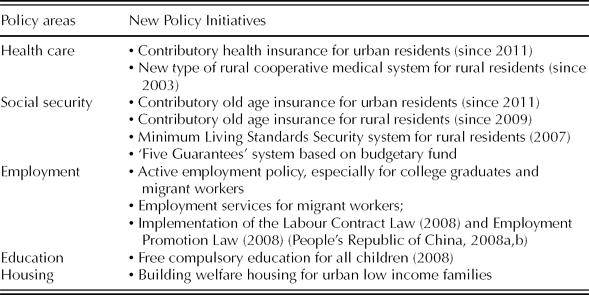
After the SARS crisis an array of social policy initiatives were launched (see Table 1). By analysing the Work Report of the Central Government (2004–2012) (State Council of the People's Republic of China, 2004–2012), it can be shown that the government has paid much more attention to the subject matter of ‘people's livelihood’, or ‘people's wellbeing’, and more social policy areas have gained a place at the top of the government agenda. Since 2003, a leap-forward in China's development of social policies is easily observable. As new changes have taken place in the field of social welfare, such as welfare philosophy, policy subjects and the distribution of responsibilities, it seems a new social welfare model has been taking shape.
Social policy expansion in China since 2003

First, the responsibility of the government in welfare provision has been reaffirmed. As many scholars have pointed out, the traditional Chinese concept of welfare was quite narrow (Leung and Nann, Reference Leung and Nann1995; Wong, Reference Wong1998; Wang, Reference Wang2009). Based on this narrow sense of welfare, China had established a typical residual social welfare system in Mao's era, which lasted into the post-Mao reform era (Leung and Nann, Reference Leung and Nann1995; Wong, Reference Wong1998). With the advent of ‘the era of people's livelihood’ (minsheng shidai) (Zheng, Reference Zheng2007: 54), the state has strengthened its role in providing social assistance, social insurance, education, employment and healthcare. With the expansion of social policy, the state has upgraded its goal for social welfare development. The old policy goal of ‘wide coverage’ and ‘low benefit level’ has been replaced by ‘full coverage’ and ‘moderate level of benefit’.
For example, a new comprehensive national Law on Social Insurance (2011), effective in July 2011, which ‘clearly and legally states the establishment of a basic pension, basic medical and social insurance system for work injury, unemployment, maternity and other’ (All-China Federation of Industry and Commerce, 2010; People's Republic of China, 2011). The changes in welfare perception and policy goals not only give rise to the expansion of social policy provision, but also redefine welfare responsibilities among the state, society, enterprises and individuals. On a similar note, the increasing role of the state in healthcare is significant. In April 2009, the central government unveiled a long-awaited policy document on healthcare system reform. The document declares that the government's role in ‘formulating policies and plans, raising funds, providing service, and supervising’ must be strengthened in order to ensure the fairness and equity of the service. It is the first time in the history of China that the government has promised to ensure fair and affordable health services for all 1.3 billion citizens. According to the document, China will have a basic healthcare system that can provide ‘safe, effective, convenient and affordable’ health services to urban and rural residents in 2020 (State Council of the People's Republic of China, 2009).
Second, relatedly, the government has strengthened its role in providing welfare services. Since 2003, the government has increased its role in social service provision. On 30 August 2007, China enacted the Employment Promotion Law. To enhance the skills of workers, it requires governments above the county level to support vocational training, and employers to provide pre-employment training, on-the-job training and reemployment training. In addition, government-run employment service agencies have to provide free services for job-seekers. In the area of education policy, from 2003 the issue of unequal education opportunities began to gain a place on the agenda of the central government, and some new initiatives promoted educational equality between cities and villages and between regions. In 2004, the central government decided to reduce and waive tuition fees and miscellaneous school fees for students in poor regions who were receiving compulsory education. In 2006, a new Law on Compulsory Education was enacted, which stipulates that China's compulsory education is free for students. In 2008, free compulsory education was extended to the whole country. As a result, a free compulsory education system has been realised in China. In the area of social assistance, the first decade of the new century witnessed rapid growth of the urban Minimum Living Standards Security System (MLSS). In 1999, only 2.65 million urban poor benefited from MLSS. This figure soared to 22.46 million in 2003. Since then, the total urban beneficiaries of the MLSS has remained at approximately 23 million. In December 2006, the central government decided to extend the MLSS to all rural areas in 2007. With strong policy pressure from the central government, the rural MLSS was set up nationwide within one year. While only 3.67 million of the rural poor benefited from the MLSS at this stage, the figure rose to 47.6 million in 2009 (Ministry of Civil Affairs, 2010).
Third, a conception of social citizenship has begun to emerge as the nature of the relationship between rights and obligations for different members in a welfare system has been redefined (Dwyer, Reference Dwyer2004). The proposal of China's ‘moderate institutional social welfare’ and the implementation of various welfare programmes, in a sense, are a kind of reaffirmation of social citizenship. In China's traditional welfare system, welfare benefits were bound with the household registration system (Hukou) that formed a type of ‘differentiated citizenship’ (Wu, Reference Wu2000, Reference Wu and Whyte2010). In this regard, Chinese migrant workers were undoubtedly a key focus of debate, some scholars pointing out that migrant workers have been deprived of social citizenship by the household registration system and market forces, and so excluded from the welfare system (Solinger, Reference Solinger1999; Wu, Reference Wu2000, Reference Wu and Whyte2010). The sufferings of migrant workers have been widely covered by the media, and one consequence of the media coverage is that migrant workers have become an important target group of social policy in recent years. For instance, the urban social insurance schemes have been extended to cover migrant workers, and some new labour policies were adopted to take care of migrant workers (for example, migrant workers are allowed to join official trade unions, and qualify for public employment services and government-sponsored vocational training programmes). In some cities, migrant workers were even given the status of ‘new citizens’.
In addition to creating acute pressures around migrant workers, the household registration system divided the whole population into two parts: urban residents and rural residents. Such a division not only differentiates social citizenship, but also renders China's welfare system with characteristics of ‘one country, two systems’ (Shi, Reference Shi2009). In recent years, due to the continuous loosening of the Hukou system and the promotion of regional integration of urban and rural development (chengxiang yitihua), the segregated social welfare system has started to become more integrated. Many social policies which were originally applied to cities and towns have been extended to rural areas, such as the Minimum Living Standards Security System, which was introduced in cities in the late 1990s and extended to rural residents in 2007. Some social insurance schemes have been implemented in rural areas, such as the New Agricultural Cooperative Medical System and the New Rural Pension Insurance.
In view of the difficulty of completely decoupling the Hukou and social welfare entitlement, central government has given local governments the power to carry out experiments in social security reforms. As a result, a trend of local activism has emerged and local welfare states have even developed. In some richer localities, local governments have taken initiatives to abolish the Hukou system and delink social welfare entitlements and Hukou status within their jurisdictions. Cases in point are Dongguan in Guangdong province, and Shenmu in Shannxi province. Dongguan city, a large centre for migrant workers in the Pearl River Delta, has provided universal health insurance and pension insurance for its residents, including migrant workers. Unlike other cities, Dongguan also offers the same health insurance scheme for civil servants, urban workers and farmers, i.e. one scheme for all. Shenmu county, a place with rich coal resources, has provided free medical care services for its residents. Within the Shenmu model of healthcare, local residents, no matter whether with urban or rural Hukou, are treated equally in terms of contributions, government subsidies and benefits. In such a local welfare state, key social security schemes, especially health insurance and pension insurance, are no longer based on Hukou status and employment status. The status of local residence establishes eligibility for local social insurance entitlements. In this sense, a local social citizenship is being established, and hence a local welfare state based on it is taking shape. Of course, limitations exist, as migrant workers are only recognised as workers rather than residents, so they are included only in the contribution-based social insurance programs and are excluded from means-tested social welfare programs. Many other localities are trying to develop an integrated social security system for urban and rural residents. In Guangdong, provincial authorities have planned to integrate the health insurance scheme for farmers with the health insurance scheme for urban residents. However, although the schemes are integrated, benefit levels for farmers and citizens are still differentiated, and the risk sharing level is still lower at the county level. Local initiatives and activism around the social security system are good for meeting local needs and identifying best practices. They imply a bottom-up mechanism in building up social citizenship in China, which can be seen as the first step to establishing a national concept of social citizenship (Ngok, Reference Ngok2010).
Fourth, a social policy oriented budgeting process has been taking shape in China. Under the policy guideline of ‘building a harmonious society’, the Chinese government has begun to place greater emphasis on expenditure, and the share of GDP allocated to social policy expenditure has increased significantly. For example, the percentage of GDP accounted for by total expenditure on employment and social security, education and healthcare, the three key social policy areas in China, was 4.69 per cent in 2003 but rose to 7.20 per cent in 2011. The growth is remarkable, representing two and a half percentage points of GDP within ten years when GDP itself was increasing rapidly. In 2001, government spending on social policy accounted for 4.8 per cent of GDP, rising to 8.0 per cent in 2011.
So far, by examining the different stages of social policy development since the initiation of the economic reform, we have observed a clear paradigm shift in China's social policy before and after 2003. Before 2003, in order to achieve economic development, the Chinese government followed a policy principle of ‘efficiency first, equity second’, and formulated an all-out economic development strategy. Under this GDP-oriented development mode, the state withdrew from welfare provision, and social policy was transformed as a tool for economic growth. However, although this GDPism brought about rapid economic growth, it also produced and accumulated many social problems which posed a great threat to social stability in China. In view of the social unrest that resulted from the lack of effective social policy, the new political leadership formed in 2002–03 formulated a ‘people first’ policy principle, and advocated a clearer balance between economic and social development. In so doing, the state has strengthened its role in welfare provision, and many new social policies have been implemented. As a result, a new policy paradigm that has brought the state back into social policy has emerged.
Many reasons have contributed to this policy paradigm shift. First, the negative social consequences brought about by the all-out development strategy in the reform era created large groups of vulnerable people. Second, the outbreak of the SARS epidemic functioned as a trigger event for the Chinese government and society to revisit the economic growth model practiced in the Chinese market transition. Third, the succession of China's ‘fourth generation’ of political leadership opened a ‘policy window’ for urgent policy changes. The ‘fourth generation’ of political leadership, led by Hu and Wen, needed policy changes to consolidate their authority and legitimacy. By formulating the ambitious goal of building a harmonious society, the leadership demarcated themselves from their predecessors (Ngok, Reference Ngok2009). Finally, after about three decades of rapid economic growth, China had accumulated a significant pool of wealth which enhanced the financial capacity of the Chinese government to provide more welfare and benefits to its people.
Conclusion
In the context of market transition, China's social policy experienced dramatic changes. Mao's state-dominated social policy regime began to fade away in the early 1980s, and the privatisation of SOEs and the declining role of the state in welfare financing and provision impacted adversely on ordinary people, especially low-income citizens. With the advent of the new century, along with the succession of the leadership of Hu and Wen, a fundamental policy change emerged in China which indicates that the state started to reposition its role in public welfare and social justice. Such a policy reorientation indicates a paradigm shift in China's social policy in the twenty-first century.
The policy paradigm theory provides a good analytical framework to describe the process of the changes in social policy in China in the market transition context, and the statism inhabited in the policy paradigm theory is helpful in explaining why social policy changed in China. Indeed, the policy paradigm theory inspires a state-centred analysis in examining social policy expansion in China. The key point of state-centrism is that the state does not necessarily and mechanically respond to the demands of society as suggested by classic functionalist theories of welfare state change and growth. Instead, the state possesses a certain independence. The structure of the state, capabilities and preferences will have a huge impact on society (Skocpol, Reference Skocpol, Evans, Rueschemeyer and Skocpol1985). State-centrism holds that managers of the state apparatus, politicians and civil servants, possess independence and autonomy in policy formulation and policy implementation, which is an important part in state autonomy.
China has a centralised administration system under the leadership of the Chinese Communist Party. This system possesses the features of official ideology-dominated government, consensus of elites and strong regulation of social activities which results in the distinct character of a ‘strong state’ in China. The will of the state, the ideas of the leadership, exert clear influence on policy. Strong state autonomy makes the ‘pursuit of specific national goals rather than the reactions of certain social groups, class or social interests’ possible (Skocpol, Reference Skocpol, Evans, Rueschemeyer and Skocpol1985). This has led to the development of a social policy process with a strong ‘state dominance’ character to it.
China has undertaken economic reform and market-oriented transformation since 1978. By the late 1980s, the state focused on economic efficiency and invested the majority of its revenue in economic development. Social policy was regarded as a tool for supporting economic reform. In the late 1990s, social problems became increasingly prominent, creating large groups of vulnerable people. The leadership succession in 2002–03 opened a ‘policy window’ for social policy changes (Breslin, Reference Breslin2008), and the outbreak of the SARS epidemic made China's ‘fourth generation’ of political leadership aware of the importance of social protection policy and social development. China's leaders began to rethink the development path and proposed a ‘scientific concept of development’ and ‘building a harmonious society’ as key objectives. Thus, social spending increased significantly and promoted the acceleration of social policy expansion. This indicates that the expansion of social policy is closely related to the perceptions of the ruling party and state leaders in China. Of course, economic development and the growth in revenue also increased the state's ability to develop social policy.
However, while this process of change has brought the state back in to social policy, currently there remain some important issues facing China's social policy. First, although the scope of beneficiaries of welfare services is expanding, service development is still at a low overall level that can only ‘guarantee the basics’ (bao jiben), and the welfare state has difficulty meeting the increasing welfare needs of residents. Second, following from this, expenditure on social policy as a proportion of GDP needs to increase further. Third, as mentioned above, in the process of gradual combination or integration of welfare systems between urban and rural areas, regional differences in the level of welfare are widening increasingly, and varying ‘welfare regions’ have begun to come into being, posing a challenge to territorial justice and social citizenship. Given that current central–local relations revolve around political centralisation and fiscal decentralisation, balancing the regional development of social policy is a thorny issue. Finally, it should be noted that the new development of social policy was triggered by the SARS crisis, driven by the central government in a top-down manner and closely related to the leadership's subjective perception. Whether this model is sustainable or whether China's social policy is able to keep expanding in the coming decades remains to be studied.
Acknowledgement
This research was carried out with the support of the Key Research Project (No. 11JJD840018) of the Key Research Bases for Humanities and Social Sciences, Ministry of Education, China.