Introduction
The ability of microorganisms to fix dinitrogen (N2) is of particular interest in meltwater ponds on the McMurdo Ice Shelf, where microbial mats form thick accumulations in ponds and lakes within an area of up to 104 m2 during the summer months (Howard-Williams 1990), as nitrogen sources are limited due to the prevalent low ratios of dissolved inorganic nitrogen and phosphorous. The fixed nitrogen input into these ponds is limited to recycled ammonium from sediments and snow/ice melt (Hawes et al. Reference Hawes, Howard-Williams and Pridmore1993, Howard-Williams & Hawes Reference Howard-Williams and Hawes2007).
Nitrogen concentrations in the interstitial fluids of the mats are much higher than in the water column (Howard-Williams et al. Reference Howard-Williams, Pridmore, Broady and Vincent1990, Howard-Williams & Hawes Reference Howard-Williams and Hawes2007) due to N2-fixation by the phototrophic microbial community. Although the phototrophic community is dominated by oscillatoriales cyanobacteria, most of the determined N2-fixation activity was attributed to Nostoc spp., (Howard-Williams et al. Reference Howard-Williams, Priscu and Vincent1989, Vincent et al. Reference Vincent, Castenholz, Downes and Howard-Williams1993, Fernández-Valiente et al. Reference Fernández-Valiente, Quesada, Howard-Williams and Hawes2001) and was suggested to satisfy 30% of the annual fixed nitrogen requirement of the ecosystem.
However, molecular data confirming these findings and further elucidation of the N2-fixing diversity are lacking. Therefore, we characterized the dinitrogenase reductase (nifH) gene and nifH transcript diversity of microbial mat communities in association with acetylene reduction assay measurements from Orange Pond, located within the network of meltwater ponds on the McMurdo Ice Shelf.
Material and methods
Sampling for DNA and RNA analysis and water chemistry
Orange Pond (unofficial name, 78.00′S, 165.30′E) is located on the McMurdo Ice Shelf south of Bratina Island, and it is part of a network of meltwater ponds on the ice shelf during the summer. Orange Pond has a maximum dimension of c. 5 m x 2 m, and was ice free at the time of sampling. The microbial mats were thin (c. 5 mm) and submerged in the sediments. Microbial mat material collected in January 2005 was lyophilised and stored at -20°C until further use. Material collected in January 2006 was immediately transferred into RNALater buffer (Ambion) and stored at -80°C. It was not possible to obtain material for RNA analysis in January 2005. Water chemistry parameters and chlorophyll a (chl a) were determined as described by Hawes et al. (Reference Hawes, Howard-Williams and Pridmore1993).
DNA extraction
Freeze-dried mat material was suspended in 600 μl XS-buffer (1% potassium-methyl-xanthogenate, 800 mM ammonium acetate, 20 mM EDTA, 1% SDS, 100 mM Tris-HCl, pH 7.4, (Tillett & Neilan Reference Tillett and Neilan2000). The mixture was vortex-mixed and incubated at 65°C for 6 h and cooled overnight at -20°C. Cell debris was removed by centrifugation at 12 000 g for 10 min. An equal volume of phenol-chloroform-isoamyl alcohol (25:24:1) was then added to the removed aqueous phase and centrifuged at 12 000 g for 5 min. The two steps were repeated twice. DNA was precipitated by the addition of 1 volume of isopropanol and 1/10 volume of 4 M ammonium acetate overnight at -20°C. Precipitated DNA was concentrated by centrifugation at 12 000 g for 10 min and washed with 70% ethanol. The extracted DNA was resuspended in 100 μl of sterile water. The DNA concentration was measured using a ND-1000 Spectrophotometer (Wilmington, DE).
RNA extraction and reverse transcription polymerase chain reaction (RT-PCR)
Total RNA was extracted as described by Schmidt-Goff & Federspiel (Reference Schmidt-Goff and Federspiel1993) and Summers et al. (Reference Summers, Wallis, Campbell and Meeks1995). Briefly, microbial mat material was lysed in 0.58 g silicate beads (5 mm), 33.3 μl SDS (20%), 167 μl celite (3%) and 583 μl Tris-buffered phenol by bead beating. Cell debris was removed by centrifugation at 14 000 g for 15 min at 4°C. The extracted RNA was combined with an equal volume of chloroform, mixed and centrifuged at 14 000 g for 10 min at 4°C. The RNA was precipitated with 4 M LiCl, 20 mM Tris-HCl buffer (pH 7.4) and 10 mM EDTA (pH 8) overnight at -20°C. The RNA pellet was rinsed with 2 M LiCl and precipitated again for 20 min at -80°C. Extracted RNA was washed in 75% ethanol and resuspended in DEPC-treated nuclease and stored at -80°C.
Residual DNA was removed by four DNase treatments (Promega, Madison, USA), purified with Trizol and chloroform, precipitated with isopropanol and two 75% ethanol wash steps. The air dried RNA was resuspended in 20 μl DEPC-treated nuclease free water and stored at -80°C. Reverse transcription (RT)-PCR was performed using random hexamers according to the protocol provided by Marligen Biosciences (Hanover, USA) first-strand cDNA synthesis system kit (20 μl reaction using 150 ng μl-1 RNA).
PCR, cloning, RFLP (Restriction Fragment Length Polymorphism) analysis and sequencing
A nested PCR was used to amplify the dinitrogen reductase nifH (Zani et al. Reference Zani, Mellon, Collier and Zehr2000). All PCR reactions were performed on 25 ng of template DNA. The first PCR of the nested approach was performed using NIFH4 (5′-TTYTAYGGNAARGGNGG-3′) and NIFH3 (5′-ATRTTRTTNGCNGCRTA-3′; Zani et al. Reference Zani, Mellon, Collier and Zehr2000) using 0.3 U Taq DNA polymerase (Fischer Biotech, Perth, Australia) in a 20 μl reaction mix containing 2.5 mM MgCl2, 1x Taq-Polymerase buffer (Fischer Biotech), 0.5 mM dNTPs (Fischer Biotech) and 2 pmol each of forward and reverse primers. The initial denaturation step at 94°C for 4 min was followed by 30 cycles of DNA denaturation at 94°C for 1 min, primer annealing at 55°C for 1 min, strand extension at 72°C for 1 min and a final extension step at 72°C for 7 min. The second amplification round was performed using 2 μl of initial PCR-product and the primers NIFH1 (5′-TGYGAYCCNAARGCNGA-3′) and NIFH2 (5′-ANDGCCATCATYTCNCC-3′; Zehr & McReynolds Reference Zehr and McReynolds1989). The reaction mix and amplification protocol were used as described above except that the annealing temperature was increased to 57°C. PCR-products (350 bp) were analysed on 4% agarose gels, excised and gel-purified using a Promega Wizard SV Gel and PCR clean-up system (Promega).
For cloning, the pGem-T Easy Vector System (Promega) was used as described in Jungblut et al. (Reference Jungblut, Hawes, Hitzfeld, Mountfort, Dietrich, Burns and Neilan2005). Clones of interest were amplified using the vector specific primer MPF (5′-CCCAGTCACGACGTTGTAAAAC-3′). RFLP were performed in separate reactions using 2 units of the restriction enzymes AluI or ScriF1 (Fermentas, Hanover, MA) in a 10 μl reaction, and RFLP patterns were analysed on 3% agarose gels with TAE-buffer. At least 100 positive clones were screened from each clone-library. Sequencing of at least one clone per unique RFLP pattern was carried out for the clone-libraries based on DNA samples as described (Jungblut et al. Reference Jungblut, Hawes, Hitzfeld, Mountfort, Dietrich, Burns and Neilan2005). Due to the low number of different RFLP patterns obtained from the cDNA clone-library at least 4 clones were sequenced for each unique pattern. More than one pattern was obtained for each phylotype as PCR-products ligate in the forward and reverse direction into the cloning vector.
The sequence data has been submitted to the GenBank database under the accession number EU915049-EU915068.
Phylogenetic sequence analysis
Translated sequences were aligned using ClustalX (1.8) (Thompson et al. Reference Thompson, Higgins and Gibson1994) and manually corrected. A phylogenetic tree was obtained using the PHYLIP programme version 3.67 (Felsenstein Reference Felsenstein1989), and constructed using neighbor-joining with the Dayhoff PAM Matrix (Prodist, Neighbor). The confidence levels were calculated via bootstrapping using 1000 resampling events (Seqboot, Consense, Felsenstein Reference Felsenstein1989).
Acetylene reduction assay
Nitrogenase activity of the Orange Pond microbial mats was measured by the in situ acetylene reduction assay (ARA) following the procedures of Stewart et al. (Reference Stewart, Fitzgerald and Burris1967) and Fernández-Valiente et al. (Reference Fernández-Valiente, Quesada, Howard-Williams and Hawes2001). Experiments were carried out under natural light irradiance (no shading) from 13h00–15h00 in a water bath at 0.7°C in January 2005. Fresh microbial mat material was collected and transferred into reaction vessels within thirty minutes of collection. One mat core of 20 mm diameter was placed into each reaction vessel with the surface layer facing upwards. Each treatment was incubated in duplicate in 30 ml serum bottles with 15 ml of pond water from the respective pond added. The serum bottles were sealed, and 2 ml of the gas phase was removed and 5 ml of acetylene (BOC, Australia) added to the gas phase. Two ml of the gas phase was transferred into pre-vacuated 4 ml vacutainers (Greiner Bio-One, Australia) 2 h after the start of the experiment. Controls comprised 15 ml of pond water without a mat core. Fixation rates determined for the controls were subtracted from the treatments to account for any potential nitrogen-fixation activity in the water. Duplicate samples with 0.01 mM final concentration of DCMU (3-(3,4-dichlorophenyl)-1,1-dimethyl urea) were also prepared. The samples were carefully shaken without disturbing the mat matrix. Ethylene concentrations were determined using a gas chromatography flame ionisation detector (Shimazu model GC-8A-FID), and a Poropak T column (Alltech, Australia) at 130°C, with N2 (BOC, Australia) as the carrier gas and a 0.5 ml injection volume. The acetylene reduction activity was based on a calibrated ethylene (BOC) standard curve.
Results and discussion
Molecular analysis of functional gene diversity such as the nifH gene, coding for the dinitrogen reductase in the dinitrogen fixation gene cluster (Zehr et al. Reference Zehr, Jenkins, Short and Steward2003), and characterization of its RNA transcript diversity, allows us to link community diversity with physiological activities (Omoregie et al. Reference Omoregie, Crumbliss, Bebout and Zehr2004). In the study presented here, molecular analysis enabled us to gain further insights in to the N2-fixing diversity of Orange Pond microbial mats on the McMurdo Ice Shelf.
Orange Pond had a conductivity of 3469 μS cm-1 and therefore represents a medium conductivity pond within the network of McMurdo Ice Shelf meltwater ponds (Howard-Williams et al. Reference Howard-Williams, Priscu and Vincent1989). The pH values recorded were 9.9 for Orange Pond water in both sampling years. The organic content of the total mat material was 6.5%, with a chl a concentration of 27.9 μg g-1 of the total dry weight in the sampling year 2005. Ammonium-N and nitrate-N concentrations were 21 mg m-3 or lower with total dissolved phosphorus of 89 mg m-3 or less (Table I).
Water chemistry, organic content and chlorophyll a (chl a).

Notes: 1ammonium-N, 2nitrate-N (2), 3dissolved reactive phosphorus.
The RNA yield was 17.78 ng mg-1 of Orange Pond microbial mat wet weight. The DNA yields were at least 150 ng mg-1 of Orange Pond microbial mat dry weight (2005) and wet weight (2006), respectively. PCR-products were successfully amplified and cloned from DNA and cDNA templates using the nested amplification approach. Based on the RFLP analyses of at least 100 clones for each clone-library, a total of 113 clones were sequenced, 43 from the 2005 DNA sample, 53 from the 2006 DNA sample, and 16 from the 2006 cDNA clone library.
Phylogenetic analysis of the nifH gene sequences was performed in relation to reference sequence data obtained from NCBI BLAST searches (Altschul et al. Reference Altschul, Gish, Miller, Myers and Lipman1990). For each new phylotype, reference sequences were included when they were the closest match out of all GenBank (NCBI) sequences. Other reference sequences were included when they were the closest related taxonomically characterized isolate. nifH sequence data from Lake Bonney, Canada Stream and Dry Pond (McMurdo Dry Valleys) (Olson et al. Reference Olson, Steppe, Litaker and Paerl1998) were also included in the phylogenetic analysis to compare the overall distribution of the Antarctic nifH phylotype diversity.
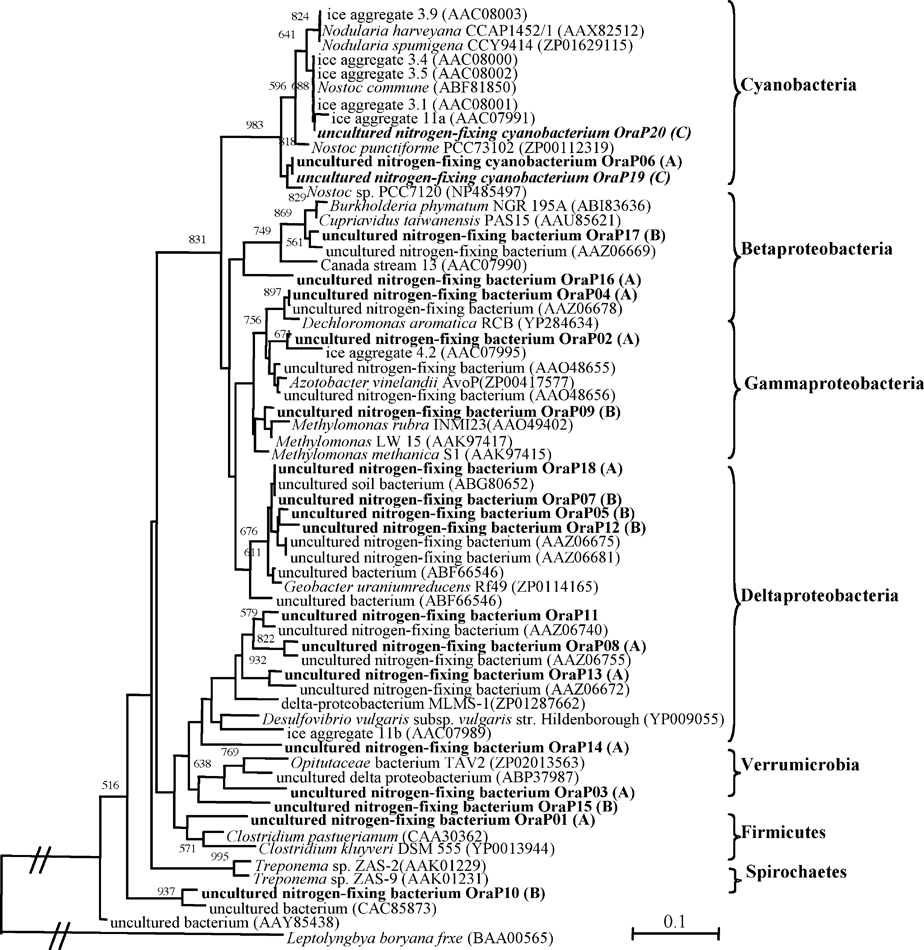
Using nifH transcript analysis by reverse transcription-PCR, we only identified sequences with highest similarity to Nostoc spp. (Table I) based on more than 100 analysed RFLP patterns. All sequences of nifH transcripts had an identity of at least 94% to Nostoc sp. PCC7120 (NP_485497) and 99% to Nostoc sp. PCC73102 (ZP_00109382) (Fig. 1, Table I).
Phylogenetic analysis with nifH sequence types identified from Orange Pond. A indicates sequences obtained from DNA 2005. B indicates sequences obtained from DNA 2006. C indicates sequences obtained from 2006 RNA are in italics.
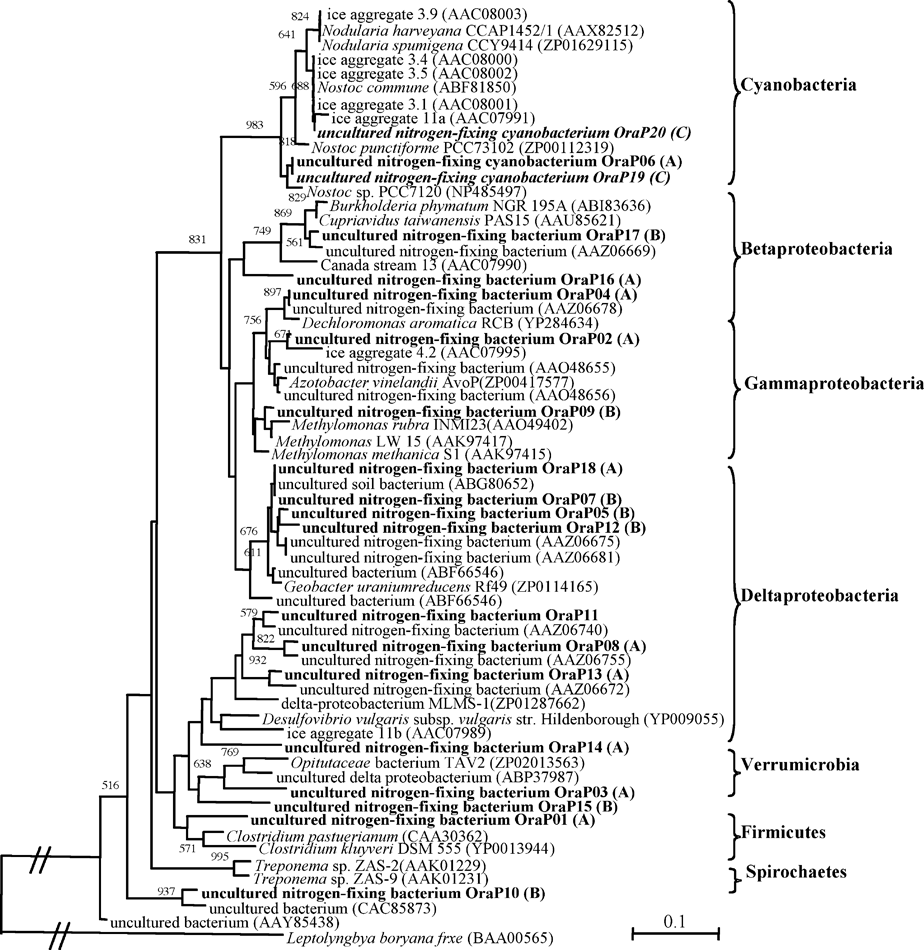
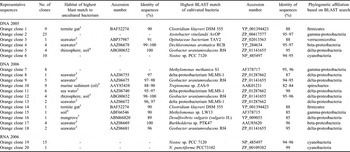
In contrast, we identified 18 nifH gene phylotypes from the DNA samples with highest similarities ranging from 82–97% to cyanobacteria, firmicutes, gamma-, beta- and deltaproteobacteria, spirochaetes and verrumicrobia (Table II, Fig. 1). Differences in nifH gene diversity between the two sampling years could be due to PCR-bias, storage or small-scale spatial variations in microbial diversity within the pond. The meltwater ponds and mat communities are generally considered to be stable due to the short annual growth periods, constant nutrient and physico-chemical condition (Vincent et al. Reference Vincent, Castenholz, Downes and Howard-Williams1993, Hawes et al. Reference Hawes, Smith, Howard-Williams and Schwarz1999, Jungblut et al. Reference Jungblut, Hawes, Hitzfeld, Mountfort, Dietrich, Burns and Neilan2005).
Summary of representative nifH-gene sequences recovered from Orange Pond microbial mats.

Habitat notes: 1) Cryptocercus punctulatus, termite gut, 2) western English Channel, 3) USA: Chesapeake Bay, seawater, 4) white spruce (Picea glauca) rhizosphere soil, 5) oil-contaminated marine sediment, 6) long-term tilled soil, macroaggregate, 7) mangrove.
Interestingly, no sequences within cyanobacteria other than Nostoc sp. were obtained in the analysis of the nifH gene diversity, even though Oscillatoriales comprises at least 70% of the cyanobacterial assemblage (Vincent et al. Reference Vincent, Castenholz, Downes and Howard-Williams1993). This suggests that N2-fixation genes are not present in the Oscillatoriales assemblage. This agrees with previous N2-fixation measurements on microbial mats on the McMurdo Ice Shelf, where the acetylene reduction activity was mainly attributed to heterocystous cyanobacteria and no activity was observed in absence of light (Fernández-Valiente et al. Reference Fernández-Valiente, Quesada, Howard-Williams and Hawes2001). This is in contrast to microbial mat from Guerrero Negro, Baja California (Mexico) where typically cyanobacterial nifH phylotypes are Oscillatoriales groups, including Phormidium and Plectonema, as well as unicellular Halothece and Synechocystis (Omoregie et al. Reference Omoregie, Crumbliss, Bebout and Zehr2004).
Although, the diversity of non-cyanobacterial nifH phylotypes matches previous 16S rRNA gene, culturing and signature lipid studies of bacterial diversity of the McMurdo Ice Shelf (Mountfort et al. Reference Mountfort, Rainey, Burghardt, Kaspar and Stackebrandt1997, Sjöling & Cowan Reference Sjöling and Cowan2003, Jungblut et al. Reference Jungblut, Allen, Burns and Neilan2009), the present molecular data suggest that nifH transcription was absent or under the detection limit with the tested conditions based on the screening of 100 clones. This stands also in contrast to microbial mats from Guerrero Negro, Baja California (Mexico) where nifH transcripts were recovered from cyanobacteria and heterotrophic bacteria (Omoregie et al. Reference Omoregie, Crumbliss, Bebout and Zehr2004). Therefore, additional analysis of clones from the cDNA-library could give further clarification to the here identified nifH transcript diversity. However, the absence of nifH transcripts related to heterotrophic bacteria is consistent with previous studies by Fernández-Valiente et al. (Reference Fernández-Valiente, Quesada, Howard-Williams and Hawes2001), where contributions to the total nitrogen budget by heterotrophic bacteria were suggested to be very low. This could be potentially due to unfavourable conditions such as micronutrient limitations and the absence of anoxia due to high photosynthesis rates with 24-h light during the summer.
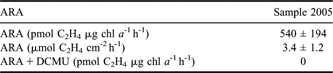
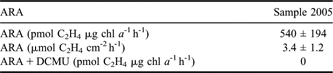
Furthermore, mean nitrogenase activity was similar to previous measurements by Fernández-Valiente et al. (Reference Fernández-Valiente, Quesada, Howard-Williams and Hawes2001) with 540 ± 194 pmol ethylene μg chl a -1 h-1 (n = 2), (3.4 ± 1.2 μmol ethylene cm-2 h-1) in the presence of light and absence of DCMU, whereas no activity was observed in the presence of DCMU (Table III). This N2-fixation activity is indicative of phototrophic activity such as potentially heterocyst-forming cyanobacteria (Nostoc sp.) and therefore agrees with the molecular findings. However, additional combined physiological and molecular analyses would provide a more detailed understanding of non-cyanobacterial N2-fixation in McMurdo Ice Shelf mat systems.
Acetylene reduction assay measurements.
Comparisons with other Antarctic freshwater ecosystems suggested the presence of similar nifH phylotype diversity, although Orange Pond mats contained greater diversity than reported for theMcMurdo Dry Valley communities. Phylotypes from Dry Valley mats with highest similarity to Nostoc sp. were also the only cyanobacterial related sequences that were recovered. Our results here were also characterized by a large number of clone sequences that had relatively low similarity to other known species, a finding that is in common with many other environmental studies (Zehr et al. Reference Zehr, Jenkins, Short and Steward2003).
In summary, additional combined physiological and molecular analyses are needed to fully understand the functional diversity behind N2-fixation in Antarctic microbial mats. However, these first molecular results elucidate the nifH phylotype diversity and confirm the importance of Nostoc spp. for the nitrogen budget on the McMurdo Ice Shelf, Antarctica.
Acknowledgements
We would like to thank Donna Sutherland and Ian Hawes for their help, and Antarctica New Zealand for providing logistical support during the field event of 2005, as well as for financial support from the New Zealand Foundation for Research, Science and Technology. Thanks to Reut Sorek Abramovich for assistance and Michelle Gehringer and Brendan Burns for revisions. The field event of 2005 was supported by a Boehringer-Ingelheim Funds Travel Allowance to A.D.J. Antonio Quesada is thanked for his assistance with the 2006 sampling which was made possible in part by the US National Science Foundation-sponsored International Graduate Training Course in Antarctic Biology (NSF grant No. 0504072 to D.T. Manahan). B.A.N was supported by a grant and fellowship from the Australian Research Council.