A considerable body of research has demonstrated that childhood maltreatment is associated with increased risk for substance use (De Sanctis et al., Reference De Sanctis, Trampush, Harty, Marks, Newcorn and Miller2008; Huang et al., Reference Huang, Trapido, Fleming, Arheart, Crandall and French2011; Kaufman et al., Reference Kaufman, Yang, Douglas-Palumberi, Crouse-Artus, Lipschitz and Krystal2007; Oshri, Rogosch, Burnette, & Cichetti, 2011; Scott, Smith, & Ellis, Reference Scott, Smith and Ellis2010; Smith, Ireland, & Thornberry, Reference Smith, Ireland and Thornberry2005; Thornberry, Henry, Ireland, & Smith, Reference Thornberry, Henry, Ireland and Smith2010; Widom, Marmorstein, & White, Reference Widom, Marmorstein and White2006; Widom, Weiler, & Cottler, Reference Wisdom, Weiler and Cottler1999; Young-Wolff, Kendler, Ricson, & Prescott, 2011), especially among women (Smith et al., Reference Smith, Ireland and Thornberry2005; White & Widom, Reference White and Widom2008; Widom, Ireland, & Glynn, Reference Widom, Ireland and Glynn1995; Wilson & Widom, Reference Wilson and Widom2009). Although research has started to examine the role of potential mediators and moderators of the relationship between childhood maltreatment and substance use, it has focused on individual level risk factors such as psychopathology, criminal behavior, prostitution, and early drug use (Huang et al., Reference Huang, Trapido, Fleming, Arheart, Crandall and French2011; Kaufman et al., Reference Kaufman, Yang, Douglas-Palumberi, Crouse-Artus, Lipschitz and Krystal2007; Oshri et al., Reference Oshri, Rogosch, Burnette and Cicchetti2011; White & Widom, Reference White and Widom2008; Wilson & Widom, Reference Wilson and Widom2009), largely ignoring the crucial role of neighborhood characteristics. The lack of research in this area is surprising, given that studies indicate a relationship between maltreatment rates and neighborhood characteristics (Coulton, Korbin, & Su, Reference Coulton, Korbin and Su1999; Freisthler, Bruce, & Needell, Reference Freisthler, Bruce and Needell2007; Molnar, Buka, Brennena, Holton, & Earls, 2003) as well as between neighborhood characteristics and substance use (Boardman, Finch, Elison, Williams, & Jackson, 2001; Gardner, Barajas, & Brooks-Gunn, Reference Gardner, Barajas, Brooks-Gunn and Scheier2010; Saxe et al., Reference Saxe, Kadushin, Beveridge, Livert, Tighe and Rindskopf2001; Sunder, Grady, & Wu, Reference Sunder, Grady and Wu2007). To date, no study has prospectively examined either the exacerbating or protective role of neighborhood characteristics on illicit drug use into middle adulthood among maltreated children. This study sought to bring together these two disparate bodies of literature to illuminate the complex relationships between childhood maltreatment and illicit drug use at an individual and neighborhood level.
Theoretical Framework
Drawing upon Bronfenbrenner's (Reference Bronfenbrenner1979) ecological theory, several scholars have proposed models that emphasize the need to examine both the etiology and outcomes of childhood maltreatment using multiple levels of influence including characteristics of families, peer groups, neighborhoods, and social policies (Belsky, Reference Belsky1980; Cicchetti & Lynch, Reference Cicchetti and Lynch1993; Cicchetti & Toth, Reference Cicchetti, Toth and Hansen2000; Widom, Reference Widom and Reece2000). Specifically, Cicchetti and Lynch (Reference Cicchetti and Lynch1993) proposed an ecological–transactional development model that highlights how disturbances in early childhood environment, such as maltreatment, can impact long-term individual development and adaptation. They indicate that this developmental process is dynamic in nature and reciprocal relationships evolve over the life course. Expanding on this approach, Widom (Reference Widom and Reece2000) emphasized the need to consider the impact of maltreatment on children across sex and race/ethnicity. Using this framework and a prospective cohort design, we examine the complex relationships among childhood maltreatment, middle adulthood neighborhood characteristics, and subsequent illicit drug use.
Neighborhood Constructs
Several overlapping but discrete neighborhood level constructs may be theoretically related to illicit drug use. Neighborhood disorder (high levels of observable disorder, such as abandoned buildings, graffiti, drinking in public, drug use, and availability; Skogan, Reference Skogan, Reiss and Tonry1986) and neighborhood disadvantage (greater socioeconomic disadvantage) can both serve as risk factors for illicit drug use (Sampson, Reference Sampson1997). Although disadvantage and disorder are highly related, high levels of one are not necessarily indicative of the other. Nonetheless, the mechanisms by which these neighborhood characteristics function as risk factors are similar and draw from numerous theoretical approaches. First, embedded within “broken windows” theory (Wilson & Kelling, Reference Wilson and Kelling1982), neighborhood disorder can indicate low levels of social control and tolerance for antisocial behaviors that include illicit drug use. Second, opportunity theory would suggest that neighborhood disorder may provide more opportunities for an individual to buy and engage in illicit drug use (Cohen & Felson, Reference Cohen and Felson1979). Third, based on principles of relapse prevention, disorder can create high risk situations that serve as triggers for relapsing and subsequently engaging in illicit drug use (Marlatt & Gordon, Reference Marlatt and Gordon1985). Fourth, in line with social disorganization theory (Shaw & McKay, Reference Shaw and McKay1969), high levels of disadvantage may indicate fewer resources (e.g., libraries, boys and girls clubs, transportation to other neighborhoods) and less informal control, thereby creating physical and social isolation. This in turn could lead to more time available to engage in drug use as well as the “need” to use drugs as a method to cope with isolation.
In contrast, social cohesion, social control, neighborhood resources, and neighborhood advantage can serve as potential protective factors against illicit drug use. Social cohesion is described as mutual trust, solidarity, and a willingness to assist one another within a neighborhood (Koonce, Reference Koonce2011; Sampson, Reference Sampson1997). A related construct of social control refers to the likelihood of neighbors intervening when seeing antisocial behavior such as spray-painting and drug distribution to young children. Neighborhood resources can indicate the presence of or involvement in neighborhood organizations such as sports clubs and community centers. Finally, neighborhood advantage is meant to be indicative of high levels of socioeconomic advantage (e.g., professional, persons with college degrees). All of these factors may play an important role in illicit drug use for a number of reasons. First, informal social processes such as social cohesion and social control may promote solidarity among neighbors and provide support to maltreated individuals within the neighborhood, thereby reducing the need to utilize drugs as a coping mechanism. Second, higher levels of social cohesion and control may result in lower acceptance of antisocial behaviors such as illicit drug use within a given neighborhood. Third, neighborhood resources, social cohesion, and social control may lead to an individual engaging in more socially acceptable community behaviors that promote positive outcomes, thereby reducing the amount of time available to spend on negative behaviors such as drug use. A comprehensive assessment of neighborhoods is necessary to fully grasp the impact of each of these constructs on illicit drug use.
Childhood Maltreatment and Neighborhood Characteristics
Several studies have demonstrated that certain neighborhood characteristics, including, but not limited to, greater socioeconomic disadvantage, social disorder, and availability of alcohol and drugs, are associated with higher rates of maltreatment, especially at an aggregate level (Ben-Arieh, Reference Ben-Arieh2010; Coulton et al., Reference Coulton, Korbin and Su1999; Coulton, Korbin, Su, & Chow, Reference Coulton, Korbin, Su and Chow1995; Drake & Pandey, Reference Drake and Pandey1996; Freisthler, Reference Freisthler2004; Freisthler, Bruce, & Needell, Reference Freisthler, Bruce and Needell2007; Freisthler, Gruenewald, Remer, Lery, & Needell, 2005, Reference Freisthler, Gruenewald, Remer, Lery and Needell2007; Freisthler, Midanik, & Gruenewald, Reference Freisthler, Midanik and Gruenewald2004; Freisthler, Needell, & Gruenewald, Reference Freisthler, Needell and Gruenewald2005; Merritt, Reference Merritt2009; Schuck, Reference Schuck2005). These influences have also been demonstrated at an individual level. For example, using data from the Project on Human Development in Chicago Neighborhoods, research has found that neighborhood characteristics such as socioeconomic disadvantage, immigrant concentration, and neighborhood violence are associated with parent to child physical aggression, whereas social cohesion and social control are not associated with these outcomes (Molnar et al., Reference Molnar, Buka, Brennan, Holton and Earls2003).
Although the relationship between neighborhood characteristics and childhood maltreatment rates are well established, especially at the aggregate level, what remains less clear is (a) whether childhood maltreatment has an impact on the neighborhood that a person lives in during adulthood and (b) if, and to what extent, do these adulthood neighborhood characteristics influence negative outcomes such as illicit drug use among maltreated children.
To date, no study has examined whether maltreatment leads individuals to live in less desirable neighborhoods relative to nonmaltreated counterparts. However, from a theoretical standpoint, maltreatment may function as a risk factor that keeps individuals in poor or disordered neighborhoods or perhaps even propels them to move to worse neighborhoods, relative to their nonmaltreated counterparts (Cicchetti & Lynch, Reference Cicchetti and Lynch1993; Widom, Reference Widom and Reece2000). This is an important unexplored area, given that neighborhood characteristics can further influence other individual level outcomes.
Neighborhood Characteristics and Drug Use
A small body of literature is beginning to examine the impact of neighborhoods on illicit drug use. Some studies have found an association between neighborhood disadvantage and higher drug use among adults (Boardman et al., Reference Boardman, Finch, Ellison, Williams and Jackson2001; Finch, Kolody, & Verga, Reference Finch, Kolody and Verga1999; Freisthler, Lascala, Gruenewald, & Treno, Reference Freisthler, Lascala, Gruenewald and Treno2005; Fuller et al., Reference Fuller, Borrell, Latkin, Galea, Ompad and Strathdee2005; Saxe et al., Reference Saxe, Kadushin, Beveridge, Livert, Tighe and Rindskopf2001; Sunder et al., Reference Sunder, Grady and Wu2007; Williams & Latkin, Reference Williams and Latkin2007), whereas others have found no association between the two for adolescents (Kulis, Marsiglia, Sicotte, & Nieri, Reference Kulis, Marsiglia, Sicotte and Nieri2007) or adults (Ford & Beveridge, Reference Ford and Beveridge2006). Three studies have found a positive association between neighborhood disorder and drug use at a cross-sectional level among adolescents (Wilson, Syme, Boyce, Battistich, & Selvin, Reference Wilson, Syme, Boyce, Battistich and Selvin2005) and adults (Latkin, Curry, Hua, & Davey, Reference Latkin, Curry, Hua and Davey2007) and at a longitudinal level among adolescents (Furr-Holden et al., Reference Furr-Holden, Lee, Milam, Johnson, Lee and Ialongo2011). One cross-sectional study found that social cohesion was associated with slightly more, rather than less, engagement in illicit drug use among a national sample (Reynoso-Vallejo, Reference Reynoso-Vallejo2011), whereas another cross-sectional study found that neither social cohesion nor social control were associated with adolescent cannabis and alcohol use (Erickson, Harrison, Cook, Cousineau, & Adlaf, Reference Erickson, Harrison, Cook, Cousineau and Adlaf2012). Further, levels of social participation within a neighborhood resulted in less drug use among a national sample (Reynoso-Vallejo, Reference Reynoso-Vallejo2011) and neighborhood closure, assessed as whether parents and adults within a neighborhood know each other, was negatively associated with alcohol and cannabis use among adolescents (Erickson et al., Reference Erickson, Harrison, Cook, Cousineau and Adlaf2012). In sum, aside from neighborhood disorder, there is no consistent relationship between neighborhood characteristics and drug use.
Childhood Maltreatment and Neighborhood Characteristics
Two studies point to the importance of neighborhoods in determining child and adolescent outcomes for maltreated children. Jaffee, Caspi, Moffitt, Polo-Tomás, and Taylor (Reference Jaffee, Caspi, Moffitt, Polo-Tomás and Taylor2007), using a nationally representative sample of twin pairs from England and Wales, found that neighborhoods at age 5 influenced resilience, defined as engaging in normative levels of antisocial behavior despite having been maltreated, at age 7. After exposure to physical maltreatment, children who lived in more disadvantaged areas with less social cohesion and less informal social control were less likely to be resilient. Yonas et al. (Reference Yonas, Lewsi, Hussey, Thompson, Newton, English and Dubowitz2010), using Child Protective Service records for maltreatment, found that collective efficacy moderated the relationship between earlier neglect, but not abuse, and aggression at age 12.
Two other studies have extended the association between neighborhoods and childhood maltreatment to adult outcomes. Schuck and Widom (Reference Schuck and Widom2005) found that neighborhoods moderated the relationship between maltreatment and criminality. Specifically, the impact of early childhood maltreatment on later criminal behavior (i.e., juvenile and adult arrests) was the strongest for those who lived in the most disadvantaged and most stable neighborhoods (Schuck & Widom, Reference Schuck and Widom2005). Nikulina, Widom, and Czaja (Reference Nikulina, Widom and Czaja2011) found that childhood neighborhood poverty was associated with posttraumatic stress disorder and being arrested in adulthood. However, childhood neighborhood poverty was no longer significant when controlling for childhood neglect and family poverty.
The above studies indicate that neighborhoods are important factors in the lives of maltreated children. However, there is some ambiguity in the temporal relationships examined. Three of the studies assess childhood neighborhood characteristics at the same time as childhood maltreatment (Jaffee et al., Reference Jaffee, Caspi, Moffitt, Polo-Tomás and Taylor2007; Nikulina et al., Reference Nikulina, Widom and Czaja2011; Schuck & Widom, Reference Schuck and Widom2005). One study examined adolescent neighborhood characteristics with adolescent outcomes, thereby assessing neighborhood characteristics at the same time as the outcome (Yonas et al., Reference Yonas, Lewsi, Hussey, Thompson, Newton, English and Dubowitz2010). To more clearly tease apart these temporal relationships, a minimum of three time points are necessary: childhood maltreatment, subsequent neighborhood characteristics, and subsequent outcomes.
The Importance of Race and Sex
An examination of the role of neighborhood context on substance use among maltreated children needs to consider potential race and sex differences for several reasons. First, research has consistently demonstrated race differences in neighborhood context, with Black Americans being significantly more likely to reside in disadvantaged neighborhoods relative to White Americans (Sampson, Reference Sampson1997). Second, even though White Americans have higher rates of drug use relative to Blacks in adolescence (Aarons, McCabe, Gearity, & Hough, Reference Aarons, McCabe, Gearity and Hough2003; Dannerbeck, Harris, Sundet, & Lloyd, Reference Dannerbeck, Harris, Sundet and Lloyd2006), Black Americans are less likely to age out of drug use (Vogt Yuan, Reference Vogt Yuan2011; Watt, Reference Watt2008) and experience more negative outcomes associated with drug use, including lower treatment rates (Cummings, Wen, & Druss, Reference Cummings, Wen and Druss2008), as well as worse symptoms of comorbid psychiatric disorders and substance use disorders (Elwy, Ranganathan, & Eisen, Reference Elwy, Ranganathan and Eisen2008; Huang et al., Reference Huang, Grant, Dawson, Stinson, Chou and Saha2006). A number of factors account for these adverse patterns among Black Americans relative to White Americans including economic conditions, racial discrimination, and drug availability and exposure (Gibbons et al., Reference Gibbons, Yeh, Gerrard, Cleveland, Cutrona and Simons2007; Vogt Yuan, Reference Vogt Yuan2011; Watt, 2008). Over time it is possible that the use and effects of drugs are more detrimental for Black Americans, given that they are more likely to live in poor neighborhoods that may be marginalized and have higher rates of drug use. Third, there may be race differences in the effects of neighborhoods on maltreatment rates. For example, one study found that neighborhood disadvantage was associated with maltreatment similarly across race (Freisthler et al., Reference Freisthler, Bruce and Needell2007), whereas another found that neighborhood disadvantage is a more potent risk factor for neighborhoods with predominantly White Americans relative to predominantly Black Americans (Korbin, Coulton, Chard, Platt-Houston, & Su, Reference Korbin, Coulton, Chard, Platt-Houston and Su1998). Thus, potential race differences need to be considered in examining the relationships among child maltreatment, neighborhood characteristics, and illicit drug use.
With regard to sex, some research suggests that neighborhood characteristics may function differently for men and women, with different mediating variables being relevant for each group (Kroneman, Loeber, & Hipwell, Reference Kroneman, Loeber and Hipwell2004). Research has rather consistently suggested that the impact of maltreatment on drug use appears to be stronger for women relative to men (Lansford, Dodge, Pettit, & Bates, Reference Lansford, Dodge, Pettit and Bates2010; Widom et al., Reference Widom, Marmorstein and White2006; Wilson & Widom, Reference Wilson and Widom2009). Lansford et al. (Reference Lansford, Dodge, Pettit and Bates2010) found that parent-reported physical abuse prior to age 5 predicted substance use at age 12 for females, but not for males. Among females, early physical abuse indirectly influenced later substance use (i.e., age 16 and age 24) through substance use at age 12. Furthermore, using the current data, previous research has found that abused and neglected children were as likely as their nonmaltreated counterparts to meet the criteria for a diagnosis of drug abuse and/or dependence in early adulthood (i.e., mean age 29). However, by age 40, there was an increased likelihood of drug use among maltreated females, compared to nonmaltreated females (Widom et al., Reference Widom, Marmorstein and White2006). No such relationship existed for males. Furthermore, a problem behavior profile of prostitution, homelessness, delinquency and criminal behavior, and school problems mediated this relationship between maltreatment and middle adulthood drug use for females, but not for males (Wilson & Widom, Reference Wilson and Widom2009). As such, females in middle adulthood may be more likely to engage in illicit drug use to cope with a host of problematic experiences that start with childhood maltreatment and escalate to other problem behaviors. Given these findings, the current study will examine both sex- and race-specific pathways to illicit drug use among maltreated children and matched controls.
The current study expands on previous research in four main ways. First, we use substantiated cases of maltreatment, thereby not relying on self-reports that are prone to biases and memory errors. Second, the inclusion of matched controls decreases the likelihood of other confounding variables that may influence these associations. Third, this is a prospective study that allows us to examine relationships among child maltreatment, neighborhood context, and illicit drug use in a temporally correct manner, in contrast to cross-sectional studies. Fourth, we assess a wide range of neighborhood factors using objective (i.e., census data) and subjective indicators (i.e., survey data) to measure both risk and protective factors.
Current Study
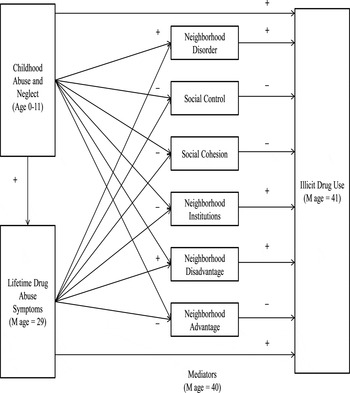
Using a prospective cohort design, the current study seeks to (a) determine whether children with documented histories of physical abuse, sexual abuse, and neglect live in worse neighborhoods as adults relative to children without such histories; (b) examine the direct and indirect effects of neighborhood characteristics (e.g., neighborhood disorder, social cohesion, social control, neighborhood institutions, neighborhood disadvantage, and neighborhood advantage) on illicit drug use in middle adulthood for maltreated children and matched controls (see Figure 1); and (c) determine whether there are sex- and race-specific (White vs. Black) differences in these associations.
A schematic model illustrating the hypothesized relationships among childhood maltreatment (1967–1971), drug abuse symptoms (1989–1995), neighborhood characteristics (2000–2002), and illicit drug use (2003–2005). The relationships between childhood maltreatment and drug use symptoms with neighborhood characteristics are hypothesized to be in the same direction.

There are three main hypotheses:
Hypothesis I: After accounting for age, race, and sex, maltreated children, compared to matched controls, will reside in neighborhoods with higher levels of neighborhood disorder and disadvantage and lower levels of social cohesion, social control, neighborhood institutions (e.g., community center, religious organizations), and neighborhood advantage in middle adulthood.
Hypothesis II: Maltreated children will be more likely to report illicit drug use in middle adulthood compared to nonmaltreated children. These results will differ by sex, with maltreated women being more likely to report illicit drug use compared to matched controls, whereas there will be no differences between maltreated and control men. Given the dearth of research on race differences in these relationships, we do not make a priori hypotheses.
Hypothesis III: Neighborhood characteristics will have both direct and indirect effects on the relationship between child maltreatment and illicit drug use in middle adulthood. More specifically, neighborhood disadvantage and disorder will be risk factors for illicit drug use, whereas social cohesion, social control, neighborhood institutions, and neighborhood advantage will be protective against illicit drug use in middle adulthood (see Figure 1). We do not make a priori hypotheses with regard to sex- and race-specific relationships.
Methods
Research design and sample
The data used here are from a larger research project based on a cohort design study in which abused and/or neglected children were matched with nonabused, nonneglected children and followed prospectively into middle adulthood. Because of the matching procedure, the subjects are assumed to differ only on the risk factor: that is, having experienced childhood physical abuse, sexual abuse, or neglect. Becasue it is not possible to randomly assign subjects to groups, the assumption of equivalency of the groups is an approximation. However, this design allows us a greater probability of ruling out confounding variables. Widom (Reference Widom1989a) provides complete details on study design and subject selection.
The original sample of abused and neglected children was made up of all substantiated cases of childhood physical and sexual abuse and neglect processed from 1967 to 1971 in the county juvenile (family) or adult criminal courts of a Midwestern metropolitan area. Cases of abuse and neglect were restricted to children 11 years of age or younger at the time of the incident and therefore represent childhood maltreatment.
A control group of children without documented histories of childhood abuse and/or neglect was matched with the abuse/neglect group on age, sex, race/ethnicity, and approximate family social class during the time that the abuse and neglect records were processed. This matching was important because it is theoretically plausible that any relationship between child abuse and neglect and subsequent outcomes is confounded with or explained by social class differences (MacMillan et al., Reference MacMillan, Fleming, Streiner, Lin, Boyle and Jamieson2001; Widom, Reference Widom1989b). The matching procedure used here is based on a broad definition of social class that includes neighborhoods in which children were reared and schools they attended (Watt, Reference Watt1972). The control group establishes the base rates of outcomes expected in a sample of adults from comparable circumstances who did not come to court attention in childhood as victims of abuse or neglect.
Children who were under school age at the time of the abuse and/or neglect were matched with children of the same sex, race, date of birth (±1 week), and hospital of birth through the use of county birth record information. For children of school age, records of more than 100 elementary schools for the same time period were used to find matches with children of the same sex, race, date of birth (±6 months), class in elementary school during the years 1967 to 1971, and home address, preferably within a five-block radius of the abused/neglected child. Overall, matches were found for 74% of the abused and neglected children. Nonmatches occurred for a number of reasons. For birth records, nonmatches occurred in situations when the abused and neglected child was born outside the county or state or when date of birth information was missing. For school records, nonmatches occurred because of lack of adequate identifying information for the abused and neglected children or because the elementary school had closed over the last 20 years and class registers were unavailable. Reanalyses of earlier findings were conducted using only matched pairs, and the results did not change with the smaller sample size (Widom, Reference Widom1989b; Widom, DuMont, & Czaja, Reference Widom, DuMont and Czaja2007).
The initial phase of the study compared the abused and/or neglected children to the matched comparison group (total N = 1,575) on juvenile and adult criminal arrest records (Widom, Reference Widom1989b). A second phase involved locating and interviewing both the abused and/or neglected and comparison groups during 1989–1995, approximately 22 years after the incidents of abuse and neglect (n = 1,196). Follow-up interviews were conducted in 2000 to 2002 and in 2003 to 2005.
Of the original sample, 1,307 (85%) were located and 1,196 (76%) were first interviewed in 1989–1995. Those not interviewed were deceased (n = 43), incapable of being interviewed (n = 8), not found (n = 268), or refused to participate (n = 60). There were no significant differences between the original sample (N = 1,575) and the follow-up sample (n = 1,196) with regard to demographic characteristics of sex, race, poverty in census tract, current age, and group status (maltreated vs. matched controls). Of the 1,196 interviews, 896 participants (75%) completed the 2000 to 2002 interview and 807 (67%) participants completed the 2003 to 2005 interview. Here, we use data collected from four time points: 1967 to 1971 (initial case identification), 1989 to 1995 (lifetime drug abuse symptoms), 2000 to 2002 (neighborhood characteristics), and 2003 to 2005 (illicit drug use). At the last interview (2003–2005), the mean age was 41.20 (SD = 3.54). Women represented about half the sample (53%) and 59% of the sample was non-Hispanic White, 34% non-Hispanic Black, 4% were Hispanic, and 3% other. Given the small sample size for Hispanics, these analyses are based on Whites and Blacks, not Hispanics. Thus, the valid number of cases is 833 for neighborhood outcomes (2000–2002) and 753 for illicit drug use outcomes (2003–2005).
Measures
Childhood maltreatment
Childhood physical abuse, sexual abuse, and neglect were defined through case review of official records from 1967 to 1971. Physical abuse included bruises, welts, burns, abrasions, lacerations, wounds, cuts, bone and skull fractures, and other evidence of physical injury. Sexual abuse charges varied from “assault and battery with intent to gratify sexual desires” to more specific charges of “fondling or touching in an obscene manner,” rape, sodomy, incest, and so on. Neglect cases reflected a judgment that the parents' deficiencies in childcare were beyond those acceptable by community and professional standards at that time. These cases represented extreme failure to provide adequate food, clothing, shelter, and medical attention to children. Children with documented cases of any one of these forms of maltreatment are included in the overall maltreatment group and in the specific type of maltreatment group (i.e., physical abuse, sexual abuse, and neglect) if they experienced that particular type, but not necessarily only that type. That is, children with physical abuse cases could also have experienced neglect or sexual abuse or some other combination of maltreatment and can be included in both categories. However, only 10% of the sample experienced more than one type of maltreatment.
Neighborhood disadvantage and advantage
Addresses from the 2000 to 2002 interviews were geocoded and geomatched to a 2000 census tract. Census tracts average about 4,000 people, have relatively homogenous characteristics, and are defined by physical boundaries such as rivers and major streets (US Bureau of Census, 2001). We used three items from the US Census data to assess neighborhood disadvantage: (a) percentage of families below the poverty line, (b) percentage of families on public assistance, and (c) percentage of woman headed households. We used four items to calculate neighborhood advantage: (a) percentage of homes that are owner occupied, (b) percentage of people that are professionals, (c) percentage of people with college degrees, and (d) percentage of homes with income more than $125,000.
There were 474 census tracts within the study. The majority (68%) of the census tracts had only one participant, with another 14% of the census tracts having two participants. Given that the vast majority of the census tracts had only one or two individuals, nested modeling that would account for nonindependence among participants was not necessary.
Neighborhood disorder
Neighborhood disorder (Skogan, Reference Skogan, Reiss and Tonry1986) was assessed with 10 items inquiring about the extent of certain problems within a participant's current neighborhood using a 4-point Likert scale (1 = not at all to 4 = very much). Items included vandalism, abandoned housing, and gang fights. Two items directly related to drug use including “drunks and drug addicts” and “people selling or distributing illegal drugs” were removed from the original scale so as to not confound it with the outcome variable of illicit drug use. This revised scale demonstrated adequate internal reliability (α = 0.93). However, this scale was highly skewed and was log transformed.
Social cohesion
Social cohesion (Sampson, Raudenbusch, & Earls, 1997) was measured using eight items on a 5-point Likert scale (1 = strongly disagree to 5 = strongly agree). Participants were asked how much they agreed with statement such as “People here are willing to help their neighbors.” Higher scores indicate greater social cohesion. This scale had adequate reliability (α = 0.83).
Social control
Social control (Sampson et al., Reference Sampson, Raudenbush and Earls1997) was assessed using seven items on a 4-point Likert scale (1 = very likely to 4 = very unlikely). Participants were asked to assess the likelihood of a neighbor doing something if they saw something such as “Someone was trying to sell drugs to your children in plain sight?” The reliability of this scale was high (α = 0.90). Higher scores indicate greater social control.
Neighborhood institutions
This questionnaire asked participants to describe the presence of 11 institutions within their neighborhood (e.g., community center, parent support groups, sports clubs). The number of institutions reported by each participant was summed; this scale yielded adequate reliability (α = 0.72).
DSM-III-R drug abuse symptoms
The NIMH Diagnostic Interview Schedule, Third Edition, Revised (Robins, Helzer, Cottler, & Goldring, Reference Robins, Helzer, Cottler and Goldring1989) was administered during the first interview (1989–1995) to assess drug abuse and/or dependence in young adulthood (M age = ~29 years). It includes information about cannabis, stimulants, sedatives, cocaine, heroin, opiates, PCP, hallucinogens, and inhalants. The Diagnostic Interview Schedule has been shown to have good test–retest reliability for substance abuse disorder (Helzer et al., Reference Helzer, Robins, McEvoy, Spitznagel, Stoltzman and Farmer1985). We used the number of lifetime drug abuse symptoms across all types of drugs as a covariate. The mean number of symptoms endorsed was 1.57 (SD = 2.40, range = 0–9). This scale was skewed; therefore, we added 1 and log transformed the lifetime drug abuse symptom variable.
Illicit drug use
During the 2003–2005 interviews, participants were asked whether they had used illicit drugs (marijuana, psychedelics, cocaine, and heroin) during the past year. We used a count variable for past year illicit drug use coded as 0 = no illicit drug use (75%), 1 = use of one type of illicit drug (19%), and 2 = use of more than one type of illicit drug (5%).
Analytic strategy
First, using general linear models (GLMs), we examined group differences (maltreated children vs. matched controls) in the prevalence rates of neighborhood characteristics and illicit drug use after accounting for age, sex, and race. GLMs were also conducted at sex-specific levels accounting for age and race and at race-specific levels accounting for age and sex. Second, we investigated correlations among neighborhood variables and their relation to lifetime drug abuse symptoms and illicit drug use in the past year. Third, we conducted multivariate path analyses to examine direct and indirect pathways from childhood abuse and neglect to lifetime drug abuse symptoms in early adulthood, middle adulthood neighborhood characteristics, and middle adulthood illicit drug use (see Figure 1). Path analyses accounted for age, sex, and race. We also conducted sex-specific and race-specific analyses to determine whether relationship varied by demographic groups. We used SPSS version 20 for the GLMs and correlations and Mplus 6.12 (Muthén & Muthén, 1998–2010) for all path analyses. Mplus simultaneously examines direct and indirect pathways; uses the full information maximum likelihood method to handle missing data; and is a model-dependent procedure that uses all available data points to construct the best possible estimates, thereby increasing the power of the analyses.
Results
Childhood maltreatment, neighborhood characteristics, and illicit drug use in middle adulthood
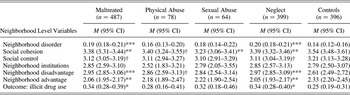
Table 1 presents the mean scores for neighborhood characteristics and illicit drug use for maltreated children and matched controls after accounting for age, race, and sex. Maltreated children, neglected children in particular, were significantly more likely than the controls to live in neighborhoods with more disorder and disadvantage as well as less social cohesion and neighborhood advantage. There was a nonsignificant trend indicating that individuals with histories of childhood abuse and neglect were also less likely to live in neighborhoods with high social control. There were no differences between the groups on the number of neighborhood institutions reported. Table 1 also shows that maltreated children and neglected children in particular were more likely to engage in illicit drug use in the past year, relative to matched controls. Physically abused children were not significantly different from controls in terms of illicit drug use in middle adulthood, although there was a trend suggesting that the neighborhoods in which they lived had less social cohesion and more disadvantage compared to controls. Individuals with histories of childhood sexual abuse were less likely to live in socially cohesive neighborhoods than matched controls.
Means for neighborhood level variables and illicit drug use by maltreatment type after adjusting for age, race, and sex

Note: CI, confidence interval. The mean is after adjusting for age, race (White, non-Hispanic vs. Black, non-Hispanic), and sex. Specific sample sizes within analyses vary by missing data. The means reported for the controls are relative to the individuals with histories of child maltreatment. However, the means for the control versus subgroups (physical abuse, sexual abuse, and neglect) vary slightly based on missing data and relative demographic adjustments.
†p < .10. *p < .05. **p < .01. ***p < .001.
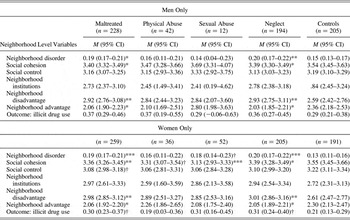
Table 2 presents these results at a sex-specific level, after accounting for age and race. Overall, men and women with documented histories of childhood abuse and neglect were more likely to live in disordered and disadvantaged neighborhoods as well as less likely to live in socially cohesive and advantaged neighborhoods compared to controls. Note that the mean differences were larger between maltreated women relative to control women compared to maltreated men relative to control men for all variables except neighborhood advantage. We found the same results for neglected men and women, relative to control men and women. Maltreated women and specifically neglected women demonstrated a nonsignificant trend toward higher levels of illicit drug use compared to control women. Physically and sexually abused men did not differ from control men. However, women with histories of childhood sexual abuse were less likely to live in socially cohesive neighborhoods relative to women without such histories.
Sex-specific means for neighborhood level variables and illicit drug use by maltreatment type after adjusting for age and race

Note: CI, confidence interval. The mean is after adjusting for age and race (White, non-Hispanic vs. Black, non-Hispanic). Specific sample sizes within analyses vary by missing data. The means reported for the controls are relative to the individuals with histories of child maltreatment. However, the means for the control versus subgroups (physical abuse, sexual abuse, and neglect) vary slightly based on missing data and relative demographic adjustments.
†p < .10. *p < .05. **p < .01. ***p < .001.
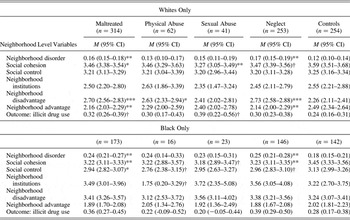
Table 3 presents these results at a race-specific level, comparing Whites and Blacks after accounting for age and sex. First, maltreated Whites and Blacks were both more likely to live in disordered neighborhoods and less likely to live in socially cohesive neighborhoods relative to control Whites and Blacks, respectively. Whites with histories of childhood abuse and neglect were more likely to live in disadvantaged neighborhoods and less likely to live in advantaged neighborhoods compared to White controls, whereas no such differences emerged for Blacks. In contrast, Blacks with histories of childhood abuse and neglect were less likely to live in neighborhoods with high social control relative to control Blacks. There were also differences by type of abuse. Physically abused Whites were more likely to live in more disadvantaged neighborhoods relative to control Whites, whereas sexually abused Whites were more likely to live in less socially cohesive neighborhoods relative to control Whites. Finally, there was a nonsignificant trend suggesting that Whites with histories of childhood abuse and neglect were more likely to engage in illicit drug use compared to control Whites, and this trend was particularly strong for sexually abused Whites.
Race-specific means for neighborhood level variables and illicit drug use by maltreatment type after adjusting for age and sex

Note: CI, confidence interval. The mean is after adjusting for age and sex. Specific sample sizes within analyses vary by missing data. The means reported for the controls are relative to the individuals with histories of child maltreatment. However, the means for the control versus subgroups (physical abuse, sexual abuse, and neglect) vary slightly based on missing data and relative demographic adjustments.
†p < .10. *p < .05. **p < .01. ***p < .001.
Correlations between neighborhood characteristics and illicit drug use
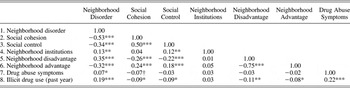
Table 4 displays the correlations among neighborhood characteristics, lifetime drug abuse symptoms assessed in young adulthood, and past year illicit drug use. All of the relationships among the neighborhood characteristics were in the expected direction, except the relationship between neighborhood disorder and number of neighborhoods institutions that showed a positive correlation, suggesting that the greater the neighborhood disorder, the greater the number of neighborhood institutions (r = .13, p < .01). Neighborhood disadvantage and neighborhood advantage were highly correlated with one another in an inverse direction (r = –.75, p < .001). As such, given the high degree of multicollinearity, only the disadvantage variable was used in subsequent multivariate analyses. Social cohesion and social control were moderately correlated with one another, indicating that these two constructs were capturing distinctive aspects of neighborhood level processes (r = .50, p < .001). Lifetime drug abuse symptoms were positively associated with neighborhood disorder (r = .07, p < .05). Past year illicit drug use was associated with all neighborhood characteristics except number of neighborhood institutions. Based on these results, the number of neighborhood institutions was not included in the multivariate models. Finally, past year drug use and lifetime drug abuse symptoms had a relatively small but significant correlation (r = .22, p < .001).
Correlations among neighborhood level variables

†p < .10. *p < .05. **p < .01. ***p < .001.
Path analysis examining childhood maltreatment, neighborhood characteristics, and illicit drug use in middle adulthood
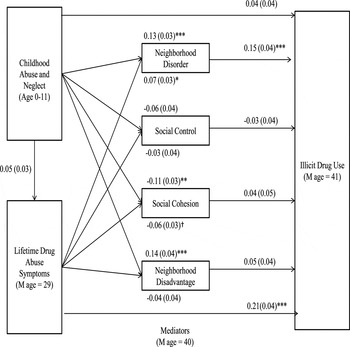
Figure 2 shows the results of path analyses indicating the prospective relationships among childhood maltreatment, drug abuse symptoms in young adulthood, neighborhood characteristics, and illicit drug use in middle adulthood after accounting for age, sex, and race. As was present with the bivariate relationships, childhood abuse and neglect predicted neighborhood characteristics of more disorder and disadvantage, as well as less social cohesion. Having more drug abuse symptoms in young adulthood predicted more neighborhood disorder in middle adulthood, with a nonsignificant trend for living in less socially cohesive neighborhoods. Only two factors predicted illicit drug use at age 41: drug abuse symptoms at age 29 and past year neighborhood disorder. There was no direct relationship between childhood maltreatment and illicit drug use in middle adulthood after accounting for prior drug use symptoms, neighborhood characteristics, age, race, and sex. There was a significant indirect effect between childhood maltreatment and illicit drug use via neighborhood disorder, β = 0.02 (0.01), p < .01. This model accounted for 8% of the variance in illicit drug use at age 41.
Path analyses showing the results of relationships among childhood maltreatment (1967–1971), drug use symptoms (1989–1995), neighborhood characteristics (2000–2002), and illicit drug use (2003–2005). Standardized coefficients (stdyx in Mplus) are reported. These analyses account for age, sex, and race. Numbers above the neighborhood characteristics are associated with childhood abuse and neglect, and numbers below the neighborhood characteristics are associated with lifetime drug abuse symptoms. †p < .10. *p < .05. **p < .01. ***p < .001.

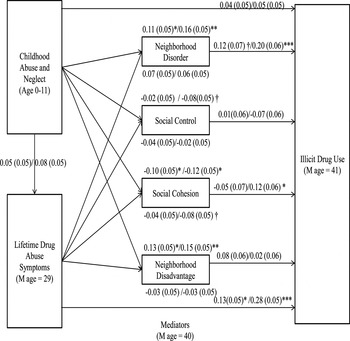
Figure 3 illustrates the sex-specific prospective relationships among childhood maltreatment, lifetime drug abuse symptoms in young adulthood, neighborhood characteristics, and illicit drug use in middle adulthood after accounting for age and race. Childhood maltreatment predicted living in more disordered and disadvantaged as well as less socially cohesive neighborhoods among men and women compared to sex-specific controls. Having more drug abuse symptoms at age 29 did not predict neighborhood characteristics at age 40 for men or women, with one exception (there was a nonsignificant trend for women, with more drug abuse symptoms in young adulthood predicting less socially cohesive neighborhoods in middle adulthood). For both men and women, having drug abuse symptoms at age 29 predicted past year illicit drug use at age 41. Neighborhood disorder (2000–2002) predicted past year illicit drug use (2003–2005) for women, with a nonsignificant trend for men. It is surprising that both maltreated and control women who lived in more socially cohesive neighborhoods were more likely to engage in past year illicit drug use. There was no direct relationship between childhood maltreatment and illicit drug use in middle adulthood after accounting for these neighborhood characteristics, prior drug abuse symptoms, age, and race. Finally, the indirect effect pathway from childhood maltreatment to illicit drug use via neighborhood disorder was significant for women, β = 0.03 (0.01), p < .05, but not for men, β = 0.01 (0.01), p = .16. This model explained 16% of the variance in illicit drug use for women but only 5% of the variance for men.
Sex-specific path analyses showing the results indicating relationships among childhood maltreatment (1967–1971), lifetime drug use symptoms (1989–1995), neighborhood characteristics (2000–2002), and illicit drug use (2003–2005). Standardized coefficients (stdyx in MPlus) are reported. These analyses account for age and race. Numbers to the left of the slash are for men, and numbers to the right are for women. Numbers above the neighborhood characteristics are associated with childhood abuse and neglect, and numbers below the neighborhood characteristics are associated with lifetime drug abuse symptoms. †p < .10. *p < .05. **p < .01. ***p < .001.

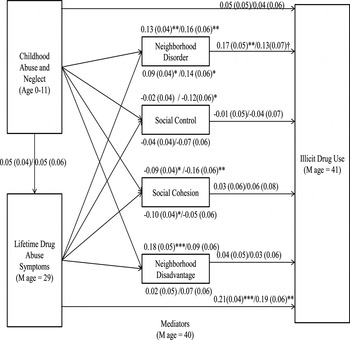
Figure 4 presents the race-specific prospective relationships between childhood maltreatment, drug use symptoms in young adulthood, and subsequent neighborhood characteristics and illicit drug use after accounting for age and sex. Childhood maltreatment predicted living in more disordered and less socially cohesive neighborhoods among Blacks and Whites compared to race-specific controls. Whites were more likely to live in more disadvantaged neighborhoods compared to White controls, with no such relationship for Blacks. In contrast, Blacks were more likely to live in neighborhoods with less social control compared to Black controls. Having more drug abuse symptoms at age 29 predicted living in more disordered neighborhoods at age 40 for Whites and Blacks. In addition, Whites with more drug abuse symptoms at age 29 were less likely to live in socially cohesive neighborhoods at age 40. For both Blacks and Whites, having more drug abuse symptoms at age 29 predicted illicit drug use at age 41. Neighborhood disorder predicted illicit drug use for Whites, with a nonsignificant trend for Blacks. There was no direct relationship between childhood maltreatment and illicit drug use in middle adulthood after accounting for prior drug abuse symptoms, neighborhood characteristics, age, and sex. However, the indirect effect between childhood maltreatment and illicit drug use in middle adulthood via neighborhood disorder was significant for Whites, β = 0.02 (0.01), p < .05, but not Blacks, β = 0.02 (0.01), p = .12. This model explained slightly greater variance in illicit drug use for Whites (9%) relative to Blacks (7%).
Race-specific path analyses showing the results and relationships among childhood maltreatment (1967–1971), lifetime drug use symptoms (1989–1995), neighborhood characteristics (2000–2002), and illicit drug use (2003–2005). Standardized coefficients (stdyx in Mplus) are reported. These analyses account for age and sex. Numbers to the left of the slash are for Whites, and numbers to the right are for Blacks. Numbers above the neighborhood characteristics are associated with childhood abuse and neglect, and numbers below the neighborhood characteristics are associated with lifetime drug abuse symptoms. †p < .10. *p < .05. **p < .01. ***p < .001.

Post hoc analyses
We conducted post hoc analyses to examine the unexpected positive relationship between social cohesion and illicit drug use among women in the multivariate analysis. At the bivariate level, there was a negative but nonsignificant relationship between social cohesion and illicit drug use among women (r = –.08, p = .11). However, within the multivariate models, the inclusion of neighborhood disorder changed the direction of this relationship from negative to positive. Our further analyses led us to examine the distribution underlying this relationship, and we found that for 1 SD above the neighborhood disorder mean (M = 0.16, SD = 0.17), the relationship between social cohesion and illicit drug use continued to be nonsignificant (r = .04, p = .70, n = 106). However, at 2 SD above the mean, there is a significant positive association between social cohesion and illicit drug use (r = .29, p = .04, n = 54).
Discussion
This is the first prospective longitudinal study to examine whether individuals with documented histories of child abuse and neglect live in worse neighborhoods as adults and whether neighborhood characteristics in adulthood influence subsequent illicit drug use for this sample of maltreated children and matched controls. Overall, our results indicate that child maltreatment has demonstrable consequences for residence in less desirable neighborhoods and for illicit drug use in middle adulthood. Furthermore, neighborhood disorder indirectly impacts the relationship between childhood maltreatment and middle adulthood illicit drug use for the sample overall and for women and Whites. This was the case even after controlling for drug abuse symptoms in young adulthood.
There was partial support for our first hypothesis: individuals with documented histories of child maltreatment will reside in neighborhoods with higher levels of disorder and disadvantage and lower levels of social cohesion, social control, institutions (e.g., community center, religious organizations), and advantage compared to controls. Our results indicate that, as adults, maltreated children live in more disadvantaged and more disordered neighborhoods with less advantage and less cohesion compared to their matched controls. No differences were found for social control or the number of neighborhood institutions. As such, child maltreatment appears to place individuals on a negative trajectory that results in living in less desirable neighborhoods via both objective standards using census data and subjective standards using self-reports. This is also consistent with previous research that has found that maltreated children experience poorer economic outcomes relative to matched controls (Currie & Widom, Reference Currie and Widom2010).
Note that the results for the subjective measures, particularly of social cohesion and social control, are complex. That is, individuals with histories of child abuse and neglect may experience greater social isolation and less connectedness to their neighbors or neighborhoods relative to others. Even though a neighborhood may actually be socially cohesive, maltreated individuals may report less social cohesion because they are isolated or because of other individual level problems, such as psychopathology, prostitution, crime, and economic issues (Currie & Widom, Reference Currie and Widom2010; Maxfield & Widom, Reference Maxfield and Widom1996; Smith & Thornberry, Reference Smith and Thornberry1995; Stolz et al., Reference Stolz, Shannon, Kerr, Zhang, Montaner and Wood2007; Widom, Reference Widom1989b, Reference Widom1999; Widom et al., Reference Widom, DuMont and Czaja2007; Wilson & Widom, Reference Wilson and Widom2008; Zingraff, Leiter, Myers, & Johnsen, Reference Zingraff, Leiter, Myers and Johnsen1993). It remains unclear whether childhood maltreatment directly leads to living in less desirable neighborhoods or if other intervening mechanisms, such as criminal behavior, contribute to living in these poorer neighborhoods.
Both men and women with histories of child abuse and neglect were more likely to end up in less desirable neighborhoods relative to the controls, but the strength of these relationships was stronger for women. Currie and Widom (Reference Currie and Widom2010) found that maltreated women, but not maltreated men, had completed fewer years of schooling and had lower IQs and were less likely to be employed, own a bank account, own stock, own a vehicle, or own a home relative to controls in middle adulthood. As such, it is possible that these differential resources and available income of maltreated women may have played an important role in their neighborhood residence.
With regard to race, Whites and Blacks with documented histories of childhood abuse and neglect were more likely to live in disordered and less socially cohesive neighborhoods compared to controls. However, only the maltreated Whites were at increased risk to live in more disadvantaged neighborhoods compared to control Whites. Given that Blacks relative to Whites are more likely to live in disadvantaged neighborhoods overall, it is possible that a floor effect may be present (Sampson, Reference Sampson1997). Childhood maltreatment may not have an additional impact on the level of disadvantage of adult neighborhoods among Blacks in this sample.
With regard to maltreatment subtypes, childhood neglect consistently demonstrated trends to more negative neighborhood characteristics, less positive neighborhood characteristics, and illicit drug use relative to other maltreatment types. Although these results suggest that neglect may have a more detrimental effect than previously assumed by theorists and researchers (Hobbs, Reference Hobbs2002), these results may also be related to low statistical power in the physical and sexual abuse groups, given that the neglect group was the largest and substantially larger than the physical abuse and sexual abuse groups.
The small to moderate correlations among the neighborhood variables indicates that each construct assessed in the current study is measuring distinctive neighborhood characteristics. This suggests that studies that assess only one aspect of neighborhoods, such as disadvantage, are not adequately measuring neighborhoods. This may help to explain the divergent results found in the broader literature on the effects of neighborhood disadvantage on substance use (Boardman et al., Reference Boardman, Finch, Ellison, Williams and Jackson2001; Finch et al., Reference Finch, Kolody and Verga1999; Ford & Beveridge, Reference Ford and Beveridge2006; Freisthler et al., Reference Freisthler, Lascala, Gruenewald and Treno2005; Fuller et al., Reference Fuller, Borrell, Latkin, Galea, Ompad and Strathdee2005; Kulis et al., Reference Kulis, Marsiglia, Sicotte and Nieri2007; Saxe et al., Reference Saxe, Kadushin, Beveridge, Livert, Tighe and Rindskopf2001; Sunder et al., Reference Sunder, Grady and Wu2007; Williams & Latkin, Reference Williams and Latkin2007).
Our second hypothesis was partially supported: individuals with histories of childhood maltreatment, and maltreated women in particular, will be more likely to report illicit drug use in middle adulthood compared to controls. Consistent with previous research, childhood maltreatment increased the likelihood of illicit drug use (De Sanctics et al., 2008; Huang et al., Reference Huang, Trapido, Fleming, Arheart, Crandall and French2011; Kaufman et al., Reference Kaufman, Yang, Douglas-Palumberi, Crouse-Artus, Lipschitz and Krystal2007; Oshri et al., Reference Oshri, Rogosch, Burnette and Cicchetti2011; Scott et al., Reference Scott, Smith and Ellis2010; Smith et al., Reference Smith, Ireland and Thornberry2005; Widom et al., Reference Wisdom, Weiler and Cottler1999, Reference Widom, Marmorstein and White2006; Young-Wolff et al., Reference Young-Wolff, Kendler, Ericson and Prescott2011). There was a nonsignificant trend for maltreated women and Whites to report more illicit drug use in middle adulthood compared to nonmaltreated controls. This is consistent with some previous research that has found that maltreated women are likely to engage in illicit drug use (Smith et al., Reference Smith, Ireland and Thornberry2005; Widom et al., Reference Widom, Marmorstein and White2006; Wilson & Widom, Reference Wilson and Widom2009). However, these sex and race differences have been largely unexplored and warrant further investigation but suggest that child abuse and neglect may alter the developmental pathways for women and Whites in different ways relative to men and Blacks.
The third hypothesis received partial support: neighborhood characteristics will have both direct and indirect effects on the relationship between child maltreatment and illicit drug use in middle adulthood. We found that childhood maltreatment was not directly associated with illicit drug use at age 41 after accounting for drug abuse symptoms at age 29 and neighborhood characteristics at age 40. However, there was an indirect pathway from childhood maltreatment to neighborhood disorder to illicit drug use in middle adulthood. Our results indicated that it is not poor neighborhoods per se but rather neighborhoods that have a high level of disorderliness indicated by graffiti or vandalism that are most strongly associated with illicit drug use. Although disorder may lead to greater drug use, it is also possible that those engaging in illicit drug use may choose to live in more disordered neighborhoods. It is interesting that other neighborhood characteristics, such as social cohesion, social control, neighborhood disadvantage, neighborhood advantage, and neighborhood institutions, were not associated with illicit drug use for the group as a whole. Future research should attempt to disentangle whether maltreated children live in disordered neighborhoods because of choice or because of a lack of other options. Regardless, the current findings indicate that disordered neighborhoods represent high risk situations that provide opportunities for drug use. Therefore, attempts to clean up indicators of neighborhood disorder, such as graffiti, and strengthening efforts to reduce vandalism may have payoffs in lowering drug use among vulnerable groups.
The indirect effect between childhood maltreatment, neighborhood disorder, and illicit drug use followed a similar pattern across sex and race. In terms of variance explained, however, these multivariate models were the most powerful for women, followed by Whites. We were surprised to find a positive association between social cohesion and illicit drug use among women, although this is consistent with some previous research (Reynoso-Vallejo, Reference Reynoso-Vallejo2011). Post hoc analyses of this relationship suggested that social cohesion fosters illicit drug use but only in neighborhoods with high levels of disorder. These sex-specific results are also consistent with the literature on injecting drug use that suggests that women compared to men are more likely to initiate drug use in groups of women and with romantic or sexual partners (Bryant & Treloar, Reference Bryant and Treloar2007; Diaz, Vlahov, Edwards, Conover, & Monterroso, Reference Diaz, Vlahov, Edwards, Conover and Monterroso2002; Goldsamt, Harocopos, Kobrak, Jost, & Clatts, Reference Goldsamt, Harocopos, Kobrak, Jost and Clatts2010). It seems that social networks and relationships impact drug use among women more so than men (Frajzyngier, Neaigus, Gyarmathy, Miller, & Friedman, Reference Frajzyngier, Neaigus, Gyarmathy, Miller and Friedman2007) and disordered neighborhoods that are socially cohesive may provide women with negative social networks that accept drug use, create a sense of safety for engaging in drug use, and/or access to drugs, thereby facilitating drug use. The pathway to drug use appears to be complex, particularly for women. Replication and further exploration is necessary with regard to sex differences between neighborhood characteristics and drug use. Nonetheless, these results lend further support to the idea that the linkages between neighborhood characteristics and negative outcomes such as illicit drug use vary by sex and race. Future research should continue to examine sex-specific and race-specific models.
This broad set of results lends further support to the idea that neighborhoods not only impact individual level outcomes but also individual level factors impact neighborhoods. The relationship between neighborhood and individual characteristics appears to be dynamic and bidirectional in nature. The majority of existing research examines only one direction, “neighborhood effects” on individual outcomes, thereby ignoring a crucial piece of this relationship. Future research should begin to examine the impact of individual level risk factors on neighborhood characteristics and how these characteristics influence subsequent antisocial outcomes. Although much has been written about the importance of an ecological perspective in understanding consequences of child maltreatment, it is our hope that these results will stimulate researchers concerned with the development of antisocial behaviors to consider the contributions of neighborhood and particularly the bidirectional nature of this influence over the life span.
Despite the strengths of this study, several limitations should be noted. First, these maltreatment cases represent children whose cases were processed through the courts and may be at the more severe end of the continuum. Thus, these results may not generalize to less extreme or unreported cases of abuse and neglect. Second, although the long follow-up is a significant strength of the study, these cases were identified more than 30 years ago and the results may not translate to more recent cases of maltreatment. Third, cases processed through the courts were skewed toward the lower end of the socioeconomic spectrum. Fourth, because of the matching procedure, the controls in this study are also predominantly from lower socioeconomic strata. Thus, these findings do not necessarily apply to cases of maltreatment among middle and upper class children.
In sum, these results support the value of an ecological framework and demonstrate that childhood maltreatment has a complicated relationship to illicit drug use in middle adulthood that is influenced by neighborhood characteristics. Although most research focuses on the effects of neighborhoods on individual level outcomes, these new results suggest that it is meaningful to consider alternative pathways: individual level factors impact neighborhood level characteristics. These findings also provide support for prior research relating neighborhood disorder to illicit drug use (Furr-Holden et al., Reference Furr-Holden, Lee, Milam, Johnson, Lee and Ialongo2011; Latkin et al., Reference Latkin, Curry, Hua and Davey2007; Wilson et al., Reference Wilson, Syme, Boyce, Battistich and Selvin2005). Finally, childhood maltreatment indirectly impacts illicit drug use in middle adulthood via neighborhood disorder, suggesting that the effects of maltreatment are dynamic and need to be considered within a multilevel contextual framework.