INTRODUCTION
Emergence of multidrug-resistant Plasmodium falciparum strains is threatening global malaria control programmes. The parasite has evolved resistance against nearly all known antimalarials including chloroquine, mefloquine, halofantrine, quinine and a combination of pyrimethamine and sulfadoxin (Wellems, 1991; Olliaro et al. 1996; WHO, 2000). Global malaria-related mortality is around 1·090 million/year, with nearly 3000 children mortality/day in Africa alone (Remme et al. 2002; WHO, 2003). Artemisinin-based drugs, developed by China, USA and India, which include artemether, β arteether, α/β arteether, and artesunate, are powerful antimalarials which can combat drug-resistant malaria (Anon, 1982a,b; Mishra et al. 1995; Dutta and Tripathi, 1996, 2003; Anon, 2001; Awad et al. 2003). Since the supply of the natural product artemisinin produced from Artemisia annua, is very limited, the global requirement of these artemisinin-based drugs cannot be made available at reasonable cost in poor countries. During the last 15 years, efforts have been made to produce a second generation of synthetic antimalarial peroxides as substitutes for artemisinin derivatives, some of which would probably be equally effective for malaria treatment (Zaman and Sharma, 1991; Jefford et al. 1988, 1993, 1995; Posner et al. 1994; Meshnick et al. 1996). Recently, Vennerstrom et al. (2004) and O'Neill (2004) have identified 1,2,4 trioxolanes, which are a new class of endoperoxide antimalarials, such as OZ277 or trioxolane 7 (which produced a 67% cure rate at an oral dose of 10 mg/kg×3 against P. berghei) for clinical development. These trioxolane compounds also have a peroxide group in their structure like Fenozans (1,2,4 trioxanes). Peters et al. (1993b) reported the details of in vivo ED50 and ED90 activities of 51 Fenozan derivatives (including 24 Fenozan compounds of the 3,3-spirocyclopentane series which includes Fenozan 7, 14 Fenozan compounds of 3,3-dimethyl and 3,3-spirocyclohexane series and 13 Fenozan compounds of 3,3-spirohydropyran derivatives) against drug-sensitive and resistant lines of rodent plasmodia, using DMSO formulations for the subcutaneous route of drug administration, but the data on curative doses have not been reported to date. Peters et al. (1993b) reported that Fenozan 7 (B07=Fenozan-50F) was most active with a broad spectrum of antimalarial activity against chloroquine-sensitive as well as different individual antimalarial-resistant lines of P. berghei N and P. yoelii NS and P. yoelii nigeriensis. In most of the studies, the Fenozan-50F (B07) was formulated in 10% DMSO solution in water and administered to Swiss mice by subcutaneous and oral routes and the ED50 and ED90 values against the parasites were recorded in a 4-day test (Peters, 1975). Overall results of their study showed better efficacy for the subcutaneous route of drug administration, which cannot be used in clinical treatment.
In the present study we have re-evaluated 4 synthetic 3,3-spirocyclopentane Fenozans including Fenozan-7 (Fenozan-50F=B07), two 3,3-spirocyclohexanes and four 3,3-spirohydropyrans, for their blood schizontocidal activity against a highly multidrug-resistant strain of P. yoelii nigeriensis, which shows resistance to chloroquine, amodiaquine, mepacrine, mefloquine, quinidine, quinine, halofantrine, artemisinin and a variety of antibiotics. The strain produces 100% lethal infection in Swiss mice and we have used the criterion of 100% curative dose determination with 28-day parasite recording/survival, following administration of a 5-dose schedule. We have used a different drug formulation prepared in neutral ground-nut (peanut) oil for administration of the compounds, which is safe for human clinical trials (Mishra et al. 1995, Dutta and Tripathi, 2003). The formulation proposed in this study will be useful for the treatment of multidrug-resistant malaria infection especially in the areas of chloroquine/mefloquine/quinine drug resistance and improved efficacy has been achieved by oral administration.
MATERIALS AND METHDOS
Swiss mice (weight 20±2 g) of either sex were used in the study. These mice infected with P. yoelii nigeriensis (MDR), were used to evaluate the curative antimalarial activity of 10 Fenozan compounds numbers 6, 7, 11, 27, 32, 39, 44, 45, 48 and 51 as designated by Peters et al. (1993b). P. yoelii nigeriensis is virulent and kills 100% mice in 6–7 days with a standard inoculum size (1×10⁷ infected rbcs/mouse). The MDR strain is resistant to oral treatment with chloroquine 128 mg/kg×4, mefloquine 128 mg/kg×4, quinine 400 mg/kg×4, quinidine 400 mg/kg×4 and halofantrine 128 mg/kg×4 (Tripathi et al. 2005). P. yoelii nigeriensis obtained from the UK was used to develop MDR strain used in this study and it is considered a better model for selecting compounds that should be effective against P. falciparum (Peters, 1998).
Experimental mice were infected with 1×10⁷-infected RBCs by the intraperitoneal route. The treatment was started on day 0 and continued from day 0 to day 4 (5-day treatment). Compounds were dissolved either in sterile refined neutralized groundnut (peanut) oil or prepared as a DMSO- Tween-80-water formulation (Peters et al. 1993b). Both the formulations were administered orally in 0·2 ml for comparison of their blood schizontocidal activities. The drug formulations were prepared daily and the treatment was given once a day. Compound Fenozan 7 was also tested by the intramuscular route. Compound Fenozan 11 was also tested in a 3-day dose schedule (day 0 to day +2) to test its efficacy in a shorter regimen.
Parasitaemia (mean±S.D.) was recorded from tail blood smears after staining the blood films with Giemsa's stain to 28 days post-treatment. The survival of mice to 28 days was recorded. Statistical analysis for P values, was done using Fisher's test (Jerrold, 1974). The chemical structures of the 10 Fenozan compounds are given in Fig. 1.

Fig. 1. Chemical structures of Fenozans 6, 7, 11, 27, 32, 39, 44, 45, 48 and 51, used for their antimalarial profile in the present study.
RESULTS
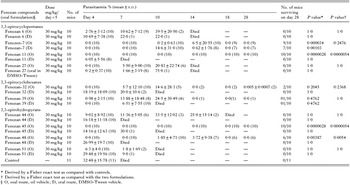
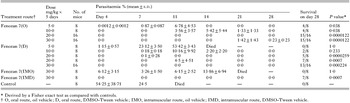
Antimalarial blood schizontocidal activity of four 3,3-spirocyclopentanes (Serial No.: Fenozan 6 (Fig. 1A), 7 (Fig. 1B), 11 (Fig. 1C) and 27 (Fig. 1D) and two 3,3-spirocyclohexanes (Fenozan-32 (Fig. 1E) and 39 (Fig. 1F))) and four 3,3-spirohydropyran (Fenozan 44 (Fig. 1G), 45 (Fig. 1H), 48 (Fig. 1I) & 51 (Fig. 1J)) – as listed by Peters et al. (1993b), have been evaluated against a highly multidrug-resistant P. yoelii nigeriensis (MDR strain), using 2 formulations, namely Fenozan compounds dissolved in either neutral groundnut (peanut) oil or in DMSO-Tween diluted with water. Both of the drug formulations were administered orally to infected mice for 5 consecutive days (day 0 to day +4) and results of parasitaemia record/survival of animals until day 28 are presented in Tables 1–4.
Table 1. Blood schizontocidal activity of 3,3-spirocyclopentane derivatives (Fenozan 6, 7, 11 and 27), 3,3-spirocyclohexane derivatives (Fenozan 32 and 39) and 3,3-spirohydropyran derivatives (Fenozan 44, 45, 48 and 51) against multidrug-resistant Plasmodium yoelii nigeriensis (MDR strain) by the oral route of drug administration (Chemical structures of Fenozan compounds 6, 7, 11, 27, 32, 39, 44, 45, 48 and 51 are presented in Fig. 1 (represented by structures A–J respectively). Fenozan nos. as quoted by Peters et al. (1993b).)


Six Fenozans namely 3,3-spirocyclopentanes (Fenozans 6 and 27), 3,3-spirocyclohexane derivatives (Fenozan 32 and 39) and 3,3-spirohydropyranes (Fenozan 44 and 51) (structures given in Fig. 1A, D, E, F, G and J respectively) were found to be inactive when given orally at 30 mg/kg/day×5 days treatment schedule. Both formulations of these compounds, failed to clear parasitaemia on days 4 and 7, resulting in early mortality in most of the treated mice (Table 1).
Fenozan-7 (Fig. 1B) at 30 mg/kg/day×5 doses initially showed 90% curative action when administered orally in neutral groundnut oil formulation (with survival of 9/10 mice). The second formulation in DMSO-Tween was less active, as shown by survival of 7/10 mice although the difference was found not to be significant (P value=0·2476) when compared with its oil formulation (Table 1). In a revalidation test, the oral formulation in oil at 30 mg/kg/day×5 doses treatment cured 15/16 mice (cure 93·7%, P value (compared with control)=0·0000122), while the oral formulation in DMSO-Tween was less active (P value (compared with control)=0·000224) with the cure of 81·2%. The results of intramuscular administration of Fenozan-50F showed that intramuscular formulation in oil at 30 mg/kg/day was inactive, while the intramuscular formulation at 30 mg/kg in DMSO-Tween was curative with survival of 7/8 mice (cure 87·5%) (Table 2).
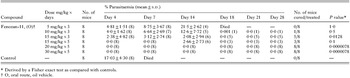
Fenozan 11 (Fig. 1C) formulation in neutral groundnut oil was very effective orally against MDR P. yoelii nigeriensis in mice at 30 mg/kg/day×5 doses as shown by complete clearance of parasitaemia (days 4–28), with a high cure rate (10/10 mice). However, its formulation in DMSO-Tween-water administered orally was inactive (P value=0·0000054 when both the formulations were compared) (Table 1). Revalidation of Fenozan 11 oral formulation in neutral oil also showed that the compound was fully curative, protecting 8/8 mice at both 20 and 30 mg/kg×5 doses, while a lower dose (15 mg/kg×5) was partially curative (3/8 mice) (Table 3). The results of the 3 dose administration schedule at 15 mg/kg/day showed partial protection of 5/8 of mice. The cure rate of Fenozan 11 in oil formulation administered orally seemed to be better than Fenozan-7.
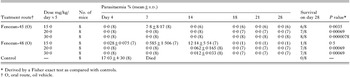
Fenozan 45 (Fig. 1H) showed very good blood schizontocidal activity at 30 mg/kg/day×5 days when administered orally in oil formulation, with complete clearance of parasitaemia until day 28 with 100% protection of mice (10/10 mice), whereas its DMSO-Tween formulation was not protective (P value=0·0000054) (Table 1). In revalidation tests oral formulation in oil was again 100% curative and protected 8/8 mice (Table 4).
Fenozan 48 (Fig. 1I) formulation in oil was partially protective (6/10 mice) at 30 mg/kg/day×5 days whereas its DMSO-Tween formulation was not protective (Table 1). The revalidation test also gave a cure rate of 87·5% (7/8 mice protected) (Table 4).
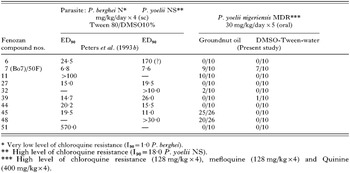
A comparison was also made of the results obtained in the study, especially the protection of mice provided by the groundnut oil-DMSO-Tween formulations of Fenozan compounds. The ED90 results of these compounds against P. berghei N and P. yoelii NS reported by Peters et al. (1993b) are summarized in Table 5.

The control groups of mice (Tables 1–4) infected with MDR P. yoelii nigeriensis showed 100% mortality of mice in 7–8 days. Vehicle-neutral groundnut oil used in the study has no effect on parasitaemia or mortality in controls.
DISCUSSION
In a recent publication, Peters et al. (2002) have reported that their earlier published data in which DMSO (10%) was used for formulating Fenozan 7 (B07=50F) showed wider discrepancies between different experiments because the compound B07 had been found to be unstable in a DMSO-based aqueous formulation. Evaluation of drug formulated in DMSO if stored for several days, indicated that earlier antimalarial activity data had under-estimated the activity of this compound. They further reported that Fenozan-B07 (as the racemic form) is 5 to 7-fold more active against P. berghei N when given orally in ‘DMSO-solution’ than originally reported (Jefford et al. 1995). These authors have pointed out that loss of activity may result from chemical interaction between compound B07 and DMSO in which the cyclopentanone moiety would be replaced by DMSO, thus producing a less active derivative, or alternately, B07 possibly crystallized out of DMSO solution on freezing the drug formulation. Peters et al. (2002) have cautioned against the use of DMSO formulation for drug testing of Fenozan and other endoperoxide antimalarials because this could clearly lead to erratic and misleading antimalarial screening results. In view of the above results using DMSO (vehicle) in in vivo antimalarial screening, double refined neutral groundnut (peanut) oil was used as vehicle for formulating the compounds in this study.
Four 3,3-spirocyclopentanes, namely Fenozan 6, 7, 11 and 27 derivatives,whose ED50 and ED90 activities against P. berghei N and P. yoelii NS were reported by Peters et al. (1993b), have been evaluated and compared against a multidrug-resistant strain of P. yoelii nigeriensis in order to obtain in vivo efficacy data on their curative doses (ED100) in a 5-dose oral treatment schedule using neutral groundnut oil vehicle and DMSO-Tween 80-water formulations. Compounds Fenozan 7 and 11 in oil for oral use showed very good curative activity in our study while their DMSO-Tween formulation was inactive. Fenozan 6 and 27 are not curative against P. yoelii nigeriensis (MDR strain) when administered orally in oil or in DMSO-Tween-water. Although Fenozan 27 was reported to be active by Peters et al. (1993b), the compound has failed to cure MDR P. yoelii nigeriensis in our study.
Fenozan 11, reported to be inactive (ED90=>100 mg/kg×4 s.c. against P. berghei NS) by Peters et al. (1993b), has been found to be fully curative in oil. Peters et al. (1993b,c) had reported that Fenozan 7 (named as cis (+)-4a, 7a-dihydro-6, 7a-di (p-fluorophenyl) spiro (cyclopentane-3, 3′-7H-cyclopenta-1,2,4-trioxine) was the most potent compound of this series against P. yoelii NS (chloroquine resistant) and its ED90 was reported to be 7·6 mg/kg/day×4 s.c. and its ED90 against P. yoelii nigeriensis was reported to be 4·0 mg/kg/day×4 s.c. or as an oral dose. Fenozan-7 was also reported to be highly active against a wide-spectrum of drug-resistant strains of P. berghei-derived lines (lines resistant to chloroquine, primaquine, cycloguanil, pyrimthamine and sulfaphenazole) and P. yoelii (lines resistant to chloroquine, amodiaquine, pyronaridine, mefloquine and halofantrine). Fenozan-7 was reported to be safe up to 3000 mg/kg single oral dose or 600 mg/kg single s.c. dose (Tween-DMSO-water vehicle) in mice, and was identified as a candidate Fenozan compound for drug development (Peters et al. 1993a,c).
The major limitation of Fenozan 7 (Fenozan-50F, B07) is the problem of delayed recrudescence of parasitaemia in a few treated mice, leading to a slight increase in mortality. Although this compound formulated in oil is able to clear day 4 and day 7 parasitaemia, the delayed recrudescence of MDR parasites after a 5-day oral treatment is a matter of major concern in developing this compound as a future drug. The results of our curative dose study with Fenozan 7 support the earlier findings of Peters et al. (1993b,c) who had reported that Fenozan 7 can control MDR malaria infections, though the cure rate in our study was around 93% against P. yoelii nigeriensis (MDR). Our observations suggest that oral Fenozan-50F (B07) formulation in neutral oil is more effective than the DMSO-Tween based aqueous formulation (cure rate 93·7% vs 81·2%, P value 0·0000122 vs 0·000224).
Two 3,3-spirocyclohexane derivatives, namely Fenozan 32 and 39, have been found to be inactive against P. yoelii nigeriensis (MDR) and protection of mice was very low i.e. 2/10 and 1/10 respectively. Fenozan 32 was reported to be active by Peters et al. (1993b) but was inactive against P. yoelii nigeriensis in our study. Out of four 3,3-spirohydropyran Fenozans (44, 45, 48 and 51) that were evaluated, fenozan 44 and 51 in both the formulations, showed no protection against P. yoelii nigeriensis (MDR). However, Fenozan 45 showed higher activity than Fenozan 48.
Peters et al. (1993b) had reported high activity of the p-fluorophenyl derivative (Fenozan 45), which was reported to be slightly less active than its spirocyclopentane analogue-Fenozan 7. The ED90 of Fenozan 45 against P. berghei N was 19·5 mg/kg and against P. yoelii NS was 11 mg/kg/day×4 when administered subcutaneously. They also reported that its activity by the oral route was lower (ED50=approximately 20 mg/kg×4). During the present study, Fenozan 45 has been found to be more active than Fenozan 7 when administered as an oral formulation (in groundnut oil), with better curative action. The present study has established high curative action of Fenozan 45 (structure given in Fig. 1H) against multidrug-resistant P. yoelii nigeriensis when the compound was administered orally in groundnut oil. The compound was inactive orally when administered in DMSO-Tween aqueous formulation, which is in agreement with the view of Peters et al. (2002) that certain trioxanes lose activity in DMSO formulations.
Peters et al. (1993b) also reported moderate activity of Fenozan 48 (ED90=30 mg/kg×4) by the subcutaneous route against P. yoelii NS line. In the present study we have also observed an 87·5% curative effect of the same compound dissolved in oil at both 20 and 30 mg/kg/day×5 when dosed orally.
Our results suggest that DMSO is not an ideal solvent for trioxanes and therefore many potential trioxanes could have been overlooked in the past because of the use of these solvents (vehicle). The present results also indicate that neutralized groundnut oil is an ideal vehicle to use for evaluation of trioxanes or artemisinin derivatives, which are not soluble in water. Because of the use of groundnut oil as vehicle, Fenozan 11 and 45 have been found to be more potent antimalarial compounds for future development.
This paper reports potential antimalarial efficacy of Fenozan 11 and 45 against MDR malaria, but before final selection for clinical development, their stability (shelf life) and their regulatory animal toxicity including LD50, therapeutic index and safety should be properly investigated.
The authors are thankful to Dr C. M. Gupta, Director, C.D.R.I. for his continuous support during the present study. Thanks are also due to Dr S. K. Puri, Head, Parasitology Division, for providing excellent research facilities and for his valuable suggestions. The Fenozan compounds used in the study were kindly supplied by Professor C. W. Jefford. C.D.R.I. communication number 6770.