

Introduction
Grains, especially wheat and barley, were essential products in the Greek and Roman diets. These products have been given much consideration by modern scholars, who have investigated their production in different regions and their contribution to intraregional and interregional trade. However, different types of legumes seem also to have been used in the main diets of those empires. Most of the modern studies relevant to legumes consider that their cultivation did not particularly exceed their local use, which included land fertilisation, human consumption and animal fodder (Amemiya Reference Amemiya2007, 68; Flint-Hamilton Reference Flint-Hamilton1999, 373; Pelling and al Hassy Reference Pelling and al Hassy1997, 1–4). Flint-Hamilton argues that legumes were different from wheat and barley, as they do not seem to have been planted by the Greeks or Romans for use as a cash crop. However, the considerable revenue of legumes, in contrast to that of wheat and barley, as represented by the Hellenistic epigraphic evidence from Cyrene may suggest that they contributed to the interregional markets.
Legumes were among the most commonly cultivated products in the ancient Greek Mediterranean area, and they were probably consumed as much in this early era as one might expect. This figure appears in a number of Greek literary sources. In the ninth–eighth century BC, Homer (Iliad II.13.588, 589) referred to methods of threshing beans (κύαμοι) and chickpeas (ἐρέβινθοι) in which the black skin (μελανόχροες) was removed from the grain. Although he did not say whether these beans and chickpeas were for human or animal consumption, the fact that people at his time were using the threshing process for legumes, similar to that for wheat and barley, suggests that they were probably eating them also. In the fifth century BC, Plato (Republic 372c) described the good meals that should maintain men's health and make them live longer. He stated that after eating a meal that consisted of olives, cheese and greens (probably vegetables), other fruits, nuts and pulses including beans and chickpeas should be served. Although Plato's work describes an ideal city, it indicates the presence of legumes in Greek food culture.
Furthermore, concerning the cultivation of various sorts of legumes in Greek times, there is significant evidence to reflect their awareness of the nutritional value of these products. For instance, around 370 BC, Xenophon (Anabasis VI.4.1–6) named various crops which were planted in the Thracian lands, which he called ‘all kinds of legumes’ (ὄσπρια πάντα). Pulses also seem to have been cooked by the Greeks in different ways. The physician Hippocrates (Regimen XVIII), in the same century, wrote that legumes cause much gas to the stomach, even if they are raw, boiled or roasted: ‘ὄσπρια δὲ πάντα φυσώδεα, καὶ ὠμὰ, καὶ ἑφθὰ, καὶ πεφρυγμένα’. Hippocrates believed that the products of the environment, including human diet and living habits, were responsible for the different diseases that occurred. Therefore, he attempted to explain what constituted better food and how it should be consumed. This reference is significant in that it demonstrates that a variety of legumes were among the most familiar foods to the Greeks during the fifth century BC to the degree that they had created various methods to prepare them. If this was the case for pulses in different Greek regions, did they have the same importance in Cyrenaica?
Archaeobotanical evidence and literary references to legume cultivation in Cyrenaica
Cyrenaica may have cultivated different kinds of legumes from the sixth century BC. This has been archaeologically indicated via a botanical study of seed remains which were discovered at the excavation of Euesperides (Pelling and al Hassy Reference Pelling and al Hassy1997, 1–4). The study suggests that lentils are possibly among these samples (Reference Pelling and al Hassyibid.). Furthermore, other archaeobotanical evidence indicates that some form of legume was retrieved from the excavation of Berenice. The botanical analysis of the samples recovered in a carbonised condition indicated some of the plants that seem to have been cultivated or grown naturally in this city during the imperial period (Webley Reference Webley and Lloyd1979, 31). Pea (Pisum sativum, var. arvense), horse bean (Vicia faba), and bitter vetch (Vicia ervilia) are kinds of pulses attested to in these data. As, so far, only two botanical studies have been conducted in the region and both indicate the presence of some form of legume, one might expect that future excavations and studies will only further enrich our knowledge regarding the growth of legumes in Cyrenaica, and may even provide solid evidence of the earliest introduction of this product.
Although the Greek and Roman literary references to the cultivation of pulses in Cyrenaica are limited and sometimes indirect, they are nevertheless important because they may well support other relevant epigraphic data represented by the damiergoi lists of Cyrene. The first indirect testimony was given by Theophrastus (c. 371–c. 287 BC). Theophrastus (Enquiry into Plants VIII.vi.6), during his discussion of the quantity of rainfall required for growing cereals and pulses and its impact, stated that in the area around Cyrene and Euesperides, and other places where rainfall is scarce, the dews are sufficient to feed these plants. Theophrastus (Enquiry into Plants VIII.vi.6) cites his book VIII for the discussion of matters relevant to pulse and cereal cultivation. These include soil type, seed quality, the best time for sowing, what time the rainfall could positively or negatively affect each kind of cereal and legume, and others. That the writer was equally concerned with both cereals and pulses is probably an indication of their similar, or at least close, economic value to the people at his time. Additionally, al-Idrisi (الإدريسي ), the Arab historian and geographer who lived in the twelfth century AD, mentioned the cultivation of legumes in two Cyrenaican cities. Al-Idrisi (Reference Idrisin.d., 311, 315) highlighted the abundant agriculture of types of pulses and barley at Barce, and referred to groves of pulses that had been planted around Tocra. Chatterton and Chatterton (Reference Chatterton and Chatterton1984, 157–60) showed an appreciation of Cyrenaican soil's potential for cultivating a variety of legumes when they applied the method of rotating pasture with cereals, medicago, which was used in South Australia, to Cyrenaica and Tripolitania. Although the date attributed to these references is much later than the scope of the present study, they are nevertheless significant in that they could mirror the successful agriculture of legumes in the region over time.
Legume cultivation at Cyrene in the fourth century BC
The agricultural importance of pulses in the region is reflected by a number of inscriptions recorded by the damiergoi and that date back to the period from the fourth to the second century BC. Legumes were recorded with other products in the epigraphic lists, including the crops and fruits that have been cultivated in the lands, which may belong to Apollo at Cyrene. The lists from the fourth century BC indicate the word ‘legumes’ (ὄσπρια) in a plural neuter nominative noun form, which refers to pulses in general without specification as to exact type. The word ὄσπρια makes evident their cultivation in the region in the fourth century BC, but does not really give us any further useful information. However, their order in the lists, and the contrasting of their prices per medimnos to that of cereals (wheat and barley), may implicitly identify their economic importance. In all inscriptions of this century, the word ‘legumes’ (ὄσπρια) has been directly inscribed after barley and wheat. For example, ‘Καρπός: crops: κριθαί (barley) … σπυροί (wheat) … ὄσπρια (pulses)…’ (SEG 9.11 to 15, 19, 20, 23, 25; 48.2051). The sequence in which the products in these lists are given should be taken into consideration because some changed their places in the lists of the third and second centuries BC. A good example of this fundamental factor can be seen in the swapping of places for barley and wheat; barley was always written before wheat in all lists from the fourth century BC, but was replaced by wheat in the second–third centuries in all records. The probable reasons for listing wheat before barley in the inscriptions of those two centuries are discussed in detail in my forthcoming thesis. Nevertheless, legumes kept their position after cereals in the damiergoi inscriptions over these three centuries, which may be an implicit reference to their importance as a dry food after wheat and barley.
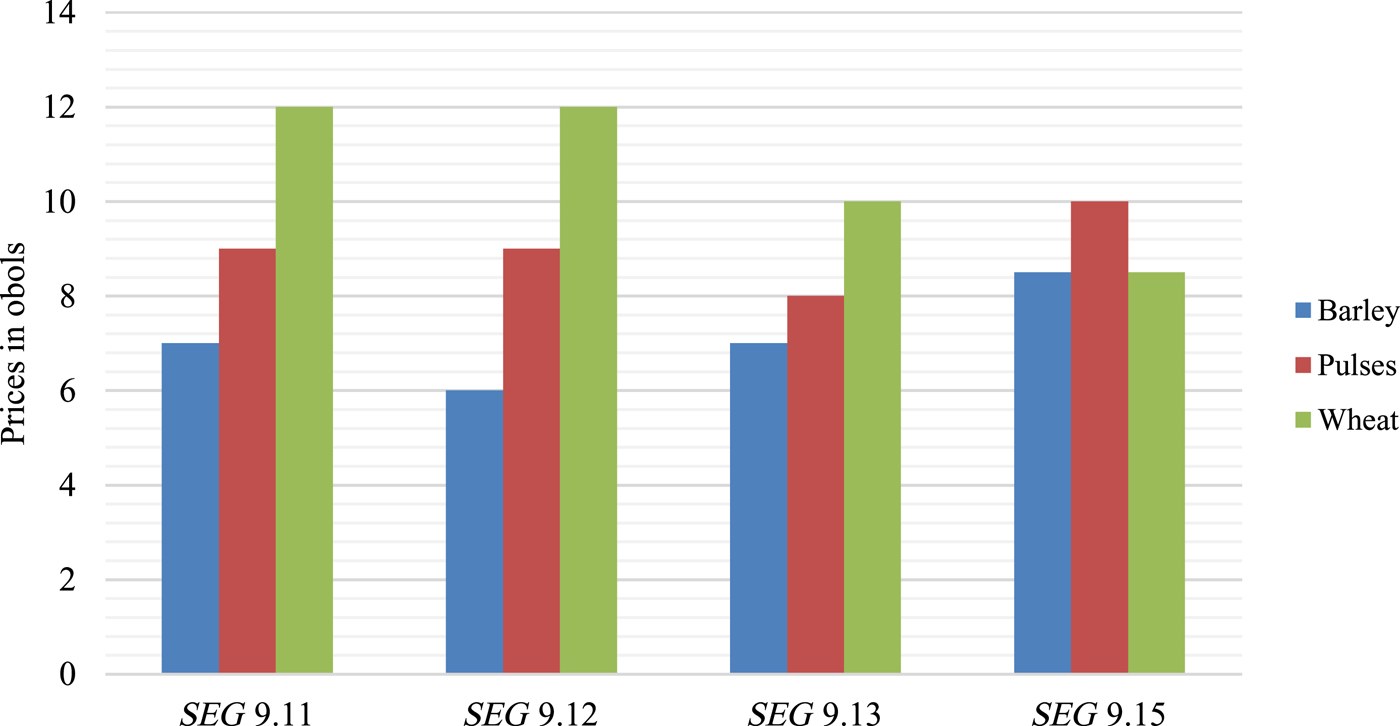
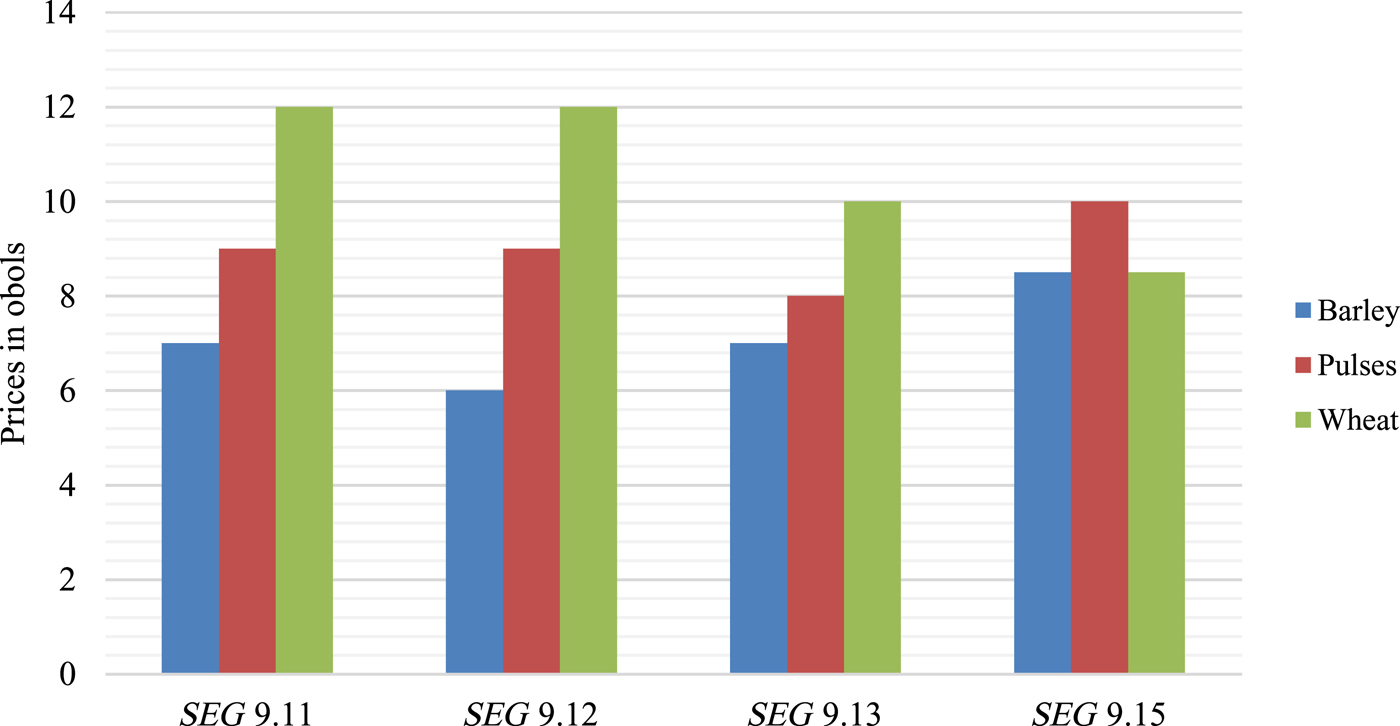
The other point which may demonstrate legumes’ economic significance is their price per medimnos, which can be compared with that of cereals. The cost of the pulses survived in only four out of ten inscriptions of the fourth century BC. In three of these inscriptions, the cost of legumes is higher than that of barley but less than wheat, as can be seen in Table 1 and Figure 1 (SEG 9.11, 12, 15). However, in the remaining inscription, pulses were recorded at a higher price than both wheat and barley, which were sold at similar prices (SEG 9.15).
Prices in obols of barley, legumes and wheat per medimnos as represented by four damiergoi inscriptions dated to 335 BC.
The cost in drachmas and obols of barley, wheat and legumes per medimnos represented by damiergoi inscriptions dated to 335 BC.

Wheat and barley were, as previously mentioned, the most important products to be both consumed and traded during the Greek period. Cereals from Cyrenaica also contributed to the economy of the Mediterranean world. The Grain Decree of Cyrene is a significant piece of evidence to this effect (SEG 9.2; IGCyr010900). It indicates that the city supplied more than forty other cities and communities with a large volume of grain (805,000 medimnoi) in different places in the Greek world at the beginning of the Hellenistic period. Sealing legumes at a price between those two principal products may be an indication that they also formed an essential part of the human diet, and were probably traded alongside wheat, barley and other products.
The unusually high prices of legumes and barley seem to have been a consequence of a poor wheat harvest. The scarcity of wheat may have driven the prices of barley and pulses up to perhaps an overly significant position in the market. This can be understood from the rather unusual circumstance of wheat and barley being of almost equal price. The cost of wheat in the majority of cases would nominally be expected to be higher than that of barley, or double it as was the case in the inscription SEG 9.12. It demonstrates that wheat was sold at 2 drachmas (12 obols) while barley cost only 1 drachma (6 obols). Therefore, increasing the cost of pulses and barley and decreasing that of wheat was probably due to reduced rainfall in the region in that particular year, which would have negatively affected wheat production and thus the reason for the limited amount of wheat. The lack of wheat seems to have increased the demand for barley and legumes and helped farmers to gain considerable profit from marketing them. Whatever the reason behind the increase in the price of legumes in this inscription, it is significant evidence that could represent them following the general marketing trend of wheat and barley in Cyrenaica.
Producing varieties of pulses in Cyrene during the Hellenistic period
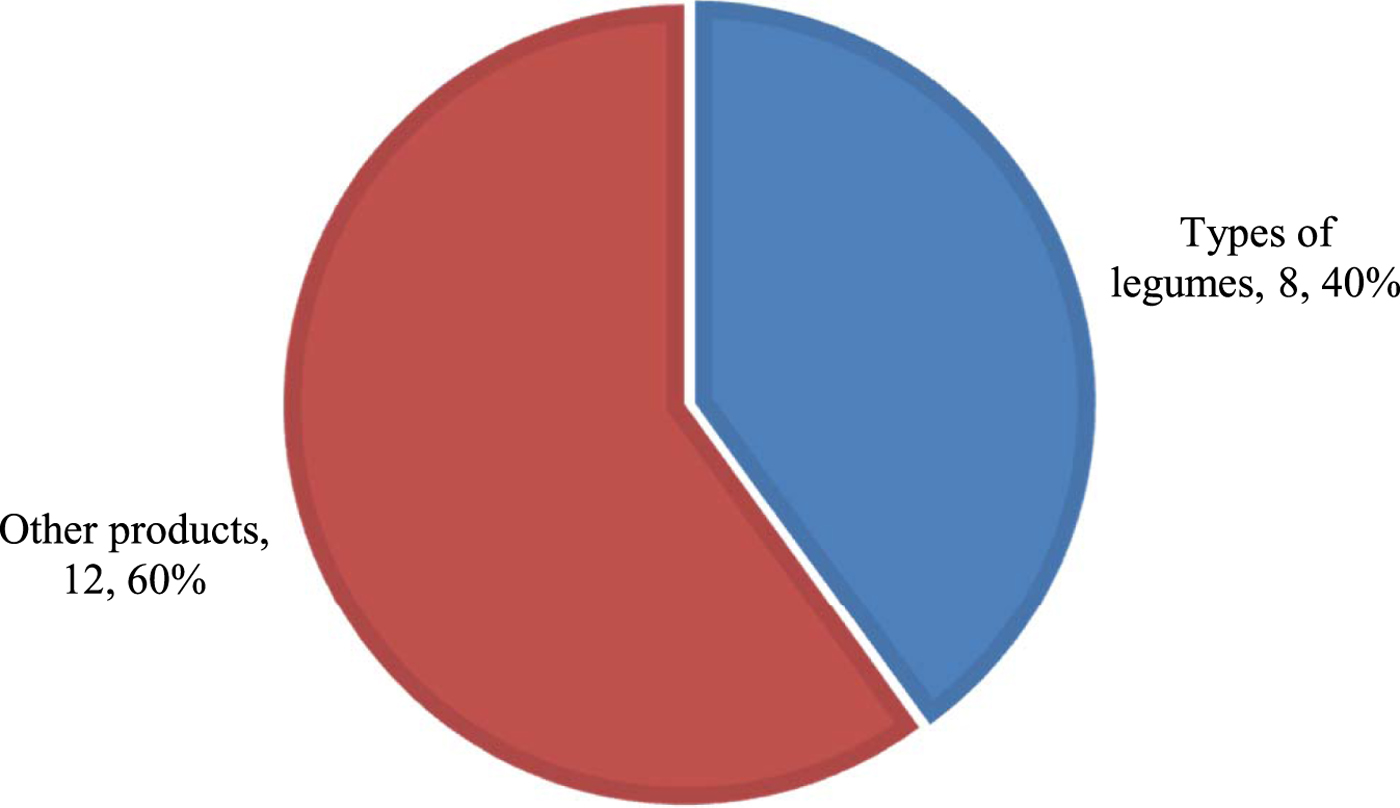
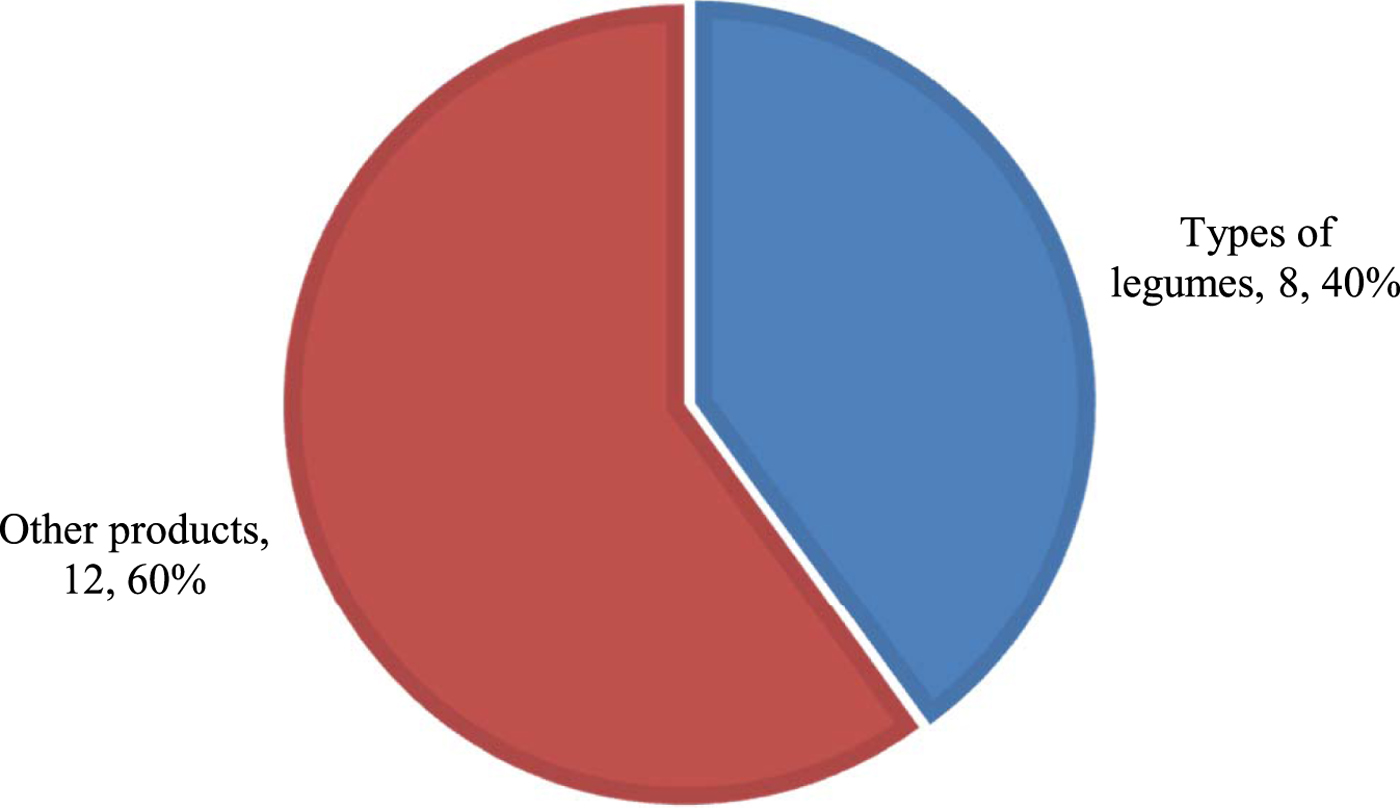
The lists of the damiergoi of the third–second century BC display the clear development of the agriculture of legumes in the region during the Hellenistic era (Laronde Reference Laronde1987, 325–27). Legumes maintained the same position in the lists, after wheat and barley, as that of the fourth century BC. The most interesting matter is that the lists specify the names of six kinds of legume with their prices, in addition to other unidentified legumes. They were recorded twice a year, as were other products, in the first and the second semesters (each six months). These are chickpeas (ὄροβοι), beans (φάσηλοι), peas (πίσσαι), beans (κύαμοι), chickpeas (ἐρέβινθοι), lentils (φακοί) and other pulses (τὰ ἄλλα ὄσπρια) (SEG 9.32, 35–37, 40, 42–44; SEG 18.743). The phrase τὰ ἄλλα ὄσπρια (other pulses) implicitly refers to a number of legumes, therefore it is reasonable to assume at least two other sorts had been planted alongside the six named varieties. The lists also record 18 products which appear to have been produced from the lands of Cyrene, which were devoted to Apollo. They also include some byproducts such as wine, raisins, olive oil and three types of hay. Excluding the byproducts, farmers grew at least eight kinds of legumes and 12 other plants suitable for human consumption, some of which could also have been used for animals. These were wheat, barley, cumin, almonds, figs, olives, garlic, onion and four kinds of grape. Legumes represent 40% (eight out of 20) of the total number of cultivated plants in this area (Figure 2). Although the quantities of each product are unknown, this percentage can be considered a positive sign of the importance of legumes for fertilisation, human diet and animal fodder, and it would seem likely that they were also cultivated for trade.
Numbers and percentages of legume kinds and other products recorded by the damiergoi of the third–second century BC.
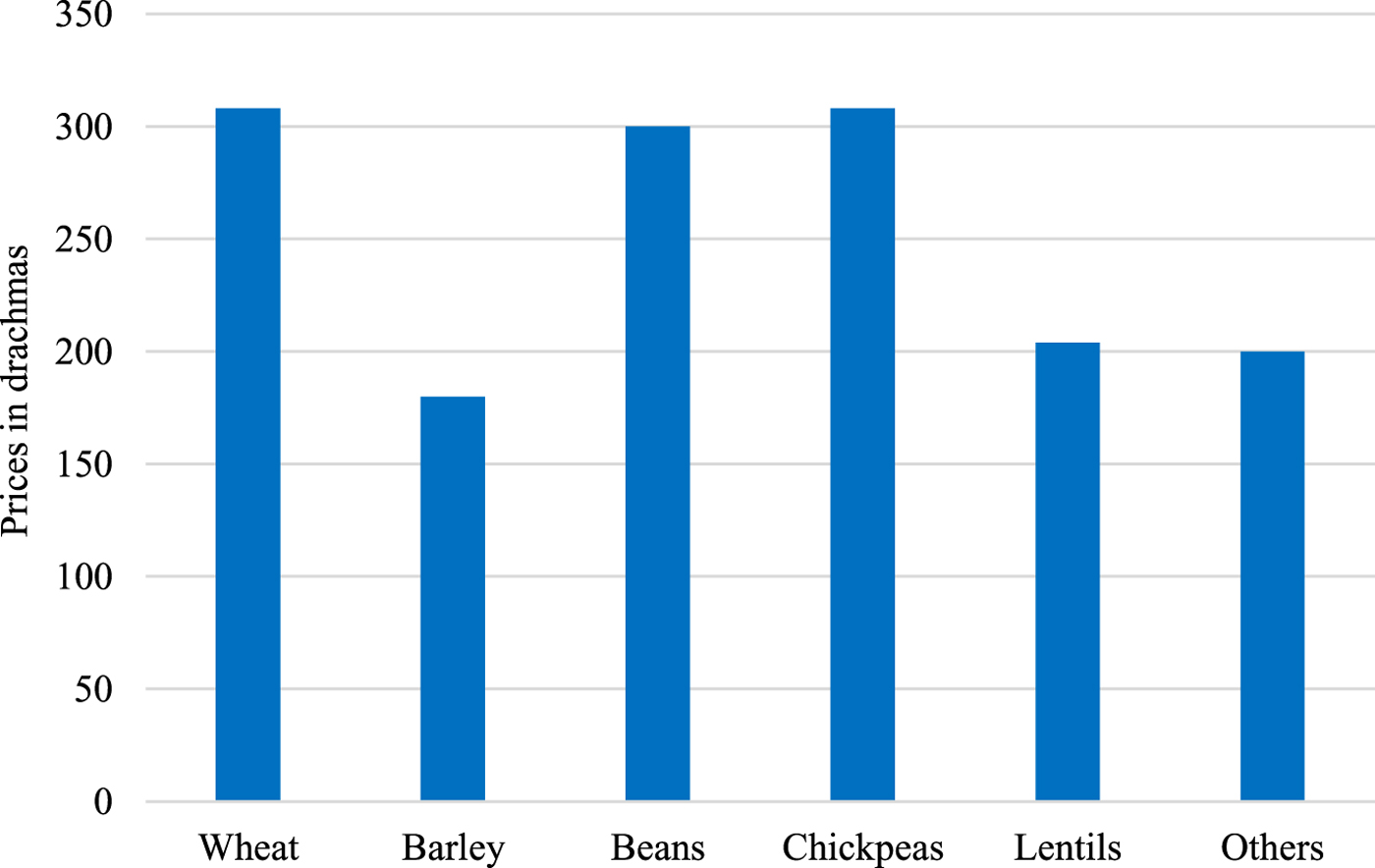
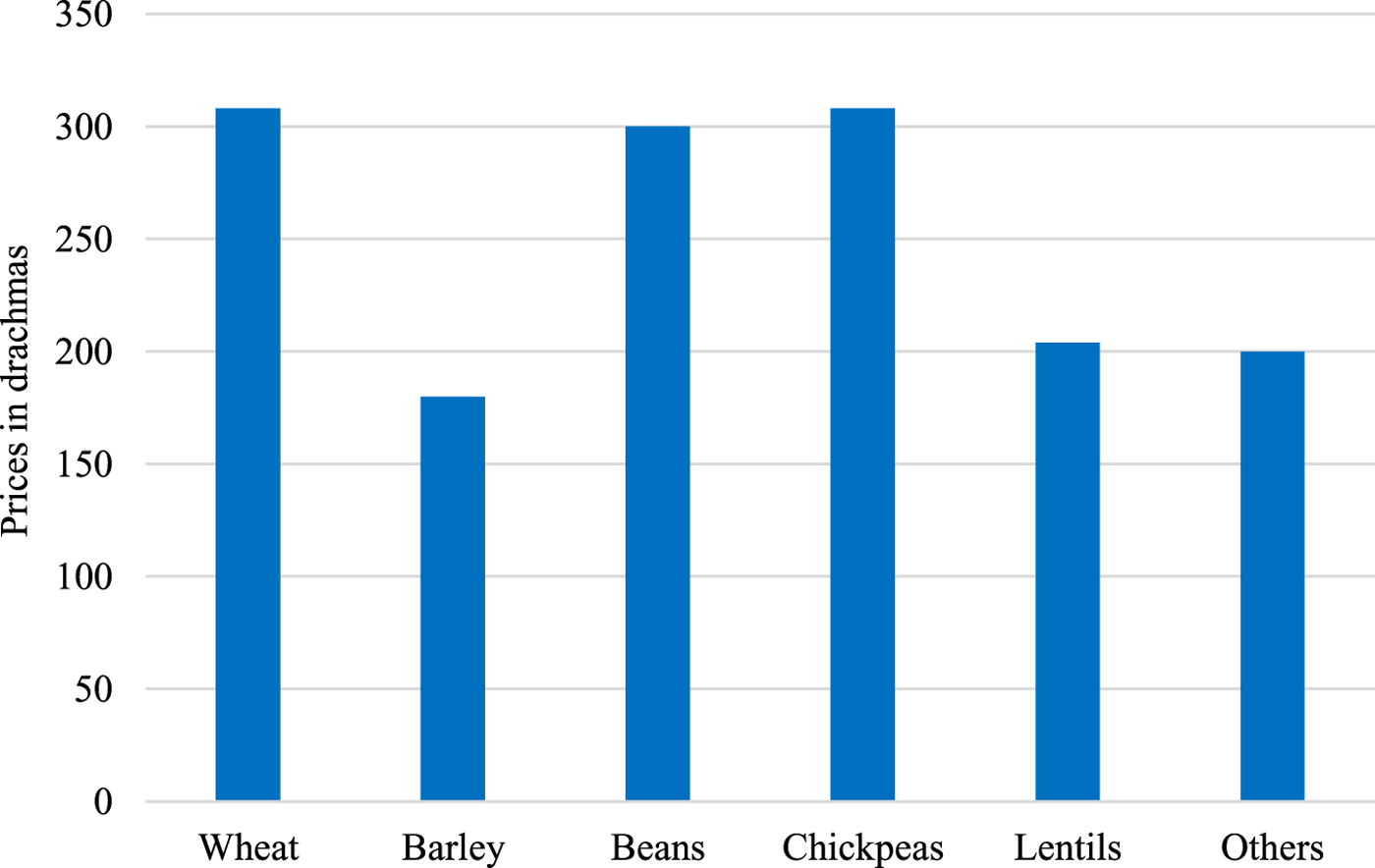
In terms of cost, the beans (κύαμοι), chickpeas (ἐρέβινθοι), lentils (φακοί) and other pulses (τὰ ἄλλα ὄσπρια) mentioned alongside wheat and barley also had an indication of their prices in an inscription dated to the second century BC (SEG 9.43; IGCyr014500; Rosamilia Reference Rosamilia2017, 142). The evidence demonstrates their rate in the first semester only; whilst these products also appeared in the second semester, the associated costs are unfortunately missing. This is another valuable indication that likely reflects legumes’ important economic role. This importance can be understood by contrasting their price with those of wheat and barley. Wheat and chickpeas were sold at a similar price (308 drachmas) per medimnos, and beans were sold at the almost identical price of 300 drachmas. The costs of lentils and the unidentified pulses per medimnos were 204 and 200 drachmas respectively (Figure 3). However, the prices of both were higher than that of barley, which cost 180 drachmas.
The prices in drachmas per medimnos of wheat, barley, beans, chickpeas, lentils and other unidentified pulses as represented by SEG 9.43.
Contrasting the cost of legumes to that of cereals in this evidence shows that the general trend of pricing represented by the inscriptions of the fourth century BC were still being maintained (see Table 1 and Figure 1 above). The costs of pulses were not higher than that of wheat, and were not less than the cost of barley. A similar trend in pricing can also be seen in an inscription dated to the end of the third and beginning of the second centuries BC (SEG 9.43; IGCyr014500). A comparison of the increasing costs of cereals and pulses made by Rosamilia (Reference Bencivenni, Reynolds and Roueché2017, 142) also reflects this trend in the prices of this period, despite the change in the value of the drachma from silver to bronze standard.
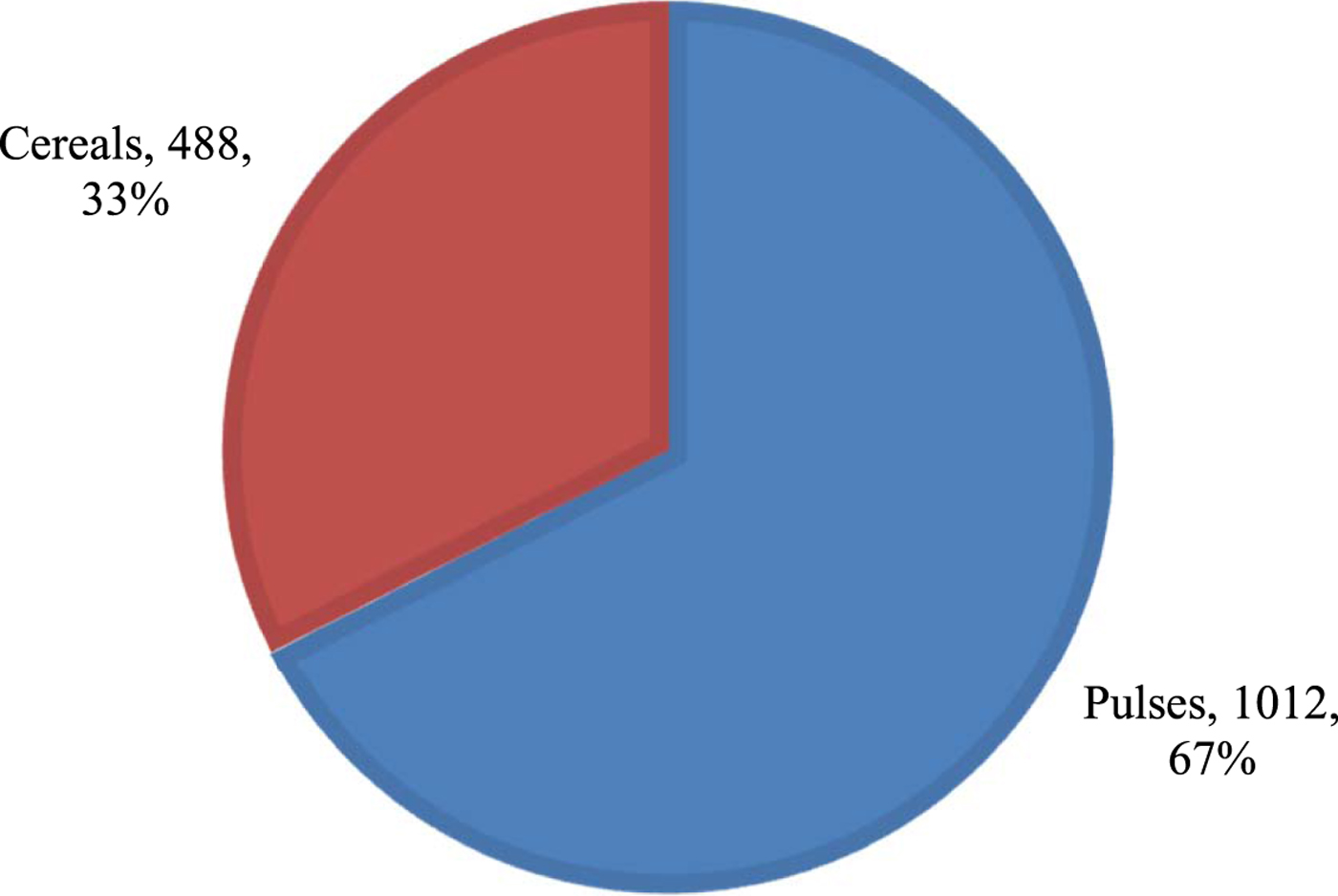
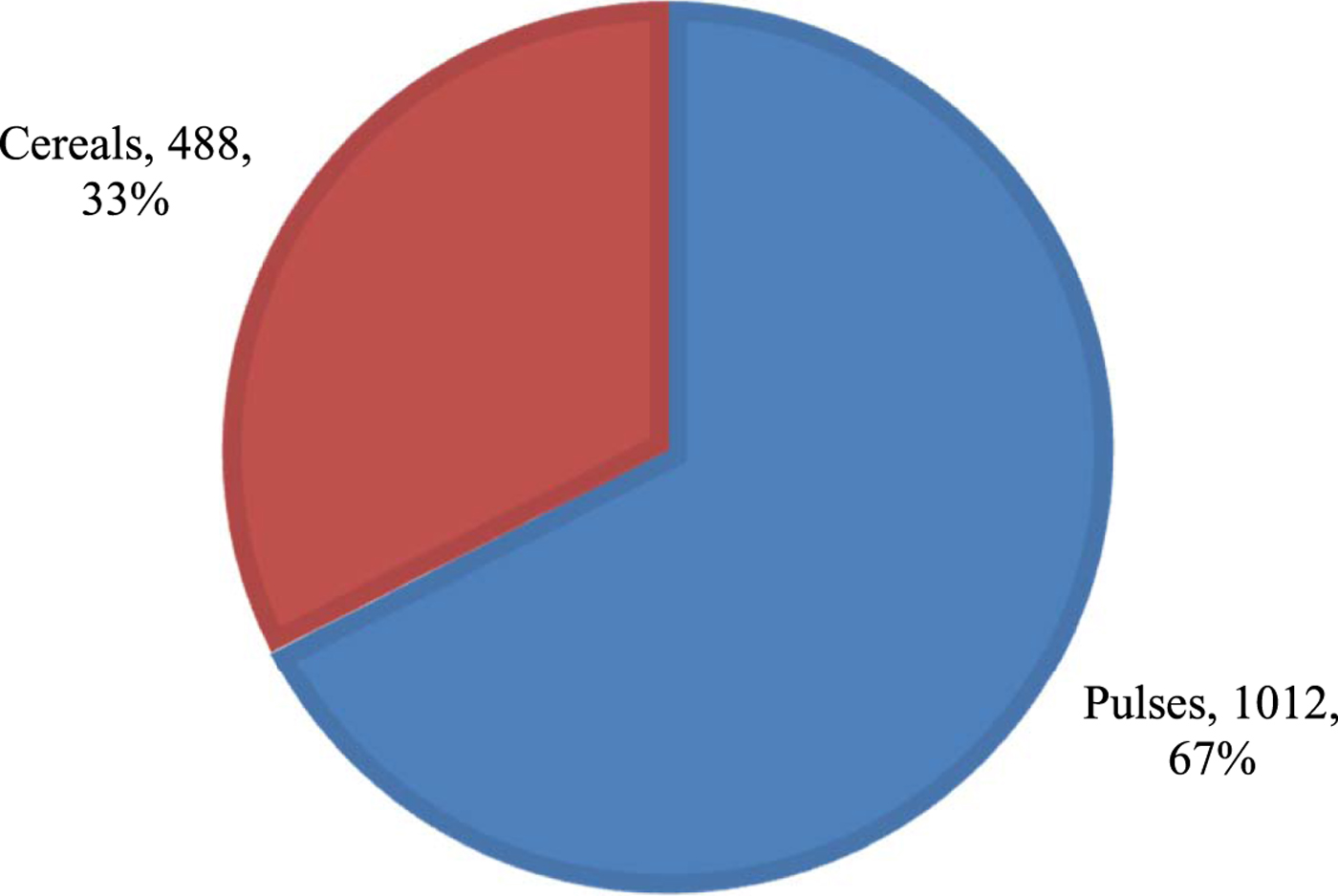
The prices that appear in this inscription could be used to estimate the total production and income if a farmer in Cyrenaica sold a medimnos of the varied kinds of legumes and the two cereal products. We can thus imagine the extent to which the Cyrenaicans were concerned with the production of miscellaneous varieties of legumes. The total income that could be gained from sealing a medimnos of each kind of legume was 1,012 drachmas (308 + 300 + 204 + 200), while that of wheat and barley was 488 drachmas (308 + 180) (Figure 3). Pulses made up 67% of the total of the hypothetical income of all crops, whilst that of wheat and barley represented 33% (Figure 4). The noticeable revenue available from the sale of legumes raises the question of whether they were grown purely for local consumption and manuring the lands, or whether, as with wheat and barley, they were probably also cultivated to contribute to the global markets.
The proportion of revenue gained from selling one medimnos of all kinds of pulses in contrast to that gained from cereals (wheat and barley).
An estimation of legume production in Cyrene based on their revenues and prices
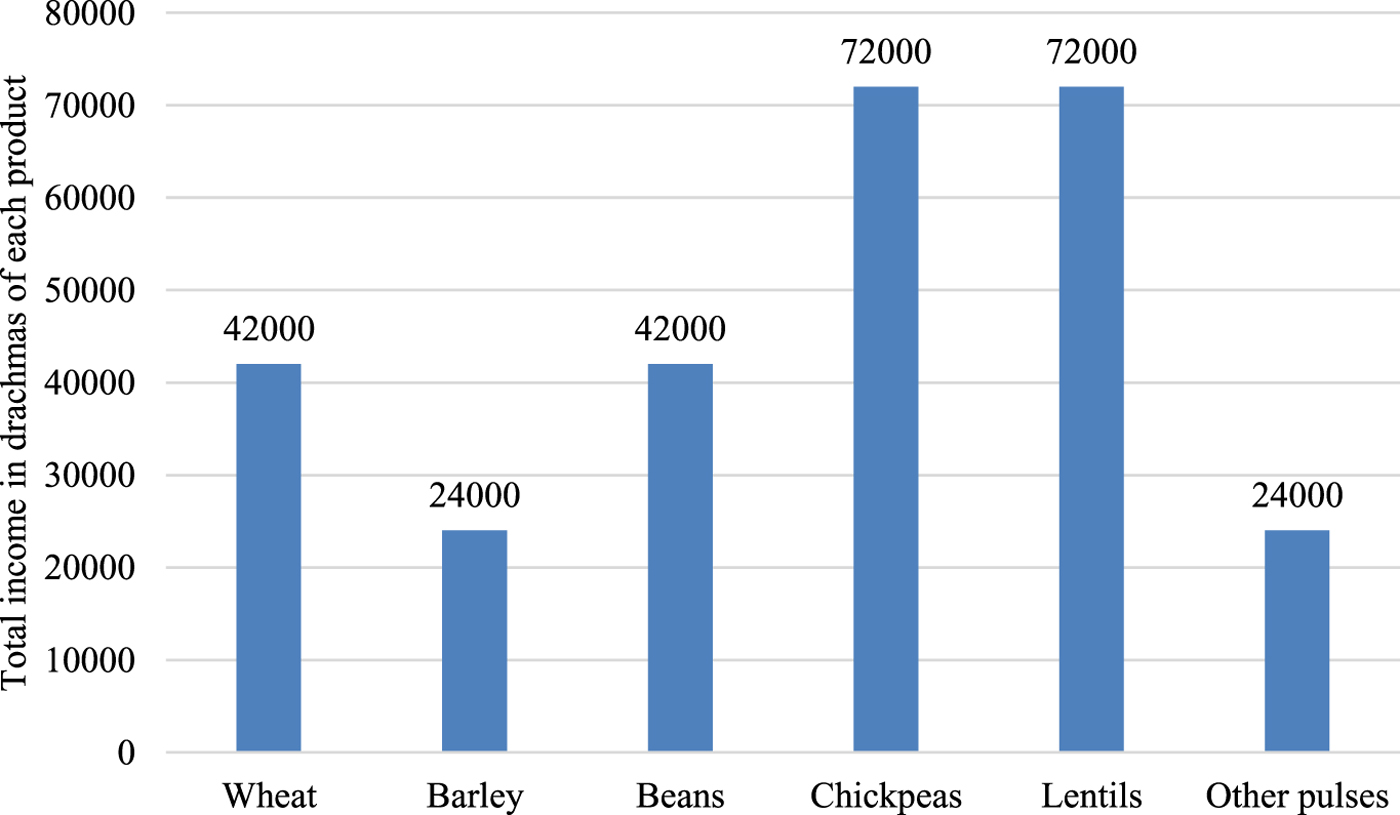
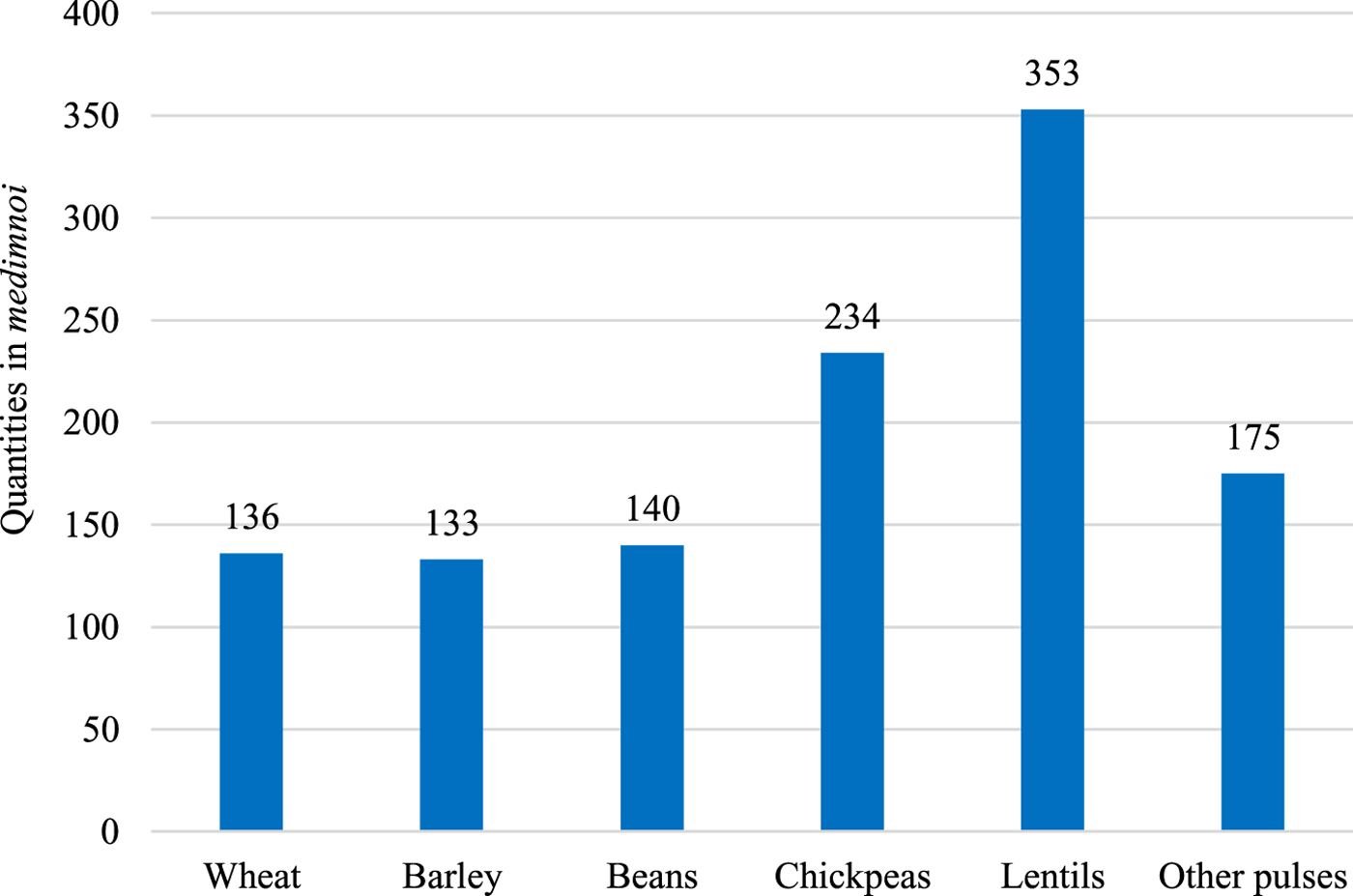
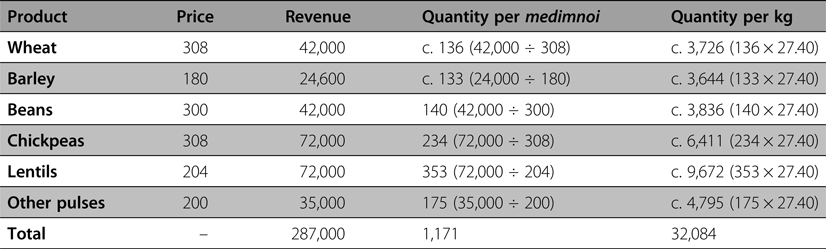
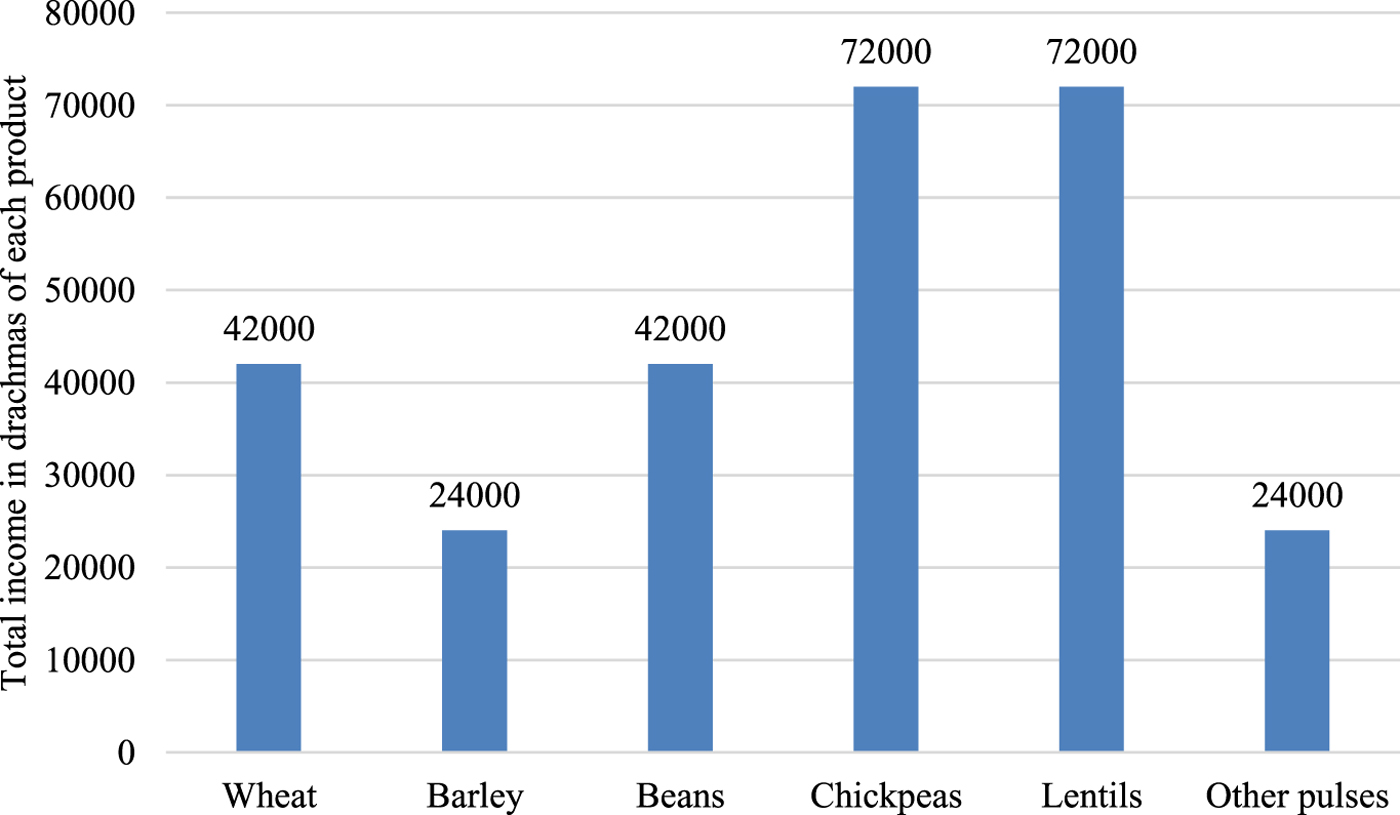
The appreciable profit of trading legumes, in particular beans (κύαμοι), chickpeas (ἐρέβινθοι), lentils (φακοί) and others (τὰ ἄλλα ὄσπρια), is evidenced from numeral data inscribed in SEG 9.42, which was also dated to the second century BC. Dobias-Lalou rereads these numbers and suggests that they probably represent quantities and they are not the price per unit as has been proposed by Oliverio (IGCyr014400). Rosamilia supported Dobias-Lalou's suggestion regarding Oliverio's erroneous readings and argues that the numerous numbers recorded after each product in this evidence are the total income from their marketing (Rosamilia Reference Bencivenni, Reynolds and Roueché2017, 143). He also, though somewhat questionably, suggests a possible slight shortage in legume production as a result of gaining the high income represented by SEG 9.42 (Figure 5). However, if one bears in mind the prices of pulses per medimnos as represented by SEG 9.43, the probable interpretation of this noticeable income would be their medimnoi (μέδιμνοι), where the modern value of the medimnos of wheat or barley has been discussed in the literature and their average weight approximated at 27.40 kg (Bresson Reference Bresson and Archibald2011, 66–95; Stroud Reference Stroud1998, 54, 55). Therefore, it is reasonable to believe that a medimnos of pulses would also have been equivalent to c. 27.40 kg. Based on this, a trivial mathematical calculation can be made to estimate the quantity of each crop sold with regard to the prices recorded in SEG 9.43 and the revenue indicated in SEG 9.42. This allows a fair interpretation of receiving tens of thousands of drachmas for each product. For example, as the price of a medimnos of beans was 300 drachmas and the earnings from the sale of an unknown volume were 42,000 drachmas, this quantity would be about 140 medimnoi (42,000 ÷ 300 = 140) or 3,780 kg (140 × 27.40). The same operation can be applied to all other products to identify their total production in a six-month period (Table 2; Figures 5 and 6).
The total income in drachmas earned from selling each crop as represented in SEG 9.42.
The approximate quantities of cereals and legumes in medimnoi (corresponding to Table 2).
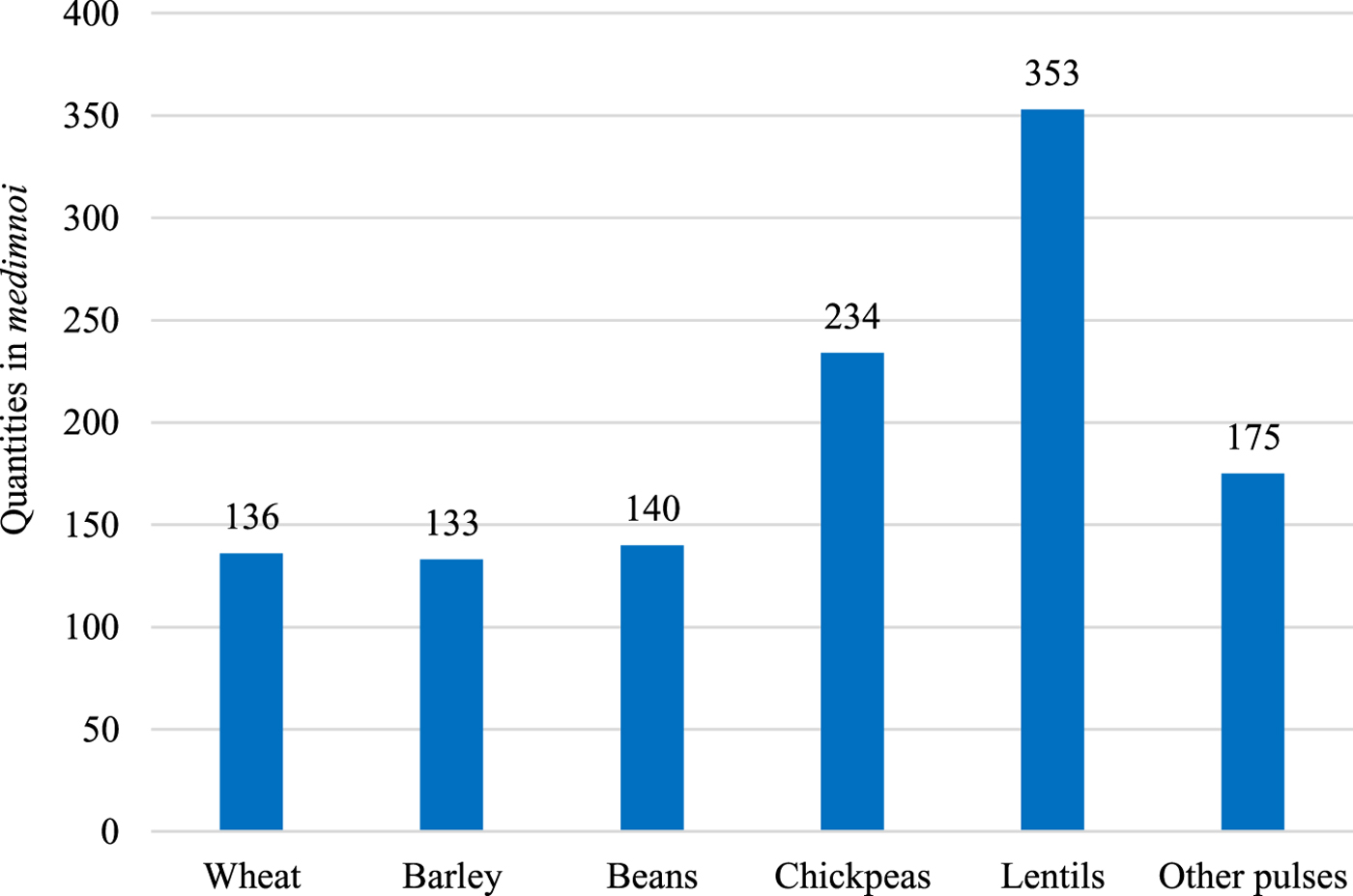
The estimated quantities of cereals and legumes in medimnoi based on their prices and incomes per drachma recorded in SEG 9.42, 43, and approximating the volumes in kg assuming 27.40 kg per medimnos (corresponding to Figure 6).

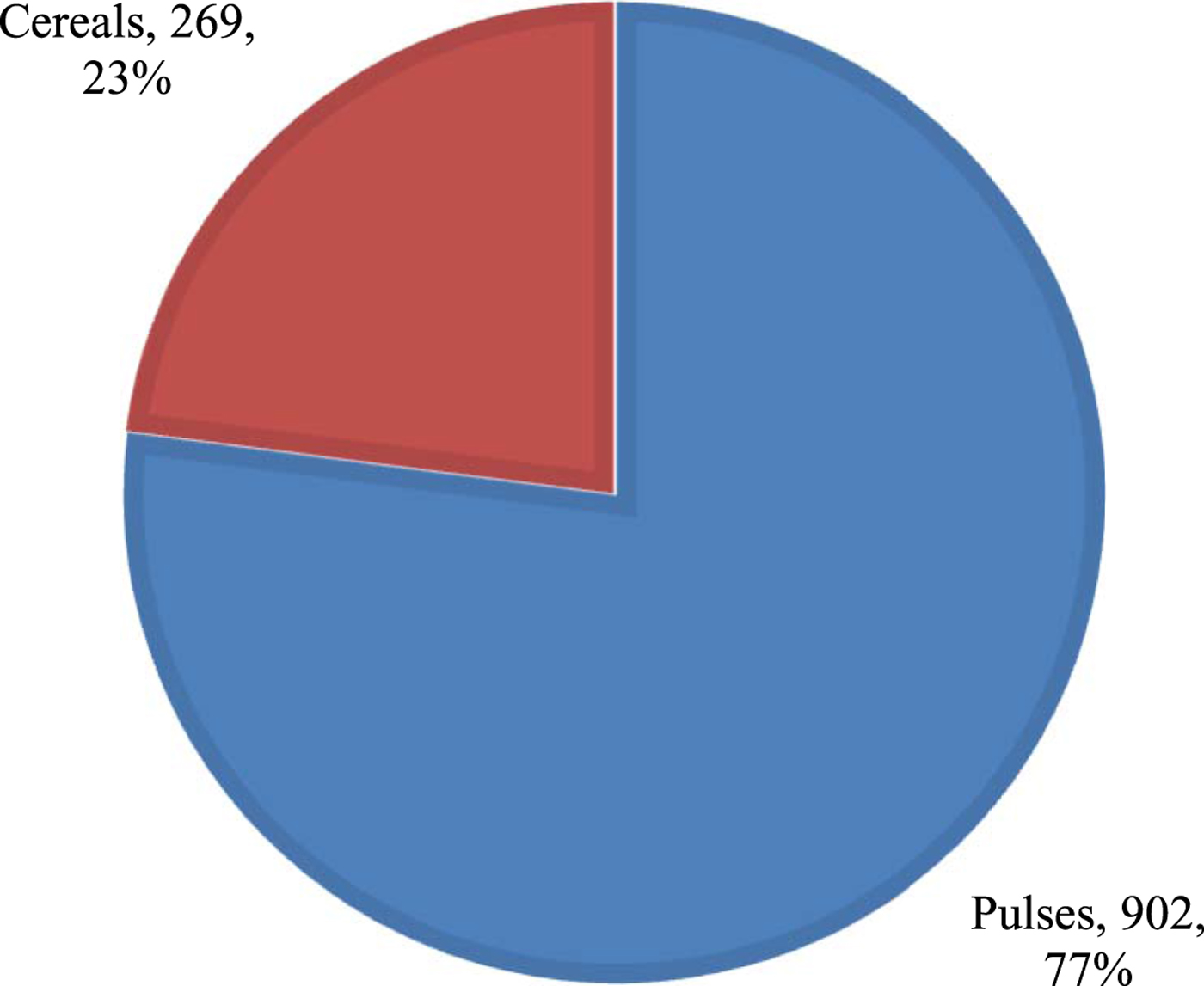
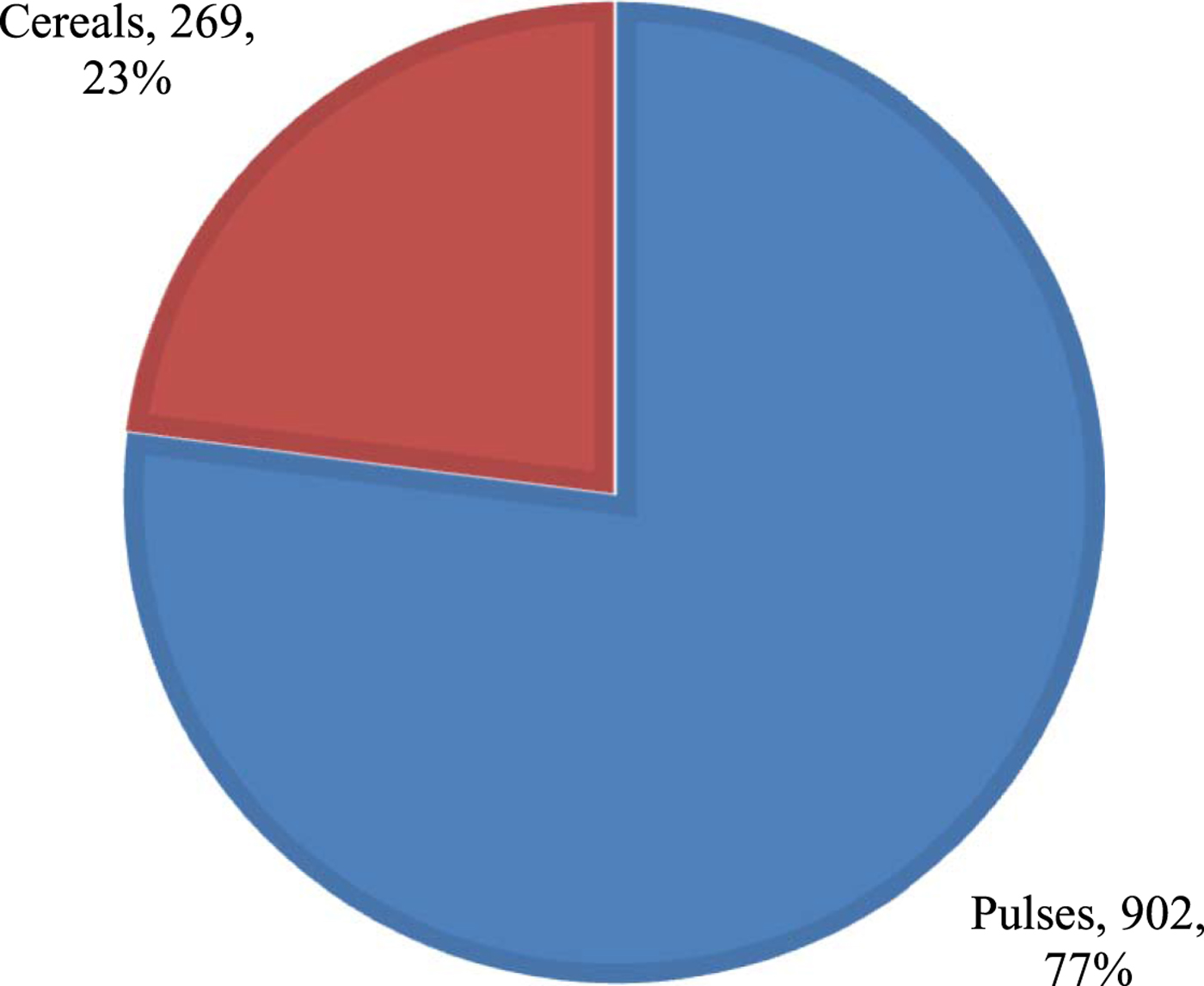
The above allows us to estimate, in terms of the quantities of cereals and legumes produced, that the volume of the latter was much larger than the former. They indicate 140 medimnoi of beans, 234 medimnoi of chickpeas, 353 medimnoi of lentils and 175 medimnoi of unidentified pulses, while that of wheat was c. 136 medimnoi and 133 medimnoi of barley (Table 2; Figure 6). Thus, the production of pulses in the first semester represents 77% (902 out of 1,171 medimnoi) of the total grain production, whereas cereals make up merely 23% (Figure 7). If one assumes a similar volume of pulses to have been produced in the second semester, the total would be 1,804 medimnoi or c. 49,429 tonnes (1,804 × 27.40 ÷ 1,000). The agricultural pattern implemented in some Cyrenian lands (devoted to Apollo) recorded by the damiergoi can be considered as a case study and applied to the terrain around Cyrene and other parts of the region such as Barce and Tocra. Al-Idrisi (Reference Idrisin.d., 311, 315) reports the sizeable cultivation of pulses around those two cities. This strongly implies the consumption of different types of pulses in the region, and probably their export over time.
The quantities in medimnoi and the percentages of the approximate production of pulses and cereals.
The considerable quantity of legumes produced in Hellenistic Cyrene in contrast to that of cereals may reflect a better purpose for the cultivation of pulses from that of land fertilisation or local consumption to a more significant commercial role. This could be true if one calls to mind the traditional concept of using legumes for land manuring during the fourth century BC. Two inscriptions from Attica dated to the fourth century BC referred to the involvement of legumes in the land rotation system (Applebaum Reference Applebaum1979, 92, 117; Bresson Reference Bresson2016, 169; IG II2 2493; IG II2 1241; Moreno Reference Moreno2007, 328). The inscription of Myrrhinous, for example, notes that 50% of the land should be cultivated with wheat and barley and half of the other 50% should be devoted to legumes, while the remaining quarter should be left fallow: ‘σ|[π]ερεῖ δὲ τῆς γῆς σίτωι τὴν ἡμίσειαν, τῆ|ς δὲ ἀργοῦ ὀσπρεύσει ὁπό[ση]ν ἂν βούλητ|αι’ (IG II2 1241).
The awareness of legumes’ nutritional value
Cyrenaica was a part of the Greek and Roman world which seems to have been widely planted, and perhaps traded different kinds of legumes for human consumption because they were aware of their nutritional value. In c. 25 BC–AD 50, Celsus (De Medicina IX,4.9.3), the Roman encyclopaedist, stated that walking and running were important physical activities that should be practised. He also specified certain kinds of foods that should be regarded as a vital part of the daily diet, which included lentils (lentĭcŭla). Additionally, Galen (On the Properties of Foodstuffs 525–51), the Greek physician, surgeon and philosopher who lived in the second century AD, indicated the names of a variety of legumes and explained how they were prepared to suit the human diet. Foxhall and Forbes (Reference Foxhall and Forbes1982, 41–90), in their work on the main diet of the Greeks, stress the nutritive importance of wheat and barley. Their extensive comparative nutritional analysis has determined a daily portion of wheat or barley per person in the Classical period. This argument is based on a literary indication mentioned by Herodotus (Histories VII.187.2). They consider that this ration was sufficient because it provided the body's daily needs of calories in particular, and other vital elements of the diet including protein. O'Connor (Reference O'Connor2011; Reference O'Connor2013, 327–56) also discusses the amount of wheat or barley which was probably consumed by soldiers to provide the required calories to cover their daily physical effort. These researchers opened up a new way of thinking, as focused on the body's daily needs in terms of calories, calcium and other elements, in antiquity. As legumes are one of the most important sources of protein, the studies conducted by Foxhall and Forbes and by O'Connor inspire me to address the question about the body's daily needs in terms of protein in Greek and Roman times, especially for agricultural labourers or indeed other occupations requiring hard physical activity. Foxhall and Forbes (Reference Foxhall and Forbes1982, 41–90) consider one choenix (χοῖνιξ: a dry measure; one choenix is worth 1/48 medimnos) of wheat or two of barley to contain the daily bodily amount of protein.
Legumes have been regarded by a number of modern studies as one of the most important sources of protein (Allen Reference Allen, Bowman and Wilson2009, 340, 341; FAO 1994; Garnsey Reference Garnsey1998, 240, 242; Messina Reference Messina2014, 437–42). Garnsey (Reference Garnsey1998, 240–41) mentions that ‘wine, oil and dry legumes are commonly regarded as staples throughout the Mediterranean region, and special reasons have to be found for denying their presence to some degree in the diet of the ordinary people of Rome’. People may consume legumes and barley alongside small portions of wheat, or indeed instead of wheat, because the two former products are usually cheaper. In addition, the agricultural system of land rotation between cereals and pulses allows for the production of various types of legumes.
Storing, donating and trading legumes like wheat and barley
Legumes were like cereal dried and stored to be consumed in the winter, during times of shortage and to supply the military during the Roman period. Pliny (Natural History V.xviii.73), in his explanations of how people stored grains, mentions beans, lentils and chickpeas in addition to wheat and barley. Additionally, the inscription of Lete of Macedonia indicates that a benefactor would provide a Roman army with beans, wheat and barley. This evidence is probably contemporary to Hadrian's time. It demonstrates that the city would honour a gymnasiarch because he provided a cheap grain at a difficult time and supplied the army with wine and grain, including beans:
The city celebrates Manius Salarius Sabinus, gymnasiarch and benefactor, who very often in times of shortage sold grain much more cheaply than the current price, and when the emperor's army was passing through, provided for the annona 400 medimnoi of wheat (σείτου μεδ(ίμνους) υʹ), 100 of barley (κριθῶν μεδ(ίμνους) ρʹ) and 60 of beans (κυάμου μεδ(ίμνους) ξʹ), plus 100 metretae of wine (οἴνου μετρητὰς ρʹ) at a much cheaper rate than the current price. (Garnsey Reference Garnsey1988, 247, 248; SEG 1.276)
The importance of this text lies in the fact that wheat and barley were not the only dry foods to be consumed by the Roman army, but rather that pulses were also found in their diet. In addition, beans, or possibly other varieties of pulses, were among the grain that this gymnasiarch sold at cheaper cost. If so, some varieties of legumes were perhaps traded in the Mediterranean Greek and Roman worlds. Wilson (Reference Wilson, Bowman and Wilson2009, 214, 215) argues that many products are ‘invisible’ in an archaeological sense, including the different varieties of pulses that seem to have been traded during the Roman era. He provides interesting data, as indicated by textual evidence (TPSulp. 51, 52 cited in Wilson Reference Wilson, Bowman and Wilson2009, 215) which demonstrates the export of 7,000 modii, or 31.5 tonnes (7,000 × 4.5 kg ÷ 1,000 kg), of Alexandrian wheat and 4,000 modii, or 18 tonnes (4,000 × 4.5 kg ÷ 1,000 kg), of beans, lentils and chickpeas at the beginning of the first century AD. This quantity of legumes comprised more than 50% of the volume of wheat. This is a positive sign that pulses made a significant contribution to Egyptian commercial activities during the Roman era. This suggestion is supported by a literary reference in Pliny (Natural History IV.xvi.76.201). He refers to a consignment of lentils equalling 120,000 modii, or 540 tonnes (120,000 modii × 4.5 kg ÷ 1,000 kg). This quantity was loaded aboard the ship that carried the Vatican obelisk (Wilson Reference Wilson, Bowman and Wilson2009, no. 26). Wilson (Reference Wilson, Bowman and Wilson2009, no. 26) also notes that the total capacity of the ship was approximated at 1,100 tonnes. If so, the lentils would have comprised about 50% (540 tonnes) of the ship's total tonnage capacity. This data is a significant indication of trading some kinds of legumes throughout the Mediterranean world during the first century AD. It may also reveal people's concern about the proper way of storing them, like wheat and barley, as Pliny mentioned.
Costs trend of pulses and cereals recorded in Diocletian’s Edict
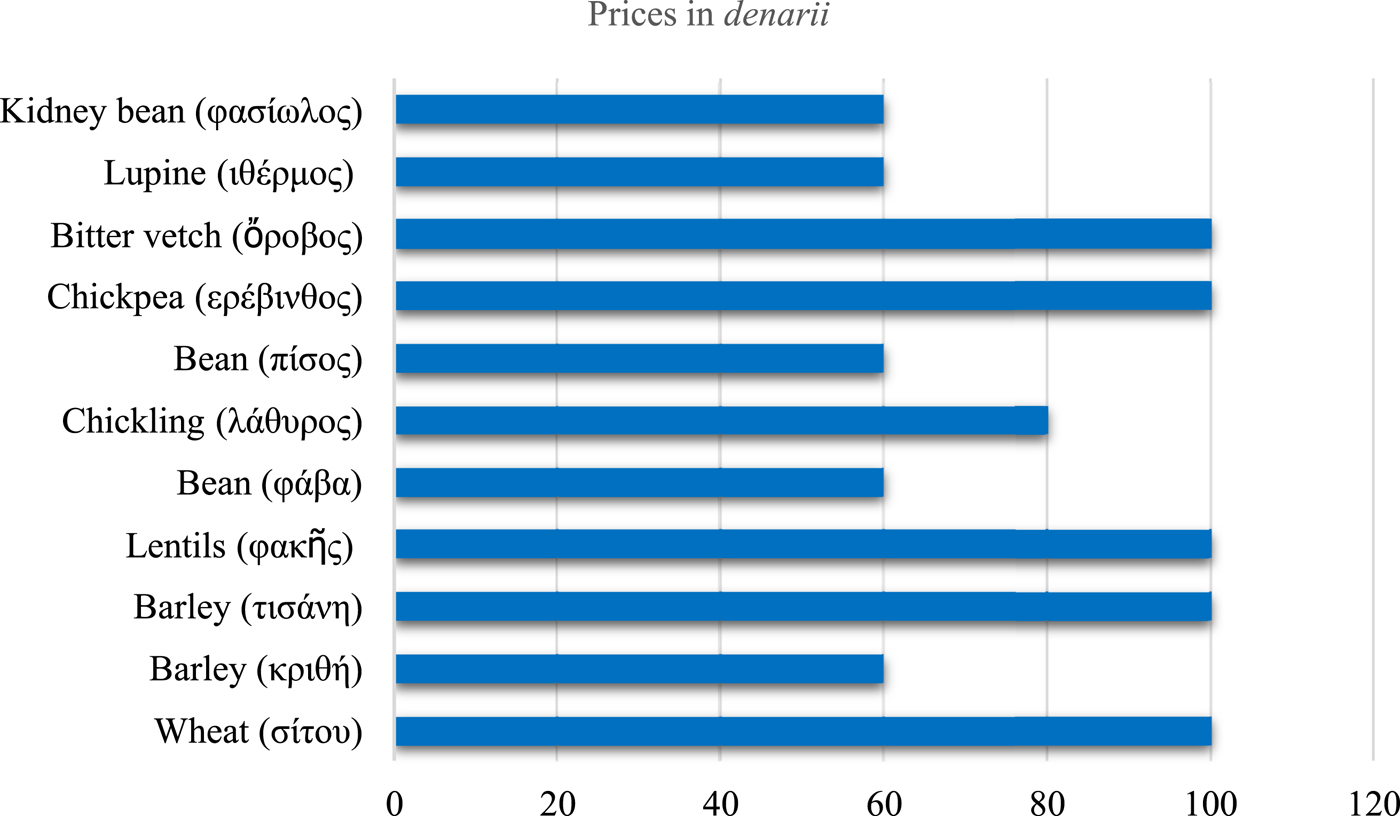
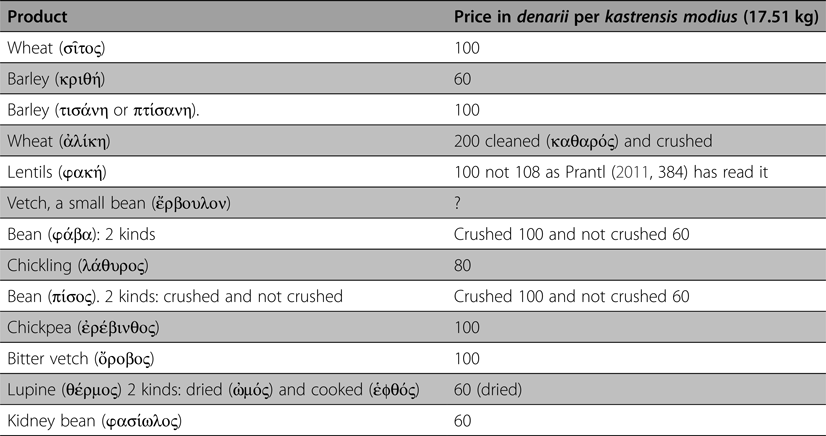
The growth of a variety of pulses by the Romans is perhaps an implication of their importance as a dry food, alongside wheat and barley. Diocletian's ‘Edict on Maximum Prices of AD 301’ lists different kinds of legumes (Prantl Reference Prantl2011, 368, 369, 384, 385). The edict notes at least 12 legume types among 27 different kinds of grain (Table 3). Some of these pulses were sold crushed and some whole. Beans (φάβα), for example, were classified into two kinds whose costs were different. Crushed beans cost 100 denarii per kastrensis modius (17.51 kg), whilst whole beans cost only 60 denarii (Prantl Reference Prantl2011, 367). As the legumes in this edict were represented by the same unit of weight as cereals, it is possible to contrast their prices directly. Excluding the crushed products, the whole pulses had a similar cost to that of wheat or barley (Table 3 and Figure 8). The maximum price for lentils (φακή), chickpeas (ἐρέβινθος) and bitter vetch (ὄροβος) was fixed at 100 denarii per kastrensis modius; this was the maximum price allowed for wheat (σîτος) and barley (τισάνη). The maximum cost of the other varieties of legume were fixed at 60 denarii per kastrensis modius, essentially identical to that of barley (κριθή). It is important to note that the three kinds of legume sold at 100 denarii per kastrensis modius were probably better quality than the other types, and were cultivated in Cyrenaica during the Hellenistic period as the damiergoi lists of Cyrene have shown (SEG 9.32, 37, 40, 42–44). The Cyrenaican chickpeas (ἐρέβινθος) and lentils (φακή) represent the two highest quantities that were sold among the varied pulses and cereals estimated above, as based on their incomes recorded in SEG 9.43 (see Figure 6 above). Furthermore, the kidney beans (φασίωλος) and beans (πίσος) of Diocletian's Edict, which cost 60 denarii per the same measurement, were indicated in the damiergoi inscriptions of the Hellenistic period (SEG 9.35, 36; SEG 18.743). Moreover, some kinds of legume indicated in Latin in one of the fragments of Diocletian's Edict were found at Ptolemais (Caputo and Goodchild Reference Caputo and Goodchild1955; Reynolds Reference Reynolds1971). These were represented in fragment V, which is part of chapter 1, as follows:
[Fasi]ọli s[icci – –] (dried kidney beans)
[Lini] semi[nis – –] (flax seed)
[Oryza]e mun[dae – –] (cleaned rice) (Reynolds Reference Reynolds1971, 34)
The cost in denarii of whole (uncrushed) pulses and cereals per kastrensis modius.
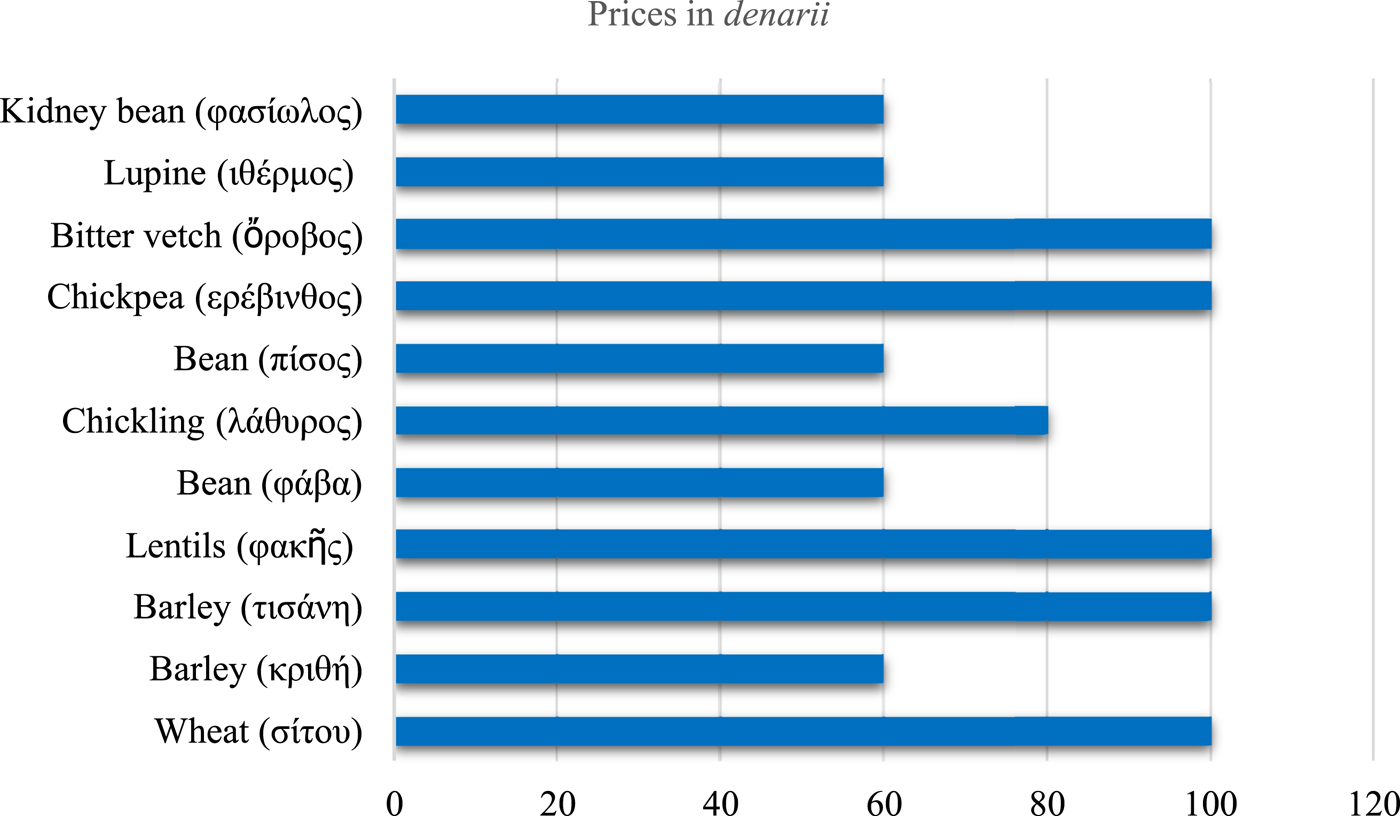
Prices in denarii per kastrensis modius of different types of cereals and pulses recorded in Diocletian's Edict (data from Prantl Reference Prantl2011, 368, 369, 384, 385).

Although the prices are lost, they correspond exactly to entries 23 to 25 of Prantl's presentation (Prantl Reference Prantl2011, 369). Therefore, the variety of pulses recorded in the copies of Diocletian's Edict and their comparable cost to that of wheat and barley are perhaps important evidence of the wide use of legumes in human and animal diets, and the significance of their contribution to the Roman economy.
Conclusion
This paper has discussed textual data to identify the importance of legume production in Cyrenaica during the Hellenistic period and its significance as a part of the Greek and Roman diets in the Mediterranean world from at least the fifth century BC onwards. The damiergoi inscriptions of Cyrene from the fourth century BC indicate the cultivation of legume varieties in Cyrenaica, although they do not specify which. However, various types of pulses appear to have been planted during the third and second centuries BC, as the damiergoi evidence demonstrates. These include two kinds of bean (φάσηλοι and κύαμοι), two kinds of chickpea, (ἐρέβινθοι and ὄροβοι), peas (πίσσαι), lentils (φακοί) and others otherwise unidentified. Beans (κύαμοι), chickpeas (ἐρέβινθοι), lentils (φακοί) and the otherwise unidentified were represented in higher quantities than those of wheat or barley in the second century BC, as has been estimated in this paper based on the available prices and revenues. This is perhaps an important indication of legumes playing a parallel economic role to that of cereals for both local consumption and export. The estimated volume of legumes in Cyrene dating to the second century BC indicates a higher quantity than one of the tow exported cargos from Egypt in the first century AD. It represents c. 25 tonnes (902 medimnoi), whereas the Egyptian consignment makes up c. 18 tonnes (4,000 modii). In view of the fact that the quantity of pulses for Cyrene showed only the harvest of one semester from the lands devoted to Apollo, their production for the whole region was probably larger and trading them from Cyrenaica in the Hellenistic period is most likely. The region perhaps continued to produce pulses during the Roman period. Despite the lack of related textual evidence, a number of botanical legume samples have been attested to in Berenice and dated to the imperial epoch. Legume prices identified by Diocletian's Edict were comparable to those of wheat and barley, as was the case for those of Hellenistic Cyrenaica. In other words, over time legumes and cereals (wheat and barley) appear to have followed a similar pricing trend even in Cyrenaica or outside. Thus one may consider that a variety of legumes was widely produced in Hellenistic and Roman Cyrenaica. They were used for land fertilisation and as a basic dry food for humans and animals, like wheat and barley, for both the Greeks and Romans. Furthermore, pulses probably contributed significantly to the region's economy via interregional commerce alongside cereals and other dry grains, especially from the Hellenistic period onwards because Cyrenaican silphium had started to decline in this period.
Acknowledgements
I would like to express my deepest appreciation to Professors David Mattingly and Graham Shipley for their academic support and encouragement. I also warmly thank the teams of the Inscriptions of Greek Cyrenaica (IGCyr) and Greek Verse Inscriptions of Cyrenaica (GVCyr) projects, especially Professor Catherine Dobias-Lalou for giving me access to the project data before their final publication, for her detailed answers to my questions related to the damiergoi inscriptions of Cyrene, for providing me with the relevant latest publication and for reading this paper and annotating it with useful comments. I would also like to extend my thanks to Abdulla Rhebi, Ahmed Buzaian and Doctor Hafed Walda for their different kinds of support.