Enough patent medicine is consumed by the British public to float a warship, and enough pills to pave Piccadilly.
—Ronald Macfie, The Romance of Medicine Footnote 1Despite Macfie's vivid assertion, studies of Victorian medicine and literature have not paid special attention to the pharmaceutical field, perhaps because of its messy associations with trade or inferiority to more respected healing practices. After all, it is Doctor Lydgate's refusal to prescribe the expected drugs in Middlemarch that proves his commitment to evidence-based Parisian medicine. As I aim to demonstrate, however, pharmacy and its products have a distinct and two-edged history in late-Victorian England. Medical writers increasingly assert the scientific authority and physiological promise of pharmacology. At the same time, they begin to show interest in the romance of drugs: their origins in alchemy and the occult, harvesting in the furthest outreaches of empire, and, at home, display in the magical space of the chemist's shop. This productive tension between medicinal drugs as stuff of ancient mystery and sign of medical progress informs their depiction in the transforming drug narratives of Robert Louis Stevenson's Strange Case of Dr. Jekyll and Mr. Hyde (1886), Arthur Machen's “Novel of the White Powder” (1895), and Rudyard Kipling's “Wireless” (1902). Bringing romance and drugs together invites readers to think about their respective claims to invigorate, transport, even remake the self.
To be sure, this essay traces a textual trajectory that is but one strand in the broad and varied tapestry of late-Victorian romance. All the same, tracing what Elaine Freedgood would call the “fugitive meaning” of the transforming drug enables a more comprehensive view of the medical field than a focus on the doctor-patient relationship allows.Footnote 2 And as Victorian critics of Jekyll and Hyde make clear, looking closely at fictional medications means thinking about the aesthetic category of the narratives in which they appear. The potion of each tale functions as a plot catalyst, a concept itself borrowed from chemistry. Because these narratives lavish attention on the appearance and composition of the drugs, they invite us to consider: what kinds of things, with what physical properties, histories, and cultural connotations, have the muscle to do this particularly strenuous form of narrative work? Employing the insights of thing theory to analyze drugs furthers our understanding of romance because it shows how its authors construct a particular type of thing and its attendant subject-object relation for the genre. Lawrence Rothfield has demonstrated how traditional realism models itself on the observational techniques situated in the clinic, the sickroom, doctor's office, or hospital.Footnote 3 Conversely, I show how medical romance finds its literary home in the pharmacy.
1
With a few important exceptions, Victorian critics looking at things understandably focus on realism, a genre typically pervaded by seemingly inconsequential items.Footnote 4 Roland Barthes argues that this fictional stuff produces a “reality effect,” which signifies a general sense of “the real,” rather than prompting the deep readings that we construct from symbol or metaphor.Footnote 5 More recently, Stefanie Markovits notes that “critics working from within both thing theory and neo-formalism are often surprisingly unreflective about the generic statuses of the texts they consider.”Footnote 6 She addresses this oversight by showing how the diamond functions as a “generic touchstone” in midcentury writings, an image that enables authors to address issues of form in lyric and narrative.
Clearly, drugs are a very different kind of thing. Whereas diamonds are prized for their beauty and permanence, medicinal powders do not look like much. Then they disappear when dissolved. Bill Brown, who originated thing theory, emphasizes that semantically the thing will always “hover over the threshold between the nameable and unnameable, the figurable and unfigurable, the identifiable and unidentifiable: Dr. Seuss's Thing One and Thing Two.”Footnote 7 As an illustration, he notes how the word “thing,” as in “Put it by that green thing in the hall,” connotes concreteness and ambiguity at the same time. Transforming drug stories linger over this moment when the thingness of a drug—having been harvested somewhere, labeled with presumable care, circulated as a commodity, measured in a lab, perhaps prescribed by a doctor or placed on a bedside table—crosses that threshold and becomes something else. “I stirred it in, and it seemed to disappear, leaving the water clear and colorless,” notes Machen's narrator in wonder.Footnote 8 Here the story freezes a moment in which something changes to nothing. The drug functions as an entity that, as Avital Ronell has it, moves as “a kind of circulating non-essence” in a narrative or discourse.Footnote 9
What seems like nothing, though, may threaten the most cherished properties of selfhood, which surely informs the Victorian fascination with the materiality of drugs. In 1859 Wilkie Collins's Count Fosco argues as much when he raptly describes how they open the passage between opposing qualities. The villain of The Woman in White boasts in a long soliloquy that his studies in chemistry have shown him how to reduce the productions of Shakespeare, “by the action of his body,” to “the most abject drivel” with “a few grains of powder dropped into his daily food.”Footnote 10 He continues to assert that he can make Newton eat an apple instead of discovering the principle of gravitation and turn Nero into the mildest of men. We are meant to shudder at Fosco's wickedness, already evident in his use of medicated water and smelling salts for the abduction of Lady Glyde.
We should also note how he emphasizes the quotidian nature of “daily food,” the scantiness of a “few grains.” Subsequent authors will also display a fascination with how the small and invisible can command the great and powerful. In generic terms, minuscule particles sprinkled into everyday fare start a chain reaction that unfolds into the improbable plots of sensation or romance fiction. Winifred Hughes explains in a frequently invoked definition that “what distinguishes the true sensation genre … is the violent yoking of romance and realism.”Footnote 11 And what, we might ask, characterizes the narrative yoke itself? Here it bestrides the worlds of romance and realism because it works covertly and mysteriously on the body yet is nothing more than a few homely grains dropped in food or water. Of course, it is hard to imagine any drug acting in the precise manner that Fosco describes. Collins appears to tap contemporary anxieties about mesmerism as much as drugs in this passage. All the same, his assertion that the chemist is “the most omnipotent of all potentates” just as easily describes the power of the novelist.Footnote 12 Introduce the right kind of narrative agent, and characters submit to sudden transformation, ready to do the author's bidding.
In his now-classic essay on the pharmakon in the Phaedrus, Jacques Derrida likewise sees the drug as an exceptional kind of thing that collapses categories properly kept separate. “Plato's Pharmacy” is most often read as a founding text of deconstruction, in which Derrida probes the privileging of presence/speech over absence/writing in Western metaphysics. We can also read this densely argued one-hundred-page treatise for its insights on medicinal drugs and ask why they figure so prominently in foundational texts of ancient philosophy and contemporary deconstruction. Derrida begins by emphasizing the radical polysemy of pharmakon in Greek, which may be translated as “remedy,” “recipe,” “poison,” “drug,” and “philtre.”Footnote 13 The pharmakon does not merely hold these meanings in tension or pose a quandary for translators. Its diverse meanings also threaten “the domestic, hierarchical interiority of the pharmacy, the proper order and healthy movement of goods, the lawful prescription of its controlled, classed, measured, labeled products, rigorously divided into remedies and poisons, seeds of life and seeds of death, good and bad traces, the unity of metaphysics, of well-computed binarism.”Footnote 14
Pharmacology is a system dependent, like the metaphysics under critique here, on stable oppositions. To be sure, one might say that all material items are subject to classification and control. Furniture, for instance, may be cataloged by antique dealers, inventoried in a warehouse, classified by maker or style, and so on. This labeling, however, is scarcely a matter of life and death, nor are these items subject to the legal and medical systems used to police drugs. When Derrida thinks about language alongside pharmacy, he raises the stakes for the apparently simplest form of linguistic use: naming and identification. What we want writing to do for us—and how it threatens to elude our control—has no greater consequences than when applied to medicine for ailing bodies.
The British Parliament and medical community realized as much as they worked to regulate the rapidly changing and expanding field of late-Victorian physic. Legislators approved a series of acts to ensure the standardization and safety of prescribed medications, with only partial success. The latter half of the century saw passage of the Pharmacy Act of 1868, which mandated examinations administered by the Royal Pharmaceutical Society for the qualification of druggists and limited the sale of dangerous drugs. The Adulteration Acts of 1860 and 1872, Sale of Food and Drugs Act of 1875, and Sale and Use of Poisons Act in 1876 also tightened control over the drug trade. It was difficult, however, to enforce standards, particularly those for drug purity. In fact, a local government board of 1882 found that almost one-fifth of submitted drug samples were adulterated.Footnote 15 The Pharmaceutical Society attributed this continuing problem to the demand for cheap medicine by working-class customers, those most likely to self-medicate or seek the advice of druggists rather than doctors.Footnote 16 Most medical writers pointed out that the vast majority of customers were cheated rather than poisoned, yet in the case, for instance, of a patient who takes a diluted opium preparation for an extended period of time and then obtains a more potent mixture, the results could well be deadly. Travelers within the United Kingdom were especially vulnerable because the London, Edinburgh, and Dublin pharmacopoeias all differed in instructions for dosage strength and preparation formulae.
The Medical Acts of 1858 and 1862 responded to this danger by calling for a new pharmacopoeia to replace the separate publications then in use. “Of the several functions conferred on the General Medical Council of the United Kingdom by the Medical Act of 1858,” authors of the 1864 first edition state nervously, “not one has caused the Council more anxiety than the preparation of the British Pharmacopoeia.”Footnote 17 Published in English rather than Latin for the first time, the work aimed to be clear and comprehensive. Nonetheless, all manner of compendia, addenda, and supplementary works soon followed, with the most well-known being the 1883 The Extra Pharmacopoeia, authored by William Martindale and Dr. Wynn Westcott.Footnote 18 Describing the use of modern drugs, or new uses for old drugs not contained in the British text, the first edition of the text (known informally as “the Martindale” to this day) sold out in a matter of weeks. Even the second edition, published in the same year as the first, included forty-three new drugs and chemical preparations. Martindale himself took his own life via cyanide poisoning in 1902 while assisting a government enquiry into poisons legislation. News accounts blamed his despondency on overwork.Footnote 19
These attempts to tighten control and classification of medications resulted in a departure from the materia medica of traditional healing and herbal medicine, a break evident in the Western pharmacopoeia more generally. Paula De Vos has demonstrated that the medicines used by healers remained remarkably consistent until 1865.Footnote 20 The majority of these “simples,” composed of one substance, were recorded by Greek physician Pedanius Dioscorides in the first century CE. After 1865, however, development of analytic chemistry and synthetic drugs, in addition to new techniques in mass production and the rise of pharmaceutical companies, disrupted the historical continuity of Western remedies.Footnote 21 Today, only a few of the earlier, traditional substances are recognized in modern medicine.
Despite this increasing professionalization of pharmacists, regulation of medicines, and advances in chemistry, prominent writers debated whether physic should be considered a science at all. In a speech to the International Medical Congress of 1881 often quoted by contemporaries, Thomas Huxley reminds listeners of the advances in pharmacology of the last forty years, citing knowledge of the properties of strychnia and phosphorus, among other substances. He then confidently predicts that “sooner or later” the pharmacist will be able to supply the physician with drugs that will precisely affect any biological function in the body, “like a very cunningly contrived torpedo” aimed at “a particular group of living elements” that will “cause an explosion among them, leaving the rest untouched.”Footnote 22 Other writers of the 1880s are far less optimistic. H. Baptist Crofts recalls Derrida's “seeds of death” when the medical writer notes that any drug produces an “abnormal effect,” which is in fact “what is commonly termed ‘poisonous,’” for it produces “a certain derangement of function which may in some manner or degree counteract a certain derangement of disease.”Footnote 23 Like other defenders of the homeopathic movement, Crofts claims that the therapeutic qualities of air, temperature, diet, and exercise will prove to be the best weapons against disease. Morrell Mackenzie shares his skepticism. He does acknowledge real advances in medical science, noting especially the use of the stethoscope, microscope, anesthetics, and antiseptic method. Nonetheless, while the physiologist knows the results of a severed spinal cord, “the physician can never know beforehand the precise effect which a drug will produce in a given case. … [W]e are in a region of mere probability.”Footnote 24 Pharmacology will never be on the same scientific footing as physiology or pure chemistry because drugs act in various ways on different bodies. Moreover, even when researchers know that they do usually work, the mechanism of their operation is often obscure.
While its shaky foundation in “mere probability” surely demotes the scientific standing of pharmacy, it also opens another imaginative space, the province of romance: of wonder, mystery, invigoration, and danger. Although the medicalization of “the addict” did not take place until late in the nineteenth century, drugs had a long and storied literary past in the writings of authors such as Thomas De Quincey and John Keats, who locate opium ingestion in domestic and natural settings. Writing in 1901, Gertrude Bacon, in contrast, celebrates the romance of drugs in a seemingly surprising commercial space—the modern druggist's shop:
No one, I fancy, will be disposed to deny that there is something impressive and mysterious about a chemist's shop. Whether it be the indescribable odour that haunts it, the long array of antique-shaped jars and bottles, the fearsome and perfectly unintelligible legends inscribed thereon, the knowledge that deadly poisons and drugs of awful potency are lying within reach, and that the whole world, from frozen north to glowing tropics, has been laid under the tax of her strangest and rarest to yield the medley of material from which to wage war against disease and death, some subtle influence there is that never fails to appeal to the imagination.Footnote 25
The pharmacy is a paradox because it is a site of knowing and not-knowing. The customer cannot read the inscriptions yet knows that their contents may be restorative or deadly. Further, its wares signify the things of empire: “whole world,” “laid under tax,” and “war” evoke an imperial domain directing its colonial products into the English bodies that need their stimulation and protection. Bacon closes the essay by lamenting that the remarkable space of the chemist's shop may soon be a thing of the past. She notes that German pharmaceutical firms, particularly in their development and sale of “newfangled chemical remedies” such as coal-tar products, have shrunk the market for older vegetable-based drugs.Footnote 26
Bacon's confidence that her readers feel the romance of pharmacy is not evident earlier in the nineteenth century. Writing for the London Society in 1867, Frederick Arnold begins his address by exclaiming, “The Romance of Medicine! Is it possible that there is a particle of romance in so unromantic a subject?”Footnote 27 By 1897, however, the physician and prolific medical writer Charles John Samuel Thompson needs no such disclaimer for his The Mystery and Romance of Alchemy and Pharmacy. He unearths the history of modern pharmacy by documenting fantastical searches for the philosopher's stone and unicorns, in addition to describing the disgusting remedies of the past at their most cringe-inducing. In his later role as principal curator for the medical library of Henry Wellcome, he had access to hundreds of works on medical history, which informed his writing of over forty books, spanning the Poison Romances and Poison Mysteries in 1899 to The Lure and Romance of Alchemy of 1932. In the same year, Stafford and Allen published a more specialized work entitled The Romance of Empire Drugs, which describes the origins of drugs harvested in all regions of the empire. This work especially lauds cinchona, actively cultivated in the British West Indies after 1850. The plant, more commonly known as Peruvian bark, provides the alkaloids for quinine. “[Its] use,” the authors assert, “has largely conquered the scourge of malaria and materially assisted in the advance of white civilization in the great tropical areas of the British Empire and other parts of the world.”Footnote 28
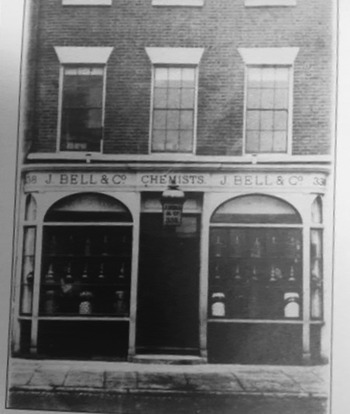
The appearance of the pharmacy itself back in England further strengthened its associations with the romance of ancient times and foreign lands. The passerby would expect to see an elevated platform displaying carboys of colored water. Frequently backlit by oil lamps or gas jets, they cast a warm glow of colored light onto the street. The narrator of J. M. Barrie's Sentimental Tommy proclaims that the hero and his friend experience “many delicious thrills” from the influence of the carboys, and “the coloured bottles of the chemists are the first poem known to the London child.”Footnote 29 Their origins were shrouded in mystery, which gave rise to all sorts of fanciful theories about their history. Thompson explains that they probably originated in the bazaars of the Near East, in which druggists distinguished their trade by displaying rose water or wine in the large vessels.Footnote 30 The carboys, however, were just one way in which English pharmacies, particularly those considered high-end, cultivated a deliberately archaic look.Footnote 31 Note, for instance, the photograph of William Hooper's Covent Garden pharmacy in 1900, which retained the ancient signboard from 1732 well after the proprietor raised the shopfront and installed an expanse of plate glass in 1840, as in figure 1. In Cambridge, Deck's pharmacy kept its shop front unchanged for over sixty years. Moreover, John Bell's pharmacy was not altered externally after the store was completely rebuilt in 1806. The photograph shows it as it stood in 1870 (fig. 2). Retaining old-fashioned signage or frontage certainly conveys the longevity and respectability of any individual shop. At the same time, such practices help explain how the retail space and its wares, in Bacon's words, “never [fail] to appeal to the imagination.”
The shopfront of William Hooper & Co., 24 Russell Street, Covent Garden, London, ca. 1900. Reprinted with permission from the Royal Pharmaceutical Society from Tallis and Foster, Pharmacy History.

The shopfront of J. Bell and Company, Oxford Street, London, ca. 1870. Reprinted with permission from the Royal Pharmaceutical Society from Tallis and Foster, Pharmacy History.

Their appeal stems from the ways in which powders and potions require yet resist identification, evoke the foreign yet are consumed within a domestic space, and signify medical progress at the same time as they never quite shed associations with the dark mystery of alchemy, pharmacology's fantastical prehistory. This polysemy subverts a realist order of visibility, what Mark Seltzer describes as “making everything, including interior states, visible, legible, and governable.”Footnote 32 They vanish before one's eyes while retaining or even heightening their ability to affect mind and body. Their protean yet distinctive properties set the stage for drugs to realize what Victorian genre theorists thought the things of romance should be and do.
2
Of course, romance is notoriously difficult to define, especially as it branches into ever more divergent and discrete subgenres in the late nineteenth century. Anna Vaninskaya persuasively argues that creating a comprehensive yet precise taxonomy of romance revival texts is “an immensely revelatory but ultimately futile exercise.”Footnote 33 Critics create definitions so elastic that they lose any precision. Alternatively, they may keep multiplying categories—such as scientific romance, supernatural fiction, the detective novel, historical romance, the gothic, and so on—in need of so much qualification that they are no longer useful. She shows how a more productive approach reconstructs the genre theory of the period and evaluates its works according to the romancers’ own criteria.Footnote 34 This means attending to the relatively familiar romance manifestoes of George Saintsbury, R. L. Haggard, Robert Louis Stevenson, and Andrew Lang, in addition to the writings of lesser-known periodical writers who joined the fray between 1880 and the first decade of the twentieth century. My discussion of late-Victorian genre adopts Vaninskaya's approach yet focuses closely on the persistent medical language in romance rhetoric. This aesthetics of embodiment frames agency in such a way that we logically arrive at the self-dosing subject, a self that seeks romance via chemical means in a manifestly unromantic age. To do so, it must contend with what Stevenson calls “the problems of the body.”
In their denigration of realism, defenders of romance employ imagery of dissection and microscopy to paint a picture of realism so fragmenting the embodied self that the agency and autonomy of that self becomes nearly unthinkable. Stevenson inaugurates this trend in 1882 when he claims that the realists “remark and dissect, with the most cutting logic, the complications of life and of the human spirit.”Footnote 35 Lang fleshes out the comparison by arguing that realists “not only use the microscope and ply experiments, but ply them, too often, in copore vili [on worthless bodies].”Footnote 36 Saintsbury employs a rather more gruesome image of dismemberment in his claim that the average person “has been drawn and quartered, analyzed and ‘introspected,’ till there is nothing new to be done to him or her.”Footnote 37 This model of the embodied self recalls Rothfield's definition of “individuated bodies,” defined as a “corpus of isolated, discrete elements.”Footnote 38 It emerged later in the century as microscopy, cell theory, and bacteriology broke the organic body down into increasingly minute entities for analysis. For the romance camp, the problem with this medical perspective is not so much its omniscient and detached observer per se but rather that this mode of narration produces immobilized and self-conscious bodies. Such bodies cannot generate or respond to exciting incidents that will provide an imaginatively absorbing experience for the reader.
While the realist camp, including Walter Besant and Henry James, unsurprisingly evokes the reader's heart, head, and ethical judgement as sites of literary value, the romancers stake their claim on the body and its relation to its environment. That is, they turn our attention from what the author does to what the character and a sympathetic reader feel, to the reader's imaginative immersion in challenging surroundings. Stevenson declares that “there is a vast deal in life and letters both which is not immoral, but simply a-moral.”Footnote 39 Here is where “the interest turns … not on the passionate slips and hesitations of the conscience, but on the problems of the body and of the practical intelligence, in clean, open-air adventure, the shock of arms or the diplomacy of life.”Footnote 40 Ideally, the romance reader will be “submerged by the tale as by a billow.”Footnote 41 In this situation, great art will cause a pleasurable, accelerated heartbeat even if the events are tragic or unpleasant. Saintsbury also invokes an image of immersion, claiming that we will not have the best fiction “till we have bathed once more long and well in the romance of adventure and of passion.”Footnote 42 Ironically, if readers are to realize this energized and unified body, they must embrace an essentially dual notion of the self. Lang calls it “the old barbarian under our clothes,”Footnote 43 while Haggard asserts that “under the surface human nature is the same to-day as it was in the time of Ramses.”Footnote 44 In literary terms, romance writers need readers to embrace the old barbarian under their clothes if the public is to overcome prejudice toward tales of adventure and mystery as mere popular stories of the moment. That is, they need a canvas on which Stevenson's “problems of the body” are not solved by the anatomist or moralist but rather by the ingenuity and spirit of the adventurer.
One cannot, however, create a fictional world comprised solely of bodies and their environment. It needs things as well. If, as Barthes maintains, the things of realism produce a realism effect, then what might a comparable consequence be for the things of romance? Stevenson and Machen return to this question with remarkable persistence in their literary criticism. For Stevenson, things acquire meaning for the types of narratives they evoke. In “A Gossip on Romance,” for instance, he claims that we can separate true romantic art from the merely pedestrian by looking at the inventory of shipwrecks in adventure tales. The castaways of The Swiss Family Robinson and Jules Verne's Mysterious Island find items that “have no gusto and no glamour … [which] might have come from a shop,” whereas each article Crusoe discovers “should be found” and the right thing begets “whole vistas of secondary stories.”Footnote 45 While the wrong thing of romance is located in the realm of exchange value and consumer culture, the right thing possesses another kind of value—its ability to evoke more tales of true romance. That is, it functions as a generic marker of stories like that in which it appears. Two years later, he defends his art against English readers who elevate realist fiction by asserting that romance “runs the fox of material interest,” not the “hare of moral or intellectual interest.”Footnote 46 As a case in point, he urges us to think of the playacting of the child, for whom a pirate means costumes and accessories: a beard, pair of wide trousers, or collection of pistols. These objects are not to be understood as symbols, or objects of possession, or inroads to the psychology of a character but rather signify romance itself, the genre in which the pirate figures.
Machen takes up Stevenson's challenge to the hegemony of realism by proposing a related yet distinct representational strategy. Whereas Stevenson's will direct us to similar stories, Machen's will transport readers to a metaphysical plane. His 1902 Hieroglyphics is set up as the literary talk of a reclusive old man of letters in northern London. The work elucidates his “esoteric philosophy of things” that will distinguish between great and mediocre fiction. Appropriating the language of chemistry, Machen applies what he calls his “literary solvent” to texts.Footnote 47 Dismissing narrative technique, reader interest, and emotional impact as indices of literary value, he explains his ultimate criteria of “ecstasy,” which also may be understood as “rapture, beauty, adoration, wonder, awe, mystery, sense of the unknown, desire for the unknown … withdrawal from the common life and common consciousness” (11).
Machen's philosopher repeatedly turns to the physical world in his attempt to explain this elusive “ecstasy.” As one example, he explains that a temple may be in ruins and a tub may be exquisitely made; nonetheless, “one means worship, and the other means washing, and that is the distinction” (13). He concludes that we must elevate symbols, those things that gesture toward the unknown, and delight in narratives that depict the turning of a thing of utility into a symbol. Thomas Hardy's “Two on a Tower” is representative, in which a simple tower, which was initially only a convenient meeting place for lovers, “every stone of it aglow with mystic light,” transforms into a symbol of love and the eternal (62).
Because the things of true romance beget more stories of incident or devotional practice, and indeed may be undergoing their own dramatic transformation within the narrative itself, they gesture forward to an elusive future in which the consciousness of the thing's user undergoes some fundamental alteration. Freedgood advocates that the thing theorist emulate Walter Benjamin's collector and elucidate the storied past of literary things. A significant object in romance calls for a different approach, one more analogous to the work of a chemist than a collector. Thinking about romance things certainly does not exclude uncovering their repressed history, yet the paramount question for romancers, like chemists is: What might this substance and its effects, given the right environment or physical alteration, do or become? This orientation means being attuned to imaginative possibilities that promise release from the colorless and mundane. Indeed, the protagonists of transforming drug stories never consider physically escaping or reforming their social environment. Rather, they turn to medicine as a means of reengineering the self. Hence, we arrive at the self-dosing subject.
3
What Henry James termed “the business of the powders” in Jekyll and Hyde becomes a type of aesthetic litmus for Stevenson's reviewers. James asserts that the “machinery of the transformation” is “too explicit and explanatory. … [T]his uncanny process would be more conceivable … if the author had not made it so definite.”Footnote 48 Machen's literary hermit agrees with James, claiming that the drug is mere ingenious mechanism; it coarsens what should be a luminous prose romance that conveys “a vision of the mystery of human nature” (84). Rather than seeing the powders as overly realistic, both Robert Bridges and Arnold Bennett found the physical means of transformation to be unrealistic, with Bennett calling the “potion business … childish and unconvincing.”Footnote 49 Critics seem dissatisfied with the handling of the powders because they have different expectations based on the story's genre, in what it aims to be. Certainly, more recent critics will situate the text within a gothic or urban gothic generic frame. As Nicholas Daly has noted, though, the term gothic was not used by late-Victorian critics for the fiction of Stevenson, Haggard, and Stoker.Footnote 50 James and his contemporaries rather draw on criteria that Victorian readers would broadly associate with romance and realism, and their divergent readings convey a clear sense that Stevenson has set up the powders as realistic and fantastical at the same time.
Certainly, the substance can seem very much of the mundane waking world, with the narrative of Dr. Lanyon most emphasizing the thingification of the powders. Jekyll directs the physician to force the lock on a drawer in his presses and bring the contents of that drawer: “some powders, a phial, and a paper book.”Footnote 51 Upon procuring these items, Lanyon's observations situate them within the realm of the commonplace: “the book was an ordinary version-book [a notebook that children use] and contained little but a series of dates” (71). The physician then flatly identifies the powders as “a simple crystalline salt of a white color” (73). A “simple” in the Western materia medica consists of one substance exhibiting a single action; it might be classified as plant, animal, or mineral but is most likely herbal. Being labeled a simple, or sal comun, suggests its long use as a reliable therapeutic element. We are comfortably within the realm of realist representation here, with Lanyon seeking to make the powders legible via his professional eye.
Readers learn, however, that Lanyon's classification is erroneous; if the powders are adulterated, they must be a compound. As pharmaceutical processes become more sophisticated, wide-ranging, and synthetic, Lanyon and others will rarely encounter drugs in their easily classifiable raw state. Unsurprisingly, then, these substances foster a sense of mystery, the quality that Machen finds indispensable in prose romances. Moreover, the medical man's one confident identification, of phosphorus in the liquid, would surely have romantic associations for Victorian readers, a sort of dark sensationalist glamor well suited to a tale of danger and adventure. They would likely think of the magical effects produced by phosphorus compounds that glow in the dark. Additionally, the chemical has a dangerous and insidious reputation, as those familiar with the physical deterioration of London match makers are aware. About the other ingredients, Lanyon confesses that he “can make no guess” (73).
We know, of course, that this deceptively simple salt in fact contains the active agent in Jekyll's compound, its catalytic properties owing to some unidentified element in the adulterated supply that the doctor first procured from the wholesale chemist, Mssrs. Maw. Beyond exasperating Stevenson's critics, the plotline works to trouble distinctions fundamental to the pharmacy as a site of lawful dispensing. Ronell reflects that “the drug store figures a legalized reproach to uncontrolled or street drugs but at the same time argues for the necessity of a certain drug culture.”Footnote 52 Jekyll and Hyde defies the lawful admonition of the pharmacy, not the least in its deliberate confusion of nomenclature. Lanyon, Poole, Utterson, and Jekyll variously call the substance in question a medicine, drug, draught, and potion, which collapses distinctions between authorized medication and unregulated substance. The quaint anachronism of potion also evokes the dark arts of alchemy. And because the novella shows how even a legitimate substance procured from a respectable chemist is as vulnerable to the vicissitudes of commerce as any item that goes through many hands, Jekyll and Hyde intimates that the unknown cannot be safely contained in pharmacy's prehistory, nor does a drug always produce consistent results. Jekyll notes, for instance, that he must sometimes double or triple the usual dosage to get the previous effect. We are left in the “region of mere probability,” as Mackenzie has it. Moreover, Jekyll's drugs refuse to remain within the respectable spaces of lawful prescription or domestic consumption. They should either remain with Mssrs. Maws or be in their neatly labeled drawers in the doctor's cabinet, which invariably recall the glazed presses of the traditional pharmacy. After Jekyll has his colleague Dr. Lanyon break into the room, however, and bring the drugs back to his office, they move into the street, with all the connotations of street drugs: the illicit and criminal, the fix that that the addict must have now.Footnote 53 Stevenson's chemical compound, then, is not merely a figure for the arrogance of medical authority, nor just a device that fails to be scientifically realistic, but is rather an entity that challenges the dichotomy of lawful medication versus illegal drug—a distinction foundational for modern pharmacy.
It also evokes both genres that map the literary landscape in which it appeared. Regarding late-Victorian romance, most readers will invariably think of adventure narratives. Reading Jekyll and Hyde through the lens of romance and realism rather than the gothic means recognizing how the emergence of Hyde generates exciting episodes for other characters, particularly for lawyer Gabriel Utterson. The narrative opens in high-realist fashion, with a lengthy dissection of his character and daily life, both so unstimulating that his dull walks with kinsman Enfield are the high points of his week. These strolls invoke what Stevenson sees as the “monotonous fitness” of incidents in contemporary realist novels (“Gossip” 6). Once drawn into the mystery of Hyde, however, Utterson plunges into his role as detective, “If he be Mr. Hyde, I shall be Mr. Seek” (40), and ambushes Hyde outside his door in Soho. He later interrogates Hyde, admonishes the hysterical servants, and threatens Jekyll that he and Poole will force entry to his cabinet by fair means or foul, “if not by your consent, then by brute force!” (67). Utterson is invigorated in these later scenes, a man showing courage in the face of fear and danger: the hallmark of high-romantic art for Stevenson and like-minded defenders of the genre. Although ultimately Lanyon has a mental breakdown after seeing Hyde transform back into Jekyll, even the mild-mannered Lanyon at first resolved to load his revolver so that he “might be found in some posture of self-defence” (73). Hyde, then, consistently prompts the performance of heroic masculinity in other men.
We might consider Hyde himself as a figure of romance trapped within the respectable bourgeois body of realist form. He is young and small, “springs like a boy into the sea of liberty” (51), and acts as a child when he clubs Sir Danvers Carew. In addition to associating romance with the pleasures of boyhood, Stevenson theorizes that romance calls up “an array of anonymous desires and pleasures” (“Gossip” 4), an apt description of Hyde's unknown nocturnal doings. Jekyll, moreover, associates Hyde with a mountain bandit who thinks of his host body only as that robber “remembers the cave in which he hides himself from pursuit” (86), one of Stevenson's beloved characters from his boyhood reading. At the close of the novel, Jekyll wonders if Hyde will have the “courage” to commit suicide, and since Hyde apparently does so, the evil being's last act is ironically one of resolution despite fear, a defining virtue of the romance genre for its defenders. In stressing such attributes, I do not seek to portray Hyde as heroic in a conventional sense, but rather to suggest that he is, in Stevenson's terms, “simply a-moral” in his pursuit of self-interest and indulgence of childish aggression. To be sure, Jekyll does call his alter ego “pure evil” (81), but the doctor emphatically attributes this wickedness to his own ignoble motives for compounding the drug, not the substance itself or a universal core of human nature. Hyde is, as much as anything, the necessary byproduct of a culture in which respectability means disavowing romance's pleasures.
Published nine years after Jekyll and Hyde, Machen's “Novel of the White Powder” furthers Stevenson's interest in the provenance, circulation, legibility, and effects of transformative medicine.Footnote 54 As its title suggests and as Machen's reviewers have disapprovingly noted, “White Powder” models itself on Jekyll and Hyde to a remarkable degree, as even a brief synopsis indicates. A doctor prescribes what the narrator calls a seemingly harmless white powder to her brother, an overworked lawyer named Francis. After procuring the medicine from a respectable local druggist, Francis continues to take it even when ostensibly well. The patient then loses himself to the pleasures of London nightlife and comes to display a small mark on his hand, which we are to take as a Satanic brand. He regresses to the point that he can no longer hold a conversation and barricades himself in his room. By the close of the tale, he has disintegrated into an oozing mass of some noxious substance, “seething with corruption and hideous rottenness, neither liquid nor solid” (207). A postscript provided by chemical analyst Dr. Chambers reveals that the irregular temperatures in the pharmacy's storeroom have converted the powder into the active agent in the wine of the Sabbath. This elixir known to the ancients produces a double or “glamor” that provides unearthly sexual pleasures for the witch. The scientist marvels that just a “few grains of [the] white powder dissolved in water” (210) compel the bacchanalian debauchery that has destroyed the lawyer. As in Stevenson's novella, the drug initiates the fundamental features of romance for secondary characters: Dr. Haberden bravely breaks down the door to Francis's room, while Miss Leicester eludes the surveillance of the man who shadows her because family members suspect that she killed her brother.
“White Powder” departs from its predecessor text, however, in its focus on the late-Victorian drugstore as a conduit to the unknown. Francis elects to have his prescription filled at an old-fashioned pharmacy, a move that echoes the nostalgia of Gertrude Bacon for the apothecary of the past. Whereas Jekyll and Hyde primarily constructs its thematic tensions via spatial binaries (affluent versus poor neighborhoods, home versus street, and cabinet versus living quarters), “White Powder” uses its medication to set up the opposition of the past/occult/spiritualism and modernity/science/commercialism. The lawyer had put his faith in the “scrupulous purity of [the shop's] drugs,” for this is an establishment devoid “of the studied coquetry and calculated glitter that makes so gay a show on the counters and shelves of the modern apothecary” (197).Footnote 55 Yet Francis does not realize just quite how archaic the chemist's practices really are, for the druggist kept this obscure substance on the shelves for over twenty years in a room with fluctuating temperatures. Dr. Haberden and the narrator note that the flakiness of the powder looks like that of the quinine sulfate originally prescribed, again demonstrating the resistance of modern drugs to identification via the senses. It is rather the chemical analyst Dr. Chambers who finally reports that “chance and coincidence” combined to produce a “delicate and so complicated process” of the powder transforming into the Vinum Sabbati (210), one that modern science could never hope to reproduce.
Yet the drug does not merely whisk readers to a fantastic past, for “Novel of the White Powder” also critiques the tendency of modern doctors to prescribe inherently inscrutable drugs with haste and overconfidence. Even though Dr. Haberden identifies his patient's anxiety, light-headedness, and broken sleep as owing to mere “digestive trouble and a little mischief in the nervous system” from reading too hard and eating too hastily, he proclaims to the narrator that “I have written him a prescription which ought to do great things” (197). Medical authority William Osler complains in 1895 that “even in minor ailments, which would yield to dieting or just to home remedies, the doctor's visit is not thought to be complete without the prescription,” a crusade against overmedication that he would continue when appointed as Regius Chair of Medicine at Oxford in 1905.Footnote 56 The story sets up an analogous context in the ancient and modern world, for in both cases, the fully initiated member of a coterie presses a substance upon the unsuspecting, which generates a sense of well-being only experienced when under the influence of the substance. “Why should [Francis] go on taking the stuff when he is quite well?” asks Dr. Haberden in exasperation (201).
The doctor fails to realize that the drug sustains rather than merely initiates the condition of “quite well.” Because Francis literally replaces the lifestyle of sober student with that of a metropolitan “careless and merry idler” (198), he in fact feels better than well. Machen thus transfers the agency and authority of the physician or pharmacist to the self-medicating patient. The horror of the story's final image of Francis as protoplasmic blob owes not merely to the incoherent self of the addict or the formlessness of the corrupt soul; it is also, within the context of physic, an image of the self as very much like the powder: we are an assemblage of inscrutable elements that generate feelings of satisfaction or despair.
Published just after the turn of the century, Kipling's “Wireless” dispenses with the physician figure as character altogether in its representation of life-changing medicine, instead shifting medical efficacy to the apothecary and his customer.Footnote 57 Mr. Cashell, proprietor of the pharmacy that is the story's setting, tells his employees that in fact “the compounder is a medicine-man. On him depends the physician's reputation. He holds it literally in the hollow of his hand.”Footnote 58 We might see the blatant commodification of medicine in this reification of medical reputation in a pill. The owner's reference to “medicine-man,” however, gestures to further tensions informing pharmaceutical thing culture. It is a form of trade, yet its practitioners draw on a specialized body of knowledge. Too, the respected among them adhere to a distinct code of ethics. Indeed, the narrator respects Cashell because he and his employees abide by the professional code of the local Apothecaries’ Hall. They disdain the unprincipled cost-cutting practices of the new cooperative pharmacies.
All the same, while the exposition of the tale represents the chemist's shop as a space of sober medical practice, the ensuing narrative imagines it as a site of polymorphic romance that elicits desire and wonder from employees and customers alike. After consumptive druggist Shaynor steps out with his buxom sweetheart, the narrator slips behind the counter and manufactures a “wildish drink” (245). The mixture has little effect on him and a young clerk; Shaynor, however, falls into a trance and begins composing, in fits and starts, stanzas from “The Eve of St. Agnes” and “Ode to a Nightingale,” even though he has never read Keats. The narrator looks on in wonder and awe, occasionally urging the clerk to go on. Apparently, the telegraphic experiment taking place in the next room, in conjunction with the tonic and Shaynor's weak constitution, makes him a human conductor for the consciousness of a poet synonymous with the masterful romance. His profession also makes him an apt instrument of transmission since, the narrator explains, Keats was the only poet studying to be a druggist. Other than his desire for Fanny Brand, Shaynor has no interests other than his work: “For relaxation he seemed to go no farther afield than the romance of drugs—their discovery, preparation, packaging, and export” (241).
The pharmacy embodies the essence of consumer culture in its phantasmagoric array of enticing products that beckon with the promise of relief or renewal, however short-lived.Footnote 59 The electrical lighting makes the space look like a “Paris diamond-mine” (247), a collection of synthetic products that are just as alluring as the real thing when artfully displayed. More widely, Keatsian synesthesia frames the mingled sights and smells of drugs, Kodak films, and hygiene products, all arrayed beneath the framed beauty in a perfume advertisement, “whose charms were unholily heightened by the glare from the red bottle in the window” (247). The effect of this passage is to show how even the most professional of establishments cannot police the border between the medical alleviation of pain and the commercial promise of pleasure, a dividing line metonymically drawn and breached in the narrator's casual step behind the counter. Yet nowhere is the disruption of traditional medical authority more evident than in the patent drug pamphlets strewn about the place.Footnote 60 The consumptive young apothecary claims that his rigorous training protects him from the false claims of advertisers. Nonetheless, he reflexively quotes a slogan for Epp's cocoa when first tasting the drink, “My word! That's grateful and comforting” (203); burns Blaudett's Cathedral pastilles before the voluptuous siren of the advertisement; and yearns for a girl with the surname of “Brand” (204). Osler will claim in 1902 that “the large borderland pharmaceutical houses” threaten “to become a huge parasite eating the vitals of the body medical” via their “pernicious literature” and drummer boys sent to extol the virtues of the latest nostrum.Footnote 61 Arguably, this loss of integrity for the body medical is a gain for the author of romance, as drugs promise a sense of heightened well-being.
“Wireless” characterizes the “wildish drink” itself as a substance that floats effortlessly, like the bubbles on its surface, between contextual frames. It is a comforting beverage, an intoxicant, a medical treatment for the druggist's tubercular symptoms, and an object of aesthetic and sensuous gratification. Shaynor muses that the “winking” bubbles look like the string of pearls worn by the beauty of the advertisement (206). Comprised of a few cardamoms, ground ginger, chloric-ether, and dilute alcohol, ingredients in the potent brew traverse traditional healing practices, everyday cookery, and modern chemistry. Many cultures have long valued cardamom and ginger for their curative properties; ginger, either ground or in its root form, might also be found in the kitchen of any English cook who values its distinctive flavor. Conversely, as two historians of anesthesia explain, chloric-ether must be manufactured in a well-equipped laboratory, such as that of the Amsterdam chemists who first created the substance known as Dutch liquid in 1794 when they combined olefiant gas (or ethylene) with chlorine in a hot water bath. By midcentury, London physicians widely prescribed hydrochloric ether, an alcoholic solution of chloroform, as a stimulant or antispasmodic. However, pure chloroform, a more predictable and less expensive drug, rather quickly replaced chloric ether in internal medicine and surgery.Footnote 62 Hence, the active ingredient in the compound is both relatively modern and medically passé by the turn of the century. As such, it evokes the specter of obsolescence that hangs over products in the rapidly developing field of chemistry; at the same time, it gestures to an ancient tradition of self-treatment with herbs, roots, and seeds.
Critical commentary on “Wireless” treats the drink and its environ as a mere prelude to the real focus of the story: artistic inspiration, sexual obsession, modern telecommunication, or the narrator's own shifting point of view.Footnote 63 Yet the story has as much to say about late-Victorian pharmacy as the new technology of the wireless, evident in the persistent parallels between the two experiments occurring simultaneously in adjacent rooms. Both unleash an energy that takes the user to another, more stimulating world; young Cashell, for instance, intercepts signals between two naval ships signaling one another near the Isle of Wight, prompting the amazement of the narrator when he realizes that “we're eavesdropping across half of south England” (220). Moreover, both fields take experimentation out of the hands of the expert and open it up to amateurs. Unlike the telegraph, which had to be hooked into an official network of wires, one only needs a practical understanding of electricity to construct a wireless. Likewise, the proliferation of chemists in the second half of the century, in addition to the rapid expansion of the patent-medicine business, democratized self-dosing to a remarkable degree. Kipling's pharmacy is a space in which the subject temporarily constructs a new self, one emancipated from bodily limitations and thus free to seek a form and language for amorphous desire. Thus, the capriciousness of drugs, their chief limitation for the scientific community, explains their appeal for the romancer. Even as they are consumed in a common setting, in an unromantic age, they provide a glimpse of the unseen yet powerful currents that feed into the seemingly rational and explicable self.
Yet for all their subversive and liberating potential, drugs can never be the real stuff of romance. In addition to producing a sense of wellness that is illusory, they cannot endure as literature endures, potentially outliving its author by centuries. Only Henry Jekyll can produce a “full statement of the case,” whereas the drug-induced Hyde cannot or will not. Francis scribbles what he modestly terms “nonsense” (196) only before he starts taking the white powder. Shaynor does, of course, write in his anesthetic trance but produces mere derivative fragments. And for Kipling's clerk, we know that his liberation from anxiety and incessant coughing is short-lived. His impending death looms, just as it darkened the final stage of Keats's life. Drugs, then, are as much an enemy as a conduit to romance. For Stevenson and Machen, the things of romance should beget a multiplicity of stories in the reader's imagination and open out into the unknown. Yet as Lang articulates in a poetic phrase, “romance bloweth where she listeth.”Footnote 64 While the drugs in these tales do produce a state of full immersion in a heightened experience, the problem is that the subject will merely seek to reproduce the highs of the past. He becomes the habitual user, a story that's scarcely original or capable of producing Machen's wonder and ecstasy because it has been told many times. As Marcus Boon emphasizes in his reading of narcotic literature, “the story is the same one … pleasure, suffering, redemption and/or loss.”Footnote 65 Memoirist Ann Marlowe makes the same point when she asserts that “dope is anti-fiction” because readers expect a certain narrative in a way that they do not about a story of love or revenge.Footnote 66 Late-Victorian drug fiction suggests that narrative alone, not drugs, has the enduring potential to delight and transport.
Examining this trajectory of works brings us to a representation of the self-dosing subject that seems particularly prescient. Their representation of the diminished role of the physician and influence of advertising gesture forward to what sociologists identify as the increasing medicalization of everyday life, in which an expanding array of bodily or psychic conditions become treatable disorders. As we have seen, however, the value of drug as image is above all aesthetic and literary. Medicinal substances have the singular ability to traverse time and space. They yoke distant lands and the domestic drugstore or conflate contemporary England with its ancient past or a long-dead poet. As material objects, they prompt the most fundamental of scientific questions (what's in this stuff?) yet preserve the inherent mystery and glamor of romance. Thinking about drugs within the context of late-Victorian theories of romance rather than the subgenres in which we usually classify them means recognizing that romance, like realism, has a thing world. Its objects perform cultural work located at the intersection of the body, desire, and the material world. They ultimately propose that medicine may offer relief, but lasting regeneration resides in literature alone.