Introduction
This article reports on the diffusion and structural adaptation of a global “discourse-pragmatic innovation” (Tagliamonte & D'Arcy Reference Tagliamonte and D'Arcy2009)—quotative be like—into a rural African American speech community with evolving sociolinguistic norms. Be like is a particularly interesting feature through which to investigate diffusion and adaptation because of its explosive expansion across ethnic and global speech communities and because the linguistic and social constraints on this feature have been well-documented for several varieties of English.
The processes of diffusion and transmission have received new emphasis in recent years both because of the rapid spread of be like and because of the work of Labov (Reference Labov2001, Reference Labov2007, Reference Labov2010). In this work Labov clarifies the relationship between diffusion and transmission by looking at these processes across a number of phonological features. In his discussion of transmission Labov notes that when children acquire their first language they often do not preserve the exact linguistic structures of the generation before them—in a sense their vernacular is “reorganized” (Labov Reference Labov2001:415). Change occurs as second-generation speakers incorporate the restructured forms into their grammar and as they increase the frequency and/or scope of these forms, what Labov (Reference Labov2001, Reference Labov2007) calls “incrementation.” This cycle repeats as subsequent generations transmit restructured forms and as each generation incrementally advances the reorganized forms. A recent analysis of the incrementation model using morphosyntactic data, including data on change in progress in the quotative system of Canadian youth (Tagliamonte & D'Arcy Reference Tagliamonte and D'Arcy2009), supports the incrementation model proposed by Labov for phonological features. Data from the present study of quotative be like in African American Vernacular English (AAVE) also lend support to this model.
Change through diffusion has been shown to occur across communities when speakers of different languages or language varieties come in contact with each other. Labov argues that unlike transmission, diffusion rarely leads to structural change since these contact situations typically involve adults, who “do not learn and reproduce linguistic forms, rules, and constraints with the accuracy and speed that children display” (Labov Reference Labov2007:349).Footnote 1 In reaching these conclusions, Labov examines a broad array of data from a number of urban settings that have “well-defined limits, a common structural base, and a unified set of sociolinguistic norms” (Labov Reference Labov2007:347). It is not clear to what extent these conclusions apply to communities with less clearly defined limits and evolving sociolinguistic norms. In what follows I explore some of those conclusions with data from such a community. These data are a part of a larger corpus of longitudinal recordings with rural AAVE speakers born between 1894–2002. The quotative be like data for the present study come from speakers born between 1978–2002, the only residents of the community who use be like consistently and whose quotative systems include this form.
Previous research on quotative be like
The use of be like to introduce recreated speech or constructed dialogue (Tannen Reference Tannen and Coulmas1986), as in (1a), inner thoughts as in (1b), or nonlexicalized sounds or gestures as in (1c) has garnered the attention of sociolinguists for almost four decades.
(1)
a. An’ I was at the mall an’ I saw this guy that I useta go to school with an’ he was like, “Why you didn't come to the reunion?” I was like, “What reunion?” You know he was like, “We had, you know the past two class reunions.” An’ I was like, “I didn't know anything about it.” I was like, “I didn't know anything about it, you know.” (B/82/2009)Footnote 2
b. When Keisha drink soda she don’ wanna stop drinkin’ it. I'm like, “Girl I know that's burning your throat!” (B/82/1999)
c. An’ he was goin’, I think he was goin’ fast, an’ like the trailer thing jus’ tipped over. An’ I was like, “[breathes in].” (K/82/2009)
Numerous studies on the distribution of be like and the other “new” quotatives, go and be all, from both sociolinguistic fieldwork and online corpora, document widespread use of one or more of these forms for speakers of American English (Blyth, Becktenwald, & Wang Reference Blyth, Becktenwald and Wang1990; Romaine & Lange Reference Romaine and Lange1991; Ferrara & Bell Reference Ferrara and Bell1995; Dailey-O'Cain Reference Dailey-O'Cain2000; Barbieri Reference Barbieri2007, Reference Barbieri2009; Rickford, Buchstaller, Wasow, & Zwicky Reference Rickford, Buchstaller, Wasow and Zwicky2007), Canadian English (D'Arcy Reference D'Arcy2004; Tagliamonte & D'Arcy Reference Tagliamonte and D'Arcy2004, Reference Tagliamonte and D'Arcy2007), British English (Buchstaller Reference Buchstaller2011; Durham, Haddican, Zweig, Baker, Cockerham, Danks, & Tyler Reference Durham, Haddican, Zweig, Johnson, Baker, Cockeram, Danks and Tyler2012), Scottish English (Macaulay Reference Macaulay2001), Australian English (Winter Reference Winter2002), and New Zealand English (Baird Reference Baird2001; D'Arcy Reference D'Arcy2010, Reference D'Arcy2012). In addition, cross-variety comparisons (Tagliamonte & Hudson Reference Tagliamonte, D'Arcy and Hudson1999; Buchstaller Reference Buchstaller2006, Reference Buchstaller2008; Buchstaller & D'Arcy Reference Buchstaller and D'Arcy2009) suggest pathways of diffusion for the new quotatives as they develop in World Englishes and other languages (cf. Eriksson Reference Eriksson1995 for Swedish, Golato Reference Golato2000 for German, and Maschler Reference Maschler2002 for Hebrew).
The two most studied linguistic constraints for quotative be like—content of the quote, in which be like is favored before thoughts ((1b) above) and grammatical person, where be like occurs more often with first person subjects ((1a–c) above)—have remained stable as this form has diffused across varieties and continues to expand in the speech of younger generations. A third characteristic of be like, attested mainly in American English, is that be like occurs most often in the present tense (cf. Blyth et al. Reference Blyth, Becktenwald and Wang1990; Romaine & Lange Reference Romaine and Lange1991; Singler Reference Singler2001).Footnote 3 However, as Tagliamonte & D'Arcy (Reference Tagliamonte and D'Arcy2007:203–4) note, surface morphology with be like does not always correspond to its actual temporal reference, since be like frequently occurs in narrative discourse, and as such would have past temporal reference. In these cases then, be like would actually be historical present (HP) (Wolfson Reference Wolfson1978, Reference Wolfson1979; Schiffrin Reference Schiffrin1981)—non-past morphology with past temporal reference. Indeed, VARBRUL results for morphology/temporal reference in their Toronto data reveal a “split in the population.” For the 20–39-year-olds be like predominantly occurs with nonpast morphology, both with present and past temporal reference (although for speakers aged 20–29 HP is the favored form), yet for speakers under age nineteen be like occurs most often in the historical present (Tagliamonte & D'Arcy Reference Tagliamonte and D'Arcy2007:206–8). The morphology/temporal reference constraint has also been shown to operate in other varieties of English (cf. Buchstaller & D'Arcy Reference Buchstaller and D'Arcy2009; D'Arcy Reference D'Arcy2010); however, as these researchers suggest, “the effect is subject to local re-organization as be like finds its niche in the respective quotative systems outside the North American context” (Buchstaller & D'Arcy Reference Buchstaller and D'Arcy2009:309).
Research on the diffusion of be like across ethnic varieties of American English is more limited, and all but Cukor-Avila (Reference Cukor-Avila2002) report on data from urban settings (cf. Sánchez & Charity Reference Sánchez and Charity1999, Singler Reference Singler2001, and Kohn & Franz Reference Kohn and Franz2009 for urban AAVE speakers; Fought Reference Fought2003, Bayley & Santa Ana Reference Bayley, Ana, Kortmann, Burridge, Mesthrie, Schneider and Upton2004, Hansen-Thomas Reference Hansen-Thomas2008, Kohn Reference Kohn2008, and Kohn & Franz Reference Kohn and Franz2009 for urban ChicanoFootnote 4 speakers). The data from each of these studies show that be like not only has become the preferred verb of quotation for young AAVE and Chicano English speakers, but also that the two main constraints on be like illustrated above in (1 a–c) hold in these varieties as well.
The rural AAVE quotative be like data discussed in Cukor-Avila (Reference Cukor-Avila2002) are of particular interest to the present study of the relationship between transmission, diffusion, and structural adaptation since previous research on this same variety has suggested that innovative AAVE features, such as present habitual be and preterite had + past, have diffused into the community from neighboring urban areas (Cukor-Avila Reference Cukor-Avila1995, Reference Cukor-Avila and Lanehart2001; Cukor-Avila & Bailey Reference Cukor-Avila, Bailey, Ahlers, Bilmes, Guenter, Kaiser and Namkung1995b, Reference Cukor-Avila, Bailey, Arnold, Blake, Davidson, Schwenter and Solomon1996) a generation or so after they appear in urban varieties. The present analysis, based on an expanded data set from additional recordings with the same speakers, confirms the suggestion in Cukor-Avila (Reference Cukor-Avila2002) that be like has followed a similar path of diffusion as it becomes the primary means of expressing quoted speech for speakers born after 1970. New recordings of speakers born in the 1990s and early 2000s provide the data necessary to explore the transmission of be like in the community. In addition, the present study explores how quotative be like has been structurally adapted into the AAVE copula system.
Research site
The data for this study come from conversational recordings made with residents living in and around Springville, Texas.Footnote 5 This rural community has maintained a stable population of 150 to 170 over the last sixty years—approximately 70% of the residents are African American, with the remainder of the population equally divided among Mexican Americans and Anglos. Guy Bailey conducted exploratory fieldwork at the Springville School in 1986 and 1987, and following that in the summer of 1988, I began extensive fieldwork in the community. Since the Springville project was designed as a longitudinal study to explore the mechanisms of language change in addition to compiling a database of primary evidence on rural AAVE, we have done follow-up fieldwork nearly every year between 1988 and 2002, with the most recent recordings made in the spring of 2010. The follow-up fieldwork includes re-interviews with almost two-thirds of the African American informants recorded during the initial fieldwork, which has enabled us to construct a panel survey that provides real-time evidence crucial for understanding how transmission, diffusion, and adaptation have contributed to language change for AAVE speakers in this rural setting. In addition, over the past twenty-two years we have also recorded new informants, both children who were born during this time period and former residents who moved back to the community. At present, the roughly 1.8-million-word Springville corpus includes approximately 165 hours of recordings with 103 informants: sixty-seven African Americans, twenty-four Anglos, and twelve Mexican Americans.
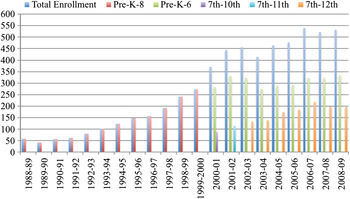
For over half a century the center of the village was the Springville general store and post office, which provided a gathering place for residents of all ages and races and was the primary site of public linguistic interaction in the community (cf. Cukor-Avila & Bailey Reference Cukor-Avila and Bailey1995a). However, in December 2004, some two years after the death of the owner, the store closed and now only the post office remains open. One other notable change that has occurred in Springville over the last decade has been the explosive growth of the Springville School and the Springville Independent School District (ISD). When the project began in 1988 Springville School served fifty-eight students in pre-K through 8th grade and was in danger of being closed by the Texas Education Agency (TEA) due to low enrollment. For the next three years the enrollment remained low, then starting with the 1992–93 school year student enrollment began to climb, and by the beginning of the 1994–95 academic year the student population had more than doubled (see Figure 1). This dramatic rise was not the result of an increase in the population of Springville, something which has changed little since World War II, but rather to an influx of transfer students, primarily from nearby urban communities who began attending the Springville School because it was considered to be safer and was ranked higher by TEA than the schools in their districts. Over the years enrollment continued to rise, and in 1997 a new school was built on the property adjacent to the original school, and in 2001 a third building opened. The new buildings provided the necessary space to add one grade per year, so that by the end of the 2002–03 school year Springville had its first class of graduating high school seniors.Footnote 6 Currently, Springville ISD is a thriving school district with over 500 students, virtually all of whom are from outside the community. The district has been rated by TEA as “Exemplary”: in 2008–09 it won a TEA Title 1 Distinguished Performance Award, and it was recognized as a Higher Performing School and District by the National Center for Educational Achievement. In 2008 Springville Elementary School was selected as a Blue Ribbon school, and that same year US News and World Report named Springville High School as one of America's Best High Schools with a bronze category recognition. Thus, in just under two decades, Springville ISD has redefined itself simply by allowing students to cross district lines to increase enrollment in an effort to “save” the school and the district and perhaps the community as well.
Student enrollment in Springville ISD 1988–2009 (source: Texas Education Agency District AEIS History Report).Footnote 7

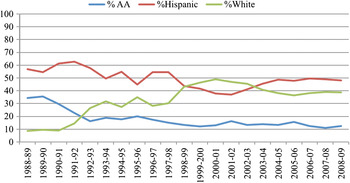
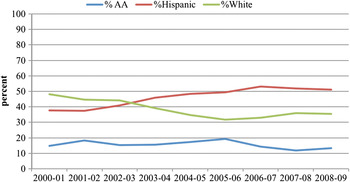
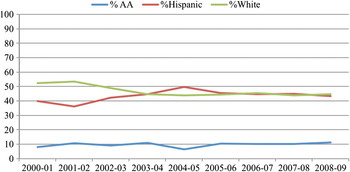
Another outcome of the growth of Springville ISD is a shift in the demographic makeup of the district. As Figure 2 shows, between the 1988–89 and the 2000–01 academic years the percentage of white students significantly increased as the percentages of both African American and Hispanic students was in decline. The following eight-year period, which coincides with the opening of Springville High School, marks a leveling off in the percentage of African American students, while the percentage of Hispanic students continued to grow and the percentage of white students slowly decreased.Footnote 8Figures 3 and 4, which present these data by grade level, reveal that it is precisely in grades 7–12, when peer networks and the “construction of a peer-based social order” (Eckert Reference Eckert2008:31) has been reported to play an important role in adolescents’ linguistic choices (Cukor-Avila & Bailey Reference Cukor-Avila, Bailey, Ahlers, Bilmes, Guenter, Kaiser and Namkung1995b, Reference Cukor-Avila, Bailey, Arnold, Blake, Davidson, Schwenter and Solomon1996; Cukor-Avila Reference Cukor-Avila2002; Eckert Reference Eckert2008), that there are four times as many Hispanic and white students than there are African Americans. The linguistic implications of the demographic make-up of Springville ISD, which is not mirrored in the community, clearly deserve further attention.
Demographic makeup of Springville ISD 1988–2009 (source: Texas Education Agency District AEIS History Report).

Demographic makeup of Springville Elementary 2000–2009 (source: Texas Education Agency District AEIS History Report).

Demographic makeup of Springville High School 2000–2009 (source: Texas Education Agency District AEIS History Report).

Previous research on be like in Springville
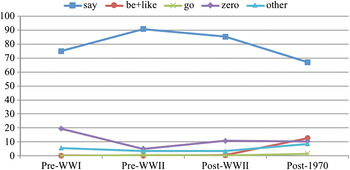
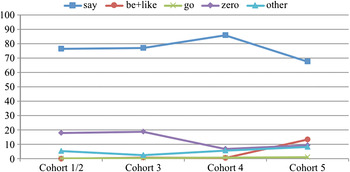
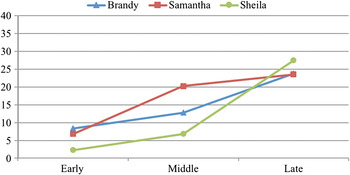
The following brief summary of the 2002 analysis provides an overview of quotative use by Springville speakers across four major time periods that earlier studies have suggested are significant for the diffusion of urban vernacular forms in the community (cf. Cukor-Avila Reference Cukor-Avila1995, Reference Cukor-Avila1999; Cukor-Avila & Bailey Reference Cukor-Avila, Bailey, Ahlers, Bilmes, Guenter, Kaiser and Namkung1995b, Reference Cukor-Avila, Bailey, Arnold, Blake, Davidson, Schwenter and Solomon1996, Reference Cukor-Avila and Bailey2007). This analysis includes 3,202 quotative tokens extracted from conversational recordings with fourteen Springville African Americans born between 1907–1982, thirteen of whom had been recorded multiple times in a variety of interview contexts between 1988–1999.Footnote 9Figure 5 (adapted from the data in table 2 in Cukor-Avila Reference Cukor-Avila2002:12) shows that by far the most commonly used quotative form for each of the speakers is say, and that be like only begins to emerge as an alternative form for speakers born after 1970. This is approximately one generation behind the diffusion of this form in non-AAVE speech communities in the US (cf. Blyth et al. Reference Blyth, Becktenwald and Wang1990; Ferrara & Bell Reference Ferrara and Bell1995; Dailey-O'Cain Reference Dailey-O'Cain2000). Moreover, the overall percentage of quotative be like use for the post-1970 generation is significantly lower than what Sánchez & Charity (Reference Sánchez and Charity1999) report for the youngest speakers in their urban AAVE data from Philadelphia (67%) and what Ferrara & Bell (Reference Ferrara and Bell1995:277) report for urban African American speakers from Texas (eight out of thirteen subjects use be like). This difference is not surprising if, as Ferrara & Bell (Reference Ferrara and Bell1995) hypothesize, be like is diffusing hierarchically from urban to rural areas in Texas. In fact, data from three Springville adolescents over three time periods between 1988–1999 suggest that quotative be like most likely diffused into Springville from neighboring urban communities. Figure 6 illustrates that their use of be like increases as these girls progress through their teens and their social networks begin to extend outside of Springville. Their increased use of be like is not surprising in light of previous analyses of the use of AAVE features, such as habitual invariant be, copula absence, verbal -s absence, and preterite had + past in the speech of these three girls, which show a strong correlation between the development of peer networks outside of Springville and the acquisition of these vernacular forms (Cukor-Avila Reference Cukor-Avila1995, Reference Cukor-Avila1999, Reference Cukor-Avila and Lanehart2001, Reference Cukor-Avila, Nagle and Sanders2003; Cukor-Avila & Bailey Reference Cukor-Avila, Bailey, Ahlers, Bilmes, Guenter, Kaiser and Namkung1995b, Reference Cukor-Avila, Bailey, Arnold, Blake, Davidson, Schwenter and Solomon1996). For Brandy this occurs during her first and second years of high school in 1996–97 and 1997–98; for Samantha this occurs when she temporarily moves to urban Attmore in 1997 and subsequently drops out of high school; and for Sheila this occurs when she drops out of school in 1993 and moves fifteen miles away to the urban town of Wilson.
Overall distribution of dialogue introducers for Springville AAVE speakers born 1907–1982 (adapted from Cukor-Avila Reference Cukor-Avila2002:12, table 2).

Recoded overall distribution of dialogue introducers for Springville AAVE speakers born 1907–1982.

Diffusion of be like in the speech of three Springville adolescents (adapted from Cukor-Avila Reference Cukor-Avila2002:14, table 3).

The 2002 analysis also suggests that the person/number and discourse constraints on the use of be like by Springville adolescents are similar to what had been documented in the 1990s for urban middle-class whites in the US, Canada, and England (Romaine & Lange Reference Romaine and Lange1991; Tagliamonte & Hudson Reference Tagliamonte, D'Arcy and Hudson1999; Dailey-O'Cain Reference Dailey-O'Cain2000): be like is more frequent in first person singular contextsFootnote 10 and it is favored before internal dialogue and nonlexicalized sounds. In fact, the longitudinal data show that as be like is incorporated into the speech of the post-1970 generation its frequency increases over time in all quotative contexts while the grammatical and discourse constraints on its use remain constant (cf. Kroch Reference Kroch1989). Because this earlier analysis focused only on constraints that had been identified in previous quotative research, however, it did not highlight some distinctive characteristics of be like and its distribution in Springville speech that may be unique to AAVE in general. The present analysis discusses these distinctive characteristics in light of the more general linguistic process of diffusion. In doing so, it explores specifically how structures from one variety adapt into the pre-existing grammatical system of another variety as these forms diffuse in the speech community.
Current study
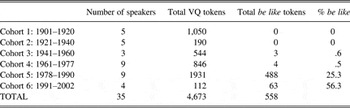
Since the 2002 study a new cohort of speakers has been added to the Springville corpus. This cohort includes children born in the mid 1990s who are now teenagers, and Brandy's two children who were born in the early 2000s. In addition, follow-up group and individual recordings made in 2006, 2009, and 2010 with speakers recorded regularly over the past twenty years have been added to widen the scope of the real-time corpus. Thus, the present study includes data from thirty-five Springville residents born between 1907–2002 divided into six cohorts, as shown in Table 1.Footnote 11 This subset of the total number of African Americans in the Springville corpus (sixty-seven) represents only those informants who use direct speech or thought introduced by a verb of quotation in their recorded conversations. Twenty-five of the thirty-five informants included in this study have been recorded multiple times in various interview contexts.
Total number of quotatives in six cohorts of Springville speakers.

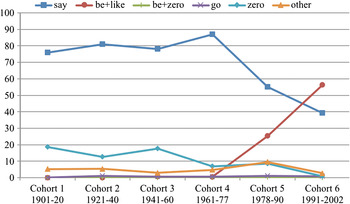
Following the methods of the 2002 study, all quotatives that introduce direct speech, inner thought, and nonlexicalized sounds or gestures were extracted from the transcribed recordings and coded by form into five types—say, be like, go, zero, and other—for a total of 4,673 quotative forms. The distribution of these quotatives across each cohort is shown in Figure 7 and examples of each are shown in (2a–e) below.
(2)
a. I tripped him when he called me. He said, “Mama what'd they say?” I say, “They wrote me out a check for fifty thousan’.” (V/61/2010)
b. An’ then he was like uh, he was like, “I'm surprised you called,” or whatever. I was like, “Why you say that?” He was like, “I don't know. I'm jus’ surprised you called,” or whatever. (B/82/2002)
c. ‘Cause you know sometimes when my mama is, like tired or somethin’ or she don't feel like bein’ bothered she'll call an’ she'll go, “What you cookin’?” (B/82/2002)
d. Tina be trippin’. She's 0, “Nuh uh don't get in my bed! Bed outside.” (S/79/2000)
e. They really, really love him an’ then they gon tell me uh, talkin’ about uh, “We ain't foolin’ with that one.” Talkin’ about, “This our baby right here.” (B/82/2002)
Distribution of quotatives over six cohorts of Springville speakers (totals include say, be like, go, zero, and other).

Figure 7 is remarkably similar to figure 2 in Tagliamonte & D'Arcy (Reference Tagliamonte and D'Arcy2007:205), revealing that the explosive increase in the use of be like coupled with the steady decline in the use of say is occurring in Springville AAVE just like it has occurred in Canadian English and in other varieties of English. The main difference, however, is that Springville AAVE speakers are approximately a decade behind the Canadian English speakers in the wholesale adoption of be like as their primary quotative form. Tagliamonte & D'Arcy (Reference Tagliamonte and D'Arcy2007) suggest that be like replaced say in Canadian English around the early 1980s, when the thirty-year-olds in their study (roughly the same age cohort as Cohort 4 in Springville) were teenagers. As Fig. 7 shows, the cross-over, where be like begins to replace say, does not occur in Springville until the Cohort 5 speakers are in their teens, around the mid 1990s.
On the surface, then, the diffusion of quotative be like in Springville appears to mimic its diffusion in other varieties of English: be like is rapidly replacing say as the number one quotative for young Springville AAVE speakers, and data from 2002 confirm that the person/number and discourse constraints are similar to what has been found in other varieties of English.Footnote 12 What has not been previously analyzed, however, and is not apparent from a frequency count or constraint analysis of be like, is the form of be in be like as this quotative has diffused in Springville AAVE. If be in these constructions adapts to the semantic and structural norms of AAVE then we would expect to find examples of both invariant be and zero in be like quotatives.
The present tense be paradigm is one of the most studied features of AAVE, in particular the use of invariant be + V-ing in contemporary AAVE to refer to present habitual actions, as in (3a), and the person/number and grammatical context of zero copula, as in (3b) and (3c) (cf. Labov Reference Labov1972; Bailey & Maynor Reference Bailey and Maynor1987, Reference Bailey and Maynor1989; Wolfram & Thomas Reference Wolfram and Thomas2002).
(3)
a. Sometime I be hearin’ that bus during 8th period. I know I be hearin’ that bus during 8th period on Mondays an’ Tuesdays. (K/96/2010)
b. ∅ You full Tina? Tina ∅ full, look. Watch. Look Keisha. See she ∅ quiet now. Quiet. She ∅ ready to talk now. She done got full. (V/61/1997)
c. Well you ain't too pretty. You ∅ annoyin’ me. I hate to see what your baby ∅ gonna look like. (S/79/2000)
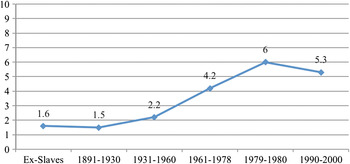
Research on invariant be in Springville shows that the frequency of this form began to increase in the speech of residents born in the 1930s (see Figure 8), and that the increase in frequency was accompanied by both semantic and syntactic restrictions on its occurrence. As invariant be has grammaticalized in Springville it has become primarily a marker of habituality before V-ing for speakers born after 1945, just as it has in other varieties of AAVE (Cukor-Avila & Bailey Reference Cukor-Avila, Bailey, Ahlers, Bilmes, Guenter, Kaiser and Namkung1995b; Cukor-Avila Reference Cukor-Avila and Lanehart2001). The use of zero copula in Springville also parallels what has been found in other AAVE-speaking communities (Labov Reference Labov1972; Rickford, Ball, Blake, Jackson, & Martin Reference Rickford, Ball, Blake, Jackson and Martin1991; Wolfram & Thomas Reference Wolfram and Thomas2002): zero typically occurs with plural and 2nd and 3rd singular pronoun subjects, is favored before verb-like predicates, and is disfavored before noun-like predicates, with locatives and adjectives somewhere in-between (Cukor-Avila Reference Cukor-Avila1999).
The expansion of invariant be in Springville (invariant be as a percentage of all forms of the present tense of be).

In order to investigate the structural adaptation of be in be like quotatives, all examples of be like (N = 558) were separated from the database of 4,673 quotatives and subsequently coded for form of be (am, is, are, zero, be), and for aspect (habitual/nonhabitual). Additionally, all be like tokens were also coded for tense, temporal reference, and discourse context (narrative/nonnarrative). The results for each of these analyses are discussed in the following section.
Results
One of the most striking differences between the data from Springville and the data reported in previous studies is in the tense of be like tokens. As noted above, previous studies on quotative use in American English have suggested that be like typically occurs with nonpast surface morphology, either with present temporal reference, as in (4a), or with past temporal reference as a historical present, as in (4b).
(4)
a. An’ like, you can get fired for that. Because they're like, you know, “This is a professional workplace.” (B/82/2009)
b. Boy it was some big ol’ pretty hamburgers. I started bitin’ in about that far – an’ they had put ‘em on the grill. I'm like, “Give me some of ‘em.” (L/81/1997)
c. An’ I was like, ‘cause he seen it on his paper an’ he was like, “Who spelled my name like this?” An’ I said, “I did.” He say, “Look it how you spelled my name.” An’ then he wrote it down for me an’ I was like, I was like, “Well with that kin'a name you don't know which way to spell it.” (S/79/1998)
These studies also suggest that the use of past tense be like, as in (4c), is much less frequent; in fact, Tagliamonte & D'Arcy (Reference Tagliamonte and D'Arcy2007:206, table 2) show that be like used with past temporal reference is disfavored for all age groups in their study of Canadian English speakers.
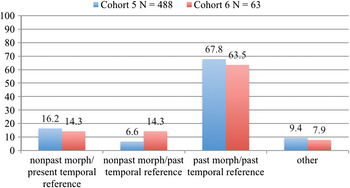
The situation in Springville, however, is quite different. As Figure 9 shows, for speakers in Cohorts 5 and 6 be like occurs primarily as a past tense form, morphologically and temporally marked for past approximately two-thirds of the time in both generations.Footnote 13 More importantly, its use in the past has remained stable from the time when be like first emerged in the speech of young teenagers in the early 1990s.
Morphology and temporal reference of be like in Cohorts 5 and 6 (“other” includes future and ambiguous forms).

The passages below illustrate how Springville teens and young adults most often recreate dialogue and inner thought in their narratives.
(5) We made some hamburgers [laughs] an’ we just a-playin’ aroun’. We was makin’ some hamburgers. She was like, “What do yall wanna eat?” Tina was like, “I don't know.” An’ Tina was like, “Wanna make some HAMBURGERS.” An’ like we was, you know, messin’ with the um, meat an’ puttin’ it together an’ Tina's patty came apart. An’ Sheryl was like, “That's your patty!” Our patty was jus’ so perfect. We made some little bitty ones. But we had fun, we had a lotta fun. (K/96/2009)
(6) Uh, it is – hmmm, I went – me an’ Misty went. She was goin’ to get a purse that she had seen it on sale. An’ when she, when we got there the purse was gone. She was very upset. She was like, “I came all the way out here to get this purse an’ it's not here.” I was like, “Well they got a lotta purses on sale. You don't see another one you might want?” She was like, “No I wanted that one!” I was like, “Oh God!” (B/82/2010)
(7) Yeah but they didn't admit me. They was jus’ like, “He really pushed her button didn't he?” I was like, “Yeah.” [laughs] I was like, “Yeah I tried to kill him.” An’ they say, he was like, “You don't remember?” I was like, “No.” He was like, “You blacked out.” I was like, “Yeah that's what they say. (S/79/2009)
The data in Fig. 9 seem to suggest that the use of simple present has declined between Cohorts 5 and 6 and that the use of HP (nonpast morphology with past temporal reference) has increased. While this appears to parallel the findings in Tagliamonte & D'Arcy (Reference Tagliamonte and D'Arcy2007), the relatively small number of present tense be like tokens for the youngest cohort makes it difficult to reach definitive conclusions: the 14.3% nonpast morphology/past temporal reference among Cohort 6 in Fig. 9 above represents only nine total tokens. When be like quotatives do occur in the historical present they typically co-occur with either past tense be like or other past tense quotatives (cf. Tagliamonte & Poplack Reference Tagliamonte, D'Arcy, Hudson and Poplack1988), as in the short narrative examples in (8) and (9) below. In fact, since HP is a relatively rare construction in narrative discourse in Springville AAVE (Labov, Cohen, Robbins, & Lewis Reference Labov, Cohen, Robbins and Lewis1968:138; Cukor-Avila Reference Cukor-Avila1990; Myhill Reference Myhill1995), its infrequency with quotatives simply mirrors its infrequency elsewhere.
(8) So I was over there, you know. We was um, I think we were either, I think we were about to get ready to go to class. An’ she outside beggin’ me for money while her husban’ in the house beggin’ my niece for money. She was like, “Oh I need some weed.” I'm like, “Ehhh? If that's one of your habits you need to support your own habit.” So she was like, “You don't have any money?” I said, “Samantha I got five dollars an’ that is for my gas money.” So she was like um, “I got a ten dollars Macy card. I'll give it to you for street value four dollars.” I said, “Do Macy's have a gas pump? Didn't I jus’ tell you that my five dollars was for gas? Ima need for you not to as’ me for my little five dollars ‘cause I'm broke jus’ like you broke, you know.” (B/82/2009)
(9) An’ like it was scary ‘cause this one girl, her friend name Cheyenne, an’ she, she was like about ten when we were like friends with her. She was like eleven or twelve. An’ then we were like, “We gotta drive.” An’ she can't drive. So we were like on this big ol’ ramp an’ she's all swervin’. I'm like, “Oh my God she's about to kill us.” An’ we were like swervin’ everywhere. An’ I was like, “OK we should go back down now.” (T/95/2010)
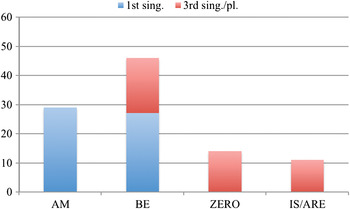
Almost as remarkable as the tense differences between the Springville data and other corpora are the present tense forms of be that occur in be like quotatives. The data show that Springville speakers have adapted be like into their pre-existing AAVE grammatical system, and as a result, they use the full range of AAVE copula forms (am, is, are, zero, be) for this feature. The distribution of be forms across the paradigm reflects what has been reported in earlier studies of present tense be in the community in many ways (cf. Cukor-Avila Reference Cukor-Avila1995, Reference Cukor-Avila1999). However, as Figure 10 shows, zero, as in (10), occurs less often in quotative than in nonquotative constructions, and invariant be, as in (11), occurs much more frequently. Nevertheless, together these forms account for 60% of present tense forms in be like quotatives.
(10) You know Samantha got a little boy friend. She like, “I don’ want you talkin’ to the boy.” (S/79/1996)
(11) You know why they do Keisha like that? ‘Cause when they come to the house, she don't let ‘em go no more. She, she bosses him aroun’, she be like, “Don't go in my room.” Or, “Get outta my mama room!” (B/82/2002)
Figure 10.Distribution of forms of present tense be in be like quotatives for Cohorts 5 and 6 (N = 100).


The relatively small number of zero and of present tense tokens in general (N = 100) is a reflection of the fact that, as outlined in the previous section, be like is predominantly used in the past tense in Springville (see Fig. 9 above), and the relatively small number of is, are, and zero tokens (N = 25) is a reflection of the fact that present tense be like quotatives occur most often in 1st person contexts (cf. Cukor-Avila Reference Cukor-Avila2002). Of the eleven occurrences of is and are, six are it's, a strongly disfavoring environment for zero (cf. Blake Reference Blake1997), and although the number of zero tokens is small, Fig. 10 illustrates that zero comprises more than half of the noninvariant be tokens in plural and 3rd singular.
Somewhat surprisingly, Fig. 10 shows that invariant be comprises almost 50% of the present tense be like quotatives. The explanation for this lies with the fact that 60% of the present tense be like quotatives occur in habitual contexts, the favoring context for invariant be in AAVE. When be like first diffused into Springville, young AAVE speakers adapted it into the AAVE tense/aspect system by (among other things) encoding invariant be as the predominant form to mark present habitual be like quotatives, as in examples (12a) and (12b).
(12)
a. He's O.K. You be tryin’ to talk an’ he interrupt you. 0 “I'm talkin’ right now.” An’ I be like, “I wanna talk.” (R/78/1997)
b. ‘Cause when things go to, goin’ wrong you know, Rolanda she, she call me an’ talk to me. Like we talk more than me an’ Sheila talk about more personal stuff. So she'll call me every time when somein’ goin’ wrong. She jus’ be like, “Look out.” She be like, “Man I cannot deal with Red too much longer” you know. (B/82/2010)
c. They motto, they motto is “if you wanna come to church an’ you ain't got no good clothes girl come as you are, come. If you got some ratty clothes on baby, got some little short shorts, come in.” Because when you tell them kids that they gotta wear some specific things you jus’ pushin’ ‘em away from the church. Exactly what you're doin’. Because man Sunday mornin’ be borin’ an’ then I go at New Birth, I'm like, “Hey!” Like yeah. It be jammin’. (L/81/1997)
d. An’ this one—they be lookin’ so much alike to me. I get ‘em confused all the time. I be like, “Thomas an’ Nathan.” He like, “I ain’ no Thomas.” (B/82/1999)
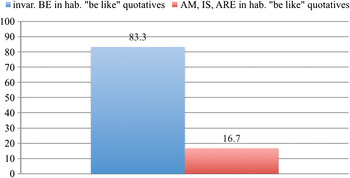
While forms of am, is, are, and zero do occur in habitual be like quotatives, as in (12c) and (12d), they only comprise less than 20% of the total habitual be like forms, as Figure 11 shows.
Distribution of present tense be forms used in habitual be like quotatives in the speech of Cohorts 5 and 6.

At the time that quotative be like first appeared in the mid 1990s, it comprised approximately 25% of the quotatives for speakers in Cohort 5. Say was still by far the predominant quotative form for them as well as for speakers born earlier. And although there was variable marking for tense, as in (13a), say was virtually never marked for aspect, even in habitual contexts, as in (13b).
(13)
a. Girl but at firs’ he tickled me with that cash register. He thought he was gonna punch somethin’ an’ mess it up. I said, “Mr. Stan, you ain’ gotta worry about this.” I say, “If it's somethin’ you punch an’ you ain’ suppose to it gonna, it's gonna let you know ‘cause it gonna bing at you.” I say, “Gee, you ain’ gotta worry ‘bout this.” An’ then I showed him how to use it. He started usin’ it. He said, “Oh it tells you how much change!” I said, “Yeah.” I said, “You don’ even have to work no more, see!” (V/61/1991)
b. That girl bad. Ohhh she bad. She, she always wanna get the recorder instead of like talkin’ but it some parts on that tape [makes noise]. She jus’ [unintelligible]. She be tryin’ to take the recorder. I say, “Misty, get back! You can’ get this.” She is so bad. (B/82/1996)
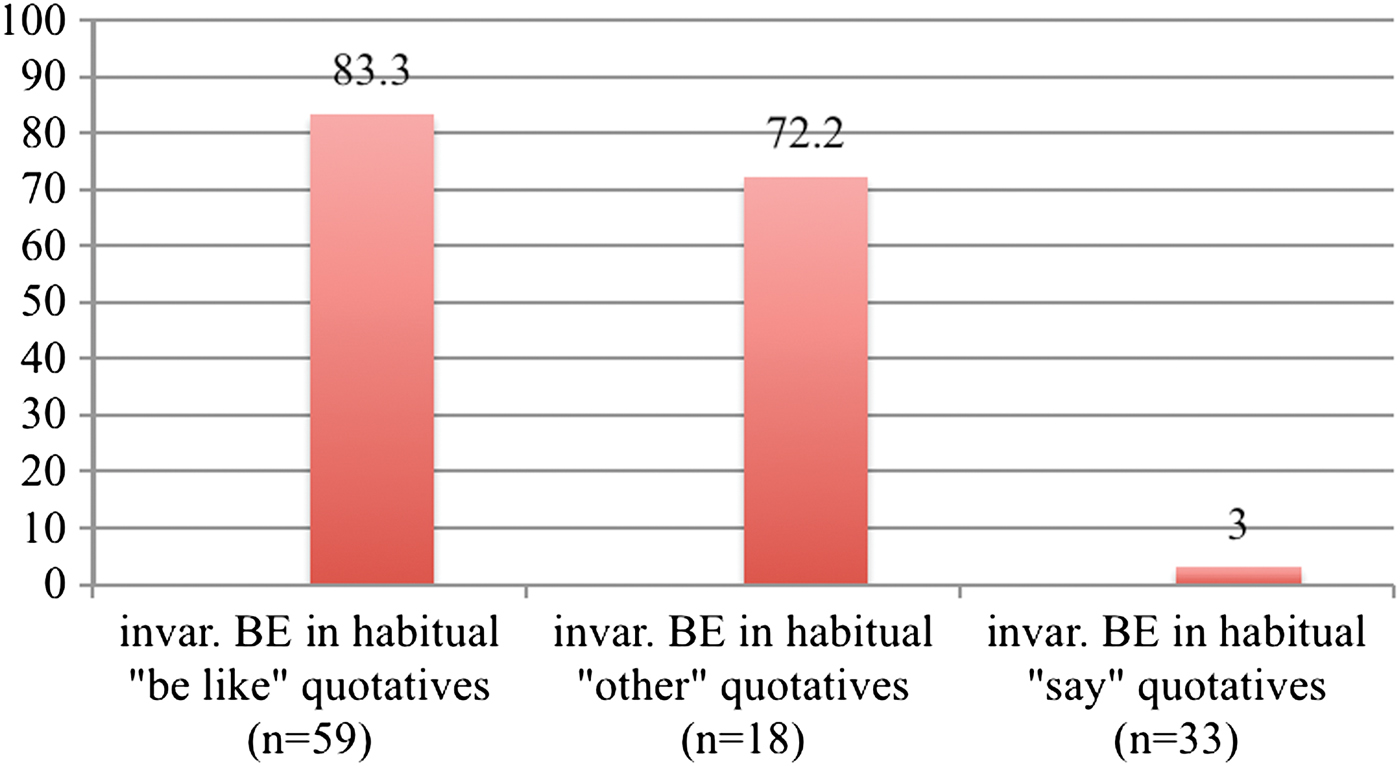
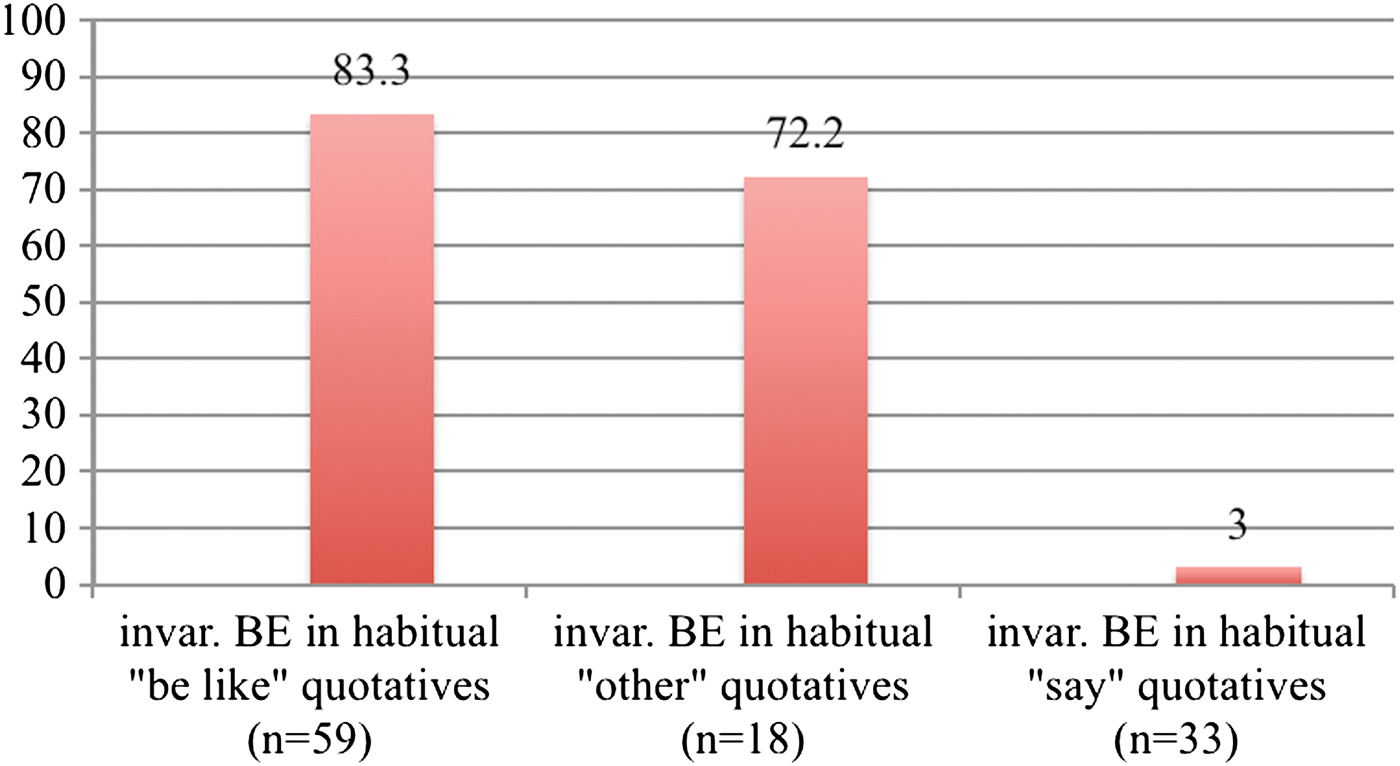
After 1995, as be like began to increase dramatically, invariant be became the primary form of be used to express habituality in be like quotatives, and it subsequently spread to non-be like quotatives except for say. Examples (14a) and (14b) illustrate the use of habitual be in non-be like quotatives.
(14)
a. I'm nervous. Every time I be sittin’ up there I jus’ be thinkin’, “Don’ be nervous.” I look up an’ see all those people out there I jus’ get nervous. (S/82/1996)
b. She be tryin’ to tell ‘em uh, “Yall get out of my room.” Or, “That's my mama's. An’ that's my mama room. Get outta there.” An’ I be lookin’ at her an’ tellin’ her, “Who do you think you is? You ain’ runnin’ enough over here.” (B/82/2002)
With say, however, habituality is still rarely marked, as shown in Figure 12 below. It seems clear that the use of habitual invariant be in be like and other quotatives was triggered by the diffusion of be like into the community, since examples of each occur simultaneously over a fifteen year period in the data. Moreover, there are no examples of invariant be used with non-be like quotatives before 1995, a date that coincides with the emergence of be like in Springville.
Invariant be as a percentage of be in habitual quotatives.
As be like has diffused into Springville it has developed the formal characteristics of the AAVE present tense of be, and in doing so, it has helped create a quotative system that is quite different from other varieties described in the literature and from the previous quotative system described for Springville (Cukor-Avila Reference Cukor-Avila2002). Thus the use of the full range of AAVE present tense copula forms, the encoding of habituality with invariant be, and the predominance of be like in the past tense together create a be like quotative system that conforms to the more general norms of AAVE rather than to the norms of the vernacular from which be like diffused.
Discussion and implications
The spread of be like into Springville represents a clear example of linguistic diffusion, with a well-known feature that developed earlier in the surrounding urban areas, most likely first among adolescent whites, then subsequently spreading into both urban and rural AAVE speech communities. Labov argues that diffusion rarely leads to structural change because adults are slower at learning new structures than children, and when adults are exposed to new structures in language-contact situations they typically “do not faithfully reproduce the structural patterns of the system they are borrowing from” (2007:383). But what if the language contact situation that leads to diffusion is not between adults, but rather between children and adolescents? The diffusion of be like in Springville provides us with such a setting.Footnote 14
Social context for diffusion
The tremendous growth of the Springville ISD since 2000 accompanied by demographic shifts in the student population have created language contact situations in Springville for young residents that only existed for earlier generations when they left the community either to visit friends or relatives, attend high school, work, or move away to the city (cf. Ash & Myhill Reference Ash, Myhill and Sankoff1986). Prior to this time, all of the students who attended Springville School lived in the community, and since there were no organized extracurricular activities like competitive sports, cheerleading, or clubs where they could interact with students from other schools, school did not play an important role in their social lives, and as such, their social networks were limited.
In contrast, Cohort 6 speakers are the first group of Springville residents to have grown up interacting regularly with peers from neighboring urban communities, most of whom are not African American, both during school, when they hang out with each other at lunch, and in extracurricular activities and clubs. They typically participate together in sports and cheerleading, and often see each other outside of school at parties or sleepovers. Thus, the dense multiplex social networks characteristic of Springville residents born prior to the 1990s are becoming a thing of the past. As more and more “outsiders” attend school in Springville ISD, young Springville speakers’ social networks will continue to become less dense and more uniplex (Milroy Reference Milroy1987) as their communities of practice develop around school-based relationships with people who neither live nor have family ties in Springville. The following excerpts from a conversation I had in April 2010 with Brandy (b. 1982) about her fifteen-year-old niece Tina (b. 1995) illustrate this point.

The Springville School, then, provides a relatively comprehensive social environment (Eckert & McConnell-Ginet Reference Eckert, McConnell-Ginet, Hall and Bucholt1995:472) where children and adolescents from Springville and the surrounding communities construct their individual and social identities. Research in sociolinguistics suggests that language plays a primary role in this process (cf. Tabouret-Keller Reference Tabouret-Keller and Coulmas1997). Given this social situation, it is not surprising that Cohort 6 Springville speakers have been caught up in the be like tidal wave that has swept across the English-speaking world.
Linguistic context for diffusion
The diffusion of be like into Springville in the early to mid 1990s coincided with significant structural changes in the tense and aspect systems of Cohort 5 Springville speakers, as this is the period when innovative AAVE features such as preterite had + past and habitual be + V-ing, that first emerged in urban areas, developed in their speech (Cukor-Avila & Bailey Reference Cukor-Avila, Bailey, Arnold, Blake, Davidson, Schwenter and Solomon1996, Reference Cukor-Avila and Bailey2007). As speakers were sorting out form/function relationships in the present tense copula system (cf. Bailey & Maynor Reference Bailey and Maynor1987; Cukor-Avila Reference Cukor-Avila1999) and ambiguities in past tense marking (Cukor-Avila & Bailey Reference Cukor-Avila, Bailey, Ahlers, Bilmes, Guenter, Kaiser and Namkung1995b), they were exposed to an innovation in the quotative system, crucially one that could easily adapt to their newly reconfigured grammar. Up until this time, the quotative system of Springville speakers of all ages was remarkably similar, with say as the primary verb used to introduce both speech and inner thought followed in frequency by zero, which was occasionally used (more often by speakers born before WWII) when quoting constructed dialogue. The adoption of be like by speakers in Cohort 5 caused a shift from a “say quotative system” to a “be like quotative system,” similar to what has been documented in other quotative studies. Yet unlike its diffusion in other communities, be like did not diffuse structurally intact in Springville—its form changed as it adapted into the existing AAVE copula paradigm. The result is a quotative system in Springville that is more structurally complex and less ambiguous than the earlier system was since say, which is typically unmarked for tense and aspect in AAVE, is rapidly being replaced with be like, a form that marks tense and aspect as do other AAVE copula forms. As is shown above, not only does be in be like quotatives have the same range of forms found in the AAVE present tense copula system (am, is are, zero, and be), but also the distribution of these forms parallels their distribution in nonquotative contexts. In addition, as Fig. 12 shows, the use of habitual invariant be has spread to non-be like quotatives, providing further evidence for the adaptation of be like into the existing copula system in Springville.
Diffusion, adaptation, and structural change
The 2002 study proposed that be like diffused in Springville sometime in the mid 1990s, approximately a decade after its appearance was documented in other speech communities in North America (cf. Tagliamonte & D'Arcy Reference Tagliamonte and D'Arcy2007). Since the grammatical and discourse constraints on the use of be like documented for Springville speakers at that time paralleled the constraints found in other English varieties, the diffusion of be like appeared to be an example of “weak transfer or replication” (Meyerhoff Reference Meyerhoff2009:3034). The added data from the present study, however, suggest a revised interpretation. These data show that be like did not diffuse intact, but rather as Springville speakers began to replace say with be like as the primary quotative form, they simultaneously adapted it to the structural norms of AAVE that were already operative in the speech of younger generations in the community. This structural adaptation echoes the findings in D'Arcy (Reference D'Arcy2010: 63) on the diffusion of be like in New Zealand English for Maori and Pakeha speakers in that “be like does not impose itself on an existent system but rather is integrated into it in ways which cohere with the system's prevailing, and pre-existing, overall configuration.” However, there is a crucial distinction between the adaptation of be like in the grammar of Springville speakers and its adaptation in New Zealand English. In Maori and Pakeha English it is the frequency and distribution of be like that differs,Footnote 16 whereas in Springville it is the form of be like that changes when it diffuses in the community. As the form is adapted, it has structural consequences for the Springville quotative system, as the data in this study suggest.
Labov has argued that diffusion does not lead to structural change in the grammar of the host language. As discussed above, this argument is based on contact situations between adult speakers with shared sociolinguistic norms. The diffusion of be like quotatives in Springville, however, presents an alternative account. The analysis of tense and form of be in be like for young Springville speakers suggests that when linguistic features diffuse between vernaculars that are structurally different, grammatical constraints in the host variety may trump the existing constraints on those features in the source vernacular. As these data show, the diffusion and structural adaptation of be like in Springville AAVE has transformed the existing “say quotative system” into one that is more structurally complex and less ambiguous. Thus, diffusion may lead to structural consequences for the grammatical system of a host language as new features adapt into its grammar.